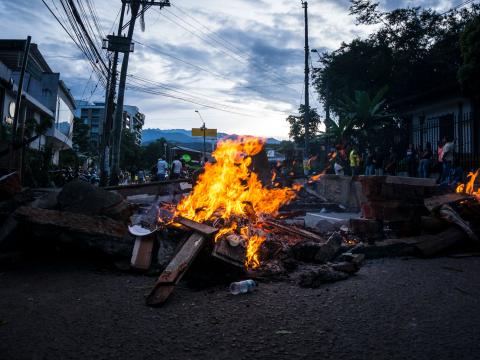
Venezuela: the killing of Sabino Romero
The official statement of the El Libertario collective following the murder of Sabino Romero, Yukpa indigenous rights activist, in Zulia, Venezuela last night.
During the night of March 3, 2013 Yukpa Cacique Sabino Romero, well known for his defense of the rights of the Yukpa people, was assassinated on Chaktapa Highway, in the Sierra de Perijá (Zulia State).
'Romantic visions of pure indigenous communities - barriers to a radical ecology' - Russ Hiedalman
Russ Hiedalman takes a look at the problems of how indegenous politics are incorporated into radical environmentalism. Originally published in September 2009.
Everyone from the Conservatives to Labour, the BNP and the Green Party claim to have the most rational solutions for reducing CO2 emissions in the next 10 years (or however many it is until the end of the world). Considering these dire options this article looks at some of the barriers to a radical ecology that would place social and environmental justice at the top of the agenda.
Thanksgiving and telling the full history
When we attempt to tell a history from the bottom up of Thanksgiving, we need to remember to tell the whole thing.
As a revolutionary who lives in New England and was born and raised in Massachusetts, I feel a particular obligation to help propagate a counter-narrative to the hegemonic one about Thanksgiving.
Primitivism and history - Miguel Amorós
An index of key quotations from the utopian and philosophical predecessors of today's primitivism, from Diogenes to Battaille, via the bagaudae, the Diggers, Bakunin and Morris, featuring passages from Henri Zisly’s Voyage to the Beautiful Country of Naturia (1900) and Pierre Quirole’s The American Anarchist City (1914), with commentary by the author, who concludes that “[t]he hunter-gatherer of the primitivists is nothing but an idealized reflection of the atomized and déclassé individual of mass society produced by late capitalism” and that only social revolution (“the highest form of potlatch”) can make “the reconciliation of man and the world” possible.
Primitivism and History – Miguel Amorós
1. The Sect of the Dog
Are free individuals the necessary prerequisites for a successful struggle for freedom? - Anselm Jappe
In this text written in late 2011, Anselm Jappe criticizes the popular slogan “We are the 99%” in the context of a discussion of the “anthropological regression” induced by capitalism that has attenuated humanity’s capacity and desire for freedom, emphasizes the continuing relevance of the core concepts of value analysis for the understanding of the current capitalist crisis, and maintains that the present task of revolutionaries “… confronted by the disasters caused by the permanent revolutions unleashed by capital … is to ‘preserve’ some of the essential acquisitions of humanity and to attempt to cultivate them so that they assume a higher form”.
Are Free Individuals the Necessary Prerequisites for a Successful Struggle for Freedom? – Anselm Jappe
Belo Monte dam protest
The latest protest against the Amazonian Belo Monte Dam project took place in Washington last Monday (9th of April). This demonstration against the Brazilian government's anti-social and anti-environmental policies took place on the same day that Brazil's president and former revolutionary guerilla Dilma Roussef met Barack Obama. Despite international and indigenous outcry, construction of the world's third largest damn is already under way. With five thousand men at work, nothing seems to stop the government's determination to build this dam.
Brazil is rapidly becoming a strong emerging economy at the global level. Industrial development and and increase in the standard of living has meant that demand for energy is at an all time high, hence the government's keenness to construct a network of dams in the Amazonia.
A people's history of the American revolution - Howard Zinn
Howard Zinn's critical history of the American Revolution against British rule and its impact on ordinary people.
Columbus, the Indians and the 'discovery' of America
Howard Zinn on the "discovery" of America, the treatment of the native population and how it was justified as "progress".
They ...
The Day the Raids Came: stories of survival and resistance to the state terror raids in New Zealand
On October 15th, 2007 an estimated 300 police raided houses all over Aotearoa New Zealand and arrested people based on warrants issued under the Terrorism Suppression Act. Lives were turned upside down as the police searched for evidence of ‘terrorism.’ This book is a collection of oral history interviews of people affected by those raids and the aftermath: defendants, friends, family, supporters and other people subject to the state’s coercive powers on that day.
The case is the first ever attempted use of the Terrorism Suppression Act, a piece of legislation enacted in response to the 9/11 events in New York and Washington DC. The terrorism charges were not brought, but the people arrested continue to face a long journey to freedom as the state seeks to punish political activists and to reinforce the status quo.
Ecuador: the President who cried "¡Golpe!”
Last Thursday, the world was briefly enthralled by events in Quito, Ecuador, where left-leaning President Rafael Correa called his followers out onto the streets via a hospital telephone, claiming that a police and military coup d’etat was in motion against his regime. However, upon closer examination, a different picture - one of popular anger with austerity measures and mass reduncancy - emerges...
News channels and radio stations on Thursday night dramatically reported a siege - apparently maintained by a number of insubordinate policemen - of the Quito hospital where Correa was being treated for injuries caused by a tear gas canister thrown at him while he addressed protesting policemen in their barracks.


Can comment on articles and discussions