An introducton to the prison revolts in France, May 1985.

We have a lot of friends in the nick, and we ourselves could end up there.. That is, we have felt the current wave of revolt, which began on Sunday May 5th with the mutiny of part of Fleury-Merogis Prison, coming for a long time.
The detainees were no longer able to bear the disgusting crap which the screws indulge in more and more overtly. Two precise incidents, in all probability, have been over the top:
— in March, the killing of Bruno Sulak by some screws, after a failed escape. The liars who speak on the telly and write in the press presented it as an accident, even though the screws at Fleury boasted about having bum-ped him off.
— at the begining of April, a screw received a few blows in a prison in Lyons, during an escape attempt. His colleagues responded by launching a strike. A few days later, also in Lyons, some prisoners reacted to their arrogance by hitting a couple of these scum. A national strike of all the screws followed, putting a stop to exercise periods, visiting time and the release of prisoners due for release or parole, which aggravated the already unbearable prison conditions (intensification of daily interferences and irritations, habitual beatings)
Those who speak to us of over-crowding in the prisons are the same ones who fill them up to breaking-point! And obviously they turn things upside down. For us, it's not a question of constructing new prisons, but of emptying those which already exist
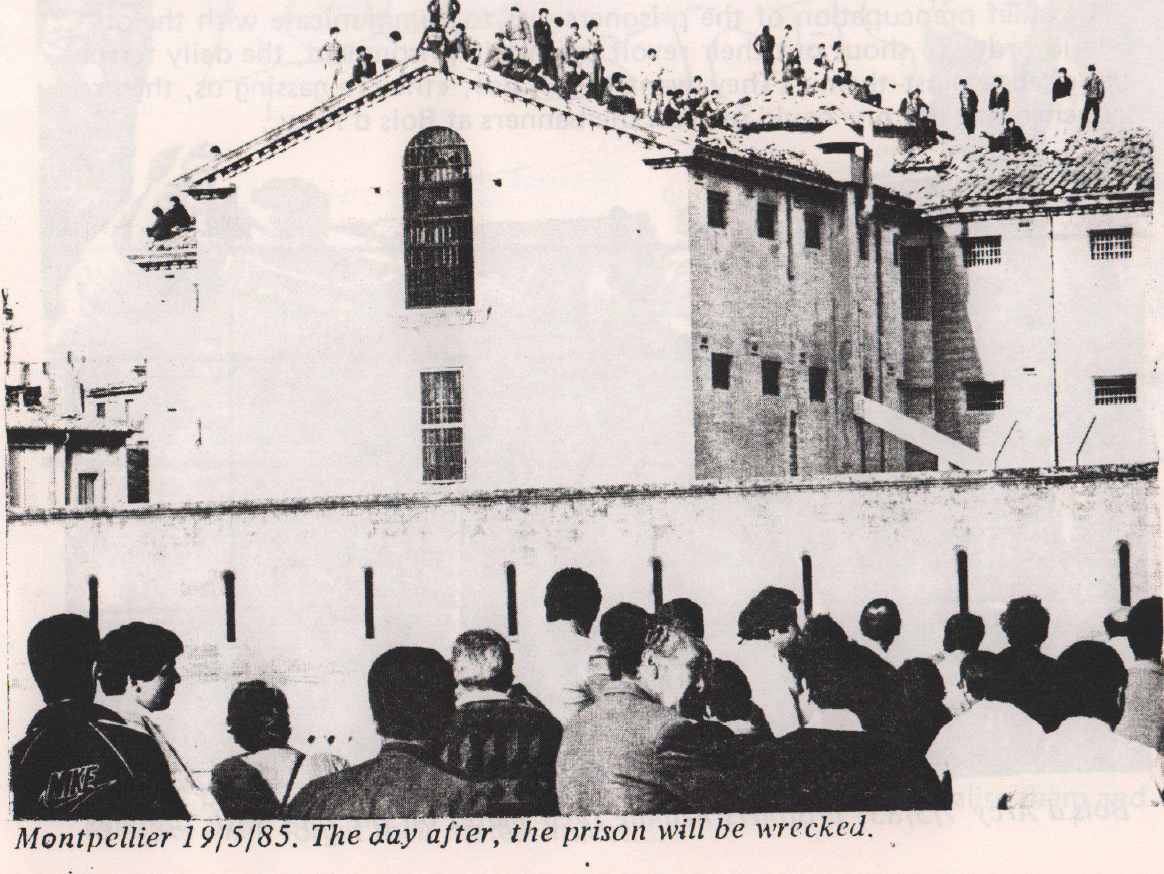
The demands of the rebellious prisoners are clear: Freedom! They don't negotiate this with the prison administration, but they begin to take it: climbing onto the rooftops, that's freedom snatched from the state. "We are taking a breath of fresh air" they say; for the space of a few hours they chat together sheltered from the ears of snoopers, speak down below the walls to their mates outside, insult the pigs who repress them, chuck slates at them, and finally make people talk about them. That's what real "Parloirs Libres"(1) about!
The prison administration and the media attributed the revolt at Fleury Merogis to a handful of political militants (notably to Action Directe). These militants, preoccupied by their fame alone, have always participated in this lie by not denying such attributes. All these liars had already played the same trick during the hunger strike which began developing at Fleury, at the end of 84. But we'll leave the militants to their dead verbiage.....
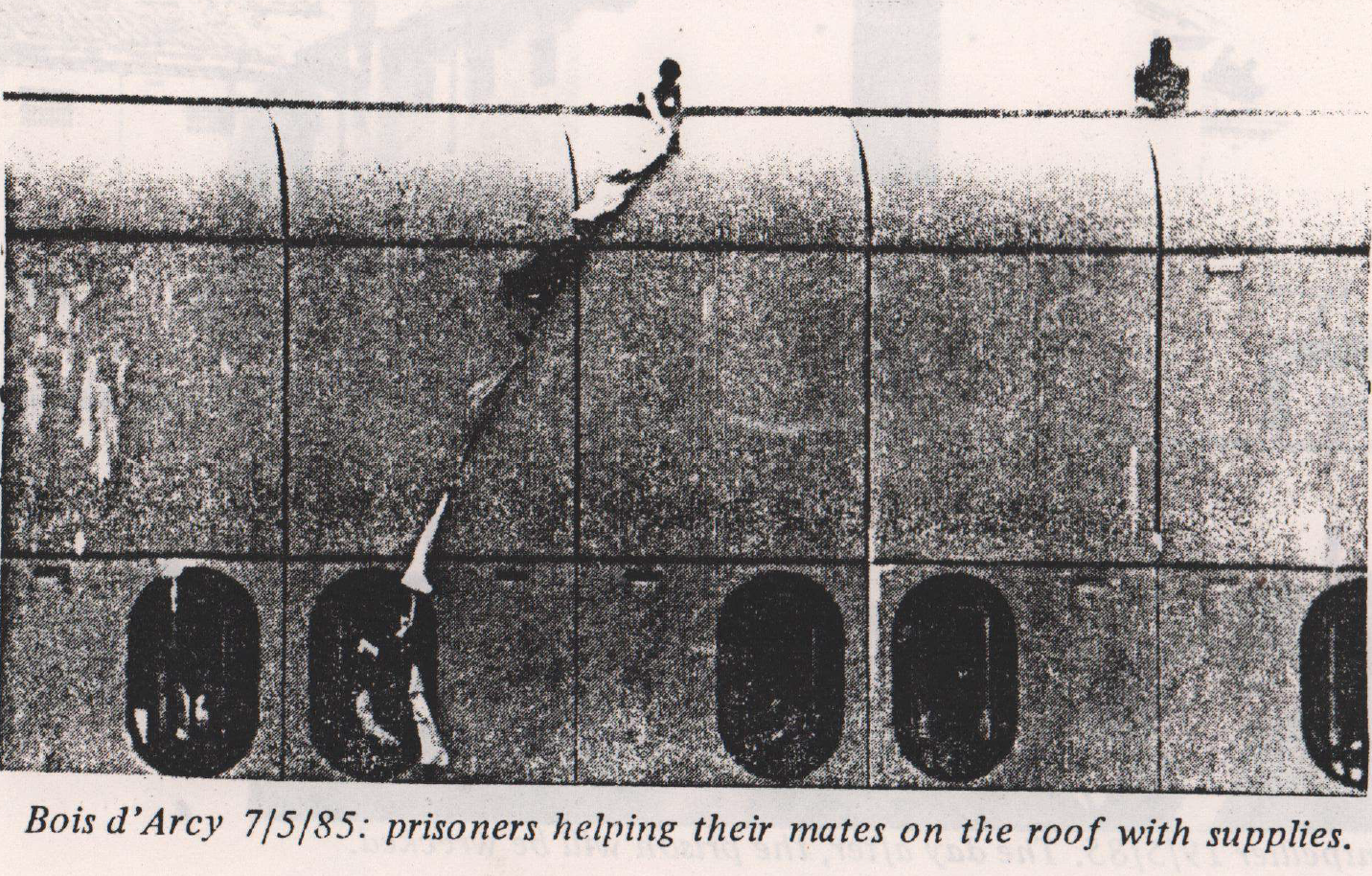
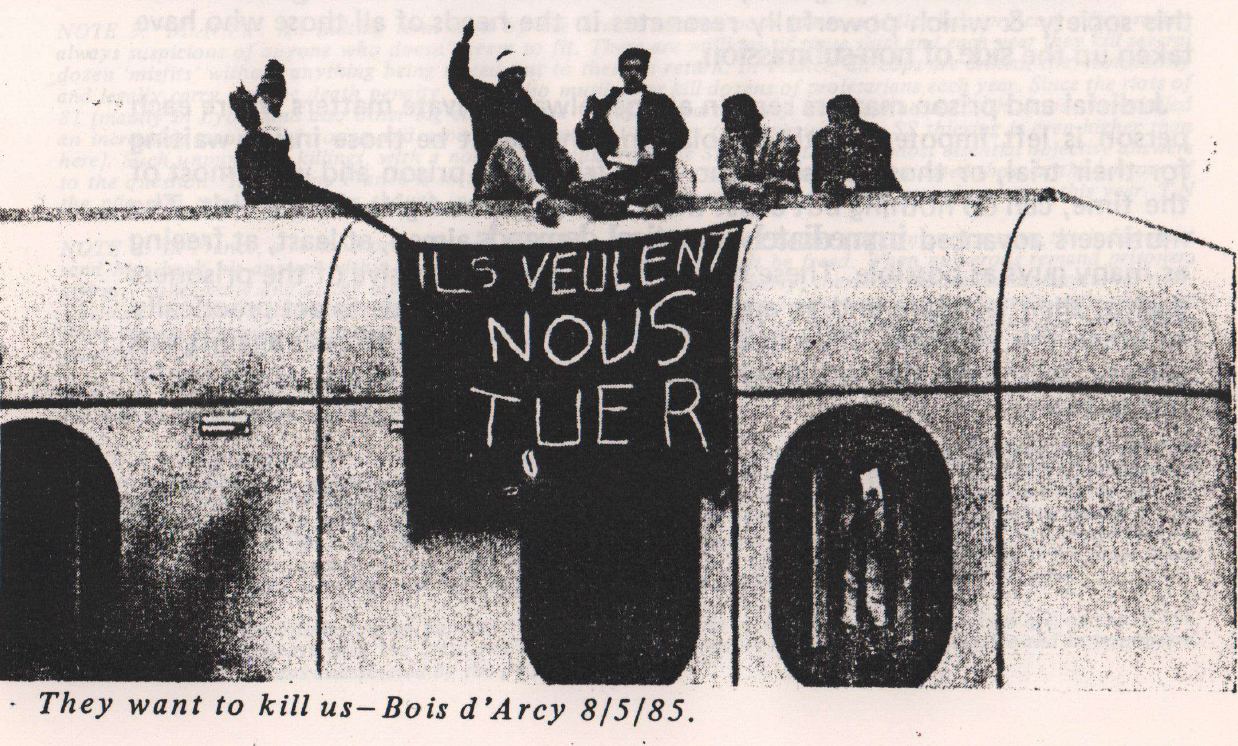
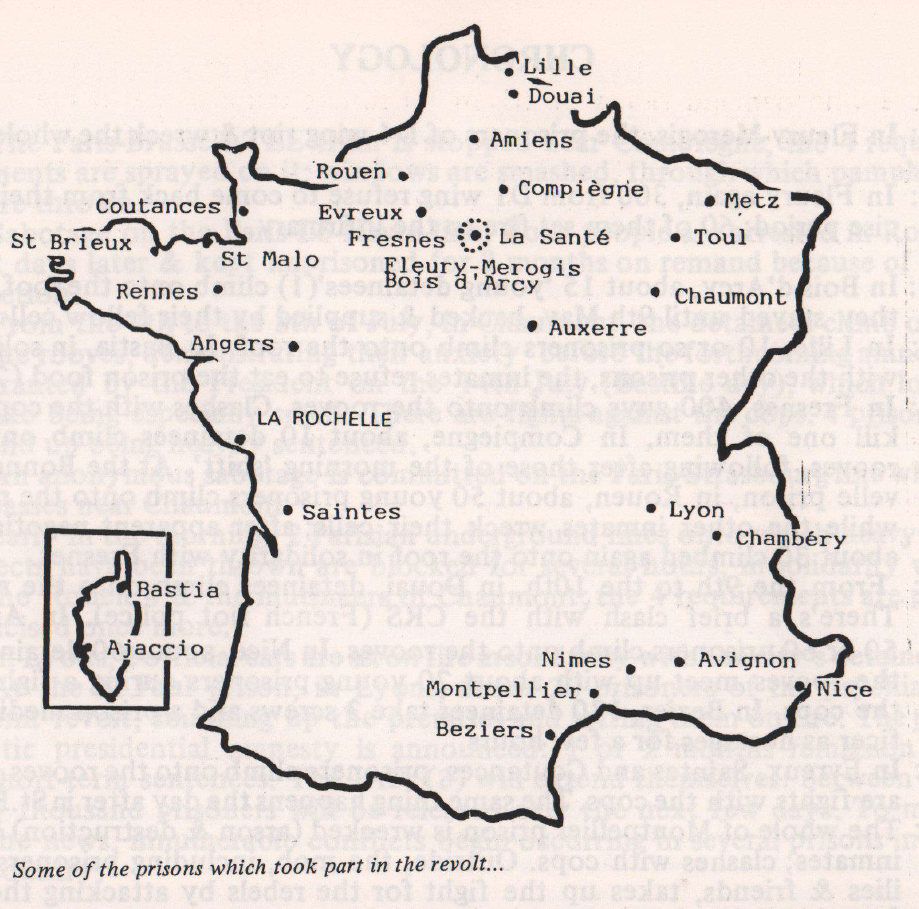
On the other hand, a real solidarity existed between the prisoners (in Bois-d'Arcy, the prisoners in cells were ready to break everything if those who were on the roofs were moved away: that's why the GIGN (french equivalent of the SAS) didn't intervene, and they stayed 40 hours in the open air, supplied by their fellow cell-mates; in Bastia,'they went on hunger strike in solidarity with the rebels of the other prisons). This solidarity was also manifested outside; in Montpellier, on May 19th, where people took up the fight for the rebel prisoners and attacked the cops from behind— who then dispersed them with dogs. The chief preocupation of the prisoners was to communicate with the outside in order to shout out their revolt against imprisonment, the daily terror exercised against them. "They want to kill us", "they're gassing us, they're truncheoning us" one could read on the banners at Bois d'Arcy..
Prisoners take an enormous risk when they revolt.. Everyone knows beforehand that the prison administration will make them pay dearly for this afterwards: by severe punishment blocks, loss of parole & remission(2), transfers, beatings, murders disguised as suicides. In Douai, 3 guys for simply having climbed onto the roof and having demonstrated their revolt by chucking down roof tiles— were, as soon as they came down , immediately condemned by an emergency tribunal to 15 months and 6 months extra time inside (one was to have been freed in June). This sentence was intended to be exemplary.
The anxiety engendered by the repressive terror and the despair of returning to the crushing isolation of the prison are such that at the very moment of revolt some of them turned against themselves through self-mutilation. In Fleury and in Montpellier, some of the prisoners leapt onto some barbiturates and swallowed them, at the same time as smashing everything in their way. 25 of them were seriously poisoned. Others slashed their wrists calling on other prisoners to do the same. One of them died. At the same time several prisoners hanged themselves in different yards. At this very moment, in St. Paul, in Lyons, prisoners each day mutilate or try to hang themselves.
"Freedom is the crime which contains all crimes" and it's against this crime that the old world defends itself: the state is in the process of physically eliminating all the beautiful youths who aren't resigned - the very same youths who die at the hands of the cops or the other "Beaufs" (3)— those whom the law can hold down, whom the state buries alive in its prisons, as long as possible, terrorising at the same time those who manage to stay outside. For these, it pays educators and other scum, whose task is to demoralise them and to make them forget their mates inside.....
As the housing estates of proletarian areas lose more and more youths, so the prisons fill up. This is the secret of over-crowding. The servants of the state would have us believe this is a question of budgeting! Overcrowding is supposedly caused by a malfunctioning of the prison system when it’s caused by the maximum functioning of the judicial system.
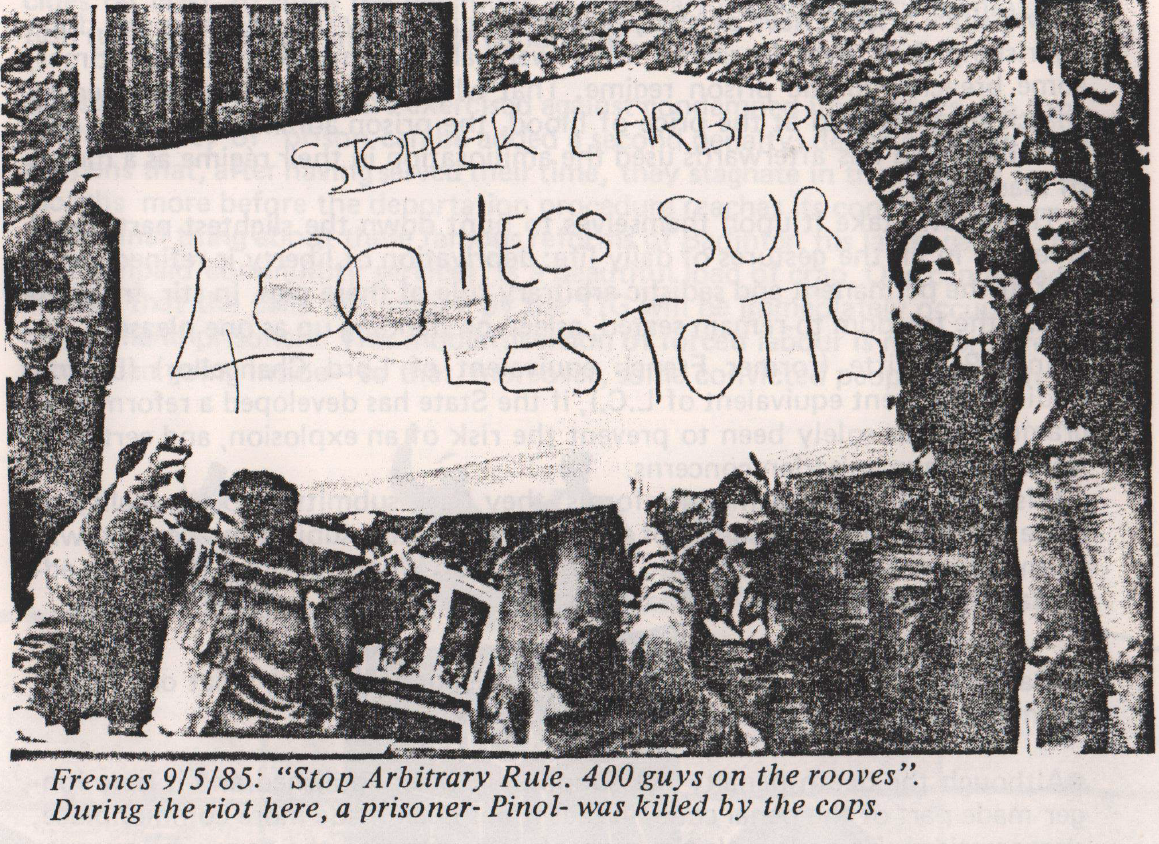
The only way of dealing with overcrowding in prisons is obviously to empty them, as the rioters of Fleury put it - on this point they couldn’t be clearer: they oppose the building of new prisons in a declaration signed by "The 600 leaders". The prisoners of Montpelier expressed a practical solution to overcrowding, They destroyed virtually all the cells!
It is the law, and, more precisely, the taking of hostages which preventive detention on remand constitutes (which officially condemns people to an indefinite spell inside, which is afterwards confirmed, if not aggravated, by judicial sentencing), which the prisoners revolt against. We are reminded of the movement which collectively affirmed demands for provisional liberty before trial in Lyons, at the beginning of the summer of 84. (4)
Ever since prisons have existed, everything gained by the prisoners was done by risking their lives in revolt. They were able to impose, at certain times, some breaches in the prison regime. That which prisoners have managed to snatch by force and at the price of blood, the prison administration has nibbled back and has afterwards used the amilioration in their régime as a means
of blackmail.
The screws take it upon themselves to hunt down the slightest particle of freedom in all the gestures of daily life; deprivation of liberty is refined every day in the permanent and sadistic arbitrary rule of these pigs. In stir, freedom is also the freedom to remain seated, asleep or standing up as one pleases.
Since Peyrefitte (former French equivalent of Lord Chancellor) (5) and Badinter (present equivalent of L.C.), if the State has developed a reform programme, it has solely been to prevent the risk of an explosion, and certainly not out of humanitarian concerns.
Prisoners no longer demand reforms: they have submitted to the reality of these reforms. The application of each reform remains subject to the good will of the prison administration and of the screws. What was presented as an advantage became one more degradation.
- "Parloirs libres" are refused by certain prisoners, because what one has to submit to in order to get these visits is humiliating.
- Although the death penalty has supposedly been abolished and It is no longer made part of the penal code, in fact it has been made more commonplace, democratised. Nowaday it’s the mob of "Beaufs" and the cops who execute people and in the nick it’s the screws.
- Also, the suppression of the maximum security wings (QHS) was a humanist bluff (developed by the left): the best example of this opportunism was when they released Knobelspiess with the support of a humanist campaign. Knobelspiess had denounced the horror of these maximum security wings, the left having used him , locked him up again without hesitation (6).
The QHS, as a specific regime of solitary confinement, has never been suppressed, it has simply changed its name. Now it is called the QI (isolation quarters). In '83, a new prison called "Les Godets" aimed at incarcerating prisoners considered to be particularly dangerous, was opened near Nevers. It can bang up 80 prisoners under an extremely severe regime of surveillance. What's more, the administration and the screws want to extend the conditions of the OHS to all the prisons; the number of isolation cells has increased, the statute of the DPS (specially surveilled detainees) is applied more and more, the punishment blocks are increasingly filled.
- The prison administration, in relation to the tension which reigns in the prisons, now increasingly reserve the right to punish prisoners even more, to inflict special sanctions. Petty humiliations and beatings are very common. The administration push the prisoners to suicide, or dress up killings as suicides. There's no such thing as a natural death in the stammer, those who die there die of prison. Killing is called "accidental death" --like Mohammed Rhabi in Rouen and Bruno Sulak in Fleury, killed by the fucking screws during escape attempts; like Alain Pinol in Fresnes, killed by the cops. The suicide of prisoners are all murders committed by the prison administration who gladly provide the rope to hang yourself. And if there are more and more suicides (at least 20 since the beginning of the year) it is because the administration rules increasingly intolerable conditions.
- A supplementary pressure exercised against condemned immigrants. On top of the penalty of prison can be added a second penalty: deportation. It even happens that, after having served their time, they stagnate in the nick for some months more before the deportation procedure reaches its conclusion. One final thing about these famous reforms of Badinter, his latest gadget, the TIG (unpaid community service), is a beautiful load of crap. One can already foresee that the cells left empty by the TIG will be immediately occupied by new remand prisoners. This modern version of forced labour is no more preferable than going inside-- so that, moreover, some convicted people refuse it.
All those who demand rights in prison (prisoners unions) are in the rearguard of the prisoners movement of revolt, because prisoners have to impose their requirements by violence at the risk of their lives. "Union struggle will be made within the law and through the law, by prosecuting all exactions before competent judiciaries". That's what the prisoners union programe has to say.....
We've already seen what unions are outside prisons. They only aim to channel and domesticate peoples revolt into reforms intended to re-arrange peoples misery. They also serve to stifle the real demands the poor spontaneously think up in their revolt.
Prisoners no longer fight for reforms since they know now that they were only an illusion: rather than putting themselves within the abstract sphere of rights, they are able to insist upon something that will at least have a concrete result-- a general reduction in penalties.
What's at stake are the requirements affirmed by the prisoners;
REMISSION FOR ALL CONDEMNED PRISONERS.
THE LIBERATION OF ALL REMAND PRISONERS.
A DEFINITIVE STOP TO ALL DEPORTATION ORDERS.
THE LIFTING OF ALL PUNISHMENT FOR ALL THE MUTINEERS.
The demand for the liberation of remand prisoners goes beyond a specific demand in prison. Even more than to the state or the prison administration, it addresses itself to all the poor people for whom, preventive detention is a sword of Damocles hanging daily over their heads. It's a challenge thrown at this society & which powerfully resonates in the heads of all those who have taken up the side of nonsubmission.
Judicial and prison matters remain almost always private matters where each person is left impotent in their isolation, whether it be those inside waiting for their trial, or those outside who have friends in prison and who, most of the time, can do nothing but assist them financially and give them a visit. The mutineers advanced immediately practical demands aimed, at least, at freeing as many guys as possible. These requirements are an offensive of the prisoners against their isolation and an appeal to those on the outside to act practically to break this isolation. It's a question of bringing pressure to bear against this society, to shit on this world with its prisons, this world which would prefer not to hear.
OS CANGACEIROS Beginning of June 85.
NOTE 1.- 'PARLOIRS LIBRES'. In France, during the 'parloirs', the prisoners and their visitors are separated by a double window. The demand for 'free parloirs' necessitates the abolition of this separation for obvious reasons.....If the State, under pressure from prisoners, have at last conceded this 'right' it is in order to use it against these prisoners. 'Free parloirs' is given to those whom the administration deems worthy of it— it is given as a reward for submission. There is nothing free about it apart from its name: instead of a window a screw provides the separation, surveilling every gesture. And after going 'free parloirs' you get searched with extra thoroughness. (Translator's note: TN)
NOTE 2: Once again a clever con: remissions of sentence are in fact additions of sentence, which are assigned to those who stand up for themselves. Judges calculate sentences proportionally in relation to rewards: if they want a prisoner locked up for at least 9 months, they are given a year inside (in Britain 13 months).
NOTE 3: 'REAUFS'. An insulting term used by the French against poor lower middle-class, pro-cop, often racist, always suspicious of anyone who doesn't seem to fit. There are millions of these shits and each year they kill several dozen 'misfits' without anything being meted out to them in return. In France, all cops are armed; they constantly and legally carry out the death penalty. They also mutilate or kill dozens of proletarians each year. Since the riots of 81 (mainly in Lyons and also other big cities) these 'beaufs' —particularly those connected with shops— have killed an increasing amount of young and especially immigrant thieves (with virtually no SS [social security] thieving is even higher than here). Such unpunished killings, with a nod and a wink from the State, is one of the most essential objective answers to the question "How come France is so quiet?". These murders have effectively intimidated those at the bottom of the pile into terrorised silence though in Marseilles and Paris there has been some sporadic rioting this year. TN
NOTE 4: In France, a remand prisoner may demand provisional liberty before trial. In such a case, the judge must send him back his answer within 5 days, otherwise the prisoner must be freed. When numerous remand prisoners affirm —collectively and at the same time— demands for provisional liberty, the local judicial administration is overwhelmed with work and might forget to answer in time, so some remand prisoners who don't get a reply could be freed (but in this case, the magistrates got together to stop this, though at the expense of considerable bureaucratic disorder). TN
NOTE 5: The 'Ministre de la justice' is the French equivalent of the British Lord Chancellor, but is also responsible for prison administration and everything concerned with it. TN
NOTE 6; We draw particular attention to the unbearable situation of condemned prisoners who have been locked up in solitary confinement, or those who are still in these wings like Knobelspiess, those whom the prison administration particularly harass in order to make them pay the maximum for never having submitted to the prison regime. We cite the case of Charlie Bauer, condemned in '62 to 20 years inside for burglaries. Conditionally freed on parole in '76, after having submitted, for a long time, to the ordeal of the QHS; he was imprisoned again, with a 5 years sentence for receiving, plus 6 years because of loss of his conditional parole. He'll only be able to leave in '90. It because Bauer fought against the WM, where he met up with Mesrine (7) that the prison administration coudn't forgive.
NOTE 7: MESRINE. Public Enemy number 1 in France at the end of the 70s. At the end of his life, on top of robbing banks, he openly attacked the State and its prisons. His escapades became public knowledge and an inspiration. For these reasons, he was assassinated by the pigs. TN.
Comments