Harry Cleaver's study guide to chapter 27 of Marx's Capital volume 1.
Outline of Marx's Discussion:
- England: serfdom disappeared by last part of 14th Century
- - mostly independent peasants in 15th Century
- part time laborers
- right to common land for grazing, timber, etc.
- small peasant properties
- - dissolution of bands of feudal retainers
- partly by royal power reducing wealth of aristocracy
- partly by feudal lords
- driving peasants from land for sheep walks (fx increased wool price)
- usurping commons
- destruction of houses - futile legislation for 150 years after Henry VII (1489) to stem this trend, i.e., to 1630.
- - colossal spoliation of catholic church property - ex-feudal proprietor of land
- dissolution of monasteries
- estates given to royal favorites, drove out hereditary sub-tenants
- estates sold at nominal price
- - theft of state lands, seized and given away or sold at low prices
- -"Bills for the Enclosure of Commons" by Parliament dominated by "landed and capitalist profit grubbers."
- - clearing of cottages and people
- particularly dramatic in Scotland, e.g. by the Duchess of Sutherland:
- 15,000 people pushed out by British soldiers in appropriation of 794,000 acres of land,
- pushed to seashore, later driven awary again when sea-shore let to London fishmongers.
- conversion of sheep-walks to "deer-forests" for sport (led to famine)
- 1. destruction of yeomanry (independent peasants) by 1750
- - replaced by tenants at will, small farmers on yearly leases, a servile rabble,
- and sheep/deer, agricultural labor
3. driving of people into the manufacturing towns:
- - creation of the human material to be shaped into an industrial working class,
- "driven from the land and forbidden to emigrate"
Commentary
This historical analysis of the first step in the creation of the working class centers on the forcible expropriation of the means of livelihood of peasants and craftspeople. In England some 6,000,000 acres or 1/4 of the cultivated acreage was enclosed by direct act of parliament. Another 4-7 million acres are estimated to have been enclosed privately. (1) The second step—forcing them into the factories—comes in the next chapter. This expropriation of the land was a long process, 300 to 400 years, and only through considerable violence were these changes accomplished. Vast numbers resisted and had to be forcibly dispossessed, a violence that forced them to seek refuge in woodland or cities or even flee abroad.
One area of dispossession, which Marx highlights, is the highlands in Scotland where the Dutchess of Sutherland and others drove their clansmen from the land. Such enclosures and the human misery produced were fought by those directly victimized and protested by sympathizers.
The long and tragic history of the enclosures with their terrible costs to humans and to nature left an indelible mark on the various cultures of the "British" Isles. These costs were a central issue in the transformation wrought by the rise of capitalism, the commercialization of agriculture and the industrialization of manufacturing. Not surprisingly, they have also become the inspiration of folk music that remembers and laments. "The Highland Clearances" written by Andy Stewart, blasts Queen Victoria for sanctioning the kind of highland clearances carried out by the duchess of Sutherland, evokes the burning of the peasant crofts and recalls those who were forced to take ship for the New, and hopefully better, World.(2)
 |
The Highland Clearances Ah, for the Glens are lyin' bare Black is the wood on the roof ance was braw |
Many hae gane tae Americay. Ah for the Glens are lyin' bare Silly Wizard, So Many Partings, 1989 |
While the new capitalist farmers were on the offensive, they found it no easy task to drive off and pauperize the population. There was violent resistance to physical removal; there were polemics written by economists and others, and from time to time, there was even legislation against the process—though largely ignored and unenforced. As we see in the subsequent chapter, the dispossessed also turned to "vagabondage and brigandry" out of desperation and to avenge themselves for the loss of their land and livelihoods.
This process that Marx analyzes in Britain has been universal throughout the bloody history of the creation of the capitalist world. Marx mentions Germany, Sweden and France in passing, but it has been employed everywhere capitalists invaded, from Asia, through the Middle East and Africa to the Western Hemisphere. In all those regions, British capitalists, backed by their government’s army and navy, established private property by force and fiat against the indigenous peoples and their customs, no matter how varied. So too did the Dutch in the East Indies. In the lands of the Incas and Aztecs, the violence of the Spanish conquistadors and expropriators is well known. Both Spaniards and Portuguese established huge colonial empires in South America, bequeathing the region the title of Latin America following the imposition of their own languages on indigenous peoples. (3) The Dutch also carved out pieces of South America and Southern Africa. Throughout the “Age of Imperialism,” capitalists, backed by their governments, competed, both economically and militarily, frequently displacing one another in wars for the control of the peoples, resources, markets and investment opportunities throughout the world.
Over time, “primitive” accumulation became a recurrent aspect of capitalist development. Despite capitalist efforts to extend their control throughout the world, that world was just too large and its people too numerous and too resisting for capitalist investment to expand as rapidly as its colonial control. As we see in Chapter 25, capitalists have sought to use un-dispossessed people left on the land as a vast, latent “reserve army” to be expelled and exploited when needed. Today, these conflicts continue as capital repeatedly seeks to steal what little land remains in the hands of small farmers, peasants and indigenous communities. Undeterred by government regulation, private capitalists clear-cut and burn tropical rainforests, which remain the home of diverse traditional cultures. Governments seize both private and public lands for corporate investors in airports, golf courses or mining. As such enclosures continue, so too do the struggles against enclosure, sometimes in the courts, sometimes in the streets and forests.(4)
Because his subject is the creation of the working class, Marx focuses on the dispossession of independent peasants and does not dwell either on the general nature of the pre-capitalist system, or on details of the ways of life being wiped out. His general interpretive analysis grasps the transition in terms of where it is headed but gives little sense of the kind of societies that were being destroyed. As a result, he leaves us no feeling for either the world of the peasants who are being driven off their land, or for the world of the landed estates whose "retainers" were being let go to join the unemployed, potentially waged labor force.
Marx's reasons for this absence can be explained partly by ignorance, partly by just not taking the time away from trying to understand the kind of world capitalists were imposing to examine the world(s) it was replacing. Certainly, he had no nostalgia for any kind of feudalism, nor was he a pastoralist wanting to turn history back to mythical peasant utopias. What little attention he did pay to peasant struggles before writing Capital—mainly those of French peasants—led him to be dismissive of their revolutionary potential. (5) However, as I have mentioned, years after Capital was published, debates in Russia over the importance of peasant life as a potential point of departure for a post-capitalist future led him to a much more sympathetic examination of the peasant mir.(6)
Whatever Marx's reasons for largely neglecting the study of the world(s) resisting capitalist enclosure, similar ongoing struggles—many of which have survived for hundreds of years—demand that we do the work he only began with his investigation of Russian peasant life and try to understand what such people have been fighting to protect. (See below, the last part of these commentaries on this chapter.)
Literary Illustrations
Traces of this great drama abound in English literature. While several middle- or upper-class poets wrote pastoral verses idealizing a vanishing world they knew only as tourists, lamenting its passing through enclosure, a handful of those who actually worked the land also took up the pen to chronicle the destruction of their world. One among those whose writings have come down to us was John Clare (1793-1864). Born in the village of Helpstone, Northamptonshire, Clare was a landless agricultural laborer who worked in various jobs. He was also an acute and sympathetic observer of both the nature around him and a harsh critic of the way that nature and the people who worked in it were being wiped out by enclosures. The following poem "The Mores" or "Moors" (Clare's spelling is often local and non-standard), begins with an evocation of a beautiful, wide-open natural area of "unbounded freedom" unmolested by fence or plow, where Clare had spent his boyhood. But then comes enclosure that builds fences, "improves" the land, trampling on labor's rights and turning the poor into slaves. Clare's contempt for this process and the character of those responsible are crystal clear. "Fence now meets fence in owner's little bounds / Of fields and meadow large as garden grounds / In little parcels little minds to please / With men and flocks imprisoned ill at ease." (7)
The Mores
Far spread the moorey ground a level scene
Bespread with rush and one eternal green
That never felt the rage of blundering plough
Though centurys wreathed spring's blossoms on its brow
Still meeting plains that stretched them far away
In uncheckt shadows of green brown, and grey
Unbounded freedom ruled the wandering scene
Nor fence of ownership crept in between
To hide the prospect of the following eye
Its only bondage was the circling sky
One mighty flat undwarfed by bush and tree
Spread its faint shadow of immensity
And lost itself, which seemed to eke its bounds
In the blue mist the horizon's edge surrounds
Now this sweet vision of my boyish hours
Free as spring clouds and wild as summer flowers
Is faded all - a hope that blossomed free,
And hath been once, no more shall ever be
Inclosure came and trampled on the grave
Of labour's rights and left the poor a slave
And memory's pride ere want to wealth did bow
Is both the shadow and the substance now
The sheep and cows were free to range as then
Where change might prompt nor felt the bonds of men
Cows went and came, with evening morn and night,
To the wild pasture as their common right
And sheep, unfolded with the rising sun
Heard the swains shout and felt their freedom won
Tracked the red fallow field and heath and plain
Then met the brook and drank and roamed again
The brook that dribbled on as clear as glass
Beneath the roots they hid among the grass
While the glad shepherd traced their tracks along
Free as the lark and happy as her song
But now all's fled and flats of many a dye
That seemed to lengthen with the following eye
Moors, loosing from the sight, far, smooth, and blea
Where swopt the plover in its pleasure free
Are vanished now with commons wild and gay
As poet's visions of life's early day
Mulberry-bushes where the boy would run
To fill his hands with fruit are grubbed and done
And hedgrow-briars - flower-lovers overjoyed
Came and got flower-pots - these are all destroyed
And sky-bound mores in mangled garbs are left
Like mighty giants of their limbs bereft
Fence now meets fence in owners' little bounds
Of field and meadow large as garden grounds
In little parcels little minds to please
With men and flocks imprisoned ill at ease
Each little path that led its pleasant way
As sweet as morning leading night astray
Where little flowers bloomed round a varied host
That travel felt delighted to be lost
Nor grudged the steps that he had ta-en as vain
When right roads traced his journeys and again -
Nay, on a broken tree he'd sit awhile
To see the mores and fields and meadows smile
Sometimes with cowslaps smothered - then all white
With daiseys - then the summer's splendid sight
Of cornfields crimson o'er the headache bloomd
Like splendid armys for the battle plumed
He gazed upon them with wild fancy's eye
As fallen landscapes from an evening sky
These paths are stopt - the rude philistine's thrall
Is laid upon them and destroyed them all
Each little tyrant with his little sign
Shows where man claims earth glows no more divine
But paths to freedom and to childhood dear
A board sticks up to notice 'no road here'
And on the tree with ivy overhung
The hated sign by vulgar taste is hung
As tho' the very birds should learn to know
When they go there they must no further go
Thus, with the poor, scared freedom bade goodbye
And much they feel it in the smothered sigh
And birds and trees and flowers without a name
All sighed when lawless law's enclosure came
And dreams of plunder in such rebel schemes
Have found too truly that they were but dreams
I have gathered several of Clare's "enclosure" poems together here.
The drama of this long period lay both in the loss of those various rural ways of life that Marx failed to study and in their replacement by the highly urbanized world of industrial capitalism, with its satanic mills, money values and new kinds of class antagonism. The so-called “industrial novels” of the nineteenth century, however, reflected and nourished political and philosophical debates about the human meaning of these changes. More than “fiction,” these novels are invaluable historical canvases on which their authors painted, in rich detail, their changing world. While the central interests in novels are their characters, whose personal dramas and development make up the narrative structure, the books also contain a variety of vivid portrayals of various aspects of English society: some disappearing and some coming to dominate.
One of those novelists who was preoccupied in her writing with the social and human meanings of the transition was Elizabeth Gaskell (1810– 65). Her novel Mary Barton: A Story of Manchester Life was published in 1848, the same year as Marx and Engels’s Communist Manifesto. The wife of a Unitarian minister in Manchester, Gaskell was intimately familiar with the working-class world she portrayed and although, unlike Marx, she hoped for a reconciliation of the classes, her novel gives a sympathetic and very human portrayal of the difficult lives and struggles of manufacturing workers. While Mary Barton only marginally evokes the transition from an agrarian England to an industrializing one, through the character of Alice Wilson, another of Gaskell’s novels, North and South (1855) deals with it quite directly.(8) The “South” of the novel is the largely agrarian south of England—from which the main heroine of the story comes—and the “North” is the increasingly industrial north of that country—to which the heroine moves. Discovering a whole new world, she reflects upon all the differences between the two. Here too, Gaskell portrays the class struggles of industrial capitalism, this time through the eyes of the daughter of a disillusioned minister.
Writing under the pseudonym of George Elliot, Mary Ann Evans (1819–80) is perhaps best known for Silas Marner (1861) and
While only a reading of the whole novel, with its poetic and striking presentation of individual lives, can do it justice, it includes brilliant snapshots of the world being displaced by capitalism. Her metaphor of the dinosaur evokes the quantitative importance of those estate "retainers" whose dismissal preoccupies Marx and of the imminent extinction of the class which had subordinated so many people, at such great expense, to its own luxurious lifestyle:
| But a man of Sir Maximus's rank is like those antediluvian animals whom the system of things condemned to carry such a huge bulk that they really could not inspect their bodily appurtenance, and had no conception of their own tails: their parasites doubtless had a merry time of it, and after did extremely well when the high-bred saurian himself was ill at ease. Treby Manor, measured from the front saloon to the remotest shed, was as large as a moderate-sized village, and there were certainly more lights burning in it every evening, more wine, spirits, and ale drunk, more waste and more folly, than could be found in some large villages. There was fast revelry in the steward's room, and slow revelry in the Scotch bailiff's room; short whist, costume, and flirtation in the housekeeper's room, and the same at a lower price in the servants' hall; a select Olympian feast in the private apartment of the cook, who was a much grander person than her ladyship, and wore gold and jewelry to a vast amount of suet; a gambling group in the stables, and the coachman, perhaps the most innocent member of the establishment, tippling in majestic solitude by a fire in the harness room. For Sir Maximus, as everyone said, was a gentleman of the right sort, condescended to no mean inquires, greeted his head-servants with a 'good evening, gentlemen', when he met them in the park, and only snarled in a subdued way when he looked over the accounts, willing to endure some personal inconvenience in order to keep up the institutions of the country, to maintain his hereditary establishment, and do his duty in that station of life -the station of a long-tailed saurian- to which it had pleased Providence to call him.(9) |
The passing of such grand estates was often gradual and often due to their owners’ resistance to changing times, such as the need to modernize the agriculture upon which their rents and incomes were based. Such resistance is part of the tale told in the hugely popular, ITV/PBS Masterpiece Theatre mini-series Downton Abbey (2010–15).(10)
Tales of Resistance
Marx’s analysis also lacks a detailed examination of the resistance that shaped and forced changes in capital’s expropriation and organization of labor. Marx tells us what was done, but he rarely gives a satisfying analysis of the power shifts that made it possible. The Russian anarchist Peter Kropotkin (1842–1921) spells out what needs to be done for the study of all worker struggles, overtly revolutionary or otherwise:
We endeavor, first of all, to free the histories of revolutions written up till now from the partisan, and for the most part false, governmental coloring that has been given them. In the histories hitherto written we do not yet see the people; nor do we see how revolutions began. The stereotyped phrases about the desperate condition of people previous to revolutions fail to explain whence amid this desperation came the hope of something better—whence came the revolutionary spirit. And therefore after reading these histories, we put them aside, and going back to first sources, try to learn from them what caused the people to rise and what was its true part in revolutions, what advantages it obtained from a revolution, what ideas it launched into circulation, what faults of tactics it committed.(11)
This perspective suggests some areas of Marx’s argument that need more research:
1. Dissolution of feudal retainers: the reduction of wealth of the feudal nobility that forced them to let servants go is cited but not analyzed. The dismissal of servants is easy to understand: they could hardly fight to stay, though the above passage from George Eliot suggests why they might want to do so. The issue is what did they do when dismissed, how did they live and struggle?
2. Similarly, the issue of the reformation and the overthrow of the hegemony of the Catholic Church needs an examination of the popular forces at play in the English Reformation—forces which not only displaced the Roman church but nearly overthrew the whole regime during the English Revolution of the 17th Century.
3. More important are the usurpation of the common lands through enclosure. Why this was desired, Marx makes clear. How the power was mobilized to do so, he does not. How did the peasants resist? How was the clearing carried out so that peasant resistance was crushed? British troops were used at times. but how were they turned against their own people? One can speculate but Marx tells us very little about the actual dynamics of this "decomposition" of the peasantry. We get neither analysis of politico-military tactics of repression nor of the tactics of resistance that failed (Kropotkin's "faults of tactics").
4. Laws were passed against enclosure for 150 years, but to no avail—a clear split between legislative and executive action. Why? What were the forces that led the latter to defy the former?
Fortunately, we can gain some insights into these things by studying the writings of historians such as E. P. Thompson (1924-93). In his Making of the English Working Class (1963), he revealed new information about agrarian struggles in the period 1790-1830. "How was it possible, . . . for the labourer to be held at brute subsistence level?" he asks and begins to give an answer that takes into account peasant resistance. (12) (Note that he is discussing labor revolt in the later stages of expropriation, the last gasp of the resisting peasantry and the continuing resistance of the new class of agricultural workers.)
On the side of resistance he cites various kinds of resistance: threats to overseers, sporadic sabotage (burning corn ricks), sullen and discontented spirits, turnip-pilfering, alehouse scrounging, poaching and layabouts. In 1816, after the Napoleonic War years (1793-1815) when the return of troops caused problems in East Anglia, dispossessed field laborers rose up demanding minimum wages and price maxims. There were "food riots, forced levies for money from the gentry, and the destruction of threshing machines."(13) The Laborers Revolt of 1830 included multi-village strikes, thresher breaking, demand for land, extortion of money, robbery, etc. This movement gained the sympathy of many in the middle class and some concessions.
On the side of the capitalist farmers and gentry, Thompson mentions various means that were used to repress such rebellions: mobilization of servants and retainers, grooms, huntsmen, game-keepers with pistols, shotguns, etc.; as well as the use of government troops.
Overall he sketches relatively isolated revolts on which superior military force could be focused. Isolation due to the inability to organize beyond local villages was, in turn, due to the difficulty of communication as well as the unevenness of exploitation. Enclosures were not carried out everywhere at once but piece by piece. Isolated in boh space and time, peasant resistance could be destroyed by local goons and government troops. Who were these troops? Were there failures? As we ask these questions of enclosures in the present period, so too must we ask them of those of the 15th to 19th Centuries. We ask them so that we can learn of past strengths and weaknesses in order to do better today. Land is still being seized, people are still being displaced and resistance continues. The peasantry or land question and the capitalist need for labor are still pressing ones. Even when the question is of a shift from unwaged exploitation to waged exploitation (or vice versa) rather than of “primitive” accumulation, the fundamental conflict still plagues us.
The World Turned Upside Down
Was the earth made to preserve a few covetous proud men
to live at ease, and for them to bag and barn up the treasures
of the Earth from others that these may beg or starve in a
fruitful land; or was it made to preserve all her children? (14)
Gerard Winstanley (1609–76) was a leader of the “Diggers” or “True Levellers” movement against enclosures, a movement that not only resisted but sought to reverse the process by seizing and working unused, enclosed land. One important moment of those struggles took place in 1649, a time of explosive political conflicts in England. The poor harvests of 1648 had led to widespread hunger and unemployment and the urgency of demands for change had led to widespread radical demands, even within Cromwell’s army. Marxist historian Christopher Hill (1912–2003), a compatriot of E. P. Thompson, did the research necessary to provide a detailed description of the struggles and repression of the Diggers in 1649 in his book The World Turned Upside Down (1984). (15)
As part of those struggles Winstanley wrote a battle song, "You Noble Diggers All," calling workers to battle to reclaim common lands from the greedy hands of private property.(16) The song blasts not only the landlords and their violence but also the lawyers who manipulated the laws to the landlords' advantage and the priests who wielded their religious doctrine to condemn workers and justify the violence used against them. In a fine example of reappropriating past struggles, Leon Rosselson not only resurrected Winstanley's song, but wrote one of his own, whose title "World Turned Upside Down" was probably taken from Christopher Hill's book. (17) Scotsman Dick Gaughan, who has performed the song, wrote this about it: "The mark of a great song is its ability to speak universals about specific happenings and to be relevant to all times. Sometimes we (Scots and Irish) forget that the first colony of the British Empire was in fact England." (18) For a visual, and visceral, sense of the struggles, see the 1975 film Winstanley directed by Kevin Brownlow and Andrew Mollo, noted for the quality of its attention to historical detail.
You Noble Diggers All You noble all, Your houses they pull down, With spades and hoes and ploughs, Their self-will is their law, The gentry are all around, The lawyers they conjoin, The clergy they come in, Gainst lawyers and gainst priests, The club is all their law, (Leon Rosselson, Harry's Gone Fishing, Wimbley Park: Fuse Records, 1999 (CFCD 007). |
The World Turned Upside Down In 1649 'We come in peace' they said 'The sin of property 'They make the laws We work, we eat together From the men of property 'You poor take courage (Dick Gaughan, Handful of Earth, |
Hill's description of the events dealt with in these songs goes as follows:
"On Sunday 1 April . . . a group of poor men (described as labourers in a legal action three months later) collected on St. George's Hill . . . and began to dig the waste land there. It was a symbolic assumption of ownership of the common lands . . . The numbers of the Diggers soon rose to twenty or thirty. 'They invited all to come in and help them,' an observer noted, 'and promise them meat, drink and clothes . . . They give out, they will be four or five thousand within ten days . . . It is feared they have some design in hand.' Consider for a moment the area affected. St. George's Hill was just outside London, within easy reach of any poor man there who might be interested in the colony. It lay on the edge of Windsor Great Forest, where in 1641 'scores and hundreds set upon the King's deer.' It was unpromising agricultural land, the improver Walter Blith sniffed. Kingston, the nearest town, to which the Diggers were taken for trial by the local landlords, was a great corn market. It had a long-standing radical tradition . . . landowners in the area round St. George's Hill were more disturbed by the digging than the Council of State or General Fairfax . . . Nor does Oliver Cromwell seem to have been unduly alarmed when a 'northern profetess' warned him, a propos the Diggers, that 'if provision be not made for them poor commoners, England will have new troubles.' But parson Platt and other Lords of manors in Surrey organized raids on the colony and an economic boycott; they harassed the Diggers with legal actions . . . Even after the Diggers moved to Cobham Heath a few miles away the raids continued, and by April 1650 the colony had been forcibly dispersed, huts and furniture burnt, the Diggers chased away from the area. It was a brief episode in English history, involving perhaps a few score men and their families: we know the names of seventy-three of them . . . But historians are becoming aware that it was not quite so isolated in occurrence as used to be thought . . . We should see the Digger colony on St. George's Hill as merely one particularly well-documented example of a trend which was repeated in many other places . . . Other Digger colonies appeared at Wellingborough in Northhamptonshire, Cox Hall in Kent, Iver in Buckinghamshire, Barnet in Hertfordshire, Enfield in Middlesex, Dunstable in Bedfordshire, Bosworth in Leicestershire, and at unknown places in Glouscestershire and Nottinghamshire. Not enough local work has yet been done on most of these places, but we know something about Wellingborough . . . the Wellingborough Diggers produced a DECLARATION which tells us very precisely what sort of people supported their movement. There were 1169 persons in receipt of alms in the parish. Trade was decayed, there was no work; 'rich men's hearts are hardened, they will not give us if we beg at their doors. If we steal, the law will end our lives, givers of the poor are starved to death already and it were better for us that are living to die by the sword than by the famine.' So they, like the Surrey Diggers, had begun to 'dig up, manure and sow corn upon the common waste ground called Bareshank . . . But this colony seems to have been suppressed at the same time as that in Surrey." pp. 107-124.
The Diggers' attempt to reverse the process of enclosure and clearing failed. But that failure was only one moment in a multitude of struggles that shaped the emerging class composition of England. And the Diggers' visions, of the common use of the land, and of the right of people to eat and to determine their own lives are still shared by many and not all "diggers" have failed.
The twentieth century saw a vast resurgence of demands for "land reform," the restoration to people of land previously taken from them. During the Mexican Revolution begun in 1910, Mexican peasants cut barbed wire fences and retook their land in revolts dramatically portrayed in the film Viva Zapata! (1952).(19) During the Russian Revolution of 1917, with the slogan "Bread and Land" millions of peasants reappropriated what had once been theirs. In China in 1927, Mao Zedong visited Hunan province and discovered that the revolution had begun without him; poor peasants were expropriating the rich and redistributing the land. In Vietnam, peasants joined the Vietminh against colonialists who had seized their land for rice and rubber production for export, fighting in turn, the French, the Japanese, the French again and finally the Americans. Those were four great revolutionary moments when the reappropriation of land, the reversal of enclosure, was a central issue. We could multiply the examples of such conflicts a thousand-fold, throughout Asia, Africa and the Americas. Today, two current struggles come immediately to mind: those of the Landless Laborers in Brazil (MST) and of the Zapatistas in southern Mexico who have fought to reclaim lands previously stolen and concentrated in the hands of capitalist farmers.
Enclosing Water
Echoing the sad tale of Highlanders pushed to the seashore by the Duchess of Sutherland, who then “let the seashore to the big London fishmongers,” (20) an Irish song tells the story of the resistance of fishermen in Northern Ireland to their dispossession by British colonialism. The original expropriation of eel-fishing rights was carried out under the orders of King Charles I in the mid-1600s. The Toome Eel Fishery referred to in the song was formed in the late 1950s and was awarded exclusive fishing rights by a British court in 1963. Lough Neagh is both the largest freshwater lake in the British Isles (153 square miles) and the largest eel fishing area in Northern Ireland, with an annual take of about 600 tons.
On the jacket of their record This is Free Belfast the Men of No Property give the following background: "Northern Ireland's great Lough Neagh is the richest fishing ground of Western Europe. Instead of this natural treasure being the heritage and property of all the people, the fishing rights to its greatest catch: eels, are controlled exclusively by one company, the Dutch-controlled Toome Eel Fisheries (N.I.) Ltd. This company prosecutes the fishermen, and can revoke their licenses."(21)
 The Great Eel RobberyCome all you gallant Ulstermen Well, the cruel decision the judges made Now we contend King Charles gave away |
They've stolen away what should belong To each and every man, And for our fate cruel England's law Well, she does not give one damn. They called our fishing poaching For they have a great monopoly But though we've had a setback
|
The song ends with a promise of continuing struggle to win back fishing rights for local fishermen. And indeed, the fishermen formed a Lough Neagh Fisherman's Association and registered as a trade union to fight for their rights. According to one account the fishermen successfully formed a "Co-operative Society" that was able to buy 20% of the shares of Toome Eel Fishery (NI) Ltd. When the majority shareholders refused to buy eels from the Irish fishing co-operative, the latter by-passed Toome and developed new markets in Europe. With the profits they realized from those markets, they were ultimately able to buy out the other 80 percent of the shares of Toome and as forecast in the song, the full rights to eel fishing finally reverted to local Irish fishermen!(22) 
There is another interesting dimension to this story. The song notes that the Dutch company held a "great monopoly that stretches Europe round". Leaving aside the empirical question of exactly what the market share of that company has been, it is true enough that fishing, not just in Europe but around the world, has become increasingly concentrated in the hands of huge multinational corporations using "advanced" technology to maximize their take and profits. One result has been global over-fishing and a dramatic depletion of many species of fish. Moreover, because fish eat fish, this has caused such a disruption of ocean ecological balance as to create a growing crisis - one that cannot be overcome by the substitution of aguaculture or farm fishing for wild catch. The Associated Press reports that this overfishing and depletion includes the European eel.(23) Not only are prices rising rapidly as supply shrinks, but the reduction in the eel population is also creating worries about the impact on other animals who eat them, e.g., cormorants, herons, otters and other European wildlife.
In contrast to this over-fishing, the fishermen of Lough Neagh are carefully manage their fishing in ways designed to sustain the eel population on which their livelihood depends. This is often the case with local fishing, as with local agriculture. A multinational corporation can deplete what they see as a "resource" and move on; local populations, dependent on the sustainability of their ecosystem, are often more careful in how they interact with it. (24)
Enclosures in United States
In North America the initial expropriation of the "agricultural population" was the displacement and extermination of Native Americans. Forming a diverse array of cultures based on various mixtures of agriculture and hunting & gathering, the these peoples filled the land the European invaded. Their hunting and gathering spread out over wide regions, and their agricultural methods often involved shifting and moving about. To the Europeans, used to dense populations where virtually every available hectare of arrable land was cultivated, or given over to city building, North America looked "empty", or at least so they pretended. As the Europeans occupied the East Coast and pushed inland they sought to either subordinate or eliminate those in their way. For the most part, the indigenous population was never accepted assimilation. With few exceptions, they could never be put to work directly, either as slaves or as wage labor —they simply refused, prefering to fight or to die. In some cases the European invaders were able to tap the Indians' labor indirectly through the fur trade but mostly they simply pushed them out of the way and killed them when they resisted.
TThat resistance, of course, was great, long and bloody. It took a 200-year war to secure the majority of the land and to eliminate most of the Indians, confining the few who remained to reservations. This is a history that has been, for the most part, passed over quickly at all levels of school, from elementary to university. Ignorance of Native American culture and stereotypical images of barbaric savages were promulgated to rationalize their destruction and only recently have begun to be replaced by more informed and less racist knowledge and treatments. With respect to Native American resistance, for a long time about the only aspects of that history whose memory was preserved with respect were some of their more effective armed struggles—preserved ironically by the military forces that defeated them, but that still honor the brilliance of their strategies and tactics of war.
Fortunately, the neglect and failure to appreciate the resilience and creativity of Native American resistance has been increasingly countered in recent years, first by student struggles to create space and to gain resources for Native American Studies and second, by histories written from the point of view of the indigenous.(25)
Beyond these accounts of primitive accumulation in Britain and North America— understood as the creation of the classes of capitalist society—we must also recognize that both processes cannot be properly analyzed within national or even continental bounds. Because the indigenous population would not work for a wage, and because indentured European servants often escaped their servitude, the North American working class was constructed, in part, through the enslavement of Africans. That enslavement ripped people from their land and forcibly transported them across the Atlantic to plantations where they were put to work on land stolen from the Cherokee (Tsalaqi), the Creek (Muskogee), the Chickasaw (Chikasha), the Choctaw (Chahta) and the Seminole (Meskwaki). Just as the displaced agricultural population in Britain migrated from rural areas toward cities and even abroad, so too did the African slave trade force a migration that contributed to the formation of a working class throughout much of the Atlantic basin. Thus, primitive accumulation in the New World was closely interlocked with that of Europe and Africa, making it mandatory to study the formation of an Atlantic working class rather than a purely North American one. (26)
This history and its study is complicated by the process of separating people from the land being repeatedly renewed. European settlers, who displaced the indigenous population, used the land they seized to ground their own independence from the growing capitalist demands for labor. For the most part, the frontier was not settled by capitalist plantation owners and ranchers employing slave or waged labor, but by family farmers who came west precisely to escape the factories and slums of both Western Europe and the American East Coast. The frontier moved west year after year and generation after generation as part of a struggle for freedom from exploitation—even as the indigenous population lost its freedom, and often its very existence.
This westward movement of pioneers, mountain men and homesteaders provided not only the inspiration for ideals such as Jefferson’s agrarian democracy, but also an ongoing problem for capitalists who wanted to integrate the labor of these independent agriculturalists into a wider project of accumulation. As late as the nineteenth century, most US citizens still lived on the land and their labor (like that of the indigenous before them) could only be tapped through the market. They could only be exploited through unequal exchange in which they sold agricultural produce that took a great deal of labor to create and bought manufactured products that took much less. With the development of capitalist banking and finance, they were also exploited through mortgages and bank loans. Over the years, these methods all worked together to generate a slow but inexorable process of dispossession, through which the vast majority of independent farmers lost their farms and were forced into wage labor. This process is still going on, even though only 3 or 4 percent of Americans still live on the land. It accelerates in hard times, when farm prices are low and mortgages and bank loans cannot be repaid, and slows during upturns when expanding demand and government subsidies keep farm output prices up and credit cheap.
As might be expected, this process, like earlier periods, generated considerable resistance. From the Whiskey Rebellion (1791–94) through the Populist Revolt of the 19th Century to the American Farm Movement of the 1970s (supported by Willie Nelson's Farm Aid concerts), it has been a long and bitter history. Repeatedly, the dreams of independence of many generations of American farmers have been crushed and, like the British yeomen and Native Indians before them, they and their families have been driven from the land.
Typical of the popular music of farmer resistance are two songs, one from the period of the Populist Revolt and the second from that of the American Farm Movement. “The Farmer is the Man” originated among western farmers after the Civil War and became famous during the Populist Revolt of the 1890s. In that song, those responsible for the exploitation and ultimate enclosure of family farmers’ lands and tools are the mortgage men and bankers who “get it all.”(27)
 The Farmer is the ManWhen the farmer comes to townWith his wagon broken down, Oh, the farmer is the man Who feeds them all. If you'll only look and see, The farmer is the man, When the lawyer hangs around And the preacher and the cook Oh, the farmer is the man, When the banker says he's broke Oh, the farmer is the man, |
The more recent song about the loss of family farms is “Rain on the Scarecrow” by John Cougar Mellencamp.(28) This song is bleaker, more about loss than about struggle, but fitting, given that most farmers have lost and very few remain. The story is the same: “The crops we grew last summer weren't enough to pay the loans / Couldn't buy the seed to plant this Spring, and the Farmers Bank foreclosed."
 Rain on the Scarecrow Scarecrow on a wooden cross Rain on the scarecrow The crops we grew last summer Well there's ninety-seven crosses Rain on the scarecrow Rain on the scarecrow (John Cougar Melencamp, Scarecrow, PolyGram Records, 1985 |
Women, Witches and the Enclosure of the Body
 Marx's analysis of the enclosures focuses on the theft of peasants' land, one of their basic means of subsistence and sources of power to resist exploitation by others (whether landlords who would charge rent or capitalists who would profit from paying low wages). The loss of land, of course, was often accompanied by the loss of most other means of subsistence including home and tools (such as spinning wheels, axes, saws, looms, cauldrons) which allowed peasants to provide themselves with housing, furniture, clothes and food. Thus, along with the expropriation of the means of production went that of the means of reproduction —of reproducing daily life for oneself and one's family.
Accompanying this expropriation of land and the material means of reproduction was another expropriation even more intimate: that of women's bodies. During this period, a wide variety of women's social practices and rights came under attack including their right to regulate their own fertility, their equality with men in both work and struggle and their right to enjoy their own sexuality and their spiritual relations with nature. Contraception was outlawed; they were painted as evil and threatening to men, their proper role was redefined as broodmare and houseworker; adultry was criminalized; as was free, collective sexuality (of both women and men); their skills at healing and magic were outlawed and made punishable by death. Their proper roles were redefined as brood mare and housewife. Their rights and possibilities were dramatically reduced as they were more deeply, subordinated to men in both homes and workplaces.
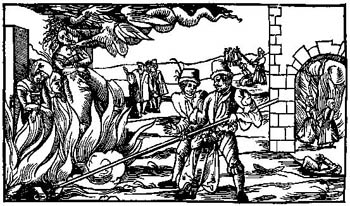
The nadir of this repression unfolded in Britain and Western Europe during 1550-1650, the period of the "Great Witch Hunt," which saw tens of thousands of women tortured and executed for once common practices that had been criminalized. Most of the victims of this repression were poor peasant women singled out in a population that was resisting the enclosures. In Britain, this period is bracketed by the 1549 Ketts Rebellion against enclosures and the English Revolution, which sought to turn the whole new order "upside down." During those years, the state, in collaboration with both Catholic and Protestant Churches, accelerated a wave of repression against women that had been growing with the rise of capitalism and popular resistance to it. Midwives (sage femmes, or wise women, in French) were accused of being in league with the devil and preventing procreation or committing infanticide. This persecution was the beginning of a process where women were forced to procreate more workers for the labor market and increasingly excluded from all aspects of obstetrics and gynecology which were taken over by men and the state.
Rebellious women who spoke out or who insisted on their rights and their desires were accused of witchcraft and killed, as examples to all others. Such attacks struck directly at the important roles women had played in peasant revolt. Any and all manifestation of sexual desire outside of marriage—adultry, procreation, prostitution, etc.— was criminalized.(29) The sexuality of the young was repressed, of the old ridiculed—indeed the stereotypical image of the witch as an old, evil and lascivious crone dates from this period (and is still with us). Women in general were accused by demonologists of "insatiable sexuality" capable of dominating men to the point of being able to cause impotence. (30)
Such repressive laws, such as those calling for sexually active but unwed women to be put to death, had already been attacked vehemently at the beginning of the 16th Century by Ludovico Ariosto in his epic romantic poem Orlando Furioso(1516). In that poem, one of the main characters, a chivilrous knight named Rinaldo, learns of a princess who had been set up for death by a spurned suitor. The suitor achieved his revenge by making it seem as if she had made love with another outside of wedlock—this in a country (Scotland) where such behavior was punishable by death. Rinaldo's reaction expresses Ariosto's own feelings about such repressive laws. “This inequality in law much wrong / Has done to women. / With God’s help I mean / To show that to have suffered it so long / The greatest of inequities has been. / A curse upon the legislator’s head!”(31)
| The law of Scotland, harsh, severe, unjust, 63 Rinaldo thought a while and then he said: 66 If the same ardour, if an equal fire 67 'This inequality in law much wrong (from Canto IV) |
The attack on women was orchestrated also to strike at men’s sexual freedom and to undermine any solidarity between men and women while redirecting the energy of both into work for capital.(32) Women were to procreate and recreate the working class, while men were to do the work of disciplining women—and eventually both would be driven into the factory. Not surprisingly, along with the aggravation of antagonistic relations between men and women, the period of the witch hunts also saw the demonization and criminalization of all other “unproductive” sexual activity, such as homosexuality and public, collective sexuality, both of which had been common during the Middle Ages.(33)
Land, Capital and the Struggle for the Preservation of Cultural Diversity
For much of the world, the kind of enclosure Marx is talking about has meant the destruction of entire ways of life that were deeply rooted in people's relationships to the land, both material and spiritual. In capitalism, land becomes a commodity, something to be bought and sold, a source of profits, and mainly, a vehicle for the control and exploitation of other humans. Unlike indigenous cultures, capitalism has no place for a spiritual relation to the land (or to the other creatures who dwell upon it). Instead of being one with the rest of nature, capitalism sees it all as usable and exploitable "resources."(34) For thousands of years, traditional Native Americans lived in balance on the land, hunting and gathering only what they needed for their limited populations and cultivating a little ground for a few crops. Instead of shaping human culture in harmony with the surrounding ecology, capitalism wantonly destroys and pillages the earth. The commons are drawn and quartered into "little parcels little minds to please." Forests are clear-cut for lumber and left as wasteland. Whole species, such as the buffalo, are hunted to near extinction. Grasslands are stripped through overgrazing and turned into deserts. Mountains are ripped apart by "mountain-top removal" and strip-mining more generally. Rivers are turned into open sewers and lakes into cesspools or sterilized with acid rain. Oceans are polluted, overfished and littered with plastic waste. The only spaces spared this exploitation are those that have been fought for and won against the logic of capitalist economics: a few reservations where Native American have refused the temptation of selling their mineral rights, a few National Parks and areas of wilderness, and a variety of so-far commercially value-less lands.
Understanding the human meaning of this destruction requires studying the cultures being destroyed and their ongoing struggles to preserve what is left. Much has been learned by anthropologists and sympathetic outsiders who have observed and tried to understand in the years since Marx studied those few reports available to him.(35) From indigenous communities in southern Mexico to hunter-gatherers in the Amazon and beyond, people whose cultures contain strong pre- or anti-capitalist elements still survive and resist. In a few cases, resistance has mutated into efforts to expand, often through land seizure, to obtain more space for these cultures to grow and evolve. However limited our ability to understand those cultures, we can realize the rich diversity of human being which is at stake and measure the losses humanity has sustained as capitalism has done its best to exterminate all but the most superficial differences around the world, to undermine people's ability to live differently through the expropriation of their land, of their tools, of control over their bodies, integrating them poorly equipped into its spiritless world of endless work.
Recent decades have seen the flourishing of resistance both to capitalist ecological destruction and to the cultural genocide it perpetrates. Films dealing with these tragedies include The Emerald Forest (1985), Amazonia: Voices from the Rainforest (1990, Medicine Man (1992), Ferngully (1992), Zapatista (1999), The Burning Season (2008) and Avatar (2009).
 The film The Emerald Forest is the story of the struggle of the peoples of the Amazon rainforest to resist the violent intrusion of capitalism and its destruction of their world. It has the form of an adventure story -a white boy raised among the Indigenous who chooses their ways and fights both the enslavement of their women and the creation of a giant dam. The film shows some of the classic methods used in the Amazon by the invaders: pitting tribe against tribe, murder and the slaughter of the forest. But it also shows some of the spiritual richness of the indigenous culture and the close relations between humans and the animal world. Other tribes have different relations with nature; a recent Ph.D dissertation describes a tribe that communes with plants rather than animals, but the lesson is the same. These so-called primitive people live in harmony not conflict with their world. And they must struggle to prevent its destruction by capital. |
Amazonia contains numerous interviews with Brazilian Indians and rubber tappers, once enemies, now increasingly allied in the attempt to defend the rainforest and the autonomy of their lives against the inroads of ranchers, miners and government "development" projects such as roads and dams. It also points out that of the 900 tribes in the Amazon at the time of colonial conquest, only 180 remain; the other 720 were wiped out. Medicine Man deals with how the destruction of the rainforests also involves the destruction of a rich and diverse source of medicinal "resources." Ferngully, an animated feature-length fantasy film, simply celebrates the beauty of the forests. Zapatista documents the indigenous uprising in Chiapas while providing background that makes it understandable. The Burning Season documents forest clearance for commercial palm oil production in Indonesia and its impact on orangutans and global warming. Although science fiction and located on another, fictional planet, the critical acclaim and worldwide popularity of Avatar's portrayal of the conflict between a rapacious capitalist corporation and an indigenous people demonstrates the degree to which people all over have become sympathetic to the struggle against capitalist depredations. There are many more films dealing with these issues.
Recommended Further Reading
| The thistles climb the thatch. Forever The stars shine over Sutherland cropped among corn. We will remember this. are burning: that to hear Iain Crichton Smith, The Law and the Grace, 1965. |
- Marx's first writings in "economics" dealt with the enclosures of forests in Germany aimed at forcing the peasants into more waged work. See the article by Peter Linebaugh, "Karl Marx, the Theft of Wood and Working Class Composition: A contribution to the current debate," Crime and Social Justice, No. 6, Fall-Winter 1976, pp. 5-16. Marx wrote many articles dealing with India and the imposition of private property in land, many have been collected in Avineri (ed.) Marx on Colonialism, also see the recent issues of Marx-Engels Collected Works.
Since Marx wrote there has been much debate about the issue of the enclosures. For an apologetic treatment that tries to explain the growth of labor supplies in other ways (e.g., population growth) see the book by J. D. Chambers and G. E. Mingay, The Agricultural Revolution, 1750-1880, London: Batsford, 1966. For a radical review of the issue and critique of such anti-Marxist arguments, see Bill Lazonick's article on the enclosures in the Review of Radical Political Economics, Vol. 6, No. 2, Summer 1974, pp. 1-59. For an even more recent argument that "enclosures" are an integral part of current capitalist strategy see: Midnight Notes, The New Enclosures, 1990.
The Marxist debate on the transition to capitalism from feudalism is even larger than the more narrow topic of the enclosures. An overview of the debate is provided in Chapter 2 "Maurice Dobb and the Debate on the Transition to Capitalism" in Harvey J. Kaye, The British Marxist Historians: An Introductory Analysis, Cambridge: Polity Press, 1984. In some ways, as Kaye says, the debate as such began with Dobb's Studies in the Development of Capitalism, New York: International Publishers, 1947, 1963, although it had been going on ever since Marx, e.g., the arguments in Russia over whether or not capitalism was inevitable (see my notes on chapter 26). The debate developed with a series of exchanges in the journal Science and Society beginning with an attack on Dobb by the American Marxist Paul Sweezy in 1950. Other contributors included H.K.Takahashi, Rodney Hilton and Christopher Hill. The exchanges were collected into Rodney Hilton (ed), The Transition from Feudalism to Capitalism, London: New Left Books, 1976. From my point of view the most interesting moments of the debate, then and since, are those which have emphasized the crisis of feudalism brought on by the struggles of the dominated classes. The writings by Rodney Hilton, for example, focus on the struggles of the peasantry which ruptured the sinews of feudal society. For an overview of his work see the book by Kaye.
On the evolution of early capitalism and the struggles of peasants and workers, a lot of historical work on England has been done by Marxist historians like Edward Thompson, Christopher Hill and Peter Linebaugh. See references in the notes on chapter 26 and the book by Kaye on British Marxist Historians. There are other works which trace this same kind of process elsewhere. For example on colonial Central America see the UT M.A. Thesis by Mark Walker, An Analysis of the Class Struggle from a Working Class Perspective: Example of Guatamala, 1977. On post colonial Argentina see the UT Ph.D. Dissertation by Ricardo Salvatore, Class Struggle and International Trade: Rio de la Plata's Commerce and the Atlantic Proletariat, 1790-1850, 1987. More generally, the development of a Marxist theory of this dynamic (working class power and capitalist development) has been a central theme in the tradition of what I call "autonomist Marxism". See the introduction to my Reading Capital Politically for an overview.
On the Diggers, besides the book by Christopher Hill (The World Turned Upside Down), there is also a recent pamphlet reprint of Digger writings: Digger Tracts, 1649-50, Aporia Press, 1989, which can be obtained through Bound Together Books in San Francisco. Other books on peasant struggles in England include: Julian Cornwall, The Revolt of the Peasantry, 1549, London: Routledge & Kegan Paul, 1977, Charles Poulson, The English Rebels, London: Jouneyman Press, 1984; R. B. Dobson (ed) The Peasant Revolt of 1381, London: Macmillan, 1970; R. Hilton and T. H. Aston (eds), The English Rising of 1381, New York: Cambridge University Press, 1984; Henry Kamen, The Iron Century: Social Change in Europe, 1550-1660, New York: Praeger, 1971, London: Hutchinson, 1984.
Two novels that provide some humanity to the story of the Highland Clearances are: Iain Crichton Smith, Consider the Lilies, 1968 and Jeanne Williams, Daughter of the Storm. Crichton Smith's story takes place in the midst of the clearances carried out by the Dutchess of Sutherland that Marx discusses in this chapter. His main character is an old woman whose husband was killed fighting the queen's war and whose son has emigrated to Canada. William's story takes place on an island in the hebrides. Her main character is a young woman and the there's a romance thread that runs through the novel amidst the historical drama of the clearances and the resistance to them. Both are based on real history and many of the subsidiary characters - especially the oppressors - were quite real, and their real names are used in the stories. Both novels are very much worth the read.
The literature on contemporary peasant struggles for land reform is enormous but central must be that which deals with Mexico, Russia and China -the three great peasant revolutions of the 20th Century. For an overview see: Eric R. Wolf, Peasant Wars of the Twentieth Century, New York: Harper & Row, 1969 which also deals with Vietnam, Algeria and Cuba. On Russia see Teodore Shanin's two volumes: Russia as a 'Developing Society' and Russia, 1905-07, Revolution as a Moment of Truth, New Haven: Yale University Press, 1985 and 1986. Mao's report following his discovery of peasant revolution in China is "Report on an Investigation of the Peasant Movement in Hunan" in Mao Tse-Tung, Selected Works, Volume I, Peking: Foreign Language Press, 1967.
The literature dealing with the enclosure of North America, and the separation of Native Americans from their land is vast, and unfortunately, most of it has been written from the point of view of whites. As a beginning you might want to look at two recent overviews of contemporary Indian resistance and attempts to regain what was stolen from them: M. Annette Jaimes (ed) The State of Native America: Genocide, Colonization and Resistance, Boston: South End Press, 1992 and Ward Chruchill, Struggle for the Land: Indigenous Resistance to Genocide, Ecocide and Expropriation in Contemporary North America, Monroe: Common Courage Press, 1993. Churchill has also published a debate between Indigenists and orthodox Marxists which demonstrates the inability of Leninist-Stalinist Marxism to understand class struggle from the point of view of Native Americans: Marxism and Native Americans, Boston: South End Press, 1983. A taste of the history of the struggle over Indians lands and their genocide can be obtained through such books as Robert F. Heizer, The Destruction of the California Indians, Lincoln: University of Nebaska Press, 1974 which emphasizes the victimization of West Coast tribes, and Albert L. Hurtado, Indian Survival on the California Frontier, New Haven: Yale University Press, 1988 and George H. Phillips, Chiefs and Challengers: Indian Cooperation and Resistance in Southern California, Berkeley: University of California Press, 1975 both of which emphasize Native American resistance and self-activity in the same area.
For a critique of the dominant capitalist view of nature (and people for that matter) as "resources' see the essays by Wolfgang Sachs and Vandana Shiva in Wolfgang Sachs (ed) The Development Dictionary: A Guide to Knowledge and Power, London: Zed Books, 1992.
The UT dissertation mentioned in the blurb on the Emerald Forest is Clarice Mota, As Jurema Told Us: Kariri-Shoko and Shoko Mode of Utilization of Medicinal Plants in the Context of Modern Northeastern Brazil, 1987. For further information on current struggles of others, besides the Irish fishermen, whose way of life is tied to fishing and threatened by the encroachment of capitalism see the special issue of Cultural Survival Quarterly on "Fishing Communities", Volume 11, No. 2, 1987. The same journal has also had a recent issue on the efforts of capitalist pharmaceudical companies to exploit the "resources" developed by indigenous peoples in the Third World: see the issue on "Intellectual Property Rights: The Politics of Ownership" Summer 1991.
For further information on the witch hunts and the enclosure of women's bodies see: the recent supurb book on the subject by Silvia Federici, Caliban and the Witch: Women, The Body and Primitive Accumulation, New York: Autonomedia, 2004. Other materials include: Wallace Notestein, A History of Witchcraft in England from 1558 to 1718, (1911) New York: Russell & Russell, 1965, New York: T.Y. Crowell, 1968; Margaret Murray, The Witchcult in Western Europe, Oxford: Clarendon Press, 1921; George L. Kittredge, Witchcraft in Old and New England, Cambridge: Harvard University Press, 1929, Russell & Russell, 1956, 1958; Thomas R. Forbes, "Midwifery and Witchcraft", Journal of the History of Medicine, Vol. XVII, 1962, pp. 417-439; Alan Macfarlane, Witchcraft in Tudor and Stuart England: A Regional and Comparative Study, New York: Harper and Row, 1970; Keith Thomas, Religion and the Decline of Magic, New York: Scribner, 1971; Barbara Ehrenreich and Deirdre English, Witches, Midwives and Nurses: A History of Women Healers, Old Westbury: The Feminist Press, 1973; Marvin Harris, Cows, Pigs, Wars and Witches, New York: Random House, 1974; Norman Cohn, Europe's Inner Demons: An Enquiry Inspired by the Great Witch-hunt, New York: Basic Books, 1975; Brian Easlea, Witchhunting, Magic and the New Philosophy: An Introduction to the Debates of the Scientific Revolution, 1450-1750, Brighton: Harvester Press, 1980, Atlantic Highlands: Humanities Press, 1980; Brian Levack, The Witchhunt in Early Modern Europe, London: Longman, 1987; Marianne Hester, Lewd Women and Wicked Witches: A Study of the Dynamics of Male Domination, London: Routledge, 1992.
CONCEPTS FOR REVIEW
free peasant proprietor Enclosures wage-laborers feudal retainers land reform the commons sheep walks the Diggers |
Reformation cultural diversity spoliation of church property poor rate Dutch. of Sutherland yeomanry thefts of state lands clearing of estates
|
QUESTIONS FOR REVIEW
(An * means that one possible answer to that question can be found at the end of the study guide.)
1. Describe some of the pre-capitalist attachments between those who worked and the land.
2. How does Marx's description of the clearing of the land, the enclosures, etc. constitute a description of only the first moment in the creation of the working class -- despite the fact that this "moment" stretched over several centuries?
3. How did the Reformation create an opportunity for the take over of church property? Which two classes suffered the consequences?
4. What was "common land"? From when did it date? How was it destroyed?
*5. What is there in Marx's description of the clearing of the estates that suggests resistance on the part of those displaced? What is lacking in Marx's analysis?
6. What does the length of time of the expropriation of the land and of the diversity of Marx's examples suggest about the strategies of expropriation that were successful?
*7. What is the American counterpart to the expropriation of land in England? What land was taken and who was displaced? Was the destiny of those displaced the same as that of the workers in England?
*8. What can we say about resistance to these expropriations in the United States? Was it a simple process or was the resistance long and intense? When did it end?
*9. Do you think it is a moment of primitive accumulation when a bank forecloses on a mortgage and forces a small family off the land? If not, then what is it?
*10. Who were the Diggers, when did they struggle, for what, and what was the result?
11. Do you think land reform, e.g. in El Salvador, represents a reversal of the process of primitive accumulation, or something else?
*12. Consider the seizure of empty buildings in Zurich by street youths, or of empty houses in Frankfort or Los Angeles by the homeless. Are these activities analogous to land reform efforts in rural areas of the Third World? If so how? If not why not?
FOOTNOTES
1 The area enclosed officially is from the estimate by J. D. Chambers and G. E. Mingay, The Agricultural Revolution, 1750-1880, London: Batsford, 1966, p. 77. The estimate of privately enclosed land is from Lord Ernle, English Farming Past and Present, London: Longmans Green, 1941, p. 163.
2 Silly Wizard, So Many Partings, Shanachie Records, 1980.
3 From the beginning of colonialism, colonial powers imposed not only work but also their own languages on the indigenous populations. For an interesting account of introduction of this method of domination to the founders of the Spanish empire, see Ivan Illich, Shadow Work, Cape Town: University of Cape Town, 1980.
4 Within the United States, the current Trump administration’s shrinking of National Monuments and the sale of mining, lumbering and grazing rights on public lands are prime examples of contemporary government-managed enclosure of the commons.
5 See his essays "Class Struggles in France" about the Revolution of 1848, MECW, vol. 10, pp. 118-123, and "The Eighteenth Brumaire of Louis Bonaparte", MECW, vol. 11, pp. 187-192.
6 See the discussion of this in my analysis of Chapter 26 and the question of whether Marx was an historical materialist.
7 John Clare, Selected Poems, London: Penguin Books, 1990, p. 170
8 The book was made into a TV mini-series North & South, Brian Percival (dir.), BBC One, 2004.
9 George Eliot, Felix Holt, The Radical, New York: Penguin Classics, 1987, pp. 182-183.
10 Conflict arises in season four of the series, over whether the estate’s income from tenants should be supplemented by producing pigs for the market. Opinions are divided by generations, with Lord Grantham resisting while Tom, Mathew and Mary embrace this very capitalist venture. See Mollie Burton’s commentary “Pig Farming and Downton’s Bright Future”
11 Peter Kropotkin, “Modern Science and Anarchism” (1901), reprinted in Roger Baldwin (ed.), Kropotkins ’ Revolutionary Pamphlets, New York: Vanguard Press, 1927, pp. 186–187. Kropotkin carried out just such research into the role of peasants and the urban poor in the French Revolution and published the results as Peter Kropotkin, The Great French Revolution (1909), New York: Black Rose Books, 1989.
12 E. P. Thompson, The Making of the English Working Class, New York Vintage, 1966, p. 218.
13 Ibid., pp. 225–226.
14 Gerard Winstanley, The New Law of Righteousness (1649), (accessed January 15, 2019).
15 Christopher Hill, The World Turned Upside Down: Radical Ideas During the English Revolution, London: Penguin, 1984, pp. 107-124. See too the 1975 film Winstanley, Kevin Brownlow and Andrew Mollo (dirs).
16 Gerrard Sabine and George Holland (eds.), The Works of Gerrard Winstanley (1941), New York: Russell & Russell, 1965, p. 663.
17 Leon Rosselson, Harry's Gone Fishing, Wimbley Park Fuse Records, 1999 (CFCD 007).
18 Gaughan recorded and released this album in the wake of the political turmoil surrounding the general election of 1979 that brought Margaret Thatcher to power.
19 This not-to-miss film's screenplay was written by John Steinbeck, directed by Elia Kazan and starred Marlon Brando as Emiliano Zapata.
20 Capital, Vol. I, p. 892
21 Men of No Property, This is Free Belfast: Irish Rebel Songs of the Six Counties, New York: Paredon Records, 1971 (P1006).
22 Rev. Oliver P. Kennedy, "The Lough Neagh Eel Fishery", Inland Waterways News, vol. 27, no. 3, Autumn 2000.
23 Toby Sterling, "Europe's Eel Population Collapsing", The Associated Press, August 15, 2004.
24 Just how widespread these struggles are can be seen in Mariarosa Dalla Costa and Monica Chilese, Our Mother Ocean: Enclosure, Commons, and the Global Fishermen's Movement, Brooklyn, NY: Common Notions, 2014.
25 See Winona LaDuke, All Our Relations: Native Struggles for Land and Life, Boston, MA: South End Press, 1999; Ward Churchill, Struggle for the Land: Native American Resistance to Genocide, Ecocide and Colonization, San Francisco, CA: City Lights, 2nd edn., 2002; and David Treuer, The Heartbeat of Wounded Knee: Native America from 1890 to the Present, New York: Riverhead Books, 2019.
26 Such has been the objective of Peter Linebaugh and Marcus Rediker in their Many-headed Hydra: Sailors, Slaves, Commoners, and the Hidden History of the Revolutionary Atlantic, Boston, MA: Beacon Press, 2000.
27 Pete Seeger, American Industrial Ballads, Smithsonian Folkway Records, 1992 (CD SF 40058).
28 John Cougar Mellencamp, Scarecrow, PolyGram Records, 1985 (824 865-2 M-1).
29 As in Scotland in the case described by Ludovico Ariosto below and in many cases continuing until today. Even where women have succeeded in removing such laws, the repression has often continued in the form of social opprobrium, e.g., procreation outside of marriage, and civil liability, e.g., adultry.
30 Such fear of women’s sexuality has continued to haunt gender relationships long after demonologists became mere subjects of horror films. It poisoned medicine and early psychology, where female sexuality was diagnosed in terms of hysteria and can still be found among insecure men and misogynistic defenders of male dominance.
31 Ludovico Ariosto, Orlando Furioso (1516), Part One, Canto IV, New York: Penguin Classics, 1975.
32 Freud’s argument in Civilization and its Discontents (1930) that civilization is based on the sublimation of libidinal energy into work was taken over by Herbert Marcuse (1898–1979) for the case of capitalism in Eros and Civilization, New York: Beacon Press, 1955. One doesn’t have to agree with either’s theoretical apparatus to see the appropriateness of the analysis in a society which tries to channel all energy into work.
33 The argument of this section is based, in part, on two critical overviews of the studies of English and European witch hunts: Richard A. Horsley, “Who Were the Witches? The Social Roles of the Accused in the European Witch Trials”, Journal of Interdisciplinary History, vol. IX, no. 4, Spring 1979, pp. 689–715; and Silvia Federici, “The Great Witch Hunt”, The Maine Scholar, vol. 1, no. 1, Autumn 1988, pp. 31–52. More recently, Federici has given us a much more complete history of both women’s struggles in this period and their violent repression in her books: Caliban and the Witch: Women, the Body and Primitive Accumulation, New York: Autonomedia, 2004 and Witches, Witch Hunting and Women, Oakland, CA and Brooklyn, NY: PM Press, Autonomedia, Common Notions, 2018.
34 See Vandana Shiva's essay "Resources", in Wolfgang Sachs, The Development Dictionary: A Guide to Knowledge as Power, London: Zed Books, 1992, pp. 206-218.
35 Krader, The Ethnological Notebooks of Karl Marx.
Attachments
ClareEnclosurePoems_0.pdf
(51.88 KB)
357kEelFisheryToome.pdf
(30.54 KB)
Comments