autonomism

Work and non-work - Owen Hatherley

Chungking Express

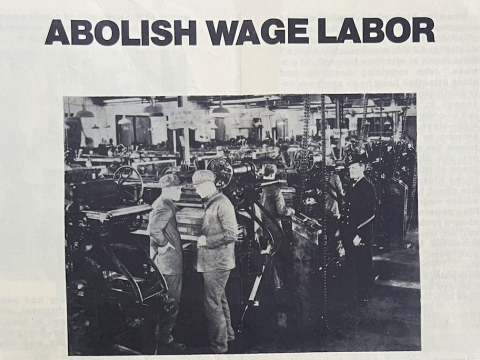
A short history of the refusal of work as a revolutionary strategy.

A strange delusion possesses the working classes of the nations where capitalist civilisation holds sway. This delusion drags in its train the individual and social woes which for two centuries have tortured sad humanity. This delusion is the love of work, the furious passion for work, pushed even to the exhaustion of the vital force of the individual and his progeny.'

Apocalypse and survival - Francesco Santini

A harrowing intellectual biography and review essay devoted to the life and works of Giorgio Cesarano, interwoven with an account of the Italian “radical current” of 1968-1978, when revolutionary expectations ran high but, for the few consistent revolutionaries caught between the terrorism of the state and the armed groups, the hostility of the Stalinist and crypto-Stalinist political formations, and a ruthless and sweeping repression, the results were often madness, prison, suicide and a wave of disillusionment that devastated the revolutionary milieu.

Apocalypse and survival: Reflections on Giorgio Cesarano's book, Critica dell’utopia capitale, and the experience of the radical communist current in Italy

By Francesco Santini (1994), Spanish translation by Carlos Lagos P. Original text in Italian at: http://www.autprol.org/public/news/apoeriv.htm
English translation from Spanish completed January 2013

Storming the West - Celluloid Liberation Front

Film theory on the spaghetti western films of the 1960s and 70s and how they were informed by the revolutionary conditions in the real world.

"I remember we used to wear the same dusters from The Wild Bunch or the one James Coburn wore in Duck, You Sucker!" —Francesco Piccioni (Red Brigades member)

Fire and flames: A history of the German autonomist movement

German autonomen

Fire and Flames is no detached academic study, but a passionate, hands-on, and engaging account of the beginnings of one of Europe's most intriguing protest movements of the last thirty years. An introduction by George Katsiaficas, author of The Subversion of Politics and an afterword by Gabriel Kuhn, a long-time autonomous activist and author, add historical context and an update on the current state of the Autonomen.

Fire and Flames was the first comprehensive study of the German autonomous movement ever published. Released in 1990, it reached its fifth edition by 1997, with the legendary German Konkret journal concluding that "the movement had produced its own classic." The author, writing under the pseudonym of Geronimo, has been an autonomous activist since the movement burst onto the scene in 1980-81.

Educate, disempower, destroy

The Imaginary Party on the NUS, the prospects for higher education and students and how the latter can organise around their material interests.

We all know what’s happening. The NUS has called its annual demonstration today just like it has done every single year since 1997 – with the exception of course of 2011, probably the one year when such an event could of had an impact. It’s what they do with disarming regularity. The NUS has no intention of fighting for anything at all, let alone winning.

Two short stories - Nanni Balestrini

Nanni Balestrini was born in Milan in 1935. Known both as an experimental writer of prose and verse and as a cultural and political activist, he played a leading role in avant-garde writing and publishing in the sixties. His involvement with the extra-parliamentary left in the seventies resulted in terrorism charges (of which he was subsequently acquitted) and a long period of self-imposed exile from Italy.

Let A Thousand Hands... is an extract translated from the novel La Violenza Illustrata (Einaudi, 1976). Using one of Balestrini’s favorite techniques, it is a montage of newspaper reports of the death of Mara Cagol, one of the founders of the Red Brigades.

FIAT (1977) is a first-hand account of work (or its refusal) at the infamous FIAT plant in Turin, Italy.

The unseen - Nanni Balestrini

For a brief explosive period in the mid-1970s, the young and the unemployed of Italy’s cities joined the workers in an unexpectedly militant movement known simply as Autonomy (Autonomia). Its “politics of refusal” united its opponents behind draconian measures more severe than any seen since the war.

Nanni Balestrini, the poet of youth rebellion, himself a victim of that repression, has invented a remarkable fictional form to express the hopes and conflicts of the movement.

What the hell is the family?

A text translated by Evan Calder Williams from Rosso, an Italian communist journal, from 1974. It’s written by the rather formally named “Study Group on the Family In Collaboration with the Workers’ Committee ALFA-FACE-IBM.” It is, in short, an attempt to figure out the economic and ideological function of the family form, particularly in its Italian incarnation.

That is to say, a very strong, deeply embedded, and quite particular incarnation.) Many of its analyses won’t be particularly surprising to some readers, as it draws on the better-known texts of Dalla Costa and James and on the theses of Lotta Femminista more generally.

What do the autonomen want?

A 1988 critique from the Ruthless Criticism group of the "autonomen".

The worldview of the Autonomen is quite simple. It is only them and the “pigs” with their “system.”

With “hatemasks” and “slingshots” ...

On the Black Bloc - Salar Mohandesi

A critique of the black bloc, which the author sees as coming from a specific context, time and struggle. Now, stripped of these things, it has become both a tactic and identity with an implicit strategy of grabbing attention or creating autonomous space through street fighting and property destruction.

The “internecine ultra-left argument of the moment,” says the Wall Street Journal, is the debate over the “black bloc.” And if this debate has led the WSJ to talk about “ultra-leftism,” it’s clearly a debate we have to address.