autonomist Marxism

Invaders from Marx: on the uses of Marxian theory, and the difficulties of a contemporary reading - Michael Heinrich

The following text is the slightly reworked version of an article which appeared on 21 September 2005 in “Jungle World”, a leftist German weekly newspaper. In a previous issue, Karl Heinz Roth. one of the main German representatives of Operaismo, had argued that some important Marxian categories are not able to grasp contemporary capitalism. The text at hand answers this critique, stressing the difference between Marxian theory and traditional Marxism, emphasizing the “new reading of Marx”, which developed through the last decades. The German text can be found at the website of the author: www.oekonomiekritik.de

In the past 120 years, Marx has been read and understood in widely varying ways. In the Social Democratic and Communist worker’s movement, Marx was viewed as the great Economist, who proved the exploitation of the workers, the unavoidable collapse of capitalism, and the inevitability of proletarian revolution.

No peace in the class war

Article by Swedish group Kämpa Tillsammans on class composition in Sweden and the syndicalst 'register method'.

Revolutionary perspectives today: society is a factory

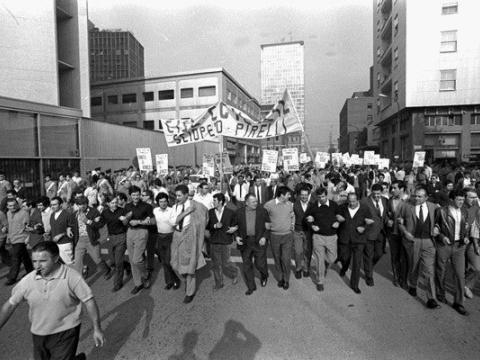
1962-1973: Worker and student struggles in Italy

A history of the wave of strikes and occupations that gripped Italian factories and universities during the 1960s. Coming to a head with the Hot Autumn of 1969, independent forms of struggle used by workers represented a significant attempt to break from restrictive trade unions.

Rising from a period of centre-left coalition that had been marked by a constant failure to bring promised reforms to Italian society, the struggles of the 1960s acted as a pressure gauge for many sections of the Italian working class, one which was to reach its climax during the mass strikes of 1968-1970.

Italy 1977-8 - 'Living with an Earthquake' - Red Notes

Documents, personal accounts and analysis - from a time when a very high level of class struggle dominated Italian society. Despite their differences - the state, church, fascists, Communist Party and unions were all united in opposition to the the radical social movement.

Link to PDF of pamphlet.

Published by Red Notes, London, UK, late 1970s

Cattivi Maestri: Some Reflections on the Legacy of Guido Bianchini, Luciano Ferrari Bravo and Primo Moroni - Steve Wright

Students in Italy, 1968

Steve Wright's analysis of the ideas of three Marxists who, along with Antonio Negri, were accused of being the "evil masters" of red terrorism in 1960s and 1970s Italy.

Cattivi Maestri: Reflections on the Legacy of Guido Bianchini, Luciano Ferrari Bravo and Primo

Steve Wright

You were like one who, traveling by night,

Carries the torch behind - no help to him -

But he makes those who follow him the wiser.(1)

Libertarian Marxism's Relation to Anarchism - Wayne Price

The current world-wide revival of anarchism is premised on the decline of Marxism. Yet there remains a strand of Marxism (libertarian or autonomist Marxism) to which anarchists often feel close and whose followers often express a closeness to anarchism.

Its libertarian-democratic, humanist, and anti-statist qualities permit anarchists to use valuable aspects of Marxism (such as the economic analysis or the theory of class struggle). Yet it still contains the main weaknesses of Marxism. And in certain ways it has the same weaknesses of much of anarchism, rather than being an alternative.

Darkness at midnight: Review of Midnight Oil - Work, Energy, War, 1973-1992 by Midnight Notes

Kuwaiti oil fields burn

A review of an anthology of articles by the US autonomist Marxist-influenced Midnight Notes collective and the earlier Zerowork group.

From issue no. 17 of the Wildcat (UK) journal.

=============
DARKNESS AT MIDNIGHT


There and back again: mapping the pathways within autonomist Marxism - Steve Wright

Steve Wright analysis different currents of autonomist Marxism, centred in Italy from the 1960s and 70s to today.

How to interpret the contours of autonomist Marxism over the past quarter century? Before 1979, any discussion of the topic would necessarily have centred upon the Italian experience.

A libertarian Marxist tendency map

This tendency map was produced by Chris Wright for endpage.com, now part of the libcom.org library - it is designed to trace some of the important tendencies in libertarian Marxism. Contains a brief written history with links to key individuals, groups and publications, and a graphic map.

To help navigate the site, this is a rough, textual "family tree" of libertarian Marxism. Please refer to the Companion Map for a graphical guide to these currents

Syndicate content