interviews
Archive of interviews with radicals and working class activists on libcom.org.
Interview with Kurdish anarchists, 2010
The spanish anarchist site alasbarricadas.org interviewed last month members of the exiled Kurdistan Anarchist Forum. Here is the full interview:
Where are you based? I mean, are you living in Kurdistan or in exile or have you emigrated to other places inside Turkey or abroad?
KAF We are mainly based in different countries in Europe: UK, Germany, France and Sweden. We are Kurdish but originally from Iraq not from Turkey. We all immigrated to Europe at different times but all for political reasons.
The laws are for exploitation and there is freedom to exploit beyond the law
Interviews with factory workers in Gurgaon, India, about their conditions and whether they meet legal requirements.
The law: wages for a month of work have to be paid by the 7th to 10th of the subsequent month; the daily working-time is eight hours, the maximum overtime allowed is 50 hours in three month; overtime has to be paid by double rate; the minimum monthly wage defined by the government of Haryana for an unskilled helper-worker is: 2, 484.28 Rs; this is based on an eight hours day and four days off per
The Gurgaon call centre hub
Text from autumn 2006 giving an overview on the call centre hub in Gurgaon, including interviews with workers.
Gurgaon is a satellite town in the south of Delhi, a new development area. The area is characterised by the automobile industry. Maruti/Suzuki, India’s biggest car manufacturer, and Hero Honda and Honda Scooters and Motorcycles India, Indians biggest two-wheeler manufacturers have their plants and suppliers in Gurgaon.
Hell’s bells: call centre and workers in global movement
Information and interviews on call centre work and struggles in Romania and India from January 2010.
It seems that with the crisis a last push of global re-location of call centre and IT related services take place. IBM announces to cut thousands of jobs in the global north while adding 5,000 jobs to its India centres. Though the interview with Convergys workers reveals that the call centre Mekka Gurgaon is not left untouched by the slump either.
Struggle at Wipro in Romania
"Anarchists had more of a stomach for the fight": interview with Juan Carlos Mechoso
2001 interview with the co-founder of the Federación Anarquista Uruguaya (FAU). From the pamphlet The Federacion Anarquista Uruguaya (FAU) : Crisis, Armed Struggle and Dictatorship, 1967-1985 available from Kate Sharpley Library.
Juan Carlos Mechoso does not need much coaxing to turn to his subject – the El Cerro district [Montevideo] – a subject that loosens his tongue and stirs him more than any other.
Robert Hullot-Kentor with Paul Chan
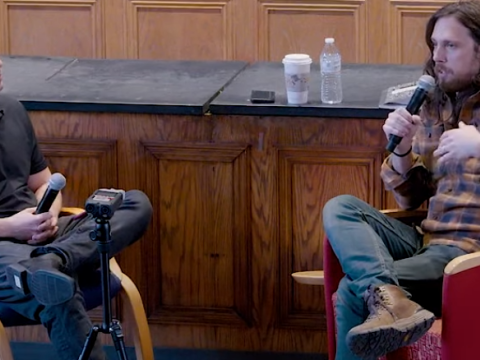
One early evening in February, on the occasion of his new book, Things Beyond Resemblance, the translator, critic and philosopher Robert Hullot-Kentor sat with the artist Paul Chan at the The Brooklyn Rail’s HQ in Greenpoint, where they exchanged reassessments of Adorno’s life and philosophy.
Paul Chan (Rail): You have a few new books. There’s your collected essays on Adorno, Things Beyond Resemblance, which was just published. And then there’s something called Current of Music, which I guess is a reconstruction of a book Adorno was writing when he lived in New York City in the late 1930s?
[b]
Robert Hullot-Kentor in Conversation with Fabio Akcelrud Durão
One recent afternoon, Fabio Akcelrud Durão, a Brazilian literary theorist, paid a visit to the home of Robert Hullot-Kentor in Manhattan. The following is the result of their discussion of Adorno’s theory of a “web of unknowing,” psychoanalysis and politics, apocalypse, what words not to use, the gratuitous plural, and what art is.
Fabio Akcelrud Durão (Rail): I’ve always found Adorno’s idea of a societal “web of unknowing,” or “web of delusion”—what he calls the Verblendungszusammenhang—provocative and important. Could we discuss this idea and consider the concrete political relevance it might have for the present in such different contexts as those of Brazil and the U.S.?
[b]
CLODO Speaks
Interview with French saboteurs of a nuclear power project.
Sporadic acts of sabotage against companies involved in nuclear plant construction began to take place in the region of Toulouse, France in mid-1979. This occurred at the height of vigorous, broad-based regional opposition to the construction of the GOLFECH nuclear power plant on the Garonne River.
YES WE CA$H!- Welfare struggles and precarity in Italy
An interview with a new campaign for a social wage in Emilia-Romagna, Italy, formed in the wake of Onda Anomala movement last year.
The current phase of welfare struggles (in countries that have welfare to struggle over) is of defensive struggle against their erosion by neo-liberal re-imposition of work and privatisation. However, Italy is potentially moving in another direction as the crisis has highlighted the problems of welfare with even liberal commentators advocating the extension of welfare benefits.