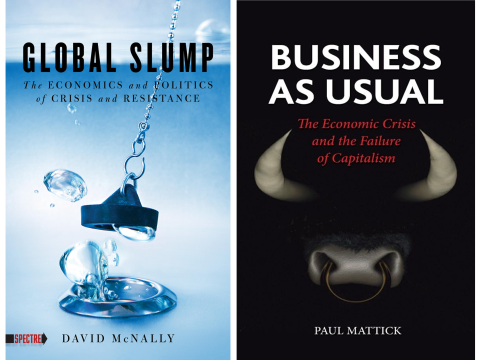
Paul Mattick

Mattick, Paul

German council communist and active member of the 1918 German Revolution who emigrated to the USA and wrote widely on the German and Russian revolutions and the Marxist critique of political economy.

The permanent crisis: Henryk Grossman’s interpretation of Marx’s theory of capitalist accumulation - Paul Mattick

Paul Mattick

Mattick's classic work on the economic theories of Henryk Grossman and the dynamics behind the inevitable downfall of capitalism.

Introduction

The German Revolution - Paul Mattick

Berlin, 1919

The German Revolution, chapter 7 from Mattick's work Reform or Revolution, looks at the events upsurge of working class militancy in Germany during November 1918.

Contrary to Bolshevik expectations, the Russian Revolution remained a national revolution. Its international repercussions involved no more than a growing demand for the ending of the war. The Bolsheviks’ call for an immediate peace without annexations and reparations found a positive response among the soldiers and workers in the Western nations.

Bolshevism and Stalinism - Paul Mattick

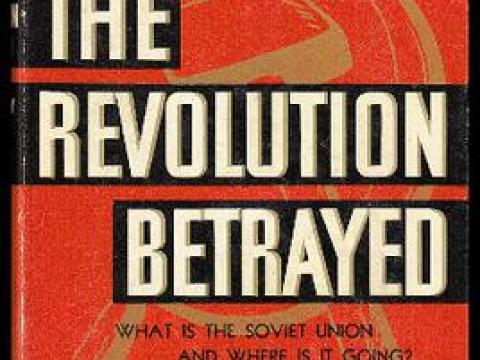
Mattick analyses "the superficiality of the ideological differences between Stalinism and Trotskyism" and why "Trotsky's own past and theories", with his role in the construction of the Russian regime, "condemned 'Trotskyism' to remain a mere collecting agency for unsuccessful Bolsheviks".

Article source: The Council Communist Archive - www.kurasje.org

The largest collection of Mattick's work is at the Paul Mattick homepage - http://www.home.no/mattick/

'Bolshevism and Stalinism' was originally published in Politics Vol. 4 - no. 2 - Mar/Apr 1947.

Anti-Bolshevist Communism in Germany - Paul Mattick

Rosa Luxemburg

The council-communist Paul Mattick looks back at the German revolution he participated in.

He describes the conflicts and tensions between the various political factions; between communist revolutionaries and social democracy, between German revolutionaries and Russian Bolshevism. He discusses reasons for the failure of the revolution in the context of the wider international situation and the development trends of capitalism.

"The Barricades Must Be Torn Down": Moscow-Fascism in Spain - Paul Mattick

On May 7, 1937, the CNT-FAl of Barcelona broadcast the following order: "The barricades must be torn down! The hours of crisis have passed. Calm must be established.

The Limits Of Matticks Economics - Ron Rothbart

The Limits Of Matticks Economics

Economic Law and Class Struggle

Ron Rothbart

Mattick, Paul, 1904-1981

Paul Mattick

A short biography of German council communist tool maker-turned academic Paul Mattick.

Born in Pomerania in 1904 and raised in Berlin by class-conscious parents, Mattick was already at the age of 14 a member of the Spartacists’ Freie Sozialistiche Jugend. In 1918, he started to train as a toolmaker at Siemens, where he was also elected as the apprentices’ delegate on the workers’ council of the company during the German revolution.

Economics, Politics and The Age of Inflation

Comprising of six articles written in the years between 1974 and 1978, Economics, Politics and the Age of Inflation is a study of the role of the state in economic affairs. In making this analysis, Mattick shows us the interconnections between the phenomenal world of capitalism and the social production relations

Economic Crisis and Crisis Theory

Keynesian economics claimed to have overcome the problem of economic depressions. However, as Mattick argues, these crises are inherent within capitalism and neither the market not Keynesianism can stop "the steady deterioration of the economy". Written in 1974, Economic Crisis and Crisis Theory is one of Mattick's most valuable contributions to Marxist economics and radical theory in general

Spontaneity and Organisation

The question of organisation and spontaneity was approached in the labour movement as a problem of class consciousness, involving the relations of the revolutionary minority to the mass of the capitalistically-indoctrinated proletariat. It was considered unlikely that more than a minority would accept, and, by organising itself, maintain and apply a revolutionary consciousness.

Marx and Keynes

Classical economy, whose beginning is usually traced to Adam Smith, found its best expression and also its end in David Ricardo. Ricardo, as Marx wrote, "made the antagonism of class-interest, of wages and profits, of profits and rent, the starting-point of his investigation, naively taking this antagonism for a social law of nature.

The Masses & The Vanguard

Economic and political changes proceed with bewildering rapidity since the close of the world war. The old conceptions in the labour movement have become faulty and inadequate and the working class organizations present a scene of indecision and confusion.

Lotta Continua Interview with Paul Mattick

WE SEEM TO BE ENTERING INTO A NEW PERIOD OF SERIOUS ECONOMIC AND SOCIAL CRISIS. WHAT ARE THE NEW FEATURES OF THIS PERIOD, IN COMPARISON WITH THE 1930's

Paul Mattick Interview by J.J. Lebel

This interview was given in February 1975. It was never published. Initially it was aimed to be part of a radio programme on workers' councils which never went on the air. A French translation was added to the second French edition of Workers' Councils (Spartacus, November 1982). Reprinted from Vol. 4 "Workers Councils" -- Anton Pannekoek (ECHANGES), where it appeared as an appendix

Otto Ruhle and the German Labour Movement

Otto Rühle

Paul Mattick critically analyses Otto Rühle's role in the German Revolution

[b]Section I[/b]
Otto Ruhle's activity in the German Labour Movement was related to the work of small and restricted minorities within and outside of the official labour organisations. The groups which he directly adhered to were at no time of real significance. And even within these groups he held a peculiar position; he could never completely identify himself with any organisation.

Rosa Luxemburg in Retrospect

It will soon be sixty years since the mercenaries of the German social-democratic leadership murdered Karl Liebknecht and Rosa Luxemburg. Although they are mentioned in the same breath, as they both symbolized the radical element within the German political revolution of 1918, Rosa Luxemburg's name carries greater weight because her theoretical work was of greater seminal power.

The New Capitalism and the Old Class Struggle

"The proletariat is revolutionary or it is nothing." - Karl Marx

Critique of Marcuse and 'One Dimensional Man In Class Society'

"A Marxist shall not be duped by any kind of mystification or illusion." Herbert Marcuse

Luxemburg versus Lenin

Rosa Luxemburg as well as Lenin developed from the Social Democracy, in which both played important roles. Their work influenced not only the Russian, Polish and German labour movement, but was of worldwide significance. Both symbolised the movement opposed to the revisionism and reformism of the Second International.

Syndicate content