Russia

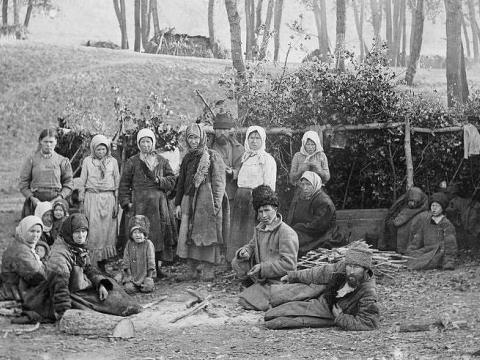
Russian Bauxite miners occupy mine shaft

After over a week of occupation of a mine shaft, the Russian miners returned to the surface, with the promise of compromise on key wage demands and the restoration of social programmes.

The occupation began on March 26th, with the workers producing a list of 11 demands including a 50% wage increase, and the restoration of previously suspended parts of the workers welfare packages.

Rogdaev, Nikolai 188?-1932 aka Uncle Vanya

A short biography of Nikolai Rogdaev, Trailblazer of Russian anarchism

Nikolai Ignatievich Rogdaev (Muzil) aka Uncle Vanya 188?-1932

Gorelik, Grigorii aka Anatolii, 1889-1956

A short biography of Grigorii Gorelik, Ukrainian anarchist participant in the Russian Revolution.

Grigorii Gorelik, usually known as Anatolii Gorelik was born into a Jewish family in 1889. He became an anarchist in 1904, at the age of fourteen. He was active in the Ukraine, and was arrested several times by the Tsarist police.

Yarchuk, Efim, 1882 or 1886-1937

Kronstadt sailors in 1917

A short biography of Efim Yarchuk, who played an important role in the rebellious town of Kronstadt.

Yarchuk, Efim Zakharovich aka Khaim Zakharev - Also rendered as Yarchook, Yartchuk, Iarchuk etc.

“a man who enjoyed exceptional influence among the sailors and workers and whose idealism and devotion are matters of historic record” - My Disillusionment in Russia. Emma Goldman

Matiushenko, Afanasy Nikolaevich 1879-1907

Afanasy Matiushenko

A biography of Afanasy Matiushenko, who was one of the key mutineers on the Battleship Potemkin, immortalised by Eisenstein's film, which helped kick-start the 1905 Revolution.

Afanasy Nikolaevich Matiushenko
Also spelled Afanasiy Matyushenko, born 1879 - Kharkov, Russia, died 20 October 1907 - Sevastopol, Russia

The Potemkin mutineer
Afanasy Matiushenko was the son of peasants from Kharkov province in the Ukraine. He was born in 1879, in the village of Dergachi. His father had to give up the unrewarding work of farming to become a shoemaker.

Communism - Story of the Communist Party - Guy A. Aldred

Guy A. Aldred

Aldred's summary of the development of the official communist movement and of its external radical communist critics contains a wealth of detail.

[b]Published during World War II, it illustrates how Russian political intervention in China and Europe served Russian foreign policy interests and so worked against the possibilities of proletarian revolution.

1919-1922: The Workers’ Opposition

Leading Workers' Opposition activist, Alexandra Kollontai

A short history of a group within the Russian Communist Party that struggled against the increasing party bureaucracy and for trade union control over industry which, by 1922, had been forcibly disbanded by the party.

The Workers Opposition began to form in 1919, as a result of the policies of War Communism, which set a precedence for the domination of the Communist Party over local party branches and trade unions. During the civil war, the Workers Opposition began agitating against the lack of democracy in the Communist Party as a result of the centralising actions of the party’s bureaucracy.

1912: The Lena Massacre

A short history of the brutal suppression of a strike by Russian gold miners protesting low wages and inhumane working conditions in 1912.

Situated in the dense forest of south-east Siberia, the massive goldfields that lined the river Lena were, at the turn of the century, amongst the most profitable enterprises in the Russian Empire. The Lena Gold Mining Joint Stock Company (Lenzoloto), the principal owner of the majority of goldfields in the region, was running at profits of 7,000,000 roubles a year.

Counter-revolution and the Soviet Union - Gregori Maximov

The Red Army enter Tblisi, February 1921

Short essay by famous Russian anarchist, Gregori Maximov, on the defeat of the 1917 revolution by counter-revolution from within.

Taken from the Bulletin of the Kate Sharpley Library, No. 14 (March 1998), can also be found on the KSL website here.

Medvedev, Sergei Pavlovich, 1885-1937

Petrograd Soviet, 1917

Story of the life of Bolshevik metal worker and member of the Workers' Opposition group, Sergei Medvedev, who, like many others who criticised his party's bureaucracy, was executed by the party he spent the majority of his life serving.

Sergei Pavlovich Medvedev was a Russian Bolshevik revolutionary, metalworker, and trade union organizer. Born into a peasant estate, he grew up in the countryside near Moscow and in St. Petersburg. After receiving a primary school education, he began factory work at age thirteen. He first worked at the Obukhov factory in St. Petersburg and participated in the 1901 Obukhov strike.

Kollontai, Alexandra, 1872-1952

Alexandra Kollontai, 1952

Short biography of the Bolshevik feminist Alexandra Kollontai who played a crucial role in the Workers Opposition movement.

Alexandra Kollontai was a major figure in the Russian socialist movement from the turn of the century through the revolution and civil war. During periods of exile she was also active as a speaker and writer in Germany, Belgium, France, Britain, Scandinavia and the United States.

Women fighters in the days of the great October Revolution - Alexandra Kollontai

Revolutionary Russian women in 1905

In this article, written in 1927 (well after the Bolshevik consolidation of power), Alexandra Kollontai describes the leading role in which women played in Russian Revolution of 1917. Though heavily Bolshevik in focus, it describes well the activity of working class women in the revolution.

The women who took part in the Great October Revolution – who were they? Isolated individuals? No, there were hosts of them; tens, hundreds of thousands of nameless heroines who, marching side by side with the workers and peasants behind the Red Flag and the slogan of the Soviets, passed over the ruins of tsarist theocracy into a new future...

The Workers' Opposition - Alexandra Kollontai

Alexandra Kollontai at the International Women's Conference, 1921

Kollontai's pamphlet was one of the central theoretical works of the Workers' Opposition movement within the Bolshevik Party, arguing for increased union control of the economy and the debureaucratisation of the party hierarchy.

First published in Pravda, January 25, 1921 this text was banned in Soviet Russia in March of 1921, by resolution of the 10th Congress of the Communist Party. It was then printed in the Workers ' Dreadnought (by Sylvia Pankhurst), April 22 - August 19, 1921.

On the History of the Movement of Women Workers in Russia - Alexandra Kollontai

Written in 1919, Alexandra Kollontai's essay looks at the role of working class women in the history of Russian radicalism with particular focus on the 1905 revolution.

What year could be said to mark the beginning of the working women's movement in Russia?

Shliapnikov, Alexander, 1885-1937

Alexander Shliapnikov

Biography of working class Bolshevik, Alexander Shliapnikov, active in the Workers' Opposition movement who was eventually purged from the party and executed for his activities.

Alexander Shliapnikov was born in 1885 in Murom, Russia, into a Russian family belonging to the urban estate (meshchanstvo) and professing the Old Belief (a religious sect that split from the Russian Orthodox Church in the seventeenth century). His father died when he was three, leaving his mother to support four children by taking in washing.

Appeal of the 22 - Alexander Shliapnikov

Lenin and Trotsky with troops in Petrograd, 1921

Appeal by members of the Workers' Opposition group for support against Bolshevik forces trying to silence their dissent within the party. Distributed at the Eleventh Russian Communist Party Congress in 1922.

Dear comrades!

From our newspapers we have learned that the Executive Committee of the Communist International is discussing the “united workers’ front,” and we consider it our communist duty to inform you that in our country the “united front” is in bad shape not only in the broad sense of this term, but even in its application toward the ranks of our party.

Theses of the Workers Opposition - Alexander Shliapnikov

All Russian Central Council of Trade Unions members

Original thesis of the Workers' Opposition group within the Bolshevik Party, arguing for greater trade union control of the economy. Written in 1919, it was published in Pravda on January 25, 1921.

General Tenets

On the relations between the Russian Communist Party, the soviets and production unions - Alexander Shliapnikov

Thesis of Workers' Opposition member, Alexander Shliapnikov, given at the ninth Bolshevik Party congress in March 1920.

In it he argues for increased democracy within the party and for more control of the economy to be handed over to the unions.

1. The three-year experience of the Russian Revolution shows that the single force consciously fighting for the organization of society on communist foundations is the Proletariat.

The Truth about Kronstadt

Pravda o Kronshtadte (cover)

A translation of Pravda o Kronshtadte, produced by SRs shortly after the event in 1921.

This version is taken from: http://www-personal.umich.edu/~mhuey/HOME.html Copyright © 1992, 1998 by Scott Zenkatsu Parker.
The author permits the unlimited duplication, transmission, and distribution of this text with the proper citations for academic, educational, and non-commercial use only.

The Communist Left in Russia after 1920 - Ian Hebbes

A re-evaluation by the late Ian Hebbes of the continued existence of a Left Communist opposition within the USSR up until the 1930s.

Syndicate content