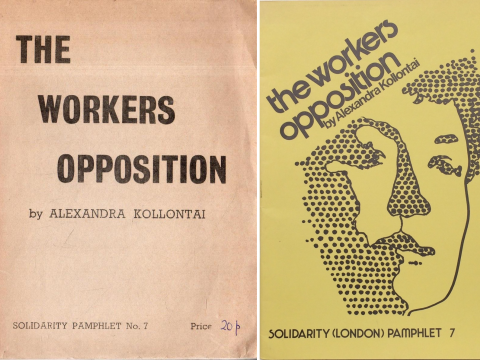
Solidarity

Solidarity

Solidarity was an influential libertarian socialist group based in the UK, active in industrial struggles and the anti-nuclear movement.

Heavily influenced by the ideas of Cornelius Castoriadis/Paul Cardan and his group Socialisme ou Barbarie, they left a large amount of important historical material and written information about workers' struggles of the time, and had a massive effect on the libertarian left in Britain.

Mount Isa: the great Queensland strike - Solidarity

Mount Isa: the great Queensland strike

Pamphlet by the UK Solidarity group on the 1964-1965 strike and lockout at the Mount Isa copper mine in Queensland, Australia, which placed miners in direct opposition to their union, employer and the Queensland State Government for almost seven months.

Revolution betrayed - the Workers Revolutionary Party and Iraq

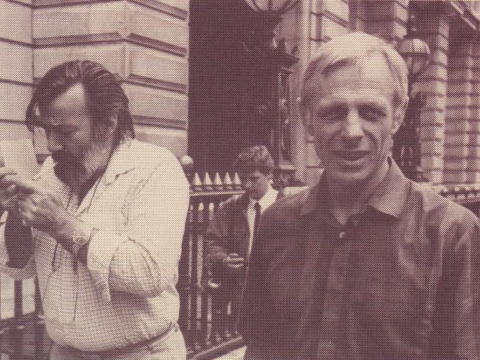
Gerry Healy early on, sharing the stage with Ted Grant and Sid Bidwell

Two articles from Solidarity on corruption in the Workers Revolutionary Party and its links with Saddam Hussein and other Middle Eastern governments.

THE REVOLUTION BETRAYED

A review of Joe Jacob's 'Out of the Ghetto' - Al Richardson

Joe Jacobs, 1950

A review of the late Joe Jacob's excellent autobiography. Growing up in London's Jewish East End, Joe was variously a Communist Party militant, anti-fascist, Trotskyist, and in his later years a member of the Solidarity libertarian socialist group.

Originally published in Vol. 5, No. 1 of the Trotskyist journal Revolutionary History.
Reprinted in Echanges et Mouvement no 80/81, 1996.

===========
Joe Jacobs - Out of the Ghetto; Phoenix Press, London, 1991
(Reviewed by Al Richardson)

On the Content of Socialism III - Socialisme Ou Barbarie

French libertarian socialist group Socialisme Ou Barbarie's third part of the Content of Socialism: The workers' struggle against the organization of the capitalist enterprise.

We have tried to show[1] that socialism is nothing other than people's conscious self-organization of their own lives in all domains; that it signifies, therefore, the management of production by the producers themselves on the scale of the workplace as well as on that of the economy as a whole; that it implies the abolition of every ruling apparatus separated from society; that it has to bring ab

Under new management - Fisher-Bendix occupation, 1972

Solidarity's excellent eyewitness account, with background information, of the Fisher-Bendix factory and offices against closure. The workers also implemented certain new aspects of work policy.

The workers at Fisher-Bendix, Kirkby near Liverpool, occupied the entire factory and offices on Wednesday, January 5, 1972. This action by all the workers, manual and non-manual, represents an advanced form of struggle.

On the Content of Socialism II - Socialisme Ou Barbarie

Very detailed article by French libertarian socialist group Socialisme Ou Barbarie on "the development of modern society and what has happened to the working-class movement over the last 100 years" and how they "have compelled us to make a radical revision of the ideas on which that movement has been based."

The Labour Government vs. The Dockers 1945-1951

LABOUR GOVERNMENT VS THE DOCKERS 1945-1951
SOLIDARITY PAMPHLET 19 / 5p

***********************************************************************

INTRODUCTION TO FIRST REPRINTING ( SPRING 1965 )

The New Movement

Influential in its day and expressing the optimism of its times, this text describes the characteristics of the New Movement of class struggle of the 1960s and 70s and its relationship to the Old Movement: "These tendencies towards autonomy and the original forms, be they open or diffuse, that they take, come up

Recollections of my time in Solidarity

Recollections of my time in Solidarity

I thought I'd try and put down some recollections of my time in Solidarity and what I remember about the organisation. I actually joined in the late 70s and was a member for about four years, during the time that we were producing the magazine Solidarity for Social Revolution.

The Commune: Paris 1871 - Solidarity

P. Guillaume and M. Grainger

Solidarity Pamphlet 35

I. THE COMMUNE... FROM MARX TO TROTSKY.

'Each time we study the history of the Commune we see something new in it, thanks to the experiences gained, in later revolutionary struggles...' Thus wrote Trotsky in 1921, in his preface to a book by Tales[1] which was to become basic reading for a whole generation of French revolutionaries.

The malaise on the left

Among thinking socialists there is a deep malaise. The purpose of this article is to explore the roots of this malaise, and to show that they lie in the transformations of class society itself. Over the last few decades - and in many different areas - established society has itself brought about the number of the things that the revolutionaries of yesterday were demanding. This has happened in relation to economic attitudes, in relation to certain forms of social organisation, and in relation to various aspects of the personal and sexual revolutions. When this adaptation in fact benefits established society, it is legitimate to refer to it as "recuperation". This article seeks to start a discussion on the limits of recuperation.

Capitalism and socialism

For the traditional socialist "raising the standard of living" is the main purpose of social change. Capitalism allegedly cannot any longer develop production... It seems to be of secondary importance to this kind of socialist that under modern capitalism people are brutalised at work, manipulated in consumption and in leisure, their intellectual capacity stunted or their taste corrupted by a commercial culture. One must be "soft" it is implied, if one considers the systematic destruction of human beings to be worth a big song and dance.

Portugal: The Impossible Revolution?

Phil Mailer of Solidarity's excellent history and analysis of the Portuguese Revolution from 1974-1976.

:> Buy Portugal: The Impossible Revolution? now

Theses On The Chinese Revolution and Cultural Revolution

Theses On The Chinese Revolution and Cultural Revolution

By Cajo Brendel Solidarity (U.K.) Pamphlet # 46 (1974)

Preface to the Second English Edition

Suicide for Socialism? - Brinton on the Jonestown massacre, 1978

Mass death "for socialism": Jonestown

Maurice Brinton's analysis of the bizarre mass suicide of a socialist cult led by American Jim Jones in Jonestown, Guyana. Discusses political sects in general.

'We're gonna die for the revolution. We're gonna die to expose this racist and fascist society.

Paris: May 1968 - Maurice Brinton's diary

Paris '68

A vivid and exciting eyewitness diary by Maurice Brinton (the writing pseudonym of Chris Pallis) of Solidarity on the events in Paris in May 1968.

Despite the optimism of the time, however, Brinton does not get too swept up in the events, and unlike some accounts of the time, manages to keep his views firmly rooted in reality.

Paris:May 1968
First edition published by Solidarity, June 1968 This edition published jointly by Dark Star Press and Rebel Press, 1986

Introduction

The Irrational in Politics

The Irrational in Politics

Maurice Brinton, 1970

Propaganda and policemen, prisons and schools, traditional values and traditional morality all serve to reinforce the power of the few and to convince or coerce the many into acceptance of a brutal, degrading and irrational system.

(AS WE SEE IT - Solidarity)

N.B. There are some patriarchal and offensive comments in this essay.

As We See It / Don't See It

By Solidarity London, it is an introduction to the ideas and activity of the group Solidarity. As We See It is followed by As We Don't See It, a series of clarifications and explanations published later, and later revisions to both.

These texts were taken from the on-line Solidarity and Subversion archive at af-north.org

Syndicate content