South Korea

Strikes and lockouts in South Korea

As the economic recession hits South Korea, striking car workers have been locked out of their factory while earlier in the week construction workers go on strike in and around Seoul.

Ssangyong Motor Company has locked striking workers out of its plant to stop them disrupting production at the carmaker, which is in bankruptcy protection.

Unionised workers at the South Korean automaker have been on strike since May 21, demanding management keep the assembly line workforce at current levels in a self-rescue plan the company is devising under a court order.

Workers in South Korea respond to mass redundancies with strike action

Workers at South Korean automaker Ssangyong Motor went on strike on Thursday in protest at plans for mass layoffs to save the firm from bankruptcy.

Assembly lines at its plant in Pyeongtaek, south of Seoul, stopped at 1:30pm, said union spokesman Lee Chang-Geun.

"Management should come to talk with the union on avoiding the proposed massive job cuts," Lee said, adding that the duration of the strike would be decided Friday.

South Korean government arrests 450 workers as general strike seems imminent

Police apprehended more than 450 labor activists Saturday after a violent protest in Daejeon which left about 150 injured. Labour unrest is set to escalate this month as truck drivers plan to strike and a major labour umbrella group pledged to join.

Thousands of Korean Confederation of Trade Unions members rallied in the city to mark the anniversary of the 1980 Gwangju Uprising. They mourned a unionized trucker who committed suicide earlier this month in what colleagues said was a protest against the government's policies.

Crackdown in South Korea as President Lee emphasises need for "labour market flexibility"

Nineteen former workers at the Kor-Tek guitar and bass factory in Dungchon, Seoul, have been indicted on serious charges relating to the occupation of the plant late last year. The charges, alongside similar cases, have led to protests from unions which describe them as “excessive” and “preposterous”.

The original dispute at the plant related to management plans to close the factory and move production to China. Workers quickly staged a sit-in strike, but this was broken up by police after only four hours. The strikers were rounded up, and two local union leaders were given one year sentences, which were later commuted to suspended sentences.

Seoul: police attack occupied building, kill protestors

Six dead, many injured and arrested after police attack protestors near American Military Base.

Yongsan in Seoul is to be "redeveloped", that is gentrified. This is effecting not only residents, but many small family-run businesses in the area. Members of the Committee of Residents Forced Out of Yongsan District 4 in Seoul and the National Coalition of Forcefully Relocated People decided on Jan. 19 to occupy a building in protest.

Korean workers ring in new year with strike for press freedom

Media workers demonstrate outside the national assembly, 30 December

Media workers have launched a general strike against a new set of state laws which they claim will enable the government to seize control of the press.

Thousands have been on strike since late December against the South Korean government's package of seven laws, the so-called MB laws, which they claim will restrict press freedom.

Around 4000 workers have joined the stoppage, from 74 newspaper and broadcasting companies, called by the the National Union of Media Workers.

Arrests of Korean trade unionists continue

Following a wave of strikes, the South Korean government has unleashed a massive attack against the Korean Metal Workers' Union targeting more than 75 of the union's key leaders for arrest or investigation.

With the recent arrest of Hyundai Motor Branch First Vice-President Kim Tae-gon on September 16 and the arraignment of Jung Gab-deuk, president of the Korean Metal Workers' Union (KMWU), on September 18 on charges of obstructing business, members of the KMWU are bracing for more assaults. Leaders of the Korean Confederation of Trade Unions have also been targets of arrest.

Korean three-year struggle against precariousness

Female precarious workers at Kiryung Electronics Satellite Radio plant in Seoul enter their 1,100th day of struggle.

Female precarious workers for the Korean firm Kiryung electronics today enter their 1,100th day of action in demand of direct employment.

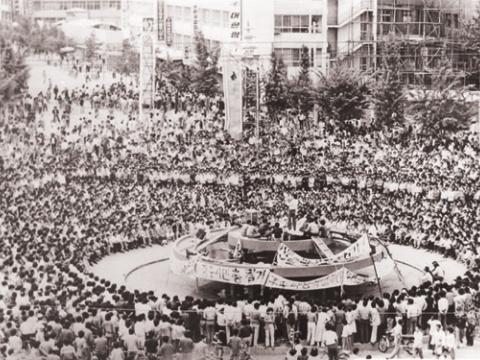
1987: The Great Workers' Struggle in South Korea

A short account of the South Korean strike wave of 1987 known as the Great Workers' Struggle. Affecting most major industries and involving over a million workers, the strikes and militant tactics used won significant gains in pay and conditions for many.

The workplace struggles that took place in 1987 occurred within the wider background of political reform. For thirty years South Korea had been ruled by a military dictatorship, and growing calls for democracy had echoed across the peninsula through the 1970s and early 80s.

South Korean government steps up conflict with candlelight demonstrators

demonstators and police face off in Seoul

150 South Korean protesters and bystanders have been rounded up by riot police.

Riot police in Seoul have stepped up their repression of the "candlelight demonstrations" in Korea, arresting around 150 people after a demonstration on August 15th. Police used water cannons filled with dye on the protestors, and used dye stains as a pretext for arrests.

Syndicate content