Sylvia Pankhurst

Radical London & The Workers Dreadnought in the early 1920s - Claude McKay

Arriving in London from the US in 1919, West Indian writer McKay describes in these excerpts from his autobiography how he became involved in radical circles and worked on Sylvia Pankhurst's Workers Dreadnought paper.

From; A Long Way From Home, Claude McKay; Pluto Press, London 1985. Originally published in 1937.

Comments on Pankhurst's "The Communist Party: Provisional Resolutions towards a Programme"

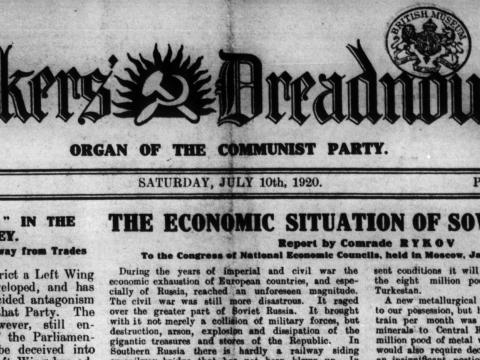
Workers' Memory, Comments on Pankhurst's "The Communist Party: Provisional Resolutions towards a Programme" (July 1920), from Communism #3

Introduction

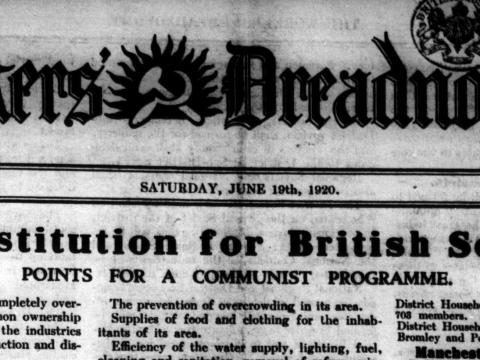
1920: The Communist Party - Provisional Resolutions towards a Programme

Communist Party

(British section of the Third International)

Provisional resolutions towards a programme

(As outlined at the conference of June 19th and 20th, 1920, for the consideration of branches and individual members, pending the National Conference to be held in September. Amendments and additions should be sent to the Secretary for the conference agenda.)

* * *

Anton Pannekoek's Letter to Sylvia Pankhurst

Anton Pannekoek's letter -

DEAR COMRADE,

1920s: Communism vs. Reforms: Mistakes of the Communist Party in Ireland

Limerick United Trades and Labour Council, 1919 - The Limerick Soviet

Pankhurst exposes the reactionary role of the Communist Party of Ireland and gives some background information on the Limerick and Cork soviets.

Online version by http://www.af-north.org

From "Workers' Voice", Liverpool, 1974

Communism And Its Tactics

Version One Part One

Workers Dreadnought VOL. VIII. No. 37 Saturday, November 26th, 1921

Under Communism all shall satisfy their material needs without stint or measure from the common storehouse, according to their desires. Everyone will be able to have what he or she desires in food, in clothing, books, music, education and travel facilities. The abundant production now possible, and which invention will constantly facilitate, will remove any need for rationing or limiting of consumption.

The Forgotten Keir Hardie

This article by Sylvia Pankhurst, written in 1921 is a rejoinder to an appreciation by long-standing British Marxist and early member of the Communist Party, John B Askew. Sylvia argues that Hardie was always a class struggle politician and more influenced by Marx than many would have credited. Certainly her view is supported by a recent biography by Fred Reid (Keir Hardie: the Making of a Socialist) who shows that Hardie's early battles as an organiser for the Scottish miners convinced him of the centrality of class struggle and made him receptive to Marxist ideas.

The British Workers and Soviet Russia

Pankhurst discusses the responses of British workers to the Russian Revolution and Allied intervention via the trade unions and Labour Party.

PREFACE

Syndicate content