syndicalism

Statement of the IWW for the international syndicalist reunion March 22 – 24 2013 Paris

A statement answering questions presented to the IWW in lead up to and presented at a conference on "alternative unionism" hosted by the SUD in France.

1.) Regarding Crisis of capitalism – what kind of answers, positions and contributions can alternative basic-democratic syndicalism give?

Syndicalism in modern society - SAC

SAC

A pamphlet published by SAC (The Central Organization of Swedish Workers) in 1963, laying out the organizations "new orientation" towards a more reformist syndicalism, with a strong focus on the cooperative movement.

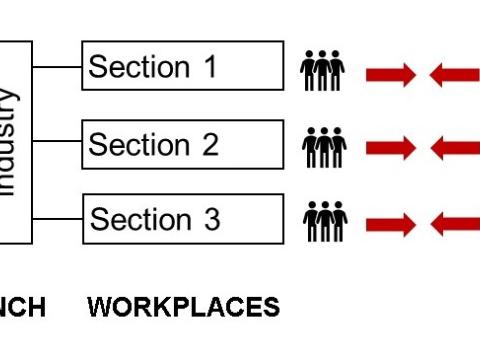
The 4 Phases of Syndicalism

Women in the cleaning sector and hotel-restaurant industry: syndicalist conversations

The purpose of these interviews is to provide an insight into the situation and the struggles of female workers in the cleaning sector and the hotel-restaurant industry. To this end, we have met cleaning and catering trade union members of the CNT-Solidarité Ouvrière in the Paris region.

More generally, we hope to encourage readers to think about the relationships between women's struggles and labour unions, from the perspective of emancipatory social transformation. Of course, this article does not claim to exhaust the subject, but rather elicit contributions.

Syndicalism: the modern menace to capitalism - Emma Goldman

In view of the fact that the ideas embodied in Syndicalism have been practiced by the workers for the last half century, even if without the background of social consciousness; that in this country five men had to pay with their lives because they advocated Syndicalist methods as the most effective, in the struggle of labor against capital; and that, furthermore, Syndicalism has been consciously practiced by the workers of France, Italy and Spain since 1895, it is rather amusing to witness some people in America and England now swooping down upon Syndicalism as a perfectly new and never before heard-of proposition.

It is astonishing how very naïve Americans are, how crude and immature in matters of international importance. For all his boasted practical aptitude, the average American is the very last to learn of the modern means and tactics employed in the great struggles of his day. Always he lags behind in ideas and methods that the European workers have for years past been applying with great success.

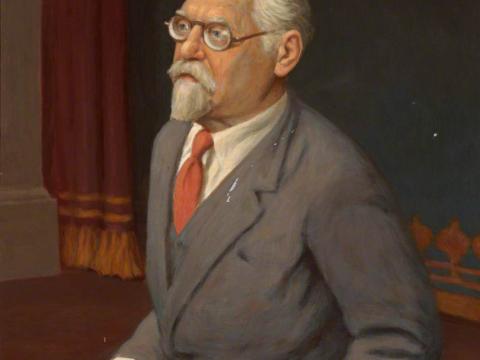
Tom Mann's memoirs

The personal memoirs of syndicalist Tom Mann. While we disagree with much of his politics, such as his support for the Stalinist Communist Party, we reproduce this text is an important addition to the history of the workers' movement in the UK.

Original introduction

Leaflet for which Tom Mann was jailed in 1912

The first issue of The Syndicalist reprinted a ‘Don’t Shoot’ letter originally published in The Irish Worker and written by a Liverpool building worker. Then a railway worker, Fred Crowsley, had it reprinted and personally distributed copies to soldiers at Aldershot. He was arrested, tried and sentenced to four months.

The editor of The Syndicalist, Guy Bowman, was given nine months and the printers, the Becks, of Walthamstow, got six. Tom Mann, chairman of the Industrial Syndicalist Education League which published The Syndicalist, was charged, like the others, under the 1797 Act. He wrote: February 1912, all of the miners had downed tools.

2nd world congress of the Comintern: Syndicalism and the party debate

A debate at the 2nd World Congress of the Comintern from July 19 to August 7, 1920 between Jack Tanner, Lenin and Trotsky over the specific position and point of the party and the role of the revolutionary minority. Raising left-wing objections to parties, and the problems it causes, especially in relation to ideological unity and leadership. Including a discussion of syndicalism and trade union relations with politics.

Jack Tanner (Shop Steward): Comrade Zinoviev placed the main emphasis in his report on the necessity of a Communist Party. This seems to me to be mistaken, as does the idea that the dictatorship of the proletariat coincides with the dictatorship of the Communist Party. What has now taken place in Russia cannot be a valid pattern for every country.

Fighting for ourselves: Anarcho-syndicalism and the class struggle - Solidarity Federation

Fighting for ourselves: Anarcho-syndicalism and the class struggle - Solidarity

This excellent book by Solfed aims to recover some of the lost history of the workers' movement, in order to set out a revolutionary strategy for the present conditions. In clear and accessible prose, the book sets out the anarcho-syndicalist criticisms of political parties and trade unions, engages with other radical traditions such as anarchism, syndicalism and dissident Marxisms, explains what anarcho-syndicalism was in the twentieth century, and how it's relevant - indeed, vital - for workers today.

[i]You can buy hard copies of Fighting for ourselves for £6 (including p&p) from Freedom Press (UK - £5 in the shop), and for $10+p&p from Thoughtcrime Ink Books (North America).

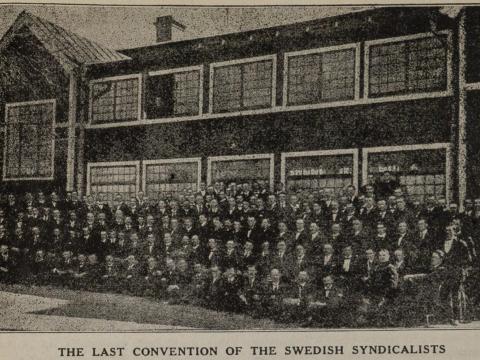
Second spring of syndicalism - trade union re-organisation within the SAC

An article by Mattias Wåg, first published in 2008 in From Thoughts to Action, summarising the Swedish syndicalist union SAC's re-organisation.

Lilla Karachi is hardly regarded as one of Stockholm’s more up-market restaurants. However, it has a good location at the centre of the tourist district of the Old Town and not very far from the Parliament once now and then, the MP’s stop by to eat.

Anarcho-syndicalism: history and action

A pamplet by DAM about the organisation, the history of syndicalism in the UK and the rebirth of anarcho-syndicalism. Scanned by and gratefully taken from The Sparrows' Nest.