Tunisia

Tunisia: Emergency state restructuring after an incomplete attempt at democratic insurrection - Mouvement Communiste and Kolektivně proti kapitálu

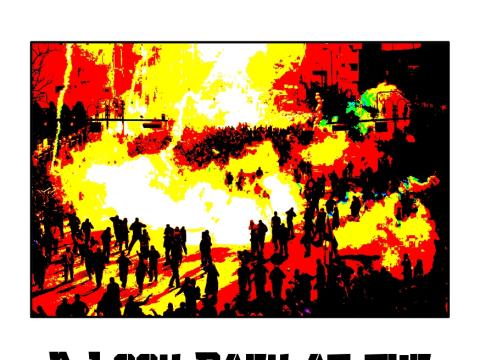
Tunis graffiti

Pamphlet by Mouvement Communiste and Kolektivně proti kapitálu about unrest in Tunisia at the beginning of 2011.

INTRODUCTION

Anarchist, Liberal and Authoritarian Enlightenments: Notes From the Arab Spring

Mohammed A. Bamyeh discusses the currents and contradictions within the revolutionary movements sweeping the Arab world, and their ultimate potential.

The Arab spring, as far as we can see, appears to require no guardian intellectual authority, no political leadership, no organized parties.

The UGTT: caught between struggle and betrayal

The Union Générale Tunisienne du Travail (UGTT - Tunisian General Labour Union), the sole union in Tunisia up to now, has for many years played an ambiguous role as part of the dictatorial state apparatus with multiple links to the ruling party while being at the same time the centre of combative, independent trade unionism.

Both poles have coexisted because they needed each other. The UGTT's bureaucratic leadership apparatus has needed, and now needs more than ever, this veneer of militancy and struggle that the militant sector gives the union in order to maintain its share of power within the state apparatus and to survive the dictatorship in circumstances such as those at present.

In the heart of Tunisia. Thala: the occupied police station

The second instalment of a series of reports from a couple of CGT members visiting Tunisia. Here, the author visits the town of Thala in the northwest, where the people's protests led to the local police taking to their heels.

Thala, Kasserine governorate (province), 300 kms from the capital. A poor city, on the fringe, whose only resource is agriculture which depends on rainfall: wheat, prickly pears... without industry.

Tunisian committees to safeguard the revolution: the example of Bizerte

Since 14th January numerous committees to safeguard the revolution have been set up in many places throughout the country, with a variety of forms, constitutions and functions. Municipal bodies almost everywhere in Tunisia have been swept away, and temporary bodies for managing municipalities have taken their place.

The form and make-up of these institutions depends on the balance of forces in each locality. In some cases, they have been created on the basis of proposals by the committees to safeguard the revolution, in others they maintain links with the old local political bosses.

The Bizerte committee to safeguard the revolution

Converti, Nicolò, 1855-1939 and anarchism in Tunisia

A short biography of Nicolò Converti, an Italian anarchist who was active in the Tunisian workers' and libertarian movements.

Born in Roseto Capo Spulico (in the province of Cosenza, Calabria) on 18 March 1855, his parents were Leonardo and Elisabetta Aletta, both from well-off families. He attended primary school in Calabria and moved to Naples to attend high school, where his teacher for the final year was Giovanni Bovio.

Understanding the period - Class analysis and events in the Arab world

Article by the Turkish section of the ICC outlining the nature of the recent events in Tunisia, Egypt, and Libya and across the Middle East and trying to draw an understanding of the current situation internationally.

1. What is going on and why it is important to understand it.

Mass mobilisation, ‘democratic transition’ and ‘transitional violence’ in Africa

Johannesburg libertarian militant Michael Neocosmos on how 'democratic transitions' are about handing power over to (often neo-colonial) 'experts'.

by Michael Neocosmos, 31 March 2011

First strong points on the last revolts in Arab countries

Mouvement Communiste and Kolektivne Proti Kapitalu on the North African and Middle Eastern revolts of 2011.

First point

The era of riots has started…

The era of riots has started…

Leaflet circulated on 23 February 2011 in the general strike demonstrations in Athens and Thessaloniki, Greece.

Nothing explodes like an oil refinery and the insurgents tend to like burning things ...
(Statement by Financial analyst in Aljazeera)

The transitional phase of the crisis: From restructuring to rebellion