workers councils

Workers' councils are bodies in a given locale (containing a mix of workers, peasants and soldiers depending on where they are) which are formed when large numbers of workers come together to defend their own interests against capital.

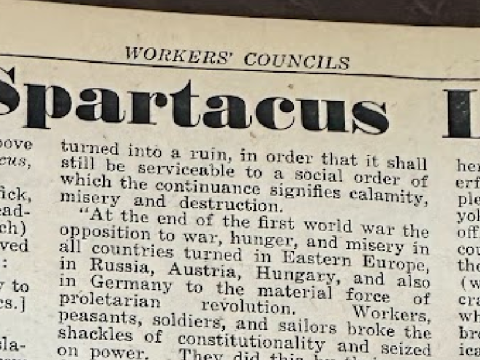
Working-class activity and councils - Germany 1918‑1923 - Peter Rachleff

Spartakists fighting - 1918

A survey of the main events and the limits of working class activity during the Revolution.

"[i]Without being conscious of it, the working class had conquered power in November of 1918. It had gone in its actions far beyond its explicit demands ‑‑ and far beyond the consciousness it had of its own activity and desires.

The Hamburg revolution - Heinrich Laufenberg

A participant's account of their involvement in the November 1918 rebellion in Hamburg, and the movement of workers' councils that developed from it.

Preface

The Communist Left in Germany 1918-1921 - Gilles Dauvé and Denis Authier

A analysis of the revolutionary movements in Europe at the end of World War I, their contradictions and limitations.

First published in France in 1976, as 'La Gauche Communiste en Allemagne (1918-1921)'. English translation by M. DeSocio published in 2006. Taken from the Collective Action Notes website.

Letter on Workers Councils - Anton Pannekoek

Letter written by Anton Pannekoek where he expounds his theories on the organisation and power of workers' councils.

This letter by Pannekoek was first published in the journal Funken, Vol. III No. 1, and June 1952. This translation has been made from the version published in the anthology of his writings Neubestimmung des Marxismus 1. Diskussion über Arbeiterräte. Introduction by Cajo Brendel. (Karin Kramer Verlag, Berlin, 1974).

Review - Workers' Councils by Anton Pannekoek - Red and Black Notes

Red and Black Notes review of Workers' Councils by Anton Pannekoek. The full text of Workers' Councils can be found here.

For many years, at least in the English speaking milieu, Anton Pannekoek was one of the most important, but least read theorists of the communist left. While the Internet has gone considerable distances to rectifying this problem, outside of small run publications, little of Pannekoek's work is in print.

A constitution for British soviets. Points for a communist programme - Sylvia Pankhurst

Pankhurst outlines her vision of how a system of soviets might be applied to Britain.

The capitalist system must be completely overthrown and replaced by the common ownership and workers' control of the land, the industries of all kinds and all means of production and distribution.

Parliament must be abolished and replaced by a system of Soviets formed by delegates from the industries, the homes, the regiments and the ships.

The Role of the Soviets in Russia's Bourgeois Revolution - The Point of View of Julius Martov

Julius Martov

Questions the assumption that the form of working class organisation to overthrow capitalism and establish socialism has been found in the workers' "soviets" or councils such as those that appeared during the Russian revolution. Looks at Martov's work "The State and the Socialist Revolution".

This article originally appeared in the French political journal, <i>Economies et societes, cahiers de l'ISMEA</i>, (Paris, serie S, Number 18, April-May 1976)

The basic principle defended by Marx throughout his forty years of socialist activity can be summed up in the clause of the General Rules of the First International that "the emancipation of the working class must be conquered by the working classes themselves".

Workers in Ukraine occupy factory building

Workers occupy Kherson Engineering Factory, elect a workers' council and list their demands.

The workers of the Kherson Engineering Factory occupied an administrative building on the premises at 9.30 today. The factory guards offered little resistance, and none of the occupiers were injured.

Statement by Komiteye-Hamahangi (Coordinating Committee to Form Workers Organizations in Iran)

Founding statement by Komiteye Hamahangi (or the Coordinating Committe to Form Workers Organizations in Iran). Founded in 2005 with the signatures of around 3,000 workers it looks to the founding of workers councils (shoras) in Iran.

A number of their members have been imprisoned. The most famous case being the Saqqez Seven, which includes Mahmoud Salehi.

On “Coordinating Committee to Form Workers Organization”

The ‘Coordinating Committee to Form Workers Organization’ is not a workers organization. This committee is an organized group of worker-activists struggling to meet the following aims:

The working class in Iran: some background - class struggles from 1979-1989 - Mostafa Saber

Oil workers strike - Iran 1978-79

Some excerpts from A Brief Look at the Situation of the Working Class in Iran, a short description of workers' history and conditions - and their struggles during and following the 1979 Revolution.

Of particular interest is the observation that "in practice the [workers'] councils, due to their complete accordance with workers' direct and immediate exercise of power, won an indisputable victory vis-a-vis the unions. The few attempts at creating unions remained irrelevant to the real workers' movement."

Syndicate content