Memories of butterflies and moths before the age of environmental planners: The wild life rich brownfield experience of Aycliffe Trading Estate, Co Durham in the 1950s.

A New Somewhat Differently Nuanced Intro Cum Addition by David Wise...... as part of a presentation to the Michel Prigent Commemoration Group in December 1923:
Heighington Station, Co Durham and the oldest passenger railway station in the world
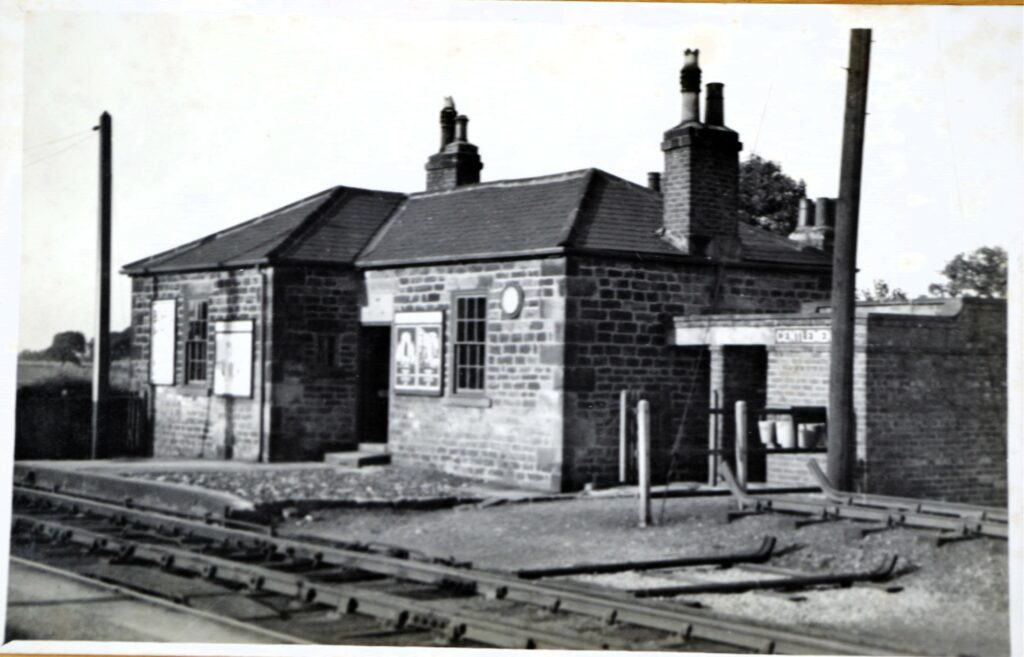
Above: Heighington Stn as we knew it as children in the late 1940s / early 1950s
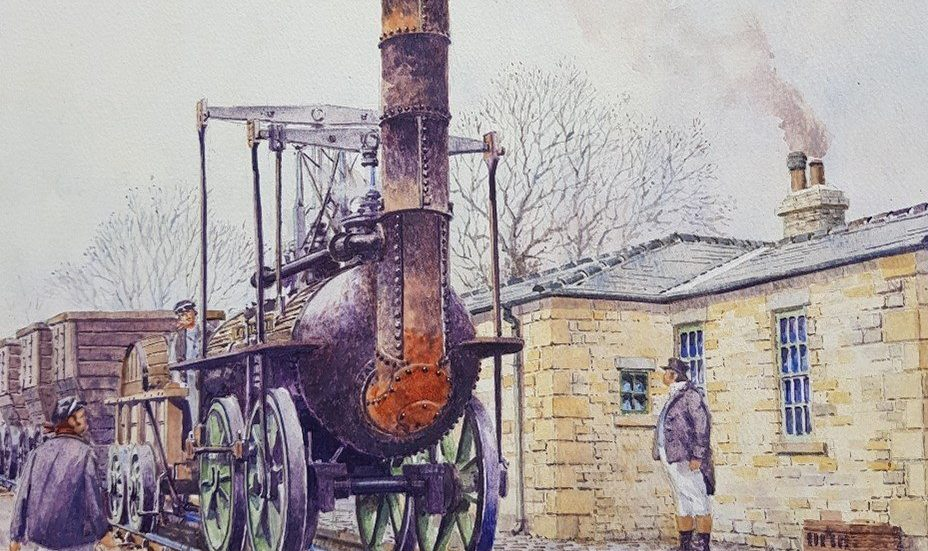
Above: The same station in 1825 as Locomotion Number One is put on the rails
One of the photos below in Stuart Wise's Street One & Codlings shows the row of railway workers dwellings (which we lived in adjacent to the station and built in stone around the same time as Heighington railway station was opened in the early 1820s. It thus became the very first passenger railway station in the world and where George Stephenson's Locomotion Number 1 was put on the rail heralding the opening of the Stockton and Darlington railway in 1825. Stuart and me lived in these cottages and on our allotment in the mid to late 1940s situated between the cottages and the railway ticket office plus porters room (see above) and goods yard when messing about we accidently dug up some of the old railway lines which supported Locomotion Number 1. These old, rusting lines were immediately handed over to York Railway Museum once adults realised what had been unearthed. Sadly the old stone cottages (see below) weren't preserved and were callously knocked down during the 1980s before a site of historical interest notification could be placed on them. Once I found out a few months later my heart was broken.....
Although Stuart's missive (below) to a top nature bureaucrat in northern Butterfly Conservation is remarkable for its wealth of local natural history knowledge of insects and plants, even if the remit kind of blocks a concomitant take on the equally remarkable rare bird life that could also be found there. For instance, Corncrakes could be regularly heard on the other side of the railway from our bedroom window, whilst at the back of the house in neighbouring fields, Nightjars would fly in the evenings .
However nature is not the subject I wish to comment upon here, rather it's the remarkable character and understanding of the railway workers who inhabited these cottages many of whom were also nature sensitive memorably revealing hare's nests (known as forms) to us hidden among long grass.
All the workers' families who resided here were left wing. Most belonged to, or had affinities with the old Independent Labour party of Kier Hardie and his ilk who were in their heyday before the onset of World War !. There was one exception; the signalman Fred Sturdy who was a member of the Communist party. Fred was paranoid as he was always getting attacked for his belief in Russian 'communism' , though not from a right wing perspective but from a more sophisticated ILP perspective which pointed out that the revolution in Russia was a failure and Lenin's victory merely a coup d'etat. However all this disagreement with Fred was done in a witty rather than a nasty put down way. Thus when the seasonal Autumnal - often huge - murmurations of starlings from Siberia arrived on the Durham coastal flatlands of which Heighington was just to say a part of, neighbours would joust to Fred commenting that "Stalin's arrived". Also, one must put these comments in their historical context in and about a general fear stoked up by the USA after the end of World War 2 that Western Europe was about to fall to large Communist parties in Italy, Belgium and especially, France. Indeed, Fred had a tricolour flying in his backyard. (Historically the tricolour had been flown especially in areas of northern England - as against the union jack - in the long aftermath of the French Revolution of 1789.This was especially true of Bradford, itself perhaps the home of "physical force" Chartism right up to the early 1850s). However with Fred there was a more sophisticated 'modern' side suggesting that if the party took over in France considering the country's rebel history then a real grass roots, liberatory revolution would be instigated which would then spread over the rest of Western Europe far surpassing Tito's recent Yugoslavian experiment. It's a position still elucidated today among some intellectual circles mainly in academia. Nonetheless Fred felt paranoid and lonely and on a Friday night would get rotten drunk in the nearest pub well over a mile away in Aycliffe village, then stumble back home down an unlit dark tarmacked road ending up in his backyard situated just below our bedroom window. He then would throw up for a considerable time shouting "I wanna die, I wanna die" waking all of us up as we broke out into uncontrollable laughter tempered with sympathy for a fine neighbour!! After all from a young age we knew that signalmen often developed acute psychological problems due to isolation in their cabins plus their highly responsible positions. Indeed, around the same time a signalman who lived in Aycliffe village and worked on the main line from London to Edinburgh - and whom we knew through parents - committed suicide because he was held responsible for a few coal wagon derailments that delayed The Flying Scotsman for a few hours...
More or less, the atmosphere in these cottages was very friendly and neighbourly. Rarely was there any disputes.(actually I cannot remember anything really serious) and tramps were welcomed given money and food together with a dollop of Wesleyan trade union Methodism, even though the churches and chapels were too far away for any Sunday attendance and no one had a car. Nonetheless. Christmas and New Year and other occasions meant regular quite large get togethers. I nostalgically look back on them with delight and even as a child I often found the conversations intriguing from engine drivers mulling over difficult sections of local rail track to navigate, to train crashes, to more general takes on society at large. Remember too, this was the time of PM Clement Atlee's Labour government which in retrospect perhaps the most progressive government these islands ever had and there wasn't much of a visceral attack on Tories, rather a voice of progressive optimism about the future. Thus comments sometimes were pointedly directed towards us such as: "Hey lads when you are grown up, you won't have to worry so much about money as transport will be free and rents reduced to next to nothing" Such comments struck home though in a mild way as somehow or another we'd already felt such 'truths' in our bones .More importantly there was no indication in the atmosphere of the horrors to come, of neo-liberal economics and the growth of a kleptocracy implying the monetisation of almost everything even perhaps for the future including every breath we take.
These get togethers were also alcohol free and the conversations would drift into discussions surprisingly not of memories of World War 2 but once or twice of the failed Spanish revolution of the late 1930s, as we played with toys on the floor next to a burning coal fire. Once mention of the POUM (Partido Obrero de Unificacion Marxista) was brought up. The POUM of course was a workers' organisation cum rank 'n' file militia that was partially truly liberatory having informal relations with the Spanish anarchists. (Interestingly too no railway worker here ever mentioned the anarchists) We, of course had no idea what the POUM was but in retrospect it was the name in itself that sparked the initial interest delighting in a punchy title to be repeated through the mouth like a steam train chugging by our windows - poum .poum, poum! Only much later reading George Orwell's Homage to Catalunya did we put 2 and 2 together, as Orwell in a somewhat haphazard way had joined the organisation heralding a taking up arms against largely fascist militias.
Moreover, there is another extremely interesting aside to all this: the formation of "Landscapes of Contempt". The original rural landscape around Heighington Stn had over the past decades been turned over into factories. Come the Second World War and they were requisitioned by the State for the assembly-line production of military shells and bombs. The buildings both high and low were then usually covered with soil and then planted with all kinds of scrubland plant particularly gorse and interspersed with ponds. It looked like an unusual veritable wilderness, From the air the high flying Luftwaffe were unable to find this military location and much to their chagrin. At the same time women workers were conscripted in their thousands to make the shells arriving each morning at Heighington stn from small local villages to big towns like Darlington and Bishop Auckland nearby. Little did they realize the chemicals they were using were often toxic even lethal. Quite quickly at the end of the war many of these hard working women died of cancer followed by shock and horror as this workforce were renamed in the MSM "The Aycliffe Angels". Moreover, having no idea this was what was happening as young children and imitating the indigenous tribes of North America, it became out playground as in no time we rapidly acquired a quite amazing knowledge of nature starting off with the newts in the industrially refashioned ponds becoming home not only to the common Smooth Newt but of all things, a large amount of Great Crested Newts!! And our long journey into nature had thus begun..........
On a more general level a lot of the early/mid 1940s was a time of reflux when a traditional working class was beginning to lose its identity or at least was morphing Old poverties still remained but mass consumerism was just to say in the wings even though the TV set had yet to make its deadly incursions never mind beyond that, a none future of Internet Second Life. Small working class communities (like ours) were relatively common but there was little notion of the "new poverties" on the horizon plus the deadly isolationism that would go with it, never mind the reality of an extinction apocalypse as nature was torn to shreds. Moreover within four years after the following text was written our transitioning into active intervention in and among what became known as the previously mentioned "Landscapes of Contempt" - the landscapes of our childhood - meant nature officialdom like Butterfly Conservation turned on us with appalling viciousness. In short having attained something like a revolutionary critique of the totality helped considerably by the French grouping Encyclopedie de Nuisances itself a development of situationist critique, we had become personae non gratae in conformist natural history circles.
David Wise: December 2023
Street One & Codlings - Stuart Wise
Dear Sam Ellis, (Butterfly Conservation Officer, northern England)
Although I now live in London, during the 1950s I lived in Newton Aycliffe and, though only in my early teens, was already a passionate lepidopterist.
You may be interested in the following observations. The Dingy Skipper, which is still found at Simpasture, once could be seen in their thousands over Aycliffe Trading estate and around Heighington Station, particularly on or near the cinder paths that intersected the land and sidings around the station. It was probably the biggest colony in the north of England including those in the E Yorks Wolds. The Trading estate had once been, during wartime, an immense armaments factory and earth had been bulldozed over the factories to camouflage them from the air.
After the war the factories had been converted to peacetime use though the artificial heaps and covering of earth had, for the moment, been left in place. By the mid-fifties it had become a haven for wildlife. Birds Foot trefoil, Ox Eye daisy, Thistles, Rose Bay Willow Herb, Gorse and Broom abounded. The Gorse was inhabited by flocks of Goldfinches and Skylarks were everywhere. In the winter time the occasional Waxwing could be seen and on the Willow Herb there were Elephant Hawk caterpillars. I can only assume that the Simpasture colony of Dingy Skippers was the ancestral colony, even though miniscule in comparison. There were, after all, a number of branch lines that criss-crossed the Trading Estate and were connected to the railway line at Simpasture Junction. It must have been along these conduits that the skipper spread on to the estate.
At Simpasture we would regularly find Drinker moth caterpillars almost, as it were, by our own choosing. As I recall we would playfully part the grass and there they were. In fact we once organised a competition amongst ourselves to see how many we could find in one evening!
However, the richest site by far for butterflies and moths was the railway embankment running from Heighington Station up to Codlings Bridge and slightly beyond in the Darlington direction. Although interestingly we never, as I recall, found any Dingy Skippers there was a colony of Dark Green Fritillaries numbering, I would guess, around 100 at the height of the emergence. In fact around 1949 an elder brother had bought a first edition of E B Ford's 'Butterflies' (which I still possess) convinced he had seen a Silver Washed Fritillary and needed to be sure. He still insists it was but I am equally persuaded it was a case of mistaken identity. Also, along this stretch of railway we found the Wood Tiger moth. Nothing all that special about that perhaps, except the sex-linked, white underwing var. hospita was also to be found there in considerable numbers. Though still schoolboys, we felt it was important and informed an elderly collector in Coniscliffe of our discovery. However, I doubt if this local record ever found its way in to the national records. Much later I found Ford mentions that it occurs in the hilly district of N W Durham. However this site at Codlings Bridge was only about a mile and a half from the beginning of the coastal plain.

Heighington Station, Co Durham. Two hundred yards or so up the line at the right of the photo is the exact location of Codlings Bridge. Does the Dark Green Fritillary still fly there? The Simpasture Nature Reserve is down left of the photo. The row of houses where we lived like the station itself & glorious focal point of a passionate childhood, now no longer exists.

Scar Close, N Yorks. Limestone pavement at the foot of the mountain of Ingleborough. A Dark Green Fritillary nectaring on thistle, August 2003. Across the field and rising in the background is Whernside, the highest Yorkshire mountain.
Yet of all the rarities that I found there none was more memorable than the Large Tortoiseshell that I saw flying along the railway embankment near Codlings Bridge in 1956. I failed to capture it, which was the bitterest disappointment of my brief collecting career. I never saw another one and possibly it had flown on the embankment from the nearby Cumby Wood which contained a number of Elms. There may even have been a small colony in the wood - who knows?
Finally, one more incident that may be of interest. One evening in the summer of 1956 a friend called to say there was a large moth resting in the doorway of his home just off Stephenson's Way. It turned out to be a Death's Head Hawk. We thought it was probably a female and, though still in fairly good condition, appeared to be exhausted. We took it home in the hope it would lay some eggs but it died shortly afterwards without ever moving or feeding. It is still preserved in the one remaining box in my collection from those days. I had heard tales from beekeepers around the Cleveland Hills that the moth would, not uncommonly, raid their hives.
I was also interested to read about the discovery of the Purple Hairstreak in Durham City. Two years ago we found it all over the Bradford area even up to where the stunted oaks gave out close to the summit of Baildon Moor. Encouraged to venture further afield last year we found it in Skipton Castle Woods. These specimens were still in pristine condition unlike the dished examples we were seeing around Bradford at the same time and which suggested a later emergence. This year we intend journeying to settle and beyond to Dent Head in the hope of finding in the high Pennines.
I am also beginning to wonder if the Skipton colony, in particular, is not an ancient colony which may have been there since time immemorial but which has escaped notice because of the Purple Hairstreaks secretive habits in these northerly latitudes and relatively high altitudes. Their behaviour is so very different to their southern counterparts and it took us some considerable time to learn how to look for them. Only rarely do they descend from the oak canopy and the best time to get a closer look at them is toward the end of their brief lives when they literally seem to fall to earth in a crazy, almost uncontrolled fashion. To say that they are on their last legs is not just a manner of speaking because the northern Purple Hairstreaks do appear to spend far more time perambulating around the twigs and branches of oak trees, interrupted by the occasional brief flight. I even speculated if the Skipton butterflies were in the process of becoming flightless, virtual butterflies!
There are forensic techniques, which could determine if the northern populations are genetically different and which could possibly account for their behavioural difference. This would be an interesting experiment but aside from ethical considerations to with the killing of butterflies, to actually capture a specimen from the Skipton Castle site would be almost impossible, seeing they are leading such a clandestine existence.
But to return to Aycliffe Trading Estate. It does hold a special place in my affections and this random creation does I think have something special to teach us. Looking back I am truly amazed at how favourable it was to wildlife even though that was the last thing the 'planners' ' if indeed there were planners, had in mind. In fact the aim was to imitate as closely as possible from the air, the spoil heaps that once liberally dotted the area, particularly around West Auckland, Lealholme, Coundon etc. And yet this bare-earth policy succeeded. It was composed entirely of clay, shale, low-grade coal and cinders. As a result grass was never able to gain a complete stranglehold sufficient to shade out other plant life. Once the Birds Foot Trefoil had become established it ideally suited the Common Blue and the Dingy Skipper. In comparison the patchwork of fields surrounding the estate for miles around had nothing so inviting to offer. It is also an interesting example because it shows how quickly species can expand if the conditions are right. And how different, and so much more successful, this trading Estate was from today's more consciously planned efforts at land reclamation. I have just returned from reconnoitring a landfill site between Batley and Morley in West Yorks called appropriately Soothill which once contained a vast number of pit heaps and a large quarry. Barely two miles away, at another disused quarry, the Grayling was found last year and I was gutted to see the Soothill quarry was being used for landfill. Soon it will be a featureless expanse and nearby several earth-moving vehicles are already at work levelling the land into a mindless pastiche of downland before covering it with soil and seeding it indiscriminately with grass. There must be more imaginative and sensitive ways of reclaiming so-called derelict land. A sort of needless banality of farming land appearances, combined with a caricature of nature, is being imposed upon it. Why not, for example, only cover part of the ground with soil and leave the rest bare? Why even the topographical irregularities which the eye and nature finds so refreshing and attractive. All I can say that as a child I found Aycliffe Trading estate much more exciting to play in and much more stimulating to the imagination and there was never any danger of being chased out by irate farmers. I also think it bequeathed within me a discontent rather than an outright rejection of the urban environment and industry, which is increasingly becoming a feature of contemporary conservation movements. I have a model, a touchstone, from which I can begin to challenge urban spaces, a vision rooted in an actual example of what can be done with them, particularly when faced with newer desolations like the typical Barretts estate. Yet when this Estate was first turned over to wartime use it must have looked a clay and shale hell rejected even by the worms and made all the worse by the forbidding grid plan of roads where the usual street names had been replaced by numerals like 'Street One'. However, less than 15 years later no roadside verge for miles around could equal the life that teemed along the borders of 'Street One', a name which will forever resonate within me.

Above: Aycliffe Trading Estate in its post Second World War butterfly-rich heyday. The photo on the right gives a clear indication of the great earth works covering the factories and where the Dingy Shipper emerged in thousands during May and June.
Anyhow I hope this is of some interest. I fear I can never return to Heighington Station, Codlings Bridge or Simpasture. It is far better I remember them as they once were.
Stuart Wise (Spring 2003)
Comments
New intro by David Wise…
New intro by David Wise added.