Emglish translations of texts on the prison revolts in France in 1985.

Contents
- Freedom is the crime which contains all crimes: The prison revolts in France, May 1985
- Chronology May-August 1985
- The truth about some actions carried out in solidarity with the prison mutinies
- Nothing human is achieved in the grip of fear
- Us, Cangaceiros
PDF courtesy of Sparrows Nest Archive, Nottingham.
Attachments

An introducton to the prison revolts in France, May 1985.
We have a lot of friends in the nick, and we ourselves could end up there.. That is, we have felt the current wave of revolt, which began on Sunday May 5th with the mutiny of part of Fleury-Merogis Prison, coming for a long time.
The detainees were no longer able to bear the disgusting crap which the screws indulge in more and more overtly. Two precise incidents, in all probability, have been over the top:
— in March, the killing of Bruno Sulak by some screws, after a failed escape. The liars who speak on the telly and write in the press presented it as an accident, even though the screws at Fleury boasted about having bum-ped him off.
— at the begining of April, a screw received a few blows in a prison in Lyons, during an escape attempt. His colleagues responded by launching a strike. A few days later, also in Lyons, some prisoners reacted to their arrogance by hitting a couple of these scum. A national strike of all the screws followed, putting a stop to exercise periods, visiting time and the release of prisoners due for release or parole, which aggravated the already unbearable prison conditions (intensification of daily interferences and irritations, habitual beatings)
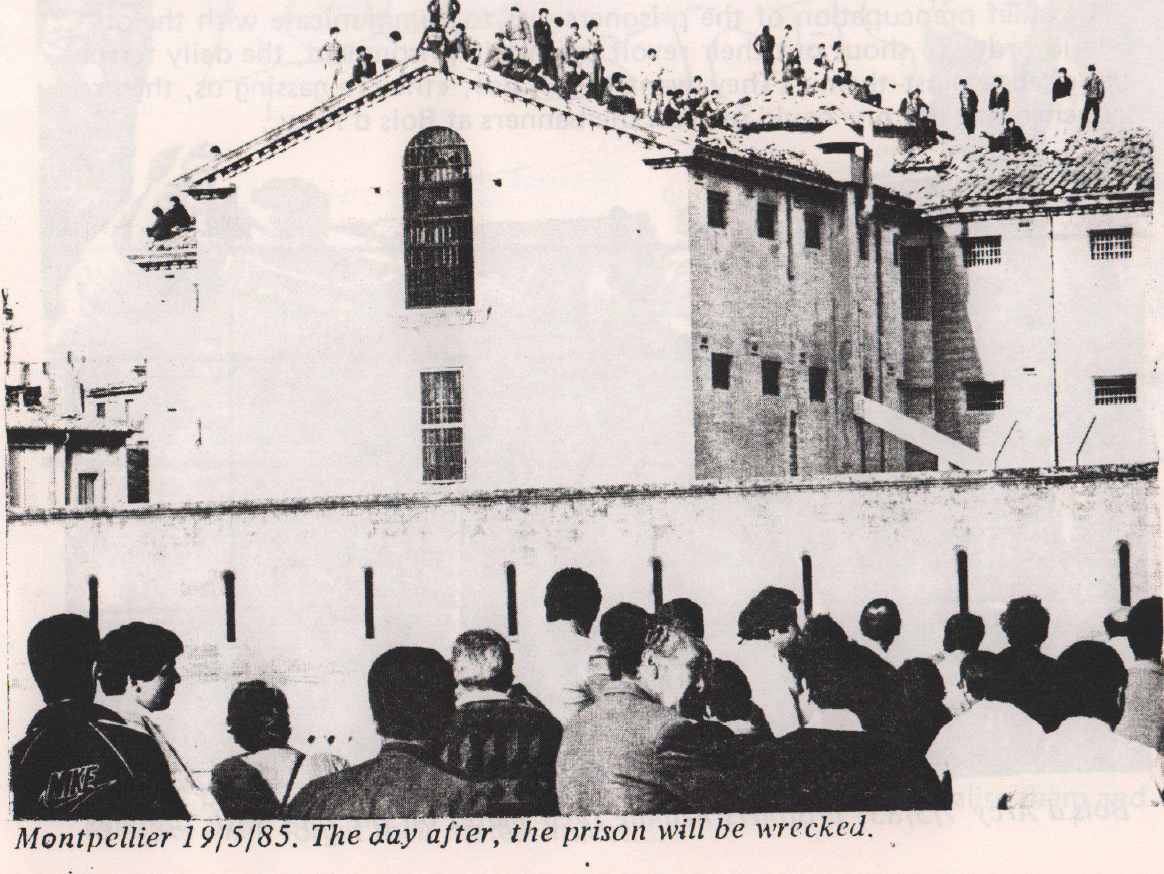
Those who speak to us of over-crowding in the prisons are the same ones who fill them up to breaking-point! And obviously they turn things upside down. For us, it's not a question of constructing new prisons, but of emptying those which already exist
The demands of the rebellious prisoners are clear: Freedom! They don't negotiate this with the prison administration, but they begin to take it: climbing onto the rooftops, that's freedom snatched from the state. "We are taking a breath of fresh air" they say; for the space of a few hours they chat together sheltered from the ears of snoopers, speak down below the walls to their mates outside, insult the pigs who repress them, chuck slates at them, and finally make people talk about them. That's what real "Parloirs Libres"(1) about!
The prison administration and the media attributed the revolt at Fleury Merogis to a handful of political militants (notably to Action Directe). These militants, preoccupied by their fame alone, have always participated in this lie by not denying such attributes. All these liars had already played the same trick during the hunger strike which began developing at Fleury, at the end of 84. But we'll leave the militants to their dead verbiage.....
On the other hand, a real solidarity existed between the prisoners (in Bois-d'Arcy, the prisoners in cells were ready to break everything if those who were on the roofs were moved away: that's why the GIGN (french equivalent of the SAS) didn't intervene, and they stayed 40 hours in the open air, supplied by their fellow cell-mates; in Bastia,'they went on hunger strike in solidarity with the rebels of the other prisons). This solidarity was also manifested outside; in Montpellier, on May 19th, where people took up the fight for the rebel prisoners and attacked the cops from behind— who then dispersed them with dogs. The chief preocupation of the prisoners was to communicate with the outside in order to shout out their revolt against imprisonment, the daily terror exercised against them. "They want to kill us", "they're gassing us, they're truncheoning us" one could read on the banners at Bois d'Arcy..
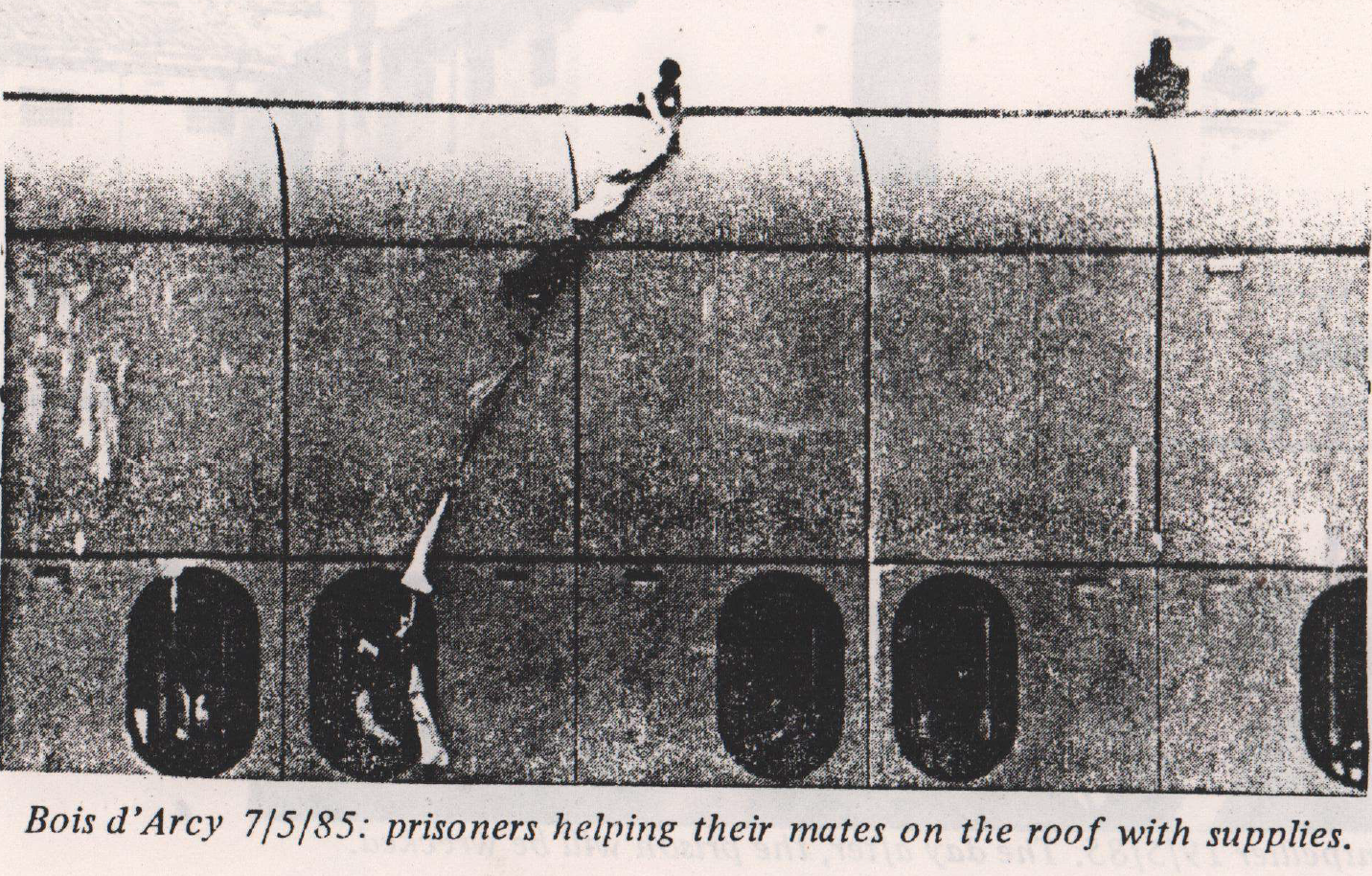
Prisoners take an enormous risk when they revolt.. Everyone knows beforehand that the prison administration will make them pay dearly for this afterwards: by severe punishment blocks, loss of parole & remission(2), transfers, beatings, murders disguised as suicides. In Douai, 3 guys for simply having climbed onto the roof and having demonstrated their revolt by chucking down roof tiles— were, as soon as they came down , immediately condemned by an emergency tribunal to 15 months and 6 months extra time inside (one was to have been freed in June). This sentence was intended to be exemplary.
The anxiety engendered by the repressive terror and the despair of returning to the crushing isolation of the prison are such that at the very moment of revolt some of them turned against themselves through self-mutilation. In Fleury and in Montpellier, some of the prisoners leapt onto some barbiturates and swallowed them, at the same time as smashing everything in their way. 25 of them were seriously poisoned. Others slashed their wrists calling on other prisoners to do the same. One of them died. At the same time several prisoners hanged themselves in different yards. At this very moment, in St. Paul, in Lyons, prisoners each day mutilate or try to hang themselves.
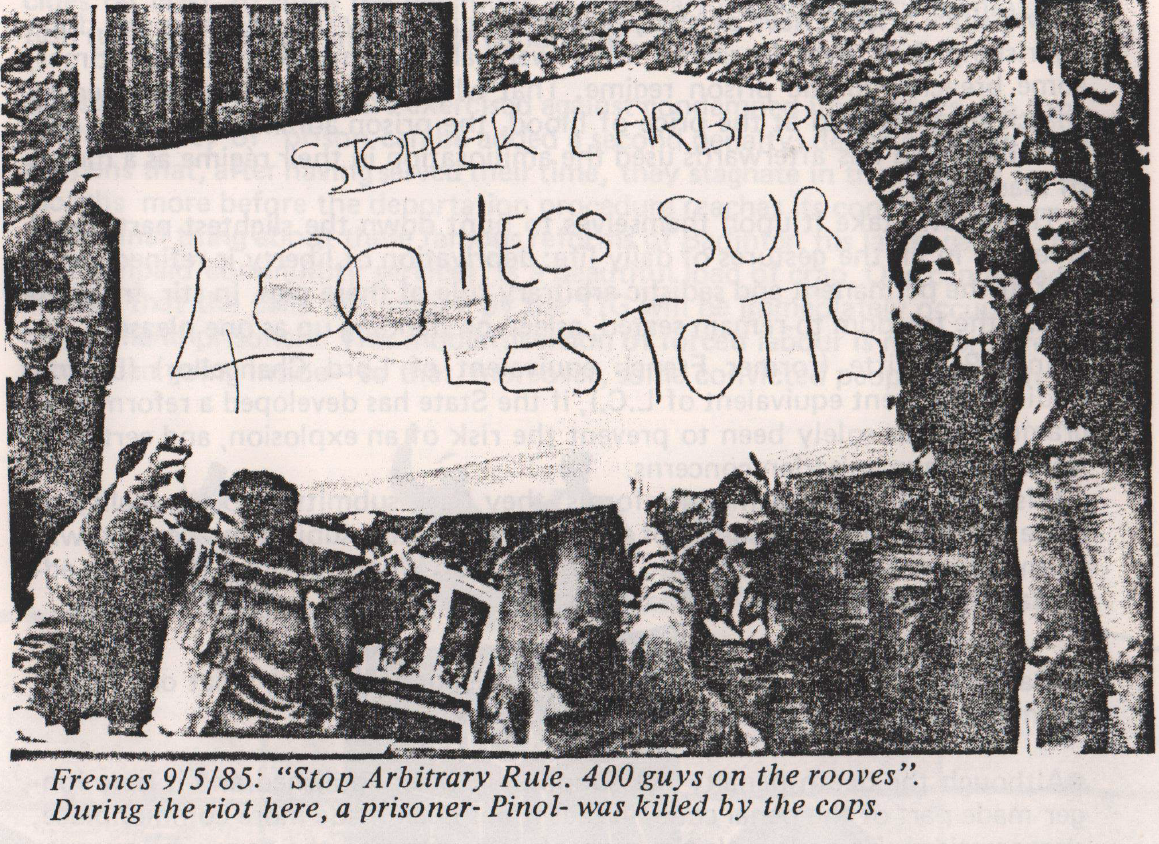
"Freedom is the crime which contains all crimes" and it's against this crime that the old world defends itself: the state is in the process of physically eliminating all the beautiful youths who aren't resigned - the very same youths who die at the hands of the cops or the other "Beaufs" (3)— those whom the law can hold down, whom the state buries alive in its prisons, as long as possible, terrorising at the same time those who manage to stay outside. For these, it pays educators and other scum, whose task is to demoralise them and to make them forget their mates inside.....
As the housing estates of proletarian areas lose more and more youths, so the prisons fill up. This is the secret of over-crowding. The servants of the state would have us believe this is a question of budgeting! Overcrowding is supposedly caused by a malfunctioning of the prison system when it’s caused by the maximum functioning of the judicial system.
The only way of dealing with overcrowding in prisons is obviously to empty them, as the rioters of Fleury put it - on this point they couldn’t be clearer: they oppose the building of new prisons in a declaration signed by "The 600 leaders". The prisoners of Montpelier expressed a practical solution to overcrowding, They destroyed virtually all the cells!
It is the law, and, more precisely, the taking of hostages which preventive detention on remand constitutes (which officially condemns people to an indefinite spell inside, which is afterwards confirmed, if not aggravated, by judicial sentencing), which the prisoners revolt against. We are reminded of the movement which collectively affirmed demands for provisional liberty before trial in Lyons, at the beginning of the summer of 84. (4)
Ever since prisons have existed, everything gained by the prisoners was done by risking their lives in revolt. They were able to impose, at certain times, some breaches in the prison regime. That which prisoners have managed to snatch by force and at the price of blood, the prison administration has nibbled back and has afterwards used the amilioration in their régime as a means
of blackmail.
The screws take it upon themselves to hunt down the slightest particle of freedom in all the gestures of daily life; deprivation of liberty is refined every day in the permanent and sadistic arbitrary rule of these pigs. In stir, freedom is also the freedom to remain seated, asleep or standing up as one pleases.
Since Peyrefitte (former French equivalent of Lord Chancellor) (5) and Badinter (present equivalent of L.C.), if the State has developed a reform programme, it has solely been to prevent the risk of an explosion, and certainly not out of humanitarian concerns.
Prisoners no longer demand reforms: they have submitted to the reality of these reforms. The application of each reform remains subject to the good will of the prison administration and of the screws. What was presented as an advantage became one more degradation.
- "Parloirs libres" are refused by certain prisoners, because what one has to submit to in order to get these visits is humiliating.
- Although the death penalty has supposedly been abolished and It is no longer made part of the penal code, in fact it has been made more commonplace, democratised. Nowaday it’s the mob of "Beaufs" and the cops who execute people and in the nick it’s the screws.
- Also, the suppression of the maximum security wings (QHS) was a humanist bluff (developed by the left): the best example of this opportunism was when they released Knobelspiess with the support of a humanist campaign. Knobelspiess had denounced the horror of these maximum security wings, the left having used him , locked him up again without hesitation (6).
The QHS, as a specific regime of solitary confinement, has never been suppressed, it has simply changed its name. Now it is called the QI (isolation quarters). In '83, a new prison called "Les Godets" aimed at incarcerating prisoners considered to be particularly dangerous, was opened near Nevers. It can bang up 80 prisoners under an extremely severe regime of surveillance. What's more, the administration and the screws want to extend the conditions of the OHS to all the prisons; the number of isolation cells has increased, the statute of the DPS (specially surveilled detainees) is applied more and more, the punishment blocks are increasingly filled.
- The prison administration, in relation to the tension which reigns in the prisons, now increasingly reserve the right to punish prisoners even more, to inflict special sanctions. Petty humiliations and beatings are very common. The administration push the prisoners to suicide, or dress up killings as suicides. There's no such thing as a natural death in the stammer, those who die there die of prison. Killing is called "accidental death" --like Mohammed Rhabi in Rouen and Bruno Sulak in Fleury, killed by the fucking screws during escape attempts; like Alain Pinol in Fresnes, killed by the cops. The suicide of prisoners are all murders committed by the prison administration who gladly provide the rope to hang yourself. And if there are more and more suicides (at least 20 since the beginning of the year) it is because the administration rules increasingly intolerable conditions.
- A supplementary pressure exercised against condemned immigrants. On top of the penalty of prison can be added a second penalty: deportation. It even happens that, after having served their time, they stagnate in the nick for some months more before the deportation procedure reaches its conclusion. One final thing about these famous reforms of Badinter, his latest gadget, the TIG (unpaid community service), is a beautiful load of crap. One can already foresee that the cells left empty by the TIG will be immediately occupied by new remand prisoners. This modern version of forced labour is no more preferable than going inside-- so that, moreover, some convicted people refuse it.
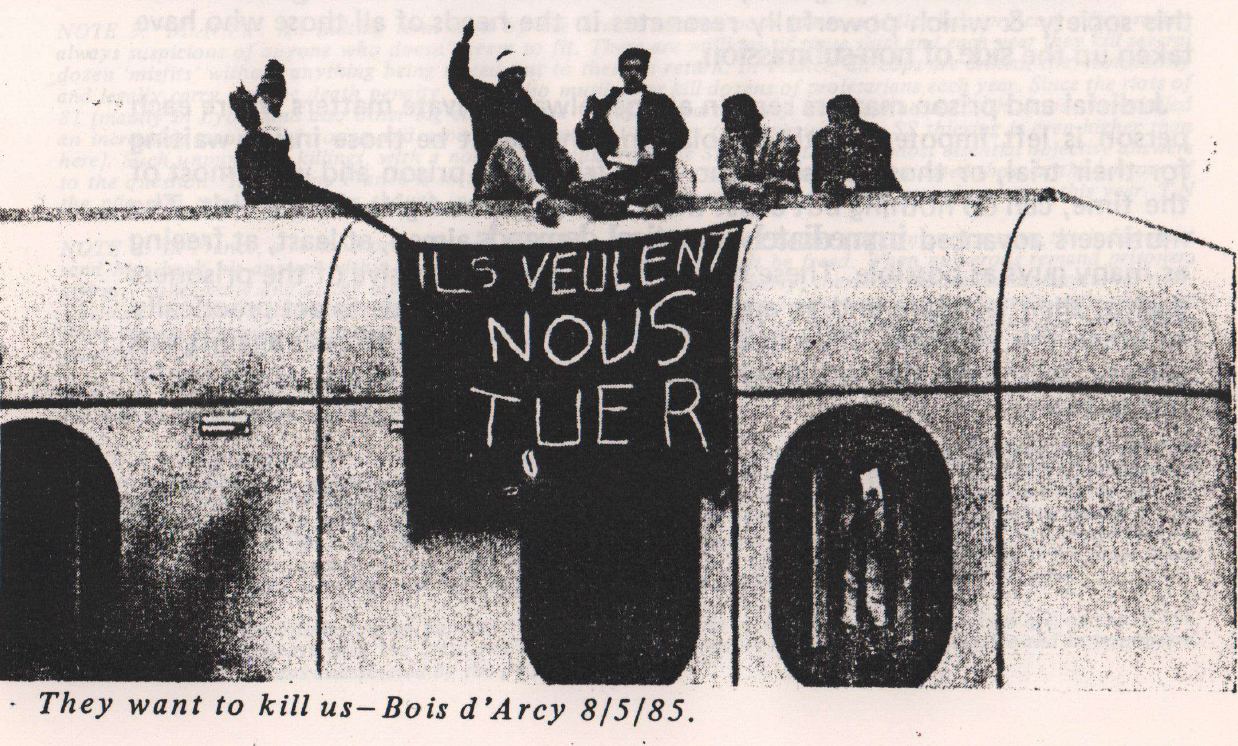
All those who demand rights in prison (prisoners unions) are in the rearguard of the prisoners movement of revolt, because prisoners have to impose their requirements by violence at the risk of their lives. "Union struggle will be made within the law and through the law, by prosecuting all exactions before competent judiciaries". That's what the prisoners union programe has to say.....
We've already seen what unions are outside prisons. They only aim to channel and domesticate peoples revolt into reforms intended to re-arrange peoples misery. They also serve to stifle the real demands the poor spontaneously think up in their revolt.
Prisoners no longer fight for reforms since they know now that they were only an illusion: rather than putting themselves within the abstract sphere of rights, they are able to insist upon something that will at least have a concrete result-- a general reduction in penalties.
What's at stake are the requirements affirmed by the prisoners;
REMISSION FOR ALL CONDEMNED PRISONERS.
THE LIBERATION OF ALL REMAND PRISONERS.
A DEFINITIVE STOP TO ALL DEPORTATION ORDERS.
THE LIFTING OF ALL PUNISHMENT FOR ALL THE MUTINEERS.
The demand for the liberation of remand prisoners goes beyond a specific demand in prison. Even more than to the state or the prison administration, it addresses itself to all the poor people for whom, preventive detention is a sword of Damocles hanging daily over their heads. It's a challenge thrown at this society & which powerfully resonates in the heads of all those who have taken up the side of nonsubmission.
Judicial and prison matters remain almost always private matters where each person is left impotent in their isolation, whether it be those inside waiting for their trial, or those outside who have friends in prison and who, most of the time, can do nothing but assist them financially and give them a visit. The mutineers advanced immediately practical demands aimed, at least, at freeing as many guys as possible. These requirements are an offensive of the prisoners against their isolation and an appeal to those on the outside to act practically to break this isolation. It's a question of bringing pressure to bear against this society, to shit on this world with its prisons, this world which would prefer not to hear.
OS CANGACEIROS Beginning of June 85.
NOTE 1.- 'PARLOIRS LIBRES'. In France, during the 'parloirs', the prisoners and their visitors are separated by a double window. The demand for 'free parloirs' necessitates the abolition of this separation for obvious reasons.....If the State, under pressure from prisoners, have at last conceded this 'right' it is in order to use it against these prisoners. 'Free parloirs' is given to those whom the administration deems worthy of it— it is given as a reward for submission. There is nothing free about it apart from its name: instead of a window a screw provides the separation, surveilling every gesture. And after going 'free parloirs' you get searched with extra thoroughness. (Translator's note: TN)
NOTE 2: Once again a clever con: remissions of sentence are in fact additions of sentence, which are assigned to those who stand up for themselves. Judges calculate sentences proportionally in relation to rewards: if they want a prisoner locked up for at least 9 months, they are given a year inside (in Britain 13 months).
NOTE 3: 'REAUFS'. An insulting term used by the French against poor lower middle-class, pro-cop, often racist, always suspicious of anyone who doesn't seem to fit. There are millions of these shits and each year they kill several dozen 'misfits' without anything being meted out to them in return. In France, all cops are armed; they constantly and legally carry out the death penalty. They also mutilate or kill dozens of proletarians each year. Since the riots of 81 (mainly in Lyons and also other big cities) these 'beaufs' —particularly those connected with shops— have killed an increasing amount of young and especially immigrant thieves (with virtually no SS [social security] thieving is even higher than here). Such unpunished killings, with a nod and a wink from the State, is one of the most essential objective answers to the question "How come France is so quiet?". These murders have effectively intimidated those at the bottom of the pile into terrorised silence though in Marseilles and Paris there has been some sporadic rioting this year. TN
NOTE 4: In France, a remand prisoner may demand provisional liberty before trial. In such a case, the judge must send him back his answer within 5 days, otherwise the prisoner must be freed. When numerous remand prisoners affirm —collectively and at the same time— demands for provisional liberty, the local judicial administration is overwhelmed with work and might forget to answer in time, so some remand prisoners who don't get a reply could be freed (but in this case, the magistrates got together to stop this, though at the expense of considerable bureaucratic disorder). TN
NOTE 5: The 'Ministre de la justice' is the French equivalent of the British Lord Chancellor, but is also responsible for prison administration and everything concerned with it. TN
NOTE 6; We draw particular attention to the unbearable situation of condemned prisoners who have been locked up in solitary confinement, or those who are still in these wings like Knobelspiess, those whom the prison administration particularly harass in order to make them pay the maximum for never having submitted to the prison regime. We cite the case of Charlie Bauer, condemned in '62 to 20 years inside for burglaries. Conditionally freed on parole in '76, after having submitted, for a long time, to the ordeal of the QHS; he was imprisoned again, with a 5 years sentence for receiving, plus 6 years because of loss of his conditional parole. He'll only be able to leave in '90. It because Bauer fought against the WM, where he met up with Mesrine (7) that the prison administration coudn't forgive.
NOTE 7: MESRINE. Public Enemy number 1 in France at the end of the 70s. At the end of his life, on top of robbing banks, he openly attacked the State and its prisons. His escapades became public knowledge and an inspiration. For these reasons, he was assassinated by the pigs. TN.
Attachments
Comments

Timeline of the prison revolts in France, May 1985.
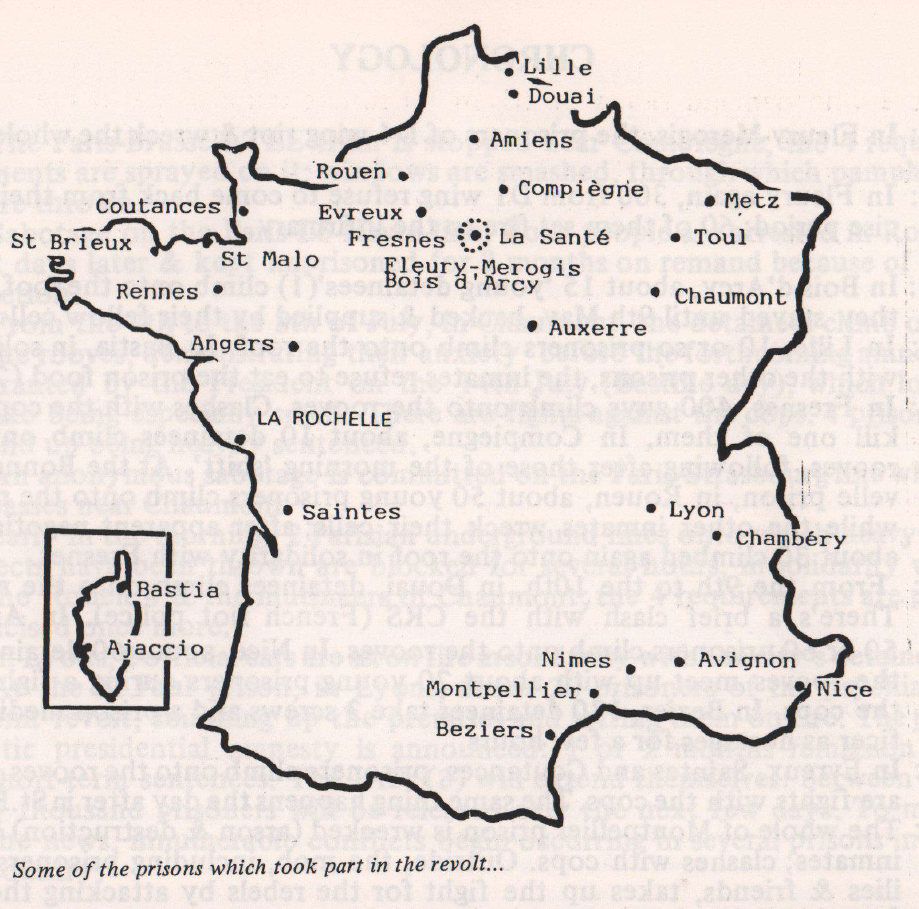
5/5/85: In Fleury-Merogis, the prisoners of D4 wing riot & wreck the whole wing.
6/5/85: In Fleury again, 300 from D1 wing refuse to come back from their exercise period; 60 of them set fire to the infirmary.
7/5/85: In Bois d'Arcy, about 15 'young detaineees'1 climb onto the roof, where they stayed until 9th May, backed & supplied by their fellow cell-mates.
8/5/85: In Lille, 10 or so prisoners climb onto the roof. In Bastia, in solidarity with the other prisons, the inmates refuse to eat the prison food2 .
9/5/85: In Fresnes, 400 guys climb onto the roofs. Clashes with the cops who kill one of them. In Compiegne, about 10 detainees climb onto the roofs, following after those of the morning 'shift'. At the Bonne Nouvelle prison, in Rouen, about 50 young prisoners climb onto the roofs, while the other inmates wreck their cells; after apparent negotiations, about 30 climbed again onto the roof in solidarity with Fresnes.
10/5/85: From the 9th to the 10th, in Douai, detainees climb onto the roofs. There's a brief clash with the CRS (French riot police). In Amiens, 50 or 60 prisoners climb onto the roofs. In Nice, about 60 detainees on the roofs meet up with about 20 young prisoners during a fight with the cops. In Bezier, 130 detainees take 3 screws and a prison medical officer as hostages for a few hours.
11/5/85: In Evreux, Saintes and Coutances, prisoners climb onto the roofs. There are fights with the cops. The same thing happens the day after in St.Brieuc.
19/5/85: The whole of Montpellier prison is wrecked (arson & destruction) by the inmates; clashes with cops. Outside, the mob, including prisoners' families & friends, takes up the fight for the rebels by attacking the cops from behind.
Apart from several fights occurring in different prisons, cells are smashed & there are arson attempts (Rennes, Angers, Metz, etc.) as well as collective refusal of prison food (Lyons, men & women in Fleury, Ajaccio, Auxerres, St. Malo, Avignon, Chambery, etc.). During this period, there are lots of suicides. Very heavy sentences are given to the mutineers of Douai Evreux, on the pretext of occassinal destruction.
17/6/85: On the Nantes-Paris railway line, a barricade is set on fire near Nantes in solidarity with the prison mutinies.
20/6/85: Sabotage of the TGV (High Speed Train) railway line's installations in the south of Paris.
27/6/85: On the Toulouse Paris line, a barricade is set on fire near Toulouse.
30/6/85: During the night of June 30th - July 1st, the printing of Parisian daily papers is paralysed by a sabotage of the IPLO print shop near Nantes.
"We have dicided to impose half a days silence on the national press in honour of rebellious convicts...It is also dedicated to all the 'suicided' detainees who have died. All these papers are well-known for their hostility towards the recent movement of revolt in the prisons..."
1/7/85: Sabotage of railway installations on the Nimes-Tarascon line.
Each time, these actions lead to prolonged disturbances of railway traffic & hours of delay for day-time trains. At no time was there the possibility of an accident occurring. The requirements affirmed durinig these acts of sabotage were always the same:
REMISSION FOR ALL CONDEMNED PRISONERS
RELEASE OF ALL REMAND PRISONERS
A DEFINITIVE STOP TO ALL DEPORTATION ORDERS
THE LIFTING OF ALL PUNISHMENT FOR ALL MUTINEERS
2/7/85: The Paris-Brussels TEE train is stopped near Compiegne, the 4 requirements are sprayed on it; windows are smashed, through which pamphlets are thrown.
5/7/85: Sabotage on the Paris-Le Havre line. Four people are arrested in Rouen 2 days later & kept imprisoned for 3 months on remand because of this action.
8/7/85: From the 7th to the 8th of July, in Chaumont, the detainees climb onto the roofs, demonstrating their anxiety before the forthcoming amnesty granted by the President on the 14th July (Bastille day), which looks like being especially small. There are fights against the cops. 4 prisoners end up being heavily sentenced.
9/7/85: An anonymous sabotage is committed on the Paris-Strasbourg line which passes near Chaumont.
12/7/85: Early in the morning, 2 Parisian underground lines onto which heavy objects have been thrown are blocked for several hours, in solidarity with the Rouen 4 & the mutineers of Chaumont; the 4 requirements are publicised once more.
13/7/85: In Lyons, 2 official cars are sat on fire in solidarity with the city's detainees.
14/7/85: At the St. Paul prison, in Lyons, about 20 prisoners of the psychiatric unit revolt, smashing up the premises and setting them on fire. The pathetic presidential amnesty is announced: 1 or 2 months remission for short-term sentences. The JAPs3 will extend themselves: between 3 & 4 thousand prisoners will be released over the next few days. To mark the news, innumerable conflicts begin occurring in several prisons in the country.
15/7/85: During the night of the 14th-15th, tyres of cars belonging to the official cyclist French Round convoy are slashed (about 100 immobilised vehicles) in solidarity with the condemned prisoners. In Toulouse, a firm employing prisoners is destroyed by fire.
14/8/85: In Lille, dozens of prisoners climb onto the roofs.
18/8/85: In Lyons, the ROP printshop for Parisian daily papers is wrecked (publication & distribution are seriously effected); this was in order to take revenge again on the papers for their lies & hostility towards the mutineers.
- 1"Young detainees" refers to the inmates under 18, who are usually held in separate blocks or prisons.
- 2"The refusal of prison food" is not exactly a hunger strike, although this may be a way of carrying it out.
- 3"JAP" literally means 'Judge of application of sentences'; this kind of fudge works on the prisoner's file & record in order to grant him a release on bail or, when outside the nick, to control him.
Comments

Os Cangaceiros on various direct action and sabotage efforts in support of the 1980s prison mutinies in France - and the media reaction.
For the first time in this rotten country, a movement of practical solidarity with prisoners in revolt has appeared outside the prisons. This was a blow which none of the reformers or moaners ever expected - all those who allow the suffering of prisoners to justify their own cowardliness, their own interest in helping to maintain the status quo. Above all, it was a blow for the State.
On the outside, there are a multitude of cretins who indulge themselves in long speeches over what they prudishly call 'the problem of detention', even though they have no personal experience of being arrested and would be better shutting up. Their pretentious hot air contrasts with the silence that is imposed upon the prisoners in revolt, and the total censure that their communiques have received.
Inside a prison, information gets around by underground rumours. From one prison to another, though, information gets round differently. This gives a certain importance in prisons to the written press, on top of it being a way of killing time through reading. Boredom and isolation are the only two things which make prisoners a bit interested in the newspapers; and makes each of their lies that much more damaging.
The press has been unanimously hostile to the prisoners revolts, through slander or silence. All commentators shout out the same stupid questions that only intellectuals can pose, with the all too obvious aim of creating doubt and confusion. They only differ in the manner by which they ask the State to crush the revolt. At one extreme, Le Figaro calls for a tighter clamping down upon prisoners, and harps on ceaselessly about supposed government inaction. At the other extreme, Liberation joyfully supports a government which talks of reforms, & waxes eloquent over the cultural gadgets by which the government hopes to cool the jailbirds' anger.
All these liars are even more hostile when they have to report gestures of real solidarity with the inmates which counter their views.
We're not like those who specialise in writing or speaking about prison (we're not like those who try to set up gatherings at Beaubourg, or who shamelessly go and waffle for two hours with the head-screw of the Fleury-Merogis gaol either).
The risk of ending up in jail -and the fact that many of us have been there before- largely condi-tions our lives. Let's point out that those of us who have been convicted and detained in the past have always been criminals; we have no affinity with 'political prisoners' whatsoever.1
The prisoners struggle totally concerns us. We distributed a folder in June '85 which echoed and amplified the prison mutineers demands, in the spirit of the revolt itself. To our knowledge, this is the only document on the outside which clearly took the side of the revolt, without the embarassed excuses put forth by the militants of all types. The four demands stated were those of the mutineers, expressed in the rare tracts to filter out, and, above all, expressed in their actions. A certain number of people then created a scandal, particularly by disturbing rail traffic throughout the country. They thus gained publicity for the demands which had been denied up to that point, and have justice to the reality of the revolt.
The hostility of the media has been systematic from the beginning. All have spoken of 'outrages'. Calling a barricade on a railway track, or breaking a signal light an 'outrage' is not only an outrageous exaggeration, but also a means of encouraging repression by confusing all expressions of practical solidarity with the mutineers, with terrorism. A fortiori, to speak of 'rail terrorists' as some papers have done is very sordid. One paper even spoke of travellers taken hostage, after an action involving the Trans Europe Express. (Speaking of hostages, what about the 25,000 in Preventive detention?!) Organised vandalisme would be more precise.
We use the means of action of any proletarian: sabotage and vandalism. We don't carry out symbolic actions, we create disorder like workers in struggle are currently doing, blocking road and railway lines, stopping TV transmitters etc.
The principal characteristics of the actions from mid May to mid June was simplicity. The Brussels TEE was stopped by a very simple procedure which changed a signal light to red. 15 people were enough to stop this important train, spray-paint the demands of the May rioters, break the windows to throw the tracts inside. The customs officials and plain clothes policemen in the front car did nothing to oppose this. The system of signals of the high speed TGV was sabotaged by a mere hammer; on various rail lines, electrical boxes were burnt with a bit of petrol.
Straw burns well in summer as a Toulouse chair maker who used to make his profits from the sweat of prisoners found out: ‘Bandoleros' reduced his workshop & his business to ruins. At Nantes, the printing press which handles the national press for the western regions was sabotaged when sand, gravel and nails were shoved into the compressors that feed the printing cylinders. In Paris, two metro lines were shut down by the simplest of techniques: throwing worksite material on the tracks.
Each time every precaution was taken to see that the safety of the travellers was not threatened. This is why we did not stop the high speed train (TGV) in the same way that we stopped the TEE train. We thought it too dangerous to brutally stop a train as fast as this one, so we sabotaged material to make them very late.
Emboldened by the arrest of 4 people at Rouen at the beginning of July, the specialised liars went one step further in their hypocrisy they insinuated that these 4 could have been responsible for the derailment which took place 3 days after the action of the 'Hoboes of the Val-de-Seine' on the Paris-Le Havre line. The press announced that they had burned some signal boxes which upset the mechanism. But as the railway company itself had stated on numerous occasions, this could not have had dangerous consequences for the safety of passengers because the destruction of any signal boxes automatically causes all railway signals to go red so that all trains coming into the sector stop, and then proceed at greatly redrced speed (about 20 m.p.h.).
There is no way that the 'Hoboes of Val-de-Seine' could have been responsible for the accident yet they have been accused of the destruction of material which could endanger lives, a criminal offence. Channel 2 and France-Sok have gone out of their way to push these slanders to the limit, with the aim of frightening off those who might be tempted to carry out such actions in the future.
In Paris, the underground was interrupted in two different places simultaneously on the mor-ning of Friday the 12th July. That night Le Monde and France-Soir announced that the saboteurs had left tracts signed 'Black Order': this is untrue. This can only be a police provocation, as they were the first on the scene. 'Black Order' is the name used by the Italian secret service when they set off murderous bombs in the station at Bologna a couple of years ago. One can see the sort of analogy that there they were trying to set up.... Despite the formal denial, that evening France-Sok took up this blatant fabrication in its edition of the following day.
After they first asked if we were terrorists or jokers with poor taste, the specialists of lies went from insinuation to denunciation. This is not surprising in a social system whose survival depends upon the police and the lie. They speak of a 'mysterious group' behind all this. A pretentious ignoramus in France-Soir declared that 'these groups recruit members of left-wing anarchism, the fringe between delinquency and terrorism'.
Let's stress once and for all that we, Cangaceiros, don't come from leftism, anarchist or otherwise there isn't a single ex-militant amongst us. And none of us has ever been mixed up with any kind of political racket in any way. We have only one form of relation with political groups and organisations: war. They're all our enemies, there's no exception. We aren't 'on the fringes of delinquency': we are delinquents. Which doesn't mean that our 'delinquent situation is a professional one'. But on the other hand we have nothing to do with terrorism at all. The poor sods who let themselves be drummed into that are but puppets, executors of a stinking ideology serving an apparatus based on a cop-mentality and hierarchical structures as we said before, we treat militants with contempt.
Other liars insinuate we have large amonts of money, suggesting we are 'supported by more important organisations'. What then? The Mafia? The K.G.B.? The Red Brigades? And the Opus Dei? And to say we are well organised they say we are 'strongly structured' (HORROR !). They find our texts are too well printed: anyone knows you don't need to be covered with gold to get a few thousand mags correctly printed. Yet they insinuate...They use calumny and amalgam techniques hoping some of it will end up on a judge's desk...
Among the most derisory of these calumnies, the press and T.V. have said that one of our friends arrested in Rouen is a professor of philosophy! The Ministry of National Education itself had to correct this a few days later: the insulted person had, in fact, only been a simple assistant in a school ten years ago. This is a typical police reflex - to point out one thinker and, for these cretins, this person has to be a graduate. Intellectuals are only graduate cretins. Proletarians know how to think by themselves - they don't need to be taught. As for philosophers, they can't think because they don't know a thing about life. T
To finish with these dubious allegations let's say that a group who publishes a magazine and often makes its position known through leaflets, tracts and posters can hardly be described as obscure and mysterious. A widely diffused tract explains the sufficient reasons for these actions: no paper, no radio or T.V. news has dared say precisely what was in it. They prefered to make suppositions, to make up a mystery out of simple things: it's like all the cackling about the prisoner's revolt, on `the problem of prison'. Although it's an extremely simple thing, they keep confusing the issues so no one knows what it's all about in the end. The question is to know whether we accept the prisons or whether we refuse them. Unequivocal.
We wanted to make widely known the demands logically following the May '85 revolts and start to break down the inmates' isolation, as every care was taken to suffocate them into silence after the fever of the mutinies was gone.
Outside, we are usually submerged by a feeling of impotence as to what is going on inside. For the first time this impression of powerlessness has been overcome. Though not numerous, by simple and effective means, we have given the May revolts a beautiful publicity. And if these actions have remained limited, it's down to our own isolation in this society.
The coming of the Left to power has allowed French capitalism to overcome a difficult moment and, notably, to discipline the workers with the help of the trade-unions. It has intensified the modernisation of social isolation through the extension of policing and control this is built on a policy of isolation by imprisoning those who still escape this control. The social peace appearing to reign in this country depends, in great part, on the overpopulation in the prisons. That's all.
One could, of course, hope that because of the revolt there will be a breath of fresh air on the 14th July. We have seen to what point the socialists take everyone for idiots. But what can one hope from a State, apart from blows and lies? And what can one hope from a shit like Mitterand, who, as Home Secretary, gave the orders to shoot down striking workers in 1955 in Nantes?
"Everything that crawls on this earth is governed by blows"
OUR FRIENDSHIP TO THE HOBOES OF VAL-DE-SEINE!!!
OUR FRIENDSHIP TO THE MUTINEERS OF CHAUMONT, OF LYON, DOUAI, EVREUX, AND TO ALL THE OTHERS.
Beginning of August '85
OS CANGACEIROS
Translation: March 86
A censored version of this text has been previously published by Black Flag (with whom we have no contact and have obviously asked nothing from) in November '85. As always, the censors define themselves by the content of what they censor.
- 1Of course, we're not talking here about workers whom the State send to gaol in order to break a strike (like the miners). In practice, in France it doesn't occur to a proletarian to proclaim himself as a "political prisoner". Only members of political sects and other militants aren't ashamed of defining themselves like this. (Note, March '86)
Comments

Os Cangaceiros contrasts the series of terrorist bombings in Paris in 1985-6 with the direct action carried out in the same period in support of the prison uprisings across France.
The series of bombings committed recently in Paris have as their immediate consequence the reinforcement of the control of the police. Paris is today in a state of siege.
The blabbering of the media, asking "Who did it?", masks the essential question, which is "What end does it serve?" The exploitation of these bornhings by the police and by the specialised liars plays its part in a strategy of the State: to make the climate of generalised defeat in France even more absolute. One idea must, bit by bit, enter one's head: that the growth and systematisation of repressive measures are necessary and inescapable. The banality of the areas targeted by this strategy of diffuse panic reinforce in each and everyone the feeling of anguish and powerlessness. The terrain is ready and justice can bury alive anyone who lifts his head.
In this shit country, every proletarian who does not feel guilty is suspect, and can, as such, be assassinated. Since the flare-up of the French suburbs in '81, the State has left to the initiative of the "beaufs"1 the social reaction which precipitated the crushing of all those who were growing restless in this country. The bombs set off in the cities around Marseilles (in La Cayolle and Bassens in '81, in La Bricarde in '83) and the murderous summers of '82 and '832 , are two aspects of a decisive moment. Terror and isolation now paralize the majority of those who have not given in, when justice hasn't already taken care of them.
The State drives in the nail. It perfects in the legal system what was already imposed in reality. The Badinter project of a modernised penal code confirms the license to kill while extending the right of "self-defense"3 to include the defense of property. The stage is set: police custody for four days, gathering together of criminal and terrorist files, general worsening of the penalties for all forms of delinquency, suppression of remission of sentences...
The media devotes itself to making us believe that only terrorists attack the State, and that, consequently, all those who attack the State are terrorists. Their intention is clear: to define every act of revolt as one of terrorism, all the while increasing tenfold the emotional charge attached to the word. Terrorism is the continuation of politics by other means.
The campaign of sabotage in solidarity with the prison mutinies (summer of '85) was the work of some organized proletarians. The media has attributed it to mysterious "railway terrorists". More recently - the 20th of December - the wildcat strikers of the metro were accused of taking the Parisians hostage. That same day, in Nantes, Courtois, Khalki, and Thiolet were even said to have taken the media hostage4 . This is a sordid reversal of reality on the part of those precisely whose job is to colonize minds; those sharks that particularly displease us.
Manipulation reaches its goal in all this. The trials to come will take place in the most unhealthy atmosphere for those who are the real target of the State. After being nailed to the pillory of terrorism, they will be condemned to a staggering sentence.
Contrary to what happened in Italy in the 70's, these bombings are not the last bullets of a State at bay. In France, partisans of the State intend to consolidate the position of force it has squired these last few years as much as they can. The Italian State used expeditious means for creating terror in the population and for justifying on the same occasion the emergency recourse to the police, indeed, to the army. But we know, since then, that such an "emergency" recourse, imposed for the moment, becomes the rule.
We are suffering directly from the intensification of the means of control. The sinister German precedent gives a foretaste of what is hanging over our heads. It becomes more and more difficult to conceal oneself from the eyes of the State. In this world, only commodities can circulate freely. For us, the poor, the simple fact of circulating is becoming perillous.
DOWN WITH FRANCE
Paris, 12 February, 1986 OS CANGACEIROS
(Translation: March, 1986)
- 1'REAUFS'. An insulting term used by the French against poor lower middle-class, pro-cop, often racist, always suspicious of anyone who doesn't seem to fit. There are millions of these shits and each year they kill several dozen 'misfits' without anything being meted out to them in return. In France, all cops are armed; they constantly and legally carry out the death penalty. They also mutilate or kill dozens of proletarians each year. Since the riots of 81 (mainly in Lyons and also other big cities) these 'beaufs' —particularly those connected with shops— have killed an increasing amount of young and especially immigrant thieves (with virtually no SS [social security] thieving is even higher than here). Such unpunished killings, with a nod and a wink from the State, is one of the most essential objective answers to the question "How come France is so quiet?". These murders have effectively intimidated those at the bottom of the pile into terrorised silence though in Marseilles and Paris there has been some sporadic rioting this year. TN
- 2During these summers, a large number of young proletarians were assassinated by the cops and the "beaufs". In not sending them to gaol (or sometimes sending them only for a short time) the State gave these scum a license to kill. Some shopkeepers even went so far as to organise demonstrations when one of them had stayed 2 weeks in prison. This situation is still the same (Hernu, the former socialist Minister of Defence sacked over the Rainbow Warrior affair, still mayor of Venissieux - a proletarian area of Lyon - recently publicly congratulated a cop for killing a thief).
- 3"Legitimate Defence" is a judicial term which gives someone the right to defend themselves with arms equiva-lent to the arms of their attacketis. The "beaufs" use this argument fallaciously - as a way of justifying killing un-armed thieves or shooting in the back thieves who are running away.
- 4During a trial, Khalki (at that time having been freed from prison just 3 weeks before) went to the courtroom where his friends were on trial in order to free them. They took the judge, some court officials and the fury host-age. Then they demanded that TV cameras be brought into the courtoom so that they could talk publicly about the cops, about prison, about `justice , about their innocence in this trial, about their lives broken by several periods of imprisonment they had been in prison for two years awaiting trial), about.... They surrendered after 2 days in exchange for a promise from the State that Khalki would be deported to a country of his choice, a promise which the State broke in spite of Khalkis' subsequent long hunger strike. Most French proletarians recog-nised themselves in what these three men did and said.
Comments

"Our programe is very old: to live without dead time. We will of course publicize it through scandal. There's no other worthy means for such a programe. Our existence itself is already a scandal."
We talk a lot about violence in the inner cities and suburbs. However we don't think they are the only places where things happen. It's just that many people like us live there, and often ourselves as well. We don't just talk about violence: it is our element, our everyday fate. Violence is first of all the conditions we are forced to live in, that of the people who defend these conditions, and more rarely, alas, that which we smack back in their faces. We don't know all our enemies but we know what they stand for. All our allies aren't our associates. Sometimes they are. We aren't in touch with all our allies. The unemployed who fight poverty are our allies as much as the workers rebelling against work and escaping the control of the trade-unions. We do not think we hold universal truths but communicate them. Universal truths are those you communicate- not those you hold. To those who wonder whether we are assemblyist or councilist we answer that what matters to us is the way people establish and organise dialogue. We care about clandestinity but that doesn't make us terrorists; the old mole digging away, as it used to be said. Nowadays people asserting revolutionary demands are seen as dreamers. But man is made of the same matter as his dreams. We are revolutionary. Os Cangaceiros means: "Everything is possible", "We are at war", "Nothing is true, everything can be dared". We are many considering society's overwhelming atomisation. We have many allies all over the world.
Our programe is very old: to live without dead time. We will of course publicize it through scandal. There's no other worthy means for such a programe. Our existence itself is already a scandal. We are not, of course, indispensable; nevertheless, we've had to be so on several occasions. In the social war no-one can be dispensed with. We are also very wary: experience proves one is never too wary. Mistrust judges the trust you can grant others. We are not really part of what can be called the "world of work'1 , though this is where we come from. But when real struggles take place there, they also fight the world of work and attack what constrains the poor to work: the necessity for money.
Of course our magazine has a derisory diffusion compared to our enormous ambitions. But we count on our readers' strength of spirit to compensate for this, and this doesn't counter our ambitions. The diffusion of such a journal has obviously nothing in common with the massive and daily distribution of the presses' lies. If it is quantitatively limited, it addresses itself to people which whom the dialogue can exist, not to a mass of spectators. Best to have a few smart and determined persons on our side than a shapeless mass. It helps the enormous ambitions. We are against any hierarchy and our association is egalitarian in the sense that everybody must be able to make decisions. We aren't embarassed to refer to intellectuals like Marx and Hegel: in those days one could be an intellectual without being an intellectual whore. Now that's finished, even impossible. Moreover they were not just intellectuals because they acted upon the world. We see the possibility of regular contacts with other groups on this fundamental condition: the supercession of all forms of agitation/propaganda into activity. What we criticise in politics is the State.
The question is to inject new blood into these times, and to have the means to do so. When we went and met striking miners in GB, we were asked a number of times this obvious question: "What force do you really constitute?, what can you do with the information we give you?" We have to be able to answer such questions clearly, especially because a regroupment like ours isn't easy for everyone to understand. We've been asked in Poland: "Who are you?, what is your movement?". We must know how to make clear the universal character of our existence. Our interest in the revolts of people like us reaches beyond the interest of the isolated, often powerless, poor in the world. Yet it must be made clear that we speak solely about what concerns us. We don't want to assist others' struggles. We only want to meet them and join in the fun. Most of the rebellious workers we happen to meet are still influenced by the militant state of mind remaining from the old workers' movement. At the moment we can only count on meetings with people taken individually although we sometimes go through the channel of organised groups which still have illusions about trade-unonism, and where we can meet workers in re-volt. We don't care about the activism of these groups but we know people there who, like us, refuse work.
The young kids in the cities, more used to meeting isolated people or local gangs are always a bit surprised to see a formed group when they meet us. On the other hand, struggling workers are more used to seeing people acting as members of official organisations and are surprised to see individuals acting only on their own behalf when they meet us. In GB and in Spain many workers in revolt have been puzzled at this group of organised "unemployed for life' people with international information and contacts, having certain resources, and existing independantly of any trade-union or political apparatus. Finally, people are intrigued by our mere existence.
Anyway, the only serious risk we run is that of dying poor.
- 1"Le monde du travail" (the world of work) is a French expression refering to all problems and aspects of work: labour market, employment/unemployment, conditions work etc.(TN)
Comments