The first part of Harry Cleaver's Study Guide to Marx's Capital Volume I, which covers the later sections of the book.
We begin with Part VIII of Capital instead of Part I for two reasons. In the first place, Part VIII is a lot easier to read, being less abstract and richer with historical detail. The chapters of Part I, which deal with "value" and money, tend to be very abstract and terse. In the second place, the study of Part VIII, which shows how the capitalist system originated, i.e., how capital originally created the working class and imposed its system on it, provides a very useful point of reference for the careful dissection of value in Part I.
Once we have seen how people were driven off the land and otherwise dispoiled of their means of production and reproduction, how their existing social and cultural relations were destroyed, how they were thus forced to sell their life-time as the commodity labor-power, and found their lives subordinated to work, then it is much easier to understand why Marx elaborated a "labor" theory of value (because the substance of the social relations of capitalism is imposed work) and why he pays so much attention to the "commodity form" (the form of the imposition of work). At each step of his abstract discussion of the substance, measure and form of value, we will find it easier to explore the social and class meaning of their various aspects thanks to our reading of Part VIII. If the imposition of work on most members of society through the commodity form, i.e., through the process of forcing them into the labor market, is the defining case of exchange in society, then we can see how every aspect of exchange, including the role of money, is an aspect of that central class relationship. To remember this after stating it as an abstraction is difficult. To remember it after having explored the historical period of the inception of the commodity form is much easier.
When we examine the structure of Part VIII we see that the material is organized in such a manner as to highlight the creation of the classes as the central issue in primitive accumulation:
Introduction, one chapter:
Chap. 26: The Secret of Primitive Accumulation
Creation of the Working Class, two chapters:
Chap. 27: The Expropriation of the Agricultural Population
Chap. 28: Bloody Legislation Against the Expropriated
Creation of the Capitalist Class, three chapters:
Chap. 29: Genesis of the Capitalist Farmer
Chap. 30: Creation of a Home Market for Industry
Chap. 31: Genesis of the Industrial Capitalist
Conclusion of Book, one chapter:
Chap. 32: Historical Tendency of Capitalist Accumulation
Nota Bene: Chapter 32 is the logical end of the book, as it evokes the overthrow of capital and the quotation of the Communist Manifesto for revolution.
"Appendix" to Chapter 31, one chapter
Chap. 33: Modern Theory of Colonialism
Nota Bene: Chapter 33 logically goes after Chapter 28 or 31 in so far as it discusses the creation of the working class in the colonies and through immigration. Chapters 33 and 31 both deal with the international aspects of the emergence of capitalism.
In what follows, the commentaries on the chapters will not only highlight those aspects of primitive accumulation emphasized by Marx but will also draw attention to what I feel are two important aspects of primative accumulation that are not dealt with adequately in his treatment: 1) the social and cultural destruction caused by the spreading imposition of capitalist social relations, and 2) the fierce resistance to that imposition by those who did not want to be reduced to the status of "mere worker" in a class of workers. Marx used the expression "mere worker" in the Grundrisse (the manuscripts of 1857) when discussing the possibilities of moving beyond capitalism to a situation where people can become multidimensional. His negative view of the one-dimensionality of a life of imposed work, however, permeates all of his writing.
Harry Cleaver's study guide to chapter 26 of Marx's Capital volume 1.
Chapter 26: The Secret of Primitive Accumulation
Outline of Marx's Discussion:
- "Primitive," or "Original," or "Previous" Accumulation is historical point of departure of capitalism.
The Myth of Political Economy:
- frugal elite (who accumulated wealth)
vs
lazy rascals (who spent it all and were left with nothing but their skins)
- capitalists (replace guild masters or feudal lords)
vs
working class (displaced from the soil, lost their tools, autonomy)
The capitalists gained control of the means of production via "conquest enslavement, robbery, murder, in short, force" (1)
"So-called primitive accumulation, therefore, is nothing else than the historical process of divorcing the producer from the means of production." (2)
Workers are freed in a double sense:
1. neither are they owned (i.e., as slaves) as means of production
2. nor do they own the means of production: change in form of servitude,
Capitalist era dates from the 16th Century.
Commentary
What makes capitalism a new kind of society has been the creation of two new classes: a capitalist one made up of those who seek to organize most people's lives around the work of producing commodities and another, a class of workers, made up of those whose lives are subordinated to that organization. The secret of this creation—hidden by pro-capitalist political apologists in the telling of history—is that the emerging class of capitalists imposed this social order with brutality and violence, forcibly serparating people from their means of livelihood and destroying their ways of life. Those means included: privately owned tools, formal and informal land tenure and commons, such as pastures, fishing waters, forests and often language and culture to which everyone in a community had acess. Although this forcible separation created a situation where the reality (and threat) of destitution and starvation would largely replace the lash as a coercive instrument of control, violence continued to provide capitalists with a supplementary weapon for keeping people subordinated, right down to the present. This is true whether the violence has been wielded by corporate goons, paramilitary thugs or by government police and military.
Marx both critiques political economy by showing it to be at once apologetic and false and gives an overview of the actual processes through which capitalism emerged as a new kind of social order—an outline of the history he examines more thoroughly in the subsequent chapters.(3)
His analysis temporarily ignores the central subjects of political economy —the interactions of "money and commodities"—to focus on the social social conflicts that shaped the new world in which those things came to figure so centrally. The violence that capitalists required to impose their order reveals the depth of resistance. The agents of this new order, the "knights of industry", exploited every opportunity to achieve power, to subordinate the exploited classes of the old order in a new way and to usurp the power of the feudal lords, the "knights of the sword." Here the nascent capitalist class is portrayed as using "base" means, of "making use of events in which they played no part whatsoever" and of using various "revolutions"as "levers."
The Myths of Political Economy
Myths about the class structure of capitalism have served to justify its historical origins and on-going class disparities. The central myth, still promulgated today, is a morality tale that portrays capitalists as obtaining their wealth by frugally saving and investing. It suggests that everyone has always been able to become a capitalist by the same means, and those who do not, have no one to blame but themselves.
In 19th Century English literature, this myth was already the object of ridicule far more ascerbic than that of Marx's. For example, in Charles Dickens's (1812–70) 1854 novel Hard Times, which narrates the lives and tragedies of several people in a fictional Manchester-style, manufacturing city called Coketown, we find many passages where various persons are repeating this myth. Examples include the self-praising speeches of Mr. Josiah Bounderby—the novel's central capitalist—constantly bragging (falsely it turns out) about how he raised himself out of the mud to his present august position as mill owner and banker. (4) More concise, however, is a pretty exchange between Bounderby's ex-housekeeper Mrs. Sparsit and Bitzer, his light porter, general spy and informer at the bank, in which the repetition of the myth reveals both a distain for those irrational creatures (the workers) who put human relationships before personal profit and a self-delusion about the origins of wealth. Both, of course, are merely repeating the self-justifying truisms of Bounderby in an almost ritual, and mutually reinforcing, manner. (5) The effect is both comic and appalling.
 This, again, was among the fictions of Coketown. Any capitalist there, who had made sixty thousand pounds out of sixpence, always professed to wonder why the sixty thousand nearest Hands didn't each make sixty thousand pounds out of sixpence, and more or less reproached them every one for not accomplishing the little feat. What I did you can do. Why don't you go and do it?
|
A subtler, but even more biting indictment of the myth of the self-made man, is contained in Charlotte Brontë's first novel The Professor which was written in 1846 but not published until after her death in 1857. The protagonist, a young man who becomes a school teacher, rather than a capitalist, only achieves success by fully participating in a dog-eat-dog world fully shaped by the laissez-faire, competitive capitalism of the 19th Century. The novel portrays the necessary combination of aggressiveness and defensiveness required for survival, as well as the ultimate loneliness and isolation of even the most successful competitors for status and love. It is an amazingly modern treatment of what Marx in his 1844 Manuscripts and social critics in the 20th Century call the alienation of capitalist society. The pressures to which the young professor succumbs and the behaviors that he adopts continue to be depressingly widespread in contemporary academia where academics are pitted against each other in an endless struggle for publication, research funds and promotion.
In American literature and popular culture, this myth has taken many forms, including the novels for young adults of Horatio Alger (1832–99). With the rise of the modern corporation with its many-leveled wage and salary hierarchy, the myth has taken the form of stories of energetic individuals who work hard and scheme their way up that hierarchy, perhaps even to the top. From Horatio Alger’s young men to Michael J. Fox in The Secret of My Success (1987) or Melanie Griffith in Working Girl (1988), the myth has changed little. It has, however, also been repeatedly critiqued, in novels such as Sinclair Lewis’s Babbitt (1922) or poems such as Edwin Robertson’s “Richard Cory” (1897), made famous in Simon and Garfunkel’s musical interpretation (1966). (6) I return to these critiques in my commentary on Chapter 7.
Controversy: Was Marx an "Historical Materialist"?
Declining to take on the history of capital everywhere, Marx announces that he will take the example of England as the "classic" case. And indeed throughout Capital most of Marx's examples are drawn from British history although from time to time, including this section on primitive accumulation, he brings in the experiences in other countries. However, since Capital was published in 1867, there are many who have tried to convert Marx's analysis of the rise of capitalism into a general theory of history, i.e., historical materialism. Engels's efforts in this direction built on a few generalizations that he and Marx had made in their early joint works The German Ideology (c.1846) and The Communist Manifesto (1848). In the former, they insisted on the material foundations of human life in the genesis of ideology. In the latter, aimed at differentiating their communist movement from a variety of socialist efforts, they famously wrote: "The history of all hitherto existing society is the history of class struggles." A decade later, in his brief preface to his Contribution to the Critique of Political Economy (1850) Marx wrote:
- In the social production of their existence, men inevitably enter into definite relations, which are independent of their will, namely relations of production appropriate to a given stage in the development of their material forces of production. The totality of these relations of production constitutes the economic structure of society, the real foundation, on which arises a legal and political superstructure and to which correspond definite forms of social consciousness. The mode of production of material life conditions the general process of social, political and intellectual life. It is not the consciousness of men that determines their existence, but their social existence that determines their consciousness. At a certain stage of development, the material productive forces of society come into conflict with the existing relations of production or—this merely expresses the same thing in legal terms—with the property relations within the framework of which they have operated hitherto. From forms of development of the productive forces these relations turn into their fetters. Then begins an era of social revolution. The changes in the economic foundation lead sooner or later to the transformation of the whole immense superstructure.(7)
Given the generic character of this passage, characterizing human history in general, it is easy enough to see why some would see it as a first step toward a general theory of human history. Engels, but not Marx, went on to attempt the elaboration of such a general theory in writings such as Anti-Dühring (1878) and The Dialectics of Nature (1883), where he pushed beyond a general theory of history, to sketch a virtual cosmology—a dialectical materialism encompassing all of nature as well as human history, a cosmology in which historical materialism constituted a subset of a broader vision.
These works became essential references for official Soviet ideology, referred to in shorthand as histomat and diamat. At their nadir, during Stalin’s regime, both were reduced to a virtual catechism to which all Soviet intellectuals were forced to adhere. They were also used to justify—when it suited Soviet interests—demands that members of the Soviet-organized Third International in regions of the Global South support the development of capitalism against so-called “feudal forces.” In the wake of Stalin’s death in 1953 and of the Soviet crushing of the Hungarian Revolution in 1956, the theory was refurbished as an elaborate structural model by Althusser and his collaborators. The ongoing appeal of one version of historical materialism or another is evident in the continuing publication of the academic journal Historical Materialism (1997–), its conferences and its book series.
Unfortunately for those attached to the idea of a general theory of history, Marx wrote his own commentary on this kind of interpretation of his work. One author to whom Marx took exception was Nicolai K. Mikhailovski (1842–1904) who had used Marx’s analysis of primitive accumulation to argue the historical necessity for all countries, including Russia, to pass through the stage of capitalism. Yes, the czar should be overthrown, but that overthrow must be followed by accelerating capitalist industrialization of the country. This was a highly political issue in Russia in the 1870s and remained so right through the Russian Revolution when the Bolsheviks seized power and pursued precisely such a policy. Others, such as the populists, recognized no such inevitability, argued and organized for a revolution of workers and peasants that would undercut the beginnings of capitalism in Russia and permit a direct passage from the traditional village mir (a communal form of organization) to communism. In the process of rejecting Mikhailovski's interpretation, Marx refuses the conversion of his theory into "historical materialism":
- It is absolutely necessary for him to metamorphose my historical sketch of the genesis of capitalism in Western Europe into a historico-philosophical theory of general development, imposed by fate for all peoples, whatever the historical circumstances in which they are placed.(8)
Elsewhere in the same letter, to illustrate his objection to applying his analysis willy-nilly, Marx points out how the expropriation of peasants in ancient Rome led not to wage labor but to slavery.
Four years later, in a letter to Vera Zasulich (1849-1919), he again rejected the generalization of his theory and insisted on the open-ended possibilities of the Russian village mir as the basis of a new society:
- The historical inevitability of this process [the genesis of capitalist production] is, expressly limited to the countries of Western Europe . . . Hence, the analysis presented Capital does not adduce reasons either for or against the viability of the rural commune, but a special study which I have made of it and the material which I drew from original sources, has convinced me that this commune is the fulcrum of the social regeneration of Russia . . . (9)
He hoped, we now know, vainly, that revolution might give the mir a chance to become the point of departure for the growth of an alternative, more attractive culture and civilization. (10)
From these notes and from the treatment in Capital I draw two conclusions: first, this section on primitive accumulation shows the conditions and processes through which capitalism emerged and which it must maintain to reproduce its social order. People must be separated from alternative means of livelihood and driven into the labor market, where they can gain their bread only by working for business. (11) Second, it is a mistake to see this analysis as a linear stages theory that says all peoples have to pass through these processes.
Even today, when it can be argued that all countries have long been caught up in the capitalist web and their workers fitted into its net of exploitation, there is nothing in Marx that argues each subordinated group must progress through predetermined stages of development before they can fight to be free of capitalism. In a world organized around an extremely complex multinational division of labor, it makes no sense to interpret the call for a “universal development of productive forces” as a call for universal industrialization. Marx shows us how capitalist development has always involved underdevelopment, both as a process and as a strategy. The development of capitalism is not only based on the underdevelopment and impoverishment of all other modes of life but in the process, it generates a poverty it can never abolish because it provides an ongoing threat that not being directly exploited by capitalism can be worse than being exploited by it. (12) The division of labor, a corresponding income hierarchy and the promise of upward mobility have provided capitalists with carrots to induce acceptance of its rules of the game, but also with the sticks of unemployment and poverty to club people into line when the carrot does not provide sufficient motivation.
Extensions: Capitalism Can Not Eliminate the Alternatives
As he argues here, and again in Chapter 25 on accumulation, capitalist development never means giving everyone a living wage in exchange for work. On the contrary, many, perhaps most (on a world scale) of those whose previous ways of life are progressively destroyed are doomed to remain unwaged and poor.
This is one reason why so many people have resisted and fought to preserve their independence as communities and their uniqueness as cultures. In the United States, as in other so-called developed capitalist countries, most people have lost that struggle and been swept into the world of factories, offices, ghettos and suburbs. Some have preserved unique cultural attributes by forming rural or urban communities. We have the Amish in the countryside, Native Americans on reservations, and ethnic communities in cities. Others, from time to time, have broken away to form intentional communities that escape, to some degree, subordination to wage labor. But most people have been integrated into the waged/unwaged hierarchies of capitalist society. In the Global South, where factories have been fewer and capitalist development has concentrated its poverty, a higher percentage of people have had better luck in preserving some land, some control over their means of production and more of their traditional culture. They are not outside of capitalism, they too are exploited, as we will see, in a variety of ways, yet they still have some space that supports their ongoing struggle for autonomy. In Capital, Marx does not talk much about these situations because his historical examples are mostly drawn from the British Isles where very little of pre-capitalist social forms and culture survived.(13)
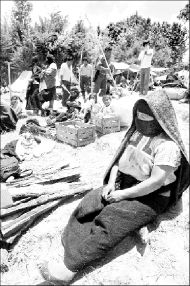
One place where access to land and community cohesion have made possible resistance to total subsumption to capitalism and a certain degree of autonomy is Mexico. In the early 1990s, in the run-up to the passage of the North American Free Trade Agreement (NAFTA), the Mexican government pushed through a consitutional amendment aimed at undercutting one of the few fruits of the Mexican Revolution (1910-20) won by peasants and the indigenous: the collective ownership of land in the form of ejidos where the land belonged to communities and not to individuals and could not be bought and sold. While not organized like the Russian mir, the ejidos nevertheless provided the material foundations for peasant, especially indigneous, communities to survive and preserve elements of their languages, music, dress and self-organization quite different from the institutions of the centralized Mexican state. Thus, they have formed unwanted rigidities to Mexican and American business with an interest in expanding their investments and tapping more people as cheap labor.
While the amendment of the Mexican constitution pleased business, indigenous communities saw it as a death knell foretelling widespread ethnic genocide. As a result in the southern state of Chiapas the indigenous members of many communities united to form, equip and launch a rebellion against such a destiny. These are the Zapatistas, self-named after one of the heroes of the Mexican Revolution, Emiliano Zapata (1879-1919), a peasant from the state of Morelos who became leader of the Liberation Army of the South.
On January 1, 1994, the same day NAFTA went into effect, fighters of the Ejército Zapatista de Liberación Nacional (EZLN, or Zapatista Army of National Liberation) poured out of the jungles and forests and seized six cities in Chiapas. As they did so they explained their rebellion as a last ditch defense against their extermination as peoples and demanded official recognition of their rights to preserve and evolve, in their own ways, their traditional forms of social organization. The Mexican government counterattacked with troops but was soon forced into negotiations by widespread protests all over Mexico and around the world. Those protests were sparked by the ability of the Zapatistas, especially their main early spokesperson Subcomandante Marcos, to clearly articulate not only NAFTA's threat to their communities and their demands for autonomy, but also a more general critique of neoliberalism that resonated around the world so much so as even to inspire foreign musicians, such as the band Rage Against the Machine to celebrate their rebellion in the song "People of the Sun." (14) Outflanked and defeated repeatedly in the subsequent political struggle, the state attacked again in early 1995 and was again forced to back off.
Over the last two decades, the conflict has continued and so far, despite the consitutional amendment permitting communities to be privatized, broken up, sold off and dispersed, the indigneous of the Zapatista movement have been successful in resisting such pressures. Indeed, they have continued to reorganize themselves in more and more explicitly anti-capitalist ways and carried those efforts to the rest of grassroots Mexico seeking ways of building a nationwide, anti-capitalist movement. (15) They continue to resist the final enclosure of the Mexican countryside and the completion of the kinds of processes described by Marx in these chapters.
Because many pre-capitalist forms in Britain were also exploitative, such as the rural world of tenants dominated by a landed aristocracy, Marx had no nostalgia for them. In many areas of the rest of the world, however, those cultures which predated capitalism were either not exploitative, or the people had spheres of autonomy filled with their own traditions, skills and rituals, as in Mexico where strong elements of precolumbian, mesoamerican culture have survived and evolved. (16) Where capitalism has succeeded in destroying such cultures the world has suffered an absolute loss of cultural diversity and human meaning with little to take their place other than the alienated world of capitalist poverty. Where capitalism has failed to impose its own rules of the game because of peoples' resistance, the conflict continues.
Late in his life, Marx not only studied the peasant mir in Russia but also delved into anthropological works on so-called primitive cultures, looking, his notebooks suggest, for further possibilities of avoiding the evils of capitalism through the further development of autonomous cultural practices. (17)
Today, we can look around the world, to some degree here in the U.S. and in the other "developed" capitalist countries, but to a larger degree in the Global South and see the wide variety of distinct ways of life which have been preserved (with change of course), or invented, that still offer a diverse array of alternatives to the dominant culture of capitalism. Whether these alternatives are judged satisfying or seen as points of departure, they show something extremely important: capital has never been able to shape the world entirely according to its own rules.
Beyond the survival of pre-capitalist cultural practices, people have also repeatedly created new kinds of social relationships that are incompatible with the capitalist rules of the game and in the process, have posed new alternatives to it. In his theoretical chapters, Marx shows capitalism really has no creativity at all, but lives by absorbing and harnessing the creativity of those it dominates. The realization of this constant failure of capital to bend all people during all their lives to its demands alerts us to the essential source of potential change: those alternatives preserved and created through struggle.
With these notes of warning about too simplistic an adoption of Marx's analysis as being universally valid in its details, and even more so as being a prescription for a painful but necessary historical passage, we can proceed to examine the elements of this original accumulation which Marx selected for detailed treatment
RECOMMENDED FURTHER READING
- On the issue of the myths of political economy, there are three types of literature. The first, is that which portrays the myths and contributes to their promulgation. In the United States, the best known of this sort are the stories of Horatio Algers such as Ragged Dick (1867) and Struggling Upward (1890) which have been reprinted together in a Penguin American Library Edition (1985). The second, which I have cited and quoted in my commentary, critiques and sometimes ridicules the myths. This includes both literary treatments such as Dickens' Hard Times (1842) or Brontë's The Professor (1846) and the more analytical treatments of Marx's 1844 Manuscripts or such contemporary treatments as David Riesman's The Lonely Crowd, 1953 or Erich Fromm's The Revolution of Hope: Toward a Humanized Technology, 1968. The third type of material is that of professional historians which describe the actual rise of capitalism in all its brutality and ugliness. Such material is not as vast as the reality but reliable accounts are available for many areas of the world, from Britain and other areas of early capitalist development, from the Global South where capitalism extended its rule via colonialism, and later, after World War II, continued to dominate in various forms of neocolonialism.
For the rise of the English working class, as seen from the bottom up, see the following three supurb works: Edward Thompson, The Making of the English Working Class, New York: Vintage, 1963, Christopher Hill, The World Turned Upside Down, New York: Penguin, 1972 and Peter Linebaugh, The London Hanged, New York: Cambridge University Press, 1992.
On the issue of whether Marx was an "historical materialist", you can read both those who claim that he was and his own words arguing that he was not. The former was the official line of the Soviet Communist Party and its derivitives as well as various other more or less "orthodox" Marxist tendencies which have seen him both as the philsopher of "dialectical materialism" and as the social scientist of "historical materialism. The Soviets published a selection of writings by Marx, Engels and Lenin that they felt contributed to the definition and development of historical materialism: K. Marx, F. Engels and V. Lenin, On Historical Materialism: A Collection, Moscow: Progress Publishers, 1972. A typical contemporary orthodox treatment is Maurice Cornfoth, Historical Materialism, New York: International Publishers, 1971. A more sophisticated Althusserian formulation is given by Étienne Balibar in his essay "The Basic Concepts of Historical Materialism" included in Louis Althusser and Étienne Balibar, Reading Capital, London: New Left Books, 1970. A critique of the Althusserian version of historical materialism is given by Edward Thompson in his The Poverty of Theory and Other Essays, New York: Monthly Review Press, 1978. A more recent evaluation is Stanley Aronowitz, The Crisis in Historical Materialism: Class, Politics and Culture in Marxist Theory, New York: Praeger, 1981.
For a more detailed discussion of Marx's work and thoughts on 19th Century Russia, see Teodor Shanin (ed) Late Marx and the Russian Road, New York: Monthly Review Press, 1983 which includes the letters to Zasulich.
On the issue of existing alternatives to capitalism, living within the interstices of capitalist domination, there are two kinds of material. First is that of anthropology which has been devoted to studying such cultural survivals on the margins of the industrial countries and throughout the largely non-industrialized ones of the Global South. The literature here is obviously too vast too cite, but contemporary struggles of such peoples to survive and evolve are chronicled and supported in the journal Cultural Survival Quarterly. Second is that of the history of "working class culture" or of popular counter-culture which has been generated and reproduced within the struggle against capitalist domination. This includes not only the struggles of daily life and such mass movements of as those of the 1960s, but also the accounts of recurrent efforts to elaborate intentional "utopian" communities in autonomous spaces carved out of the larger capitalist society. Here again the literature is enormous.
CONCEPTS FOR REVIEW
frugal elite lazy rascals force historical materialism working class capitalist class development and poverty
|
QUESTIONS FOR REVIEW
(An * means that one possible answer to that question can be found at the end of the study guide.)
*1. What is the idyllic myth of the origins of capitalism, according to Marx? What is his critique of that myth?
2. What are the two senses in which workers are freed during the period of the emergence of capitalism? What two transformations are involved?
3. Who did the industrial capitalists come to replace in society?
4. Over what period does Marx consider capitalism to have emerged?
5. In footnote #1 Marx notes a case where workers who had once been driven into the cities came to be once more driven into the countryside. How is land reform like this process he describes?
6. What is the role of force Marx sees in the emergence of capitalism?
*7. What can we deduce about peoples' response to primitive accumulation from capital's need to use violence to impose its new kind of civilization?
8. "Only in England, which we therefore take as our example, has it (primitive accumulation) the classic form." England is for Marx his most steady point of reference and source of examples throughout Capital. Do you think this means that he sees in the history of the rise of capitalism in England an inevitable series of steps through which all societies pass? As an intellectual exercise, collect all the quotes you can to buttress such a position.
*9. How did Marx respond to Mikhailovski's application of the analysis in Capital to the case of Russia? Does he embrace or reject the interpretation of his theory as a general "historical-philosophical theory of universal development"?
10. Discuss the relationship of Marx's analysis in this chapter with the structure of presentation of all of Part VIII in this volume.
11. From the reading of this chapter, what can you say about Marx's concept of the working class? of the capitalist class? of class? If not everyone has been drafted into the waged working class, through what other ways can you think of have people been forced to work for capital.
*12. Discuss the issue of cultural creation and destruction in the rise of capitalism. Give some examples of cultures which were mostly, or entirely destroyed. Was this destruction a one-time phenomenon of primitive accumulation or has it been an ongoing process?
Footnotes
1 Capital, Vol. 1., p. 874.
2 Ibid., p. 875.
3 This opening makes clear why the subtitle of Volume I of Capital is "A Critique of Political Economy." His critique does not provide an alternative political economy or economic theory of capitalism, but rather an analysis designed to inform struggles to overthrow it.
4 Dickens's character, Mr. Josiah Bounderby, has found a real-life incarnation in Donald Trump; the parallels between their incessant, narcissistic bragging and their lies about the sources of their wealth are striking.
5 Here too are parallels with the sycophants with which Trump surrounds himself.
6 Edwin Arlington Robinson, Selected Poems, New York: Penguin Classics, 1997.
7 MECW, vol. 29, p. 263.
8 Marx to Otechestvenniye Zapiski, November 1877, MECW, vol. 24, p. 200.
9 Marx to Vera Zasulich, March 8, 1881, MECW, vol. 24, pp. 370-371. Also available in the same volume are three drafts of the letter. See pp. 346-369.
10 These letters have played a role in efforts to show how Marx's later work escaped what seemed to be its early limitations. See Teodor Shanin, Late Marx and the Russian Road: Marx and the Peripheries of Capitalism, New York Monthly Review Press, 1983 and Kevin Anderson, Marx at the Margins: On Nationalism, Ethnicity and Non-Western Societies, Chicago, IL: University of Chicago Press, 2016.
11 In recent years, a debate arose about whether Marx's analysis of primitive accumulation is only applicable to the period of the rise of capitalism or also explains continuing processes of enclosure, dispossession and the imposition of markets in contemporary capitalism. See the articles collected in the second issue of the online journal The Commoner, September 2001.
12 This point was apparently made so frequently by the English economist Joan Robinson that the statement “The only thing worse than being exploited by capitalism is not being exploited by capitalism” has been repeatedly attributed to her. See her An Essay on Marxist Economics, London: Palgrave Macmillan, 2nd rev. edn., 1967.
13 Fortunately, a bit more has survived in England's first colonies, Wales (1282), Ireland (1603) and Scotland (1707), especially, for those of us who appreciate things Celtic, their traditional language, music and folklore. Capitalists, of course, try to co-opt/instrumentalize all such survivals—just as they do with wholly new artistic and musical creations —by turning them into profitable commodities and spectacles. Thus, folk and even protest music often wind up being sold for a profit. Of course, in the process capitalist commodification often becomes a vehicle for the widespread circulation of anti-capitalist messages and struggle. In the place of wandering troubadours such as Joe Hill (1879–1915) and Woody Guthrie (1912–67), who inspired workers' struggles as they moved from place to place, came LP recordings of Pete Seeger (1919–2014) spreading their songs across the USA, and Bob Dylan (1941–) inspiring the cultural revolution of the 1960s through LPs, tapes and televised performances. Today, with peer-to-peer digital sharing, YouTube and various social media, capitalist commodification has become more difficult and the circulation of anti-capitalist art and music more widespread than ever before. See Brett Caraway, "Survey of File-Sharing Culture", International Journal of Communication, no. 6, 2012, pp. 564-584.
14 “People of the Sun” got Rage Against the Machine banned by the Mexican government until 1999 when they were finally able to stage a concert in Mexico City. See their video The Battle of Mexico City (2001). The Zapatistas and their supporters have made extensive use of social media, beginning with email and webpages, to circulate information about their struggles and to coordinate resistance to government repression. See H. Cleaver, “The Zapatistas and the Electronic Circulation of Struggle” (1995), in John Holloway and Eloina Peláez (eds.), Zapatista! Reinventing Revolution in Mexico, Sterling, VA: Pluto Press, 1998, pp. 81–103.
15 This was the objective of “The Other Campaign” launched in 2005 as an alternative to presidential elections in Mexico. Having won a certain freedom to travel by dint of continuous struggle, a group of Zapatista spokespeople carried their message and questions about democratic alternatives to Mexico’s formal electoral system throughout Mexico.
16 See Guillermo Bonfil Batalla, Mexico Profundo: Reclaiming a Civilization, Austin: University of Texas Press, 1996.
17 See Lawrence Krader (ed.), The Ethnological Notebooks of Karl Marx: Studies of Morgan, Phear, Maine, Lubbock, Amsterdam: Van Gorcum & Co., 1972 and Anderson, Marx at the Margins.
Attachments
Comments
Harry Cleaver's study guide to chapter 27 of Marx's Capital volume 1.
Outline of Marx's Discussion:
- England: serfdom disappeared by last part of 14th Century
- - mostly independent peasants in 15th Century
- part time laborers
- right to common land for grazing, timber, etc.
- small peasant properties
- - dissolution of bands of feudal retainers
- partly by royal power reducing wealth of aristocracy
- partly by feudal lords
- driving peasants from land for sheep walks (fx increased wool price)
- usurping commons
- destruction of houses - futile legislation for 150 years after Henry VII (1489) to stem this trend, i.e., to 1630.
- - colossal spoliation of catholic church property - ex-feudal proprietor of land
- dissolution of monasteries
- estates given to royal favorites, drove out hereditary sub-tenants
- estates sold at nominal price
- - theft of state lands, seized and given away or sold at low prices
- -"Bills for the Enclosure of Commons" by Parliament dominated by "landed and capitalist profit grubbers."
- - clearing of cottages and people
- particularly dramatic in Scotland, e.g. by the Duchess of Sutherland:
- 15,000 people pushed out by British soldiers in appropriation of 794,000 acres of land,
- pushed to seashore, later driven awary again when sea-shore let to London fishmongers.
- conversion of sheep-walks to "deer-forests" for sport (led to famine)
- 1. destruction of yeomanry (independent peasants) by 1750
- - replaced by tenants at will, small farmers on yearly leases, a servile rabble,
- and sheep/deer, agricultural labor
3. driving of people into the manufacturing towns:
- - creation of the human material to be shaped into an industrial working class,
- "driven from the land and forbidden to emigrate"
Commentary
This historical analysis of the first step in the creation of the working class centers on the forcible expropriation of the means of livelihood of peasants and craftspeople. In England some 6,000,000 acres or 1/4 of the cultivated acreage was enclosed by direct act of parliament. Another 4-7 million acres are estimated to have been enclosed privately. (1) The second step—forcing them into the factories—comes in the next chapter. This expropriation of the land was a long process, 300 to 400 years, and only through considerable violence were these changes accomplished. Vast numbers resisted and had to be forcibly dispossessed, a violence that forced them to seek refuge in woodland or cities or even flee abroad.
One area of dispossession, which Marx highlights, is the highlands in Scotland where the Dutchess of Sutherland and others drove their clansmen from the land. Such enclosures and the human misery produced were fought by those directly victimized and protested by sympathizers.
The long and tragic history of the enclosures with their terrible costs to humans and to nature left an indelible mark on the various cultures of the "British" Isles. These costs were a central issue in the transformation wrought by the rise of capitalism, the commercialization of agriculture and the industrialization of manufacturing. Not surprisingly, they have also become the inspiration of folk music that remembers and laments. "The Highland Clearances" written by Andy Stewart, blasts Queen Victoria for sanctioning the kind of highland clearances carried out by the duchess of Sutherland, evokes the burning of the peasant crofts and recalls those who were forced to take ship for the New, and hopefully better, World.(2)
 |
The Highland Clearances Ah, for the Glens are lyin' bare Black is the wood on the roof ance was braw |
Many hae gane tae Americay. Ah for the Glens are lyin' bare Silly Wizard, So Many Partings, 1989 |
While the new capitalist farmers were on the offensive, they found it no easy task to drive off and pauperize the population. There was violent resistance to physical removal; there were polemics written by economists and others, and from time to time, there was even legislation against the process—though largely ignored and unenforced. As we see in the subsequent chapter, the dispossessed also turned to "vagabondage and brigandry" out of desperation and to avenge themselves for the loss of their land and livelihoods.
This process that Marx analyzes in Britain has been universal throughout the bloody history of the creation of the capitalist world. Marx mentions Germany, Sweden and France in passing, but it has been employed everywhere capitalists invaded, from Asia, through the Middle East and Africa to the Western Hemisphere. In all those regions, British capitalists, backed by their government’s army and navy, established private property by force and fiat against the indigenous peoples and their customs, no matter how varied. So too did the Dutch in the East Indies. In the lands of the Incas and Aztecs, the violence of the Spanish conquistadors and expropriators is well known. Both Spaniards and Portuguese established huge colonial empires in South America, bequeathing the region the title of Latin America following the imposition of their own languages on indigenous peoples. (3) The Dutch also carved out pieces of South America and Southern Africa. Throughout the “Age of Imperialism,” capitalists, backed by their governments, competed, both economically and militarily, frequently displacing one another in wars for the control of the peoples, resources, markets and investment opportunities throughout the world.
Over time, “primitive” accumulation became a recurrent aspect of capitalist development. Despite capitalist efforts to extend their control throughout the world, that world was just too large and its people too numerous and too resisting for capitalist investment to expand as rapidly as its colonial control. As we see in Chapter 25, capitalists have sought to use un-dispossessed people left on the land as a vast, latent “reserve army” to be expelled and exploited when needed. Today, these conflicts continue as capital repeatedly seeks to steal what little land remains in the hands of small farmers, peasants and indigenous communities. Undeterred by government regulation, private capitalists clear-cut and burn tropical rainforests, which remain the home of diverse traditional cultures. Governments seize both private and public lands for corporate investors in airports, golf courses or mining. As such enclosures continue, so too do the struggles against enclosure, sometimes in the courts, sometimes in the streets and forests.(4)
Because his subject is the creation of the working class, Marx focuses on the dispossession of independent peasants and does not dwell either on the general nature of the pre-capitalist system, or on details of the ways of life being wiped out. His general interpretive analysis grasps the transition in terms of where it is headed but gives little sense of the kind of societies that were being destroyed. As a result, he leaves us no feeling for either the world of the peasants who are being driven off their land, or for the world of the landed estates whose "retainers" were being let go to join the unemployed, potentially waged labor force.
Marx's reasons for this absence can be explained partly by ignorance, partly by just not taking the time away from trying to understand the kind of world capitalists were imposing to examine the world(s) it was replacing. Certainly, he had no nostalgia for any kind of feudalism, nor was he a pastoralist wanting to turn history back to mythical peasant utopias. What little attention he did pay to peasant struggles before writing Capital—mainly those of French peasants—led him to be dismissive of their revolutionary potential. (5) However, as I have mentioned, years after Capital was published, debates in Russia over the importance of peasant life as a potential point of departure for a post-capitalist future led him to a much more sympathetic examination of the peasant mir.(6)
Whatever Marx's reasons for largely neglecting the study of the world(s) resisting capitalist enclosure, similar ongoing struggles—many of which have survived for hundreds of years—demand that we do the work he only began with his investigation of Russian peasant life and try to understand what such people have been fighting to protect. (See below, the last part of these commentaries on this chapter.)
Literary Illustrations
Traces of this great drama abound in English literature. While several middle- or upper-class poets wrote pastoral verses idealizing a vanishing world they knew only as tourists, lamenting its passing through enclosure, a handful of those who actually worked the land also took up the pen to chronicle the destruction of their world. One among those whose writings have come down to us was John Clare (1793-1864). Born in the village of Helpstone, Northamptonshire, Clare was a landless agricultural laborer who worked in various jobs. He was also an acute and sympathetic observer of both the nature around him and a harsh critic of the way that nature and the people who worked in it were being wiped out by enclosures. The following poem "The Mores" or "Moors" (Clare's spelling is often local and non-standard), begins with an evocation of a beautiful, wide-open natural area of "unbounded freedom" unmolested by fence or plow, where Clare had spent his boyhood. But then comes enclosure that builds fences, "improves" the land, trampling on labor's rights and turning the poor into slaves. Clare's contempt for this process and the character of those responsible are crystal clear. "Fence now meets fence in owner's little bounds / Of fields and meadow large as garden grounds / In little parcels little minds to please / With men and flocks imprisoned ill at ease." (7)
The Mores
Far spread the moorey ground a level scene
Bespread with rush and one eternal green
That never felt the rage of blundering plough
Though centurys wreathed spring's blossoms on its brow
Still meeting plains that stretched them far away
In uncheckt shadows of green brown, and grey
Unbounded freedom ruled the wandering scene
Nor fence of ownership crept in between
To hide the prospect of the following eye
Its only bondage was the circling sky
One mighty flat undwarfed by bush and tree
Spread its faint shadow of immensity
And lost itself, which seemed to eke its bounds
In the blue mist the horizon's edge surrounds
Now this sweet vision of my boyish hours
Free as spring clouds and wild as summer flowers
Is faded all - a hope that blossomed free,
And hath been once, no more shall ever be
Inclosure came and trampled on the grave
Of labour's rights and left the poor a slave
And memory's pride ere want to wealth did bow
Is both the shadow and the substance now
The sheep and cows were free to range as then
Where change might prompt nor felt the bonds of men
Cows went and came, with evening morn and night,
To the wild pasture as their common right
And sheep, unfolded with the rising sun
Heard the swains shout and felt their freedom won
Tracked the red fallow field and heath and plain
Then met the brook and drank and roamed again
The brook that dribbled on as clear as glass
Beneath the roots they hid among the grass
While the glad shepherd traced their tracks along
Free as the lark and happy as her song
But now all's fled and flats of many a dye
That seemed to lengthen with the following eye
Moors, loosing from the sight, far, smooth, and blea
Where swopt the plover in its pleasure free
Are vanished now with commons wild and gay
As poet's visions of life's early day
Mulberry-bushes where the boy would run
To fill his hands with fruit are grubbed and done
And hedgrow-briars - flower-lovers overjoyed
Came and got flower-pots - these are all destroyed
And sky-bound mores in mangled garbs are left
Like mighty giants of their limbs bereft
Fence now meets fence in owners' little bounds
Of field and meadow large as garden grounds
In little parcels little minds to please
With men and flocks imprisoned ill at ease
Each little path that led its pleasant way
As sweet as morning leading night astray
Where little flowers bloomed round a varied host
That travel felt delighted to be lost
Nor grudged the steps that he had ta-en as vain
When right roads traced his journeys and again -
Nay, on a broken tree he'd sit awhile
To see the mores and fields and meadows smile
Sometimes with cowslaps smothered - then all white
With daiseys - then the summer's splendid sight
Of cornfields crimson o'er the headache bloomd
Like splendid armys for the battle plumed
He gazed upon them with wild fancy's eye
As fallen landscapes from an evening sky
These paths are stopt - the rude philistine's thrall
Is laid upon them and destroyed them all
Each little tyrant with his little sign
Shows where man claims earth glows no more divine
But paths to freedom and to childhood dear
A board sticks up to notice 'no road here'
And on the tree with ivy overhung
The hated sign by vulgar taste is hung
As tho' the very birds should learn to know
When they go there they must no further go
Thus, with the poor, scared freedom bade goodbye
And much they feel it in the smothered sigh
And birds and trees and flowers without a name
All sighed when lawless law's enclosure came
And dreams of plunder in such rebel schemes
Have found too truly that they were but dreams
I have gathered several of Clare's "enclosure" poems together here.
The drama of this long period lay both in the loss of those various rural ways of life that Marx failed to study and in their replacement by the highly urbanized world of industrial capitalism, with its satanic mills, money values and new kinds of class antagonism. The so-called “industrial novels” of the nineteenth century, however, reflected and nourished political and philosophical debates about the human meaning of these changes. More than “fiction,” these novels are invaluable historical canvases on which their authors painted, in rich detail, their changing world. While the central interests in novels are their characters, whose personal dramas and development make up the narrative structure, the books also contain a variety of vivid portrayals of various aspects of English society: some disappearing and some coming to dominate.
One of those novelists who was preoccupied in her writing with the social and human meanings of the transition was Elizabeth Gaskell (1810– 65). Her novel Mary Barton: A Story of Manchester Life was published in 1848, the same year as Marx and Engels’s Communist Manifesto. The wife of a Unitarian minister in Manchester, Gaskell was intimately familiar with the working-class world she portrayed and although, unlike Marx, she hoped for a reconciliation of the classes, her novel gives a sympathetic and very human portrayal of the difficult lives and struggles of manufacturing workers. While Mary Barton only marginally evokes the transition from an agrarian England to an industrializing one, through the character of Alice Wilson, another of Gaskell’s novels, North and South (1855) deals with it quite directly.(8) The “South” of the novel is the largely agrarian south of England—from which the main heroine of the story comes—and the “North” is the increasingly industrial north of that country—to which the heroine moves. Discovering a whole new world, she reflects upon all the differences between the two. Here too, Gaskell portrays the class struggles of industrial capitalism, this time through the eyes of the daughter of a disillusioned minister.
Writing under the pseudonym of George Elliot, Mary Ann Evans (1819–80) is perhaps best known for Silas Marner (1861) and
While only a reading of the whole novel, with its poetic and striking presentation of individual lives, can do it justice, it includes brilliant snapshots of the world being displaced by capitalism. Her metaphor of the dinosaur evokes the quantitative importance of those estate "retainers" whose dismissal preoccupies Marx and of the imminent extinction of the class which had subordinated so many people, at such great expense, to its own luxurious lifestyle:
| But a man of Sir Maximus's rank is like those antediluvian animals whom the system of things condemned to carry such a huge bulk that they really could not inspect their bodily appurtenance, and had no conception of their own tails: their parasites doubtless had a merry time of it, and after did extremely well when the high-bred saurian himself was ill at ease. Treby Manor, measured from the front saloon to the remotest shed, was as large as a moderate-sized village, and there were certainly more lights burning in it every evening, more wine, spirits, and ale drunk, more waste and more folly, than could be found in some large villages. There was fast revelry in the steward's room, and slow revelry in the Scotch bailiff's room; short whist, costume, and flirtation in the housekeeper's room, and the same at a lower price in the servants' hall; a select Olympian feast in the private apartment of the cook, who was a much grander person than her ladyship, and wore gold and jewelry to a vast amount of suet; a gambling group in the stables, and the coachman, perhaps the most innocent member of the establishment, tippling in majestic solitude by a fire in the harness room. For Sir Maximus, as everyone said, was a gentleman of the right sort, condescended to no mean inquires, greeted his head-servants with a 'good evening, gentlemen', when he met them in the park, and only snarled in a subdued way when he looked over the accounts, willing to endure some personal inconvenience in order to keep up the institutions of the country, to maintain his hereditary establishment, and do his duty in that station of life -the station of a long-tailed saurian- to which it had pleased Providence to call him.(9) |
The passing of such grand estates was often gradual and often due to their owners’ resistance to changing times, such as the need to modernize the agriculture upon which their rents and incomes were based. Such resistance is part of the tale told in the hugely popular, ITV/PBS Masterpiece Theatre mini-series Downton Abbey (2010–15).(10)
Tales of Resistance
Marx’s analysis also lacks a detailed examination of the resistance that shaped and forced changes in capital’s expropriation and organization of labor. Marx tells us what was done, but he rarely gives a satisfying analysis of the power shifts that made it possible. The Russian anarchist Peter Kropotkin (1842–1921) spells out what needs to be done for the study of all worker struggles, overtly revolutionary or otherwise:
We endeavor, first of all, to free the histories of revolutions written up till now from the partisan, and for the most part false, governmental coloring that has been given them. In the histories hitherto written we do not yet see the people; nor do we see how revolutions began. The stereotyped phrases about the desperate condition of people previous to revolutions fail to explain whence amid this desperation came the hope of something better—whence came the revolutionary spirit. And therefore after reading these histories, we put them aside, and going back to first sources, try to learn from them what caused the people to rise and what was its true part in revolutions, what advantages it obtained from a revolution, what ideas it launched into circulation, what faults of tactics it committed.(11)
This perspective suggests some areas of Marx’s argument that need more research:
1. Dissolution of feudal retainers: the reduction of wealth of the feudal nobility that forced them to let servants go is cited but not analyzed. The dismissal of servants is easy to understand: they could hardly fight to stay, though the above passage from George Eliot suggests why they might want to do so. The issue is what did they do when dismissed, how did they live and struggle?
2. Similarly, the issue of the reformation and the overthrow of the hegemony of the Catholic Church needs an examination of the popular forces at play in the English Reformation—forces which not only displaced the Roman church but nearly overthrew the whole regime during the English Revolution of the 17th Century.
3. More important are the usurpation of the common lands through enclosure. Why this was desired, Marx makes clear. How the power was mobilized to do so, he does not. How did the peasants resist? How was the clearing carried out so that peasant resistance was crushed? British troops were used at times. but how were they turned against their own people? One can speculate but Marx tells us very little about the actual dynamics of this "decomposition" of the peasantry. We get neither analysis of politico-military tactics of repression nor of the tactics of resistance that failed (Kropotkin's "faults of tactics").
4. Laws were passed against enclosure for 150 years, but to no avail—a clear split between legislative and executive action. Why? What were the forces that led the latter to defy the former?
Fortunately, we can gain some insights into these things by studying the writings of historians such as E. P. Thompson (1924-93). In his Making of the English Working Class (1963), he revealed new information about agrarian struggles in the period 1790-1830. "How was it possible, . . . for the labourer to be held at brute subsistence level?" he asks and begins to give an answer that takes into account peasant resistance. (12) (Note that he is discussing labor revolt in the later stages of expropriation, the last gasp of the resisting peasantry and the continuing resistance of the new class of agricultural workers.)
On the side of resistance he cites various kinds of resistance: threats to overseers, sporadic sabotage (burning corn ricks), sullen and discontented spirits, turnip-pilfering, alehouse scrounging, poaching and layabouts. In 1816, after the Napoleonic War years (1793-1815) when the return of troops caused problems in East Anglia, dispossessed field laborers rose up demanding minimum wages and price maxims. There were "food riots, forced levies for money from the gentry, and the destruction of threshing machines."(13) The Laborers Revolt of 1830 included multi-village strikes, thresher breaking, demand for land, extortion of money, robbery, etc. This movement gained the sympathy of many in the middle class and some concessions.
On the side of the capitalist farmers and gentry, Thompson mentions various means that were used to repress such rebellions: mobilization of servants and retainers, grooms, huntsmen, game-keepers with pistols, shotguns, etc.; as well as the use of government troops.
Overall he sketches relatively isolated revolts on which superior military force could be focused. Isolation due to the inability to organize beyond local villages was, in turn, due to the difficulty of communication as well as the unevenness of exploitation. Enclosures were not carried out everywhere at once but piece by piece. Isolated in boh space and time, peasant resistance could be destroyed by local goons and government troops. Who were these troops? Were there failures? As we ask these questions of enclosures in the present period, so too must we ask them of those of the 15th to 19th Centuries. We ask them so that we can learn of past strengths and weaknesses in order to do better today. Land is still being seized, people are still being displaced and resistance continues. The peasantry or land question and the capitalist need for labor are still pressing ones. Even when the question is of a shift from unwaged exploitation to waged exploitation (or vice versa) rather than of “primitive” accumulation, the fundamental conflict still plagues us.
The World Turned Upside Down
Was the earth made to preserve a few covetous proud men
to live at ease, and for them to bag and barn up the treasures
of the Earth from others that these may beg or starve in a
fruitful land; or was it made to preserve all her children? (14)
Gerard Winstanley (1609–76) was a leader of the “Diggers” or “True Levellers” movement against enclosures, a movement that not only resisted but sought to reverse the process by seizing and working unused, enclosed land. One important moment of those struggles took place in 1649, a time of explosive political conflicts in England. The poor harvests of 1648 had led to widespread hunger and unemployment and the urgency of demands for change had led to widespread radical demands, even within Cromwell’s army. Marxist historian Christopher Hill (1912–2003), a compatriot of E. P. Thompson, did the research necessary to provide a detailed description of the struggles and repression of the Diggers in 1649 in his book The World Turned Upside Down (1984). (15)
As part of those struggles Winstanley wrote a battle song, "You Noble Diggers All," calling workers to battle to reclaim common lands from the greedy hands of private property.(16) The song blasts not only the landlords and their violence but also the lawyers who manipulated the laws to the landlords' advantage and the priests who wielded their religious doctrine to condemn workers and justify the violence used against them. In a fine example of reappropriating past struggles, Leon Rosselson not only resurrected Winstanley's song, but wrote one of his own, whose title "World Turned Upside Down" was probably taken from Christopher Hill's book. (17) Scotsman Dick Gaughan, who has performed the song, wrote this about it: "The mark of a great song is its ability to speak universals about specific happenings and to be relevant to all times. Sometimes we (Scots and Irish) forget that the first colony of the British Empire was in fact England." (18) For a visual, and visceral, sense of the struggles, see the 1975 film Winstanley directed by Kevin Brownlow and Andrew Mollo, noted for the quality of its attention to historical detail.
You Noble Diggers All You noble all, Your houses they pull down, With spades and hoes and ploughs, Their self-will is their law, The gentry are all around, The lawyers they conjoin, The clergy they come in, Gainst lawyers and gainst priests, The club is all their law, (Leon Rosselson, Harry's Gone Fishing, Wimbley Park: Fuse Records, 1999 (CFCD 007). |
The World Turned Upside Down In 1649 'We come in peace' they said 'The sin of property 'They make the laws We work, we eat together From the men of property 'You poor take courage (Dick Gaughan, Handful of Earth, |
Hill's description of the events dealt with in these songs goes as follows:
"On Sunday 1 April . . . a group of poor men (described as labourers in a legal action three months later) collected on St. George's Hill . . . and began to dig the waste land there. It was a symbolic assumption of ownership of the common lands . . . The numbers of the Diggers soon rose to twenty or thirty. 'They invited all to come in and help them,' an observer noted, 'and promise them meat, drink and clothes . . . They give out, they will be four or five thousand within ten days . . . It is feared they have some design in hand.' Consider for a moment the area affected. St. George's Hill was just outside London, within easy reach of any poor man there who might be interested in the colony. It lay on the edge of Windsor Great Forest, where in 1641 'scores and hundreds set upon the King's deer.' It was unpromising agricultural land, the improver Walter Blith sniffed. Kingston, the nearest town, to which the Diggers were taken for trial by the local landlords, was a great corn market. It had a long-standing radical tradition . . . landowners in the area round St. George's Hill were more disturbed by the digging than the Council of State or General Fairfax . . . Nor does Oliver Cromwell seem to have been unduly alarmed when a 'northern profetess' warned him, a propos the Diggers, that 'if provision be not made for them poor commoners, England will have new troubles.' But parson Platt and other Lords of manors in Surrey organized raids on the colony and an economic boycott; they harassed the Diggers with legal actions . . . Even after the Diggers moved to Cobham Heath a few miles away the raids continued, and by April 1650 the colony had been forcibly dispersed, huts and furniture burnt, the Diggers chased away from the area. It was a brief episode in English history, involving perhaps a few score men and their families: we know the names of seventy-three of them . . . But historians are becoming aware that it was not quite so isolated in occurrence as used to be thought . . . We should see the Digger colony on St. George's Hill as merely one particularly well-documented example of a trend which was repeated in many other places . . . Other Digger colonies appeared at Wellingborough in Northhamptonshire, Cox Hall in Kent, Iver in Buckinghamshire, Barnet in Hertfordshire, Enfield in Middlesex, Dunstable in Bedfordshire, Bosworth in Leicestershire, and at unknown places in Glouscestershire and Nottinghamshire. Not enough local work has yet been done on most of these places, but we know something about Wellingborough . . . the Wellingborough Diggers produced a DECLARATION which tells us very precisely what sort of people supported their movement. There were 1169 persons in receipt of alms in the parish. Trade was decayed, there was no work; 'rich men's hearts are hardened, they will not give us if we beg at their doors. If we steal, the law will end our lives, givers of the poor are starved to death already and it were better for us that are living to die by the sword than by the famine.' So they, like the Surrey Diggers, had begun to 'dig up, manure and sow corn upon the common waste ground called Bareshank . . . But this colony seems to have been suppressed at the same time as that in Surrey." pp. 107-124.
The Diggers' attempt to reverse the process of enclosure and clearing failed. But that failure was only one moment in a multitude of struggles that shaped the emerging class composition of England. And the Diggers' visions, of the common use of the land, and of the right of people to eat and to determine their own lives are still shared by many and not all "diggers" have failed.
The twentieth century saw a vast resurgence of demands for "land reform," the restoration to people of land previously taken from them. During the Mexican Revolution begun in 1910, Mexican peasants cut barbed wire fences and retook their land in revolts dramatically portrayed in the film Viva Zapata! (1952).(19) During the Russian Revolution of 1917, with the slogan "Bread and Land" millions of peasants reappropriated what had once been theirs. In China in 1927, Mao Zedong visited Hunan province and discovered that the revolution had begun without him; poor peasants were expropriating the rich and redistributing the land. In Vietnam, peasants joined the Vietminh against colonialists who had seized their land for rice and rubber production for export, fighting in turn, the French, the Japanese, the French again and finally the Americans. Those were four great revolutionary moments when the reappropriation of land, the reversal of enclosure, was a central issue. We could multiply the examples of such conflicts a thousand-fold, throughout Asia, Africa and the Americas. Today, two current struggles come immediately to mind: those of the Landless Laborers in Brazil (MST) and of the Zapatistas in southern Mexico who have fought to reclaim lands previously stolen and concentrated in the hands of capitalist farmers.
Enclosing Water
Echoing the sad tale of Highlanders pushed to the seashore by the Duchess of Sutherland, who then “let the seashore to the big London fishmongers,” (20) an Irish song tells the story of the resistance of fishermen in Northern Ireland to their dispossession by British colonialism. The original expropriation of eel-fishing rights was carried out under the orders of King Charles I in the mid-1600s. The Toome Eel Fishery referred to in the song was formed in the late 1950s and was awarded exclusive fishing rights by a British court in 1963. Lough Neagh is both the largest freshwater lake in the British Isles (153 square miles) and the largest eel fishing area in Northern Ireland, with an annual take of about 600 tons.
On the jacket of their record This is Free Belfast the Men of No Property give the following background: "Northern Ireland's great Lough Neagh is the richest fishing ground of Western Europe. Instead of this natural treasure being the heritage and property of all the people, the fishing rights to its greatest catch: eels, are controlled exclusively by one company, the Dutch-controlled Toome Eel Fisheries (N.I.) Ltd. This company prosecutes the fishermen, and can revoke their licenses."(21)
 The Great Eel RobberyCome all you gallant Ulstermen Well, the cruel decision the judges made Now we contend King Charles gave away |
They've stolen away what should belong To each and every man, And for our fate cruel England's law Well, she does not give one damn. They called our fishing poaching For they have a great monopoly But though we've had a setback
|
The song ends with a promise of continuing struggle to win back fishing rights for local fishermen. And indeed, the fishermen formed a Lough Neagh Fisherman's Association and registered as a trade union to fight for their rights. According to one account the fishermen successfully formed a "Co-operative Society" that was able to buy 20% of the shares of Toome Eel Fishery (NI) Ltd. When the majority shareholders refused to buy eels from the Irish fishing co-operative, the latter by-passed Toome and developed new markets in Europe. With the profits they realized from those markets, they were ultimately able to buy out the other 80 percent of the shares of Toome and as forecast in the song, the full rights to eel fishing finally reverted to local Irish fishermen!(22) 
There is another interesting dimension to this story. The song notes that the Dutch company held a "great monopoly that stretches Europe round". Leaving aside the empirical question of exactly what the market share of that company has been, it is true enough that fishing, not just in Europe but around the world, has become increasingly concentrated in the hands of huge multinational corporations using "advanced" technology to maximize their take and profits. One result has been global over-fishing and a dramatic depletion of many species of fish. Moreover, because fish eat fish, this has caused such a disruption of ocean ecological balance as to create a growing crisis - one that cannot be overcome by the substitution of aguaculture or farm fishing for wild catch. The Associated Press reports that this overfishing and depletion includes the European eel.(23) Not only are prices rising rapidly as supply shrinks, but the reduction in the eel population is also creating worries about the impact on other animals who eat them, e.g., cormorants, herons, otters and other European wildlife.
In contrast to this over-fishing, the fishermen of Lough Neagh are carefully manage their fishing in ways designed to sustain the eel population on which their livelihood depends. This is often the case with local fishing, as with local agriculture. A multinational corporation can deplete what they see as a "resource" and move on; local populations, dependent on the sustainability of their ecosystem, are often more careful in how they interact with it. (24)
Enclosures in United States
In North America the initial expropriation of the "agricultural population" was the displacement and extermination of Native Americans. Forming a diverse array of cultures based on various mixtures of agriculture and hunting & gathering, the these peoples filled the land the European invaded. Their hunting and gathering spread out over wide regions, and their agricultural methods often involved shifting and moving about. To the Europeans, used to dense populations where virtually every available hectare of arrable land was cultivated, or given over to city building, North America looked "empty", or at least so they pretended. As the Europeans occupied the East Coast and pushed inland they sought to either subordinate or eliminate those in their way. For the most part, the indigenous population was never accepted assimilation. With few exceptions, they could never be put to work directly, either as slaves or as wage labor —they simply refused, prefering to fight or to die. In some cases the European invaders were able to tap the Indians' labor indirectly through the fur trade but mostly they simply pushed them out of the way and killed them when they resisted.
TThat resistance, of course, was great, long and bloody. It took a 200-year war to secure the majority of the land and to eliminate most of the Indians, confining the few who remained to reservations. This is a history that has been, for the most part, passed over quickly at all levels of school, from elementary to university. Ignorance of Native American culture and stereotypical images of barbaric savages were promulgated to rationalize their destruction and only recently have begun to be replaced by more informed and less racist knowledge and treatments. With respect to Native American resistance, for a long time about the only aspects of that history whose memory was preserved with respect were some of their more effective armed struggles—preserved ironically by the military forces that defeated them, but that still honor the brilliance of their strategies and tactics of war.
Fortunately, the neglect and failure to appreciate the resilience and creativity of Native American resistance has been increasingly countered in recent years, first by student struggles to create space and to gain resources for Native American Studies and second, by histories written from the point of view of the indigenous.(25)
Beyond these accounts of primitive accumulation in Britain and North America— understood as the creation of the classes of capitalist society—we must also recognize that both processes cannot be properly analyzed within national or even continental bounds. Because the indigenous population would not work for a wage, and because indentured European servants often escaped their servitude, the North American working class was constructed, in part, through the enslavement of Africans. That enslavement ripped people from their land and forcibly transported them across the Atlantic to plantations where they were put to work on land stolen from the Cherokee (Tsalaqi), the Creek (Muskogee), the Chickasaw (Chikasha), the Choctaw (Chahta) and the Seminole (Meskwaki). Just as the displaced agricultural population in Britain migrated from rural areas toward cities and even abroad, so too did the African slave trade force a migration that contributed to the formation of a working class throughout much of the Atlantic basin. Thus, primitive accumulation in the New World was closely interlocked with that of Europe and Africa, making it mandatory to study the formation of an Atlantic working class rather than a purely North American one. (26)
This history and its study is complicated by the process of separating people from the land being repeatedly renewed. European settlers, who displaced the indigenous population, used the land they seized to ground their own independence from the growing capitalist demands for labor. For the most part, the frontier was not settled by capitalist plantation owners and ranchers employing slave or waged labor, but by family farmers who came west precisely to escape the factories and slums of both Western Europe and the American East Coast. The frontier moved west year after year and generation after generation as part of a struggle for freedom from exploitation—even as the indigenous population lost its freedom, and often its very existence.
This westward movement of pioneers, mountain men and homesteaders provided not only the inspiration for ideals such as Jefferson’s agrarian democracy, but also an ongoing problem for capitalists who wanted to integrate the labor of these independent agriculturalists into a wider project of accumulation. As late as the nineteenth century, most US citizens still lived on the land and their labor (like that of the indigenous before them) could only be tapped through the market. They could only be exploited through unequal exchange in which they sold agricultural produce that took a great deal of labor to create and bought manufactured products that took much less. With the development of capitalist banking and finance, they were also exploited through mortgages and bank loans. Over the years, these methods all worked together to generate a slow but inexorable process of dispossession, through which the vast majority of independent farmers lost their farms and were forced into wage labor. This process is still going on, even though only 3 or 4 percent of Americans still live on the land. It accelerates in hard times, when farm prices are low and mortgages and bank loans cannot be repaid, and slows during upturns when expanding demand and government subsidies keep farm output prices up and credit cheap.
As might be expected, this process, like earlier periods, generated considerable resistance. From the Whiskey Rebellion (1791–94) through the Populist Revolt of the 19th Century to the American Farm Movement of the 1970s (supported by Willie Nelson's Farm Aid concerts), it has been a long and bitter history. Repeatedly, the dreams of independence of many generations of American farmers have been crushed and, like the British yeomen and Native Indians before them, they and their families have been driven from the land.
Typical of the popular music of farmer resistance are two songs, one from the period of the Populist Revolt and the second from that of the American Farm Movement. “The Farmer is the Man” originated among western farmers after the Civil War and became famous during the Populist Revolt of the 1890s. In that song, those responsible for the exploitation and ultimate enclosure of family farmers’ lands and tools are the mortgage men and bankers who “get it all.”(27)
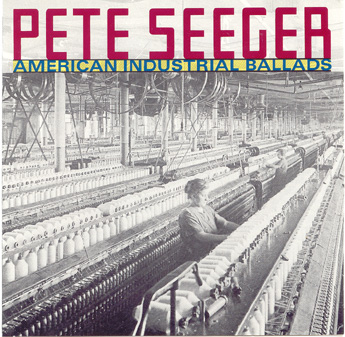 The Farmer is the ManWhen the farmer comes to townWith his wagon broken down, Oh, the farmer is the man Who feeds them all. If you'll only look and see, The farmer is the man, When the lawyer hangs around And the preacher and the cook Oh, the farmer is the man, When the banker says he's broke Oh, the farmer is the man, |
The more recent song about the loss of family farms is “Rain on the Scarecrow” by John Cougar Mellencamp.(28) This song is bleaker, more about loss than about struggle, but fitting, given that most farmers have lost and very few remain. The story is the same: “The crops we grew last summer weren't enough to pay the loans / Couldn't buy the seed to plant this Spring, and the Farmers Bank foreclosed."
 Rain on the Scarecrow Scarecrow on a wooden cross Rain on the scarecrow The crops we grew last summer Well there's ninety-seven crosses Rain on the scarecrow Rain on the scarecrow (John Cougar Melencamp, Scarecrow, PolyGram Records, 1985 |
Women, Witches and the Enclosure of the Body
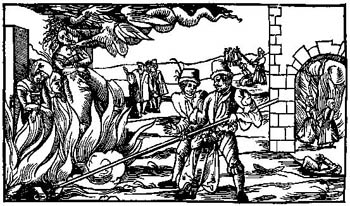 Marx's analysis of the enclosures focuses on the theft of peasants' land, one of their basic means of subsistence and sources of power to resist exploitation by others (whether landlords who would charge rent or capitalists who would profit from paying low wages). The loss of land, of course, was often accompanied by the loss of most other means of subsistence including home and tools (such as spinning wheels, axes, saws, looms, cauldrons) which allowed peasants to provide themselves with housing, furniture, clothes and food. Thus, along with the expropriation of the means of production went that of the means of reproduction —of reproducing daily life for oneself and one's family.
Accompanying this expropriation of land and the material means of reproduction was another expropriation even more intimate: that of women's bodies. During this period, a wide variety of women's social practices and rights came under attack including their right to regulate their own fertility, their equality with men in both work and struggle and their right to enjoy their own sexuality and their spiritual relations with nature. Contraception was outlawed; they were painted as evil and threatening to men, their proper role was redefined as broodmare and houseworker; adultry was criminalized; as was free, collective sexuality (of both women and men); their skills at healing and magic were outlawed and made punishable by death. Their proper roles were redefined as brood mare and housewife. Their rights and possibilities were dramatically reduced as they were more deeply, subordinated to men in both homes and workplaces.
The nadir of this repression unfolded in Britain and Western Europe during 1550-1650, the period of the "Great Witch Hunt," which saw tens of thousands of women tortured and executed for once common practices that had been criminalized. Most of the victims of this repression were poor peasant women singled out in a population that was resisting the enclosures. In Britain, this period is bracketed by the 1549 Ketts Rebellion against enclosures and the English Revolution, which sought to turn the whole new order "upside down." During those years, the state, in collaboration with both Catholic and Protestant Churches, accelerated a wave of repression against women that had been growing with the rise of capitalism and popular resistance to it. Midwives (sage femmes, or wise women, in French) were accused of being in league with the devil and preventing procreation or committing infanticide. This persecution was the beginning of a process where women were forced to procreate more workers for the labor market and increasingly excluded from all aspects of obstetrics and gynecology which were taken over by men and the state.
Rebellious women who spoke out or who insisted on their rights and their desires were accused of witchcraft and killed, as examples to all others. Such attacks struck directly at the important roles women had played in peasant revolt. Any and all manifestation of sexual desire outside of marriage—adultry, procreation, prostitution, etc.— was criminalized.(29) The sexuality of the young was repressed, of the old ridiculed—indeed the stereotypical image of the witch as an old, evil and lascivious crone dates from this period (and is still with us). Women in general were accused by demonologists of "insatiable sexuality" capable of dominating men to the point of being able to cause impotence. (30)
Such repressive laws, such as those calling for sexually active but unwed women to be put to death, had already been attacked vehemently at the beginning of the 16th Century by Ludovico Ariosto in his epic romantic poem Orlando Furioso(1516). In that poem, one of the main characters, a chivilrous knight named Rinaldo, learns of a princess who had been set up for death by a spurned suitor. The suitor achieved his revenge by making it seem as if she had made love with another outside of wedlock—this in a country (Scotland) where such behavior was punishable by death. Rinaldo's reaction expresses Ariosto's own feelings about such repressive laws. “This inequality in law much wrong / Has done to women. / With God’s help I mean / To show that to have suffered it so long / The greatest of inequities has been. / A curse upon the legislator’s head!”(31)
| The law of Scotland, harsh, severe, unjust, 63 Rinaldo thought a while and then he said: 66 If the same ardour, if an equal fire 67 'This inequality in law much wrong (from Canto IV) |
The attack on women was orchestrated also to strike at men’s sexual freedom and to undermine any solidarity between men and women while redirecting the energy of both into work for capital.(32) Women were to procreate and recreate the working class, while men were to do the work of disciplining women—and eventually both would be driven into the factory. Not surprisingly, along with the aggravation of antagonistic relations between men and women, the period of the witch hunts also saw the demonization and criminalization of all other “unproductive” sexual activity, such as homosexuality and public, collective sexuality, both of which had been common during the Middle Ages.(33)
Land, Capital and the Struggle for the Preservation of Cultural Diversity
For much of the world, the kind of enclosure Marx is talking about has meant the destruction of entire ways of life that were deeply rooted in people's relationships to the land, both material and spiritual. In capitalism, land becomes a commodity, something to be bought and sold, a source of profits, and mainly, a vehicle for the control and exploitation of other humans. Unlike indigenous cultures, capitalism has no place for a spiritual relation to the land (or to the other creatures who dwell upon it). Instead of being one with the rest of nature, capitalism sees it all as usable and exploitable "resources."(34) For thousands of years, traditional Native Americans lived in balance on the land, hunting and gathering only what they needed for their limited populations and cultivating a little ground for a few crops. Instead of shaping human culture in harmony with the surrounding ecology, capitalism wantonly destroys and pillages the earth. The commons are drawn and quartered into "little parcels little minds to please." Forests are clear-cut for lumber and left as wasteland. Whole species, such as the buffalo, are hunted to near extinction. Grasslands are stripped through overgrazing and turned into deserts. Mountains are ripped apart by "mountain-top removal" and strip-mining more generally. Rivers are turned into open sewers and lakes into cesspools or sterilized with acid rain. Oceans are polluted, overfished and littered with plastic waste. The only spaces spared this exploitation are those that have been fought for and won against the logic of capitalist economics: a few reservations where Native American have refused the temptation of selling their mineral rights, a few National Parks and areas of wilderness, and a variety of so-far commercially value-less lands.
Understanding the human meaning of this destruction requires studying the cultures being destroyed and their ongoing struggles to preserve what is left. Much has been learned by anthropologists and sympathetic outsiders who have observed and tried to understand in the years since Marx studied those few reports available to him.(35) From indigenous communities in southern Mexico to hunter-gatherers in the Amazon and beyond, people whose cultures contain strong pre- or anti-capitalist elements still survive and resist. In a few cases, resistance has mutated into efforts to expand, often through land seizure, to obtain more space for these cultures to grow and evolve. However limited our ability to understand those cultures, we can realize the rich diversity of human being which is at stake and measure the losses humanity has sustained as capitalism has done its best to exterminate all but the most superficial differences around the world, to undermine people's ability to live differently through the expropriation of their land, of their tools, of control over their bodies, integrating them poorly equipped into its spiritless world of endless work.
Recent decades have seen the flourishing of resistance both to capitalist ecological destruction and to the cultural genocide it perpetrates. Films dealing with these tragedies include The Emerald Forest (1985), Amazonia: Voices from the Rainforest (1990, Medicine Man (1992), Ferngully (1992), Zapatista (1999), The Burning Season (2008) and Avatar (2009).
 The film The Emerald Forest is the story of the struggle of the peoples of the Amazon rainforest to resist the violent intrusion of capitalism and its destruction of their world. It has the form of an adventure story -a white boy raised among the Indigenous who chooses their ways and fights both the enslavement of their women and the creation of a giant dam. The film shows some of the classic methods used in the Amazon by the invaders: pitting tribe against tribe, murder and the slaughter of the forest. But it also shows some of the spiritual richness of the indigenous culture and the close relations between humans and the animal world. Other tribes have different relations with nature; a recent Ph.D dissertation describes a tribe that communes with plants rather than animals, but the lesson is the same. These so-called primitive people live in harmony not conflict with their world. And they must struggle to prevent its destruction by capital. |
Amazonia contains numerous interviews with Brazilian Indians and rubber tappers, once enemies, now increasingly allied in the attempt to defend the rainforest and the autonomy of their lives against the inroads of ranchers, miners and government "development" projects such as roads and dams. It also points out that of the 900 tribes in the Amazon at the time of colonial conquest, only 180 remain; the other 720 were wiped out. Medicine Man deals with how the destruction of the rainforests also involves the destruction of a rich and diverse source of medicinal "resources." Ferngully, an animated feature-length fantasy film, simply celebrates the beauty of the forests. Zapatista documents the indigenous uprising in Chiapas while providing background that makes it understandable. The Burning Season documents forest clearance for commercial palm oil production in Indonesia and its impact on orangutans and global warming. Although science fiction and located on another, fictional planet, the critical acclaim and worldwide popularity of Avatar's portrayal of the conflict between a rapacious capitalist corporation and an indigenous people demonstrates the degree to which people all over have become sympathetic to the struggle against capitalist depredations. There are many more films dealing with these issues.
Recommended Further Reading
| The thistles climb the thatch. Forever The stars shine over Sutherland cropped among corn. We will remember this. are burning: that to hear Iain Crichton Smith, The Law and the Grace, 1965. |
- Marx's first writings in "economics" dealt with the enclosures of forests in Germany aimed at forcing the peasants into more waged work. See the article by Peter Linebaugh, "Karl Marx, the Theft of Wood and Working Class Composition: A contribution to the current debate," Crime and Social Justice, No. 6, Fall-Winter 1976, pp. 5-16. Marx wrote many articles dealing with India and the imposition of private property in land, many have been collected in Avineri (ed.) Marx on Colonialism, also see the recent issues of Marx-Engels Collected Works.
Since Marx wrote there has been much debate about the issue of the enclosures. For an apologetic treatment that tries to explain the growth of labor supplies in other ways (e.g., population growth) see the book by J. D. Chambers and G. E. Mingay, The Agricultural Revolution, 1750-1880, London: Batsford, 1966. For a radical review of the issue and critique of such anti-Marxist arguments, see Bill Lazonick's article on the enclosures in the Review of Radical Political Economics, Vol. 6, No. 2, Summer 1974, pp. 1-59. For an even more recent argument that "enclosures" are an integral part of current capitalist strategy see: Midnight Notes, The New Enclosures, 1990.
The Marxist debate on the transition to capitalism from feudalism is even larger than the more narrow topic of the enclosures. An overview of the debate is provided in Chapter 2 "Maurice Dobb and the Debate on the Transition to Capitalism" in Harvey J. Kaye, The British Marxist Historians: An Introductory Analysis, Cambridge: Polity Press, 1984. In some ways, as Kaye says, the debate as such began with Dobb's Studies in the Development of Capitalism, New York: International Publishers, 1947, 1963, although it had been going on ever since Marx, e.g., the arguments in Russia over whether or not capitalism was inevitable (see my notes on chapter 26). The debate developed with a series of exchanges in the journal Science and Society beginning with an attack on Dobb by the American Marxist Paul Sweezy in 1950. Other contributors included H.K.Takahashi, Rodney Hilton and Christopher Hill. The exchanges were collected into Rodney Hilton (ed), The Transition from Feudalism to Capitalism, London: New Left Books, 1976. From my point of view the most interesting moments of the debate, then and since, are those which have emphasized the crisis of feudalism brought on by the struggles of the dominated classes. The writings by Rodney Hilton, for example, focus on the struggles of the peasantry which ruptured the sinews of feudal society. For an overview of his work see the book by Kaye.
On the evolution of early capitalism and the struggles of peasants and workers, a lot of historical work on England has been done by Marxist historians like Edward Thompson, Christopher Hill and Peter Linebaugh. See references in the notes on chapter 26 and the book by Kaye on British Marxist Historians. There are other works which trace this same kind of process elsewhere. For example on colonial Central America see the UT M.A. Thesis by Mark Walker, An Analysis of the Class Struggle from a Working Class Perspective: Example of Guatamala, 1977. On post colonial Argentina see the UT Ph.D. Dissertation by Ricardo Salvatore, Class Struggle and International Trade: Rio de la Plata's Commerce and the Atlantic Proletariat, 1790-1850, 1987. More generally, the development of a Marxist theory of this dynamic (working class power and capitalist development) has been a central theme in the tradition of what I call "autonomist Marxism". See the introduction to my Reading Capital Politically for an overview.
On the Diggers, besides the book by Christopher Hill (The World Turned Upside Down), there is also a recent pamphlet reprint of Digger writings: Digger Tracts, 1649-50, Aporia Press, 1989, which can be obtained through Bound Together Books in San Francisco. Other books on peasant struggles in England include: Julian Cornwall, The Revolt of the Peasantry, 1549, London: Routledge & Kegan Paul, 1977, Charles Poulson, The English Rebels, London: Jouneyman Press, 1984; R. B. Dobson (ed) The Peasant Revolt of 1381, London: Macmillan, 1970; R. Hilton and T. H. Aston (eds), The English Rising of 1381, New York: Cambridge University Press, 1984; Henry Kamen, The Iron Century: Social Change in Europe, 1550-1660, New York: Praeger, 1971, London: Hutchinson, 1984.
Two novels that provide some humanity to the story of the Highland Clearances are: Iain Crichton Smith, Consider the Lilies, 1968 and Jeanne Williams, Daughter of the Storm. Crichton Smith's story takes place in the midst of the clearances carried out by the Dutchess of Sutherland that Marx discusses in this chapter. His main character is an old woman whose husband was killed fighting the queen's war and whose son has emigrated to Canada. William's story takes place on an island in the hebrides. Her main character is a young woman and the there's a romance thread that runs through the novel amidst the historical drama of the clearances and the resistance to them. Both are based on real history and many of the subsidiary characters - especially the oppressors - were quite real, and their real names are used in the stories. Both novels are very much worth the read.
The literature on contemporary peasant struggles for land reform is enormous but central must be that which deals with Mexico, Russia and China -the three great peasant revolutions of the 20th Century. For an overview see: Eric R. Wolf, Peasant Wars of the Twentieth Century, New York: Harper & Row, 1969 which also deals with Vietnam, Algeria and Cuba. On Russia see Teodore Shanin's two volumes: Russia as a 'Developing Society' and Russia, 1905-07, Revolution as a Moment of Truth, New Haven: Yale University Press, 1985 and 1986. Mao's report following his discovery of peasant revolution in China is "Report on an Investigation of the Peasant Movement in Hunan" in Mao Tse-Tung, Selected Works, Volume I, Peking: Foreign Language Press, 1967.
The literature dealing with the enclosure of North America, and the separation of Native Americans from their land is vast, and unfortunately, most of it has been written from the point of view of whites. As a beginning you might want to look at two recent overviews of contemporary Indian resistance and attempts to regain what was stolen from them: M. Annette Jaimes (ed) The State of Native America: Genocide, Colonization and Resistance, Boston: South End Press, 1992 and Ward Chruchill, Struggle for the Land: Indigenous Resistance to Genocide, Ecocide and Expropriation in Contemporary North America, Monroe: Common Courage Press, 1993. Churchill has also published a debate between Indigenists and orthodox Marxists which demonstrates the inability of Leninist-Stalinist Marxism to understand class struggle from the point of view of Native Americans: Marxism and Native Americans, Boston: South End Press, 1983. A taste of the history of the struggle over Indians lands and their genocide can be obtained through such books as Robert F. Heizer, The Destruction of the California Indians, Lincoln: University of Nebaska Press, 1974 which emphasizes the victimization of West Coast tribes, and Albert L. Hurtado, Indian Survival on the California Frontier, New Haven: Yale University Press, 1988 and George H. Phillips, Chiefs and Challengers: Indian Cooperation and Resistance in Southern California, Berkeley: University of California Press, 1975 both of which emphasize Native American resistance and self-activity in the same area.
For a critique of the dominant capitalist view of nature (and people for that matter) as "resources' see the essays by Wolfgang Sachs and Vandana Shiva in Wolfgang Sachs (ed) The Development Dictionary: A Guide to Knowledge and Power, London: Zed Books, 1992.
The UT dissertation mentioned in the blurb on the Emerald Forest is Clarice Mota, As Jurema Told Us: Kariri-Shoko and Shoko Mode of Utilization of Medicinal Plants in the Context of Modern Northeastern Brazil, 1987. For further information on current struggles of others, besides the Irish fishermen, whose way of life is tied to fishing and threatened by the encroachment of capitalism see the special issue of Cultural Survival Quarterly on "Fishing Communities", Volume 11, No. 2, 1987. The same journal has also had a recent issue on the efforts of capitalist pharmaceudical companies to exploit the "resources" developed by indigenous peoples in the Third World: see the issue on "Intellectual Property Rights: The Politics of Ownership" Summer 1991.
For further information on the witch hunts and the enclosure of women's bodies see: the recent supurb book on the subject by Silvia Federici, Caliban and the Witch: Women, The Body and Primitive Accumulation, New York: Autonomedia, 2004. Other materials include: Wallace Notestein, A History of Witchcraft in England from 1558 to 1718, (1911) New York: Russell & Russell, 1965, New York: T.Y. Crowell, 1968; Margaret Murray, The Witchcult in Western Europe, Oxford: Clarendon Press, 1921; George L. Kittredge, Witchcraft in Old and New England, Cambridge: Harvard University Press, 1929, Russell & Russell, 1956, 1958; Thomas R. Forbes, "Midwifery and Witchcraft", Journal of the History of Medicine, Vol. XVII, 1962, pp. 417-439; Alan Macfarlane, Witchcraft in Tudor and Stuart England: A Regional and Comparative Study, New York: Harper and Row, 1970; Keith Thomas, Religion and the Decline of Magic, New York: Scribner, 1971; Barbara Ehrenreich and Deirdre English, Witches, Midwives and Nurses: A History of Women Healers, Old Westbury: The Feminist Press, 1973; Marvin Harris, Cows, Pigs, Wars and Witches, New York: Random House, 1974; Norman Cohn, Europe's Inner Demons: An Enquiry Inspired by the Great Witch-hunt, New York: Basic Books, 1975; Brian Easlea, Witchhunting, Magic and the New Philosophy: An Introduction to the Debates of the Scientific Revolution, 1450-1750, Brighton: Harvester Press, 1980, Atlantic Highlands: Humanities Press, 1980; Brian Levack, The Witchhunt in Early Modern Europe, London: Longman, 1987; Marianne Hester, Lewd Women and Wicked Witches: A Study of the Dynamics of Male Domination, London: Routledge, 1992.
CONCEPTS FOR REVIEW
free peasant proprietor Enclosures wage-laborers feudal retainers land reform the commons sheep walks the Diggers |
Reformation cultural diversity spoliation of church property poor rate Dutch. of Sutherland yeomanry thefts of state lands clearing of estates
|
QUESTIONS FOR REVIEW
(An * means that one possible answer to that question can be found at the end of the study guide.)
1. Describe some of the pre-capitalist attachments between those who worked and the land.
2. How does Marx's description of the clearing of the land, the enclosures, etc. constitute a description of only the first moment in the creation of the working class -- despite the fact that this "moment" stretched over several centuries?
3. How did the Reformation create an opportunity for the take over of church property? Which two classes suffered the consequences?
4. What was "common land"? From when did it date? How was it destroyed?
*5. What is there in Marx's description of the clearing of the estates that suggests resistance on the part of those displaced? What is lacking in Marx's analysis?
6. What does the length of time of the expropriation of the land and of the diversity of Marx's examples suggest about the strategies of expropriation that were successful?
*7. What is the American counterpart to the expropriation of land in England? What land was taken and who was displaced? Was the destiny of those displaced the same as that of the workers in England?
*8. What can we say about resistance to these expropriations in the United States? Was it a simple process or was the resistance long and intense? When did it end?
*9. Do you think it is a moment of primitive accumulation when a bank forecloses on a mortgage and forces a small family off the land? If not, then what is it?
*10. Who were the Diggers, when did they struggle, for what, and what was the result?
11. Do you think land reform, e.g. in El Salvador, represents a reversal of the process of primitive accumulation, or something else?
*12. Consider the seizure of empty buildings in Zurich by street youths, or of empty houses in Frankfort or Los Angeles by the homeless. Are these activities analogous to land reform efforts in rural areas of the Third World? If so how? If not why not?
FOOTNOTES
1 The area enclosed officially is from the estimate by J. D. Chambers and G. E. Mingay, The Agricultural Revolution, 1750-1880, London: Batsford, 1966, p. 77. The estimate of privately enclosed land is from Lord Ernle, English Farming Past and Present, London: Longmans Green, 1941, p. 163.
2 Silly Wizard, So Many Partings, Shanachie Records, 1980.
3 From the beginning of colonialism, colonial powers imposed not only work but also their own languages on the indigenous populations. For an interesting account of introduction of this method of domination to the founders of the Spanish empire, see Ivan Illich, Shadow Work, Cape Town: University of Cape Town, 1980.
4 Within the United States, the current Trump administration’s shrinking of National Monuments and the sale of mining, lumbering and grazing rights on public lands are prime examples of contemporary government-managed enclosure of the commons.
5 See his essays "Class Struggles in France" about the Revolution of 1848, MECW, vol. 10, pp. 118-123, and "The Eighteenth Brumaire of Louis Bonaparte", MECW, vol. 11, pp. 187-192.
6 See the discussion of this in my analysis of Chapter 26 and the question of whether Marx was an historical materialist.
7 John Clare, Selected Poems, London: Penguin Books, 1990, p. 170
8 The book was made into a TV mini-series North & South, Brian Percival (dir.), BBC One, 2004.
9 George Eliot, Felix Holt, The Radical, New York: Penguin Classics, 1987, pp. 182-183.
10 Conflict arises in season four of the series, over whether the estate’s income from tenants should be supplemented by producing pigs for the market. Opinions are divided by generations, with Lord Grantham resisting while Tom, Mathew and Mary embrace this very capitalist venture. See Mollie Burton’s commentary “Pig Farming and Downton’s Bright Future”
11 Peter Kropotkin, “Modern Science and Anarchism” (1901), reprinted in Roger Baldwin (ed.), Kropotkins ’ Revolutionary Pamphlets, New York: Vanguard Press, 1927, pp. 186–187. Kropotkin carried out just such research into the role of peasants and the urban poor in the French Revolution and published the results as Peter Kropotkin, The Great French Revolution (1909), New York: Black Rose Books, 1989.
12 E. P. Thompson, The Making of the English Working Class, New York Vintage, 1966, p. 218.
13 Ibid., pp. 225–226.
14 Gerard Winstanley, The New Law of Righteousness (1649), (accessed January 15, 2019).
15 Christopher Hill, The World Turned Upside Down: Radical Ideas During the English Revolution, London: Penguin, 1984, pp. 107-124. See too the 1975 film Winstanley, Kevin Brownlow and Andrew Mollo (dirs).
16 Gerrard Sabine and George Holland (eds.), The Works of Gerrard Winstanley (1941), New York: Russell & Russell, 1965, p. 663.
17 Leon Rosselson, Harry's Gone Fishing, Wimbley Park Fuse Records, 1999 (CFCD 007).
18 Gaughan recorded and released this album in the wake of the political turmoil surrounding the general election of 1979 that brought Margaret Thatcher to power.
19 This not-to-miss film's screenplay was written by John Steinbeck, directed by Elia Kazan and starred Marlon Brando as Emiliano Zapata.
20 Capital, Vol. I, p. 892
21 Men of No Property, This is Free Belfast: Irish Rebel Songs of the Six Counties, New York: Paredon Records, 1971 (P1006).
22 Rev. Oliver P. Kennedy, "The Lough Neagh Eel Fishery", Inland Waterways News, vol. 27, no. 3, Autumn 2000.
23 Toby Sterling, "Europe's Eel Population Collapsing", The Associated Press, August 15, 2004.
24 Just how widespread these struggles are can be seen in Mariarosa Dalla Costa and Monica Chilese, Our Mother Ocean: Enclosure, Commons, and the Global Fishermen's Movement, Brooklyn, NY: Common Notions, 2014.
25 See Winona LaDuke, All Our Relations: Native Struggles for Land and Life, Boston, MA: South End Press, 1999; Ward Churchill, Struggle for the Land: Native American Resistance to Genocide, Ecocide and Colonization, San Francisco, CA: City Lights, 2nd edn., 2002; and David Treuer, The Heartbeat of Wounded Knee: Native America from 1890 to the Present, New York: Riverhead Books, 2019.
26 Such has been the objective of Peter Linebaugh and Marcus Rediker in their Many-headed Hydra: Sailors, Slaves, Commoners, and the Hidden History of the Revolutionary Atlantic, Boston, MA: Beacon Press, 2000.
27 Pete Seeger, American Industrial Ballads, Smithsonian Folkway Records, 1992 (CD SF 40058).
28 John Cougar Mellencamp, Scarecrow, PolyGram Records, 1985 (824 865-2 M-1).
29 As in Scotland in the case described by Ludovico Ariosto below and in many cases continuing until today. Even where women have succeeded in removing such laws, the repression has often continued in the form of social opprobrium, e.g., procreation outside of marriage, and civil liability, e.g., adultry.
30 Such fear of women’s sexuality has continued to haunt gender relationships long after demonologists became mere subjects of horror films. It poisoned medicine and early psychology, where female sexuality was diagnosed in terms of hysteria and can still be found among insecure men and misogynistic defenders of male dominance.
31 Ludovico Ariosto, Orlando Furioso (1516), Part One, Canto IV, New York: Penguin Classics, 1975.
32 Freud’s argument in Civilization and its Discontents (1930) that civilization is based on the sublimation of libidinal energy into work was taken over by Herbert Marcuse (1898–1979) for the case of capitalism in Eros and Civilization, New York: Beacon Press, 1955. One doesn’t have to agree with either’s theoretical apparatus to see the appropriateness of the analysis in a society which tries to channel all energy into work.
33 The argument of this section is based, in part, on two critical overviews of the studies of English and European witch hunts: Richard A. Horsley, “Who Were the Witches? The Social Roles of the Accused in the European Witch Trials”, Journal of Interdisciplinary History, vol. IX, no. 4, Spring 1979, pp. 689–715; and Silvia Federici, “The Great Witch Hunt”, The Maine Scholar, vol. 1, no. 1, Autumn 1988, pp. 31–52. More recently, Federici has given us a much more complete history of both women’s struggles in this period and their violent repression in her books: Caliban and the Witch: Women, the Body and Primitive Accumulation, New York: Autonomedia, 2004 and Witches, Witch Hunting and Women, Oakland, CA and Brooklyn, NY: PM Press, Autonomedia, Common Notions, 2018.
34 See Vandana Shiva's essay "Resources", in Wolfgang Sachs, The Development Dictionary: A Guide to Knowledge as Power, London: Zed Books, 1992, pp. 206-218.
35 Krader, The Ethnological Notebooks of Karl Marx.
Attachments
ClareEnclosurePoems_0.pdf
(51.88 KB)
357kEelFisheryToome.pdf
(30.54 KB)
Comments
Harry Cleaver's study guide to chapter 28 of Marx's Capital volume 1.
Outline of Marx's Analysis
People resisted, choosing to become "beggars, robbers and vagabonds" instead of exploited factory workers. Thus, the use of violence to reduce them to a "labor force".
1530: Henry VIII (1491-1547): 
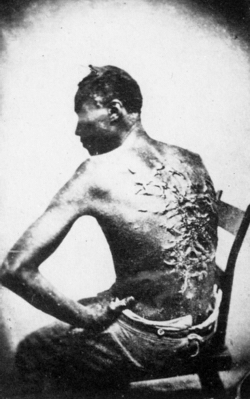 |
The photo above is of a slave in the United States, his back scarred from repeated whippings. The photo below is of prisoner in Iraq who has been beaten and whipped by Iraqi guards of the new United States backed regime in that country. See the August 7, 2004 story behind this second photo at OregonLive.Com |
- --whipping
--sliced off ear
--hanged
--72,000 thieves put to death
1547: Edward VI (1537-1553):

- --slavery
--whip and chains
--branded V on chest of vagabonds
--execution
--take children
1572: Elizabeth (1558-1602):

- --branded on ear
--execution
James I (1566-1625);


- --public whipping
--branded R left shoulder
--execution
Early period: "Direct extra-economic force"
Later period: "silent compulsion of economic relations" or "natural laws"
The State: "the rising bourgeoisie needs the power of the state" (p. 899)
- --to lengthen the working day (Chap. 10)
--to set maximum wages (punishment more severe for acceptance than payment)
--outlawing of "combinations, contracts, oaths" from 14th Century to the 19th Century
"The barbarous laws against combinations of workers collapsed in 1825 in the face of the threatening attitude of the proletariat" (p. 903)
"It is evident that only against its will, and under the pressure of the masses, did the English Parliament give up the laws against strikes and trade unions" (p. 903)
Commentary:
The conversion of peasants and artisans into waged and potentially waged workers involved a long and brutal campaign by capital to drive the "freed" population into the labor market—a campaign whose difficulty was due to resistance, documented in centuries of "bloody legislation" aimed at its suppression.
In part, resistance was a refusal of the factory and the refusal to be reduced to a machine among machines in that factory. The following statement by one American manager reveals how capitalists saw workers: “I regard my work-people just as I regard my machinery. . . . They must look out for themselves as I do for myself. When my machines get old and useless, I reject them and get new, and these people are part of my machinery.”(1) No residue here of the paternalism of feudal times, much less the closeness and mutual support of so-called primitive cultures, only the most violent redefinition of human beings as animate tools, an attitude echoed in more recent times by economists who consider workers “human capital.”(2)
Charlie Chaplin's classic film Modern Times (1936) presents an eloquent visual representation of workers as part of the machinery, paced by machinery, eaten up by machinery and driven crazy by the factory. Although it concerns the assembly line of Fordism in the 20th Century its basic vision is every bit as valid for earlier periods.
As early as 1857, Marx observed in his Grundrisse notebooks, "They must be forced to work within the conditions posited by capital".(3) They do not go willingly from the fields, forests and villages to the "satanic mills" of early capitalist factories and into the dank tenements available to such mill workers. Force must be used because they resist. Marx cites begging, vagabondage and robbing as forms taken by the resistance to entering factories and he describes the bloody legislation passed to repress them. However, he does not analyse these activities in any detail; we get no texture of this resistance, only of punishment by whip and branding iron. When he analyses the factory in Chapters 13, 14, and 15 on cooperation, the division of labor and machineryand modern industry, he does show how the struggle continued inside the factories through machine breaking, strikes and so on.
The continuing brutality of factory work, described by Rebecca Harding Davis in her book Life in the Iron Mills (1861), through that portrayed by Bruce Springsteen in his song “Factory” (1978), goes far to explain why so many have resisted being forced to work in them.(4) The day-to-day violence of work and of the struggle over that work have shaped our world both on the job and off.
 From the back-window I can see a narrow brickyard sloping down to the river-side, strewed with rain-butts and tubs . . . I look on the slow stream of human life creeping past, night and morning, to the great mills. Masses of men, with dull, besotted faces bent to the ground, sharpened here and there by pain or cunning; skin and muscles and flesh all begrimed with smoke and ashes; stooping all night over boiling caldrons of metal, laired by day in dens of drunkenness and infamy; breathing from infancy to death an air saturated with fog and grease and soot, vileness for soul and body. |
Both Davis and Springsteen portray the consequences of factory work for community and family life. She evokes men "laired by day in dens of drunkenness and infamy," while he remembers his daddy coming home "with death in his eyes" and "Somebody's gonna get hurt tonight.
 FACTORYEarly in the morning factory whistle blows, Through the mansions of fear, through the mansions of pain, End of the day, factory whistle cries,
|
The Street as an Alternative to the Factory
Begging was already a form of refusal to work in the feudal period, where various persons made use of a certain space created by Catholic attitudes toward alms-giving to live without working. This was a struggle because there was, even then, an attempt to distinguish between "deserving" and "undeserving" beggers and the undeserving included those judged able to work. By the 15th Century and the 16th the attempts to control begging advanced with the need for labor in the emerging capitalist factories, and with the growing militancy of the beggers. In 1529 a Great Riot exploded in Lyons:
. . . mobs of destitute people pillaged the homes of the rich, broke into the municipal granary, and occupied the city hall in protest aginst the soaring price of bread. The Grande Rebeine caused profound concern in Lyons, and over the next few years the new system of poor relief was put into effect.(5)
The Lyons system of poor relief had two sides: 1) it granted bread, etc., and 2) it aimed at regulating the poor and forcing them to work. Tickets were allocated (like food stamps) for bread. Children were housed in "hospital asylums," vocational training was provided, they were then placed in domestic service or apprenticed. The city government also provided support for industry, especially the Lyons Silk industry, to help provide jobs. Finally, begging was forbidden, a new special police force was set up: the chasse-coquins and if any beggars were caught, they were put to work at hard labor or thrown into jail. This was the kind of treatment so thoroughly portrayed in Victor Hugo's great novel Les Misérables (1862).
Despite such state tactics, begging remained widespread. Beggars used many different kinds of tricks in their trade. Some feigned illnesses by chewing soap, foaming at the mouth and acting epileptic. There were at one time 19 secret societies in Rome ranging from "gibbering idiots," "illness fakirs" to tradesmen who had lost their jobs. In 1627 an Italian monk listed 33 types of false beggars that included "tears at will," "flour for communion wafers," "mad as result of tarantula bite," and so on. Sir Thomas Moore complained of these "sturdy and valiante beggars, cloking their idle lyfe under the colors of some disease or sickness."(6)
Clearly many people preferred the colorful life of the street to the drab drudgery of the factory and the grim grey existence of the factory family. Henry Mayhew (1812–87), a playwright and a founder of the satirical weekly Punch, was also an investigative reporter. He interviewed vagrants, both the temporarily jobless and the permanently unwaged, gathered their stories, published them in the Morning Chronicle in London and later in his book London Labour and the London Poor; Cyclopaedia of the Condition and Earnings of Those That WILL Work, Those That CANNOT Work, and Those That WILL Not Work (1851). The vagrants often juxtaposed the joys of wandering and begging to the drudgery of waged labor.(7)
Listen carefully to the following testimony by an English "vagrant" about his life in the early 19th Century:
| I couldn't bring myself to work somehow. While I sat at the work [carpet-weaving], I thought I should like to be away in the country: work seemed a burden to me. I found it very difficult to stick to anything for a long time; so I made up my mind, when my time was out, that I'd be off roving, and see a little of life. I went by the packet from Bristol to Newport. After being there three weeks, I had spent all the money that I had brought from home. I spent it in drinking - most of it, and idling about. After that I was obliged to sell my clothes, &c. The first thing I sold was my watch; I got 2£ 5s for that. Then I was obliged to part with my suit of clothes. For these I got 1£ 5s. With this I started from Newport to go father up over the hills. I liked this life much better than working. . . . I'm sure I must have asked assistance from more than a hundred people. They said, some of them, that they had "nout" for me; and others did give me a bit of "bara caws", or "bara minny" (that is, bread and cheese, or bread and butter). Money is very scarce among the Welsh, and what they have they are very fond of. They don't mind giving food; if you wanted a bagful you might have it there of the working people. I inquired for a night's lodging at the union in Monmouth. That was the first time I ever asked for shelter in a workhouse in my life. . . In the morning I was turned out, and after I had left I picked up with a young woman, who had slept in the union over-night. I said I was going on the road across country to Birmingham, and I axed her to go with me. I had never seen her before. She consented, and we went along together, begging our way. We passed as man and wife, and I was a carpet-weaver out of employment. . . . Oh, yes, I have found that I could always get more money out of my own trade than any other people. I did so well at Wolverhampton, begging, that I stopped there three weeks. I never troubled my head whether I was doing right or wrong by asking my brother -weavers for a portion of their hard earnings to keep me in idleness. Many a time I have given part of my wages to others myself. I can't say that I would have given it to them if I had known they wouldn't work like me. I wouldn't have worked sometimes if I could have got it. I can't tell why, but somehow it was painful to me to stick long at anything. To tell the truth, I loved a roving, idle life. I would much rather have been on the road than at my home. (Henry Mayhew, London Labour and the London Poor, New York: Penguin Classics, 1985, pp. 383-385.) |
In another autobiographical story recorded by Mayhew, a vagrant tells of cooperation among the beggers and pickpockets and how they shared their experiences and even those of more famous "criminals":
| "We used to share our money with those who did nothing for a day, and they with us when we rested. There never was any blabbing. We wouldn't do one another out of a farthing. Of a night some one would now and then read hymns, out of books they sold about the streets - I'm sure they were hymns; or else we'd read stories about Jack Sheppard and Dick Turpin, and all through that set. They were large thick books, borrowed from the library. They told how they used to break open the houses, and get out of Newgate, and how Dick got away to York. We used to think Jack and them very fine fellows. I wished I could be like Jack (I did then), about the blankets in his escape . . ." (Ibid., p. 391. On Jack Shepard and the working class art of ex-carceration, see Peter Linebaugh, The London Hanged, New York: Cambridge University Press, 1992, Chapter One: 'The Common Discourse of the Whole Nation': Jack Sheppard and the Art of Escape.")
|
History has also recorded considerable sympathy for beggars among common people—to the point of helping them resist arrest—probably because most workers knew they might become beggars themselves, by choice or because of downturns in the industrial cycle. Garraty notes "French archives contain evidence showing that the police were often harassed by crowds when they attempted to arrest beggars."(8)
Even more colorful, the history of "robbery" and "pilfering" provides rich material for the beginning of a class analysis of crimes against property. (9) On the one side, workers directly appropriate what they have produced but is now owned by capitalists, whether on the job or in the larger society. On the other side, capitalist theft is legalized, from their domestic enclosure of land, homes and tools to their foreign conquests. Such analysis reveals how business has succeeded in pitting workers against workers, from communities where desperate workers rob other workers, nativists against immigrants and colonial armies to carry out the dirty work of spreading capitalist theft across the face of the earth.
Controversy: The Nature of the State
What is the "state"? Marx doesn't analyse the state in the abstract but rather shows us concretely.(10) Here the state appears as government, legislation (Statute of Laborers, etc.), as the House of Commons, as police and armies. In this period, capital succeeds in turning the state-as-government into a tool, an organ of its class rule. This is done both via laws for capital that are enforced, and via laws against capital that are not enforced (such as those against enclosures).(11) Yet the passage of some laws that favor the working class shows that the government is also a terrain of class conflict. What ultimately matters however are neither votes nor debate, but acts. Which and whether laws are passed and enforced is a function of class power.
During this period of "bloody legislation," capital succeeded in using state power for its own ends, against workers and against the old landed aristocracy. Capitalist power is clearly greater than that of workers, yet the balance of power also shifts and causes shifts in government action. Marx attributes the collapse of laws against combinations of workers in 1825 to the "threatening attitude of the proletariat."(12) Similarly, the abandonment of laws against strikes was done only "under the pressure of the masses."(13) Similar shifts in power, resulting in changes in laws concerning the length of the working day, are analyzed in Chapter 10.
Two observations: first, government appears as an organ of capitalist class rule only to the degree that it acts in the interests of that class. It is also a terrain, a space where struggle ensues, and working-class power may be reflected in both parliamentary debate and in executive action. Today the growth of working-class power has resulted in many enforced laws which benefit workers to the detriment of capital. This does not mean that government is a neutral third-party, mediating between the classes as sometimes depicted. It does mean that no simple theory of government as capitalist-state will suffice. Second, although Marx does mention some of the victories won by the working class as well as some defeats, he does not analyse or describe the struggles that produced these changes and while we can see both the need for struggle and its possible effectiveness, we learn nothing of the methods used and how they succeeded. What concretely constituted the "threatening attitude of the proletariat"? How did the "masses" exert pressure? Of these things we learn little.
Working Class Struggles
E. P. Thompson's Making of the English Working Class reveals something of those struggles which Marx mentions but fails to analyze in detail. Examining the period between the Combination Acts of 1799 and 1800 and their repeal in 1824-25,(14), he shows us how rising anger and militancy of both reformist intellectuals and workers took a number of forms including clandestine political groupings and secret unionism but never in any centralized movement. He shows how such underground activity developed rapidly in response to the anti-combination laws and acts. Workers drew together and swore secret oaths in multiple conspiracies. When they could not strike openly, they developed subtle new methods for sabotaging production, methods that would leave little evidence for prosecution. "If the demands were not met there was no need—in the small workshop— for a formal strike; men would simply drop away or singly give notice." On the other hand, the workers developed many forms of direct action because they had no other recourse. "In its milder forms it was little more than extreme moral pressure. The craftsman working under the union rate would be boycotted; the 'illegal' man would find that his tools were 'lost', or would be 'fined' by his shopmates. In Spitalfields, silk would be cut in the loom; in the woolen districts pieces would be slashed; in the framework-knitting industry the 'jacks', vital parts of the stocking-loom, would disappear. Blacklegs or bad masters would know themselves to be watched; a brick might come through the window, or they might be attacked in a lane at night . . . there was a scatter of cases reported from Glasgow, Dublin, Manchester and Sheffield, of actual or attempted assassinations, vitriol-throwing or charges of gunpowder thrown into workshops."(15)
In such ways were the "threatening attitudes" of the proletariat expressed and the Combination Acts undermined to such a degree that by 1824 a repeal bill was moved through Parliament by men arguing that the Acts had favored combination and must needs be abolished to undermine the growth of working-class organizations! Much to these persons' despair, however, repeal was followed immediately by widespread, now legal, strikes and conflict. Efforts to reinstate the Acts in 1825 were immediately attacked by a "storm of protests, petitions, meetings, and deputations from every trade". The reinstatement efforts failed, opening the way for "the great wave of general unionism between 1832 and 1834."(16)
We need this kind of history and analysis complement Marx's sketch in Capital. We need to examine how those before us fought being forced into the labor market and factories, and how they fought once there —how they fought singly, in small groups, and in relationship to political groups and to the emerging unions. We need to examine how their struggles interacted with the plans of capital. What methods worked, which did not. Beyond understanding how capital imposed its system, and maintained it, only by fierce repression against widespread militancy, we need to learn lessons for today from the history of those struggles.
Vagrancy Laws During Reconstruction
In the United States, the early post-Civil War period provided a very close parallel to this use of vicious legislation to force a population freed from the land into service to capital. Large numbers of newly freed slaves, together with many uprooted and burned out whites, roamed the South wanting only "forty acres and a mule" to begin a new life. The failure of the Reconstruction Act of 1867 to include land reform—the breakup and redistribution of the old plantation land to those who had worked it—condemned the war-freed and uprooted population to search for work where they could find it. Southern landowners, of course, wanted to reinstitute the plantation system via wage labor, under conditions similar to the slavery they had lost. Most of the freed and uprooted, however, refused to return to those conditions. Failing to entice these potential workers into such employment, the capitalists used force in a method strikingly like that used in England.
The photo to the right is of a prisoner working at the notorious Parchman Penitentiary, a huge prison plantation in the Mississippi Delta, where prisoners were treated with extreme brutality. 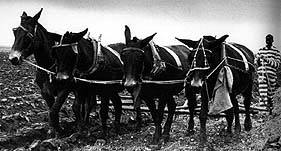
Harsh laws in most southern states criminalized vagabondage, petty pilfering and other crimes against "property," resulting in a rapid increase in the number of people thrown into prison. In some cases, such as the notorious Parchman Penitentiary, a huge prison plantation in the Mississippi, the government imposed what amounted to slave labor. To help finance the penal system, it also supplied a large quantity of cheap labor to capitalists who were unwilling to pay sufficiently high wages to attract a work force. State governments would lease out prisoners to work in chain gangs at nominal cost to local and national capitalists. C. Vann Woodward (1908-99) in his book Origins of the New South, 1877–1913 (1951) provides us with horrifying descriptions. (17) In his book we find the following:
- The system quickly became a large-scale and sinister business. Leases of ten, twenty, andthirty years were granted by legislatures to powerful politicians, Northern syndicates, mining corporations, and individual planters. Laws limiting hours of labor and types of work for convicts were nonexistent in some states and negligible in others . . . The South's 'penitentiaries' were great rolling cages that followed construction camps and railroad building, hastily built stockades deep in forest or swamp or mining fields, or windowless log forts in turpentine flats. (p. 213)(18)
The conditions in these state-provisioned labor camps rivaled not only the brutality of the English situation in the 16th and 17th Centuries, but the Soviet gulag and Nazis camps of the 20th Century. It is always worth remembering the slogan over the entrance to the German concentration camp at Auschwitz was the very capitalist slogan Arbeit Mach Frei—"Work Makes You Free." In some ways, labor camps and prison labor are the quintessential expression of capitalist society. They are among the few places where the illusions of freedom are discarded, and work is imposed directly and brutally. And in Alabama:
A report of the inspectors of the Alabama penitentiary revealed that the prisons were packed with several times the number of convicts they could reasonably hold. 'They are as filthy, as a rule, as dirt could make them, and both prisions and prisoners were infested with vermin. The bedding was totally unfit for use . . . [It] was found that convicts were excessively and sometimes cruelly punished; that they were poorly clothed and fed; that the sick were neglected, insomuch as no hospitals had been provided, that they were confined with the well convicts. A grand-jury investigation of the penitentiary hospital in Mississippi reported that inmates were 'all bearing on their persons marks of the most inhuman and brutal treatments. Most of them have their backs cut in great wales, scars and blisters, some with the skin peeling off in pieces as the result of severe beatings . . . They were lying there dying, some of them on bare boards, so poor and emaciated that their bones almost came through their skin, many complaining for want of food . . . We actually saw live vermin crawling over their faces, and the little bedding and clothing they have is in tatters and stiff with filth.(C. Van Woodward, op. cit., p. 214) (19)
With this kind of treatment death rates were high. But it didn't matter because there were always more vagabonds or petty criminals to be shipped out to the mines or swamps to be worked to death for the sake of capitalist profits.(20)
This was very similar to the period of slavery when the slave trade supplied so many slaves that cheap new muscle could replace that driven into the grave. In Chapter 10, Marx discusses the abuses capitalists inflict when the supply of labor is cheap:
"Hence the Negro labour in the southern states of the American Union preserved a moderately patriarchial characater as long as production was chiefly directed to the satisfaction of immediate local requirements. But in proportion as the export of cotton became of vital interest to those states, the over-working of the Negro and sometimes the consumption of his life in seven years of labour, became a factor in a calculated and calculating system."(21)
Once the slave trade was abolished and slaves became hard to replace capital, their treatment improved to insure reproduction! In the post Civil War South the roaming masses provided the same kind of surplus labor supply as the slave hunting grounds of Africa—with the same kinds of abuses.
Workers did not accept such barbaric treatment passively. Crime grew in response to repression, and in turn swelled the ranks of prison labor. Non-prison labor finding itself undercut by cheap convict labor fought against this involuntary servitude of so many of their number. When convicts were used to break strikes and displace legal laborers, open conflict over this issue became widespread. Woodward quotes one Colonel Colyar who was the Tennessee Democratic leader and general counsel to the Tennessee Coal, Iron and Railroad Company: “we found that we were right in calculating that free laborers would be loath to enter upon strikes when they saw that the company was amply provided with convict labor.”(22) By 1891, however, the good Colonel’s workers had had enough. When the company offered a contract with no-strike and other objectionable clauses and the workers refused it,
the company ordered convicts to tear down their houses and build stockades for the convicts who were to replace free labor. The evicted miners then marched in force on the stockades and, without bloodshed, compelled guards, officers and convicts to board a train for Knoxville.
Governor John P. Buchanan, with three companies of militia promptly returned the convicts to the stockades. A few days later more than a thousand armed miners packed the guards and convicts off to Knoxville a second time, and those of another company along with them, again without bloodshed.
The conflict over convict labor continued until October 31, 1891 when the workers "forcibly freed the convicts of the Tennesseee Coal Mine Company, allowed them all to escape, and burned down the stockades. They repeated the same tactics later at two other mining companies, releasing in all some five hundred convicts. The mine operators of the area then employed free labor . . ." (23) In other words in this instance the workers won and defeated this strategy of capital by using armed force.
There is a song that dates from this period, written in the town of Coal Creek. According to the notation on the Smithsonian/Folkways recording it "is a miner's version of a song which was sung by the Negro convicts who were working the mine."

ROLL DOWN THE LINE
Way back yonder in Tennessee Free labor rebelled against it Chorus: Bully won't you roll down the line Early Monday mornin' Chorus The beans they are half done But when you get your task done Chorus The bank boss he's a hard man But when you get your task done Chorus
(Pete Seeger, American Industrial Ballads, 1957, Smithsonian-Folkways, CD SF 40058) |
Unfortunately, even today, almost two decades into the twenty-first century, penal labor is thriving. Many prisons in the US are still being run as gulags with their inmates either put to work by the prison itself or rented out to private capital.(24)
Controversy: The Wage, Its Absence and the Imposition of Work
Although primitive accumulation has often been defined as the creation of a waged proletariat, we have seen how that very process also involved the creation of the unwaged, from vagabonds through slaves to housewives and children.
In an article analysing Marx's treatment of conflict over laws passed against the appropriation of forest wood by peasants in Germany, historian Peter Linebaugh has argued that the real issue was a change in the wage-form. Traditionally, the appropriation of forest wood and timber was legal and one part of the subsistence income of German peasants. Its outlawing was a way of forcing peasants to turn to the labor market for a greater part of their subsistence, a way of increasing the pressure on them to work for a wage. It was not an act of primitive accumulation because the peasants were already working within the capitalist system—reproducing themselves as part-time labor-power. The attempt to restrict their access to wood simply pushed them deeper into a labor market within which they were already emeshed.(25)
Regarding slavery in the capitalist epoch, Marxists have debated the status of slaves because they are not waged. Some, such as historian Eugene Genovese (1930–2012),have argued that slavery constituted a different kind of social system articulated with the capitalism. Others, myself included, see American slave labor as a peculiar form of labor command within capitalism, a form of unwaged labor essential to the functioning of both Southern and Atlantic capitalism. Cotton slavery in the U.S. was the material foundation of the cotton textile mills in Manchester England. In Capital Marx often speaks of "wage-slavery" marking the similarity of wage labor to slavery. Clearly, for him, the distance between the two in the 19th Century was not great. Elsewhere he wrote:
"I do not mean indirect slavery, the slavery of the proletariat; I mean direct slavery, the slavery of the Blacks in Surinam, in Brazil, in the southern regions of North America. Direct slavery is the pivot of our industrialism today as much as machinery, credit, etc. Without slavery, you have no cotton, without cotton you have no modern industry. It is slavery that has given value to the colonies; it was the colonies that created world trade; it is world trade that is the necessary conditon for large-scale industry." (26)
On the other hand, in Chapter 3 we saw him contrast the fate of the Roman plebes and enclosure-freed Englishmen. One situation led to slavery and one to capitalism. His analysis is not a priori but he deals with slavery within the overall historical context. In the ancient world it defines a social system. In the capitalist 19th Century it is a peculiar form of labor control within a system based more on exchange than on direct coercion. Yet the coercion of the market is not far from that of the whip. Not in the 19th Century, and not in the 21st when slavery persists in the interstices of contemporary capitalist society.
During the late slave period just before the Civil War, the South was beginning to industrialize, partly in response to resentment over terms of trade between the raw materials of the South and the industrial products of the North. Robrt S. Starobin (1939–71), in a book on this industrialization effort, noted how the situation of the slave was being transformed by the needs of industry for greater labor mobility. (27) Rather than being inseparable from the plantation, slaves were being sent out by their owners to seek work for wages! The industrially employed slaves would then turn over part of their wage to their owner. This meant a dramatic transformation in the day-to-day habits and behavior of the slaves as well as in the nature of their relationship with their owners and with capital. In short they were acting less like slaves and more like free labor.
We must examine the role of slavery within Atlantic capitalism by the pattern of conflict between the working class and capital in the various countries. Eric Williams (1911–81) argued that slavery itself originated from the struggles of both “free” waged workers and indentured workers in the colonies. Capital had to seek out new sources of cheap and totally controlled labor to compensate for the concessions made to workers at home and the facility with which the indentured could escape.(28) Slaves, of course, fought for freedom, through overt revolts and by escaping. (29) At least some English workers saw the freedom of slaves as beneficial to them. Marx even wrote to Lincoln congratulating him on the freeing of the slaves and his re-election in 1864 in a letter on behalf of the International Working Men's Association (the First International). (30) During the Civil War, British textile capitalists supported the Southern cause, because they depended upon cheap, slave-produced Southern cotton. Some even argued that Britain should enter the war on the Southern side. Demonstrations by British workers helped block such intervention.
Within the U.S. many Northern workers also saw, to some degree, that their ability to win higher wages and better working conditions depended upon ending a situation where some workers were literally made slaves—to work at extremely low "wages." In Chapter 10, Marx notes:
In the United States of America, every independent worker's movement was paralyzed as long as slavery disfigured a part of the republic. Labor in a white skin cannot emancipate itself where it is branded in a black skin. However, a new life immediately arose from the death of slavery. The first fruit of the American Civil War was the eight hours agitation which ran from the Atlantic to the Pacific . . . (31)
As the struggles of the waged and unwaged were linked, so too are many (and eventually all) conflicts between various groups of workers and capital interconnected. If the power of American workers in the North and of British workers was limited by slavery in the early 19th Century, today we see plenty of evidence of how the power of those same workers is limited by the weakness of workers in the Global South. Multinational corporations and free trade have increased capital's ability to shift jobs from high to low wage areas, undercutting the livelihoods of workers in the former areas with little or no improvement for workers in the latter ones. The solution to this problem today, as in the 19th Century, is an acceleration of the international circulation of struggle via the self-conscious collaboration between higher, lower and unwaged workers.(32)
Recommended Further Reading
On the street as an alternative to the factory, see John A. Garraty, Unemployment in History, New York: Harper Colophon, 1978 and Henry Mayhew's London Labour and the London Poor and the other references listed at the end of the section above on "Literature and Class Struggle" and in the chronology of Victorian social literature.
Marxist theoretical discussions and debates over the "state" are virtually endless; it has always been a central issue because there have always been those who have conceived of revolution in terms of taking over or overthrowing of the state. For a survey and discussion of the evolution of the idea of the state in Marx see Hal Draper's Karl Marx's Theory of Revolution, Volume I: State and Bureaucracy, New York: Monthly Review Press, 1977. The classic, and most progressive, statement by Lenin on the subject his book The State and Revolution, 1917. In the 1970s there was a new wave of work on state theory in Europe and in the United States as capitalism was plunged into crisis and existing state policies floundered. A collection of pieces from the German "state-derivation" debate are in John Holloway and S.Picciotto (eds), State and Capital: A Marxist Debate, Austin: University of Texas Press, 1978. In France a new school of theory emerged which reframed the issue of state in terms of the "regulation" of various modes of accumulation, e.g., M.Aglietta, A Theory of Capitalist Regulation: The U.S. Experience, London, New Left Books, 1979 which hand an impact on some English Marxists like Bob Jessop, The Capitalist State, Oxford: Martin Robertson, 1982. For some recent debate on this subject see: Werner Bonefeld and John Holloway (eds) Post-Fordism & Social Form: A Marxist Debate on the Post-Fordist State, London: MacMillan, 1991 and Simon Clarke (ed) The State Debate, London: MacMillan, 1991, both of which include regulation theorists and autonomist critics.
On "crime" and working class struggle, there has recently been a spurt of new work by Marxist historians of which the most important works are: Edward Thompson, Whigs and Hunters: The Origins of the Black Act, 1975, Douglas Hay, Peter Linebaugh and Edward Thompson (eds) Albion's Fatal Tree: Crime and Society in Eighteenth-Century England, 1975 and Peter Linebaugh, The London Hanged, 1992. Unlike many earlier historical works that have looked at "crime" from the point of view of the police and the maintenance of "order", these works attempt to examine the history from the bottom-up, from the point of view of the workers' whose struggles have brought them into conflict with laws made by the ruling classes. "Our starting-point, " writes Linebaugh, "is neither law nor 'critical law' but the hanged men and women whose views and actions continually challenged both law and their own class." (p. xxiii)
On 18th and 19th Century slavery, there is, of course, an endless literature. Among Marxist historians there are several approaches of interest. The more or less "orthodox" approach to the subject can be found in the work of Herbert Aptheker, American Negro Slave Revolts, New York: International Publishers, 1943 and Essays in the History of the American Negro, New York: International Publishers, 1945 as well as the works of Eugene Genovese such as The Political Economy of Slavery: Studies in the Economy and Society of the Slave South, New York: Pantheon, 1966. What mainly chracterizes Genovese's approach is an attempt to differentiate the Southern slave system from the wider system of capitalism; this he does by identifying different behaviors on the part of the slave owning class and by defining slavery as a distinct "mode of production". A second, more interesting, and bottom-up approach has emphasized the self-activity of slaves not only in revolt but in everyday life. The seminal work was C. L. R. James, The Black Jacobins:Toussaint L'Ouverture and the San Domingo Revolution, 2nd ed., New York: Vintage Books, 1963 (originally written in 1938). See also: C. L. R. James, "The Atlantic Slave Trade", Amistad, I, 1970, reprinted in C. L. R. James, The Future in the Present: Selected Writings, London: Allison Busby, 1977. James' work was a fundamental influence on that of George Rawick who gather, edited and commented some 20 volumes of slave narratives as part of an extensive project documenting the slave self-activity. Rawick's summary analysis of the results of that research was published as From Sundown to Sunup: The Making of the Black Community, Westport: Greenwood, 1972 (volume 1 in the series of narratives). This book like that of James', had far reaching influence, not only on historians like Linebaugh but also among a wide variety of activists, including feminists in Italy, who saw parallels between the kind of practices Rawick discovered among slaves and those of women struggling against capitalist patriarchy. Finally, little by little there has been developing an analysis of the working class at the level of the entire Atlantic region which attempts to resituate each element of the working class, including slaves, within the wider context of an international circulation of workers, their experience and their struggles. See, for example, Peter Linebaugh, "All the Atlantic Mountains Shook, Labour/Le Travail, Winter 1982, Marcus Rediger, Between the Devil and the Deep Blue Sea: Merchant Seamen, Pirates, and the Anglo-American Maritime World, 1700-1750, New York: Cambridge, 1987, and Ricardo Salvatore, Class Struggle and International Trade: Rio de la Plata's Commerce and the Atlantic Proletariat, 1790-1850, Ph.D. Dissertation, University of Texas at Austin, 1987.
Concepts for Review
begging as refusal of work formal subordination of labor maximum wage laws combinations reconstruction the state "crime" and the class character of law prison labor waged and unwaged labor slavery and waged labor
|
Questions For Review
(An * means that one possible answer to that question can be found at the end of the study guide.)
1. Marx describes the resistence to the factory in these terms: "these men . . . could not immediately adapt themselves to the discipline of their new condition. They were turned in massive quantities into beggars, robbers and vagabonds, partly from inclination, in most cases under the force of circumstances." Why might people have turned to these methods out of "inclination"?
*2. List the punishments Marx mentions for refusal to work? Are there such punishments today? What are they? In society in general? In the school? In the family? In prisons?
3. How did workers force a change from maximum to minimum wage laws? How did they force an end to anti-combination laws?
4. How does this chapter constitute a description of the second step in forcing people to subordinate their lives to work?
*5. Provide a working class rationale for begging or for stealing (from capitalists) as an alternative to work? Do you think Austin street people have anything in common with the English people against whom the "bloody legislation" was directed?
6. What do you think Marx means by "the state"? Is it the same as government or different? How? What examples does he give of the exercise of state power? What do his examples suggest about the class charactaer of the state?
*7. Discuss the similarities and differences between the laws against vagabonds passed during the period Marx was examining and those passed in the post-Civil War period in the American South.
8. Discuss the relationship between slavery and wage labor in the early 19th Century. Was slavery a part of primitive accumulaton? Was its end?
*9. What does the analysis of the "bloody legislation," of wage labor, of slave labor and of prison labor tell you about the nature of the wage in capitalism? What other forms of unwaged forced labor can you think of?
Footnotes
1 Norman Ware, The Industrial Worker, 1840–1860, Chicago, IL: Quadrangle Books, 1964, p. 77.
2 See Gary Becker, Human Capital: A Theoretical and Empirical Analysis, with Special Reference to Education (1964), Chicago, IL: The University of Chicago Press, 3rd edn., 1993.
3 Grundrisse, p. 736.
4 Rebecca Harding Davis, Life in the Iron Mills, New York: The Feminist Press, 1972. Originally written 1861 in the city of Wheeling on the Ohio River. Bruce Springsteen, Darkness on the Edge of Town, Columbia Records, 1978 (JC-35318).
5 John A. Garraty, Unemployment in History, New York Harper Colophon, 1978, p. 25. Something similar happened with the widespread urban uprisings of the mid-196os. They were followed by a massive expansion of the Federal Food Stamp program. See Tim Reynolds, The Food Stamp Explosion, University of Texas at Austin, M.A. Thesis, 1980.
6 Thomas Moore, Utopia (1516), Book 2, Part 2, New York: Penguin Classics, 2003.
7 Henry Mayhew, London Labour and the London Poor, New York: Penguin Classics, 1985, pp. 383–385.
8 Garraty, Unemployment in History, op. cit., p. 55.
9 Essential contributions to the analysis of the class politics of crime in this period can be found in E. P. Thompson, Douglas Hay, Peter Linebaugh, John G. Rule and Cal Winslow, Albion’s Fatal Tree: Crime and Society in Eighteenth-Century England, New York: Pantheon, 1975. On Jack Sheppard and the working-class art of excarceration, see Peter Linebaugh, The London Hanged: Crime and Civil Society in the Eighteenth Century, London: Allen Lane, 1991, Chapter 1: “‘The Common Discourse of the Whole Nation’: Jack Sheppard and the Art of Escape.”
10 One result has been a proliferation of Marxist efforts to "fill the gap" in his theory by conjuring up a Marxist theory of the state. Among the many contributions to that effort, see the issues of the journal Kapitalistate (1973-83).
11 The non-enforcement of laws and regulation costly to business became public policy under the Reagan administration that systematically sought to undermine existing labor rights and environmental protection laws by eliminating them where possible and refusing to enforce them elsewhere. This practice has been renewed under Donald Trump.
12 Capital, Vol. I, p. 903.
13 Ibid.
14 Thompson, Making of the English Working Class, op. cit., pp. 497–521.
15 Ibid., pp. 514–515.
16 Ibid., p. 520.
17 C. Vann Woodward, Origins of the New South, 1817–1913, Baton Rouge: Louisiana State University Press, 1951, pp. 213-214.
18 Ibid., p. 213.
19 Ibid., p. 214.
20 For a visual, though tame, taste of this regime, see the film Cool Hand Luke (1967) with Paul Newman in a modern chain gang. Just in case you think that vicious corporal punishment has been banned from the capitalist world in this new 21st century, take a look at documentation compiled by World Corporal Punishment Research—or do some research on the Abu Ghraib prison once run by the US government in Iraq.
21 Capital, Vol. I, p. 345.
22 Woodward, Origins of the New South, op. cit., p. 233.
23 Ibid., pp. 233–234.
24 For an example of the former, see the documentary Angola for Life: Rehabilitation and Reform Inside the Louisiana State Penitentiary (2015) and the article about it by Whitney Benns, "American Slavery, Reinvented", The Atlantic Monthly, September 21, 2015. See also Vicky Paliez, "The Prison Industry in the United States, Big Business or a New Form of Slavery", Center for Research on Globalization, March 2008. Compare with the recent imposition of forced labor in China where ethnic minorities are being incarcerated in labor camps and forced to work for American companies. See Dake Kang, Martha Mendoza and Yanan Wang, "In Locked Compound, Minorities in China Make Clothes for US", Associated Press, December 18, 2018.
25 Peter Linebaugh, "Karl Marx, the Theft of Wood, and Working Class Composition: A Contribution to the Current Debate," Crime and Social Justice, 6 (Fall/Winter 1976), pp. 5-16.
26 Capital, Vol. I, p. 625, and “Marx to Pavel Vasilyevich Annenkov” (December 28, 1846), MECW, Vol. 38, p. 101.
27 Robert S. Starobin, Industrial Slavery in the Old South, Oxford: Oxford University Press, 1971.
28 Eric Williams, Capitalism and Slavery, Chapel Hill: University of North Carolina Press, 1944, which is directly indebted to C. L. R. James's book The Black Jacobins: Toussaint L'Ouverture and the San Domingo Revolution (1938), rev. 2nd edn., New York: Vintage Books, 1963 (see Williams's bibliographic notes III.B. at the end of his book).
29 Escaping in the US often made use of the underground railroad; escaping in Latin America and the Caribbean often involved flight into the hinterland and the establishment of "maroon" communities, sometimes with indigenous peoples. See Richard Price, Maroon Societies: Rebel Slave Communities in the Americas, 3rd edn., Baltimore, MD: Johns Hopkins University Press, 1996.
30 Karl Marx, "To Abraham Lincoln, President of the United States of America", MECW, Vol. 20, pp. 19-21.
31 Capital, Vol. I, p. 414.
Attachments
Comments
Harry Cleaver's study guide to chapter 29 of Marx's Capital volume 1.
Outline of Marx's Analysis:
- "Whence came the capitalists originally?" The expropriation of the agricultural population only created "great landed proprietors.
Genesis of the Capitalist Farmer: "was a slow process" evolving through many centuries.
For England:
- 1) First form: the baileff, himself a serf, like the Roman villicus.
2) Second form: emerging in second half of the 14th Century was the farmer provided by the landlord with seed, cattle and farm implements, exploits more wage labor.
3) Third form: metayer or sharecropper who advances part of inputs, rest advanced by landowner and they divide the output.
4) Fourth form: 15th Century on, capitalist farmer proper who has his own capital for investment, employs wage labor and pays rent.
This emerging class gets boost in 15th/16th Century from:
- 1) "Usurpation of the common lands" which allows expansion in cattle and manure.
2) Fall in value of gold and money causing a rise in the prices (e.g., agricultural output) which undermining real wages and rents, raising surplus value/profits.
So, by the end of the 16th Century, England had a "class of capitalist farmers."
Commentary
Analyzing the emergence of the capitalist class, Marx begins in the countryside, where he began his discussion of the genesis of the working class. The expropriation of the rural population made it possible for the landed proprietors to reorganize the countryside, directly or through intermediaries. In some cases, landlords took over supervision of waged workers on their enlarged domains. In most, they hired others to reorganize agricultural production increasing its commercialization, demanding only their share of the surplus-value as rent. The examples Marx gives shows the decreasing control of landlords, per se, and the increasing control of the emerging class of capitalist farmers. Like the capitalist class more generally, in order to emerge as a dominant class, agrarian capitalists had to first gain control over production, independent of the landlords, and second, employ a reorganized labor force to produce a marketable surplus.
As the point of departure of this process in Europe varied enormously, so too did the paths along which the new class emerged. They varied from region to region and country to country. The history in the United States was just as varied, starting from family farming, waged labor and plantation slavery. After slavery was ended by revolt and civil war, small farmers, whether independent or sharecroppers, were slowly squeezed off the land in an ongoing process of enclosure by large-scale capitalist agribusiness, with considerable help from the US government.
The Resistance to Market Forces in American Farming
In the United States, the westward movement of people seeking alternatives to the emerging factories (in Europe and on the East Coast of North America) created a class of independent family farmers linked together in many kinds of community. These farmers were akin to the independent yeoman farmers Marx saw being wiped out in England. Obtaining land by displacing Native Americans, their labor could only be harnessed/exploited by the emerging capitalist system through the market (the manipulation of domestic terms of trade and high interest rates). Such exploitation culminated in the Populist Revolt in the late 19th Century, when millions of American farmers joined together to protest, among other things, the falling ratio of the prices they received for their crops to the prices they paid for their tools, seeds, etc. They also protested the limitation of the money supply to gold—that kept supplies of money limited, prices down and interest rates up—and demanded the monetization of silver.(1)
Throughout much of the following twentieth century, farmers had to struggle against a tendency for the terms of their trade to fall and thus for their situation to worsen.(2) A blues song, “Seven Cent Cotton,” composed in 1927 by Sampson Pittman, dealt with just such a problem: low prices for cotton and high prices for just about everything the farmers had to buy. The song begins: "7¢ cotton and 40¢ meat / How in the world / Can a poor man eat? / Flour up high and / Cotton down low / How in the world / Can we raise the dough?”(3)
 Seven Cent Cotton7¢ cotton and 40¢ meatHow in the world Can a poor man eat? Flour up high and 7¢ cotton and 8 dollar pants |
How in the world Can a poor man eat? Mule's in the barn 7¢ cotton and 40¢ meat Poor are gettin poorer (Pete Seeger,
|
Other methods of exploitation included debt peonage through which farmers would become indebted to landowners, banks or suppliers and forced to produce commercial crops to pay off their debt. This was the fate of many ex-slaves after the Civil War. For those who escaped imprisonment and de facto slavery (see my commentary on Chapter 28) and were unable to obtain land, they often found themselves “sharecropping” others’ land and trapped in perpetual debt.(4) Others have been subordinated via the modern “putting out” or “contract farming” system, whereby small farm owners sign contracts with food chains or food processing corporations and must follow the methods and instructions of their buyers. In both cases, as in the case of slavery, people’s skills and labor have been manipulated and exploited by capital without this being done through the wage.
Capitalists have not always found it easy to entice or compel American family farmers to produce for the market, and thus expose themselves to exploitation. The traditional American family farm is a complex combination of animal husbandry, vegetable and grain growing, designed from the first to be largely self-supporting. Animal wastes are returned to the soil as nutrients; the animals feed on grain or their byproducts or on fallow pastures being renewed by nitrogen-fixing crops. Drying, butchering, salting, canning and more recently freezing have provided farm families with food the year round. In these circumstances, it is possible for small farmers, if they are not caught by the debt traps of suppliers or bankers, to produce for the market only to the degree that they choose, selling just enough to buy things they cannot produce. In research for his PhD dissertation, Ricardo Salvatore discovered how the refusal of New England farmers to produce hides for even a regional leather market forced East Coast shoe producers to import hides from as far away as Argentina and California.(5) Those farmers who refused to subordinate their production to the market were opting for a certain culture and way of life in which they were working for themselves and their own self-defined needs.
In a process that Marx analyzes with respect to industry in Chapter 25, American agriculture has suffered gradual processes of both proletarianization and centralization. Exploited and then foreclosed, most small farmers have been driven off the land and into rural or urban labor markets. Some, in self-defense, have survived by banding together in farmer cooperatives.(6) Parallel has been the rise of larger, more wealthy farmers and ranchers and their takeover by Eastern or European investment companies. American agribusiness emerged from open range wars, where the stronger stole from the weaker, and from some buying up others' land, often at cut-rate prices from foreclosing banks. The big farms and ranches fenced the land and hired ever more laborers, including cowboys to manage herds and cattle drives-armed cowboys who, sometimes, struck for higher wages." (7) In these ways, the experience of England has been essentially repeated in North America, albeit with some variation.
The period of the Populist Revolt was the last important instance of large and small American farmers combining in a common political cause. Subsequently, the state, through the Department of Agriculture, went out of its way to destroy this alliance by supporting the growth of the American Farm Federation that catered to large farmers and by directing its increasing number of agricultural extension agents to push new technology mainly toward more affluent farmers who could afford the necessary investment.(8) In recent years, the revival of the “farm movement” in response to the latest credit crunches and crises of parity in output and input prices has been supported by those few small farmers who are left, and some large farmers who stand to gain from price supports. This “movement” is on a very small scale in comparison to the Populist Revolt, in large measure because while in 1870 almost 50 percent of Americans still worked the land, today that number has been reduced to 3–4 percent and is still declining.
As its operations and the need for cheap farm labor grew, U.S. agribusiness turned to immigrant labor, both legal—through the Bracero Program— and illegal. By the 1960s, however, field workers (mostly Mexican, or Mexican American) began to form unions, fight for union recognition, higher wages and better working conditions in the central valley of California. They fought in part through strikes and in part through a nationwide grape boycott that mobilized millions of shoppers (mainly housewives) in their support. Many of us who were supporting the resistance of peasants in Southeast Asia to US government counterinsurgency war also lent our time and energy to support that struggle in the American countryside.
The struggles of farmworkers have been commemorated in song. An early one, “Deportee (Plane Wreck at Los Gatos)” (1948) by Woody Guthrie, lamented the exploitation of immigrant workers. Another, the “Corrido de Delano” or the “Ballad of Delano” by Lalo Guerrero (1916–2005), celebrated the battles of the United Farm Workers in California. The song begins: “In 1965 or 1966, more or less / Our people rose up / In the fields of Delano / Demanding better wages / For working the land.”
Corrido de Delano Ano del 65, 66 mas o menos Estado de California Por que salimos en huelga? Estado de California Murphy y Kennedy vinieron Con el estandard hermoso |
Ballad of Delano In 1965 or 1966, more or less In the state of California Why are we going to strike? In the state of California Murphy and Kennedy came With the beautiful banner (from Work's Many Voices, Vol. II,
|
Among the many other musical expressions of such rural conflicts in that period was “Maggie’s Farm” by Bob Dylan. His song, however, was more than an expression of rural revolt; it expressed a whole cycle of social struggles of the late 1960s: the revolt against capitalist work in all its forms. “Maggie’s Farm” could be any farm, factory, office or schoolroom where people were put to work and mistreated. The miseries that Dylan describes are those of all workers: ideas which can’t be realized because work drains away energy, low wages, penalties for the infraction of stupid rules, the blindness of bosses to anything besides their pursuit of profit, their frequent enjoyment of their power over workers, the shadow of the state standing behind them to protect them from workers’ revolt, ideology that hides hypocrisy. Yet, the song reveals the struggle for self-realization despite the oppressions of boring work. It begins: “I ain’t gonna work on Maggie’s farm no more / No, I ain’t gonna work on Maggie’s farm no more / Well, I wake up in the morning / Hold my hands and pray for rain / I got a head full of ideas that are driving me insane / It’s a shame the way she makes me scrub the floor.” Just how widely the sentiments of the song rippled, can be seen in its Wikipedia entry.

Parallels in the Global South
Colonial plantations, on land stolen from indigenous populations, faced resistance and had to resort to many different forms of coerced labor. (9) For the most part, such agriculture produced raw materials for the industries of the colonizing countries, e.g., American, Egyptian or Indian cotton, Caribbean sugar or Vietnamese rice and rubber. See the films Burn and The Mission for vivid portrayals of the colonial period in Latin America. The post colonial period perpetuated plantation or ladifundia forms of exploitation, still based on stealing land from the indigneous people and on driving them into wage labor, or, where they had the power to retain some of their own land, on trying to draw them into market production. Like some American family farmers, many peasant communities have refused to gear their production to the demands of the market. Some, seduced by market income in the past, have withdrawn after nasty experiences of finding their income subject to wild fluctuations in market prices. Periods of downturns in crop prices have shown them that their medium- and long-run income, not to mention their cultural ways of life, are more secure when their production is essentially organized to meet their own needs and only surpluses are offered to the market.
On the other hand, in the post-colonial era, influential commercial producers reacted to such market price instability by demanding considerable state intervention to lessen such fluctuations and stabilize income. In this way new independent governments gained some control over their economies, which had been and continued to be dependent on former colonial trade. Such interventions—such as subsidizing the prices of basic food crops—were long opposed by development economists and foreign governments who wanted to open those markets to their own exports.
That long opposition culminated in the trumpeted free-market, neoliberal ideology of the Reagan administration in the 1980s. On every front, the US government pressured foreign governments to "open their markets" and reduce government "regulation." The ideology was that of 18th and 19th Century liberalism: "free markets are the best solution to all economic problems." (10) The actual strategy was merely a variant of colonial force: hammer down all those defenses that local groups had erected to their subordination by multinational capital. During the 1982 debt crisis in Mexico, for instance, the International Monetary Fund demanded the elimination of subsidies supporting the price of the basic food crop, maize, as one condition (among many) for debt rollover. It was accepted and enforced by the Mexican government. The result was a drop in maize prices and a flood of maize imports from the US that convinced many peasants to abandon market-geared monoculture and return to more diverse farming practices designed for local needs. This pattern has been replicated worldwide.
Such neoliberal policies have continued to be pursued by Democratic as well as Republican administrations. A decade after Mexico’s de facto default, the Clinton administration pushed through the neoliberal NAFTA that went into effect on January 1, 1994, an implementation met by the indigenous Zapatista uprising on the very same day. Within a year, the peso went belly-up and that same administration demanded further opening of the Mexican economy to foreign investment and trade as conditions for bailing out speculators. In all these cases, the welfare of both farmers and consumers was subordinated to that of multinational corporations, including agribusiness.
The Use of Inflation in Primitive and Mature Accumulation
Marx’s analysis of the way inflation (a general rise of prices) enriched capitalist farmers in the 16th Century is still instructive in our own period. The utilization of inflation by capitalists to transfer value from waged workers (and others on fixed income) to themselves (the owners of the commodities whose prices are rising) became a conscious policy in the 1940s–1960s, a period in which capitalist macroeconomic policy was dominated by the thought of John Maynard Keynes (1883–1946). Keynes had seen how inflation could be used to undermine real wages in the presence of “money illusion.” Then development economists such as Sir William Arthur Lewis (1915–91) recommended state-generated inflation as a way to increase savings and investment to spur accumulation in the Global South.(11) In some countries, such as Brazil, this was institutionalized, not only with inflation but with differential indexation whereby wages were indexed at a lower rate than capital values.
In the 1970s rapid inflation was the only way capital could undermine real wages, given that, in the late 1960s, nominal wages had grown more rapidly than productivity and undermined profits. Thus, the acceptance by US capital of the quadrupling of oil prices by the Organization of Petroleum Exporting Countries (OPEC) in 1974 and again in 1978, in the hope and expectation that hundreds of billions of "petrodollars" would be recycled through Western banks and become available for capital to use against workers.(12) Inflation successfully prevented the rapid rise of real wages and an accelerated fall in the share of profits. However, workers' continued success in raising nominal wages generated accelerating inflation that became, for business, more of a problem than a useful strategy. At that point, policies "attacking inflation" became a euphemism for what were really "attacks on wages."
This points to a basic lesson to be learned from the study of this part of Capital: in his analysis of the period of primitive accumulation, Marx outlines and analyzes then new phenomena, which become established patterns of mature accumulation. We can approach primitive accumulation by looking backward and asking how the mechanisms of capitalist domination became established, but we can also examine the ongoing patterns of accumulation to discover how the same mechanisms have been continually re-employed. Land, for example, is still being enclosed and people continue to struggle against enclosure or to reverse it, seeking the re-establishment of ever larger commons as one vehicle for escaping capitalist domination. Certainly, the structure of the section, two chapters on the emergence of the working class, and three on the emergence of the capitalist class, points to a fundamental point which many Marxists have overlooked: socially speaking, accumulation is an accumulation of classes and the accumulating quantities of money, means of production, commodities, factories, etc., are only moments, or elements, in the social accumulation of the antagonistic social struggles which make up the interactions of those classes.
Recommended Further Reading
- See footnotes.
Concepts for Review
bailiff Populist Revolt metayer sharecropper contract farming |
inflation accumulation production for use production for the market |
Questions for Review
(An * means that one possible answer to that question can be found at the end of the study guide.)
1. Why does Marx begin his discussion of the emergence of the capitalist class in the countryside?
2. What is the nature of the conflict between the emerging class of capitalist farmers and the landlords?
3. What kind of conflicts between workers and managers do you think might have influenced the pattern of emergence of the capitalist farmers?
*4. With regard to the United States discuss the class status of: the family farmer in the Midwest and West of the 18th and 19th Centuries, the family farmer of the present who contracts his production (say of chickens) to Safeway, the slave plantation owner producing for the English market, the black and white sharecroppers of the post-Civil War period.
*5. Under what conditions was it possible for the emerging capitalist farmers to benefit from 16th Century inflation? How was that different from the Keynesian or Lewis use of inflation in the post WWII world? What conditions had to be met for the strategy to work?
6. How sensitive do you think people are today to the effects of inflation on the value of their wages? Do you think many people understand that the war on inflation is actually a war on wages? Why or why not? Is an understanding of the impact of inflation on real wages enough to undermine its usefulness for that purpose?
7. Under which circumstances does it make sense to call farmers "capitalists" and under which to call them "workers?"
8. Imagine yourself in the position of a peasant with enough land to survive on. Under which conditions would you be tempted to produce for the market? Under which conditions might you be willing to reorient all your production for the market? What do you imagine might be the benefits of these acts? What would be the dangers?
Footnotes
1 On the agrarian Populist Revolt in the United States, see the following works: John Hicks, The Populist Revolt, Minneapolis: University of Minneapolis Press, 1931; C. Vann Woodward, Tom Watson: Agrarian Rebel, New York: Oxford University Press, 1963; Lawrence Goodwyn, The Populist Movement: A Short History of the Agrarian Revolt in America, New York Oxford University Press, 1978; Robert Klepper, The Economic Bases for Agrarian Protest Movements in the U.S., 1870–1900, New York Arno, 1978; Bruce Palmer, "Man Over Money": The Southern Populist Critique of American Capitalism, Chapel Hill: University of Northern Carolina Press, 198o; Donna Barnes, Farmers in Rebellion: the Rise and Fall of the Southern Farmer's Alliance and People's Party in Texas, Austin: University of Texas Press, 1984. For an allegorical treatment of the populist battle for the monetarization of silver, see Frank Baum, The Wonderful Wizard of Oz, Chicago, IL: George M. Hill Co., 1900. You can also re-examine the 1939 film version, but its makers changed Dorothy’s magical shoes from silver (symbolic of free silver) to ruby (looked better on the screen) and thus obfuscated a main point!
2 This problem with relative prices deserves two further comments: 1) the ratio has sometimes been quite consciously manipulated by policymakers to exploit farmers, the most notorious case being the Stalinist government in the Soviet Union that wielded the “scissors” against peasants; 2) concern with just such problems on an international scale was raised by the Argentine economist Raúl Prebisch (1901–1986) and others who argued that the raw material exporting Global South as a whole was chronically faced with falling terms of trade.
3 For one rendition of this song, and for the rest of the lyrics, see Pete Seeger, American Industrial Ballads, Folkways, 1957 (5251), Smithsonian/Folkways, 1992 (CD SF 40058). Others, but not Pete’s, are available on YouTube.
4 See Edward Royce, The Origins of Southern Sharecropping, Philadelphia, PA: Temple University Press, 1993.
5 Ricardo D. Salvatore, "Class Struggle and International Trade: Rio de la Plata's Commerce and the Atlantic Proletariat, 1790–1850”, University of Texas at Austin, PhD dissertation, 1987. The problem of controlling a hide-producing proletariat reappeared in the Pampas, where fiercely independent gauchos only killed wild cattle for hides when they needed money.
6 See the discussion of cooperatives in my commentary on Chapter 13.
7 See Ruth Allen, Chapters in the History of Organized Labor in Texas, Austin: University of Texas Press, 1941.
8 On how the alliance between small and large farmers was irretrievably broken with help from the Department of Agriculture, see Grant McConnell, The Decline of Agrarian Democracy, New York: Atheneum, 1969.
9 See Marx's comments on the attitudes of freed slaves in Jamaica, cited in my commentary on Chapter 10.
10 Of course, markets have never been free, neither then nor now, but are carefully organized to benefit those capitalists with the most clout in shaping trade policies.
11 See W. A. Lewis’s classic article on development and the use of inflation against the working class: “Development with Unlimited Supplies of Labor”, Manchester School, May 1954, pp. 139–191. On Keynes and “money illusion,” see his General Theory, 1936. For a class analysis of the dynamics of inflation politics in Brazil, see Nathan Dudley, “Worker Struggle and Wage Compression: The Rise and Fall of Indexation in Brazil”, University of Texas, MA thesis, May 1988; and Conrad Herold, “Working Class Struggle and the Brazilian Debt Crisis”, University of Texas, PhD dissertation, 1994.
12 US negotiators let OPEC know that it would not oppose increases in oil prices. When European governments sought to form a "buyers' cartel" to manipulate demand against OPEC's manipulation of supply, the US government refused to go along. See V. H. Oppenheim, "Why Oil Prices Go Up: The Past: We Pushed Them", Foreign Policy, no. 25, Winter 1976-1977, pp. 24-57.
Attachments
Comments
Harry Cleaver's study guide for chapter 30 of Marx's Capital volume 1.
Outline of Marx's Analysis
- Point of departure: largely self-sufficient peasantry, which worked the land, produced raw materials, and processed them into final consumption goods, e.g., raised sheep, worked wool into thread and hence into cloth and clothes.
Expropriation of the land had three results:
- 1. Peasants became workers and landlords either became or hired agrarian capitalists.
2. Produced raw materials, along with the land became the property of the agrarian capitalists.
3. The destruction of independent artisanal and handicraft production so that all consumer goodshad to be purchased.
- – begins with expropriation of the land which often involved the destruction of villages and means of artisanal production such as looms
– is temporarily limited by the rise of cottage industry which is subordinated to merchant capital.
– this begins the period of manufacturing controlled by merchants, in isolated workshops, with the aim of profits
– is completed with the rise of industrial factories in which production and workers are concentrated in "labor barracks"
– creates the home market which replaces what were once home made or artisan goods produced to meet local needs
Commentary
The expropriation of land and the bloody legislation against the expropriated produced not only a proletariat available for work in capitalist industry, but also a market for the goods being produced by that industry. Previously, that market was quite limited because most people produced what they needed. It was restricted to the wealthy with money to spend or to local exchange, often under conditions of barter or reciprocity within a community. Marx points out that the rise of a waged working class also meant the rise of a class of consumers who increasingly bought everything they needed in the market.
The Imposition of the Market
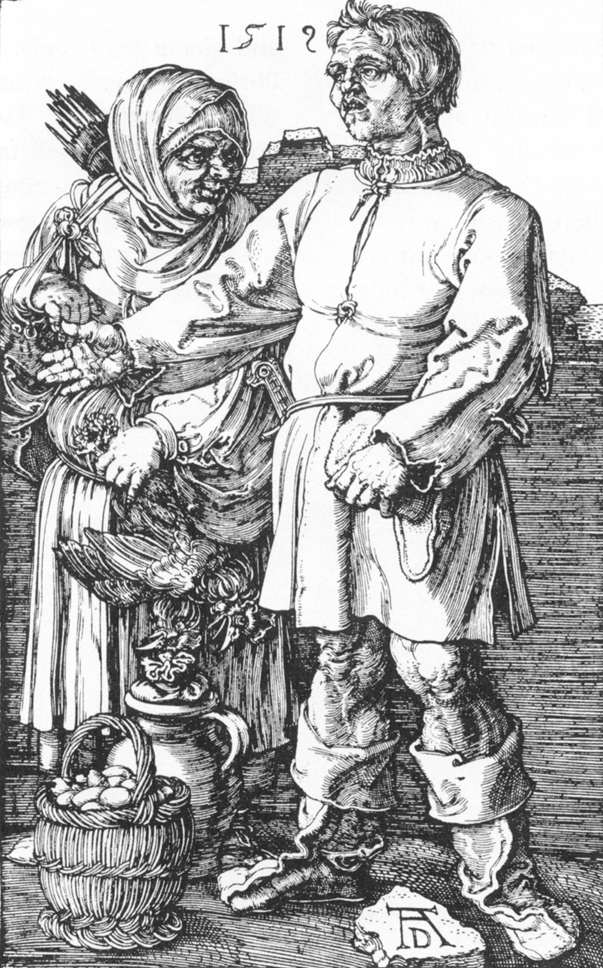
For most people involvement with the market in pre-capitalist times was marginal. In Albrecht Durer's 1512 etching we see his portrayal of two peasants at the market. You will note that they have but a few items to sell. Similarly, those doing the buying would also buy little of what they needed.
As we saw in Chapter 28, throwing peasants off the land does not necessarily mean they will present themselves at the factory gates or constitute an immediate market for capitalists' goods. The inability to produce one's own food or clothing does not mean those who need to eat or to be clothed will have the money necessary to buy what they need or that buying them is the only way to obtain them. They could also be appropriated directly. In legend, Robin Hood and his merry men poached the king's deer. As commons were enclosed, peasants continued to gather wood in forests for huts and fires and poached game on now private land.(1) Along with the laws against vagabondage, aimed at creating a class of waged workers, came other laws aimed at preventing such direct appropriation, i.e., property laws that imposed the market as the only legal way to acquire goods. These laws were every bit as bloody, perhaps more so, than those against vagabondage. In the 17th and 18th Centuries, British courts regularly hanged people for petty "theft." Historian Peter Linebaugh coined the term "thanatocracy" for this rule by death.(2)
While this distinction between direct appropriation and buying with a wage may seem clear cut, historically it was not so neatly defined. During the period of manufacturing, it was commonplace in many trades, for the workers to take part of their income in the form of directly appropriated means of production. For example, silk workers would appropriate scraps of silk cloth, shoemakers would keep excess leather, shipwrights would help themselves to scrap lumber, sailors would take tobacco being transported in their ships, cowboys could take part of their pay in calves or put their own brand on mavericks, and so on. In each case the workers would either consume the material directly, sell it for money or work it up into a product (e.g., leather into shoes) and sell that for money.(3) Eventually, this kind of activity was criminalized; laws were passed attacking these non-wage forms of income and through them the real wage was lowered, making the workers poorer and the employers richer. Moreover, the struggle over such appropriation led to a variety of new methods of production: from hogsheads (large wooden barrels) in shipping (to make "pilfering" more difficult) to Mirabeau's fabriques réunies in which workers could be watched over, their labor process more carefully controlled and "waste" limited.
Valorization and disvalorization
Another way of looking at the emergence of the "home market" is the commodification of production, that is so say how goods which had been produced for use, came to be produced for sale. This is characteristic of the capitalist organization of life: capitalists convert human activities into commodity producing ones. The people capitalists put to work, produce not just useful items but items or services but commodities that can be sold to make a profit (or so the capitalists hope. This whole process of putting people to work producing commodities, sold to realize a profit, which is then reinvested to begin the whole process over again, Marx calls (in Chapter 7) “valorization” or the “self-valorization” of capital.(4) 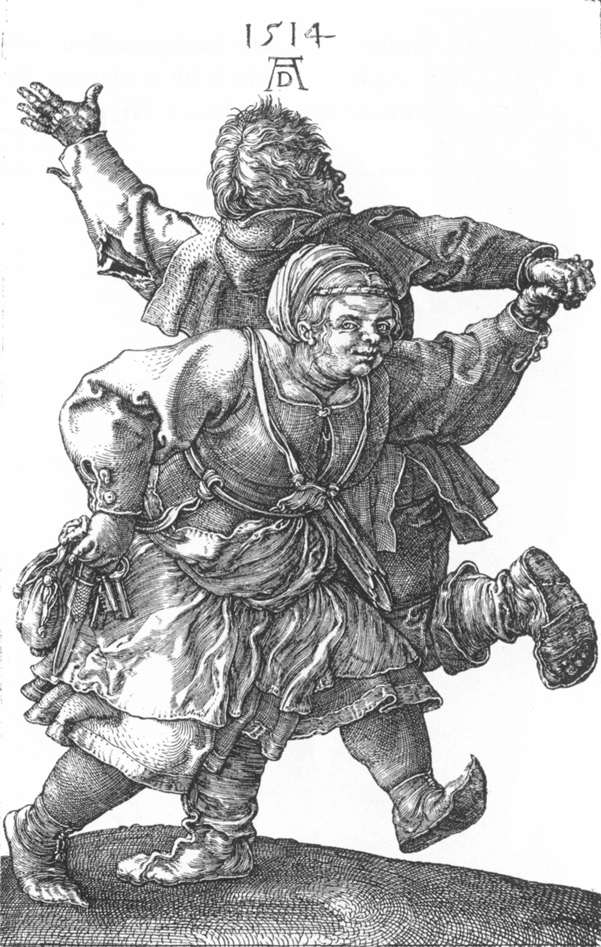
Capitalist valorization is quite the reverse from the point of view of displaced peasants and artisans. Peasants displaced from the land lose their ability to farm, not only in the direct sense that without land they cannot grow food, but over time the very skills necessary for farming are lost within a generation. Their children, raised away from the land, never acquire the skills of their parents. Artisans, who knew how to spin thread or weave cloth but lost their spinning wheels and looms, soon lose their skills in those handicrafts. Their children never gain them. Thus, the creation of value for the capitalist means the creation of what Ivan Illich has called “disvalue” for the expropriated.(5) This loss of skill, this loss of the ability to produce for oneself to meet one’s own needs, involves two related processes, devalorization and disvalorization. Where certain skills and abilities and knowledges are lost completely, not just by the individual but by society, we can say there has been devalorization or the destruction of value. Where the skills and abilities are lost to individuals but taken over and incorporated into capital and the production of commodities, we can say the people have suffered disvalorization—the displacement of personal and communal skills into the production of commodities.(6)
These processes, although begun in the earliest period of primitive accumulation, continue to this day. In Chapter 15 of Capital, on machinery and modern industry, Marx analyzes this process in terms of deskilling. He shows how the development of machines has involved the mechanical reproduction of skills that workers then no longer exercise. The more this process develops, the fewer aspects of traditional skill are exercised by workers. The result is a real process of "abstraction" through which work is steadily reduced to simple machine tending.
Today, the processes of devalorization and disvalorization are most evident in the Global South. In barrios and villages, we find people whose abilities to meet their own needs are being undermined by the intrusion of the market. Sometimes, as in the case of the substitution of marketed baby formula for breastfeeding, the results have been dramatic: malnourishment, crippling and even death.(7) In other cases, say the substitution of store-bought clothing for homespun, the results are not so immediately obvious or dramatic but, in the long run, cultural traditions and ways of life are lost, e.g., patterns unique to communities woven into clothing, traditional reverence for the earth. The creation of the home market replaces diverse cultural practices and ways of being by a single way of doing things and similar goods. Capitalists like to point with pride to the array of colors and styles available in your average department store, or the array of foods available in supermarkets. But compared to the pre-existing diversity of styles in clothing and cuisines, their vaunted "choices" pale, mere variations to maximize sales.
Under these circumstances, people have long fought against the subordination of their activities to capitalist accumulation and for the preservation of their cultures, which cannot survive independently of the structure of those activities. Just as peasants struggled against the expropriation of their land, so too did the artisans among them struggle against the destruction or subordination of their tools and crafts. As described in Chapter 15, during the early period of manufacture workers sometimes smashed machines that would subordinate their skills, increase their work and lower their income.(8) Such struggles also constituted a defense of ways of life, of patterns of interactions, within a community and between generations (parent-child, apprenticeships).
Looking primarily at Europe, Marx saw the rigidities of the guilds with their strict rules that limited production, the number of journeymen working under a master, and so on. In those conditions, he saw capitalism bringing a certain freeing up, a liberation of production from artificial restraint, thus an historically progressive force. But the guilds were mainly city institutions and Marx never closely explored the great variety of cultural practices in the countryside&mdashh;at least not until late in his life, long after Capital was written. Then, he began to read ethnographic studies and was drawn into debates about the Russian mir, or peasant commune. As a result, he showed a greater appreciation of such alternative forms of social organization. Unfortunately, none of this shows up in Capital; it was never revised to take account of this new appreciation.
The Realties and Costs of Agricultural Development
Marx does address a fundamental difficulty inherent in the rise of an industry based on a labor force separated from the land. If expropriation led to a fall in production of foodstuffs, because of fewer people working the land and agrarian capitalists replacing food production with raw material production for multiplying factories, there would be a serious problem in feeding those forced off. However, he was aware of two factors that tended to offset such a difficulty. First, England had increasing recourse to importing foodstuffs from the continent.(9) Second, the concentration of the land in the hands of an emerging capitalist class was accompanied by an increase in agricultural productivity, an early “green revolution” that involved innovations such as crop rotation, the spreading use of nitrogen-fixing crops, drainage, land reclamation and water meadows.(10) These improved methods were implemented primarily by the greater cooperation and intensity of work by wage laborers under the control of agrarian capitalists. Under these circumstances, the “setting free” of part of the agricultural population was accompanied by a similar “setting free” of part of the product of the soil, now sold in the market to those forced into the cities.(11)
Increased productivity has often been used as a justification for changes in land tenure by policymakers in Western capitalist countries as well as by those in the Soviet bloc who imposed collectivization. But two points temper this rationale. First, it is easy to find many areas of the world where land was expropriated but then not cultivated at all and so productivity did not rise. In some cases, the land was monopolized purely with the intent of preventing the indigenous population from having recourse to subsistence farming. Examples are common in Central America. When the CIA overthrew the government of Guatemala in 1954, it was partly because its democratically elected president, Jacobo Árbenz Guzman (1913–71), had appropriated unused lands of the United Fruit Company for distribution to landless peasants.(12) In other areas, expropriated lands have been used productively and then abandoned but not given back to their original owners, e.g., in the Brazilian northeast where, when the price of sugar dropped, sugar cane lands were abandoned. In the Soviet Union and other so-called socialist countries, peasant resentment and resistance to forced labor systematically undermined the productivity of the state or collective farms.


Second, the basic argument that changes in land tenure can raise productivity is, itself, questionable. Questionable not because data on productivity, such as pounds of wool per acre or per hour of labor, do not show a rise, but because of the narrow notion of productivity. Traditional self-sustaining agriculture has almost always involved a complex mix of interrelated activities— well-known in traditional American family farming that long dominated US agriculture. The traditional family farm engaged in both cropping and husbandry. Corn provided food for the table, feed for cattle as well as marketable produce. Cattle provided milk and milk by-products, meat, income through the sale of meat and hides as well as fertilizer for the fields. Rotated nitrogen fixing crops such as alfalfa or clover provided feed for the cattle as well as fertilizer to the soil. Gardens provided a balance of vegetables and fruit for the table, and sometimes for sale in local markets. Pigs absorbed table waste while producing meat for consumption or sale, and so on. The replacement of a large number of such farms by a few commercial agribusiness operations that produce just one crop, such as hybrid corn, or feedlot cattle or pigs, has involved the substitution of a simple monoculture system, whose productivity is narrowly defined and easy to measure, for a complex system whose productivity is not so simply measured, or even conceptualized. That complex system was a way of life that integrated humans and nature as well as nature itself.(13) Destroying such ways of life replaces complex, balanced ecosystems by simplified, unbalanced ones, often with disastrous consequences for the land, for water and for human life. (14) In short, the decline of traditional farming involved tremendous human and ecological costs in terms of the destruction of ways of being that could not be legitimately compared with or compensated for by increased productivity. What has been true in the United States has also been true around the world, from the destruction of Mexican milpas and communities to the commercialization of Asian wet-paddy rice culture..
Recommended Further Reading
- See footnotes
Concepts for Review
home market manufactures reunies destruction of handicrafts imperialism disvalorization devalorization |
Questions for Review
(An * means that one possible answer to that question can be found at the end of the study guide.)
1. What was the relationship between agricultural production and artisan manufacture in the period before the expropriation of the agrarian population?
2. What are the processes Marx cites through which the agricultural revolution raises output on the land? In what sense was the agricultural revolution a technological one, in what sense a social one and how were these two related?
3. Explain what it means to say that the means of subsistence were "set free" at the same time the workers were. Is this as simple as it sounds?
4. What does Marx and Mirabeau's discussion of the factory tell us about its initial form and origins?
*5. In footnote seven (on p. 912 of Vintage ed.) Marx extends the discussion from the creation of the "home" market to that of the foreign market—a moment of analysis of "imperialism." How might protection (limiting competing imports) hasten the separation of agriculture and domestic industry as Marx suggests?
*6. Discuss the process of disvalorization as presented in the commentary. Can you observe this process in the world around you? What about in school? What abilities and skills do children sometimes acquire independently of school which are then undermined by the structure of school?
Footnotes
1 See Peter Linebaugh, "Karl Marx, the Theft of Wood, and Working-Class Com¬position: A Contribution to the Current Debate", Crime and Social Justice, no. 6, Fall-Winter 1976, pp. 5-16 on Marx's early interest in such direct appropriation. See also Douglas Hay, "Poaching and the Game Laws on Cannock Chase", in Thompson et al., Albion's Fatal Tree.
2 See Linebaugh, The London Hanged, Chapter Two: "'Old Mr Gory' and the Thanatocracy."
3 Linebaugh analyzes several of these situations, both the direct appropriation that supplemented money wages and its criminalization. Ibid., Chapters 5, 8 and 11. See also Allen, Chapters in the History of Organized Labor in Texas.
4 As opposed to the self-valorization of workers. In the Introduction to Reading Capital Politically, I point out how this term “self-valorization” was appropriated and redefined by the autonomist Marxist Antonio Negri to designate, not the self-valorization of capital, but the self-activities of workers valorizing their own lives.
5 On the concept of disvalue, see Ivan Illich’s essay “Useful Unemployment and its Professional Enemies” in his book Towards a History of Needs, Berkeley, CA: Heyday Books, 1977.
6 For further methodological considerations on valorization and disvalorization, see Harry Cleaver, “The Inversion of Class Perspective in Marxian Theory: from Valorization to Self-Valorization”, in Werner Bonefeld, Richard Gunn and Kosmas Psychopedis (eds.), Open Marxism, vol. 2, Theory and Practice, London: Pluto, 1992, pp. 106–144.
7 Such results led to an international boycott of Nestle for pushing baby formula to the poor in the Global South and to the formation of the International Baby Food Action Network (IBFA).
8 Capital, Vol. I, pp. 554-555.
9 102. With England in the lead in the development of manufacturing, many countries on the continent, from Revolutionary France to Czarist Russia exported grain to England in order to buy manufactured goods, including machinery to expand their own industry. This would only pose a problem in times of war, e.g., the Napoleonic Wars (1803–15) when grain imports were cut off.
10 See G. E. Mingay, Agricultural Revolution: Changes in Agriculture, 1650–1880, London: A & C Black Publishers, 1977.
11 This history was forgotten by economists who expected, after World War II, to be able to move some 25 percent of the agricultural labor force in Eastern Europe into manufacturing labor with no reduction in output. They were wrong and soon had to revise their plans to include increased investment in agriculture to raise productivity. See Paul Rosenstein-Rodan’s classic “Problems of Industrialization of Eastern and South-Eastern Europe”, Economic Journal, Vol. 53, no. 210/211, 1943, pp. 202–211. A later example of the less optimistic efforts to find ways of imposing work is John C. H. Fei and Gustav Ranis, Development of the Labor Surplus Economy: Theory and Policy, Chicago, IL: Homewood, 1964.
12 Richard H. Immerman, The CIA in Guatemala, Austin: University of Texas Press, 1982. Also see the now released CIA assassination plans for the overthrow of the Arbenz government and the "cleansing" of his supporters.
13 See Wendell Berry, The Unsettling of America: Culture & Agriculture, Berkeley, CA: Counterpoint, 1977, 2015.
14 Examples include the impoverishment of the soil by monocropping, the runoff of excess inorganic fertilizers into waterways causing eutrophication and the overuse of pesticides poisoning workers in the fields, consumers and a variety of non-human an-mals, most recently honeybees, whose colony collapses are threatening entire industries requiring them for pollination.
Attachments
Comments
Harry Cleaver's study guide to chapter 31 of Marx's Capital volume 1.
Outline of Marx's Argument
- Industrial capital grew up more rapidly than agarian capital
- – less through gradual accumulation by workers or artisans
– more through the annexation of labor by merchant or usurer capital
– despite traditional restrictions of guilds, etc.
– began in sea ports and villages beyond such constraints
– accelerated and solidified through the victory of capital over the feudal ruling classes
– financed by wealth accumulated through force
The wealth that financed the rise of industry, Marx emphasizes, was not accumulated through frugality
- – but rather by force
– above all, in the beginning, by colonialism
– "enslavement and entombment in mines" of the indigenous population of the Americas
– "the conquest and plunder of India"
– the enslavement of Africans
– the monopolization of trade (including the Opium trade in China)
– but also the use of banks, the national debt and taxation (imposed by state power)
– "Force is the midwife of every old society which is pregnant with a new one. It is itself an economic power."
Colonialism: Marx: Dutch, English, Spanish
- – violence and the plunder of wealth
– massacre and the direct theft of land and riches
– enslavement of populations
– monopolization of trade (including the slave trade)
– the English East India Company in India: salt, tea, betel, opium
– the Dutch in Indonesia: slaves
– trade in both directions: exports of local wealth, imports from the home country
– concentrated wealth in the hands of those who invested it in industry
– led to commercial wars between competing colonial powers
Public Debt: one of the earliest and longest lasting mechanisms that Marx discusses
- – private finance capital loaned money to the state in exchange for negotiable bonds
– the state used the money to finance the violence of primitive accumulation: army, navy
– repaid the debt with interest, through the imposition of taxes on the people
– which concentrated more money in the hands of finance capital
– the circulation of state debt & the creation of large scale banking gives rise to the massive expansion of credit
– in the hands of capitalists – before the rise of consumer credit
Trade Protection: monopolization of trade and the extorsion of heavy taxes combine in the use of:
- – protective duties
– export primiums
– the destruction of competing industries (e.g. Irish woolen manufacturing)
– all of which plundered both the English people and their trading partners and the concentrated wealth in the hands of the capitalists
These methods financed industrialization
- In England:
- – the impoverishment of the workers
– the enslavement of their children (who were not free agents in the labor markets)
– cruel working conditions and minimal pay
– the rise of night work: "the beds never get cold"
- – slavery ("the veiled slavery of the wage-labourers in Europe needed the unqualified slavery of the new world as its pedestal")
– scalp hunting and murder
"If money," Marx concludes, "'comes into the world with a congenital blood-stain on one cheek,' capital comes dripping from head to toe, from every pore, with blood and dirt." (p.926)
Commentary
Industrial capital, the prototypical form of capital, emerged alongside agrarian capitalism. Marx refutes the myth that this emergence was accomplished purely through conscientious frugality and entrepreneurial investment by describing the actual sources of finance for investment that became permanent features of capitalism, well beyond the early period of primitive accumulation.
The Myth of Entrepreneurship
Marx’s attack on the myth of entrepreneurial frugality remains important because the myth still flourishes. It became foundational to the ideology of upward mobility, which claims that anyone who works hard can move up the income hierarchy, even to the very top. Recently, it has been refurbished as part of the right-wing attack on those roles of the state used by workers for their own protection. In the United States, amidst the crisis of Keynesianism in the 1970s, this ideology was elaborated by neo-conservatives, and soon became known in the rest of the world by the label neoliberalism.(1) In the Global South, it has been an important element of the writings of people such as economists P. T. Bauer (1915–2002)—created a "life peer" by the UK's union busting Prime Minister Margaret Thatcher!—and Hernando De Soto Polar (1841 -)&mdashbest known for his counter-revolutionary(2) advocacy of government deregulation—both of whom have been vociferous advocates of "liberating" the market and entrepreneurship around the world. In the Soviet Bloc and China, the appeal to liberate entrepreneurial spirit was a part of the reformist attack on state planning, and after the fall of the wall, the imposition of the market and the gutting of worker protectons became integral parts of the programs of "shock therapy" reforms in Eastern Europe.
While Marx accepts the grain of truth that many small guild masters, independent small artisans and even wage-laborers, “transformed themselves. . . into capitalists.”(3), he argues that such personal initiative, savings and investment were not the major mechanisms by which industrial capitalism emerged. Nor we can add, are small businesses today the major source of capitalist expansion.
Since the 1970s, attacks on the Keynesian social and environmental programs and regulations have been rationalized by the pretense that they undermine entrepreneurship. State paternalism, neoliberals have claimed, whether of welfare state in the West or of socialist governments in the East, creates dependency and tends to snuff out the entrepreneurial spirit vital to the building of free enterprise and society more generally. Targets have included programs that support working-class income and increase workers' ability to resist exploitation, as well as environmental, occupational safety and health regulations that workers have imposed on business to limit damage to both humans and the rest of nature. Neoliberals call for deregulation to cut corporate costs and enhance private profits, the selling off (enclosure) of public lands for purposes of exploitation, the removal of environmental regulations to encourage investment, the reduction or elimination of social safety-net programs, vouchers to finance private schools outside the public-school system, and in countries now freed from Soviet-style regimes, the substitution of private farming for state or collective farms. Hypocrisy is blatant in the steadfast opposition these same capitalist apologists maintain to any reduction in the role of government in the defense and subsidization of corporations and in their repeated support for "supply-side" tax cuts that supposedly increase investment but actually benefit the wealthy at the expense of everyone else. Such policies have rightly given rise to the term "corporate welfare."
Analyzing the rise of industrial capitalism shows us how these arguments are just as ideological and self-serving as those Marx confronted in the 19th Century. Even during the birth of capitalism, in the supposed golden age of laissez faire, before the rise of "big government" or the welfare state, the role of the state was crucial for the emergence and survival of capitalism. Whether describing the state use of armed violence to capture and maintain colonies for exploitation by "free enterprise" or analyzing the use of national debt and taxation to finance such violence and to transfer income from workers to capital, Marx highlights the ways in which the greatest and most important "entrepreneurial" ability of all was the ability to mobilize, not individual creativity, but state power in the service of capital accumulation. Similarly, he shows how the main beneficiaries of this ability were not small, "entrepreneurial" firms, built with individual initiative, but giant monopolistic trading and industrial enterprises —such as the British and Dutch East India Companies—built and sustained by state charters and armed support.
The myth of entrepreneurship derives its strength partly from the ubiquitous propaganda apparatus of capital, but also from an extremely important truth hidden beneath all its distortions and hypocrisy. Within capitalism, the real sources of creativity and innovation are social individuals working and thinking within a collective process. The myth of entrepreneurship misleads by pointing only to the innovative individual (from Horatio Alger to Steve Jobs), while ignoring both the social fabric enabling such individuals to create and their dependence on capitalist finance, which turns their innovations into new modes of exploitation.
The real source of innovation and wealth, Marx argues, is living labor (including creative thinking). Capitalists, as such, serve as mere managers of a system in which dead labor—in the form of capital, whether means of production or money—dominates living labor. Where those who work and think have the power to force capital to harness rather than repress such creativity, the system accumulates and develops rapidly. Where workers are weak and capital powerful and rigid in its control, the system can accumulate only quantitatively and tends to stagnate. In the West, the right-wing calls for a liberation of entrepreneurship, but their policy prescriptions have been focused primarily on liberating not individuals but multinational corporations from constraints that benefit workers and protect the environment. In the last years of the Cold War, Soviet reformers, such as Mikhail Gorbachev, found themselves caught in a contradiction; they needed looser industrial and political controls (to achieve more flexibility and rapid accumulation) but feared the result would be explosive expressions of discontent they could not manage. Their fears soon proved to be justified, the Berlin Wall fell and their regime with it, soon replaced by a savage mafia-capitalism dedicated to maximum exploitation and repression. The reality of neoliberalism is Trump's authoritarianism and Putin's dictatorship.
Capitalist Development and the Role of the State
Thus, capitalists' attitude toward the state depends entirely on the degree to which it serves their needs. Where, during the early period of primitive accumulation, industrial capitalists did not have the power to use the state to eliminate guild rules inimical to their business interests, they set up operations in sea ports and villages where such restrictions did not obtain. Where and when capitalists were able to usurp state power, they used it to craft a world more to their own convenience. They pillaged the Global South through colonialism. They impoverished and disvalorized their employees through low wages and taxation. In both areas, they imposed a murderously repressive social order based on slavery and the exploitation of children.
The central role of colonialism in the original accumulation of industrial capital consists of a series of mechanisms, some crass and violent, some subtler but still violent, which facilitated amassing the wealth that financed British industrialization.(4) These mechanisms became quasi-permanent features of capitalism right up to the decolonialization period after World War II. The violence he describes in the initial conquest and plundering was required to overcome the fierce resistance of the people being colonized. The example he cites from the United States— scalping and murdering Native American men, women and children—was far from unique, as people everywhere resisted integration into the invading European capitalist takeover of their lands.
The violence did not disappear with the stabilization of colonial rule because resistance did not disappear. Violence begat violence. In the French colony of Vietnam, for example, military force was required to maintain control against both passive resistance and armed struggle. It took their military defeat at Dien Bien Phu in 1954 to force their withdrawal from Indochina. The history of colonialism is one long drama of invasion, resistance, conquest, exploitation, continued resistance and continued repression. But repression ultimately failed, as one anti-colonial struggle after another succeeded in pushing foreign governments and their repressive apparatus out. Unfortunately, as colonized people were to learn to their chagrin, the end of formal colonialization did not always mean the end to the mechanisms of exploitation.
One such mechanism was trade, trade internal to the colony, trade between the colony and the colonizing country, and trade with the outside world. Marx describes the case of India where the British took over the trade in consumer items such as salt, betel, opium and rice.(5) In the case of rice, he claims that the British created a famine in the process. Indeed, famine became recurrent.(6) Most notorious was the Bengal famine of 1943 in which over 2 million people died. Four years later, the British were finally forced out. Another example of British efforts to monopolize trade within a colony was Nigeria, which came into direct conflict with the market women who had traditionally dominated domestic trade. When the women sought to affirm their traditional rights, the British violently repressed them.(7)
The rise of British industry at home—the central subject of this chapter—was fueled by the monopolization of colonial foreign trade. Colonialism meant an extension of the markets for industrial output beyond the home market.(8) Colonial powers prevented any other countries' industries from selling in their conquered territories, destroyed local industry, either directly (say by cutting off the thumbs of the weavers) or indirectly by underselling at lower prices. (9) In the Communist Manifesto, Marx and Engels commented on this aspect of capitalist expansion:
"[The bourgeoisie] has resolved personal worth into exchange value, and in place of the numberless indefeasible chartered freedoms, has set up that single, unconsciounable freedom -Free Trade. . . . The cheap prices of its commodities are the heavy artillery with which it batters down all Chinese walls, with which it forces the barbarians' intensely obstinate hatred of foreigners to capitulate." (10)
The reference to "Chinese walls", of course, is not to the great wall of China, built to keep out nomadic tribes and to tax commerce on the Silk Road, but to the efforts of the Chinese ruling class to keep out Western capitalist merchants and their cheap and often noxious commodities. The walls were battered down by both cheap commodities and the gun boats of the Western powers which forced China to accept foreign trade.(11)
European capitalists not only imposed exports on their colonies, they also demanded protectionist measures to limit imports at home to keep prices and profits up. Demands for “free trade” or for “protectionism” depended purely on what was useful to a particular set of capitalists at any point in time.
Arguments for either set of policies could draw on the writings of economists, always ready to provide rationales for capitalist demands. The proponents of “free trade” could draw on classical political economists such as Adam Smith (1723––90) and David Ricardo (1772–1823). The latter was especially useful because he provided a theory of “comparative advantage” that argued that all parties could gain from trade. The proponents of protectionism had not only the arguments of US Secretary of the Treasury Alexander Hamilton (1755–1804) for protecting American industry, but The National System of Political Economy (1841) by Friedrich List (1789-1846) who turned Hamilton's arguments into systematic economic theory.'(12) List, who had supported the new German Customs Union to facilitate wider trade, came to modify his embrace of free trade by supporting the argument that "infant-industries" deserve protection until they can get their production costs lowered enough to become competitive in world markets. The imposition of barriers to imports helped create the home markets required by new industry. By limiting supply, protectionist measures raise the prices at which industrialists can sell, boosting their profits and ability to invest. In consumer goods industries, the higher prices undercut the real wages of their customers, who pay this supposedly limited, short-term subsidy for the sake of the development of industry.
In a speech given in January 1848, the year he and Engels published the Manifesto, Marx addressed free trade and protectionist policies directly and at length. After reproducing the arguments on all sides, especially mocking capitalist arguments about how one policy or the other would benefit workers, he shows how, on the contrary, workers suffer from both policies. "What is Free Trade," he asks, "under the present conditions of society?" His answer: "Freedom of Capital. . . freedom of Capital to crush the worker." What of protection? "The Protective system is nothing but a means of establishing manufacture upon a large scale, that is to say, of making it dependent upon the market of the world; and from the moment that dependence upon the market of world is established, there is more or less dependence upon Free Trade too."
Given this analysis, he goes on to conclude, "Generally speaking, the Protective system in these days is conservative, while the Free trade system works destructively. It breaks up old nationalities and carries the antagonism of proletariat and bourgeoisie to the uttermost point. In a word, the Free Trade system hastens the Social Revolution. In this revolutionary sense alone, gentlemen, I am in favor of Free Trade."(13)
Today, conflicts over the choice of free trade versus protectionist policies persist. Campaign contributions have bought some industries continuing protection for their markets and their profits, at the expense of those who buy their products. The sugar industry in the US is one durable example. The price of sugar has been, since 1789, artificially raised by tariffs.
Sugar, Cokes and Pain |
After the Great Depression of the 1930s, multinational corporate interests increasingly demanded free trade. Most economists concurred, arguing that competing protectionist measures had deepened that crisis. The General Agreement on Tariffs and Trade (GATT) of 1947 was formed to reduce obstacles to trade. In the wake of World War II, American companies, less damaged by war than their foreign counterparts, wanted as much freedom to invest and export as possible. Reduced trade barriers and subsidies, such as the Marshall Plan (1948–51), where some 13 billion dollars were loaned to countries in Western Europe, facilitated a huge flow of consumer and capital goods from the US.(15) While policymakers saw the Plan as a way to stabilize Western Europe at the dawn of the Cold War, economists justified it mainly by recourse to Ricardo’s arguments for free trade. For economists and for business media, trade is almost universally portrayed in terms of the relationships between nations, rather than between classes. Ricardo laid out his argument about “comparative advantage” and “gains from trade” in terms of trading between England and Portugal. Politicians and TV commentators today talk about improving or worsening trade between countries such as the United States and China. Determining such conflicts and influencing the negotiations between governments, however, are the class forces at work within the individual countries and across borders.
Negotiated in secret collaboration with business interests, NAFTA provides a good example. On the surface, it appeared to be simply an agreement between the governments of the US, Canada and Mexico to form a free trade zone that could compete with the increasingly unified European Union, created in 1993. Both blocs contain huge populations, large internal markets and enormous combined resources. But behind this appearance lay patterns of struggle between capital and labor.
The interest of American and Canadian corporations in including Mexico in a trading bloc derives from the possibilities of pitting Mexican workers against American and Canadian workers who are paid more and have more legal rights. Having already moved thousands of jobs south into Mexico, corporations have used the threat of moving to Mexico, where workers are much less powerful, both on the job (lower wages and benefits) and off (little social security, unenforced environmental protection, political repression), as a threat to obtain concessions (lower wages, more flexible work rules, etc.) from American and Canadian workers."(16) Such outsourcing requires that goods once produced in the US or Canada, but now produced in Mexico can be freely exported back into the US and Canada. Without the ability to do so, such a continental strategy against labor could not work.
Opposition to the treaty clarified the class content of trade. Literally thousands of protestors from all three countries—from unions to environmentalists—collaborated to oppose a corporate-friendly NAFTA. Coalitions of hundreds of groups in each country organized to oppose the treaty. Those coalitions, in turn, linked together to support each other through international discussion and the circulation of information. This was the first time that such grassroots organization occurred on this scale."(17) Although those efforts were defeated, and NAFTA went into effect in 1994, the network of new contacts prepared the ground for the subsequent alter-globalization movement that mobilized against the World Trade Organization (WTO), formed to undercut local democracy by imposing global trading rules. Grassroots groups such as People's Global Action organized massive demonstrations in Geneva, Seattle and elsewhere. Just how much of a threat to capitalist interests such mobilization constitutes can be measured by the increasing violence unleashed by the state in Quebec City, in Prague and in Genoa, including beatings, torture and killings. Measured by the breadth of mobilization and the degree of repression, the intensity of class struggle around trade has become great indeed.
Banks, Debt and Taxes
The last of the mechanisms of amassing investible funds that Marx highlights is the manipulation of public debt and taxes. He describes a process that would grow and develop over time to become one of the most powerful levers of capitalist control in our day. He deals with this issue at both the national and international level, and so should we. The process is a simple one, although obscure to most of us. Capitalists loan money to the state to finance its expenses over and above revenues (e.g., to cover budgetary deficits). The state uses the money to pay for its expenditures—Marx emphasizes those which support the process of primitive accumulation—and then pays back the borrowed money, at interest, with money acquired through taxation, an act which Marx describes as turning money into capital “as with the stroke of an enchanter’s wand.”(18) Here he emphasizes taxes on subsistence goods, which impoverishes peasants and artisans and results in their expropriation. Augmented, the money loaned becomes capital—finance or usurer’s capital. Although not based on the extraction of surplus labor from industrial workers analyzed in the rest of the book, this amassing does make such extraction possible. This process in turn, because national debt takes the form of negotiable securities, provides one basis for the expansion of banking and financial markets, which also facilitate financial intermediation or the pooling of money that can be used to finance industrial capital.
Marx does not discuss, at this point, something he knows to be a complicated issue: the conditions under which amassed money-capital becomes available for industrial investment. Already quite familiar with the problem in the 1850s, he analyzed and wrote many articles about it, years before Capital went to press. He criticized, at length, the French Crédit Mobilier, an early financial institution that claimed to be channeling capital into industry. Marx showed that it greatly overstated the degree to which this was being done and was in fact guilty of a great deal of speculation with other people’s money.(19) Nevertheless, he claims the development of financial markets played a key role in amassing the money that financed industrialization, but his focus is more on the amassing than on its channeling to industrial investment.
Today, when the United States and many other countries have highly developed financial markets, this remains an issue of contention. One of the most severe critiques of financial deregulation that began at the end of the 1970s have been how it facilitated the diversion of money out of real capital investment and into the “casino economy” with its various forms of speculation, from real estate through stocks to mergers and takeovers.(20) The result was very slow growth in the real economy, collapse of the US savings and loan industry and the stock market crash of 1987. Similarly, the freeing of financial markets from state regulation has been contentious in the Global South. Free market economists make the kind of claim Marx is making in this chapter: that the development of such markets would speed investment. But, is Marx's analysis of the Crédit Mobilier more to the point? To what degree does such freeing simply result in financial swindling and speculation rather than investment in new factories? The international financial crises associated with the European Exchange Rate Mechanism (ERM) in 1992; the Peso crisis of 1994; the Asia crisis of 1997; the Russian financial crisis of 1998; the repeated failures in the late 1990s to implement the European Monetary Union; the Turkish financial crisis in 2000; and the 2001-02 financial crisis in Argentina and, most recently, the financial crisis of 2007-09 have kept the issue alive.
The repayment of sovereign debt as a risk-free use of the state's power of taxation to multiply the capital of finance capitalists has certainly become a permanent feature of capitalism. The current US federal deficit is a case in point. Excesses of government expenditures over tax revenues have been financed with hundreds of billions of dollars of debt, loans from private capitalists being repaid at market rates of interest with taxpayers' money.
Ever since Marx was writing, international loans to foreign governments have also provided a lucrative way to convert bank money into finance capital. In the early 20th Century, Western bankers sought, with their nations' gunboats and marines, to obtain a slice of the royal Chinese debt."(21) After World War II, the Marshall Plan initiated decades of US government loans to other governments, in return for concessions to US diplomatic objectives and the interests of multinational corporations. More recently, in the 1970s, OPEC petrodollars, deposited in Western banks, were lent to desperate oil-importing countries at flexible rates of interest, to be repaid with export revenues via various forms of taxation. When American monetary policy tightened after 1980, interest rates soared, the world economy was pitched into depression, and those borrowing governments faced a crisis. Unable to raise the sums necessary to repay the sudden spike in repayment obligations, the result was an international debt crisis. Further loans to repay earlier loans were conditional on the imposition of austerity on the workers of the indebted countries."(22)
Slavery and Child Labor
At the end of the chapter, Marx emphasizes what were clearly to him two of the most obnoxious and reprehensible features of early capitalism: slavery and the exploitation of children. The wage-slavery of the Old World, he argued, had the formal slavery of the New World as its foundation. The taking of slaves in Africa, the trade in slaves that brought them to the Americas and the peculiar institution of plantation slavery were all vital in producing the raw material worked up in British industry: textiles from cotton, rum from sugar and so on.(23) Thus, the capitalism emerging in this period was not just British capitalism but was an Atlantic capitalism of a particularly vicious nature. Not only did it plunder and loot, but it imposed both literal as well as waged slavery.
Though Marx joined others of his day in condemning the exploitation of children in mines and textile mills, decades would pass before effective child labor laws would put an end to the most flagrant abuses of this sort in the US and other industrial centers. That said, the exploitation of children has never ended, not in the US or in other countries around the world. The subjection of children to forced labor for pitiful payment outside any free labor market is still common.(24) This is not about fast food stores hiring teens, or children put to work by television and Hollywood producers, but rather the forced prostitution of children and their exploitation in industrial production (such as carpet making, cocoa production, cobalt mining) around the world under conditions every bit as atrocious as those described by Marx. Most out-and-out slavery, the buying and selling of individuals, has been largely abolished, with a few exceptions, including the sex trade where children are trafficked along with adults. Groups such as the Anti-Slavery Society as well as the International Labor Organization periodically publish reports of the depressing extent of such exploitation.(25) Those reports include a textbook for university students that is well worth reading. It has many illustrations and personal testimony from children as well as analysis of the depth of the problem.
| Looms loom Knotting -hands in a blur A hard shared bench A ballad: village life and laments Deep breaths of heavy particled air
|
These aspects of capitalism have been around since its inception and continue, wherever business has the power to impose them. As Marx points out, if you really want to understand capitalism (or any other social system of class domination) study it where it exists with the fewest constraints. (26)
Recommended Further Reading
- On contemporary neo-conservative, anti-state (i.e., anti-pro-worker policies) propaganda in the United States, read almost any Reagan or Bush speech or see: Irving Kristol, Two Cheers for Capitalism, New York: Basic Books, 1978 or Jude Wanniski, The Way the World Works, New York: Simon & Schuster, 1978. You might also want to see the film Wall Street, starring Michael Douglas; this film, in which he delivers the famous "Greed is Good" speech, is quintessential Reagan era. For background, see Peter Steinfels, The Neo-Conservatives, New York: Simon & Schuster, 1979. Hernando de Soto is best known for his book: The Other Path: The Invisible Revolution in the Third World, New York: Harper & Row, 1989 which deals with the supposed virtues of the market in Peru.
On Western aid and markets in Eastern Europe, the best known spokesperson is Jeff Sachs, see, for example, Jeff Sachs and David Lipton, "Poland's Economic Reform," Foreign Affairs, Vol. 69, No. 3, Summer 1990, pp. 47-66.
On the crisis of the Keynesian State see Zerowork #1, December 1975, or my essay on the subject "The Rise and Fall of the Keynesian State" that you can find on my Eco 304L webpage.
On the class politics of Mexican border industrialization see: Devon Peña's UT Dissertation on Class Strugles in the Maquiladoras (subsequently published as a book: Terror of the Machine) or Devon Peña, "Tortuosidad: Shop Floor Struggles of Female Maquiladora Workers," in Vicki Ruiz and Susan Tiano (eds), Women on the U.S.-Mexican Border: Responses to Change, London: Allen & Unwin, 1987.
On the North American Free Trade Agreement which will extend these relations deeper into Mexico see: John Cavanagh et. al., (eds) Trading Freedom: How Free Trade Affects Our Lives, Work and Environment, San Francisco: The Institute for Food and Development Policy, 1992; Dan La Botz, Mask of Democracy: Labor Suppression in Mexico Today, Boston: South End Press, 1992; John Cavanagh, et. al., Trade's Hidden Costs: Worker Rights in a Changing World Economy, Washington: International Labor Rights Education and Research Fund, 1988.
The literature on colonialism, neo-colonialism and "imperialism" by Marxists is vast. In general, all are explained by the need of capital to expand. Lenin's classic book is Imperialism: The Highest State of Capitalism, 1917, based in part on Nikolai Bukharin, Imperialism and World Economy, 1915 and John Hobson, Imperialism - a study, (1902). A post-WWII, Third World point of view from Africa is Nwame Nkrumah, Neo-Colonialism: The Last Stage of Capitalism, New York: International Publishers, 1965. A Marxist commentary on Nkrumah is C.L.R. James, Nkrumah and the Ghana Revolution, Westport: Lawrence Hill, 1977. See also many of the books mentioned above, e.g., Peter Linebaugh, The London Hanged, 1992, Ricardo Salvatore, Class Struggle and International Trade, 1987, etc.
A study of Marx's examination of the Crédit Mobilier can be found in Joseph Ricciardi, Essays on the Role of Money and Finance in Economic Development, UT Ph.D. Dissertation, 1985. Marx's writings are now all easily available in Karl Marx & Frederick Engels Collected Works, New York: International Publishers, Volume 15 and thereabouts.
On international debt at the turn of the century see the classic Dollar Diplomacy. On the recent debt crisis, I have an essay "Close the IMF, Abolish Debt and End Development: A Class Analysis of the International Debt Crisis", Capital & Class, #39, Winter 1989, as well as an annotated reading list and packet of materials I use in my Spring course Eco 357L on The Political Economy of International Crisis. The annotated reading list is on the web.
Concepts for Review
merchant's capital industrial capital state force credit national debt press-gang |
East India Company rentiers bank notes credit-money overtaxation protection child stealing
|
Questions for Review
(An * means that one possible answer to that question can be found at the end of the study guide.)
1. What are the two paths along which the industrial capitalist appears? Which does Marx think is the more important?
2. How are usurer's and merchant capital different from industrial capital? What were the obstacles to the former being turned into the latter?
3. What does Marx characterize as the "chief moments of primitive accumulation"? Why chief?
4. What are the "different moments" of primitive accumulation which are "systematically combined together at the end of the 17th Century in England? Discuss their relationships to each other.
5. Discuss: "Force is the midwife of every old society which is pregnant with a new one. It is itself an economic power." (p. 916)
*6. In this chapter we have a whole discussion of colonialism - a phenomenon only mentioned in a footnote in Chap.30. Describe the ways in which colonialism constitutes a world wide extension of primitive accumulation as well as a part of it in England.
7. In footnote 4 Marx says: "This stuff (on slavery, etc.) ought to be studied in detail, to see what the bourgeois makes of himself and of the worker when he can model the world according to his own image without any interference." What does this suggest methodologically with respect to understanding the most fundamental nature of capitalism? What does it suggest about the transformations of capitalism that have occurred since "the bourgeois" could shape the world "without interference"? What is the primary source of "interference"?
8. List the ways Marx discusses through which capital is able to use the state for its own purposes during this period.
9. Were you aware that the Puritains started the practice of paying money for Indian scalps? Why were the Indians killed instead of being put to work?
10. How did British colonialism cause famine and starvation in India?
11. Discuss the relation between industrial and commercial development in the period of manufacture and in that of industry.
*12. Describe the creation and operation of national debt. How does it act to concentrate wealth in the hands of capitalists at the expense of others? Is this still a characteristic of ongoing as opposed to primitive accumulation? What do you think is the impact of the current $200 billion debt on this process?
13. How did national debt give rise to joint-stock companies, stock exchange gambling and "the modern bankocracy"?
*14. What was the role of the "international credit system" in primitive accumulation? Explain Marx's examples. What do you imagine is its role today? Do you think Marx's comment - "A great deal of capital, which appears today in the United States without any birth-certificate, was yesterday, in England (or elsewhere), the capitalized blood of children." - is still true?
15. Why do you think DeWitt thought that the modern tax system was "the best system for making the wage-laborer submissive, frugal, industrious . . . and overburdened with work"? Discuss the analogy with the hut tax in the colonies. Do you think this is still true? How? How do some argue that this is now changed, that higher taxes make people less willing to work? What makes such a change possible?
16. Discuss the process Marx describes through which the emerging capitalist countries sought to "forcibly uproot all industries in the neighboring dependent countries." Does this still go on?
17. Between the old precapitalist society and the full development of the emerging system was a long period in which force and brutal coercion played as much or more of a role than the market in mobilization of people into the labor force. What information does Marx give us in this chapter that illustrates that use of force?
18. With the rise of large-scale industry what changes in the processes Marx is describing?
19. Sketch the exploitation of children Marx describes in this chapter. Do you know when this ended in the United States - if you don't go to the PCL and look up a bit of history of child labor laws.
*20. From Marx's analysis in this chapter, how would you characterize the place of slavery in relationship to capitalism in this period. Did slavery constitute a separate mode of production, an integral part of North Atlantic capitalism, or what?
21. From what you have read here, and from what you have read elsewhere do you think Marx exaggerates when he says: ". . .capital comes (into the world) dripping from head to toe, from every pore with blood and dirt." Just how good a metaphor for the birth of capital is the chest burster of "Alien"? How bloodstained do you think capitalism is today? How fresh are the stains?
Footnotes
1 The term neo-conservative was adopted in the United States by conservatives who wanted to differentiate themselves not only from “liberals” (which in the US has come to mean vaguely socially progressive) but also from earlier moderate conservatives. Self-proclaimed neo-conservatives emerged on the public scene with the crisis of Keynesianism whose managers— members of what some used to call the Establishment—tended include both “liberals” and “mainstream or moderate conservatives” (as opposed to far-right groups like the John Birch Society and the China Lobby). The neo-conservatives, backed by considerable right-wing money began to build alternative policymaking institutions—such as the Heritage Foundation—and proclaim a “return to first principles,” namely a faith in markets and opposition to all government programs benefiting workers. First in Latin American, now pretty much everywhere, the term neoliberal has been used to characterize the policies of those neo-conservatives. The term neoliberal evokes a contemporary version of 19th Century liberalism, i.e., the ideology of free trade and faith that markets were the best way to solve most problems—coupled, of course, with the use of the state for the repression of workers’ struggles. The worldwide adoption of the term neoliberal accelerated in the wake of the Zapatistas’ multinational Encounters against Neoliberalism and for Humanity in 1996 and 1997.
2 The "other path" in the title of De Soto's first and best known book El Otro Sendero (1989) was "other" to that of the revolutionary Sendero Luminosa (Shining Path) guerrilla group in Peru. In it De Soto called for the liberation of the entrepreneurial abilities of the inhabitants of Peru's (and of the Global South more generally) informal sectors from government regulation. Where he saw teeming multitudes of potential entrepreneurial capitalists, others, such as Mexican grassroots activist Gustavo Esteva saw yet other, often anti-capitalist, paths to social reform. See Esteva's "Regenerating People's Space," Alternatives XII, 1987, pp. 125-152.
3 Capital, Vol. I, p. 914.
4 Socially speaking, real "wealth" in capitalism is not gold or money but social power, the power of capital to command people's lives as labor. Thus, the colonial plundering of gold or other non-human material resources was secondary to the imposition of work on the colonized and the use of the colonized to reinforce the imposition of work within the colonial country.
5 Capital, Vol. I, p. 917.
6 See Brian Murton, "VI.4: Famine", in K. F. Kiple and K. C. Ornelas (eds.), The Cambridge World History of Food, New York: Cambridge University Press, 2000, pp. 1411-1427.
7 See Judith Van Allen, "Sitting on a Man: Colonialism and the Lost Political Institutions of Igbo Women", Canadian Journal of African Studies, vol. VI, no. ii, 1972, pp. 165-181, and the Wikipedia entry on the Abeokuta Women's Revolt.
8 The colonies, Marx wrote, “provided a market for the budding manufactures.” Capital, Vol. I, p. 918.
9 See Michael Edwards, Growth of the British Cotton Trade 1780–1815, New York: Augustus M. Kelley Publishers, 1976.
10 MECW, Vol. 6, pp. 487–488.
11 Classic were the British wars to force China to accept British exports of opium.
12 Friedrich List, The National System of Political Economy (1841), New York: Garland Publishing, 1974.
13 "Speech on the Question of Free Trade", January 9, 1848, MECW, Vol. 6, pp. 463-465.
14 The 1969 film Burn!, is a story of imperialist rivalry over control of slaves and sugar production on one Caribbean island. One power brings in an agent—played by Marlon Brando—to organize a slave revolt to undermine another power's control. After the revolt succeeds, Brando is brought back in to put down the rebellious slaves. To do so, he burns down the island with all its sugar cane fields. The film is both historical AND an allagory of the war in Vietnam where one general infamously stated about the distruction of a village, that he had to destroy it to save it! Because the allegory was so clear, the film was quickly blacklisted and disappeared from theatres—despite its famous star. Sidney W. Mintz’s Sweetness and Power: The Place of Sugar in Modern History, New York: Penguin, 1985 may lack the visual drama of film but the history it recounts is every bit as dramatic.
15 Reduced barriers to capital investment, achieved through the rules of the International Monetary Fund, created in 1945, also facilitated a wave of investment by increasingly multinational “American” corporations.
16 For a dramatic exploration of the consequences to Flint, Michigan of such displacement, watch Michael Moore's film Roger and Me (1989) about the results of General Motors moving auto plants and some 30,000 jobs to Mexico.
17 For a capitalist view of the dangers of such international grassroots mobilization, see Cathryn Thorup, "The Politics of Free Trade and the Dynamics of Cross-Border Coalitions in U.S. Mexican Relations", Columbia Journal of World Business, vol. XXVI, no. 11, Summer 1991, pp. 12-26.
18 Capital, Vol. I, p. 919.
19 A study of Marx’s examination of the Crédit Mobilier can be found in Joseph Ricciardi, “Essays on the Role of Money and Finance in Economic Development”, University of Texas at Austin, PhD dissertation, 1985, some of which was more recently published as “Marx on Financial Intermediation: Lessons from the French Crédit Mobilier in the New York Daily Tribune”, Science & Society, Vol. 79, no. 4, October 2015, pp. 497–526. Marx’s writings on this subject are now easily available in MECW, Vol. 15 and thereabouts.
20 See Anthony Bianco, “The Casino Society: Playing with Fire”, BusinessWeek, September 16, 1985 and Susan Strange, Casino Capitalism, New York: Basil Blackwell, 1986.
21 See Scott Nearing and Joseph Freeman, Dollar Diplomacy: A Study in American Imperialism, New York Monthly Review Press, 1966.
22 See Cleaver, "Close the IMF, Abolish Debt and End Development: a Class Analysis of the International Debt Crisis", Capital & Class, vol. 13, issue 3, no. 39, Winter 1989, pp. 17-50.
23 This infamous pattern is now known as the “Atlantic triangular slave trade.” Manufactured goods were traded in Africa for slaves. Slaves were traded to the Western Hemisphere for raw materials. Raw materials were traded to New England, Britain and Europe.
24 If slavery involves legally enforced, unpaid labor, then we should include two other groups of incarcerated workers: children in schools and prisoners in both public and private jails—even if individuals are being neither bought nor sold.
25 Those reports include an ILO textbook well worth reading. It has many illustrations and personal testimony from children as well as analysis of the depth of the problem. One such group, the Concerned Center of Child Workers in Nepal, publishes a newsletter (Voice of Child Workers) in which you can find ample illustration of the extent of the problem in that country.
26 Capital, Vol. I, p. 916, footnote 4.
Attachments
Comments
Harry Cleaver's study guide to chapter 32 of Marx's Capital volume 1.
Outline of Marx's Analysis
- Three historical phases:
1. either: a) slaves, serfs, or b) private property in means of production based on the labor of its owner
- – peasants own land, artisans own tools
– fragmentation of holdings, excludes co-operation
– small scale industry
– «first negation: of individual private property»
– violent and protracted
2. private property in means of production of capitalism
- – based on expropriation of personal private property
– cooperation, division of labor in workplace, socialized labor
– large scale industry, application of science
– expropriation of capitalist by capitalist via centralization of capital
– internationalization of production and markets
– growth in mass of misery, oppression, slavery, exploitation
– growth in the revolt of the working class
– expropriation of the expropriators
– -«second negation: of capitalist private property»
– quicker, less violent
3. social property in the means of production
- – individual property founded on achievements of capitalism
– based on the carrying on of production by society
– i.e., co-operation and possession in common of means of production
Commentary
This chapter sums up both the historical processes of primitive accumulation and the dynamics of capitalist development itself, especially the processes of centralization of capital and class struggle, which Marx argues will bring the overthrow of capitalism.
The Ideology of Private Property
Marx juxtaposes capitalist private property to small-scale, personal private property in the means of production, e.g., land and tools, which he notes existed to some degree under most earlier social systems. He contemptuously condemns the capitalist ideology of private property, not only because it serves as a justification for violence and exploitation, but also because it ignores how the creation of capitalist private property involved the mass destruction of earlier forms of property.
Private property is usually justified by appealing to people’s sense that it is only proper for individuals to have property/control/possession of the fruits of their own labor. Farmers who work the land should have property rights in that land and whatever their cultivation can produce. Artisans who weave cloth should own their looms and the cloth they have woven and be free to determine what becomes of it. Anyone who works, gets paid a wage, and uses that wage to buy something has a right to the personal ownership of that thing because, in a transformed way, it was obtained through personal effort. Such were the kind of arguments put forward by John Locke (1632–1704) in his Second Treatise of Civil Government in 1690.(1)
Marx argues that such reasoning, based on individual effort, is hypocritically used to justify something very different: the capitalist ownership and control of goods produced by other people (i.e., the workers in the factories owned and controlled by the capitalists). A concept of justice that makes sense at the level of the individual does not necessarily make sense at the social level, if applied to property relations between factory owners and workers. This distinction is ignored or skimmed over for the sake of justifying capitalist control over their workers’ products. But why should capitalists “own” the products of workers? Because the capitalists own the machines and raw materials? But labor is just as vital, perhaps more so, and that is “owned” by the workers. Shouldn’t both capitalists and workers own the products and share in whatever revenue comes from their sale? In Chapter 6, Marx argues that because they purchase workers’ “labor-power” (their ability and willingness to labor) capitalists own everything in the production process, i.e., both means of production and the labor of their workers, and therefore have unique property right to the products. However, one judges this situation, it is quite clearly not covered by an ideology based on the situation of individuals.
As the material in this section of primitive accumulation has made clear, the capitalists used violence to wipe out the personal means of production of most people, monopolizing them in their own hands. In this process, they showed no respect for "private property." How hypocritical then to use moral principles applicable to the individual to justify the results of the violation of those principles.
One other note on this mutation of property rights: while today there are many cases of personally owned, small businesses (mostly short-lived), the vast bulk of capitalist operations are organized through limited liability corporations in which "ownership" is diffused among a great many anonymous shareholders and their "property" is controlled by a handful of managers and, perhaps, a few shareholders who own substantial blocks of stock. Because of this mutation, capitalists sought, successfully, to have property laws rewritten in such a way that "corporations" are treated in much the same way as individuals with respect to property and other rights but not with respect to liability.(2) Rights are concentrated; liability is limited. This is the hypocritical context of the ideology of property rights: the property of giant multinational corporations (who often exercise power greater than many nations) is justified using ethical arguments applicable to a very different reality.
Revolution and Communism
Although he does not use the terms revolution and communism in this chapter, the "expropriation of the expropriators" clearly refers to the revolutionary overthrow of capitalists, while "social property" or the "possession in common of the land and the means of production" also clearly refers to communism as the form of post-capitalist society. In Capital, Marx makes only passing allusions to these two phenomena. He sets out an analysis of capitalism, but neither an analysis of possible revolutions nor blueprints for post-capitalist society.
Nevertheless, the book has a great deal about class struggle against capitalism. He shows, for example, how alienated workers come to constitute a threat to the survival of the system by self-organizing in factories—created by capitalists for the purpose of control and exploitation. He mentions such things as strikes (Chapter 10) and machine breaking (Chapter 15), but nothing about actual processes of revolution. In this chapter, the only comment touching this issue is his assertion that the overthrow of capital will be less violent and less protracted than the capitalist overthrow of the earlier modes of production. This will be true, he suggests, because workers are many and capitalists are few. But from such a comment to an analysis of how such an overthrow might take place is obviously a long jump and has been the subject of Marxist debate and organization ever since.
Both before and after he wrote Capital, Marx, along with Friedrich Engels and other friends, engaged directly in political struggles against feudal absolutism and against capitalism. Before and during the 1848 Revolutions in Europe, Marx and Engels both contributed to the emergence of a revolution against the absolutist state in Germany through journalism (publishing newspaper articles, the Communist Manifesto, etc.) and then, in Engels’s case, through direct participation in armed struggle against the state. Although there is relatively little in their writings on the subject of the methods to be used to overthrow capitalism, I think it is fair to say that while they thought many different forms of struggle were appropriate at different times and places, they were not optimistic about the likelihood of capitalists voluntarily stepping aside to allow workers to take over. After Marx’s death in 1883, during the years of the Second International (1889–1914), Engels and many other Marxists had great hopes that increases in workers’ right to vote (first men, then women) and the rise of social democratic parties could bring about a peaceful end to capitalism. Not only did that dream die with the onset of World War I, but in the decades since, even when social democrats have gained national power through elections, they have either proved complicit with capitalism or been overthrown. As a result, Marxists have split over this issue. Some continue to embrace an electoral path to the transcendence of capitalism; others have thought it impossible and organize for violent revolution.
Given his analysis of the growth of class struggle, always situating its development within the material conditions of the organization of capital and the self-organization of the workers, Marx also thought that the paths through capitalism to communism were multiple. Twenty-two years after the 1848 Revolutions, another revolution erupted in France and created the Paris Commune. Marx followed that revolution—centered in Paris—closely and his commentaries are among the most interesting of his writings. In the Civil War in France (1871), he describes and analyzes the sequence of events by which the French government was overthrown, a new revolutionary government established and then crushed by the old regime.(3) Marx drew no formulae from these events, any more than he had from the 1848 Revolutions. In each case, he sought to judge the adequacy of the measures taken in terms of the actual historical conditions obtaining at the time.
This approach made it impossible for Marx to design revolutionary strategies before the fact, a priori; every revolution would be unique in terms of which particular methods would be appropriate and successful. Clearly, he felt this to be the case in the 1870s when he was consulted about the possibilities of revolution in Russia. As I mentioned in my commentary on Chapter 26, he rejected the idea of applying his work on England, without qualification, to Russia and argued that the existence of a materially different situation, especially the existence of the peasant mir, implied that another path to and through revolution to "social regeneration" was at least possible.
Something similar can be said about Marx's approach to communism—a term chosen to differentiate his politics from existing ideas of socialism—a post-capitalist, classless society. In Capital, very little is said about this. He only mentions "social property" being established "on the basis of the achievements of the capitalist era: namely cooperation and the possession in common of the land and the means of production produced by labor itself."(4) We can assemble a variety of such limited comments from Marx's writings, from the 1840s to those in the 1880s, but nowhere is there a pre¬scription or formula, a design or a blueprint, for either the structure or the workings of a communist society.
In the mass media, the adjective "Marxist" is often used interchangeably with "communist," as in "a Marxist society" or a "Marxist government." Such terms are also used to refer either to some hypothetical post-capitalist society, or to existing societies that call themselves "socialist" or "communist," such as the Union of Soviet Socialist Republics (USSR). Both uses are erroneous. First, Marx everywhere eschewed "utopianism" which, by definition, involves intentionally designing a better society that does not yet exist.(5) There have been many efforts to found utopian communities but none of them were designed by Karl Marx. He clearly believed in trying to imagine and in trying to achieve a better society, but he also felt, as in the case of revolution, that the form and content of such a society would be determined as a collective social project based on historical givens, and not on the implementation of any one, or even a few, persons’ ideas. Second, the founders and managers of the USSR appropriated Marx’s analysis of capitalism in two ways. They used his critique of capitalism to denounce the sins of their Western adversaries during the Cold War and, ironically, they appropriated his analysis of capitalist accumulation as a guide for accumulation within their own system.(6) The resulting “socialism” amounted to a new form of state capitalism, with only the mix of planning and markets differing from that in the West.
A basic methodological principle permeates Marx’s work on revolution and communism: to understand the direction in which society seems to be evolving, study the social forces at work forcing changes. For some idea about what a future society might be like, look both at those aspects of the current society which people are struggling to eliminate and at those new kinds of relationships they are struggling to bring into being or to nourish to full growth. This approach to understanding social change (as the basis for contributing to it), makes studying Marx still useful.
Dialectics
Towards the end of his analysis in this chapter, Marx uses two obscure terms: “the first negation” and “the negation of the negation.” Both derive from the writings of German philosopher Georg Wilhelm Friedrich Hegel (1770–1831) that Marx studied as a student and critiqued in the 1840s.(7) In Hegel's philosophical system, everything, both thought and the rest of the cosmos, develops "dialectically." That is to say, he saw everything unfolding in a complex kind of movement, which he analyzed in a series of lectures and books. Leaving aside the rest of the cosmos, Marx felt that Hegel was correct in grasping the form of social development that occurred within capitalism as dialectical. Therefore, from time to time, he found Hegelian concepts accurately denoted various aspects of the social relations of capital.
In this case, the "first negation" was capital's destruction of pre-capitalist social relations. As was typical of such a Hegelian concept, this first negation both destroyed some aspects of the old society (personal property), yet at the same time preserved something of the past (private property), while creating something new (capitalist private property).
The "negation of the negation" Marx imagined, would be the suspension of capital's monopolization of the means of production (capitalist private property), with all that entails, through revolution. Yet, again, Marx thought this second negation would also preserve something of the old system (cooperation and a sophisticated system of social production) while eliminating its more obnoxious characteristics (class domination, exploitation and alienation).
The concept of dialectics is most often presented in terms of the famous triad: thesis, anti-thesis, synthesis, in which a thesis (e.g., capitalism) gives rise to its anti-thesis (e.g., the working class), and this contradiction is resolved (e.g., through revolution) in a way that produces fundamental changes (e.g., the elimination of classes) while retaining progressive features of the old contradiction (e.g., socialized production). This triad, however, is only one brief moment of the Hegelian dialectic, spelled out at great length in his Science of Logic (1816) and other books, and also only one of the many moments of his analysis which Marx thought relevant to the analysis of social relations under capitalism.
There are reasons, however, to think long and hard about the differences as well as the similarities between Hegel and Marx. For Hegel, his dialectics was a cosmology, a science of an unending reality. There are plenty of reasons, however, to think that while Marx saw the social relationships of capitalism as dialectical—and therefore containing aspects grasped by Hegel—the antagonism of working-class struggle always posed the threat of a revolution in which synthesis would be impossible and the dialectical character of the class relationship ruptured completely. By implication, there is no a priori reason to think that the social relationships of post-capitalist society would be dialectical in the same sense that they are in capitalism.
Recommended Further Reading
- For an overview of Marx's views on Revolution see: Hal Draper, Karl Marx's Theory of Revolution, 3 Volumes, New York: Monthly Review Press, 1986. Among the most important things Marx wrote on this subject are his essays on the Revolutions of 1848 and on the Paris Commune of 1870. The best of these are: Class Struggles in France and Civil War in France, respectively.
The essay on the Commune, Civil War in France, is probably the most important thing Marx wrote on post-capitalist society, which he called communism. For a wide variety of quotes and references, I have a rather large Mac file of Marx's scattered statements on communism which I will share with you if you like. On the contradictions between freedom and authority that have always been present in the idea of socialism -and communism for that matter- see my essay "Socialism" in Wolfgang Sachs (ed) The Development Dictionary, London: Zed, 1992. This essay also has a useful bibliography of the main works in the history of 19th and 20th Century socialism and communism.
On dialectics -the idea and practice of which goes all the way back to the ancient Greeks- you can read the classics, e.g., Hegel's Science of Logic (or his smaller Encyclopedia Logic), his Phenomenology of the Spirit and his History of Philosophy. For an old but unusually clear non-Marxist exposition of Hegel's ideas which place them in the history of philosophy, see W. T. Stace, The Philosophy of Hegel (1924), London: Dover, 1955. You can also read orthodox Marxists on the subject, starting with Engel's books Anti-Dürhing and Dialectics of Nature, but they, like Hegel, make it into a cosmology. Better to read Marx and see how he perceives "dialectical" relations in capitalist society.
Over time a strain of modern philosophy developed -originating with or against Marx depending on your point of view- which was very anti-dialectic. See Gilles Deleuze, Nietzsche and Philosophy, New York: Columbia University Press, 1983 and Toni Negri, Marx Beyond Marx, New York: Autonomedia, 1984. Negri, in particular develops the concept of a separate and antagonistic working class "logic" which threatens that of the "dialectic" of capital.
Concepts for Review
co-operation simple commodity production mode of production centralization of capitals monopoly dialectics |
socially concentrated MP alien labor communal means of production social property negation negation of the negation |
Questions for Review
(An * means that one possible answer to that question can be found at the end of the study guide.)
*1. Discuss the relations of private property under pre-capitalist relations and compare/contrast them with those under capitalism. What do you think of the critique of the ideology of private property?
2. Does the term simple commodity production denote an historical period or a scattered phenomenon or what?
*3. In what sense has the working class as a class been united and organized by capital? How is it that "What the bourgeoisie, therefore, produces, above all, are its own gravediggers."?
4. What does Marx think of the motives of the newly emerging capitalist class? Do you agree? Why?
5. What do you think are the mechanisms of the centralization of capitals by which one capitalist expropriates another? At least a partial answer can be found in Chapter 25.
*6. Why should it be true that as "the mass of misery, oppression, slavery, degradation and exploitation grows; but with this there also grows the revolt of the working class . . ."? Is the first part of this statement an assertion that people are getting absolutely poorer?
7. What does Marx mean when he says that the "monopoly of capital becomes a fetter upon the mode of production"?
*8. Marx writes: "The centralization of the means of production and the socialization of labor reach a point at which they become incompatible with their capitalist integument. This integument is burst asunder. The knell of capitalist private property sounds. The expropriators are expropriated." What is the "integument"?
9. What does it mean to say the capitalist mode of appropriation is the "first negation" of individual private property? What is the "negation of the negation"?
10. Marx says "Its (capitalism's) fall and the victory of the proletariat are equally inevitable . . ." What do you think he means when he says "inevitable"? Is this prophecy or rhetoric?
Footnotes
1 John Locke, Two Treatises of Government, Peter Laslett (ed.), Cambridge: Cambridge University Press, 1960, student edn., 1988.
2 The most notorious recent example has been the Citizens United v. Federal Election Commission case in which a conservative Supreme Court used the free speech clause of the First Amendment to the Constitution to grant corporations the same ability to spend money influencing elections as individuals.
3 MECW, Vol. 22, pp. 307-359.
4 Capital, Vol. I, p. 929.
5 For an example of Marx and Engels's friendly, yet critical, comments on the utopian socialists, see the discussion in the Communist Manifesto. Given the relatively underdeveloped struggles of workers of their time, they argue, the utopians were led to substitute their own visions for the analysis of the positive directions of the struggles. "Historical action," the utopians hope, "is to yield to their personal inventive action, historically created conditions of emancipation to fantastic ones, and the gradual, spontaneous class organization of the proletariat to an organization of society specially contrived by these inventors. Future history resolves itself, in their eyes, into the propaganda and the practical carrying out of their social plans. . . . In proportion as the modern class struggle develops and takes definite shape, this fantastic standing apart from the contest, these fantastic attacks on it, lose all practical value and all theoretical justification.” MECW, Vol. 6, pp. 515–516.
6 This appropriation is clear in an essay by Yevgeni Preobrazhensky (1886–1937) titled “Primitive Socialist Accumulation” (1926) devoted to accelerating investment in industry via the expropriation of peasant surpluses. See Preobrazhensky, The New Economics, Oxford: Clarendon Press, 1967, pp. 77–146. The main thing that differentiated his kind of accumulation from that analyzed in this part of Capital was the word “socialist.” Stalin instituted that expropriation with a vengeance via forced collectivization. See also Rita di Leo, “I Bolscevichi e «il capitale», Contropiano, maggio-agosto, 2/1969, pp. 273–344, and her Il modello di stalin: il rapporto tra politica e economia nel socialismo realizzato, Milano: Feltrinelli, 1977.
7 Notably “Critique of the Hegelian Dialectic and Philosophy as a Whole” (1843), MECW, Vol. 3, pp. 326–346, and “The German Ideology” (1846), MECW, Vol. 5, pp. 15–539.
Attachments
Comments
Harry Cleaver's study guide to chapter 33 of Marx's Capital volume 1.
Outline of Marx's Analysis
- True Colonies:
- – "virgin soil" colonized by free immigrants, e.g., America, Australia
– as opposed to colonies constructed from old societies, e.g., India, Indonesia
– In true, or free, colonies there is a dramatic contradiction between:
- – the capitalists who want to hire workers to valorize their capital
– and people who, because of the availability of land, become independent producers
Edward Gibbon Wakefield (1796-1862), a kidnapper, ex-con and English political economist 
- – looks at this situation in the true colonies
– sees how labor markets are constantly "understocked"
– and capitalists unable to valorize their capital
– and deduces the need to deprive people of the possibility of being independent
– so, his solution is to put an artificial price on the land
– which will force immigrants to work for capitalists
– and the price they eventually pay for the land can be used to import more workers
Marx applauds the honesty of Wakefield's analysis because:
- – Wakefield is admitting to the need to separate people from the land
– in order for capitalism to develop
– and in the process, he [Wakefield] admits people are better off as free producers
– the absence of expropriation gives workers the power to demand higher wages
– all this ends "the illusion" of "free contracts" between equals in the labor market
However, when approaches such as Wakefield's were tried by England in Australia:
- – they were undermined as the flow of immigrants simply diverted itself to the US
– but eventually, the "squandering" of land on aristocrats and capitalists
– together with the influx of gold seekers
– and the destruction of artisans by cheap British imports
– succeeded in producing a labor surplus
Thus, once more, Marx concludes that the secret of primitive accumulation is:
- "that the capitalist mode of production and accumulation, and therefore
capitalist private property as well, have for their fundamental condition
the annihilation of that private property which rests on the labour of
the individual himself; in other words, the expropriation of the worker." (p. 940)
Commentary
Three interesting dimensions to Marx's analysis stand out. First, the chapter extends his previous comments on the hypocrisy of capitalist ideology of private property Wakefield's work illustrates clearly how that ideology is set aside when it becomes an obstacle to capital accumulation.(1) Second, it expands his analysis of colonialism in Chapter 31. Third, his reading of Wakefield provides a political methodology for reading other economists.
Land and Power
By demonstrating an acute awareness of how access to land helps people resist the labor market and wage labor, Wakefield confirms Marx's analysis in Chapter 27 of the capitalist use of expropriation. Unlike England, in Australia and in North America, there was too much land to enclose. Immigrants—both those fleeing capital's depredations in Europe and those transported as criminals—fled to unenclosed land to avoid the clutches of waged labor. This goes far toward illuminating the drama of past and current struggles over land tenure and its reform around the world. Unfortunately, the backdrop to this story of struggle between colonizing capitalists and immigrant workers in Australia and in North America, was the expropriation, slaughter and displacement of the aboriginal population.
As we have seen, the struggle over land did not end with the establishment of capitalism. To begin with, the elimination of smallholding peasants and farmers was often very incomplete. Where the incompleteness was substantial, there has been ongoing conflict between small farmers and capitalists over control of land. On the whole, small farmers have lost; their numbers and the proportion of land under their control has declined more or less continuously. But this history of defeat has included dogged resis¬tance. Even today small farmers continue to fight against their expulsion from the land.
At the same time, a great many of the dispossessed, all around the world, have fought to regain what they, or their ancestors, have lost. In some countries, they have achieved considerable success, either through revolutionary or, sometimes, legal means. One important example is Mexico. In the first decades of the twentieth century, the struggle for land was a central issue during the Mexican revolution. Millions of peasants mobilized in 1910 not only to overthrow the Porfiriato, but to retake lands that had been stolen from them since colonial times. In 1934, from the government of Lázaro Cárdenas, they won the redistribution of millions of acres of land to ejidos—a fundamental reorganization of land tenure from private to unalienable communal property. For decades following that redistribution, capitalists renewed their efforts to once again monopolize land. Finally, in 1991, Mexican President Salinas railroaded through a change in the constitution undermining the legal protections for ejidal lands—as one giveaway in negotiations over NAFTA. Three years later, Mexican campesinos rose up once again, this time in the form of the EZLN. That rebellion, launched on January 1, 1994, the same day NAFTA went into effect, constituted what indigenous communities in the southern state of Chiapas saw as a life-or-death effort to defend their land, their communities and their ways of life.
Other major examples of peasant revolt in the twentieth century—always including the fight for land—included, most notably, the revolutions in Russia and in China. Despite the way local, revolutionary Marxists argued for the “leading role” of the industrial proletariat in those countries, they were well aware that the vast majority of the population demanding change were peasants. Slogans including “Land and Bread” were designed to appeal to both peasants and industrial workers. Peasant struggles for land also played a key role in many decolonization movements, e.g., India, Vietnam, as well as in battles for land reforms in the post-colonial period. Such struggles continue today all around the world.
Despite such overwhelming evidence of the ability of peasants to mobilize, many “orthodox” Marxists have attacked small landholders, farmers and peasants as structurally reactionary. They have emphasized Marx and Engels’s comments on the failure of peasant revolts in Germany, on the limitations of growth potential in English smallholdings, and on the politics of peasants in France.(2) Doing so justified systematically subordinating peasant needs and desires to what they viewed as more progressive objectives of the factory proletariat.(3) The results in the Soviet Union, in China and elsewhere has been to turn Marxism into an ideology of rural expropriation via collectivization and state control.
Yet, here, as in his comments cited earlier about the Russian peasant commune, we see Marx's appreciation of the advantages of personal property in the land and its associated means of production. In commenting on Wakefield, he emphasizes how control over land "is the secret. . . of the prosperity of the colonies." He points out how Wakefield admits that this control benefits small farmers: "He depicts the mass of the American people as well-to-do, independent, enterprising and comparatively cultured, whereas 'the English agricultural laborer [with no land] is a miserable wretch, a pauper.'"(4) While it is certain that Marx was no Jeffersonian romantic dreaming that all life should be organized around the small farm, it is nevertheless clear that he understood both the benefits and the power that people derive from being self-sufficient and not dependent on capitalists for a wage. Orthodox Marxist-Leninists in the USSR, who justified forced collectivization as "primitive socialist accumulation," understood this as well. Like Mr. Wakefield, they sought to subordinate peasants' labor-power to the accumulation of capital. Unfortunately for their plans, the allocation of small subsistence plots of land to Russian peasants gave them a vital resource to resist their exploitation on collective and state farms. Both Soviet planners, in their day, and Chinese Communist Party leaders were forced, time and again, to capitulate to the long war of attrition peasants have carried out based, in part, on their little plots of land. The struggles have continued in the post-Soviet era in Russia, in Eastern Europe and in China.
Reading Bourgeois Economics Politically
Marx's treatment of Wakefield provides us a paradigm for reading the writings of economists. Unlike many critics who tend to focus on the ideological aspect of capitalist thought, Marx focuses on the strategic meaning of Wakefield's ideas. He is primarily interested in the strategies and tactics that Wakefield proposes for gaining control over workers. Marx's presentation in Capital provides us with an insight into the class content of such approaches and the dangers they represent.(5) Here Marx provides a report on the enemy's strategy that both makes sense of some workers' behavior on the battlefields of the class war and provides insights that can guide that of others.(6)
In some sub-fields of economics, such as “development” economics (the contemporary counterpart of Wakefield’s work), the strategic content of economic theory is often very clear. For example, in my commentary on Chapter 29, I highlight the work of W. A. Lewis who wrote about how to use money and inflation against workers to the benefit of capitalists. In other sub-fields, this content is often less clear and must be deciphered. For example, in Keynesian macroeconomics, aggregation tends to hide class relations in nebulous categories. “Consumption,” for example, denotes not just the expenditure of working-class wages and salaries on consumption goods and services but includes that of all receivers of income. Similarly, “savings” includes not only the unexpended income of “households” but retained profits of corporations. Nevertheless, by studying the evolution of the theory within the historical context of class struggle, we can decode such concepts and discover their class meaning.
For example, we can recognize in the centrality of the “consumption function,” and of “demand” more generally, Keynes’s response to the changing balance of class power in the 1920s and 1930s. His theoretical concepts expressed his recognition of a situation in which working-class wages could no longer be usefully viewed simply in terms of costs—to be held down as much as possible—but had to be understood as the main source of markets for final output. As such, he pointed out how their increase can induce capitalist investment and accumulation. Keynes’s genius lay in seeing how, when they could no longer be repressed, workers’ demands for wages, unemployment compensation and social security could be harnessed for capitalist development.
Keynes’s own ability to read pre-Keynesian economic theory politically can be seen in his reactions to the return of the pound to the gold standard after World War I. In a remarkable series of articles entitled “The Economic Consequences of Mr. Churchill” (1925), Keynes forced into public scrutiny and debate the strategic class meaning of the return to gold.(7) As he showed, it was no mere technical adjustment, but required a direct attack on working-class wages—an attack which could not be publicly admitted but which would inevitably generate a highly unpopular class war. Although he was no Marxist, his political reading of this international monetary policy is very similar, methodologically, to Marx's reading of Wakefield. This kind of reading turns the study of economic theory into an adventure in class espionage. Making clear how economics functions as a tool of capitalist management, facilitates our understanding of the strategies that are being woven against us and thus finding ways to defend ourselves.
Recommended Further Reading
- The seminal essay that got beyond traditional Marxist critiques of Keynes was Antonio Negri, "John M. Keynes and the Capitalist Theory of the State in 1929," in Toni Negri, Revolution Retrieved: Selected Writings on Marx, Keynes, Capitalist Crisis and New Social Subjects, 1967-83, London: Red Notes, 1987. Originally in Contropiano 1968.
For another example of reading bourgeois theory politically, you might look at my "Supply Side Economics: The New Phase of Capitalist Strategy in the Crisis," published in French in Babylone No. 0 (Paris) and in Italian in Metropoli No. 7 (Rome) and Spanish in El Gallo Illustrado (Mexico City). An English version is available.
Concepts for Review
E. G. Wakefield systematic colonization independent producer |
Questions for Review
(An * means that one possible answer to that question can be found at the end of the study guide.)
1. In what ways do "independent" producers constitute "obstacles" to the development of capitalism?
2. How are political economists "sycophants" of capital?
3. Discuss: "He [Wakefield] discovered that capital is not a thing, but a social relation between persons which is mediated through things." "A mule is a machine for spinning cotton. Only in certain relations does it become capital . . . Capital is a social relation of production." (footnote#4)
4. How did Wakefield think the division between workers and capitalist arose in Europe?
*5. How does Marx think that the workings of supply and demand in the labor market are kept within bounds desired by capital? What other methods can you think of for accomplishing that end? Inversely, how might those bounds be breached?
6. What happened to Mr. Peel on the banks of Swan River? What did Mr. Molinari discover to his horror in the West Indies? How are these two series of happenings related?
*7. What was Wakefield's solution to the problem of labor supply? Does it resemble current discussions of immigration in the United States? How?
8. Did Wakefield's solution work? If not why not?
Footnotes
1 For more on Wakefield's work within the evolution of classical political economy, see Michael Perelman's The Invention of Capitalism: Classical Political Economy and the Secret History of Primitive Accumulation, Durham, NC: Duke University Press, 2000, pp. 324-339.
2 Marx’s best-known comments on the peasantry are in his essay “The Eighteenth Brumaire of Louis Bonaparte” (1851), MECW, Vol. 11, pp. 187–192. Engels’s most thorough work on the subject was: “The Peasant War in Germany” (1850) in MECW, Vol. 10, pp. 397–482.
3 Lenin wrote endlessly on the subject, largely as part of an ongoing debate in Russia, first with the Populists and then among the Bolsheviks. On the Bolshevik debates, see Moshe Lewin and Irene Nove, Russian Peasants and Soviet Power, New York: W. W. Norton, 1968, 1975, Chapter 6: “The Party and the Accursed Problem”; and Stephen F. Cohen, Bukharin and the Bolshevik Revolution, New York: Vintage, 1971, Chapter 6: “Bukharinism and the Road to Socialism.” For an overview of the orthodox Marxist tradition (Engels, Lenin, Mao) of anti-peasant analysis, see Chapter 1 in Ann Lucas de Rouffignac, The Contemporary Peasantry in Mexico, New York: Praeger, 1985.
4 Capital, Vol. I, p. 938.
5 Marx spent considerable time and energy analyzing bourgeois economics. The main results can be found in the three volumes of Theories of Surplus Value, but his insights and comments are scattered through many other works.
6 In the introduction to my book Reading Capital Politically, I liken this approach to the portrayal in the movie Patton (1970) of General George Patton’s reading of German Field Marshall Erwin Rommel’s book on tank warfare. Patton read Rommel, not to critique him, but to defeat him.
7 John Maynard Keynes, “The Economic Consequences of Mr. Churchill”, in John Maynard Keynes, Collected Works, Vol. XIII, Cambridge: Cambridge University Press, 1978, pp. 207–230.
Attachments
Comments
Answers to Review Questions chapters 26-33 of Marx's Capital volume 1. From Harry Cleaver's study guide.
Chapter 26
1. The idyllic myth of the origins of capitalism is that it arose from some people (mostly men) saving and investing their income instead of wasting it on consumption, gradually gaining enough resources to put others to work --those who were not so frugal and crafty. The on-going propagation of the myth saw capitalism constantly renewed by the same means --by newly self-made-entrepreneurs who raised themselves by their financial bootstraps to compete with established capitalists. Thus, in Hard Times, we find Bitzer expressing impatience with "hands" who are not individually penny-pinching, self-serving and trying to climb the "ladder of success". Marx critiques these view by showing how much capitalist wealth was accumulated by theft and enslavement. Elsewhere he also points out that workers don't make enough to save even if they would, much less, save enough to invest. Nor, he might have added, did they have the time, energy, information of connections necessary to successful "entry" into competition.
7. We can deduce that violence was needed to impose this new kind of civilization because there was resistance to it. Unless you want to suppose some gratuitous will-to-violence against people who were quite willing to cooperate, we have to suppose some correlation between the methods used and the methods necessary to achieve the desired ends. The resistance apparently came from both the old ruling class --the landed aristocracy-- and from the old exploited classes —the peasants and worker-artisans.
9. He responds by rejecting the idea that his analysis of the rise of capitalism in England should be taken as an inevitable process in all countries, e.g. Russia. Here and in his letters to Zasulich, he argues that different peoples may follow different paths, e.g., the Russians might follow a different path because the traditional collectivist practices of the mir provided a different point of departure and possible template for further development.
12. Cultural creation and destruction. Capitalism is not just a way of organizing the economy; it is also a way of organizing all of society around the economy, a way which subordinates cultural activities to the needs of capitalist reproduction. Thus, the social relationships of capitalism have tended to penetrate and reshape or supplant all other kinds of social relationships. As a result, pre-capitalist cultures have been more or less undermined or destroyed. Of course, faced with this invasion of a new way of life, many people have experienced these changes as threatening and resisted them, with greater or lesser success, depending on the case. Others have experienced at least aspects of these changes as liberating and have thrown themselves into the whirlwind of change. But even then, they have usually experienced the dual "freedom" Marx talks about "free from" and "free to". Examples of those cultures mostly, or entirely destroyed, might include most of the indigenous cultures throughout the Americas. No, it was not a one-time phenomena but became an on-groing process. Unable to immediately put people to work everywhere in the colonial world, the capitalists often left them on their own, to reproduce themselves as a "reserve army of labor' (see chapter 25). But this also meant that they continued to live in ways that preserved many aspects of pre-colonial times and to develop in ways which were influenced by but distinct from the central capitalist culture.
Chapter 27
5. That in Marx's description which suggests resistance by the displaced is the force used to accomplish the displacement. If there were no resistance there would have been no need of force. What is lacking is an account and analysis of the resistance and of subsequent struggles to regain what had been lost (or some variation thereof, e.g., the Diggers).
7. American counterpart = First, the expropriation of the land from the Indians and second, the subsequent displacement of farmers from the land by banks and agribusiness --a process that reduced the population on the land to 3 - 4 percent. One might also include subsequent enclosures such as that of Thompson Square Park in New York City. Destiny? Indians died rather than work for the white man. Farmers went to the city. Squatters moved elsewhere.
8. Resistance? Indians fought to the death or to incarceration on reservations. Farmers fought individually and collectively as in the Populist Movement of the 19th century or more recently in the American Farm Movement. Those who occupied Thompson Square Park continue to resist, resulting in barbed wire and police guards. Resistance has been recurrent, even today Indians fight to regain their land.
9. Bank Foreclosure? Not primitive accumulation in the sense that the farm family has usually been long incorporated into the capitalist system. Yet, it is clearly a continuation of the original processes of enclosure by which people were driven off the land. Linebaugh may be right that it is simply a change in the "wage form" but it has the same contours as primitive accumulation.
10. Diggers --Landless English in the 1640's who banded together to attempt to regain the use of unused commons (mostly wastelands). They fought for the land, albeit for a kind of collective appropriation which they invented and which was not, therefore, a simple return to the past. They failed, were driven from the land and prosecuted, but made a long remembered contribution to the history of working class struggle in England.
12. The squatting of abandoned buildings is analogous to land reform in the Third World to the degree that it involves people struggling for the direct appropriation of space for their own needs. Inasmuch as it is usually resisted by the State as a violation of property rights and almost never adopted as a policy for the pacification of the homeless, it has not yet become a tool in capital's strategic arsenal (with minor exceptions in New York City).
Chapter 28
2. Punishments: whipping and imprisonment, half the ear sliced off, execution, enslavement, forced to work with whip and chains, branded, have their children taken away, iron neck rings, sent to the galleys. Yes, there are such punishments today, but less open --mostly jailing but the violence of prisons makes jailing much more of a punishment than mere incarceration. School: failure and condemnation to the galleys of McDonalds for life; family: grounding, beatings, expulsion; prisons: solitary confinement, violence.
5. Rationale: begging: better the charity of the person in the street than that of the capitalist who thinks he has bought you with his money; stealing: direct appropriation of wealth, from capitalists who have stolen the tools and products from those who do the work, seems only fair. Street people: also victims of and rebels against enclosures, this time of the industrial belt in the North; also the cripples of past wars and alienated lives.
7. Similarities: both past against vagabonds created by enclosure of land. Differences: the English lost traditional rights; ex-slaves did not get land reform (forty acres and a mule from plantation owners). England: traditional land use was pre-capitalist; in the South, slavery had been an integral part of the North Atlantic capitalist economy.
9. It tells me that integral to the imposition of the wage form was the simultaneous imposition of a variety of other kinds of coercion designed to impose work on everyone; that the wage form has always involved unwaged forms. Other forms? Compulsory schooling, job search by the unemployed, housework by women taught it is their destiny, South African homelands where unwaged domestic labor makes low urban and mining wages possible. etc.
Chapter 29
4. Class status of: 1. Family Farmer --In a few cases autonomous and outside of capitalist class relations, but mostly part of working class, exploited via market; 2. Contract Farmer --Legally a small capitalist supplying commodities to larger capitalists, but often exploited by big capital and banks so unable to accumulate, effectively locked into relying on own labor; 3. Slave Plantation Owner --capitalist supplying raw material and exploiting an unwaged labor force; 4. Sharecropper --ostensibly independent but exploited by land owners and debt peonage, so part of working class.
5. Capitalist farmers could benefit from 16th century inflation when wages and rent were more or less fixed --thus the prices of their goods rose while costs declined relatively. In the 16th century no one was consciously manipulating the money supply and the rate of inflation. In the post WWII period on the contrary, central monetary authorities did just that to undercut real wages and raise profits. For this to work either workers had to suffer from monetary illusion and not try to raise wages with inflation, or they had to be too weak to achieve such an increase whether they understood or not.
Chapter 30
5. Protection of local industry will raise prices of local industrial output by excluding cheaper foreign imports. The higher prices will increase profits and stimulate a shift of resources out of agriculture (unless it too is protected) into industry. e.g., increase demand for local goods due to exclusion of imported ones should increase industrial demands for labor which would be less available for agriculture; wealthy landowners may invest in more profitable industry.
6. Disvalorization --the process of pre-existing skills being absorbed by capital, often piecemeal with other aspects totally lost or devalued. Yes, e.g., school. Kids develop creativity in play, school either kills it (devalues its) or channels it narrowly into activities (work) useful to capital, so they wind up being able to create ads but not worlds.
Chapter 31
6. Colonialism = worldwide extension of primitive accumulation in the basic sense that it involved an international process of class creation, especially the forced drafting of third world populations into the working class dominated and organized by the capitalist class of the colonizing nation. At the same time, it was also an integral part of English primitive accumulation in the sense that the colonization and enslavement of the Third World went hand in hand with the accumulation of the vast bulk of the English population as workers in English textile mills, etc.
12. National Debt = money borrowed to finance excess of government expenditures over tax revenues, then owed to lenders. Concentrates wealth because it is repaid with interest obtained by taxing others. Yes, today national debt is in trillions --a high percentage of our taxes are being transferred to the holders of that debt. Despite Reagan-Bush balanced budget rhetoric, the giant deficit produced by their tax cuts have accelerated this concentration of wealth.
14. International credit systems both mobilize money internationally (e.g., Venice to Holland, Holland to England, England to US) and reconcentrated it internationally (in Venice, Holland and England respectively). Yesterday (1970's) international banks loaned US/European/OPEC money to Mexico, etc. Today (1980's, 1990's) they drain the money out of the debtor countries through capital flight and debt repayment. Yes, the blood of children working in the factories of Mexico stains money repaid to US banks; the blood of children sold for body parts stains the money paid by Guatemala, etc.
20. Slavery in the New World produced raw materials for industry in the Old World, thus it was an integral part of Atlantic capitalism. Its "mode" of production my have differed in a technical sense (e.g., slave gangs instead of waged workers) but slaves' work was being valorized within the same economic mechanism.
Chapter 32
1. Pre-capitalist private property in England = personal property in one's tools and products often co-existed with the "commons" i.e. property of the community. Capitalist private property was founded on the destruction both of personal property and of the commons, both of tools and products. "Personal" or "individual" private property was often more complicated than it seems; there were family rights and property, clan rights and property, and so on. But the basic point remains the same, that capitalist private property rights were founded on the destruction of earlier rights and its ideology doesn't recognize this.
3. United and organized by 1. Bringing them together in factories and cooperative production, and 2. imposing a common antagonism (exploitation) and enemy (capital). This despite all the tendencies of capital to divide and conquer, separate and disorganize, by pitting white against black, men against women, English against Irish, etc.
6. Because the growth of the mass of these things involved the growth of antagonism and with it revolt. Clearly there are many strategies, e.g., divide and conquer, which may offset this tendency as the antagonism is directed away from capital and toward other groups of people. Absolutely poorer? Not necessarily, could even be less poor and still have the mass grow, or could have an increase in the relative mass and poverty. Mass = quantity.
8. Integument = the social relations of capital, the rules of the game, the legal and economic organization that links and binds all the different parts of the system together: laws, money, exchange, etc.
Chapter 33
5. Through the manipulation of supply and demand. In this chapter he shows us Wakefield's plan for manipulating the supply of labor. By restricting access to land, Wakefield thought to increase supply. Increased immigration could also be used, and was in both the United States and Australia, both free immigration and coerced immigration, e.g., transported prisoners. Breach? By seizing land and refusing the labor market, by refusing to immigrate according to capitalist needs.
7. Restrict access to land, increase immigration. Less concern now with keeping land out of the hands of people in the United States, but access to land elsewhere does influence immigration flows to the United States, e.g. reversal of Mexican land reforms have been one source of increased immigration across the Mexican-US border.
Comments