Harry Cleaver's Study Guide to Marx's Capital Part I
Commodities and Money
We turn to Part I after having studied Part VIII because hopefully the latter material will provide a framework within which the abstract material of this first part will be easier to understand.
Parts I through VII (Chapters 1 - 25) constitute Marx's presentation of his theory of the antagonistic class relationships of capitalism. His organization of that presentation involves going from the most fundamental but also most abstract moments of his theory to more and more concrete ones (more concrete in the sense of having more determinations).
When we examined the structure of Part VIII we saw that the material is organized in such a manner as to highlight the creation of the classes as the central issue in primitive accumulation. The material is historical, illustrated with graphic descriptions of real moments and processes in history. When we examine the structure of Part I we find no such concreteness. We find instead an analysis of value and money mostly stripped of any such historical detail. The organization of the material is due to Marx deciding to take Hegel's Science of Logic as a model for his own presentation. In that work Hegel-the-philosopher begins with the most abstract thing he can think of (being) and works his way towards a theory of the very concrete cosmos. Marx-the-social analyst begins with the "commodity," that he calls the most elementary form of wealth in capitalism, analyses it, and argues that its most essential ingredient is abstract human labor that he calls the "substance of value." This becomes the real point of departure for his presentation of his theory. The rest of Chapter One elaborates an analysis not only of the "substance" of value, but also of its "measure" and its "form," ending with the "money form" of value.
- This chapter can be read forward, from "abstract labor" to the "money form" as a theory of value. Or, it can be read backward, from the "money form" to "abstract labor" as the beginnings of a theory of money. Viewed in this second manner the next two chapters on exchange and money continue the elaboration of Marx's theory of money. They do not, however, complete it because to do so requires grasping money within the circuits of capital, exploitation and accumulation which come later in the text.
- Whereas in Chapter 1 Marx's analysis abstracts from the human actors involved in exchange, and is thus subject to his critique of fetishism enunciated at the end of that chapter, in this second chapter he points out that commodities do not "bring themselves to market" but are but objects subject to the will of their owners. This is the first step into resituating commodities as moments of human social relationships.
- In Chapter 3, therefore, Marx analyses money within the context of human exchange; how it is used to facilitate buying and selling, as a measure of value and standard of price, and so on. The material in this chapter deals with the usual aspects of money touched on in mainstream economics textbooks, but does so through the use of Marx's theory of value and money as embodying the substance and the form of value, i.e., the substance and form of the antagonistic class relations of capital.
Harry Cleaver's study guide to chapter 1 of Marx's Capital volume 1.
Overview of Chapter
Section 1: The Two Factors of the Commodity: Use-value and Exchange-value
Section 2: The Dual Character of the Labor Embodied in Commodities Section 3: The Value-form or Exchange-Value- (a) The Simple, Isolated, or Accidental Form of Value
(b) The Expanded Form of Value
(c) The General Form of Value
(d) The Money Form of Value
Preliminary Commentary
Marx’s presentation begins with the analysis of commodities— of useful products of human labor that are bought and sold—because:
The wealth of societies in which the capitalist mode of production prevails appears as “an immense collection of commodities,” the individual commodity appears as its elementary form. Our investigation therefore begins with the analysis of a commodity.(1)
His “wealth of societies” echoes the title of Adam Smith’s The Wealth of Nations (1776), the foundational text of classical political economy. But when he goes on to specify “in which the capitalist mode of production prevails”, we know that he will be analyzing wealth in capitalism, not in any random “nation”.
Part VIII on Primitive Accumulation explains why wealth appears as commodities in capitalism—because capitalists have imposed the commodity-form on both workers and production. They have stripped people of their land and tools (Chapter 27) and have forced them to sell their willingness and ability to work as a commodity for wages (Chapter 28). These processes created a “home market” (Chapter 30) in which most consumer goods take the form of commodities. In Volume II, Marx restates this point explicitly. “The wage-laborers, the mass of direct producers, . . . must constantly be faced with the necessary means of subsistence in purchasable form, i.e., in the form of commodities . . . When production by means of wage-labour becomes universal, commodity production is bound to be the general form of production”. (2) With raw materials, machinery, factories and office buildings being produced by capitalist-controlled wage (or slave) labor, this has also been true for producer goods. Finally, the same is true for everything produced for sale to the state or for export abroad.
Beyond a new organization of production—in which wealth takes the form of commodities—Part VIII also explains how work imposed in this manner results in a class society, made up of capitalists who impose work and workers upon whom work is imposed. Workers, unable to escape the factory or office, continue to resist and sometimes create alternatives. To provide an analysis that can help workers overthrow this system, Chapter 1 explains how commodities are not simply “things produced and sold” but embody characteristics of the antagonistic class relationships of capitalism. The real “wealth” of capitalists is their control over people via imposed work. This fundamental bond must be broken to liberate society from the exploitation characteristic of capitalism and the cruel alienation that results.
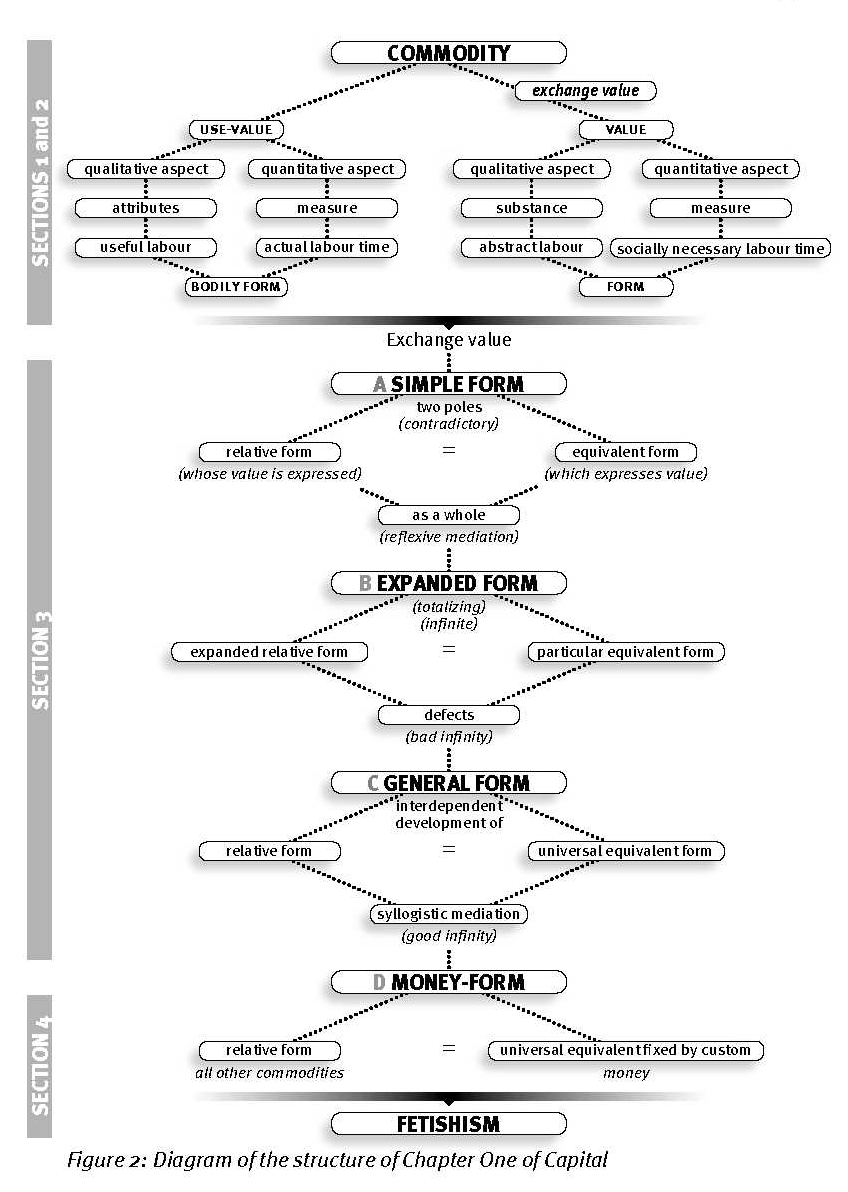
Figure 1 portrays the overall structure of his analysis. Section 1 analyzes the commodity into use-value and exchange-value, beneath which lurks “value” whose substance is abstract labor. Section 2 examines the measure of value— socially necessary labor time. Section 3 explores the complexities of the form of value. Section 4 calls our attention to the fetishism of the presentation up to this point and prepares us for Chapter 2 that begins de-fetishizing the analysis by situating commodities in the hands of their owners.
Section 1: The Two Factors of the Commodity: Use-Value and Value
Outline of Marx’s Analysis
- Commodities have two contradictory aspects
- – use-value, or value in use
– exchange-value, or value in exchange
– this contradiction is resolved via exchange
- – various qualities imply various uses
– various qualities imply various measures of quantity
– only realized when used/consumed
- – 1 quarter of corn = x cwt of iron
– as use-values corn and iron are different, but
– the equality in exchange implies some common property
– abstracted from their different use-values and
– abstracted from the different useful labors that produced them
– common property = products of undifferentiated labor
– commodities are “crystals of this social substance”, abstract labor
– substance of commodity values = abstract labor
- – socially necessary labor time (SNLT) varies with conditions of production
- – when not produced by labor, e.g., air, unworked soil, wild forests
– when produced by labor but not exchanged, consumed directly
Commentary
Marx analyzes the commodity into its two modes of existence. In the first part of Figure 1, we have:
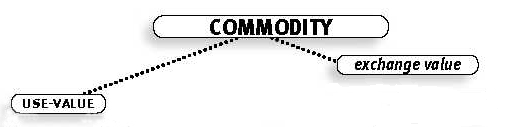
A commodity is a use-value because it has a value in use; that is, it “satisfies human wants of some sort or another.” It also is an exchange-value because it has a value in exchange; that is, it can be exchanged for something else. However, these two different determinations are contradictory. A commodity only becomes a use-value if it used. It only becomes an exchange-value if it is not used but exchanged. Yet, the commodity—sold, bought and consumed—is the unity of these opposites. The strange combination of unity and opposition, in which the opposites only have their meaning vis-à-vis each other and are thus inextricably joined, constitute what Marx means by a contradiction or contradictory relation. Just such a contradiction obtains in the antagonistic class relationships of capitalism. Each class stands opposed to the other, but at the same time each exists, as such, only within the relationship. A capitalist class can only exist when those with money can hire people and put them to work; people constitute a working class only in their subordination to capital.(3)
This contradiction, which Marx analyzed in A Contribution to the Critique of Political Economy, can only find its solution in the actual exchange process which: “must comprise both the evolution and the solution of these contradictions.” (4) He analyzes this solution more fully in Chapter 3, where he describes the realization of the two contradictory aspects in circulation as a metamorphosis. Before a commodity is sold and consumed, both use-value and exchange-value have only abstract and potential existences. Selling the commodity results in the metamorphosis of its potential exchange-value into whatever has been obtained in exchange. In Chapter 3, the exchange value of commodities appears in the form of money. When that money is then exchanged for another commodity, obtained for consumption, exchange-value metamorphoses again into use-value, realized as it is consumed.
The biological metaphor of metamorphosis evokes the changes in form through which an insect develops from an egg, through the stages of pupa, larva, chrysalis, to adult; the form and appearance change but the essence remains constant. The Monarch, for example, through all these stages in becoming a butterfly remains Danaus plexippus. What remains the same as the commodity goes through its metamorphoses? Marx’s answer is “value”, whose substance is human labor in the abstract, and whose form is exchange-value. Before turning to how he extracts that answer from his analysis of exchange-value, and what he means by it, let’s examine his analysis of use-value in more detail.
At first, Marx suggests that use-values only “provide the material for a special brand of knowledge, namely the commercial knowledge of commodities”.(5) Similarly, in A Contribution to the Critique of Political Economy, he wrote that use-values “do not express the social relations of production” and that “use-value, as such, lies outside the sphere of investigation of political economy. It belongs in this sphere only when it is itself a determinate form.”(6) Despite these comments, throughout his writings we discover that use-value has many “determinate forms”, which do express distinct social relations—and are often contested. Even before he published Capital, while analyzing how some product can be directly reinvested, Marx notes how this is an example of the importance of “the analysis of use-value for the determination of economic phenomena”. Here, in Volume I, use-value expresses “value” (see Section 3 below); labor-power has varying use-values (Chapters 6 & 7); the manipulation of use-value is one way of cheating workers/consumers (Chapter 10); machines, besides their use in making things, also serve to control workers (Chapter 15). Many years later, in his “Marginal Notes on Adolph Wagner” (1879), Marx explicitly rejects as “drivel” that use-value has no place in his analysis beyond being one aspect of the commodity. Besides the value of a commodity being represented in the use-value of another, he also points out that “behind use-value is useful labor, one aspect of the twofold character of labor which produces commodities” (see Section 2 below) and “surplus value itself is derived from a 'specific' use-value of labor-power [see Chapter 7 below] . . . etc., etc.” He concludes: “for me use-value plays an important part quite different from its part in economics hitherto.”(8) Use-value, therefore, is worth considering at some length.
The use-values of commodities have specific qualities, or attributes, produced by specific sorts of concrete useful labor, and specific quantities, the result of that labor being exerted over measurable amounts of time.
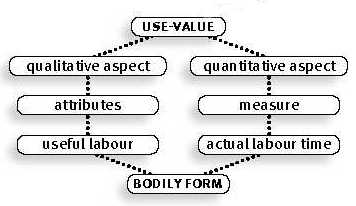
Marx illustrates his argument with a variety of apparently innocuous use-values/commodities—linen, iron, clocks and corn (wheat). (9) I say “apparently” because these played key roles in the period of capitalist development he was analyzing. Linen, a cloth made from flax was, along with wool, then cotton, essential to the development of the textile industry, the core of British industrialization. Iron, along with coal, was required in the production of machinery for industry and weapons for controlling workers both at home and throughout the expanding British Empire. Clocks (and eventually watches) became tools for measuring work and maximizing exploitation. Wheat bread was the basic means of subsistence for the working class in England. In the same spirit, in Reading Capital Politically, I examined food and energy more generally than just bread and coal. While food provides us with nutrition and pleasure, both in consumption and in the opportunities for social bonding, control over its production provides capitalists with profit and control over the rest of us—because they make food a commodity and write laws that force us to buy what we need and want and thus to work for wages. While human energy provides us with life and non-human energy with the means to reduce work and make life more pleasant (heating and lighting our homes etc.), capitalists exploit our energy as part of our labor-power and, like food, turn non-human energy into commodities they sell for profits or use against us. (Chapters 12–15) Here, let’s turn from the production of things to that of services, now the dominant commodity-producing sector of the economy.
Although in the 19th Century the limited commercialization of services meant Marx felt he could largely ignore them, services now make up the majority of commodities and include transportation, finance, entertainment, medical aid, housekeeping, care-giving, communication and schooling. In each case, the use-value to their purchasers depends upon the nature of the service. Their use-value to capital, besides exchange-value, parallels that of food and energy: control over those who need or desire them. Also, in each case, a vast number of differentiated services are offered to workers, corporations and government.
Narrowing our focus to just one kind of service—the loaning of money and the resulting debt of the borrower—we can easily see the differences in use-values for borrowers and lenders. In Marx’s time, most lending was by capitalists to each other and to governments because workers had very low, precarious wages and little or no collateral to cover default on debt. As we saw in Chapter 31, the immediate use-value to those who loaned money to governments was the profit they received via interest— profit that could be loaned out again. Over time, financial institutions increasingly loaned to businesses that used their borrowings for either speculation or real investment, i.e., putting people to work. A secondary use-value was the leverage lenders gained over the behavior of borrowers. By the end of the 19th Century, the Austrian Marxist Rudolf Hilferding (1877–1941) argued that businesses had become so dependent on banks as to give the later considerable power over the former.(10) In the 20th Century, as workers’ struggles succeeded in repeatedly raising wages, they gained access to various kinds of credit. As a result, we are able to obtain other services and things such as washing machines (credit cards), automobiles (car loans) or houses (mortgages). Such borrowing allows us to enjoy use-values before we have enough cash-on-hand to pay for them. Yet, the form of such lending—the fine print and fraudulent practices—often traps us in perpetual debt, endless worry and the need to work and work and work to meet our repayment obligations. The result, of course, has been intense conflicts between debtors and creditors.
These stark differences between the use-values of commodities to workers and their use-values to capital have resulted in struggle over the qualities and prices of commodities. “Consumerism” has involved not only the efforts of capitalists to persuade people that they need more and more of this and that through advertising and ideology, but also the self-organization of workers-qua-consumers, who have contested various qualities of commodities, e.g., dangerous automobiles, poisonous effects of the “chemical feast”, and even their very existence, e.g., hydrocarbon energy commodities that many want to replace with renewable ones to stave off both immediate harm to people and their environment and long-term effects on global warming and all of its emerging, catastrophic consequences.
From Exchange-value to Value
Marx begins his analysis of exchange-value much the way Adam Smith did: with simple barter, the exchange of a given quantity of one thing for a given quantity of another. Whereas Smith evoked hunting and gathering societies that exchanged such things as pelts, hides, fish or tools, Marx chose, as we have seen, commodities important for British capitalism, e.g., 1 quarter of corn = x cwt of iron.(11) Whether we consider Marx’s choices or the more contemporary ones I have suggested, we quickly see that the meanings of the exchange-value of any given commodity are not the same for workers and capitalists.
We can easily see this in the domain of finance, looking (as above) only at the loaning of money and the resulting debt of the borrower. The higher the rate of interest (and accompanying fees), the more profit capitalist lenders will rake in and the “deeper” the debt of borrowers.(12) For those institutions that make such loans out of monies in their possession, e.g., automobile companies or banks, the objective is the extraction of as much interest as possible, to maximize their profits. So, whether the loans are made to businesses, government or individuals, lenders encourage 1) the very partial repayment of the principal borrowed, e.g., a minimum repayment that only slowly reduces the principal upon which interest is charged, and 2) refinancing of debt that prolongs the period during which they can extract interest and profit. Beyond such simple financial calculations, keeping people, business or governments in perpetual debt with continuing obligations to repay grants leverage and power over borrowers. Hilferding made this point about bank loans to businesses, millions of workers today live under constant threat of dispossession (of automobiles by the “repo” man, or of homes by sheriffs with notices of eviction). Many governments facing difficulty in repaying their debt out of current revenue choose to cut expenditures—imposing austerity on workers—instead of raising taxes.(13)
In the 1970s, when capitalists responded to worker success in raising wages by raising prices, the resulting accelerating inflation undercut real interest rates. Lenders responded by imposing flexible rate loans. When President Jimmy Carter brought Paul Volcker in to chair the Fed and attack inflation, i.e., wages, he increased interest rates, drove up loan repayment costs and pitched the world economy into a depression. Coupled with simultaneous financial deregulation, the result was the International Debt Crisis of the 1980s and 1990s, the imposition of austerity on workers, rising unemployment, falling wages and widespread recourse by workers to debt to maintain their standard of living. All of which prepared the ground for further financial crisis, first the collapse of the Savings & Loan Industry in the late 1980s and then that of 2006-2008 in which millions lost jobs and homes, prompting protests and demands for increased regulation, e.g., the Consumer Financial Protection Bureau, and debt-forgiveness, e.g., the widespread demands to cancel student debts and make education free.
Value
To return to barter, the implied em>equivalence, accepted by the exchangers, cannot lie in the use-values of the items exchanged because they are qualitatively different and have quite different use-values. Nor can it lie in the concrete useful labor that produced them because those labors were also quite distinct. In his example of 1 quarter of corn = x cwt of iron, cultivating and harvesting labor is obviously quite different from mining and smelting labor even if both extract something usable from the earth. So, what is the source of equivalence perceived by the exchangers?
For Marx, equivalence must lie in some common property. Abstracting from both use-value and the concrete, useful labors that produce use-values, he writes that:
exchange-values [commodities] can only differ in quantity, and therefore do not contain an atom of use-value. If then we disregard the use-value of commodities, only one property remains, that of being products of labor . . . Nor [are they] any longer the product of . . . any particular kind of productive labor . . . [they] are all together reduced to the same kind of labor, human labor in the abstract . . . they are merely congealed quantities of homogeneous human labor . . . crystals of this social substance, which is common to them all, they are values—commodity values.(14)
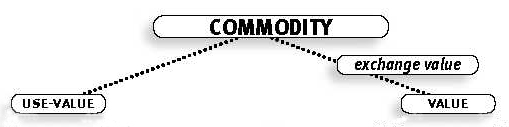
Marx’s argument that “only one property remains, that of being products of labor” has been repeatedly challenged with counterarguments that strike at the heart of the “labor” theory of value. For example, some have argued that labor is not the only universal factor of production, energy is another. Already in Marx’s time, non-human sources of energy were rapidly replacing human muscle-power as capitalists invested in machinery, driven by water, then steam, then electrical power. All commodities, therefore, can also be understood as “products of energy”. Why, then, privilege a labor theory of value over an energy theory of value?

Marx was neither economist nor engineer; he does not offer a technical theory based on inputs and outputs, as expressed, for example, in economists’ production functions of the sort Q = f(K, L, E) where output, Q, is a function of inputs capital, K, e.g., machinery and raw materials, labor, L, and energy, E. He is not interested in just any “common property”. What interests him is the “social substance”, because his is a social theory in which he centers the key social relationship of capitalism: imposed labor (and the resistance to it). We see this in Part VIII, where imposed labor forms the primary means through which capital subordinates most people’s lives to its own organizational forms.(15)
Can this “abstract labor”, the substance of value, have any semantic meaning beyond being the fruit of a logical deduction? There are at least two ways in which I think it does.
First, Marx argues that as it develops, the capitalist division of labor tends to simplify skills to the point where workers can be moved easily from task to task. If the forms of labor are increasingly secondary, then it makes sense to speak of labor abstracted from those changing forms. This argument has been accepted by many as sufficient justification for considering “abstract labor” the substance of value.(16)
Second, in what sense is the varying content—different kinds of useful labor—secondary? There are many important passages in Capital where the concrete form of useful labor is vitally important to Marx’s analysis. For example, in Part IV, Chapters 12-15 repeated alterations in the technical composition of capital (the shop floor arrangement of workers, tools, machines and raw materials) are shown to have been essential in maintaining or regaining control over workers. But, in capitalism, “control’ means, above all, keeping people working at producing commodities. Therefore, there is a second, more profound semantic meaning to his “abstract labor”; the substance of value is precisely the social control over people’s lives provided by any form of labor, independently of its content or form. Capitalism structures people’s lives and society around work, no matter the nature of the work, which changes over time as technology evolves within the dynamics of struggle between the imposition of work and people’s resistance to it. In other words, “value” expresses the particular social use-value of labor to capital as its primary means of social control. Marx’s labor theory of value is a theory of the value of labor to capital.
Section 2: The Dual Character of the Labor Embodied in Commodities
Outline of Marx’s Analysis
- 1) Useful labor Social division of labor involves heterogeneous use-values and forms of labor
- – qualitatively different use-values, e.g., cloth and coats, produced by…
– qualitatively different forms of labor, e.g., weaving and tailoring
– in Indian villages, use-values are not commodities
– in capitalism, use-values are commodities
- – a “condition of human existence”
– an eternal natural necessity
– mediates the metabolism between humans and nature
– Petty: labor is the father of material wealth, the earth is its mother
- – labor abstracted from useful or determinate qualities
– labor as simple expenditure of human labor-power
– value of a commodity represents human labor pure and simple
– simple average labor produced by simple, i.e., average, labor-power
– complex labor = intensified or multiplied simple labor
– magnitude of value determined by labor time
– if one coat has same value as 20 yards of linen, both embody same amount (duration) of labor
– value varies with productivity, or output per hour of concrete useful labor
– increased productivity increases material wealth or output per hour
– increased productivity decreases value per unit
Commentary
This section provides, as Marx says, a “further elucidation” of the arguments in Section 1 about the two-fold nature of the labor contained in commodities. His elucidation, therefore, is divided into two parts, the first elaborates his previous analysis of useful labor, the second deepens his previous analysis of abstract labor, or the substance of value. The former elaboration has been much less controversial than the second.
Useful labor
Useful labor is heterogeneous. People do all kinds of useful labor, producing all kinds of useful things (and services). With the textile industry the heart of British industrialization, Marx points to the useful labor that weaves linen thread (made from flax) into linen cloth and the quite distinct useful tailoring labor that cuts and sews that cloth into linen coats. He might have added the horticultural labor that grows the flax, the harvest labor that reaps it, the labor that rets it, the labor that scutches it, the labor that heckles the fibers and the spinning labor that spins the long flax fibers into the thread necessary to weave/produce linen cloth. Because humans discovered many kinds of labor early on, there has always been a social division of labor, where some folks undertake some kinds of useful labor and others undertake other kinds. But only in capitalism have the diverse use-values produced by the diverse forms of useful labor generally taken the form of commodities, of things and services that are sold to others. Why this has been so, is explained in his analysis of primitive accumulation.
His emphasis on how human labor “mediates the metabolism between man and nature”, foreshadows an analysis he elaborates in Chapter 7 on “The Labor Process”. (17) Here, by asserting that labor is “a condition of human existence” and “an eternal natural necessity”, he frames his concept of useful labor as generic and a-historical, applicable throughout human history. The formulation by William Petty (1623–1687) that labor is the father of material wealth and earth the mother, Marx proposes true for all time. (18) In so doing, he sets the stage for differentiating “abstract labor” from useful labor as a characteristic of capitalism alone.
Abstract labor, or labor as source of value
Section 1 arrived at the concept of abstract labor by abstracting from the diverse determinate forms of useful labor. Here, Marx defines labor as the “simple expenditure of human labor-power”, without regard to the particular skills involved, he suggests two corresponding concepts, 1) “simple labor-power” and 2) “simple average labor” performable by “every ordinary man” (with “ordinary” explicitly understood to evolve over time with society).
The idea of an undeveloped” “simple labor” implies its contrary, that of more developed, or skilled “complex labor”. To explain the relationship between the two, Marx offers “More complex labor counts only as intensified, or rather multiplied simple labor, so that a smaller quantity of complex labor is considered equal to a larger quantity of simple labor.” But who is doing the counting; who is considering, or making the judgement about what equals what? Marx doesn’t say, but merely argues that “this reduction [of complex to simple] is constantly being made . . . behind the backs of the producers”. How?
The lack of precision about the “who” and the “how” has led to various interpretations trying to clarify these statements. The most common interpretation perceives a “reduction” problem solved through market mechanisms of exchange, an optimistic logic akin to that of economists’ wishful expectations of tendencies toward equilibrium. This interpretation finds consistency in another statement that Marx makes here, namely, “through its value [a commodity] is posited as equal to the product of simple labor.” This reading sees “value” as revealed in exchange, not the varying exchange-values resulting from market fluctuations, but some underlying value which anchors those fluctuations. Once “prices” are accepted as the monetary expression of exchange-value (at the end of this chapter, and then in Vol. III), this “reduction” problem re-emerges as the so-called “transformation problem” of whether and in what manner values determine prices.
My alternative interpretation, consistent with my suggestion that Marx’s labor theory of value is a theory of the value of labor to capital, is the following. If the substance of value (denoted by the concept of abstract labor) is precisely the social control over people’s lives that any labor, independently of its content or form, provides capital, then that substance becomes the determinate character of whatever kind of useful labor we care to consider—quite independently of whatever “complexity” or skill is being exercised. As to “who” counts or considers, the answer becomes “capital” or “capitalists” or “capitalist policy makers”, who worry, first and foremost, not about the kinds of useful labor being imposed but the overall success of business in putting people to work. Here is the real-world “reduction”; forget complexity and ask rather how many and for how long are those ordinary men and women being employed? When Marx says this happens “behind the backs of the producers”, many Marxists think “behind the backs of the capitalists”, forgetting that “the producers” are the workers they employ. The reduction of the problem that concerns workers —of whether the existing complex assortment of concrete labors is producing what they need—to that of how successfully work is being imposed overall, not only happens “behind their backs” but usually behind closed doors, among policy makers dedicated to preserving and expanding capital’s way of organizing life around imposed labor. “Simple labor” then, is not so much a characterization of some basic ability as it is a concept denoting the simple fact of being put to work—in more or less complex ways. Thus the “value” of a commodity is “equal to” or determined by the amount of work that can be imposed in producing it.
Socially Necessary Labor Time
But how is the “amount” of work measured? Assuming the “intensity” of labor constant, Marx argues that the amount of labor and the corresponding magnitude of value are determined by the time of labor, irrespective of complexity or skill.(19) Not the concrete labor time required to produce a given commodity, in a given production setting, but the average amount, or socially necessary labor time (SNLT) required. Thus, from a capitalist point of view, two commodities produced with the same amount of labor have equal values. They have equal values because their production provides equal opportunities for putting people to work.
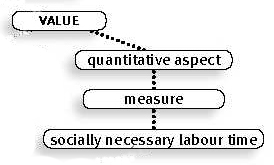
With the amount or quantity of value now seen to be determined by the time of labor, Marx turns to the effects on variations in the effectiveness, or productivity (e.g., output per hour), of useful labor.(20) A doubling of productivity, brought about, for instance, through the introduction of machines, or better machines, will cut in half the value of each unit of output, because each unit takes only half the time to produce. Or, the value of each unit of that commodity to capital will be cut in half because producing it provides only half the opportunity for putting people to work.
These results clarify the distinction between the meanings of useful labor and abstract labor—one determines actual production, the other the value of the labor employed to capital as its primary means of social control—and lay the basis for further analysis. In the next section, Marx examines quantitative changes in exchange rates due to changes in productivity. In Chapter 3 on money, he examines how changes in the productivity of labor producing metals used for money are related to changes in prices. In his extensive analysis of technological change in Part IV, Chapters 12-15, he explores how productivity evolves as an aspect of class struggle over the imposition of work and resistance to it.
Section 3: The Value-form or Exchange-Value
Outline of Chapter
- (a) The Simple, Isolated, or Accidental Form of Value
(b) The Total or Expanded Form of Value
(c) The General Form of Value
(d) The Money Form of Value
Preliminary Commentary
This frequently neglected section on the form of value, begins with the simplest form—where one good represents the value of another— and ends with the money form, where some historically and socially determined money represents the value of every commodity. Further determinations of the character and roles of money are analyzed in Chapters 2 and 3, which build on the complexities examined in this section.
Marx shows us how, just as use-value receives an expression and existence in the bodily form of the commodity, so too does value receive an independent expression and existence in the form of money. In the Grundrisse, before he had worked out the mode of presentation used in Capital, the understanding of money was a central concern of his studies of value and abstract labor. In the early notebooks comprising the “chapter on money” a great many of the determinations of Chapter 1 are discussed, not as abstract qualities of commodities in general, but directly as determinations of money, the ultimate commodity.(21)
Unfortunately, most Marxists have had little to say about the form of value or the complexities hidden within the money form but revealed in this section. For example, both Paul Sweezy and Ronald Meek, two widely read and influential Marxist economists, focused on the substance and measure of value almost totally ignoring its form. Sweezy's “qualitative value problem” concerns only the qualities of abstract labor and socially necessary labor time and ignores form completely.(22) Meek's commentary on Chapter 1 devotes fifteen pages to the quantitative reduction problem and only one very short paragraph to the form of value (to which Marx devotes 24 pages).(23) He justified this neglect by quoting Engels, who thought all the detail was just about how the emergence of money overcame the inefficiencies of barter exchange.
This neglect, however, is quite inexcusable. Not only does this section reveal many subtle aspects of exchange and money, but because both are elements of the class relationship, these same aspects can be discovered throughout the social relationships of capitalism.
(a) The Simple, Isolated, or Accidental Form of Value
Outline of Marx’s Analysis
- Commodities’ character as value is purely social
- – that character appears in the social relation of exchange
– commonly recognized value-form is the money form
– objective: reveal, through analysis, what lies within the money form
– simple form: xA = yB, e.g., 20 yards of linen = 1 coat
- – relative form: value of xA is expressed by yB
– equivalent form: yB
- – expresses the value of xA,
– is form of existence of the value of xA
– is material embodiment of the value of xA
– quantitative equality requires a common quantum, i.e., value
– exchange gives value a form distinct from use-value
– 20 yds linen = 1 coat implies equation of weaving with tailoring
- – what is equal in the two kinds of labor is...
– their common quality of being human labor in general
- – becomes value in its coagulated state, in objective form, a materially different thing
– so, in exchange, the coat (in equivalent form) represents more than it does alone
- – i.e., yB reflexively mediates A’s relation to its value
- – changes in productivity in production of A, changes value per unit
- – which changes amount y of B required to represent the value of A
Commentary
Marx devotes more words to presenting his analysis of the simple form of value than to any of the other forms, including that of money. The reason for this he explained to Engels in 1867. “The simplest commodity-form,” he wrote, “contains the whole secret of the money form and with it in embryo, of all the bourgeois forms of the product of labor.” (24) Through the exchange of some quantity x of commodity A for some quantity y of commodity B, or
the value of commodity A finds an independent expression and a concrete manifestation in commodity B. This simple, or elementary, exchange relation is also called accidental because it is accidental which commodity expresses the value of another. This relationship, although pictured above in the form of an equation, is not a mathematical, reversible equation. Marx is careful to explain that the equals sign is short for is worth. As it is written, xA = yB says that xA is worth yB meaning that yB expresses the value of xA. To obtain an expression of the worth of yB, the relationship must be rewritten as yB = xA, i.e., yB is worth xA, where now xA expresses the value of yB. Most of the analysis of this section consists of analyzing the meanings of this relation.
Marx first deals with the qualitative aspects of this relation, ignoring the quantitative constants x and y. He formalizes the unsymmetrical nature of the expression by analyzing the two forms within the simple form: the relative form and the equivalent form.
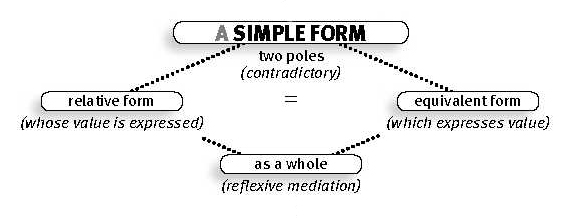
In the exchange xA = yB, Marx calls commodity A the relative value form because its value is expressed in, and relative to, commodity B. He calls commodity B the equivalent form because it serves as the material equivalent for the value of commodity A. In other words, commodity A gets its value expressed, while (the corporeal use-value of) commodity B provides a phenomenal expression of the value of A. Therefore, when the value of commodity B is expressed by xA in yB = xA, then B has the relative form and A the equivalent form.
As with the relationship between use-value and exchange-value, we find an opposition and a unity. We have an opposition because the relative value form and the equivalent form exist as two opposed, contradictory poles. We have unity in the sense that they are “mutually dependent and inseparable.” A only has the relative form if it has an equivalent B; B is only an equivalent when expressing the value of some other A. The two expressions represent the two sides of an actual exchange process. When a commodity is brought to market its owner only finds out what it is worth by exchanging it. The commodity acquired is accepted as the equivalent of the value of the commodity given up.(25)
As with use-value and exchange-value, this unity of opposites has the form of the class struggle: two opposed perspectives and forces bound in one contradictory totality. This is obvious in the case where the commodity brought to market is the labor-power of workers. When they sell their labor-power to capital, it has the relative form and the value received (the wage or other income) has the equivalent form. An examination of each of these forms—in this chapter carried out only with respect to the exchange of random commodities—further clarifies this kind of relationship.
The Relative Form of Value
Why is it value that is being expressed by B and not something else? Because the only thing commodity B has in common with A that matters to capital is value, i.e., the value of being products of labor-in-general, of being vehicles for the imposition of work and social control. It is in this sense, within the framework of capitalism, that commodity A achieves an independent expression of its value to capital in B. In a simple exchange of “use-values” between friends, outside of any capitalist market, no such common value need exist or be postulated.(26) For example, I prepare and serve you a meal (an objectivization of some of my skills); you reward me with a smile and a request for second helping. There is no basis—common value—for equivalence in such a case. (27)
But in capitalism, where the value of things to capital is measured by the amount of work that can be imposed in their production, Marx points out that these relations between the two commodities necessarily represent the relations between the labor contained in them. The equation of the two products of labor distinguishes the substance of their value—abstract labor—from the useful labors that produced them as distinct commodities. The exchange equation expresses the reduction of the various kinds of useful labor to abstract labor, the common value to capital of all kinds of labor that produce commodities.
His analysis of the quantitative aspect of the relative form of value, having established that the only way magnitude can be expressed relatively is in terms of the same quantum of quality, shows how the quantity of the value of one commodity, A, can be expressed by a quantity of another, B. Inevitably, the expression of value will vary with changes in the productivity of either commodity A or commodity B. Earlier, in Section 1, we saw the impact of variations in productivity during the analysis of socially necessary labor time and in Section 2 we saw how this was grounded in changes in useful labor, while abstract labor remained constant. If the intensity of labor is constant, an increase in the productivity of the labor required to produce some good, A, implies a drop in the socially necessary labor time per unit and a reduction in its per unit value. As more use-values embody the same total value, each unit embodies less. In this section, we see the implications for the simple form of value and the quantitative expression, yB, of changes in the value of commodity xA.
If the productivity of the labor producing commodity A rises, so that its per unit value falls, and if the productivity in the production of B has not changed, then a decreased amount y of the equivalent commodity B will be sufficient to express the value of xA. If the productivity of the useful labor producing B rises, reducing its value per unit, while that producing A remains constant, then there must be an increase in the amount y of B expressing the value of xA. If the productivity of both change, then the quantitative variation can be calculated by taking both effects into account. This illustrates a further reason why the relative value form is called relative. The relative value of commodity A can change (because of a change in the value of commodity B), although its value (in terms of socially necessary labor time) remains the same. Or, its relative value can remain the same, even if the value of A changes.
The Equivalent Form and Reflexivity
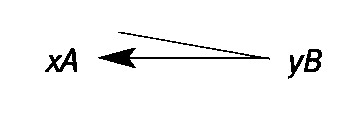
When we say that B expresses the value of A, we are speaking of a relation of mediation known as reflection. In this kind of mediation, one thing (in this case, commodity A) is related to an aspect of itself (value) through another thing (in this case, commodity B). Familiar examples of this kind of mediation are how we all come to know our image through a mirror, or aspects of ourselves (from image to abilities) through the comments of others. (28)In speaking of how the equivalent performs such a service, Marx says: “In order to act as such a mirror of value, tailoring itself [producing commodity B, the coat] must reflect nothing apart from its own abstract quality of being human labor.” (29) In a footnote, Marx notes that Hegel called this kind of relation “determinations of reflection” [Reflexionsbestimmungen].” (30) In the first German edition of Capital, Marx wrote: “Its [coat's] status as an equivalent is [so to speak] only a reflexion-determination of linen.”(31) Also, “the relative value-form of a commodity is mediated; namely through its relationship to another commodity.”(32) In other words, commodity A can come explicitly into relation to itself as value only through the mediation of another commodity (B) expressing a single aspect of commodity A. We can represent this relation of reflective mediation as:
As with two randomly exchanged commodities, this relationship of reflective mediation is also an aspect of the commodity-form of the class relation. Individuals and capital stand as oppose poles just like the relative and equivalent value-forms. Just as the relative value-form finds its meaning only in the equivalent form, so too do individuals recognize themselves as workers only through their relation to their employers. It is not just a matter of perception. Within capitalism individuals can only exist as workers, and collectively constitute a working class, within that relation. Put in the language above, the mass of workers has their joint condition as working class reflected to them through capital acting as a mirror which mediates this recognition. In this way, the class gains both definition and self-recognition. This is true both in terms of class-in-itself, in which all workers have in common is the exchange of their labor-power for income, and in terms of class-for-itself in which workers discover their unity through struggle. Just as the equivalent form brings out and expresses a unique quality in other commodities, value, so too does capital reflect a unique quality of people, their labor-power, or their ability and willingness to be put to work. Inversely, those with money can only be capitalists when they are able to hire people and put them to work. But the relation is not parallel. People can break out of this reciprocal relationship—rejecting and smashing the mirror—and remain people, complete with all their skills, now freed to build new worlds. Whereas if we deprive capital (or capitalists, the functionaries of capital-as-social-relation) of its ability to impose work on us, it loses its control over us and with it, its ability to organize society, leaving the rest of us free to experiment with new modes of self-organization.
The analysis, so far, shows us how all the elements which we have analyzed—use-value, exchange-value, abstract labor, socially necessary labor time, and so on—are combined in their elementary interrelationships in this simple value form. In the expanded, general, and money forms which follow, further determinations are taken into account to achieve a more complete and more complex expression of value.
The Insufficiency of the Simple Form and the Transition to the Expanded Form
While the simple form gives the value of A an independent expression in B, there is nevertheless a contradiction between this form and the nature of value. This is the “insufficiency” of the simple form of value. The simple form fails to represent “A's qualitative equality with all other commodities and its quantitative proportionality to them.”(34) Why should it? The reason lies in his previous analysis of value. In Section 1, he designated the substance of value as abstract labor. Abstract labor, in turn, denotes the peculiar character of all concrete forms of useful labor as serving capital as its primary mode of organizing its control over society. In Section 2, socially necessary labor time was based on averages across the whole commodity-producing society. Now, if the substance and measure of value reflect this universality of the commodity-form, then so too must the phenomenal form of value. The value-form must represent these interconnections among all commodities. His exposition of his analysis of the value-form progresses in this direction.
(b) The Total or Expanded Form of Value
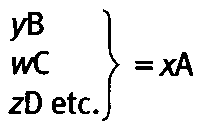
If, in the elementary form, A finds its expression in one other commodity, B, and if, furthermore, the B chosen is accidental, then any commodity could be so chosen. “The number of such possible expressions,” Marx writes, [of the value of A] “is limited only by the number of different kinds of commodities distinct from it.”(35) This is why the second form of value, the expanded form of commodity A's value, consists of “an indefinitely expandable series of different simple expressions of that value.”(36) In this way, the immediate contradiction between the individual representation of A's value and the multiplicity of commodities (universality of value) is resolved. This new form, a more complete expression of value, can be represented in the following manner.
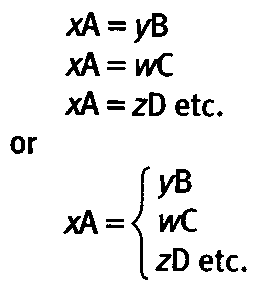
The relation of reflection, by which the relative value of A is given independent expression through a particular equivalent, is now multiplied. “Every other commodity now becomes a mirror of linen's value. (37)” This is why Marx calls the relative form “expanded.” The equivalent form remains particular in the sense that, although there is an endless list of equivalents, each is a particular expression of A's relative value. In this way, the various kinds of useful labor that produced all these commodities are expressed as equal through the interrelation of the products.
Each of these many expressions of the value of A has the characteristics of the simple value form: the polarity between relative and equivalent forms, the unity of opposites, reflectiveness, and so on. In this way, the more complete form preserves the previous form containing all the latter's relations to the class struggle. What analysis of this expanded form reveals, however, is much more than a mere list of possibilities.
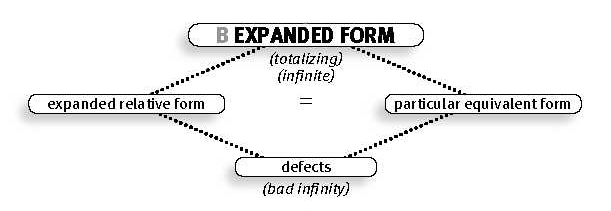
The importance of this new form lies in its comprehensiveness. Because all commodities are involved, accidentality disappears. The form provides a representation of the totality of generalized commodity production under capitalism. By including the production of all commodities, not just of things and services but also of labor-power, the representation expresses much of capital’s social totality.(38)
Because the number of expressions of value is limited only by the number of commodities, for which there is no theoretical limit, the form also expresses capital’s tendency to expand infinitely. It seeks to constantly expand its way of organizing society, forever bringing more and more people, activities, and materials, under its control by forcing them to become elements of the production of commodities. This tendency toward infinite extension is not provoked “from the outside.” Capitalist social relationships generate, through their mutual antagonism, their own self-expansion, only one part of which is the expansion of the commodity world. Those antagonistic social relationships— especially the struggles of workers—force capitalists to seek out and invest in new sources of all the elements that make it up. Whether we are speaking of its expansion internationally, as different parts of the world are brought into the orbit of its imposition of social control through work, or of its expansion into all sectors of production, or of its expansion into all aspects of the reproduction of labor-power, in each case the new “areas” of control are not mere additions. They grow out of dynamics internal to the class struggle and constitute moments of reorganization as capital tries to retain or expand overall control.
In Marx’s time, that tendency was manifested not only in the commodification of everyday life, but also in colonialism, as capitalists in countries such as Britain, France and Holland built empires, annexing ever greater numbers of people, their lands, “resources” and activities throughout the world. This tendency of capitalism toward infinity, moreover, does not merely involve adding something new to existing social orders, it has always been one of subsuming them, of transforming them into moments of existing relationships. Controlling the cheap and often slave labor employed in raw material production in colonies facilitated control of workers in English factories. These dynamics continue in the form of vertical integration in industry, outsourcing and immigration to pit foreign cheap labor against more expensive local labor. In this way capitalism is also totalizing; in the language of contemporary literary criticism, it seeks to impose its own narrative on the world.(39)
Today, we can recognize this tendency in both neo-liberal globalization and in the ever-multiplying number of commodities imposed upon us. We can also recognize it in the privatization of space exploration and colonization. In the United States, NASA has been turning over ever more of its programs to private corporations such as SpaceX and United Launch Alliance. Corporations already own and operate satellites and are preparing to build and operate space shuttles and orbital hotels for wealthy tourists. As many science fiction writers have long foreseen, unchecked capitalism will expand throughout the solar system and, if possible, bring its nightmarish form of society to the stars. The expanded form expresses this tendency toward infinite expansion. In more optimistic sci-fi, such as Star Trek, we figure out how to get rid of capitalism and expand into the universe largely free of its constraints.(40)
Unfortunately for capital, however, the realization of its efforts to find ever more opportunities to impose work requires the mobilization of workers’ (our) imagination and creativity. As Marx discusses in later chapters, living labor—our activity—is the only source of innovation and change within capitalism. Inevitably, despite capital’s efforts to constrain and harness that power for its own purposes, we, both individually and collectively, discover our own kind of infinity—that of the potentially infinite possibilities for living realizable only through freedom from the constraints of capitalism. In the very movement whereby capital multiplies a world of proliferating commodities, we discover vast potential beyond capital itself, which tries to restrict our possibilities to those in its own interest.
Defects of the Expanded Form
Although this form gives us a more complete representation of value, by making the interrelationship among all commodities explicit, Marx points out why even this form is inadequate. He lists its defects. First from the point of view of the relative value form, the series of equations representing the relative expression of value is interminable, a pieced-together mosaic of independent expressions; there is no common representation of value which would express its universality. And then, from the point of view of the equivalent form, because we have particular equivalents, we have a series of unrelated, fragmentary equivalent forms, the labor embodied in each equivalent thus appears only as particular not general, or abstract labor. Abstract labor, therefore, is only manifested through the totality of its particular forms, but that totality is an ever-incomplete series lacking internal unity.
In short, an adequate expression of value must represent the interaction of all the (potentially infinite) commodities capital succeeds in forcing us to produce, but in a way that expresses their common character. In the expanded form the common substance of abstract labor remains unexpressed because we have no unique or common expression for the value of each commodity. This critique by Marx of the expanded form is similar to Hegel's critique of the bad infinity—also an unlinked, interminable series.
(c) The General Form of Value
The answer to the defect of the expanded form is implicit in that form. While the expanded form appears as a natural extension of the simple form, because the equivalent chosen in the simple form is arbitrary, the general form emerges from a reversal in perspective. When A is exchanged against B, C, D, those commodities express the value of A. But it is also true that B, C, D and so on are being exchanged for A. Consequently, A, viewed as equivalent, expresses the value of B, C and D, etc. This gives a common expression for the value of all commodities, namely xA. We now have a potentially infinite list, but one that is no longer fragmentary because all commodities are linked through a common or general expression of value in A.
For each commodity, the expression of its value takes place in its exchange with another commodity, yB = xA, but when the equivalent is the same for all, the form taken as a whole is unified. A unique aspect of all commodities, value now has a unique representative. By being equated to this single representative, the value of any commodity is not only distinguished from its bodily use-value, but its representation also expresses what it has in common with all other commodities.
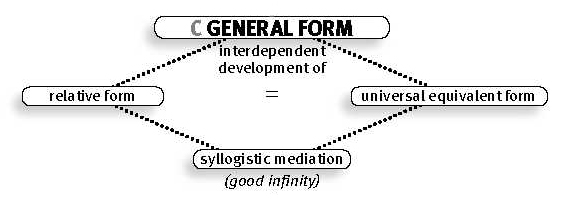
This form is general, or universal, in all its parts. The relative form of any given commodity is universal “because it is the relative value-form of all other commodities at the same time.”(43) The equivalent form is universal because the equivalent has become the unique form of appearance of value for all commodities. Because of this, the labor producing it “acquires as a result a general social form, the form of equality with all other kinds of labor . . . the general form of appearance of undifferentiated human labor” or abstract labor.(44) That abstraction from concrete specificity within capitalism makes the universal equivalent the embodiment and symbol of the core class relationship: the imposition of work as the fundamental vehicle for the organization of society.
Within this general form, the internal contradictions characteristic of the earlier forms still obtain. The irreversible and contradictory polarity and reflectiveness of the simple form, the totalizing and infinite aspects of the expanded form, all remain characteristics of the general form. But now something new appears. Because the universal equivalent has acquired the character of direct exchangeability with every other commodity, all other commodities have lost that quality. They are longer exchanged for each other but must first be exchanged for the universal equivalent.
This observation highlights a fundamental aspect of the general form—namely, as the equivalent form becomes the universal equivalent for the value of all other commodities, it also becomes the universal mediator between them all. Earlier, we saw how individual commodities related to their own value through the mediation of an equivalent (through reflection). We now see how reflexive mediation, as a characteristic of the general form, is part of another kind of mediation played by the universal equivalent: “All commodities by mirroring themselves in one and the same commodity as quantities of value, reflect themselves reciprocally as quantities of value.”(45) Reciprocal reflection, but mediated through the universal equivalent. (46)That equivalent has become a mediator for the expression of value of each commodity and for the relation of all commodities to each other as values.
This second form of mediation between two distinct commodities is syllogistic mediation. In a syllogism, two distinct entities are related via a third.(47) The universal equivalent, xA, mediates the relationship between yB and wC.
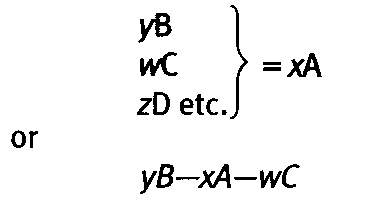
Expressing the value of each individual commodity, the universal mediator binds them together. It explicitly incorporates each individual commodity into the universal value relation. By having a common expression of value, the otherwise disparate exchanges become parts of an interconnected commodity world. The series grows, potentially infinitely. But that infinity is no longer a tiresome mosaic of separate elements. Like Hegel’s “good infinity”, the capitalist commodity world is now expressed as an integrated and united whole in which the repeated appearance of new commodities no longer means only the creation of new finites, but the continuation of a tendentially infinite process.
Syllogistic mediation plays a fundamental role, not only in how capital organizes the world of commodities but in how it organizes its control over workers. Just as the universal equivalent mediates between all commodities, capital trys to mediate all relations in the social factory, between workers producing commodities, between producers and consumers, between parents and children, between teachers and students, between spouses, between ethnicities, races, age groups and genders, between locals and immigrants, and so on.
But what does it mean to say that capital intervenes as a mediating force everywhere? We have already seen how capital imposes money as universal, mediating equivalent. (More on this in the next section.) We have also seen how it uses the state, e.g., troops for enclosure, property laws and police to impose the commodity-form, maximum or minimum wage laws, and so on. Seeing how some of us are organized to mediate capital’s relations with others is often less obvious. In RCP, I illustrated this kind of mediation with several examples: in the relations between the waged, in those between waged men and unwaged women, between teachers and students and between domestic and immigrant workers. In each case, capital sets up a hierarchy, of higher waged over lower waged, waged men over unwaged women, waged teachers over unwaged students, and domestic workers over immigrants. Through these hierarchies it seeks to pit us against one another and use some of us to manage others—both by imposing work on those ranked lower and by absorbing the ire of those imposed upon. To reinforce these mediations, capital also makes use of racial, gender, ethnic, religious or national differences among workers. So, in a place like Texas, local Anglo workers tend to be higher paid and hold managerial positions vis-à-vis lower paid black or Mexican-American workers.
Understanding this kind of mediation in the class struggle not only helps illuminate its complexity, but also suggests how we can take the initiative to rupture and destroy it, forcing a recomposition of class relations. This happens when we refuse the mediation and bypass it. In industry, in wildcat strikes rank & file workers organize autonomously and bypass both foremen and trade union officials to confront employers directly. In education, when university students occupy an administration building, demanding an end to school complicity with war, or a termination of cuts to programs important to them, they are bypassing the mediation of professors and directly confronting the administrators of capital’s edu-factories. When students in K-12 schools walk out—as they did during the “Si, se puede!” immigrant rights marches in the Spring of 2006 and in March 2018 during the National School Walkout, in the wake of the shootings at Marjory Stoneman Douglas High School—they are bypassing both teachers and administrators. Today, “Dreamers”, threatened by Trump’s efforts to end Deferred Action for Childhood Arrivals (DACA), and by resurgent racism and nativism, school children, threatened by repeated mass shootings, and black youth, threatened by police murders of unarmed civilians, are also on the march. In echoes of the Civil Rights Movement, they are all bypassing local mediations and demanding security from deportation, from the profit-hungry arms industry and from racist police through changes in laws both local and national. In the great “Women’s Marches” of 2017–2019, millions of women have acted collectively, bypassing all of capital’s mediations.(48)
These mediations can also be broken as well as bypassed. That happens when they result in such harsh conflict as to no longer function as intended. University students generally carry their struggles directly to the administration or beyond. But in K-12 schools, student refusal of discipline rarely bypasses teachers to strike directly at administrators—as in the walkouts in 2006 and 2018. Instead, anger flares against teachers, sometimes to such a degree that the latter cannot retain control. This has spurred the proliferation of teacher unions, changing the relationship between administrators and teachers. Acting in federations, mobilizing at the level of the state, they make demands for collective instead of individual bargaining over salaries and conditions of work. The work of having to impose discipline in an increasingly rebellious classroom is the equivalent of speed-up on an assembly line—it increases the intensity of the workday and the requirements for reproducing labor-power. In these circumstances, militant teacher unions are creating a whole new alignment of power in education. Faced with teacher refusal to try to impose discipline in dangerous situations, school administrations and city governments are being forced to pay higher wages, to bring in security guards, metal detectors and police, so on.
At the same time, such developments raise serious problems for working-class strategy. How can this growing power of students and teachers be organized so that it is directed more against capital than against each other? The autonomous power of students has forced the creation of a new level of autonomous organization and power among teachers—a recomposition of class relations. But as long as the dynamic and direction of these developments are not understood, there is the danger of ultimate collapse and defeat.
In universities we have seen such dangers. In the Sixties, the antiwar struggles of students forced a recomposition of the teaching staff that included a new generation of radicals and new fields of study initially aimed at supporting further protest, e.g., Black Studies, Mexican-American Studies, Women’s Studies, Peace Studies. The changes undermined the ability of higher education to discipline, plan, and organize the supply of labor. But the insurgent spirit that created those new programs has been constantly undermined by both the usual neutralizing institutional measures, e.g., competition for funding and promotion,(49) and by outside attacks by conservative forces, e.g., the National Association of Scholars or, more recently, Turning Point USA. In the same period, student pressures undermined grade tracking, generating grade inflation. But as a result, experiments are underway to find other modes of judging the ability and willingness of students to work. All these developments have led to the current attempt by capital to reimpose work discipline in the schools through fiscal crisis, and a nationwide restructuring of education. Such a restructuring necessarily involves attempts to find new kinds of mediation to replace those which student and teacher/professors’ struggles have rendered less reliable. Being clear about mediation can help in discovering vulnerabilities and modes of subversion. Recognizing the dynamics of mediation can facilitate their refusal and defeat, as when students join teacher strikes, seen lately in West Virginia, Oklahoma, Arizona, Kentucky, Colorado and Los Angeles. (50)
Ultimately, we must destroy the divisions and intra-class antagonisms which capital imposes. But while students and professors may struggle against administrator plans, or men and women, whites and black, locals and immigrants seek ways to destroy the mediations, solutions are never so simple as “unite and fight.” As I argued in the section on abstract labor, the divisions are real and hierarchical; they are power divisions, and collaboration requires a power struggle not only of different segments of the working class against capital but also, at times, between those segments. Our problem of political organization is how to develop our intra-class struggles, not as a circular firing squad, but in ways that strengthen all of us.
(d) The Money Form of Value
The transition from the general form to the money form is much simpler than the previous transitions. The money form differs from the general form only in so far as the universal equivalent has become fixed by social custom into some one commodity. Once this happens, the universal equivalent functions as money and we have the money form.

The money form is the total relationship,
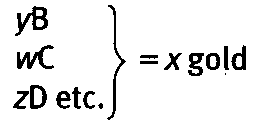
and must be differentiated from money which, in this case, is gold. This money form contains all the determinations of the prior forms. It has the contradictory unity and reflective relations between the relative form and the equivalent form brought out in the simple form. It has the totality and infinitude brought out in the expanded form and welded together in the general form. And it has the mediated character of the general form. Like capital, then, the money form is contradictory, reflexive, totalizing, infinite, and mediated.
Marx’s whole analysis in this first chapter has been leading to the money form. We can now reverse the process and reassess each step as elements of a theory of money. Money is partly defined as a universal equivalent, not simply one element of this totality but expressing this totality. Money is one commodity among many, and the unique general expression of their value to capital as vehicles for the imposition of work. Money, by expressing all commodities as values, expresses the domain of capital—the social relations which turn use-values into commodities. As a moment in the money form, money is a moment of the whole of capitalism. If capital is most basically the social relations of the commodity-form (of which the commodity world is a part), then money is the quintessential expression of the commodity-form itself. In capitalist society, to have a coin in the hand is to have a golden drop of that society itself. Look deeply into that coin, as you might with a crystal ball, and behind its golden luster, which has stopped many an eye, you discover the blood and sweat of the class struggle.
When we look back at the roles of the equivalent form in the various relations we have examined, we now know we were looking at the roles of money. For example, money stands as equivalent in contradictory unity with labor-power. It does the same with all other commodities and, by so doing, shows them (through reflection) their character as values, and thus as parts of capital. The tendency for capital to expand infinitely is partly the tendency to turn social relations into money relations, that is, to convert all use-values into values by utilizing their production as a means of social control and by setting them equal to money. Money becomes the magic wand by which capital incorporates both old and new elements of the world into itself.
To set an object equal to money is to give it a price. Thus, the price form is a sub-form of the money form, in which any
But the price-form never stands alone. It is part of the money form. Setting any commodity equal to some quantity of money, by giving it a price, instantly ties it into the whole world of capital.(51) How? By setting a price, it is affirmed that this use-value, having been produced by useful labor of some sort, is only one special product of that universal tool of capital's control: work. Setting an object equal to money sets it equal to all other commodities and equates the labor which produced it to all other labor, affirms its common usefulness to capital as means of social control. (We ignore, as Marx does, cases where prices are set on things that are not the products of labor, e.g., unworked land.) It makes no difference whether the quantity of embodied labor is socially necessary or not—as we have seen earlier, this is often not the case. The qualitative equality of work has been affirmed and the quantity set socially. Money shows to the commodity its value for capital, i.e., the usefulness of the labor that produced it as a vehicle for controlling society.
Money not only equates all commodities as products of labor but also stands as the universal mediator between all these different elements of capital. In the exchange of labor-power for money, money mediates its owner’s relation to capital, not only to direct employers but to other workers and to all commodities. The money wage, M, is one way in which capital, K, mediates its relation to our labor-power, LP: K – M – LP. There are many others, as we saw in the preceding section, but the money wage is the most common and most revealing. As such it also establishes the importance of the unwaged relation to capital.
As we have seen, unwaged relations may be mediated in a variety of ways, e.g., men mediating the relation of their unwaged wives or professors mediating that of students to capital. All workers, waged and unwaged, must obtain the means of subsistence, but not always directly through wages. School children work for capital to the extent that they produce their labor-power for future roles as workers (waged and unwaged), but most receive no direct money payment. As unwaged housewives are supported by the resources (money) obtained by a waged husband, so children are supported by one or more waged parent. The relation with capital is mediated directly for whoever is paid a money wage, but that person mediates for unwaged family members. In these circumstances, the ways those at home work for capital is hidden by the absence of direct money payment. (52)
This brings out an important consideration about money that is often overlooked—namely, that for money to play the role of mediator or universal equivalent, there must be many relations where it does not mediate directly. The place in Capital where Marx makes this clearest is in his analysis—in Chapter 25—of the waged and unwaged. For capital to be able to use the money wage to mediate its relation to waged workers, it must maintain a reserve army of unwaged workers as a check on the power of the former. But to say that there must always be such an army is to say that money is the universal mediator in a peculiar way. Ultimately, everyone must get commodities to survive, but not necessarily through their personal command of a wage. Money, however, remains the universal mediator because it even defines its absence. The unwaged are defined with deference to the waged—defined by their lack of control over some money. Unwaged spouses and children may not receive money directly from capital, but they either receive some through the waged member of the household or receive what money buys—what they lack is control over the money supporting them, buying their food, etc. This is exactly why the struggle of the unwaged has often been for wages, not because they want to expand capital's dominion—they already suffer that—but to gain greater powers of self-determination. This was the objective of the Wages for Housework Campaign.(53)
The maintenance of non-monied, or unwaged, relations are important to capital in many ways. The image of the milling crowd at the factory gates begging for jobs or protesting their absence is one traditional but limited vision. To it we must add unwaged students, women, and street dwellers in the developed world. But, as we saw in the analysis of primitive accumulation, the case of the Global South is even more dramatic. Through colonialism, capital created and maintained vast, partially self-supporting global reserves of unwaged labor-power—a world-wide reserve army. Despite the defeat of most formal colonial empires, poverty continues to be the tool by which vast millions are kept alive but (capitalists hope) available when needed. These reserves are drawn upon either for immigration into areas where their cheap labor can be used to hold down the wage demands of more powerful workers (e.g., Mexican and Caribbean labor in the U.S.; Mediterranean, East European and African workers in Western Europe) or for employment in their own areas when runaway shops seek out their cheap, and often politically repressed, labor locally. Of course, time and again things have not worked out so well and the struggles of the unwaged have often made them unprofitable for capital's factories.
That money is a mediator—interposed between capital and the working class—means two things. First, for workers, attacks on capital can both use and refuse this mediation, exactly as women and students have used and bypassed men and professors, respectively. In strikes, workers refuse the wage mediation and attack capital directly with refusal of work, sabotage, factory seizure, and so on. So too, direct appropriation involves the refusal of capital’s prices of other commodities, e.g., changing labels in a supermarket, using free slugs instead of purchased tokens in the subway, or the total elimination of price through shoplifting, sneaking into movie theatres, employee theft, or collective Black Christmases where commodities are seized.(54) It involves the self-reduction or bypassing of utility or housing prices, e.g., collective refusal to pay, illegally taping electrical lines or gas pipes, squatting abandoned buildings.(55) This refusal of price is a refusal of capital's rules of the game. Refusing to accept the role of money amounts to the refusal to accept everything we have seen going into the determination of money—the whole set of value relations. This is a working-class perspective with a vengeance.
The only question one might ask is whether it makes any difference that today gold has been largely demonetized and replaced by paper and bank accounts. Marx shows in Chapter 3 that it does not; I return to this question in my commentary on that chapter.
Howsoever capital manipulates money, whether through corporations, national governments, or international agreement, it should now be clear that the actual object of the manipulations is the value relation between workers and capital. We have seen the complex way money expresses this class relation and the complex roles it plays at the heart of that relation. Many roles and institutions of money are not analyzed in Chapter 1, but the analysis of the universal equivalent in the money form and the price form has given us some fundamental and basic insights into the role of money as medium of circulation and as mediator between the classes. It permits us to see, if not the details, at least the basic character of money in every period of class struggle.
Section 4: The Fetishism of the Commodity and its Secret
Outline of Marx’s Analysis
- Commodities seem simple but are very strange, enigmatic things
- – not as sensuous use-values, not as products of useful labor
– but as values, as products of abstract labor
– such that the relationships between their producers “take on the form of a social relation between the products of labor”
- – where social relations among producers assume “the fantastic form of a relation between things.”
– akin to religion where “the products of the human brain appear as autonomous figures”
– attaches itself to products of labor
– social relations among producers exist only through the mediation of exchange
- – producers see only the relationship between objects that are exchanged
– but equating different products in exchange, equates different kinds of labor
– thus, fetishism hides value, or, the value hidden within the commodity form
– commodities become social hieroglyphs that must be deciphered
- – deciphering becomes possible through the quantitative equality revealed in the exchange of commodities
– at first random, but eventually “firmly established” through repeated exchanges
– amidst fluctuations, socially necessary labor time “asserts itself”
– determination of the magnitude of value by labor time is therefore “a secret” hidden under random fluctuations
– analysis of prices led to determination of the magnitude of value
– analysis of their common expression in money led to the establishment of their character as values
– but the money form conceals the social character of an individual’s labor
- – hidden in capitalism
– in plain view in Robinson Crusoe, in feudal society, in associations of free men
– in all these cases, social relations are not disguised as social relations between things.
- – analyzed value and its magnitude, but...
– never clearly differentiated between “labor as it appears in the value of a product” and “labor as it appears in the product’s use-value”
– never asked why labor is expressed in value, why labor time is expressed in the magnitude of value
– never saw that purely quantitative distinctions presuppose their qualitative unity, “reduction to abstract human labor”
– never succeeded “in discovering the form of value which in fact turns value into exchange-value”
Commentary
This fourth section has a strange relationship with the three sections that precede it. Whereas those three exposit a theory of the value of labor to capital and explore many of its aspects, the arguments in this section critique what has just been laid out for failing to explicitly situate commodities as moments of a set of social relationships. Although throughout this section Marx refers only to the social relationships of commodity producing society, he also makes clear that the only fully developed one is capitalism. (56)
There are two main points to this section. The first identifies fetishism, or how omnipresent commodity exchange hides the social relationships that have generated that phenomenon. The second, partly through lengthy footnotes, illustrates this fetishism by pointing to how poorly economists have seen through it, remaining stuck at the analysis of the relationships among things. By failing to perceive how the interactions among things have been determined by the social relationships that produced them and they have never been able to understand “value” in terms of those social relationships.
Fetishism
In my experience of teaching, I have found that for most students, their only notion of fetishism has been limited to that of a sexual fetish, i.e., some body part or thing upon which people have a sexual fixation—thus missing the idea of something hidden behind the fetish. Because of this limitation, I have often used the example of Chinese foot fetishism as an illustration of the kind of thing Marx discusses with respect to commodities. In that particularly obnoxious case, the subordination and domination of Chinese women, achieved through the painful breaking and binding of their feet—often inflicted by their mothers —was camouflaged by making those crippled feet into supposedly desirable, sexually stimulating objects. Indeed, specialized shoes were sometimes constructed, covered with sexually evocative imagery, diverting attention from the real social relationship of domination to that of sexual excitation. (57) Marx’s own choice—religion—to illustrate fetishism posed several problems for my students.
In “the misty realm” of religion, Marx argues, “the products of the human brain appear as autonomous figures endowed with a life of their own, which enter into relations both with each other and with the human race.” (58) Where is the fetishism? In the way the preoccupation of religious people with their gods (or, for Deists, their God) blinds them to how their imagined deities are indeed “the products of the human brain”. This analysis amounts to what is sometimes called a “projection” theory of religion. Marx was neither the first to embrace such a theory—he was preceded by both conservative thinkers such as Thomas Hobbes (1588–1679) and David Hume (1711–1776) and radical ones such as Ludwig Feuerbach (1804–1872) —nor the last, as we find similar concepts in the work of Nietzsche and in modern psychology where interest in “projection” has shifted from a preoccupation with religion to one with interpersonal relationships, e.g., individuals who project their own traits onto the behavior of others, whether those traits be desirable or not.(59)
My students’ problems with Marx’s theory of religion included 1) perceiving it as a harsh attack on religion in general, and 2) perceiving it as an attack on their own beliefs. Where gods and goddesses have been incarnations of natural forces or personifications of particular human traits, e.g., Aphrodite or Venus as goddess of beauty, many students found the idea of projection easy enough to grasp, and even accept. But those who believed in a singular, unique God, e.g., those in the Judeo-Christian-Islamic tradition, found it much harder to see their God as a projection and personification of human ideas of power, of goodness and of the patriarchal social relations of the societies that birthed those religions.
Perceiving Marx’s theory as an attack on religion in general usually derived not only from the cited passage in Capital, but from his well-known reference to religion as “the opiate of the people” in his Contribution to the Critique of Hegel’s Philosophy of Right (1843). Marx’s phrase has usually been interpreted as condemning religion for promising an illusory “pie up in the sky, after you die” and distracting workers from struggle against their exploiters in the here and now. Today, during an opioid-addiction epidemic, where the primary starting point of addiction has been the use of painkillers, it should be easier to read Marx’s characterization of religion in the spirit of his time. In those days, the primary use of opiates was, as it is today, pain killing. There were, to be sure, “opium eaters”, both in Britain and in China, where the British East India company fought two wars to open the country to its opium. But far more common was the use of morphine (extracted from opium) and of laudanum (opium prepared in an alcoholic solution) as pain killers. Within both that historical context, and within the current epidemic, to call religion an “opiate of the people” appears less of a condemnation and more as simple commentary on how the pains of day-to-day existence are, to some degree, alleviated by religious faith.
With commodity fetishism, Marx argues, relationships between producers “take on the form of a social relation between the products of labor”. In other words, people see only that mass of commodities, evoked at the beginning of the chapter, being produced by a diverse array of producers, and not the social relationships they embody. This is an everyday experience, as we are bombarded by advertisements touting this or that commodity. As a result, most people only relate to other producers through the market, through buying (or ignoring) the products of their labor. Economists too, Marx observes, have been primarily preoccupied with the analysis of market relations where commodities are bought and sold—to the detriment, he argues, of their ability to understand the social dynamics of capitalism.
The Limited Understanding of Economists
With their attention focused on commodity exchange, Marx argues, economists were inexorably drawn to the analysis of the quantitative relationships among commodities, as manifested in their money prices. “It was solely the analysis of the prices of commodities,” he writes, “which led to the determination of the magnitude of value, and solely the common expression of all commodities in money which led to the establishment of their character as values.”(60) While the classical political economists’ theory of value was based on labor, that theory was soon replaced with “neoclassical economics” whose core was “price theory”, or what is now called “microeconomics”, where market-determined, money price is the only concept of value.(61) Even after the advent of Keynesian “macroeconomics”, however, market prices have remained the only recognized universal measure of value. Fetishism obtains throughout because of the way the money form “conceals the social character of private labor” and the social relations among producers, “instead of revealing them plainly.”
Marx’s assessment of the limited understanding of classical political economists was based on extensive critical study of their writings, beginning in the 1840s, that revealed, he felt, both what they had understood and what they failed to comprehend. By 1863, four years before publishing Capital, he had filled some 23 notebooks, over a thousand pages, with extensive commentary on the writings of political economists such as Adam Smith and David Ricardo. Originally intended as Volume IV of Capital, some of that critical material was included in his Contribution to the Critique of Political Economy but most was eventually compiled and published after his death in the three volumes of Theories of Surplus Value. What you find in this section of Chapter 1 is therefore a very abbreviated set of critical comments based on that research.
In those comments, Marx highlights what he considers the fundamental limitation of even the best analyses of the classical political economists.
As regards value in general, classical political economy in fact nowhere distinguishes explicitly and with a clear awareness between labor as it appears in the value of a product, and the same labor as it appears in the product’s use-value . . . It does not occur to the economists that a purely quantitative distinction between the kinds of labor presupposes their qualitative unity or equality, and therefore their reduction to abstract human labor.(62)
In Section 2, Marx considered this distinction “the pivot on which a clear comprehension of Political Economy turns.” He considered his discovery of this distinction and his working out of its implications, not only for the critique of classical political economy but for his own theory, essential. He once wrote to Engels that one of the “best points in my book” was “the two-fold character of labor, according to whether it is expressed in use-value or exchange-value.”(63)
He also claims that “one of the chief failings of classical political economy” was its inability to discover “the form of value which in fact turns value into exchange-value.” Not only did Smith and Ricardo treat the form of value as “something of indifference” but by treating capitalism as “the eternal natural form of social production” they overlooked “the specificity of the value-form, and consequently of the commodity-form together with its further developments, the money form, the capital form, etc.”(64) This blindness to historical specificity has plagued economics ever since. Whether looking back at history or at the current conjuncture, economists tend to deploy the same a-historical theory in their analysis.
In a final point, let us note Marx’s critique of economists’ efforts to include “nature” in the determination of exchange-value. He writes, “The degree to which some economists are misled by fetishism . . . is shown, among other things by the dull and tedious dispute over the part played by nature in the formation of exchange-value.”(65) Because, he argues, “exchange-value is a definite social manner of expressing the labor bestowed on a thing, it can have no . . . natural content”. As he pointed out in Section 2, labor mediates humans’ relationship to nature, but his theory of value is a social theory of that mediation, not, as the economists would have it, a theory that sees labor as one input into production and “nature” (in whatever form) another input. In formulations such as the production function Q = f(K, L, N), economists only achieve the homogeneity of both inputs (K, L, N) and output Q, necessary to the utilization of such equations, by measuring everything in terms of exchange-value (money), thus deriving their equations based on an assumption that not only capital and labor, but also “nature” can be measured in such a fashion.
Footnotes
1 In the preface to the first German edition, in which Marx talks about the method he uses in this chapter, he refers to the commodity form as the cell form: "Moreover, in the analysis of economic forms neither microscopes nor chemical reagents are of assistance. The power of abstraction must replace both. But for bourgeois society, the commodity-form of the product of labor, or the value-form of the commodity, is the economic cell-form. To the superficial observer, the analysis of these forms seems to turn upon minutiae. It does indeed deal with minutiae, but so similarly does microscopic anatomy." Capital, Vol. I, p. 90.
2 Capital, Vol. II, p 119.
3 The contradictory unity of capital and labor is akin to that of masters and slaves analyzed by Hegel in his Phenomenology of the Spirit (1807), New York: Oxford Univer¬sity Press, 1977. There, Hegel argues further that masters require that for slaves to be truly slaves, they must acknowledge and accept their servitude. By that criterion neither Spartacus nor Nat Turner were truly slaves. Through their rebellion, they asserted their autonomy and became more than mere workers. The same is true for those who rebel against capitalist control over their lives.
4 MECW, Vol. 29, p. 285.
5 Capital, Vol. I, p. 126.
6 MECW, Vol. 29, p. 270.
7 MECW, Vol. 32, p. 120.
8 “Marginal Notes on Adolph Wagner’s Lehrbuch der politischen oekonomie”, MECW, Vol. 24, pp. 544–546.
9 In British usage, and in this context, "corn" refers to important cereal crops. In England that was wheat; in Ireland and Scotland oats, in Mexico maize, in China rice.
10 See his book Finance Capital: A Study in the Latest Phase of Capitalist Development (1910), London: Routledge & Kegan Paul, 1985
11 In British Imperial weight measures, a quarter of corn = 28 pounds and cwt = hundredweight = four quarters or 112 pounds. In this and other examples of exchange, the equals symbol (=) should be read "is worth" because clearly iron is not the same as corn.
12 The real cost of borrowing derives not merely from interest and fees but often from a whole host of ancillary conditions, including time and conditions of repayment.
13 Such was the case in New York City in 1974 when lenders would rollover loans to the city government only when it accepted to impose austerity on city workers and welfare recipients. See Donna Demac and Philip Mattera, "Developing and Underdeveloping New York: The 'Fiscal Crisis' and the Imposition of Austerity", Zerowork #2, Fall 1977, pp. 113-139.
14 Capital, Vol. I, p. 128. Marx doesn’t consider the possibility of non-equivalent reciprocity, where exchange merely satisfies both participants, with no underlying common property or common measure at all.
15 In the fourth section of this chapter, Marx's social focus is dear when he laments "the dull and tedious dispute [among economists] over the part played by nature in the formation of exchange-value. Because exchange-value is a definite social manner of expressing the labor bestowed on a thing, it can have not more natural content than has, for example, the rate of exchange." p. 176.
16 See, for example, Paul Sweezy, The Theory of Capitalist Development: Principles of Marxian Political Economy (1949), New York Monthly Review Press, 1968; and Ronald Meek, Studies in the Labor Theory of Value, New York: Monthly Review Press, 1956.
17 In Capital, like most writers in his day, Marx used the term “man” to designate the human species. When not directly quoting Marx, I use non-sexist alternatives such as humanity or humans.
18 Capital, Vol. I, p. 134.
19 In Chapter 15, Section 3c, he drops the assumption and examines how capital seeks to intensify labor as a means of imposing more work and extracting more value.
20 NB: although in microeconomic models each factor of production has its own productivity (output per unit of input), in Marx’s analysis the focus is on labor productivity because labor is the source of value for capital. Henceforth, unless otherwise specified, all references to changes in productivity are to changes in the productivity of useful labor.
21 Grundrisse, Notebooks I and II.
22 Sweezy, The Theory of Capitalist Development, op. cit., pp. 23-40.
23 Meek, Studies in the Labor Theory of Value, op. cit., pp. 173-174. A. Leontiev gives about four pages to the form of value in his Political Economy: A Beginner's Course (1935), San Francisco, CA: Proletarian Publishers, n.d., pp. 64-67 and Isaak Illich Rubin (1886–1937) does only a little better in his Essays on Marx's Theory of Value (1928), Detroit, MI: Black & Red, 1972, pp. 115-123. One might be tempted to simply attribute this to an intellectual error, but, as I argued in Reading Capital Politically this neglect of the form of value can be seen as only one manifestation of a much broader failure to confront the question of form throughout the class struggle. See RCP, 2nd edn., pp. 136-13.
24 Mark to Engels, June 22, I867, MECW, Vol. 42, p. 384.
25 Keep in mind that here, as in most of the book, Marx assumes equal exchange, i.e., no cheating, in which one commodity owner would wind up with another commodity of lesser value. Why he makes this assumption becomes clear in his analysis of exploitation in Chapter 7.
26 I put use-value in quotes because outside of capitalism, either before its historical rise, or in a future post-capitalist world, there seems no reason to use this generic term, invented to differentiate values-in-use from value-to-capital, to characterize things we make or ways we help each other. As we struggle for that future world, free of capital, we can also abandon the vocabulary developed to analyze this insane society that we want to leave behind.
27 In non-capitalist systems of reciprocity, it might be natural for the person so gifted to estimate the time and energy that went into preparing said meal in order to reciprocate, more or less in kind, at some point in the future. But such estimations are more likely to be manifestations of the desire to demonstrate roughly equal appreciation, honor or love than of the desire to calculate equal opportunities to impose work.
28 For a detailed analysis of this kind of mediation between humans, see the analysis of l’autrui (the other) in Jean-Paul Sartre, L’être et le néant: Essai d’ontologie phénoménologique (1943), or Being and Nothingness: An Essay on Phenomenological Ontology (1966).
29 Capital, Vol. I, p. 150.
30 Ibid., p. 149n. This follows Hegel’s analysis of reflection in his Logic, upon which Marx undoubtedly drew—as Ben Fowkes recognizes in an editorial footnote. Hegel’s analysis appears fittingly in the Book of Essence, which is divided into three parts: essence, appearance and actuality. For Hegel, essence is “being coming into mediation with itself through the negativity of itself” (A related to its value thru B). The metaphor of a mirror which Marx uses to discuss the revelation of essence through reflection is used by Hegel: “The word reflection is originally applied, when a ray of light in a straight-line impinging upon the surface of a mirror is thrown back from it.” Or, “reflection or light thrown into itself, constitutes the distinction between essence and immediate being, and is the peculiar characteristic of essence itself” (§112). The existence of essence, however, must be grounded “not in itself but on something else” (§131), not in commodity A but on B. Marx’s analysis is thus very close to Hegel’s and the lecture of the latter can inform the analysis of the former. The fact that Hegel is indulging in an exercise in philosophy while Marx is analyzing the commodity form of the class struggle should not obscure this relationship. It should only keep us on our toes to be able to grasp not only the similarities but also the differences between the two. See Hegels’ Logic, Being Part One of the Encyclopaedia of the Philosophical Sciences (1830), Oxford: Clarendon Press, 1975.
31 “The Commodity” (Chapter 1 of the first German edition of Volume I of Capital), in Value: Studies by Karl Marx, translated and edited by Albert Dragstedt, London: New Park Publications, 1976, p. 24.
32 “The Form of Value”, ibid., p. 60.
33 In footnote 22, where Marx evokes Reflexionsbestimmungen, he prepares the ground for this insight by commenting "one man is king only because other men stand in the relation of subjects to him. They on the other hand, imagine that they are subjects because he is king."
34 Capital, Vol. I, p. 154.
35 Ibid.
36 Ibid.
37 Ibid., p. 155.
38 Much, but not all. Left out are all those relations not involving exchange, e.g., the activities of the unwaged.
39 Many theorists of “new social movements” have accused Marx of seeking to impose a totalizing narrative of class on a world full of other complexities, e.g., racial, ethnic and gender discrimination and resistance. The accusation fails to recognize that it was not his narrative but that of capital he was analyzing and critiquing.
40 I say “largely” because the galaxy is still plagued by Ferengi capitalists. Alternatively, as in the two versions of the film The Day the Earth Stood Still (1951), (2008), a wiser galactic civilization stops a humanity still enthralled to capitalism in its tracks.
41 Grundrisse, Notebook IV, pp. 408-409.
42 See Hegel's Logic, §94–§95, pp. 137-141.
43 Value: Studies by Karl Marx, op. cit., p. 29.
44 Capital, Vol. I, p. 159.
45 Value: Studies by Karl Marx, op. cit., p. 30.
46 This reciprocity between any two commodities is, in some ways, like that of Hegel's Civil Society. But the mediation of the reciprocal relation through a universal equivalent is different from Hegel's concept of reciprocity. Marx's introduction of the syllogistic mediation, which Hegel introduces in the Book of the Notion, makes it quite distinct.
47 A classic example of a syllogism in logic textbooks is: Caesar is a man; all men are mortal; therefore, Caesar is mortal. What interested both Hegel and Marx is not the logic of the deduction, but how Caesar's existence as a man mediates his relation to mortality.
48 Many men, refusing their assigned role of mediators, have also marched alongside those women, just as some teachers have marched with their students and all kinds of whites have joined Black Lives Matter marches.
49 Thus, the continuing relevance of Marcuse’s analysis of “repressive tolerance” in Herbert Marcuse, Barrington Moore and Robert Paul Wolff, A Critique of Pure Tolerance, Boston, MA: Beacon Press, 1965, 1969.
50 Jeffery R. Webber, “Return of the Strike: A Forum on the Teachers’ Rebellion in the United States”, Historical Materialism, Vol. 26, issue 4, 2018, pp. 1–46.
51 Already in his analysis of the production and circulation of commodities, Marx saw how setting a price on a product incorporated it into capital, even when it was produced by unwaged labor. See Capital, Vol. II, Chapter 4, pp. 109-111. Today, from the perspective of the social factory, in which so-called non-capitalist modes of production are understood as ways of organizing unwaged labor, this is even more true.
52 See the more detailed analysis in my commentaries on the chapters on the wage (especially Chapters 19 and 21).
53 On the logic of the “wages for housework” analysis of the work of women in the home and their demands for payment for their work, see the seminal essay by Mariarosa Dalla Costa, “Women and the Subversion of the Community” (1971), in Barbagallo (ed.), Women and the Subversion of the Community: A Mariarosa Dalla Costa Reader, Brooklyn, NY: PM Press, 2019. For some history of that campaign, see Louise Toupin, Le salaire au travail ménager: Chronique d’une lutte féminist international, Montréal: les éditions du remoue-ménage, 2014; and Silvia Federici (ed.), Wages for Housework: The New York Committee 1972–1977, History, Theory, Documents, Brooklyn, NY: Autonomedia, 2017.
54 “Black Christmases” refers to the direct appropriation of goods during electrical blackouts, such as the one that occurred in New York City in 2003. The same kind of appropriation occurred during the urban uprisings of the mid-1960s, from Watts in California to Newark, New Jersey, and in moments of crisis, in the absence of outside aid, e.g., New Orleans in the wake of Hurricane Katrina in 2005.
55 For examples of the collective self-reduction of prices, see Bruno Ramirez, "The Working-Class Struggle Against the Crisis: Self-Reduction of Prices in Italy", Zerowork #1, 1975, pp. 143-150, or the mass refusal to pay jacked up water prices in Detroit in 2014 or Baltimore in 2016.
56 Among other places where he states this clearly is in footnote 34, where he writes: "The value-form of the product of labor is the most abstract, but also the most universal form of the bourgeois mode of production; by that fact it stamps the bourgeois mode of production as a particular kind of social production of a historical and transitory nature." Capital, Vol. I, p. 174.
57 See Michel Beurdeley and Kristopher Schipper, Chinese Erotic Art, Rutland, VT: C. E. Tuttle Co., 1969 and the attack on foot-binding by Qiu Jin (1875-1907) in Amy Dooling, Women's Literary Feminism in Twentieth-Century China, New York: Palgrave Macmillan, 2005.
58 Capital, Vol. I, p. 165.
59 A standout example today is Donald Trump, who repeatedly castigates others for behaviors of which he has been frequently guilty, e.g., lying and purveying what he calls “fake news.”
60 Ibid., p. 168.
61 In Part I of Rupturing the Dialectic, there is a brief analysis of the replacement of the labor theory of value with theories of price determination based first on a homogenous concept of utility, somewhat akin to a labor theory, and then on heterogeneous personal preferences. A much more detailed account is given in Cheeyakpuvanda Carriappa's "The Unruly Masses in the Development of Economic Thought", PhD dissertation, University of Texas at Austin, August 2003.
62 Capital, Vol. I, footnote 33, p. 173.
63 Marx to Engels, August 24, 1867, MECW, Vol. 42, p. 407.
64 These points are made in Capital, Vol. I, footnote 34, p. 174.
65 Capital, Vol. I, p. 176.
Attachments
Comments
Harry Cleaver's study guide to chapter two of Marx's Capital volume 1.
Outline of Marx's Discussion
- Analysis of fetishism means we must move from study of commodities to that of their owners.
- – possession
– embodied will
– consenting alienation
– private property and contract
- – values before use-values
– use-values before values
– resolution = exchange
History of Exchange
- – reciprocity instead of exchange
– exchange of excess
– production for exchange
– emergence of money
Commentary
Here Marx responds to his critique of the fetishism of his own presentation in Sections 1–3 of Chapter 1 because it only dealt with the relationships between commodities independently of the social relations of which they are a part.
From Things to Social Processes
Against his previous descriptions of commodities “doing this” and “doing that” (e.g., expressing value here, reflecting an essence there), he notes that “commodities cannot themselves go to market. . . we must, therefore have recourse to their guardians.”(1) In so doing, we pass from the abstract world of Chapter 1, to the more realistic world of actual exchange—to the market where the owners of commodities meet, trade and realize the form of value.
Marx starts with an analysis of the relation between commodities and their owners, then passes to a summary of the logic of money as a requirement of generalized exchange, and finally to a sketch of the historical emergence of exchange and money. His analysis of the relations between commodities and their owners, and among owners, is very close to Hegel’s in his Philosophy of Right (1820).(2)
- 1. Owners have possession of commodities
2. Owners are in relation to each other as having their "will" in the objects
3. Alienation of commodities only occurs in consenting acts
4. Juridical expression of this is private property and contracts of exchange
The primary and most fundamental example of this in capitalism is the exchange of labor-power for the means of subsistence. In that case, we have already seen in Part VIII the meaning of the above four conditions. The worker must have possession of his labor-power (not be a slave or a serf). The capitalist must have possession of the means of production (having taken them from the workers). Given this pattern of possession, the two parties are "free" to act. This "freedom" appears as an act of free "will" as well as an act between two freely consenting property owners. That Marx goes beyond Hegel on this was already apparent in Part VIII in his ironic attack on the meaning of such "freedom." This will recur in Chapter 6 on the "Sale and Purchase of labor-power." Finally, the exchange of labor-power for the means of subsistence takes the form of a legal contract, verbal or written. The union contract formed through collective bargaining being a recent formal example.
The introduction of the owner adds concreteness to the analysis of the exchange process, partly because the owner, unlike the commodity, is not interested in just any exchange but in some specific exchange. "[The commodity] is always ready to exchange not only soul, but body, with each and every other commodity. . . the owner makes up for this lack [of specificity] in the commodity of a sense of the concrete, physical body of the other commodity by his own five and more senses?"(3) In other words, the owner goes into the market with a will, with the objective of acquiring some other particular commodity—directly, in the case of barter, indirectly in the case of markets where money is used.
At this point Marx points out a contradiction—an analysis carried over from his earlier work A Contribution to the Critique of Political Economy (1859) and from his analysis in Chapter 1 of the two sides of the commodity: use-value and exchange-value. First, sellers' only interest in their own commodities are their exchange-values, "for himself its only direct use-value is as a bearer of exchange-value. . . all commodities are non-use-values for their owners. . . consequently [and this is the first point] commodities must be realized as values [which is to say exchanged] before they can be realized as use-values [consumed]." Second, to be exchanged someone must see them as potential use-values: "they must stand the test as use-values before they can be realized as values."(4) There is the contradiction. Before they can be use-values they must be exchange-values but before they can be exchange-values they must be use-values. To be complete as commodities they must be both.
Money in Exchange
In this contradiction Marx sees the origin of the need for money in exchange. In so far as each owner of commodities looks at other commodities "as the particular equivalent of his own commodities [and]. . . his own commodity is the universal equivalent for all others. . . there is in fact no commodity acting as universal equivalent.” This problem was already discussed in Chapter 1 more abstractly (the problem of the expanded form) and the solution perceived: the money form. But this, he notes, cannot be solved in the abstract, at the formal level of Chapter 1:
- Only the action of society can turn a particular commodity into the universal equivalent . . . through the agency of the social process it becomes the specific social function of the commodity which has been set apart to be the universal equivalent. It thus becomes—money. Money necessarily crystalizes out of the process of exchange.(5)
In other words, the rise of the universal equivalent, i.e., money, is a concrete social phenomenon, not an abstract one; it emerges within the historical development of exchange. It comes with the “broadening and deepening of the phenomenon of exchange.” The “need to give an external expression to this opposition [between use-value and exchange-value] for the purposes of commercial intercourse produces the drive towards an independent form of value.” So, money within exchange is the historical outgrowth of the exchanging of commodities by their owners. Here again Marx fights the fetishism which would deal with these matters purely in terms of the relations between things.
The rest of this chapter is devoted to a sketch of the process by which money as universal equivalent emerged from widening exchange. Howsoever accurate Marx's treatment, the major methodological point is that we must locate this phenomenon in the real world of exchange, understand what is being designated by the term universal equivalent, money, and not be bemused by commodity fetishism into an equally mistaken money fetishism. As he terminates the chapter: "The riddle of the money fetish is therefore the riddle of the commodity fetish, now become visible and dazzling to our eyes."(6)
Then and Now
- 1. There is no reciprocal isolation or foreigness in the "primitive" community—whether of patriarchal family, Indian commune, or Inca state
2. Exchange begins at the boundaries of communities, not produced for exchange
3. Commodities come to be produced for exchange
4. Repetition makes normal, fixes values at definite magnitudes
5. Articles come to only momentary equivalence with universal equivalent, comes and goes
6. The universal equivalent rystallizes out as money form—attached to most important articles of exchange from outside, or to local mobile wealth, i.e., cattle
7. Natural selection leads to money commodity being chosen among those that can be divisible at will, uniform in quality, i.e., precious metals
8. Value of money is determined by labor time of its production, expressed in other commodities.
All of this is a synopsis of his discussion in the Contribution To The Critique of Political Economy and in the Grundrisse's chapter on money, both of which can be consulted for a more developed analysis.
This sketch of the historical origins of money has led some to interpret this chapter, as well as Chapters 1 and 3, as being about money in all kinds of society where money and exchange have existed, not just about money and exchange in capitalism. Of such interpretations I say: the primary analysis in each chapter in Part One is about the determinations of exchange within a fully developed system of exchange. The only fully developed system of exchange is capitalism, for reasons that are presented in Part VIII and elsewhere (Volume II, Part One). Certainly, he does give examples, such as those above, which draw on pre-capitalist societies, while making the point that money as universal equivalent is not an abstraction but designates a real social phenomenon within the history of exchange.(7) And at times he points to the historical roots of various aspects of capital. Here it is money; in Volume III it is merchant capital, rent, etc. But I would recall his discussion in the Introduction to the Contribution about bourgeois economy providing the key to the past, but not equating the past with the present.(8)
Commodification of Life
One aspect of Marx's analysis of the centrality of exchange in capitalism which has struck a sympathetic cord in many, even those who would never call themselves Marxists, is how, in the pursuit of profit and social control capitalism tends to convert almost every thing and every relation into a commodity. This tendency toward the "commodification of life" has been recognized and deplored by a great many novelists, poets, social commentators and song writers. From Balzac's caustic condemnations of an infinitely invasive commerical logic to popular music, the tendency has long been denounced, made fun of and rejected in prose and lyrics.
In reggae musician Jimmy Cliff's song "Commercialization" this aspect of capitalist Babylon is attacked vigorously. He decries the commercialization—"the notion of capitalist civilization—of women, people in general, food, drugs, war and time.(9) Although written long before the Gulf War, its arcade video packaging and selling gives the lyrics about war an unfortunately all too contemporary relevance.
Commercialization
|
War War War Investigate it Instigate it Motivate it Commercialize it Cause commercialization is the notion of the civilization Time is running out Jimmy Cliff
|
More lighthearted Tom Waits' song "Step Right Up" from the mid-1970s, is more makes carnivalesque fun of advertising and the pretence that any and all problems can be solved by the purchase of some commodity, from the drudgery of housework to fears about personal appearance and relationships.(10) Interlaced with a myriad sound bites of advertising hype and sexual inuendo is the real message of the song: all the junk is being sold for profit at the expense of the buyer ("how do we do it? Volume, volume turn up the volume", "we'll give you the business", "the large print giveth and the small print taketh away.") In this case the very length of the song is both a reproduction and a critique of the endlessness of the advertising noise that constantly bombards us all.
 Step Right UpStep right up Three for a dollar Volume, volume, turn up the volume
|
It'll mow your lawn And it picks up the kids from school And it gets rid of unwanted facial hair It gets rid of embarassing age spots It delivers the pizza And it lengthens And it strengthens And it finds that slipper that's been at large under the chaise-lounge for several weeks And it plays a mean rythmn master And it makes excuses for unwanted lipstick on your collar And it's only a dollar Step right up Step right up Removes embarassing stains from contour See you later alligator It steals your car |
Gives you dandruff It's a redeemable coupon Prizes! Prizes! Prizes! We need your business |
Read the easy to follow Step right up Com'on step right up Come on, come on Etc. Tom Waits, Small Change, 1976
|
In 1979 the British rock group The Clash also took up this theme more directly, attacking the idea that one can buy a “personality” through the purchase of commodities. Instead of being a “happy shopper” constructing his life through his purchases, the singer in “Lost in the Supermarket” wanders confused amidst the mountains of commodities.(11) He has done as the ads say, clipped his coupons, listened to the “hit” music and drunk his bottle of social brew; but lo and behold, the alienation doesn’t go away no matter how much he participates in “exchange.”
Lost in the Supermarket Chorus: I wasn't born so much as I fell out I heard the people who live on the ceiling Chorus I'm all tuned in. I see your programs The kids in the halls and the pipes in the walls, Chorus It's not here Chorus I'm all lost... The Clash, London Calling, |
Finally, the Reagan years (1981–89) of “greed is good” justifying tax breaks for the rich, the Bush II years (2001–09) of war, economic crisis and more tax breaks for the rich, and Trump’s most recent (2017) additional tax breaks for the one percent have only reinforced such critical views of the commercialization of life and the narrow concept of self-interest that pervades the ideology that has accompanied it. Such critique has found its way into the repertoires of even the most popular, non-radical rock and country singers. One example is Shania Twain in "Ka-ching!" (2003) who mocks/laments the capitalist seduction that "more is better," the compulsion to buy, the dangers of credit and the notion that having more money and the stuff it buys brings happiness.(12)
 Ka-Ching! We live in a greedy little world - We've created us a credit card mess All we ever want is more Can you hear it ring When you're broke go and get a loan |
All we ever want is more Can you hear it ring Let's swing All we ever want is more Can you hear it ring Can you hear it ring Shania Twain, UP!, |
Recommended Further Reading
- For Hegel's discussion, on which Marx draws, see T. M. Knox (ed) Hegel's Philosophy of Right, Oxford: Clarendon Press, 1952, First Part: "Abstract Right", Section i: "Property" and Section ii: "Contract". You might also want to read the 1820 preface which contains Hegel's famous remark about the limits of philosophy: "The owl of Minerva spreads its wings only with the falling of the dusk." (p. 13) as well as the Third Part: section ii on "Civil Society"; Subsection a on the "System of Needs" contains his discussion of needs, work, capital and class divisions.
Marx's work The Contribution to the Critique of Political Economy (1859), which deals primarily with value and money, was the first published fruit of his work in the late 1850s that produced the long unpublished manuscript the Grundrisse (1857-58).
The Contribution to the Critique was intended as the opening salvo of a series of works critiquing political economy but instead of following it up with the next parts, Marx wound up writing Capital instead, whose first volume was published in 1867. Despite the fact that some of the Contribution is included in Capital (and some in Marx's three volume Theories of Surplus Value), there is much material in it which provides useful alternative formulations to the first part of Capital on value and money. The same, of course, is true of the first chapter of Grundrisse manuscripts which also deals with value and money. Both the Contribution and the Grundrisse are available on-line and in Karl Marx and Frederick Engels, Collected Works, New York: International Publishers; the former can be found in Volume 29 and the latter in Volumes 28-29. The Grundrisse is also available in a Penguin paperback edition.
Along with Marx's own review of the history of the development of money and exchange, you might also want to look at Ernest Mandel's discussion in Chapter 2 of Volume I of his Marxist Economic Theory, New York: Monthly Review Press, 1962. At the same time you might also want to keep in mind that Mandel is a Trotskyist theorist whose understanding of these matters is quite different than the one I have been presenting to you. (Remember he is also the author of the introduction to the edition of Capital which you are using.) Another Marxist treatment, more thorough, is Pierre Vilar, A History of Gold and Money, 1450-1920, New York: Verso, 1991 (originally published in Spain in 1960).
There are many works by historians on the history of money and exchange and it has been a central area of contention in anthropology where "formalist" anthropologists have sought to find bourgeois rationality (homo economicus) in every society and "structuralist" anthropologists have sought to understand non-capitalist systems of exchange in their own right as alternative forms of social interaction. Among the latter, some of the most interesting work is by ex-Marxist Karl Polanyi whose book The Great Transformation, Boston: Beacon Press, 1944 is a classic and well worth the read. Polanyi abandons Marx's framework of understanding the modern world in terms of "capitalism" in favor of "the market economy" but the subject is the same and and a great deal can be learned from studying his work. The Fall 1987 issue of Telos magazine has a special section on Polanyi with an interesting overview of his life and work by his daughter Kari Polanyi-Levitt and Marguerite Mendell.
On the commodification of war (as in Jimmy Cliff's song "Commercialization", see Doug Kellner, The Persian Gulf TV War (1992) on how the pentagon and the news networks packaged and sold the Gulf War to the American people -against one of the most rapidly mobilized and nationwide anti-war movements in U.S. history. For further background see his earlier book: Television and the Crisis of Democracy, Boulder: Westview Press, 1990.
Concepts For Review
private property free will a contract the money fetish reciprocal isolation
|
Questions For Review
*1. Explain the role of Chapter Two in Capital. That is to say, explain its relation to Chapter One and to what comes after -- at least as far as you have studied to date.
2. Discuss the relationship between commodities and their owners as Marx analyses it here in Chapter Two. What is an "owner?" What is the distinction between "ownership" and "possession?"
3. Discuss the meaning of "freedom" with respect to commodity exchange.
4. What is the attitude of the owners of commodities toward those commodities when they want to exchange them. How do they look at those commodities? What is it about their commodities which concerns them first of all? What else must concern them if they are to actually realize an exchange?
*5. Explain the contradiction and the resolution of the contradiction that Marx says confronts commodities and their owners in exchange.
6. What does it mean to say that "money necessarily crystalizes out of the process of exchange?"
*7. Discuss the issue as to whether the analysis of Chapter Two is applicable to all forms of exchange or only to that within capitalism.
8. What new things do we learn about money in this chapter that we had not already learned in Chapter One?
*9. Apply the analysis of this chapter to the exchange of labor power for the wage.
10. Sketch the history that Marx cites of the development of exchange and money. What do you think is the relationship between this history and the presentation of the chapter?
11. Explain the solution to the "riddle" Marx refers to in his statement: "The riddle of the money fetish is therefore the riddle of the commodity fetish, now become visible and dazzling to our eyes."
12. If, in so-called "primitive" societies, people produced and shared collectively, or communally, with a division of labor, such that "exchange" relations were those of reciprocity and had no sense of "equality," what does this suggest about the possibilities of post-capitalist society?
Footnotes
1 Capital, Vol. I, p. 178.
2 For Hegel’s analysis, on which Marx draws, see G. W. F. Hegel, Outlines of the Philosophy of Right, translated by T. M. Knox, revised by Stephen Houlgate, Oxford: Oxford University Press, 2008, First Part: “Abstract Right”, Section 1: “Property” and Section 2: “Contract.” You might also want to read the Third Part: section 2 on “Civil Society”; Subsection A on the “System of Needs”, which contains his analysis of needs, work, capital and class divisions.
3 Capital, Vol. I, p. 179.
4 All quotations from Capital, Vol. I, p. 179.
5 Ibid., p. 180.
6 Ibid., p. 187.
7 Along with Marx's own review of the history of the development of money and exchange, you might also want to look at Pierre Vilar, A History of Gold and Money, 1450–1920, New York: Verso, 1991 (originally published in Spain in 1960).
8 Originally written for the Contribution, the Introduction was set aside and replaced with a shorter Preface. It can now be found in MECW, Vol. 28, pp. 37-45.
9 On the commodification of war, see Doug Kellner, The Persian Gulf TV War, Boulder, CO: Westview Press, 1992 on how the Pentagon and the news networks packaged and sold the Gulf War to the American people, against one of the most rapidly mobilized and nationwide anti-war movements in US history. For further background, see his earlier book, Television and the Crisis of Democracy, Boulder, CO: Westview Press, 1990.
10 Small Change, Asylum Records, 1995.
11 London Calling, CBS, 1979.
12 UP!, Mercury Records, 2002.
Attachments
Comments
Harry Cleaver's Study Guide to Capital, Chapter 3.
Outline of Marx's Argument
Section 1: The Measures of Money
 |
Above: El Greco's painting of Christ driving the money lenders from the temple (1571-76). Below: Cranach the Elder's woodcut of the same event from a pamplet - Passional Christi und Antichristi - used by Martin Luther in 1521. |
a. money as measure of value
- - ideal
- real
- - price
- money names
- weight names
Section 2: The Medium of Circulation
a. metamorphosis of commodities
- C - M - C, (P - U - I)
- qualitative: M - C - M'
quantitative: M = PQ/V
c.coin and symbols of value
- - role of the state
- paper money
Section 3: Money
a. hoarding
- - money as store of value
- monetary reserves
 b. means of payment
 - - credit
- credit and class struggle
- credit and crisis
- - extension of analysis to world level
- universal :means of payment
- :means of purchase
:embodiment of wealth
Commentary
MoneyMoney, get away Money, get back Money it's a crime Pink Floyd,The Dark Side of the Moon, |
First and foremost, in capitalism money is power. Money both embodies the power capital has had to impose work on people and bestows the power (through investment) to do it again. At the same time, from the point of view of the rest of us, money --if only we can get our hands on enough of it-- gives us the power to resist or refuse that work. Not surprisingly then, money is a frequent subject of popular music. Big money --especially corporate wealth-- is desired for the power it gives and feared for the threat that it carries. Pink Floyd in their song "Money" (on their ablum The Dark Side of the Moon, 1972), written in a period when capitalists were resisting wage increases, mock the ideological contradictions of such a situation: "Money so they say - is the root of all evil today - but if you ask for a rise - it's no surprise - that they are giving none away." They, of course, are the capitalists and their apologists who preach the evils of money to the working class while using it for their own purposes of domination. Rush, in the following song, written during the Reagan years when capital was wielding its money like a bludgeon against the working class, are more blunt about the power of money:

The Big MoneyBig money goes around the world Sometimes pushing people around Big money goes around the world Sometimes building ivory towers Big money goes around the world |
In another song, written only three years later, still during the unapologetic reign of Reagan/Bush and their rich capitalist friends, Randy Newman makes the same point in his own low-key, ironic manner. How is it, he wonders, as so many of us have, that the best and the brighest often just scrape by while the wheelers and dealers, the slimeballs and the crooks are living high off the hog in their "great big houses" with their "great big swimming pools". The answer, of course, is money.
It's Money That MattersOf all of the people that I used to know (Chorus) All of these people are much brighter than I When I was a young boy, maybe thirteen (Chorus) Then I talked to a man lived up on the county line "But I got a great big house on the hill here Randy Newman, Land of Dreams, 1988 |
Of course, most of us understand that "it's money that matters" and not just in the USA but throughout the whole capitalist world. The difficult questions concern why it is money that matters and how it can be the weapon as well as the fruit of power.
Marx's analysis in this chapter gives us a broader understanding about how and why money is power. He focuses on a variety of roles which money plays in the capitalist world of commodities. In Chapter One he discussed the forms of value. These forms, which are abstract determinations of the commodity form, identify general aspects of the commodity world as a whole. The general form of value for example:
- xA = wM
yB
zC
expresses the interrelation of all the commodities to each other mediated via the universal equivalent. The universal equivalent itself is not isolated from the whole but rather expresses value in relation to the potentially infinite series of other commodities. These forms presuppose the actual world of capitalist commodity exchange and are determinations of it. They express aspects of the relations among commodities, most importantly, those of the central exchange relation between the classes --the exchange of labor power for means of subsistence.
Now in Chapters Two and Three Marx evaluates the form of that exchange process within the actual circulation of commodities in exchange. There is a transition as he isolates and identifies the exchange process, a transition from the form of value, to the exchange aspect of its actualization.
When we look at the money form of value we can see that the form of simple commodity exchange C - M - C emerges if we isolate the mediated relation xA - w gold - yB.
- xA
yB = w gold = [xA - w gold - yB] = [C - M - C]
zC
The money form expresses money as the universal mediator. In C - M - C we isolate a single mediated exchange in order to explore the general structure of such exchange. Later, that understood, we can aggregate all such exchanges to obtain circulation as a whole. Marx's analysis of money in chapter three (i.e., the role of M in C - M - C) therefore develops that of the money form of chapter one. Money and the money-form will no longer be confused.
Structure of the Chapter
Marx's discussion begins with money within nationstates --because of the way national governments have come to mint and regulate money-- and then later moves on to an examination of money at the international level. Both of these analyses add concreteness to the much more abstract discussion of chapter one where there was no such reference to nationstates and their role in exchange. He discusses 5 aspects of money within areas controlled by a single state (generally but not always national boundaries):
- 1. Money as measure of value
2. Money as standard of price
3. Money as means of circulation
4. Money as hoard or store of value
5. Money as means of payment (credit)
1. The difference between measure of value and standard of price
The first aspect of chapter 3 that I want to discuss is Marx's distinction between money serving as the measure of value and money serving as a standard of price. In this discussion Marx is speaking of the ideal or imaginary expression of value and price that occurs before commodities are actually sold. In terms of C-M-C we are only at the first C, neither C - M (sale) nor M - C (purchase) has actually been completed. We can picture this phase of the analysis as concerning:
- C - M - C, or C - potential M - potential C
C is produced and real but M is only an anticipated ideal, as is the subsequent M - C, so - M - C is only potential.
Now we saw in the money form of chapter one that money is the expression of value of commodities and its magnitude measures that value.(1) We also saw in the price-form that with respect to a single commodity money not only expresses value but also price. Money (gold) is a standard of price in so far as "it is a fixed weight of metal," i.e., a measure of the quantity of gold (the w in w gold). The setting of this standard is a function of the State. The State sets both the weight unit or quantum with which to measure the amount of gold, eg., ounce, and it gives the money names to those units.
Let's take an example: 1 ton of iron = 1 oz. of Au
Since the amount of socially necessary labor time in the production of one ton of iron is the same as that in the production of 1 oz. of gold, the gold serves as an expression of the value of the ton of iron -both are crystalized, abstract labor time. In terms of the class relationships, both represent the same amount of imposed labor in capital, the same amount of social control -just as many workers can be set to work just as long producing 1 oz. of Au as 1 ton of iron.(2) Now, because the gold is measured, in this case by the ounce, the quantity of value is given, and the gold simultaneously can serve as standard of price. The 1 oz. measures the quantity of gold by a unit weight of gold. It thus gives the price of the iron. The 1 oz. is the weight-name for the price of iron. The State also gives such a measure a money-name, e.g., $35.00. In the days of commodity money, these money-names were attached to gold coins minted by the state at a given, standard weight. To summarize:
- Commodity: iron
Quantity: 1 ton
Measure of value: = 1 oz. Au
Standard of Price: = 1 oz. Au or 35 dollars(3)
Various examples: Country, weight, name, coin
- U.S., 1 oz., 35 dollars, 35 gold one dollar coins
U.K.,1 oz., 12 pounds, 12 one Lpound; coins
France, 20 grams Au, 100 francs, 100 franc coins
For several historical reasons money names became separated from weight names. One of the more interesting of these reasons was the physical debasement of coins by users. (There was also the debasement of coin by official act of the sovereign and the mint.) The debasement of coin, e.g., the shaving or clipping of metal from metal coins, is interesting because it was both a form of class struggle --anyone who could get their hands on a coin could shave a bit here and there-- and a direct challenge not only to the power of the State but to the class relations embodied in money. With debasement, the money names (i.e., dollar, pounds, francs, etc.) are still applied to coins, but the coins no longer contain the weight of the metal that is the standard of money, thus as standards of price they misrepresent value. A gold coin that was worth $10 upon coinage, after clipping might be worth only $9.95 or $9.90 because it contained less gold. Yet it would continue to be exchanged as if it were worth $10 --until, of course, a general perception of the debasement led to its rejection as a standard. This was the danger to exchange and to the power of the State. As a result the government agency which was responsible for coinage was invariably also preoccupied with ferreting out and persecuting those responsible for such attacks on the value of money.
This is why the distinction between money as measure of value and as standard of price is important. Values can change and leave prices uneffected, or prices can change with value uneffected. Suppose the money name or price changes due to sudden changes in demand, i.e., all of a sudden everyone wants to buy some commodity x. The price of x will be raised as a reaction to the sudden increase in demand but its value, grasped in terms of the socially necessary labor time has not changed. Inversely there may be an inability to sell said commodity at a price which equals the value, and it is either sold at a price under its value or not sold at all. In such cases the full value of the commodity is not realized. It is either devalued or if the price goes to zero, it has no value at all. This is the so-called realization problem. For a commodity to have value it must be exchanged, i.e., have real exchange value. If the price is above or below the value, then there is unequal exchange. If this persists then there will be a change in the production of the commodity, i.e., if it can't be sold, it won't be produced and its production will no longer provide the opportunity for the imposition of work. If price rises more may be produced. In case of what is considered a normal (i.e., upward sloping) supply curve, socially necessary labor time may rise with the increase in production as more people are put to work producing the product at marginally lower levels of productivity.
As a general rule throughout this chapter, and throughout the book more generally, Marx abstracts from such discrepancies and assumes that value = price. This simplifies his analysis and exposition --he doesn't have to be constantly dealing with such discrepancies. However, he is quite explicit about the fact that not only are there some commodities which have a price but no value, e.g., unworked land, but also as a general rule market prices do NOT equal value. He recognizes that the constant fluxuations of supply and demand occur far more rapidly than changes in the socially necessary labor time required to produce commodities. He can make such an abstraction because his primary purpose here is a social/class understanding of the role of money in capitalism rather than explaining price variations.
There have been many who have complained that Marx's theory in chapters 1-3 does not provide an explanation of the fluctuations in relative prices. This is true, but that is because it is not the purpose of the theory. Neoclassical microeconomic theory (or "price theory" as it used to be called) was designed for the analysis of just such market fluctuations and it does the job much better than Marx's value theory --which, I repeat, was not designed for the purpose. However, what Marxist theory does better than neoclassical theory is provide an analysis of money as a moment of the antagonistic relations of capitalism. Neoclassical theory doesn't do this because its purpose is other. For that matter, it doesn't even recognize the existence of class society. When we examine Marx's discussions of historical price fluxtuations we find that he uses a mixture of his labor theory and supply & demand analysis to understand price changes.(4)
2. Money as Means of Circulation
The second aspect of chapter 3 I want to emphasize is money as medium of circulation of commodities, i.e., the role of M in C - M - C. Now this circuit is actually a combination of:
- sale: C - M
and
purchase: M - C
In sale, a commodity C is exchanged for money M. In this transaction, the owner of C realizes its exchange-value. The exchange-value of C now has actual existence in the form of the money M. This original owner of C has accomplished the first metamorphosis or change of form.(5)
Now when this money (the exchange-value form of C) is then used as means of purchase (M - C) the second change of form occurs --the second metamorphosis-- as the value of the original commodity is transformed by exchange into a particular use-value which is consumed. Thus the original contradiction between the use-value and exchange-value of the commodity discussed at length in chapter one, is resolved as it sequentially becomes potential exchange-value and potential use-value are transformed into actual exchange-value and actual use-value.
If anything occurs to break this sequence then we do not have a commodity circuit. The total process of exchange-value and use-value must be complete, e.g. if goods are never sold they are realized as neither exchange-value nor use-value and they never become a commodity. This is quite possible because the separation of exchange into purchase and sale means that the "commodity" may be suspended either in its original form (no sale) or in the form of money (no purchase). This polarity of sale and purchase and possible rupture implies both the possibility of commercial crises and reflects the underlying antagonistic polarity of capitalist class relations. As Marx writes in the Contribution to the Critique of Political Economy:
The "antagonistic nature of bourgeois production is, moreover expressed in the antithesis of buyer and seller" (Marx and Engels, Collected Works, Vol. 29, p. 331)
"The division of exchange into purchase and sale . . . contains the general possibility of commercial crisis, essentially because the contradiction of commodity and money is the abstract and general form of all contradictions inherent in the bourgeois mode of labor." (Marx and Engels, Collected Works, Vol. 29, p. 332)
Commercial crisis is the rupture of the smooth flow of sale and purchase. The possibility of such a crisis reflects and indicates the possible rupture of the underlying class relation, i.e., the rejection and potential destruction of capital's commodity form by the working class -- the end of sale of labor power by the working class, its purchase by capital, and of the need of the working class to purchase its means of subsistence from capital, i.e., the LP - M - C as expression of the basic imposition of the sale of LP and hence work on the working class by capital.
It is important to see that C - M - C is one moment in the general circulation of commodities, and how it is linked. It would be indicative but misleading to picture circulation as simply the sum of the circuits, because each part of the circuit C - M - C is also a part of two other circuits. Let (C - M - C)1 also be represented by C1 - M1 - C1. Then the sale C1 - M1 is also simultaneously a purchase from the point of view of the owner of money M who spends it on C1. In other words, if the perspective is that of the owner and seller of C1 then M1 is the transformed value of C1 and we call it M1. But for the owner of M, its nature is not derived from C1 but, perhaps, from some previous commodity C2 which was sold. So from this purchaser's point of view the M is M2. Etc. Etc. We can picture this interlinkage as follows:
- (Purchaser A) sells C2 for M2 which can be used to purchase C2 from seller B.
(Seller B) sells C1 to Purchaser A for M1 which can be used to purchase C1
Physically M2 = M1, C1 = C2, but the subscripts designate the fact that they play different roles when viewed from different perspectives.
Since the series of such interconnections is unlimited or infinite and since it is interlocked, that infinity is of the "good" variety - self related and mediated by the universal mediator.(6) This is an essential point. The commodity circuit of capital involves all the exchanges. It is one huge circuit of circuits in which exchange-value and use-value are defined within the whole. The role of money as mediator is even clearer now than when we studied the money-form. In the relation C - M - C, we have a clear syllogistic form of mediation which in the Contribution Marx identifies as P - U - I (from Hegel's Logic) or particularity - universality - individuality. C exists for the seller only in a particular aspect of itself, i.e., as potential exchange-value (the seller is not interested in its use-value). When the commodity is then sold it is converted in form into money which is the universal equivalent. The money is then converted subsequently into some individual commodity which is consumed as use-value. Money therefore mediates the two extremes. The most important such mediation, of course, is that between the working class and capital in labor markets and consumer markets:
- LP - M - C.
This remains true when we understand LP - M - C as transformed by capital into LP - M - C(MS) . . . P . . . LP*.
Money mediates the renewal of labor power via productive consumption.
Although money is determined in circulation by the exchange of commodities, both qualitatively and quantitatively, money itself also circulates as one moment in this process. This parallel circulation, Marx represents as M-C-M. In the Contribution, the two forms are set out immediately together:
- C - M - C
M - C - M
In Capital, the second is talked about but not specified in this way till the chapter on capital. The reason is clear enough. M - C - M makes no sense in and of itself. As Marx says, when we look at M - C - M, "one will immediately recognize the predominant form of bourgeois production" (Contribution p. 123.) But in capital M - C - M must be M - C - M', the expanding form of capital. Marx doesn't want to talk specifically about this expanding aspect of capital just yet, and he therefore restricts himself to dealing with the circulation of money as a moment of the circulation of commodities. Which is fine because it is consistent with the basic perspective of the chapter, namely studying money as the result of the production and circulation of commodities --that is to say, it both embodies and forms a part of the imposition of work (production) through the commodity form (circulation).(7)
The movement in Chapter One from simple value form of the commodity xA = yB to the money form, is paralleled in Chapter 3 by the movement from the flow of commodities to the flow of money. The order emphasizes what is fundamental.
The quantitative aspect of money as medium of circulation concerns how much money is necessary to circulate a given quantity and value of commodities (at a given rapidity). The relation between the required amount of money (M), the total value of the commodities (PQ), assuming value = price, and the rapidity of circulation or velocity of money = V is given by the formula:
M = PQ/V
Although this formula appears to be exactly the same as the "quantity theory" of classical political economy, usually written MV = PQ, or M=PQ/V, Marx's interpretation is quite different. The usual interpretation of the quantity theory assumes that Q and V are given and states that the prices of the commodities will be determined by the amount of money thrown into the economy. In other words P = f(M) and dP/dM > 0.
For example, many quantity theorists interpreted the rise of prices which occurred in Europe in the 16th Century in the wake of the huge new gold flows from the the rape of the New World, as having been caused by the increase in the amount of precious metals, i.e., of money, in circulation. Marx says just the opposite about money gold. Since money exists in circulation only to circulate commodities its amount is determined by the amount and value of the commodities being bought and sold. The value of the commodities is determined by the SNLT, the value of gold by its SNLT. Therefore, the amount of money is determined by the value of gold and the value and quantity of other commodities, or M = f(V), not visa versa. So that he explains the inflation of the 16th Century by the fact that the discovery and rape of the Inca and Aztec civilizations and of the subsequent use of slave labor in the mines of the Western Hemisphere which produced the new flows of gold dramatically reduced the costs of producing gold and thus lowered its value. With a lower value for gold it took more of it to represent the values of a relatively unchanged quantity of commodities. Hence the price rise.(8)
It should be noted here that M = PQ/V, (if M = xAu where Au is gold and x is a quantifier and price = value, and q = the quantity of goods) has the form of the price-form with the additional determination of velocity of circulation --a measure of how fast the exchanges of commodities for money takes place-- a factor not taken into account in chapter one or two. Since Marx is talking here about the totality of circulation, he has essentially added up all of the exchanges of the price form xA = yAu (gold), added up all the goods taken at their values and all the gold at its value. By adding in the additional information of how fast the gold circulates, he then knows how much money is required for circulation.
The metal money circulating is called coin. Since in circulation money "never comes to rest" as Marx says, but flows restlessly and unceasingly, there is no need to have money as means of circulation exist as precise quantities of gold itself --undebased metal coins. Therefore coins of baser metal (tokens) and even paper will serve as symbols of the appropriate amounts of gold. But because any symbol can represent a given value, different amounts of paper (which designate prices) can represent the same amount of value. In these circumstances, which we have already discussed above, where value and price differ, the formula above requires reinterpretation. Now let us write it as:
(1) M = VQ/Vel with Q = total output V = value of commodities and Vel = velocity
In this form the interpretation remains the same as above. But, when we write:
(2) Mp = PQ/Vel where P = price of commodities, and Mp = paper money
we must interpret differently. The amount of paper is clearly arbitrary and its value not determined by its cost of production (SNLT) which we can assume = zero. If the state decides to finance expenditures with huge increases in paper money, the amount of Mp will rise. Since prices are expressed in paper money-names, they will clearly rise as a result. For example, if Mp is quickly doubled then on the average P will double if Q and V remain constant, (i.e. assuming no feedback on production Q from the injection of money). The value represented by the doubled quantity of paper money will not have changed, anymore than will the quantity of commodities Q. Because the increased paper and prices represent the same aggregate value, the value represented by an aliquot portion of paper and prices (e.g. one dollar) has dropped. Paper money has been devalued. In other words we see that there was some truth in the quantity theory but only in the case of paper money. The value of paper money (or rather represented by) is seen to be a function of its own quantity and the values it represents. The failure of the classical political economists to clearly distinguish between value and prices hindered them from seeing this. Their politics, perhaps, kept them from making the distinction.
3. Money as Store of Value
The third point I want to discuss concerns money as money, or money as store of value. When money drops out of circulation it comes to rest as it were. When it does so, when it is held by its owners as hoard, it takes several forms. Often it takes on its corporeal form of gold coin or bullion. Or it takes on the form of gold reshaped into jewlery, sculpture, etc. The less time money is held out of circulation the less likely it will differ from the reserve of coin. The reserves held by individuals or banks for short periods may be of coin or of paper money. But money is still money when it is independent of circulation --when it is non-means of circulation. But in what sense? When such money falls out of circulation it breaks the flow C - M - C and the first metamorphosis is not followed by the second.
In hoarding, value is "stored." Money as the conclusion of C - M we saw to be the money expression of the exchange-value of C. If M is set aside or hidden away, that exchange-value is congealed and suspended in gold. "Exchange-value which was merely a form is turned into the content of the moment." Contribution, p. 128. Yet this solidification of money as solid gold must be understood as a necessary moment in the functioning of gold as money which is means of circulation. How? First, the flow of money into and out of hoard is necessary to regulate the amount of money in circulation. That is, as value, price, quantity and velocity change, the M implied by VQ/V changes. Hoard therefore, like reserves of coin and paper, serves as a reserve which provides the system with flexibility. This is perhaps most obvious in recent years in the case of central and international banks where foreign exchange reserves accumulate as circulation of commodities drops off and are drained in periods when rapid growth of commodity production and circulation demands more "liquid" money, i.e., more money as medium of circulation. Second, it is only because gold (or silver, etc.) proves by the process of dropping out and then returning as means of purchase, i.e. universal equivalent in M-C, that it is not just one more commodity but money. Thus the paradox that gold only becomes "money" as non-means of circulation. "The withdrawal of commodities from circulation in the form of gold," Marx writes, "is thus the only means of keeping them (gold and silver) continually in circulation (as money)." Contribution p. 128. Hoard is thus not simply separate from circulation, it is in continuous tension with it, i.e. flowing in and out over shorter or longer periods. If it did not, it would cease to be money as money.
The hoarders behave as misers, they are caught in a contradiction. As money is piled up in hoard, exchange-value is being accumulated. Now, as we have seen, exchange-value expresses an endless expansion - it has infinite character. But money as hoard is necessarily limited in quantity, and thus no matter how much money the miser has stored away, it is never enough; there is always the contrast between the endless possibility and the limited achievement. The miser is thus driven to pile up money endlessly. This kind of hoarder is, as Marx says, "a martyr to exchange-value." Unlike the capitalist who has understood that the way to accumulate ever increasing quantities of money is to continuously throw it back into circulation, the miser appears as the "holy ascetic seated at the top of a metal column." Another way of saying this, in the language of part 4 of Chapter One, is that misers are the victims of their own money fetishism. Unlike the capitalist who understands that the purpose of money is investment and putting people to work, the miser thinks that the object of making money is the money itself.
This narrow and limited perspective was found among the early mercantile "bullionists" who believed that the objective of foreign trade and government policy should be to enrich a country through the gathering of precious metals, or "treasure" as they often said. They wanted to restrict imports (and thus gold or silver outflow) while encouraging exports (and thus gold or silver inflow). This view was attacked both by more sophisticated mercantilists (like Thomas Mun and Richard Cantillon) and by classical economists (like Adam Smith) who demonstrated how the export of gold and silver (spending money abroad) could result in even more gold and silver being brought into the country (from subsequent exports).
4. Money as Means of Payment
This is the form money takes as the its function of means of payment is separated from the means of purchase. Instead of M - C, purchase, we have buying on credit where the good C is obtained before the payment of money M takes place. In this case M is credit money - generally an IOU of immaginary money which is later paid. For example, when you use a credit card you sign a paper as you purchase and acquire the commodity, but you have not yet paid. You pay later with a check drawn on your bank checking account.
The polarity and separation of actions (M - C) and (C - M) in credit, like the polarity of simple sale and purchase opens the possibility of the disruption of the circulation process --credit crises-- like the 1974-1975 fiscal crisis in New York, where the city government piled up a huge number of IOU's by borrowing to pay for growing services, etc., but then had trouble acquiring the means of payment by taxing business' C - M, etc. --partly because the class struggle in New York was leading to business' pulling out of the city or cutting down operations and thus reducing the number and size of their taxable C - M's.
This crisis was subsequently repeated on a world scale in the 1980s after US President Jimmy Carter's appointee to the Chairmanship of the Federal Reserve tightened up money supplies, dramatically raised interest rates and plunged the world into depression. The combination of high interest rates (dramatically raising the cost of debt service on international loans) and depression (shrinking business sales in both domestic and foreign markets and thus reduced possibilities for earning the foreign exchange necessary to repay the suddenly augmented debt service obligations) caused an international debt crisis from which the world has still not fully recovered.
Similarly, but not exactly the same, during pre-capitalist times, as Marx points out, the struggle between debtor and creditor was often an important aspect of class struggle as it is today:
- "The class struggle in the ancient world, for instance, took the form mainly of a contest between debtors and creditors, and ended in Rome with the ruin of the plebeian debtors, who were replaced by slaves." p. 233.
Marx notes that once you have a developed system of credit and money as means of payment, then this must be taken into account in the discussion of the quantitative determination of the amount of money needed to circulate goods. This is taken into account partly by netting out the payments which cancel each other out and adding on the payments left over to those commodities circulating due to direct payment. p. 237 The discussion of money as means of payment and of the credit system is continued by Marx, within the framework of capitalist production and circulation in Volume III of Capital and can there be followed by the student who desires more information on this point.
5. World Money
Marx's remarks on money at the level of the international economy are very brief. He notes mainly that money loses "the local functions it has acquired, as the standard of prices coin and small change, and as a symbol of value." Instead it serves mainly in its original form as bullion, as the commodity gold or silver. In this form it serves primarily as
- universal means of payment to cover debts incurred
- universal means of purchase to circulate goods in international trade directly
- absolute social materialization of wealth when wealth is to be transferred between countries but not in the form of particular commodities.
Because these international payments fluctuate with world trade and capital flows, just as circulation fluctuates within countries, he notes the need for international reserves. In his days when gold and silver were the main international monies, reserves would be held as gold or silver. Today, of course, such reserves are held primarily as stocks of foreign currencies, i.e., as credit accounts denominated in foreign currencies.
Even from these brief remarks, we can see how Marx extends his analysis of domestic money to the world market insofar as it is appropriate. We can do the same with other aspects of his analysis. For example, take his discussion of the separation of price and value. We can find such a separation of money name from value when paper currency (with a purely symbolic value) was used the fixed exchange rate system of Bretton Woods after WWII. The exchange value of the dollar had been fixed at 1 oz. gold being represented by 35 dollars. But, during the post-WWII period, the gold supply grew more slowly than the rapidly expanding trade that accompanied the recovery of Western Europe and Japan. As the result of a growing unwillingness of other countries to hold more dollars and of problems at home, after 1971 the dollar was devalued such that it took some $70 to purchase 1 oz. of gold.(9) The value of the 1 oz. of Au hadn't changed but that amount of gold was given a new money name. At the same time, the prices of all other commodities --whose values could also be assumed to remain the same-- denominated in dollars rose. Thus price can change while the value of a commodity remains the same. In the case cited the devaluation of the dollar has no effect on the value of an ounce of gold (or a ton of iron) but the price of the gold (or iron) as expressed in its money name roses from $35 to $70.
Similarly we can find in Marx's discussions of credit the beginnings of a useful analysis of the rise and role of international financial institutions such as the International Monetary Fund. The Fund was created along with the fixed exchange rate system as a lender of last resort. With a fixed rate system, countries needed to hold reserves in case their need to pay exceeded their inflows in a given period. The Fund managed a pool of reserves provided by participating countries who could borrow from it to cover short run needs --a kind of lender of last resort.
Most importantly however, we must always keep in mind the social relations which money embodies and represents, the class relations of power which are reflected and represented in the exchange form, the money form, etc. International money flows are international rearrangements in those structures of power, as are international commodity flows, and that must never be forgotten! It is always tempting to give in to the money fetish, to forget the social realities of money within the class context and be blinded by money and complicated money mechanisms as such. It is not always easy to translate the complexities of money into class terms. It is not always easy to avoid the fetishism that accompanies the failure to do so. But it must be done, the underlying class meaning must always be sought and laid bare.
To take an example, which extends Marx's analysis to the global level, we can examine the crises around the structure of debt and credit that exploded in the 3rd world in the wake of the two oil crises in the 1970s and in the wake of the fierce tightening of the supply of money in the U.S. in 1979-1981 which drove up interest rates and plunged the world into depression. The so-called Third World Debt crisis, however, must not be seen as merely the byproducts of OPEC price and U.S. monetary policies, but more importantly in terms of the class politics they embody.
Behind the OPEC price increases lay not merely greedy sheiks, but working class pressures for more income and better standards of living. Behind the tight money policies inaugerated by Carter, Volcker and Reagan lay the urgent need to attack a level of working class power within the United States which was driving an accelerating inflation, undercutting exports and business investment generally. Behind the build up of massive debt in Mexico, Argentina and Brazil lay the need for resources to cope with social and labor unrest (both through military and police repression and through development, i.e., more jobs and wages). Thus, behind the international negotiations between "creditor" and "debtor" nations lay the class politics within each, and within the world as a whole.
Paper Money and Credit
To put it simply, while we recognize that this chapter isolates and analyses only a limited number of the determinations of money and not all (e.g., not money as capital in all its complexity), we can also recognize that all the basic elements of Marx's analysis are just as correct today as they were when he wrote Capital. Money is still used to set prices ideally, still circulates commodities as universal mediator, etc. The fact that paper money has replaced virtually all coin does not change this, as Marx has showed. The value of the total paper money supply is determined by the value of the commodities and the conditions of circulation. The fact that in an earlier period paper was tied to gold, and today it is not, changes nothing in this respect. The same can be said about the rise of deposit banking and the rise of checking accounts -- of the replacement of coin and paper by IOU's and means of payment.
On the other hand, analysis of these new forms can show how they make it easier in some ways for capital to use money as a weapon against the working class in new ways (i.e., since the expansion of the money supply now has no legal limits fixed by a tie to gold production). Marx's analysis of credit-money here and in Volume III provides a beginning to understand the complex credit mechanisms of today. Marx did not know the credit card, but his theory grasps it easily. Already in chapter three, in footnote 54, p. 238, he marvels at how small a role is paid by the actual exchange of money (rather than credit) in the accounts of a London merchant bank. The fact that credit-money now functions as medium of circulation has many implications. But it does not change either the function of money as medium of circulation nor the fundamental relation between the value of the commodities in circulation and the supply of money. The latter is simply measured today largely in terms of the quantity of coin and paper plus the quantity of (credit) deposits: M1 (or, measured to include various other credit devices in M2 or M3, etc.).
It is through the new forms of credit that money is manipulated today via government monetary policy as a weapon against the working class in countries like the U.S. Bank reserves are reserves of coin and credit/money and these reserves are manipulated to expand or contract the money supply and thus have an impact on prices, demand for labor (and thus wages), and so on. This is the role of the Federal Reserve Banks in the U.S. -- by changing the legal reserve requirements as a percent of assets, and by changing the rate of interest at which it will lend money to the banks: the discount rate. (A third aspect of monetary policy tools is the buying and selling of government securities in open market operations -- this too depends on the manipulation of new forms of credit - but one which Marx already saw developing and describes in Part VIII on the role of national debt in primitive accumulation).
Yet through all these complex monetary relations we must discover the underlying class meaning. We must see for example how these new monetary tools can be used by capital to intentionally create or permit inflation that can be used to undermine the value of labor-power indirectly through the devaluation of money. However incomplete, Marx's discussion in this chapter provides keys to understanding such Keynesian strategies for lowering real wages, just as it can provide keys for understanding the more recent manipulation of commodity prices to achieve the same result, e.g., food and oil crises of the 1970s). Unfortunately, in far too many Marxist discussions of money in the past (and there have not been that many!) the interactions of money and commodities have been dealt with only in terms of those categories --in the fetishized fashion of chapter one. This tradition we must discard in this period in which the manipulation of money and prices, both nationally and internationlly has become one of the principal tools of capital against us.
Not surprisingly, given the role of money as a weapon of repression and exploitation in the Third World, it is common to find expressions of resentment against money, especially the dollar --the money most frequently used to finance repression-- throughout popular music, just as in the US. One good example of such resentment can be found in Peter Tosh's song "The Day the Dollar Die". One of the best known reggae musicians in the world, Tosh crafted an anticipatory song which celebrates the future (that he obviously thinks inevitable) death of the dollar, and of money more generally. A video of Tosh singing this song at the Montreux Jazz Festival in Switzerland in 1979 is now available on YouTube.
The Day the Dollar DieI see Johnny with his head hanging down The day the dollar die Tell me Brother, is there something Things can be much better The day the dollar die Now I see you're standing, on your feet Bills and budgets are mourning The day the dollar die P. Tosh, Mystic Man, 1979 |
Recommended Further Reading
- As mentioned in this section of my notes on Chapter 2, and as indicated by the multiple footnotes making reference to it in this chapter, Marx's earlier work Contribution to the Critique of Political Economy provides an interesting and useful supplement to this chapter, as does the chapter on money of the Grundrisse. In both cases you will discover something of Marx's political motivations that are not so obvious in Capital. In each of these books he critiques not only bourgeois political economy but also socialist theories, such as those of French socialist Pierre-Joseph Proudhon and his followers, which are based, in Marx's view, on a missunderstanding not only of the relation between money and commodities but also of the relationship between both of these and the class relations of capitalism.
With respect to the class politics of the debasement of money, George Caffentzis' book Clipped Coins, Abused Words and Civil Government: John Locke's Philosophy of Money, New York: Autonomedia, 1989, contains both an account of such problems and an analysis of its class character. It also presents an analysis of how and why it was not inconsistent for Locke, a well-known exponent of the quantity theory, to argue for recoinage (which everyone thought would reduce the money supply and cause deflation) during a period of crisis and war. Caffentzis shows that not only did Locke think the internal threat to state power (attack on the state's ability to manage the money supply) was greater than the external one but also how he didn't think the effects of recoinage would be deflationary anyway.
On the class politics of the fiscal crisis of New York, which turned out to be the prototype for fiscal crises everywhere, including the U.S. federal government, see Donna Demac and Philp Mattera, "Developing and Underdeveloping New York: The 'Fiscal Crisis' and the Imposition of Austerity", Zerowork #2, 1977, pp. 113-139 and Eric Lichten, Class, Power & Austerity: The New York City Fiscal Crisis, South Hadley: Bergin & Garvey, 1986.
On the class politics of the international debt crisis, see my article "Close the IMF, Abolish Debt and End Development: A Class Analysis of the The International Debt Crisis," Capital & Class, #39, Winter 1989 and issue #10 of Midnight Notes on the "New Enclosures".
Concepts for Review
standard of price means of circulation hoard store of value means of payment |
weight names debasement of coin the realization problem metamorphosis of a commodity velocity quantity theory of money |
Questions for Review
1. Explain the role of Chapter Three in Capital. That is to say explain its relationship to Chapters One and Two and to what comes after.
2. Explain the relationship between the general form of value and Marx's formula C - M - C.
3. What can you say about the price on a price tag in a store using Marx's discussion in this chapter?
4. What is the role of the state with respect to the role of money as a standard of price?
5. Explain the relationships among gold, the weight name for the price of a good, and the money name for such a price. How can debasement result in a difference between the price and value of a commodity?
6. Give an example and explain how a thing may have a price but no value.
7. Explain why the general possibility of crisis exists within exchange relationships where money plays the role of mediator. What is the relation between this and a labor strike against a business?
8. Locate C - M - C within the overall world of commodity exchange. Analyse it into its component parts and relate them to the rest of that world.
9. Explain the logic of Marx's comments that C - M - C can be usefully examined within the framework of Hegel's syllogism P - U - I.
10. Explain the difference between Marx's quantity theory of money and that of classical political economy. How do they differ? Under what conditions do their interpretations converge?
11. Discuss the relevance of post-WWII international monetary "liquidity problems" for interpreting the quantity theory.
12. What is the role of hoard in the money system of capitalism?
13. What is the miser's mistake according to Marx?
14. Explain "credit money" in Marx's analysis. How does it not remove the possibility of crisis?
15. "The class struggle in the ancient world," Marx says "took the form mainly of a contest between debtors and creditors..." In what sense are struggles over debt today, especially in the international arena, part of the class struggle?
16. What changes, if any, do we need to make to Marx's discussion of money in order to analyse the role of money internationally?
Footnotes
1 Because so many things and relationships become commodities in capitalism, money comes to be seen as the measure of everything, even things which might otherwise be thought of with no reference to money. In his song "Money Machine" on his album In The Pocket, James Taylor sings "you can measure your manhood by it". Now it is not only in a capitalist society that your "manhood" is judged by how much money you earn, but in this society it takes a critical faculty to be able to avoid such attitudes.
2 This is an imaginary example, not based on any empirical evidence.
3 I give $35 here because for many years the exchange value of gold was fixed by the American government at $35/oz. That was the price it would pay for gold and that was the amount of gold it would give up (to foreigners) in exchange for their dollars. Since gold was demonetized after the onset of the international monetary crisis in 1971, the price of gold has been set by supply and demand in the gold market and its price has varied enormously but in recent times around $350/oz.
4 You should note that Marx's analysis of supply and demand is not the same as that of contemporary microeconomics. He, like almost every economist of his time, was working before anyone (with the exception of a little known French economist named Cournot) had developed an analysis of supply and demand in terms of mathematical functions relating price and quantity changes. You will not find in his discussion, therefore, distinctions such as those between the quantity demanded at a price and the "demand" conceived in terms of a downward sloping curve. This said, you will also find as competent a discussion of market forces as was available in the mid-19th Century.
5 N.B.:Marx's choice of "metamorphosis", "chrysalis" etc., makes a clear analogy with the evolution of an insects' growth: egg, pupa, larva, chrysalis, adult, etc. -where the form changes but the essence remains constant.
6 On the "good infinity" see the discussion of the general form of value in my commentary on Marx's discussion of the form of value in chapter one.
7 In M - C - M' money appears as the initiator of the process, an occurrance which helps make it a fetish - which hides the centrality of the production process - the control over labor power and the production of commodities, including labor power.
8 In this interpretation Marx shared the position of Adam Smith who was consistent in his value and money theories.
9 The dollar was repeatedly devalued between 1971 and 1973 after which it floated against the other currencies and against gold -with the result that gold was effectively demonetized and its role as an international money collapsed.
Comments