Part 3 of Harry Cleaver's study guide to Marx's Capital volume 1, covering chapters 7-11.
Harry Cleaver's study guide to chapter 7 of Marx's Capital volume 1.
Outline of Marx's Discussion
- Section 1:
Labour as a particular kind of human activity
Labour as useful labor - production of use-values
(independent of social form)
Work - humans and nature are both participants
Humans (active) act on Nature (passive) and change both, Nature in humanity.
Humans workers unique in Nature as having conscious will, work as one kind of fulfillment of humans actively being in the world.
Labour Process:
1. work - one kind of activity of living human
2. raw materials - that which is worked upon
3. tools, instruments of work
Under capitalism:
1. worker works under control of capital, not for self.
2. the product is the property of the capitalist which is used against worker to dominate.
Labour as capitalist labor
Labour as abstract labor
- production of surplus value/surplus labor time
- distinct through its extension in time
Historical:
A. formal subsumption of labor to capital
B. real subsumption of labor to capital (change in structure of labor process)
Capitalist concern is with labor time, not production as such; with exchange-value/value rather than with use-value
Value of product = C = value of means of production (labor time embodied)+ V = value of labor power (labor time necessary to produce MS)+
S = surplus value, surplus labor time
New labor time in the labor process makes up both V and S, problem of capital is to make sure labor time not limited to V.
All of these measures of labor time must be SNLT - socially necessary labor time, only that which is required on the average. This is necessary so we can ignore qualitative variations in labor and focus only on how long workers are forced to work.
So, production of commodities = unity of
1. labor process
2. value creation
capitalist production of commodities = unity:
1. labor process
2. valorization process (realizations of surplus value)
Commentary
This chapter opens Part Three of Volume I of Capital. It is the first of a long series of chapters dealing with the sphere of production - that sphere in which people are put to work for capital producing commodities. This chapter resolves the problem set out in Part Two: the source of surplus value in the circuit of capital M-C-M'. At the same time this chapter renews several themes opened as early as chapter 1. It further develops the distinction between useful labor and abstract labor, between use-value and value. Moreover it delves into some of the most central and important issues raised by Marx's whole analysis: the meaning of work, what is central and determining in capitalism, the relation between human kind and nature, the social relations of work and domination. So far in Capital Marx has been using the term labor or work without much effort at critical definition. This chapter provides that definition.
1. The Labour Process
The chapter is divided into two parts, one on the labor process and one on the valorization process; this is basically a division between a generic discussion of work as human activity and a more specific one of work under capitalism. Much of what is laid out in this first part is an elaboration of the qualities of production discussed by Marx in the "introduction" to the Contribution to the Critique of Political Economy. What Marx wants to address here are the characteristics of "production in general", independently "of the particular form it assumes under given social conditions."
He begins by juxtaposing humanity with nature.(1) Humans he says, "confront" nature as one of its own forces and proceed to shape it and transform it into forms adapted to their own needs. This confrontation and transformation is stated to be a peculiarly human quality and Marx contrasts this with the activities of other animals, e.g., spiders or bees. What is the difference? In the case of other animals, he argues, activity is performed instinctually without thought or intent, whereas humans act with forethought and purpose, with a conscious will:
"But what distinguishes the worst architect from the best of bees
is that the architect builds the cell in his mind before he constructs it in wax." p. 284.
We have here two issues of considerable import: the relationship between humans and nature in general and the question of what distinguishes humans from other species - what is "human nature." With respect to the first, the relationship appears here as one of opposition, of antagonistic contradictions: Humans versus Nature, Humans conquer Nature. But there is no real opposition because Nature appears here without any independent consciousness or will, and thus as a collection of "things" on which humans act. This contrast seems to follow Hegel's in the Philosophy of Right chapters on "property" where "free mind" - an attribute of human beings - is distinguished from and counterpoised to "the external pure and simple, a thing, something not free, not personal, without rights." (paragraph 42) This is also similar to Jean-Paul Sartre's distinction between being in-itself and being for-itself (human being) in which only the latter has the power of self-transformation, of change, and the former is frozen into sameness, unless acted upon by some outside force. This distinction also exists in Marx's discussion of class in- and for-itself, where in the case of the working class we have working class in-itself when it exists only as factor of production for capital, and we have working class for-itself when it acts as subject in its own interest against capital.
Marx held this vision of humanity as active being, juxtaposed to the rest of Nature as passive existence, in one form or another, from a very early period and it was a position in which he was clearly influenced by Hegel. We find this analysis central to the Economic and Philosophical Manuscripts of 1844: "The worker can create nothing without nature, without the sensuous external world. It is the material on which his labour is realized, in which it is active, from which and by means of which it produces." (Collected Works, Vol. 3, p. 273) Yet Marx presses beyond the theme of Humans against Nature even though they are part of it, one of its forces. In the Manuscripts and in Capital we find evidence of the way in which Marx saw humans transforming nature and giving it meaning only as a moment of humanity's own existence - a reversal of "humans in nature" to "nature in humanity." In the Manuscripts we find Marx defining the being of the human species as lying in its self-conscious treatment of itself "as a universal and therefore a free being." (p. 275, CW, 3) This free being appropriates all of nature and can subordinate it because it is unfree: "The universality of man appears in practice precisely in the universality which makes all nature his inorganic body - both inasmuch as nature is 1) his direct means of life, and 2) the material, the object, and the instrument of his life activity." (CW, 3, p. 276) Thus the oft repeated aim of some Eastern religions that humans should seek oneness with nature becomes nature's oneness with humankind. In Capital as we progress through the three volumes of the book we find an increasing appropriation of nature by humans within capitalism. In the chapters on machinery and modern industry, for example, humans appropriate the forces of nature (wind, water, steam, etc.) to drive machinery. In Vol. III on ground rent we find the problem that arises when the land has been so worked up that it becomes impossible to distinguish the productivity of the incorporated capital investment from the "natural" productivity of that soil -thus a conflict between capitalist farmer and landlord.
But as we will see, this oneness of nature within humanity is no smooth, integrated process of development. It is one fraught with contradictions - contradictions directly related to the class contradiction. The subordination of nature under capitalism becomes not source of fulfillment to human beings' active creativity, but rather an element in the social control of the working class. Thus the rape of nature depicted in section 10 of chapter 15 on agriculture.
The second issue: what distinguishes humans from other species can now be seen to be a subset of the first issue. If humans are unique by their self-consciousness and will, then other animals must be simply parts of the "things" - without will and freedom - that constitute nature. "The animal," Marx says in the Manuscripts "is immediately one with its life activity. It does not distinguish itself from it. It is its life activity. Man [on the other hand] makes his life activity itself the object of his will and of his consciousness. He has conscious life activity." (CW, 3, p. 276) Compare to Hegel who says in the Encyclopaedia (paragraph 468): "the animal on the other hand, because it does not think is also incapable of possessing a will."
There are two comments I would make about this argument. First, it is obviously very anthropocentric. Hegel and Marx assert - on the basis of what little they know about other species - that those species do not think or have a will. Research since their time throws this into sharp question. Work with gorillas that have developed vocabularies of hundreds of words/symbols and who compose sentences with them, work with whales and porpoises whose brains are as complicated and as big as human brains, etc. suggests that both self-consciousness and will are present in other species - though perhaps neither the form nor the content of their consciousness resembles that of humanity. If this is true then some other differentiating characteristic, or characteristics, will have to be found to indicate what is specifically human about humans. Perhaps what differentiates humanity is simply the greater or lesser amounts of, and particular combination of characteristics which we share with many other species. There is one further issue which Marx raises and to which I will return momentarily: humans' tool making and using activity.
The second comment is that the above issue is not determining for what follows. Even if other species are conscious and have wills, humans still can be so characterized and analysed. This chapter deals with the labor process, with a particular kind of interaction with the world. The central issue is the character of that interaction. That other animals might share this quality is secondary to its analysis within the human context.
In what follows it is important to remember that labor, or work, as Marx defines it, is only one kind of possible activity for humans. It is a process in which humans reach out, take possession of some aspect of nature and transform it, usually with tools. There are obviously other ways of being. Swimming in the sea, hiking a forest trail or climbing a mountain are both intensive interactions with nature but they involve no transformation per se.(2) The same is true with contemplation - sitting on a hill and feeling the wind and watching clouds - or gymnastics, or running, etc. In all of these activities there is no tool building, no transformation, yet there is an intensive interaction with the environment. The labor process as Marx defines and analyses it is a very particular process.
So. What is this labor process? It has, Marx says, three elements: the workers, their tools, and the material on which they work. Here the human worker is the active element, the objects to be transformed and the tools for that transformation are passive - hence a particular interaction between willful humans and will-less nature. Here Marx reinforces his suggestions of how humans make nature part of themselves: "nature becomes one of the organs of his activity, which he annexes to his own bodily organs" (Capital, p. 285). And again vis à vis other species: "The use and construction of instruments of labor although present in germ among certain species of animals, is characteristic of the specifically human labor process, and Franklin therefore defines man as 'a tool-making animal'." (Capital, p. 286) In the Manuscripts Marx dealt with this distinction at greater length: an animal, he says, only produces what it needs, "It produces one-sidedly, whilst man produces universally. It produces only under the dominion of immediate physical need, whilst man produces even when he is free from physical need and only truly produces in freedom therefrom." (CW, 3, pp. 276-277).
Given the concept of humans acting upon passive nature with their will, labor appears as a kind of activity in which humans by transforming nature (say the raw material through the use of tools) impress their ideas (and thus themselves) upon it. [This is Hegel's second form of taking possession of a thing: by forming it - see paragraph 54-56 in the Philosophy of Right] In Capital Marx describes this process:
"In the labor process, therefore, man's activity, via the instruments of labor, effects an alteration in the object of labor which was intended from the outset . . . the product is a use-value . . . Labour has become bound up in its object: labor has been objectified, the object has been worked on. What on the side of the worker appeared in the form of unrest [Unruhe] now appears, on the side of the product, in the form of being [Sein], as a fixed immobile characteristic." (Capital, p. 287)
 In other words, in the kind of human activity Marx calls labor or work, humans translate their ideas into objects, create those objects and by so doing externalize themselves in those objects. But these objects, even though created by humans, are again but things, fixed and immobile. The robot is one advanced example of humans putting themselves into things - creating a machine that performs many of their own actions. (In the case of an android they create the machine in their own image.) But hence also the fear of creating a self-acting, thinking robot that could have a will of its own. Thus Isaac Asimov's Three Rules of Robotics so that they never become a threat (read his "robot" novels).
As nature transformed by humans, use-values appear even more closely to
be an element of humankind's "inorganic body"; they embody the will of humans, their creation is a fulfillment of that will, they are thus an extension of their creators. Here humans do not dominate nature because it has no will, they merely shape it, and transform it in their own image. Here we have moved behind that fetishism of commodities that Marx discussed in part 4 of chapter 1: "The mysterious character of the commodity-form consists therefore simply in the fact that the commodity reflects the social characteristics of men's own labor as objective characteristics of the products of labor themselves, as the socio-natural properties of these things." (Capital, p. 164-5). What this chapter should remind us of, and show us how, is that commodities, as use-values are but the objectified results of human activity. They are not things-in-themselves, they are things-for-us that we have created. Furthermore, they have been created within certain social conditions and bear their stamp. But we will come to this anon.
So, from one point of view we have labor power in action as work, and on the other we have the passive things: tools and raw materials and intermediary goods which together constitute the means of production. To emphasize and sharpen this distinction between the active element: workers working, and the passive element: means of production, Marx uses a vivid metaphor: that of necromancy:
"Living labor must seize upon these things, awaken them from the dead, change them from merely possible into real and effective use-values. Bathed in the fire of labor, appropriated as part of its organism, and infused with vital energy..." (Capital. p. 289)
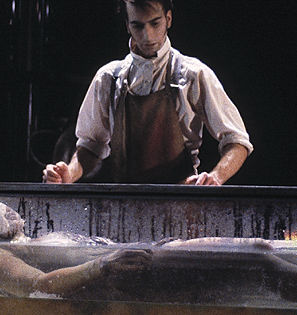
We can almost see Dr. Frankenstein hovering over his chunk of dead flesh infusing it with energy, bringing it to life. This image is certainly consistent with the view of the human/nature relationship as one of active/passive. Only here it becomes living/dead. This is a powerful metaphor and one to which Marx returns with many variations. As we will see, he finds this process malevolent only when it falls under the control of capital - only then does Dr. Frankenstein's creation become a monster. At this stage, on the contrary, it is a life-giving process alone. Humans give life to unfree, passive things by incorporating them into the human world. Human life, at least from the view of humans (Marx) is the only true life. Obviously animals like sheep, cows and pigs are alive in the biological sense, but they become alive for humankind only in so far as they become the object of its labor. Hegel is explicit about this and Marx undoubtedly agrees: "What I do to the organic does not remain external to it but is assimilated by it. Examples are the tilling of the soil, the cultivation of plants, the taming and feeding of animals . . ." (Philosophy of Right, para. 56) 
It should be obvious at this point why Marx used the example of religion in his discussion of fetishism in Chapter 1. Whereas, for him, humans embue other things with life through their labor, he can only see the Judeo-Christian tradition of a "God" creating humankind as an idealistic projection of this quality that humans themselves possess. The same would be true with respect to other "creation myths" such as the Mayan myth that the Oldest Gods created the Mayan people from corn, thus they call themselves "the people of the corn". One can imagine Marx commenting: "What's really going on here is that the Mayan people recreate themselves, day by day, year after year, through their milpas [plots of corn] that they have produced and from which they live. They have merely projected this fundamental aspect of their own lives, their own creativity, in an idealized form."
Now, if it is true that other species are endowed with consciousness and will, then truly humans have been involved in interspecial slavery and murder in their domination of other species, their genocides, and their consumption of animal flesh. The view that humans alone have a will, and impart life to other things is clearly one not limited to Marx and is a central feature and justification for much of our way of life. To believe, or to discover, otherwise would have the most profound ramifications. Ecologists and vegetarians push this kind of thinking: demanding that we find ways of living that do not kill off other species, either because they view the species as complementary to each other in an ecological balance or for simpler moral reasons: you don't murder other sentient beings.
Marx then discusses the labor process not only as production but as consumption - consumption of the means of production. Here again he is drawing on the previous discussion of this in the "introduction" to the Contribution to the Critique (see Grundrisse, pp. 90-94) In Capital he limits himself to the distinction between labor as productive consumption of the means of production; and individual consumption which reproduces the individual. This is a distinction which becomes more complicated in capitalism where capital reaches beyond the factory to insure that all individual consumption is productive consumption within its own self-reproduction, e.g., that workers' consumption reproduces them as workers and not simply as human beings. In the general case Marx is discussing here where humans are making nature part of their world, part of themselves, it might even seem that productive consumption (i.e., labor process) is subordinated to and ultimately a part of individual consumption! Labor creates products but only as an extension of itself. From the point of view of the individual worker this is clearly less so than for human workers in general because of the division of labor. Workers ultimately produce things for each other, for the species as a whole in an interconnected pattern and not simply for themselves as individuals. But directly or indirectly, productive consumption is but a moment in the reproduction of both the individual and of the species, and thus part of its consumption of nature, individually and collectively.
It is in this sense that Marx speaks, in the Manuscripts of humans as "species-beings." "In creating a world of objects by his practical activity, in his work upon inorganic nature, man proves himself a conscious species-being, i.e., as a being that treats the species as its own essential being, or that treats itself as a species-being." (CW, 3, p. 276) In other words, humans act together as a species as they create things out of inorganic nature, as they transform the world in which they live for themselves. As they treat their own species as their own essential being -they act for themselves rather than for something else, or for someone else. Labor here is simply one form of "spontaneous, free activity" - that form which involves the transformation of nature. "The object of labor is, therefore, the objectification of man's species-life: for he duplicates himself . . . he sees himself in a world that he has created." (CW, 3, p. 277) It is free activity, free expression of life precisely because as we have seen humans act according to their will: being a conscious being means that humans' own lives are objectsworkworkwork for them. "Only because of that is . . . activity free activity." (CW, 3, p. 276)
Critique of the Generic Character of Marx's Analysis
[This section is an excerpt from my essay "Work is Still the Central Issue!" ]
When Marx does discuss the specificities of labour in capitalism, his primary concern is valorisation or the extraction of surplus labour from the workers.
In Engels' footnote, he argues that the term 'work' should be used to designate labour in general, while the term 'labour' be reserved for work under capitalism.
In both texts we can see a similar distinction between a generic concept of labour (work for Engels) and a more specific labour-in-capitalism. Even in Marx's earlier writing, such as the 1844 Manuscripts, there was a distinction between alienated labour (in capitalism) versus some other kind(s) of un-alienated labour .
In making these distinctions I think both men were making a mistake, and violating a fundamental tenet of Marx's own methodology to boot. The mistake and violation lay in the conceptualisation of a generic or transhistorical concept of work (or labour) that could be applied retrospectively throughout history and, by implication, projected forward into the future. The retrospective application meant looking back at a vast array of human activities in diverse cultures in terms of 'work', e.g. studying bygone tools as a key to understanding bygone labour processes and the societies within which they occurred. The forward projection meant thinking about postcapitalist society in terms of post-capitalist work or unalienated work or communist work, or some such:
Freedom, in this sphere [of necessity], can consist only in this, that socialized man, the associated producers, govern the human metabolism with nature in a rational way, bringing it under their collective control instead of being dominated by it as a blind power; accomplishing it with the least expenditure of energy and in conditions most worthy and appropriate for their human nature. (Capital, Volume 111, chapter 48, The Trinity Formula)
The methodological tenet being violated was the one spelled out in what is now known as the "Introduction" to the Grundrisse. In that introduction, written for, but not published with, his Contribution to a Critique of Political Economy, Marx discussed the historical character of concepts and made two interrelated arguments. First, he argued that modern concepts can provide "insights" into previous social forms:
Bourgeois society is the most developed and the most complex historic organisation of production. The categories which express its relations, the comprehension of its structure, thereby also allows insights into the structure and the relations of production of all the vanished social formations out of whose ruins and elements it built itself up (author's emphasis). (This and the next few quotes are all from the section on "The Method of Political Economy
Second, he warned against applying those concepts developed in one period to the phenomena of other periods in any simple-minded way. His example was 'ground rent', a concept that as developed within capitalist society refers to the part of surplus-value generated by labour that accrues to the owner of land used in the production process. It would be a mistake, Marx argues, to look backwards at the medieval phenomenon of 'tithe' and try to understand it in terms of the modern concept of 'rent' even though there may be superficial similarities between the two:
The bourgeois economy thus supplies the key to the ancient, etc. But not at all in the manner of those economists who smudge over all historical differences and see bourgeois relations in all forms of society. One can understand tribute, tithe, etc., if one is acquainted with ground rent. But one must not identify them.
Now I think this latter argument makes sense generally, essentially it outlaws transhistorical categories, and applies specifically to the category 'work' even though Marx clearly disagrees. For him, although the intellectual grasp of 'labour-in-general' only came with capitalism and its generalised imposition of work, he claims that:
the conception of labour in this general form -as labour as such - is also immeasurably old... The simplest abstraction, then, [labour as such]... expresses an immeasurably ancient relation valid in all forms of society...
He does not, however, provide any evidence for this claim, whatsoever. Yet, unless he can show that the concept really has been around forever but only given full meaning today (something he argues more persuasively with respect to 'money'), then the most he can claim is his earlier suggestion that knowledge of current forms (labour) can provide 'insights' into previous forms, while those insights must be leavened with the recognition that the concepts are not really appropriate and others, more specific to the time, are required.
Without going into a lot of etymology and philology, I think it is true that prior to capitalism most societies had no generic concept of work. People were engaged in a wide variety of activities but it never occurred to anyone to refer to all these activities collectively as 'work'. Some people raised animals or tended crops, others made barrels or ships or silver dishes and so on. But they were referred to as shepherds or farmers, coopers or shipwrights or silversmiths rather than 'workers'. Different kinds of activities were just that and those who performed them were associated with particular castes, or subcultures or status groups. Members of exploited classes were often viewed as individuals representative of their social position, e.g. slaves or vassals or serfs, but again, not as 'workers'.
Marx took the concept of work or labour from both the philosophy and the political economy of his times. It seems to me that the reasons why the use of such a concept makes sense in capitalism - but not necessarily in any other period - are two. First, as Marx argued:
when it is economically conceived in this simplicity [labour as such], 'labour' is as modern a category as are the relations which create this simple abstraction ....Indifference toward any specific kind of labour, presupposes a very developed totality of real kinds of labour, of which no single one is any longer predominant.
Second, the real indifference toward any specific kind of labour is not that of the workers, who may have very distinct preferences, but is that of capital. In commodity-producing, profit-generating, reinvesting capitalism the particular characteristics of commodity producing activities are entirely secondary. It does not matter what people are put to doing as long as they produce commodities that make possible the realisation of a profit that can be used to put them to work all over again, preferably on an expanded scale. Under such circumstances it is reasonable to refer to all of these diverse activities under one rubric: work (or labour) that refers not to the specificity of the activity but to its central role in maintaining order. It is this social dimension of work that is designated, at least in a part, by what Marx calls the 'substance of value' or 'abstract labour', is measured by socially necessary labour time and has the form of exchange. Thus value is the conceptual tool for analysing human activities incorporated into capital as work.
Moreover, I think all this is reinforced by looking more closely at Marx's analysis of the 'work process'. Of his three elements of work, only one is active and the other two are completely passive. The human agents play the active role, imagining their project, the methods of its execution and its achievement. The tools these agents use and the nature upon which they work are the passive elements. While most people would probably concede the notion that human-made 'tools' are passive, growing numbers of people who have been focusing on ecological issues these last few decades are unwilling to accept the notion that of all of nature, only human beings can be viewed as active.10 This vision of work as involving active, imaginative humans creatively reaching out and transforming passive nonhuman nature is one Marx took over from Hegel and is a very anthropomorphic, enlightenment vision common to the times, but neither common to, nor appropriate to, other times and places, past and future.
The Labor Process in Reproduction
Earlier I wrote: "This is a distinction [between productive and individual consumption] which becomes more complicated in capitalism where capital reaches beyond the factory to insure that all individual consumption is productive consumption within its own self-reproduction, e.g., that workers' consumption reproduces them as workers and not simply as human beings." Although I will return to this later, in my commentary on Chapter 23, I want to discuss some of these "complications" here.
Given capital's shaping working class consumption so as to make sure that it results in the production of labor power, and thus is productive for capital, we must ask ourselves if Marx's analysis of the labor process is also applicable to the work of producing and reproducing labor power. His analysis was developed primarily with respect to the factory, to the production of commodities that capital would sell with the objective of making a profit, reinvesting and beginning the whole process over again. In that context his analysis of the labor process as consisting of the three elements labor, tools and raw materials seems fairly straightforward - at least in capitalism. But are these elements also present in the activities that produce labor power? If they are then it would make sense to treat that production as also involving "labor processes" and to analyze them much as Marx does work in the factory.
With respect to the first of these elements, labor, it can be tempting to see such things as procreation, gestation, child rearing, teaching, training, disciplining or retraining as involving labor or work, as transforming activities carried out intentionally. But is that all that is going on? Or, is that the central aspect of what is going on? Does it make sense to treat making love, having babies, caring for them and teaching them mainly as work? What of the second element, tools? Well, here again at least some elements of all these activities, such as the equipment of invitro fertilization, the surgical tools used in cesarian sections, baby bottles and formula, toys, cribs, school desks and textbooks, computers and laboratory equipment, paddles, canes and rooms of detention can all be seen as "tools" that are used by mothers, fathers, teachers, and employers in the formation of the ability and willingness to work. But what of the bodies of the father and mother, their sperm and ovum involved in procreation, of the mother's body involved in gestation, birthing and breast feeding? Are these reasonably viewed as tools? And what of the third element, the "raw material"? In as much as labor power is embodied in human beings, is crafted as part of that being, is it reasonable to view ourselves as passive "raw material"?

Given the common capitalist ideologies of love, the family and education, one's most immediate reaction, it seems to me, is a virulent "No!" We are not passive objects objects open to manipulation by some external subject. Our relationships of friendship, of marriage, of parent and child are surely more profound and meaningful than simple relations of labor! We are active, willing human beings, interacting with each other in hopefully creative, mutually fulfilling ways, no? Even when we fail, we are still involved in human relationships far more complex than mere work!
However... when we consider the character of labor power, that within capitalism it is the ability and willingness to work for capital, according to its bidding and its designs, and for its profit, we begin to see that the applicability of Marx's categories of analysis may be all too appropriate. For as we will see in the next section, the production of labor power is the production of people who are willing and able to set aside their own humanity to become the pawns of their employers, objects to be used, and abused/exploited, to set aside their own wills and objectives and to become the instruments/tools of their employers' wills. So the activities of reproduction, or those activities which produce and reproduce labor power is very much labor that not only treats people as things, but tends to surpress their will, their subjectivity, to make them passive, to convert any and all self-activity into activity-for-capital. In short, the labor of reproduction, the various activities that are involved, are those which dehumanize the person whose labor power is being formed.

Some examples. 1) We would like to view procreation, gestation, birthing and child rearing as the activities of loving spouses and parents, but to the degree that women are used as brood mares by their husbands, families or the state to produce the next generation of the labor force, both the activities and the offspring take on the character of pure work. Not surprisingly women caught in such situations are sometimes resentful and abusive/neglectful of their children. 2) The children, on the other hand, regardless of the love and care of their parents, find themselves doomed to years of hard labor (whether in the fields, at a loom, in a brothel, or in a school) designed to turn them into productive workers. 3) Wives who are expected, and pressured (sometimes verbally, sometimes physically) to do the work of cooking for, and serving meals to, of cleaning up after, of nursing when ill, of satisfying the sexual appetites of, and of being the objects of abuse by frustrated, tired husbands who work at, and are beaten down by, waged jobs are essentially reproducing their husbands' labor power for capital. When they aren't doing that, in what little time and energy they have left over, they must reproduce their own ability to keep doing this kind of work. 4) Teachers who might like to help children learn but who find themselves forced to impose fixed curriculum and standardized tests in classrooms of too many children for any individual attention, and therefore filled with resentful students who have to be disciplined find themselves doing the hard, and sometimes dangerous, work of hammering lives into labor power.
The implication of recognizing the applicability of Marx's analysis of the labor process to the work of reproduction is that just as he explores the concrete forms of the labor process in the sphere of production, in the factory, so must we explore the various concrete forms of the labor process in the sphere of reproduction, in the home, the school and community. We don't need to do that here, any more than Marx does with respect to factory work, but as we study the chapters where he carries out such exploration, e.g., in his analysis of co-operation (chapter 13), of the division of labor (chapter 14) and of technological change (chapter 15) so too should we examine the parallels between factory and home as well as the differences and the peculiarities of the various labor processes involved in the production and reproduction of labor power.
2. The Valorization Process
When Marx turns from production in general, or the labor process in general to consideration of production and the labor process in capital he turns from (in the language of chapter 1) the analysis of useful labor to that of abstract labor - or, what is the same thing, useful labor within capital. He makes this turn at the end of part 1 where he notes that what capital purchases in the market (re: chap. 6) are the means of production (the objective factors of production ) and labor power (the subjective factor). At this point he makes an historical observation: namely that as capital appears on the historical scene and takes over control of production, it takes control of the labor process as it has existed:
"The general character of the labour process is evidently not changed by the fact that the worker works for the capitalist instead of for himself; moreover, the particular methods and operations employed . . . are not immediately altered . . . The transformation of the mode of production itself which results from the subordination of labour to capital can only occur later on, and we shall therefore deal with it in a later chapter." (Capital, p. 291)
This distinction Marx later develops (in chapters 14-15 and in the Appendix [Vintage/Penguin Ed.]) is the distinction between the "formal subsumption of labor to capital" and the "real subsumption of labor to capital." In the former the labor process is unmodified, in the later it is transformed within the dynamic of the class relations of production. This distinction is emphasized in Capital by the division between Part 3, on Absolute Surplus Value where the focus is on "how long" workers work) and Part 4, on Relative Surplus Value where the focus is on the transformation of the labor process. Therefore if the labor process is at first untransformed then what changes when capital takes over?
Marx's first suggestion at the end of part 1 of this chapter is twofold: First, "the worker works under the control of the capitalist to whom his labor belongs". Second, the "product is the property of the capitalist." (Capital. pp. 291-2) What changes? The worker's activity of work is no longer free but is subordinated to and controlled by the capital, who by owning the labor-power-set-in-motion also owns the product. Thus the product is no longer the property of the worker but belongs to the capitalist. This part is entitled "The Valorization Process" because it considers the labor process from the point of view of value, both qualitatively and quantitatively, from the point of view of the goals and intentions of the capitalist - the realization of an increase in value or a surplus value, the prime in M - C - M'.
Here we discover that labor as value is subordinated to surplus labor or surplus value, and to understand value we must restudy it from the capitalist optic of surplus value. From the point of view of the labor process we had actual labor and means of production. From the point of view of surplus value (work) what counts is the labor embodied in the means of production and the new, living labor, or the embodied value and the new value. As Marx makes clear what interests the capitalist is that the new value, the new labor expended in the labor process be of sufficient quantity to cover the costs of the labor power and leave something left over as a surplus. As Marx develops in chapter 8, the value of the product embodies the value of the means of production (in the buying of which the capitalist has invested constant capital - constant because this value does not change) and value newly incorporated in the new product. This new value must contain sufficient value (labor time) to cover the costs of reproducing the workers' capacity to work or labor power (in the buying of which the capitalist has invested variable capital - variable because the amount of work the worker can do varies) and a surplus value over and above this. Symbolically:
where C = value (or socially necessary labor time) embodied in the means of production and V + S = newly produced value (labor time expended in this labor process) of which V = the amount necessary to reproduce the workers and S = surplus labor or surplus value. Since V + S
or the total amount of time the workers may work is, or must be for capital to continue with production, greater than V the time necessary for the production of their means of subsistence, "Therefore the value of labour power, and the value which that labour-power valorizes in the labour process are two entirely different magnitudes," (Capital, p. 300) Since what the capitalist is concerned with here is surplus labor time, what is essential is the length of the labor process. This issue: the length of the working day is the central subject of chapters 7-10 and its determination will be seen to occur within the class struggle.
There is an important interaction here between qualitative and quantitative factors, central to the understanding of "capitalist" production. If the workers work only so long as is necessary to reproduce themselves (this may happen directly in agriculture if they are paid part of the crop, indirectly in manufacturing) then the capitalist obtains no surplus value, and fails qua capitalist. In order to retain control over labor the capitalist must extract surplus value - both to survive (if not earning a wage through work), and to invest on a larger scale. The imposition of work must be quantitatively sufficient to result in surplus work or surplus value.
This is vital to his whole discussion - that the major qualitative determination of what is peculiar to capitalist control of the labor process is the amount of work imposed! What we have here is a central feature of capitalism: its tendency to continuously expand the amount of work it imposes, its tendency to expand investment (via reinvestment of surplus value), to expand its hold on human life, on the number of humans brought under its control. The creation of surplus value is the creation of surplus work - surplus over and above that needed to produce the workers as labor-power. The purpose of labor in the labor process in which the laborer controlled the process was the transformation of nature to meet workers' needs and to satisfy and fulfill their being through activity tout court. The purpose of labor under capital is simply more labor than the workers would perform for themselves - surplus labor. For the moment Marx does not question or analyse the reasons for this unending quest by capital for more labor. We can see the imposition of labor as the imposition of a certain kind of social control, but why does this expand? Why the quest for more and more control over more people, over more hours. This is not answered here. Marx simply notes that this is the case and goes on to analyse the implications of this for other aspects of the labor process and the role of humans within it.
Alienation
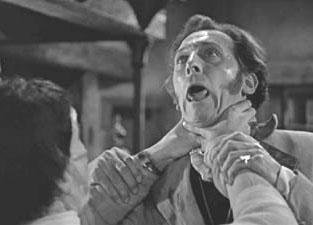
A major result of this control by capital, besides forcing more work, is to transform the meaning of work for humans. Because the capitalist controls the labor process the workers work for the capitalist not for themselves. Because the product belongs to the capitalist and not to the worker it appears as something outside and indeed menacing. It is the capitalist who now brings living labor and dead labor together, the subjective element of the worker and the objectified labor of the means of production. It is the capitalist that orders the worker to infuse life into the dead. But now this necromancy has turned malevolent. The dead flesh endowed with life becomes "an animated monster" who, turning against its creator, slowly strangles the worker.
Why? Because it is owned by the capitalist and stands alongside the capitalist opposed to the worker. If the product is a machine then it is the capitalist machine which the capitalist will use to enslave the worker. If the product is a means of subsistence then the worker will only have access to it to the degree that he accepts the despotism of the capitalist over his life by working for him. The worker's labor is no longer simply one form of life activity in which there is human interaction with nature of a particular sort, it is now the means by which the worker is controlled and dominated. Where in the case of the free human, work would appear as one "free manifestation of life, hence as an enjoyment of life" (CW3, p. 228), now this particular kind of interaction with nature has become "an alienation of life." Whereas for the free human this kind of activity would be one way of affirming
"the specific nature of my individuality", an exteriorization of myself in things, under capital this work process in which my own being and talents are embodied in a product is one in which the product is alien to me, owned by the capitalist and used against me. ". . .it is a forced activity and one imposed on me" only through "an external [capitalist] fortuitous need, not through an inner, essential one." (CW, 3, p. 228)
This theme of the "alienation" of work and of the products of work was elaborated by Marx in the 1840s and remains in his analysis even through Capital. It was particularly present and developed in the Economic and Philosophical Manuscripts of 1844 [pdf file] (and in his "Comments on James Mill"). The "alienation" of work means that under capitalism with the capitalists in control of the work process, work is no longer the autonomous means of self-expression and fulfillment to workers but is rather an alien force imposed on them, dominating them. The "alienation" of the product of labor means that the product, rather than being a fulfilling objectification of the worker's personality becomes a weapon for controlling the worker.
Work as a form of life is "alienated" above all because it is forced from the outside, imposed by capital:
"His labor is therefore not voluntary, but coerced; it is forced labor. It is therefore not the satisfaction of a need; it is merely a means to satisfy needs external to it. Its alien character emerges clearly in the fact that as soon as no physical or other compulsion exists, labor is shunned like the plague . . . it [labor] is not his own, but someone else's, that it does not belong to him, that in it he belongs, not to himself, but to another . . . . it is the loss of his self" (CW, 3, p. 274)
The Resentment of Work
There are two elements here: first that the labor is forced, second that the worker feels it as such and shuns it. That the first of these is true is the main point, whether the second is true is secondary. It may well be that a worker feels that work is pleasant or enjoyable even though the work is being done for capital - certainly much of capitalist schooling and ideology is designed to instill the "work ethic" of enjoying work, including work for capital. Therefore whether or not workers like (subjectively) their work is secondary to the objective fact that it is imposed on them. It may be that, as Marx says: "The worker therefore only feels himself outside his work, and in his work feels outside himself. He feels at home when he is not working . . ." (CW, 3, p. 274) But then the worker may also have decided, consciously or not, to "make the best of a bad situation" and learned to enjoy working. The issue, it seems to me, is secondary.
However secondary it may be, it should be recognized that dislike for work is indeed pervasive in capitalist society. We are surrounded with cultural manifestations of people's resentment of work: from bumper stickers which say "Work Sucks, But I Need the Bucks" or "I'm in No Hurry, I'm On My Way to Work" through desk and office signs announcing "Work May Not Hurt You, But Why Take The Chance" or "I Love My Job, It's The Work I Hate" or "Work Is A Four-letter Word" to popular music of all sorts. In the previous treatment of primitive accumulation we discussed Bob Dylan's protest song "Maggie's Farm" from the 1960s with the refrain "Ain't gonna work on Maggie's farm no more". There are many such from all decades. Another, from the Austin punk era of the early 1980s is just as frank:
 I Won't Go Back To Work
They tell me everyone has to do it
They say everyone has just got to make it No, I won't go back If I don't dress just right, you'll have to excuse it No, I won't go back
The Explosives, Record Title, 19__ |
During the countercultural revolution of the 1960s, the term "alienation" came to be used quite broadly to refer to all feelings of estrangement in society. Marx's Economic and Philosophic Manuscripts of 1844
coupled with Capital can provide a theoretical weapon to understand not only alienation in work but of the experience of alienation throughout life once we recognize how capitalism has succeeded in subordinating so much of life to imposed work . The following two songs from the 1960s express such feelings of alienations, the first, The Sound of Silence, by Simon and Garfunkel from the point of view of the alienated individual and the second by John Lennon and Paul McCartney as a commentary on the isolation of others.
In the first of these songs, the singer wanders the streets alone amidst thousands of equally isolated individuals talking and talking but never connecting - precisely the experience of the alienation of worker from worker, of person from person when all are merely workers-for-capital instead of being involved with each other as a result of their own self-activity.

The Sound of Silence
Hello darkness, my old friend In restless dreams I walked alone
And in the naked light I saw "Fools," I said,"oh you do not know And the people bowed and prayed
Simon & Garfunkel, "Sound of Silence", 1965, in Collected Works, |
In the second song, the evocation of "all the lonely people" is generalized in the chorus but focused on Elenor Rigby who dies alone and Father McKenzie who buries her alone.
 Elenor RigbyElenor Rigby picks up (chorus) Father McKenzie
(repeat chorus) Elenor Rigby (repeat chorus) McCartney/Lennon/Saka
|
These songs gave voice to the individual experiences and feelings of alienation within mass urbanized society and resonated in the emotions of millions. They are not intellectual essays on alienation, like Marx's texts, they are poetic evocations of daily pain and their favorable reception (measured by record sales) demonstrated just how widespread that pain was (and is).
Aliens and Monsters

Irrespective of the feelings of workers, however, work is imposed and the product of the labor process is used to control the worker - it becomes, as the property of the capitalist,
"something alien, as a power independent of the producer . . . . Under these economic conditions [capital] this realization of labour appears as loss of realization for the workers; objectification as loss of the object and bondage to it; appropriation as estrangement, as alienation. . . . the greater this product, the less is he himself . . . the life which he has conferred on the object confronts him as something hostile and alien." (CW, 3, p. 272)
As property of the capitalist, as either means of production or means of subsistence, the product of labor becomes the means of forcing laborers to labor, it becomes capital. The alien in this horror movie is capital. The worker has imbued dead, objectified means of production with life, created something new, but then this product raised from the dead turns monster and dominates its creator.
This is a complete reversal of the labor process described in the first part of chapter 7. There humans are god-like, mobilizing passive or dead things, and endowing them with life. Here capital, by using dead things (MP, MS) as moments of itself, mobilizes and dominates living labor. It subordinates work as one kind of life activity to itself, the worker "is lost to himself" and has the misfortune to be "a living capital." Here the worker appears as a zombie - the living dead, human life suspended and used by death. Instead of working to live, we have living to work -the ideal of the capitalist work ethic. Humans become as Marx says "nothing more than workers" (CW, 3, p. 283) Or again in the Grundrisse (p. 708): "the positing of an individual's entire time as labor time, and his degradation therefore to mere worker, subsumption under labor." Instead of work being one form of being for humans, all forms of human being are eliminated except for work through the use of the products of labor to dominate labor, to force it to work, to produce ever more surplus value. Thus, under capital, alienation takes four forms:

- 1.The alienation of workers from their labor: living labor becomes alien to humans, a means for controlling them rather than fulfilling them
2. The alienation of workers from their product: the products humans create become alien to them. Owned by the capitalists they are separated from them and then used for dominating and controlling them.
3. The alienation of workers from each other: the stripping away of their self-realization within their species means the "estrangement of man from man . . . . What applies to a man's relation to his work, to the product of his work, and to himself, also holds of a man's relation to the other man . . ." (CW, 3, p. 277) Thus capital ruptures the interactions between people and forces them to exist and to act only for capital. First, the domination of their lives by work means that they have, effectively, very little time and energy available for relationships with teach other. Thus they are alienated from each other in the simplest sense: being separated. Second, the capitalist imposition of competition and hierarchy pits them against one another, estranges them from one from another precisely in so far as their lives are defined only in terms of their relation to capital and not in terms of unmediated relationships between one another - thus the loneliness and separateness of life in capitalist society portrayed in the songs above.
4. The alienation of workers from their "species-being": therefore work, which was one means of human interaction, one way of fulfilling human specie's-being as a collectivity, becomes merely a means to insure individual existence. "In tearing away from [humans] the object of [their] production [the product] estranged labor tears away from [them their] species-life, [their] real objectivity as a member of the species." (CW, 3, p. 277)
Gone are the positive phenomena associated with the interaction of humans with each other in their work and in the sharing of their products such as Marx imagined existing in some society free of capitalist domination:
"In your enjoyment or use of my product I would have the direct enjoyment both of being conscious of having satisfied a human need by my work, that is, of having objectified man's essential nature, and of having thus created an object corresponding to the need of another man's essential nature. I would have been for you the mediator between you and the species . . . in the individual expression of my life I would have directly created your expression of your life, and therefore in my individual activity I would have directly confirmed and realized my true nature, my human nature, my communal nature. Our products would be so many mirrors in which we saw reflected our essential nature." (CW,3, p. 228)
Thus capital is seen as undermining not only the individual human's self-realization through the transformation of nature, but also the mutual interactions of individuals each carrying on these activities communally.
In Capital all of this discussion is left out. Marx does not insert this long discussion of the Manuscripts into Capital which he wrote years later. This has led some interpreters to see a sharp rupture between the "young" Marx of the 1840s and the "mature" Marx of the 1860s. Yet, there are clearly important elements of this analysis which persist, indeed are amplified, in Capital. 
The product produced by workers for capital does become a "monster" (Capital, p. 302) Later, in Chapter 10, we find this monster is pictured by Marx as a Vampire! "Capital is dead labor, which, vampire-like, lives only by sucking living labor, and lives the more, the more labor it sucks." (Capital, p. 342) The evocation, of course, is not of the vampire who kills quickly at one feeding, but who returns again and again to slowly sap the life force of its victim. The dead labor is precisely the products produced by workers, products that have become alien objects, part of capital, and are used to dominate workers. The expression "sucking living labor" clearly means forcing humans to work, and the more they are forced to work the more products are produced, the more surplus value, the more capital thrives. Still further (Capital, p. 353) he speaks of capital's "were-wolf hunger for surplus labor", again the alien monster seeking ever to impose more work. And then in Chapter 11 we find in somewhat less picturesque language:
"It is no longer the worker who employs the means of production, but the means of production which employ the worker. Instead of being consumed by him as material elements of his productive activity, they consume him as the ferment necessary to their own life-process, and the life-process consists solely in its own motion as self-valorizing value." (Capital, p. 425).
Further, in the chapters on machinery and modern industry there is a whole discussion about how under capital the worker comes to serve the machine rather than visa versa. Clearly the core of the analysis of alienation is very much alive in Capital in so far as it concerns the way capital distorts humans' relationship with themselves and with each other. Humans become the tools of capital, of things, rather than being their creator, rather than creating them as extensions of self, individual and collective. What is missing, it seems, is the way Marx in the early writings spoke freely of the "feelings" of workers. Then he could discourse freely about workers "enjoying" activity, or finding it "hateful", of "feeling at home" or of "feeling outside", etc. In short what is absent in Capital is any extended discussion of working class consciousness and its relationship to their situation. Marx is concerned here with the dynamics of capitalist domination or with working class struggle against it (e.g., chap. 10) but he no longer spends time exploring the relationship between what is going on and what workers think or feel about it. He examines their subjectivity in their actions rather than in their minds.
Alienation in Reproduction
As suggested earlier, the ever more extensive intervention of capital into the management of people's lives off-the shop floor, in homes and families, in schools and spaces of recreation, demands not only the recognition of its efforts to reduce our lives to the creation and recreation of our labor power, but also an analysis of the kinds of alienation that must inevitably be associated with such intervention and such reduction.
Let us examine, one after another, to what degree Marx's four aspects of alienation as he finds them within the sphere of production are also present within the sphere of reproduction and whatever differences there may be between the two spheres.

The first form of alienation is that of the workers from their labor, i.e., because the labor processes in which they engage are defined for them by their employers their work activities are not free expressions of their own will and creativity. In section 1 above I mentioned "procreation, gestation, child rearing, teaching, training, disciplining or retraining" as examples of the work of reproduction. Now each of these may include a variety of different, concrete labor processes but the key issue vis a vis alienation are the ways and the degree to which those processes are dictated by capital and those performing them are stripped of their control and ability to exercise their own will/creativity autonomously.
At first glance it would appear that in some of the workspaces where such labor processes are carried out - such as the home - individuals have considerable freedom over what they do and how they do it. No overseer or manager is standing over those doing the work telling them what to do and how to do it. In other spaces this is obviously much less true, e.g., training classes within an enterprise, or a technical school, may well have teachers serving as overseers and students' work kept strictly regulated. In turn, the work of those teachers may well be the imposition of standardized curriculum, tests and rules of behavior over which they have little control and thus little scope for individual creativity. Such working conditions more often obtain in elementary and secondary schools than in colleges and universities but they are not unknown even in those work spaces.

Clearly, the sub-spheres of reproduction where there is the least direct control by capital pose the greatest challenge to the relevance of Marx's analysis of the alienation of workers from their labor. So, let's examine what many feel is the freest such sub-sphere: the home. The home and family have often been considered as free of capitalist relations, indeed as refuges from those relations that dominate most waged and salaried jobs. At the end of the working day, do not many flee the office or factory and seek the sanctuary of one's home, free of the boss's oversight and demands? Certainly the daily evening rush hour traffic is jambed with exhausted workers seeking relief, relaxation, friendly faces, dinner and sleep in the private haven of their apartments and houses.
Unfortunately, throughout the 20th Century (and even before, though in not so comprehensive a fashion) capital has been intervening in the home, as it has in other unwaged spaces such as schools, to shape, and adjust and dictate what does and does not go on in that supposed sanctuary. The institutions of that intervention have been both private and public. Beginning in 1910 the well-known Robber Baron John Rockefeller set up the Rockefeller Sanitary Commission and the General Education Board (GEB) with the goal of transforming the Southern labor force from a low-productivity, mainly agrarian, and often sickly, bunch of workers into a more useable, higher productivity and more profitable-to-employ collection of workers. While the Sanitary Commission worked through the state and public health to eliminate hookworm - a parasite that debilitated vast numbers of southern workers - the GEB worked to engineer changes in both schooling and the family that were expected to improve the quality of the labor force. Among other things the GEB hired lobbyists to push for a generalization of public schooling and helped launch home economics by setting up a network of girls canning clubs to teach modern methods of food preparation and preservation. The avowed purpose was to transform the character of the family by transforming the tasks that were performed within it. (See picture of a girl's canning class to the lower right.) 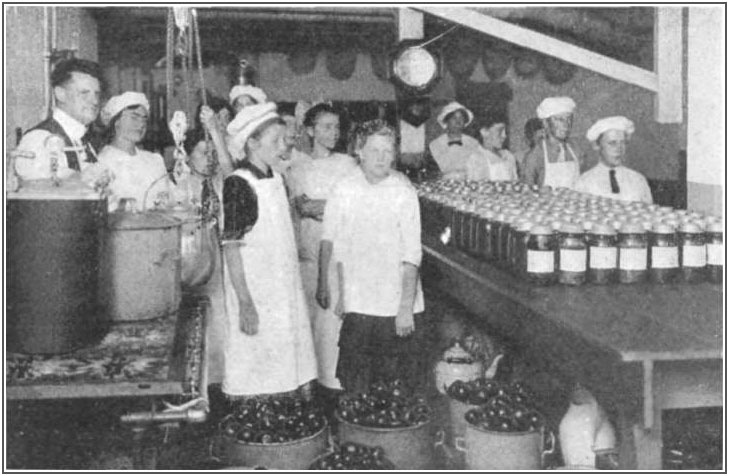
Similar programs were being implemented to shape the huge flow of largely peasant immigrants flowing into the United States in the late 1800s and early 1900s. Here too, agents both private and public were working to adapt people who came to the US with rural habits to the demands of industry for a labor force with habits that fit its needs. Again such programs were aimed at both the habits of waged work, e.g., working by the clock instead of by the sun, and those of unwaged work, e.g., in the home.
Beyond such programs the success of workers in fighting for less work and higher wages was widening the demand for consumer goods and business not only increased and diversified production to meet such demand, but shaped both products and their advertising to cultivate modes of consumption and behavior that were compatible with business' ideas about the nature of a proper work force. When labor laws to protect, and sometimes to exclude, women and children in/from production were finally enacted in the 20th Century so that more women were spending more time in the home, consumer goods designed for the home were often peddled with screeds preaching their proper use, and thus the proper modes of labor in the home. Similarly, and I return to this in my comments on piece work in chapter 21, along with the production of soaps, washing machines, dishwashers, vaccuum cleaners, carpet cleaners etc. came ever increasing standards of "cleanliness" such that not only did the machines regulate the work of cleaning but the standards dictated more such work as well.
In schools, of course, the early work of the GEB soon became regular courses on home economics where children, mainly girl children, were trained in the various skills of "homemaking" - cooking, sewing and so on - such that instead of mothers passing along their particular, and often ethnically distinct, skills to their children, all of those children were being taught the same skills by identical institutions.
At the same time, the state, acting primarily in the interests of business was also regulating the legal structures of the family through property laws, marriage laws, child protection laws, tax laws and so on. So, although the ideology of capitalism held the family and home up as the quintessential "private sphere" in fact the state was busy implementing regulations and specifying what could, and what could not, go on there both with respect to the relationships among adults and between adults and children. Those laws and regulations, of course, were, and are, only as effective as their enforcement so the police and judiciary also played increasingly important roles in structuring family life. Laws might forbid a man to beat his wife if she didn't do her work properly (according to his accessment) or to rape her if she wasn't compliant with his sexual desires but if the police would not arrest him, or the courts not convict him, then such laws would be meaningless.
In all of these ways, and many more, capital has shaped family life and the behavior of people within the home. What at first glance seems private and protected from the pressures of the work-a-day world, upon closer examination turns out to be determined, sometimes to an amazingly detailed degree by capital through a wide variety of mechanisms. And when people are reared within such institutions and accustomed to their structures they often internalize the behaviors they have experienced while remaining blind to the forces that have shaped them - a blindness which helps, of course, perpetuate the myth of the home-as-sanctuary.
Turning to the second form of alienation - the alienation of workers from their product - we can also query the relevance of this to the sphere of reproduction. Well, the product of the work of reproduction is labor power and labor power is a willingness and ability to work that will generally be sold to some capitalist employer. In all those cases, the alienation of the product is inherent in the product itself. One trains children (as a parent or teacher) or trains/disciplines oneself, to work long and hard in order to be able to get a job. Moreover, as with other products, once sold to the capitalist the product labor power is then employed by the capitalist against the workers who sold it; the capitalist structures their work both to control them immediately on the job but also to exploit and alienate them in ways mentioned above.
But what of those whose labor power does not wind up being sold to capitalists? What of, say, the unemployed who strive fruitlessly to prostitute themselves on the labor market? What of children, mostly girls, who are trained for housework and who wind up spending their lives working in the home rather than selling their labor power in the market? In neither case are they alienated and exploited directly by a capitalist and therefore it might be denied that their product, their labor power has been alienated.
In the case of the unemployed their search for jobs is clearly work for capital - it is what makes the labor market function and as Marx discusses in chapter 25 helps keep down others' wages - and since the 1940s in the United States that work has even been paid, in the form of unemployment compensation. (To obtain such compensation in most states workers must provide proof of job-search interviews with prospective employers.) Such workers are not working for wages, per se, but they are undertaking a labor vital to the functioning of the capitalist labor market and thus of every market and the system as a whole. Moreover, the "products" of their labor, namely the opportunities they provide capitalists to reorganize their labor force through firing and hiring and the downward pressure on current employee wages are surely not things which belong to them; they are services provided to capital who uses them against them and all their class.
In the case of children who are trained in housework and who go on to become houseworkers, mostly housewives, and who therefore do not sell their labor power in the labor market, we have already seen that as housewives they will be doing the work of producing labor power for capital. So whether they are producing their own labor power, or later producing that of others as well (spouses or children), they are in both cases working for capital. In as much as their "product" is for-capital and will be used by it for its own purposes, then that product - the commodity labor power - is every bit as much alienated from them as the commodities produced by factory or office workers.
With respect to the third form of alienation - of worker from worker - we must ask if this too can be found within the home, within the family unit or in any other sphere of reproduction. The last thirty years or so have given a resounding, and very public, YES! to this question in the form of youth and feminist revolt in the 1960s and 1970s and more generally "the crisis of the family" that has haunted capitalist policy makers and their hired strategists in academia ever since. 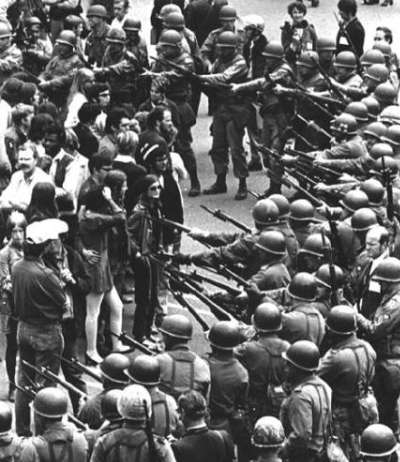
The youth revolt of the 1960s was a revolt against virtually every aspect of modern capitalist society but three dimensions were particularly evident: a revolt against parental authority that grew rapidly from its origins in the 1950s, a revolt against school - especially against the imposition of curriculum determined from above, a revolt against societal injustice of many forms, from civil rights to imperialist war. All of these revolts took place mainly within the sphere of reproduction: within the family, the school and the community rather than the waged job place. They were all engendered by revulsion against a life (and possible death) structured and organized by capital in all of the alienated ways mentioned above.
Within the home the rebellion of children against parental authority was reinforced, and perhaps sometimes a spin-off from, that of women against the patriarchal authority of their husbands and fathers. The feminist movement was formed by women fleeing the isolation of the home and the assumption that it was their lot to remain there forever, for the public sphere of collective action and struggle. 
The division of labor within the nuclear family that had emerged in the 20th Century wherein husbands worked at waged jobs and women worked at unwaged housework had involved, most often, an hierachical power relationship in which the men who commanded the wage and the property it could buy were also in a position to command their wives. That command was the most immediate manifestation and concrete form of the capitalist shaping of the family and home and of women's lives. Women revolted against that command and broke out of the hierarchy, the home and the family to seek better working conditions and better pay - whether those conditions were within or outside the home and whether the pay was a formal wage or a better share of family income.
Women also revolted against the perpetuation of patriarchal power within various social movements that challenged this or that aspect of capitalist society. Whether in the anti-war or black power or student rights movements young men, no doubt following the pattern of their fathers, often sought to lead and get their fellow female rebels to follow that lead - to make the coffee and clean up the mess after meetings. But young women increasingly would have none of it, spoke up and spoke out and soon formed their own autonomous organizations - vital steps in the emergence of militant wings of the feminist movement.
In all these cases we find young men and women, and then often older men and women following the lead of the young, revolting against what they saw as intolerable conditions of alienation in the home, in the school and in the community. As students they were sick of being pitted against each other in a highly competitive educational system in which only a few were permoted to higher education and many were discarded/dropped-out along the way. They sought co-operation and collective action as a substitute for competition and a dog-eat-dog scrabble for grades and scholarships. They wanted to control their curriculum and they fought for Black Studies, radical economics, insurgent sociology, women's studies, Chicano studies etc. in the universities. They also fought against the imposition of too much work so they would have time to learn on their own, both in libraries and in the streets. Professors and administrators came under pressure, grading became easier; grade "inflation" was born, and whole new programs of study were created on the basis of militant student desires.
Blurring the distinction between private and public life they experimented - often openly and to the horror of the ideologs of the capitalist family - with new family structures: open marriages, communal living arrangements, homosexual and lesbian partnerships and so on. The "crisis of the family" was not just born, it was created by such innovating rebels.
Finally, with respect to the fourth form of alienation - that of workers from their species-being - because this involves the substitution of the capitalist will for that of workers, both individually and collectively, then to the degree that capital has succeeded in shaping the sphere of reproduction such that we do what it wants/needs, the way it wants and needs us to do them, we are stripped of our humanity every bit as much as we are in the factory or office.
When parents become truant officers enforcing capitalist hours on learning, or drill sargeants ferociously imposing the arduous work of competitive sports, on their children, then neither parents nor children are living autonomously but are both playing pre-designated roles in the capitalist machine. When parents expect and husbands demand that young women become broodmares to perpetuate the family (i.e., the labor force) and either set aside their own dreams and autonomous plans or take them up only as a second job along side their "primary" one within the home, then both the women and those imposing these standards are, once again, playing pre-designated roles within capitalist accumulation and have effectively given up the free exercise of their own wills.
That some people have sometimes consciously embraced the capitalist values and roles of such institutions, doesn't obviate their loss of autonomy, and thus of their humanity. Given Marx's theory of human species-being as the exercise of the will, we must conclude that a human or a group of humans, can, after all, choose to be less than human by giving up the exercise of their free will. And this is true whether we are dealing with the sphere of production or that of reproduction. It is also true whether we are dealing with workers or capitalists.
The Alienated Capitalist

Although Marx is unconcerned with capitalists as individuals, many social commentators, novelists, song writers and film makers have been. A recurring theme in their treatment of the fate of individuals who become capitalists has been that "success" does not breed happiness. "Success", of course, being defined in terms of moving up the capitalist hierarchy of power, success in moving into positions where you are more of a manager and less of a worker being managed. The payoff for such movement is power and wealth, income and status. The image of the successful capitalist having substituted in contemporary society for older images of the royalty and nobility. Against such ideology which portrays the capitalist as the hero of capitalist society has been pitted the more critical view that while "success" is materially rewarding it's achievement is also generally been spiritually and socially exhausting. The cost of competing has been the isolation of the workaholic -which is not all that different from the isolation of the worker enslaved to the factory. In both cases life is reduced to work with all its alienation, especially the isolation from fulfilling relationships with others. Sometimes this theme has been developed as critical commentary, sometimes as a warning to those tempted by the obvious payoffs of "success" but blind to the costs. One such treatment in the 1960s was Simon and Garfunkel's "Richard Cory", an adaptation of a poem by Edwin Arlington Robinson:

Richard Cory
They say that Richard Cory owns one half (chorus) The papers print his picture almost (repeat chorus) He freely gave to charity, (repeat chorus) Simon & Garfunkel, "Sounds of Silence", 1965 |
Recommended Further Reading
- As indicated in the commentary above, the key references to Marx's work on "alienation" are his "Comments on James Mill" and the section on "Estranged Labor" in Economic and Philosophic Manuscripts of 1844, both of which are now available in the Karl Marx Frederick Engels Collected Works, Volume 3, New York: International Publishers, 1975, pp. 211-228, 270-282. Two contemporary Marxist treatments that interpret Marx and seek to expand upon his work are Ivan Mézáros, Marx's Theory of Alienation, London, 1970 and Bertell Ollman, Alienation: Marx's Conception of Man in Capitalist Society, Cambridge: Cambridge University Press, 1971. There is today an enormous literature on alienation as a result of a virtual explosion of activity on the part of sociologists and psychologists in the wake of the cultural revolution of the 1960s and in response to widespread job dissatisfaction.
For some analysis of the original version of "Richard Cory" see the comments on this work by Edwin Arlington Robinson (1869-1935).
Concepts For Review
abstract labor labor process being in-itself being for-itself c + v + s formal subsumption of labor |
capital as vampire alienation valorization productive consumption species-being real subsumption of labor |
Questions For Review
(An * means that one possible answer to the question can be found at the end of this study guide.)
*1. Explain the difference between labor and the labor process and why it is important for Marx.
*2. Explain the connection between Chapter Seven and Chapter One, especially section two of Chapter One.
3. Discuss and critique Marx's comments on the relation between human beings and the rest of nature. What is particular about humans that distinguishes them from other animals for Marx and Hegel? In what sense are their views species-centric?
4. What are the three elements of the labor process and what are their relationships to each other? How do these relationships change under capitalism?
5. Compare Marx's concepts of class in-itself and for-itself with Sartre's concepts of being in-itself and being for-itself.
6. Compare Marx's concepts of class in-itself and for-itself with Sartre's concepts of being in-itself and being for-itself.
7. What does Marx mean by species-being? How does it relate to labor and production and how to the relations among human beings?
*8. Under what circumstances can labor be one form of "spontaneous, free activity" with the potential of being fulfilling for human beings.
9. What is valorization? Explain it in terms of its usual meaning and in terms of Marx's analysis.
10. Distinguish between the formal and the real subsumption of labor to capital and explain the relationship between this distinction and primitive accumulation.
11. Why is it that in order to understand value in Marx, we must also understand surplus value?
12. Explain the meaning of C = c + v + s. How central is s in understanding valorization and wherein lies the struggle between the workers and capital in this equation?
*13. What does Marx mean by "alienation"? Describe all the various aspects of work and life that fall under this rubric for Marx.
*14. Explain the following comment in social/class terms: "Capital is dead labor, which, vampire-like, lives only by sucking living labor, and lives the more, the more labor it sucks."
15. From your reading of Chapter Seven, how much truth do you feel there is in the assertion that in this chapter Marx focuses more on the processes of alienation than he does on how workers feel about it.
(1) In Capital Marx, like most writers in his day, used the term "Man" to designate the human species. I will use non-sexist alternatives such as humanity.
(2) That is to say intentional transformation is neither the intent nor primary characteristic of the activity. Obviously, swimmers may leave suntan lotion in the sea, transforming its chemical make-up and that may have further effects, too many hikers (or mountain bikers) may cause erosion and mountain climbers can pound so many pitons into cracks that they widen them, or leave their waste and discarded junk on the mountain to such a degree as to have an impact on the local ecology. But these, as in many other activities are unintended (un-willed) side effects and not the defining characteristic of the activity - at least not from the point of view of the human actors. (3) This was the position of French Communist Party philosopher Louis Althusser and his co-author Etienne Balibar in their book Reading Capital in which they argued the existence of an "epistemological break" between the "young" Marx of the Manuscripts and the "mature" Marx of Capital.
Attachments
Comments
Harry Cleaver's study guide to chapter 6 of Marx's Capital volume 1.
Outline of Marx's Analysis
- Constant Capital = c
- – the value invested in the means of production, MP
– the value embodied in MP
- – the value invested in the hiring of labor-power, LP
– hired labor-power, LP
- – preserves old value, by virtue of its character as useful labor
– creates new value, by virtue of its character as abstract labor
- – create new value; more work, more value
– if more than the value of their labor-power, v, they create surplus-value, s
- – transfer their value to the product as they are used up
– quickly for raw materials
– over time for tools and machinery (depreciation)
– "their value undergoes a metempsychosis. It deserts the consumed body to occupy the newly created one."
Secondary points:
- 1) Marx treats the value imparted to machines during repairs the same as their original creation. The repair labor is added to the original labor to determine their value. So depreciation is that "which no doctor can cure."
2) with the value embodied in the product = c + v + s,
- – rise or fall of the SNLT required for producing MP or LP will result in a rise or fall in the value of c + v
– thus s will diminish or increase accordingly
Commentary
Although aimed at clarifying and elaborating the content of the previous chapter, Marx's use of language in this chapter is misleading. Writing of labor "preserving," "transferring" or "creating" value makes value sound like some metaphysical essence, some ethereal substance which can be conjured into being, conserved or transferred from one object to another. This is particularly true when he writes of value undergoing a "metempsychosis," a term which usually refers to the transmigration of souls from one body to another. These verbs, preserve, create, transfer, are all transitive verbs that seem to have an object: value. Because value is not an object, but a sociopolitical aspect of labor, these words obscure the phenomena they are intended to evoke. We can, however, bring those phenomena into the light.
"Creating" value is nothing more than the simple act of working within the context of capitalist institutions. Workers "create" value every time their labor performs the roles capital assigns to it, i.e., creating commodities that are sold and on which a surplus-value is realized, and, in the process, serving to keep people's lives centered on work, now and in the future. "Preserving" or "transferring" value refers simply to how useful labor, if it is performed competently, guarantees that the SNLT previously embodied in raw materials and machinery becomes part of the total SNLT required for the creation of the final product. Incompetent labor (or intentional sabotage), which results in wasted raw materials, broken machinery or flawed products, not only fails to add new value but nullifies the previous labor that went into producing the means of production. It is unfortunate that the language Marx chose is not clearer.
In this chapter, as in Chapter 7, Marx further develops the fundamental dichotomy he set out in Chapter 1 between useful labor and abstract labor. Here it is the useful labor—the actual concrete processes of labor that produce a use-value—which preserves, through its competence, the labor already invested in prior stages of production. It is the additional characteristic of that useful labor as abstract labor, that makes it count as additional value.
With respect to his comments on the repair of machinery, his point is a simple one: the labor it takes to create a machine and the labor it takes to keep it running are both necessary for its existence as a machine and count as value. This analysis of the labor that repairs machinery can be extended to the labor that repairs labor-power. Later on in chapter 23 of Capital Marx has some analysis of this issue but we can at least mention it here.
Repairing and Producing Labor Power
In Chapter 6, the labor required to reproduce the ability and willingness to work was defined as that embodied in the means of subsistence. The labor of repairing labor-power, analogous to that which repairs machinery, raises new issues. Operating coffee machines at work to obtain the caffeine necessary to stay alert on-the-job is labor that obviously repairs and maintains labor-power. But brewing off-the-job morning coffee to wake up, get up, get to work and begin work, also renews labor-power. Then there's the work of caring for those on sick leave, of patching up the psychological wounds incurred on the job. In short, much of housework contributes to the daily, weekly and annual repair of labor-power. This labor neither creates commodities purchased with the wage, nor does it create commodities that the capitalist purchases and then provides to the worker. Such labor, because it does not produce a capitalist marketed good, is not counted in the value of labor-power. It certainly influences that value, as I pointed out in my commentary on Chapter 6, but unlike the labor that repairs machinery, it is not counted in the value of labor-power.
Yet, the amount of work involved in repairing labor-power is probably much greater than that involved in repairing machinery. When you count all the work done by individuals taking care of themselves and all the work done by other family members and friends, you have a tremendous amount. Unaccounted for in Marx's value theory, it also remains uncounted in capitalist measures of labor performed or of (market) value produced, e.g., national product accounting that only tallies up the market values of sold commodities. Only when such work is done by professional cooks, housekeepers, cleaning establishments, prostitutes, psychotherapists, and so on, are the hours of work measured and the purchased service counted as part of the value of labor-power.
One place where the large extent of such work is recognized is in the Global South—because so much effort goes into subistence farming, in both rural communities and garden patches in cities, often maintained by rural-urban migrants. So extensive is such work that it supports not only those performing it but often also provides a necessary subsidy for those working at below subsistence wages, or those who have lost their jobs. Extended families that include those growing food in many areas constitute the only form of "welfare" available.
Even in the developed countries such labor is important. In the early 1970s when food prices jumped as a result of Nixon Administration manipulation of the supply and demand for agricultural goods, there was a rapid expansion in home gardening and canning. This home production constituted an expansion of housework to offset an attack on the real wage (the value of labor-power). People wanted to continue to eat as well as they did before prices jumped. Of course, even when they were successful in maintaining their standards of consumption, the increase in the amount of work they were forced to perform to do so meant a drop in that part of their standard of living made up of leisure time.
In general the amount of work involved in patching up, in repairing labor power is probably much greater than that involved in repairing machinery. When you count all the work done by individuals trying to take care of themselves and all the work done by spouses and even kids, you have a tremendous amount of work—and none of it is taken into account by capitalist accounting methods, e.g., national income accounting which only tallies up the market values of sold commodities. Only when workers are forced to have such work done by professionals: cooks, housekeepers, cleaning establishments, prostitutes, psychotherapists, and so on, does such work produce a marketed service that is counted as part of the value of labor power.
Against this almost universal refusal to recognize the importance and quantity of housework, some Marxist feminists have pointed out its essential role in the reproduction of capital and created an international "wages for housework" campaign of women demanding regular payment for their work of procreating, rearing and repairing labor-power. In some places, government pro-natalist policies have indirectly recognized the validity of these arguments by awarding money to women for having children. In some recent divorce and separation legal cases, women and some hired economists have argued persuasively that such work has economic value. A few economists have even argued that housework should have a value imputed to it and should be included in measures of Gross National Product.
Recommended Further Reading
On the logic of the "wages for housework" analysis of the work of women in the home and their demands for payment for their work see the seminal work by Mariarosa Dalla Costa and Selma James, The Power of Women and the Subversion of the Community, Bristol: Falling Wall Press, 1972.
Concepts For Review
preservation of value metempsychosis |
Questions For Review
(An * means that one possible answer to the question can be found at the end of the study guide.)
*1. What do you think Marx means by the "creation" or "preservation" of value? If you disagree with the interpretation I have set forward, explain your reasons.
2. Define and distinguish constant and variable capital. In what sense is there a conflict between the two?
3. Why might workers want more constant capital as opposed to less?
*4. Discuss the analogy I have suggested between the work of repairing constant capital and that of repairing variable capital. What do you think of the way Marx ignores housework in his calculation of the value of labor power?
5. What is there about subsistence peasants that makes it cheap for capitalists to hire them?
*6. What would be the counterparts of constant and variable capital in the "industry" of creating and repairing labor power?
Comments
Harry Cleaver's study guide to Marx's Capital volume 1 chapter 9.
Outline of Marx's Discussion
Section 1: The Degree of Exploitation of Labor Power
surplus value = excess of value of product over value of inputs = s
value of inputs = constant capital (c) + variable capital (v) = c + v
total value of product = C' = (c+v)+s
C' - C = s
constant capital = fixed capital (machinery, plant, etc) + raw materials (c2)
but fixed capital gives up only a part of its value (c1) in each period
so, constant capital (c) in a given period = c1 + c2
new value created = v + s
= reproduction of value of labor power + a surplus
= necessary labor time + surplus labor time
= necessary labor + surplus labor
measures of s:
s/v = rate of surplus value = rate of exploitation
s/(c+v) = rate of profit
Commentary
Partly these sections are just setting out some basic definitions that Marx will utilize in the rest of the text. Partly, he is explaining some of the implications of the last two chapters where he introduced surplus value, constant capital and variable capital.
The most interesting thing in this section concerns the difference between the two measures of the rate of extracting a surplus from the workers. The rate of surplus value compares surplus labor time with necessary labor time and measures the surplus in terms of the workers' labor as a whole; it gives an idea about what proportion of the workers' day is given up to the capitalist versus the amount spent on self-reproduction, i.e., reproducing the value of labor power. This is very much a worker's view of the issue because what is at issue is the worker's time and its allocation. Clearly, the higher the ratio s/v the higher percentage of the workers' day is being appropriated by the capitalist and the smaller the part the workers are working for themselves.
The rate of profit, on the other hand, which measures the surplus labor time against the capitalist's total investment, is a measure primarily of interest to the capitalists, in so far as it measures how much they earn in relation to how much they had to invest originally. This rate of profit, although expressed in value terms is a good first approximation for the actual calculations of rates of profit that occur in business and therefore expresses the capitalist point of view. (Of course, in actual calculations business would not only be measuring costs in money terms but would also take into account things like taxes on profits, from which Marx makes abstraction here.)
The rate of surplus value is never calculated by the capitalist, nor is it likely that any would ever attempt such a calculation, at least not publicly, for it would draw attention to the time the workers work for the capitalists. This of course is just Marx's purpose; he presents this moment of analysis to clarify what is going on from the workers' point of view, the view the capitalists would prefer to hide or cover up.
Another interesting point, not raised here by Marx, but worth contemplating, is the relations between necessary and surplus labor time understood dynamically. Isn't surplus labor today merely going to be invested tomorrow to raise the productivity of necessary labor and thus the standard of living? And if such investment is in fact necessary for such increases of productivity then does it make any sense today to speak of "surplus" labor? Shouldn't we rather speak of labor necessary today and labor necessary for the future? These questions throw us back to the issue of what is "necessary" about necessary labor, an issue first raised in chapter 6 and one that requires a more complex answer than Marx gave us there if we are to understand the dynamics of capitalist development and get beyond a static concept of exploitation. Marx addresses these questions in chapter 10.
Outline of Marx's Argument
Section 2: The Representation of Components of Value by Parts of the Product
Marx uses an example to show how the three components of value of the product: c, v, and s can be represented by proportional parts of the product itself. In his example the total product of 20 lbs of cotton yarn which is worth 30s (shillings) contains the following components of value:
c = 24s (shillings)
v = 3s
s = 3s
C' = 30s
These values of 24, 3 and 3 can be represented by 16, 2 and 2 lbs of yarn respectively. At the same time, following this logic, he also notes that newly created value of 12 hours work (and 6s value) can be represented by only 4 lbs of yarn. At 6s/12hrs, or .5s/hr, the 30s final product embodies 60 hrs labor, of which the other 48 derive from c.
Then, using the same example, Marx notes how the same components of value: c, v and s can be represented in terms of proportional parts of the total time employed in production, i.e., 12hrs. In this case the values of c = 24s, v = 3s and s = 3s, could be represented by 9hrs 38min, 1hr 12min, and 1hr 12min respectively.
Section 3: Senior's "Last Hour"
- Marx here critiques Nassau Senior's argument, in defense of British manufacturers against the Factory Acts and against the workers' efforts to reduce the working day to 10 hours, that the reduction of the working day by one hour would wipe out all manufacturing profits.
Senior's Argument (in Marx's jargon): the component parts of the total value of the final product can be represented by proportional parts of the time worked (as Marx described in section 2). In his case, the value of c + v is represented by 10.5 hours, the value of s by 1.0 hours. If, he therefore concludes, the working day is reduced by one hour, from 11.5 to 10.5, the surplus value s will be eliminated.
Marx's Critique: a) this is silly, why would a reduction of 1 hour drop s to zero? Why not drop c+v to 9.5 and use less constant capital and labor? b) more seriously he points out that in each hour of the working day, constant capital is being used up and its value transferred to the product through the exercise of labor, therefore a reduction of one hour would reduce not only total labor time but also the use of constant capital. Assuming the ratio of s/v equals unity, then 5.75 hours are producing v and 5.75 hours are producing s (where 5.75 + 5.75 = 11.5) A reduction of one hour, assuming wages constant would drop s from 5.75 to 4.75 and lower the rate of surplus value from 100% to 82.6%, hardly an elimination of profit! In a footnote, Marx notes that Senior "to his honor" later on came to support the factory legislation.
In another footnote, Marx notes with sarcasm Andrew Ure's argument that less work would also corrupt children's morals because "idleness is the parent of vice." This, of course, is an argument that has hardly disappeared and is often repeated to justify keeping children in school for long hours.
Commentary
These two sections go together because Marx is preparing in section 2 the critique of Senior that he wants to make in section 3. At first he sets out what appears to be a rather formalistic argument that the components of value can be "represented" by either parts of the product, or by parts of the time used to produce the product. Why anyone would want to do this is unclear and the example given is tedious. We discover the motivation in the next section, however, when we see how Senior has used this kind of an argument to defend profits.
Marx's critique is simple enough. He has only to show the fallacy of Senior's reasoning by recalling that each hour of production processes elements of constant capital and, by Senior's assumptions, one half the total time of labor creates surplus value, not just the last hour. Now, Marx concludes his argument in terms of the rate of surplus value, which he points out will only drop from 100% to 82.6%. Some may find this argument troubling, however, not because it is wrong, in Marx's terms, but because it is not framed in terms of profit (or net profit) as Senior would have it. It is, however, easy to frame the conclusion in terms of absolute levels of profit, the rate of profit or the rate of exploitation as Marx has done.
Restating Senior's example in Marx's terms, the initial case of an 11.5 hr day gives the following results:
C' = 115,000 (total value of product)
c = 95,000 (constant capital, adding depreciation to other c)
v = 10,000 (wages, assuming s/v = 1, or 100%)
net profit or s = 10,000 (absolute level of surplus value)
so, c + v = 105,000
therefore s/(c + v) = 9.5%
Senior's horror story of a one hour drop in the working day gives the following calculations for a 10.5 hour working day:
C' = 105,000 (assuming production falls proportionately, prices constant)
({115,000/11.5}10.5 = 105,000)
c = 86,739.1 (assuming costs fall proportionately)
({95,000/11.5}10.5 = 86,739.1)
v = 10,000 (assuming the wage bill remains the same)
so, c + v = 96,739.1
net profit s = 8,260.9 (105,000 - 96,739.1)
therefore, s/(c + v) = 8.5%
therefore, s/v = 82.6% (as in Marx's calculations)
So, we see in Senior's example that if the working day is reduced one hour the result would be a drop in absolute profits from 10,000 to 8,260.9 or a drop in the rate of profit from 9.5% to 8.5%, both of which confirm the argument Marx is making that Senior drastically overstates the potential impact of the 10 hours law on profits. We can also note, that in the more likely case that the wage rate rather than the the wage bill remained the same, the reduction of one hour would drop the wage bill (v) from 10,000 to 9,130.4, c would still be at 86,739.1 and profits (C' - {c + v}) would therefore only fall to 9,130.5 + with a resultant negligible change in s/v and s/(c + v)!
The history of Senior's hour, and of all other episodes like it --such as the one Marx cites in 1848-- bespeak much more than false logic. The desperate arguments put forward by capitalists and their apologists to resist any reduction of work time reflect more than fear of losing profits, their arguments which often foretell doom and societal collapse reflect a deeper intuition that all reductions in work threaten the social fabric of capitalism as a civilization built on the subordination of life to work. Down the path of less and less work lies another kind of world, one in which capitalists as a class are completely superfluous.
Partly this can be seen in Ure's argument that Marx cites in a footnote: the panic concern that a life not structured by work would be both idle and immoral. This has been typical of the capitalist work ethic whose ghost can still be found lurking in the darker spirits of society. The greatest fear of teacher's strikes is that of an uncontrolled mob of children being turned loose on society --this despite all evidence of how school discipline destroys creativity and imagination --qualities which only grow when given free time for free development.
Section 4: Surplus-Product
surplus product = the portion of the product that represents surplus value
rate of surplus product = surplus product/necessary product
Commentary
In this last, short section, Marx simply finishes his parallels between the distribution of value and the distribution of product. He emphasizes the ratio of surplus product to necessary product (i.e., the part that goes to working class consumption) for the same reason he emphasizes the ratio s/v: they both highlight distribution between the classes.
In the final footnote of this section (#13) Marx quotes T. Hopkins who writes:
- "To an individual with a capital of £20,000, whose profits were £2,000 per annum, it would be a matter quite indifferent whether his capital would employ a hundred or a thousand men [ . . . ]"
Such indifference is an attribute of what I would call a narrow-minded, fetishistic capitalist who can not see beyond the bottom line --one who thinks that the point of business is merely profit making and self enrichment. Such capitalists rarely rise to the level of policy making because they cannot see that it often does matter whether a hundred or a thousand people are employed. Being organized around the endless and universal imposition of work, capitalists collectively must worry about whether they are providing enough employment to absorb the existing labor force. If they do not, and unemployment grows, and if it grows too large, their ability to control society is threatened. It has been the recognition of this that has driven policy makers in high unemployment areas to be concerned with the issue of "appropriate technology," i.e., whether a given technology will contribute to solving the "problem" of unemployment. [NB: a certain amount of unemployment is necessary in capitalism to keep pressure on workers to accept alienated low paying jobs; but too much unemployment creates a terrain of unrest.] It was also this recognition during the last twenty years of the 20th Century that led the International Labor Organization to warn of the need for the creation of a billion jobs by century's end to absorb the growth in the world's labor force --or risk widespread unrest.
Concepts For Review
surplus labor time rate of profit exploitation rate of exploitation Senior's last hour surplus produce |
Questions For Review
(An * means that one possible answer can be found at the end of the study guide.)
*1. Explain the difference between the rate of exploitation and the rate of profit. Why is the former a reasonable measure for workers and the latter a reasonable measure for capitalists?
*2. Discuss the concept of necessary labor. What is included; what is excluded? What would be the results of redefining the concept in dynamic terms, e.g. over time, rather than statically as Marx defines it?
3. Keeping in mind that one pound = 20 shillings, that a quarter = 8 bushels, examine Marx's example taken from Jacob. What would the total value of the produce have to be for his example to be consistent? What would this imply for his measures of price and productivity?
4. Why do you think Marx goes through the analysis of Section 2 looking at c, v and s in terms of proportional parts of the product?
*5. Explain Senior's argument as to why the extension of the working day by one hour would wipe out capitalist profits and bring wreck and ruin to the economy. Then explain the fallacy in his reasoning. Would his analysis be relevant today? Why or why not?
Comments
Harry Cleaver's study guide to Marx's Capital volume 1: chapter 10.
Section 1: "The limits of the Working Day"
Outline of Marx's Discussion
The working day is a "variable," "fluid" or "indeterminate" quantity that can be represented thus:
1. A ---------- B ----- C
where the length A---------B represents the part of the day that produces V
and B------C represents that part of the working day that produces S
But B-----C can be "variable," longer or shorter
B-----C, or
B-------C, or
B---------C, depending on the power of business to impose work
2. But there are limits:
There is a minimum limit to A---B for workers to enable the reproduction of their labor power
so the capitalists must obtain a working day at least A---B + B---C,
where B---C = average profit (or they will withdraw from this form of investment).
There is a maximum limit of A----C, which is a function of:
—the "physical limits" set by workers' needs for sleep, food, etc.
—a "moral/social" limit set by workers' needs for intellectual and social requirements.
—both of these are elastic though within 24 hours.
3. In LP—M (and M—LP) we have an exchange between two subjects with two different views on the implications of the exchange.
Capitalists: demand the use of daily working power, LP, in exchange for wages
Workers: demand enough time so that along with their wages they can re-produce LP and live, i.e., a normal working day
4. Thus, capitalist rights as purchaser vs. workers' rights as sellers
"Between equal rights force decides. Hence it is that in the history of capitalist production, the determination of what is a working day, presents itself as the result of a struggle, a struggle between collective capital, i.e., the class of capitalists and collective labor, i.e., the working class."
Commentary
In the first place, the choice of working day rather than week, month or year is appropriate enough in a period where workers are working 7 days out of the week and day labor is common. Today we might well choose another unit of time, for example the working week, because since the successful working class struggle in the 1930s to create the five-day week (and thus the weekend —a hitherto unknown entity) this has been a common frame of reference. In the early 1970s even this shortened week came under attack by many workers advocating the 4-day week or the reduction of the 40-hr. week to the 36 hr. week, etc. More recently, since the early 1980s, the initiative again passed to the capitaist class that has succeeded at imposing somewhat longer working days, though the weekend is still intact.
The choice of unit is really an historical question, in the mid-1800s workers fought for the 10-hour day, 8-hour day, etc. Later workers demanded shorter weeks or even years (more paid holidays). We can adopt Marx's analysis to whichever unit is relevant to a particular situation.
Slavery Wasn't Abolished8 hours? It's more than 8 hours Living close by to Taking breaks from Marie Cohen |
More importantly, today we must extend Marx's analysis beyond the factory to a "working day" defined not only in terms of the production of commodities on whose sale a surplus value is realized, but also in terms of work aimed at the reproduction of labor-power. The working day thus includes the time of production and the time of reproduction. This extension is required not only because capital has extended its despotism beyond the factory into the home, family and community, but because working class struggle has also developed in these areas, and the terrain of struggle over the "working day" has expanded accordingly.
In Marx's discussion of this section, which sets the tone for the rest of the chapter, there are clearly two subjects in contention: the capitalist and working classes. Capital demands one thing, workers demand another (Marx even has the workers speak in their own behalf.) There are capitalist rights and worker rights. In the Hegelian language of Chapter Two, two wills or sets of wills confront each other. The determination of the length of the working day is thus achieved through struggle, through the opposition of force. This we will see to be true of most of the key variables in Marx's analysis: they denote moments of struggle and their value is determined by struggle.
In the case of the minimum limit to the working day: v + s Marx will ultimately make clear that in general capitalists must earn at least the average rate of profit (s/{c+v}) = π in order to continue in a given line of investment. If π falls below the average for very long, the capitalist will close up shop. This is why the minimum cannot fall to v in a sustained manner. What determines the average rate of profit is the balance of class forces, both directly and in mediated ways. This minimum as Marx defines it here is purely in terms of production hours. Once we include capitalist organized reproduction then this minimum amount of working time is analogous (the time —both in and out of production— required for the reproduction of labor power) but expanded.
In the case of the maximum limit we can see two kinds of changes over time. First, capital pushes beyond these physical limits, tries to reduce them, e.g., meal times, sleep. Such times are increasingly organized by capital to be short and to guarantee that they reproduce the willingness and ability to work rather than to fight against capital. (See section below on industries without limits and over work.) In response, workers try to defend the limits, and where possible expand them. Second, the "moral/social" limits which are a function of working class needs for intellectual and social activity undergo two kinds of transformations: a) they are colonized by capital and structured to become non-threatening, b) they come more and more to dominate the maximum limit as opposed to the "physical" limits. That is to say as workers succeed in forcing the working day down and creating more and more "free" time, that time is increasingly in excess of what is required for mere physical reproduction. Thus with the reduction of the working day through the development of a militant working class for-itself, that class is creating more and more time for the fulfillment of its own, self-defined needs. It is just this development of the working class subject that forces capital to invade this "free" time and try to colonize it, to control it through educational institutions, etc., so that it does not become threatening. Thus the terrain of struggle over the working day shifts to include the time of reproduction as well as the time of production.
Section 2: The Voracious Appetite for Surplus Labor
Outline of Marx's Discussion
- 1. "Capital did not invent surplus labor."
Class society with the monopolization of MP has long produced surplus labor. (generic)
2. Where use-value predominates
—surplus labor is limited by set of wants
—no boundless thirst from production itself
3. Where exchange-value (capitalist market) dominates
—there is just that boundless thirst, the aim is not use-value and therefore not limited by wants
—this comes with capitalist world market and production for export, e.g., in the United States slavery transformed from paternalism to the using up of slaves' lives to maximize exchange-value and profit.
4. Corvee labor
—in Danubian Principalities, Reglement Organique (1831)
—a "positive" expression of thirst for surplus labor. It is positive, because explicitly defined and expanded
—here "surplus labor in an independent and immediately perceptible form," i.e., work on seignoral estate.
5.Factory Acts in England (1850)
—negative expression of thirst, negative because the Acts set limits to surplus labor
—limits set through state, forced by working class struggle & exhaustion of LP
—capital responds with "nibbling and cribbling" at working day in a way that shows the nature of surplus value is no secret to anyone.
6. Full-timers, half-timers: people defined as personified labor time.
Commentary
Capitalism as Endless Work
Points 1-3 bring out something of fundamental importance in Marx's analysis of surplus value. It is not the existence of surplus labor that makes capitalism unique or that defines it. There has been surplus labor in many different societies. Marx names several. Rather it is the boundlessness of surplus labor under capital that makes it unique. In other societies surplus labor was subordinated to use-value, to the production of use-values for the ruling classes. In capitalism it is the other way around, the production of use-value is subordinated to surplus value, i.e., the extraction of surplus labor. This is absolutely basic. Significantly, Marx discusses it here without regard to the "form" of surplus labor, i.e., surplus value. The form in capital, exchange-value, or surplus value, is important, but it is not as fundamental as the content. First of all capital seeks endless amounts of surplus labor. Secondarily it seeks this through the commodity form, and thus surplus labor appears in the form of surplus value, and ultimately surplus money and profit. On this subject of form, it is worth noting that Marx uses American slavery to illustrate capital's boundless thirst for surplus labor despite the fact that slaves are not waged —the most common form of domination in capitalism.
Because capitalism is not defined by the existence of surplus labor, the end of capitalism cannot be defined by the end of surplus labor. What must be ended to bring about a post capitalist society, is the endlessness of surplus labor and the subordination of useful labor to surplus labor. We must reverse the relationship and subordinate surplus labor to the multidimensional needs defined by post-capitalist society. Thus post-capitalist society is not a no-growth society but one whose growth is organized to meet needs and not the other way around.
This can also be put in terms of the relation between work time and leisure time, or between production time and reproduction time. With capital we see an effort to subordinate reproduction to production, to make non-factory life such that it only prepares one to enter or reenter the factory. This includes the subordination of culture to capitalist organized work, commodity production and education as discipline and training for work. Thus the reversal and overthrow of capital must include the reversal and overthrow of these relations. We seek the subordination of work to non-work life, the subordination of production to reproduction, to culture. Education for living not just training. It would appear that only through these reversals can we begin to think and live work as one fruitful element of life among others, no longer antagonistic because no longer the mechanism for domination and for defining the rest of life.
In points 4 & 5 the juxtaposition of the Danubian corvee with the Factory acts is interesting not only because it presents two cases where surplus labor is obvious and non-obvious, but also because we see two moments of class confrontation when first one side and then the other has the initiative. In the case of the corvee the dominant class is moving and imposing more work. In the case of the factory acts the working class has moved and forced a reduction of work. What happens depends on the balance of class power.
Nibbling and Cribbling
 This discussion takes place within the context of "the working day" and "absolute surplus value" so the focus is on how the capitalists must use overseers and foremen to keep workers working as long as possible. Later, in chapter 15 he will discuss how the subordination of workers to machines can achieve the same end, but here it is human oversight, from harrassement to threats of firing that gets workers to start work, keep working, and return to work after breaks. In the sketch to the left, ex-railway worker Mark Anthony Priest (and present professor of painting at the University of Louisville) portrays one such overseer yelling at a rail repairman to get back to work. (Click on the image to see the painting for which this was the sketch. The painting is quite appropriately titled "Get Back To Work!".)
Marx's comments about how capital "nibbles and cribbles" at the working day, stealing a few extra minutes from workers here and a few more minutes there, are both accurate and of continuing relevance —as every student knows whose class has run overtime or who has been given more homework.
Unfortunately, Marx's comments are also very one-sided. He fails to examine the similar ways in which workers nibble at the time they are forced to give to capital, stealing back moments of their lives when they can, biting off big chunks when possible. It is clear that the struggle over the working day goes on in this fashion just as it does at the level of legislation. Playing on the job, absenteeism, slow down, sabotage —withdrawal of efficiency as Veblen said— are all ways in which workers seek to reduce the amount of their lives they give up to business. See the ad from a business magazine denoucing "time theft" patterned after a wanted poster.
Several contemporary examples of this kind of "nibbling" are given in a 1971 article on the auto industry: "Counter-Planning on the Shop Floor" by Bill Watson. Two went as follows: 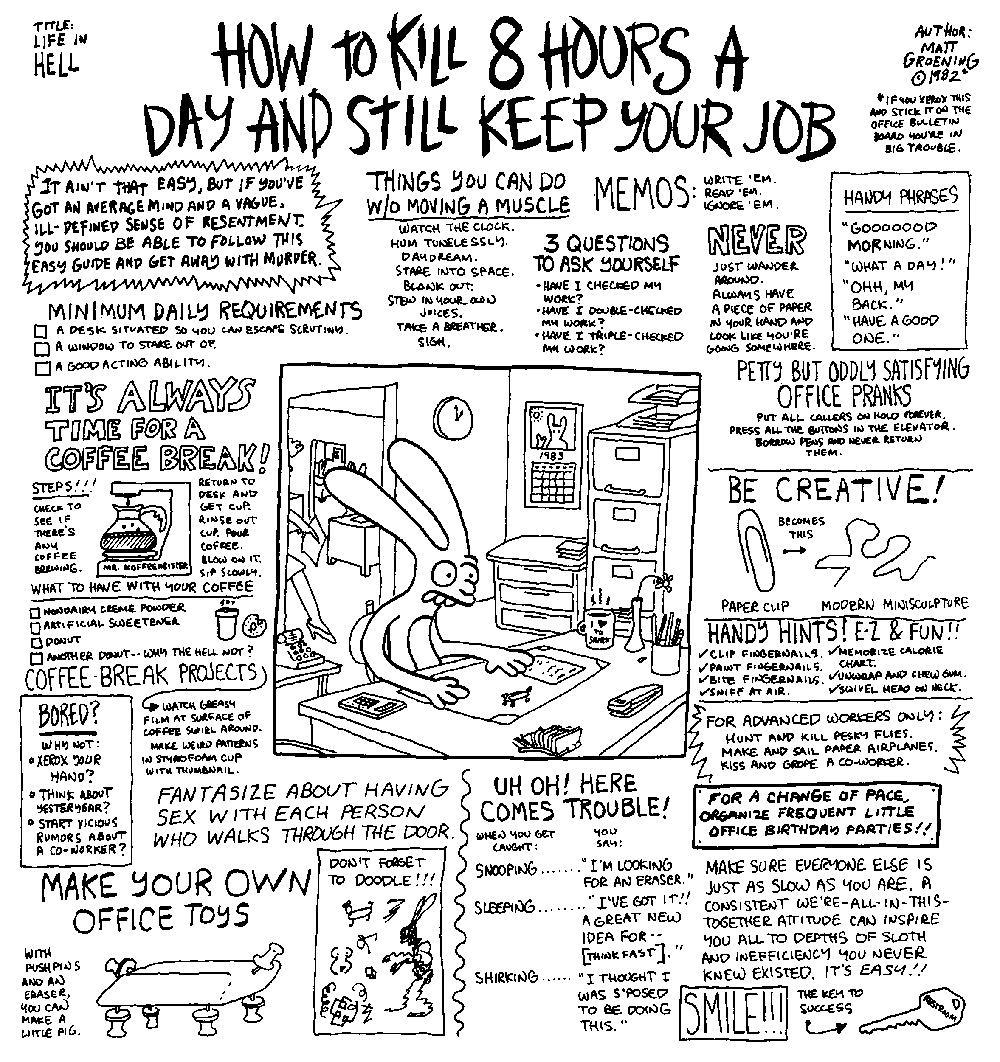
- Sabotage is also exerted to shut down the process to gain extra time before lunch and in some areas, to lengthen group breaks or allow friends to break at the same time. In the especially hot months of June and July, when the temperature rises to 115 degrees in the plant and remains there for hours, such sabotage is used to gain free time to sit with friends in front of a fan or simply away from the machinery.
A plant-wide rotating sabotage program was planned in the summer to gain free time. At one meeting workers counted of nuimbers from 1 to 50 or more. . . . Each man took a period of about 20 minutes during the next two weeks, and when his period arrived he did something to sabotage the production process in his area, hopefully shutting down the entire line. . . .
The "sabotage of the rationalization of time" is not some foolery of men. In its own context it appears as nothing more than the forcing of more free time into existence; any worker will tell you as much. . . .
What stands out in all this is the level of co-operative organization of workers in and between areas. While this organization is a reaction to the need for common action in getting the work done, relationships like these also function to carry out sabotage . . . Such was the case in the motor-test area.
The inspectors organized a rod-blowing contest which required the posting of lookouts at the entrances to the shop area and the making of deals with assembly, for example, to neglect the torquing of bolts on rods for a random number of motors so that there would be loose rods. When an inspector stepped up to a motor and felt the telltale knock in the water-pump wheel, he would scream out to clear the shop, the men abandoning their work and running behind boxes and benches. The he would arc himself away from the stand and ram the throttle up to first 4,000 and then 5,000 rpm. The motor would knock, clank, and finally blur to a cracking halt with the rod blowing through the side of the oil pan and across the shop. The men would rise up from their cover, exploding with cheers, and another point would be chalked on the wall for that inspector. This particular contest went on for several weeks, resulting in more than 150 blown motors. No small amount of money was exchanged in bets over the contests.
Such conflict goes on throughout the social factory, not just in commodity producing work alone. When students arrive late to class or blow off studying, this happens on a small scale. When they insist on taking courses such as philosophy, or Marxism, or labor history as vehicles for their own education and needs instead of more "practical" courses that are job oriented, they are nibbling at the time capital is trying to convert into reproduction time on a much larger scale. This kind of perpetual conflict characterizes life within capitalist society. When women resist having any, or more, children, they are often fighting for more time for their own life —including, perhaps, life with their husband (or existing children)— and undermining the reproduction of labor power for capital. Working class action therein is sometimes overt and aggressive, sometimes covert and passive in its resistance, but it is never absent.
Section 3: Sectors of Industry with No Legal Limits
Outline of Marx's Discussion
- Examples:
1. The lace trade —children used up by being worked 15 hours and more
2. Potteries —life span shortening, chest diseases (pneumonia, asthma, bronchitis) etc., function of long hours, poor conditions
3. Lucifer matches —tetanus (lockjaw), long hours in rooms with phosphorus.
4. Paper hangings —no stoppage for meals
5. Baking —adulteration and overwork related; bread contains "human perspiration, discharge of abscesses, etc." —sleeping on kneading boards —workers organized and won the abolition of night labor in some areas, were defeated in other areas
6. Agricultural workers —long hours, formation of trades union
7. Railway men —accidents from overwork, failure of labor power
8. Dressmaking (milliners) —Mary Anne Walkley, 20, death from overwork.
9. Blacksmithing —die at rate of 31 per thousand/year, 11 above mean
Commentary
In this section Marx mixes his discussion of the length of the working day with that of its conditions and finds the two closely interrelated. He will do this again later with relative surplus value and speed-up. There he will focus on the results of working too fast. Here working too hard to the detriment of the worker is associated with working too long. In these examples, we see not only the lengths to which capital will go in extorting absolute surplus value when the working class is too weak to resist, but also how, in its fetishistic pursuit of monetary profit, capitalists lose sight of their social role of putting people to work and by their fanaticism sometimes wind up putting people to death —undermining the very society they are trying to control and structure. Here fetishism is not simply failing to perceive social relations behind things, but is a mentality and way of behaving which undermines the reproductive capacity of the system itself.
Although by definition Marx is here examining those sectors of industry where the working class is too weak to achieve reduction in hours, Marx does mention from time to time (e.g. bakers and agricultural workers) instances where workers are or have been struggling in these sectors to change the situation. What we have little of here, as all too often in Marx, is any analysis of why some workers were successful and others were not. Here we have only the results.
In the passage below, taken from the 1855 novel North and South by Elizabeth Gaskell, we have a very vividly described example of the kind of working situation Marx was writing about. The conversation takes place between Bessy, a working class girl whose health has been destroyed by working long hours in the textile mills, and Margaret, the book's main character, the daughter of an ex-minister who has recently moved from the rural South to the industrial North. Bessy describes the circumstances under which she contracted what we now call byssinosis.
| [Bessy:] 'I think I was well when mother died, but I have never been rightly strong sin' somewhere about that time. I began to work in a carding-room soon after, and the fluff got into my lungs and poisoned me.' |
If you find the situation described in the above quote hard to visualize, I recommend that you watch Martin Ritt's 1979 film Norma Rae, starring Sally Field as a cotton mill worker who gets involved in a struggle with the mill owners. In that film you will SEE the "fluff" Bessy is referring to. If you want to learn more about the struggle to get Byssinosis recognized as a preventable disease and to get regulations imposed to protect workers from it, see the book: The Cotton Dust Papers: Science, Politics, and Power in the Discovery of Byssinosis in the U.S. 2001.
In his 1905 novel The Jungle, about the life and struggles of Lithuanian immigrants in and around the Chicago stockyards, Upton Sinclair provided shocking descriptions of the conditions under which workers were compelled to labor. In the next passage we are given a description of the vile conditions under which the main character Jurgis is forced to work (after losing a better job on the killing floor due to an ancident). His problem is similar to Bessy's with "fluff" but worse.
| His labour took him about one minute to learn. Before him was one of the vents of the mill in which the fertilzer was being ground —rushing forth in a great brown river, with a spray of the finest dust flung forth in clouds. Jurgis was given a shovel, and along with half a dozen others it was his task to shovel this fertilizer into carts. . . .In five minutes he was, of course, a mass of fertilizer from head to feet; they gave him a sponge to tie over his mouth, so that he could breathe, but the sponge did not prvent his lips and eyelids from caking up with it and his ears from filling solid. . . . |
Unfortunately, these examples find their counterparts in any number of employments today. Conditions like those described in the passages above not only continue to exist in many of the world's textile mills and meat packing plants, but also obtain in a great many other work places. The peculiar attitude of some English workers toward the evacuation of "fluff" is similar to that sometimes encountered in American coal mines where workers refuse to wear the masks designed to protect them from coal dust and "black lung" because the equipment is so uncomfortable! On the other hand, one imagines that Jurgis would have given a great deal for such a mask.
Sinclair describes the toxic effects of the fertilizer on Jurgis but he doesn't follow the stuff downstream. We know today that such poisoning continues as such materials are applied to the fields by agricultural laborers who, like Jurgis, are exposed to it for hours at a time. Moreover, as the 20th Century has progressed this situation deteriorated as even more toxic pesticides and herbicides have become common in modern corporate farming. The exposure and poisoning of farm workers exposed to lethal pesticides such as parathion have been well documented. The most recent United Farm Workers' boycott of California table grapes is part of the struggle against such practices. [Listen to Tish Hinojosa's song "Somthing in the Rain"] Moreover, we now know that not only the workers but the entire environment has become increasingly poisoned by the growing quantities of chemicals used in agriculture. From these observations we can derive a methodology for studying the breath of such problems —following the material circuits of production and consumption of particular products. In the case of Sinclair's beef industry derived fertilizer we would want to follow the toxic trail both upstream (back through the production and transport of phosphates and beef waste) and downstream (transport, use in fields, effects on workers, consumers and environment). At each point we could examine the hours worked, the conditions of work and the human and environmental costs incurred. In the process we would discover all the real costs of this product, including those hidden by the capitalists because they don't have to pay for them.
Where workers have the power, they have set strict limits to the time spent in dangerous jobs. For example, there have been jobs in steel mills where the temperature is so high a worker will only work for ten minutes before being replaced. In the nuclear industry workers also refuse to work for more than a few minutes when exposed to high radiation levels —another kind of heat. These are jobs where longer exposure will kill quickly. On the other hand, there are far more jobs like Bessy's which are ultimately more dangerous because the threat is less immediate and longer term. The killing occurs through poisoning (pesticides) or diseases (white or black lung) that shorten workers' lives but in ways that are not so transparently associated with a particular job. In such cases business fights tooth and nail to deny any responsibility, even hires researchers and lawyers to dispute connections between working conditions and the destruction of workers' health. In this, as in so much of what Marx analyzes about 19th Century capitalism we are forced to say "plus ça change, plus c'est la meme chose" (the more things change, the more they remain the same).
Book after book has been written on questions of job safety. Struggles to improve working conditions —including the reduction of work time— continue. The Occupational Safety and Health Administration (OSHA) was created as part of these conflicts. This issue is even more pertinent today than it has been for some time. As a result of attacks by the Reagan-Bush Administrations on safety regulations, wages and employment, American workers have been forced to accept a subtantial increase in the length of the working week —the first in decades— as well as more dangerous working conditions.
Doctors?
While the struggle over the length of the working day is usually associated with blue collar jobs, it has also become germane in many white collar jobs. One striking, and surprising to some, example is that of doctors, especially resident physicians working in hospitals - an increasingly profit-oriented service industry. With the length of resident physician working hours ("shifts") left, up to now, to the private sector, the industry continues to force resident physicians to work continuously for such long hours - 30 hours to be exact - as to cause serious harm to both the workers and their patients. Despite studies that have shown that such hours have resulted in physician mistakes that have cost the lives of as many as 98,000 patients a year in the United States, and other studies on the adverse effect of sleep deprivation on the physicians themselves, the private sector group that oversees the training of physcians in the U.S. (The Accredition Council on Graduate Medical Education, or ACGME) refuses to reduce the maximum work hours that can be imposed. Moreover, the ACGME has successfully lobbied against OSHA imposing shorter hours - as it has done for airline pilots, train, bus and truck drivers. As the consequences of such exploitation and distain for patient welfare on the part of profit-maximizing hospitals has become more widely known, a movement has emerged to change the situation and reduce resident physician hours and improve patient survival. See: the website Wake Up Doctor.
Adulteration
The subject of adulteration appears in this section as a byproduct of the preoccupation with the long working hours of unregulated business. The counterpart of trying to extract the most work from the workers was minimizing other costs; both contributed to increasing profit. The lack of regulation of work conditions is associated with the lack of regulations concerning the quality of the product. Both derive from capital's power to resist government interference which would raise costs and undermine profits. If baking hours had been regulated so that workers had time to go home to sleep, there would be no "perspiration, discharge of abcesses, etc." on the bread boards. But then the costs would be born by the capitalists rather than the workers and consumers. (Naturally, the capitalists would do their best to pass the costs along in some other way, e.g., higher costs of bread.) As you might suspect, since the time Marx wrote Capital the struggle over such issues has continued apace with workers —qua workers— doing their best to reduce hours and improve working conditions, and workers —qua consumers— trying to avoid suffering the consequences of such adulteration. An integral part of the struggle against such mistreatment of workers and consumers by cost minimizing, profit maximizing capitalists came to be the public "exposé" of such conditions to provoke public pressure on government to impose regulations and bring such practices to a stop. At the turn of the century in America the writing of such exposés was called "muckraking"; today it is one kind of "investigative reporting" and has become institutionalized by such groups as those organized by Ralph Nader.
Sinclair's The Jungle was such a muckraking work and alongside its vivid descriptions of horrid working conditions it also detailed the kinds of adulteration carried on in the meat packing industry. Some of the worst adulteration occured in the production of sausage. The following passage was probably one of those that spurred President Theodore Roosevelt (who read the book) to push through the Pure Food and Drug Act and the Meat Inspection Act in 1906.
| It was only when the whole ham was spoiled that it came into the department of Elzbieta. Cut up by the two-thousand-revolutions-a-minute flyers, and mixed with half a ton of other meat, no odour that ever was in a ham could make any difference. There was never the least attention paid to what was cut up for sausages; there would come all the way back from Europe old sausage that had been rejected, and that was mouldy and white — it would be dosed with borax and glycerine, and dumped into the hoppers, and made over again for home consumpiton. There would be meat that had tumbled out on the floor, in the dirt and sawdust, where the workers had tramped and spit uncounted billions of consumption germs. There would be meat stored in great piles in rooms; and the water from leaky roofs would drip over it, and thousands of rats would race about on it. It was too dark in these storage places to see well, but a man could run his hand over these piles of meat and sweep off handfuls of the dried dung of rats. These rats were nuisances, and the packers would put poisoned bread out for them; they would die, and then rats, bread, and meat would go into the hoppers together. This is no fairy story and no joke: the meat would be shovelled into carts, and the man who did the shovelling would not trouble to lift out a rat even when he saw one — there were things that went into the sausage in comparison with which a poisioned rat was a tidbit. There was no place for the men to wash their hands before they ate their dinner, and so they made a practice of washing them in the water that was to be ladled into the sausage. There were the butt ends of smoked meat, and the scraps of corned beef, and all the odds and ends of the waste of the plants, that would be dumped into old barrels in the cellar and left there. Under the system of rigid economy which the packers enforced, there were some jobs that it only paid to do once in a long time, and among these was the cleaning out of the waste barrels. Every spring they did it; and in the barrels would be dirt and rust, and old nails and stale water — and cartload after cartload of it would be taken up and dumped into the hoppers with fresh meat, and sent out to the public's breakfast. (Upton Sinclair, The Jungle, Edited by James R. Barrett, Urbana & Chicago: University of Illinois Press, 1988.) |
Not long ago, despite the meat inspection laws that resulted from Sinclair's novel, 60 Minutes reported that in American chicken packing plants as much as 35% of the meat is infected with salmonella bacteria. And if you think the problems stop at the factory gate, read and compare the following two texts: the first from the Jungle and the second a poem written recently by a worker in a supermarket.
| |
HamsA woman brings a ham back. A display of twenty hams Each one unwrapped finds behind the baseboard. in vinegar, wraps them up Herbert Scott in Tom Wayman (ed), |
Section 4: Day and Night Work
Outline of Marx's Discussion
1. Day and night relay shifts are designed to avoid losses due to under-utilization of capacity —double time rather than double plant size
2. Mixed night work (men and women) — deterioration of "character"
3. Night work especially bad for health — no sunlight
4. Often workers work sequential shifts — incredibly long work days glossed over
5. Children/adult hierarchy
Commentary
Much of what is described here still holds true. Children may no longer be used, hours may be shortened, wages raised, etc., but the principle of night work to maximize capacity utilization and hold down costs remains. Even where there is no extra cost associated with daily shutdowns of operations capital seeks maximum labor and surplus labor.
This is as true outside the factory as within. Child rearing, the traditional province of women, is notoriously a 24 hour a day undertaking — 24 hours which, to the degree that it is capable, capital structures to obtain the production of labor power, not just human life. Schooling, as it replaced factory work for children, also finds its province of night-work, its way of extending itself into the evening and night in the form of homework (problems, research papers, etc. done under the spur of the piece-rates of grades or the direct disciplinary power of the school or parental authorities.) So too does the struggle ultimately reproduce itself in these new areas, e.g. cheating and plagiarism to shorten night time homework or just refusal, in favor of self-determined activity. Similarly the paid work of teachers also involves the same kind of pressures for night work. Again the factory hierarchy of age is reproduced in the school in fine gradations, not only teacher/student, but in years of schooling, upper classmen/lower classmen, etc. And when days are taken up with schooling and income low, nighttime may be taken up with waged work for survival —by either students or teachers.
Section 5: Struggle Over Extension of Work Day
Outline of Marx's Discussion
1. The struggle has two subjects
— capital for which "the worker is nothing other than labor-power for the duration of his whole life." Capital, with its "were-wolf hunger for surplus labor"
— the working class which seeks "time for education, for intellectual development, for the fulfillment of social functions, for social intercourse, for the free play of the vital forces of his body and his mind..."
2. Capital will try to use up workers' lives as fast as possible, if new recruits are available. If not, it may have them imported, e.g. from agricultural areas or poor houses by "flesh agents." True for slave labor, true for wage labor. Its treatment of labor is purely a function of profitability.
3. This excessive using up of human life is not a question of subjective viciousness but of competition between capitalists that keeps pressure on all.
4. "The establishment of the normal working day is the result of centuries of struggle between the capitalist and the worker . . . [14th C -- 18th C] . . . Centuries are required before the 'free' worker, owing to the greater development of the capitalist mode of production, makes a voluntary agreement, i.e., is compelled by social conditions to sell the whole of his active life, his very capacity for labour, in return for the price of his customary means of subsistence, to sell his birthright for a mess of pottage."
Among the uses made by capitalism of the state were laws extending the working day (and limiting wages) were:
e.g.
Statute of Labourers (23 Edward III, 1349)
Statute of 1496 (Henry VII)
Statute of Elizabeth (1562)
5. "Still, during the greater part of the 18th C, up to the epoch of large-scale industry, capital in England had not succeeded in gaining control of the worker's whole week..." "The fact that they could live for a whole week on the wage of four days did not appear to the workers to be a sufficient reason for working for the capitalist for the other two days." In general: the working class was attacked for being "naturally inclined to ease and indolence."
6. This includes attack on idleness of children and praise of Germans for "children there are educated from their cradle at least to 'something of employment'"
Commentary
Capitalism and the Extension of Work
Marx is dealing with the rise of capitalism when the emerging capitalist class had the power to mobilize the state to enforce an ever greater imposition of work. In this period the capitalists clearly had the initiative and the workers were fighting a defensive battle against the loss of their life time. He suggests that this battle was fought long and tenaciously, through "centuries of struggle" and even through most of the 18th Century workers still preserved some time free from capitalist control.
In terms of understanding what capitalism as a social system is all about, this period is of great interest because it reveals the kind of world capital shaped when it had the power to arrange things according to its own needs. It shaped a world in which life was entirely subordinated to work and the mere existence of any time for other activities was derided (ideologically) as a threat to the morality and (more accurately ) as undermining the submissiveness of the working class.
Marx's comment about workers who could live on four day's wages not wanting to work another two days for the capitalists is reminiscent of his wonderful reference in the Grundrisse to a similar situation in the West Indies:
"The Times of November 1857 contains an utterly delightful cry of outrage on the part of a West-Indian plantation owner. This advocate analyses with great moral indignation —as a plea for the re-introduction of Negro slavery— how the Quashees (the free blacks of Jamaica) content themselves with producing only what is strictly necessary for their own consumption, and, alongside this 'use-value' regard loafing (indulgence and idleness) as the real luxury good; how they do not care a damn for the sugar and the fixed capital invested in the plantations but rather observe the planter's impending bankruptcy with an ironic grin of malicious pleasure."
This phenomenon of workers making enough wages to want to work less, in order to have the time to enjoy the possibilities created by their wages has been recurrent in capitalism, growing more common as standards of living have risen. Indeed, it can be argued that success in the wage struggle inevitably leads to intensified struggle over time because, from a worker's point of view, the real object of wages is to live and life requires time. Over time, more and more money (and the wealth and possibilities it buys) is useless if there is no time to put it to use.
Escaping Work
When work is imposed, and the workplace an alienated hell, then escaping from it (with enough means to survive) means a flight into liberty and freedom. As Marx wrote in the Economic and Philosophic Manuscripts of 1844, when work is imposed workers feel "outside" themselves at work and only feel "at home" when they are not working. Thus, escape from work is not only a victory won, but a freeing of the body and, at least potentially, a rebirth of the spirit, a rediscovery of life-for-itself after life-as-work-for-capital. Of course, such escape and such joy of liberty can only be obtained by most workers for brief periods. Through the processes of primitive accumulation capital has removed the means of production from most people and thereby also removed the possibility of sustained independence. Freedom can last only as long as available resources (saved or directly appropriated) permit. As those resources are used up, workers are driven back into work for the capitalists who alone can provide the wages necessary for survival.
Nevertheless, the joy of such escapes into freedom from work and into freedom to be and to do independently of the whims of any employer can be sweet indeed —no matter how short or how long. The fleeting opportunities of the "weekend" or the joys of "vacation" may not last long but they can give a taste of freedom and the possibilities of self-valorization. The exhileration of telling a boss to "take this job and shove it" derives partly from casting off alienation, partly from the sweet taste of free activity it makes possible.
Among American writers who have written in protest against the conditions of human life under capitalism, the theme of escape from the universal life sentence of hard labor and the joy it can bring has been recurrent. In Jack London's short story "The Apostate" the main character —a boy named Johnny who had spent all his life in factories— finally walks away from a life that had stunted and twisted him. What will become of him we don't know, but in the escape from work there is bliss.
| He passed out of the house and down the street. A wan delight came into his face at the sight of the lone tree. "Jes' ain't goin' to do nothin'," he said to himself, half aloud, in a crooning tone. He glanced wistfully up at the sky, but the bright sun dazzled and blinded him. |
In Sinclair's The Jungle, a very similar event occurs in the life the main character Jurgis Rudkus who flees the hell of working class Chicago and briefly escapes from work and all its miseries. This event occurs late in the novel, after he and his family have been exploited and beaten down on the job and off, after all their hopes and dreams have been destroyed, after his wife has died in an unheated garret and his baby son drowned in an unrepaired street. After all this, Jurgis —like London's Johnny— jumps a train and flees the city and the horrors of his life. But in Sinclair's novel, unlike London's short story, we find out what happens next. Jurgis soon finds himself in the countryside, a countryside not so unlike what he had known in Lithuania as a peasant child before immigrating to America. The passages below describe his reawakening from the nightmare of his life working for and being destroyed by capital.
| When ever the cars stopped a warm breeze blew upon him, a breeze laden with the perfume of fresh fields, of honeysuckle and clover. He snuffed it, and it made his heart beat wildly — he was out in the country again! He was going to live in the country! When the dawn came he was peering out with hungry eyes, getting glimpses of meadows and woods and rivers. At last he could stand it no longer, and when the train stopped again he crawled out. Upon the top of the car was a brakeman, who shook his fist and swore; Jurgis waved his hand derisively, and started across the country. |
Lest this passage be taken as an example of pastoral romanticism, examination of the novel will reveal that Jurgis soon began to learn that the countryside too was a factory, only organized differently, in farms rather than in plants. He learned not only the ways of tramps but of the migrant agricultural labor force as well —with plenty of work and good wages for a few months in the fall and no work and no wages throughout the long months of winter. Thus the escape into freedom proved to be only temporary and through the unrolling of the story of this individual Sinclair makes it very clear that such flights by individuals can only be temporary and fleeting. At the time Sinclair was writing, workers were organizing collectively and little by little were able to hammer down the length of the working day. However, as I will discuss shortly, that would lead to a broadened struggle. Ultimately, the only general and permanent way to end the subordination of life to work is the elimination of capitalism as a social system. The momentary joys of the individual in these stories figure as evocations of the possibilities open to humankind through the transcendence of capitalism.
The Struggle over Free Time
Although, as Marx shows in the next section, the working class was ultimately able to blunt the capitalist expansion of the working day, and indeed eventually was able to pass over to the offensive and successfully reduce the length of the working day, capitalists are forever trying to increase the amount of work they get out of workers, not only on the job (as this section discusses —and as recent calls to delay the age of retirement or to lengthen the school year repeat) but also off.
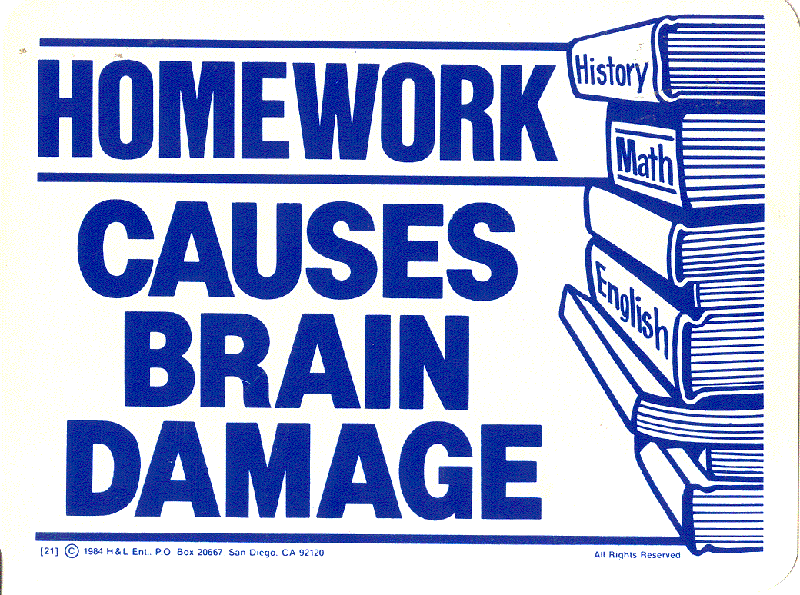
Sometimes, the effort to convert free time into a part of the working day is obvious, many times it is not. In many jobs the employer expects the workers to use their "free" time for company business. Corporate employees, for example, are expected to take work home at night if necessary, as well as putting in long formal hours. An example has been the effort on the part of high tech computer firms to convince its employees to spend their time driving to and from work listening to tapes on which have been recorded articles on the latest developments in their area. Students are expected to use their "free" time for homework. Secondary school teachers are regularly forced, by the size of their classes and the occupation of their time at school, to take home papers to be graded or other work. University professors, whose raises and promotions depend upon publishing inevitably convert many hours that might be "free" into work. Perhaps the most extreme example of such efforts were the hopes a few years back for "sleep-learning" in which everyone could be plugged into a tape recorder a night and go on working while asleep! Such was the modern version of the capitalist fantasies Marx relates in the 17th through the 19th Century. 
On the other hand, much of the capitalist colonization of free time has been more subtle and indirect. The conversion of all of society into a "social factory" proceeded over a long period of time and paralleled the liberation of time from waged labor. From the time of the progressive era with the rise of public schooling through the post-WWII period, capital invaded the time workers had liberated from waged work and shaped it for purposes of social control. Perhaps the most obvious moment of this colonization was the re-incarceration in schools of the young (who were expelled from the factories by child labor laws) such that what might have been free time was structured to convert their life energies into labor power. In this way the possibilities of "the free play of mind" which Marx had envisioned for time set free from work were converted into the labor of creating labor power —as the learning process was sharply structured with the student-teacher opposition.
While Marxist cultural critics have also elaborated an extensive critique of the capitalist colonialization of free time through the structuring of consumption, probably the most instructive of what has been written on this theme has been written by women. For the distinction between work time and free time has always been nebulous for housewives. Unlike factory workers where work time and free time, at least apparently, are separated by the gates of the plant or the doors of the office, women working in the home and community have no clear cut division between what is "housework" and what is supposed to be self-fulfilling activities. In fact, as any number of feminist writers have pointed out, much of what has been justified as "love and nurturing" has often been work —either for men or for capital or for both— with little or no self-fulfillment involved. Shopping, house cleaning, child care and even sexual activity can and often has been reduced to the work of reproducing labor power. The increasingly common observation that husbands retire but housewives never do speaks to this muddled boundary between work and freedom. We can also examine the cultural society of the spectacle, as the Situationists have done, to see how working class time is occupied and structured to merely restore the vitality necessary to work rather than infusing energy for struggle. Observations such as these lead us to see that the boundary between work and non-work is fuzzy because so much of "non-work" time is actually structured to reproduce work time.
However, unlike those who see only domination and no effective struggle in such spheres, who see, for example, only the instrumentalization of the wage struggle —wage driven consumer demand contributing to the expansion of capital— we must also see the ways struggle often ruptures accumulation and causes crisis. One critical theorist, Herbert Marcuse, understood how the autonomous appropriation of consumption had revolutionary potential in the youth revolts of the 1960s. But, having written off the working class as sold out, he failed to see how the rupture of the Keynesian productivity deal in the factories could also undermine capital and lead to the refusal of what he, following Freud, called the sublimation of libidal energies into work.
We can recast the critical theory preoccupation with consumerism both by seeing how consumption is shaped by capital to reinforce a life based on work and how this is resisted. Critical theorists have often argued that consumption has replaced work as the key category of advanced capitalism. What they fail to demonstrate is that the subordination of consumption to work has been reversed. It seems to me on the contrary that it is rather easy to show how most spheres of consumption are structured as spheres of the reproduction of labor power, i.e., of life as the capacity to work.
Yet, at the same time, we must also examine the struggles against this subordination of free time to life-as-work. We must recognize how students have resisted being conditioned into dutiful workers. We must learn from feminist literature how women have fought against their subordination to men (and to capital). We must examine how the passivity inculcated by the spectacle has been repeatedly ruptured and people have taken the initiative in the shaping of their own and their communities lives. We must see how people have either refused or taken and subverted the consumerist commodities through which capital has sought to structure our lives. We must listen to hear how music has escaped the limits of commercialism and fired resistance and revolt. We must watch to see how, even in Hollywood, films have reproduced and circulated people's struggles against their integration as passive pawns in others games. All this is what is involved in extending Marx's analysis of the fierce working class resistance to the expansion of the working day to the class struggle over whether free time will really be free.
Section 6: Struggle for the Limitation of Working Hours
Outline of Marx's Discussion
Capital: last 1/3 of 18th Century: avalanche of violent and unmeasured extensions of working day
Working class: Began to resist: "As soon as the working class, . . . had recovered its senses . . . it began to offer resistance, first of all in England the native land of large-scale industry."
1802 - 1833 Five labor laws are passed in response to working class struggle
—but there is no enforcement
—children and young people are worked all night, all day or both
1833: The Factory Act of 1833 is passed, will last till 1844
—applied to cotton, wool, flax & silk factories
—regulated hours of children and young people
—set working day at 15 hrs (5:30 - 8:30)
—set maximum hours at 12 (during this 15 hr period)
—set minimum meal times of 1 1/2 hrs
—no children under 9 yrs (mostly)
—set maximum hours of children 9 - 13 yrs at 8 hrs
(except in silk industry with 10 hrs)
—banned night work for ages 9 - 18
—no regulation of adult workers over 18 yrs, could work 15hrs
Capital: the capitalist response was to find new ways to lengthen hours
—mainly the development of the relay system
—ages 9-13 worked in two shifts (5:30-1:30; 1:30-8:30)
—made it hard to judge compliance with law
—sought to lower age of childhood from 13 to 12 —this was defeated by working class:
—"'the pressure from without' became more threatening"
—sought to repeal corn laws to lower wages
Working Class: during this period workers began to demand the Ten Hours Bill, achieved:
1844: Factory Act of 7 June 1844
—protected women workers over 18
—by limiting hours to 12
—by banning night work
—reduced hours for children under 13 to max. 6 1/2 hrs
—except silk which got 10hrs for 10-13 yr olds
—attacked the relay system (a main object of the law)
—all labor must end at same time
—labor time regulated with public clocks
—hrs to be posted
—still no regulation of hours of adult male workers
—The results of this was the generalization of the working day to 12 hrs
1847: Factory Act of 8 June 1847 (10 Hours Act)
—reduced hours for young persons (13 - 18) and all women to 11 hours
—hours to be reduced to 10 on 1 May 1848
—still no regulation of hours of adult male workers
1848: Revolutions of 1848 swept Europe
Capital: the capitalist response to these laws included:
—use of crisis of 1846-47 to repeal corn laws, proclaim free trade
—reduce wages (about 25%)
—attempt to get workers to demand repeal of Act of 1847 (failed)
—attack on factory inspectors (failed)
—counterattack against working class in wake of uprisings of 1848
—dismissals of young people and women (regulated hours)
—restored night work for adult males
—shifted meal times to before and after work (failed, courts ordered otherwise)
—reorganized "relay system"
—divided up hours into "shreds of time" (p.403)
—kept workers in factory longer than work hours
—"hours of enforced idleness" (paid 10 hr wages for control over 12-15hrs)
—Home Secretary George Gray told factory inspectors to lay off
—local courts acquitted mill-owners of violations of Act
—1850: Court of the Exchequer ruled Act of 1844 was meaningless
Working Class: Against these counterattacks, the workers struggled harder:
"So, far, the workers had offered a resistance which was passive, though inflexible and unceasing. They now protested in Lancashire and Yorkshire in threatening meetings . . . class antagonisms had reached an unheard-of degree of tension."
1850: The Factory Act of 5 August 1850
—ended the relay system
—set work day at 6am to 6pm (except for children:attack on adults)
—set 1.5 hrs for mealtime, same time for all
—but allowed increase in hours of young and women from 10-10.5 M-F, reduced to 7.5 on Saturday
—silk again the exception, children 10--13 could still be worked 10.5 in some branches: silk-twisting and silk winding
1853: a law was passed limiting time children could be kept at work to 6am to 6pm
—forced by adult males who didn't want children used against them
—cumulative result was to achieve 12 hr day for all, including adult males
—result: "physical and moral regeneration of the factory workers"
—"capital's power of resistance gradually weakened, while at the same time the working class's power of attack grew"
1860: dye works and bleach-works brought under Factory Act of 1850
1861: lace and stocking factories brought under Factory Act of 1850
1863: earthernware products, matches, percussion caps, cartridges, carpets, baking, etc.
Commentary
The first point I want to make about this section is methodological. Throughout his historical sketch, although from time to time he discusses specific groups of businessmen and and workers, Marx mainly discusses the class struggle in terms of two personifications of the classes: capital and the working class. He thus carries on his discourse at two levels of abstraction: specific industries, general classes. He even, from time to time, cites specific individuals who took particular actions at points in time --a third level of analysis. Clearly a complete history of this period would require an interweaving of all three levels: class, industry, individual. The point here is to see the circumstances in which he feels free to talk about "capital" in a general way. He does this when and where the actions of specific groups represent or express the interests of classes as a whole. When a specific group of capitalists introduced the relay system to outflank the law, Marx saw them acting as representatives of their class, others followed their lead, they were the most innovative at that point of the class struggle, thus they represented not just themselves but "capital."
The second point I want to make concerns the fundamental shift that takes place from the last section to this section. In the last section (and indeed in the opening sentences of this one too) Marx was emphasizing the way in which capital was on the offensive, pushing out the limits of the working day, imposing longer hours etc. Thus he points to the last 1/3 of the 18th Century as a period in which the capitalists at the height of their power pushed working hours beyond all bounds. In these circumstances the working class plays a defensive role, it merely resists even if this resistance is "inflexible and unceasing." But in this section, we see a shift in initiative in the class struggle. This occurs as the workers' resistance grows to the point where they can block further extension of the working day, and then, the workers pass over to the attack, they take the initiative in the class struggle. From the Factory Act of 1933 on, the regulation of the working day means not only a setting of the maximum number of hours, but that maximum is steadily being reduced. What Marx is describing here are defensive manoeuvres by capital to defend the long hours they were able to impose originally and then to resist the reduction of those hours. But first work for children, then that of women and finally that of adult men is limited and reduced.
This was a fundamental turning point in the history of class struggle in capitalism. After this point for decades the workers were on the offensive the majority of the time. The achievement of ten hours limit on the working day was followed by agitation for the 8 hours day, and by the 1930s not only had most workers in the United States achieved the 8 hours day, they also achieved the five day week with the liberation of the weekend from capitalist time. In the United States the working week was chopped down by working class struggle from an average of 75-80 hours in 1880 to 40 hours in 1940. For forty years after that the struggles shifted from the working week to the working year and life cycle as workers fought for more paid holidays and early retirement. Although in recent years capital has regained the initiative, it must be seen that the historical trend throughout most of the 20th Century was successful working class struggles to reduce the portion of their lives given up to capital. As in early periods, capital resisted each and every such reduction. It seems to understand intuitively that a reduction of hours is not only a threat to its immediate profits but also a long run threat to the very survival of the capitalist system. As the portion of life time devoted directly to work drops, it becomes ever more untenable to demand that the rest of life be subordinated to that diminishing percentage.
Which brings us to another important point. Given the success of workers struggles to limit and then reduce the working day, the expansion of "free time," as we saw earlier, has led to capitalist attempts to colonize that time. The reduction of commodity production time has led to ever greater efforts to reduce "free time" to the work of reproducing labor power within the social factory. Now, just as I argued in the last section that we must learn to recognize struggles against this encroachment on free time, so too must we learn to recognize when such struggles pass over from defense to offense in ways that parallel the shift in factory struggles Marx describes in this section. We must learn to differentiate between resistance and offense. For example, with respect to school we can argue confidently that while prior to the mid 1960s students were fighting a defensive —and often fragmented and individualistic— battle against capitalist efforts to subordinate education to business, the mid- and late-1960s saw the kind of shift we are looking for. Instead of merely resisting the functioning of the school as factory, students took the initiative and attacked its structures, demanding more time for their own projects, their own courses of study. So successful were these attacks that a wide variety of spaces were opened for study critical of capital and unsubordinated to its needs. By forcing the creation of courses and fields such as women's studies, radical economics, insurgent sociology, black studies, chicano studies, and so on, students were beating back their working day and expanding the time available to them for their own purposes. This reduction in the time during which students could be forced to work for capital (i.e., being disciplined into dutiful workers) is analogous to the reductions of factory work time Marx is describing in this section.
What is missing in this section, as in other parts of Capital, is adequate discussion of just how workers were able to achieve these changes in their benefit. Just as we need to know how they failed to block the extension of work in the previous period, so to do we need to know how they were able to pass over from an ineffective defence, to an effective one and then take the initiative. We know a few things from this section: for example, that the working class used Parliament, the Factory Inspectors, the Courts, and "threatening meetings" to fight for less work. To truly understand, we obviously need much more detail and analysis. The same is true about the struggle against the work of reproducing labor power, e.g., in the school. In this period in which students have been mostly on the defensive, there is an obvious need to go back and understand how a previous generation of students were able to take the offensive and force changes in their own interests. In Capital Marx draws our attention to such struggles and shows how important they have been in the development of capitalism. This is a vital step. But we must push the method further and deeper to learn all we need to learn.
Section 7: The Impact of English Legislation on Other Countries
Outline of Marx's Discussion
- First Point: after having been imposed first in the earliest large scale industries (textiles) the factory legislation was gradually extended to all of industry.
Second Point: isolated workers are helpless, organization and a "more or less concealed civil war between the capitalist class and the working class" is necessary to limit and then reduce the working day."
France: "limps slowly behind England"
—factory legislation brought by February Revolution
—but legislation is comprehensive and becomes a general principle
United States: struggle for less work was impossible as long as slavery s urvived
—"Labor in a white skin cannot emancipate itself where it is branded in a black skin."
—first fruit of Civil War was 8 Hours agitation
—1866 General Congress of Labour in Baltimore calls for 8 hrs
First International: The International Working Men's Association
—Congress in September 1966 calls for 8 hrs universally
Conclusion: "the workers have to put their heads together and, as a class, compel the passing of a law, an all-powerful social barrier b y which they can be prevented from selling themselves and their families into slavery and death.."
Commentary
The main emphasis in this short section is to point to the obvious conclusion from the foregoing historical sketch: namely, that to bring about changes beneficial to themselves workers have to "put their heads together," organize and fight collectively. They must overcome the divisions which separate and pit them against each other (e.g., racial divisions) and organize on all levels, including the international level. As Marx argued, the struggles of Southern slaves were key to the struggle of "free" workers in the North. Marx's participation in the First International was testimony to how strongly he felt that workers had to organize and circulate the experience of their struggle from country to country and not let themselves be isolated —down that path his studies showed nothing but defeat. Today the struggle of workers in Mexico, and elsewhere in the Third World, are key to those of Americans. The weakness of the former has been used to undercut the power of the latter —a division the North American Free Trade Agreement, the World Trade Organization and the proposed Free Trade Agreement of the Americas are aimed at exploiting. Without the gains won in the North (U.S., Western Europe and Japan) being extended to the South (the Third World), capitalists will continue to pit poor, weaker Southern workers against more powerful Northern ones. With that extension the international circulation of struggle will strengthen all. One attempt to achieve such circulation has been through the International Labor Organization with its calls for international labor standards (e.g., of working hours, conditions etc). Another example is the collaboration of workers in different countries, such as the support by steveadores all over the world for the Liverpool Dockers a few years ago. Even more important has been the emergence of a global movement against the current neoliberal capitalist attack on workers around the world. Pushed not only by national governments but by supra-national institutions such as the International Monetary Fund and the WTO, such policies are under- cutting worker rights and wages and giving capitalist the leverage to extend working hours. Against these efforts, ever since the Intercontinental Encounter in Chiapas in 1996 tens of thousands of grassroots and labor organizers have been mobilizing a global movement to counter the capitalist offensive. From Chiapas to Geneva, from Seattle to Davos, from Prague to Genoa capitalist efforts have been brought under ever increasing attack. Perhaps Marx's dream of an effective "international" of workers is finally being realized.
With respect to this aspect of his analysis of the struggles, we can note that what has been true about factory workers has also been true for workers in reproduction. Isolated individuals, be they students, housewives, children, or the homeless are usually defeated in their struggles. When and where they have been able to build collective movements as in the student movement of the 1960s or the women's movement of the 1970s (or perhaps the homeless movement of today?) they have been more successful.
The Work Week and Popular Music
In Marx's time the "working day" was the most common measure of working time because most people worked every day and there was no such thing as a week end. In the United States the weekend was created in the 1930s during the cycle of struggle that imposed the 40-hour week as the norm. Given the history of the struggle for the 8 hour day which had been going on since the 19th Century, a 40-hour week has meant 8 hours a day, 5 days a week, for most people. As a result, since that period the "week end" of two days, usually Saturday and Sunday, has become standard and most discussions of further shortenings of work time have concerned an extension of the week end. For example, in the early 1970s there was a brief renewal of overt demands for a reduction in work time as unemployment began to rise and once againk, as in the 1930s, workers suggested spreading existing work over more people by shortening the amount of work time for each individual. In practice, however, most reductions of work time that have occurred over the period since WWII have involved marginal increases in annual vacation time rather than reductions in the working week.
Given this situation, coupled with most people's experience of work as an onerous, imposed activity which they would prefer to avoid, a great deal of popular culture which deals with work has focused on the working week. The almost universal critical attitude toward it is manifest in the resentment of, and attacks on, Monday —the day people must return to work— and celebrations of Friday —the day people escape from work. We find these attitudes recurrent in such widely appreciated cultural icons as the cartoon strip in which the main character Garfield detests Monday and "lives for the weekend". People identify with this attitude despite the fact that Garfield himself never goes to work, no matter what day it is! It is the attitude that matters, the almost universal loathing of the obligated return to the job. In a parallel fashion, the most common prayer in America, regardless of one's religious faith, is "Thank God, It's Friday" or TGIF which, among other things, was adopted as the name of a chain restaurant because of its widespread appeal.
These attitudes have also been reproduced, elaborated on and circulated in almost every form of popular music. Rock & roll, country-western and punk song writers and bands have all contributed to the construction of a corpus of musical denunciation of the working week and of the rhythm of the working days which constitute it. The songs that follow are a small sampling of this body of music. The first of these is a general attack on the working week as a whole. "I know it won't thrill you, I hope it don't kill you", Elvis Costello sings. The points are well taken because not only do most people dislike working but work does kill, thousands of people each year, either through on-the-job accidents or through its byproducts such as stress and insanity.
 Welcome to the Working Week Now that your picture's in the paper Chorus: All of your family had to kill to survive Chorus I hear ya saying that the city's allright Welcome to the working week Elvis Costello, My Aim is True, 1977 |
The next two songs are both attacks on Monday, the first and most despised day of the working week. In the first, by the women's rock group the Bangles, the unpleasantness of getting up and going to work is contrasted with the pleasures of Sunday, making love and dreaming. Despite the unpleasantness of a "run day" when she must hurry, hurry, get dressed, catch a train and make it to work on time, the singer will get up and go to work for exactly the classic reason within capitalism: in order to eat! In this case the pressures on her are even greater because her lover is unemployed and they both depend on her job for survival —the traditional situation of the family with only one wage earner.
Manic MondaySix o'clock already Chorus Have to catch an early train, Chorus All of the nights Chorus The Bangles, Different Light, |
In the second of these two songs, the dislike for Monday takes dramatic form: violent resistance. This song "I Don't Like Mondays" was written by the Boomtown Rats as a memorial to the actions of a student in California who, one Monday morning, decided that not only did she not want to go to school but that no one else should go either. To implement her decision, this school girl who apparently lived across the street from the school took a rifle and started shooting. In their song, the Boomtown Rats reflect on the general amazement that followed this event as no one could understand how this hitherto quite ordinary 16 year old —who was always "good as gold"— could do such a thing. In the Rats interpretation, "the silicon chip inside her head got switched to overload" —in other words her programmed behavior of going to school every Monday became more than her humanity could tolerate. "Why?" everyone asked, "what were the reasons?" Well, the Rats respond, "They can see no reason — Cause there are no reasons — What reasons do you need to be shown?" In other words, what needs explaining is not why she flipped out, but why it didn't happen long before. How was it possible for a healthy human being to be programmed into weekly self-destruction without revolting? That is what needs to be explained, not why she didn't want to go to school. All of this, of course, is based on the understanding that school like the factory is a place of encarceration, that schoolwork really is work, and is imposed on most people just like other kinds of work; and therefore, that revolt against unwaged schoolwork, like the revolt against waged work is a perfectly sane response. The song is reminescent of the analysis of schizophrenia by Richard Cooper and R. D. Laing who have argued that people sometimes find themselves in insane situations to which the only sane response is insanity.
I Don't Like MondaysThe silican chip inside her head Tell me why, I don't like Mondays The telex machine is kept so clean Chorus The playin's stopped in the playground now And the silican chip inside her head
The Boomtown Rats, |
The last four songs that I have included here all deal with the daily routine and pains of the working day. Dolly Parton's "9 to 5" is from the movie of the same name and describes not only the morning rituals of drugging one's self awake and dragging one's self to the job, but also the exploitation on the job where "they just use your mind and they never give you credit" and "you're just a step on the boss man's ladder". Without ever speaking of "capitalist society" as such Parton says the same thing in American vernacular: "It's a rich man's game, no matter what they call it — And you spend your life puttin' money in his wallet".
9 to 5Tumble out of bed and stumble to the kitchen Jump in the shower and the blood starts pumpin Chorus Working 9 to 5 for service and devotion I swear sometimes that man is out to get me They let you dream just to watch them shatter You're in the same boat with a lot of your friends Chorus Workin 9 to 5 they got you where they want you Chorus Dolly Parton, 9 to 5, |
The second of these four songs is by The Clash, the second best known British Punk band (after the Sex Pistols). Like Parton's "9 to 5" it rails against the working day from dragging one's self from bed at 7 a.m. through work, till quiting time and beyond to a life poisoned by work. The title of the song "Magnificent Seven" is, of course, ironic. Seven in the morning is NOT magnificent but rather damned because it is the time you have to start getting ready for work "Move y'self to go again — cold water in the face — brings you back to this awful place". On the job "clocks go slow in a place of work — minutes drag and the hours jerk" till lunch when you can "wave bu-bub-bub bye to the boss" and get away from the grind. The Clash are very clear about the qualitative nature of time in this song, when they sing about lunch time that "It's our profit, its his [the boss'] loss" they emphasize the work situation when our work is his profit and our loss. Work is money for the boss, loss of life for us. Time away from work is life for us, loss of profit for capital. Work in the afternoon, the after lunch, the after freedom (such as it is, watching cops kickin' gypsies on the pavement!) is no better: "So get back to work and sweat some more . . . It's no good for man to work in cages". But what follows, once you "get out the door" and escape at the end of the day? The worker "hits the town, he drinks his wages" Workers never make enough money to change their basic condition: "did you notice you ain't gettin?" At the end of the song there is an evocation of various people who have struggled against some aspects of capitalism, Marx and Engels, Martin Luther Kind and Mahatma Ghandi. The reference to Marx and Engels is humorous and refers to Marx being poor and having to borrow money from Engels. The reference to King and Ghandi is much more bitter, "they was murdered by the other team".

Magnificent SevenRing! Ring! It's seven A.M.! You Lot! What? Don't Stop! Working for a rise, better my station Wave bu-bub-bub bye to the boss You lot! What? Don't Stop, huh? So get back to work and sweat some more Karlo Marx and Fredrich Engels What have we got? Yeh, o, magnificence!! Luther King and Mahatma Gandhi |
The last two songs by the British rock band The Kinks comes from a concept album entitled Soap Opera. Most of the songs on side A of that album deal with the working day and its consequences: before, during and after official work hours. I have reproduced only two here, those dealing with getting to work ("Rush Hour Blues") and with the job itself ("Nine to Five" —the same title as Parton's song). Once again, 7 a.m. begins the day —well before the official job itself at 9 o'clock. As this and the other songs make clear the real working day is much longer than the official one and includes getting ready for the job and getting there. From Parton's "cup of ambition" through The Clash's "cold water in the face" to The Kinks' cup of tea, the story is the same: there is no spontaneous enthusiasm that brings one springing from bed in joyous anticipation of going to work. On the contrary, dreams, yawns and reluctance require shock and drug treatment to be overcome. In The Kinks song, the reluctance becomes resistance to being hurried to the unpleasantness of both commuting and work itself. "The Rush Hour Blues" laments all the details of the daily annoyances of commuting, "waiting for the train", "rushing up the stairs and in the elevator", being "caught in the crush", being "pushed" and "shoved", "fightin with my briefcase and my umbrella". And the worst of it is "some people do it every day of their lives"!!
The second Kink's song "Nine to Five" has something of the same tenor as that of The Clash. Work life "is so incredibly dull", "the hours tick away — the seconds, the minutes, the hours, the days — each day, each week — seems like any other". And the result, like the little girl in California is "he's starting to lose his mind" —or take it back, depending on your perspective.
 Rush Hour BluesHe gets up early, about 7 o'clock So put a shine on his shoes Darling, are you ready Get a move on darling So put a shine on his shoes Soon I'll be just one of the commuters I got the rush hour blues |
I'll be pushed and be shoved and I'll be tryin to get the subway train I'll be fightin with my briefcase and my umbrella every morning and every night Some people do it every day of their lives I got the rush hour blues My, my, every day, every night Some people do it every day of their lives Mr. Paper later you'll get caught in the queues Darling get a move on Nine to FiveAnswering phones and dictating letters And time goes by He's caught in a mass of computerized trivia The Kinks,Soap Opera, |
Recommended Further Reading
- On the history of struggle over work time in America see David R. Roediger and Philip S. Foner, Our Own Time: A History of American Labor and the Working Day, New York: Verso, 1989. On the same struggle in recent years see Juliet Schor's book The Overworked American: The Unexpected Decline of Leisure, New York: Basic Books, 1991.
For the story of the struggle to get byssinosis recognized by industry and government in the United States, see: The cotton dust papers : science, politics, and power in the "discovery" of byssinosis in the U.S. by Charles Levenstein and Gregory F. DeLaurier, with Mary Lee Dunn (Amityville: Baywood Pub. Co., 2002).
For updated information on working conditions in the contemporary meatpacking industry read the articles from The New York Times and from Mother Jones.
Concepts For Review
normal working day free time nibbling and cribbling |
child labor Factory Acts Chartist movement |
Questions For Review
(An * means that one possible answer can be found at the end of the study guide.)
1. Explain what determines the maximum and minimum limits to the working day.
2. Explain why it made sense in Marx's day to look at the time workers worked in terms of the length of the working "day". Discuss what measures would be appropriate in our time period.
*3. Discuss the argument that the concept of the length of the working day should be understood to include not only the phase of production but also activities of reproduction. What is "free" time? How can we tell if it is really free?
*4. Explicate: "Between equal rights force decides. Hence it is that in the history of capitalist production, the determination of what is a working day, presents itself as the result of a struggle, a struggle between collective capital, i.e., the class of capitalists and collective labor, i.e., the working class."
*5. In Section 2 of Chapter 10 Marx says that "Capital did not invent surplus labor." What then did it invent? What is the relation of this invention to the form of value? to primitive accumulation? to valorization? to our understanding surplus labor in a dynamic sense? to our understanding of what needs to be transformed in the sphere of reproduction?
6. What, according to Marx, was the impact on slavery in the United States of the mobilization of slaves to produce for the world market? Why did this occur? Explain its relation to the logic of the system?
*7. Discuss "nibbling and cribbling."
8. What parallels can you find today to the murderous conditions of work in many English industries in the 19th Century? Are they, too, associated with working too long?
*9. Explain the logic of the capitalist move to keep production going day and night and demanding that the workers work all night long. To what degree does this pattern find itself repeated in the case of reproduction? Discuss this last question with reference to the age hierarchy.
*10. Discuss the pattern of struggle over the length of work time since the rise of capitalism. During what periods was capital on the offensive? What methods did they use? During what periods did the working class take the initiative? What methods did they use? What can we say about these trends during the 20th Century? Today?
11. What will be the effect on capitalist attempts to impose long hours of labor of the ready availability of large amounts of unemployed cheap labor? What will be the effects on the lives of workers? What conclusions might one draw for immigration policy?
12. What does this chapter tell us about competition among capitalists?
*13. Discuss the relationship between the labor theory of value and the struggle over the length of the working day.
*14. What motives may lie behind recent moves by workers in Western Europe for a shortening of the working week? In other words, what were the pressures on the European Commission that prompted it on September 20, 1983 to endorse the shortening of the working week? What are the likely reasons why European business strongly opposes such a change? Explain this from the point of view of the firm and from that of the capitalist class viewed as a social power.
*15. Discuss the international ramifications of working class success in struggling over working time in a given country -- but not in all. Discuss this, in particular, in a contemporary context in the light of the multinational corporation.
16. Discuss the implications of Marx's analysis of the struggle for a normal working day for our understanding of the way he uses the concept of "law of motion" of capitalism.
Attachments
Comments
Harry Cleaver's study guide to chapter 11 of Marx's Capital volume 1.
Outline of Marx's Discussion
The rate of surplus value = s/v = (for example): (6 hours)/(6 hours),
or 100% or (3 shillings)/(3 shillings), or 100%
First Law:
- e.g., if Vt declines, a rise in s/v can maintain Sm at the original level. Therefore, the level of exploitation is, to some degree, independent of the supply of workers.
- e.g., a decline in s/v can be compensated by an increase in the number of workers.
(At the level of society, the growth of population sets a limit to such an increase.)
mass of surplus value = Sm = Vt(s/v),
where Vt = (v = value of average labor power)(# workers)
= total variable capital
= total hrs necessary to reproduce LP
Implication of First Law:
A decline in one factor can be compensated by an increase in another in order to maintain the mass of surplus value.
Second Law:
But, the absolute limit of the average working day ( 24 hrs) sets an absolute limit to the degree to which the decline in the number of workers can be compensated by a rise in s/v through an extension of the working day.
e.g., if Vt = 1500 for 500 workers, s/v = 100% for a working day of 12 hours, then Sm = 1500.
if the number of workers drops to 100 and Vt = 300, and the length of the working day is raised to its physical limit, say of 18 hours, the 100 workers will only be able to produce a Sm of 600.
Third Law:
The mass of surplus value varies directly with the investment in variable capital, i.e.,
this is not affected by differences or changes in c/v
—either between different branches of industry
—or in the same branch
But, this law contradicts immediate experience which is that different industries tend to generate the same rate of profit even though their organic composition of capital may be quite different .
Observations on the Definitions of Classes:
- Independent workers: own/control their means of production
e.g., small farmers concerned primarily with their own subsistence - Capitalist who-also-works: hybrid, e.g., a “small master”, such as those in the guilds
- Capitalist qua capitalist: “capital personified”
- —fully devoted to the “control of the labor of others”
—requires an increase in the number of workers controlled
—this was opposed by the guilds
—in order for this to happen some minimum amount of capital had to be available to the would-be capitalist
- —if minimum too large then capitalists might acquire either 1) state subsidies or 2) a monopoly in the market for their goods.
—thus Hegel’s quantitative change (increasing number of employees) which becomes qualitative (conversion of the small master into a capitalist)
Main Points:
- Capital develops within production until it acquired command over labor
- This command is coercive:
- —forces people to work more than necessary for their needs
—more coercive than all earlier systems of directly compulsory labor — unbounded. - At first this coercion is exercised with no change in technology.
- But the relation between workers and their means of production is soon inverted and the MP
- —become the means for the absorption of the LP of others
—come to consume the workers instead of visa versaCommentary
This chapter provides a summary of some keys ideas in section III on absolute surplus value. So, the first thing to keep in mind is that within the context of the discussion of absolute surplus value, the intensity and productivity of labor are held constant.
The First Law
Thus, the First Law states that the only way the capitalists can increase the mass of surplus value is by increasing the number of workers (which raises Vt) and/or increasing the length of the working day (which raises s/v by raising s {and v + s}).
(It should be obvious that an increase in Vt that occurred because of an increase in the value of labor power would undercut the mass of surplus value, not increases it. Mathematically this would occur because an increase in Vt that occurred because of an increase in v would also result in a fall in s (and in s/v) as long as the length of the working day were held constant at v + s. In other words, the better paid workers would be producing less surplus value in the same work time. For this reason, Marx assumes v is constant in this chapter and changes in Vt are due solely to changes in the number of workers.)
Let’s look at an example of the implications of the first law, a case in which a decline in the number of workers is offset by an increase in the length of the working day (which produces an increase in s/v)
- Assume: v = 3 shillings [or 6 hours of work],
# workers = 100,
so, Vt = 300 shillings, [or (v{#}) = (3•100), or (6•100 = 600 hrs)]
if s/v = .5 (or 50%), [1.5/3 in shillings, 3/6 in terms of hours)]
then, Sm = 150 shillings in a 9 hr working day [9 = 6(v) + 3(s)]
= 300 hrs surplus labor [3•100].If Vt declines from 300 to 150, because the number of workers falls from 100 to 50,
Sm would fall to 75.
But, if the length of the working day is lengthened from 9 to 12, then s/v will rise
from 3/6 (or .5) to 6/6 (or 1, or 100%) and Sm will remain at 150 shillings.
[before 100 workers were producing 300 surplus hours (100•3hrs), now 50 workers are producing 300 surplus hours (50•6)]In other words, if for some reason capitalists must reduce employment, then they can try to compensate by getting their remaining workers to work longer so as to raise the rate of surplus value and to keep getting the same amount of surplus value. The law also says that if workers somehow manage to reduce the rate of exploitation, e.g., by forcing up v (or wages), then the only way for the capitalists to maintain their total mass of surplus value would be by putting workers to work.
The Second Law
The point of the second law is that this process of compensation has its limits and those limits are set by the absolute length of the average working day. Biologically speaking, that absolute limit must be something less than 24 hours because no one can work continuously without rest and sleep without dying. At the height of capitalist power the level of such an absolute limit was explored as capital pushed the daily number of hours people were forced to work out to 14, 15 even 18 hours. Marx recognized that such extreme limits, although sustainable for a number of years, had the long run effect of shortening the life time of the workers. This, of course, didn’t matter to the capitalist as long as new recruits were available —from new generations or from immigration or through foreign conquest. Fortunately, as we saw in chapter 10, the absolute limit came to be set not biologically but socially, by the power of the working class. Moreover, that limit was forced down over time by working class struggle. Therefore, this “absolute limit” he evokes here is a very real historical reality which constrains the capitalists’ ability to cope with a contraction of their labor supply.
In the example given above, we have seen that a halving of the labor force (e.g., a drop from 100 to 50 workers) could be compensated by a doubling of the s/v from 50 to 100% so that Sm stayed at 150 shillings (or 300 hours). But what the second law says is that given some limit to the length of the working day (say 18 hours), at some point a drop in the number of workers cannot be compensated. We can calculate that limit in this case by working backward using Sm = Vt (s/v) = (v•#)(s/v). If 18 hrs = 6v (assuming v fixed) + 12 (s), then extending the working day to its maximum means that an Sm of 150 shillings or 300 hours would be produced by “#” workers when 300 hrs = (6•#)(12/6) or 150 shillings = (3•#)(6/3). In both cases # = 25. In other words, if the number of workers fell below 25, it would be impossible for those remaining to produce 150 shillings worth of surplus value even working the maximum of 18 hours. A similar calculation will show that there would be such a limit even if workers could be forced to work 24 hours a day. So the limit will exist even if the capitalists had the power to literally work people to death.
For Marx, as he suggests briefly, this limit is important primarily because while capital always seeks to produce the maximum mass of surplus value, there are also strong tendencies for it to also reduce the number of workers as much as possible in any production process in order to facilitate control over the remaining workers. This tendency he will discuss at length in the next section on relative surplus value. It will appear as a part of the technological changes capitalists introduce in order to raise the mass and rate of surplus value by raising productivity.
The Third Law
The third law, that with v and s/v constant, the mass of value and surplus value produced is exclusively dependent on the mass of labor set in motion, is clearly derived directly from the first law. We can also state the 3rd law as: Sm varies directly with the number of workers employed, or ΔSm/ΔVt >0 or even, more directly, ΔSm/Δ# >0.
Now, inasmuch as this is pretty evident from everything said to this point, the main issue Marx emphasizes is that this holds true regardless of the amount of investment in constant capital. He juxtaposes the cotton spinner who has a very high organic composition of capital (c/v) with a baker who has a very low organic composition. After showing how surplus value is uniquely dependent upon the living labor set in motion by the capitalist, Marx turns to the issue of constant capital. He does this because, as he says, immediate experience suggests that most capitalists earn more or less the same average rate of profit despite employing very different technologies and c/v’s. Yet this seems to contradict the assertion that s and Sm depend uniquely on v.
Remembering that the rate of profit = Sm/(Ct+Vt) where Ct equals the total investment in constant capital, it would certainly seem that differing levels of Ct would produce differing rates of profit given the same Vt and Sm, even if Sm varies only with Vt and not with Ct. Given that Ct does vary enormously from industry to industry, and indeed from firm to firm, this would seem to contradict the notion of an average or general rate of profit. Marx deals no more with this issue in Volume I of Capital, but returns to this issue in part I of Volume III of Capital. In that discussion he argues that the notion of an average or general rate of profit remains valid because of the tendency for capital to reallocate itself across profit rate differentials and thus to create a tendency for profit rates to equalize. In that discussion the determining factor of the rate of profit is the organic composition of capital (the rate of exploitation is held constant) which tends to rise as a result of the substitution of controllable constant capital for less controllable workers —the dynamic discussed in part IV of Volume I of Capital under the rubric of relative surplus value. His discussion of such a tendency to reallocation later finds an impoverished expression in the neoclassical theory of long term equilibrium in an industry via the mechanisms of firm entry and exit —impoverished because emptied of its explicit class content.
Definitions of Classes and Individual Psychology
These comments emphasize the class distinction between worker and capitalist in two ways. The first is the question of control. While independent workers (not members of the working class —and thus not really “workers” but just people, or peasants, or artisans, etc) control their tools only in order to live, capitalists control tools in order to control people. The “capitalist” who also works is but a “small master” as in the feudal guilds where, say, a goldsmith would both work at his craft and employ a small number of apprentices. The capitalist qua capitalist, or the capitalist properly speaking, only works in the sense of controlling the labor of others, but not even in the sense of coordinating and managing their labor, rather in the simplest sense of making sure that they do in fact work —usually by hiring someone else to make sure that happens, e.g., a supervisor or manager. For small masters to become such capitalists they must have enough money to put to work enough people to generate a surplus value not only large enough for their own consumption but also large enough to allow investment and growth. (This aspect of capitalism will be emphasized and studied by Marx in part VII on “accumulation.”)
This discussion of intermediate cases between the extreme class prototypes (the worker who only works and the capitalist who only imposes work on others) is useful not only because it shows Marx’s awareness of such real life complexity, but also because it speaks to the issue of class in the age of the “middle class.” The contemporary counterpart to Marx’s “small master” would appear at first to be the middle class, lower level corporate managers who both work (have work imposed on them by those higher up) and impose work on others (those lower down). Further consideration shows that virtually everyone in contemporary capitalism lives this dichotomy somewhere in the highly segmented corporate wage hierarchy. Moreover, given the nature of contemporary social institutions for converting life into labor power, e.g., the public school system, virtually everyone lives this dichotomy internally, psychologically, as well as externally in their work situation. The inculcation of self-discipline, which is a prime prerequisite for getting middle and higher waged jobs, is a primary objective of schooling.
To the degree that such inculcation is successful, each person lives a continual tension between their capitalist side that keeps reminding them of their obligation to work and their working class side which repeatedly rebels against the subordination of their life to work. Among students such tension takes the form of internal conflict between the sense of obligation to go to class or to complete assigned homework and desires to play or to follow one’s own intellectual curiosity down uncharted, and unassigned paths. Among workers such tension takes the form of conflict between the sensed need to always be on time and always be focused on their work and the desire to carve out free time through absenteeism or playing on the job.
Resolution of the tension through the suppression of desire leads to the pathologies of workaholism, unidimensionality and social isolation. Resolution of the tension through the complete rejection of imposed work while perhaps leading to a happier and psychologically healthier life in the short run, may also lead to problems of survival in the longer run. Most people experiencing the unending pressures of capital to work and the insurgence of their own needs and desires struggle to work out a compromise whereby they can live with the tension. They learn how to resist the internalized “ought” enough to preserve space for some personal fulfillment, while giving in to it enough to survive. The tradeoff capital offers is clear enough: the more you are willing to subordinate your life to work, the more (on the average) you will be rewarded with income. At least that is the promise. In reality, of course, there are all kinds of limitations (such as sexual or racial discrimination as well as the wage hierarchy itself) which prevent some from being rewarded no matter how much they internalize the capitalist work ethic, no matter how hard they work.
What all this shows is that the issue of class in capitalism, whether at the level of society or at the level of the individual, concerns the struggle over competing ways of life: the capitalist way in which life is subordinated to work and alternative ways in which life is self-constructed and work is subordinated to that self-construction.
Main Points
In these four points Marx sketches what he considers vital aspects of the emergence of capitalism. First: capital develops within production (or takes it over) until it acquired direct command over labor. Thus the merchant capitalist becomes an industrial capitalist only as putting out and then the factory provide mechanisms to control other peoples’ labor. Capital is power over others, power to command their lives and make them convert their lives into labor. This is the basic point of part VIII on primitive accumulation.
Second, this command, which makes capital what it is, is coercive. Capital forces people to be workers, to be part of the working class; it forces them to work more than they otherwise would. Especially, it forces them to work longer than they would. This was the point of the discussion in Chapter 10 of the capitalist success at forcing out the length of the working day, at introducing night work and so on. Here he repeats what he emphasized in section 2 of chapter 10, that capitalism is more successful in the imposition of work than all earlier systems of directly compulsory labor. Unlike such earlier systems which imposed labor to achieve some finite purposes (building a pyramid or a Gothic cathedral or a chateau or a castle or the feeding of royalty, etc) the capitalist imposition of work knows no limits; it is unbounded, there is an endless “thirst” for surplus labor and its monetary equivalent. Where the imposition of work is the substance of the social order, the backbone of civilization, then the eternal maintenance of that order requires that such imposition be endless.
Third, command over labor, over life as labor, is prior to any question of technology. The capitalists at first take command, impose work, using the technologies available, whatever they are. The imposition of work is the main thing; how it is imposed is secondary. This priority is obvious in the putting out system and in early factories where traditional methods of production dominate. However....
Fourth, the method of production as embodied in the means of production themselves, soon become the vehicle for capitalist command. They are no longer tools in the hands of workers, but tools of the capitalist for the control of workers. Instead of being the means workers use to produce useful things, the means of production become, under the control of the capitalists, the means of absorbing the labor power of others, the means for putting people to work. Instead of the workers consuming their tools in the accomplishment of their own ends, the workers are consumed by the means of production in the accomplishment of the capitalists’ own ends which may involve the fetishistic chase after money and, quite independently of the consciousness of the capitalist, always involves the imposition of work. Note: there are many times and places where capitalists understand quite explicitly their role in maintaining social order. One common example is in periods of high unemployment when policy makers worry about the lack of jobs leaving too many people too free – people who’s free time threatens to be used in ways inimical to capitalist plans. Another example occurs during strikes by school teachers in which those same policy makers worry about the dangers of having vast numbers of young people loose in the streets instead of safely incarcerated in school houses.
This discussion which ends section III on absolute surplus value, sets up the reader for the next section on relative surplus value by focusing attention on the issue of technology and the means of production. Relative surplus value, Marx will show, is that surplus value obtained through the manipulation of technology for the purpose of imposing more work on the workers or of obtaining a greater proportion of the work they are already performing.
Concepts for Review
- rate of surplus value
mass of surplus value
variable capital- First Law and implication
Second Law
Third LawQuestions for Review
1. Practice thinking about the meaning of the First Law in terms of hours of abstract labor time. In the following table it is assumed 1) that the cost of reproducing each worker is given at 6 hrs of labor per day, 2) that the length of the working day is 12 hours and 3) that the rate of exploitation is set at 100%. Calculate the missing values in the table using the “first law.”
# workers v (hrs) Vt work day total hrs ave. s/v Sm in hrs 1 6 6 12 12 100% 6 2 6 12 12 24 100% 12 3 6 12 100% 100 6 12 100% 2. Practice thinking about the meaning of the first law in terms of money. In the following table it is assumed 1) that the cost of variable capital per worker is 3 shillings a day, 2) that the length of the working day is 12 hours, and that 3) the rate of exploitation = 100%. Calculate the missing values in the table using the first law.
#
workersv
(shillings)Vt
(shillings)work day
(hrs)total value
(shillings)ave. s/v Sm
(shillings)1 3 3 12 6 100% 3 2 3 6 12 12 100% 6 3 3 12 100% 100 3 12 100% 3. A central implication of the first law is that capitalists can compensate for a decline in Vt by raising s/v through an increase in the length of the working day. In the following table, use the first law to calculate by how much the length of the working day and s/v must be increased in order to maintain an Sm = 300.
#
workersvt
@v= 3 shillingsWorking day
(hrs)s/v Sm 100 300 12 100% 300 90 270 300 80 300 70 300 60 300 4. The second law says there are absolute limits to the ability of the capitalists to compensate for a decline in the number of workers through an increase in s/v and the length of the working day. Extend the above table and calculate the # of workers below which Sm will fall even if they could be made to work 24 hours a day.
#
workersvt
@v=3 shillingsWorking Day
(hrs)s/v Sm 50 300 40 300 -- 300 5. The Third Law states that the mass of surplus value will vary directly with the number of workers set to work given the length of the working day and s/v. Calculate the values in the following table to show this, starting from the employment of 100 workers.
# workers Vt
@ 3 shillingsWorking
Days/v Sm
(shillings)Δ# ΔSm
(shillings)200 12 100% 150 12 100% 100 300 12 100% 300 -0- -0- 50 12 100% 6. As Marx showed in Chapter 10, eventually workers struggled successfully to reduce the length of the working day. Fill in the following table to see what the impact on s/v and Sm would be with no compensating increase in the number of workers.
#
workersvt
@v= 3 shillings
Working day
(hrs)s/v
(shillings)Sm
(shillings)100 300 12 6/6=100% 100 300 10 100 300 8 Now, calculate how many more workers the capitalists would have to set to work to make up for the fall in working hours in order to maintain the same mass of surplus value. How much capital will they have to invest in mobilizing labor?
#
workersvt
@v= 3 shillings
Working day
(hrs)s/v
(shillings)Sm
(shillings)100 300 12 6/6=100% 300 10 300 8 300 7. What do you think is the principle purpose of this chapter? Why didn’t Marx just leave it out?
8. Discuss Marx’s analysis of workers who embody both elements of the working class (they work) and elements of the capitalist class (they impose work on somebody). Does this make sense to you for the period Marx is describing? Does it make sense to you today, in your experience and what you know of the corporate wage hierarchy?
9. What do you think of the application of the class dichotomy to the analysis of individual psychology? Do you recognize the tensions being discussed in your own life? In others? What other explanations might be offered for just such tensions? What kind of resolutions are possible? Might these be the object of some kind of “therapy”?
10. How might Hegel’s view of quantitative changes becoming qualitative changes apply to the emergence of capitalism as a whole as well as to the emergence of the particular capitalist or capitalist company? Think about the quantitative growth of the elements of capital, such as money, or people available for waged work, etc.
Attachments
chapter11-pdf-version.pdf
(249.75 KB)
Comments
Questions for Review, Capital, Chap. 7: Answers
1. Labor is what a human does when working, the labor process includes: the human working, the tools used and the raw material worked up. The labor process is thus a broader category and one which is repeatedly transformed within capitalist development and in turn alters the character of labor itself. In capitalism, the capitalist owns/controls the tools and raw materials, and hence the product, and is therefore in a position to also control what the worker does. As Marx points out in the second section of Chapter 7 the most basic thing done with that control is to make the worker work longer so that capital is valorized.
2. Connection between Chap 7 and Chap.1, sec. 2.? Sec 2 is concerned with the distinction between useful labor and abstract labor, chapter 7 is divided in two sections the first, on the labor process, is basically about useful labor while the second, on valorization, is basically about labor under capitalism or abstract labor "”which turns out to not only be labor-as-command but surplus labor to boot.
8. Labor as fulfilling "spontaneous, free activity"? As a rule this is most likely to happen where labor is not used as a means of social control and exploitation. If it is imposed it is not free; if workers are told what to do and how to do it, it is hardly spontaneous. It can only have these qualities when it is the completion of autonomous acts by self-determining subjects. However, it does happen that workers are able to wrench control over their own activity away from their employers, at least for short periods and in limited spaces, and pursue their own ends. They thus may create temporal and spatial islands of self-valorizing work.
13. Alienation? 1. alienation of the workers from their work "”when the capitalist imposes controls the kind, methods, tempos and content of work processes; 2. alienation of the workers from their products "”when the capitalists rather than the workers own/control the products and are able to use them against their producers (to force them to work, to manipulate their desires, etc); 3. alienation of workers from each other "”occurs as the capitalist division of labor is manipulated to divide and conquer the working class by pitting workers against each other; 4. alienation from species being "”occurs as workers are prevented from collectively exercising their will and self-determination which makes them human (in Marx and Hegel's view) and find themselves mere cogs in a larger machine, objects rather than subjects. There is also the feeling of alienation, the distaste of workers for work because of the various kinds of alienation that characterizes it under capitalism.
14. Capital as Vampire? Capital is a particular form of social relations, a particular way of organizing social life; that form and that way changes only marginally through time, metamorphosing (from human to bat) rather than mutating and becoming something truly different. At the center of that way of organizing social life is the imposition of work, the more work imposed (labor sucked) the more that way of life "thrives", expands, grows (by englobing more people), thus surplus labor, or surplus value, is both the means (via investment) and the index of the "live" of the Vampire.
Questions for Review, Capital, Chap. 8: Answers
1. By "creating" value Marx seems to mean working productively within the context of capitalism, i.e., producing a new commodity which can be sold for a profit (the new value created being V+S). Living labor "creates" value if it produces something with a use-value and with exchange-value but to be viable in capitalism that exchange value must be such as to generate an average S. As for "preserving" value, this seems to mean the preservation of the value productivity of previously completed work, e.g. the work that created the value of machines or of raw materials. The new labor "preserves" the old value if it results in a new product (C') to which the old labor can be seen to have contributed at one step removed. Various disagreements are possible, the point is to present a reasoned argument.
4. Repairing constant capital and repairing variable capital? Machines have to be repaired, i.e., more labor done to keep them running and productive; so too does labor power have to be repaired daily at least through cooking/serving/eating/dishes and washing sheets/bed making/sleeping/coffee making/caffine intake but often also through psychological repair as well as physical repair. That the similarity is more than an analogy can be seen in the neoclassical theory of "human capital" where labor power is treated as a kind of capital and in the comments of capitalists who see their workers as productive parts of their factories. Marx's undertreatment of this work may reflect (as Cleaver has suggested) the fact that virtually everyone was being drafted into the factory in the mid-19th C but it may also be a reflection of his own gender habits and the fact that Jenny (his wife) did his housework!
6. Counterparts? Constant capital: home, school, TV, computer, dishwasher, books, cars, brothels, beds, etc. Variable capital: the labor of houseworkers, school workers, of children discipling themselves, of spouces (still mostly mothers) raising a new generation of workers or repairing their spouses, of teachers imposing homework and tests, and so on.
Questions for Review, Capital, Chap. 9: Answers
1. Rate of exploitation measures proportion of work (life) given up to capital to work done for self (understood broadly); rate of profit measures life acquired in relation to investment (C + V). The former is a reasonable measure for workers because it is their live that is being given up (S + V, every day) and it would seem logical that they would be interested in how much of it is not done for themselves but for the boss. Whereas the capitalist measures the amount of work extracted for business expansion (S) against the total amount of capital laid out. V is of interest to the capitalist but only as one cost among others.
2. Necessary labor is that labor which is necessary for the reproduction of labor power that goes into the production of those means of subsistence which are purchased as commodities with the wage (or other forms of payment for labor power). This capitalist accounting clearly excludes housework, schoolwork, therapy, recreation etc for which a wage is not paid but is "necessary" for "consumption" of those means of subsistence. Thus we know there is much more "necessary" labor required than appears in the wage. Marx juxtaposes necessary to surplus labor (V to S) seeing surplus labor primarily in terms of the labor which produces the means of production purchased by the capitalists with their profits. But if we take into account that increases in consumption require the creation of new means of production ahead of time, then at least some of the "surplus" labor would appear to be "necessary" for future reproduction. In this case the relation between necessary and surplus must be reconceptualized in terms of the subordination of the one to the other, i.e., if surplus today is only aimed at increased consumption tomorrow then it can be viewed as necessary, but if consumption is subordinated to surplus (to finance the endless imposition of work) then that surplus is by no means "necessary" from the point of view of the workers.
5. Senior argues loping off last hour will wipe out profits by dividing working day into hours that pay for costs and hours that provide profit in such a way that only one hour does the latter. The fallacy lies in the way he relates hours worked to costs: he ignores that constant capital is employed (and used up, i.e., value transfered to product) during each hour and that a reduction in hours will reduce C as well as S. To avoid the confusion, ignore C and focus on V + S. Relevant today? No more today than before, the logical error is timeless.
Questions for Review, Capital, Chap. 10: Answers
3. The argument that the "working day" includes activities of reproduction is based on the analysis that much of what workers do off the job is functional to what they do on the job, i.e., it is the work of preparing for work, recuperating from work, rebuilding ones labor power. The idea here is that much of life is subordinated to work, that people literally live to work rather than work to live. Therefore, much of what is commonly called "free" is not really free; workers have neither energy nor opportunity to be self-determining because there is so much they must do in order to continue to be workers. Judging whether such free-time or leisure-time activities are simply reproducing life as labor power or are constitutive of something more requires not only an analysis of what one does during such times but the relation to other times, especially formal work times. If "self-activity" merely gives you energy to work it would seem to be functional to it. If it takes energy away from work and becomes an end in itself then it may constitute another way of being. Mostly, since people do go on working, the best we can hope for is that "free-time" activity is at least to some degree self-valorizing rather than capital valorizing and with time the power to constitute real alternatives to the capitalist subordination of life to work grows but undercutting capital and creating new ways of being.
4. "Between equal rights force decides"; collective capital versus collective labor. The argument is that we can observe, historically, antagonistic conflict over the direction social development in which the antagonists assert their rights against each other. In the context of chapter 10, the right to the use of labor power versus the right to live beyond work. Moreover, the argument asserts that the conflicts, however, diverse are in some sense bipolar: between two classes even if neither class is monolithic. This analysis derives principally from the argument that we can recognize and analyse capitalism as a particular kind of social order for which some fight and against which others struggle, some more at some times, others more at other times, but the commonality of their anatagonism derives from their resistance to the imposition of one particular, capitalist, order.
5. What did capitalism invent? It invented the endlessness of surplus labor. The relation to the form of value is the endlessness of the expanded, general and money forms which express this quality of the social relations of capitalist imposed work. The relation to primitive accumulation is the transformation of the imposition of work from one geared primarily to the creation of use-values for the ruling classes (luxuries, castles, cathedrals, pyrimids, etc) to one geared to the creation of exchange value and the accuulation of money both of which are but mechanisms in an endless putting of people to work as a form of social control and domination irrespectively of the quantity or quality of use-values produced. Valorization is just the path of this endless process. The relation to our understanding of labor in the dynamic sense is the endlessness can be expressed in terms of the subordination of life (necessary labor) to endless work(surplus labor used to impose more work). What needs to be transformed is this relation: the transcendance of capitalism must involve demoting work to a means of life instead of subordinting life to endless work.
7. Nibbling and Cribbling? In Marx's discussion these are the processes through which the capitalist constantly, or at least repeatedly, seek to extend the length of the working day by adding on a few minutes here, a few minutes there, cutting lunch times, starting early, ending the working day late and so on. The kinds of practices which led to workers demands for public clocks whose tolling could be heard by all and thus such capitalist cheating could be undercut. To Marx's discussion we need to add two things: first, the extension of such nibbling and cribbling to the informal working day, i.e., work outside the official waged time, and second, the inverse struggle of workers to reduce their work load on the margin. In the first case, we can see such practices as Motorola asking its employees to listen to tapes while driving to and from work, teachers assigning more homework to students, the business school upping its required GPA "”all such practices increase the work people have to do for capital. In the second case, although Marx ignores it, workers also struggle to reduce the amount of work they do in a myriad of ways: stopping work before the official end of the day, starting late (thus the punch-in time clock), skipping classes, long coffee breaks, chatting about non-work issues on the job, etc.
9. Day and night work? The logic as Marx presents it mainly concerns the reduced costs associated with continuing operation of many kinds of machinery and industrial processes. The start-up or shutdown costs may be substantial and avoidable if production is kept going 24 hours a day, e.g. blast furnaces are extremely expensive and time consuming to start up or shut down. There is also the costs of set-up by workers (who nibble and cribble) in the morning and shut-down at the end of the day which can be avoided if workers just step into the shoes of another at an on-going process. In the case of reproduction where there may be little fixed capital involved the push for long hours, night work may just be geared to absorbing everyone's time and energy independently of their other obligations, a kind of capitalist flex-time exploitation, e.g. 24 hour library hours leave students no excuse for not completing research projects etc regardless of their time schedules. With reference to the age hierarchy? I don't remember what I had in mind. What do you think?
10. Pattern of struggle: at first the capitalists were successful in extending the length of the working day (by dictating longer hours, by paying wages so low that workers sought longer hours, etc) , later worker struggles succeeded in block further extension and then in reducing the working day (by organizing themselves and striking against employers, by making political demands at the level of parliament so that laws were passed, and implemented).Thus in the long haul there has been a fundamental shift of class power in favor of workers "”this despite the short or medium term successes capital may have had in forcing longer hours. In the 20th Century the general movement, thanks to workers continued struggles, has been toward fewer hours, arriving at about 40hr/week in the U.S. in the 1940s, although in recent years the Reagan-Bush counterattack on the working class has succeed in lower wages such that many workers now seek as much "overtime" as possible to sustain their income, plus the shift of factories to the Third World has also resulted in longer hours on a world scale. Moreover there has been a push for longer hours/days/weeks in some work of reproduction, e.g. schools (longer school year). On the other hand, the success of workers in reducing the official working day also led to capitalist colonization of the unofficial working day, e.g. through schools, so that much of what appeared as "free time" has not really been free but subordinated to the reproduction of labor power. The trends here are more favorable to capital although in the 1960s the student revolt certainly undercut the amount of such work and created freer times and spaces for students to do what they wanted that did not contributed to capitalist reproduction, e.g. study Marxist economics or their own racial, ethnic or gender backgrounds and history. The long run historical trends are less clear in this area because their are far fewer statistics.
13. LTV and struggle over working day: the struggle over the length of the working day is clearly a struggle over the degree to which people's lives will be subordinated to capital through work, thus the degree to which a labor theory of value will be useful in clarifying the social antagonisms at play in society. To the degree that the struggle succeeds and people are able to escape the subordination of their lives to capitalist work, the relevance of the LTV is undermined and we need some other theoretical tools to understand the spaces of self-valorization.
14. Motives: on the one hand the same motives that have always spurred workers: the desire for freedom to self-construct their own lives, on the other hand, the post-war growth of working class income may have led to growing demands for more time in which to enjoy the material fruits of labor, i.e., the things growing wages could buy. There is not much point in having many consumer goods if they cannot be consumed, consumption takes time, consumption can become self-valorization and the struggle for less official work time the struggle for more time of self-valorization. The pressures on the EC derived, probably, primarily from trade unions who had increasingly been putting shorter hours on the agenda of its negotiations with employers. Business opposes such changes because at the level of the firm it raises costs (shorter hours with the same wages, plus increased costs of more shifts as people come and go in the work process, etc.) while at the level of society as a whole it undercuts the fundamental mechanism of capitalist social control: work on the job and off.
15. If workers succeed in reducing hours in one country, but not in others, and it conditions are such that capitalists (via multinational corporations) can invest readily in those countries where workers have failed, then plants and production processes may be shifted from those areas where workers are stronger (Detroit) to areas where workers are weaker (Mexico). Thus undercuts the power of the higher waged, better organized workers while increasing demand for workers in the countries with longer hours "”which ceteris paribus should increase their power, thus the frequency in which we find harsh, even brutal state power being exercised to prevent them from taking advantage of their increased bargaining power. Thus the defeat of American workers requires the brutality of the Mexican (or South Korean, or Indonesian, etc) state. The implication of course, for workers, is that they must organize themselves internationally to meet the international strategy of capital.
Comments