
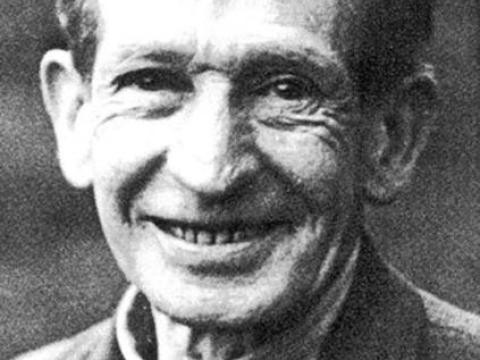
A short biography of English anarchist Fred Dunn, active opponent of the First World War.

Fred Dunn (second from left, Sis Wilkinson to his left) Harlech anarchist camp
Fred William Dunn was the son of Edwin Dunn, leading light in the Rose Street Club in Soho (Rose Street is now Manette Street). Edwin had been elected secretary of the Marylebone Radical Reform Association at a founding meeting chaired by Joe Lane. He was the initiator for an independent labour party alongside H. M. Hyndman, and it was he who sent out invitations as secretary of the Marylebone Radical Association for a meeting in June 1881. This led to the foundation of the Democratic Federation, which later became the Social Democratic Federation in 1884. Dunn’s section was more advanced than the majority of the DF in 1881.
Fred was one of those who set up the Anarchist Educational League in 1913. Other members were Mabel Besant Hope, Lilian Wolfe (born Woolf) Tom Sweetlove, Elizabeth Archer and W. Fanner. These young people wanted to spread anarchist ideas more widely in the working class and most of them seem to have come from among postal and telegraph workers (Mabel Hope worked as a telegraph clerk, as did Lilian Wolfe, and Fred worked in a sorting office). Both Mabel and Lilian had been previously involved in orthodox socialism and suffragism (1).
Five issues of a four-page newssheet The Torch were produced by the League.
Freedom Press had started publishing a paper aimed at industrial struggle The Voice of Labour, alongside Freedom, in 1907, run by Tom Keell and Alfred Marsh, with contributions from Guy Aldred. This had ceased publication.
The new group was introduced to Tom Keell by Mabel Hope, who had started writing articles for Freedom from 1912 and the idea came up to revive the paper. The Torch became The Voice of Labour from May Day 1914 and started appearing weekly. Its nominal editor was George Barrett but he was already too ill to take much part and Fred Dunn was in practice its real editor. The group around the Voice of Labour was also the most active in supporting Freedom in London and enthusiastically distributed the paper. They fully backed Tom Keell against Kropotkin in the controversy over the First World War. As well as the activists already mentioned Leonard Motler (who was an active anarchist and deaf-mute) also contributed to The Voice of Labour.
It was Fred writing under the pen name Fred Watson who provided a report on the British movement for Mother Earth, the American anarchist paper edited by Emma Goldman. This article The Movement in Great Britain, appeared in February 1917. It reported on the Anarchist Congress held in Hazel Grove, Stockport in April 1915, where the British anarchist movement took a “strongly anti-militaristic attitude… with “only two voices …raised to support those who favored war”. Fred was one of the signatories of the International Manifesto on the War in February1915, alongside Wolfe, Malatesta, Domela Niewenhuis, Alexander Schapiro, Berkman and Goldman and thirty others (Rudolf Rocker was unable to sign this anti-war declaration as he was interned by the British authorities at the time). The Manifesto called for unremitting class war in reply to imperialist war and for “social justice achieved through the free organisation of producers: war and militarism eradicated forever, complete freedom won through the utter demolition of the State and its agencies of coercion”.
The Voice of Labour was totally opposed to the First World War. Marsh House was set up in March 1915. It was an anarchist household at 1 Meckenburgh Street, off Bloomsbury Road, where lived among others Fred, Lilian Wolfe, Jim and Nelly Dick, and a Belgian anarchist Gaston Marin, most of its members living as a commune. It was named after Alfred Marsh who had died of cancer in 1914. It was a meeting place for the anarchist movement in London, as well as serving as a centre for the Anti-Conscription League (a sort of anarchist response to the No-Conscription Fellowship). In his memoirs of that period Jack Cummins mentions Marsh House and the anarchist activities there: " At times I went to an Anarchists' Sunday school in Stepney and spoke to the children , a precocious lot of infants who discussed Free Love, Divorce, and any other subject that occurred to them. I wrote one or two things for the anarchist papers The Torch and freedom. Some anarchists had taken a house in Bloomsbury, and lived there. The lower part of the house had been converted into a hall where we had entertainments and dances. Often I was M.C. at the dances, for dancing was one of my new loves...... I was not much at home over the weekends, for soon after tea I was off to Marsh House, the anarchists' place in Bloomsbury for the Sunday night dance" (The Landlord Cometh, 1981). (Cummins (1894-1981) was active in the Independent Labour Party and was secretary of the Central London branch of the Daily Herald League. After WW1 he joined the Fabian Society and the Labour Party).
When the Military Service Act was passed in January 1916, The Voice of Labour and Freedom started publishing appeals for more conscientious objection, as well as reports from anarchists resisting the draft. Fred became liable for the draft in March 1916. He was arrested and put in a military prison. He was posted to a regiment but managed to escape. From hiding, “somewhere in the Scottish hills” he wrote a front page article in April 1916 for the Voice of Labour entitled Defying the Act. 10,000 leaflets reproducing the article were run off by Keell and distributed by Lilian Wolfe. Some were intercepted by the police. This resulted in a raid on the Freedom Press offices on 5th May, with the arrests of Keell and Wolfe.
Mabel Hope was now editing The Voice of Labour but was forced to close down in August 1916 (The Voice had run weekly for 18 issues until 27th August 1914 and then monthly with a total of 42 issues). She and Elizabeth Archer soon left for the United States. Fred had managed to escape there already. He apparently stayed at the Whiteway Colony for a short time with fellow anarchist and postal worker Emily Wilkinson (2) ( known as Sis or Ciss) with whom he seems to have had a relationship. Wilkinson remained at Whiteway. There is a picture of her and Dunn standing on a hillside at the Anarchist holiday camp at Harlech in 1915 alongside Lilian Wolfe, George Wilkinson ( Emily's brother?) Bert Wells and Mary Darley. The camp was situated by the house of wealthy anarchist George Davison and it later became Coleg Harlech. Davison also financed Communist Clubs in Ammanford and Chopwell.
In the USA Fred taught at the Stelton Modern School, founded on the principles of Ferrer, and was a popular teacher there. With Jim Dick, who had also left Britain for the States, he ran a cooperative jitney (taxi) service at the colony in New Jersey. He fell out with Harry Kelly, who directed the school and left Stelton.He then worked as an organiser for the Consumer Cooperative Housing Association in New York City until his sudden death in 1925. He died on May 18th in a New York hospital after an operation for gastritis from which he had suffered for some time. Harry Kelly put aside his disagreements with Fred to attend a memorial meeting.
NICK HEATH
(1) Mabel Hope was born in London in 1880. In an Open Competition she gained a post of Female Telegraph Learner in October 1897 in the Central Office London and entered the Telegraph Department of the Civil Service in the following year . She became a socialist in 1897. She joined the Postal Telegraph Clerks Association in 1901 becoming its secretary. She later became a full-time officer of the Women's Trade Union League and served on the executive of the Women's Labour League from 1906-07. At the conference of the National Union of Women Workers in 1907 she spoke on the disparity of pay between male and female telegraphists and in the same year spoke at the Labour Party conference on adult suffrage of which she was a strong supporter. It is not clear if she was a member of the Social Democratic Federation but she spoke to its branches and seemed sympathetic towards the SDF and ready to work with it.
(2) Emily Wilkinson taught Morse code at the Post office. She is described as being "arty" and fond of wearing smocks in the book on Whiteway by Joy Thacker. She was the sister ( hence her nickname) of the puppeteers and artists Arthur and Walter Wilkinson. Arthur had similar politics to Emily and married the Scottish activist Lilian (Lily) Gair who appears to have been a member of the Socialist Labour Party in Glasgow, at least in 1910. Lily wrote 2 pamphlets where she takes a critical stance on the question of woman's suffrage, the first in 1910,published by the SLP, the second in 1914 , published by Freedom Press. She contributed to the anarchist feminist paper The Freewoman ( indicating a move away from the SLP towards anarchism?). With their marriage Arthur and Lily changed their surname to Gair Wilkinson. They later became friends of D.H. Lawrence.
Sources:
Avrich, P. Anarchist voices.
Becker, H. Notes on Freedom and the Freedom Press 1896-1986. Raven 1. Freedom Press.
Cummins J. (1981)The landlord cometh.QueenSpark Books.
Obituary in Freedom, 1925
Photo from Freedom: a hundred years. Freedom Press.


Comments
A leaflet and membership for
A leaflet and membership for for the Anti-Conscription League are here: https://www.katesharpleylibrary.net/qjq447