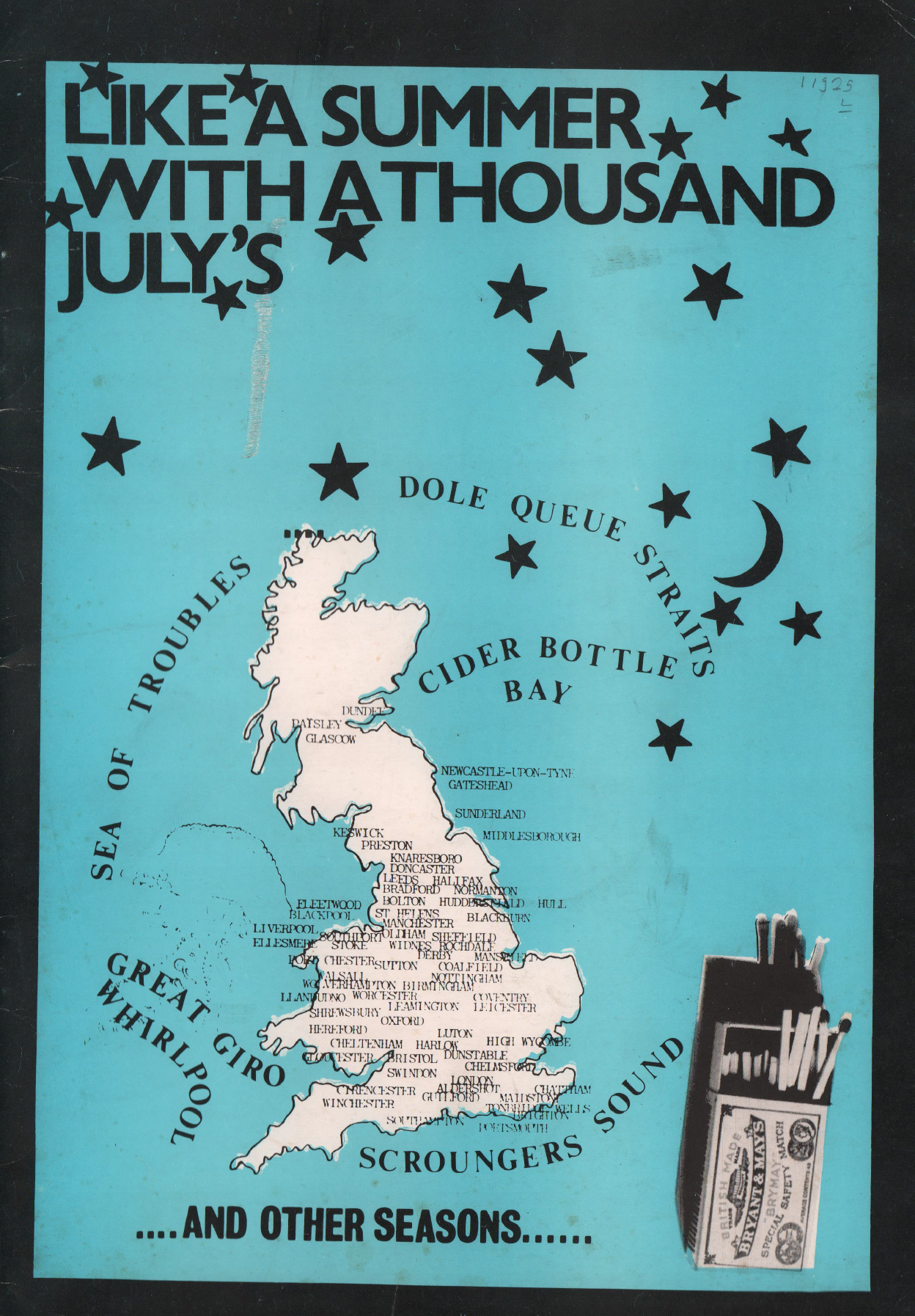
An overview of the early 1980s strikes and riots in the UK.
This text has been reproduced without most of the original pictures and their captions due to space. Some captions which were thought to be useful additions to the main text have been included in boxes.
Like a Summer with a Thousand Julys …and Other Seasons…
INFANT SORROW
My mother groaned! my father wept. Into the dangerous world I leapt: Helpless, naked, piping loud: Like a fiend hid in a cloud
.
(From reflections of a Moss Side rioter, circa 1981)
Introduction
The rest of the world has long recognised the UK (except N. Ireland) as one of the most liberal countries in the world. This by now reflex view has been slow to die the death.
In spite of the Parliamentary ambivalence intrinsic to declaring several 'States of Emergency' and shortish periods of national government restricted to wartime and the '30s economic depression, the Mother of Parliaments has adequately served the interests of the ruling class. Since Cromwell's Protectorate following the civil war of 1640-5, it has never resorted to outright dictatorship.
Many illusions have been spawned about Britain's liberal tradition by people who should have known better. The general drift of their pronouncements if not remembered word for word have been passed on from one generation to another inhibiting the emergence of a revolutionary critique.
Marx and Engels (particularly the latter who had many illusions about German Social Democracy also) went so far as to speculate on the possibilities of legislating social revolution into existence in Britain. In a speech given in Amsterdam in 1872 Marx said, 'There are certain countries such as the United States and England in which the workers may hope to secure their ends by peaceful means.' This misjudgement much influenced by English liberalism has persisted through to the present day. It is the backbone of left parliamentarism and ginger groups from the Socialist Party of Great Britain, the Trotskyists, the revamped ultra-Stalinists of the New Communist Party through to the various still overwhelmingly Parliament orientated single issue campaigns (e.g. ecology and the increasing professionalism of the women's movement).
But going back to the origins of that other strand of the labour movement eschewing Parliament and politics in general, we find Bakunin's inappropriate judgements on Britain exaggerated the opposite extreme. In Statism and Anarchism Bakunin said 'In England the social revolution is much nearer than is generally thought and nowhere will it assume such a terrible character because in no other country will it meet such desperate and well organized resistance.' Marx is naively pragmatic, Bakunin apocalyptic magnifying out of all proportion the determination of the ruling class to resist at any cost, libertarian revolution. Both are completely wide of the mark - a sure indication of the difficulties encountered in getting to grips with this deeply perplexing society. Analysis tends to get bogged down in a sort of metaphorical swampland and the blood of insurgents dead begins after a while to look like ketchup as the quagmire begins to suck in the partisan. Or maybe you take a leap expecting to clear the swamp to land on 'the other shore'. But meanwhile the bank has vanished into thin air like Carroll's Cheshire Cat and you go down, down, down. It is a land of undertones, riddles, top secrets and endless mazes attracting unsuspecting travellers off the known routes.
Approaching the end of the 20th century, to EEC bureaucrats sitting in Brussels, the UK is the 'sick man of Europe'. The symptoms that go to make up the 'English disease' are many, including a seismic strike record. Unlike the modern technocratic character of French capitalism, Britain's fixed capital is antiquated. Rapid de-industrialization and the acres of reclaimed land on which only a few years previously stood mighty industrial structures appears to painlessly blend with a still powerful feudal heritage sold the world over to attract tourists. This medieval tableau appears to stand cheek by schizoid jowl alongside some of the most advanced projections capital is capable of (fashion, pop music, joke packed ads, a sales oriented exploration of the human psyche indebted to the artistic avant garde of the '20s and '30s and surpassing by far the psycho analytical obviousness of the Hidden Persuaders.)
Britain is a paradoxically closed yet 'open' society ruled over by a patrician but condescendingly populist elite possessing the most remarkable cunning and duplicity well versed in a token recuperation of everything from below that raises its head in protest. Yet at the same time it unfailingly manages to treat those below as another species being. On almost everyside there is also an almost totalitarian repressiveness in daily life at odds with the trajectory of modern capitalism and deriving ultimately from the native strength of the puritan tradition. In 'The Twilight of the Idols' Nietzche said 'In England, in response to every little emancipation from theology one has to reassert one's position in a fear-inspiring manner as a moral fanatic'.
It was a fighting observation only marred by Nietzche's failure to explain why. Much of the historical strength of moral fanaticism in Britain derives almost totally from the need to keep the working class pressed down. Particularly in the first half of the 19th century British capitalism possessed in religious garb a remarkably effective array of penitential ordeals, abject deliverances, a horrifically mutilated sexual imagery, ministering to the whole person but designed to assure labour discipline and the very profane ends of increased profitability.
These religious practices have disappeared but the immense Jekyll and Hyde psychic damage they inflicted still lingers on, it tends to generate a sort of unhealthy euphoria springing from being tied down. In fact there was just enough strength left in the beast its hour come round well over a century and a half ago reared on hard work and thrift, despising leisure seekers and idlers to ensure Maggie Thatcher a near landslide victory.
At the opposite extreme there is a bollweevil refusal of work which Thatcherism has only patchily checked. But longer holidays, 'sickness' benefits, absenteesim on the firms time must venture more than comfy arm chairs and let the good times roll right on through the capitalist leisure principle. For example the long Xmas break extending into the New Year and still unique to Britain is experienced by many people as a grindingly empty endurance leisure-test.
Leisure in Britain is still organized far more than it need be - even in terms of capitalist alienation - around the maintenance of work discipline. As a moral philosophy monetarism is the heir to a long line of secular disapprovals of enjoyment forced to intermittently hibernate throughout the long boom of the '50s and '60s and early '70s. Naturally the workers were not cut out of the shopping spree. That made no economic sense whatsoever. But in revenge they were treated like spoilt wayward kids liable, given half the chance, to put coal in the baths of their new dolls houses. Though the economy held the keys to the toy cupboard, patrician forbearance (e.g. Macmillan) was there to regulate the playroom terrain of consumption in broadly the same manner as workers could not be left alone to get on with a job at work. (Skilled British émigré workers particularly in Holland are genuinely taken aback at the comparative absence of surveillance at work and the adult availability of credit facilities: in contrast British management is hamstrung by attitudes more appropriate to the early stages of capitalism). With the result leisure in Britain has a crazed edge and every second is flogged to death as if it were the last. Contrary to myth Britain is a very violent society.
Other than as a means of reviving energies expended at work leisure has no place in Britain. Latin societies only just manage to maintain a whiff of the good life but wine, good food, relaxed eating and drinking, leisurely raps have long been a mark of class distinction in the UK. This would be severely utilitarian regulation of social life weighs particularly heavily on the unemployed who are forced in over, press ganged so often into an a-sexual cell like existence alienated almost beyond alienation. They are left dangling in a void often without a modicum of social contact. Their isolation is frequently aggravated by a collapsing family structure excelled only in the States.
Yet over the last decade the UK has lived through profound social turmoil. Mingled with the seemingly never ending hopelessness of drugs, drugs, drugs, drink, drink, drink, the place is alive with an unfocussed rebellion.
There is a path that leads out of this wasteland and during the summer of '81 the unemployed started to travel its length unaided. The totality of desperation and misery produced its opposite - The nights were young and tho' the pubs had called time the firewater was freely circulating.
In the space of 10 days in early July '81. England was transformed. It will never be the same again. Every major city and town was rocked with youth riots. Bored youngsters ranging from 8 to 80 excitedly got ready for an evenings burnin' and lootin'. Even Army recruits on leave joined in. If the grandkid did the hell raising, grandma helped out with the free shopping. In Manchester an 8 year old was arrested for setting fire to a bike shop and in Bristol a paraplegic pensioner was wheeled obligingly into a supermarket so he could get in on the lootin' too.
Beginning in London, the riots spread north to Liverpool, followed by other big northern and midland cities. Up to now people have been kept in the dark about their actual extent. It was said over and over again that sensational media coverage fanned the riots (the so-called copy cat effect). By the end of riot week holidays it was clear; the media were underplaying what was going down in the towns and cities. Clearly things were getting out of hand and Chief cop Oxford had just said few people realized how close the police had been to losing the battle of Liverpool. Scotland and Wales though less affected were more or less totally blanked by the media. Trouble there would have done for that sociological nonsense which claims all the trouble was caused by black 'unadapted' youth. Apparently there was more to Saturday night aggro in Glasgow than the usual trouble at closing times and Paisley Anarchists got closed down by the police.
Throughout the glorious week, the police received the hammering of their lives. Several police stations came under seige in Bristol, Southall. Birmingham (Handsworth) Manchester (-in Moss Side where youths set fire to 12 vehicles in the police yard), Sheffield (an unmanned station attacked by skinheads) and in Derby where a police traffic office was set on fire. The four corners of England if not yet the whole of the UK were exposed to a force 10 gale of youthful class fury. There will be set backs but in the long run the infectious momentum will hopefully prove unstoppable and roll on through other sectors of alienated society.
What had once been a solitary half mad '60s vision now grown old with time, of volcanic eruptions affecting vast masses of people in every nook and cranny and backyard appeared about to come true. Across an incredulous media was flashed the news that sleepy towns - the scented rose gardens of England's dreaming - had suddenly been hit by brief, furious riots: towns like Cirencester, Market Harborough, Dunstable, the fossilizing well spa resort of Knaresboro' and ultra posh Southport where the northern bourgeoisie elect to die on their fat retirement pensions. Old oaken shades and mossy lanes with evocative olde worlde names had lost their immunity from potentially revolutionary turmoil. What happened in the rural Cremlington on the Bumps' was also reflected in Halifax, a quintessential 19th century northern industrial town preserved almost intact. In this living museum of industrial archeology, silent mills and smokeless chimneys, sand blasted to look a bit like Canterbury, petrol bombs were also to snake through the cleaned up air. Preservation orders may now be organically assimilating the first shocks of industrialization to the more archaic past but the heirs of Robin Hood and his merry men women and children were making doubly sure no such preservation order would be slapped on them. The New Towns descendents of the countrified socialist garden cities, which Lenin loved so much and copied in mother Russia, laid out and policed like old colonial citadels got their dues. Letchworth where Lenin lived for a short while didn't get torched but nearby Harlow did.
The eyes of the world were fixed on the UK and its peoples were for a brief moment to become the latest in the line of oppressed nationals beside those of the Chileans and the Irish. Placard waving demonstrators in Canada supported the heroic struggle of the British People against the fascist Thatcher tyranny!! Applied to Britain this inflated populist rhetoric, which lefties find so irresistable, was inconceivable a mere 8 years ago. Even an Iranian Ayotollah in Qom accustomed to foaming with anti-imperialist rhetoric prayed to Allah for the black (but not the white) rioters.
PLAY SCHOOL FREEDOM FIGHTERS GO RADICAL WINDOW SHOPPING
It was kids amazingly who were responsible for most of the heavy shit going down. Teeny boppers dragged weeny boppers along in their wake. Or vice versa - no one was quite sure. It was that sort of anybody's guess time. Although the rioting was commonly said to be the effect of mass unemployment, top authorities refused to acknowledge unemployment as a cause of the rioting because of the large number of children involved. The authorities were right on the level of facts but the kids intuitively knew far deeper than any big shot, there was No Future for them in the old world of work. Whitelaw said 'Many of the hooligans were aged between 10 and 11 even less so there can be no question of unemployment being the cause'. Children in particular played a prominent part in the battle of Liverpool 8. Out of 67 arrested during rioting on Park Road, 21 were juveniles aged between 8 and 16. The Tones tried to blame the troubles on lax parents and the break-up of the family. Relations within the family are loosening but a growing distance between parents and kids even in tight knit working class families didn't stop parents from being right behind their kids.
…Waiting for night to fall. What was going to happen next? A kid breaking free from school in the late afternoon, shouting loudly to others - was that a signal for a riot to begin? Who could tell? Adults thought so but then they weren't really in the know. 'Hey son, where's it going to be tonight?' 'Kilburn', came back the answer. And five hours later the police got ready for the battle of Kilburn which never came. ... a few broken windows, a clothes rack nicked out of a store but Sinn Fein still blinkedly sold their wares in the pubs.
Galvanized awake many older people particularly in the northern towns joined with gusto in the rioting. If caught they could expect no mercy from the courts and several received stiff prison sentences. But it was on a more general day to day basis the effects of the rioting, causing people to sit bolt upright and take notice, were the most apparent.
During past proletarian upheavals, the 3 day week, the Winter of Discontent etc, the lives of people not directly involved had been sufficiently disrupted for them to start asking why. Now people were hit in the gut with a sledgehammer blow. Suddenly there was an endless amount to talk about. The baffling uniqueness of the events for a time all but stamped out prejudiced superficial reactions. The battle on the streets opened up closed, frivolous, trendy, desperate minds everywhere. Before peoples eyes a new level of reality was being unforgettably exposed and a dream of distant Utopias became by fits and starts a real possibility.
In pubs there was only one topic of conversation. Trivia: tennis at Wimbledon, the Test match, the coming Royal Wedding were barely mentioned as talk came to center on the streets. Did anyone really want to watch escapist films, the lies and half truths of TV documentaries or listen to music. Rank was going to close 13 cinemas in London because of falling profits. So fucking what!
Eyes and ears were glued to the news media. However the predictably slanted version of events did not signify control over peoples mind. The salient facts were all that counted and reading between the lines must have become habitual. At any rate inspite of the press, TV and radio coverage there was remarkably little animosity, at least in the big cities shown towards the rioters - excepting the police that is. Bewilderment maybe amongst sections of the working class and lower middle class but no thought of ever coming down hard on the rioters crossed their minds. In fact many an onlooker was inspired by their example as buried hopes and expectations were raised. Violence in the streets externalized the violence raging within as the phoney class peace announced by Thatcher came to a dramatic and unanticipated end.
'WE SHALL OVERCOME' - Maggie Thatcher on the friday night of riot week hols.
Black youth were the main protagonists but only in the sense that they opened up the gap through which Asians, Anglo-Saxons, Celts, Turks, Greeks, Cypriots, Eskimos - if these categorizations still have any meaning - and others, followed. So sing out if you're glad to be an albino! Truly it meant that the UK was in the throes of becoming one of the first unfolding multi-racial, pre-revolutionary societies. The rioting as press and politicians alike had to frankly admit (Enoch Powell excepted in a BBC radio program on July 7th '81) was not racial in character. (Here too we exclude fascists like Charles Parker of the 'New National Front' who said, 'the riots are just a rehearsal for full scale war') But elsewhere in the world accuracy was lacking. A journalist from Corriere Delia Sera, probably hooked on some anti-imperialist ideology of racist Brits, lyingly reported there was fighting between black and white youth in Liverpool. And initially some of the German press (e.g. Frankfurter Allegemeine) reported the riots as racial in character too. They quickly changed their tune in the next few days. The American press taking their cue from The New York Times which made the mistake of describing the first night of the Brixton riots in April '81 as racial (again quickly changing its tune the following day), now at least plumped for a semblance of accuracy. Emphasizing class as the prime factor, they rightly noted London had seen nothing like this since the days of the Gordon Riots in 1780 (The International Herald Tribune). Though 400 insurgents were shot by the army in the streets of London in 1780, taking the UK as a whole, it's a fair bet the riots were the most extensive if not the most intensive ever since the Civil War. And Ned and Lady Ludd were weeping with joy in an anonymous grave on some wild Yorkshire moor at the splendid audacity of their successors.
'The Only Race Is The Rat Race'
- graffiti Notting Hill Gate, 1968
Racism exists in the UK alright. But the mixed character of the rioting overcame racial separations pushing it well into the background. Powerful sections of the State would have liked it to be otherwise and actually tried to foment racial confrontation. In Derby police forced mainly white youths running amuck in the smart city center into the ghettoised Normanton Road and Peartree area. Fortunately this tactic came unstuck because a battle ensued involving white, black and asian youth who more or less fought the police together. Was this an example of overt police racism or were they calculating on disrupting class unity? Certainly as a means of stirring up hostility, the race question in press reports was secondary to the practice of highlighting incidents which taken out of context looked like the work of animals.
In the pages and pages of bumph written on the riots most have stressed racial/ethnic differences rather than class factors. Apart from the gift horse of Southall everyone has to admit racial confrontation (excepting police of course) hardly figured in the riots. But how come so many writers who invariably turn out to have secure prestigious, well paid jobs in Universities, Polys' or in the Race Relations Industry almost instinctively opt for race rather than class? Is it because race is one of those collective nouns intrinsic to the continual existence of the Nation State? Certainly both trendy academics and race relations careerists would like to see the status quo changed. But only within the confines of the Nation State making for instance the lily white British State more 'a State of the whole people' (positive discrimination etc). At best they will only ameliorate racism never totally abolish it which requires nothing less than the international extension of proletarian revolution sweeping away all national territories and Nation States. All their venom and contempt are ultimately held in reserve to counteract this.
Actually there are few things more irritating than the tut-tutting reprimands of the various arms of the race relations industry faced with 'racist' jokes. They are totally unselective in these matters unaware that 'racial' jokes can actually defuse rather than stir up trouble. They seem not to have any experience of situations where such things have happened. More probably than not the Race Relations Board will in the future moderate their attitude because on the level of shitty entertainment (Tiswas, OTT) minorities are starting to give as good as they get. This reflects a far more open ended and much funnier situation below where there is a stronger desire than ever to escape out of the ethnic, regional, national bolt holds. Being able to laugh at oneself is part of this process.
The media on the face of it was unprejudiced. However a current of racist innuendo was apparent particularly in the press reporting. In the circumstances its appearance was predictable: the British bourgeoisie when driven into a corner disparage their opponents more through suggestion than out-right calumny. The practise of calling blacks 'immigrants' was especially offensive when applied to districts like Liverpool 8 where a sizable black community has existed for close on 100 years.
During riot week hols, radio and TV were crammed with instant interviews of staid psycho-sociologists in top universities. They would always finalize their homilies (what else?) with the need for more effective police measures. But this was drama! In future what we are likely to see, is an 'enlightening' mountain of material, taped on video and in print, interpreting the weeks events. It is more than likely Leicester University's Center of Mass Communications will publish some report examining the influence of the media on the riots but not the impact of the rioters on the media. They will for ever fight shy of raising this upsetting question.
In Brixton rioters attacked photographers from the Daily Star, burnt out ITN film vans and in Toxteth attacked the Guardian reporter who then pretended he was a dosser to get his copy. However, the sad fact is, the rioters were too negligent about media infiltration and many poor sods were later picked up by the coppers after being identified in photos. There were unsubstantiated rumours that TV networks had handed footage of the riots over to the police. Failing this the police in any case were taping television coverage on their videos.
TV items particularly the early evening news must have had an effect but to accurately assess its influence isn't as easy as it sounds. The British Film Institutes Broadcasting Research Unit funded jointly by the BBC and the IBA in a sociologial survey to be published later in '82 claimed the 'copy cat' effect was greatly exaggerated. Maybe. Up to a point kids did emulate what they'd seen on TV. For instance youths gathering on Wood Green High Road in N. London the morning after the riot there, loudly played back tape recordings of news reports just to goad the police. Chris, a 17 year old Greek Cypriot said 'I hope this gets us in the papers. I hope this counts as a big riot like Liverpool'.
On the otherhand the younger generation watch less TV than any other generation since television first became a mass consumer item. Apologists excusing declining literacy point to the effect of TV as decisively influencing this historic change. The relative lack of interest shown by the youngest generation in TV suggests there is a basic sea change toward the media in general going on. With luck the media is about to be blown out. Certainly according to the Daily Telegraph the heads of TV corporations are deeply worried people. The date, July the 13th, '81, the end of riot week is telling showing how convulsions tend to bring out point by point the concentrated fears of the bourgeoisie. Maybe the heads of TV will more than roll. When interest in the box is declining they obviously have more to fear than just being made redundant.
In fact the Police thought the youth grapevine was by far the most effective media for communicating a message which burst out simultaneously in all parts of the country. It was throughout the entire week their only promising insight.
DEVIANT SOCIOLOGISTS
The riots at least should prove a lucrative source of income for that symposium of oily rags the Sociology of Deviancy.
One of their most notable celebrities the dishonourable Jock Young wrote (together with a certain John Dea) an article on the riots in that lefty rag The Chartist. It is a classic of its kind ending by condoning what it had just written off as a compromised solution. He knows the Labour Party and trade unions have acted as a drag on the working class preventing it from ever achieving a revolutionary consciousness. Yet he proposes the trade unions shake themselves out of their torpor and become 'channels for the political organization of young people with minimal contact with work.' This will only, lead to the 'compromise solution' he has just panned. But that is what he is secretly after. This example of the purest cynicism shows the pivot around which his life revolves: a sinecure for life and a string of wretched sycophants whom he can wrap around his little finger.
Young does not mention by name 'the reconstructed Labour Party' but that is what he has in mind when he alludes to 'an extension of democracy at a local level' to counteract institutions which have been originated 'from above'. The sort of mass democracy Young pretends he wants at a local level sporadically appeared once the riots had died down and people spontaneously came together to discuss the events. As will become clear later these meetings were emphatically not political and the presence of political parties was hotly resented. Though it was never said so clearly they were, admittedly very much in embryo, a new form of power containing within them the dissolution of State power. It is nonsensical therefore to say 'we are witnessing the return of rioting as a form of political expression for those for whom all other channels of political activity have either dried up or are non existent' (ibid).
To further suggest as he does there are parallels between these riots and those of the late 18th and early 19th century when a factory based proletariat was in the process of being formed is stretching it more than a bit. Illusions about the wonders of Parliamentary democracy were then rife. When the mob burnt down Nottingham Castle in the early 19th century they were protesting against the delay in the passing of The Great Reform Bill in 1832. A good century and a half later and the cup of political reforms is just about drained. If his comments on America in the same article are anything to go by, Young is well aware of this even though when it comes to assimilating immigrants Britain has much to learn from America. Yet the sly dog goes through reel after reel of type-writer ribbon saying there are solutions when deep down he knows as well as anybody short of revolution there are none. Predictably the article closes with an appeal for the 'political de-marginalisation' of inner cities; 'more police accountability to local government' and the decriminalization of "soft" drugs - the cause of many a combustible hassle (e.g. Notting Hill April '82) between the police and young blacks.
All along the front line the Sociologists of Deviance have been afraid to say the obvious. They have toyed with revolution in the past solely to hit the jackpot and the highspots putting on their soluble-in-water war paint of radicality to aid their sexual conquests. Being yesterdays martyrs to the lost cause of Trotskyism is not to their fashionable tastes. Quitting the Socialist Workers Party they have not sunk below the horizon as the sun finally set on a Bolshevik seizure of State power. They now look to the reconstructed Labour Party as a more realistic option offering the hope of a glittering prize in place of former mock heroic dreams of a commissarship.
One of their favourite tricks is to let fly with radical sounding phrases which are later retrieved for bourgeois democratic ends. In his article on the riots the fork tongued Young sounds really enthusiastic. But don't let that fool you. Another of them Stan Cohen in an article on prisons he wrote several years earlier had this to say, 'The prison is a small (and not necessarily permanent) terminal point of a much larger process of social change'. (New Society, Dec. 74). Fuck you jack if you were dumb enough like some of us to think for a sec' this is an earnest plea for the abolition of prisons. However the remark is strictly remedial in intent pertaining to the development of non-custodial punishments. Considering the penal obsessions of the English judiciary it should have done wonders for the deviant sociologists fading lustre of radicality but the bluff doesn't serve like it once did.
Over the past decade the Sociology of Deviancy has dealt with the social disintegration of modern capitalism. Parcelled up into discreet bundles of essays, books and articles, this has included sabotage, survival in high security prisons, drug taking ripping ott, pornography, suicide, soccer violence and Weathermen/Women bombing (uncritically clapped on the safer sidelines by that creep Paul Walton).
Originally much influenced by the Chicago school of Sociology in the aftermath of '68 they looted further afield lobotomizing more radical theories coming from France, particularly the Situationists. By striking matches under the rigor-morticized toes of State functionaries the aim of these intelligence spies of the State then as now is to promote reforms. Like grub street journalists the depths they are prepared to sink to have yet to be plummeted. The shameless Jock Young for instance before being scared off by revolutionaries was about to blow the whistle on the black economy. What did he care if as a result life was made even more insupportable for millions of people?
Finally just for the record they are drawn irrestibly to big time villanry (like John McVicar) seeing there a distorted reflection of their own high flying careerism. However much they may protest to the contrary, petty criminality is for nonentities going very much against their success-minded grain.
Having rejected the proletariat they are bound to reject whatever's proletarian in petty criminality. They have for example little first hand knowledge of and indeed sympathy for the conscientious resolve not to pick on the proletariat that lies behind much petty criminality. Jock Young for instance subscribes to the view 'most working class crime is directed against working class people' which is hard cheese on shoplifters, scroungers and the like.
Time was not that long ago when Phil Cohen hadn't a good word to say about the Sociology of Deviancy. Now he has cut his losses and teamed up with them. And how. Having rejected the 'wageless society' as Utopian dreaming he must eventually turn on every other revolutionary conviction. The path from revolution to reform is paved with the utmost malice and we weren't the only ones who were stunned to learn he had been lecturing at Hendon Police college.
As a result of his experiences there he has proposed a 'special police education unit' - composed equally of police with a university training in social science and academics with a knowledge and understanding of the force' (City Limits) under the control of the GLC Police Committee. These suggestions hardly differ at all from those made by Shirley Williams (SDP) who in a speech (April 6th '82) given at the Police Training Centre in Hutton, Lancashire stressed the need for police cadets to 'learn more about the political social and economic background of the country and of their own areas'. She made a point, obviously, of not supporting the 'left' wing dominated police committees but in all other respects her proposals are the same as Phil Cohen's.
The class rather than racial character of the rioting rules out an American style purely ethnic educational program in police colleges. Phil Cohen realized this and was only able to rap the knuckles of the police cadets on the race question by first probing the sensitive nerve ends of the class system as reproduced in the police force. This same duality, acknowledging class in order to belittle it from an unrevolutionary middle of the road, middle class standpoint was evident in Knuckle Sandwich a book he wrote with Dave Robins (former editor of the late '60s underground newspaper Ink). Published in 1978 the books interesting empirical details like the regionally mixed character of Manchester United's football hooligan supporters are all but swamped by the ludicrous conclusion: 'Racism not revolution is in the air'. The riots knocked that on the head good and proper but for the liberal patriciate the race issue has the advantage of avoiding the thornier problems posed by a thorough going class war against capitalism. And Cohen doesn't like it when the proletariat becomes too independently minded neglecting to pay him the respect he so often abuses.
Both Cohen and Robins are experts at tapping charities but the money is never diverted to revolutionary ends. Rather grants from e.g. the Leverhume Trust go towards setting up yet another social work con (e.g. Street Aid in Soho and Covent Garden). But give credit where credits due because Cohen had during the London Street Commune of '69 displayed qualities the cowardly and parasitic Sociology of Deviancy have always lacked. Regretfully he wished even then to impose a super annuated sub cultural research unit on this audacious squat interring its radical potential beneath a respectable sounding appeal for money.
ORGANISED RACISM AND INTER-RACIAL RESISTANCE
The one big racial incident which by default preceded riot week resulted from the National Front/British Movement guided skinhead invasion of Southall's Asian community. The battle which followed, as the young asians cleared the streets of fascists and torched their musical venue at the Hamborough Tavern was thankfully untypical of what was to come. On the whole racist attacks, in contrast to the orchestrated invasion of Southall, tend to be less well organized and more individualistic.
Undeniably over the last year or so, there has been a series of ugly and horrific acts, carried out by white racists, against blacks and asians. The most notorious occurred in Deptford on January '81 when 13 young blacks were burnt to death after an all night party. A Coroner returned a verdict of not proven but collusion between police, fascists and the higher and murkier regions of the State was the real point at issue. Also at the end of the week of fire, after the funeral of Mrs Doreen Khan and her 3 children a riot of asian youth broke out in Walthamstow, E. London. They died as a result of a petrol bomb attack on their home early in July. On both occasions the police, adding insult to injury, detained for questioning friends and relatives of the victims, repeatedly grilling them hoping to shift the blame for the tragedies on to them. Mr Khan, already a broken man recovering in hospital from his burns, was doubly shattered when he got to learn of this.
These isolated attacks are horrendous but must not be used to disguise the way blacks and whites have spontaneously come together (outside the reach of lefty contrived orchestration) and fought white racists. There's the memorable battle of Chippenham, Wiltshire on May 30th '81, where in a supposedly dumb fuck country district, black and white fought white racists after an incident at a night club. Also, the example comes to mind of the suicidally depressed black youth who was stabbed to death at a Peckham fish and chip shop on June 20th '81 by skinheads. Earlier in the evening when attacked by the same skinheads, who were later to kill him, white and black youths had come to his aid. However not all teenage killings are random or racial in character. During riot week at the Black Uhuru concert in the Rainbow, Finsbury Park a black kid was stabbed to death by another black kid after an argument over dividing the spoils. For both black and white if violence cannot express itself lucidly by destroying commodity relations, then it is going to turn in over in a whirligig of brutality. Racism finally is part of that whirligig.
'Standing at the corner swinging a chain, Up comes a copper and he takes my name, Takes out my razor and I slit his throat, Blood all down my teddy boy coat.'
('50s psycho billy street Ted song from Co. Durham and W. Yorkshire)
It's a very complicated whirligig too. There's no clear cut distinction so far between pathological behaviour and a near revolutionary assault on the old world. Often youths are yenning for a bruize any which way they can. After all society is organized in a hierarchical fashion and those at the bottom of the ladder know they are looked down on by almost everyone. They inflect the general values of society by setting up their own pecking order whose values run counter to those of respectable society. Youths who are looked up to are those who have been involved in the most punch ups, those who have been arrested the most times. Their university is the slammer. Youths on the lam try to achieve a status and recognition for themselves which they cannot achieve in any other way. This made itself felt in the riots and it is pointless denying it at the same time as it merged into a class experience. A youth arrested in Manchester for throwing a petrol bomb into a police van frankly admitted in court. 'I did it to make a name for myself.'
JOHNNY YOU'RE TOO BAD. WAITING HERE IN LIMBO FOR THE PROLETARIAN TIDE TO TURN
Black youth have the highest levels of unemployment of any section of society. Lacking money to consume, their resentment has often resulted in a form of indiscriminate aggression. Small wonder then that they have turned to mugging. All too often the victims of muggings are poor whites who live in close proximity to them, the people least responsible for their plight.
However being black does not imply immunity. At the 1977 Caribbean Carnival in Notting Hill, blacks were also mugged alongside whites. During a Carnival dance in Hammersmith, a gang of black youths invaded the dance hall mugging and beating people savagely. This incident was mentioned by older blacks who were shocked by it serving to emphasize just how estranged they had become from their own kith and kin. It said a lot for the myths of racial identity to hear these youths denounced in terms echoing racist police and magistrates.
But having exposed racial solidarity for what it's worth, they then go and put the boot in on class solidarity. Sometimes it does look as though they don't give a piss for anyone. A quite justified pride at having made such. an impact during the rioting can so easily be turned into an abuse of power. Drunk with success.
And then there's family complications too. Parents of black youth tend to regard any symbols of rebellion or visible signs of black pride with fear and suspicion. There is a very definite breakdown in relations between younger and older blacks. Aggravation between parents and children is not common to them but it is much more pronounced in the black community.
This is a legacy of 19th century colonialism. One writer in the Jamaican Gleaner said that the facts about slavery and the obvious ways in which blacks were kept down are well known. 'But what is not so generally appreciated is the way in which we are colonized in our minds'. The standards of Victorian society were imposed on blacks and these attitudes have persisted among blacks long after they broke down in the Imperial country. Many West Indian and African parents are very authoritarian and take a heavy handed Victorian attitude when it comes to discipline and orderly behaviour.
Many blacks have fought a losing battle to maintain old fashioned standards in the face of a permissive society. The kids rebel against this and many run away from home. Some are even thrown out by their parents when they become too defiant. There is an echo here of the phrase from Victorian melodrama, 'Never darken my door step again.'
In the first year of its existence a hostel for homeless kids in Waltham Forest catered for 64 black kids and 11 whites. This probably gives a fair indication of the breakdown in black families in proportion to whites. In some cases it resulted from social deprivation which neither the kids nor their parents could do much about. In most cases it springs from a conflict between kids and their parents, arguments about dreadlocks, a father forbidding his 17 year old son to have a girlfriend etc. The parents of an Islington youth were so frightened he would get into trouble that they forbade him to go out and tried to keep him home every evening. He ran away and became homeless at 14. He was eventually picked up by the police with a gang of other boys and brought to trial for mugging. His parents fear had brought about that which they feared the most. The discipline West Indian parents want to enforce can become excessively harsh and this has been criticized by some black community workers with the unfortunate side effect of lending credence in the eyes of the kids to their function as social controllers. Really they should tell them to sod off double quick. This has on occasion happened. In one local incident we know of a number of homeless blacks who squatted a property in Netting Hill Gate put the frighteners on a local rasta-dandy social worker sent in as the para-State's secret weapon to get them to quit the premises.
Some parents have expressed an antagonism to social security and the social services from authoritarian family based attitudes rather than any revolutionary point of view. One black guy said on TV 'How can I discipline my son when he can leave home when ever he likes and get money from the SS.' He also was hostile to social workers because they provided black kids with all the necessary back up when they leave home. Black parents see what they believe to be a too permissive society and the social services as conspiring to undermine the authority of black parents and frustrating their efforts to raise their children in a 'proper' manner. One black woman in a letter to The Times said that parents were blamed for failing to discipline their children and letting them run wild. 'Parents are frightened of being too strict for fear of welfare officers coming in. The welfare officers are dying to snatch black kids away and put them with nice white aunties and uncles for love and affection.' This condescending bullshit sums up State benevolence: it even produces a sneaking sympathy for the repressive fucked up black parents.
UNEMPLOYMENT…
The Notting Hill Carnival riots from '76 to '79 were almost exclusively a black show. By the summer of '81, everybody was mucking in. By then unemployment had easily doubled. Inspite of the forgoing remarks, unemployment was a contributary factor even if not consistent with a dour 'Right to Work' myth of downtrodden masses hungry for work at any price.
For those in the straight jacket of Surburbia a survey conducted by Liverpool University of 20 year olds living in inner city areas might have produced surprising results. For those accustomed to living in inner city areas they were as stale as yesterdays news and further evidence of the Universities stuck fast in their time machines, waking up to the obvious. The findings were made known in August 1980. The survey showed that not all the youths were unemployed because they had not been able to find work or had been made redundant. Jobs had been given up voluntarily. The principal reason given was boredom. The second, dislike of superiors and inability to get on with work mates and thirdly dissatisfaction with pay. Youngsters would take a low paid menial job and find themselves unable to put up with it and so they would go on the dole. After a period of time the boredom and poverty of life on the dole would become unbearable. So they would try a job again. They cannot stand work and at the same time cannot stand life on the dole. With the recession biting hard, there weren't enough jobs to keep them all in employment all the time but as the kids did not want to be in permanent unemployment, there was enough jobs to fall into when they felt like it. This situation just about kept the lid on the inner cities. However since the survey the situation has dramatically worsened, although for us hopes of a new world have dramatically brightened. At the time of the Toxteth riots there were only 12 jobs on offer for school leavers at the Job Centre. There was literally nothing for them to even 'fall' into.
These attitudes outlined above differ markedly from those of their parents and grandparents who coming from the West Indies in the '50s were prepared to take anything available. The young blacks born in the UK expect something 'better'.
Perhaps more so than their white counterparts they are prone to a brittle image worship falling somewhere between golden-calf idolatry of music, dancing, fashion and theater and easily provoked aggression. Slavery maybe abolished but it remains very much in the minds of young West Indians and some refuse any job that has the slightest stigma attached to it. One young black girl for instance wanted a job in fashion. After a great deal of difficulty she managed to get fixed up as a receptionist/model with a West End clothing firm. The girl was delighted until she discovered part of her duties was to make tea for other staff. She promptly turned the job down.
…AND CRIME
Undeniably the huge increase in unemployment has resulted in an increase in crime. An unemployed white teenager said 'Sure there's robbery - when your dole runs out, which is quick, you have to do something to live. Everybody round here does it.' There's even desperation just to get the feel of dole money in your hand too. During riot week, some black youths in Hammersmith post office menaced a long queue of black and white unemployed people waiting to cash their giro's by shoving everyone aside to be served first. Edgy mounted police had been stationed outside the post office in case of trouble and these young blacks, outta their skulls with hope, were looking for any occasion to provoke a riot. But in their understandable eagerness they were well out of line and this silly action only served to put everyone against them in the airless and crammed post office. Even so, the cops were scared of dealing with them.
THE TURBAN ROCKS
What we are beginning to see (the riots were the living proof) is the end of racism. Even a bum liberal like Mr Raj Nayan, a senior officer for Leicester Council for Community Relations appreciated this. 'I think we're seeing an embryonic movement of poor working class white kids teaming up with poor black kids' (Daily Telegraph July 15th '81) and as an unemployed London East End skin said of the middle classes: 'They're terrified of the blacks and whites rising together and storming the suburbs. That's where they ought to riot in Finchley and Richmond, not in Moss Side'. (The Guardian, July 10th '81) And the once submissive asians played their part too. Asian kids are breaking away from the traditional values of the Muslim, Hindu, Sikh stranglehold. Elders of the Asian community repeatedly call for youth to remain peaceful and law abiding but their appeals increasingly fall on stony ground. If now you want to see the revolt of Islam, then here it is - the revolt against Islam. The asians kids have more that's obnoxious to fight against - chaperoned girls, arranged marriages, wives behind locked doors, a culture of passive resignation to one's supposed lot. Now they are making the greatest breaks of all from the nightmare past - actually through a see sawing interaction with black and white kids whose respect for the family is at an all time low. The old asian values are crumbling fast. Even so, the Sikhs long fighting tradition held them in good stead in Southall. Specially selected racist skins who thought they could easily throw a scare into the predominately Sikh Southall community sure as hell got their ethnography fucked up. They are not submissive East End Bengalis who in any case are beginning to square up to racist provocation. Their standing in the Brick Lane area of East London has gone up by leaps and bounds since they first started to resist racist thugs unaided. At Southall there was an explosion of anger against the police. In the later phase of the rioting, asians living in other places, particularly Bradford, were to get involved. In Bradford several asians were later framed and confessions beaten out of them. During the preliminary hearings a high proportion of whites were evident in the pickets surrounding the court house.
Although the police do not pick on them to the same extent as young blacks, asians constantly complain that the police are indifferent to racist attacks and will do nothing to protect them. Inspite of the constitutional illusions inherent in this sort of reasoning, it does at least represent a step in the direction of organising one's own defence.
One incident which particularly angered young asians in Southall was an attack on one of them by three white racists who carved swastikas on his stomach. The police did not believe him and charged him with wasting police time. Many young asians are angry with their elders who they see as too passive in the face of racist attacks and police indifference. In Southall, in response, militant youth have organised themselves into the Southall youth movement in order to defend themselves, preferring not to put their faith in the established asian organisations dominated by their elders. Many of the Elders are store owners, supermarket under-managers and restaurant owners - those asians in fact with a direct interest in protecting capital. The Indian Workers Organisation - a thoroughly misleading title - is dominated by this crew. However worker oriented the ad hoc defense committees also call on asians to lay down their arms. The Coventry Committee Against Racism for instance made up of councillors and trade union reps is not much more than a lefty talking shop. Its main aim now is dissuading young asians against self organisation against police and fascists. Shamelessly the committee call this self organisation 'vigilante' aware doubtless the term, because of the use made of the vigilante in the USA has a nebulous fascistic implication.
The splits then developing in the Asian community reflect to some extent those in the black community. There are uneven features to this and they don't always amount to unequivocal class progress. But much that is reactionary (religion and the status of women amongst asians in particular) and harmful to class struggle is at the same time being jettisoned.
Attitudes amongst whitey (the chitties) have been changing fast also. Respect for asian workers has been growing steadily amongst white workers once they began to stand up and fight back. The long battle by a largely asian workforce at Imperial Typewriters at Leicester in 1973, even though accompanied by trade union lock stock and barrel illusions nevertheless forced admiration out of the local white working class who previously had often voiced ugly racist sentiments. Standing up to the bosses, not allowing yourself to be put down by the police or other authorities, is the surest way of knocking racist attitudes out of those white proletarians in a similar structural position. They then become the best ally in the struggle for libertarian revolution. In the riot at Luton on Saturday July 11th '81, black, white and asians went on the rampage together. There was a back log of racist activity in the town but this act of multi-racial insurgency was a shining example of integrated rioting. Once having gone on the rampage there was no stopping the crowd and soul brother black and asian business in Moss Side, Brixton and Liverpool provided no immunity against a more fundamental attack on commodity relations.
Also one must bear in mind there have been a number of multi-racial strikes. Class as a working category matters more than race in Britain. At work irrespective of colour of skin, black, white, brown and green are treated as equals. Like a piece of shit in other words! As a divide and rule wage cutting operation, the wave of post war immigration blew up in the face of its creators. Whether for sound reasons or not the unions made certain of that.
However it is somewhat ironic considering workers wages in the UK are now often below those of immigrant workers in the better off parts of the EEC. During the recent BL set-to someone remarked how the predominantly white labour force was having to knuckle under and accept conditions normally reserved for immigrants in other major European car plants. More by luck than good management the British State has not succeeded in creating broadly based privileged categories of white workers who also act as overseers to less privileged 'immigrant' workers. It will therefore encounter considerable obstacles should it ever attempt to intentionally re-organise white workers around the race question.
SKIN COMPLEX. Ne-Ne Na-Na Na-Na Nu-Nu
Standing up changes attitudes before changing reality. Skinheads after the battle of Southall reflecting on that experience began to leave some of their bad old ways behind. In fact many were apologetic later. As one said at an Oi gig in Peckham immediately after Southall: 'Why do they think all skinheads is Nazis? Just cos' I'm white and working class doesn't mean I'm racist.' Earlier in the year a skin quoted in The Guardian (May 23rd '81) said, teenagers join right wing groups 'just for the punch up' and 'we hated the police too.' Unfortunately the guy was exchanging one set of 'extreme' capitalist values, for a nicer but finally no less insidious opposite: the anti-nazi league. The skins are like souped up versions of the Cossack hordes, wanting activity and life above all else but always, or nearly always, through the aggro stakes. During riot week, skinheads joined with blacks on many occasions. Brixton, Croydon and Upton Park in London. Further north, in Leeds, a large skinhead contingent coming from all over the city joined in with mainly black youth in Chapeltown. Finally there is the odd jewish skinhead who goes round rassing out reactionary Hassidyn Jews.
In some areas there is a more permanent tie up between skinheads and blacks. Not for nothing are the London Notting Hill skinheads called 'commie skins' by others belonging to the hell fire fraternity. This does not mean they have been infiltrated by the local CP or Trot group, or even felled by the general liberal/left ambience of the area. Something of the sort has brushed off but chiefly they are pretty unique amongst skins when it comes to articulately defending their point of view. They were for instance maligned as an NF contingent in '79 when members were denied entrance to a 'Rock Against Racism' gig at Acklam Hall. They hit back fiercely wrecking amongst other things a couple of sound system transit vans. A RAR rep described them as racist thugs. But outside Acklam Hall there was no such clear cut racial demarcation. As skins, punks, rude boys and rastas slugged it out, most of the older and heavier blacks collected on the steps outside of the garage/sound system repair shop stood impassively by watching the fun and games and expressing no preference for either side. The Gate skins were so incensed by the coverage in the musical press that they wrote a collective letter of protest to The New Musical Express denying any involvement in racist groups. To no avail. The liberal/left anti skinhead consensus meant they were cast as NF boot boys in an attack on (presumably) Acklam Hall in the film Breaking Glass starring the nauseating Hazel O'Connor whose street credibility consisted in knowing how to use show biz connections to cast herself as a rebel punk superstar.
The skins possess all the quality and defects of modern day barbarians and vandals. In one week in May '81 they firebombed Indian and Commonwealth clubs and a Hare Krishna temple in Coventry. What did they have in mind? The transcendence of religion? Well, even though such acts are unnecessarily barbaric, it comes into it. They have after all been caught ransacking Methodist chapels though they never receive anything like the same publicity for wrecking such home grown articles. Inversely, during the riots in Derby a group of asians were seen carrying a large cross through the streets. The cross was later recovered but Our Saviour had been nicked.
But this was no Islamic anti-image jag, more probably it was a protest against a band of young catholics who marched with all the sensitivity of an elephant through Derby's semi ghettoised district singing 'We Shall Overcome'.
Nonetheless the attacks on religious symbols in Coventry were interpreted by asians as racist and its an accusation that cannot be lightly dismissed. Skins often do hit the right enemy but random cruelty (hitting old age pensioners etc) like that of black muggers, provides perfect material to the word smithies of sensational news copy. Screaming headlines are tied up with circulation wars but the 'news' they help in this respect to convey is one of psychotic lawlessness everywhere. This has the added advantage of keeping the proletariat locked away day and night in fearful little boxes of routinised existence. At one moment skins can drag the filthy rich out of their de-luxe cars in Chelsea, hand out a fistful of fives to ex-PM Sir Alex Douglas Home and split into the night. At other moments they succumb to a maimed psychotic rage lacking any class content whatsoever.
THE SHEFFIELD STOMP
There was a few weeks before the mass rioting, a vivid example of class conscious skin activity. One Saturday, skins and a handful of blacks and punks (already a break thru') organised a demonstration themselves in Sheffield to protest against police harassment. Standing on the steps of Sheffield Town Hall, skins hollered out impromptu agit verbals to the rest of the assembled mob before proceeding to rampage through the city center. En route, they caused thousands of pounds worth of damage to the Crucible theatre, which with its £100,000 grant from Sheffield City Council had been invaded five times in the past 18 months by mods, soccer fans, as well as skinheads. These guys and gals really have taste because the Crucible theatre is a showpiece of 'enlightened' leftist theatre/music which in the past played host to every conceivable shade of dramatised bad conscience including the Sadista Sisters and Red Ladder (or, as it has come to be known locally 'Gets Sadder') But the one thing a skin sees red at is that mixture of inexhaustible guilt and superiority typical of audiences likely to attend the Crucible theatre. A skin and his girlfriend find it offensive because in every case they are written out of the script as barbarians, picked on and pilloried as an example of everything that's bad. Guilt likewise is a luxury they can ill afford. By negating this aspect of culture, they were making a class protest. How did Bruce Burchall a regional cultural organizer feel about all this? It's a fair bet he conveniently forgot how he once called for something like a total assault on culture.
Two Sheffield social workers had planted the idea of a demonstration in the skinheads when they had suggested calling a protest meeting. The local Sheffield Labour Party had then participated in the event. So did the local Euro' MP looking even more ludicrously out of place. As per usual a Labour Party councillor David Morgan blamed the trouble on a minority of vandals. But as the editorial in the Sheffield Telegraph more accurately pointed out on June 22nd '81… 'The element that raided the Crucible was estimated by staff at 150, the march itself numbered only 200'.
Though the local Labour Party was held to be guilty by association the main culprits according, to the Regional Chief Constable Brownlow were the youth workers. Like so many in the ultra repressive State Apparatus, Brownlow counts the soft cops amongst his pet hates. For some inscrutable reason, mutual acknowledgement that they are performing equivalent repressive functions is scant. The social workers didn't after all justify the wrecking of the Crucible theatre.[In some senses, the wrecking by the white youth was often more 'aimless' than the often selected targets of the blacks (c/f later in the account of the battle of Liverpool.) After riot week in the great mod battle of Keswick, a travelling theatre was again torched and on August '81 bank hols. the model railway station at Brighton was molotoved by white youths.]
What happened in Sheffield was skinhead energy and destruction at its best. During riot week, 2,500 coppers in Sheffield were put on full alert for use against rampaging skins, more in fact than were on standby during the steel strike of Jan/March 1980 when steel workers and miners tried to close down Hadfields for scabbing.
HULL AND HELL AND ...........
50 miles to the N.East lies Hull. During riot week a different saga unfolded in Hull epitomizing some of the worst aspects of skin activity. In addition to wrecking the city center rival gangs of skins, punks etc set upon each other. Symbols of wealth like the Leeds Building Society plus a number of large stores, including Binns, were trashed. But excepting anti police verbals (one guy was jailed for shouting 'kill the pigs') class consciousness generally rose no higher than the Humber river bed.
Shouting football slogans some rioters nutted ordinary people standing in bus queues. One youth threw a concrete block through a bus window while passengers were still inside.
This chaotic response not surprisingly created amongst some Hull transport workers a passing sympathy for the police. The local TGWU official with the backing of the rank and file made preparations in concert with the police and the Transport management to close down the Ferensway bus station at the center of the riots. The Hull Daily Mail rubbed its hands in glee as workers, management and police clasped hands throughout this mid summer week of countryside proletarian insurgency.
Over the past 10 years the Hull working class have exhibited a notable radicality, even as recently as the Winter of Discontent, which makes this understandable reaction doubly sad. They are not by nature hostile to class violence and sabotage. For instance during the '72 Dock strike in the UK some Hull dockers cut ships, moored at the disputed container wharves up river, adrift. But they didn't then go on to root out innocent crew members to give them a thrashing as local skins might have done if their performance throughout riot week is anything to go by.
No one knows in advance whether skins will take a left turn or a right turn or drive straight on into a brick wall. There are unconfirmed reports of fascist organizations pumping skins full of drink, drugs and racist wind prior to sending them out on a dirty-dozen mission.
Some skins could in future be recruited by para military organisations like Column 88, Leaderguard and the League of St. George. The latter is reputed to lead right into the heart of this most secretive of States. Throughout the world State manipulated terrorism is growing in importance (e.g. Italy - the Red Brigades, Spain - GRAPO - plus authenticated examples in France, Brazil and to a lesser extent in Chile) and there's no reason to think it couldn't form part of a counter revolutionary strategy here.
The colonial armies of the British Raj utilised terrorist atrocities and as recently as the Heath Government, agent provacateurs/the Littlejohn Brothers) were employed to infiltrate the IRA and carry out bank raids in the Irish Republic. The names of their employers reads like something out of Burke's Peerage: Lord Carrington, the Defence Secretary, Geoffrey Johnson Smith and finally the Littlejohn's friend Lady Pamela Onslow an ex social worker. They have never denied the charge levelled at them by the Litllejohn bros.[There is a real possibility the Birmingham pub bombings atrocities of '74 were not carried out by the IRA. The six convicted men have always protested their innocence claiming confessions were beaten out of them. The IRA lias never admitted responsibility for the pub bombings which is unusual. Forensic evidence used to convict two of the men has been discounted. A swab test revealed traces of ammonia and iron nitrates on their hands, a compound substance left by both gelignite or smoking! Both men were smokers. Like the bomb in the Piazza Fontana detonated by the Italian Secret Services ending Italy's 'hot autumn' in 1969, the Birmingham pub bombs were in all probability planted by an arm of the State. To achieve what? To disorientate Brummy's militant proletariat? During the now famous miners strike, engineering workers from Birmingham's extensive industrial belt had joined with the miners and picketed Saltley Power station. Together they had inflicted a memorable defeat on the British Government. However the bombs did nothing to dampen class struggle but they did achieve the immediate aim of the Special Branch; preparing opinion for the passing of the Anti-Terrorist Act which was implemented immediately after the outrages. In future the Act could be more fully used than at present for detaining subversives.
And what of later episodes of class struggle? If the bomb planted on the Canvey Island gas and oil terminal during the Winter of Discontent had not mercifully been defused in lime a fire ball would have ripped through Canvey Island leaving maybe thousands dead. It would have in addition cremated a strike wave which included hospital ancillary workers. The bomb was said to have been planted by the IRA but a nagging doubt remains like a toothache which won't go away. Just Supposing…? Pro republican sentiments in the Republic (e.g. the Irish Times) though not wholeheartedly for the strikes (Ireland was itself about to be plunged into a big strike wave) never the less took pleasure in seeing the British Government squirm. The IRA is respectful of moderate republican opinion and whenever possible would prefer not to antagonise it unnecessarily - so it is highly unlikely that the Canvey Island bomb was the work of the IRA.]
Fascist groups inevitably gained members during and after the rioting but the media was obsessed with uncovering evidence of left wing and IRA infiltration. The hidden face of protest was invariably one or the other. The News of the World (July 19th '81) hysterically reported that black power leaders had made their first contact with 2 Provisional IRA leaders in Chapeltown, Leeds. Wearing balaclavas was to the press evidence enough of IRA involvement and the daily tabloids carried photos of youths wearing them. In fact balaclavas were only worn to protect the hidden face of protest from vampirish press photographers.
Finally the Special Branch, clutching at straws, unearthed a couple of terrorist suspects. Jean Weir along with an Italian girlfriend were arrested for allegedly throwing a molotov during the Brixton riots in April '81. Bratach Dubh which Weir belongs to had critically praised the Red Brigade in a pamphlet entitled 'Armed Struggle in Italy'. When it came to suggesting the violence on the street was manipulated by unseen hands, a refusal to condemn State manipulated terrorism outright made the job of the press that little bit easier.
The Sigh Of The Oppressed Oppressor
YOUTH/SOCIAL WORKERS
Those 12 nights in early July '81 marked a watershed. Revolutionary potential remains both a real and distant possibility. The youth valiantly fought the coppers but when it comes to subverting intermediary bodies of the State - youth work/culture/alternatives etc are easily thrown off course. Though the special pleadings of social workers in riot situations goes largely unheeded the youth clubs have yet to be consciously attacked. Though sly kicks are frequently aimed at them only in one notable incident has a youth club come under attack. This Was during a small riot in Leicester in the summer of '80 when a mainly black youth club was attacked. The incident however was not reported in the national press.
In these hard times youth clubs must find room for the growing numbers of young unemployed. They are consequently stretched to breaking point and youth workers are being sent loopy with even heavier work loads. As they cannot recruit more staff enabling them to do their job 'properly' preacher man pep talks become a victim of the cuts and static manning levels. With the result kids minds are just that extra bit liberated from the paralysing effect of youth work.
Physically youth workers are often light weights having to contend with real heavies. They are extremely reluctant to call the cops yet are often in need of protection themselves nervously selecting keys from loaded key rings, dutifully locking doors behind them to keep youth club property safe from never miss a chance snaffling fingers. In their heart of hearts how many yearn to be a strong arm Cagney outsmarting the not so angelic upstarts at their own game?
Ever since the State systematizing of social work first took off in a big way during the 1880's, social work in the name of more spiritual capitalist values has thumbed its nose at the 'cheap thrills' on offer in the market place. Nowadays the private market in youth entertainment, more expert at grabbing kids attention, is a source of competitive annoyance to youth workers. They dislike the rampant commercialism of amusement arcades and space invader emporiums where the only source of authority is the dubious money changing bouncer. Confronted with this racketeering magnet either the youth club makes concessions or risks losing all custom. But swimming with the current is also an admission of defeat and there is an unhallowed something in the spectacle of a youth workers attempting to become as slick as the next kid at playing space invaders on one of the clubs two machines. The market induced drift into backsliding ends the day the youth worker quits.
Having become more mechanised (videos, sound systems, music rooms, recording studios) youth clubs find themselves having to hire technically minded youth workers, fix-its. Employed in a less ideological capacity they tend to poke fun at their harassed colleagues who obediently read and swear by The Guardian, New Society etc just like they've been trained to do. As pure cynicism this dismissive gesture takes some beating in a scene which is noted for its close professional naivete. Only time will tell if it is at all capable of progressing beyond mere cynicism.
There are other pressures leading the youth worker astray. Some gain the respect of kids by infringing the law in rather minor ways and generally making out they are tougher than they really are. Holding high their self esteem and the esteem of others they are easily nagged into continually proving themselves. However there shortly may come a day when on account of former braggardly actions they get pressured into throwing petrol bombs just for the sake of keeping up appearances. If caught they will quickly find out they have thrown away their job - and probably the keys to the jail.
In Britain the time has long gone when there was a manifest relationship between the owners of large scale property and social work. There are echoes amongst today's social workers of Beatrice Webb's 'new consciousness of sin amongst men of intellect and property' but the 19th century combination of guilt and fear of personally being expropriated has greatly diminished. The moralizing function of social work has become progressively detached from defending individual property being more a question of protecting the State as the collective capitalist. Social workers today dread the onset of role crisis more than they fear expropriation of their property, which in any case is rather petty. But low rates of pay, long hours, being on call, add their weight to a significant number correctly gauging their role as merely compounding misery.
Come this potential major turning point and the greatest danger comes from honey tongued marxist ideologists of 'social welfare work'. They step in to save the social worker from a social crises of deep personal significance. Arguing the State is not a monolith built to safeguard bourgeois class rule enables the social worker to pick up the pieces and cheerily soldier on convinced, having made the switch from liberal or Christian values to a marxist approach, they are now helping the proletariat. When have social workers ever believed they were doing otherwise?
Social workers cannot initiate any authentic activity themselves, while the activity of those they police gets out of hand. Yet social workers can all of a schizoid sudden flip in with the insurgents. For example a social worker was arrested for throwing a petrol bomb in Brixton in April '81. Exactly a year later he was sentenced to 3 years in nick. At the trial the judge made it clear if he had not been of previous 'good character' and a social worker the sentence would have been much stiffer. Obviously in some eyes social work still counts for something. Amongst those arrested and present at the scene of rioting were a number of teachers and professional sports people. Class pressures from below, the strains of the job etc also cause them like the social worker to act in this explosive, definitely 'unprofessional', manner.
THE TEACHER AS INFORMER
The tensions of social work corresponding to the era of mass youth unemployment are analogous to those of teaching: increased workloads (but usually as a result of cutbacks rather than having to cope with more pupils) and more, much more police involvement. Moreover there has been over the past 8 years or so a slow but sure process of weeding out the more liberal and 'rebellious' teachers leaving behind a core of either frightened or avowedly conservative teachers. Sir Keith Joseph's pronouncement (Jan 6th '82) to local authorities to find 'better ways of getting rid of ineffective teachers' is the latest in a long line of similar strictures.
The strain of the job contributes amongst teachers' hardening of attitudes and a defensive posture bordering on hysteria. To typify education nowadays as compulsory mis-education is, if secondary school teachers are present, tantamount to a declaration of war. Assembling the nitty gritty of details enabling one to form some kind of accurate picture of what is happening in schools is then halted by abusive, crass apologetics. Necessarily an analysis of the changing role of secondary teaching is fragmentary because details are lacking. Teachers keep mum about the shocking reality they are a witness to.
But the kind of policing activities teachers are progressively involved in was revealed with refreshing and chilling clarity in Toxteth. The Times reported that 'during the weekend riots school teachers had reported seeing not just children from their own schools in Liverpool amongst the rioters but those from schools outside the city'. That just about says it all.
Though schoolteachers needn't in private uphold the views of e.g. education committees, they are virtually constrained in practise to follow suit or risk disciplinary proceedings and the sack. In Liverpool for instance there was a striking concurrence between Councillor Michael Storey's (Chairman of Liverpool education committee and headteacher of a school outside the city education area) opinions and those of the Home Secretary, Willie Whitelaw. 'Parental responsibility' he said 'has gone out of the window. Not knowing where 8, 9 or 10 year olds are is disgraceful. The position is quite clear. Parents are responsible for their children' (The Times July 9th).
Councillor Storey refrained at least publicly from endorsing Whitelaw's proposals to punish parents (never incidentallly enforced by fining parents directly) but he did call a special meeting of education officers, inspectors, welfare officers and school attendance officers (once known more appropriately as kiddy catchers). Teachers were conspicuous by their absence from the meeting which had the merit of laying bare the power structure in which teachers either rest content playing second fiddle or get out. But with the rising incidence of arson in schools (c/f the wave of arson that engulfed school after school in Tyneside during the early '70s) truancy and general hooliganism, a school teacher cannot distance him/herself from the job. A take it or leave it approach was always a luxury in the teaching counter-insurgency front line ever since the beginnings of so called mass education. Today it is non existent.
Education cuts have also caused a resurgence of powerless liberalism in 'educational' matters particularly among concerned middle class parents. The pressure exerted by this body of people is wrapped up usually with the preservation of the local State. In so far as they view education as a positive good it is diversionary, inhibiting, in a perhaps rather minor way, the emergence of revolutionary theory which must never be confused with State education. It is also idealistic and severely elitist because it tends to equate 'information'(?) with survival chances: to reformulate Francis Bacon: knowledge is employment. On this reckoning the unemployed are condemned to remain claimants for the rest of their inferior lives because they lack 'knowledge'. It is nothing short of scandalous how the shining truths of clear as mud liberalism stand revealed as raving reaction.
However it is true that the kind of person who holds these views recoil if pushed, before this sort of inexorable logic. The same goes for their public utterances (letters to newspapers etc) on the riots, which were chosen with a snobby view to sounding respectable rather than from inner conviction. Judged from this privileged vantage point, education should have provided the tools for the full enjoyment of leisure (failing which kids rioted for lack of adequate preparation) rehearsing once more themes that started to become familiar from the mid '50s onwards. Mass unemployment has knocked this nonsense for six and it is only naive dreamers not Ministers of State who continue to believe in this. A final word - ironically many liberal teachers who profess to hold these opinions dear spend much of their 'educated' leisure time getting rotten drunk or stoned! (There's nothing wrong with getting continually drunk or stoned in this alienated day and age. It is the holier than thou facade which is inexcusable).
It is possible to locate one major drawback in the crisis of mass secondary education. (Higher education is of no consequence here because struggle since the qualitatively different one's of the late '60s has centered on restoring grants, extending facilities and not on the outright rejection of courses, the destruction of the university and an end to the Student role.) Quite simply the runaway subversion is seemingly happening without any theoretical elaboration. It should come from the kids themselves. (We looked in vain for even the merest glimmer of a message that however fleetingly might have explained the arson in Tyneside schools. Resistance to corporal punishment in one school unaffected by arson is all we could come up with).
The inconsistency of school rebellions was also brought out in the riots. The mass truancy in Liverpool schools wasn't accompanied by a single recorded incident of a school coming under attack. Since the riots however Liverpool schools have experienced an upsurge in destruction. At the now notorious St Saviours Church of England School in Toxteth pupils 'have wrecked class rooms by fire and vandalism and turned fire extinguishers on any teacher who dared to remonstrate' (The Daily Telegraph Feb 23rd, '82). To begin to put together an absent critique even in the midst of so much destructive activity is not easy. The educational system in Britain has certain specific features that set it apart from most other highly advanced capitalist countries. It is perhaps less closely integrated with vocational training than any other major industrial country. Excepting maybe pure science and basic literacy, the main function of mass education here is unobtrusively ideological and 'cultural', unrelated at first glance to the need to reproduce certain work skills necessary for the capitalist labour market. If this is the case then the revolt in secondary education contains within it the seeds of a critique which is far more complex than a straightforward resistance to being force fed for a particular job at the end of it all. Where does it lead? To what beauty?
THEY HURT YOU AT HOME, THEY HIT YOU AT SKOOL CRISIS OF THE SCHOOL - FAMILY COUPLE: THE LOOMING INTO VIEW OF OTHER HORIZONS
The declining importance of school and the family, the two main institutional covers for kids almost inevitably brings the law more prominently into children's lives. With children especially in mind extra police powers had been projected a good while before the riots by the Royal Commission for criminal procedure (Jack Jones the former 'radical' General Secretary of the TGWU had sat on this commission). Its recommendations to finger print children of 10 and over were enough to freeze the blood, marking something of a watershed in the criminalization of children. If the Chief Constables get their way the recommendations will become law.
The relevance to capital and the State in putting children under the police microscope has now become of pressing importance. The massed presence of children in the riots made public to astonished onlookers what the State had been maintaining all along; children were being progressively lost to view. It couldn't add - for their own good. Over night kids became strangers filled with new powers and parents and other adults peered quizzically at them as if they'd just hatched out. Yet this - one of the most advanced affirmations children have ever made - had not gone unheralded and parents had cause to wonder at their past casualness at not setting a time when children should be back and only occasionally asking them where they were going. Even going to skool is, because of rising levels of truancy, no longer the safe bet it once was.
Aries in Centuries of Childhood linked the rise of school education to a 'desire on the part of the parents to watch more closely over their children'. It is this dual surveillance process which is now in such crises. Once it presaged the rise of the bourgeois family just as loosening opaque family bonds, moving out onto a new terrain with no known reference point in the past, now signals its disappearance. Under the growing sway of police surveillance an eye as sharp as Fourier's is needed to see the potential.
Responding to the failing authority of parents, the Tories drastic solution is, first isolate the family unit before proceeding to give back its former powers. Like the 'magic of the market' this is deemed to occur spontaneously. But what really happens is this: their redrawing of the boundaries of the State, like other instances, is more a question of substituting existing bodies for other ones. What is actually taking place is a realigning of extra parental authority rather than a return to base. replacing family guidance councils more with the courts and the police. The two in any case have never been totally separate but shit social workers are more likely in the future, irrespective of changes at Government level to be drawn into co-operating more closely with the police. Almost certainly the greater encroachment of statutory police authority is bound to put a severe strain on their woolly liberalism.
Thus parents, particularly working class parents, are not expected to assimilate the witchcraft of the 'experts' but instead hand out clouts around the earhole like there's no tomorrow. The onus of the blame still falls on the parents but the terms have changed. (The findings of a survey commissioned by the News of the World on rioting kids was headlined 'It's our fault children go wrong'.) They are not now accused so much of a lack of sympathy and understanding but of a failure to act with brutal promptness.
At the time of the riots there was much talk of coercing parents into acting 'responsibly'. But the idea had been in the wind for some time. Only 3 weeks before, a research project was forwarded to the Home Office Research Unit proposing a study of the effectiveness of fines on parents for controlling their children. If the amount of doggerel now piling up is anything to go by the ruling class are clearly very preoccupied with 'lax parents'.
Not all lax parents of course, only those belonging to the working class. For once the inherent bias of sociological studies is there for all to see because it all depends on which side of the class fence you happen to be on. Laxity amongst working class parents becomes acceptable permissiveness amongst middle class parents. The Times (July 11th '81) was sympathetically frank about this in an article titled 'Why so many children take to the streets' summarizing these views as follows: 'permissiveness in child rearing during the past 10/20 years, while perhaps all well and good for the educated middle classes in leafy suburbs - is counter productive for the families of manual workers living in inner city housing estates.'
(By quoting from this newspaper article we are not entering a plea on behalf of permissiveness. Whatever the differences both contending approaches are essentially about how best to bring up that pain-in-the-arse, a model citizen).
Particularly in child rearing methods, the bourgeoisie has liked to think of itself as a vanguard confident that what it has pioneered today will benefit the proletariat tomorrow. But dual standards like these means its crusading days are over because it implies one method for the rich and the other for the poor. Using children as scapegoats (and anyone else in the family who gets in the way) easily provoked working class violence is, in this way, cynically whipped up.
But this controlled experiment in a punishing society hadn't banked on the effects of a rapidly rising unemployment surpassing that of the '30s. When an unemployed parent lashes out from frustration it nullifies the rationale behind this narrow minded dogmatism. Differences in brawn aside (which matters) beater and beaten are alike in at least one respect. Both are the trapped victims of an indivisible system, losing the power to divide and rule to its own satisfaction. As more and more tales come to light of wife, baby, child and granny bashing linked to rising unemployment, State manipulated violence rebounds to the detriments of its strategists.
INNER CITIES AS INWARDNESS
The riots do not presage an era of novel concern with the particular 'problems' of inner city areas. They come at the end of a dozen or so years of official anxiety.
The first efforts at isolating inner city areas date back to 1968 and the Labour Governments 'Urban Aid Programme'. The future PM Callaghan warned of the 'deadly quagmire of need and apathy'.
By confining problems geographically the program had a clearly divisive intent, isolating locality from workplace and the rest of society. Callaghan's statement needs to be set beside Harold Wilson's made in the same year warning of an assertion of power on the shopfloor which Governments have yet to find an answer to - and never will be able to. The immediate background to these parallel and complimentary statements were the riots sweeping American cities and revolutionary struggles in France and Italy.
The great fear was that the consensus in workplace and locality which had bound the proletariat to social democratic reformism was cracking apart. To repair the consensus was given henceforth top priority.
At the level of the factory much more emphasis was placed by the TUC and management on the training of shop stewards. Courses set up to addle the minds of shop stewards included company finance, management, industrial law, labour relations etc. Since Harold Wilson first made his remark the role of the shop steward has undergone a conservative reversal. The only point in history the shop stewards movement has posed a revolutionary threat was during and just after World War I. They have ever after periodically marked time in a drift into rank and file 'chaos' they weren't able to control. Neither the State nor management can allow their activities to go unchecked even given their shop floor werewolf prestige has irreversibly declined.
At the level of the older industrial cities which had once formed Britain's industrial heartland a series of 'community' measures were planned outside the more orthodox channels of political enfranchisement (e.g. the local Labour Party.)
This apparently ambiguous function was attractive to '68' radicals' who were none too clear about the State's sophistication in these areas of policy making. Without doing much damage to itself, the State was able to use the catchwords of '68. Robbed of any precision, 'alienation' was bent to merely signify 'unneighbourliness'. In this way contradictions inherent to capitalist society were pushed to one side and the go ahead given to redefining inner cities in pathological terms suited to remedial treatment, (delinquency, crime, deprivation, children at risk, problem families, etc.)
The range of these 'unorthodox' bodies was astonishingly varied covering health, education, urban planning, housing and social services. The approach was as near total as possible: political reintegration accompanying economic regeneration.
For this purpose organizations like the Community Development Project were founded in 1969 to pioneer unconventional approaches to unemployment. As often as not CDP activities were viewed with suspicion as 'communist' by chain bearing Labour Mayors and local councillors. They need not have worried: the State has long known how to dress up over-due modernization with feigned subversion. But they did and these ossified responses only enhanced the allure of the CDP.
'Community strategies' accorded well with the historicizing tendency of the times. Potted histories of selected areas and localities were prepared. All depending, State sponsorship was either direct or more discreet. Sometimes it was a bewildering combination of both. But having shaped the overall retrospective spirit of the '70s decade, the State had little to fear from quasi independent initiatives. Like for example the Hackney writers workshop formed with the intention of encouraging old timers to write about the neighbourhood as it once was. There was more to this venture and others like it than recollection of things past['Looking Back at Bristol' - a Bristol Broadsides publication. Revealingly the central St. Paul's area, the scene of the riot in 1980 was the subject of the first transcribed interview given by a woman who had been rehoused on the Hartcliffe estate four miles from the city center.] . Memoirs like 'Coronation cups and jam jars' (1976) evoke an unfailing neighbourly good humour and stability circumscribed by the Labour Party and the Trade Unions, able to take on the chin the very worst blows capitalism could deliver. The riots of '81 vividly brought home the near total absence of comparable punch drunk safety valves today.
Local histories and the unbearable image of harmony they conveyed were a preparatory vector of communication to the local State. But they were only able to properly act as an emotionally charged stimulus to the political economy of the area if shuffled with 'alien' cultures now flooding the inner cities. That is why local community centers like 'Centreprize' in Hackney trade on the paradoxical affinity of a pre war white working class and politically stable post war images of ethnicity both about as relevant to the present as pit ponies and dug out canoes.
The principles of political economy never in the 19th century included the principal of getting to know one's own work force, their past histories, neighbourhoods etc. Or if it did it was a comparative rarity. The political enfranchisement of the masses more an achievement of the 20th century than the 19th changed all that. In so far as they constitute the majority of the electorate 'their' history is important to the bourgeoisie just so long as it doesn't threaten its interests. It is an indispensible part of the representative apparatus of Government. When consensus breaks down the historian is called on to secure the present for the past. What passed for radical local history coming straight from the horses mouth with a moral in it for today's generation was not meant to form part of an eventual digest of international capitalism. The whole aim of the project was to encourage an introverted 'community pride' covering identity, self help schemes, individual and co-operative ownership all tied in with the resumption of the voting game. The net effect sometimes is so claustrophobic it's like going around with a feather pillow strapped to one's face.
Autonomy And The Seasons
Three thing, all of the same sort, are merciless when they get the upper hand, a water flood, a wasting fire and the common multitude of small folk. For these will never be checked by reason or discipline and therefore, to speak in brief, the present world is so troubled by them that it is well to set a remedy thereto. Ha! Age of ours, wither turnest thou?. John Gower, landlord and lawyer, writing just before the peasants revolt of 1381.
Undoubtedly the outbreaks of rioting in '81 put the long overdue social revolution back on the agenda once more. The industrial revolt of 70-74 and the 'Winter of Discontent' of '79, pale in comparison. None of those out on the streets called for leftist inspired Parliamentary alternatives to the capitalist system which were a tacit ideological rider to the industrial revolts of 70-74. Contrary to Cajo Brendel's opinion in Autonomous class struggle in Britain 1945-77, the actual amount of autonomy in these essentially industrial revolts was rather less than he imagined. Making allowances for the hyperbole, it must be admitted 'Echange et Mouvement' have consistently expressed the view Britain was heading towards a crises of revolutionary proportions. In this respect most others have been less optimistic.
But even the strikes of '79, during the 'Winter of Discontent' never really transcended a rank and file shop steward/local bureaucrat unionism - like the ringing of Hull City by striking lorry drivers who exercised a considerable degree of control over the administration of the city. Still they were highly significant strikes. A friend estimated that well over 30 categories of workers with no previous history of conflict went on strike that Winter. This served to set it apart from the more industrial conflicts of the early '70s. Careerists now visibly rising on the back of 70-74 struggles maintained a judicious silence throughout those ice bound weeks when nothing much moved - including the stiffs piling up in a Liverpool warehouse requisitioned especially to accommodate the overflow from the city's morgues. Compared with the 70-74 strike wave it was rich in unusual incidents making play with the fact Britain was experiencing its worst winter for 20 years. The elements of unattended fire, ice and deep snow became during that winter tactical weapons from striking firemen to road gutters. An eerie silence spread over snowbound city streets, deserted railway sidings and the empty porticoes of railway stations where the snow was allowed to whirl.
In the 'Winter of Discontent' the working class used bad weather conditions to press home their advantage. But in the winter of '81 '82 the tables had been turned. The snow and floods only added to the crushing weight of the bourgeoisie's counter offensive. There was no defiant pleasure to be gained out of the chaos. Streets were piled high with drifting snow not because of striking council workers but on account of Government cuts. Spirits slumped unresistingly like the laden branches. The fact that steel plants in Wales were snow bound were used as an excuse by BSC to close them permanently. Unlike the winter of '78/'79 the gleam of a new order never once shone through the blocked roads, the overflowing river banks and iced over flood water lakes stretching far and wide.
Back to the summer heat and bonfires of '81. Where did the real difference lay? Those early July days were the clearest expression yet of the proletariat becoming a 'class for itself' in the UK. The youth unencumbered by trade unionism, naked and abandoned in a 'social void' that is exceedingly dangerous to capitalism went straight for the jugular, unhampered by the sabotage of 'their' absent 'worker' representatives ensconced in the State apparatus. And that's why those in power were so disturbed by the riots. 'Left wing' labour councillors just looked perplexed. At the other end of the scale, the Queen on the eve of the Royal Wedding was all bust up inside. The Queen and other Royals were reported as far more disturbed by what was happening than ever during the miners' strike of '72, the 3 day week or the 'Winter of Discontent'.
Leftist Vanguards And The Labour Party
THE VIEW FROM THE FRONT ROW SEATS IN THE REAR
Leftist parties attempting to use the insurgent youth for their own ends were rapidly exposed for what they were. The newspapers also tried hard to link the Leninist/Trotskyist groups with the rioting. The truth is they had no influence whatsoever and were only tailending the movement, appearing with pamphlets and trying to organize meetings after the riots had occurred. They were met by open hostility or a wall of indifference. They were seen as outsiders muscling in, in a manipulatory fashion, which is exactly what they were doing. Each Leninist group believed it alone had the correct political analysis and program of action. Tony Cliff of the SWP said at a meeting in Liverpool, 'The young have provided the steam and now we must provide the engine for the steam to drive'. In the age of high tech and the micro chip, these weary clapped out metaphors probably deriving from Lenin are more ludicrous than ever. Besides he obviously can't tell the difference between steam and fire. He went on in his usual florid way which he mistakenly believes is gripping the absent masses: 'Because they have not been organized the kids have been attacking shops when they should have been attacking factories. We must teach them to take the bakery and not just the bread'. (One apocalyptic sympathiser wished they had 'kicked the factories to bit'). The arrogance and insensitivity of these people is such that they cannot see why these attitudes should be resented.
The Labour Party Young Socialists held a meeting in Southall after the riots and got a rough ride from the Southall Youth Movement. Balig Sing Purewal said, 'These people come here to exploit us. We do not want anything to do with them, the Socialist Workers Party, the Workers Revolutionary Party or any Marxist group. We are fed up with these lefties telling us what to do'. When the LYPS held a meeting in Liverpool the reaction was the same. Claire Doyle who works for the Trotskyist 'Militant' tendency was constantly heckled by the youth of Brixton and Toxteth when she tried to hustle in on their action by calling for the setting up of a Labour Committee (euphemism for the Labour Party) for both neighbourhoods. She was rightly accused of trying to make political capital out of the riots. When she told a Brixton meeting, 'You have to organize to defend yourselves', the reply came back, 'We will do all our organizing ourselves'. At another meeting three members of the Revolutionary Communist Tendency got up to speak and were booed. One kid said 'We are fed up with them hanging around since it started.'
Black people are particularly sensitive with regard to left groups. The '81 pre-Carnival issue of 'Socialist Worker' bemoaned the fact the black 'leaders' were telling black youth not to have anything to do with the white left. Because of their position, the 'leaders' reasoning would in all probability be highly suspect but their conclusion is certainly right. The groups are funded by and dominated by the white middle class left. If it is true that people in positions of power in capitalist society will fight to maintain their positions why is this not true across the board? Everything about them serves to maintain their position, they abuse the white working class so there is no reason to suppose they will behave differently to black people. These groups do not present any opportunities for black and white proletarians to organize themselves to achieve their own liberation. The reality is accepting leadership from the white middle class in what is supposed to be their own best interest. Despite their anti-capitalist and anti-racist rhetoric these groups do not present any alternative to society as it stands. Rather they present a fairly accurate reflection of it in their structure and organization.
The so-called practical help of the lefties through the Labour Committees was ostensibly to ensure that arrested youth were represented by solicitors in court. As it stood, it boiled down to little less than para-statist law centre work with 'politicizing' implications coming later. As for the rest of their comment, it was bullshit. The International Marxist's Socialist Challenge and the Socialist Worker's weakly paper achieved the ultimate in hypocrisy by defending looters, then condemning looting as unsocialist. The Workers Revolutionary Party's Newsline (July 18th) was pedigree basket case splutterings which was hardly surprising considering its long history of chronically blocked mental collapse. Breakdown for them is certainly not breakthrough. They claimed the riots were at the behest of the State, 'police and army provoked', because 'the Tory counter revolution is gearing itself to make a violent pre-emptive strike against the working class', concluding 'the main war is still in front - against the trade unions'. What drivel! But at least they didn't flinch from showing their true colours, unequivocally condemning all looting and vandalism as the acts of 'gullible youth' falling for 'police provocation'. The WIRP's have the merit of being just too crude to manipulate. Groups like the Communist Workers Organization (CWO) stemming from the old German and Italian ultra left were also only capable of writing nonsense. Having an ideology to realize they simply failed to grasp what was unique about the riots. They sounded for all the world like Trotskyists.
The CWO for example in the 'Platform of Unemployed Workers Group', predicted that 'the unemployed, discarded by capitalism today, will be dragooned into the factories to produce armaments under military discipline. This (their italics) is the only future which capitalism offers'. Rather it was (our italics). Increased automation and the higher technological composition of capital required in today's armaments industry combined with a reduced need for conventional armed forces makes today's situation utterly different from the '30s. (the source of all their cock-eyed theorizing).
Today's unemployed are not likely therefore to be dragooned into the war machine. Apart from staging bread and circuses, capital is at its wits end to know what to do with them. Obstinately ignoring these very elementary facts, how can the CWO even begin to create an effective unemployed workers group? Like diehard Trotskyists they even condemn looting as 'a gift to the ruling class since it leads nowhere' (Platform of the Unemployed Workers Group).
But Solidarity's (June/July '81) coverage of the Brixton riots didn't amount to much, unable to see that it has become a victim of views and attitudes that left parliamentarians increasingly tend to encompass. For instance Solidarity objected to those rioters who smashed the windows of small shop keepers 'who did not deserve it'. Let's face it, small shop-keepers have a well deserved notoriety. Not only do they often charge more than supermarkets because they cannot purchase in bulk and don't own an agri-business but are far from averse to short changing inattentive customers. Moreover working all hours, small shopkeepers are often classic canaries. So often their deceptive chattiness is simply earwigging which ends up down at the local cop shop.
In a similar vein, Solidarity went on to condemn all those who trashed 'the Community Action Office' whose work' they said 'is appreciated by local people'. But is it that simple? Who hasn't heard people, drunk or otherwise, sounding off against these para statist bodies. And what they say often makes a lot of sense. In Solidarity's case they probably haven't because their membership is overwhelmingly drawn from the professional strata and some are involved in the 'community' racket themselves. To crown it all, there is more than a suspicious hint the police are absolved from acting like they do because they are simply doing their job protecting the commodity and the State. In inner city areas such views are a luxury and points to the fact Solidarity members tend to live in easier parts of the city, where cops breathing constantly down the back of your neck is not an everyday experience and which makes an enlightening observation of role structure, without frothing at the mouth, a bit difficult. Let's wait and see but in future, it is possible Solidarity members could opt for the soft cop/community policing line.
Solidarity never got down to the real nitty gritty of analysis. It cannot be stressed too often the extent to which urban dereliction was a major contributing factor to the trashing then burning of small shops in poor neighbourhoods. It crystalised the worst fears of urban reformers who following the lead first suggested by urbanist Jane Jacobs, began to dread the consequences of high rise estates, desolate spaces, barren streets and alleyways and planning blight generally. These conditions, they believed, destroyed the informal network of vigilance and surveillance which, including authority figures such as teachers, parents, shopkeepers, local businessmen, publicans etc, together made the job of the police almost unnecessary. By one handle or another people were always 'known' to each other but increasing anonimity has meant the local shop could be done in without much risk of being made to pay the cost.
Concealed behind a veil of good intentions there always was an inherent class bias in which small business interests came first and foremost into their apparently damning indictments of urban redevelopment. These urban reformers want ultimately to approximately recreate the conditions which they assume once bound otherwise class divided communities together. To achieve this they tend to highlight and sensationalize indiscriminate street crime. But what they fear the most is an explosion of class war which has no compunction about attacking small business. This is exactly what happened on the streets of Britain's inner cities between July 4th and 13th '81.
Of course one can criticize the rioters but it has to be more imaginative than the run of the mill lefty criticism .... Like the following.
RIOTING IN ST PAUL'S BRISTOL, APRIL '80.
SOME SHORTCOMINGS
The rioters unable to consciously get to grips with the more 'ghostly' aspects of the commodity economy, were easily pulled up before institutions whose brutality and nakedly system serving function all must have experienced at sometime or other. While shops were looted and a bank burnt in the St Paul's riot in Bristol '80, the rioters shopped short of getting the Labour Exchange. They were held back by a black ex-civil servant who had recently been employed at the local St Paul's Labour Exchange. He warned insurgents - within seconds of torching the building - that if they did so they only stood to loose their weekly giro. Old ways even in insurrectionary moments can still exert a fearful grip on events.
At the very worst, the unemployed of St Paul's would have only had to wait a few days longer for their giro's. In any case no senior civil servant would have dared leave St Paul's without any welfare support in the days following the riot. The real effect would have been felt in other Labour Exchanges, and Social Security offices throughout the country. The petty bureaucrats would have got the jitters and more importantly, the hideous fraud squads who harass all claimants, particularly women in single parent families would have received a well deserved slap in the mouth. Union backed blacking of the 'scrounge' squads outlined for use in '82 would not have the same impact even in the unlikely event of it ever happening. The final irony came a year later when striking civil servants, without the aid of incendiaries, in some inner city areas cut off cash aid to the unemployed. Courageous people, they preferred to do this rather than snarl up NATO defences or the Whitehall administration.
THE UNACCEPTABLE FOOT OF BRITISH CAPITALISM
As for the central core of Labourism - the Labour Party - perplexity reigned. They couldn't even muster one call to kick out the Tones which on past, tho' hardly comparable occasions, had been the thing to do. Did wor' great leader, Michael Foot see in those July days the lion's claw he had prophesied would smite the land? What a joke. Scarcely six months previously, he had called on the unemployed during a speech on Liverpool's Pier Head some 3/4 of a mile from Toxteth to 'rise like lions'. Being a fustian ditherer, he later reserved his position on the use of CS gas and water cannon secure in the knowledge that he lived in a world where the only projectiles thrown are made of paper. (That, or the less immediate and more respectable repudiation of nuclear weapons). In the midst of proletarian anger boiling over in the streets, all the unacceptable Foot of British capitalism could do was call the Government's decision to axe 20.000 university places 'an act of barbarism' (July 9th '81)............. And what of Wedgewood Benn, the ace lefty manipulator of the party machine, confined as luck would have it, to a hospital bed. Not a word, not even the hint of a whisper. Sister called for 'Silence' and got it. When peace was restored, he broke his silence to say Britain was heading for a police State. .......... But best of all were the antics of the Parliamentary extremist Eric Heffer, author of the book Class Struggle in Parliament (sic) acclaimed by the SWP. Pressed to make a statement on TV the panicked Right Hon MP for Walton, Liverpool said rioters and looters must be punished with all due severity.
.............................AND THE LABOUR PARTY THAT CANNOT CHANGE ITS SPOTS
True the UK is tripping headlong down the primrose path to social revolution but a word of caution. Political parties are unlikely to give up that easily. The left in particular can still do much to slip-slide the movement awry. Ken Livingstone, leader of the Greater London Council, quick off the bureaucratic mark as usual called for the immediate release of asians arrested in Southall. He was applauded for saying it, then barracked by other asians who bluntly asked him why hadn't he been on the streets the previous night. Later on in the week, Livingstone was to address the moribund Anti-Nazi league in Brixton when rioting was literally going on only a 100 yards away! This prince of media deadlines arranges Council meetings timed to suit the press and approves of the Communist Council of Bologna in Italy, never once mentioning these Stalinists thrashed the Bolognese insurgents in 77. He has also gone on record as saying in an editorial in London Labour Briefing (late May '81) that the street fighting in Brixton during April was 'excellent'. (Later he denied he'd ever ever said such a thing).
The Labour Party is nothing if not chameleon like. The new or reconstructed Labour Party is just as prepared as the old to cut its coat according to its cloth. There have been several media scare stories of mobs stirred up by the 'new left' surrounding Parliament. Not however to demolish it but simply in order to bring more effective pressure to bear on MP's. This is what the media in general fatuoulsy calls 'extra parliamentary activity'.
Livingstone's intentionally vacillating behaviour during the riots was repeated when the Law Lords ruled against London's 'cheap' transport policy. Hiding behind a smokescreen of radicalism he had no intention of defying the ruling himself. And sure enough on the day London's fares became the most expensive in the world dear Ken paid his full whack. Even a reformist 'rebel' had been tamed by office and the media exulted. He even went so far as to say breaking the law was 'not part of the British tradition' urging Londoners to pressure 'their' 92 MP's to get the Law Lord's ruling overturned in the House of Commons (New Standard March 22nd '82). A week or so later having recovered from ticket collector jitters he was to be heard sounding off against the Met's prospective top pig Sir Kenneth Newman, the former RUC police chief from N. Ireland. This time everyone knew it was to save face.
Livingstone's duplicity is important because he is the first of the characteristically issue conscious 'new left' to drop his mask. Respect for legality may still hold good but otherwise there is little love lost between the old and the 'new' Labour Party. Throughout Britain the old hulk of consensus politics is breaking up and the classes are drifting away from the traditional parties. It behoves in the long run a profound social crises but meanwhile new political re-alignments are being launched daily.
The rhinoncerous hide of Labourism provides no lasting immunity against this frantic political experimentation. The old sub-Orwellian band of Tribunite intellectuals defending a non conformist hetrodoxy, standards in art and garlanding the image of the cloth capped worker are no match for the fledging alliance proposed by the reconstructed Labour Party. This still tentative consensus includes workers drawn from traditional sectors like coal and steel plus ethnic minorities, gays, women, ecologists, peace movement activists, paraplegics, pensioners, 'rebel' musicians, community workers, you name it Tony Benn in his report (12th Dec '81) to the London Labour Briefing said as much…'We should welcome radical liberals, community activists and those from the woman's movement, the ethnic groups, the peace movement and the pensioners, along with the young into our party now'.
It is a striking testimony to the power of issue politics. On the other hand Benn is also exploiting an endemic weakness for politics happy in the knowledge the task of winning over an issue to the reconstructed Labour Party has been smoothened from the start by a Statist orientation. Broadening an initial exclusivity then carries a heavy political penalty as single issues are refracted through the Labour Party/Communist Party 'Alternative Strategy' for capitalism.
Many of the new recruits were student 'radicals' in the late 60s who without a moments hesitation had joined moribund Trotskyist parties. From the mid '70s onwards most have begun to waken up to the utter irrelevance of vanguard parties derived from Lenin. There was even a hint of profounder insights: that working class uninterest in 'socialism' was more intelligent and egalitarian than the repentant vanguardist had previously given credit for. But to have continued in this vein may well have had disastrous (finally liberating) personal consequences raising searching questions about the State, power, the sort of job one was doing. As they had craftily slid around these thorny questions in the late '60s they were not likely to confront them in the mid to late '70s when the next installment of the mortgage was due. So they plumped for an 'independent' line which was neither one thing or the other uniting so to speak 'extra parliamentarism' with parliamentarism. Hilary Wainwright (joint author of Beyond the Fragments) has said as much in the ludicrously acclaimed 'political debate of the decade' when she and others from the 'far' left had got together with the Labour Party to thrash out their scant differences. 'The Labour Party' she said - 'lays too much emphasis on the State and on Parliament and is unable to develop extra parliamentary organizations' (The Times March 10'80).
Their notion of what is extra parliamentary is intentionally vague. It can signify 'unorthodox' parliamentary methods. On the other hand the reconstructed Labour Party will lift a precious word like assembly knowing full well it has a certain autonomous resonance to promote a form of corporate assembly fudging capital and class (e.g. The London Assembly convened to discuss London's 'social problems', fare increases etc). To keep pace with growing political disaffection the Labour Party's new auxiliaries must maintain a hygienic distance from political parties appearing to merge with the struggles of the underdog. The moment these struggles get out of hand the reconstructed Labour Party is nowhere to be seen reappearing with Labour Committee's etc once the all clear is given. The new auxiliaries of Labourism were the authors in the late '60s of a counter revolution of dirty little tricks when obviously bogus libertarians, anarchists etc all of a sudden put in at the safe harbours of vanguard Leninist/Trotskyist parties even then OK with career stakes. But at least these parties did not flinch from using the term revolutionary albeit in a hopelessly deformed way. The Labour Party always has. These seasoned rookies of the reconstructed Labour Party are now faced with the unenviable and contradictory task of pretending to support more clear headed autonomous actions than anything seen in Britain in the late '60s whilst sanctioning the shabbiest parliamentary voting reflex.
Meanwhile these new recruits to Labourism ranks tend not to blurt out comments they could have cause to regret later. During and after riot week they maintained a judicious silence which was neither whole heartedly approving or disapproving. The reconstructed New Statesman limited itself to exposing a very biased press report on the second Brixton riot which appeared in the Daily Mirror and in a detailed but ultimately light weight article to criticising the behaviour of the police in Toxteth.
KING ARTHUR AND THE KNIGHTS OF WAGE LABOUR
But what of the new breed of militant trade unionist who shall henceforth provide the muscle in the reconstructed Labour Party? Men for example like Arthur Scargill former leader of the Yorkshire miners and now President of the NUM (National Union of Miners). He could from his bureaucratic throne threaten strike action if such things as pensions and the low pay for YOP schemes aren't immediately upped. During the Grunwick strike of '77 and the steel strike of 1980, King Arthur chirpy as a cock sparrer led well drilled battalions of miners into the picketing foray. There was however method to his anti-sectional conceit. He was getting miners accustomed to the idea of one big union cutting across much basic industry. When the pathetic Bill Sirs of ISTC (Iron and Steel Trades Confederation) said he was retiring the King announced he already