USA

The great upheaval of 1877 - Jeremy Brecher

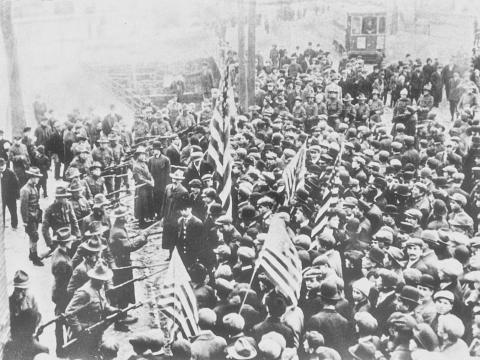
Contemporary illustration of the blockade of engines at Martinsburg.

Jeremy Brecher's vivid history of the first mass strike in US history: the great upheaval of 1877 where workers took over the railways and took on police and federal troops.

In the centers of many American cities are positioned huge armories, grim nineteenth-century edifices of brick or stone. They are fortresses, complete with massive walls and loopholes for guns. You may have wondered why they are there, but it has probably never occurred to you that they were built to protect America, not against invasion from abroad, but against popular revolt at home.

Negroes with guns - Robert F. Williams

First published in 1962, Negroes with Guns is the story of a southern black community's struggle to arm itself in self-defense against the Ku Klux Klan and other racist groups.

Frustrated and angered by violence condoned or abetted by the local authorities against blacks, the small community of Monroe, North Carolina, brought the issue of armed self-defense to the forefront of the civil rights movement. Under the leadership of Robert F. Williams (1925-1996), Monroe became the test case of the right of blacks to armed self-defense when law and order broke down.

The struggle continues at Chicago-Lake Liquors - John O'Reilly

A reportback of a IWW picket in Minneapolis of Chicago-Lake Liquors, which fired 5 organizers in April 2013. More information can be found here.

Over a month after the retaliatory firings of five works shocked South Minneapolis, a noted progressive community within the Twin Cities, workers at Chicago-Lake Liquors continue their fight for justice at work by taking it right to their bosses.

Expanding your congregation of Fellow Workers

An article by Colin Bossen about membership growth and how the IWW might deal with it.

If you have been active in the IWW for a while, you have probably come across a pamphlet called “Rusty’s Rules of Order”— the pamphlet that serves as a guide to running effective union meetings.

Christmas at Starbucks

An account by Liberté Locke about working at Starbucks in New York over the Christmas season.

Starbucks is a job in which the boss is so shitty that he can lose everything in Hurricane Sandy and his sympathy only lasts a couple weeks.

Consumer Medicine: what sort of power do we have?

An article about the role of power in the medical system from the perspective of a healthcare worker.

In The Subject and Power, Michael Foucault lays out a framework for understanding relationships between how we are placed as subjects, power, institutionalized power, and struggles surrounding these issues [1].

Taxing Our Lives: Unpaid costs and wages in transit

An article about transit, it's relationship to work and capitalism, and an exploration of a revolutionary anti-capitalist orientation towards transit struggles.

The film Who Framed Roger Rabbit is a surreal comedy-fantasy depiction of a city run on entertainment in which a corrupt judge, who runs a company that took over a trolley car line, attempts to take over and buy the city. The fantasy is based in some reality.

Thrown Off Balance: workers struggles against equilibrium

A response to a debate on unions in the United States today started between a number of groups and individuals including Unity & Struggle and Advance the Struggle. This piece attempts to argue against militant reformism growing in the union movements towards a politic of ruptures and revolutionary workplace organizing drawing from the concept of equilibrium.

Recently a debate has arisen around the nature of workers, workers’ struggles, and unions amongst the broad libertarian or autonomist left[1]. The aftermath of Occupy in the United States has corresponded to a number of happenings that have pushed unions to the center of debate.

The Combahee River Collective statement

The Combahee River Collective statement

A 1977 statement by a black feminist group which is widely considered a foundational text of the 'intersectional' approach to identity politics, which emphasises multiple, simultaneous forms of oppression.

We are a collective of Black feminists who have been meeting together since 1974.1 During that time we have been involved in the process of defining and clarifying our politics, while at the same time doing political work within our own group and in coalition with other progressive organizations and movements.

  • 1. This statement is dated April 1977.

Engel, George, 1836-1887: autobiography

George Engel

Autobiography of anarchist and Haymarket martyr, George Engel.

According to your wishes I have written the story of my life, hoping that many workingmen may profit by reading it.