
Joe Jacobs on growing up in a working class Jewish community in the East End of London in the early 20th Century.

The beginning is always a good place to start. If only I knew where it all began. It had to be the East End of London. My East End.
During the last half of the 1800’s up to the outbreak of the first world war, thousands of Jewish people left Russia and Eastern Europe to start a new life in all parts of Europe and the Americas. London was a magnet for many of them, who for one reason or another were fleeing from impossible economic conditions, to say nothing of the pogroms and antisemitic persecutions which most of them had experienced. A large number of young men were running away from conscription into the army, which was obligatory at that time in the old Russian empire.
They were followed by wives, sweethearts, parents and other relatives in large numbers. So that by the time 1914 came, and the war had started, many thousands of these immigrants had managed to pack themselves into a small area consisting of Aldgate, Spitalfields, Whitechapel and parts of St Georges, Mile End, Shoreditch and Bethnal Green. As the numbers grew because of the generally large families which the immigrants produced, the boundaries of this area were steadily pushed outwards into Limehouse and Bow to the east, Shadwell and Wapping to the south and Hackney northwards. The City of London was a barrier westwards, in which very few people actually lived.
The population had become so concentrated particularly in Whitechapel where I was born, that not more than 10% of the children attending the different schools in Baker Street, St Rutland Street, Myrdle Street, Settle Street, Fairclough Street, Bemer Street, Dempsey Street, Smith Street, Hanbury Street, Christian Street, Underwood Street, etc, were gentiles. In addition there were Jewish schools supported and run by the Jews themselves. The Jewish Free School, Stepney Jewish and an Infants School for Jews in Commercial Street (see Map).
My parents arrived within a couple of years of each other at the turn of the century. Mother was born in Karlish, Poland in 1877. My father, who was much older, came fron: Kiev in Russia. He left behind a wife, three sons and a daughter. My mother had one daughter from her first husband who had been conscripted in Poland and had deserted my mother in the process. She came to London to join her two sisters and their families who arrived here a little earlier. A younger sister and husband followed later. An older brother had already found his way to New York where he spent the rest of his life without ever seeing any of his family again, except for this younger sister who went to the USA after the war.
I know very little about my father’s origins. Anything I have managed to find out is confused because among other things, when the immigrants arrived and reported to the aliens’ department, which was administered by the police, very few were able to speak any English much less read or write. My mother remained completely illiterate and died without ever managing to write her own signature. Important things like names had to be made up on the spot simply because the immigrants could not understand what the questions were all about and the officials could not spell out the sounds made by them. This is why there are so many Jews called Cohen or Levy, for example. These were the names adopted according to which of the original 12 Jewish tribes one happened to belong and this if nothing else, was always known. For instance, my father-in-law’s name was Chochulsky. The ‘ch’s’ pronounced as though you were clearing your throat, in addition to suffering from acute bronchitis. By the time the policeman had finished asking, ‘How do you spell it?’, my father-in-law had become—Morris Cohen, instead of Moshe Hash Chochulsky.
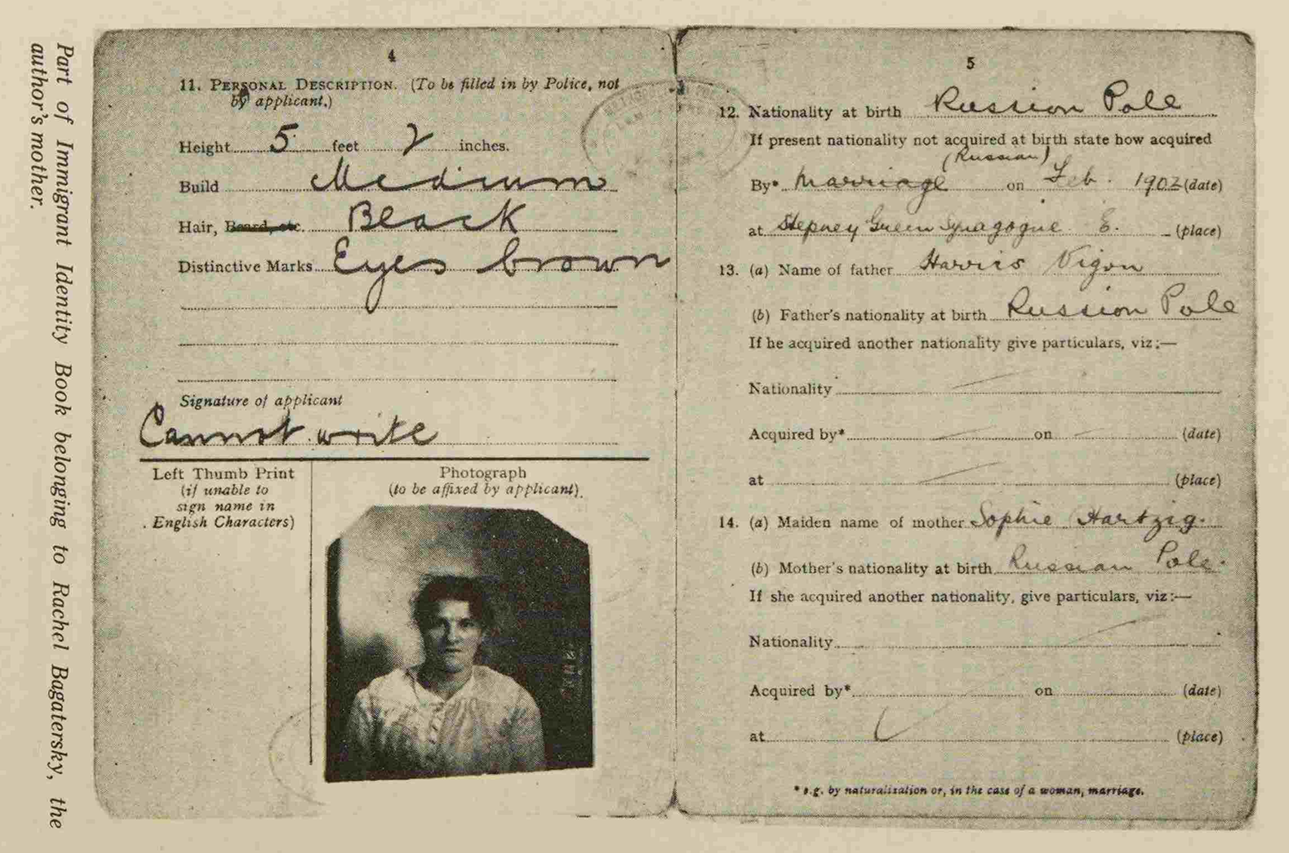
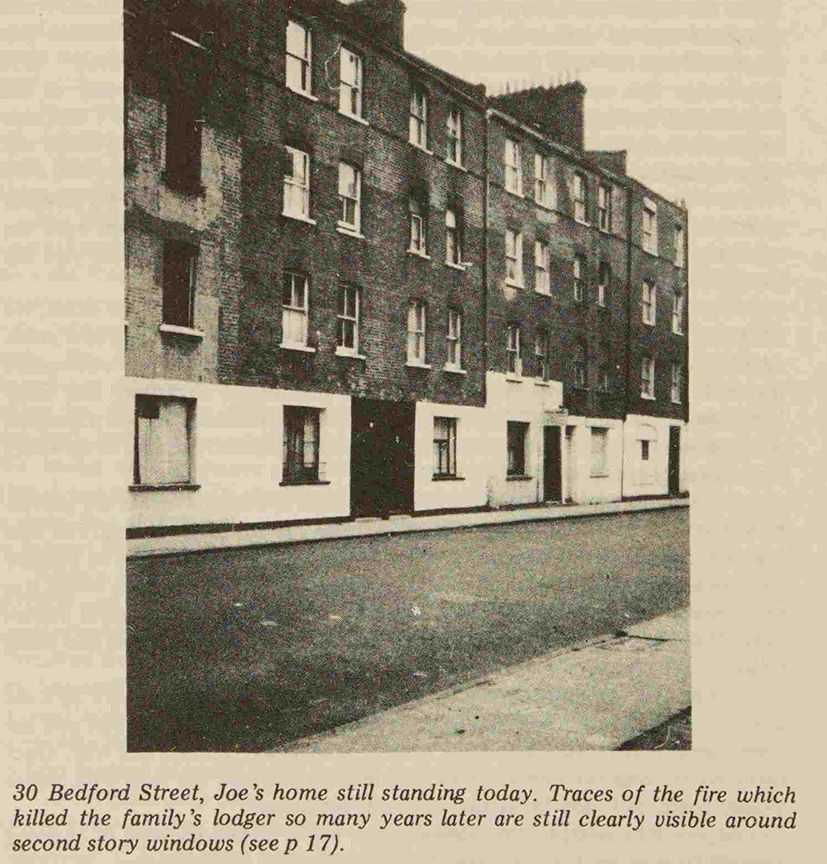
I discovered much later, that my father had been known by three names— Shlipuk—Jacobs—Bagatersky, at different times throughout his life. Both my parents must have satisfied the Jewish authorities as well as the English that had been properly divorced, because they were formally married at the Synagogue, Stepney Green and registered with the civil authorities. I did hear various tales about how this was done which left some doubts in my mind. Never mind, they were a devoted couple and, although they only lived together for about ten years before he died in 1916, they managed to produce four children. They were married in the name of Bagatersky but the four of us were registered at birth as Jacobs, a name which three of my father’s children had when they joined us from Russia a little while before I was born. His eldest son never left Russia. Many immigrants had problems concerning names because the younger men who had avoided conscription in the old country, as well as others, had left with false documents or none at all. The women did not have this problem as no passports existed at that time and leaving home did not meet with the same obstacles. My father seems to have frequently moved home within the district before he died of cancer. He became father to my mother’s daughter Sophie and then there was Deborah, born in 1909 at Arbour Square, Annie 1911 (I’m not sure of the address), myself Joe 1913, 111 Commercial Road and Hymie 1915, 30 Bedford Street. When my father’s other children arrived I understand that there was some friction between my mother and the eldest, Dave and daughter Shifra. So they did stay long before leaving our home. The younger son Harry who was about 16 years old at that time stayed and eventually joined the army where he became a sergeant and served throughout the war. He returned from the war and married a local girl and I am still in contact with her, her children and grandchildren.
I never did meet my brother Dave. He had been a student at the time of the 1905 revolution and was involved in much illegal activity in the years that followed. I don’t know much about this period except that my eldest sister of my father’s marriage told me she remembered being taken to meetings by my brother who used her, as a young child, to cover his movements. She too became involved before they both left to join my father in London, because things had become too hot. Dave started work with my father and became a tailor’s cutter and later a designer. He married, had children.
Came the revolution in 1917 and he was making every effort to get back to Russia. This did not become possible until the war had ended in 1918. I learned from his eldest son who was at that time 6 years old, that Dave, his wife and two children arrived in Russia early in 1919. He also gave me some interesting details of my brother’s activities. He was accepted into the Bolshevik Party soon after arrival because he knew many leading personalities from his previous involvement after 1905. He was appointed as manager of a clothing factory employing about 800 people. His son told me how on one occasion his father had been visited by a party official who gave him a bag of flour, about 1 cwt at a time when there was an acute shortage of food. My brother asked what he was supposed to do with 1 cwt of flour between 800 workers. The answer was that this was for his own personal use as the party had decided that it was politically prudent to preserve the health of party functionaries even at the expense of the masses, if the revolution was to succeed.
Dave began to question all that he saw going on which contradicted the views he had formed from reports he had read, before his return. His own ideas about the nature of a social revolution were also not in accordance with what he saw going on around him. He joined the ‘Workers’ Opposition’. His son was not very clear about the issues or events of the year which followed. He was only seven years old when it happened. He did learn more from his father in the years to come. It appears that Dave and his friends in the ‘Workers’ Opposition’ were being hounded and removed from positions of responsibility. He seems to have been a political prisoner at one time. Having some experience of clandestine activity under the Tzar, Dave now turned his attention to once again planning an escape from Russia. This time with his wife and children. A group decided that they would not survive physically if they continued their active opposition to Lenin and the majority of the Bolshevik Party. They made plans to proceed by way of Poland, through Germany to points westwards. They made it to Paris where my brother liked the people he met as well as Paris itself. He settled there and became a ladies’ clothing manufacturer.
His politics moved closer to the Anarchist position, but he was less and less active as time passed. His eldest son still carries on as a clothing manufacturer. His other children and grandchildren have all survived the German occupation of the second world war and continue to pursue their lives as good French citizens. I do not have any contact with them. Our lives were separated by distances and life style.
When Dave became an active revolutionary I was not yet born and was only 8 years old when he arrived in Paris. My own ‘entry’ into the workers’ movement in 1925 came before I knew any details about his existence. He did make frequent trips to London, in fact he chose to marry a girl from 13 Stepney after the death of his first wife. She joined him in France. I met my sister Shifra for the first time some 40 years later and have seen her only twice since, although she is still alive.
* * * * *
In 1916 my mother was left a widow with five children aged 11, 7,5, I was 2 years 10 months and the youngest just 10 months old. She had no means of support :s there was as yet no governmental schemes from which she could claim help. There were only the Poor Law relief, the workhouses and local charities, the main one being the Jewish Board of Guardians.
I don’t suppose I really remember my father’s funeral in such detail but one story was repeated so often I have come to regard it as an experience I actually remember. We were living in Bedford Street, on the 4th floor of the tenement house, part of a large terrace of such houses. The four flats were only separated by the winding wooden staircase leading to each floor and the doors of the three rooms led directly from the landing and passages, on which there was also a lavatory and a recess for a sink and a large brick built boiler for ‘washing’. There was no privacy between the four families and our lives were inevitably intermingled. I remember entering the larger front bedroom where men in skull caps some with long beards were mumbling away for all they were worth and beating their breasts. I could hear the women and other children in the rest of the house crying and wailing and I was very frightened. All the men in the room were gathered round a large box which was resting on two chairs, one at each end, which was draped over all with a large black cloth. Suddenly the drape was removed revealing a long unpolished wooden box, narrower at one end than the other, and one of the men began to unscrew the lid and proceeded to remove it, revealing my father’s body, lying there. Somebody noticed too late that I was present. I was petrified. I was picked up and almost thrown through the door into the arms of an enormous woman who almost smothered me in her breasts in a vain attempt to stop me from becoming completely hysterical.
Being the eldest son present it was decided to take me to the burial grounds situated at Edmonton on the outskirts of London. Soon after the coffin had been lowered into the ground, the prayers completed, I was given a ball made of paper and filled with sawdust to which was attached a long thin string of elastic. By attaching the end of the elastic, which was looped, to my finger it was possible to thrown the ball away and with any luck it would return to my hand immediately. Now, the point of this story is also the reason why it was so often repeated. On returning home, my mother asked me who had given me the ball and I am told, I said, ‘Daddy’. Of course, it is the only real remembered contact I had with my father.
The week of official mourning over, my mother had to deal with the problem of feeding herself and five young children. She was advised to appeal to the Jewish Board of Guardians. Their offices were situated in Middlesex Street (the world famous Petticoat Lane). She was received and questioned very closely about her assets and it was revealed that she had about £26 to come from a friendly society to which my father had contributed for quite a long time. Almost every Jewish family in the East End belonged to a burial society attached to the various synagogues and most of them in London still do. In addition many belonged to various friendly societies for extra benefit and insurance against ill health etc. Most of these gradually disappeared as Government sponsored National Health, welfare and pension projects got underway. It was suggested that she should hand over this £26 (which was an enormous sum for a worker to possess in those days) and that they would add another £26, which meant she could draw £1 per week for at least a year. In addition they offered to help out with boots, clothing, and at High Holiday times like Passover, the Day of Atonement and the Jewish New Year there would be food parcels. She agreed to this and came home relieved to know that the rent, 8 shillings and fourpence a week, would be paid, which left eleven and eight pence to pay for gas, coal, and food for her family. We did not enjoy the luxury of electricity for many years to come. Fortunately she was a wonderful cook and could produce good meals for very little money. Even so, that amount of cash could not be stretched very far. She must have been helped by relatives and neighbours who were used to making sacrifices in this way although they were nearly all very poor themselves.
The ‘poor helping the poor’ was a well known fact of East End life. My mother looked around for ways of supplementing her income. The only work she had done before marriage was as assistant midwife and nurse to mothers during the first week of confinement. This was not possible now because of her own very young family. So she started by taking in the neighbours’ washing, that is those who could afford to pay for this service. My earliest recollections are full of scenes of my mother spending endless hours at the wash boiler or over a tub of steaming washing rubbing away until her hands were red raw, ironing until her back could stand it no more. Living on the top floor meant that we had a good landing which was not used by other occupants of the house and by fixing rope lines from one wall to the other she was able to hang dozens of items for drying. From Monday to Friady, day and half the night, was one long ‘wash-day’. We were never free of masses of sheets, pillow slips and various items of clothing in different stages of attention. I remember well the awful smell which was always with us. In between of course she had to cook and attend to us. My sisters, young as they were, had to help to deliver the wash on Friday and collect the dirty stuff on Monday. In this way she was abie to earn a few shillings to enable us to keep body and soul together. As if she did not have enough troubles, as a result of a row with one of the neighbours, and neighbours were always having rows, somebody informed the Jewish Board of Guardians that my mother was working. So they stopped the payments which she was receiving. The first year was almost over anyway so she had to think of an alternative way of making a living.
It was during this year that something happened to me which was to affect 15 me for the rest of my life. I was about 3 and a half years old and my mother had strapped me in a wooden push chair and left me near the front door in the street, while she carried on with her work four floors above. The kids in our street were very rough as were most of the kids in the East End, and a boy called Oscar Pyser, whose father had a small cloth shop directly opposite where I sat in my pushchair, took it into his head to throw a handful of sand and dirt into my face. I must have screamed very loudly and proceeded to rub this dirt into my eyes. By the time my mother was alerted the damage had been done. My eyes became severely infected and for the next 3% years my mother had to take me, as an out-patient, several times a week to the clinic at the London Hospital which was situated just a few streets away. During this same period I spent many weeks as an in-patient at this and other hospitals. For a short period I was almost blind and I roughly remember being sent to Brighton for a period and I can remember the daily trips to the sea-front, being transported on the foot-rest of an invalid chair which was occupied by another child who was unable to walk. I can’t remember what was happening to my brother and three sisters during this time.
By the time I was seven years old it was discovered that I had contracted trachoma, a very serious contagious disease which attacks the eyes, and on 20th May 1920 I was sent to an isolation institution, ‘White Oak School’, Swanley, Kent, where I spent the next four years. I never saw my mother or any member of my family for the first two years at Swanley, and only saw my mother a couple of times during the last two years when one of the neighbours, a young man, brought her to see me. I know now how impossible it was for her to pay much attention to me, with all the money problems she faced at home. My eldest sister Sophie had started to work as a blouse machinist and that must have helped.
During the 3 and a half years before going to Swanley the war had ended and my mother had given up ‘washing’ and now that the girls were older she was able to go out to work. She became a cook at the many functions, weddings and Barmitzvahs (Confirmation of males at 13 years of age) which were going on all the time. However this meant being away from home for periods of 24 hours and more at a time. So the children really got out of hand. It must have been some time in 1922 when my sisters Debbie and Annie were sent off to a Jewish Orphanage at Norwood where they spent about 18 months. They came home before my return in May 1924, but Debbie was not living at home when I arrived.
Here’s why. Mother was in the habit of hiding small sums of money, to meet bills, in among the linen in a chest of drawers. Debbie, who must have been nearly 14 at the time, stole a half-crown and was seen coming down the street eating a large William’s pear. Mother caught her and asked where she got the pear from but was unable to get a satisfactory answer. When she arrived home she went to the drawer and found the half-crown missing. She was furious and realised that she was unable to cope, as the girls were developing into very difficult teenagers. My brother had acquired the nickname ‘Dustman’ by this time, because it was impossible to keep him clean for very long. He spent most of his time in the streets, running wild. Not knowing what to do about all this she was advised to report her situation to the ‘Ladies’. I believe this was a semi-official body of do-gooders, attached to the local Juvenile Court. Their office was situated near the County Court in Great Prescott Street, Aldgate. This resulted in Debbie being sent to a reform school in Stamford Hill, which I remember visiting on one occasion. This proved to be a disaster. My mother never again appealed to the authorities for help even though the conduct of my sisters and young brother, as time went on, was outrageous.
* * * * *
I must tell you a little about my stay at Swanley although it has nothing to do with the East End. It had a great deal to do with my development. I was seven years old when I went there. Trachoma is a very painful disease leading to total blindness, if not treated successfully. It does not exist in this country now due te modern antibiotics. I remember waking each morning ana having to use my fingers to get my eyes open due to the heavy discharge which had accumulated during the night causing the eyelids to stick tightly together. The treatment consisted of daily bathing with boracic acid solutions and various applications of ointment. Every two or three weeks the eyes were washed in a solution of silver nitrate which felt as though your eyes were being burned out of your head. This had the effect of partially freezing the tissue so that the eyelashes which were growing inwards could be plucked out with a pair of forceps. This caused a lot of blood to flow and what with the intense pain was very frightening. As you can imagine any attempt to educate us was very severely handicapped. We did go to school but could only do what the state of our eyes at any one time would allow. I was barely able to read or write at the end of those four years.
I forgot to tell you that both my name and birthday were wrongly recorded at Swanley. When I was first treated at the London Hospital, my mother had produced a document which she could not read. This showed ny name as Joseph Bagatersky, dated 25.5.1913. It was years later when I first saw my birth certificate that I found, I was really Joseph Jacobs, born 9.5.1913. This document was the certificate of circumcision, carried out by a Mohel (a sort of rabbinical surgeon) and the name had come from my mother’s marriage lines and the date was two weeks after I was born when I was circumcised. So at Swanley, my name was Bagatersky and at one time I was the only Jew there out of about 300 children of all ages. This did not help matters. I was called all sorts of names including Bag-of-Toffee and Bottle-of-Whiskey. Not only by other children but by members of the staff. The local Church of England vicar was also our minister and he took it upon himself to take special care of me. He often referred to me as one of God’s chosen people. This attention frequently had the opposite effect to that intended. He was a very kind man and I crieda great deal when he was buried early in 1924. I still visit his grave whenever I am near Swanley.
I was also a fat boy. I had spent several years without much physical exercise being unable to play ball games through bad eyesight, as well as being overfed. I felt that I was frequently being made fun of. I knew nothing about anti-semitism at that time. I became very frustrated and developed an uncontrollable temper. The more I was punished the more violent I became. I once hit another boy on the head with a heavy iron poker simply because he was given the job of cleaning the bathroom when I had to clean shoes on the back porch and I wanted his job. What I remember most is that I was always so very frightened.
On 19th May 1924 I was declared free of the disease and it was safe to send me home. Except for occasional short walks I had spent the whole of these four years behind a high fence within the buildings and grounds of this institution. I was taken from Swanley to Mile End Hospital, one of the East End infirmaries, where my mother was waiting to receive me. I went home. My real troubles were yet to come.
* * * * *
Everybody was pleased to see me. I was bewildered. Such strange sounds —such strange sights—such strange smells. A lot of the neighbours could hardly remember me. Nearly all the younger children in our street didn’t know me at all including my own sisters and brother. My sister Sophie had married a man several years older than herself. He worked in a bakery at the corner of our street where it met Varden Street. Being a night-worker he was still in bed when I got home. They were occupying our back bedroom which left only the kitchen and front bedroom for my mother, Annie, Hymie and now, me. Debbie was still at the reform school. Annie slept with my mother and we two boys slept on a mattress, on the floor. Later, when Debbie came home she had to sleep on a sofa in the kitchen.
What we called the kitchen was also the living room. Along one side, about twelve feet in length, was the fireplace, an old iron construction with a closed grate and oven on the side with the top enclosed and round covers which could be removed for feeding the fire. Along side this in a smail recess was an old fashioned dresser. four shelves and cupboards below, about eight feet long.
The far wall, about nine to ten feet long, was filled by a sofa, which was opened at night. The wall opposite the dresser and the fireplace also had the only window in the room. Below the window stood the table and chairs. In the corner along side was the gas cooker which you had to be careful not to hit when entering the room, because the door was where the room narrowed and there was only enough space for the side of the cooker and the door. There was hardly any room to move from one spot to another if more than two people happened to be seated at the table.
My mum managed to keep a window full of flowers and an odd assortment of things which grew from pips or pieces of vegetables she just happened to put into a meagre amount of soil in boxes or pots. She loved growing things and I often wondered what she would have done with a decent garden. After all she had spent her childhood and youth in a small village in Poland and knew a lot about growing things.
My mother was still cooking at functions for a living and so we were often left for days unattended. Sophie became pregnant and she and Max founda couple of rooms in the Aldgate district. We could not afford the whoie rent which had gone up to 12 shillings per week. So the back room was let to the people on the first floor because their family was growing too large for their accommodation. They had a father. He had his own workshop situated through the yard on the ground floor. He was a ‘rich’ cap maker. Not long after, they moved and this time the room was let at 4 shillings aweek to a spinster, Leah Goldstein. She must have been quite good looking at one time but her face was horribly pock-marked and she used very heavy make-up in an attempt to conceal the marks. She died a few years ago, suffocated and burned to death in this same room, so many years alone, after we left. The house is still there. I knew her as a lively person who used to sing funny songs in Yiddish at the local Trade Union halls. She was intimate ‘member’ of my family.
Within a matter of days after coming home my old uncle who had to work so hard to provide for my aunt and their eight children took me to a shop and bought me a pair of boots, without which entry to the local school would have been delayed. I joined Baker Street School. The headmaster was Charles Key, Mayor of Poplar and later Labour MP for Poplar after George Lansbury had died. He was mentioned in the Lynsky Tribunal which dealt with the Stanley affair into corruption of ministers and Board of Trade officials. I liked him very much at school although I had occasion to oppose him when he came to talk at one of our local Trade Union (TU) meetings years later.
I was a big boy and it was decided to put me in a class which was too advanced for me, rather than embarrass me by having to join the much younger children in the lower classes. I was making very rapid progress but alas, this was very short lived.
Before I was 12 years old, my left eye, which had never been restored to sight, began to cause trouble. Back to the London Hospital and this time I was detained and it was decided to end my suffering and save my right eye, by means of removing the left one. I can only remember being prepared for the operation and being very frightened. I was told afterwards that my mother spent the whole day crying and that neighbours had to take care of my young brother. After about a month in hospital I went home again, this time with a big black patch over my left eye which I wore for a short period. When I was 14 I was fitted with an artificial eye. I was unable to resume my schooling for a few months. (See school photograph.) That time was I believe crucial for my development. I had become very self conscious and shy. My temper had not improved and there were many occasions when I let fly in all directions. My young brother was a frequent victim and he came to regard me as a big bully, with some justification.
* * * * *
Before going on further I must tell you more about my street which was not unlike many others in my part of East London. Taking my side of the street which had the even numbers starting at the beginning where it joined Commercial Road, there was Singer’s sewing-machine shop. Then a restaurant, followed by a small china and glass warehouse. Then a tailor’s trimmings shop, a milliner’s, a tobacconist and a sweet shop, a butcher then a baker at the corner of Nelson Street, the street I was told where John Bloom the washing machine tycoon spent some of his childhood. On the next corner was a pub. Then an embroiderer followed by a barber shop complete with striped pole. This was the beginning of the long terrace of four storey houses in which I lived. A large number of the ground floor front rooms were converted into shops or workshops. All these houses had workshops at the back which were reached by going along the passage, crossing a small yard, containing the dustbins. In addition many had the top floor flats converted into workshops. Most of them were occupied by tailors or clothes makers of various kinds. My father had been a Ladies’ tailor. Like most of the men and young females he was employed in horrible conditions for long hours for very little money.
Continuing along the street the next front room was lived in, the next was a sewing machine mechanic’s workshop. Then came ours, occupied by an umbrella maker, with an open umbrella attached to an iron bracket coming out of the wall, as a sign. Then a private tailor, then a sack and bag dealer. This is all in addition to the workshops already mentioned. Three doors further along there was a furrier and a trousers maker in the same house. In many of these houses it was hard to find where the workshops ended and the living accommodation began. The whole street was similar in character with cobblers, tinkers and ever more tailors, dress makers, dealers in all sorts of goods connected with the tailoring trade and of course every kind of food shop with a large variety of smells which had originated in Russia, Poland and from every country in Eastern Europe.
There were two buildings in our street which were very important to me. The first, twelve doors from my home ‘No 54’ was different to all the others. The front door was in the centre and as you entered there were offices on either side of the passage which led to a wide wooden staircase. You could not see into the offices but there were small openings covered by panels which slid up and you could talk to a face on the other side. Climbing the stairs you would hear voices often very loud above the general gabble of conversation mostly in Yiddish. In addition loud bangs as the dominoes hit the table tops. On entering a very large room, occupying the whole of that floor, the cigarette smoke would almost cause you to choke. Here, during the daytime, were the men who were unemployed, to be joined in the late evenings by those who had been working. Tea and snacks of all kinds were available, at a small bar occupying one corner. The floor above had several rooms in which there was always some sort of meeting going on.
This was the headquarters of the local Tailors’ and Garment Workers’ Trade Union for Gents’ Tailoring workers. There were places serving the same function for other TUs through out the East End. They were Social Clubs as well as Trade Unions.
The other building was one of the biggest clothing factories in Stepney at that time. Schneiders, the makers of ‘Guards’ brand ciothes. This factory occupied almost a quarter of the whole length of the street and was situated towards the end leading into Whitechapel Road. This was the factory where I ‘discovered’ Arnold Wesker’s Aunt Sarah. She emerged during the course of a bitter strike, as a very good public speaker and as leader of the many women who worked there. She became a trade union leader and active in the clothing industry for many years to come. I was to meet her both as a trade unionist and member of the Communist Party (CP), over a period, chiefly through the many disagreements which we had. I believe she is portrayed in some of Arnold Wesker’s plays 1 . I also knew Arnold’s father who I liked very much but I didn’t know he was to have a famous son, then. I could go on describing our street for a long time and from time to time it will come into the early part of my story.
* * * * *
You would be wrong if you think from what I told you that everything in my scene was grim and tragic. The humour was rich, comprehensive, full of wit, when it was not downright vulgar, which it was quite a lot of the time. The street was full of gossiping women and children playing every kind of game you can think of, often to the annoyance of the trades’ people and mothers who were trying to get their babies to sleep. During the summer months the adults sat on chairs on the pavements outside the front doors talking, laughing, arguing very excitedly during the evening and late into the night. One reason for delaying the decision to retire was that when you did go to bed it meant fighting a running battle with the bedbugs which seemed to be everywhere.
One hears a great deal nowadays about the need for sex education for the young. Nobody paid too much attention to this then. I can tell you that we didn’t need much more knowledge from any ‘professional educators’ about where babies come from. Birth control? Maybe. How could it have been otherwise? The woman downstairs was having a baby every year and we knew exactly where they came from and how they were conceived. We were not very old before the usual games, ‘mothers and fathers’, ‘doctors and nurses’ were being played. And maybe you can tell me why all the boys wanted to be the Father or Doctor, and all the girls wanted to be Mother and Nurse? They all seemed to know what to do, if my memory serves me right. A
ll life was very intimate. You entered any of the neighbours’ homes as readily as going into your own. The doors were seldom closed. Even in winter the front doors, when shut, had a piece of string emerging through a hole which, because it was attached to the latch, enabled anyone to open the door without a key. The string was usually pulled in when the house was closed for the night. There was very little loneliness in my East End.
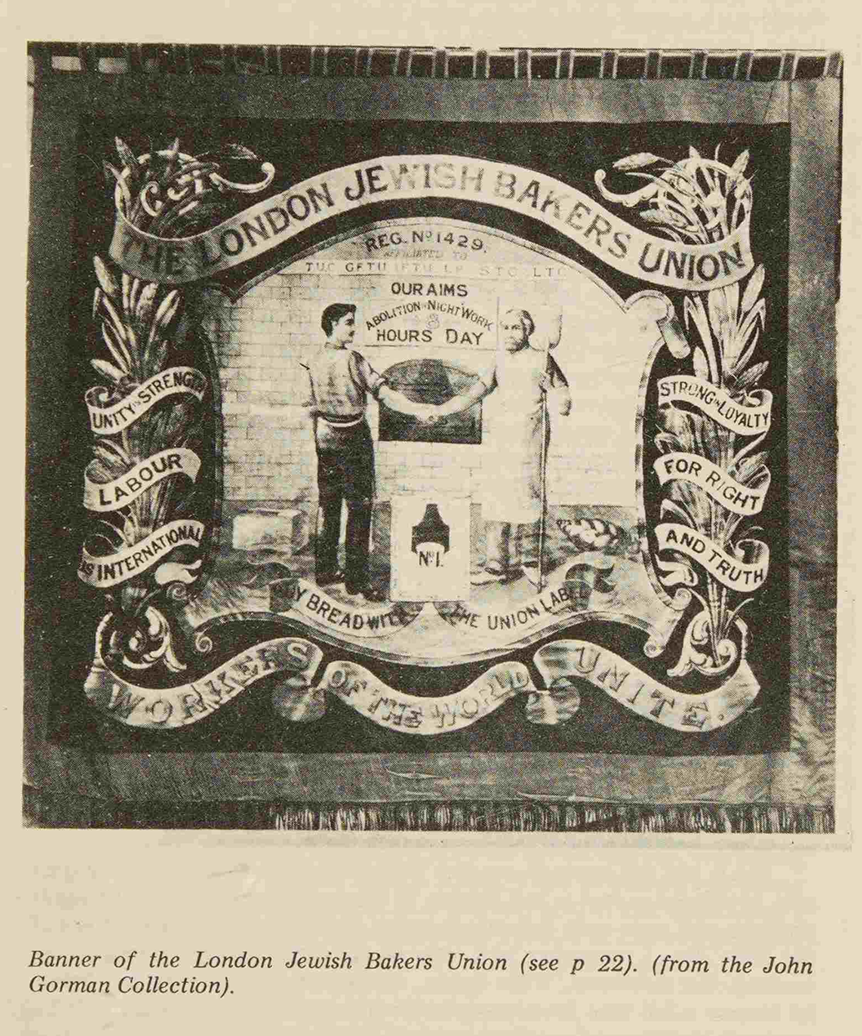
Memory can play tricks on you and you will forgive me if my dates are not always exact, but it must have been 1925. I was almost twelve years old with a few months to spare before returning to school. The rest of the children over the age of three to four were at school. I was in the street where I usually sought to occupy myself without daring to go far away from my small section, when I heard what sounded like a drum being beaten, coming from the direction of Varden Street, which joined my street forming a T-junction. I hurried towards the sound and as I reached the comer I saw a huge-multi-coloured banner blowing in the breeze, held by two men on either side with straps over their shoulder meeting at the waist into a brass fitting in which rested the pole supporting the banner. Walking in front was a slightly built man and I was looking into his face which seemed to have a sort of ‘far away’ look. Depicted in the centre of the banner was a painting of an oven door with a man dressed in bakers’ white trousers and vest and wearing what looked like a flat topped chef’s hat but not so high. In his hand was what I can only describe as a long wooden shovel. Across the top were the words “The London Jewish Bakers’ Trade Union’. I can’t remember the words along the bottom, but I do remember the scroll like decorations surrounding the picture and forming a background to the words. There were about 20 men following the banner and one of them was beating a drum. Bringing up the rear was a man carrying what looked like a small collapsable step ladder.
I was so fascinated that it was some time before I realised that I had left our street and was in fact several streets away, as I followed the procession in the middle of the road, I noticed we had acquired the presence of a policeman walking alongside on the pavement. I continued to follow, seemingly unable to stop and turn back. We arrived at a baker’s shop in Jubilee Street. There was a man walking up and down outside with a red armband, bearing the word ‘Picket’. He had two placards suspended from his shoulders with words painted on them. I can’t remember what they were.
Jubilee Street is where I was told Stalin stayed during part of his short visit to London. Between Jubilee Street and my street is another street running parallel—all three extending from Commercial Road to the south and Whitechapel Road to the north. This is the famous Sidney Street. I heard many personal accounts of the siege so often connected with Winston Churchill’s career as Home Secretary. Most of these tales, which have become part of the folklore of my East End, seldom refer to Peter the Painter and his friends as bandits or criminals, but as Anarchists and part of a revolutionary organisation.
The procession stopped, the banner was lowered to the ground, the man with the step ladder opened it and it turned out to be a speaker’s platform. The thin man with the far away look climbed on to it and began to talk, at first quite quietly. Gradually his voice got louder and louder. The far away look was gone and he became at times very angry and spoke with great emotion. His message was so simple even I could understand it. After describing the terrible conditions in which bakers worked, the heat, the long hours through the night, the low wages, the threat of instant dismissal if you displeased the boss and so on, he said that the only way the men could relieve their suffering was to organise in Trade Unions to meet the attacks of the boss by their own united action. This strike, for this is what it was, started because some employers had refused to recognise this union who were demanding that they should stick a small label on the bread which said, ‘This is made by Trade Union Labour’. It was not uncommon to see such labels on a variety of products in those days. Many printers still continue this practice. This must have been the first time I heard the words “United we stand, divided we fall’. I heard them often enough from speakers on many platforms, as time passed.
After about twenty minutes, the speaker left the platform, the procession reformed and we all moved off. The crowd which had formed round the platform dispersed, all talking to each other as they went. We proceeded as before but by a different route all through the back streets for about a mile or more before arriving at another baker’s in a narrow turning calied Plumbers Row. The same procedure as before followed outside this shop and once again we left and headed for Walden Street where we all stopped outside a small building. The semi-basement was the headquarters of the London Jewish Bakers’ Union. All the men went inside after rolling up the banner with loving care.
The man who had captivated me was called ‘Proof’, the organising secretary of this union, who I was to hear described as ‘The Anarchist’. He went back to Russia some time after the incident I have described. I did hear that he died as aresult of his disagreement with the Bolsheviks but I don’t know if that is true.
It was about 2.30 pm and I had been missing from our street for about three hours. I realised then that I was very hungry. I felt elated. I imagine this is how a drug taker must feel after his first ‘fix’. Most certainly, something had entered my bloodstream. Fortunately, I was only a couple of streets away from home and I arrived a little breathless to meet my mother who was waiting at the front door. She scolded me for my absence and I believe I got a whack round the ear, but I didn’t feel anything.
I followed these men each day for about a week except for Saturday when all the shops were shut and everyone who appeared on the street was dressed in their Sabbath clothes. In those days most of the parents were themselves immigrants and they tried very hard with growing opposition from their children to follow a pattern of religious life brought from the ‘old country’. Needless to say they lost a lot of their own way in the process.
But it was still common practice for fathers to be accompanied by their sons, to proceed on foot in best clothes, to the synagogue on Friday evening at sundown and again early Saturday morning and yet again before sundown of the same day. I remember well, one of my earliest young friends in the working-class movement, Willie Cohen, who right up to the time just before he became a full time functionary in the Young Communist League (YCL), went with his father and younger brother to the synagogue in this way, because he did not wish to meet his father’s wrath and upset his mother. Even if he did spend the rest of the week declaring among other things that ‘Religion is the opium of the people’. He was a friend of John Gollan, the recent Secretary of the CP who had recently arrived from Scotland and spent a short time in the East End. My future brother-in-law made a suit of clothes for him at that time for very little money. A sort of comradely gesture.
The synagogues were everywhere, at least seven within 250 yards of my home. They differed mainly because of the origins of their members and upon some difference in emphasis of outlook and religious practice. The boys were all required to learn Hebrew, usually in small private classes conducted by rabbis who were paid weekly. There were larger establishments called Talmud Torahs which sometimes taught free for the poorer members of the community. These classes were conducted after school hours daily—Saturday excepted—and continued until one’s Barmitzvah at 13 years of age. I’m telling you all this because I want you to understand that what I’m describing is an area, or so I thought, which had developed a ghetto like character and it was mainly created by the immigrants themselves. A ghetto has boundaries and ours was no exception. Some of our boundaries would be better described as frontiers. The nearest was at the end of our street where Commercial Road, the main road, separated us from the streets on the other side, Planet Street and Winterton Street. One did not cross into these streets alone. This is where the ‘Yoks’ (Gentiles) lived. Their female counterparts were called ‘Shiksas’.
If anything they were more ragged than us and lots of the children ran around in bare feet. We were told that this was because their parents spent all their money on beer. We were also told that they were rough and didn’t like Jews. They regarded us as foreigners who looked funny and had a peculiar smell. If we ever met across the frontier it was usually in large groups with all kinds of missiles flying around. I still have a scar on my forehead from one of these encounters.
There were other Gentiles who we called Ladies or Gentlemen. After all you couldn’t refer to the doctor or teacher as ‘Yoks’ or ‘Shiksas’. Then there were the gentiles who entered our territory freely, like policemen, postmen, rent collectors, sanitary inspectors, dustmen and so on. Occasionally groups of adult ‘Yoks’ did enter to dig holes in the road. I never saw any Jewish men dig holes in the road.
As time went on I remember some of Oswald Moseley’s public speakers repeat the statement -‘You’ll never see a “Yid” down a coal mine”. The ‘Yoks’ didn’t think much of the kind of work the Jewish men did. The feeling was that Jews were shy of hard manual labour. These sentiments may sound familiar to you now but they relate to a different kind of immigrant. What’s the good of trying to reason when deep inside a feeling of hate and prejudice is burning you up? After all, wasn’t it true the Jews killed Christ?
* * * * *
Having listened to ‘Proof the Anarchist’ and travelled further afield on my own in the process I became bolder and often found myself in Whitechapel Road during the evenings. There were always meetings going on at any of a number of street corners. There were missionaries from many local Christian missions to the Jews with premises which provided excellent medical and dental treatment. Free, if you were prepared to listen to the sermons and join in praying and hymn singing before being treated. There were Labour Party meetings, TU propaganda meetings, Socialists, Anarchists, Unemployed Workers’ organisations, and many others including one, King Anthony, an expolice inspector, who claimed to be the rightful heir to the Throne of England. Above all there was the Young Communist League and the Communist Party. They attracted me most and I listened for hours to many different speakers. It wasn’t long before I was helping to distribute leaflets at these meetings.
Having returned to school I got to know more young people living around. We met on the street corners after school, some played games, fought or chased the girls. The older boys having left school were beginning to pay more attention to their appearance and to the girls. Almost every corner had its groups. The one which pulled me towards it was a few yards away from the Garment Workers’ TU premises at No. 54. There was a lot of coming and going and often groups would form on the pavement to continue discussions which had originated inside and in this way I and other young boys could listen to talk about conditions in the workshops and factories and what ought to be done. New words were learnt every day. Exploitation, sweated labour, and strange words like sectarian and leftist and names, Marx and Lenin.
Come 1st May, there were crowds of people all gaily dressed and horse drawn carts decorated in red material, carrying children and banners and placards with slogans like ‘Workers of the world unite’. There was a band and lots of noise. Some of the men started to shout orders and after a while a procession was formed and with a lot of policemen on either side they all started to march away. I followed. We got as far as Gardiner’s corner, Aldgate, and there were thousands more people in similar processions coming from all directions. They halted in the middle of the road. When the processions stopped arriving they all joined together. There were thousands on the pavements and more policemen than I had ever seen before, some mounted on horses.
The bands started to play, people sang and shouted. The East London contingent of the May Day march got under way. I followed. We got to the Embankment and stopped to be joined by a contingent from South London and as before we moved off again in the direction of Hyde Park. I followed. When we got to Hyde Park I began to think that all the workers in London must be united.
What had happened to the ‘Yoks’ and Jews? We were all ‘comrades’. That’s what all the speakers were calling the people they were addressing. The meeting over I realised that I was tired and lost. I got to Marble Arch where I met my cousin who was a couple of years older than me and since he didn’t have any money either, we started on the long walk home. I was very tired, hungry and dirty, but happy.
The year I came home, 1924, was the time of the first Labour Government, which some historians say was brought down because of the Campbell case. I didn’t know anything about these things, much less that I would be meeting J R Campbell many times. Stepney was a Labour stronghold and I got to hear about people called Attiee, Gosling, Scurr as well as George Lansbury from neighbouring Poplar. During the two years leading to the General Strike, I heard a lot of discussion about the miners. The very thought of working deep down in the earth caused me to shudder with fright. I hadn’t yet read Zola’s Germinal and knew little about these people who lived and worked in far away places.
I was now 14 and learning at a very fast rate. So I knew that there was a possibility of a General Strike. One could hardly avoid knowing something about this in the East End, but I didn’t bargain for what I saw when it happened. Hundreds of people were rushing towards Commercial Road from every side street and I was among them. I managed to get to the front of the crowds lining the pavement and bang down the middle of the road where dozens of motor vehicles in line, were crammed full of soldiers, all heading Eastwards. There were policemen everywhere. Many, I noticed, wore flat peaked caps instead of the usual helmet. They were being referred to as ‘specials’. Some just had police armbands and caps. There were lots of mounted policemen jumping around and helping to prevent people from leaving the pavements. Occasionally a vehicle would come along moving much faster passing the line carrying the soldiers. These all had big labels stuck on them with the single word ‘Food’ printed on them. Then there were ambulances, fire engines and police vans proceeding in the same way as the food lorries. I decided to see where they were going. I got as far as Blackwall Tunnel and the entrance to the docks. The crowds were so dense [ had great difficulty in getting to the front. Every few minutes hundreds of men would surge forward off the pavements into the road and what followed frightened the living daylights out of me. Police on horseback with long wooden truncheons were hitting out in all directions. The police on foot were engaged in violent assaults on anyone who was not on the pavements while hundreds of others were linked together trying to stop more people getting into the road. I felt sick. People were holding their heads and there was a lot of blood on many of them. After a while the vehicles carrying the soldiers had passed through the dock gates. The fighting stopped except for occasional outbursts here and there. The police were in control. The crowd began to get thinner and I headed for home. This sort of thing was not repeated on this scale again where I happened to be during the week that followed. There were meetings and marches everywhere and I helped to distribute leaflets and stick labels on anything which offered itself.
This was all I saw of the General Strike and my sympathies were all for the miners and I began to hate the police. I was profoundly affected.
* * * * *
I’m a little ahead with my story because things were happening to me and my family during my 14th year which you ought to know about. My short period as a school boy had led to considerable progress in my knowledge of the three R’s but I had missed any chance of ‘further education’ because I was too old to enter for qualifying exams. My sister Debbie had been home from the reform school about a year and she worked as a waitress in various local restaurants. She seemed to change jobs very often. She was 17 and Annie was 15. My mother used to sit at the open window late at night waiting for them to come home. When they arrived together or separately at different times, decided whether or not there was to be one or two terrific rows with beatings and screaming which must have disturbed the neighbours a great deal.
My younger brother, who was now 11 years old, used to share with me the run of the home while my mother was away working, until my sisters came home from work. I’m not quite clear what exactly Annie worked at in the clothing trade. She did not work for long in any one job. She was already beyond anyone’s efforts to discipline her. When they got home before mother, they made sure to be out of the house before she arrived. I know that Annie liked going to dances in the local halls and judging from things my mother used to accuse them both of there was a great deal more to their method of amusing themselves.
My brother was getting wilder than ever and he had begun to acquire more spending money than other kids who had fathers. I’m not saying that I was a paragon of virtue. My temper was as bad as ever and I was difficult in many ways, but my interests were heading in the direction of politics. My mother worked very hard and did her best for us but she was up against impossible odds.
At this time I got a job, after school hours, as a shop-boy for an elderly man living a few doors away who had a workshop making gents’ jackets and overcoats. Just himself and his wife. He paid me four shillings per week for collecting the cut garments from two bespoke tailors’ shops, one in Bethnal Green Road and the other in Green Street, Bethnal Green, and delivering the finished product.
This meant going straight from school to collect a black wrapper and its contents and twopence fare money. I nearly always walked so that I could keep the twopence.
Incidentally, Green Street, proved to be the most fertile centre in East London when Moseley arrived to sow his poisonous seeds. This job occupied me for about three to four hours each evening and about the same time Saturday mornings. The practice of not working on Saturdays was beginning to break down under pressure from the needs of shops and other businesses situated outside the Jewish areas. I didn’t work on Sunday. I gave my mother the four shillings and she returned sixpence to me. I remember stealing two and sixpence from one of these shops and I learned other ways of supplementing my income.
When leaving my employer’s place I had to go towards Whitechapel where it joins Mile End Road. This meant passing Schneiders, the big factory in our street. I noticed that when the ‘shiksas’ were coming out at the end of the day’s work there were among them some Jewish girls and nearly all the men were Jews. A lot of them seemed to be laughing and joking with one another. This contrasted somewhat with my impression of the East End. You must remember that it was only two years since I had left Swanley. Everything I was seeing and learning about was so different from my existence in that institution. I suppose young children see things more sharply as being either black or white. I know now that what I have described so far could not have been 100% as I saw it. It began to dawn on me that Jews and Gentiles did mix a great deal more than I had supposed. In travelling further and further afield I saw this relationship more and more. Afterall lots of Jews owned shops outside my area, others had stalls in markets and many Jewish workers travelled some distance to work. People who had lived in our ‘ghetto’ were moving away in the direction of Hackney and Stamford Hill and I heard of Jews who lived in places like Cricklewood, Brondesbury and Golders Green. Around the union premises I heard of Jews in the clothing industry who it appears lived in far away places like Leeds and Manchester. I used to wonder why it was that Jews and Gentiles should find so much to differ about when they seemed to have so many interests in common about which they should be in agreement. Weren’t they nearly all of them poor? Didn’t they meet the same conditions of employment whether or not the boss happened to be Jew or Gentile? It did not take me long to think that if only they could get together things might be better.
This job I had restricted my visits to Whitechapel Road to listen to public speakers. It also restricted my association with the other boys on the corner of Ford Square and our street. I had usually finished work and had been home for supper and out again by about 7.30 in the evening, so there was still lots of time for discussion and argument and games on the corner. The job ended at the time of the General Strike. I was nearly 14 and was about to start my working life proper. I had started to read books, well into the night and my mother had a hell of a job to get me up in the mornings. It started with pamphlets and developed into a very wide variety of literature. Because of my bad eyesight I had little knowledge of children’s literature whether it be comics or the many children’s periodicals in circulation at the time. Since my ability to read properly was so much delayed I had not attempted to read a whole book before the end of my 13th year. I was now ready to start work.
Debbie was about to get married and my mother was busy trying to raise money for a trousseau and a wedding reception. She went into debt and it took her a long time to repay all she owed. She was so glad to see the back of Debbie, safely married, she would have done anything. I believe she felt very guilty for having reported he to the ‘Ladies’ and Debbie’s stay in reform school. After the wedding Debbie and her husband went to live in two rooms some distance away. He was a tailor. Annie carried on as before, only more so. Her homecomings were getting later and later. The first time she stayed out all night my mother was frantic. But she would not report her to the authorities. She tried to deal with her herself and this did not improve matters. More rows, more beatings. Annie became more rebellious. A few months after her marriage, Debbie parted from her husband and she had moved. Within a few short months Annie joined her and they were both living in the West End.
Mother was powerless to do anything about this and their occasional visits home grew rarer and eventually we never saw them for a year or two at a time. Stories about them reached us from time to time and I felt ashamed and tried hard to put them out of my mind and I explained all this to myself and reached the somewhat naive conclusion that they were victims of the ‘system’. So they were, but not in the simple way I liked to believe. You will hear less from me about them for the rest of my story. In fact Annie was removed from my scene in a very painful way and if I tell you now what happened, it won’t be necessary to break into my story later on. She returned home when I was approaching my 24th year and she was only 26. She had a young child who I had seen once or twice before. There was also a ‘husband’. She was very ill. She went into a hospital for victims of TB. I saw her die after a short stay in this hospital. Her eyes and cheeks were sunken deep into her skull, the blood was coming out of her mouth in clotted lumps. She had been a very good looking girl. Her husband disappeared and Debbie took charge of her child.
When Annie joined Debbie earlier, that left me and my brother at home with Mum still working as hard as ever. My half sister Sophie and her husband had become parents and my older half brother too. They lived normal lives in the East End and we saw each other in the normal way. They were never able to help my mother financially.
A man who lived round the corner offered to teach me to become a cabinet maker. Many children were ‘apprenticed’ in this way and some parents had to pay the employer during the first year for the willingness to take them. I was lucky. This man offered to pay me three shillings a week to start and more as I progressed. His small workshop was situated in Hoxton so I had to have tuppence a day for my fares. The hours were from 8 am to 7 pm and 8 am to 1 pm Saturday. For nearly six months all I did was push a barrow loaded with pieces of timber which had to be processed at the mill which had the machines for the various jobs. These mills served several small self-employed cabinet-makers who made a few items each week for the big manufacturers, on a piece work basis.
When I was not loading or unloading or pushing the barrow, I was the tea-boy or errand boy in general. Gradually I was allowed to sandpaper bits and pieces. Then I was shown how to fix drawer bottoms and so on. I didn’t have any tools of my own and the other workers would not let me use theirs. I was earning fifteen shillings a week and I could not afford to buy tools. The Jewish Board of Guardians used to give loans for this and similar needs of very poor families.
We were thinking of approaching them when my career as a cabinet-maker came to an abrupt end. A piece worker on this job persuaded me to join him at another job also in Hoxton, by offering me sixpence an hour and a chance to make rapid progress. No more barrows. So Ileft my first boss. At the end of a fortnight with this man I was out of work. It was Saturday morning and he was finishing off six cheap wardrobes for which he would only be paid on completion. The bloke on the next bench was doing exactly the same and he had a boy working for him. The 12 wardrobes were lined up and since they were constructed in parts which fitted together, the middle part had to be placed on the bottom part exactly ‘squared up’.
We two boys had to crawl underneath at the back and fix four small wooden blocks into the corners with the aid of glue, contained in a big hot gluepot. There was only one glurpot and we almost fought for its use. This resulted in us knocking against the ’robes and the parts were no longer square. But we did not know this. When the two men returned from having a cup of tea the glue had set and the ’robes had corners sticking out where no comers should have been. My bloke hit me round the face with his flat open hand. I fled, never to return.
My next job was helping an old coupie who had a toy stall in Wentworth Street, part of Petticoat Lane. Once again I had to push a barrow but this time only early in the morning and later in the evening, to and from the storeroom. During the day I had to get items from the storeroom as required. My main job was standing by the stall watching that no one pinched anything. I was not allowed to serve.
A well meaning neighbour told my mother that she had seen me standing at the stall shivering with the cold, and said ‘what sort of job is this for a boy?’ Teach him a trade!’ I had to leave and sure enough there was another man living a few doors away who was willing to have me, this time in the tailoring industry and he would not charge me anything but even manage to pay me something. So started my long life in the ladies’ tailoring trade.
- 1See the Wesker Trilogy —especially Chicken Soup with Barley. ‘Cissie’ is Sarah Wesker (Editor’s note).



Comments