
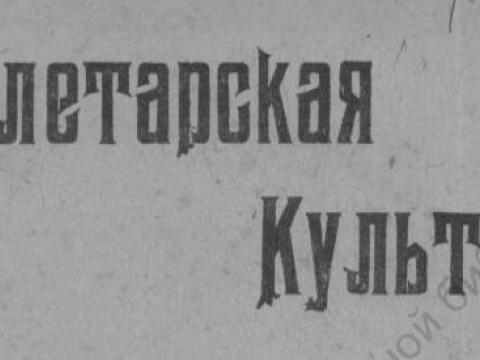
Taken from the magazine 'Proletarian Culture'

From the very first days of October, the Great Russian Revolution has passed through a series of distinct stages.
A short period of destruction was followed by an even shorter period of construction—interrupted by the onslaught of hostile forces from international counter-revolution.
After two years of bitter struggle, the weapons have been knocked from the hands of the international counter-revolution, and we are entering a period of relatively peaceful existence.
There is no doubt that international imperialism will once again raise arms against Soviet Russia or attempt to undermine the Russian Revolution from within. Therefore, it would be a deep delusion to believe that our work of deepening and completing the revolution has become even slightly easier.
Absolutely not!
The tasks of economic construction, the struggle against the disintegration of our economy, now come to the forefront, and the full weight of this work falls upon the shoulders of the proletariat.
From the battlefronts, from the trenches, the proletarians return to the factory floor, to the front of labor—and they bring with them what our factories and plants had lacked: their living, creative power, sharpened by their experience in the psychological and conscious struggle at the front.
Thus, the strongholds of the revolution are being reinforced, forces are growing, and within the framework of all the tasks posed by the new era of grand construction, the proletariat's cultural and creative work becomes the militant task of the present day.
Only by sharply sensing the essence and spirit of the current shift, only by taking into account all the forces surging into our cause, only by fully expressing in our cultural-creative work all the positions advanced by our Party, will we be able to set foot on the broad path of pure proletarian creativity—a path that, until now, has been obstructed by our pressing and urgent combat tasks.
Until recently, the nervous atmosphere of war forced us to respond directly to the needs of the front, to rush to its aid, forgetting everything else. This deprived us of the opportunity to organize the work of constructing proletarian culture according to a defined, clear, and distinctly built plan.
At the present moment, work without a plan—done haphazardly, artisanally—is not only impossible, but categorically unacceptable.
The proletarian is returning to the machine, the furnaces of the factories and plants roar, and the proletarian wants and must know what must be done and how to do it. It is our duty, through precise guidance, to assist them in the creation of their own proletarian culture.
On this basis, the Central Committee of Proletkult instructs the Presidium of the Central Committee and all comrades in the local branches to apply every effort toward the deepening and development of cultural-creative work both at the center and in the localities.
At the same time, in full accordance with the new movement of our life—and once again emphasizing all the positions outlined in the resolutions of the most recent All-Russian Congress of Proletkult—the Central Committee proposes that all comrades be guided in their work by the following practical points:
1) All work of Proletkult must henceforth become an apologia for labor and struggle through the creative labor impulse of the class.
2) Every Proletkult, without chasing after cheap effects of the present day, must subordinate all its cultural-creative work—every, even minor, effort—to the tasks of our era of great construction.
3) The creative scope of the proletariat, its new impulse in the hard labor of forging the steel walls of the socialist state, must become the sole source nourishing all cultural-creative work of the studios, clubs, responsible and rank-and-file workers, and all participants.
4) Productive propaganda and agitation must not be seen merely as matters of urgency or narrow tasks of the current moment, but as a profound endeavor revolutionizing our entire economy within the broad framework of the era. This must find the liveliest response in the work of every Proletkult.
5) The hardships of our life—hunger, cold—have brought into the proletariat a strong stream of petty-bourgeois spirit, a daily chase for a piece of bread, corroding both the living conditions and spirit of the proletariat in its domestic sphere. Therefore, the second task of every Proletkult must be the deep revolutionary transformation of the proletarian way of life, eradicating and extirpating petty-bourgeois and semi-bourgeois habits and tendencies from the depths of the class through all its work.
6) Through intensified labor—both directly creative and agitational, through demonstrations of its achievements—every Proletkult must direct its energy toward liberating the creative forces of every comrade.
The great upsurge toward collective labor, the already unfolding energy of the proletariat on the labor front, and its practical manifestations themselves provide vast, inexhaustible content for the creativity of proletarian poetry, music, painting, sculpture, choreography, and theater—wherein all forms of creative achievement are united.
7) Without discarding the valuable elements of the bourgeois era that are acceptable to us, every comrade among the leaders of Proletkult and all studio participants must sharpen their critical attention toward material borrowed from the heritage of bourgeois art.
As much self-activity and creative power of the proletariat as possible; as much revelation of our own achievements as possible; and as little borrowing from the outside as possible—this must become our task of the moment.
Let proletarian poets, artists, musicians, actors unite their still-weak forces and themselves create from their own material what is their own.
8) All cultural-creative activity in all Proletkult studios must be based on the work of scientific studios, whose task is a critical reassessment of all scientific knowledge.
9) The Central Committee of Proletkult especially emphasizes to all comrades working within Proletkult that the immediate combat tasks have not allowed our Party the time and resources to develop its own cultural program. Therefore, the work of each Proletkult, no matter how small it may be, becomes material for the cultural program of our Party. At this very moment, principled consistency—both in the creative material and in the achievements of all studios, clubs, and individual comrades of Proletkult—is the fundamental condition without which the foundation of proletarian culture cannot be firm.
Central Committee of Proletkult
II.
On the basis of the assessment of our era and the role of Proletkult at the present moment, as expressed by the Central Committee of Proletkult in its declaration of December 19, 1920, the Central Committee of the All-Russian Council of Proletkult proposes the following practical and organizational work plan for Proletkult, both at the center and in the localities:
1. All work must be subordinated to the revolutionary transformation of:
a) labor, achieving its highest developmental forms,
b) everyday life (byt), cleansing it of philistinism and petty-bourgeois tendencies in the direction of organizing a communist way of life.
2. This line, which had been outlined previously by the Central Committee and the Congresses, was nevertheless not maintained by Proletkults. They slid into the path of least resistance, often replacing cultural-creative work with cultural-enlightenment activities in their usual form, whereas these were supposed to serve as preparation and transition to genuine cultural-creative labor.
3. At present, due to changing objective conditions, the liquidation of military fronts, and our transition to large-scale economic construction on the labor front, it is both possible and necessary to firmly uphold the fundamental lines of our practical policy, revising at the root the work of past years.
4. The broad mobilization and relentless focus of all forces of Soviet Russia on the labor front must become the guiding principle in the activity of Proletkult. Studio members, by directly and organically participating in the Great Construction, should reflect it in their artistic creativity, and through their creative achievements influence the proletarian masses, being themselves shaped in a deep organic unity with the class, cultivating spirit, strength, and substance—thus amplifying their creative influence, transferring the creative impulse from the studio as a “laboratory” into the broad proletarian masses.
5. Therefore, our fundamental position—“the development of the creative self-activity of the studio members”—is presented as categorically obligatory in all activities of Proletkult; it must permeate everything from top to bottom, not only in abstract propaganda form, but primarily in daily practical work in all its kinds and forms.
6. Yet all studio members must firmly understand that without technical mastery, artistic skill, their creative self-activity will be weak, often merely rediscovering already discovered Americas. Thus, the self-activity of the studio member must necessarily rely on technical competence and the mastery of the art in which they work.
7. At the same time, the work of all studios—musical, literary, visual arts, theatrical—must be closely integrated, which can most easily be achieved through a common task or theme, to be developed collectively by all studios through their creative forces.
8. The themes of work must be closely connected with the general tendencies and tasks of our epoch of Great Works. The development of themes should be broadly free, drawing all studio members into a process of collective creative labor on a shared objective.
9. All studio members must be brought into the circle of general ideas and pressing tasks of the moment. It is the duty of each worker to cultivate not only artists, but also socially, politically, and state-minded individuals, to be achieved not just through agitation, but through deep, organic, internal political-educational and Party work within Proletkult.
10. All local Proletkult leaders are obligated to firmly implement the line of developing the self-activity of studio members, assigning non-Party specialists only to technical guidance, while strengthening their ideological influence over studios led by non-Party specialists.
11. The proposed tasks—both for individual studios and for Proletkult as a whole—are to be concretely developed and implemented accordingly.
In the Studio of Visual Arts
1. In addition to the aforementioned development of the creative initiative of the studio members, it is necessary to bring to a practical level and realize the idea of bringing art closer to labor, through, for example:
a) The organization of productive creative studios and workshops, both at clubs and within factories.
b) The development, within the studio itself, of design motifs and drawings for furnishing public buildings and proletarian dwellings—their interior decoration and architecture.
c) The creation of textile design motifs, with the goal of their practical application in textile-producing regions.
d) The development of motifs for ceramics, etc.
This—beyond its immediate influence on production and the elimination of the divide between artists and worker-executors—can and will already serve as an element of the revolutionization of everyday life.
e) Vigorous efforts must be made to organize labor-related celebrations at production sites, or common celebrations of October and May 1st, and the Paris Commune, carried out through the free creativity of studio members.
f) The arrangement and decoration of public buildings, clubs, and theater halls—design sketches for theater productions—should be assigned to studio members, even if the sketches, due to their technical weakness, cannot yet be used in actual productions.
g) Artistic execution of slogans, the development of themes and sketches for posters, and their execution must necessarily be done by the studio members themselves.
2. All achievements—no matter how weak they may be—must absolutely be exhibited. Great care must be taken to listen to criticism—primarily and exclusively—from the masses themselves.
i) Studio members must be sharply confronted with the question: “For whom are you working?” “For whom are you creating?” They must be taught to listen not only to their instructor, but to the person who perceives and receives their work—the masses themselves. For the artist works for the collective, from the collective, and for the collective.
j) The work of the theatrical and literary studios must necessarily be linked with that of the visual arts studio. In discussing staging plans and scenic sketches, visual art studio members must participate. The literary studio must collaborate with the visual arts studio in producing and executing slogans, etc.
k) Evenings of showcasing achievements must be widely used.
l) All studio work—decorative, poster-related, and including painting, sculpture, etc.—must be photographed and submitted in two copies to the Central Committee of the All-Russian Proletkult Council.
m) Studio members must be assigned the task of designing and executing union banners, etc.
n) The most successful posters must be turned into postcards for wide popular use; a series of Proletkult postcards should be published.
In the Literary Studio
1. In guiding the literary studio, the central task must be to involve proletarian poets and fiction writers in the realm of new ideas and facts of the Republic’s broad economic construction. Their creative work must be moved closer to real life.
2. Concretely, the tasks of the Literary Studio must include:
a) Producing slogans for both general and specific celebrations.
b) Developing scripts for theatrical productions. Freely adapting suggested plots. Adapting poetry and prose by proletarian poets for the stage. Selecting material for use by the theatrical studio for public readings and recitations. Staging.
c) Selecting poems to be set to music. Adapting proletarian poetry to lesser-known musical themes.
d) Publishing a wall journal for the club or clubs, in collaboration with the studio of visual arts.
e) The publishing of works by the studio must be approached with critical rigor regarding both content and form.
In the Music Studio
1. Develop choral work. Strengthen the revolutionary repertoire by setting proletarian poetry to music, maximizing the use of international songs, and recording songs created during the revolution in factories and workshops.
2. Advance experiments in free personal, group, and collective composition, with mandatory notation.
3. Maintain close contact with the literary studio through collective choral recitations.
4. Utilize the skills of specialists in setting to music the works of contemporary proletarian poets and poets of the bourgeois-capitalist era (e.g., Freiligrath, Verhaeren).
In the Theatrical Studio
1. The theatrical studio must serve as the synthesizing force, integrating the achievements of all the other studios into its work.
2. The declaration (visual arts), the stage action, the word, rhythm, plasticity (literary part – plot and its development, prose or rhythmic word; musical part – musical accompaniment) — all must be united into a single action on stage.
3. More than any other, the theatrical studio must be grounded in the creativity of the studio members themselves. The method of improvisation, collective development of plot and staging, and filling the performance with concrete content (the word) must be carried out in close contact with the literary studio.
4. In developing pre-existing plays, work must proceed with the greatest critical and creative participation of the studio members themselves.
5. The issue of repertoire, which currently hinders many Proletkult theatrical studios from breaking away from the old bourgeois theater in content and form, should be addressed on the following fronts:
a) The broadest possible use of stage adaptations made either by members of the literary studio or the theatrical studio itself.
b) The materials for such adaptations are inexhaustible but so far remain underused.
A number of works by Gastev, Verhaeren, and proletarian poets in general, as well as utopias such as Red Star, Engineer Menni, and The Myth of Prometheus in its free interpretation, offer rich material. So does The Condition of the Working Class in England by Engels, The Russian Factory: Past and Present by Tugan-Baranovsky — especially the chapters on the "Unrest of the Possessional Workers" — The History of the French Revolution, The History of the Paris Commune, the Lena Massacre of April 4th as told in The Truth about the Lena Events published by P.N. Batashev. Excerpts from H.G. Wells’ novels offer good material, particularly as satire of the bourgeois world. Anatole France’s The Case of the Street Peddler and many of Jack London’s works, etc., etc.
In addition, the use of ready-made plays — whose number is steadily growing and which Proletkult’s Central Committee will provide for local staging and development — will help supplement our meager repertoire. However, it must be emphasized: only the self-directed creative work of the studio members themselves will give us our repertoire — its content and the means of its expression — discovered and created by them in their own creative labor.
Comments