Hein Htet Kyaw: Given the situation in Iran, what is your analysis of the revolution and the current war? Sections of the western Left are conflating the Dey uprising with Israeli and western imperialism. I can also see sections of the Right calling for western and Israeli intervention and defending the war. Can you please explain this?
Maryam Namazie: The main conflict in Iran is not between the Islamic regime and foreign powers. It is between the Islamic regime and the people who have been rising up against it for decades. The struggle in Iran is not a proxy war between states but a social revolution against a theocratic regime.
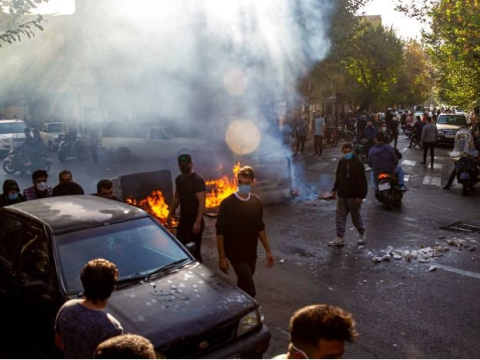
For decades, people in Iran have risen up repeatedly, including in 1999, 2009, 2017-18, 2019, 2022 and during the Dey (December-January) protests of 2025-26. Each wave has broadened socially and has become a widespread movement against the Islamic regime.
Since the 2022 “Woman, Life, Freedom” uprising in particular, women have played a central role in resisting the regime’s system of sex apartheid. Compulsory veiling and the policing of women’s bodies are not marginal policies but ideological pillars of the Islamic regime, which is why women’s resistance has sparked broader social revolt.
This ongoing revolutionary movement was not created by Israel, the United States, or any outside power. It is rooted in lived conditions inside Iran: sex apartheid, compulsory veiling, mass executions, crushed labour movements, unpaid wages, economic dispossession, inflation, corruption, and a regime that governs through sheer violence.
External actors may try to instrumentalise unrest and protests for their own strategic purposes, just as the regime tries to brand every protest as a foreign conspiracy in order to justify repression. In moments of geopolitical conflict, revolutions from below are often distorted or appropriated by states that seek to claim them as part of their own strategic agendas. The current war creates exactly this danger. A socially rooted revolution risks being overshadowed and misrepresented as merely another front in a conflict between states.
Citizen Lab, for example, documented an Israeli-linked operation using fake accounts and AI-generated material aimed at shaping public opinion. A recent academic study found that only about 17% of protest slogans in thousands of videos referred to “Shah” or “Pahlavi” during the Dey protests, while 83% were broader anti-Islamic Republic demands; yet diaspora broadcasters like Iran International heavily overrepresented monarchist narratives.
Even so, instrumentalization is not the same as orchestration. Khamenei, for example, instrumentalised Black Lives Matter, but that doesn’t mean BLM was orchestrated by the regime. Russia and China are manipulating US politics but that doesn’t mean protests against ICE are Chinese or Russian creations.
Reducing socially rooted revolts to foreign conspiracies is one of the main ways those in power attempt to hijack or neutralise popular struggles. This kind of distortion does not exist only within authoritarian regimes. It also appears in international debates about Iran.
We see this in a section of the Western “anti-imperialist” Left that has completely abandoned the people of Iran, the working class, and progressive political and social movements in the country. They have reduced anti-imperialism to a caricature. Their starting point is not social movements or the working class, but states. In this framework, the political subject shifts. The people disappear and the state takes their place.
The logic becomes simple: the enemy of my enemy is my friend. And that “friend” almost always turns out to be a ruling elite rather than the oppressed.
Therefore, if a regime is anti-western, it is “good” and part of the “resistance” like the Islamic regime in Iran. If it is not anti-Western, then it is “bad,” like the Saudi regime, though both regimes are anti-working class and authoritarian.
This has nothing to do with solidarity and reflects a narrow Eurocentric and racist worldview that centres Western power struggles while treating the struggles of people living under non-Western authoritarian regimes as secondary or irrelevant. In the West, therefore, some march for women’s rights whilst also defending an anti-woman regime in Iran. They speak about workers’ rights while legitimising a state that considers labour strikes haram and imprisons and flogs labour activists for organising 1 May.
The Islamic regime understands this well and wraps itself in the language of anti-imperialism while enforcing one of the most misogynistic systems of governance in the world. A state that executes dissidents and rules through clerical authority suddenly becomes “anti-imperialist” in the eyes of those who would never tolerate such brutality at home.
Interestingly, though, this debate is usually framed almost entirely around the failures of the Left. While endless attention is directed at marginal currents on the Left, the Right - which actually holds state power, runs armies and conducts wars, with all the means of communication at its disposal - continues to burn the world down, largely unchallenged.
Islamism in Iran, for example, is often blamed on the Left, yet Right-wing Western governments played a major role in legitimising Islamism during the final stages of the Shah’s collapse. At the 1979 Guadeloupe conference, Western leaders effectively accepted that the Shah’s rule was over and began preparing for a political transition in which Islamist forces would play a central role. During the Cold War, Western powers often supported Islamist forces as part of a strategy to create a “green belt” of Islamist opposition to Soviet influence.
As usual, the US and Israel discover a passion for women’s rights when their bombs begin to fall. Empirically, though, we know that these bombs have not produced democratic societies in the region. Their “liberation” in places like Iraq or Afghanistan has meant devastation, sectarian fragmentation, authoritarian resurgence and mass suffering. There is also a deep irony in the Israeli and US religious-Right governments presenting themselves as guarantors of Iranian freedom when their genocide in Gaza has normalised the large-scale destruction of civilian life and infrastructure.
In reality, war between states does not produce social emancipation. It destroys societies and strengthens and militarises the most reactionary forces on all sides. In such situations, authoritarian regimes often use the language of national security to intensify repression, silence dissent and push society into survival mode rather than political mobilisation. At the same time, foreign powers attempt to present military escalation as liberation. Both dynamics marginalise the very social forces inside the country that are struggling for freedom.
Those who cheer military escalation in the name of Iranian freedom are not interested in the rights and freedoms of the people of Iran any more than the anti-imperialist Left. For them, it is all geopolitics and self-interest, which erase the agency of the people and obscure the central political fact that the main conflict in Iran is not between the Islamic regime and foreign powers. It is between the Islamic regime and the people who are fighting to bring it to its knees. It is a struggle between society and the state.
Clearly, no government involved in this conflict is acting in the interests of Iranian civilians. The Islamic regime seeks survival and regional influence backed by China and Russia, while Western and regional powers pursue their own strategic calculations.
The future of Iran will not be decided by foreign governments or military escalation but by the social forces within Iranian society that are struggling for democratic change. This is particularly true of the “Woman, Life, Freedom” revolution that threatens not only the regime but the architecture of power in the region and globally.
To sum up, the pro-Islamist Left dismisses the revolution as a Western plot. The pro-war Right tries to claim it as justification for military escalation. Both erase the agency of Iranian society.
A people’s revolution belongs neither to imperial powers nor to reactionary states. It belongs to the people who risk prison, torture and execution every time they step into the streets.
Hein Htet Kyaw: How strong is the left in Iran at the moment?
Maryam Namazie: Under authoritarian conditions, the strength of the Left has to be measured differently. It cannot be measured by legal parties or formal political institutions but by its social presence.
The Islamic regime has spent decades imprisoning, executing and driving into exile leftists, trade unionists, student organisers and feminist activists. Independent unions are banned and labour organising is treated as a national security issue. International labour rights monitors such as the ITUC Global Rights Index consistently rank Iran among the worst countries in the world for workers’ rights.
Despite this repression, the Left survives and expresses itself through social struggles rather than party structures.
One important exception is Iranian Kurdistan, where Left and socialist political traditions have remained more organisationally visible. Kurdish parties such as the Communist Party of Iran maintain political structures and historical roots in the region, and Kurdish activists in many cities have been at the forefront of numerous protests, including the uprising sparked by the killing of Mahsa Jina Amini. The slogan “Woman, Life, Freedom” emerged from Kurdish struggles, particularly within the Kurdish women’s movement and the experience of Rojava.
If you look at the demands emerging from Iranian society, namely workers demanding unpaid wages, teachers and pensioners protesting poverty, women challenging compulsory veiling and sex apartheid, students resisting privatisation, campaigns against executions and for the freedom of political prisoners, these are fundamentally social and egalitarian demands. In substance they reflect the politics of equality, social justice and secularism traditionally associated with the Left.
The 2023 “Charter of Minimum Demands” by 20 independent trade and civil society organisations illustrates this clearly. The charter tied together women, students, school students, teachers, workers, families seeking justice, writers, LGBT and the wider public in a common framework of demands for political freedom, social equality and democratic rights.
Despite systematic repression, labour protest in Iran is persistent and widespread across sectors ranging from oil and petrochemicals to steel, transportation, education and agriculture.
The Human Rights Activists News Agency (HRANA) recorded at least 725 worker protests and 1,378 worker strikes in 2024, while the Center for Human Rights in Iran documented major labour rallies in at least 14 cities between March and July 2024 and strikes in more than 115 oil and gas companies between 19 June and 1 July 2024. These figures show that labour protest in Iran is persistent, widespread and structurally crucial.
One of the most important labour struggles of the past decade has been the Haft Tappeh sugarcane workers’ movement in Khuzestan against corruption, privatisation and months of unpaid wages, which has produced well-known activists such as Esmaeil Bakhshi, a labour organiser who publicly exposed torture after his arrest, and Sepideh Gholian, a journalist and labour activist who reported on the strikes and became a prominent symbol of resistance after repeated imprisonment.
Another key labour organisation is the Tehran and Suburbs Bus Workers’ Syndicate. Its leaders Reza Shahabi and Ebrahim Madadi have spent years in prison for organising workers and demanding the right to independent unions. Despite this repression, the union continues to represent one of the most visible examples of independent labour organising in Iran.
Teachers’ unions have also played a central role in recent protests. Activists such as Mohammad Habibi and Esmail Abdi have been imprisoned for organising nationwide teachers’ strikes demanding fair wages, improved education funding and the release of detained colleagues. These protests have mobilised thousands of educators across Iran.
Women’s struggles have also increasingly connected demands against compulsory veiling and sex apartheid and for bodily autonomy with broader demands for equality and social justice. This includes documenting cases of “honour killings” and domestic violence, and challenging both patriarchal social norms and the legal structures that enable violence against women. Women have played a significant role in anti-execution activism. One important example is the Mothers of Khavaran, who for decades have demanded truth and accountability for the mass executions of political prisoners in the 1980s. Many of those executed were Leftist activists whose bodies were buried in mass graves at Khavaran. Their struggle represents one of the longest-running movements for justice and memory in Iran.
Students have also historically played a central role in democratic movements. In October 2024, for example, students at the University of Tehran protested against privatisation and sex segregation. Student activism in Iran frequently combines anti-authoritarian, anti-market and egalitarian politics, with strong overlap with the historic student Left.
At the same time, the Iranian Left in exile is not a coherent political bloc. Decades of repression have fragmented organisations inside the country, and exile politics is often marked by sectarianism and division. Nonetheless, the Left remains present as a social force. It is stronger in labour struggles than many outside observers realise, more organisationally visible in parts of Kurdistan, deeply imprinted in student anti-authoritarian movements, and inseparable from the most radical edge of the women’s movement.
The Iranian Left today, therefore, is heavily repressed but socially influential in the struggles of workers, women, students, minority rights and political prisoners who continue to challenge the foundations of the state.
Focusing only on exile politics or satellite television debates erases the role of the Left and produces a distorted picture. Monarchist or Right-wing opposition groups heavily rely on social media and satellite TV stations funded by Gulf states and Israel to appear as the only visible alternative internationally. But if we look at what people inside Iran are risking prison, torture and death for - labour rights, women’s equality, freedom from dictatorship, the abolition of executions and the right to organise - the political weight of the struggle lies with Left, egalitarian and emancipatory demands.
And the fact that the regime continues to imprison labour leaders, student activists and feminist organisers tells us something important. States do not spend decades crushing movements that are irrelevant. They repress the ones they fear most.
Hein Htet Kyaw: Some say political Islam has social democratic style left-wing elements such as charity, and welfare systems. What do you think of it? As a Marxist and feminist, does political Islam fall into the left, or right?
Maryam Namazie: Political Islam is a Right-wing movement. Charity does not change that. Churches run soup kitchens too; that does not make the Vatican or the evangelical churches across the US socialist or the Christian-Right emancipatory. The real question is not whether a movement distributes aid but what kind of social order it creates and what relations of power it enforces.
The distinction between Left and Right is not about charity or welfare. It is about whether a political project expands human freedom and equality or preserves hierarchy and authority. The Left historically emerged from struggles against monarchy, clerical rule, patriarchy and class domination. Political Islam organises society around divine authority, clerical power, censorship, moral policing and punishment of dissent. It is also based on a system of sex apartheid: compulsory veiling, sex segregation, unequal rights in marriage and inheritance, and the policing of women’s bodies and sexuality. These are not marginal practices; they are pillars of the political order. Control over women’s bodies is central to how hierarchical systems reproduce themselves. When half the population is restricted, the entire society becomes easier to discipline. A political system that requires the subordination of women in order to function cannot meaningfully belong to the Left.
It is also important to understand how charity operates politically. Throughout modern history many conservative or authoritarian movements have built welfare networks while preserving hierarchy. Fascist regimes such as Mussolini’s Italy and Nazi Germany organised large welfare programmes and mass aid campaigns while destroying trade unions and democratic rights. Islamist movements often operate in a similar way. They build networks of charity, clinics or welfare assistance, but these exist within a political project that suppresses dissent, restricts women’s freedom and limits independent worker organisation. Charity is a form of patronage and social control. It is used, including in Western democracies, to pacify and depoliticise people’s struggles.
There is also a racism in the way this issue is often framed. In Europe no one argues that the Christian-Right should govern society simply because churches provide charity. Yet when the same logic is applied to Muslim-majority countries, religious rule is suddenly described as authentic or even progressive. This produces one standard of freedom for people in the West and another for people elsewhere. It is racist cultural relativism dressed up as respect.
Finally, the framing itself erases the diversity of people who live in Muslim-majority societies. “Muslims” are not a political bloc. There are workers, women, religious and sexual minorities, secularists, socialists, atheists, trade unionists and countless others who are fighting both authoritarian states and religious-Right movements.
Charity can exist under many ideologies, even fascism. What defines the Left is not charity but active participation and organisation in emancipation. A political project that depends on religious authority, patriarchal control and the suppression of dissent belongs on the Right. The Left is about expanding human freedom and equality; Islamism organises society around hierarchy and obedience.
As an aside, people sometimes say that Left and Right no longer exist. Usually what they mean is that traditional political parties have collapsed or that the political landscape has become more fragmented. But the fundamental divide has not disappeared. As long as societies still contain hierarchies of class, sex and power, that divide remains very real.
Hein Htet Kyaw: Some say political Islam goes beyond nationalism since they consider all Muslims as the vanguard of the global Muslims as a social class. So, does it seem like “internationalism” to you? Or is that another form of “othering politics” as seen in the right-wing identitarian movements?
Maryam Namazie: Internationalism begins from universal human equality and solidarity across borders. It means the solidarity of workers and oppressed people across nations, sex, race, beliefs and ethnicities against systems of exploitation and domination. The slogan is “Workers of the World Unite,” not white workers unite or Muslim workers unite.
Islamism is not internationalism; it is identitarianism. Instead of solidarity across humanity, it divides the world into believers and unbelievers, ummah and kufar, moral and corrupt. That is not class politics. It replaces class solidarity with religious belonging and turns identity into the organising principle of politics.
This is why it mirrors white nationalists. Both Islamism and Right-wing white identitarian movements reduce people to identity. Both demand loyalty to a mythic community. Both are obsessed with purity, sex-based policing and internal enemies. In both cases politics becomes less about freedom or equality and more about defending the restrictive moral boundaries of the group.
Identity politics is a breeding ground for dehumanisation because it turns homogenised people into representatives of a category. Once people are reduced to categories: Muslim, non-Muslim, believer, apostate, insider, outsider, it becomes easier to justify discrimination, repression and violence in the name of “protecting” the community.
Islamism is not a form of internationalism. Internationalism is universalist; Islamism is communitarian. One expands solidarity across humanity, the other narrows politics to religious belonging. That is not internationalism. It is the globalisation of a Right-wing identity project.
Hein Htet Kyaw: I know for a fact that the ex-Muslim movement has a unique perspective which is different from the western privileged leftists given our rich experiences of struggling against the clerical right-wing regimes, authoritarian self-claiming socialist red brown regimes, and the white supremacist right-wingers. Since you’re one of the faces leading the ex-Muslim movement, do you want to pass down the Marxist understandings along the way? I think just being an ex-Muslim is not enough. Sometimes, it can be reactionary too. For example, some ex-Muslims openly supported the war crimes committed by the Israeli regime against the Palestinians since they hate the left-wing opportunists who are simply co-opted by the Islamists and echoing or downplaying the antisemitism within the Islamists. So, to avoid such reactionary politics of both left-opportunism and right-opportunism, we have to understand anti-imperialism, class analysis, and intersectionality, I believe. What do you think?
Maryam Namazie: The ex-Muslim movement is grounded in universal principles: freedom of conscience, secularism, equality before the law and the right to leave religion.
For that reason, we should be careful not to project onto the ex-Muslim movement a political programme that it does not claim to represent. It is a civil rights movement for the right to leave religion, the right to blaspheme, the right not to believe, the abolition of apostasy and blasphemy laws and freedom of conscience. In that sense it is closer to the gay rights movement than to a political party.
Just as being gay does not automatically make someone progressive, being ex-Muslim does not automatically produce a coherent emancipatory politics. Individuals within a movement will hold different political views and must be accountable for them as individuals. Saying that ex-Muslims are all neocons or far-Right enablers is no different from saying all Muslims are Islamists. Ex-Muslims as a category are not progressive any more than Muslims as a category are reactionary.
Part of the confusion comes from a failure to distinguish between identity as experience and identity as politics. Identity as experience means that someone leaves Islam and faces threats, stigma, exile, shunning and violence. That lived reality is the basis for a civil rights movement demanding freedom of conscience.
Identity as politics is different. It begins when that experience is turned into a politics of collective virtue simply by belonging to that identity. When identity becomes the organising principle of politics, it easily turns into tribalism.
This distinction is crucial because many activists assume a simple chain of reasoning: oppression produces identity, and identity produces political truth. In other words, because someone has experienced oppression, their political conclusions must automatically be morally or politically correct. History shows that this is not the case. Experiencing oppression does not immunise anyone from adopting reactionary politics.
This is also why I would say to ex-Muslims who demonise Muslims as a people, support racist immigration policies or cheer war, genocide and collective punishment that they are reproducing the very logic that oppressed them in the first place. Islamism treated ex-Muslims as traitors who deserved death simply for leaving Islam. When ex-Muslims begin to treat Muslims as a homogeneous enemy or justify violence against them, they repeat that same politics of collective blame and dehumanisation.
Opposition to Islamism must not become a mirror image of it. The aim is not to replace a Muslim ummah with an ex-Muslim ummah or tribe defined by hostility to believers. The ex-Muslim movement is not about creating a new identity group or political tribe. Leaving religion should expand human freedom, not simply replace one tribe with another.
Reactionary politics emerge when people abandon universal principles and replace them with identity politics. Undoubtedly, a civil rights movement cannot defend only its own in-group. Rights matter precisely because they apply to everyone. The aim is not to claim moral superiority but to insist that every human being deserves freedom of conscience and universal rights that apply equally to believers and non-believers alike.
Note: Maryam Namazie is a British-Iranian secularist, communist and human rights activist, commentator, and broadcaster. She used to be a Central Committee member of the Worker-communist Party of Iran and was the editor for the Worker-communist Review, the official magazine or journal of WCPI. Nowadays, she is known for speaking out against Islam and Islamism and defending the right to apostasy and blasphemy.




Comments
It is surprising why Maryam…
It is surprising why Maryam Namazie's interview has been posted on Libcom!
She is merely an activist in the fields of promoting secularism and, in her own words, 'anti-political Islam'— nothing more.
Even during her time on the Central Committee of the so-called 'Worker-communist Party of Iran', she went no further than promoting a misguided line in the name of communism and throwing dust in the eyes of the working class.
Since its inception, this party has remained within the framework of bourgeois leftism and is considered an enemy of the Iranian working class.
The current leader of this party, in his latest interview, has this to say:
"We do not condemn this war where it directly strikes the government, its officials, its security forces, its military forces, and the centres upon which the government’s power depends. We do not condemn this. Not only do we not condemn it. We think it can, it can benefit the people’s struggles. It can weaken the regime in the face of the people’s revolution. But wherever this war causes destruction to people’s homes, devastation, the killing of ordinary people in society, those operations, those attacks are condemnable. In our view, the correct and realistic policy is this. Attack. In my opinion, no attack by any government on the Islamic Republic, on its governmental centres, and its security and military forces is condemnable. Because the Islamic Republic, in its war against the people, has shown the utmost savagery and criminality, and any blow to this regime is welcomed by the people. But the people must use this situation to completely end this warlike atmosphere and the Islamic Republic altogether. In any case, in my opinion, this war must very clearly have its attacks condemned wherever they harm and damage the people. But attacks on governmental centres should not be condemned."
https://wpiran.org/english/the-peoples-answer-to-the-war-the-overthrow-of-the-iranian-regime-interview-with-hamid-taqvaee/
Sounds like a good position…
Opinion noted but their position sounds like a pragmatic position to me as someone from similar position trying to overthrow a regime.
If Lenin can say “please record my vote for accepting the arms and support of the Anglo-French imperialist bandits”, why can’t they hold similar pragmatic views, I wonder.
But again, your opinion is noted. But about surprise thing, don’t be. I don’t think libcom.org holds correct party lines and have gulags so I would expect to see any position (even campist views and pro-red fascist views: those I personally find disgusting).