
Article from Films for action. Also published by Industrial Worker and Znetwork. Translated from the Swedish Magasinet Konkret.
Illustration above: Edvin Grans

Article from Films for action. Also published by Industrial Worker and Znetwork. Translated from the Swedish Magasinet Konkret.
Illustration above: Edvin Grans
When the wild times we’re living through demand strong social movements, Sweden’s multitude of movements are in a lousy shape. The same goes for the Swedish union movement. The problem isn’t “all talk and no action.” “There’s barely even any talk about organizing, and very few seem to know what this skill and craft is about.” So writes Rasmus Hästbacka, lawyer and member of the syndicalist union SAC.
Organizing is – or should be – the core business of every labor union. That’s how ordinary workers become a force to be reckoned with in the workplace and society. But in Swedish unions today, organizing is noticeably absent.
It’s not that there’s all talk and no action. There’s barely even any talk about organizing, and very few seem to know what this skill and craft is about. Apart from the efforts of union educator Frances Tuuloskorpi, organizer training is almost dead in Sweden. Let me say it straight away: recruiting members and administering unions is good and necessary, but it is not organizing. So, what does organizing entail?
I will tackle the subject by drawing on three books: Secrets of a Successful Organizer (2016), Swedish syndicalism (2024) and Something Has Happened (2023). The first book is published by Labor Notes. The second is written by me, mainly for beginners in union work. The third is authored by syndicalists in the Stockholm Local of SAC and highlights union activity involving migrant workers.
Below, I will first define the term organizing, then describe an organizing method taught in SAC’s courses and finally discuss union structures that can promote and sustain organizing.
WHAT IS ORGANIZING?
Let’s start with a narrow definition. Organizing means that co-workers develop and use their collective strength in a systematic way.
Moving to a broader definition, organizing also entails workers at different workplaces building cohesion and acting together. It could be workers in the same industry meeting up and strategizing – or workers from different industries coming together to support each other.
Thus, the common denominator is workers building and using their strength.
To make it more concrete, we can break organizing down into three dimensions: 1) building a formal organization, 2) developing a union movement, and 3) mobilizing for collective action and bargaining with management.
The first dimension is about building a union with a formal structure. At the local workplace, this structure is usually called a union club (within Swedish LO unions) or an operating section (within syndicalist SAC). The word “operating” refers to the long-term vision of workers taking over and operating the workplace. Swedish syndicalists often use the shorter term “section.”
The second dimension – developing a movement – is about cultivating community among co-workers and engagement around shared interests. It’s about creating a strong sense of “We” against management. Co-workers need good relationships so they can trust each other.
The third dimension, to mobilize, is about getting the workers collective moving for common demands and backing those demands with appropriate pressure – thus pushing management to make concessions.
DIFFERENT FORMS OF PRESSURE
Pressure can range from soft methods to industrial action. Two examples of soft methods are petitions and speaking as one voice at meetings with the bosses.
Examples of industrial action include blockades and strikes. A strike shuts down the workplace by means of work stoppage. A blockade is refusing to perform certain parts of the labor process, like refusing overtime work. A blockade can also mean stopping the delivery of goods and new labor power to a workplace.
The workers’ pressure gives weight at the bargaining table. Negotiations can take the form of formal union negotiations (in Sweden according to the Co-Determination Act) but there are also informal ways to confront management, for example at staff meetings.
All three dimensions of organizing are needed. The union structure gives stability to the movement. The movement leads to collective action, making negotiations successful.
A CONCRETE METHOD
In an era when information technology has reached science fiction levels, Swedish popular movements have on the contrary regressed to a primitive stage.
Since the craft of organizing is more or less forgotten in Sweden, it’s hard to discuss organizing without first outlining a concrete method. As far as I know, SAC is the only union in Sweden that teaches organizing in a systematic way. In SAC’s courses, participants learn a four-phase method. Lately, we’ve started illustrating the method with an organizing wheel that looks like this.
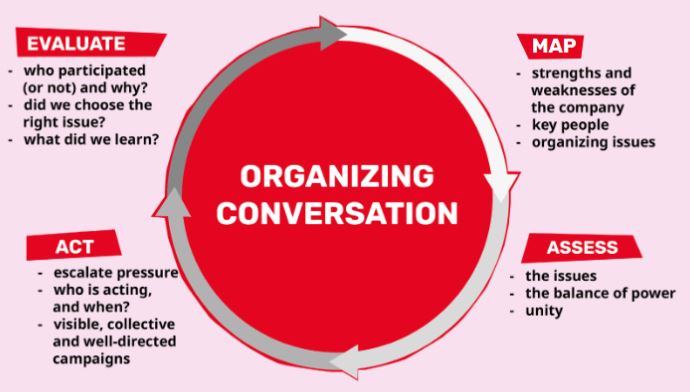
The first phase is to map the workplace, the second phase is to assess, the third to act and the fourth to evaluate the struggle. I’ll explain each phase in turn. The common thread through all phases is organizing conversations – that is, talking and above all listening to co-workers.
MAP
Mapping is about finding organizing issues. These are concrete issues that can rally co-workers. The goal is to find out which problems at work colleagues care about and ask what they are willing to do about them.
Mapping also means identifying key people – informal leaders among the staff. These are co-workers whom others trust and listen to a bit extra. Informal leaders have great influence in the group and can get people moving.
To succeed in organizing, it’s important to get the informal leaders on board. If it’s a large workplace with many departments and categories of staff, it’s valuable to find informal leaders in each category and department.
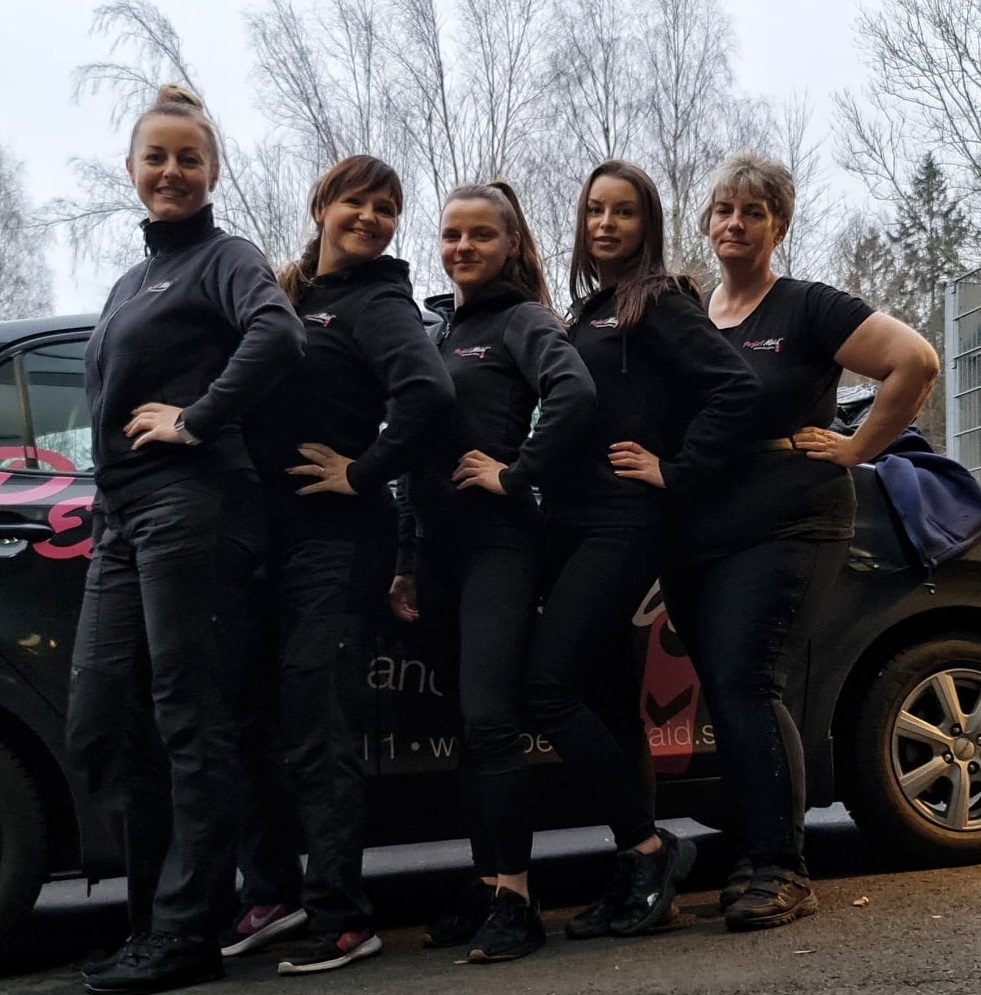
Polish cleaners in the Gothenburg Local of SAC. In the fall of 2021, they won a strike for higher wages for all employees, pay for the time spent driving company vehicles between different client companies and the right to use the vehicles to commute to and from work.
As I mentioned, the common thread through all four phases is organizing conversations. This means talking to all employees, ideally one at a time. In English union jargon, these conversations are called One-On-Ones.
Organizing conversations can happen at work or outside. In Sweden, one factor that helps is being elected as a health and safety delegate (skyddsombud). Such delegates have the right to perform their tasks during paid working hours. That’s a good foundation for walking around and talking to co-workers.
ASSESS
The second phase of the wheel is to assess which organizing issue is best to start with. There may be several issues that trigger the collective of workers. Then it’s about choosing the one with the greatest potential to push the frontline forward.
It’s also important to assess what’s called the balance of pressure or balance of power. The central question is: How hard do workers have to push management for their demands to be accepted? I’ll get to the balance of pressure in a moment, but first, a word about choosing organizing issues.
The authors of the book Secrets of a Successful Organizer have formulated four criteria for a good organizing issue. First, the issue should have breadth – that is, the issue engages many employees. Second, it should have depth – which means it engages people strongly. Third, the issue should be winnable through the workers’ collective pressure. Fourth, a fight over the issue should make the collective stronger.
When it comes to assessing the balance of pressure, two concepts are useful: concession cost and damage cost. For employers, conceding to union demands often comes at a cost – a concession cost. The question is whether the workforce can inflict a damage cost greater than the concession cost. If workers can do that, the balance of pressure tilts in their favor. Then it’s cheaper for management to say YES to the union’s demands than to say NO. In other words, there’s enough pressure for management to accept the demands.
ACTION PLAN
In the second phase, or no later than the third phase, it’s time to make an action plan. The plan needs to be anchored with as many employees as possible. It should specify who does what and in what order.
There also needs to be readiness for various countermoves from the employer side. Preparing for countermoves is sometimes called union vaccination. It’s about preparing protection before entering conflicts.
A countermove might be managers calling employees in for individual interrogations and scoldings. One way to prepare is co-workers promising each other to always approach the boss as a group.
ACT
The third phase is putting the action plan into practice. Now it’s time to mobilize for collective action and bargaining.
When it comes to methods of pressure, the authors of Secrets of a Successful Organizer offer four tips. First, the methods should be visible. That means all employees know pressure is being applied and understand why. It also means the methods are felt by management. But it doesn’t have to be visible actions in front of the bosses. Pressure can be more hidden or anonymous, like slowdowns.
Second, the workers’ demands and pressure should be properly addressed. That means demands are directed at managers who can actually act on the issue – and those managers should feel the pressure. Third, pressure should be collective. That’s pretty obvious. The more employees who participate, the better.
Last but not least, collective pressure should follow a planned escalation. Workers can start with soft methods, like petitions and group visits to management, and then move on to more demanding and impactful actions, like slowdowns and overtime blockades.
EVALUATE
The fourth phase is to evaluate the struggle. Evaluation isn’t just about the obvious question: Did we win our demands or not? Just as important is for employees to assess their ability to stick and act together. Important questions include: How many participated in the struggle? Who didn’t, and why? How can we get them involved next time?
One purpose of organizing is for the workers collective to become stronger and stronger. So, it’s important to regularly check whether the collective has made progress.
When workers finish the fourth phase, they start the next round of the wheel. They find new organizing issues to rally around or push the same issues further. In this way, a union movement can grow and develop more and more.
UNION FORMS
In the absence of workers struggles through Swedish unions, spontaneous worker action sometimes arise outside unions. But it’s usually short-lived. Activism flares up and fizzles out. That’s why a union structure needs to be added.
I will limit the discussion to the structure at the local workplace – the union club or section. A syndicalist section holds formal member meetings year-round. The section’s elected representatives also meet regularly, year-round. All organizing work becomes easier when there’s a clear structure for gathering, making decisions and carrying them out.
The four phases of the organizing wheel can largely be carried out at section meetings – at least if the section has many members who attend. At meetings, members can discuss suitable organizing issues and draw up an action plan.
For the section to promote (rather than hinder) organizing, it’s important that meeting time isn’t wasted on purely individual cases. By that, I mean cases that can’t rally co-workers – or cases that concerned members don’t want to rally colleagues around. Thus, section meetings should focus on the best organizing issues. Individual cases can instead be handled by the section board or a special bargaining committee.
ANCHORING
Of course, it’s not enough to sit in section meetings if the whole staff isn’t participating. The section’s organizers need to move throughout the workers collective to make an action plan that’s broadly anchored and mobilizes many workers.
It’s of great value that a formal section elects fellow workers to positions of trust. The elected reps can prepare member meetings so they’re both democratic and effective. Reps can make sure that decisions taken are carried out.
Elected reps also make it easier to handle ups and downs in engagement at the workplace. They maintain continuity. At a minimum, the section should have an elected board. Beyond that, various committees can be elected with different areas of responsibility.
DUAL TRACKS
Solidarity at work is undermined when unions fall into narrow turf thinking – when unions only look out for their own members (if even that) and ignore the rest of the collective.
Syndicalists instead try to work on two tracks at the same time. That means syndicalists foster solidarity both within the section and among the staff as a whole. The goal, of course, is to mobilize as many co-workers as possible in collective action and negotiations.
How can members of a section or union club work on dual tracks? The section or club can choose to hold meetings only for members or have meetings open to non-members as well.
If closed meetings are chosen, it’s important that members also promote discussions for all employees who want to change the workplace. That could be, for example, cross-union lunches on a certain day each week, an online forum or after-work gatherings where co-workers strategize together.
When a workers collective proceed along to the organizing wheel – and keep going round after round – they can win more and more influence, better pay and improved working conditions. In this way, the organizing wheel can become an upward spiral. That’s the beginning of a more reasonable world.
Rasmus Hästbacka
See also the article Sweden: How Do Successful Unions Operate?
FACTS ABOUT SAC
The Central Organization of Workers in Sweden (SAC) is a syndicalist union, founded in 1910. SAC is independent from the three big union bureaucracies LO, TCO and Saco. SAC is built on Locals (LS).
Several members at a workplace form a section, a job branch. Several sections in the same industry in a locality form a syndicate, an industrial branch. All branches in an industry form a nationwide federation.
SAC is independent of all religious and political organizations. SAC’s long-term vision is libertarian socialism, which requires workplace democracy and is seen as the foundation for equal societies.




Comments