
A forgotten history of Balkan federalism, communes and internationalist struggle
By Giorgos Chatzinakos, human geographer, researcher and writer on the commons, self-government and emancipatory politics

The social and political history of the Balkans
The socio-political history of the peoples of the Balkans has always been multifaceted and interconnected: a complex world shaped by affinities as much as by contradictions. During the nineteenth century, the ideas of the French Revolution travelled like seeds of freedom on the winds of history, searching for fertile ground across the already turbulent Balkan Peninsula.
The Balkans were never a timeless landscape of harmony, but they were a deeply plural space in which linguistic, religious and cultural communities had lived beside one another for centuries. As Ottoman rule receded, the intervention of the Great Powers and the advance of competing imperial and national projects transformed that world. The nation-state offered a powerful language of emancipation, but it also hardened borders, rival territorial claims and exclusive national histories. The result was not simply liberation from empire, but new hierarchies, new antagonisms and, at times, the violent purification of populations in the name of the nation.
This is the history through which the Balkans are still too often imagined: nationalism, violence, ethnic antagonism and fragmentation. The very word “Balkanisation” entered political language as a synonym for disintegration. Yet this familiar narrative obscures another political inheritance, one that was equally present in the struggles of the nineteenth and early twentieth centuries.
Against this teleology of inevitable nation-states stands what Andrej Grubačić, in Don’t Mourn, Balkanize![1], calls “the persistent vision of a surprisingly consistent utopia”. The Paris Commune of 1871 became one of the great reference points for this political imagination. Its fire reappeared in the Bosnian uprising of 1875 and survived the geopolitical settlement imposed by the Treaty of Berlin in 1878. In 1903, the Ilinden–Preobrazhenie Uprising, the short-lived Kruševo Republic and the Strandzha Commune offered further glimpses of a different Balkan future: not a landscape ordered only by kings, governments and armies, but one of peoples, communes and federations struggling to organise life from below.
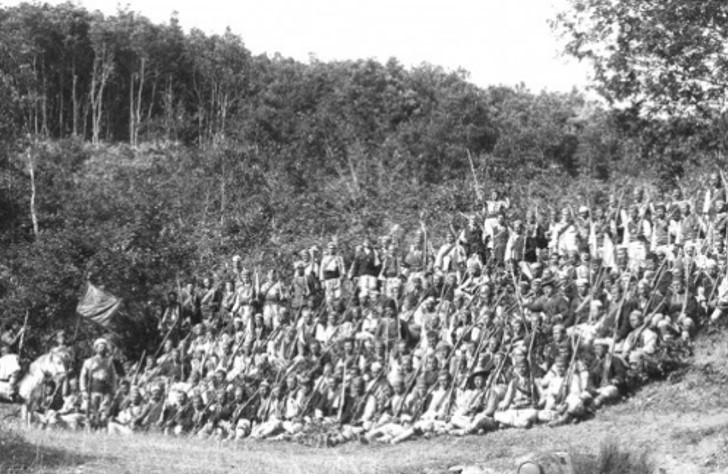
Figure 1. Group of revolutionaries with a red flag in Kruševo, July 1903. The horseman in fustanella at the far left is the local commander Pitu Guli, a leading figure in the Macedonian-Adrianople revolutionary movement. A few days later, he fell fighting the Ottoman army on the outskirts of the town.
Yavor Tarinski’s Balkan Federation and Communes: Revolutionary Projects in Bulgaria of the 19th & 20th Centuries[2] returns to this buried revolutionary inheritance. First published in Greek by Aftoleksi in 2023[3] and now being published in English by PM Press, the book examines revolutionary projects in nineteenth- and early twentieth-century Bulgaria that cultivated the ideas of the Balkan Federation and the commune. Tarinski’s central intervention is historiographical as much as political: he asks what becomes visible when Balkan history is read not from the standpoint of victorious states, but from the defeated possibilities of autonomy, federation and social revolution.
A history from below, against nationalist memory
This is where the book is at its strongest. It does not simply add several forgotten episodes to an established national story; it unsettles the story itself. In a region where historical memory remains heavily organised through the nation-state, recovering suppressed traditions of cooperation and self-government becomes a way of reopening the political imagination. An unrealised past was once a possible future.
Tarinski’s genealogy reaches further back than the nineteenth-century revolutionary movements. He points to earlier communal forms and dissident traditions, including Slavic assemblies, the Bogomils and the Commune of Zealots in fourteenth-century Thessaloniki. These episodes are very different from one another and should not be collapsed into a single continuous lineage. Their significance in the book is rather to challenge the assumption that centralised statehood is the natural or only political grammar of Balkan history.

Figure 2. Armed fighters in the mountains of North Macedonia, August 1903. DEA / Biblioteca Ambrosiana via Getty Images.
The same counter-history continues into the modern period. It is a history of communal property, assemblies, federative schemes and experiments in popular self-direction. Read in this way, the Balkans appear not simply as a region fragmented by nationalism, but also as a laboratory of repeatedly defeated alternatives to it.
Rigas and the internationalist horizon of the Balkans
At the centre of this earlier internationalist horizon stands Rigas Velestinlis [4]. Tarinski reads Rigas as a pivotal figure who tried to combine the radical republicanism of the French Revolution with the multi-ethnic reality of the Ottoman Balkans. Rather than projecting a narrowly ethnic state, Rigas imagined a democratic political community of equal citizens across the region. His Charta of Greece was therefore more than a map: it gave cartographic form to a political horizon that exceeded the national borders which would later divide the peninsula.

Figure 3. Rigas Velestinlis, Charta of Greece (1797).
Tarinski also turns to the Serbian socialist Svetozar Marković and his engagement with the South Slav zadruga, a communal form that Marković treated as a basis for common property and local self-government. The point is not to romanticise pre-modern social forms, but to recover the ways in which communal institutions could be reworked into modern projects of emancipation.
From Rigas, Tarinski follows the federalist thread through figures such as Georgi Rakovski, Vasil Levski, Hristo Botev and Lyuben Karavelov. Their positions were not identical, but they shared a distrust of liberation delivered from above by imperial patrons. Levski put the point starkly: “We already have a Sultan. We do not need a master, but freedom and human equality.” Karavelov, for his part, argued that cooperation among the peoples of the region was necessary if liberation was not simply to end under a new yoke[1].
Botev is particularly revealing because his revolutionary politics connected the Bulgarian liberation struggle to a wider social and internationalist horizon. His 1871 defence of the Paris Commune, Ridiculous Weep[5], makes clear that emancipation meant more than transferring sovereignty from one ruling group to another: it concerned the capacity of ordinary people to become authors of their own collective life.
Tarinski also draws attention to the way revolutionary figures have later been absorbed into competing national canons. Yane Sandanski and Gotse Delchev, for example, have repeatedly been claimed by rival state narratives. The result is a familiar paradox: people whose political worlds crossed borders are remembered through histories that retrospectively police those borders. Recovering the federalist and internationalist elements of these traditions is therefore also a struggle over collective memory.
The commune in practice
The argument becomes most concrete when the book turns from programmes to attempts at communal self-government. Tarinski had already developed this history in a 2022 essay for Freedom, The Commune and the Balkans: The Case of Bulgaria[6], which provides a useful English-language account of the experiments discussed here.
During the April Uprising of 1876, insurgents in Panagyurishte attempted to organise social life along communal lines. Contemporary accounts describe common management of essential goods, the suspension of money in important areas of everyday life and plans for communes that would remain in contact with one another. The experiment lasted only days before Ottoman forces crushed the uprising, but its political significance lies in the fact that liberation was being imagined not only as independence, but also as a transformation of social relations.
The Ilinden–Preobrazhenie Uprising of 1903 produced different experiments. In Kruševo, insurgents proclaimed a short-lived republic. In Strandzha, rebels associated with the Internal Macedonian-Adrianople Revolutionary Organisation established a more explicitly communal order. For several weeks, public affairs were organised locally, resources were shared and the old authority of the state was displaced. The Strandzha experiment also sought cooperation between Bulgarian and Greek communities in the liberated territory, resisting the idea that the uprising should simply reproduce another national empire.
These experiments were brief and violently defeated. That brevity, however, does not make them politically insignificant. Revolutionary moments matter not because they hand us finished institutional blueprints, but because they reveal possibilities that the established order works to make unthinkable.
Tarinski also revisits Ada Kaleh[7], the Danube island whose ambiguous relationship to surrounding states created, for a time, unusual space for local self-organisation. Table 1 reproduces a wider chronology of communal experiments and related milestones.
Table 1. Selected communes and revolutionary experiments in the Balkans, 1871–1925
Year - Milestone
1871 - Commune in the Romanian city of Galați (Galacz)
1876 - Panagyurishte Commune in central Bulgaria
1878 - Ada Kaleh: the submerged Balkan island where people once lived without a state
1903 - Strandzha Commune in south-eastern Bulgaria
1906 - Tolstoyan commune in Burgas on the Bulgarian Black Sea coast
1919 - The newspaper The Commune in Burgas
1920 - Ruse Commune in north-eastern Bulgaria
1923 - Kilifarevo Commune in northern Bulgaria
1925 - Tolstoyan commune in Ruzhintsi in north-western Bulgaria
Why the Balkan Federation still matters
The contemporary force of Tarinski’s book lies in its refusal to treat these histories as museum pieces. Nationalism, militarism and authoritarian politics are once again gaining ground across Europe, while borders and geopolitical camps are presented as the only serious language of politics. Against this supposed realism, the Balkan federalist tradition reminds us that cooperation across ethnic, linguistic and religious differences has itself been a practical political project, pursued repeatedly under extraordinarily difficult conditions.
This is also why the distinction between national memory and revolutionary memory matters. Decades later, the Bulgarian anarchist Georgi Grigoriev, known as Georgi Balkansk[8], would describe the commune as the enduring social form through which a common popular will could express itself directly. Whether revolutions called such bodies soviets, committees or communes, he argued, their underlying principle was self-direction and federation from below.
Murray Bookchin later formulated the same anti-nationalist horizon with characteristic clarity: “When at length free communes replace the nation and confederal forms of organization replace the state, humanity will have rid itself of nationalism.”[9] The point is not that one historical model can simply be transplanted into the present. It is that decentralisation, municipal self-government and confederation remain part of the political vocabulary through which domination by the centralised nation-state can be challenged.
There is also a more immediate lesson. Natural disasters do not recognise borders, and solidarity remains one of the strongest forces for crossing them. Rebuilding connections among Balkan societies means resisting the national isolation through which neighbouring peoples are so often taught to see one another. Cultural exchange, mutual aid and shared political struggles can water the historical seeds left by earlier revolutions and connect them to contemporary movements for social justice.
As Tarinski concludes, this reading of history matters because horizontal social movements can use it as a root from which new projects of internationalism, federalism, universal equality and justice might grow across the peninsula. The revolutionary inheritance of the Balkans does not ask us to return to a lost past. It asks us to recover the futures that were defeated before they could fully exist.
So let us plant new revolutionary seeds for a new Balkan Federation — and remember that we also belong to places we have not yet known, against the bourgeois state, capitalism, nationalism and war.
Footnotes
[1] https://theanarchistlibrary.org/library/andrej-grubacic-don-t-mourn-balkanize
[2] https://pmpress.org/product/balkan-federation-and-communes-revolutionary-projects-in-bulgaria-of-the-19th-20th-centuries
[3] https://www.aftoleksi.gr/2023/11/24/valkaniki-omospondia-kommoynes-epanastatika-protagmata-sti-voylgaria-19oy-amp-20oy-aiona/
[4] https://www.openarchives.gr/aggregator-openarchives/edm/helios/000024-10442_4104?language=en
[5] https://libcom.org/article/ridiculous-weep-hristo-botev-paris-commune
[6] https://freedompress.org.uk/2022/06/06/the-commune-and-the-balkans-the-case-of-bulgaria/
[7] https://libcom.org/article/ada-kaleh-balkan-island-where-people-once-lived-no-state-or-masters
[8] https://theanarchistlibrary.org/library/anarchist-communist-federation-obituary-georgi-grigoriev-balkanski-1906-1996
[9] https://theanarchistlibrary.org/library/murray-bookchin-nationalism-and-the-national-question


Comments