Róża Luksemburg (1871 – 1919)
“Women Who Changed History” Series (2)
Introduction
Throughout history, women have played crucial roles on both global and local scales. They have fought for rights, participated in governments, led nations, excelled in the arts and sciences, and inspired successive generations. Despite this, their stories have often been marginalized or their impact diminished in historical narratives dominated by the male perspective.
The series, “Women Who Changed History,” aims to spotlight prominent women from various contexts—global, local, and regional—ranging from political leaders and activists to pioneering researchers and influential cultural figures who have left indelible marks on their societies and the world.
Rosa Luxemburg and the Development of Marxism from a Feminist Perspective
On a day when the world celebrates the struggle of the working class, the name Rosa Luxemburg stands out as an unforgettable symbol… a woman who embodied revolutionary thought, intellectual audacity, and a full emotional commitment to the cause. I am inaugurating this May Day, International Workers’ Day, by choosing Rosa Luxemburg as the second figure in the “Women Who Changed History” series.
In this context, we rarely find a personality who so profoundly embodies the spirit of a combative woman, with a sharp, critical Marxist intellect and an uncompromising, internationalist heart, as Rosa Luxemburg does. Franz Mehring, Karl Marx’s biographer, was not exaggerating when he described Rosa as “the second mind after Marx.” I would add that she was the first mind as a woman who truly understood capital, class struggle, and the fight for a better socialist world for humanity.
As her close friend, the great activist and thinker Clara Zetkin, wrote in her obituary: The socialist idea filled Rosa Luxemburg’s heart and mind, shaping her creative passion and her grand mission: to pave the way for the socialist revolution. The experience of revolution and participation in its battles was her great cause. With her firm will and complete conviction, she dedicated her entire life to socialism—not only through her tragic death but through every moment of her life and long struggle. She was the activist and the living flame of the revolution.
Her contributions were not mere additions to Marxist theory; they were a fire beating in the heart of the revolutionary movement. Rosa did not just write; she lived her struggle. She gave her cause her heart, her mind, her will—her whole life. She did not compromise and never accepted half-measures; she was the true embodiment of an unyielding, revolutionary Marxism.
Rosa Luxemburg: From Poland to the Stages of Revolution
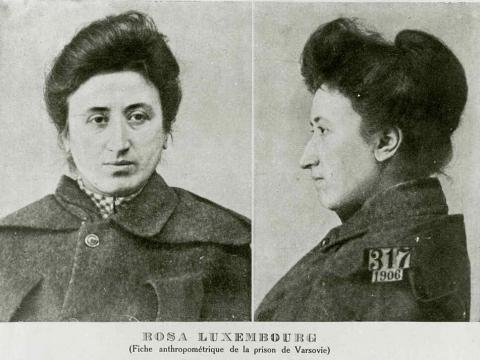
Born in 1871 in Poland, Rosa Luxemburg plunged into revolutionary work at the age of sixteen within the “Proletariat” party, which was known for organizing the workers’ movement away from individualistic tendencies and terrorist adventures. After the party’s suppression, she left for Switzerland to study economics and science, quickly becoming one of the most prominent dissenting intellectual voices among the revolutionary exiles.
From her beginnings, Rosa was marked by a rare intellectual courage, standing against nationalist currents within the Polish socialist movement in defense of the internationalist class struggle. In Germany, she joined the labor movement, becoming one of the most prominent theoreticians of the Social Democratic Party, participating in the editing of numerous newspapers and delivering mass speeches, raising the banner of revolution.
The Unrestrained Revolutionary and the Unwavering Activist
Rosa consistently sided with the struggling masses. In 1905, she secretly infiltrated Poland to participate in the uprising, then returned to Germany, where she continued her writing and agitation against imperialism and war. She co-founded the Spartacus League, the nucleus of the German Communist Party, alongside Karl Liebknecht.
In her most significant theoretical work, The Accumulation of Capital, she dissected the relationship between capitalism and imperialism. Her work is considered one of the most crucial Marxist contributions since Marx himself. During World War I, she clearly stood against nationalism and the war, leading to her arrest more than once, but she continued her struggle even from within her prison cells.
Rosa Luxemburg was not merely a Marxist theoretician; she was the living conscience of the human liberation movement. In her writings, as in her struggle, she embodied the aspiration toward socialism. Even more than a century later, she continues to inspire everyone who believes in the socialist alternative and a better world for humanity.
“Freedom is always the freedom of the dissenter,” Against Reformism and Bureaucracy
True freedom is the freedom of those who dare to think differently… in the face of reformism and bureaucracy. Rosa Luxemburg was not only an activist in the streets and squares, but she was also one of the foremost figures who fought intellectual battles within the socialist movement itself, particularly against the reformist current that was creeping into its ranks.
The most prominent of these battles was her debate with Eduard Bernstein, the leading theoretician of what was called “evolutionary socialism,” in whom Rosa saw a real danger to the essence and revolutionary spirit of Marxism.
In her famous pamphlet, Reform or Revolution?, she asserted that reform is no substitute for revolution, and that parliamentary struggle, however necessary, is insufficient to build a socialist society, because the capitalist system cannot be reformed from within; it must be completely transcended.
However, her criticism did not stop with the reformists.
Rosa also confronted Lenin and Trotsky, not out of enmity, but as a comrade who perceived the danger of centralized bureaucracy to the democratic spirit of the revolution. She disagreed with them on the party structure, opposing the closed, hierarchical model which she considered a threat to the organic connection between the party and the masses. She was never afraid to speak the truth, even to allies and closest comrades.
In one of her letters from prison, she wrote:
“Freedom is always the freedom of the dissenter.”
This statement encapsulated not only her stance toward the Bolsheviks but her position against any authority that excludes plurality and diversity, even if it is a revolutionary socialist authority. For Rosa, the struggle for socialism was inseparable from the struggle for freedom and democracy. Any socialism that does not leave room for the dissenting voice is a negation of the very spirit of the revolution.
The Moment of Revolution… and the Moment of Betrayal
When the German Revolution erupted in 1918, Rosa Luxemburg did not hesitate for a moment. After her release from prison, she joined her comrades—men and women—at the heart of the storm and in the public square. For her, the revolution was not merely a political event; it was a moment of destiny where the essence of humanity was manifested in its highest degrees of consciousness and courage. Amidst those stormy days, she wrote, agitated, organized, struggled, and remained faithful to her values until the very end. She fought her final battle with unyielding resolve. She knew the price might be her life, but she did not compromise.
She said in one of her letters:
“I was, and remain, what I am: a fighter in the ranks of Socialism.”
On January 15, 1919, the moment of betrayal occurred. Rosa, along with her comrade Karl Liebknecht, was arrested and taken away by counter-revolutionary militias. There was no trial, no law; just a bullet to the head, beating until death, and a body dumped into a Berlin canal.
It was an assassination of a body, not an idea. Rosa’s body vanished, but her ideas were not buried.
She was, and remains, the living conscience of the human liberation movement, an unquenched voice, and an eternal call toward a more just socialist world.
Her death was not an end, but the beginning of a new stage in revolutionary Marxist memory, where her words are read today not as history, but as the present reality and an open socialist horizon.
Key Books and Publications by Rosa Luxemburg:
The Accumulation of Capital (1913) Rosa argues that capitalism cannot survive solely on internal markets; it constantly needs to expand into non-capitalist areas (such as colonies) to sell its products and exploit resources. This expansion leads to imperialism and wars, which is a condition for the system’s continuation, but ultimately leads to its crisis and collapse.
Reform or Revolution? (1899) She criticizes the ideas of Eduard Bernstein, who advocated for gradual reform within the capitalist system instead of revolution. Rosa contends that reforms cannot change the essential capitalist system, and the true solution lies in a comprehensive revolution that ends class exploitation and leads to the construction of a socialist society.
The Mass Strike, the Political Party and the Trade Unions (1906) She emphasizes the importance of the mass strike as a revolutionary tool to mobilize the masses against the system. She argues that the strike must be political, not merely an economic protest, and stresses the necessity for the revolutionary party to be organically linked to the masses, with trade unions remaining an essential part of the workers’ movement.
The Russian Revolution (1918) While generally supporting the Bolshevik Revolution, she criticizes the Bolshevik leadership for eliminating internal democracy after the revolution. She asserts the necessity of genuine democratic freedom within a socialist revolution, viewing political repression as a threat to it.
Letters from Prison A collection of letters she wrote during her imprisonment in World War I, reflecting her political and intellectual vision and revealing human and personal aspects, from her love for thought and art to her struggle with isolation.
Sources:
Rosa Luxemburg: A Theoretical and Political Biography – By: J. P. Nettl
Rosa Luxemburg: A Revolutionary Heart and a Critical Mind – Website: Al-Ishtiraki (The Socialist)
Rosa Luxemburg – Ma’arifah Encyclopedia
The Rosa Luxemburg Reader – Edited by Peter Hudis & Kevin B. Anderson
Rosa Luxemburg: A Revolutionary Life – By J. P. Nettl
Rosa Luxemburg – Stanford Encyclopedia of Philosophy



Comments