
A document circulated internally in the IWW in 2016 and 2022 about the potential revision of the One Big Union pamphlet.

The Literature Committee has taken it upon themselves to work towards updating and revising the One Big Union pamphlet. In the years I’ve been a member, there has been a fair amount of conversation about the shortcomings of OBU and how it can be improved. I thought I’d try to collect some of that discussion into one document that provides the history and some opinions on how and why it should be changed.
1. History
In 1911, the Charles H. Kerr Company, a publishing cooperative sympathetic to the ‘left-wing’ of the Socialist Party of America and the Industrial Workers of the World (IWW), published a pamphlet written by William Trautmann and Thomas J. Hagerty called One Big Union: an outline of a possible industrial organization of the working class, with chart1 . It mostly consisted of an analysis of how capitalism got to the point where it was in those years, along with an explanation of industrial union classifications.
In 1919, the IWW Publishing Bureau2 , an unofficial publisher that produced both official and unofficial literature in and around the IWW, released a revised version of One Big Union3 . In this version, Trautmann and Hagerty, who had both left the union at this point, are not credited as authors. Most of the text is the same as the 1911 edition, except for the addition of organizing advice from Bill Haywood.
The first time the OBU pamphlet is officially published and distributed by the IWW is seemingly in 1924, with another revised edition4 . This is still Trautmann and Hagerty’s pamphlet.
According to at least one archive5 , there is a 4th edition, released in 1944. According to Nate Hawthorne 6 , this version is vastly different from the versions in circulation from 1911-1943 and is more or less what the IWW continues to publish in 2016.
While I haven’t actually seen the 1944 version, the 5th edition, published in 1957, includes an explanation for the purpose of OBU which is “to acquaint our fellow workers with the aims of this organization".7 I believe this is the first time that the intention of OBU is expressed openly in the pamphlet.
It does seem apparent that OBU was used as a more lengthy explanation of the union’s views and outlooks. While there have been a number of pamphlets over the years that have attempted to do this8 , OBU has come to be seen as more ‘official’. I would argue that this is not because of the superior quality or usefulness of this text versus others. Rather, this is because in 1972, the membership of the IWW voted 73-36-6 to raise the initiation fees in the US and issue every new member a copy of OBU9 . With this, OBU was elevated to a more ‘official’ status. In the 43 years since, it has only received 2-3 minor changes, as opposed to the 6-7 revisions, some major, it received in the 62 years prior.

The IWW, in 2016, is essentially using a piece of literature originally written in 1944, to describe to new members how it views the world and itself.
2. OBU pamphlet today
As of now, we continue to give OBU to new members, as it is mandated in our Bylaws. However, because of the sometimes goofy nature of democracy, the membership of the union voted to remove it, and all other lit, from the official literature classification in 2015. It is now an unofficial publication which we are required to distribute to new members.
Even though it is required to give to new members, many delegates and longtime members do not care for OBU. They try to de-emphasize it because of its outdated nature. It seems to be a generally held sentiment that OBU does not describe us accurately and in its current state has outlived its usefulness. Many Wobblies prefer utilizing other materials, such as Tim Acott’s Think It Over: An Introduction to the Industrial Workers of the World, or the Annotated Preamble of the Industrial Workers of the World for new and prospective members. There was even a motion at the 2015 Delegate Convention to replace OBU with these pieces. Although it ended up failing, and through a Robert’s Rules amendment black hole resulted in the abolition of all official literature, it indicated that parts of the membership feel strongly about this.
3. Going forward
It seems sensible to do a drastic overhaul to OBU. We should not feel shy about it. When the current version of OBU was written, the IWW only existed meaningfully in Cleveland10 and began its second great hemorrhaging of members11 . When the union required that all new members receive a copy of OBU, the IWW had, roughly, around 500 U.S. members and maybe a dozen or so in Canada12 . Back in 1944 and 1972, there was no Organizer Training 101, UK membership was insignificant, there were no high profile organizing attempts in retail and General Membership Branches (GMBs) either didn’t exist or had only existed for a short time. Additionally, in 1944, one could still possibly argue that industrial unionism was radical or even revolutionary. That is no longer the case. Industrial unionism has long been accepted by the business unions as a valid organizational form. The rise of the CIO, which dwarfed even the highest point of IWW membership, did not bring a revolution or a revolutionary movement. If anything, it brought new, even more top-down, collaborationist and bureaucratic forms of unionism into the fold, which the American labor movement has never recovered from. There is nothing particularly special or unique about industrial unionism. The optimism that the founders of the IWW had about industrial unionism turned out to be misplaced.
If we acknowledge that times have changed, what parts of OBU are outdated and unnecessary?
No politics in the union
According to Nate Hawthorne, the section called ‘No politics in the union’ in the current OBU13 was added in the 1944 version of OBU. I would argue that the terms used are quite outdated and do not serve us well. It’s intention is to explain Article IV of the union’s General Bylaws14 , which state:
"To the end of promoting industrial unity and of securing necessary discipline within the organisation, the IWW refuses all alliances, direct or indirect, with any political parties or anti-political sects, and disclaims responsibility for any individual opinion or act which may be at variance with the purposes herein expressed."
This part of the Bylaws comes from a specific situation and specific outlook. It is rooted in the IWW’s rejection of linking parliamentary or electoral efforts with union efforts, which members of a couple socialist parties tried to convince the IWW of in the 1900s. But it also reflects an overall outlook of rejecting the union-party link that is common to virtually every union. With the AFL-CIO, it is the Democratic Party. With the Trade Union Congress (TUC) in the UK, it is the Labour Party. Even some unions with some anti-capitalist views and rhetoric, such the Comisiones Obreras (CCOO) in Spain or the All-Workers Militant Front (PAME) in Greece are aligned with their country’s Communist Parties.
It is often said that the IWW’s rejection of such an alliance is based on not wanting to have unnecessary divisive debates within the union. That may have been true at one time among some members, but as any member of the IWW can tell you, there have been no shortage of unnecessary divisive debates within the union. Rather than this sometimes referred to reason, it seems more obvious that this prohibition exists more as a thought-out rejection of the union-party link that has the Party do the thinking, and the union do the acting. The IWW has always maintained that it can do both. Indeed, in the first 40 years of the union’s existence, it is amazing to see all of the official and unofficial literature distributed, reading groups and general working class political education. Programs such as the old Work Peoples College instructed Wobblies on how to complete delegate tasks and do administrative work, but also had studies on Marxist economics and other topics that were not just about nuts-and-bolts organizing15 .
Also, the IWW has long taken what we would recognize as political stances. What were the Free Speech Fights, if not political? What about the unemployed organizing in the 1930s? Our anti-war stance? Our fight against austerity in Wisconsin16 ? Does destroying a proposed local anti-homeless ordinance count17 ? We’ve also taken stances on racism, police brutality, homophobia, transphobia, condemned the USSR and endorsed the Boycott, Sanctions, Divestment (BDS) campaign in Israel/Palestine. These are all examples of political stances we’ve taken or political fights we’ve been involved in. They cannot be reduced solely to an economic stance.
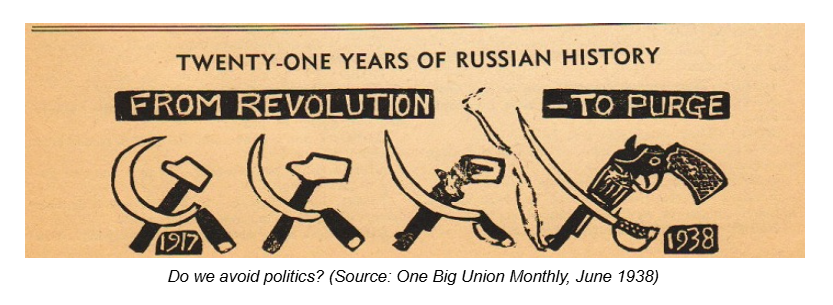
It’s clear that “no politics in the union” is not an accurate description of what we advocate or actually do. We should use terms that make it clear that the union does have political content, but that it isn’t expressed through parliamentary or electoral means.
The development of capitalism and “forward progress”
In the first section of OBU, ‘What Is Industry, and How Did It Develop?’ and ‘Revolutionary Progress’, it talks about the development of capitalism from feudalism. This is unnecessary. Knowing this development is interesting, but it doesn’t tell us anything about our present moment. Rather than an overarching narrative of capitalism that takes us from its development to the first couple of decades of the 20th Century, we should have something that more closely reflects our reality.
The emergence of the liberal welfare state, its labor-capital-state pacts of cooperation such as the National Labor Relations Board (NLRB) in the U.S. or works councils in Europe18 and the neoliberal dismantling of the liberal welfare state with the corresponding outsourcing, deindustrialization and rise of service sector are all more relevant to us than including what came before that.
The historical backdrop that OBU opens with isn’t just for informational purposes, though. It’s to advance an idea that used to very common on the far left, that history has a forward progress. Unfortunately this is not true. The revolutionary abolition of capitalism is not an inevitability. History is a complex thing. Sometimes societies and organizations improve, sometimes they take steps backwards.
Democracy?
A lot of OBU stresses democracy. This makes sense. It was written in 1944, when fascism and Stalinism still engulfed the territory and attention of much of the world. In the U.S., the Communist Party and the CIO, both bureaucratic, often anti-democratic bodies in practice, were ascendent. Being more democratic than these groups and systems did make the IWW somewhat unique.
But the pamphlet goes too far in elevating democracy, and ends up distorting the truth, as well as neglecting other things that make us unique.
We are very democratic compared to some business unions, who put renegade locals in trusteeship and refuse membership election of international-level officers. In some ways, especially if compared to other revolutionary unions, we are much less democratic. For better or worse, we still rely on electing officers to positions, who then implement what they want to do. The dramatic, internal campaigning in the union during the international officer elections 2 years ago closely resembled bourgeois elections, with endorsements, pledged programs and veiled accusations of improperly run voting. Even worse with this form of representative democracy, people often win elections, not because of their ability to do what the position requires, or any professed plan they have, but because they have name recognition. Perhaps most concerning, in a union with a worldwide membership smaller than many business union locals, we’ve had around 4-5 cases of officers embezzling money in the 6 or so years I’ve been an active member.
So, we’re democratic, more than some unions, less than others, and we struggle with it, like everyone else. I don’t think we need to state that in a revised OBU, but I believe we shouldn’t stress our democratic nature as much as the current OBU does.
Learning over the years
Any new OBU needs to include the most important developments within the last 15 years, which I believe are:
- Willingness to organize with workers who are ignored (fast-food, immigrants, prisoners, non-profits)
- Suspicion, and sometimes avoidance of, the state’s mechanisms for labor peace, such as the NLRB.
- Priority on transferring skills and knowledge (Organizer Training 101 & 102, Work Peoples College, Organizing Summits/Assemblies, Picket Training)
Thanks to the initiative of motivated workplace organizers, and partially inspired by the writings of Staughton Lynd and Alexis Buss19 , a series of campaigns began in the early 2000s. Throughout the decade, Wobblies pushed for changes at Starbucks, trucking firms, bike courier enterprises and warehouses. The Starbucks and Jimmy Johns20 campaigns, although limited in obvious success and lasting presence, accomplished some impressive things, even compared to the Service Employee International Union’s (SEIU) headline grabbing, massively funded and staffed Fight for $15 effort.
With this increased activity, there came a healthy distrust and critique of the state’s mechanisms for labor peace, like NLRB elections21 , Unfair Labor Practices22 , and even contracts23 . Unlike many unions, we don’t see these as neutral structures, but as a way for the state and capital to manage class anger into specialized legal proceedings that occur off the shopfloor. We even state often in organizer trainings: “Direct Action is our sword, and labor law is our shield”.
Which brings me to the third important development within the last 15 years: building the skills and knowledge of our membership. To me, this is the most democratic aspect of our union. Where other unions heavily rely on paid, permanent full-time staff, we rely on the rank-and-file to be organizers. We back this up with providing, as far as I’m aware, the most comprehensive organizer training available to average union members anywhere. We’ve also experimented with larger scale education, like Work Peoples College24 and with spreading less-obvious knowledge, such as with our picket training, which is based off years of experience.
4. Design
The IWW is one of the oldest, if not the oldest, continuously existing radical organization in the United States. It’s nice to have this tradition and history. But it comes with baggage.
Branches and campaigns still use imagery that was originally produced in the 1910s and 1920s. Half-naked, white, factory worker men still adorn the publications, leaflets and posters of IWW groups who don’t even have a member who had a parent who worked in a factory! Ancient mastheads and 80 year old pictures are used for front covers. The OBU pamphlet itself is 24-page, sparse, black and white, text-only onslaught.
We have a problem with design.
Any new version of the OBU should be updated, with new graphics and imagery that do not rely on the IWW of yesteryear. If this requires spending money, so be it. A piece of literature that we mandate to give to every new member should look like 2016, not 1916
5. Conclusion
We have the opportunity to create a useful document that reflects what we think and what we do in 2016. We should recognize what these things are and include them in a revised OBU, written in an accessible way so that all new members can understand the union they have just joined.
- 1Trautmann, W. E., & Haggerty, T. J. (1911). One Big Union (1st ed.). Chicago, IL: Charles H. Kerr. https://www.marxists.org/history/usa/unions/iww/1911/trautmannobu.htm
- 2Over the years, I’ve attempted to track down as much information about the IWW Publishing Bureau as possible. The following thread from libcom.org has the most information I’ve seen anywhere: https://libcom.org/forums/history/iww-publishing-bureau-04092013
- 3One Big Union (2nd ed.). (1919). Chicago, IL: IWW Publishing Bureau. https://www.marxists.org/history/usa/unions/iww/1919/obu1919.htm
- 4One Big Union (3rd ed.). (1924). Chicago, IL: Industrial Workers of the World.
- 5 Archives West IWW material. (2015, December 28). Retrieved April 16, 2016, from http://archiveswest.orbiscascade.org/ark:/80444/xv96456
- 6Hawthorne, N. (2012, October 21). "No politics in the union"? Come off it. Retrieved April 16, 2016, from https://libcom.org/blog/no-politics-union-come-it-21102012
- 7One Big Union of All Workers: The Industrial Workers of the World (5th ed.). (1957). Chicago, IL: Industrial Workers of the World.
- 8Some others which have seen multiple publications and have been considered official literature are Vincent St. John’s “The IWW - its History, Structure and Methods” and Morgan Miller’s “The ABCs of Revolutionary Unionism”.
- 9 Report of the Referendum Ballot Committee, meeting 9 December 72. (1972, December). General Organization Bulletin of the Industrial Workers of the World, 1.
- 10Pearce, George, "The I.W.W. Since 1932" (1949). Master's Theses. Paper 796. http://ecommons.luc.edu/luc_theses/796
- 11Bossen, C. (2012, October 22). In November We Remember. Industrial Worker, p. 4. Retrieved April 16, 2016, from https://libcom.org/library/november-we-remember
- 12I came to this rough estimate by using dues figures in the financial statement from the General Organization Bulletin from December 1972.
- 13One Big Union (8th ed.). (2001). Chicago, IL: Industrial Workers of the World.
- 14Preamble, Constitution, & General Bylaws of the Industrial Workers of the World. (2016). Chicago, IL: Industrial Workers of the World.
- 15Pinta, S. (2012). Educate, Organize, Emancipate: The Work People’s College and The Industrial Workers of the World. In Anarchist Pedagogies: Collective Actions, Theories, and Critical Reflections on Education. Oakland, CA: PM Press.
- 16Sawyers, B., & Conatz, J. (2011, November 10). The general strike that didn't happen: A report on the activity of the IWW in Wisconsin. Retrieved April 16, 2016, from http://libcom.org/library/general-strike-didnt-happen-report-activity-iww-wisconsin
- 17 x353319. (2015, January 6). Windsor Wobblies Build Street Solidarity. Retrieved April 16, 2016, from http://www.iww.org/content/windsor-wobblies-build-street-solidarity
- 18Out of the frying pan - a critical look at works councils (SolFed Booklets). (1998). UK: Solidarity Federation.
- 19The Origins of Solidarity Unionism. (2006?). Retrieved April 17, 2016, from http://www.iww.org/about/solidarityunionism/explained
- 20 Pudd'nhead, M. (2012). Wages So Low You'll Freak. Pudd'nhead, (6).
- 21Agenda, C. (2009, June 18). NLRB is no friend in Portland. Industrial Worker, p. 4. Retrieved April 17, 2016, from http://www.iww.org/PDF/IndustrialWorker/IWJuly09.pdf
- 22 S, K. (2012, September 20). Wobblies and unfair labor practices. Industrial Worker, p. 4. Retrieved April 17, 2016, from http://www.iww.org/PDF/IndustrialWorker/IWOctober2012.pdf
- 23 Conatz, J., G, S., Levy, T., Lynd, S., A, C., Hawthorne, N., & O'Reilly, J. (2011, December 1). Debate on 'direct unionism' Retrieved April 17, 2016, from https://libcom.org/library/debate-direct-unionism
- 24Conatz, J., & Larson, C. (2012, August 21). Reviving An Old Tradition Of Educating IWW Agitators. Industrial Worker, p. 1,6. Retrieved April 17, 2016, from http://www.iww.org/PDF/IndustrialWorker/IWSeptember2012.pdf


Comments
I somehow messed up the…
I somehow messed up the formatting on this.
I believe this was the last piece I wrote for or directed at the IWW. It was circulated internally in 2016 and 2022. The OBU pamphelt did end up being revised, and I know the people who revised it were aware of this piece, but I am unsure if this had any influence on the rewrite.
Because this has some history about the OBU pamphlet that may be interesting or useful, I decided to post this.
Asked comradely, are these…
Asked comradely, are these pamphlets for the US audience/membership/prospective members?
I don't know the entire…
I don't know the entire history of where and how OBU was used elsewhere. Until 2016-2017, how the IWW outside the United States was structured or its relationship to the US IWW varied. Sometimes bodies outside the US were more or less autonomous, other times they were subordinate to what was not always explicitly considered a US based General Administration. After 2016-2017, the IWW was divided up more on a federative basis, with the Europeans (mainly UKers) and North Americans (mainly USers) comprising essentially equal Regional Administrations as part of an 'international' IWW structure.
So I think whether OBU was seen as official literature for the entire worldwide IWW or just the US/North America probably shifts according to changes in those structures and relationships. As of now, I believe it is only official literature for the North American IWW. When I wrote this, it would have been considered official literature for the entire worldwide IWW, although in practice the UKers and European IWWers were already acting somewhat autonomously and so may have ignored it in favor of literature they produced that they felt was more relevant to them.
Got it. My couple of years…
Got it. My couple of years in the IWW back in the 1970s, then in 1980s were, of course, a different era.
The "OBU of All Workers", with a price of 3d was from when and where? I'm assuming the UK.
Ok, I figured out the…
Ok, I figured out the formatting!