Stuart and David Wise in 2018 on: Authentic Wilding / Radical Building & ex King Mob / Lived-in Conservation & the paler substitutes of Neo-Psychogeographical cum Nature Aesthetes to Urban Explorers cum Urbexers, Incredible Edible, Icteric & Transgressions / Monbiot's Feral, The Idler...../ Critique of Street Farm / The Lost Possibilities of English Romanticism (thoughts on EP Thompson)... with a new introduction from Spring 2025.

Note on "Monstrous Bastards" moniker, May 2025
In reality - The Monstrous Bastards - was all part and parcel of the wider John Clare Collective experience. In fact, they (Stuart and David Wise) found out they were being named as such by council officialdom by a great gal who helped clear 'the big field' alongside the Bradford Beck and whose sister worked as skivvy cum cleaner in Bradford Council offices. Laughing with joy the moniker was immediately embraced alongside Tweedledum & Tweedledee, Batmen & Robins, etc, and spontaneously placed on flyers, letters and what-have-you and inevitably, the Revolt Against Plenty web........
David Wise
------------------------------------------
Why Eco Peterloo? Back to Manchester 1819 and the massacre of the starving poor in St Peter's Field, meted out so quickly after the battle of Waterloo and only 35 miles from Bradford, Peterloo became a cataclysmic event of social injustice, which morphed into a theme, a gigantic nature metaphor for Shelley's, Ode to the West Wind. For us nearly 200 years later, the poem was to be turned upside down becoming the real thing minus metaphor as an eco massacre took place that dared not speak its name.
First though a necessary preamble by David Wise, early Spring 2025
Below is a far starker - and truer - description plus analyses of what finally happened in Bradford and its environs especially at the moment of the John Clare Collective. To put it bluntly: the outcome was we were hounded out of town by the council plus other state bodies especially the police. Stuart never got over this and was the trigger for his suicidal disposition toward the end of his life as an unforeseen tragedy unfolded.
For a number of years in Bradford we had been playing a game of hit & run / hide and seek with the authorities regarding our innovative eco-interventions. Thus, we couldn't easily be pinned down or rounded-up.
Stuart's on /off partner Wendy (her name has been changed here) lived by herself in Bradford and the 'authorities' became aware of this through official greenwash snitches. One day around 2014-5 male police officers visited her abode and in a heavy-handed manner demanded she hand over our addresses / telephone numbers, etc. Terrified, Wendy who was not in a good state physically, obeyed. Immediately after the uniformed thugs departed Wendy psychologically collapsed in shame and kind of 'disappeared' more or less cutting off all contact with Stuart fearing what the response could be.
I quickly learnt through the grapevine what had happened then disappearing myself from home addresses plus not answering telephone calls, etc., plus trying to contact Wendy in the nicest possible way and not remotely criticising her for her actions considering the appalling she had been subjected to by the thugs in blue.
Slowly, I was getting somewhere but then tragedy struck: Wendy somehow contracted a severe bout of sepsis and a few days later died in Bradford's Royal Infirmary.
Stuart was ultra mortified and from then on it was downhill all the way as he simply no longer looked after himself in any way. I can never get over the way he'd say to me especially in his last few months: "I just wanna die" "I just wanna die" over and over again. Also, a prostate cancer had metastasised through neglect. Rather then go into details it's best here to refer the reader to the following: The Death of Stuart Wise, eco-Situationist: The end is where we start from - a future affirmation?
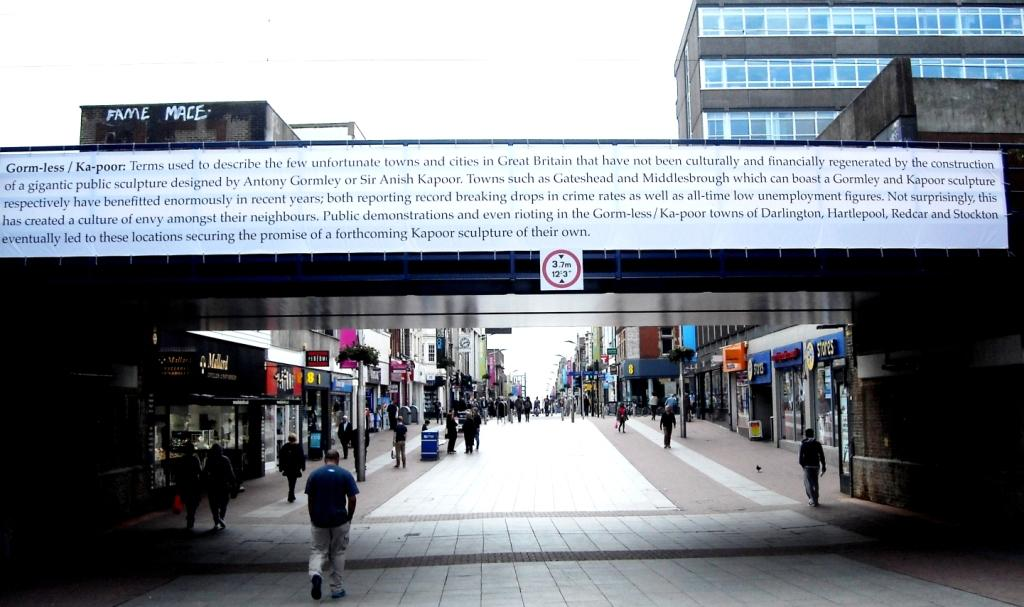
Above: A spoof tableau hung over the railway bridge across the high street of Southend-on-Sea during the autumn of 2013. How it got through the official net and for what specific reason is beyond us. Obviously its contents are a watered down, lightweight anti-art plagiarism of urban critiques related to the RAP web without mentioning (typically) its origin. What it says is:
Gormless / Ka-poor: terms used to describe the few unfortunate towns and cities in Great Britain that have not been culturally and financially regenerated by the construction of a gigantic public sculpture designed by Antony Gormley or Sir Anish Kapoor. Towns such as Gateshead and Middlesbrough which can boast a Gormley and Kapoor sculpture respectively have benefitted enormously in recent years; both reporting record breaking drops in crime rates as well as low unemployment figures. Not surprisingly, this has created a culture of envy amongst their neighbours. Public demonstrations and even rioting in the Gormless / Ka-poor towns of Darlington, Hartlepool and Stockton eventually led to these locations securing the promise of a forthcoming Kapoor sculpture of their own.
However, fashionable recuperation doesn't just start and stop on the cliffs of Southend; official poster-like graffiti on a new estate approaching Kilburn High Road in west London has been influenced by Antonio Negri's notion of "multitudes".
***********
This introduction is a direct appeal to the disappeared: to those who who've quit in despair the plethora of greenwash rackets in the hope of finding genuine encounter perhaps secreted somewhere in the growing ranks of the eco Diaspora.
The story we are about to tell is one of utter catastrophe for urbanism, nature and people. It is so shocking it simply cannot be acknowledged, let alone commented on by officialdom in all its guises, though particularly in its green guise in destroying what has to be a candidate for the finest arena of urban wildlife on a site of industrial dereliction in all of northern England. It's also a story of contemporary environmental aesthetics like in the tableau parodied above in Southend-on-Sea. This shameful triumph of neo liberal aesthetic ecology not only devastated nature (and us) but was also designed to send out a signal to anyone who might be minded to take the "do or die" matter of nature conservation into their own hands - desist or be ruthlessly crushed, our lives, and those of others deemed not to belong to the ruling elite of "high net worth individuals", mattering as little as the 1000s of butterflies, insects, mammals, birds, plants and trees that were pitilessly destroyed in the name of a 'conservation project' become a killing field.
Central to all this was the outright slaughter in West Yorkshire of a site of rich bio-diversity in Briggate, Shipley (a slightly more up market suburb of Bradford) and to a lesser extent on the banks of the Lower Aire Valley nearby. Basically this relates to the creation of a linear park to accompany Sustrans proposed six-lane wide cycle track through a former site of industrial dereliction and in the process destroying two acres of superlative bio-diversity; a mosaic of habitats within a micro-climate, especially buzzing with dense insect life......This destruction has taken place on top of a general steady disappearance of insects over decades, a process which has intensified over the last four years or so – and one that has become highly visible even though blanked in the nature media - so much so that the familiar buzz of the bluebottle is cause for nostalgia.
First and foremost WE SAY OUT LOUD we aren't criticising anybody putting down a simple cycle track through this amazing place. If only it had been that we would have been the first to applaud. Indeed initially we naively thought a Sustrans track was going to afford a much needed protection for the site's astounding and complex array of wildlife. HOW WRONG WE WERE. Rather than say much else about Briggate here –pointlessly repeating ourselves – we suggest you take a quick look at the other five webs related to this subject, Bradford's Eco-Peterloo. The Life and Death of Bill Posters, Bradford's Eco-Peterloo. Sustrans or Natural Born Killers? Bradford's Eco-Peterloo. Wild the Cities or Dead Nature Reserves? Bradford's Eco-Peterloo. Urban Unnatural Histories, Bradford's Eco-Peterloo. Briggate: Dial M for Murder (Photos) and while doing so, take a look at: London's Olympic Legacy: TOWN PLANNING FOR INSECTS
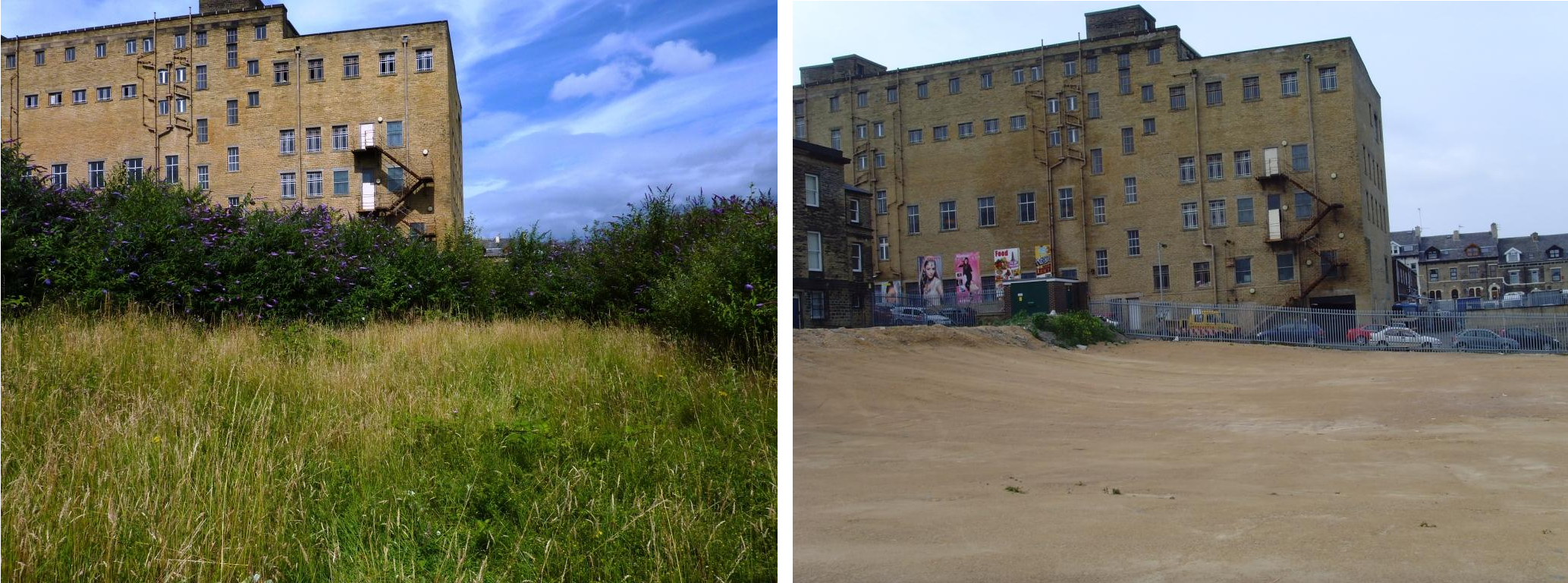
Above right 2013: A derelict rich nature site in Manningham. / Above left 2014: Gutted!!
In 2011 a worldwide Occupy movement seemed to promise great things beginning with the Arab Spring and spreading throughout the world most promisingly in the United States. The response in the UK was relatively feeble though nonetheless a ruthless and paranoid government immediately responded with a Police Reform and Social Responsibility Act forbidding all forms of camping in Parliament Square in London. Though restricted to this so-called hallowed ground, it would seem city councils and related administrative bodies elsewhere have sort to liberally reinterpret this edict in their own backyards. In Bradford penniless immigrants and others creating homemade shelters hidden among groves of often rampant foliage in and among ample, fecund derelict ground (like in Briggate and the Manningham site above) were gotten rid of by simply destroying all vestiges of rich nature on these forgotten tracts of land; a slash and burn policy the likes of which we've probably never known.
And there has been personal costs for ourselves as well as our enemies, a karmic albatross that cries out for retribution having been hung around the neck of rank 'n' file greens, Coleridge's The Rime of the Ancient Mariner also "a green parable" about the senseless destruction of nature and the life changing, psychological consequences it eventually has upon a person. At least we have come away from this dreadful business with a clear conscience, but it is scant recompense for the terrible pain we feel, made worse by a growing awareness of just how endangered all wildlife is becoming, and that the day of the last butterfly is not that far off in today's anthropogenic "sixth extinction" and that was preventable - unlike the other five. Increasingly we, the public, are being asked during appeals for funds to help save wildlife, to imagine a world without snow leopards, and other mega fauna, a 'without' that also goes right down to the little things at the other end of the scale, Matt Shardlow in a recent issue of Buglife magazine declaring "insects are facing an extinction crises." He would also draw attention to how insects were adapting to artificial soils on brownfield sites, we also emphasising this extraordinary feature in our attempt to save the Briggate site - only to be sneered and jeered at by Bradford's ruritanian ecos mostly lodged in City Hall and who had the full backing of rank 'n' file 'greens'.
Scraping away at the various sites around Shipley station has been a humbling experience, bringing us face to face with our ignorance as we do battle, on a daily basis, with a recalcitrant post industrial landscape of sooty cloth soils that have been sown with rusting metal objects, razor edged shards of industrial porcelain, glass, bolts, flattened cans, bottles, strips of torn PVC sheeting and rotting wood laminates finished with plastic veneers that can be home to a colony of ants mad as hell at being disturbed ---- and we still have the welts to prove it! Incidentally, both the Briggate site and The Big Field next to Shipley stn are swarming with ants that appear to be quite at home on these post industrial, skeletal soils, a fact which, like so many other oddities on these sites, needs to be thoroughly examined. It seems to us a new term needs to be added to the evolutionary lexicon - that of "post industrial/urban evolution" which is occurring because of the increasing amount of wildlife that is being displaced from the countryside into the towns.
Attempting to second guess nature is also largely an act of hubris at the best of times but one that is now greatly aggravated by worsening climate instability. And it is also ironic to reflect how nature has increasingly tended to gravitate toward nature-impoverished urban wastelands, thus following the path first trodden by uprooted country folk from Tudor times onwards.
************
In early 2013 we put up 3 webs by the John Clare Collective recounting in often day-to-day detail alongside broad extensive general analysis of an extensive autonomous, practical communal wilding in a major urban area. We emphasise communal and autonomy to distinguish the experiment from recent wilding vogues encompassing neo-psychogeographers merely into passive mapping and recording to George Monbiot's grandiose feral proposals (though more about that later). The term wilding has therefore already become inexact even debased. Our experiment has taken place on the cusp of open civil war in the green / environmental movement generally; one between total revolutionary autonomy and is anti capitalist and the state and the other that is ruthlessly careerist even brutally pro-capitalist deploying the sub-language of sustainababble. Ours was a skirmish on a forgotten piece of land far away thrown to one side in a northern English city though in truth, this local skirmish was anything but local and was representative of the potential civil war now beginning to break out in the eco movement, both here and internationally, in response to a corporate capitalism that increasingly makes the green agenda its own, but only by turning it into an Amazon of greenwash.
The Leninists of New Left Review have recently included in their journal a thoughtful, probing article by Joachim Jachnow, What's become of the German Greens? which finally doesn't sufficiently emphasise the need for autonomous organisation that isn't just anti parliamentarian but anti all forms of sub Bolshevisation. It is accurate to say, the new remilitarized Germany of neo liberal shock therapy would never have arisen without the enthusiastic support of the Green party. Once in office, it reneged on its non negotiable pledge to close down nuclear power stations, ensuring they operated at full belt immediately following the Chernobyl nuclear meltdown in 1986. The experience of power would also quickly corrupt them in other ways and the practice of stepping down MPs half way through their term of office was "guaranteed" to ensure maximum democracy. Though influenced by the Paris Commune and Spanish anarchism, the intent being to stamp out the curse of political institutionalisation at source, it was, in fact, very much a half-hearted concession to the full democracy of the revocable mandate as practised by the aforementioned ideal models. But it was to no avail the "Realos" winning out against the "Fundis" and nature and green issues completely losing out in the process. In came the technocrats and corporations, one green MP after another becoming a lobbyist for just about everything they were formerly opposed to, including the nuclear industry, big pharma, the car, tobacco, sweetie and fast food industry. The formerly rigorous equality where 50% of party members would be occupied by women has meant that just as many eco women as men have become corrupted by the power of corporate money. Now America's most reliable ally in the newborn Reichstag, the Green party has become the party of the greenback at a moment, packed full of uncertainty, when the dollar shows every sign of turning into funny money as the planetary debt mountain tops $300 trillion. The failure to even begin to radically critique political economy would also turn out to be the Greens' nemesis.
We have also benefitted from reading just three of an ever growing number of books dealing with the growing crises in the green movement, namely Heather Rogers, Green Gone Wrong (2010), Green Inc. by the American, Christine MacDonald, and Naomi Klein's This Changes Everything. Capitalism vs THE CLIMATE (2014) etc. In The Independent (21st May 2010) Johann Hari wrote a significant article along the same lines, entitled Polluted by Profit, wherein he lambasts the corporate funding of eco organisation and the practise of handing out awards for environmental stewardship to companies (Butterfly Conservation please note!) who would use them as "environmental insurance" to be wheeled out at the merest hint of criticism. (The World Wildlife Fund, for example, is a marketing partner with IKEA who was accused of using illegally logged timber, the WWF springing to its defence). A final word of warning: We must be careful as this 'crisis', this civil war is also in its infancy and it can hardly be said that the dissident authors and theorists mentioned above possess anything like a clear, autonomous perspective regarding an ecologically oriented social revolution. Despite elaborating a lot of excellent facts and cataloguing many instances of greenwash hogwash they are also often woefully retarded regarding anything like a totality of subversive praxis.
Typically the green groups defend their behaviour by saying they are improving, and changing, the behaviour of their corporate sponsors whereas it is they who are being changed, ending up defending the indefensible and becoming their most convincing ambassadors. But the rot does not stop there, and though Hari does say this relationship has become the norm among big green organisations, he avoids dealing with the way it has swept the board, bribery just the most obvious aspect of a development in which labels increasingly count for everything. We have gone out of our way to draw attention to Bradford ecos to all this stuff to show we are anything but barmpots though largely it's fallen on deaf ears. Latterly Naomi Klein in her recent book has added many important details relating to the appalling behaviour of "Big Green" while failing to mention the enormities of "Little Green" (for want of a better term). Sadly both are inextricably enmeshed producing a consensus that is increasingly difficult to penetrate. This timely expose is essentially about this consensus; a consensus which must be smashed apart.
And with the possibly unstoppable drift towards Proportional Representation in a disintegrating consensus that formerly was the backbone of the UK; the Green party will no doubt become as laughable as their sister German Green party. Inevitably, the broad thrust will be social democracy with a face lift allowing a certain amount of individual initiative from below, though not too much. In any case, they've already displayed enough ungreen colours in the wage cutting exercise they imposed on Brighton's refuse collectors never mind Shipley's greenwash ecocide and, no doubt, there are many other such incidents elsewhere which have never been given a public airing.
**********
What we've just experienced is a dumper truck, machine aided Auschwitz-Birkenau-like destruction of various Nameless Wilding sites throughout West Yorkshire beginning in February 2013. Inevitably while enthusing genuine people, our enemies also got hold of what The John Clare Collective was up to. The reaction by local authority hired cyber-sleuths in the north of England, especially Bradford Council in West Yorks was SEEK OUT, KILL & DESTROY without naming or acknowledging what they were really up to! The vengeful assault was executed backstairs and then quickly covered up fronted by the familiar figure of the brutal smiler with the knife, the official ecos, those nature bureaucrats awed by the totalitarian diktats of the worst developmental agenda in history which they are cravenly on their knees to. For these cretins this Greenwash Auschwitz, this blitzkrieg as nature conservation never happened, airbrushed from history and to point out the process and the end result – as we are going to do here - is nothing more than an indication of our paranoid fantasies.
After pretending that nothing ever happened what does authority do in such circumstances? Well say if something did, it was just a mere trifle that only enfeebled minds like ours could possibly get het-up about. We are, after all, only a couple of paranoiac old gits who hallucinate facts and malevolently enjoy creating trouble for the great and the good who cannot possibly do anything wrong. Their benevolence is such they prefer to humour us with an occasional reply rather than go through the uncharitable business of getting us sectioned under the mental health act. With minor variations (usually to do with degrees of violence), this is standard in all authoritarian regimes. Stripped of all rationality, dissent is thus psychologised the better to discredit it.
We like to think our opposition to the greenwash holocaust in Shipley was by far the most coherent ever mounted, involving not just the pressing need to genuinely wild urban areas but how a false 'wilding' is being used to grandstand an end-of-art, art, this 'art', in reality, a funerary monument to the wildlife it has killed off and therefore worthy only of taking a sledgehammer to.
*********
Initially in response to the almost overnight, quick-fire destruction we fired off in the following months one angry letter and email after another to the various mainly greenwash arseholes we held responsible for this appalling calamity....... We can never forgive nor forget....... The backdrop to this destruction is though more general and based on the largest, most insane property / retailing ponzi scheme in history which careering on its way throughout the world is set to produce the most stunning financial crash in history, product of an epoch when the mechanisms of capitalist reproduction has reached a dead end as debt inexorably increases and the brutalised, insecure age of insubstantiality dawns, which either breaks down and / or break through into a more and more coherent revolutionary praxis realising ours (and others) utopian but practical necessities or else falls – horror of horrors - into the worst barbarism ever experienced bringing about that "common ruin of the contending classes" Marx was so grimly aware of. If you thought what happened in the financial crash of 2007-8 was bad enough you ain't seen nothing yet for we are now in the unenviable position where capitalism can literally do little else than continually repeat the terrifying impasse of endless bubbles on an ever increasing dose of steroids. Behind this trajectory lies a capitalist mode of production stretched to breaking point and literally well past its sell by date as the essential extraction of adequate surplus value becomes almost like a species rarity; one that can only survive as a substitute creature plugged into a life support machine of leveraged bubbles based on property, retailing, endless sport spectacles and (dare we say?) art. Hence the reason we have included summaries or précis of lines or paragraphs from the writings of Robert Kurz which ended up through the efforts of others as wall slogans (on Chinese-like dazebos arenas along the Leeds / Liverpool Canal) related to the Shipley (or Shitley) ecocide.
Plus a fundamental contradiction pushed into theatrical absurdity....
All the environmentally oriented groups and bodies responsible for ecocide in Briggate fundamentally accept the reality of dangerous man-made climate change yet in practice they contribute to runaway climate change, which in its way is an almost unbelievable conundrum that stretches the modern phenomena of social schizophrenia to the nth degree. This is because these greenwash ecos accept, or have been told to accede to an omnipotent developmental agenda - put in the euphemistically acceptable terms described as "working with" – which in practise wilfully puts two fingers up to climate change without saying so explicitly. It is an agenda that subconsciously is the quintessence of arrogance suggesting, nature must be punished for daring to switch into climate change mode, as if saying, "We will teach nature a lesson it will never forget". The outcome is a totalitarian agenda of bland park-like conformism increasingly replicated everywhere; a new world order that needs these pallid ecos as the all-important "reputational insurance" previously mentioned having been given eco health certificates, which they always submissively agree to. Hardly surprising no quid pro quo is offered to these pallid ecos who invariably are rail-roaded into accepting the impossible.
The frenzy of destruction unleashed on nature by Sustrans / Bradford Council around Shipley station in 2013 requires a combined psychological and social explanation. When analysing what happened, we must always bear in mind Bradford is nigh on a failed city, the furious drive to reverse the city's fortunes triggering off chiasmic pathogenic factors that only make matters much worse. Recoiling before the featureless, dead waste that is now Briggate and vainly trying to repress all memory of what was once there, knowing if we don't we will go mad, we are in fact recoiling before a scene of carnage left by a capitalism in extreme crisis, one that can only continue to bear deserts unto itself until there is nothing left but a universal desert. Briggate today is the exteriorization of mental illness. But what kind of mental illness? In fact the most extreme of all: schizophrenia. Time has been evacuated from the empty space of Briggate signifying a loss of becoming, leaving nothing but pure space on which hallucinations dance, the deadliest of all the belief that the destruction that took place was an act of conservation. This is not a singular phenomenon either but a collective psychosis spanning the entire, so-called, eco movement in Bradford, with not a voice raised against the destruction other than ours. This hallucinatory mode of being is not accompanied by sensory hallucinations but is rather "a morbid epistemology based on the prevalence of the indentificatory principle" (False Consciousness Gabel). The people who did this had to be right for they are professionals and have the qualifications to prove it, we nobodies in comparison. For it was all about hierarchies and at the top of the pyramid, like an occult power directing the action from a distance, the Con Dem coalition's Aire Valley Regeneration Plan. Mere amateur naturalists / building workers confronting this monolith of experts? The outcome was a foregone conclusion.
This crass identification with eco professionals frees them from doing any wrong, producing an identity of predicates as in dreams and in the misconceptions of schizophrenics. Predicates absorb the subject, the actual praxis of the people responsible for the destruction unrecognisable because of the blind obeisance to CVs and job descriptions. Words take on a biblical, artistic dimension ("and the word was with god, the creator of all things") the mere utterance of words like 'eco', 'ecology', 'sustainability', 'green', the naissance of the reality of things and everything happening as if on a stage and as unreal as events on a stage, the desolating emptiness that is now Briggate, both a work of art and a consummate flowering of nature. A virtual reality visualization takes over and what is patently not there in reality, is there in fantasy, now conceived to be real by virtue of an overpowering identification with, and total surrender of all individual cognition and autonomy, to power structures. In fact what we are describing is a classic case of false consciousness though a particularly deranged, extreme form of it (which we believe will become ever more common), and which is why we deemed terms borrowed from psychology to be more appropriate, "False consciousness [representing] a purer form of schizophrenia than clinical schizophrenia" (Gabel, False Consciousness).
It was on this expanding frontier of madness with knobs on, we dropped our bombshells of sanity. That they did have an impact is beyond doubt and we can only now speculate on the mental state of those responsible for, and ratifying, such an appalling, vile act. Though having next to no communication with any of them, we suspect, however, they are in a state of shock and their inner lives have been emptied out because of it, their habitual speech a form of catatonia which they no longer believe in but pay lip service to because it temporarily prevents them from going clinically mad. Now rudderless, we would like to think they now find it difficult to place one step in front of the other, reality become one dimensional and everything in their lives taking place before them as if on a screen. Inhabiting a weightless world, they are now paradoxically weighed down by the weight of things, the universe now a crushing void and squeezing all life out of them because they took the wrong course of action entirely. Worst of all, given half a chance they would do it all over again, convinced this time the outcome will be different. Condemned to repeat themselves, we can only hope they really are in Hades, their only possible escape from its clutches, a change in the way they live and a preparedness to go to the bottom of the pile, and which will also awaken their responses to nature's new niches in the landscapes of contempt. But this is just not gonna happen.
Our response to the destruction on the psychological plane was to become depressed - an altogether much more wholesome response than that taken by the hydraulic waving arms of paranoiac JCB's on Briggate, determined to vanquish a nature their schizoid green bosses in suits feared - lest it find a voice and demand an unrepressed life and the overthrow of capitalism. We craved oblivion and the relief that sleep provided, only to be then tormented by the memory of what Manley Hopkins described as "beauty been" in our dreams and hence afraid to go to sleep, these dreams in fact unremitting nightmares and we now fearful they will haunt us until the end of our days. The psychological toll has been enormous and of course we hate those responsible for bringing it on. However we have never for one moment doubted our particular loss was also humanity's in general, there being no shades of grey on show here and finding some relief in the salutary reflection that, by creating a situation, we have at least shown up official greens for the horror story they really are. Our towering anger now has the authority of experience, there being no substitute for that.
However if we have not been turned to stone by the process, our responses to nature have most definitely been deadened and we yearn to be restored to our earlier, intense appreciation of it, just as a depressed person craves a return to their former self, no matter how impoverished that self was. One of the most progressive aspects of depression is the visceral inability of sufferers to watch TV, neither of us, post Briggate, even able to watch nature programs on TV, whereas before we had done so, though always in a highly critical fashion. This markedly contrasts with the viewing habits of the nature schizos, their false consciousness of nature owing much to TV viewing habits and the plethora of nature programs, their power such that the fault lines between true and false becomes blurred. In opposition to real, irreversible historical time, filmic nature can be played back at any point on a digital time line, nature becoming devalued in the process and essentially a substitute nature tailored to meet the theatrical cravings of sub lives. These nature programs are today's equivalents, though far more ubiquitous, of the stuffed specimens on display in natural history museums. Essentially a fiction they are a death, just like the novel is, both resulting in a loss in the faculty of encounter. This theatricalization of nature is also wedded to a reverence for hierarchy and celebrity and is a deeply rooted 'political' phenomenon, insofar as it cannot remotely see beyond the existence of politics, the state and capitalism. Thus nature celebrities constantly proclaim to the media a jaded mantra that nature is in profusion, minus a few setbacks, when in reality, the exact opposite is happening and at terrifying speed.
********************
Once, not that long ago, the utilities companies were rightfully regarded as hideous in their contempt for the natural environment, trashing every bit of bio-diversity they could get their hands on; vulgar, stoopid, appalling – you name it, they'd maim and fuck it up! But then there was a sea change. Many utility companies concerned with water, sewerage, gas, electricity, etc. finally learnt much needed lessons, often taking on board quite immaculate forms of eco sensitivity respecting their immediate environment covering pipe lines and what have you with really good wild flower mixes. It was a practice, which even extended occasionally to the road building companies! All brutality over and out then? Alas no, their previous appalling mantle has been handed over to the aestheticians especially the new generation of town and country planners in alliance with the giant building companies and the state who have become far more hideous barbarians than ever the down and dirty sewerage teams ever were. The aesthetes' crew tend to leave no stone unturned often killing almost every strange, wondrous, wild, living thing within a half-mile radius of a particular building / engineering project utterly hooked on parks and gardens concepts of lawns and primulas. But there is a catch: they - these ever so pure and wondrous designers - of course don't do the dirty deed, so it's the utility companies who cop it. They naturally – it stands to reason - they must carry the can for the aesthetes' fuck-ups! In Bradford's Briggate, Yorkshire Water got the blame for the rampant destruction, followed by KL Rouse, an excavating company.....
*********
In these dire circumstances and in the classic sense of the term we "created a situation", one which still endlessly reverberates, Not strong enough to be a movement ours was / is the classic war of the flea, of hit and run guerrilla activity, instigated by the thoughts and actions of a few individuals. We didn't communicate face-to-face with our enemies dealing with them at arm's length through letters and emails. What was the point in any case as the irrevocable damage had already been done. Nonetheless, our letters / emails were never really replied to, our arguments and polemics largely ignored, or else we received curt exasperated replies crammed with falsehoods. It could be said why bother to even attempt any kind of communication with these putrid destroyers? Well, we used this as a tactic – one among others – to bring our superior grasp and intellects along with more substantial generalisations to intimidate the pin-brains of our adversaries taking them into arenas they didn't know existed. Ours was a strategy also to make these power freaks feel small and inadequate. Moreover, considering the general dumbing-down among "the people" at large what other forces could we muster? We realised we were effectively isolated apart from a vague, warm-hearted support from mainly council tenants from all over the world close by this amazing site; a site moreover which they regarded somewhat as their own personal crazy back garden and a garden they didn't want taken away by developers. We thus deployed weapons of criticism far removed from any polite journalese or cold, unimpassioned academic style. We aimed to hit home in a deadly way. It could even be said we directed a quasi-intellectual terror against the authorities and by the by we were delighted to hear we kept many a well-paid top bod awake at night unable to sleep because of our searing comments. Moreover, under pressure and the thieves fell out with each other though no whistleblower from within their ranks handed on to us any accurate juicy titbits.
We – yes it was we wot done it – we who deliberately chose over the last forty years to refuse any position, any advancement in this impossible, hierarchical, ultra-capitalised society, remaining socially part of the common / un-common / Jack Common people. (Revolt Against Plenty was in fact an ironical aside of Jack Common's and a comment on capitalism's emphasis on the appearance of plenty when in reality it is anything but).
*******************
But let's be precise about "Wilding". What does the activity really mean? It seems as if today every greenwash pretend eco under the sun is deploying the terminology meaning the description has become devalued. Every developmental agenda is now promoted through the inclusion of a few wilding adjectives and verbs pitifully thrown in among a plethora of meaningless jargon spouted by official, corrupted "ecos.
In contradistinction to all this, ours is the wilding of the embryonic new commons; it is an activity without profile and without hierarchy. An off-shoot of Occupy beginning with Vaneigem's old premise that "All space is now occupied by the enemy"; this is an arena of contestation interplaying with the creative and spontaneous interventions of other sentient human beings doing what they must, driven by authentic desires for a new world as all around us the planet descends into misery and barbarism propelled by a suicide capitalism in its death throes. Often these people are coming out of what has become something like a mass phenomenon – that of neo-psychogeography – interweaving in a disconnected way with immigrants desperate for some kind of shanty town land to pitch a tent on; the alternative misfits and the young precariously employed together with allotments, dumpster survival and a dysfunctional collective collaboration getting slowly but surely creatively out of hand.
Initially we were quite content to use and purloin Nameless Wildness from the first King Mob Echo magazine slightly amending the poetics underneath a 14th century illustration of a millenarian peasant. Then Wayne Spenser from Calderdale suggested Unitary Wilding might be a more accurate term. It's a description that made a lot of sense suggesting connectivity to everything else, a praxis subverting separations with total critique at its centre. Whatever, wilding – nameless or unitary - is redolent of nonconformist approaches to everyday life from Ranterism through Irregular Methodism to the obvious; the industry oriented wildcat strike, which especially exploded in such amazing patterns in these islands from the mid 1960s to the end of the 1970s. Amazing? Yes, of course they were, as they rolled on and on, intensifying, heading toward an unknown destination, only to stop short, hovering, unsure of what to do next, how essentially to create a fundamental breakthrough pointing the way towards burying this alienated hell forever. Moreover beyond the high falutin, on the simplest, mundane, practical level wildcats were also increasingly criminalised. At the time, we scribbled comments upon comments fascinated by this wildcat momentum; a momentum which culminated in the explosion of 1979-80 that became known as the Winter of Discontent. Some of our jottings on this spontaneous, chaotic insurrection were much later published in Nick Brandt's pamphlet, To Delightful Measures, Changed. More recently, one of us put together memories of wildcat strikes for Loren Goldner who presented this personal epistle to a conference of insurgent South Korean workers in 2006. It is on the RAP web as Long Lost Wildcat Strikes in the UK. As if to complement this connection, this unfinished anti-business agitation, we printed out stickers in 2013, one of which proclaimed, Unofficial Nature / Unofficial Strikes...Together bombarding Bradford with them!
**************
As luck would have it, in a state of utter mortification over this brutal, bloody, unfeeling destruction of Bradford's unique nature we started work in September 2013 converting an abandoned late 19th century gothic revival church in London into flats for the homeless. Though that in itself is enough to condemn us in the eyes of Bradford's intensely reactionary bureaucratic class, we soon realised there was continuity between what we were doing in London and what we had tried to achieve in Bradford. We desired to make Shipley's sites of industrial dereliction into urban commons, our project in a gothic revival church quickly becoming part of this perspective, an example of lived-in conservation not just of a building but demonstrating a sensitivity to the meanest tree growing outside, the future tenants wanting to retain, (even magnify!), the shadow play of leaves on the interior stone walls. In Shipley we sought to commence the process of the democratisation of nature conservation, by encouraging absolute beginners to get involved. In the gothic church it was the democratisation of building, we giving tenants their head either doing the construction work or, lending a hand, as events dictated and managing to do our own, often necessary, 'add-ons' at the same time. Remarkably, it worked and at roughly £70 per week for a large room of one's devising, with gas, electricity and council tax thrown in; it undercuts the so-called social housing sector by a mile. And it is fulfilling in a way a traditionally authoritarian, state or PFI financed, social housing sector cannot match the future tenants already head over heels in love with their dream creation. This ex-church also pointing to on-the-spot tenant assembly-led public housing replete for the moment with peppercorn rents on the cusp of the abolition of rent moving through the first stages of general transition to a higher form of society having often to proceed clandestinely and with stealth; this entire drift indicative of the process towards none (or very little) new building indicating a process of adaptation and takeover; of buildings changing ad hoc on almost a daily basis and increasingly interplaying with unfettered nature.
It could be said that such a project is little more than an example of cheap city-living recuperation; a project well within the acceptable paradigms of a 'new' social democratic capitalism offered up for the future by the likes of Thomas Piketty. Maybe, but isn't it more likely that all future surplus value creation is mortgaged into paying off debt meaning no real economic recovery is possible and therefore to apply the term 'recuperation' in the context of basic social housing necessities has perhaps become meaningless?
Working for little above the minimum wage, our ad hoc, ever changing building gang, based on equal wages for all involved regardless of age or gender, gradually become obsessed making certain as far as possible that the project worked so that the place may perhaps become a beacon for other run down churches to be taken over throughout the country (plus say empty neo-gothic libraries that you get throughout northern England). Thus a huge stained glass window now lights the informal communal kitchen after taking down a double-layered Dutch bond wall. Moreover – bit by bit - throughout the rambling building, secret dens and hidey holes (high up in the towers, beneath lofty ceilings and deepest crypts) have been constructed for those secret tenants not paying rent and agreed upon by an informal general assembly. At other times the work was extremely dangerous vis-à-vis health and safety legislation and at times we were scared witless demolishing parts that, falling the wrong way, would have instantly killed.
Working on the church and obsessively mulling over what had happened in Bradford, we often thought of all the surpassingly beautiful, abandoned buildings in Bradford that could be converted at minimal cost and that could be properly sustainable (as against sustainababble buzz words) developing in harmony with nature and that need not be a destructive imposition upon it.(The future tenants of the transformed neo-gothic church raided the condemned Heygate estate in the nearby Elephant and Castle, bringing back a temperate forest of plants and saplings choking the corridors of the church - somewhat to our initial annoyance!).
In an odd way and in retrospect, there is some connection between our physical, hands-on, autonomous wilding interventions in Bradford and our physical, officially unplanned but intuitively sympathetically responsive artisanal cum briccolage building 'interventions' within a neo-gothic structure which also has something of a 19th century red brick factory walls feel (and appeal) at the back of the old structure. (Was this done on purpose originally?) In both cases, on a site of industrial dereliction where nature has acquired an extra-ordinary autonomous bio-diversity to this piece of London's urban dereliction we have (slightly but significantly) changed things in an unplanned, more-or-less spontaneous way acutely sensitive to the ambience of the given terrain and structure and taking lots of local people sympathetically along with us, so much so that they also felt encouraged to creatively intervene in their different ways.......
Of course, squatting would have been better and although squatting is virtually banned in UK plc, nonetheless putting the place right with toilets, shower facilities etc, would have been impossible if we – skilled 'artisanal' off-the-wall building workers – hadn't intervened. Now it is a lived-in church and not a piece of dead, museum-like conservation. And the tenants were all responsive as we've taught rudimentary building skills to gals and guys alike, many of them young radicals who this time will never get out of the shit economically, most likely remaining locked into "generation rent". In a way this experience points to the future essential democratisation of skills and done so in a helpful un-put-down way particularly as most of these tenants were on the dole and /or on zero hours service sector contracts. What we've recently experienced may also point to that hoped for welcome time – that revolutionary transition - when there's a mass occupation of big cities with the takeover of all the more or less empty, purposeless buildings, even those post modernist architectural / sculptural machine-like gigantic monuments which people will need to immediately adapt according to personal requirements and desires. Against the machinery of the ultra-aestheticized, modern, life-size legoland set-up where the building operative is nothing but a mathematical assembler devoid of all creative personal input, an old fashioned, somewhat artisanal approach will, out of immediate intimate human necessity, again come into its own........ That hoped for moment when there will no longer be any (false) need for much new building or yet more dead suburban subtopian estates.
We couldn't fault the radical, negative lifestyles of these tenants almost 'intuitive' co-operative behaviour in their egalitarian relations between all and each regardless of age, race and gender. Moreover, despite having locks on the doors of their ample, individual rooms, the tenants hardly ever lock them. True they borrow from each other – often without asking – but they never steal, and computers / wallets etc. are always left alone. This was a sheer delight to experience. All of this is admirable and far in advance of our own everyday lifestyle survival at their age. On the other hand at their age, our minds were much sharper, more clued-in, having read – to some degree – many of the essential books it is still necessary to digest from the great critiques of art, literature, architecture and science to Freud, Marx and Bakunin and other profound anarchists to the enlightened analysis of the anti-Bolshevikh communists.
Then came the day when a young tenant said, "I think you lot know about King Mob" even though we only referred to each other on first name terms keeping our Critical, Hidden History of King Mob hidden as this wasn't a student audience / lecturer situation. And what was the point anyway as we were more concerned with the practical situation to hand, developing friendships in the spirit of a liberated, conversational "craic" which flows so unimpeded on building sites creating bonds which sometime last for life. And the great age gap was gradually disappearing.......Suddenly the ambience became more 'theoretical' as enlightened confessionals collectively spilled out between all of us. Then we learnt a lot about what many of the young tenants had been up to recounting often-glorious recent escapades from direct assaults on notable, contemporary fascists to joining Plane Stupid, etc. We said (among many other things) for all its difficulties we had quickly become fascinated with this transforming dead church and couldn't help but think about Ivan Chetcheglov – the 1950s Parisian psychogeographer - who in condemning Le Corbusier's "architecture of suicide" proclaimed the maxim: "To live in one's own cathedral" though these tenants knew nothing about the original psychogeographers. Ever since other tenants have been asking us "oldies" about this, that and the other in our past, asking us out for drinks, even throwing a party thanking us for our building efforts! All at times rather embarrassing as increasingly we were listened to......
But as for Bradford we knew there was no chance we would be listened to and that the city has turned its back on even mildly progressive thought, the barely believable disaster that is Briggate, living proof of this assertion - if any were needed. We are still pondering how come Bradford is such a totalitarian monolith with not even a chink of light penetrating its almost Soviet style gloom and capacity for sticking with, and even perversely amplifying, its mistakes in a fashion that would have done Stalin proud.
*********
The New Commons and the dead end of Wilding aesthetics
As our praxis was / is part of the project of "the new commons" that must begin and end with the liquidation of what the Encyclopaedia of Nuisances (Encyclopaedia of Poisonous Phenomena) in France described some time ago as "the capitalist mode of destruction" ours is also the real, communal wilding and not the now fashionable term that can mean anything that is only mildly different to the dominant horticulture. Our wilding implies the transcendence of money; exploitation and the law of value and a general praxis quite unlike a bogus wilding terminology ranging from the blatant apologists of a more or less official urbanism to wilding aesthetics, (e.g. see Bradford's Eco-Peterloo. Urban Unnatural Histories).
In the last few years as the situationist critique - suitably emasculated - came to enter something like centre stage its early psychogeographical phase became massively popularised having experienced something of a paradigm shift away from those former lived-in, freer but poorer, areas of the city which in the meantime had largely succumbed to gentrification. One of the fallouts from this coming mainly from a large coterie of fluffy artistic leftovers (though still regarding themselves as artists and writers, etc) was to search out 'lost' areas more or less abandoned by commoditisation and capitalism in general. These terrain vagues, these landscapes of contempt, these arenas (often) of industrial dereliction, were rightly seen as somehow remarkable as the ethos of "the new sublime" came into focus (c/f our web The London Olympics and Mass Market Neo-Psychogeography. However none of this 'new' research unlike the original psychogeographical project centred largely in the Paris of the 1950s / early 1960s, had clear social revolutionary implications which were to be developed in insurrectionary ways and leading up to the explosion of May '68 in France. Rather they were there to be captured in quietist ways for the art gallery and the growing market of museums without walls.
Nonetheless, knowing our philistine adversaries in Bradford knew nothing of this, and after the Briggate site was destroyed we set out to intimidate them throwing the following at them in a letter dated February 2013, even though the argument doesn't quite have that necessary cutting edge that the highest level of critique demands: "The half-wit decision makers on Bradford Council have no idea just how backward and out of sync they are with the times in other respects. An 'edgeland', like the Briggate site formerly was, is now perceived by a high profile new generation of pychogeographers as something amazing in itself. But as crassness is the rule in Bradford Council, this 'new perception' will come as news to them, even though it goes back to increasingly well-known experiments carried out mainly in Paris during the 1950s. There is a side to it that is the precursor of gentrification and therefore an economic asset, industrial detritus becoming a storehouse of value. We only have to mention high profile individuals like Iain Sinclair, Laura Oldfield Ford, Alex Dimitriou, Jonathan Meades, even Will Self, - and not forgetting our influence on the Cambridge prof' Robert Macfarlane and his made for TV poetic surveys of the fascinating post industrial topography and the wildlife it hosts on 'neglected' parts of Canvey Island at the mouth of the Thames. He called it a "port hole onto another world." Precisely. And that is just what the Briggate site used to be".
We shrewdly introduced the term psychogeography just to throw these knobheads even more off balance, betting that, in all likelihood, not one of them had ever heard it mentioned before, though we knew full well psychogeography wasn't what it used to be in its glory days having had undergone a corrosive process of involution and nigh on sixty years later, had become a conservative, chiefly literary movement belying its anti-art, revolutionary origins and very much in love with special artistic grants sometimes worth a million quid. It says much about the darkly reactionary nature of our times that even psychogeography, in its unthreatening literary, picturesque guise was, still too much for the philistines of Sustrans and Bradford Council. Moreover, 'edgelands' have also proved a means of giving content back to literature as it always has the drop on landscape design, the avant-garde random psychogeography preferable to the ordered bucolic Sustrans when it comes to the conservation of wild life. Nonetheless, they share one thing in common: their opposition to taking over, to occupation, to revolutionary upheaval.
In one email sent to the official cretins we drew attention to the battle then presently being waged in 2013 to save the Nightingales of Lodge Hill in Kent (a MOD site) from a £1bn housing development. The campaign had become a cause celebre and attracted big names like the poet laureate, Andrew Motion, and the naturalist Richard Mabey, who in April 2013, held an evening of nightingale stories, studies and recordings. Lodge Hill is scrubland habitat and therefore vernal and identifiable. How could Briggate, the discarded mattress and dumped trolley basket arsehole of the world, ever hope to compete with it? And yet it is more meaningful precisely because of that, and shows that when push comes to shove, celebrities are reluctant to even pay lip service to the need to conserve brownfield sites. Just for the jollies we informed Mabey about what was happening in Briggate knowing (rightly) he would not reply to our entreaties, this born again country gent, who is anxious to distance himself from even the pussy footing, aesthetic, psychogeographical consequences of his Unofficial Countryside published in 1973, probably sensing there was a dangerously radical undertow lurking beneath what was, after all, not really a hard hitting cry for help. (In a Newsnight TV broadcast in February 2012 devoted to "Edgelands", Mabey would describe psychogeography as "babble", adding "when you scrutinize them, nothing sensible comes out". The Lettristes, the Situationists? What his unqualified condemnation does show is just how limited his understanding of the term is, and that he is fearful his early appreciation of the natural wonders of brownfield sites that were well in advance of the time, had implications way beyond the new page he had turned in natural history and that we had acted upon those implications. And that is how we have come to find ourselves in the cold in heartbreak hotel, way out in front of everyone else.........)
************
Almost concomitant with the total destruction of the neo-industrial gorge in Bradford's Briggate in early 2013 played out to the dead duck schemes of 1950s parks and gardens of rose trees and primulas, in October, across the Pennines in Cheetham Hill, Manchester, "a daylong symposium, organised by Buddleia with support from In Certain Places, examined the significance of edgelands and other 'wild' urban spaces, as sites for "artistic inquiry, intervention and social interaction".........Coined by the environmentalist, Marion Shoard, 'edgelands' describes areas of semi-urban, semi-rural land, characterised by "rubbish tips and warehouses, derelict industrial plants ... against a background of unkempt wasteland, frequently swathed in riotous growths of colourful plants, both native and exotic"..... "Traditionally overlooked and uncelebrated, this type of terrain is increasingly becoming the source of artistic inspiration. Drawing on Buddleia's recent work in North Manchester, Desire Lines examined the ecological, social and cultural value of edgelands and urban wilds, and the motivations and methods of artists who work within them. Artist and writer Joanne Lee introduced the theme by discussing her research into artistic engagement with contemporary urban 'terrain vagues'; and Nottingham-based artist Rebecca Beinart, discussed her involvement in the international Wasteland Twinning project, and her own engagement with the 'urban wilds". (This blurb was forwarded to us by Wayne Spencer in Calderdale under the headline "Groan". And GROAN we did. This wasn't at all what we meant by Wilding Intervention....
We had come across all of this before and the big protagonist is the seemingly out-in-the- woods-and-fields sculptor, Andy Goldsworthy. His artefacts have for decades been an anticipation of the increased selling of nature, its valorization, a nature that is destined to increase in value as it becomes the biggest con of all and the ultimate check out of the human species......
Way back on the 15th of September, 2007, the New Scientist imbibing the neo liberal climate – ironically on the eve of its biggest ever economic crises so far - said that traditionalapproaches to nature were doomed to failure. Now it was necessary to deploy market forces to safeguard ecosystems meaning conservationists had to work with local government, industry and the financial markets to set up incentives encouraging measures for the protection of eco systems and the vital services they provide. The idea behind all this guff meant it had become necessary to put a monetary value on the services that healthy eco systems provide for human populations. Therefore ecosystem service schemes are now being implemented around the world like the Natural Capital Project (involving Stanford University, The Nature Conservancy and the World Wild Life Fund). The Natural Capital team has put together a model called Invest which takes data collected by governments and uses it to calculate the economic effect of various conservation actions. A system of tradeable credits would mean conservation crews would also be able to buy or sell their credits. Inevitably this emphasis produced a reaction; a Stanford graduate student concluding "we must act quickly to redirect much of the effort now being devoted to the commodification of nature back toward instilling a love for nature in more people." Peter Kareiva lead scientist with The Nature Conservancy at the same time also said, "Commodification is a bad word. It's about adding value" - whatever that means - because essentially these official eco dissidents were quickly to be given short shrift. Moreover whilst true, a huge factor in all of this was simply suppressed: that the essential instrument in promoting the hoped for ultra commodification of nature was to be through aesthetic display, ironically supplying an even more lethal inflection to the old 1960s situationist slogan, "Culture, ugh, the one commodity that sells all the others."
In misery, two years later in 2009 shuffling about east London we had the singular misfortune to visit an exhibition in London's Barbican Art Gallery, entitled Radical Nature: Art and Architecture for a Changing Planet which resulted in us wondering whether to wreck this ridiculous installation of upside down trees and what have you, all self-importantly put together by an equally ridiculous slew of artists unable to go beyond – well over 40 years later – from the Icteric perspective we had espoused around 1966. A little later clearing up old newspapers we came across a Guardian "Society" pullout dated the 10th of January 2007. In it there was a piece entitled Down to a fine art? that details how a group of eco artists in England and America were simultaneously exploring "the geopolitical relationships of land use planning, focussing on how land is owned and controlled and how public access to places is restricted".
The article goes on to point out how one of them a Spanish woman, Lara Almariegui, then living in England, had focussed on empty lot's and city demolition sites. "Empty lots [she says] are spaces of freedom and possibility. They are the only places not designed by architects but still filled with the idea of possibility". Evidently she also engaged with city authorities to obtain permits to open wastelands to the public and in one instance managed to get the land protected. Something of the same was happening in The Land project in America. One of its members, Amy Balkin of This is the Public Domain had, according to the Guardian reporter, attempted "to create a piece of common land in Kern County, California, owned by the public in perpetuity. The impossibility of doing this illumined the constraints of property law in the US and led her to transfer intellectual property rights to the land to enable its public use as an art work, rather than a piece of real estate."
More recently (2009) Lara Almariegui did what could have been the basis for an interesting pamphlet entitled, A Guide to the Wastelands of the Lea Valley and subtitled, 12 empty spaces await the London Olympics. Some of the photos are breathtaking and bear an uncanny resemblance to some of ours taken prior to the Briggate carnage in Bradford. However what this pamphlet crucially lacks is any acquaintance with the wild life of the Lea Valley. Some of the sites Lara photographed would make way for the Olympic's soulless "wild flower meadow", essentially a substitute nature for passive consumers taking a breather from the nearby Westfield shopping mall .................It was left to a few neo-psychogeographers like Iain Sinclair to conduct guided tours around the derelict marvels of the Lea Valley, the heaps of abandoned tyres, etc. Though appreciative of the valley's industrial ruins and detritus, Sinclair's knowledge of nature was not that much better than Ms Almariegui. As for the latter she's now going from strength to strength from one Biennale to another as just another bullshit installation idiot.....
Though this neo-psychogeography is scarcely cutting edge stuff, Bradford's bureaucratic class could have benefited from reading or knowing about such developments and which may well have prevented the destruction in Shipley had it taken the lessons on board. However to make an obvious criticism like this will go straight over the heads of Bradford's bureaucratic class who have long made a virtue of philistinism. Strength through ignorance is their credo and if that fails then, as we know to our cost, there is always the heel and the boot, though more about this elsewhere.
The myth of Incredible Edible
Much has been made recently about Incredible Edible in Calderdale, West Yorkshire with its seeming food for free perspective overlapping with new landscaping and therefore possible candidate for yet another new wilding mystique. It is in reality anything but and its chief spokesperson, Pam Warhurst has become the veritable pinnacle of greenwash awarded one putty medal after another. Recently a Bradford-based scheme has won a prestigious European cultural heritage accolade via the South Pennines Watershed Landscape Project which has been awarded a Laureate in the European Union Prize for Cultural Heritage / Europa Nostra awards 2013. Pam Warhurst, [who else] and chairman of Pennine Prospects, said: "We are delighted to have got this far. "To be named as a Europa Nostra Laureate is fantastic and great recognition for all the hard work of the project team, at Pennine Prospects and across the partnership, and of all the volunteers who make the South Pennines Watershed Landscape Project what it is."
Or as Wayne Spencer in Calderdale put it in an email in the summer of 2013: "Re: Incredible Edible, I noticed recently that they have started selling produce locally. They also have paid staff and apprentices, it seems. Just another quasi-charitable business....... Of course, for any resident of Todmorden, the phrase "guerrilla gardening" brings to mind Incredible Edible. I had the misfortunate of sitting near a couple of leading lights of Incredible Edible in a cafe recently. Pam Warhurst (who I see is also involved with the Pennine Prospects project lauded by the European Union) did most of the talking. In public, she puts on a bluff Northern air. Behind the scenes, however, she uses that hideous, gnarled jargon much beloved by modern managers. I only wish I had jotted down a couple of prize specimens of the absurdities she trotted out. It was all about grants and PR. This is hardly surprising. Incredible Edible is a largely spectacular project, one that exists almost entirely at the level of appearance. It has generated a huge amount of publicity, most of which duly reports that it is making Todmorden increasingly self-sufficient in food. The reality is very different. I do not know a single person who has eaten even one mouthful of food produced by Incredible Edible, and I never seen a single Incredible Edible person working on public land (they do work in a fenced nursery near the Rochdale Canal in Walsden but their public plantings (which they quite rightly refer to as "propaganda" seem largely staged for the media). Beneath Incredible Edible's self-serving fog of misrepresentation, the local market in fruit and vegetables remains completely dominated by supermarkets (Morrisons in particular). The proportion of food provided by Incredible Edible is wholly indistinguishable from zero."
Urban Explorers (UE) and / or Urbexers...with asides on Bradley Garrett, well on his way to becoming a new niche mainstream superstar....
You may well ask but what does urban exploring have to do with neo-psychogeography Incredible Edible or Wilding in general? Truth to tell it's more an ambience than anything else though there are concrete overlaps with neo-psychogeography's 'new sublime' and Transgression's academic theorists (see later) plus insights into a levelling, general wilding based on the likes of environmental historian William Cronon, approvingly quoted by Garrett: "Wildness (as opposed to wilderness) can be found anywhere; in the seemingly tame fields and woodlots of Massachusetts, in the cracks of a Manhattan sidewalk, even in the cells of our own bodies."
The urbexers mission revolves around a call to transgression and adventure in a world where we are increasingly "prisoners of a flattened universe", one where desire and lust for life is systemically thwarted on every level by a 24/7mobile phone, second life, media blitz which so far has successfully distracted us from the growing might of a surveillance economy of watchers, watching watched. This lethal trajectory is backed up by a Health and Safety Executive gone bonkers demanding a fearful, blind submission to chop logic; a situation UE attempts to subvert by exposing the systems' leaky underbelly as these gallant bands of interlopers duck the 'seccas (security guards)' time and again. Essentially, at its best UE is about wrong footing power largely based in and through the vertical city going stratospheric as against the more horizontal enclaves we, the people, live in. Rightly Garrett says, "Increasingly the vertical is about security from the insecurities of street level" and the place where popular responses explode; a city where "today, citizens are treated with greater suspicion than ever before."... [UE is against the dead end, "scripted narratives" of conservation and preservation set in the aspic of a do not touch gallery aesthetic with price tag attached]. "Urban exploration appreciates history in different ways and does not offer the promise of preservation." Thus UE's participants intervene somewhat against this dominant status quo that is the "neo-liberal city, a mausoleum of sites to be seen rather than places to be touched"; the city as artefact....
Britain is one of the most policed societies in the world with more CCTV cameras than in the rest of Europe combined and is in many ways far more authoritarian and violent than the United States which, according to Garrett is, "just hidden behind a veneer of British reserve and a general willingness to accept the status quo."
Because UE's act differently to most passive walkers (like the neo-psychogeographers?) they can also act as inspiring detonators once others spontaneously cathect with their 'strange' behaviour, pulling onlookers out of familiar daily routines. "In these situations [says Garrett] explorers go beyond asserting, 'I did this' by intentionally implying, "You could also choose to do this.... Political implications emerge in the resistance of the apathy most people exhibit daily." But then (as we well know) people (the 'straights' as we used to call them) also start looking at you in a suspicious way and the UE's often experience this understandable paranoia.
At its most basic UE is the most interesting of a plethora of extreme sports outdoing the likes of parkour, skateboarding, base jumping, tags & pieces, etc. In response to growing urban totalitarianism they place–hack everything out there from sewers, ruins, abandoned mental asylums, underground railways, old MOD property, to skyscrapers and meaningless gigantic sculptures. Rightly they find another ambience, one that is proscribed. Thus, for example, UE's found the haunting quality of abandoned mental asylums compulsive..... "The explorers act as keepers of extraordinary affects in a world rendered increasingly mundane" (Garrett).
UE is about provoking authority, activity as against passive consumption, anti the passive watching of endless TV placed among a plethora of domesticated commodities that you don't really need nor get much pleasure from, often having paid an arm and a leg for. Urbexings life-enhancing surge is about time, passionately experienced time; transient but remarkable, intense moments you won't ever live again, outside the ken of consumed time, moments that are anti-money and its pursuits. And their nametags stand for a life raw and pulsating: Vanishing Days, Guts, Bacchus, Brickman, Downfallen, Uselesspsychic, etc. These people are far from stupid. Garrett and others of his ilk see their lineage in an artistically rebellious past through the likes of Walt Whitman, Dickens, Baudelaire and Benjamin together with more general movements from Dadaism, Surrealism up to the Situationists. He also mentions in passing, Hitler's architect's Albert Speer last book, Theory of Ruin Value, plus a smart rejoinder from Nietzche, "every past is worth condemning" In truth however, this acknowledgement of subversive history doesn't imply the path towards a more coherent supercession because like the neo-psychogeographers they have far more in common with lightweight avant-garde neo-cultural figures such as the cineaste Tarkovsky and the novelist JG Ballard.
Having said that, UE is almost subversive – in the best sense of the term – though stopping short again on that essential truly transgressive precipice where so many connections, insights and socially subversive praxis can begin to take shape which indeed its more clued–in exponents vaguely see, though beyond lies a much more difficult, less 'epic' terrain, which isn't so easy to hack into. UE's leading light in the UK, Brad Garrett again says, "It is at the same time a subversive response to the imperatives of late capitalism that encourages spectatorship over participation."
For sure fine as far as it goes but what is late capitalism? This categorization was regularly deployed in the late 1960s, so does this mean we are still in this 'late' phase? Or was it just a handy catch phrase to throw around in the era of state monopoly capitalism before the ideology of neo-liberalism shoved it aside? Which in turn morphed into global state financial capitalism predicated more than ever, on an aestheticised surface of smoke and mirrors (requiring an updated theory of the spectacle) as the mechanisms of surplus value extraction in capitalist reproduction have become more and more tenuous and the state more manipulatively managerial and subtly police obsessed than in its entire history. UE is against the "security entertainment complex" that is "a mixture of control through surveillance and distraction through entertainment". (Garrett)
UE's big take-off is inextricably connected to the financial collapse of 2007-8 as building projects ground to a halt, "broken-toothed building sites and decaying ruins empty and open".... "Explorers' eyes lit up all around the globe". Here there's an overlap with psychogeographical mapping as many ubexers got involved after having initially walked through and investigated many "landscapes of contempt" finding them richer and more fascinating than any laid out new shopping mall or vanity project.
An imaginative sense of something like immanent apocalypse, stemming basically from the financial collapse, spurred urbexers to great daring feeling as if they were pushing through a surface of bright lights and security guards revealing precipices, not just from the top of skyscrapers but something amounting to the metaphorical abyss previously mentioned. But what then? Urbexers haven't even begun to raise the problems – the necessities – of a transitional society rapidly moving beyond the paradigms of capital, involving major questions like the disappearance of money, never mind thoughtful insights on how all vanity monuments, vast malls and supermarkets, buried tunnels, etc. can be redirected in the process of sloughing off the monetary economy. Garrett comments: "As people become more curious about what a post capitalist world would look like, urban explorers can supply imaginative descriptions." But can they? Transition is also about the immediate transformation of ruins, not playing around with often admittedly stunning photos, depictions that in the USA (with Detroit especially) in mind have aptly been described as "ruin porn." Transition is essentially about quick and hopefully durable displacement. This means stepping outside the urbexers trajectory, which for a young man like Garrett, has so far amounted to also taking squatting on board plus attempting to sympathetically deal with the 2011 urban riots in the UK seeing in them a subversion of "the authoritarian constriction of the city" versus "directly transgressive" street riots.
Trying to break out of a limited praxis into something more rounded takes time and some Urbexers have gotten into helping the homeless which they regularly stumble across in abandoned train tunnels, etc. like in New York's subways or old storm drains in America's far west. "Dusk was another dawn for those of us whose work depended on darkness......more real than real life." (Garrett). Nonetheless, stark, humdrum immediate reality impinges on dusk to dawn ubexer activities as uneasy relationships overlap with the very real marginals who also often inhabit landscapes of contempt. An initial wariness - were they going to mug you for your expensive camera? – giving way to a social workery like pity followed by more profound insights as some UE's realized that many of these misfits wanted to live in tunnels as against the even more alienating demands of "walking the line" until dropping dead of stifling conformity. It hit as something like a revelation that a lot of these people had something quite stunning to tell you simply because they are released from "cultural, social expectation"; perhaps having encountered something similar to Andre Breton's "cry of the mind turning back on itself" as some UE's see in the experimental necessities of marginals a search for a lost, sympathetic environment and community compounded by what we've also collectively lost within our individual psyche's and impoverished personal relationships. As Garrett says, "We live in a time when fewer people than ever feel a sense of place."
It would seem, the UE's are very competitive with each other but not necessarily in that bad a way as they live off the highs of each other's achievements inspiring others to more audacious place hacking. However with UE, explorations are immediately reified (and they do deploy the word) or spectacularised as art objects thus adding to the aura of the neo-liberal city, above all a cold, reified aesthetic / artistic ambience shorn of creatively human experience where genuine encounter is increasingly on the long list of the forbidden. It could even be said, isn't the brilliant, telling photograph the be all and end all of their experimentation? There is much posing with endless photographs of tunnels revealed by stage lighting with the explorer as silhouette to be then sold on to art galleries for a tidy sum. Thus a pared-down activism becomes part of the art market added to with the addition of the curator's sales pitch, the essential lynch pin in all this; all en-route to becoming professional photographers ending up say as paparazzi? Even Garrett sees such activism as not much more than "art for arts sake" if it doesn't more concretely move out over connecting with more and more genuine people – not into UE – collectively and dialectically transforming each and everyone in the process. After all, the bottom line is that urbexing is for physically fit young men and women; after the age of 30 and it's about time to quit.
Sadly, it must be said - and after all that's be said respectfully here about the milieu - most UE's don't seem to have much of a perspective beyond mild subversion, little beyond the acceptable perspectives of extreme sports. Some do break through and it's been noted that London place hackers were / are perhaps the most 'political' of all, (political in the sense they were inclined towards anti-capitalist perspectives). Even Garrett (in a jaundiced comedown?) perceptively says UE "is much more a celebration than a condemnation of capital and spectacle. It's an anti-spectacle that runs alongside the main act, wearing a double helix" and some developers in America (hardly surprising) approved of place hacking reckoning it could be good for avant-garde property sales promo. Smart thinking!
The London Consolidation Crew (playing on the old abbreviation LCC which once stood for London County Council) prospered in the gap / sink hole before intensifying alienation in the great nothingness out there began to trap more than a few of their participants in a lifestyle of general conformity, i.e. getting a professional job, university studies, family life, academic careerism, etc. In many ways Garrettt's two books, one graced by the sub Bolshevikh, Verso publishers, Explore Everything. Place-Hacking the city and the other, Subterranean London: Cracking the Capital are his first and last combined; a funereal obituary to a past, passionate life now abandoned having joined the ranks of the professorial racket. Thus a suitably lobotomized radical enters the hallowed portals of the economically secure life styles of the Self's and Macfarlane's who ardently welcome him into their fold whilst Garrett still hears the cries of "sellout" from former buddies ringing in his ears, or more subtly, the comments of those condemning him for "codifying the practice of urban exploration which could lead up to its commodification."
In fact from quite early on, Garrett's writings were supported and funded by the geography dept at Royal Holloway, University of London. Now finally achieving PhD status plus academic "researcher" status, Garrett surely must feel guilty residing in the community of durable safety nets having passed on through to the other side, whilst former place hacking rebels continue to suffer the "slings and arrows of outrageous fortune" when not sinking into terminal, agonized oblivion. Even worse - though certainly more understandable - this conformity, this sell out, was in response to increasing harassment, something imposed by intensifying state repression – post Occupy - as police continue to silently and without media profile (which could mean worrying questions raised in some liberally minded quarters) crack down on all forms of genuine experiment. Occupy must never be allowed to happen again........ And haven't we all through our lives felt the heat too which is in many ways (even in ripe old age) as intense as ever with harassment continuing unabated. For certain no Self or Macfarlane will sing our praises in fulsome introductions simply because we've always refused for decades in our daily lives to accept compromise and recuperation. And in the eyes of 'the system' that is quite the most evil thing of all..... What the UE's have to learn to their cost is that you must constantly disappear, and in the process, acquire the nose that is able to sniff out the moment, when required, of strategic vanishing, only to return, hopefully becoming ever more formidable.
Exposure of hacking activities on UE websites has resulted in police busts and sites on the ground in consequence have been sealed against further trespass. In this our experience has overlapped with theirs except our forbidden eco researches often meant every living creature within in its circumference was exterminated by a powerful array of insecticides, and one which proved to be a far more deadly – and an unbelievable heavy response even in terms of official greenwash. At times you wonder if the UE's had chanced upon or read some of our Wilding involvement accounts. Garrett somewhere points out that today exploration of the "traditional wilderness" (we guess Amazonia, the deserts etc) is viewed as noble, while "exploration of the urban is seen as threatening." Too true, but it's even more so if you then actively intervene in any small way; in fact it becomes criminal transgression even when bringing out - lending a helping hand - to the often fecund and amazing nature residing there. We engage in eco-edgework in edgelands and the authorities become so incensed they must kill outright replacing the terrain vague with safe banality.
As for West Yorkshire, Urban Explorers over the last 3 years or so have now gravitated to our childhood wonderland of Healey Mills (ex) Marshalling Yards, now an even more inspired, ever-morphing site of industrial dereliction which we've oft commented upon and made films about. The place is now jam-packed with tags and pieces and most tags and pieces today are sadly nothing more than banal decoration (little more than externalised body tattoos) minus meaningful content, so there's nothing here that amounts to the enlightened communication of real subversive graffiti.
Below: Two at dusk atmospheric though arty urbexer photos of Healey Mills and a day time view (photographed by ourselves) of the overgrown railway tracks
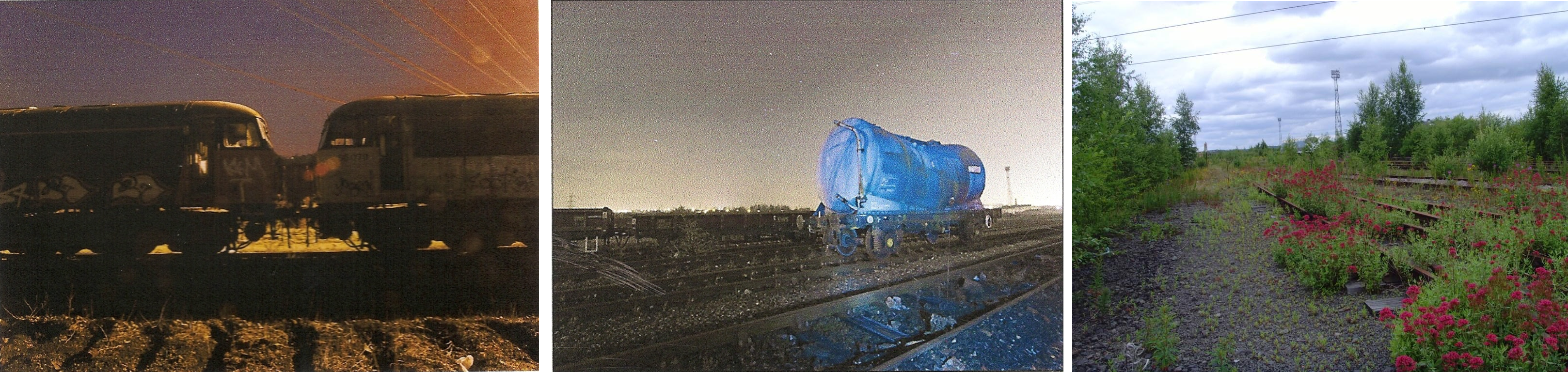
Back to Briggate and Destruction as Aesthetics
In our very first, very angry letter to Sustrans after the unbelievable destruction at Briggate, in February 2013 which in the space of a couple of days spearheaded by dumper trucks and earth moving machinery destroyed an absolutely remarkable industrially-fed wildlife site that had taken possibly 200 years or more to mature as it was also near the headwater of the infamous Bradford Canal which so fascinated John Ruskin, we suddenly realized these people were vampire-like aestheticians. Their architect Mcquillan had a plan for a linear park at this juncture in the "Great Northern Trail" (Sustrans terminology) as trees packed with rare species from butterflies to flocks of song birds were mercilessly cut down and a huge ancient boiler which served as a bat roost was unceremoniously tossed aside as he realized his stock-in-trade bucolic vision of ye olde Englande. Later David Hall (local Sustrans boss) said this was merely "forward planning" but that was only said to cover his arse as truth to tell they (along with Bradford Council) had ignored all planning and bio-diversity protocol and procedure. We will now quote a few choice sentences and paragraphs from the aforementioned letter to give you some idea what were the precise on-the-ground facts regarding this aestheticisation....
"There is not the lightest feeling for the genius loci of the place [Briggate]. This would have been at once apparent to the philosophers of the picturesque in the late 18th century, namely Uvedale Price and Gilpin. Instead of imposing their will on the environment in the manner of Capability Brown, they sought to bring out the particular, quirky, features of a place; their temporally 'unorthodox' aesthetic also a timid, largely implied, resistance to the stultifying effects of enclosure on landscape, Brown's sweeping, empty vistas the aristocratic domestication of a 'nature' based on the expulsion of the peasantry from the land. These aristocratic 'improvers' both of 'nature' and the productivity of the land allowed for ornamental flocks of sheep etc but little else beside and, brought up to date, the similarities with the 'enclosing' of the Briggate site are obvious. However what Uvedale Price and Gilpin never mention is the deleterious effect enclosure was having on nature. It took a John Clare to bring this out. Sadly we seem as far as ever from effecting some kind of modern synthesis on these unofficial 'urban commons' left by decades of de-industrialization. Meanwhile, once seized by today's 'improvers', horrible 'nature' monstrosities are born".
"If John Ruskin were to come back what would he have made of all this? The Bradford Canal obsessed him and how many times have we unknowingly followed in his footsteps, the canal's dark, evil magic invading his soul. In fact this area below Briggate is the last extant remnant of what has to be the most infamous canal in history, its notoriety largely due to Ruskin's passages of matchless prose describing how its inky waters reeked of hell. The canal's past still clings spectre-like to the place and how wondrous that it should, over time, become a place of peerless bio diversity. Once more, thank you very much Bradford Council for destroying this order of succession that makes a thing of beauty out of the irremediable!"
Nor are we are the only ones to note this aestheticisation of nature, which is unfolding everywhere. Jonathan Meades, hardly an anti artist despite the title of his most well-known book is Museums without Walls, has said:
"...the English landscape is increasingly infected with the artificial perfection of Georgian parkland whose purpose was to delight the eye: cows and sheep were theatrical props. This suave naturalism, supplied by Capability Brown to noble Whigs, has been democratised. The English sticks have been subjected to a makeover, a wash and brush up."................ "The idyll has moved from aspiration to actuality. When villages were inhabited by the sons and daughters of the soil the land was a factory without a roof. Now that they are commuters' dormitories the land is an amenity whose looks are everything. England's countryside is today more literally picturesque than it ever was, more conventionally picturesque, more institutionally picturesque.
"The National Trust and English Heritage are merely the most prominent agencies involved in turning back the clock to an age which only ever really existed in the brain of Constable and Cotman, Gainsborough and Girtin"
"As well as rushing headlong into a fictive past, the English landscape is increasingly managed. That's to say it is subject to countless prohibitions. Do not light fires. Do not park. Do not feed the ponies. Do not drive at more than 40mph. Do not, do not, do not. To which the only response can be: ignore, ignore, ignore. Tidiness is no virtue."
Icteric, Steven Graham & Transgressions
In our tirades against the arseholes that destroyed Briggate we had occasion to mention Icteric, as not far away in Harrogate at the time, Charlotte Raven was praising the "living sculpture" of some of the horticularised 'wilding' pieces on display in the ritzy Victorian town for the West Yorks rich. Of course we had coined the term and we let our protagonists know, well aware the dumb fucks we pointed this out to would not have a clue as to what we were talking about. So let's enlighten them yet again, but perhaps they can't read?? The influence of Icteric in the mid to late 1960s remained potent enough in Newcastle (especially Icteric during its later, wilder, more profound days), despite the onset of conservative reaction. As the art dept in Newcastle University succumbed to mind-numbing conservatism, on a respectable intellectual level the shadow of radicalism was squeezed back into a tolerated though official university agenda revealing itself well over 15 years later in the university's geography dept via a lecturer's magazine called Transgressions (reflecting the punk art gallery of the same name in the late 1970s / early 1980s?) Transgressions was perhaps the first building blocks of the fad that has since become neo-psychogeography, and (as previously mentioned) emasculated expression of cutting edge psychogeography first experimented with in the Paris of the 1950s petering out ten years later. Transgressions initially engaged in somewhat cardboard cut out eviscerated derives through Newcastle as well as doing interviews with Tom Vague and profiling articles by Angry Brigade notable, John Barker. Prof' Bonnet from the Geography Dept was initially the guy with the biggest neo-psychogeography profile but wasn't to remain so for long.
Then another twist; in Newcastle, Transgressions influence crossed over to the Dept of Architecture where our eldest brother once held a reactionary, forlorn sway. A couple of decades later Steven Graham took over as Professor of Cities and Society. A liberal, lightweight neo-psychogeographer he has since mapped-out the covert militarisation of many of the world's major cities specifically highlighting East London during 2012, the year of the dreadful Olympics centred in Stratford. He has had books published which have since been translated into many languages, in between doing daring things like writing for New Left Review. Wow! And shades of things to come re Sustrans and ecology, the guy is also significantly into cycling and birding, though it's rather like the yuppie variety lambasted in the Encyclopaedia de Nuisances, The Despotism of Speed (C/F Revolt Against Plenty web) Mark Dorrian, another neo-psychogeographer is Prof' of Architectural Research at Newcastle where he wrote a situationist influenced paper, "Expect anything, Fear nothing" and is head of global research unit in the architectural dept. On a more general level, the Situationist influence in Newcastle is bigger than in any other provisional city and whether we like it or not, we started the ball rolling there....
We wrote on the horror story of the London Olympics as The Monstrous Bastards and as such, posted these efforts on the RAP web -The London Olympics and Mass Market Neo-Psychogeography . It's highly likely that Steven Graham knows of our existence but abides by the rules of generalised omerta refusing to acknowledge such miscreants who are clearly beyond the pale. Nonetheless there occurred a revealing incident indicating that the guy could no longer hold-in all that academic dissimulation locked up inside his head and body – and perhaps was influenced by our more radical life styles or even by the Monstrous Bastards. For once he expressed himself directly walking out on an August bank holiday night in 2012, stoned and drunk with a screwdriver to scratch comments on a host of parked cars in a middle class Newcastle neighbourhood. It was a revealing, Mallarme-like moment as his recuperative role was cast aside. Yes, it was a commendable act though not sufficiently thought through. However, it quickly became obvious Prof' Graham wasn't used to walking on the wild side with the everyday need for pragmatic camouflage paramount as canny caution was thrown to the wind never thinking late night passers-by would shop him to the filth. Sadly his slogans on the rows of obnoxious parked cars that he rightly vandalised weren't really up to his scratches and there was to be no enlightened slogans against consumerism in general, etc. Instead we got "very silly" "really wrong" "arbitrary" dug into the pristine paint job of car carapaces. Certainly not bad but really something more provocative and memorable was needed. A few days later the guy was arrested and later in court, grovelling and apologetic, was presented with a big fine plus massive compensation for damages incurred.
Within a year a suitably chastened Steven Graham had returned to his role as a clever official dissimulator and recently has been instrumental in producing a couple of films outlining in a more general way the growing police colonisation of urban space especially in capital cities deploying, where possible, nature decoys like thick, leafy, evergreen shrubs to hide surveillance equipment. Immediately the first few film images imprinted themselves on the memory as inherited from classic psychogeography especially that of Constant Nieuwenhuys though under-pinned with a more conciliatory, even perhaps, right wing agenda. Thus, the city is no longer a space where freedom loving individuals conglomerate but the arena for cutting edge psychological control of human behaviour where the misfit can be digitally recognised and non-conformist body language decoded and then remorselessly followed. This is the essence of the modern wired, cyberspace city. This is all indisputable and well put together, but Graham's summing up at the conclusion of these films is mealy-mouthed and you are never sure as to what is being said. Is he for or against this newly equipped psychological policing as he maps out the fear of future total cyber-terrorism which could mean certain starvation for much of the population within days as all utilities are fatally taken out seeing we inhabit such a faked, insubstantial world? Is he welcoming to some degree total control instead of Constant's bohemian, artistic freedom with its more complex nuances and difficulties like genial psychopaths and nutters, now to be monitored through digital, facial profiling and a big brother scenario far in advance of Orwell's dire but simplistic prognosis. Graham did these films in collaboration with other academics such as Situaif (the pedigree is obvious) from London's Goldsmith's College of Art, under the auspices of Matthew Fuller and Martin Feuz. Or does this guy want us to start growing food on our doorsteps care of another huge, world war two like, Dig for Victory campaign with London as a vast allotment just in case a worst case scenario engulfs us. Or on the other hand, perhaps optimistically Steven Graham envisages this re-agriculturalisation will tied us over revolutionary transition? The problem is, Graham speaks with forked tongue so we don't really know.....
Al Weiwei and Icteric
In the aftermath of the Briggate disaster, forced to research the history of Sustrans, the thought dawned on us that Sustrans had taken up something, albeit probably unknowingly, from the fallout of the Icteric experiment especially through employing ex adherents we knew (and fell out with) in the north of England, end of art 'artists' into sculpture-in-nature, etc. People like Mike Lyons who helped 'create' the Yorkshire Sculpture Park at Bretton Park (near Barnsley). Recently, a scribbler named Judith Legrove who is writing a book on Lyons recently emailed asking if she could use an Icteric cover for her forthcoming book on Lyons. (She was so formal and ridiculous we just laughed despairingly as she didn't even have the foggiest notion of our anti-copyright position never mind anything else like down with sculpture!) More to the point, interestingly in researching all of this, we discovered an explicit overlap between Icteric and Ai Weiwei (aka Way Way Off-It) in China, the connection now promoted by the Chinese Cultural Board (or some such body) that even heaps praises on Icteric!! As mentioned previously, Harrogate today plays with avant-garde concepts such as 'living sculpture" (a term we invented back in 1967 and - aren't we surprised - so has Ai Weiwei in China gone in for a similar appropriation without mentioning sources). Weiwei though sticks to the installation angle, whilst Harrogate is a little more advanced in creating wild, pollinator friendly areas in the heart of the town, Bradford, by the by, clinging limpet-like to outdated, downright embarrassing, 1950s-type horticultural displays which repel the pollinators we as a species are dependent upon.
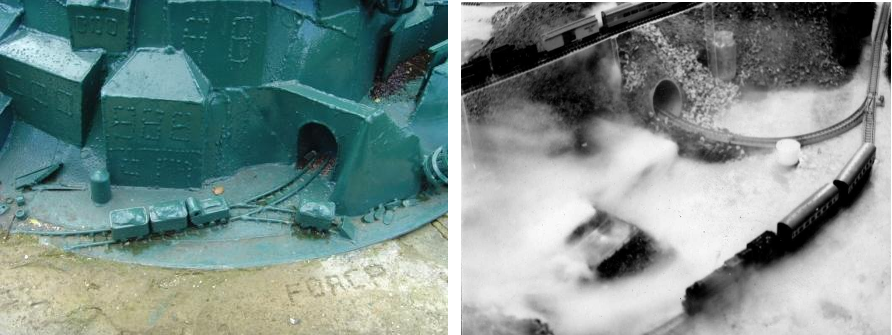
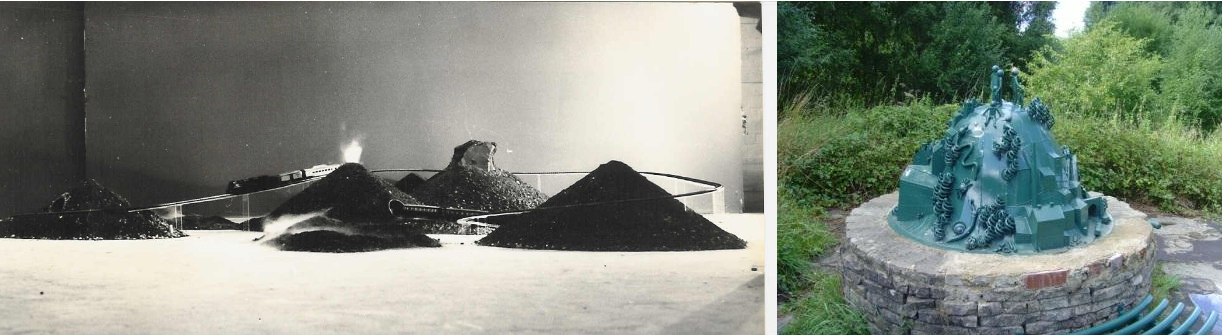
Above in colour: An eco-sculptural memory of Rothwell pit near Leeds. Above right in black and white: Isn't it rather like the Icteric colliery installation in Newcastle in 1966? Certainly, there's more than enough of an ambient connection.......
In this particular avenue of research we were ably assisted yet again by Wayne Spencer from Calderdale who had the following general comments to make:
"I also watched recently the documentary, Ai Weiwei: Never Sorry. Weiwei is both a free speech activist in China and a leading international conceptual artist with an expensive home and a warehouse in which paid assistants carry out the vulgar business of actually creating the works attributed to him. There is some interest in seeing how these two aspects of the man interact. His activism is spectacular. In the main, he creates small, mildly provocative incidents. In themselves, these have no direct, material consequences for the social organization of power. Instead, they are represented to his army of admirers and the overseas mass media through social media. Presumably that distant murmuring of the powerful and the passive that we call "public opinion" is supposed to persuade the regime to change itself. At all points, he himself is a celebrity; he stands at the centre. Even when he is not creating little dramas in which he is the main actor and his audience merely cheers his successes and boos his adversaries, it is he who provides the ideas or brings people together for projects. As with his art, he thinks and enjoys the fame, while his subordinates and admirers do what he suggests. The old distinctions between thought and action, theorist and activist, persist. Outside of China, his practice is devoid of critique. He happily provides museums, magazines, and their consumers with one piece of vapid nonsense after another."
On Feral, Wilding, Climate Change and George Monbiot
Perhaps the most well known critical ecologist in these islands is George Monbiot. We mean 'critical' in the sense he attacks the well-known cop out ecos like Mark Lynas – the turncoat who joined the ranks of Green Inc., after publishing the penetrating and prescient Six Degrees. Despite Monbiot now supporting advanced nuclear power installations through expediency because he knows full well we are on the brink of unstoppable climate change he nonetheless continually turns out a series of interesting journalistic articles that can have real edge, although unfortunately journalism per-see is his downfall as he stops short of proposing any kind of socially autonomous praxis though always hinting at the need for such a praxis. Today a tone of desperation increasingly is a deep undertow of much of what Monbiot writes as he looks around him seeing sell-outs everywhere and the situation daily getting worse. Instead of observing nature in all its fullness he knows this experience is now denied to everybody feeling intensely the encroaching horror of "the green desert" of industrialised horticulture and monocultures based on one anti-eco stimulating growth drug after another, except these drugs are regarded as ecologically sustainable by the greenwash powers that be. Rightly he notes there's more wild life in a brownfield site in Birmingham than is what is traditionally regarded as a 'nature' site and it's this realisation, which overlaps, with our perspectives. A big part of our intention here is to translocate the best of Monbiot's recent insights putting them into an anti capitalist, communal, much more autonomous perspective though knowing full well we'd never see eye to eye with him because we live on an almost completely different plain...
After so many years researching and writing on the environment, George Monbiot in his recent thought provoking, increasingly very influential book Feral finally admits, "I was ecologically bored."... "I have sought to rewild my own life" yet remains cautious. "So young a word, yet so many meanings" noting by the time rewilding entered the dictionary in 2011, it was already hotly contested. When it was first formulated, it meant releasing captive animals into the wild but soon the definition expanded to describe the reintroduction of animal and plant species to habitats from which they had been excised. "The rewilding of natural ecosystems that fascinated me is not an attempt to restore them to any prior state, but to permit ecological processes to resume".... adding perceptively, "In countries such as my own, the conservation movement, while well intentioned, has sought to freeze living systems in time. It seeks to manage nature as if tending a garden."
Rewilding for Monbiot (as with ourselves and others like us) is about "resisting the urge to control nature and allowing it to find its own nature - it let's nature decide." Moreover "The way [nature] evolves cannot be predicted, which is one of the reasons why this project enthrals. While conservation often looks to the past, rewilding of this kind looks to the future - my hope is that it makes magnificent wildlife accessible to everyone. It should happen only with the consent and enthusiasm of those who work the land. It should never be used as an instrument of expropriation and dispossession - forced rewildings that have taken place around the world.
There are two definitions of rewilding that interest me. The second is the rewilding of human life - the rewilding that I envisage has nothing to do with shedding civilization. We can I believe enjoy the benefits of advanced technology while also enjoying, if we choose, a life richer in adventure and surprise. Rewilding is not about abandoning civilization but about enhancing it. It is to "Love not man the less, but nature more". (Byron: Childe Harold) What Monbiot really wants is the reintroduction of human beings into nature with the outcome of creating "a fiercer less predictable eco system." And yes, we'd go along with most of the above quote.
But then alas, we begin to part company. Aware we are now in a conservation prison, Monbiot begins with a quote from Gerard Manley Hopkins "Oh, for the weeds and the wilderness yet" and a beautiful line that resonated with us altogether differently calling to mind the inviting virgin lands of industrial dereliction where no one had ever trod, where rust transformed the familiar products of the workshop of the world into an assemblage of the nameless awaiting to be reborn into a new world, where great glacial moraines of shattered concrete would flow down spoil heaps thinly covered in red fescue, trefoil and willow herb where from a considerable distance it was possible to pick out the sausage shapes of the elephant hawk caterpillar. Where there were butterflies and moths galore and many a postindustrial glade humming with bees and hoverflies. No other experience would come close to matching its enchantment - the subtitle of Monbiot's Feral is "Searching for enchantment on the frontiers of wilding". The difference is our wilding perspectives involve the abolition of the State / Tate [gallery] nexus plus capitalism per se.
Monbiot is right when he says the idealized landscape for many wildlife groups is the one that prevailed 100 years ago. They are defending the land from the intrusions of nature. Nature reserves are treated like botanic gardens: their habitats are herbaceous borders of favoured species weeded and tended to prevent the wilds from encroaching. In reality they should be called culture reserves. All too true, then Monbiot crosses into nameless wilding territory - and the wilding we love. "I believe that pockets of wild land - small in some places large in others - should be accessible to everyone: no one should have to travel far to seek refuge from the ordered world" meaning we have a need for landscapes, or, if you like self-willed land along with self-willed people.
The drive toward monoculture creates dewilding of both places and people enhancing ecological boredom, narrowing the scope of our own life, limiting the range of our engagement with nature. Even by European standards, the UK has a peculiar fear of nature and its conservationists a peculiar fear of letting it go. Monbiot correctly surmises, "I find the double standards hard to explain. I wonder whether our campaigns against deforestation elsewhere are a way of not seeing what has happened in our own country."
For Monbiot, conservationists sometimes resemble gamekeepers: they regard some of our native species as good and worthy of preservation, others as bad and in need of control though unlike gamekeepers, they don't use the word "vermin" to describe our native wild life, instead they say "unwanted invasive species" seeking to suppress nature, to prevent successional processes from occurring, to keep eco systems in a state of arrested development. Nothing is allowed to change; nature must do as it is told. These so-called conservationists have retained an Old Testament view of the natural world: it must be disciplined and trained; for fear that its wild instincts might otherwise surface.
Then Monbiot turns to the landscape of the Cambrian Hills. "Some people claim to love this landscape, I find it dismal, dismaying". On moving to Wales to explore these great expanses "my wonder and excitement soon gave way to disappointment then despair. "The near absence of human life found, was matched by a near absence of wildlife. The fragmented ecosystems in the city from which I had come were richer in life, richer in structure, richer in interest....whenever I venture into the Cambrian desert I almost lose the will to live. It looks like a land in perpetual winter." Such personal trauma interestingly paralleled our own though coming from an entirely different angle of pit spoil heaps and industrial dereliction in general, and the more we ventured on them, the more childhood returned with a delightful vengeance as we wearied of the scenic Yorkshire uplands finally seeing in a landscape of contempt like detritus strewn Briggate a more ecologically profound experience than ever a denuded and banal Ilkley Moor could inspire.
Monbiot more than those individuals and movements previously mentioned, embraces 'wilding' though he envisages and desires a form of extravagant fantastical re-wilding in what he calls in his book Feral, "the sheep-wrecked", shorn mountainous uplands. He wants to bring the old tree cover back not only to absorb the increased rain fall massively reducing the impact of flooding but also to repopulate these forests with wolves, hippos and rhinos etc, recreating a terrain not too dissimilar to what these northern uplands were like two million years ago when man first evolved and indeed in the 19th century, 100,000 year old hippo bones along with the bones of the straight tusked elephant were found beneath Trafalgar Square. For Monbiot, a sheep monomania has taken over, a monomania of homogeneity, and
"the greatly increased flocks [of sheep] in just 60 years have completed the transformation [of landscape] into something resembling a bowling green with contours."
If not that, there's the endless procreation of flatland for the flatlanders, of featureless green deserts bordered with beds of primulas and pansies and that guarantees there is more variety and life to be found in plasticised consumption or the pitiful gadgetry of software apps. Elsewhere Monbiot has rightly scathingly described the present day suburban lifestyle as based on a new three "Rrs": Recreation / Renovation / Resorts. And in Feral the ever present fear behind the suburban mask is backed up by one of Jimmy Ballad's better poetic insights:
"The suburbs dream of violence. Asleep in their drowsy villas, sheltered by benevolent shopping malls, they wait patiently for the nightmares that will wake them into a more passionate world."
Beyond these specific instances, Monbiot is bored and wants to experience the thrill of a rejuvenated life. Don't we all but would introducing exotic species in a refurbished wilderness achieve this, surviving as we do in an alienated society mediated through images? Isn't it a matter of breaking the spectacle and the mediatique first through a thorough going clued-in, profound social uprising? Elsewhere, (The Guardian July 5th 2014) Monbiot has noted the desperate psychological condition of those who live the negative in our present day excuse for a life. And what happens if like ourselves we are utterly incapable of performing to the gallery, prone to anxiety and possessed with social phobia both of which reflect a fear of other people who are "perceived as both evaluators and competitors and the only roles for society that market fundamentalism admits." Depression and loneliness plague us having had a lot to do with a veritable onslaught of abuse against our ideas and actions from pre-teens through Icteric and King Mob to the present day, though, without self pity, we also know - out there - it is becoming a near majority syndrome. Thus for the life of us we cannot even promote our ideas or give a lecture as this is the very essence of the aestheticised performance principle we hate so much.
Regarding the so-called countryside, for Monbiot the worst culprit in this denuding process is the European Agricultural Code, which seeks to avoid "the encroachment of unwanted vegetation on agricultural land". Farmers must stop wildplants from returning and they do not have to do anything to qualify for a subsidy other than keep wildlife from returning. More draconian, any pasture containing more than 50 trees per hectare disqualifies a farmer from receiving a subsidy payment. The effect of these rules has been to promote the frenzied clearance of habitat meaning the system could scarcely have been better designed to ensure that farmers seek out the remaining corners of land where wildlife still resides and destroy them. This results in a powerful compulsion to tidy up the land with the last remnants of hedges and copses being ripped up; a situation whereby a functioning eco system is replaced with a tidy one. Since 2003 decline in farmland birds has accelerated and farming is cited as a reason for the decline of wildlife in Wales in 92% of cases.
Behind this too (never mind the massive increase insecticides which makes Silent Spring child's play in comparison to our ultra toxic age) lies Monbiot's hatred of the big landowners and again, he is right on this score noting that Britain has one of the highest concentrations of land ownership in the world and though a small minority they dominate rural policy and little can be done without their agreement, the hunting / shooting / fishing lobby remaining as strong as ever. Inevitably there is the big gap here between Monbiot and us: council land is our bête noire in the way it is hideously managed.
More specifically Monbiot rightly rails against the Scottish landowners who have been called by Labour MP, Ian Davison, "the greediest benefit claimants in the country" having reaped well over a £billion in farm subsidies and wind turbine levies whilst paying no taxes. Post the publication of Feral within the landowners' ranks, a super-rich Danish fashion magnate, Anders Holch Povlsen, is set to acquire a string of neighbouring Highland estates to create ironically something like the realisation of Monbiot's vision of a vast uninterrupted wilderness.More interestingly, after the success of the failure of the late 2014 Scottish 'independence' referendum, Scottish students into crowdsourcing are attempting a takeover of a local baronial estate enabling immigrants to have something like a permanent base they can call home. Whilst this in diverse ways proves that Feral is becoming a very, very influential book, its fatal weakness is it doesn't encapsulate a real critique of political economy, meaning this form of wilding becomes merely another aspect of capitalism and one diametrically opposed to the communal wilding which must be essential to the unfolding of the illusive transition (that 'What After Then') of a real transcending social revolution.
Arid reductionism, banalisation, health and safety-ism, what Semprun called "progress in domestication" must be stopped though for Monbiot this necessary transformation can only be brought to realisation through a vast bureaucratic 'liberated' leftist state, among which there will probably be some top / down structured eco army beavering away until all the spaces of "the green desert" are filled up with a new wilderness (and no doubt voted into existence through a Parliament cleansed of corporate lobbying). Therefore vast tracts of land will be returned to their pre-historic state carved out (perhaps) by the most modern of earth moving machinery guided by something like an enlightened sub-Bolshevik state. However, this operation will not be a collective act of the people but will possibly be undertaken by eco-conscious, Cuban-style, Che Guevara-like brigades perhaps prefigured by 'activist' groups such as Rewilding Europe (presently working in the southern Carpathians) who might one-day morph into something similar? Such an intervention is fortunately step-by-step well nuanced. These humanoid brigades initially facilitate the wilding process; a process which from then on is handed over to the newly introduced big herbivores who naturally and harmoniously then proceed to keep the landscape varied meaning all kinds of complex, disparate wildlife can gloriously flourish guided only by organic, amoral, free will. Great, but then what do we make of the following from Monbiot: "Rewilding Europe is seeking to demonstrate that restoring ecological processes makes more money for local people than was generated by the industries that formerly used the land."
And there's the rub. Though Monbiot desires a renewed passionate life it is still a life conceived within the paradigms of capitalism. Indeed in a previous book Heat he pointedly refused to deploy the dread word capitalism worried it could put wavering Tories, etc. off the liberating eco scent and he remains stuck in the same groove throughout Feral. In reality, whether Monbiot knows it or not, his is a vista of endless capitalism, albeit a very benign version. In this perspective, Monbiot considers that most human endeavours, unless checked by public dissent, evolve into monocultures. Money seeks out a region's comparative advantage - the field in which it competes most successfully - and promotes it to the exclusion of all else. So whenever this process is loosed, every landscape or seascape performs just one function meaning money is eternal though the very idea of dissent suggests it isn't.
Whether we like it or not, George does see the future through moneyed but sensitive eco lenses like the Star Tree Market Place in Argyll, Scotland, a web based forum to foster business to business, business to community and community to business interactions. Thus Star Tree deals in MPT (Multi-Purpose Trees) and NWFP (Non Wood Forest Products). This seems to us the commodification of country pursuits like gathering nuts, picking berries, foraging for mushrooms and making a proper business out of them - an SME – (Small to Medium Enterprise) in Star Trees business oriented anagrammatic phraseology). Further prime examples of business-speak is to be found all over its web pages like, "Aims to provide better understanding, knowledge, guidance and tools to support stakeholders in optimising the management of multi-purpose trees and developing innovative approaches to increasing the marketability of NWFP for a more competitive rural economy" and "potential for markets for NWFP - including the role of public and private actors in supporting the innovative processes for new products and services based on consumers behaviour and patterns". Thus Monbiot sees a need to "Establish solid strategic partnerships working on NWFP in Europe to ensure and speed up the transfer of research and innovations into the market". With some kind of satisfaction Monbiot emphases that ecological regeneration of the region could also be the foundation of its economic regeneration noting that the colonisation of the Isle of Mull has brought £5 million a year to its local economy and supports 110 full time jobs and a study commissioned by the Scottish government calculated wildlife tourism is already worth £276m a year.
All we can say is sorry George but you do need to read the depths and profundity of the real critiques of political economy from the best of Marx, through Rosa Luxembourg to Kurz, etc and not rely on banalised interpretations through the blinkered eyes of social democrats (like the glamourised Thomas Piketty) to possibly sundry Bolshevikhs and their hair-brained successors. However we suspect George is no reader of New Left Review so his knowledge of past leftisms is probably pitiful even though in one article he wrote, Engels is quoted "If you throw nature out of the window it will come in through the back door" (quoted perhaps from The Dialectics of Nature?) and in Feral there's a passing glance in the direction of the Italian Bolshevikh, Gramsci only for George to then describe him merely as a philosopher as he translocates the latter's notion of hegemony; "We suffer from agricultural hegemony; what is deemed good for the farmer or landowner is good for us."
Hopefully by now we've sketched some reasonably accurate description of how Monbiot's wilding distinguishes itself from a fully inclusive communal wilding for everybody who may wish to join in largely among urban spaces, a concept spreading into all other kinds of activity, as against the statist initiatives which Monbiot embraces? No wonder those with a free form anarchistically oriented perspective simply cannot gel with any of this, so it's hardly surprising Ian Bone has called him, "George Moonbat" and Bone's other comments when listening to a Monbiot lecture aren't bad as far as they go.... Also, significantly George Monbiot makes no mention of ground breaking pre revolutionary experiments like the contestations of Rene Riesel and the early Confederacion Paysanne (and not what it became) in France or the revolutionary theories around Jaime Semprun and the Encylopeadie de Nuisances. These are serious flaws. Monbiot's perspective is in fact something like a new social democracy, which wants to see the democratisation of the public school (and not its abolition) along with a more equal waged society and not with the supercession of value and the abolition of the wages system.
Monbiot in The Guardian, 30th July 2014, is now firmly of the opinion the major political parties are nothing more that defenders of the super-rich, desiring little or no wealth redistribution, only then to lamentably say the following: "But there is another party, which seems to have discovered the fire and passion that moved labour so long ago: the Greens." Yet, all the 'Greens' propose is merely an update of yesteryear's failed Second International programme such as living wages, renationalisation of railways, maximum pay ratios with no executive receiving more than ten times the salary of the lowest paid workers, plus embracing a Thomas Piketty style wealth tax, etc. None of this remotely hits the central core of the capitalist mode of production, the core valorisation / devalorisation nexus. Moreover, in this 6 page web Eco Peterloo expose, our dealings (or rather non-dealings) with the Green party have been richly highlighted so there's no point in reiterating them here.
Critics of Feral like Steven Poole (a fellow Guardian Review writer) sees in Monbiot's arguments a leaning towards a nature aesthetes fascism; a lebensraum of 'natural' flora and fauna (anti immigration / anti foreigner against invaders like "Panzers and U-boats". Furthermore, Poole dislikes what he sees as a modern day obsession with a return to nature, which is now everywhere, what the French call nostalgie de la boue - "nostalgia for the mud."
However, Monbiot is no fascist but somebody who wants an enlightened, paternalistic management of the commoners on the 'new' commons though one which largely denies them their own intervention and creative contribution. Indeed he criticises the attraction to large predators often associated with misanthropy, racism and the far rights noting that the Nazi Reichsmarschall Goring seized the Bialowieza Urwald as his private property, (an area that had been preserved through the centuries) clearing the forests of people, the Hitlerian government conservation department setting out to create a vast national park which was "close to being as undisturbed ecosystem as any remaining in Europe." The zoologist Konrad Lorenz (then a Nazi party member) wanted to rewild human nature by stripping people of what he considered to be the genetic legacy of civilisation. Those selected for breeding would form not just a master race but also a master species of instinctive wild beings, which would rule the ecosystem. Monbiot unashamedly described Nietzsche as celebrating instinctive behaviour whose disruption has led to social breakdown a lack of patriotic enthusiasm and eventual human extinction. Needless to say, this is a lamentable parody of Nietzsche's thought, Monbiot unable to get to grips with Nietzsche's seminal, profound critique of art, nor his equally seminal and profound analysis of the rise of European nihilism, concepts the Situationist, Raoul Vaneigem in the 1960s superbly developed within the paradigms of contemporary revolutionary praxis.
Monbiot then goes on to condemn the process of enclosure not only by the Nazi's but also by the British Colonial Office whereby Masai tribes' people were hospitalised by the Kenya Wildlife Service in their attempt to clear the land of human beings. Even more horrible the famous wildlife TV star Joy Adamson's exhibited psychopathic traits demanding of the colonial authorities that she be given 30,000 acres of land belonging to native people so that her pets could use it. And today Richard Leakey the director decreed the setting aside of land for the purpose of wildlife conservation, so as "to support the tourist industry, is a strategic issue."
Poole also sees Monbiot in the tradition of the "Back to the Land" movements which in the 1930s in Britain briefly tended to be fascistically inclined and in this no doubt he could include popular figures like Henry Williamson and his talisman-like Tarka the Otter well loved by many a post second world school kid with dreams far removed from any Fourth Reich. However, in the 1930s there were also a sizable number of misguided people who wanted to see an end to unemployment relief and for claimants to be put to work on the land as temporary slaves under the heel of a Gauleiter overlord. It's equally obvious that George Monbiot is far removed from anything like this, his increasing desperation based on the realisation that with the cataclysmically quick nature of climate-wise we are running out of time and something very drastic must be speedily undertaken, otherwise the human race has more or less had it which means he occasionally has a tendency to embrace the whacky amongst much well thought out environmental science. Within that perspective he joins other siren voices among fellow professional intellectuals like Danny Dorling (e.g. The Coming Demographic Crisis and How to Survive it / All that is Solid: the great housing disaster) and Stephen Emmott (Population 10 Billion).
Dorling an academic urbanist from Sheffield University (now Prof' of Human Geography - i.e. recuperated psychogeography - at Oxford) rightly cannot see the point of that ever present panacea, loved by Tory and Labour alike, of endlessly building thousands upon thousands of new homes. Rather, Dorling would like to see all empty buildings, whether old or new, re-occupied, advocating in tandem, a kind of early 1930's JM Keynes form of birth control inherited from Malthus. Hardly surprising, what with his knowledge of the pointless housing waiting list in Sheffield (the largest in the UK) with all its huge potential supply of empty but condemned council properties which could be immediately reused, Dorling is something of a Bolshevised Marxist never making mention of the failures of Leninism and when mentioning Mao makes no comments on his prodigious failings like the state induced famine of the Great Leap Forward of 1958-62, etc, etc. Though Dorling is for the legalisation of squatting, he overlooks just how easy it is to convert abandoned factory units, etc. into habitable space and that the type of person who formerly would have squatted such properties were well on the way to becoming the new type of free form, ad hoc, passionately felt, female / male builder of the future. We have long recognised, and tapped into this potential, aware that brownfield sites and abandoned factories along, for instance, Canal Road in Bradford were being occupied prior to the 2013 crackdown and that the illegal inhabitants posed no threat to the buildings nor the nature that was beginning to garland them, this natural wilding providing a near impenetrable screen the eye of authority found difficult to penetrate. Now both people and nature have been evicted from these premises of infinite promise in the vain hope some latter day Donald Trump will come along and convert them into luxury condos.
A lived-in conservation of old, not so old and new-ish buildings more than ever must be predicated on a definitive break from the era of modernism and post-modernism i.e. the stereotypical 'new' house and garden with a view / nuclear family / consumer oriented unit which both neo conservatism and dead duck labourism are still obsessed by. Essentially it implies a new, liberated lifestyle centered on a communal, egalitarian way of living, anti aesthetic and anti commercial, more an assembly led collectivity. A lifestyle that supersedes the prominence of the visual engaging all the senses based more around Lautreamont's intoned maxim of "as beautiful as".....stretched to an infinity of variations.
As for Stephen Emmott in his book Population 10 Billion possessed with a lucid, scientific grasp of climate change science finally and alarmingly embraces a survivalist nightmare. He accurately says, "Right now, every leaf on every tree on earth is experiencing a level of CO2 that the planet has not experienced for millions of years". Scared of the mounting risk of famine he reckons that "entire global ecosystems are not only capable of suffering a catastrophic tipping point, but are already approaching such a transition". We therefore have only two ways of dealing with this: "the first is technologising our way out of it. The second is radical behaviour change." Geo-engineering schemes are highly risky and could backfire but he sees little hope for that essential factor in this equation, essential behaviour change. "We need to consume less...And yet, every decade, global consumption continues to increase relentlessly".... "We urgently need to do – and I mean actually do – something radical to avert a global catastrophe. But I don't think we will. I think we're fucked."
Methane is now pluming – a greenhouse gas many times more potent than CO2 – have been observed rising from previously frozen areas of the Arctic Shelf. This process could go on for centuries with a terrifying land grab by rich corporations buying arable land around the world, which means the Arctic would become a terrain of inter-imperialist competition leading to war. But Emmott thinks barbarism can hardly be avoided and we must protect ourselves by getting guns to our children no doubt followed by a war of one against all; of competing armed communities! HOLY MACKERAL! The obvious escapes such Emmott's desperate perspective, as the real hope for a levelling and declining population growth resides around support for women's empowerment with control over fertility.
These are therefore reminders of the dangerous world we are increasingly entering, as if, dear reader you need to be reminded!
*********************
In reality the dominant 'Back to the Land' movement in the UK has been anything but fascistic, rather it tends to be too well meaning, a wishy-washy liberalism lacking real and necessary hard edged critique. Moreover the hippy experience in the late 1960s and afterwards has continually shaped its future and King Mob had relations with the West Country commune anarcho individuals around HAPT and Sid Rawle of the Diggers could often been seen on the streets of an alternative, pre-gentrified Notting Hill in London. We were always on friendly, nodding terms with each other. It's no surprise therefore that one of their latter-day offspring, the Vaneigem quoting Idler has its centre nearby on Westbourne Grove. Their praiseworthy anti work perspective however stops well short of a sound, thorough going revolutionary critique of work falling back so often on social democratic measures, as in a recent rather dull article for the Independent newspaper by its 'leader' Tom Hodgkinson listing 8 hour day / four days a week working measures enacted by a variety of progressive state legislative acts over the last 100 years or so, acts which never amounted to all that much. You won't though get far with the Idler if you think the paper might discuss the increasing insubstantial character of surplus value creation, hi-tech and automation – and a critique that points to a real exit from the nightmare of disintegrating capitalism. Without saying too much here perhaps it's best to merely show a typical poster from the Idler Academy in London, which we obviously go along with to some degree fitting in to sufficiently with enough of an authentic wilding perspective, but oh, so much else is missing.........
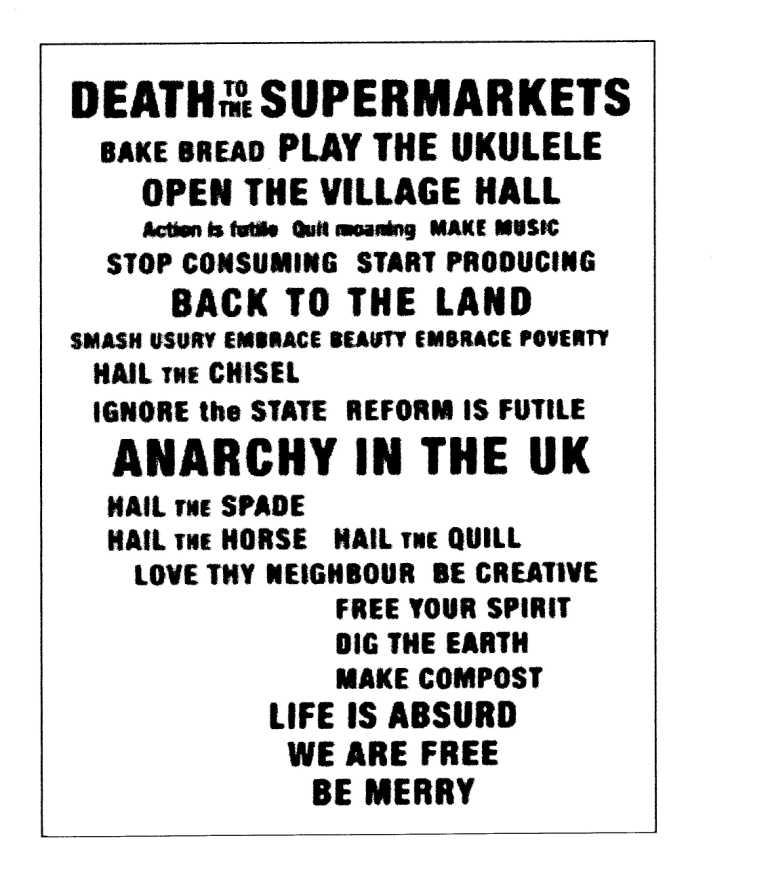
************
1972-3: Street Farm or "Ecology appreciation....help restore your natural harmony by spending time up a tree"... "Cows Arise" for "spring is here and the time is right for planting in the streets"........
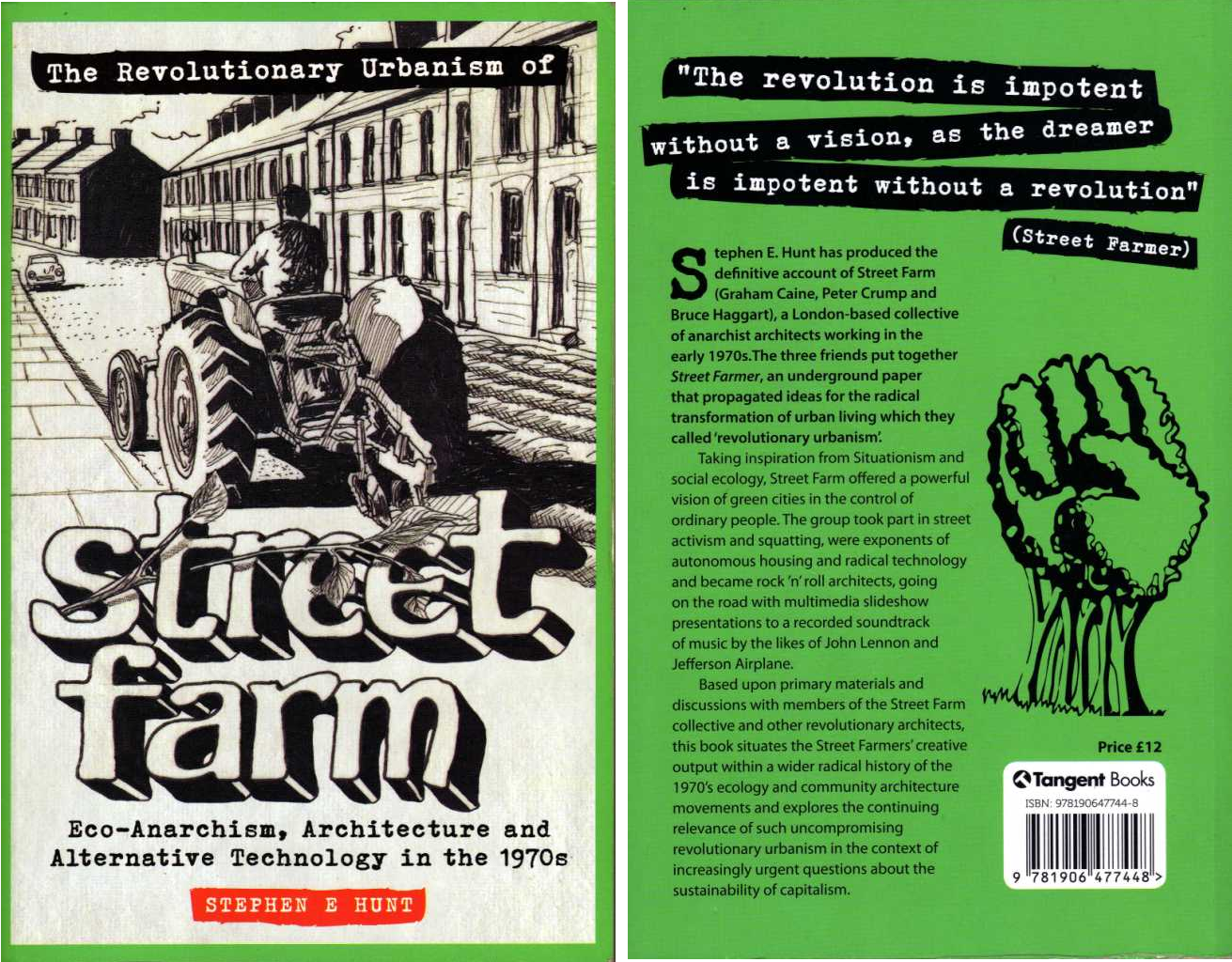
(Above: the book cover. Stephen E Hunt. Bristol Radical History Group. www.tangentbooks.co.uk . The book has the distinguished merit of absolutely NO reviews in The Guardian, The Times, New Statesman and all the rest of the high profile cultural garbage)
Street Farm (SF) was based on the excellent concept that via an open-ended revolutionary urbanism a profusion of organic growth would take over from concrete, steel and brick structures plus that vista of permanent purgatory - yet to be born - of a shorn, manicured, endless malling where all hopes of rich biodiversity are forever stifled; a terrain which has appropriately been called "hostile architecture." For SF "The land belongs to the communities of the biosphere, and NOT individuals of the human race." Anarchism was at the core of these beliefs instigated by a latter day evolution, especially the eco-anarchism of Murray Bookchin's Institute of Social Ecology though taking into its orbit, Durutti's prescient comment during the Spanish revolution of 1936-9 which, ironically could have come from the mouth of a contemporary neo-psychogeographer: "We are not in the least afraid of ruins.... [...] We carry a new world in our hearts," though this wasn't via some sales pitch of an art gallery display but an on-the-ground, full blown practical insurrectionary reality. SF even skirted with a certain belief in anarchist trade unionism, (which we by then in the early 1970s had consigned to history along with the rest of TU bunkum) supported the British miners and even had one bona fide anarchist farm worker within its tiny ranks. The boring anarchist illustrator, Clifford Harper was also a friend of Street Farm in the Kentish Town squatter community and he later distilled some of their ideas in dull and pedestrian plans for a utopian rural community of 2000 people; an anarchist yawn which comrades in late 1970s Leeds called "a boy scout camp" or "William Morris going belly-up".......
On the other hand two of SF's main protagonists, Haggart and Caine paraphrased and developed some of Murray B's ideas very well indeed succinctly summarising his central thesis: "A liberatory technology is a technology that will change the existing situation, alternative technology is one that will make that existing situation more tolerable." All this suggesting the total recuperation of ecological initiatives increasingly put most clearly and angrily by Bookchin himself as he grew older fed up to the back teeth with greenwash. In 1991 he said: "Attempts to 'green' capitalism to make it 'ecological' are doomed by the very nature of the system of endless growth."
If SF's core beliefs were anarchist inclined its presentation had more to do with fall outs from situationist experiments. Street Farm was about direct action not only as protest but more essentially, on how to run – and change - our daily lives. For instance, under the guise of the Oxford St Action Committee, they blockaded Oxford St, London in 1971 confronting traffic blight with suggestions for free public transport as well as indicating more visionary hopes. They enacted a free flowing extension of King Mob's old slogan that Cars are Dead, as SF participants' donned masks – not scarecrow masks – but scarecars masks! Street Farmer desired a top to bottom transformation of urban space as against that endless flight to a stultifying suburbia or rural drop out-ism in the countryside usually south west England or mid Wales. Basically they foresaw that the overcoming of the dualism between countryside and city begins in the revolutionary transformation of the city. In a Threatening Letter to ALL Architects (1973?), SF declaimed "our land has had FARMING confiscated from it...and an industry called AGRICULTURE imposed on it."
They quickly attracted attention especially through their living and experimental 'first' eco house in Eltham, south London which was covered by press and TV even though these official commentaries inevitably slyly rubbished SF's core anarchist persuasions. The eco-house was more or less a spontaneous construction DIY built over a period of time in Eltham (ironically in south London's suburban, liminal edgelands) in the early 1970s and was consciously put in the admittedly imposed context of a continually transforming workers' council which was elaborated within the pages of SF 2 and duly proclaimed in big graffiti on the ever changing structure. The self-build inhabitants of both sexes theorised what their form of workers' council could possibly be – and all very open-ended. "The council is not finite, has no constitution, no legality, no quorum, no structure, it is not lasting, it is not the end of revolution, but where the revolution starts." For certain this was no ordinary, dull concept of a form of self-management of alienated production which even in the apocalyptic year of 1968, the American, Theodore Roszak in The Making of a Counter Culture: Reflections on the Technocratic Society and its Youthful Opposition perceptively points to when commenting on the May 1968 uprising in France: "Surely the touchstone of the matter would be: how ready are the workers to disband whole sections of the industrial apparatus where this proves necessary to achieve ends other than efficient productivity and high consumption? How willing are they to set aside technocratic priorities in favour of a new simplicity of life, a decelerating social pace, a vital leisure? These are questions which enthusiasts for workers' control might do well to ponder. Suppose the French workers had taken over the economy, an objective which seems to have lost its general appeal in the wake of the new wage agreements the de Gaulle government has granted. Would the Renault workers have been willing to consider closing the industry down on the grounds that cars and traffic are now more the blight than the convenience of our lives?" Roszak stresses an important point and for sure that was the majority view of 'the workers' though it's a view that ignores a sizable minority of manual workers who had a far more ambivalent response to the commodities they were making, some despising them outright. At times this was expressed in glorious vandalism like when workers openly and collectively in Italian automobile factories during 1969 smashed up thousands of cars they were turning out on production lines; and in a not too dissimilar manner, some years later, in the British miners' strike of 1984-5 young miners, having the time of their lives, played on the reversal of militant trade union slogans replacing "Coal not Dole" with "Dole not Coal".
So there is a complex interweaving here, one depending also on developing momentums elsewhere willy-nilly influencing each other's limited perspectives, a momentum also morphing in the process as critique is either notched-up or gradually lost sight of. If anything, Street Farm's form of 'workers council' was about the transcendence of alienated production or, as one of its best protagonists, Graham Caine put it, apropos the ever extending eco house's often spontaneous add-ons, as "a deliberate attempt to opt out of the concept of developing yet more 'super-technology to save the world." It was put together by people leaving behind the role of architect, and initially pretty naff at skilled, manual trades, slowly but surely becoming truly brilliant on the alien, ungainly tools required to accomplish an unusual and passionate autonomous quest among individuals liberating themselves from a professional strait jacket. They deliciously discovered how to begin the process of re-directing buildings, "repurposing buildings" - an excellent phrase – to "unperceivable ends" (Graham Caine), further commenting: "In pursuing this [eco-house] project I gave up my architectural qualification in the greater belief I could and should be pursuing the betterment of the planet." Yet it was many years later that (to take one example) Caine became a full time craftsperson with the Bristol Gnomes Workers' Co-op oriented around creating a fairy land in enchanted woods - admittedly somewhat Disney-like – though in far-better context, bringing together his predilection for the Gothic mixed with Gaudi's Guell Park, etc. in Barcelona together with hopefully opening up the possibilities of a more total transformation of everyday life. But did it work out like this in practise or had the terrifying epoch of neo-liberalism wiped out everything in its path as ding bat environments quickly became acceptable whimsical decoration? Or perhaps something such as George Clarke's Amazing Spaces of cheaply put together, quirky buildings - often of high technical standards - that offer little in terms of detonating subversion beyond a mildly interesting media event. Certainly we could see in SF's trajectory enough overlap with our Bradford field eco experiments on sites of industrial dereliction and, more specifically, with our transformation of a gothic church into an arena of imaginative social housing in London, which is why we've included SF in a kind of wilding perspective.
It is also true that SF were naive in analysing the amazing flexibility a cynical capitalism possesses in hi-jacking all quasi autonomous perceptive contributions turning them into their very opposite. By the early 1970s we were long in the tooth on this score and have remained so (with one or two exceptions we are not proud of). Most of SF never really got over their roles as architects though the best of them got damned close and two or three – to their eternal credit - really did break on through to the other side. Nevertheless, early salvos were terrific: "Architex –the pigs with drawing boards" further suggesting that "Architects become office demolition men."
Inevitably, official recuperation was there from the word go and a lot of SF's innovative use of materials including bricolage, salvage, dumpster survival, plus found – or cheap – odds and ends (immediately re-termed as the "peoples' technology") was immediately taken up by hip, commercial outfits which, decades later became the virus for all the infected clean, sleek, dying and dead eco estates of today's urban horror story. In some respects, though this naivety was really sad as SF prepared the way for aspects of respectable conservationism and a seemingly 'enlightened' anti-car city planning that has proved to be so insipidly lamentable since the 1980s onwards.
SF unbeknown to themselves was pushing at a deceptive open door and only the utter half wits of the Royal Institute of British Architects (RIBA) were consistently opposed to their experiments. More traditional type anarchists like urbanist Colin Ward, ten times quicker off the mark, took up their ideas in his Do-it-Yourself, New Town of 1976, as previously he purloined or pro-moed King Mob slogans in his 1974 book Vandalism. However, we must never forget that Ward had none of the integrity and autonomous praxis which was the essence of SF at its best, dutifully attaching his career to the Town and Country Planning Association as an education officer before becoming Prof' of Housing and Social Policy at the London School of Economics.
It wasn't only that the initial inspiring eco-house experimenters were merely recuperated; they were also ripped-off blind by endless predators only to be remembered as the first well-meaning, earnest ship of fools to provide an eco, green face to the changing face of an architecture that was then able to carry on in its old imperious ways becoming ever direr. For sure the Eltham eco-house rotunda covered by dumpster plastic sheeting looks like an initial mini version of the domes over the execrable, recently constructed, eco-tourist trap of the Eden Project in Cornwall. By now though almost everything subversive has become professionalised and specialised as greenwash reins supreme having suppressed the real eco component of full blown social revolution, itself vanquished by persistent silence and omerta. And now that real serious and catastrophic climate change is kicking-in we now have obnoxious, high salaried figures referred to as "sustainability experts" to deal with the crises. Who're you kidding?
Worse still, in response, town planners initially thrown by urban experimentation were having none of the general SF trajectory and gradually cut dead experiments that could subvert and disrupt the city along with SF's cry that "there are ways you can take bits of the city back". The Eltham eco house was closed down having only ever secured temporary planning permission and dumb fuck semi-suburbanite neighbours even helped in the demolition (interestingly on almost the very spot racists killed Steven Lawrence a few years later).... as subsequently SF's urban farm in Thamesmead was to get the boot "because [as Graham Caine rightly noted] we were anarchists basically". From then on only bogus public eco self-build was to be allowed, and even in the heart of alternative Bristol around the turn of the century, the Ashley Vale Action Group, which Caine initially got involved in before walking away in fury, was a con. Autonomous self-build was merely for surface appearances hiding a public /private partnership ambience of sub-lets after clearing the site of 'eyesores' e.g. old lived-in vehicles like caravans, buses and trucks etc!
Moreover, Street Farmer weren't critical of the other arts like music, literature, cinema, painting and sculpture focussing almost exclusively on the worst culprit of them all, the dire impositions of contemporary architecture. The huge Kentish Town squat in London in the early 1970s was an extending arts lab as this place – along with others – became birthplaces of the 'new' art (punk / street art etc) and SF somewhat based in these fascinating melting pots - that tended to transcend boundaries - couldn't adequately theorise the further disintegration of the arts through morphing alternatives which, slowly but surely, merely updated a Mask of Janus status quo. Obviously SF influenced the formation of an interesting community gardening project involving local families and pensioners called the Fun Art Farm; a name that unfortunately sends out the wrong signals. They cultivated somewhat the 'underground press' at a time when we and friends were becoming daily more critical noting the transition from counter culture to culture counter as real revolutionary hopes evaporated everywhere throughout the world. Even more surprisingly, SF was able to get their polemics published in official journals such as The Architectural Association Quarterly and Architectural Design. Around the same time we didn't stand a hope in hell of getting our stuff published through similar avenues ....AND KNEW IT! True we didn't make contact with SF at the time though our friend, Nik Holliman did – on his way to becoming a profound plumber from an architectural cum planning background. Instead, we were on friendly terms with their fellow traveller compatriots, ARSE (Architects for a Really Socialist Environment) and found conversations with individuals in the group, stimulating.
More gullible still, SF played up to the dominant media of cinema and TV which was hardly surprising as most of their presentation was done via a travelling charabanc of happenings and rock music - more like a Fluxus art performance than Situationist subversion - meaning the BBC, Sunday Observer and a youthful, culture-bug Melvyn Bragg could latch on to staged events like this. Obviously interesting stuff and details came though such a rather woolly melange, even right up to Caine's 1998, Travel's with my Chainsaw though the general context meant the subversive edge was necessarily blunted.
Finally, the bottom line here is to be found outside the spatial paradigms of architecture and urbanism in general. We live in an age where all real, earth-shattering critique is rendered invisible, where there's no recognition that the extraction of surplus value is becoming ever more elusive making the whole pack of cards more and more prone to a series of financial crashes becoming ever more difficult to surmount as intractable difficulties beset capitalist accumulation presaging its ultimate downfall. No wonder, Bradford Council / Sustrans in their infinite wisdom jet hosed slogans paraphrasing Robert Kurz, and even Thoreau went the same way........
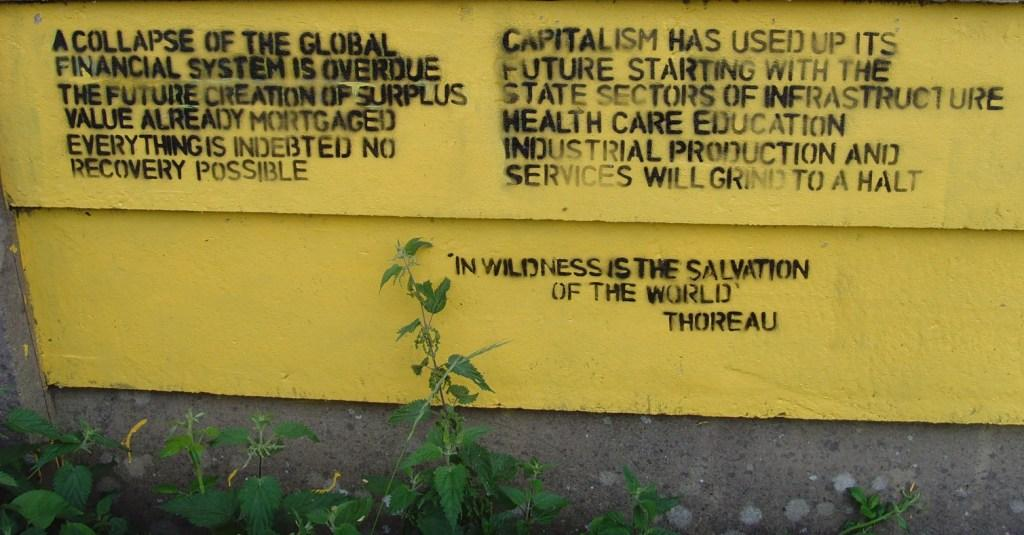
The Final Enclosure: the enclosure of the mind
The essential crux at stake here once all falsities and cover-ups are cast aside – and they are legion – is the fundamentally explosive notion of what nature really means especially in England and which continually reverberates through profound insurrection from the Peasants Revolt of 1381 through to the English Revolution of 1640-5 and its long aftermath, even playing its part in the open-ended profundities of possibly the richest Romanticism of all in Europe from the late 18th /early 19th centuries. Essentially, it's a revolt embedded in something like a collective, historical subconscious; a psyche endlessly suppressed, only to return with revived, wayward cutting edges from the 1970s onwards. Essentially nature is so suppressed in the UK because there's such a general fear not only of its insurrectionary heritage but also of its amoral depths and power. Interestingly, Mike Peters participant of the Here & Now collective in Leeds in the 1990s would in casual conservation in the pub, keep returning to the subject though, as far as we know, never putting pen to paper on the subject. Obviously Mike's drift was founded on the long shadow cast by Gerrard Winstanley's Diggers on St George's Hill in Surrey though implying a lot more taking into account interpretations of Romanticism. More than that there was an immediate practical backdrop as some of the Here & Now collective particularly Steve Bushell, one of the main protagonists's, was heavily into allotments on the rich alluvial soils on the banks of the River Aire. Indeed together, we vaguely drew up plans to protect this amazingly fertile ground (and with an ingenuity that was to again show its face in the recent Shipley calamity) once development plans were mooted.
We've emphasised the epithet 'explosive' here though the bitter fact is, Romanticism never exploded here, as it should have done. The historian Peter Linebaugh, that somewhat worshipful disciple of EP Thompson, mentions that his maitre did in fact want to write an in-depth overview of this overlap (or rather lack of it) between leading Romantics and the early makers of the English working class, i.e. those in transit from the experience of the unfettered commons threatened by predatory enclosure to the brutalised drudgery of industrial wage slavery. If this conjuncture had melded and borne succulent fruit it would have had a similar resonance as the Enlightenment had had on the sans culottes, etc, in France and with again extra explosive consequences as we all well know. In retrospect we cannot but speculate that Thompson had at the back of his mind the on-the-street, combative example of late 1960s King Mob (though Thompson the academic would never have dared speak its name) with its conscious attempt to meld together English romanticism within a much wider situationist perspective of total social revolution encompassing the overthrow and realisation of art.
To be sure the commons – and not its often mundane existence some 200 years previously - also meant a nascent free America and for revolutionaries like Tom Paine his experience on this matter was widened more by the Native Americans like Chief Last Night than say peasant locals like John Clare's (admittedly residing a little later) in Paine's native Norfolk when not banged-up in a loony bin. Romanticism in England has in this respect at best become more a slow burning fuse that never really ignited finding expression and knowledge decades later among say the Chartists (Bradford's Great Horton Chartists read a lot of early Robert Southey, etc) after its living impetus had petered out. However the living pulse of a drifting, impassioned imagination keeps reviving the more the veils of its literary recuperation are torn asunder. More importantly what has been passed down to us as 'romantic literature' is beside the point. The vital kernel that is English Romanticism always looked well beyond the "ball and chain of art" (Breton) ever impatient to break through literary / artistic form ever wishing to transform the imagination, the very essence of their pulsating beings becoming a whirlwind, autonomous force of sheer inspired thought, spontaneous communication and action. An ambience whereby, the human being adapting say, Keats' "negative capability" could play at being a tree and/or blade of grass and the worker metamorphose into a skylark to fall back to earth as a child replete with a renewed impassioned life – a renewed force of nature – an erotic "oceanic feeling" spreading throughout humanity, from barricade to barricade...Remembering in the process - fifty years later in Paris during the Commune - Rimbaud said the future human being will be filled with animals meaning something more than pig liver transplants.
To bring back the utopian promise of the commons again becomes the cry and it's this emphasis that underlines these texts propounded by The John Clare Collective and The Monstrous Bastards. This time though the hope inherent in a new communing is based on the on-going collapse of capitalism that "sound of innumerable asset bubbles popping across the uneven geographical landscape of an otherwise listless capital accumulation" (David Harvey) whereby production – foreshadowed in hi-tech - has become increasingly immaterial giving way to currency futures, credit default swaps and CDO's making up the 'new' universe of planet ponzi's grim fetishised world of fantasy. The language of advertisers' world play is essential to this presentation abundant only in the deployment of creative and greenwash epithets though essentially bereft of all truly green or creative initiatives.
In response to the worldwide Occupy movement of 2011, there's now in place a 'new enclosure' affecting every move you and we make, one that colonises our very beings. It's not only the "landscapes of contempt" which must be enclosed; more essentially, the mind must now be enclosed like never before in history. You must only look one way and in one direction only – and the paradigm you will be enforced to follow can only be based on private property and retailing - that of looking at commodities on either the Internet or superstore window in preparation for the only act that can be allowed; the act of buying and selling. You will be strictly forbidden to see and feel anything else. On a more general level, it is essential you must morph into an android; a programmed robot obeying each and every audio-visual command endlessly thrown at us in our daily lives. In consequence, all nature must now be destroyed unless it obeys the diktats of an ultra-commodified developmental programme. The lawless, arrogant Shipley destruction, which is in reality now going on everywhere, is to be all our futures if we don't fight back.........
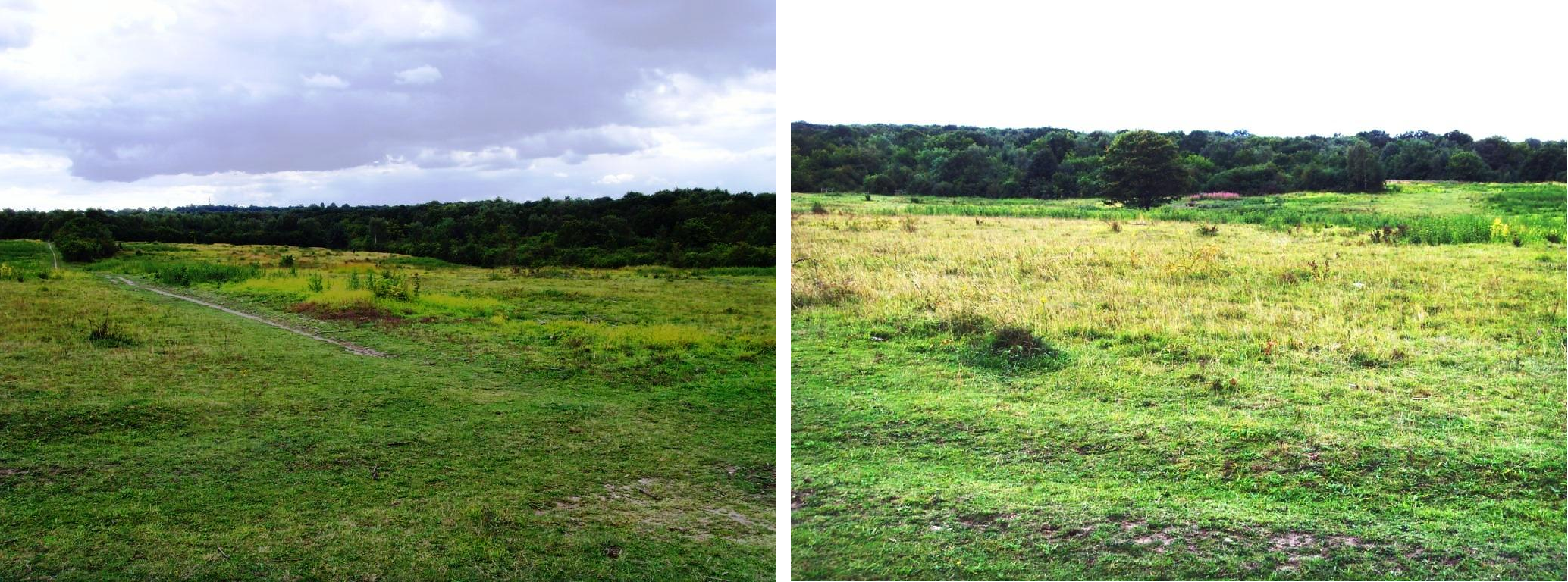
At the time we thought Briggate was something of a one off only to find well over a year later that it was part of a general pattern increasingly practised by official eco bureaucrats increasingly in hock to the developmental agenda having lost all contact with a liberating, egalitarian rank 'n' file democracy. Clear felling is now spreading throughout much environmental intervention as the above photos of a recently denuded Banstead Downs in Surrey, during 2014 testifies ostensibly in response to the almost total wipe out of the Small Blue butterfly by weather weirding. It's as if it is an exasperated response to the mammoth failure of conservation in general whereby a crazed tabula rasa has become all the rage in the vain hope a new nature will arise phoenix like from the ashes without ever questioning suicide capitalism in general. Gone are the days of sensitive, hands on, piecemeal experiment and hoped for improvement as a rigid, top down command structure becomes an unquestioning absolute. Gone too is the recognition that only the all weathers, minutely observant field naturalist possesses the real knowledge about a particular site, arrogantly pushed aside by nature bureaucrats having hired some cut price professional landscaping outfit, blundering insensitively from one disaster to the next, as over and above details what marks these increasingly dreadful times is an almost 50% cut in maintenance money scheduled for nature conservation The result is just as artists have destroyed the notion of creativity, so eco officialdom has destroyed the notion of conservation.
*************
While putting the finishing touches to these texts we came across a fairy-like, child-like encampment cum abode in the carr woodland of a "landscape of contempt" near enough to Leeds city centre on land owned by Network Rail. A lovely ex-army techie aged 70 has made this place his home; a real materialised fantasy in contrast to capitalism's destructive increasingly immaterial, fetishised world of fantasy. So all's equal then? Well no, because this innocent, decent techie has been told to get out by men and women in hi-viz jackets who will if necessary resort to arm's length thuggish measures. The company, DB Schenker Rail has called in its enforcers who coming out with all the programmed crap about health and safety along with all the rest of the bollocks are, none the less uneasy. Interestingly these enforcers told us they mustn't look at forbidden websites – in this instance the place-hacking photos urban explorers have made of their discoveries especially the former Healey Mills Marshalling Yards. Hardly surprisingly in a situation where work has unfortunately largely become the province of jobsworths, they agreed to do as they were told.
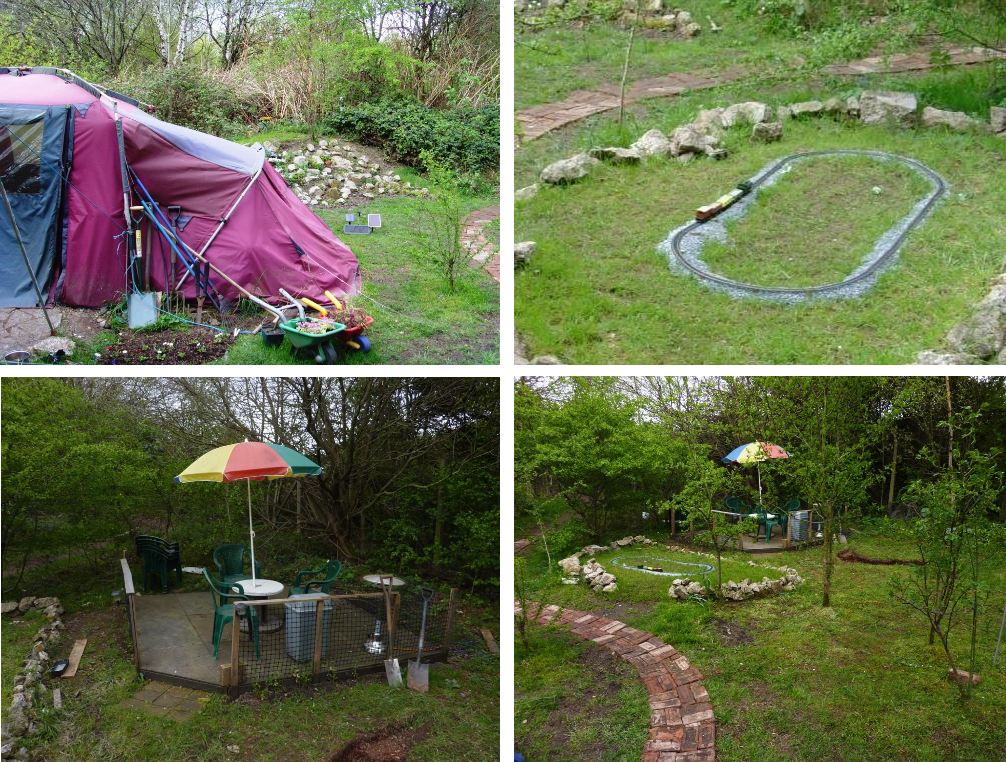
Above: The Child-like abode of Alan the techie
In the early to mid 1990s, just before the dawn of CCTV, the Here & Now Collective (ironically in Leeds) produced a series of official looking roundel stickers that pointed towards the coming Dark Age where all aspects of everyday life and behaviour will be monitored and policed. It was prescient stuff and some individuals in the Here & Now Collective spent a few days observing how people in Leeds in public spaces such as squares and amenity parks reacted to these stickers. They were noted alright – occasionally with consternation – whilst the majority blandly accepted them. Sadly no survey results were ever written up.

Attachments

Trouble Up'T Green Eco-Mill: Bradford's Eco-Peterloo (Part 2). A critique of the charity Sustrans and its destruction of a bio-diverse area in Bradford. Orignally published on the Revolt Against Plenty site.
Note on "Monstrous Bastards" moniker, May 2025
In reality - The Monstrous Bastards - was all part and parcel of the wider John Clare Collective experience. In fact, they (Stuart and David Wise) found out they were being named as such by council officialdom by a great gal who helped clear 'the big field' alongside the Bradford Beck and whose sister worked as skivvy cum cleaner in Bradford Council offices. Laughing with joy the moniker was immediately embraced alongside Tweedledum & Tweedledee, Batmen & Robins, etc, and spontaneously placed on flyers, letters and what-have-you and inevitably, the Revolt Against Plenty web........
David Wise
------------------------------------------
Sustrans was formed in 1977 from a modest, grassroots beginning as Bristol-based CYCLEBAG (Channel Your Calf and Leg Energy Bristol Action Group), to a big 'charity' providing sustainable cycle transport – as against the ever-expanding horror of the private car and endless streams of trucks – and initially utilising former railway tracks largely closed by the Beeching axe of the early 1960s. The object was to bring about safe and healthy riding working in collaboration with seemingly benevolent organisations like British Waterways improving towpaths and the like. Quickly Sustrans mushroomed into something much bigger with a scheme for a National Cycle Network morphing from predominately rural districts into big cities and former industrial conurbations like Cleator Moor in Cumbria, Sunderland, the East Durham coalfield, Belfast and elsewhere in Northern Ireland, London, Cardiff, Swansea, Manchester, Derbyshire and the Ex-Notts coalfield, Sheffield and West Yorkshire, etc. But then collaboration embraced things much more dubious, Sustrans becoming a large corporate institution, with nearly 200 staff and 14 offices around the country, responsible for spending millions of pounds of 'public' money channelled to them from central and regional government in addition to hefty donations from more aware individuals comfortably embedded in the professional classes. No longer much of a 'charity' like any corporation, money became less and less accountable and the language more and more Orwellian........
Before 2013 we knew of Sustrans but vaguely, though if asked, we would have naively said that as a charity considerably reliant on donations from wealthy, well meaning individuals, they were doing reasonably good work in facilitating cycling tracks wherever they could, utilising abandoned urban spaces especially former railway line arteries. We realised most likely we wouldn't have gotten along with Sustrans, mildly criticising them as woolly-minded, well-intentioned liberals, not remotely anti-capitalist in any theoretical or gut way, though acknowledging they probably had a more holistic, sensitive approach to wild nature. On the downside, we had rather wanly noted who some of their sponsors were: people like the money grubbing Labour party Kinnocks, the architect Lord (destroyer of Paris 1968) Rogers, Jeremy Paxman, Lord Young, the Channel 4 newscaster John (but is it art?) Snow, Green party man, Jonathan Porritt etc., so we at least were of the persuasion that there was some social schizophrenia at work here but maybe it wasn't that bad. Little did we realise just how schizo and we were to get the shock of our lives......
But first dear reader let's begin by SHOCKING YOU, let's interrupt this flow of potted history with a few inspired comments we emailed to Sustrans sometime after they'd destroyed in partnership with Bradford Council one of the finest wildlife industrially derelict sites in northern England wending its way through Bradford's Briggate only for them to completely walk away in denial from a scene of carnage like despicable rapists leaving utter desolation behind ..... This area, this oozing, loathsome area of amazing bio-diversity, this post-industrial masterpiece of oddity, "as beautiful as meeting a mushroom that fed on cloth soils" as Lautreamont might have said, was to be the final staging post marking the end of the Great Northern Trail. (And here the emphasis is on staging, meaning the theatrical stage of media events, sport spectaculars and 24 hour sports TV......)
***************
Below is an extract from a fuming letter written in agony after the full extent of the ecological destruction in Briggate had finally sunk in......
Dear Sustrans, (23rd April 2013)
"Yes, it's us again; the old gits who take a perverse delight in making a nuisance of ourselves. Roll on the golden dawn when euthanasia ceases to be voluntary and tiresome ecologists are herded up and transported to the EXIT camps (previously clinics), whilst all around there reins an ever-greater silence. The Sustrans cycle trail of destruction would then be able to proceed as planned: along the way, for the amusement of an ex-humanity, you could pin butterfly dead stock to artificial flowers and paper dragonflies to plastic trees. Belonging to the past of natural history museums, this would only be a tenth rate, interim measure. Something more digitally interactive is required. Within a decade or two we will be able to look into the synbio branches and see ever more life-like robotic birds flitting in and out of the fictile foliage. As life becomes evermore a digital totality of "additive manufacture", we could play the game of what is real and what isn't: is that an insect or a 6-legged soldier - an assassin bug in other words? For war also will have become miniaturized and everyday life a democratized war zone in which everyone can be a combatant. The art of war will cease to be virtual, the new, real gaming, an update bellum contra omnes.
At the entrance to each Greenway, Sustrans could run a rose coloured spectacle business, each cyclist able to purchase a pair of glasses they can talk to, the translucent lenses projecting an Edenic version of the devastated "travelling landscape" (a Sustrans term) they are passing through. At the grand finale where the cycle track ends on Leeds Road you could show, at a digitised comfort stop, holograms of nature as it once was, the very idea of 2D images spun off a reel and projected onto an opaque screen, as in Green Soylent, just so uncool. However such images could provoke an overpowering sense of loss and anger, such as we feel when we look at passe 2D photos of the Briggate site as it used to be. In this brave new world of memory prosthetics, there are some memories best forgotten. In the interests of social peace, let desertification precede apace Sustans style, so damn the memory holograms."
*****************
But, of course, as we know Sustrans must be innocent, clean as a whistle. Moreover in their defence, Sustrans are going to say – copping a plea – when it comes to the Briggate destruction that those who were in partnership with misled them. Yes, they were misled, both by the Con Dem's Nick Clegg's regeneration front organisation, the Aire Valley Rivers Trust and then by Susan Stead, the leader of Bradford Urban Wildlife Group. Nonetheless, Sustrans have their own posse of official ecos but like any other organisation of similar status these so-called experts are useless. Any real eco worth their salt would have realised within a matter of minutes that the Briggate site was being looked after in some ways and moreover, that the site's diverse ambience had an astonishing feel to it that should be investigated more.
The area at the big of Shipley Stn comprising the Big Field and industrial gorge of the Bradford Beck hemmed in by big cliffs on either side possesses a microclimate. It is (or rather was) a mosaic of habitats concentrated in a relatively small area, an ambience that made the place so strange and remarkable. Now much of the ambience and stark contrasts have been destroyed as Briggate has been homogenised by Sustrans aborted development, the wild terrain of so many different plants from English bluebells to garden escapes eliminated replaced unbelievably with verges of lurid green lawn seed. It is horrifying, as if it wasn't enough having to deal with the strain of perpetual weather weirding!
*********
In a little over thirty years, Sustrans had expanded from naive, plain beginnings, laying down functional simple cycleways well clear of oil guzzling, predatory, monster motorways into something far more disturbing. In no time after 1977, the organisation began to take on board much bigger projects involving the construction of low key arty trails such as the old railway line running from Bradford's Low Moor to nearby Dewsbury (what became the Spen Valley Greenway). Now however, it was accompanied and decked-out with occasional daft, welded scrap iron sheep as pathway sub-sculptures competed with something like Private Eye's resident poet, E Jarvis Thribb's cretinus add-ons affixed to various bridges. Despite the growing pretentiousness it stimulated nothing more than a cornball laugh as we weren't that irritated by the display. (Indeed it appears that West Yorks is especially gifted with Sustrans doggerel as nowhere else is sub-poetry mentioned in Sustrans blurbs even if sub-sculpture is.) But that was during the more benevolent ambiance of the 1990s............
Below: Some of the odds and ends decorating the side of the Spen Valley Greenway. When heavy rain falls its quite pleasant sitting in the ex-jaws of giant earth moving machinery listening to the heavy patter of raindrops on rusting steel. It would appear Sustrans encouraged local welder engineers to let their whimsy roam producing fairy-like kitsch far surpassing the efforts of art conscious egos, indeed somewhat on the lines of Asger Jorn's theses in rivial Banalities penned in the late 1950s. Alas Sustrans was to reinstate the artistic ego in the years to come. And how!
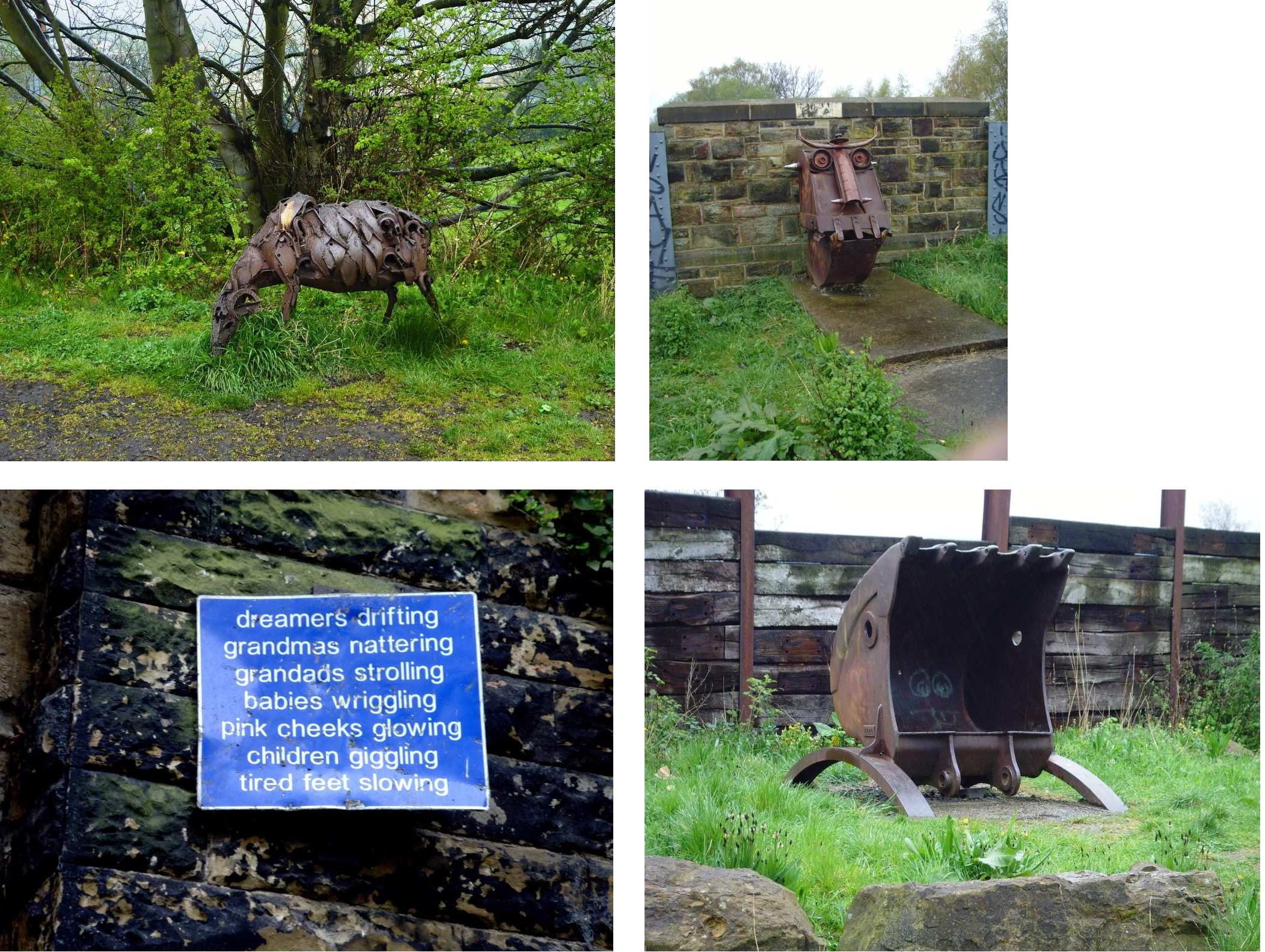
Then the real game changer kicked-in paralleling increasingly serious aestheticisation inseparable from a greater financialisation of the economy in general as Sustrans later new cycle bridge across Bradford's Manchester Road drew obvious parallels, something like a self-conscious mini pastiche of Sir Norman Forster's execrable, grandiose, deliberately unworldly giant Millau Viaduct bestriding the clouds across the Tarn River Gorge through the Massif Central in France (see last photo below). Gone was the simple Greenway, replaced with notions of display heralding a future of aestheticised urban renewal. What we now have is an imposed total experience makeover, a vista of a surrounding landscape resulting in blanding, composed of utterly anodyne new machine-like features amounting to the death of a wild nature having being remorselessly bulldozed and vanquished. Yet these new masters of the evolving urban universe of total alienation had the cheek to say this is nature sensitive even a moment of 'wilding' complete with horticultural vegetation bereft of anything to do with autonomous nature - that real intense nature these nature bureaucrats despise - who merely want a greenwash domesticated add-on, an extension of the suburban garden and the hanging basket on the porch wall behind which lurks the pornographic hell of a domesticated petite bourgeois everyday life.
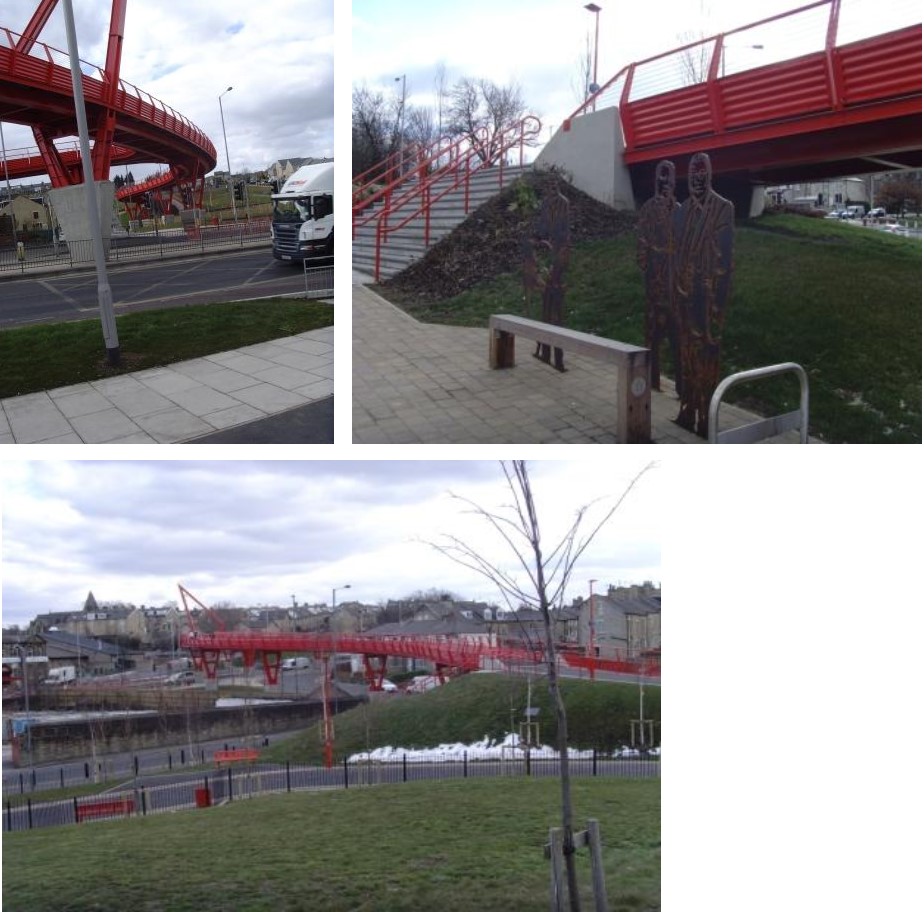
Above: Views of Sustrans Manchester Road Bridge in Bradford. What other city can boast a look-at-me designer bridge courtesy of Sustrans like that which wings its way over the Manchester Rd? Besides which Bradford is the jewel in Sustrans crown even though increasingly a failed city, hopelessly mired in a model of development that has spectacularly failed and that will never be resuscitated, one that privileges commercial / domestic property values, retail development and a consumer free for all based on unlimited credit. The highly conservative planting / landscaping regime which surrounds this bridge is a reflection of this, the theory being the more conservative the planting regime is, the more it is likely to attract inward investment. Pampas grass, mown verges, mulching regimes, evergreen shrubbery and ghastly floral displays is nothing other than a semiotics of despair, a sign that Bradford is at unprecedented cross roads and rather than face facts is in retreat before them.
Below: Norman Foster's Millau Viaduct in France
Despite their initial good intentions the reality today is of a Sustrans that has done nothing more than further facilitate the ultra commodification and gentrification of cycling. Gone forever are the glory days of a casual functional cycling, that mass transport vehicle toing and froing from a relatively locally based workplace, as we knew it in the first 50 years of the 20th century when workers in giant waves of handlebars and wheels whooped out of the shipyard and factories of an early evening as the giant gates closed behind them. The Encyclopaedia of Nuisances text, The Despotism of Speed (see RAP web) notes this change neatly saying,
"Whatever one might think of the rather unenviable character of this perpetual motion of business men, of those charged with "responsibilities" or of Mr. Average young man who nearly always seems to have leapt on his mountain bike from a Metro entrance or from an office – unfortunately one has to admit their allure has become a model. The irony of history is to have given to the May '68 slogan "life without dead time" this ever so pathetic a content".
Yes, the financialisation of cycling is finally upon us, what Iain Sinclair - that all-things-to-all-people, neo-psychogeographer – has called "a naked propaganda for anarcho-liberal bikes-for-all schemes funded by the generosity of corporate bankers" resulting in a spectacular PFI (London's Boris Bikes) spearheaded by Barclays providing a much needed facelift, otherwise known as "insurance reputation" papering over the bank's essentially crooked core; a core its CEOs can have no control over as the mechanisms that make up a functioning capitalist mode of production seriously disintegrate. The present day grim reality is that Sustrans has now become the avant-garde seemingly nature sensitive harbinger of a brutal developmentalism far worse than any previous bureaucratised urban planning organised by the state since the end of the second world war.
barclies
It wasn't that Sustrans were on their own regarding such an intense developmental agenda whereby all surrounding ambience and history must be altered from top to toe, it was also relentlessly driven by the need to eliminate autonomous nature. There was simultaneously a much more general movement afoot, one which we vehemently denounced especially the horrendous estate agent like "views from the neo-house" makeovers unleashed on the Yorkshire colliery spoil heaps in the early years of the 20th century. Elsewhere in the north of England (and no doubt in other places) an ever widening leisure industry perspective demanded that designated terrains replete with new landscape designer coastal pathways etc., had to be accompanied by freshly manufactured views clearing away everything that was imperiously thought of as vulgar and tawdry such as sheds, allotments and raw spoil which also included amazing scrubland wildlife areas. Turning the Tide (1997-2002) on the east Durham coast trounced all that had been left of its industrial past on the local topography meaning a chav nature in all its raw energies also had to be vanquished along with a former chav working class both henceforth to be regarded as the scum of the earth. Blatantly called "nature conservation" spoil was declared a "pollutant" at Easington and Horden replaced by a "brand new golf area with tree and shrub planting along the coast." Large cliff top spoil heaps were removed as the spoil was spread evenly across the sites which were then capped and covered creating what was then sickeningly declared a "public area" at Easington and "habitat creation" at Harden. To add insult to injury further enhancement of the landscape included working with local communities (what was this: holding a gun to their heads or oodles of flummery?) to reduce the impact of "eyesores such as allotment fences" (!!!!!!) an enhancement it seems that improved the chances of habitat survival for the Purple Sandpiper in the north and Little Tern in the south of this designated 'improvement' area. Has the outcome on the east Durham coast been any different to the wholesale destruction of the protected Little Ringed Plover in the Yorkshire pit spoil heap makeovers? The sheer, philistine pig ignorance of these so-called eco-developers becoming more arrogant as the years roll by, simply beggars belief.
The trouble was because there were no "down and dirty" ecos in these places who knew the real quality of particular sites of industrial dereliction and had the means and determination to communicate these facts to a wider public by making (in the old slogan) "shame more shameful by giving it publicity" meant such destruction took place past minus loud cries of indignation and fury. As the old slogan by Nick Brandt reminded us, "Money talks, People grumble"......... Oh yes, and the butterflies weren't destroyed were they? And, yes again, the so-called East Durham Heritage coast (after a still living and breathing heritage was destroyed) also became part of the National Cycle Network through a Durham coastline that hosts 92% of the total area of para-maritime magnesian limestone grass land habitation in Britain.
*********
Of course we never met up with the real culprits who organised the destruction of the Briggate site i.e. Sustrans alongside Bradford Council and the Aire Valley Rivers Trust and not forgetting the crucial part played by Bradford Urban Wildlife Group (see the web, Bradford Urban Wildlife Group morphs into Bradford Urban Deadlife Group) and though we knew the leading lights of the latter group we immediately cut dead all personal contact. Henceforth all communication took place through letters or emails condemning in lucid though heavy language the different aspects of what had been brutally destroyed. The intention was simple as it was straightforward: Freak the whole fucking lot of them out armed with a clarity and a totality none of them could ever possess unless they were prepared to make the painful attempt to change their lives completely; and in so doing creating a lifestyle that is anti commercial, anti hierarchical, anti careerist and anti aesthetic. All the culprits however who made up these groupings and bodies frequently asked us – nay even exhorted us at times – to join with them on a face-to-face level to discuss matters in hand. But why should we? Why should we meet with our executioners, these hideous monsters that had destroyed an arena of vibrant nature; a site of transcendental possibilities, an arena of the 'new' sublime? This was murder and there's no two ways about it. We made and make no deals. We could only repeat Bunting and his Beavers maxim on the Humber Levels in the 1970s: "No means no"!
In any case what was there to discuss? Moreover, seeing our anger was so intense, some form of violence could easily have been the initial outcome, which these creeps would have relished in order to discredit us. But what we really had at our disposal, our essential weapon, was sheer intransigence, the stance that is the most influential, the most enduring and the most crippling for the enemy to endure. Inevitably, there are nuanced subtleties and as much as we would have despised ourselves for it, we actually would have sat down and talked to some of these creeps face to face if we has been informed initially of the devastating changes in the offing. Officialdom probably sensed we could put a spanner in the works merely by point blank verbally throwing at them a barrage of legal objections relating to the flouting of local planning and bio-diversity laws. Moreover, there were enough people around who knew of our dedication to this amazing place yet we were deliberately marginalised. Crucially this role was carried out by Bradford Urban Wildlife Group precisely because it could have stolen the thunder of their 'great leader' who might then no longer be able to usurp credit for this rich wildlife site to add to her CV and ill-deserved conservation medals, (again, take a look a, Some general thoughts on ecology, nature reserves, developmentalism, revolutionary ecology and Bradford Urban Wildlife Group.)
People could legitimately say parleying with the avowed enemy was a potential compromise on our behalf and we would have to agree. However one major reality must be born in mind: If a building is marked for conservation and a few walls are knocked down it can be rebuilt in a reasonably sensitive way guided by the practical ingenuity of those sufficiently old-fashioned, ever dwindling body of skilled trades' people. However, in no way can this happen if an ecologically rich site is brutally destroyed. It is kaput, dead, gone forever. Desiring a viable ecological future, real conservation cannot wait for the morrow of autonomous social revolution, it must begin this very minute, fighting every step of the way pushing the capitalist mode of destruction back and back and back until there is the final violent conflict with the evil machine whereby the beast is finally eliminated. If we leave everything for that moment of true liberation (liberation when viewed simplistically like this essentially conceived in a somewhat mystical way) we will have gotten nowhere because we are only going to find what we really want in the on-going crucible of combat with the decadent, aestheticised developers massively ranged against us. Such a strategy must also be anti party political and autonomous and in no way is such a perspective similar to the eco popular frontism advocated by most Green outfits and parties.
Also were we at fault contacting 'famous' dissident eco intellectuals knowing full well they weren't revolutionary? And isn't such a manoeuvre to some degree in the same vein as going to see Sustrans / Bradford Council officials regarding the bio-diverse riches of the industrial gorge if such a meeting would have saved the area from slaughter? Incredulously, after a few months we knew the slaughter was not stopping and that we were facing a brutal, mean machine that had closed ranks on us, ready maybe even for our elimination. We were by now not only freaked out but heavy-hearted and when were thugs going to be unleashed? Moreover, once this nature slaughter had taken place and the diabolical act immediately hushed up from all quarters, we were completely isolated having few contacts in the unknown but big Diaspora of real ecos out there (but where?) and most likely, in any case disgusted with the antics of official ecos. Contacting 'big' names was also a way of protecting ourselves against the omnipresent, interconnected and ruthless Mafia ranged against us in this situation of omnipresent omerta with major facts suppressed and official webs redacted. We did receive very sympathetic comments from the likes of Jonathan Meades, George Monbiot, Simon Jenkins, Patrick Barkham etc, as they obviously sensed there was possibly much truth in the passionate and detailed way we stated our case. It could be said this tactic was opportunistic seeing we keep proclaiming that autonomous activity is essential (the essence of unitary wilding and related activities) but we preferred to cover our backs quoting Debord's comment regarding "necessary opportunisms" in certain situations. In the face of the huge, compound lie we were confronting we only had samizdat means to combat the neo-liberal total assault knowing that somehow we had to get the facts out there and by any means necessary!
Finally readers if you think we have made a mistake in deploying such tactics we sincerely apologise.......
What follows are a selection of emails, flyers, addendums and ripostes placed roughly in chronological order pinpointing Sustrans – in league with Bradford Council's – destruction of Briggate. Inevitably in the following there is repetition of detail and incidents ...
************
.....ARSEHOLES ALL.....
SUSTRANS/ BRADFORD COUNCIL /and The Local Green Party..........
OFFICIAL THUG AND WAXWORKS (SUSTRANS?) ECOS TURNING THEIR HEADS AWAY IN SHAME - AS THEY CONFRONTED US - DATE: 14/02/2013 TIME: 14.11 (A little later and THUG deployed his personally chosen fascised sturm arbeiters against us)
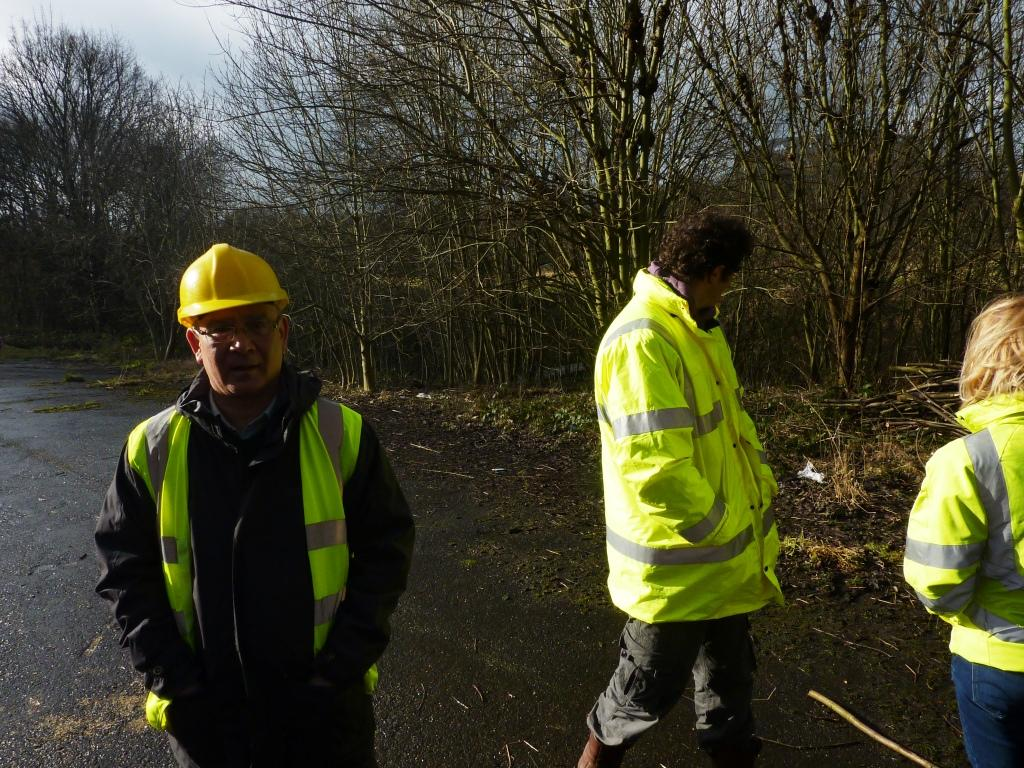
The NOTICE SAYS: "THIS TREE CONTAINS A COLONY OF RARE BUTTERFLIES. DO NOT CUT DOWN!" DATE: 17/02/2013 TIME: 14.44. (The tree was then cut down.....)
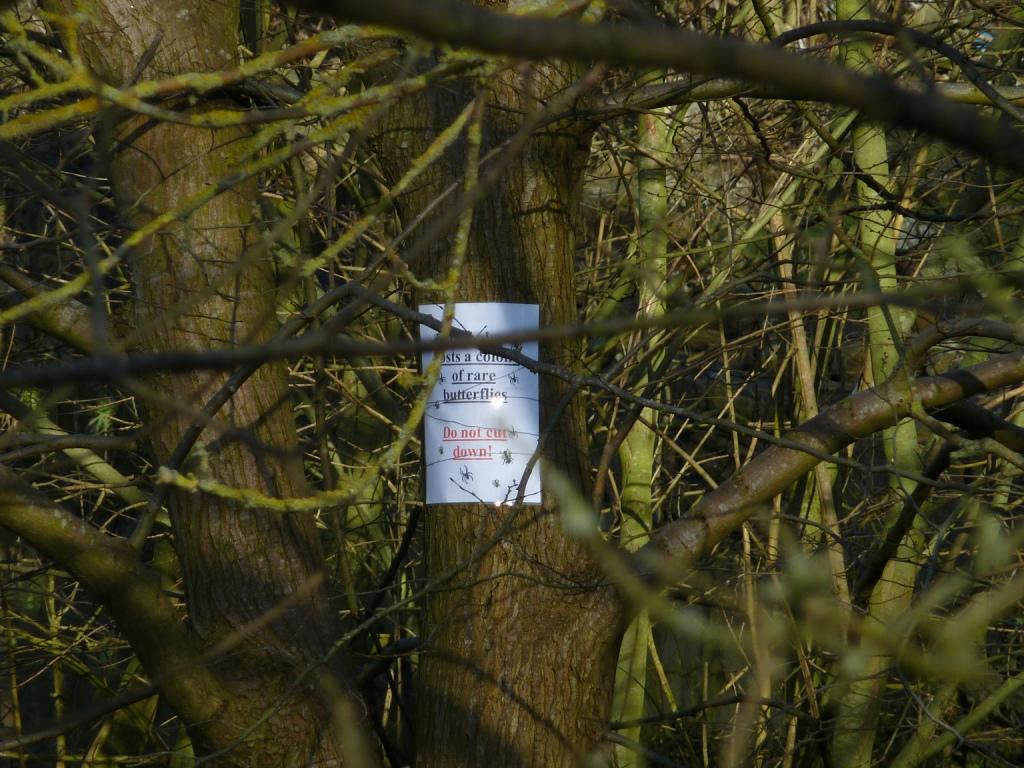
Below: later commentary one of us made on the above encounter
Right from the start, the cycle path / linear park project breathed sheer lunacy. We were made vividly aware of that the fateful day we encountered, in February 2013, the site supervisor who was taking a couple of ecos attached to Sustrans around the future scene of apocalyptic annihilation. We had been cutting up branches left by the council where they fell, piling up the logs into habitat suitable for hedgehogs, we having just approached Marian Crawley of the hedgehog rescue centre in Keighley,with a view to introducing them onto the site - though in fact they may have already been there, no survey ever having been undertaken. When the site supervisor caught sight of us, he went rigid, pointing like a human setter and we his prey: here, at last, were the bastards who had taken it upon themselves to wild Bradford city, who had coppiced carr woodland, translocated plants, scattered wild flower seeds, delved dirt steps into banksides and cut wild flower plugs into council maintained, ryegrass monocultures, etc. He could barely contain his fury and clearly wanted us banged up, hoping we would take a swing at him. This clown was kitted out in protective goggles and a hard hat to guard himself from everything nature was likely to throw at him - a falling leaf perhaps, or cross-eyed midge that mistook him for a barn-door. To cut a long story short, he told us that he, and only he, would allow hedgehogs onto the site and that the planting of dog violets (to attract perhaps the gorgeous Dark Green Fritillary and Small Pearl Bordered Fritillary) was prohibited, only he able to lift the prohibition. We informed him that we had been questioned by a couple of gracious Asian troubleshooting council officials when translocating cornunculatus trefoil from Gaisby quarries, they thinking we were fly tipping because the plants had been brought down in heavy duty, builders rubble, sacks. When told what we were doing, they instantly gave us the thumbs-up, our thug paragon of ecological virtue, however, going into a blue funk when he heard, immediately insisting we give him their names. Had we told him, we don't doubt he would have done his level best to get them sacked. (By the by, because we raised such a ruckus, our voices carried to workmen at the far end of the site, we going right up in their estimation for promptly getting heavy with this thug, who was obviously as much against workers' rights as he was against the rights of nature). Under the pretext of getting a pen, one of us took out a camera, and before you could say kill everything took a photo, simply saying "smile please", the young ecos instantly turning their heads away. To this day we don't know who they are - but they do, and obviously hope the destruction they have been party to will not blow up in their face. By now "Dog Violet"(as we immediately renamed him along with Sir Dog Violet or Lord Dog Violet) was furious - and bent on revenge, he suspecting we were not just zimmer frame eco warriors' but also "commie bastards", a more sinister combination impossible to imagine.
Which is what our urban re-commoning implied, Sustrans under the heel of Dog Violet determined to prevent that from happening, whatever the cost. Notices would go up every 50 yards warning that fly tippers would face fines of up to £20,000 if caught, we and everyone else familiar with the site knowing that serious fly tipping had ceased long ago, the real purpose of the signs was to deter criminals, like ourselves, from going onto the site and doing something to stop the destruction taking place. Signs were also erected that implied people who actually used the footpath that crossed council land were, in effect, trespassing, even though a footpath had existed here from time immemorial, linking the sheep pastures of the uplands with the market town of Shipley in the valley below. An appeal to common law would almost certainly have established this fact and the notices judged illegal.
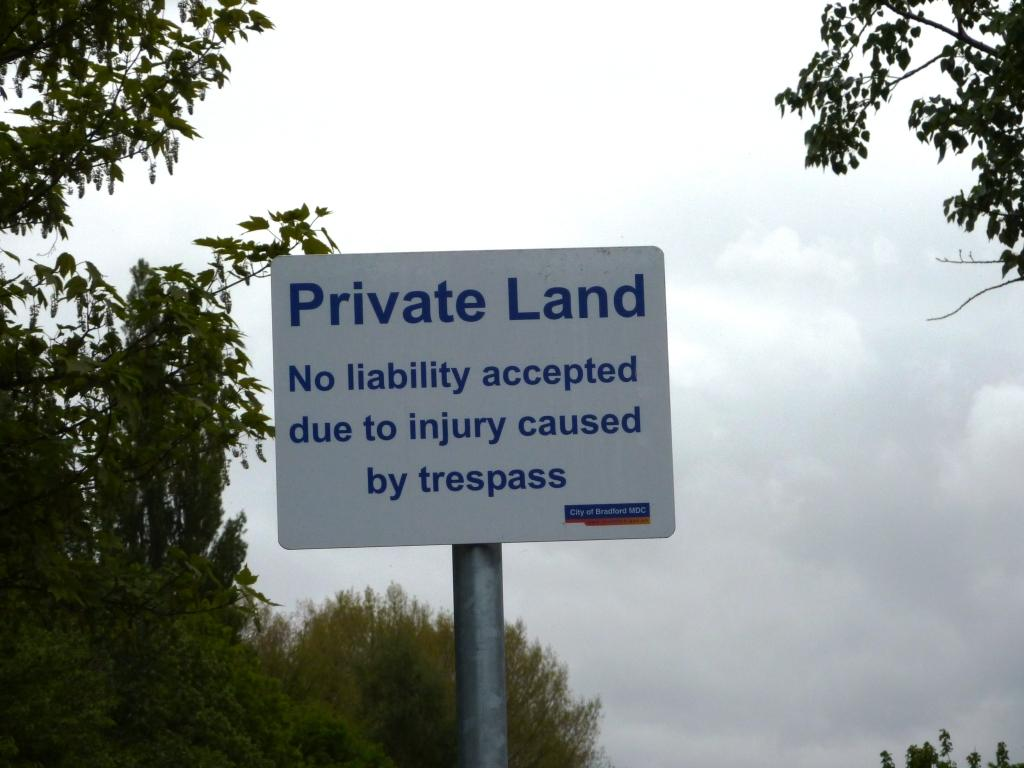
That not so rare species, the Greater Purple Faced Dog Violet almost certainly was responsible for the posting of a sign that read, "Private Property. No liability accepted due to injury caused by trespass"- which was a bit rich considering he was quite prepared to blow the place to kingdom come. At the height of the enclosure movement, each act of enclosure had to be agreed by Parliament and which often came into conflict with common law i.e. the precedent set by non statutory, judges' law. William Bunting and his Beavers from 1970s through to the 1990s used in vigente ancient law when combating the peat barons out to strip the Humber Head Levels, proving in court that the common law had been broken which meant Levingtons etc could no longer claim ownership of the land they were denuding of peat. By declaring a right of way to be private property and those who use it on an everyday basis guilty of trespass, the person who ordered the notice mentioned to be posted, and which mainly applied to the movement of the Windhillies (and ourselves), has in fact taken upon himself the right to interpret the law as he sees fit, which he is not entitled to do. But we doubt if this offensive, provocative, legally questionable notice will be taken down.
In our letters to various authorities when not kicking off in realms beyond their limited grasp we pandered occasionally to the brutality of a very limited bourgeois democracy with its eternal emphasis on fines, jailings and torture, i.e. in the language they could understand. In truth, we had no wish to jail those we held to be responsible for the eco holocaust; rather we wanted their brain cells to explode having encountered a lucidity beyond their ken. However, we would have liked to see the worst culprits forced to engage in re-educative wilding practises with say, Dog Violet ordered to personally plant thousands of dog violets, preferably in torrential rain.
**************
EMAIL TO CLAIRE WRIGHT OF LEEDS SUSTRANS, April 3rd 2013
Regarding the appalling destruction of the finest bio diverse in Bradford – certainly more diverse than Ilkley Moor – all we've encountered from all quarters are lies and obfuscations. Nobody has been straight with us and, yes, we have noted that Sustrans has redacted the section on the Briggate 'improvement' and other pertinent matters from their website. We have enclosed an attachment containing two separate photos. The first relates to the crude smashing up of notices that were displayed across the site indicating nature sensitive areas. The one here is of a wych elm tree that contained a colony of rare White Letter Hairstreaks. The notice was pulled down and the tree destroyed. The other is a mug shot of a vicious anti-eco fascist, possibly the sit supervisor (?) who ordered all concerned, knowledgeable eco's off the site. Here he is accompanied by two very ashamed, waxwork ecos who've turned their heads away from the camera. We want the name of this thug and also of the two young 'ecos'. Most likely they belong to Sustrans 1,500 strong volunteer force, or if not, are possibly from that department of Leeds University, Sustrans has links with. We are sure you will know who these people are. Is it too much to ask that, in the interests of transparency, and common decency, you divulge their names?
Quite simply the law has been broken regarding (1) correct planning procedure and (2) the legally binding bio diversity requirements. In the first instance no notices were ever posted in public places giving warning there was to be a major landscaping event. So this brutal aesthetic makeover, which ripped-out the heart of this wonderful place situated between the proposed cycle track and Bradford Beck, went ahead quite illegally. The Rio bio diversity accords of 1992-3 were torn up in the process, the whole constituting a double felony. It is no longer a civil but a criminal i.e. a police matter, wouldn't you agree?
There is more. On the day after the heated exchange with the hard-hat psycho seen here wearing protective plastic goggles (in case he should be attacked by the occasional winter midge, perhaps!) it would appear he went berserk and ordered a hit and run raid on a spinney at the back of the M&D auto repair garage on Leeds Road. He knew it was being sensitively looked after by sincere ecos and therefore all the more reason to make it a target. This thug had been so empowered (and protected) he felt he could do so with impunity, nay, with complete approval. It is not just a sacking offence but a jailing one, wouldn't you agree?
Yours sincerely,
Tweedeldum & Tweedeldee
PS. Some choice reminders from Sustrans bio diversity web.
- Sustrans aim is to maximise (!) the beneficial impacts of our routes for bio diversity conservation.....
- To support this goal we have published a biodiversity action plan for the national cycle network.
- We are seeking to work in partnership with local councils and wild life organisations [our italics!] to identify opportunities and possible funding sources for enhancing biodiversity along those stretches of our routes.
WHAT HUMBUG. IF IT WASN'T SO TRAGIC WE WOULD DIE LAUGHING
************
IS THE REICHSTAG BURNING (April 8th 2013)
Dear David Hall, (CC: Claire Wright, Susan Stead, Lorna Leeming, Head of Bradford Council)
The title refers to the burning of the German parliament building ordered by the Nazi party in 1933; a false flag operation immediately blamed on Van der Lubbe, an innocent Dutch, council communist who was then executed. In the late 1960s Is the Reichstag Burning was the heading of a pamphlet brought out by Italian Situationists correctly accusing the Italian government of instigating the bomb explosion in Milan's Piazza Fontana blaming the act on the activities of working class insurgents. Thus began the Italian state's "strategy of tension", that state-manipulated terrorism whose example has since been followed worldwide.
We visited the Shipley Sustrans / Bradford Council site today after an absence of one month due to ill health brought on by depression caused by the orgy of wildlife destruction. We aren't saying this to garner sympathy and can be medically proven; though it may come as surprise some people actually are deeply committed to nature conservation and know the future of the human race now depends on it.
We were able to confirm that the trees in the spinney had been felled with a chain saw, the gashes those a chain saw makes. The cut a hand saw generates is altogether much thinner and where a hand saw leaves sawdust, a chain saw leaves wood chippings, we took forensic photos as we are compiling a dossier of damning photographic evidence. The people who maliciously cut the spinney down were professionals and the finger of suspicion is directed at the council as who else would be motivated to do such a thing? Our careful pruning and care for the wild life we were seeking to protect has been laid waste to. We felt sick just looking at it - and very angry. Is there no end to the destruction of this outstanding site? It seems not.
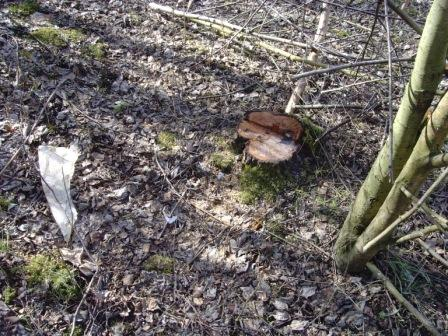
We were also deeply shocked to find fires had been set at various intervals in and around the site. Though meant to look like the work of vandals, we immediately suspected a dirty tricks campaign. We are on sufficiently good terms with the 'skivers' of the Windhill Estate to know they don't do this sort of thing - at least not on this sort of systematic scale. On closer inspection the burnt areas followed the path of the buried gas pipeline and patches were to be found next to a once open duct now covered with a sheet of ply and weighed down with breezeblock. Burnt patches were also in evidence by the side of the former canal where we had intended to plant dog violets and had been creating habitat for hedgehogs before being apprehended by your site fuehrer. Logs had been pulled off the piles of sawn branches we had stacked up with the aim of providing shelter for the mortally threatened hedgehog and wantonly scattered around. Also heaps of rubbish we had cleared from the garage site and stacked neatly on the spinney slope had been set alight and a fire started in the spinney itself. These fires had been started on very wet ground before the mid to late March snow came and would have required considerable quantities of petrol if they were ever to ignite - just the sort of thing a psychotic arsonist of a construction council manager would have little trouble getting his hands on.
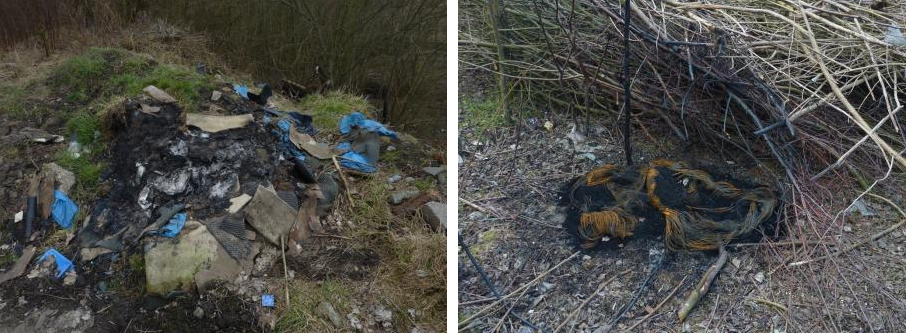
Many empty - too many - white lightning cider bottles had been strewn around and which also aroused our suspicions. Now from time to time we would chance on an alchi, this being one of the few park-like areas they could drink in unmolested without fear of being moved on. Not wanting to draw unwanted attention to themselves, they were never any trouble and always amiable. We never saw more than two together and then only on warm days. However this wild party which every alcoholic for miles around, it seems, had been invited to, had taken place in the open in the worst possible icy, snowy weather! It takes some believing, wouldn't you agree? Alcoholics are a fire risk in hostels because of their tendency to pass out with a lighted cigarette still in their hands. However we have yet to see a mob of them drunkenly setting fire to a field in sub zero temperatures! - and we doubt if anyone else has ever witnessed an event of this highly improbable kind. If not alcoholics then who else could have been setting fires? Why preteen estate kids of course! Except during all the years we have been monitoring the area for wild life, we have never encountered anything even remotely comparable. Besides young tearaways tend not to drink white lighting brew because alcoholics often are amongst their favorite targets, peer pressure preventing preteen and teeny hoodlums from downing white lightning in public. The whole thing stinks and in our considered opinion is a set-up, designed to 'get us' and people like ourselves. However there is worse to come and after you have read the following you may well agree. CSI tape should now have been stretched around the site. However we doubt you will bring the police in because the repercussions could be enormous and the story would go national.
What really disturbed us was to find that two 18m thick tubular steel pipes with a diameter of around 5 inches had been uprooted that had been sunk into the earth at the opposite ends of the gas pipe that runs parallel with the bridge. These white pipes topped with a red for danger band had been driven into the ground around 3 years ago and gave warning of the presence of the gas pipe. One of these pipes (that would have required a weight lifter to shift) had been thrown into the beck like it was a matchstick. A teenage vandal, an alcoholic enfeebled by drink? WE DONT THINK SO! It would have required several muscular young men at the very least, and which was a physical impossibility because only one of the stripling Mr Universes could have got the arms around the post at any one time: and then they would not have been able to get a good grip because the metal paint it was coated with forbade that. When we inspected the hole that had once contained this tonne weight, we found no evidence of any digging around the rim, the post which had been buried 18 inches deep having been yanked clean out of the ground in a trice, a chain, we think, having been wrapped around the post which was then attached to a hydraulic lifting arm. We actually did find marks of a caterpillar tread close by. The 14 ft post was then tossed into the beck and it was fortunate indeed that it did not strike the gas pipe line a mere 2 ft away from the bridge parapet. Had it done so and fractured the pipe, a spark could have caused a massive gas explosion and endangered the lives of umpteen Windhill Estate residents. This reckless disregard for their lives was hypocritically hidden behind a smoke screen of concern for health and safety issues and anyone who can do what we have described above is psychologically very ill indeed and should be instantly removed from public office and placed in a psychiatric institution.
Also there is a clear view of the bridge from the flats above. We do know the council tenants who live in these flats are very vigilant and will phone the police or the council if the suspect anything untoward, like fly tipping, is taking place. Increasingly over the years they have begun to see this area as their green space, especially once it became apparent the place was being cared for, despite its de facto abandonment by the council. Only a correctly dressed outfit in hi-viz jackets and hard hats could possibly have carried out this reckless act and gone 'unnoticed', as it were. This is yet another damning, salient fact which, after a moment's reflection, is surely obvious to anyone as familiar with the area as we are.
We hope you will agree that our reading of the trail of tell tale signs is worthy of a Native American and may well have sprung from our sensitivity to habitat - which we only wish more people possessed!
The weight of evidence forces us to conclude this was not vandalism but black propaganda, a counter insurgency measure aimed at genuine ecos like ourselves who really do care, the blame to be laid at the door of the Philpott sub class of the Windhill council estate. IS THE REICHSTAG BURNING AGAIN? During all the years we have frequenting the area we have not encountered one instance of seriously destructive behaviour. Picnic litter, discarded bottles of cider and lager cans even the occasional barbecue fire - one of which unintentionally burnt an alder buckthorn sapling - yes, certainly, but nothing as calculated and sinister as this. In fact the Windhillies (as we came to call them) were coming to respect the place and began to feel it belonged to them the more bio-diverse it became through careful tendering, and also, it has to be said, because they respected us, knowing what we did was not done for money but for love and we were at the opposite extreme of hated officialdom and people to be regarded therefore. It was heartening to have tough youngsters greet you with "hello lads" or "friend", especially given the very considerable age gap. We doubt if that has happened to anyone on the Briggate site and it says a lot. Our social re-appropriation of nature struck a chord and we firmly believe this is the only way forward if humanity is to be spared a horrible end.
The person responsible for these dreadful acts - and we all know who this dreadful person is- should by-pass jail and go directly to Broadmoor. He and Peter Sutcliffe might find they have much in common - and not just the fact they hale from Bradford. How come this dangerous lunatic (and we do now know from private sources he has an evil reputation) was ever put in charge of such a sensitive project as this? We suspect it was a deliberate choice and that his evil reputation was his best testimonial, guaranteeing his appointment to his position of ober gruppen fuhrer. Nor do we think this psychotic asshole would have done what he did off his own bat. He must have felt he was under some kind of protective shield and he was only doing the bidding of his superiors. We are of the view he carried out his acts of arson and unspeakable sabotage with a view to getting the bridge across the beck closed off and hence the path across the big field which has been a public right of way for centuries, and which the railway company that built the railroad into Shipley sometime during the 1840s, respected by providing an especially built bridge under which the foot path could pass. It says something about the agenda of his employers that he felt able to push ahead with this perverse anti social, anti nature goal. He almost certainly was responsible for the posting of a sign that read, "Private Property. No liability accepted due to injury caused by trespass"- which was a bit rich considering he was quite prepared to blow the place to kingdom come.
When we encountered the thug referred to above on the 3rd of February, we specifically mentioned that the Marbled White butterfly had been seen across the beck from where we were stacking logs. This remarkable sighting merely increased his determination to cleanse the area of all that made it remarkable. Henceforth he would bear a particular grudge against the field through which the common law footpath passed and was astute enough to see, as psychotics often are, that it was in the process of becoming easily the richest, post industrial butterfly meadow in the Bradford area. But not if he could help it. Our forensic examination shows he was prepared to kill over it. If something is not done about him - and seen to be done - the harm, particularly to Sustrans reputation will be incalculable.
***********
Email: April 23rd 2013
Dear all, (Sustrans, Bradford Council, Bradford Urban Wildlife Group, etc. etc.)
We include here another collection of our outrageous lies, this time (again) relating to the poplar trees on the Briggate site. Obviously nothing ever happened and in any case if some were chopped down it was due to a posse of non-accountable aliens from outer space. Therefore everyone is innocent - apart from ourselves. "Simples" as the Meercats say......
(For further information see Part 4 of Eco-Peterloo: Of Red Underwings, Black Poplars, Mulches, Cyber Beings, Nature Poets and Fallen Elms which deals specifically with the cutting down of the Black Poplars)
**********
The following letter was sent sometime in June 2013 the various developmental forces having continued with their anti-nature, malevolent project.....
Where are the Whistleblowers? Running in fear of Bradford Council's cloak and dagger thugocracy??
Hello again Unsustainable Sustrans,
Congratulations! The criminal cohort that is Sustrans and Bradford Council has done it again. If any of you have had the courage to visit the environmental crime scene that is Briggate, you may have noticed that an acre of charlock now covers what was once an ancient nettle bed and that was formerly the centre of Bradford's largest population of Small Tortoiseshells, Commas, Peacocks and Red Admirals. In fact there is so much charlock (rape seed) you could qualify for an EEC subsidy should you care to apply to Brussels for one. A nice little earner! You are to be praised for grasping the site's commercial potentiality when all we sentimentalists could see was a haven for wild life. With a bit of luck it could provide you with an income in perpetuity for the cash crop is bound to spread, rape seed a very difficult plant to eradicate once established to the extent it now is on the Briggate site. The threat posed by rampaging charlock has, over the past couple of years, even made on at least two occasions into the pages of the Southend Echo. Carted in by couldn't-care-less developers, it threatens "England's Rain Forest" in the Thames estuary on Canvey Island. In fact what you have been up to is as incommensurable as a child welfare officer caught out watching kiddie porn. Would that the T&A was able, for once, to demonstrate a similar sense of responsibility and expose this far greater ecological crime. How fortunate for you that Bradford has such a nauseatingly compliant local press, campaigning journalists as abhorrent to the T&A as they are to America's National Security Agency and Britain's GCHQ. And so, for the moment, a Mafia style law of omerta rules, guaranteeing silence, persistent thuggery and law breaking. But not forever.......
Charlock was only marginally present on the site this time last year and was well under control. We can only conclude that the destruction of the nettle beds and the importation of alien soil from the outside (despite official denials to the contrary) has caused this invasive plant to spread in such choking profusion, the seed able to lay dormant for more than 50 years, each plant producing somewhere between 2000 and 4000 seeds. Useless to demand what are you going to do about it for the place is now a wasteland, the Aire Rivers Trust's unbelievably asinine judgment the site was "ecologically worthless" now a self fulfilling prophecy you can all safely hide behind. You have the power and the money and therefore could escape prosecution when, by rights, an example should be made of the guilty men and women in Sustrans, the Council and the Aire Rivers Trust. All we have on our side is the truth and the growing conviction around the world that authority's word is not to be trusted. Increasingly it is a force to be reckoned with and Bradford won't indefinitely buck the trend, despite its so far successful attempt to gag and intimidate all opposition and one that has been vastly helped by the shameless complicity of so-called independent bodies like BUWG and BEES. Just as George Bush would not have dared go to war in Iraq without PM Tony Blair's blessing, so this wanton destruction could never have taken place had it not been for the craven acquiescence of Bradford Urban Wildlife Group.
We have also noted that rabbits are increasing on the Briggate site. Why? Because a fox den has been destroyed by the illegal linear park makeover you all hoped to push through on the sly without due consultation. (May we bring it to your attention that it is the council that is charged with the task of superintending planning law, not the breaking of it as happened on the Briggate site). Some 13 years ago the rabbits overran the area around Shipley Station and there was talk of a cull. Like a deus ex machina, the urban foxes arrived and ever since the rabbits have ceased to be a problem. Should they become rampant again, we know who to blame, don't we? Nor did any of you notice the amount of feral cats on the Briggate site which suggested there was a considerable population of small mammals. But not anymore thanks to your potlatch of wildlife. What will it take to make you feel ashamed?
Perhaps the fact bats have been observed on the site? Well, we have it on the trusted authority of eco friends in Calderdale (and they were right about the Dingy Skipper after all) that they have observed bats at night on the Briggate site. Until you anti-eco vandals came along, the Briggate site was an insect heaven and that, combined with an abundance of roosting spaces like hollow trees, would also have attracted the bats, all bats in the UK being insect feeders. So we are putting you on notice that we intend visiting the site with a camera that has the night vision app switched on. We are sure you are aware that it is unlawful to develop a site without first checking if bats are present, the Bat Conservation Trust stressing that "you will be committing a criminal offense if you intentionally or recklessly disturb a bat in its roost or deliberately disturb a group of bats." But since you have the law in your pocket, the destruction of bat habitat matters as little to you as does that of the White Letter Hairstreak, the Purple Hairstreak, the Brimstone, the Brown Argus, the Orange Tip, the Small Tortoiseshell, etc, etc.
Anyhow you can't complain we haven't given you fair warning and that your hired thugs and nature assassins should now be alerted to be on the lookout for likely suspects with cameras. One further observation: how ironic that Sustrans, not yet a year ago, were commended for going to the trouble of saving bats on the Bath / Bristol cycle trail. But that was Bristol where the Mayor, George Ferguson, takes his entire salary in "Bristol £s" (a local currency), the city council giving the staff the option to take part of their salary in "B£s." Imagine this happening in Bradford! You simply can't for in Bradford the totally unimaginative holds sway. And with such disastrous results for when the shades of night gather in Bradford, the owl of Minerva is instantly shot by the council and Sustrans when it takes flight. (And since we are dealing with blockheads, the allusion to Hegel's famous comment is bound to go unnoticed!)
Byeeeeeee
Tweedeldum & Tweedeldee
*************
July 12th 2013.....
REPLY TO SUSTRANS WHO NOW WANT US TO GET INVOLVED IN CLEARING UP THE DESTRUCTION OF BRIGGATE'S INDUSTRIAL GORGE...............
Dear Jokers,
Help clear up the irresponsible and irreversible MESS that IS the Briggate site and that is NONE of our making? You are having a giraffe! An absurd request deserves an absurd reply:
(The above is an extract from Kurt Schwitters Ur Sonata, a Dadaist sound poem. There are other, less compromised, aggressively anti-aesthetic, cries of outrage flung in the face of an absurd world. But this will have to do. Incidentally in 1966, we helped move and then restore Schwitters last Merz Bau from the Cumbrian Fells into the sanitized precincts of the Hatton gallery in Newcastle, a fact Tate Britain has been obliged to give prominence to in their recent pathetic Schwitters retrospective in an age when the exhibition has lost all life enhancing raison d'etre. As is well known we later criticised the removal of the Merz Bau from its original cow bier high on a mountain slope just as we deplore the destruction of the post-industrial ecological profundity that was once Briggate).
Yours sincerely,
Batmen & Robins
(Seeing bats and robins along with virtually every other living creature lies dead at Briggate)
***********
Below: a later commentary we made on the above incident
As for ourselves, of course we can't be sure what affect our undoubtedly superior knowledge had upon Sustrans, but there is one incident worth recounting. Work came to a halt on the makeover in the early spring of 2013 in response to our objection that the law had been broken and proper planning procedure ignored. Caught with their cocks in the custard, Sustrans and Bradford Council knew they had little choice but to make a show of observing proper procedure - and it was a show, no notices ever posted around the site to say there were going to be major alterations, which again was a legally binding stipulation. Meantime, having covered the nettle beds, the trefoil, the Aarons rod etc., in contaminated soil that had been brought in from the outside, charlock began to choke the site. We emailed David Hall boss of Leeds Sustrans (we had long denigrated him as "Al' Fall – don't worry we'll catch you") pointing this out to him and that the matter had even been raised on at least two occasions in the Southend Echo, charlock also beginning to spread like wild fire across the lower Thames estuary, (an area that had come to be acknowledged as "England's rain forest") due to the importation of contaminated soils from the outside. The impudent critter came back with the absurd demand: what did we intend doing about something that was none of our own making? Though it may have been a last, desperate attempt to get us to the negotiating table, this was really too much and so we replied to the absurd with the absurd, sending the jerk a meaningless sound poem, a Dadaist / Lettrist tactic that we thought must have outlived its usefulness. However the effect would be similar to the avant-garde provocations of the first decades of the 20th century and which, we have reason to think, really flipped Sustrans lid, they responding by stepping-up the insane orgy of destruction we had succeeded in only temporarily postponing. On the eve of the 100th anniversary of the first world war, it was like a homicidal General concluding the deaths on the Somme were not enough and that the numbers had to be doubled, an absurdist sound poem by Raoul Hausmann convincing him that the only way to purge civilisation of such insane symptoms was by totally engulfing it in madness masquerading as the most high-minded reason. Just prior to Al Fall of Sustrans sending his troops over the top to commit further atrocities against urban wildlife that will forever tarnish the organisation, he would describe us as "raving". In fact, for want of being unable to lay our hands on sound poems that were much more aggressive in intent, we sent Sustrans a transcript of Schwitters innocuous Ur Sonata, which delights in the inconsequential aesthetics of sounds, and was therefore an attempt to make an art form out of a disinclined genre that was really an open-ended, anti-art howl of protest. Our qualified reservations went right over the heads of Sustrans, they managing to do the impossible, the ensuing destruction the poem was at least partially responsible for, bestowing on Schwitters a consequential radicalism he so conspicuously lacked in real life when compared with other German Dadaists, who were forever berating him for his notorious petite bourgeois tendencies. Long dead, this posthumous moment has to be Schwitters finest, alive; he never sparking anything as remotely far-reaching in its implications.
***********
Extracts of letters sent to Sustrans Bristol CEO from August 15th to September 16th, 2013 which collected together we fronted with a recent comment from Miguel Amoros:
"If destructive growth required an environmentalist disguise, destruction would have to be presented as the environmentalist act par excellence"
............ "We write this letter with the deepest reluctance. However West Yorkshire Sustrans has been deeply complicit in the worst act of ecological destruction we have ever witnessed. We stress 'complicit' as other bodies were involved, namely Bradford Metropolitan Council and the Aire Valleys Rivers Trust. The most we can say in mitigation is that Sustrans may now feel aggrieved that it heedlessly went along with the moronic view put out by Bradford Council, the Aire Valleys Rivers Trust and the Nature Conservancy Officer on Bradford Council etc. that the site in question was "ecologically worthless" whereas in fact this two acre site in Briggate, Shipley, was more bio diverse than the whole of the neighbouring, picture postcard perfect Ilkley Moor.(The aforementioned degree-holding donkeys and professorial junkies simply could not see beyond the dereliction and detritus, and, in so doing, went against the grain of contemporary scientific awareness that brownfield sites are where it's at nature-wise).
In the space of four days the most ecologically rich urban site in the whole of Yorkshire and possibly the north of England and Scotland was devastated , in order to make way for a Sustrans cycle track, or rather the "linear park" that was to accompany it. The facts speak for themselves; at no point were notices ever posted to say a "linear park" had been proposed and the public invited to express their views. The council simply swept aside official procedure and brutally went ahead in clear breach of the law. (We have all the details and the attempts by the council to cover up a de facto state of affairs by making it appear de jure after the event). Not only was planning law flouted (despite the fact councils are charged with the task of seeing it is observed) but a number of bio diversity laws were also arrogantly disregarded, which, if justice was served, should land their perpetrators in jail and this in addition to the hefty fines that should have been imposed and that would act as a salutatory reminder to other councils etc. not to even contemplate doing the same."................................
............. "The scale of the destruction is simply unbelievable and we still have difficulty in coming to terms with it in this day of so-called heightened 'ecological' awareness. Frankly it is like a bad dream we shall shortly awaken from. It hurts just to go on this sterile, treeless waste and, not least, to note the ash trees that were ruthlessly cut down (as if Bradford Council / Sustrans were impatient of the tardiness of ash die-back disease to do the job for them) their trunks clothed in ivy around which the Holly Blue would jink. And please don't be so impertinent and ask what happened to the holly bushes! And as for the hollow trees in which the Green and Greater Spotted Woodpeckers would nest, plus the abundant small mammal population and at least two families of foxes; all that has now become the excruciatingly painful memory of "beauty been". According to eco-activist friends, the hollow trees were also bat roosts, as was the large abandoned boiler that was removed because it was an eyesore to the hydrological philistines of the Aire Valley Rivers Trust and The Friends of Bradford Beck who literally have no feel at all for these "landscapes of contempt" and who are in dire need of some kind of re-education before they commit even more irreparable damage. All of this activity is illegal and punishable by law and it is our belief that West Yorkshire Sustrans knows this, as do Bradford Council, the Aire Valley Rivers Trust etc. but who hope to get away with it by maintaining a Mafia like law of silence (omerta) because they know if the truth should ever come out someone is going to do time at her Majesty's (and our) pleasure.
We believe that Sustrans / Bradford Council were under pressure to deliver and to get the job done before the shock therapy of the new financial year kicked-in, which would have automatically ruled out an indulgence like a "linear park." Had it been allowed to continue at the expense of essential front line services, it could easily have sparked a classic rate payer's revolt. As it is the waste of council taxpayers money on this ecologically ruinous scheme has been colossal and enough in itself to unseat the ruling junta in the town hall if even a smidgeon of the truth were to come out. Beware of the city that was the centre of physical force Chartism and that gave birth to the Independent Labour Party! What we have in Briggate, Shipley, is nothing less than the big hole Mark 2. just in case you don't know, the big hole is the derisory name canny Bradfordians give to this folie de grandeur which involved demolishing nearly the entire city core in the expectation, courtesy of Westfields, this was what was required to launch Bradford into an blue sky future of high end shopping malls and de luxe riverside developments grouped around the headwaters of a reopened Bradford Canal that Ruskin wrote so dazzlingly about - though in terms of a contemporary River of Styx, which hardly makes for advertising copy. But out of the clear blue sky of this dreamscape there would hurtle, in 2007, an economic meteor which has left the former city centre looking like it has been hit by a near earth object and brilliantly characterised by the renowned graffiti that appeared on the encircling fencing: Best Amongst Ruins. Desperate to redeem the 'horror' of its manufacturing past by reinventing itself as a city synonymous with the new consumer / leisure industries, all Bradford has managed to do is reinforce its negative image both locally and nationally. The well off dales residents Bradford is so anxious to attract, once more view this unique city with repugnance - and give it a wide berth. How then offset the damage done by a sink hole of geological proportions? We now know what the answer would be: create another one!
The financial meltdown of 2008 meant the third reopening of the canal would have to be postponed - indefinitely. And in its place a more modest proposal has gained credence centred on the Bradford Beck, this free running stream (that Ruskin immediately appreciated must not be hemmed in but left to find its own way otherwise deaths would follow) now a site of aesthetic remodelling, the planned 'water features'' a proxy for the sculpted lock gates that would feature on the now abandoned Bradford 'conceptual' canal, the usual lock gates deemed beneath contempt. Roughly following Canal Rd, and also that of the proposed Sustrans cycle route, in the haste to grand stand 'art', nature and heritage would be swept to one side as damaging the economic potential of the Canal Rd Corridor growth pole. And so the stone slabs that once made up part of the Bradford Canal were tossed aside even though we had made a desperate plea for them to be preserved. We had even seeded the surrounds of these stones with trefoil in the visionary hope of seeing the lovely Common Blue flitting about these mysterious industrial cromlechs........There was just no end to the mindless destruction. It was like we were face to face with metaphysical evil.
To railroad the job through in double quick time, a psychotic, right wing, thug of a clerk of works was put in charge. To that end he was granted carte blanche to do much as he pleased, resorting to a black propaganda of the deed, He (we have a photo of him and nicknamed him variously "thug" or "dog violet" because he tried to prevent us planting dog violets) tried to discredit our voluntary conservation work of the past few years by maliciously felling trees in other ecologically sensitive areas close by, (and at the beginning of the nesting season - a criminal act, incidentally), and by setting fire to a meadow where the rare Marbled White butterfly had been seen last year, making it look like it had been the work of vandals from the nearby Windhill Estate. (Actually the "Windhilies" watch their unofficial 'common' like it was their own treasured back yard and will contact the council at the merest hint of fly tipping. The present overkill of notices threatening fly tippers with £20,000 fines are not aimed at fly tippers but at eco activists like ourselves). Of course all these allegations are going to be officially denied. The bureaucratic class in Bradford has no other option but to deny them and stereotype us as dodderers in the early stages of senile dementia. For should the real truth ever come out, Bradford would be headline news. This dark episode has a fascistoid reek to it, especially so in its disregard for bourgeois law, and, disturbingly, could well be a sign of things to come......................................................
............. The Common Blue is not the only butterfly you can add to the heaps of other you have already destroyed. This year, we have (again) been reliably informed by eco -activists, the Dingy Skipper was seen on the rockery at the end of the basin. All the more reason, therefore, to cover this beautifully metamorphosed leftover from Bradford's industrial past with soil and kill the damned thing off. Bravo Sustrans, natural born killers that you are. In fact the entire project (both cycle track and linear park) is a disgusting obscenity from start to finish. The fact that the disgraceful ecos Sustrans employs can't distinguish a Dingy Skipper from a dishcloth is no defence. And as for the unusual array of plants, were you aware there were still a couple of plants of Aron's Rod that did not flower last year, due to the bad weather? They did this year - until you decided to entomb them. They have become increasingly rare in West Yorkshire (possibly because of the increased use of herbicides by Network Rail) and so it was a joy to see them flourishing here until you sinister lot and the other living-dead cadavers you consort with, decided otherwise.
We would hazard a guess that the cycle track has been resumed in the Shipley area simply in order to attract next year's Tour d' Angleterre. There has been so much chat regarding this financialized, media orientated, cycling event in the local rag (the T&A) that we felt it was only a matter of time before Bradford would publicly make a bid to get the Tour to follow the cycle trail through the city, highlighting, in particular, the Sustrans designer bridge across Manchester Road and the grand exit where the Sustrans cycle track comes out onto Leeds Road. Given this bread and circuses scenario, nature just didn't stand a chance, the model for this sort of sport / art spectacle being the 2012 London Olympics. We rather suspect the erasure of the splendid feature that was the basin and the destruction of its remarkable wildlife has no other purpose (other than provide a foundation for grandstands from which to view the Tour) than to show case a pathetic, sub Claes Oldenburg, piece of shit, maybe a giant spoon perhaps or clothes peg of the type that Sustrans loves to display on its website as cutting edge and innovative and, if the truth be known, was already a yawn in the 1960s when people could be forgiven for thinking it "daring". These sad bits of rubbish (and not to be compared with the real nature rich rubbish that could be found on the Briggate site formerly) and that Leeds Sustrans hope will feature on prime time TV when the Tour passes through should, as we have said before, be regarded as funerary monuments to the irreplaceable wild life that has been destroyed to make way for them. ...........................................................
...........Once the bogus consultation process was over, Sustrans than continued with its wrecking spree that it had illegally embarked on in late winter. Our letters have been completely disregarded and the anti ecological thuggery continues unabated. What has to be one of the best Orange Tip butterfly sites in the country has been obliterated and presumably so has the Dingy Skipper, which, though not a red list butterfly, is an increasingly threatened one. It is beyond belief that this industrial scale slaughter of the species continues unchecked. Driven by the quasi-religious precepts of its pseudo scientific instigators, everything on site has to die in order to be reborn in virtuous innocence. In fact this purge of nature has a feel of demented religiosity about it, the extraordinary bio diversity of the Briggate site needing to be cleansed of its former guilty association with industrial dereliction. On a social level, nature must be broken to ensure ever greater human enslavement. The disaster that is now Briggate is, courtesy of Sustrans, a demonstration of brutal, machismo power over nature - nature tamed to the point of extinction. Nothing in nature is henceforth to be left to chance, the main aim being to ensure this predictable, impoverished nature is no longer extraneous to particular developmental goals, to growing inequality, finance, shopping and never ending property price rises. This barbarism could easily result in the cold blooded liquidation of the Marbled White that was found in quantities around Shipley Station earlier this year. Given that Sustrans has not given a toss about destroying the butterfly on the Briggate site, what is to stop it going in for the kill over the entire site? This dread thought may already be a reality."
Again, surprise, surprise we never received a reply from Sustrans!
*************
To: Head Office Sustrans,
Bristol BS1 5DD
September 10th 2013
Dear Malcolm Shepherd and Sustrans Head Office,
We would like to make a further devastating point. Once Bradford Council / Sustrans had carried out their developmental operations (or rather "forward planning" as the Orwellian D Hall put it) without prior consultation or requisite democratic notifications regarding the cycle track running through the Shipley & Canal Road Corridor plan they had destroyed themselves. Then horror upon horrors on realising their criminal actions had been found out they had no choice but to cook the books even further. In response to our furious letters highlighting the utter destruction of the ecologically rich Briggate post industrial gorge arena through which the Bradford Beck runs, official web sites were redacted everywhere. Moreover, once the major damage had been done, Bradford Council / Sustrans in order to cover up their tracks then had the cheek to set up a bogus consultation process which closed on May 31st 2013. This 'consultation' was mainly publicised through the local Telegraph & Argus newspaper at [email protected] A few months later and all the written representations were displayed for all to see through this URL or else through the website www.bradford.gov.uk/LDF A Summary of Representations can also be read on the following link:-http://www.bradford.gov.uk/bmdc/the_environment/planning_service/local_development_framework/shipley_action_plan_dpd . Regarding further details please contact:
Bhupinder S DevMTCP (HONS) MA.UD PgCert Mgmt MRTPI
Team Leader, Development Plans
Planning, Transportation and Highways
Tel: 01274 432012 / Mob: 07582 100063
Floor 2 South, Jacob's Well, Bradford BD1 5RW
City of Bradford Metropolitan District Council
Department of Regeneration and Culture
We say in our first paragraph here ALL representations though this is in fact a blatant lie. We sent in the objection copied below for your perusal. Of course our 'objection' wasn't even acknowledged which is customary procedure nor was it printed later in the Summary of Representations released in early August 2013. This proved to be yet another outrageous, deliberate illegal cover up. No defamatory language was deployed which we understand is good cause for censorship as, on the contrary, it was the truth itself which had to be censored. (In the copy reprinted below we have omitted our telephone number which was forwarded in the original communication precisely because we did want acknowledgement). Now however knowing we are dealing with such obscene skulduggery we want written replies and explanations........
OBJECTION TO CANAL RD / SHIPLEY GREENWAY, PROPOSED ROUTE
This is not a rectifying of the planning process but its abolition (see Dept for Communities and Local Government pamphlet on consultation: "Streamlining the planning application process" January, 2013. Prior to asking the public's opinion on the Canal Road Greenway Proposed Route, part of the 'proposals' have already been acted upon in Briggate, Shipley in clear breach of planning law.
The following was also sent to the executive of the Green Party in London. Again there was no reply:
What we're specifically complaining about is the near complete destruction of the most bio-diverse site in the whole of the Bradford area and was a living proof that sites of industrial dereliction can contain more biodiversity per square foot than the typical nature reserve. This site is a post-industrial gorge through which the Bradford Beck runs and will shortly become a Sustrans greenway cycle track. During the boom years of fictive capital values a barmy plan was hatched to reopen the Bradford Canal. This was abandoned in all but name after the crash of 2007 and another plan was hastily cobbled together: The Shipley and Canal Rd Corridor Action Plan. Consultation on what it could be like began on 16th of April 2013 and is due to end on the 31st of May 2013. According to the local newspaper, the Telegraph & Argus the new canal greenway will have routes for cyclists and pedestrians, water features and a "linear park..... a high quality new green corridor could provide similar regeneration benefits ,,,,,,,,,enhancing the green space along the Bradford Beck." HOWEVER BEFORE THE PLAN WAS THROWN OPEN TO CONSULTATION, THE BRIGGATE SITE WAS IRREPARABLY TORN APART BY EXCAVATORS.THIS WAS AN ILLEGAL ACT. OTHER BIODIVERSITY LAWS WERE ALSO DEFIANTLY BROKEN. For instance, no notices were ever posted - a legally biding requirement under EU law - nor was an environmental assessment ever undertaken - another legal requirement under EU law. We, who knew more about the sites biological riches than anyone else, were duped and then aggressively marginalized.
Yours sincerely,
Tweedledum & Tweedeldee
As if this wasn't enough once the bogus consultation was completed Sustrans then went brutally ahead as if nothing had happened completing the final leg of destruction in late summer what the organisation had embarked upon in late winter. All of our critiques had been utterly disregarded. It is beyond belief. Now the wrecking has been total as the leftovers of one the best Orange Tip colonies in the whole of the country has in the last month been completely obliterated. No doubt the rest of the Dingy Skipper colony is next as the anti-ecological thuggery continues unabated. Obviously by now we guess Bristol head office will have been well taught by Leeds Sustrans on how to kill off the sites of the "new sublime". As is well known neo-psychogeographers praise these sites among which can be included Meades, Sinclair, Self, Macfarlane (along with many another) and maybe the Leeds Sustrans philistines just hope nothing of this shame and rank philistinism ever emerges to Sustrans eternal detriment. We have had already a host of sympathetic and horrified letters especially so from Jonathan Meades. Moreover, 38 Degrees have said they will help in a campaign. Even Simon Jenkins has added personal support........
We are so devastated we cannot even go to view the destruction you have unleashed as it is so heart breaking and for the sake of our health have had to exile ourselves from Bradford's official ruling thugocracy. Now we have no choice but to do what the old adage says: "MAKE SHAME MORE SHAMEFUL BY GIVING IT PUBLICITY" and for certain Bristol's exemplary eco anarchists will be among the first to be informed.
Yours sincerely,
Tweedledum & Tweedeldee
Attachments
Comments

Trouble Up'T Green Eco-Mill: Bradford's Eco-Peterloo (Part 3). Some general thoughts on ecology, nature reserves, developmentalism, revolutionary ecology and Bradford Urban Wildlife Group. Originally published on the Revolt Against Plenty site.
Note on "Monstrous Bastards" moniker, May 2025
In reality - The Monstrous Bastards - was all part and parcel of the wider John Clare Collective experience. In fact, they (Stuart and David Wise) found out they were being named as such by council officialdom by a great gal who helped clear 'the big field' alongside the Bradford Beck and whose sister worked as skivvy cum cleaner in Bradford Council offices. Laughing with joy the moniker was immediately embraced alongside Tweedledum & Tweedledee, Batmen & Robins, etc, and spontaneously placed on flyers, letters and what-have-you and inevitably, the Revolt Against Plenty web........
David Wise
------------------------------------------
"Mendelssohn treats beauty as entomologists treat butterflies. He catches the poor animal, he pins it down, and as its legitimate colours drop away, their it lies, a lifeless corpse under the pin. This is aesthetics!"
(Goethe)
Above: Three Blind Mice - Sustrans, Bradford Council, Friends of Bradford Beck. The fourth blind mouse is missing: Bradford Urban Wildlife Group.
Once upon a time 'naturalists' in UK plc had somewhat disreputable reputations often regarded as eccentric, even mad (e.g. Lady Glanville who gave her name to the Glanville Fritillary) or, if not that, were possessed of subversive, even dangerous scientific inclinations like John Ray, a republican partisan, destined for the gibbet, though luckily was saved from such an ending. A little later in the 19th century, a naturalist's fieldwork involved incessant conflict with landowners represented by the ubiquitous figure of the brutal gamekeeper resulting in many brusque exchanges. By enlarge however a form of nature conservatism - a bucolic fantasy about a lost and beautiful "green and pleasant land"- (words ironically penned by that wild, wondrous revolutionary, William Blake) increasingly became the underlying belief of those who described themselves as naturalists throughout the latter half of the 19th century / early 20th century right up to the 1960s. Their specialist organisations, subdivided into flora, fauna and invertebrates, overwhelmingly middle class and higher (e.g. appealing to sections of the financial elite), had a stultifying conformism stamped all over them.
Post the late 1960s along with the birth of eco awareness, things really seemed to change and it looked as though the days of the conservative naturalist were numbered. Alas it was not to be. Certainly the disposition of naturalist organisations evolved from finding and observing, and sadly, collecting species to measures around conservation as nature became palpably more threatened by runaway urbanism and, hovering in the distance, ominous climate change. You would think such a major break implied big changes were in the offing. Indeed, briefly it did look that way only to find that the burgeoning naturalist organisations (all now eco oriented) weren't becoming more challenging. On the contrary, as the decades rolled by, submission kicked-in as these groups endlessly parleyed with the powers that be. In many ways they became a sub-division of a now discredited parliamentarism even when not remotely belonging to some party political organisation. Moreover, by the 1990s, naïve ecos had somehow convinced themselves they were pushing at an open door, as bit by bit, all 'conflict talk' was cut out, parleying becoming more like a variant of political wheeler dealing. Spontaneous, angry responses became passé, vulgar, even chav-like, essentially a stance to be shunned, even outlawed. Commitment and passion had become outré for the only expression regarded as acceptable was the duplicity of the advertisers' smile – all gleaming white teeth – endlessly and harmoniously repeated. Or, at least that was the illusion sold to gullible punters.
Some timely but unorthodox comments on nature reserves
The nature reserve mentality has held sway for a long time; well over a century and a half the more it was becoming obvious that nature was increasingly threatened by the developmental agenda at the very dead centre of capital accumulation and expansion. Despite the creation of natural parks especially in the USA in the late 19th century it was decades later before any really coherent take on ecology took shape in America, initially spear headed by the later editions of the anarcho, ultra-leftist journal, Contemporary Issues. Given media profile by Rachel Carson through the publication of her book Silent Spring in the 1950s the real impulse came slightly earlier under the auspices of anarchist Murray Bookchin who later founded the Institute of Social Ecology armed with a perspective involving a totality of social revolutionary transformation. Northern Europe responded more slowly but respond they finally did though most of this recognition took place just after the potentially revolutionary explosions of the late 1960s.
In the UK on a more immediate practical and alas more mundane level, it become obvious to many that the nature reserve was little more than a placebo and one destined to fail (e.g. the need to keep topping up the supply of reintroduced Large Copper butterflies situated within the green agricultural desert of a tiny Wood Walton Fen in Cambridgeshire). The pressing need then became to create corridors that connect up so wild life does not perish from becoming too inbred and isolated. Unfortunately, corridors only belong to theory, for the most part, and not in practise. Why? Because it is a huge paradigm shift and the creation of corridors comes into direct conflict with land ownership, both 'public' and private; a conflict striking at the heart of capitalism. The creation of corridors requires a new notion of what it is to be an eco and that we each must play our very hands on part in the making of these corridors. Corridors means personally getting your hands dirty beginning with the weeds, or lack of them, around your own doorstep. This is bound to result in immediate conflict once venturing further onto that bit of scrubland at the bottom of your street, more especially once you then go further to investigate edgelands, these temperate cornucopias of biodiversity, generally thought of as eyesores and in need of neatening (i.e. destroyed), which is code for being brought into harmony with the surrounding aridity. Councils are particularly good at imposing this soul destroying, dodderers set piece, upon nature and if you threaten this bureaucratic nature dead life you come up full force against the law.
As we said in a letter to Bradford's arsewipe of a local paper the Telegraph & Argus sometime in Spring 2013, knowing it would never be published:
"In its infinite wisdom Bradford Council has unilaterally declared war on the latest ecological thinking that stands opposed to the creation of nature reserves and in its stead insists that wildlife corridors are the answer to the holocaust of the species now taking place. This policy now tops the official eco agenda, even if generally only lip service is paid to it. It also tends to reverse the de haut en bas philosophy of how nature 'reserves' are created and logically requires the participation of the common people in a way that has never occurred before in modern times and links up with the still highly emotive issue of the enclosing of the common lands most eloquently expressed by the peasant poet John Clare. What is new about modern enclosure is that it is done in the name of Health and Safety. It is behind this screen that the extermination of nature will take place and as we already know Bradford Council shamelessly employs Health and Safety laws to justify wholesale destruction. In our own interests we are to be guarded from nature and ourselves. This has always been a formula for tyranny."
A little later and we sent a letter to Green party top bosses in London (May 3rd, 2013) pointing out what arseholes the local Bradford Green party was. Like the T & A newspaper, the local Green party had also refused to reply to us. The letter wasn't nasty or even combative in tone but it was probing as the following extract suggests:
"Since the onset of the intractable economic crisis of 2007, edgelands have come to constitute even more of an offence and all out war declared on them. They come to constitute everything that is wrong, their remediation a step toward putting things right and done with a bloody-minded fury for it to be reckoned a proxy war upon banksters. Everywhere it is war upon 'corrupt' nature which can be anything from an unauthorised buddleia bush to an overhanging branch in a ritzy street in London's Kensington which damn nearly results in the tree being cut down in all but name - (certainly a significant part of the tree's ecology will have been destroyed). And all, of course, covered by Health and Safety 'laws' at the same as the Health and Safety Executive is to scale down its right to intervene in workplaces. It is doom all-round, both for nature and people. There is a word for this: madness."
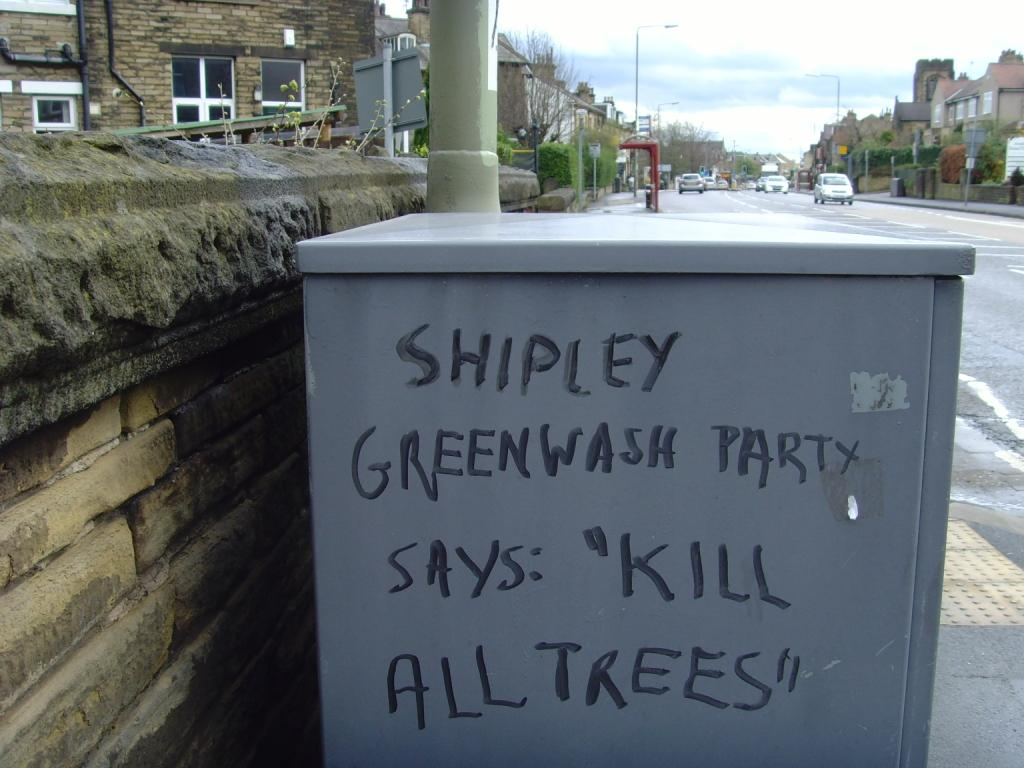
Bradford's local Green party concentrates almost exclusively on holding the balance of power in a hung council obsessed with party politicking and was quite prepared without complaint to see a beautiful avenue of trees in the elegant Victorian suburb of Saltaire clear felled. They are that obsequious as punching above their weight, the party is only concerned with point scoring electoral advantage..... We wrote a few letters to them which they blanked as did their bosses (Nathalie Bennett and Derek Wall) in London.The latter in Off the Wall occasionally writes in the Communist party Morning Star and, to judge from some of his comments, no doubt is acquainted with the situationists and most likely is fearful of our reputation. Our friend Ed Sherman on 18th December 2012 complained to the official planning review about the destruction of a Lower Aire Valley site along Otley Rd containing perhaps the biggest Common Blue population in Bradford (50 plus on the wing at one time) plus a possible badger's set. This was all in line with the "ecologically worthless" diktat decided upon by the Aire Rivers Valley's Trust. (The letter was CC'd to the local Green party. Again there was no reply). Sherman's letter also pointed out that Wickes building merchants were about to commit another ecological crime saying, "Moreover we mustn't forget that Wickes has recently been widely criticised by Friends of the Earth, The World Wildlife Fund, and Greenpeace for selling illegally sourced timber from Indonesia which Wickes claimed was taken from New Zealand and for certain the company will not want to be embarrassed by another ecological faux pas." Moreover, Bradford Green party wasn't even interested in enforcing the obligatory 10% set aside where nature is concernedand Wickes was let off the hook. Yippee: Eliminate every living thing in sight!!!
Furthermore, it wasn't just a matter of traditional nature reserves versus liminal edgelands. Something far worse was waiting in the wings. Despite the logic inherent in corridors the nature reserve mentality did not go away but was set to morph into something huge, distorted and grotesque somewhat spearheading the changed conceptions of officially sponsored park-like terrains acceptable to the neo-liberal urban epoch of shopping malls and variegated, even exotic landscape design surrounding the abodes of the super-rich which has become the accepted model for all neo-housing and urbanism much lower down the social scale. The horrific impact of the post Olympics, Queen Elizabeth Park in east London's Stratford has pushed this conquest of space much farther down the road towards an abyss. (See RAP web Town Planning for Insects1 ).
The really important thing about Nature reserves today and the bottom line as to why they are so favoured, is because they are recognised by authority especially developers and top dog council officials. The 300 pages plus planning document on Bradford's recent Canal Road Corridor proposals is inevitably written in the language of bureaucratic twaddle and gobbledy-gook. Interestingly it only mentions nature in relation to a few tiny nature reserves (among which is the stone dead Shitley Stn Meadow), otherwise, nature apart from horticulture and lawning, does not exist or has no right to exist. Worse still, this notion then becomes ubiquitous taken up by every goon in the pay of the planners.Thus even security stooges on zero hours contracts with "ENFORCER" written on the backs of the hi-viz jackets tell you in a bullying manner if you ever so slightly trespass on what they regard as their terrain looking for interesting flora and fauna etc., that "Nature is over there in the official reserve and not here"!!!!!!! In short, the 'nature reserve' has played right into the hands of a increasingly totalitarian urban developmental project whereby every secret corner, every nook and cranny is taken out and obliterated.
As we pointed out in Part 1 of Bradford's Eco-Peterloo, sadly this baneful trajectory, this horrific distortion, was founded on a profoundly truthful recognition sometime around the mid 20th century and came with the realisation that the days of collecting wildlife, of simple recording and mere spotting of wildlife creatures, rare plants etc., had lost all raison d'etre when it wasn't downright predatory. Nature was in peril everywhere trashed endlessly by ever-increasing patterns of alienated consumption and the stimulation of false needs by advertising. A greater, much more interventionist hands on approach was needed. And there's the rub. Nature had to transfer to the political realm but there its many protagonists came unstuck, even farcical, for this transfer is also a formidable task. It demanded of its protagonists they become acquainted with a much greater grasp of revolutionary theory and practise among which uppermost must be the profound critiques of post second world war urbanism best outlined by Henri Lefebvre, the early psychogeographers and the situationists though there are others of considerable merit. Instead these fledgling wildlife conservationists utterly unaware of these developments took the easy way out becoming nature bureaucrats taking on all the devious wiles and manipulations of typical politicians aping the latter's appalling practices. A necessary critique of the state, of political economy in general was anathema as they opted for deal making carried out through behind closed-door machinations with local councils and / or private companies together with the banking sector. Effectively, this deal making and lobbying outlawed all other activity especially a simple, hands on, DIY, autonomous eco-conscious, sensitive, rank 'n' file activity. Even worse – crowning it all - nature was to have no autonomous existence either. Henceforth nature was going to have to do as it was told...or else! Come the noughties and all protest was to be vanquished in a country where affiliation to various wildlife groups far outnumbers membership of all political parties combined. Moreover, though the UK is home to the largest number of nature conservation groups than anywhere in the world it means sweet fuck all simply because they are so spineless and submissive.
Unfortunately there's a problem with our side to, the first subversive analysis of post second world war urbanism missed out on a critique of the 'tamed nature' that went with it. It proved to be a glaring omission and a gap that we are now trying to fill, and vis-à-vis the basic calamity in Briggate (and the subject of these webs) was the substitute, pastiche nature of the linear park designed by Sustrans architect MacQuillan. This was the essential factor in the slaughter of real wild life, which was to follow.
Although Henri Lefebvre and the early situationists were most likely hostile to the park and lawn designer nature surrounding the early execrable Villa Radieuse in France they so rightly detested and lucidly tried to subvert, no intervention ever took place against this substitute, faux excuse for nature. If they had done so, if say the lawns had been peppered with comment, if say the insect-repellent herbage had been decimated, if say all this had been accompanied by a clued-in leaflet scattered over this living dead terrain, imagine what a profound impact this intervention would have had on future generations? What we had instead was glancing comment without much of an edge. Thus one of Constant's marquette's (with drawings), involved a plan for a technologically equipped, free-floating space for free-floating people – a kind of ephemeral city on legs – beneath which would be a landscape of wild nature. This was probably as far as any acknowledgement went among the situationists during the 1960s in relation to encouraging nature regain its raw, autonomous edge whereby the planet becomes a nature un-reserve for liberated un-reserved, autonomous people. By the time the importance of nature and climate change was recognised the situationists as a group had disbanded, though many an individual influenced by their profound analysis and praxis meant eco critique was thus considerably deepened and if you like, "recovered through transfer" (Marx). Hence this tract.
As for today, if it was merely submission without general consequences for us all then we could ignore so-called wildlife groups. Unfortunately it doesn't work out like that. Seeing the mantra of "working with" the developmental agenda is pivotal to these nature conservation groups all sense of who they are and what they stand for has been quickly lost sight of and the intense socially schizophrenic character of these greenwash eco groups becomes clear: though aware of the horrors that await us due to climate change, in practice they embrace the perspective of the climate change deniers, the big shots at the heart of the developers mission. Hence initially well-intentioned ecos begin to support outright destruction giving to the destructive act a seemingly sustainable, ecological edge, which in practise becomes an orgy of Orwellian eco-speak that is truly frightening. In the vast majority of incidences the leaders of these sustainababble so-called eco organisations aren't bribed via the contents of some clandestine brown paper envelope but do so because they think it is right, making them even bigger buffoons than we initially thought! Indeed climbing into bed with the enemy, reminds us of the 1950s-60s critical urbanist's Ian Nairn's edgy observation that, "friendship corrupts more than money."
***************
Below: Photos from those not-so-long-ago good old days when conservation groups weren't afraid to confront a rapacious neo-liberal, developmental agenda.........
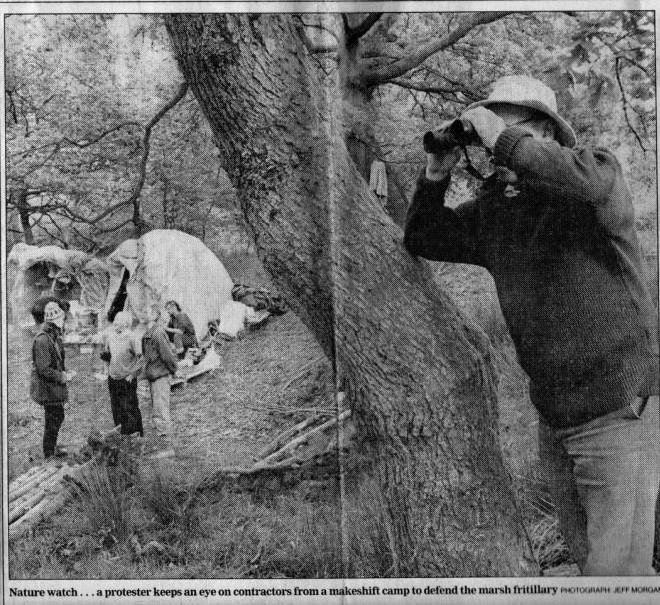
Above: 1996 and Butterfly Conservation along with other people, occupied Selar Farm in south Wales to try and prevent open cast mining on an important Marsh Fritillary site.
Below: 1996 and a nascent Buglife took part in the Newbury Bypass protest to try stop the destruction of the rare Desmoulins Whorl Snail.
Despite the actions of brave people, the courts and developers resorted to their typical solution: translocation, translocation and yet more translocation. And typically both would fail.........
****************
Bradford Urban Wildlife Group (BUWG) morphs into Bradford Suburban Deadlife Group
Although all conservation groups are deeply set against protest some are worse than others. At least the birders of the RSPB go in occasionally for half-hearted opposition even, at times, prepared to instigate desultory direct action. However the model on which a spuriously rank 'n' file organisation like Bradford Urban Wildlife Group is based is Butterfly Conservation, a model so supine it almost beggars belief. Most notably the latter collaborated whole heartedly in the mass holocaust of the Dingy Skipper on the Yorkshire, Lancashire, Derbyshire, Nottinghamshire, Northumberland spoil heaps courtesy of ghastly makeovers in the early noughties never since apologising or even acknowledging that the butterfly has been destroyed en masse. We, who pointed out this simple devastating fact were blanked everywhere. Indeed our films which put the matter straight were censored, air-brushed out of existence in a manner reminiscent of Stalinism, as plain glaringly obvious facts were dismissed as vindictive propaganda. Going on for ten years or more later the CEO of Yorks Butterfly Conservation, Howard Frost could proclaim that the birds foot trefoil (food plant of the Dingy Skipper) was slowly taking hold of the bare shale heralding a rosy future for the butterfly. Instantly you knew the colliery spoil heap he was imaging was a convenient fictive construct as most have been destroyed having long ago succumbing to the lifeless green sward makeovers of the estate agents aesthetic, that horticulturised outlook and necessary adjunct of one housing bubble ponzi scheme after another. True the butterfly is beginning to expand its range after its brutal decimation at the hands of the developmental agenda but this is mainly to do with – against all the odds - the amazing involuntarily spread of its foodplant.
For nature pressure groups like BUWG an overall mode of submission has come to mean they compensate by seeking out never-ending media exposure, which finally becomes the only raison d'etre for their existence. Eco-life as permanent up-beat representation when in reality nature has become a permanent beat-up reality, its representation bereft of all truth. Like a long lost after-glow, nature lives on as representation as it is catastrophically destroyed on the ground, in the air and in the rivers. On the ever permanent TV / Internet screen invading us like never before, a teeming nature is endlessly promoted through the lies spewed out in programmes like The Urban Jungle, The Big Wildlife Revival, Ultimate Swarms etc, (the latter like some sub Icteric add-on minus generalised subversion). Gone, all Gone! Gone too are the days of a bellicose Cyril Haxby and the Bradford Naturalists of the 1950s. Haxby was a man who constantly and ferociously mouthed-off against the newly formed Forestry Commission which took out huge areas of moorland hillside. Haxby was also a guy who had the singular honour of getting himself banned from Leeds City Stn; moreover somebody ever ready for a spell in the pub after non too polite meetings ready to cuss things out to the nth degree. Whilst we cannot glamourise individuals like Haxby – they were also very limited and reductive - we can at least acknowledge their forthright, pre PR (and no doubt pre PC) behaviour.
Since those far off days, women have tended to play a much more leading role in naturalist organisations the ideology of a gender biased, nature-nurturing feminism having been expounded some time ago especially in Carolyn Merchant's seminal The Death of Nature. Women, Ecology and the Scientific Revolution. Indeed it could even be said that such an ideology has been well and truly broken on the wheel of experience since the book first appeared in the late 1970s and what happened on the Briggate site is a sad indictment of the illusion that women per se are naturally more responsive to nature conservation and that "eco feminist perspectives" are an essential expression of womanhood. However such a response would be well overstated. The problem is that nature sensitive, initially well-intentioned women succumbed to the miserable, gradualist perspective expounded by the dull, bureaucratic nature conservationist organisations equipped with a perspective daily becoming more sclerotic and more often than not fronted by a male bureaucracy and leadership with a corporatist, developmental agenda and one that needs to be subverted. However, more, much more has to be done. Leadership in general must be overthrown via a passionate, liberating individual / collective stab at autonomy enmeshed with ongoing action and permanent exhilarating discussion and women must be central to such an uprising. Re-staffing the same structures with mere gender change is pointless; the existing worn out and useless organisations must be abandoned. No more leaders and led!
Perhaps here it's worth making further historical comments regarding the desperate need for a more fully fronted feminist rebellion, one that really cuts to the chase. Early 1970s feminism was predominately social democratic cum modishly sub-Bolshevik oriented, significantly buttressed by a then fashionable Maoism, though along with all such confusionism there were some excellent exceptions notably Shulamith Firestone in America and Annie Le Brun in France, the latter coming out with such memorable comments like the following, "The historical misfortune of feminity was to have been limited to the perspective of roles. True feminist revolt is in deserting these roles." Wow! By the late 1970s, a sex-positive feminism broke away from an often-stultifying feminist moralism characteristic of the previous years. In turn, this too was to quickly give way to a surface, simplistic Sex and the City disposition, which intensified, the more economic neo-liberalism won out on every level and as such has been well summed up in Nina Power's One Dimensional Woman and Female Chauvinist Pigs by the American, Ariel Levy, both books broadly deal with "a woman's right to shoes" as the quintessential essence of an 'independent' seemingly liberated, raunch feminism.
However what we are dealing with here is a certain, very specific, nuancing of neo-liberal womanhood, one very far removed from raunch feminism. As previously mentioned, broadly the central thesis of Carolyn Merchant's The Death of Nature. Women, Ecology and the Scientific Revolution revolves around the notion that women are more sensitive to nature because more nurturing as against traditional male brutality which had the unfortunate side effect that a necessary critique of macho behaviour also got translocated on to nature as brambles, nettles and the like acquired the status of "bully plants", etc. As an untested hypothesis this maybe looked fine at the time though in practise decades later, it has turned into anything but.
It could be said of the neo-liberal epoch beginning with a vengeance in the late 1970s that women gradually became the subject of capital compensating for the fact on a gender level they still remained socially subordinate to the male species, especially regarding wage / power differentials. But why subject? Perhaps for a simple reason related to everyday mundane consumption patterns, women becoming the cornerstone of a finance oriented capitalism floating free on ever more calamitous fictive values with the home as its centre; the home as asset bubble decked-out with increasingly aesthetic, especially customised commodities etc; the home as carport; the home as end piece of the well-manicured garden of hanging baskets etc. In short, neo-liberal feminism has marked progress in domestication and not real liberation from capitalism with its stultifying patriarchical mores.
In reality though this home oriented consumerism could only be the aspirant dream realisation for the expanding suburban middle classes and increasingly, post the great crash of 2007-8, can no longer be the goal for the majority pushed into a race to the bottom. And women at the bottom of the pile are today really at the end of their tether. Nonetheless it was from more privileged backgrounds that the majority of 'nature sensitive' women came from, those who were to become the backbone and usually small time organisers of the new nature 'conservationist' organisations. They inevitable projected their social prejudices on these organisations: stuff shirt, prissy, aesthetic, law abiding, very respectful of authority and inevitably in proper marriages, hooked-up with usually petty careerist, paltry, insipid males conjuring up misty reminders of a late 1940s-50s Keep Britain Tidy perspective quintessentially in keeping with that of a quondam, Tory party, Town Women's Guild. Moreover they tend to look down on women at the bottom of the gender pile.
The bottom line is: they are the wrong women to deal with wild nature because they aren't in their everyday lives, wild themselves. Who among them has cut up untidy, shouted the odds, taken a walk on the wild side and got the sack? Who among them can be pilloried as dole scroungers who drink and like some Mary Jane? Who among them has been in jail or borstal? Who among them has ever been on the game? Who among them holds stroppy ideas about society in general or has ever gone on a demonstration never mind participating in riots? Where are the honky-tonk women within the ranks of nature organisations? Where among them are the tough mums that male hooligans – often getting out of their prams in the wrong way - forever remain scared of? On the contrary these women - these real life, pulsating women – were (and are) very much the butt of seemingly 'nature sensitive' suburban contempt. Not knowing real women little do these suburbanites realise the object of their contempt are far more holistically eco than they ever dare imagine, yet we regular encounter these fine gals in our local wilding experiments and often they tend to be appreciative of our communal wilding efforts.
In the Introduction (Part 1) to Bradford's Eco-Peterloo we pointed out that it was the utilities companies that got the blame for destruction. This needs to be nuanced because there's something else, something far more important to consider: it's also not really the fault of the utilities management, rather it seems their workers are to blame for the carnival of destruction! Again, it would appear, these workers are constantly climbing out of their prams indulging in bouts of rampant vandalism as they blithely cut down trees or smash up heritage features and management who - try as they might – simply cannot control them. Who believes this crap? Well, in Bradford, it's the suburban, 'sensitive' petite bourgeois women in leadership eco roles who spout this cretinous stuff having literally no knowledge of manual work situations and the grim reality that workers (men and women) today are more programmed than ever before in history; having to obey and obey every diktat from on high, handed down to them even to the most infinitesimal stupid detail. In reality today, it's management that runs amok, or rather those who are, at least, able to cover up - in connivance with the real big boys above them – every blunder they amply make.
Behind this entire attitude is a still running sore deep prejudice against the worker emanating from the neo-liberal feminists especially those of a certain age usually occupying leadership positions in eco organisations. Often from typical Tory suburban backgrounds they remember the days when in the 1970s / early 80s wildcat strikes were rampant throughout the UK. Seeing nothing subversive in such activity even when involving women like the Ford machinists, indeed getting no kick out of, no promesse de bonheur, out of this backdrop to everybody's life at the time, they rapidly identified with Maggie Thatcher, the beast whom in indecent haste they began to worship as a kind of religious saviour, prelude to a kind of modern privatised rapture for the chosen few among which they needed to be included. To this day, the long shadow of this identification remains, having in the mean time, somewhat morphed in the process. Thus the real enemy of a future ecological paradise are the nasty, dumb-fuck wokkers, those women and men, often on zero hours contracts, who don't adequately pick up all the litter and other leftovers product of consumer packaging. These 'workers', these specimens are all none people - out-of-control robots - beneath contempt. Moreover, as night follows day, it wasn't so much the utility companies who made a mess of things rather it was THEIR WORKERS WHO ARE TO BLAME FOR ECOCIDE IN BRIGGATE. Sustrans, Ursula, the town and country planning aesthetes in general are therefore squeaky clean. No case to answer!
*************
Followed by a lot of further telling details.....
Though Bradford Urban Wildlife Group regularly meet in Shipley library, not one member was aware of the largely unexamined, teeming wildlife just a couple of hundred yards away and one destined to be destroyed. And why was that? Because the place was a dirty mess, a sight rather than a site that easily outranked the SSSI locality that goes by the name of Trench Meadows in Shipley Glen more than a mile away but such is the group's estrangement from nature,they preferred instead its shadow substitute TV spectacle and / or occasional visits to local 'nature' honey pots. To us it was all so obvious, and though scores of people elsewhere supported our opposition, none on the ground in Bradford were prepared to give us any immediate practical help.
In the Caroline Merchant mould, a certain Ms Susan Stead is the absolutist leader of BUWG in an organisation that brooks no argument, or real debate, never mind thoughtful, open-minded, dialectical discussion. In fact it's structured as if a party whip is in control and unclean thoughts must be permanently expunged and even though among its members there are a few individuals from the lower orders, they can only ever exist within the organisation as faithful step and fetch its. From the early to the mid 1990s onward Ms Stead firmly believed in the butterfly nature reserve of Shipley Station Meadow within the triangle formed by the coming together of three railway lines and initially opened a few years previously by that arch reactionary, climate change denier, David Bellamy. She looked on this media nature superstar with something like awe; a colossus who was really changing the parlous state of nature everywhere. Within a few years this oasis was cruelly taken apart as three quarters of the land was given over to a grotesque park 'n' ride scheme for the benefit of rail commuters. Needless to say the brutal truth dawned quickly enough: that useless heap of mobile metal, the car, was / is far more important than any insect. And despite greenwash illusions to the contrary this attitude today is truer than ever, one embraced by most greens seeing in today's car a sensitive combination of technology and art especially as the age of the supposedly clean fuel electric car appears on the horizon. The response of a bogus rank 'n' file group like BUGW was from its inception to go along with the developmental project merely attempting to modify at the edges its most brutal aspects, and often not even that. Almost from the very start they hideously went along with the empty headed notion that a meagre plot of land – a shadow of nature – might prosper. What should have been done is obvious: the newly formed group should have closed down the farcical Shipley Station Meadow but with the help of a belligerent fanfare accompanied by a strongly worded leaflet. It would have hit the PR machine square in the face becoming a benchmark of ecological activism that would have made waves endlessly disturbing the powers that be contemplating further such acts. Instead this baneful compromise, this fateful submission strengthened the destructive agenda of developmentalism.
Such naivety almost defies belief yet it's all too common out there whereby it's celebrities who change the world and not the collective action of 'the people' which, of course, includes even a small group of individuals acting on their righteous beliefs. Immediately this transcendental meadow, this dismal plot of land became ordained as a butterfly Mecca where the Ab mariscolare of the Common Blue would be tenderly nurtured, and in consequence given time, a nursery for the rest of Bradford. Therefore any small colony that was discovered within a mile or so of Shipley Stn was necessarily attributed to the meadow's conservation success the butterflies having ventured out to pastures green everywhere. This of course was ridiculous but more seriously it proved how little so-called eco conservationists investigated sites even on their own doorsteps. If they had they would rapidly have realised there were small Common Blue sites everywhere throughout Bradford though mostly on so-called ugly / brilliant corners, those edgelands related to Bradford's industrial past, scarred and abandoned, mucky, unpretty, even shrouded in shades of desperation, therefore bad, even sinister and especially significant in the up and down terrain - that rocky, turbulent outcrop - which makes Bradford so unusual, even remarkable and which so fascinated John Ruskin.
The ideology of the Butterfly Meadow remained intact precisely because there was no searching out of things strange and unknown. Reification had become absolute, so innovation firstly, on the level of changes in perception was out of the question. Therefore, according to this ideology there was no question that the small Common Blue colony we found in the late 1990s in Windhill Quarry on Wrose Brow, which hovers in the distance over the station, was inevitably an offshoot of the meadow. The backdrop to such a mistaken, even quasi-mystical concept is a belief in nature reserves, those cordoned off areas guaranteed to save nature everywhere. Of course this defies all more rational explanations at the same time as it points to that very simple lack of practical looking and observing in the age of programmed consumerism where one must only look in certain ways and direction usually related to shopping. Instead keep attention fixated on "the honey-pots" those areas designated as wildlife reservations no matter how small. Nothing else really matters...
Alas, from roughly 2004 onwards that tiny piece of nothingness, the Butterfly Meadow, was going from bad to worse, even though often acting as a glamourised frontispiece for Yorkshire wildlife trusts and Yorkshire Butterfly Conservation. Susan Stead knew in her hearts of hearts that the meadow was failing yet refused to face the fact. Yet nobody dared tell her or else facts bounced off her tin ear and were therefore disregarded. Ideology became everything: this was a nature reserve par excellence. Full stop; nothing wrong with the hallowed ground. But the nagging doubts would not go away. It was crazy; the meadow was dead, dead, dead.
Yet, in response Susan Stead believed in an even more messianic way that all the Common Blues in the extended vicinity of Shipley Stn came from the small meadow, as the mariscolare's range seemed to increase. According to her analysis, they were flying everywhere around the station alighting on the bramble florets in the adjacent Big Field during the day returning in the evening to the protective carapace of the meadow; and their satisfied with an abundance of nectar sources and joire-de-vivre, they bred like bunnies. This was ideology bordering on the nonsensical as by 2010 the Common Blues had completely died out here and the only butterflies that tarried across this by now, artificial meadow were those breeding elsewhere in the station's environs. Why? Because we had made certain – gradually and clandestinely – and for a number of years that we planted many, many trefoil plants followed up with extensive seeding here, there and everywhere. Success took time but even within a couple of years or so fairly extensive patches of birds foot trefoil began to spread especially so in the vacated space of ballast where once the old signal cabin stood and, more importantly, the huge area at the back of the Ilkley platform as well as on the dummy end, old platform at the bottom of Station St.
"Lackeying the varying tide" in Bill Shakes' words Ms Stead really didn't know where she was / is and / or what's she doing moving in all directions at once, desperate to remain in the limelight. Nervously keen to impress authority, forever looking up to the hierarchy in poorly disguised wonderment she imitated them as much as possible disparaging workers and menials as the root of all anti-eco evil. And we weren't to be excluded from this scenario. In this stew, management's enlightened efforts were always screwed up by Bolshie workers never doing what they are told and always holding the boss to ransom.
Thus a thoroughly horticulturised and ridiculous Shipley in Bloom uneasily invaded Ms Stead's weak conservation perspectives. She looked at the environs around Shipley Stn readily agreeing with Shipley in Bloom that the main obstacle to conservation and wildlife in this remarkable railway junction was too much litter thrown away mainly by irresponsible passengers (sorry customers). The place needed a good clean up preferably done no doubt by a sub-contracted PPP outfit. Pronto. Essentially this had become the crux of Susan Stead's wild life improvement efforts; more than that it chimed with her pronouncements three years previously that the meadow was being ruined by a bunch of travellers in caravans who'd taken over one of the triangles park 'n' ride bays. The blame for a failing meadow was shifted on to the travellers rubbish and had nothing to do with her utterly incompetent stewardship. It was a scapegoating that was racist to the core.
Truth to tell, considering no waste bins were provided by the station's management for the travellers use there was little dumped litter. The travellers were in fact a courteous bunch of people ever ready with a welcome hello and friendly wave. If this was merely PR it was also a very seductive exercise as in no time at all we (and others) often engaged in friendly chats with the travellers..... In reality however, the meadow was failing not only because it was far too small even to be an oasis but because bad drainage (no doubt in consequence of an inadequately drained car park foundation and / or the increased rainfall by-product of climate change) had finally brought into being an all-the-year-round damp sub-strate which the dwarf, indigenous birds foot trefoil had found to be an inhospitable terrain to expand upon. And the same went for the larvae of the Common Blue. Radical action was needed if even this pathetic oasis was to survive. The whole meadow had to be more or less dug up replaced with a new fairly wide shingle-filled drainage ditch, followed with a substantial seeding of continental, long stalk birds foot trefoil, together with the creation of hillocks of arid brick dust etc, suitable for the indigenous birds foot trefoil. This though was out of the question as an increasing blind Ms Stead was constantly proclaiming there was nothing fundamentally wrong with the meadow. Thus in a terrible film for Yorkshire TV in the summer of 2013, the illusion was again proclaimed that the famous meadow was alive, stunning and vibrant; even more dreadfully the lie was upheld that the Common Blue was breeding in this space when it plainly wasn't. Fronted by a ridiculous blurb saying Ms Susan Stead was an "amazing woman" a neo-liberal cum Stalinoid propaganda had become the order of the day. There she was filmed with her palette, brushes and easel merrily painting away 'creating' (ugh) art works so bad that they give a new depth and inflexion to the old slogan and truism that "Art is Dead".
By 2010, a small group of us began to realise we had to start doing things ourselves by going eco hands on; getting down and dirty amongst all these seemingly disgusting leftovers of two centuries of industrial revolution, even though we knew what we were going to do was strictly illegal.There was no point in asking permission as it would have been refused point blank as for sure this would have been construed as "guerrilla gardening" but with another intent behind the concept. We knew that Bradford was probably one of the most wildlife rich cities in the UK but that its wild life was now everywhere in peril despite being somewhat protected by the rocky terrain and which at times produces breath-taking conjunctions when chanced upon. We even said at the time that "Bradford was a city hovering on the marvellous" in contradistinctions to all the media hype about myriad regeneration projects based on nothing more than ponzi schemes stimulating a further frenzy of ultra commodification. We also knew we couldn't stay within the confines of Shipley stn but had immediately to move out over into the surrounding environs along the valley bottom and the lower slopes of Windhill. Above all, this area with its specific micro-climate was superlatively rich in wildlife.(Moreover, even within the confines of Shipley station by 2014 there were also substantial colonies of Dingy Skipper and Brown Argus in existence though BUWG members were presumably unable to find them as no mention has been placed on their pathetic website... As the TV ad says, they really do need to go to Specsavers......)
So our merry band of sisters and brothers set out to work and play. Time and again, we were struck by the parallels between what we were doing and the struggles of William Bunting's Beavers decades previously to conserve the raised peat lands of the Humber Head Levels from being seized and drained by large-scale agriculturalists and stripped mined for their peat by Levingtons. Though he would learn old English and use common law to successfully argue his case, Bunting, an engineer who had supplied anarchist insurgents with guns during the Spanish revolution of 1936-9, had a rag tag army of volunteers to call on. Composed mainly of miners from the Thorne Moor, and Hatfield pits during the 1970s, students from Leeds University would also muck-in giving the Beavers a helping hand in their battles with the authorities which included English Nature, the forerunner of Natural England, the threadbare state body charged (jokingly) with the defence of nature.
How different things were in our case! Though our mammoth efforts attracted a lot of local approval rather than hands-on support, when compared with Bunting we lacked a natural constituency, the lack proving crucial in our battle with the greenwash developers of Sustrans who, because of that lack, were able to brush us aside like flies, forgetting fleas are also classified as flies and that this particular "war of the flea" had only just commenced. And, oh brother, have you ever tried sleeping with a flea in the bed? Knowing that it was only a matter of time before the authorities would move against us, and despite our bitter reservations, based on actual experience, of corporatist tenants / management organizations in the council sector, we thought of contacting the Windhill tenants association to acquaint them with what we were seeking to achieve. We never got around to doing this, all our time taken up with the massive, nature-enhancing transformation we were bent on carrying out in this most favourable of spots. And so, to be honest, we were only ever on nodding terms with local council tenants, the majority, though, clearly impressed by our commitment, especially in view of our age. That we could swing an axe with the best of them in our late sixties commended us to tough street kids, they addressing us as "friend" whenever we happened to bump into them. They sort of knew instinctively that we posed no threat - unlike the Sustrans enclosure which spelt their doom, the anodyne greenwash makeover, a covert declaration of war on council and social housing tenancies in the name of yet another, unsustainable, property price bubble. We became something of a talking point amongst local bus drivers as we heaved bags packed with cornunculatus and pedunculatus trefoil, doves foot and cut leafed cranesbill, knapweed and field scabious on board busses to transplant in the vicinity of Shipley station, to aid the spread of the Common Blue and Brown Argus butterfly (and latterly the Marbled White butterfly, the last two flowers particularly appealing to it, as nectar sources). Sometimes we would leave a trail of mud behind us and which must have irked some drivers, who now have to double as cleaners. Despite the inconvenience, the majority were right behind what we were doing with only the odd surly bastard countering "we aren't a bloody removals firm, yuh know". We would, on a number of occasions, hire saloons from Abbey Taxis in the city centre, to pick up 15 or so bags from Gaisby Quarries, the Asian drivers doing it for a cut price rate once informed of what we were up to. They were even more impressed when we explained we were doing it off our own bat, and that we were not in receipt of any grants, they adding it would have been so much better if we had been able to engage local youth in our project. Too right!!
Behind ad hoc tactics though we were armed with a reasonably coherent strategy. We kind of realised we were and are an avant-garde..... ever hoping others will follow through example and make no mistake about it this form of autonomous activity really does communicate with the housing estate poor if our experiences in Shipley are anything to go by. These people knew we were genuine because our intervention, our endless diggings, seedings and what have you were done by ourselves alone. Nothing was sub-contracted out delegated to some outside organisation, even though we were often knackered by the effort. The locals responded with daily friendly greetings and a common dominator from tough gangs to single women rather nervously picking their way through the rough tracks bordered with even rougher grass. Others – often the most unlikely of individuals - gradually became more active, following us in a kind of discombobulated manner adding their own off-shoots and two penneth; a kind of parallel invasion, a stealthily sleuthing, potentially occupying force and one the authorities found more and more threatening. Our unknown, nameless compatriots became freak, madcap anarchist columns finding their way subconsciously crawling as it were towards a new world, a movement whose shape we had somewhat outlined previously in the Nameless Wilding webs put together under the name of the John Clare Collective. We described how we were shadowed both by insurgent individuals making inroads on the urban, edgeland terrain as well as by those robo-sapiens in the pay of the authorities forever trawling the Internet, in this instance the council sleuths ever ready to identify and maim. Our eco wilding subversion had thus to be destroyed taking out every living insect, bird, weed and wild flower. Kill. Exterminate. The huge and empty land bank of a BNP Paribas site on the banks of the River Aire had to be sprayed with defoliants by robo-sapiens and then sealed with arc welded steel. A Manningham land bank site was denuded and enclosed with rhino fencing (on which somebody then posted a sign "Bradford twinned with Auschwitz–on-Sea, plc") and finally the glory of Briggate had to be put to the sword. All this signalled that any attempt at urban dis-alienation must immediately be nipped in the bud preferably with the blessings of the official green movement, as this cover was the best defence of all. It is of course a path that has been well followed elsewhere initially vis-à-vis the urban terrain, one that cruelly dawned in the aftermath of May '68 in France as that creep of a left wing British architect Richard Rogers - cognisant to some degree with the themes of May '68 – destroyed the psychogeographers paradise of Les Halles building his own wretched controlled and commoditised play arena, the Pompidou Centre. He was later knighted for his efforts, (C/f London's Olympic Legacy: TOWN PLANNING FOR INSECTS.
We were acting horizontally, autonomously; the eco rackets bringing in the professional landscaping outfits who invariably don't possess an ounce of sensitivity. The reality is only experienced field naturalists know how to nuance and help habitat respecting nature's autonomy knowing they cannot substitute habitat. As for baneful professional naturalists they don't take up digging tools themselves as most are made up of middle class people who simply would never get their hands dirty. It is beneath them to do something like that in any serious way. They are there to organise conservation work occasionally visiting a site to observe the working stiffs and nothing more. In the past generally having contempt for the manual working class this attitude is now redoubled as the workless / zero hours society of Chav demonology kicked in, made up of no-people beneath contempt. Or if not these 'enlightened' 'eco' middle class go in for a seeming do-gooding deploying borstal, or possible borstal cannon fodder to do the dirty work - e.g. as BEES (Bradford Environmental Educational Services) in Bradford does re the upkeep of the old quarry of the Boars Well near to the city centre.
Everywhere we went, local people took an interest in what we were doing. Once on the top of Gaisby Quarry, a local resident asked us in for a cup of tea, intrigued that we were taking the cornunculatus trefoil from the exposed heights down to the valley floor below, where it would do more good as the Common Blue foodplant of choice. True, there was a Common Blue colony up here and that had remain undiscovered until we came by to take a look in the 1990s, most of it being destroyed when a ticky-tacky estate was built on the disused part of the quarry during the housing boom of the early noughties. From the heights of Gaisby we would look down on this legoland estate and try to make out the former features, regretting we had never taken more photographs of its once outstanding topography and that, typically, has been all but obliterated along with its wildlife. We wrote in the late 1990s there is a type of building that can actually enhance these amazing, manmade features that, over time, takes on a happenstance all of their own - but only by being put beyond the reach of architects, builders and planners. We would also find the rare Jacobs Ladder up here and wonder however did this plant of limestone grasslands ever get here and take root on a substrate of York stone, the plant having been discovered in nearby Malham Cove in the 1660s by the great botanical insurrectionist, John Ray. And yet, well over 300 years later, it would remain undiscovered up here, an oversight that is yet again an appalling indictment of local wildlife groups, and would, if we had read the runes correctly, predict the ecological ruin of the Shipley site and any hopes we might have had of being able to mobilise Bradford ecos in its defence.
Inevitably the great leader (Ms Susan Stead) began to come across our wilding interventions and immediately somewhat appropriated our often colossal labours as a means of further bigging-up her media reputation providing she could somewhat claim the glory for herself though in the meantime making certain she kept a safe distance by not getting her own cleaner than clean hands grubby in the process. In any case basically she looked askance at our efforts always emphasising their 'illegality'. Once during 2012 encountering our obviously criminal presence in The Big Field adjacent to Shipley Stn, where we were planting trefoil, knapweed and scabious for Marbled White butterflies reported in the vicinity that very year, Steady reprimanded us for blatant, serious skulduggery saying we could be accused of "stealing earth"! It was that petty! As for earth? So this is what you call this fascinating substrate of The Big Field; this base amalgam of decomposed cloth, coal, metal and sheer soot, leftovers from the time this place were busy sidings packed with coal and Mungo Shoddy freight trains. As for "earth" who on earth would have desired this neo-soil in any case? "Moreover" she threatened, "be careful that "Shipley in Bloom don't see you"! Seeing it as a pathetic comment of a steadfast (get it) suburbanite, little did we know what scheming she was up to regarding what she called "the concept" least of all re-baptising The Big Field with the polite name of Bradford Meadows c/o the idiots she was laicising with, the so called, bucolic Friends of Bradford Beck. Little also did we realise that she had an eye on making this place into a chocolate box cover, eco-lite sufficiently horticulturised semi-park devoid of wild nature. Her basic conservative instincts were appearing: she wanted a domesticated nature and was already preparing for an evil collaboration a mere year later between Bradford Council and Sustrans which would eliminate in Briggate one of the richest most bio-diverse site in northern England.
Sometime later in 2012 she briefly accompanied us to see the neo industrial gorge running through Briggate just across the Bradford Beck. Walking in the Briggate basin, a former wharf and the last standing relic of the old Bradford Canal, all this philistine could see were abandoned tyres and the inevitable musical accompaniment of old tins of paint, lost umbrellas, twisted bits of rusted steel and what have you. Yet this was all she could see and was horrified. There was to be no subtle neo-psychogeographers appraisal here, no sense of the 'new sublime'; no sense either of concepts from earlier times like Marcel Proust's "The real voyage of discovery consists not in seeking new landscape, but in having new eyes." She hated the place! Loathing oozed from her very pores. To even try pointing out the area's remarkable bio-diversity was beside the point; this area offended, this unspeakable industrial dereliction, this detritus. She knew it had it had to be swept clean, swept aside, killed off! She also had the manipulator's wit to realise we could be trouble and would have to deploy cunning measures in the hope she could get away with the forthcoming crime. We were willing, committed fools who needed to be bamboozled. She was the expert as she was top of the hierarchy and that was and is, the be all and end all of everything! Subsequently we weren't informed of an essential meeting arranged with the idiot landscape architect McQuillan who outlined his concept of a linear park to accompany Sustrans proposed cycle way through the industrial cum post-industrial gorge.
But we had been here before. Some years previously in the early noughties we had been excluded – having being promised we would be informed - from a countrywide discussion on brownfield sites specifically the abandoned colliery spoil heaps which for many years had become havens (and heavens) for disparate wild life. Official conservationists belonging to wildlife trusts and Butterfly Conservation deliberately excluded us fearful we would upset the developers plus fine upstanding bodies like the Royal Bank of Scotland who were about to fund an horrendous, destructive makeover involving in particular the holocaust of the Dingy Skipper and much, much else besides. In reality the only question to be discussed was how all could come together to realise an estate agents' greenwash aesthetics, which is what happened in practical reality. Ever since that fateful moment our revolutionary eco critique has been brutally marginalised as a maimed Stalinoid law of omerta kicked-in; our theories a form of samizdat crushed under the weight of neo-liberalism with our films never to be given a public showing; nay, more than that, never to be mentioned. So far, the suppression of the truth has worked wonders. Ms Susan Stead quite some time ago fully realised that ignorance really was bliss wholeheartedly embracing lies wherever she goes. It seems a long time ago she was told never to look at our websites and unquestionably, it seems, she obeyed the diktat........
Moreover, she didn't even know her own patch of Shipley Stn. She was so on her way to robotisation she couldn't even see other areas. She was so cloned she couldn't even allow herself to look elsewhere. It was forbidden. It wasn't even lawful. She was only interested in position and hierarchy and a honourary place on Shipley station's management committee was all that mattered. And from such heights and honour she wasn't going to say anything that could offend, so Network Rail could –and did – cut down any tree they liked simply for the hell of it and really invasive plants like Japanese Knot Weed were allowed to flourish at will. Don't upset the apple cart was all that mattered and in any case wildlife must learn to respect private property, trespass laws and Lockein civics........
And as for the Marbled White. We first got wind of it during 2012, a youth we were on passing terms with saying he had seen one in the field behind Shipley station. "Oh yeah" was our sceptical response, sure he had mistaken a Large White with particularly pronounced black markings for the butterfly. We would foreswear our disbelief a couple of days later when we managed to get a crappy photo of the butterfly in the field that bounds the Leeds Road, the photo going on Bradford Urban Wildlife's web site. We felt real good about it, sure that there was no better place for the butterfly to make out than here. And how right we were in our prediction, we counting close on 50 in the vicinity of Shipley station during the summer of 2013, the maximum count recorded by Bradford Urban Wildlife Group a mere 5, the group obviously suffering from a bad case of myopia in more ways than one. We never checked out the Briggate site, as we were too distressed by the destruction taking place there, but we were told by a consumer of nature who remains irritatingly stuck in the mere recording of wildlife, he had seen them on the site. The killing off of the butterfly on the Briggate site is sufficient in itself to damn Sustrans to all eternity - never mind all the other unspeakable horrors it is responsible for.
**********
Once all hell had broken loose as Bradford Council together with Sustrans in early 2013 destroyed a big part in of the amazing wildlife site adjacent to Shipley station, there was to be no going back. War had been declared and we hadn't started it! Though the part of the site called Briggate lay in ruins Ms Stead's instinctive response was to back the destruction simply by saying – more or less – that it didn't matter, that, in fact there was no serious destruction. Worse than that there were no butterfly colonies in Briggate. The Small Tortoiseshell, it seems was in the February of 2013 happily hibernating in the trees (no matter that it's foodplant, a glorious, rich, thick bed of often giant, ancient nettles was destroyed) and as for the Common Blue and its inimical Ab mariscolare variety peculiar to this industrial gorge, well it simply didn't exist. Again, was she blind? This was preposterous stuff! In fact, Ms Stead simply didn't know, for as previously stated, she'd only ever been on the site for half an hour and hated it! Later, the leader of BUWG even sort to absolve Anne Heeley, Bradford Council's dire bio-diversity officer who had had the temerity to say Briggate was virtually valueless regarding the quality (or lack of) its natural life. As also mentioned elsewhere, Ms Heeley further said it was fine to cut down the wych elm trees host to a colony of White Letter Hairstreaks because other elms saplings could replace them! Moreover, the bureaucrats of the council knew better than we did what was in Briggate!
And then the familiar scapegoats were again wheeled out as Ms Stead blamed the utilities companies and beck maintenance firms including Yorkshire Water for the destruction (if indeed there had been any). Yep, it was those ignorant workers again who had gone all vandalistic yet again! Nothing could be farther from the truth. Look to the aesthetes.
In fury we sent a letter to Susan Stead. 4th April 2013 and below is an extract....
"And so to the Briggate site (formerly the "lanolin site"). We were the only two people in Bradford who were at all responsive to the site and adjacent areas and open to their multi layered suggestiveness. The vast majority of 'nature lovers' and ecologists in Bradford including BUWG, BEES, etc. would have regarded them as an eyesore and not worth a second look, their retardation that bad and out of sync with the times. What it will take to shift this sickening, knee jerk, deeply reactionary view is beyond our envisioning. It was just so easy for the Council / Sustrans, etc. to move in and destroy because, if it wasn't for us, this malevolent act of destruction would have been almost totally regarded by BUWG, BEES, etc. as an act of wild life enrichment and visual improvement the more it resembled parkland and suburban gardens. This is not nature but its ruin, the respectable appearance of nature, not its wicked, liberating essence.
And then what about the Woodpeckers both Green and Greater Spotted and the rare flora? We could go on and on and on, but what is the point? BUWG has lined up with the destroyers and is seeking to whitewash them. don't worry because there is virtually no one in BUWG, BEES, etc. who can contest the party line because of one enduring, unassailable fact: their pathological hatred of genuinely urban wildlife. Obviously neither of us can have anything more to do with BUWG and we aim to make our objections public in the fond hope others will follow suit and leave in disgust."
(Obviously in the above letter, many details and names had been left out of the reckoning especially the bats, never mind the abundant small mammal life, but in the heat of the moment, in the despair and the anger, it's easy to forget things......)
Because our objections were forthright and we pulled no punches we were inevitably condemned outright as Ms Stead demanded we apologise to all BUWG members for having openly sarcastically renamed the organisation, Bradford Suburban Deadlife Group. We also took great pleasure in learning that we'd kept top bods (or top gods) on the council awake at night. In response Ms Stead even went more firmly behind the powers that be seeking out every photo opportunity available to show her solidarity with fellow partners in crime. The behaviour was craven.... as we said in a letter at the time:
"We don't doubt we were thoroughly slagged off to Bradford Council and made into a laughing stock, courtesy of BUWG. Susan haughtily dismissed our initial protest with the words "you've had your fun", the very words GCHQ and M15 would use against The Guardian newspaper for publishing the Snowdon spying revelations just prior to taking a hammer to a computer hard drive storing the top secret documents, even though other copies existed. It is surreally symptomatic of the totalitarian state now dawning that even the liberal middle ground are required to submit to the most infantile irrationality without protest. And so we were expected to go along with the mindless destruction of the Briggate site without demur. Unable to accept the unacceptable, we were the problem - and still are."
Then, almost a year later, came the big blow: Morrisons was going to build a supermarket in this landscape of contempt seeing it was next to a major commuter rail exchange. Ms Stead reacted in horror even issuing a statement that was published in the BUWG newsletter which nevertheless came out with the same dire litany that marks all these ultra collaborationist greenwash groups: BUWG would work with Morrisons no matter what to ensure some trivial ground to be set aside to 'protect' in particular, the Marbled White on the Big Field!! Meaning, prepare the butterfly's graveyard.
Later it transpired this was a Plan B alternative as Morrisons was desperate to build their new store on the Crossley Evans scrap metal recycling site adjacent to the Otley Rd on land owned by D B Schenker and Network Rail, a site that has since been heavily contested locally Then, after such pusillanimity all opposition to Morrisons new supermarket had to be curtailed forthwith; the result being that all stickers, etc. objecting to the development were torn down. Protest was out, the Greens demanded it! Seeing protest was declared an evil act henceforth we proudly proclaimed ourselves Los Amigos del Diablo! Not only that. It was just so easy to pillory Morrisons for blatant hypocrisy for hadn't the supermarket merely a few years ago launched a sophisticated "anti-greenwash initiative" when developing their Kidderminster store, when hand on heart, they provided a "company green print for stores of the future" taking care of local otters and cycle paths?.... You could throw these facts right back in Morrisons managements ugly mugs. THE GREENS SAID NO...... but we did just that it in any case!
Moreover, in a kind of angry open letter to BUWG we suggested members could have occupied this disputed ground with pop-up tents around the Briggate site even though many participants are retired but such is the leaders and led unquestioning passivity we knew this would have been out of the question. If they had somehow overcome this ridiculous self-imposed obstacle their retirement status would have made things a lot more difficult for the authorities sent to deal with them. (Perhaps like the recent Barnsley based Freedom Train Riders, a morphing, pensioner, anarchist inclined, Iron Column of Women against Pit Closure thirty years on and an inspiring event). Moreover direct action would have immediately attracted some enlightened youth as well as others. However against the grain such prospects were nil. The guiding maxim of these sheeples is: don't put authorities back-up; get on your knees to the great and good! In reality such a submissive attitude is pathetic and nothing more than a permanent stab in the back for those who make an effort. Deploying the reality of a certain age can tap into big advantages and Occupy in New York's Zuccotti Park wasn't short on creative wrinklies. Moreover the notion of "the youth revolt" is less than ever in the past 50 years though the reality of the ageless proletarianised is bigger than ever having sucked in ever bigger swaths of a once large middle class as the aspirational become almost indistinguishable from the permanently marginalised.
Although we created quite an underground stir it was hardly surprising that no mention was made of our principled opposition either on paper or on BUWG's pathetically deadly boring website. Totalitarianism reined supreme. Omerta as always remained the order of the day.....we had been airbrushed – yet again - out of existence.
....As for the future most likely our real enemies will be not so much the developers but the official ecos intent on recuperating the raw abandonment of untrammelled, amoral nature as the nature bureaucracy re-marshall their sullied forces adamantly reinforcing cover-up of the destruction which took place during 2013.
***********
Moreover, it was not just nature's disquieting freak show that had to be evicted from this post industrial Galapagos, but the oddballs, misfits and other dodgy people that also felt more at one in this their largely surveillance free, devil's island playground, the place to be rendered a yawn of a hollowed out, re-commoditised space by Sustrans and handed over to an up market, neo-liberal, home owning elite from literally across the tracks who, up to now, were absolutely ignorant of its existence. Having put the environs around Shipley station on the map, we would become convinced we had inadvertently fed a powerful appetite for revenge, the appalling destruction of nature that was to follow, also a settling of scores with us.
Though, in the last analysis, it was economic factors that would drive this appalling destruction and which were a consequence of capitalism hitting an internal barrier, sadistic psychological forces were also palpably in play and which would become ever more so as we sought to put obstacles in the path of this destructive juggernaut. And so heartbreak would follow heartbreak as each outrageous act of destruction would be outdone by acts that were even more outrageous, as if limits were being tested, the adjective, in ecological terms, here been given a whole, new meaning - as indeed it had. It seemed to us the progenitors of this destruction (Sustrans, Bradford Council, and Fiends of Bradford Beck) wanted to be avenged on nature, and that this particular skirmish in a universal war of annihilation had been anticipated in myth. And so a statement of ours would draw attention to how the myth of the Ragnorok was once more receiving an airing in extreme right wing web sites. This Twilight of the Gods, (which is how it translates from old Norse), had formed the basis of Wagner's Ring Cycle and was much admired by Hitler who even more than Wagner bent it to serve his own ends, Wagner, however, more successfully treating it as raw material out of which he would fashion the world-dominating, modern myth of the artist as messianic demi-urge replacing that of the departed gods, the "bohemian corporal" also learning much from German theatre on how to give these myths a particularly nasty, mesmeric doh-wop, ultra nationalist inflection. A glance at the poetic edda in which the myth of the Ragnorok can be found, shows how riveting and germane some snatched measures still are: "weather all treacherous", "fire engulfs the age", "it is harsh in the world", "people walk the road to hell", "no man will have mercy on another", "an axe age, a sword age" etc. Hmm - an axe age? In the case of Sustrans, a "chain saw age" more like, the bastards all but clear felling the Briggate site in an afternoon, leaving only a couple of ecologically worthless, aesthetically posed a la Corot / Claude, trees, to signpost the cycle road to hell. However when we cited the Ragnorok, we specifically stressed it was a vibe, and not something intentional, and which was operating behind the backs of Leeds Sustrans and that we must make a distinction between what an organisation thinks it does and what it actually does. This schizoid split intensifies according to the degree one is involved in the Sisyphus task of restructuring capitalism, or promoting its ends, which is what the Sustrans makeover in Shipley is all about, this debugged nature upgrade as devoid of substance as the bubble capitalism it is in hoc to. The brazen breaking of planning and bio diversity laws also has a stink about it that is peculiar to the scandal ridden, speculative side of capitalism's valorisation process, Britain now the world's R and D capitol for shady research into the manufacture of fictive values.
THE END....... AND WHERE WE START FROM
Attachments
Comments

Trouble Up'T Green Eco-Mill: Bradford's Eco-Peterloo (Part 4). A photographic record cum commentary on how an urban commons of extraordinary bio-diversity was obliterated. Originally published on the Revolt Against Plenty site.
Note on "Monstrous Bastards" moniker, May 2025
In reality - The Monstrous Bastards - was all part and parcel of the wider John Clare Collective experience. In fact, they (Stuart and David Wise) found out they were being named as such by council officialdom by a great gal who helped clear 'the big field' alongside the Bradford Beck and whose sister worked as skivvy cum cleaner in Bradford Council offices. Laughing with joy the moniker was immediately embraced alongside Tweedledum & Tweedledee, Batmen & Robins, etc, and spontaneously placed on flyers, letters and what-have-you and inevitably, the Revolt Against Plenty web........
David Wise
------------------------------------------
This entire stretch of the former Bradford Canal and the land on either side has been derelict since time immemorial - or rather, at least since its closure in 1926. In part, it had become something like an urban commons, a term coined by the naturalist, Richard Maybey to describe how people had started to make use of these derelict places following the decades of de-industrialisation beginning in the early 1980s.
They were / are polluted, seemingly unappetizing; 'ugly' places of little potential use value especially when dissected by stinking open sewers like the Bradford Beck. But suddenly something wonderful started to happen, against all the odds, as nature began to colonize these god-forsaken wastelands they became alive with insects, birds, unusual plants, etc. They were / are so rich in wild life they came to be known as "post industrial rain forests" and the area around Shipley Station was no exception to the rule - so much so it became a matter of utmost urgency that its amazing, overlooked bio diversity be protected.
On top of this there was a remarkable array of plants. Since the site was still relatively unexplored, a species inventory was badly needed covering plants, dragonflies, bees, hoverflies, flies, moths, fungi, mammals other than the rabbits and foxes in evidence. And not forgetting the birds inevitably attracted by the abundance of insects and the warm, wooded shelter the place once provided. We could only do so much by ourselves regarding ourselves as facilitators and still live in hope that others will follow suit.
The former Bradford Canal is lodged in the city's unconscious. Like a fatal trauma, the memory of it won't go away and every so often unbalances the entire city. It is the most infamous canal in all history, and Briggate was the last extant remnant of what has to be the most infamous canal in history, this industrial Styx periodically bursting into flames, like it was flowing straight from hell. Its waters were black, the headwaters that lapped the cathedral reminding John Ruskin of the contents of a spilled ink horn. Opened in 1774, the £20,000 required for its construction had been put up by local coal owners. It was soon transporting not only coal but also quarried stone and bringing in iron ore, which was then carted along rails by horses to Low Moor iron works. It was to this boom city that Ruskin was literally drawn. It was on this city; Ruskin focused his welfare plans and energies. Venice was the theory, Bradford the practice. Bradford Council therefore had to put a stop to all such revealing memory especially all memory of the canal that became Ruskin's obsession destroying an organic evolution that makes a thing of beauty out of the irredeemable and with it, why not also give John Ruskin a good smack in the gob? (This preoccupation was a central aspect of his life that has unfortunately been missed out in the recent film Effie Gray where our nephew, the actor Greg Wise (ironically and coincidently) plays Ruskin!! )
Beyond this devastation why clear away all the leftovers of an industrial past so we can pretend it never existed. In short all we ever had here in England were banks and the rising price of residential property. Nice things in fact!! But this industrial detritus, the tyres, the old boilers, the layers of ancient scrap metal and what have you really does mean something. Isn't this need to spirit away, to wash clean as it were merely to satisfy some ridiculous, worn out ideology of what is the only enforcedly natural vista available; a constant replicate chocolate box tin-lid consumerism or, a nature idyll kitsch display to hang on walls for sale in a 99p shop? These tyres, these heaps of deteriorating past industrial 'junk' are also often home to insects and plants. They thrive here. Old boilers etc are homes to families of foxes; all to be culled, all to be destroyed as only a brain dead landscape designer knows how to.
As we said to Bradford Council's bio diversity officer, Anne Heeley in an email: "We specifically begged you to ask the council's subcontractors not to tamper or remove the soil or interfere with the basic topography of the area. Well, you never wrote back or contacted in any way, even though an email address was supplied. Nonetheless we still gave you the benefit of the doubt, thinking you must be doing something positive relating to this request.
More fool us. Your response it appears was to do nothing, the dereliction of your duties as a nature conservation officer resulting in wanton environmental vandalism. What possessed the council to go in for such out and out destruction on the Sustrans route below Briggate in Shipley, West Yorks? The most bio diverse, topographically arresting site in all of Bradford was destroyed at a stroke. The dynamic ecology of this site had been 250 years in the making ever since an army of navvies had first dug the canal back in the 1770s, an aleatory, hands-off process of benign neglect subsequently creating something rich and strange. The garden waste, the minor incidents of fly tipping, the industrial detritus, tyres, moss covered bales of wool etc. even adding to the charm - and evolutionary significance as animals and plants began to adapt to the so called waste which the more insightful would now not hesitate to describe as amongst "the new beauties" of edgelands. We are dealing here with untold layers of loss, which in years to come (if there is any future) will be compared with the draining of the Fens and the Somerset Levels in the 19th century."
However, the bio diversity officer got off the hook by saying the destruction was not in her jurisdiction by claiming the work was nothing more than essential maintenance work and therefore outside a conservation officer's remit. As a Nature Conservation Officer it was well within her powers to do something about it. So what exactly IS within her jurisdiction? Keeping her birdfeeder filed with peanuts perhaps, or buying Sheba this week instead of Purina? For all the good she does she may as well stay in bed and make a phone call every month to see that her pay cheque has been deposited in the bank.
It beggars belief that she could say, "The site is part of a major regeneration project for the Canal Road Corridor, to help the economic prosperity of Bradford and wouldn't have been considered sufficiently important in the overall context of biodiversity to protect it from development." No one excepting ourselves had the remotest clue as to just how bio diverse the site was, the prejudice against industrial dereliction blinding superficial observer to its wonders.
She couldn't care less that many trees were cut down especially elms which were home to a colony of rare White Letter Hairstreak butterflies. In fact she seemed to applaud the destruction saying elm saplings can easily be planted to make up the loss! Well, as far as we know the European wych elm has yet to develop a genetic resistance to the Dutch elm disease and that is the reason wych or English elms are never planted today. Some Asian elms have developed a resistance to the disease but it is not known if Asian elms are a suitable substitute foodplant. We have yet to find any evidence that the White Letter Hairstreak feeds on the Caucasian Elm (there are a fair number of young trees in the Bradford area) which is less subject to attack by ambrosia beetles because its bark is less coruscated than the other two. Besides even if elm saplings were planted it would take at least 30 years for the White Letter Hairstreak to return. This response is just not acceptable and given that the latest data shows that the White Letter Hairstreak is down by 70% because of bad weather in 2012 so her glib comment is not just unacceptable but outrageous . Charles Komanoff of the Natural Resources Defence Council recently said, "We are close to civil war in the environmental movement." A comment like Ms Heeley's shows why.
It's also worth pointing out the way she also cynically jumped on the Health and Safety bandwagon behind which the destruction of nature proceeds apace. This H&S camouflage is everywhere now being deployed to usher-in far ranging ecological wipe out and which have ignited quite high profile protests, even occupations.
********
BELOW: Briggate 2013, on the Eve of Destruction. (Summer, Autumn & Winter)
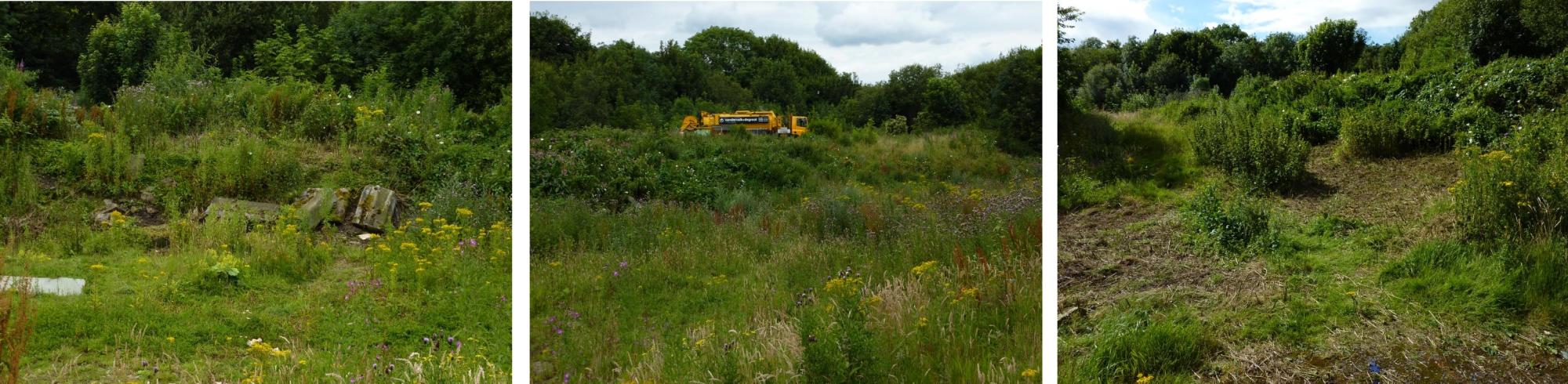
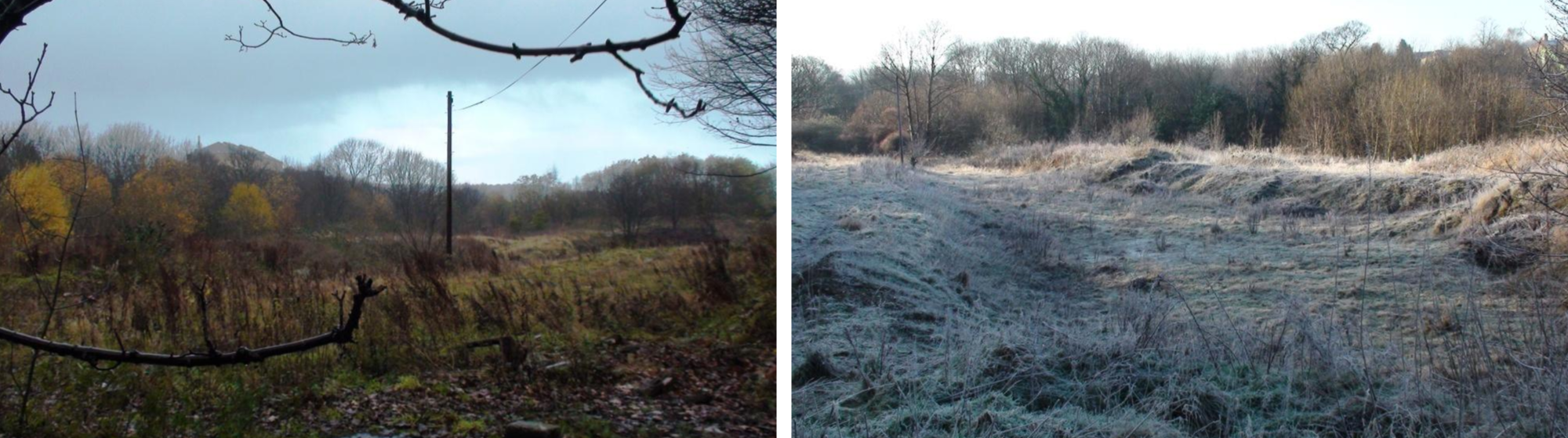
AND THEN ALL HELL BROKE LOOSE AS THE DEVELOPMENTAL / COMMODITIZING PROJECT KICKED-IN FOLLOWED BY ECOCIDE........
The disastrous results are now there for all to see. In little more than a couple of days everything was destroyed; the historic topography and the intertwined natural riches all, all gone and the damage irreparable. It was heartbreaking and that it should happen in an age of supposedly rising environmental awareness. Affixed to the Rio Convention there is a "species recovery program" designed to aid the unintended victims of development. But here the destruction was cynical and deliberate and directly counter to the "National Biodiversity Strategy" that requires "this strategy is mainstreamed into the planning and activities of all whose activities can have an impact on biodiversity." Not only should heads role as a consequence, but also people should go to jail if ever justice is served.
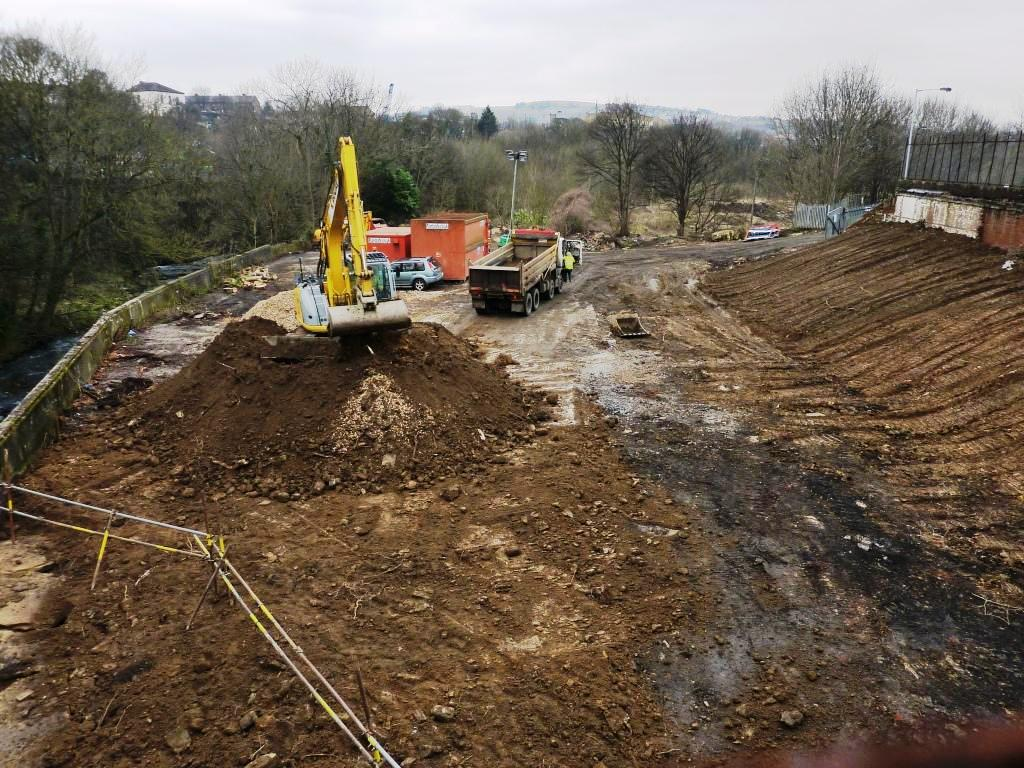
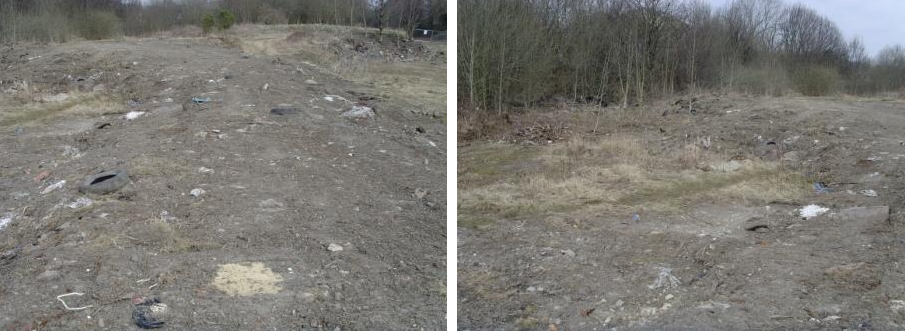
Briggate was a place of beauty, a transcendent example of the 'new beauty' even if, to superficial eyes, it was a poisoned, litter strewn, industrially derelict environment and fly tippers des. res. This 'new beauty' always tends to be accompanied by an extraordinary array of wildlife and this site was no exception to the rule. Considering that its topology of haphazard, man-made mounds was the creation of armies of navies who had excavated the canal in the 1770s, there was also something quite awesome about it that for close on 250 years had grown almost organically, nature seizing it (and how!) When the canal closed in 1926, benign neglect created something rich and strange in the continually added to process. A dynamic eco-system if ever there was one – until now.
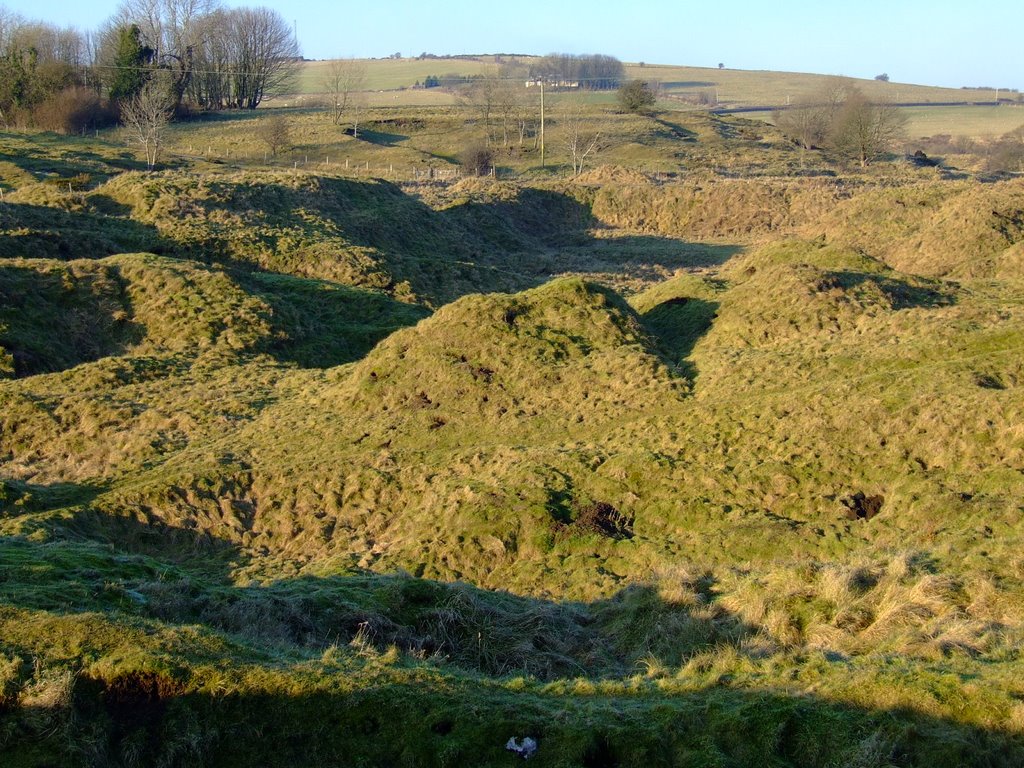
Above: Ubley Warren lead mines on the Mendips and industrial trefoil mounds, Briggate. These amazing industrial earthworks are incredibly wild life rich, and on that account alone, easily bests any existing land art.
As we have reminded people here, Briggate wasn't just an eyesore to officialdom, but a dangerous health and safety menace to be obliterated. So here we go again forced to dance to the same old tune. On a general level more and more, this is resulting in a growing clash between serious naturalists and the Health and Safety Inspectorate, genuine naturalists quick to point out that if the latter was at all logical it should razor fence off or bulldoze huge stretches of the Somerset Mendips like Ubley Warren an old, tunnelled, lead mining region going back to Roman times because of lead contamination. It seems in defiance of H&S regs, sheep and cattle are still permitted to graze close to the most polluted areas. And then there is the case of Cornwall's background radiation, natural argon gas contributing by far the largest component and which has been held responsible for many a death from cancer. So why not simply cut Cornwall adrift and tow it out in the mid Atlantic where it is then sunk? Or have it declared a no go area, policed with a thuggish border patrol especially selected for the job by Bradford Council officials? Bradford's bureaucratic class is driven by the need to be laughed at, to out-perform the fool and be a byword for inanity. When push comes to shove, it will brutally insist on continuing to be so. But for us who love the place and who have given our all lending a helping hand to its unique array of wildlife life (more so than any other British city), it is not an easy label to live with and we are literally heart broken by the way the city is being bled dry by official myopia. ...Thus we get shit like the notice below placed near a Briggate entrance. LIES UPON LIES. Unsafe! It wasn't even private land!
It goes without saying that the official killers had not the lightest feeling for the genius loci of the place. This would have been at once apparent to the philosophers of the picturesque in the late 18th century, namely Uvedale Price and Gilpin. Instead of imposing their will on the environment in the manner of Capability Brown, they sought to bring out the particular, quirky, features of a place; their temporally 'unorthodox' aesthetic also a timid, largely implied, resistance to the stultifying effects of enclosure on landscape, Brown's sweeping, empty vistas the aristocratic domestication of a 'nature' based on the expulsion of the peasantry from the land. These aristocratic 'improvers' both of 'nature' and the productivity of the land allowed for ornamental flocks of sheep etc but little else beside and, brought up to date, the similarities with the 'enclosing' of the Briggate site are obvious. However what Uvedale Price and Gilpin never mention is the deleterious effect enclosure was having on nature. It took a John Clare to bring this out. Sadly we seem as far as ever from effecting some kind of modern synthesis on these unofficial 'urban commons' left by decades of de-industrialization. Meanwhile, once seized by today's 'improvers', horrible 'nature' monstrosities are born.
Below:All that's left of Briggate now is an aesthetically posed tree care of Sustran's landscape architect's nonsense. Death and destruction MUST RULE and in its place we now have a useless, expensive vanity project, the farcical ecological equivalent of the ridiculous fountains that now 'grace' the City Park and square in central Bradford; the council having to compensate for the grandiose folly of what seemed the eternal big hole in the city centre and so literally spouted nonsense to distract attention.
[image not available on archive.org]
On top of this we were also supposed to have a neo-romantic stew of formulaic landscaping kitsch – a linear park - replete with meaninglessness, faux, Neolithic megaliths that, in its planned absence, are designed to conjure up nature, transporting us back to a primeval landscape and a time when savage nature really did rule. Ever since that amazing area of natural wonders, Kiveton Park colliery spoil heap in South Yorkshire was destroyed by a grotesque makeover in the early noughties faux Neolithic's has been the usual ingredient of outright destruction. This predictable stock-in-trade is now not all that far removed from the type of rubbish sculptural landscaping we now find around Asda, Tesco and other supermarket chains, a Costa Coffee outlet on the MI near Nottingham also featuring a Neolithic grotesquery on the cafe forecourt. And not forgetting that the colliery makeovers were fully supported by Butterfly Conservation and more tepidly by English Nature even before morphing into in its Defra oriented Natural England mode.
The designers of Shipley's ecologically ruinous 'linear park' wanted to see an ecologically thin country park overlay land once covered by factories. They can envisage nothing else but that and perhaps it comes as news to them there are such things as industrial parks. Though in practice the industrial infrastructure is not allowed to 'rot down' and 'compost' in these public parks, they do say something about how a country regards its industrial past. Unsurprisingly Germany is the world leader followed by France and America, though in fact the concept originates in Mexico, a disused steel mill in Monterrey that had closed down in 1986 reopening as a park as far back as 1988. Chunks of machinery were even put on display. Imagine, if you can, something even half as 'radical' happening in Shipley today. You can't. And so what rules is neither a critical reappraisal of Britain's industrial past (a must, if there is ever to be a genuinely green industrial revolution) nor respect for a free-flowing nature, a horticultural mediocrity burying both. In the forlorn hope this will spur inward investment, this visionless plan has gone through on the nod with fingers crossed no one will notice. And should the general slumber end, well it will all be down to the steel toecap to sort it. Although below we show some photos of these industrial parks elsewhere throughout the world we must finally insist that the very criteria of the park is a bourgeois concept and is in no way a foretaste of the landscape marking the on-set of a real social revolution. These altered, former industrial features no matter how enlightened in comparison to a chronically asphyxiated throw back of a UK are still within the paradigms of top down controlled space prettily dovetailed within a capitalist space where work and leisure are rigidly separated. None of this therefore is about the essential de-commodifying of space and land, a process that can only come about through a successful world revolutionary uprising.
Parks in themselves only reinforce the division of labour, garlanding the division between work and leisure within the capitalist mode of production. They are not (repeat NOT) harbingers of a new form of spatial free activity after the suppression and supercession of work. Increasingly too, these parks are becoming more and more niche venues not only through redesigning neo-industrial displays but extend the notion of childhood adventure playgrounds to the largely liberal professional, fee paying, alternative tourists. Even in the UK there's now play businesses like Bounce Below, a subterranean playground of nets suspended inside a slate cavern in North Wales and in the Lake District there's Tree Trek slung above a forest canopy. In fact scores of venues are opening up everywhere and Go Ape has recently opened its 28th centre in Grizedale Cumbria. Nonetheless for an ossified Bradford all this remains off-limits and unthinkable. However, the final tragedy of our heated intervention could be that we merely awaken these clodhoppers from their antediluvian nonsense.
Below: A photograph of lignite mounds in Germany that is topographically fascinating in itself. In England, once disused they would have been flattened out raised to the ground replaced with an estate agent's landscaping
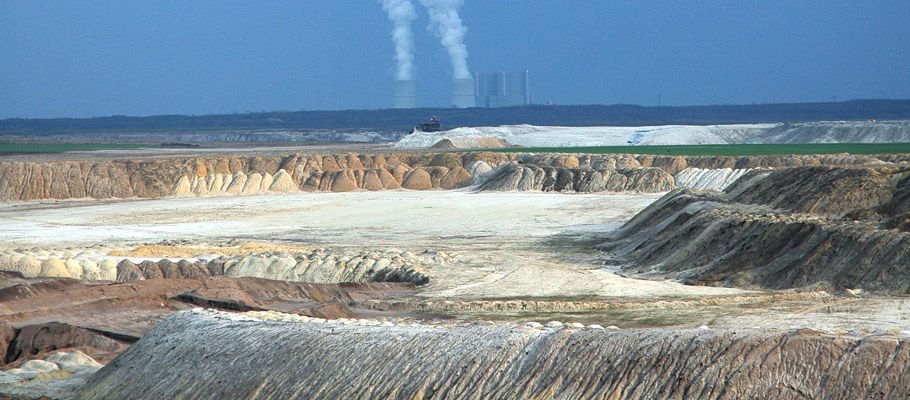
Below: Germany. Duisberg and morphing industrial dereliction. In Duisberg a steel mill has been integrated into a public park that tries to repurpose existing structures with minimal modification. 3 complete blast furnaces have been preserved, the Cowper stoves of blast furnace 5 are rust free due to a zinc layer added during construction. The cast house of blast furnace 1 has been turned into a multi-purpose hall including a newly added tribune which is used as a movie theatre in the summer. Blast furnace 5, has been turned into an observation platform open to the public featuring information plates for the function of the blast furnaces individual components.
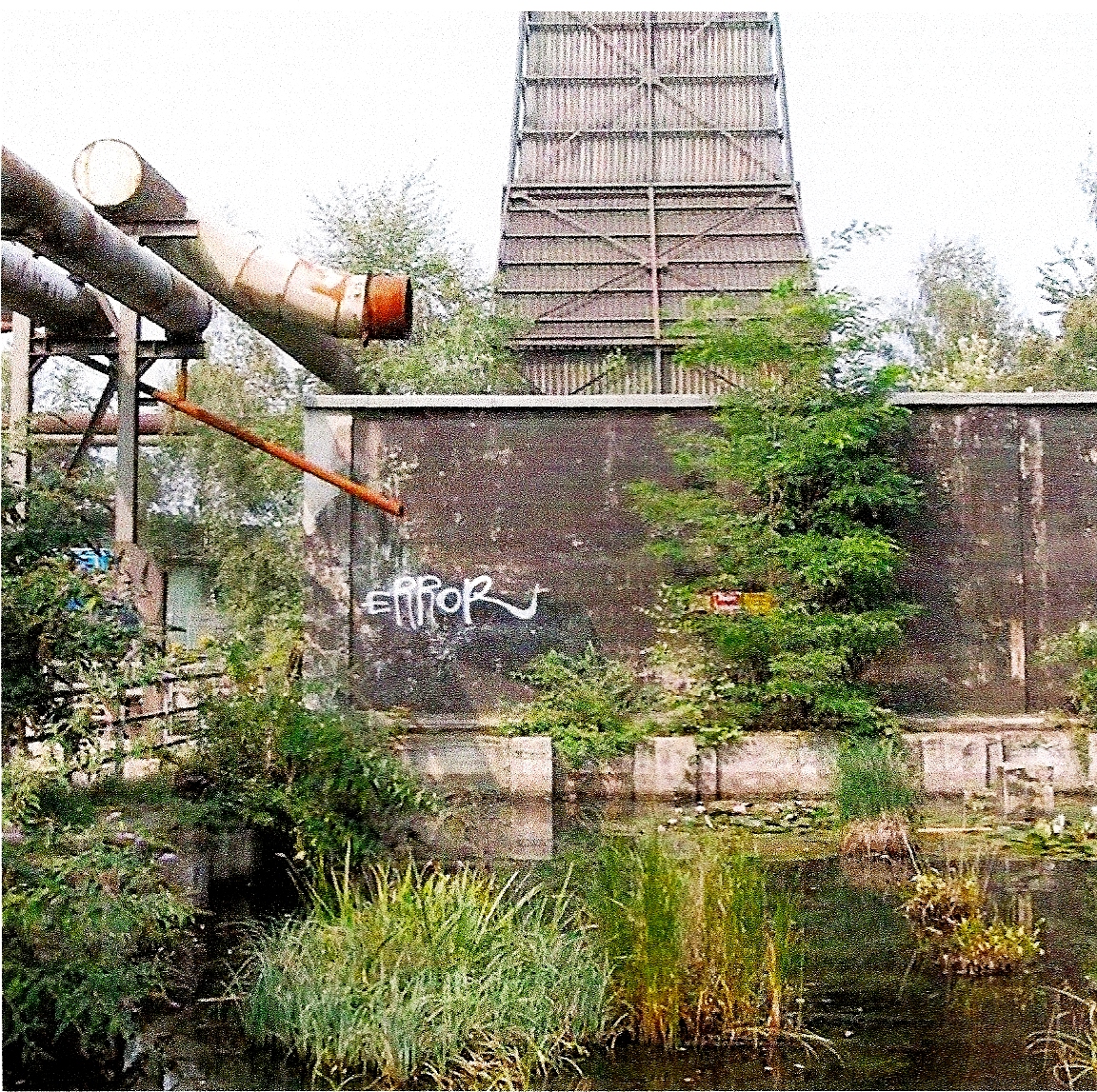
Below: A tankreef for marine life off the Lebanon coast (tankreef)
[image not available on archive.org]
Below: Drowned subway train carriages off New York Harbour transforming into bio-diverse readymades, i.e. vibrant nature reefs
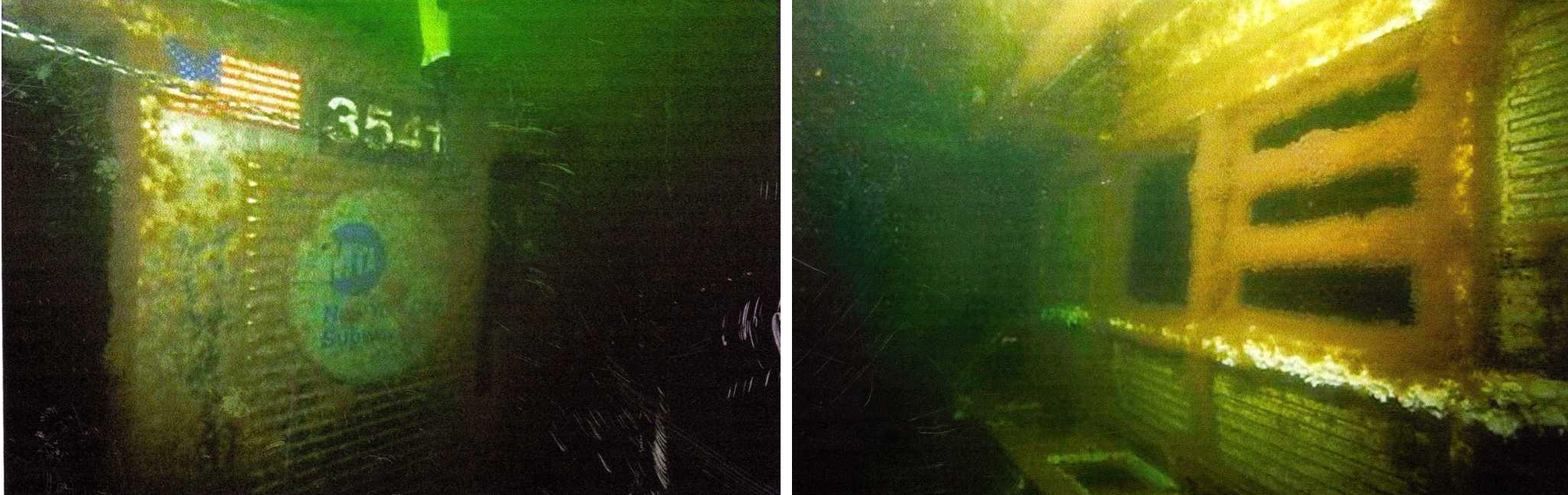
*************
Alas we return to Bradford..........
Below: The area where the Brown Argus flew..... "DESTROY," shouted Sustrans landscape designer.
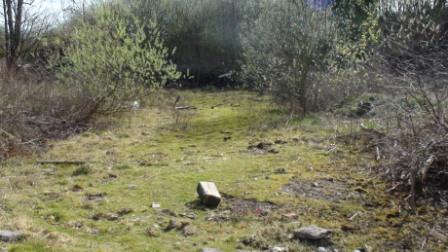
Below: The tyres made into something new, rich and strange by an autonomous nature becoming havens for insects and their larvae. Here within the tyre ring resided the wild geranium plants the Brown Argus feeds on.
[images not available]
Below: Empty, empty, empty tyres. KILL, BURN & DESTROY said Bradford Council... and the working stiffs sadly obeyed, desolation upon desolation....
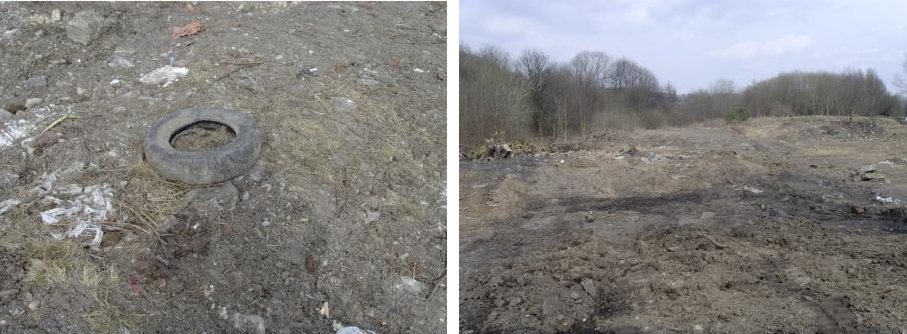
Below: The piled up tyre detritus - all to be thrown away - wrought by the philistine buffoons who thuggishly drove Bradford Council to new heights of stupidity.
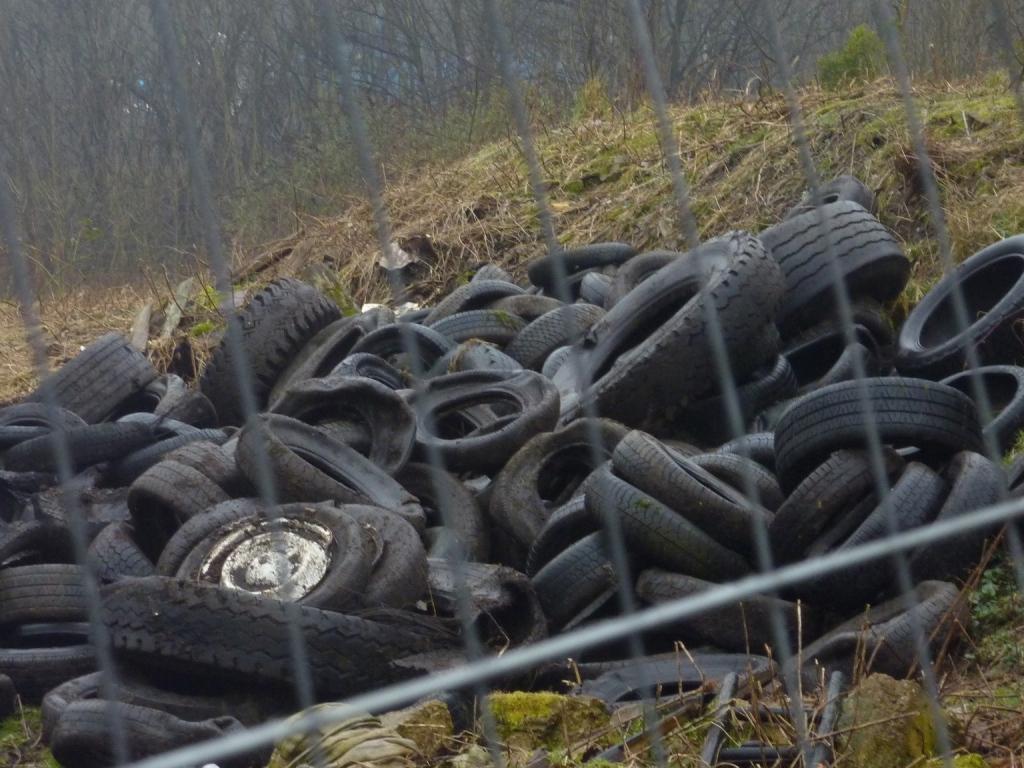
Below: Leftover tyres on Canvey Island were once simply recognised as havens for nurturing insect life especially. This also includes a Buglife photo from a few years ago, only in the present day for the tyres to be cleared away along with all the old post Second World War lamp posts as the designer aesthetes' psychosis increasingly strangles all truth to nature. Fortunately the nature conservationists have been unable to remove the great concrete slabs leftover from war time defence. Although Buglife commendably started out as a very combative invertebrate organisation almost 20 years ago it has since settled into run-of-the-mill greenwash mode happily climbing into bed with a now brutally neo-liberal oriented Defra (Dept for Environment, Food, and Rural Affairs) and thoroughly approving of Sustrans increasingly corporatist practise.
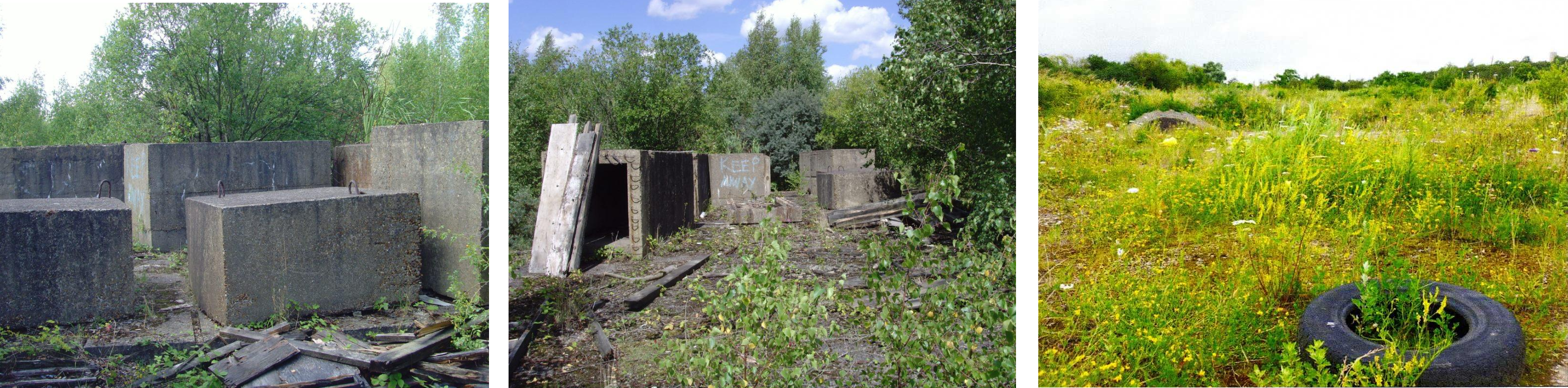
************
Shell shocked on seeing the aftermath of the blitzkrieg we sent the following missive to David Hall of Leeds Sustrans (13th of Feb 2013)
"We put it to the dead beats of Bradford Council why clear away all the leftovers of an industrial past like it never existed? Is it because Bradford Council is hooked on a failed economic model that prioritizes commercial and residential development centred around 'retail therapy' and like any junkie can't kick their habit? What do they hope to achieve by getting rid of the industrial detritus, the tyres, the old boilers, the layers of rusting scrap metal, decaying sign boards and what have you? A better nature? Or rather a kitsch nature idyll as advertised on chocolate boxes or the lids of biscuit barrels or to be found hanging on the walls of the 99p shop - an image of nature to be consumed and sold on? It breaks our hearts when we recall how a mere four weeks ago we found the doves foot cranesbill spreading over an abandoned sheet of decaying plywood. All we have now is a photograph which we cannot now look at because it will be like a knife going through us, much as what happens when a person chances on a photo of a dead loved one. And to think we might this summer have witnessed a female Brown Argus probing these very same plants looking for a leaf on which to deposit its eggs. To get footage of this would have been a natural history first. However Bradford Council has made sure no such addition to natural law will ever take place on its territory. These same rotting plywood boards faced with a gaudy plastic veneer, contained numerous ants nests, the laminates, as they separated and decomposed, proving an ideal ant habitat. This surely was a remarkable instance of adaptation and worthy of careful study. But no, Bradford Council in its wisdom thinks otherwise.
Joseph Priestley, the great chemist was born in a Bradford and had his laboratory ransacked by a 'Church and King' mob. Today Bradford Council has taken its sword to an open air laboratory of post industrial evolution. What philistines, what complete and utter philistines! And what about the tyres that have been cleared off the site? In fact they provided some kind of shelter against weather weirding, the birds foot trefoil and cranesbill growing in them protected, to a degree, from the excesses of heat and rain. There was also evidence they were used by the foxes on the site as happened on Canvey Island on the Thames lower reaches. We will now never know just how fruitful this interaction between nature and detritus was thanks to the clean minds in the council".
***************
"The variety of species we encountered in Briggate was astonishing and we are still lacking anything like a comprehensive species inventory covering insects, birds, plants, mammals and fungi. It was like we had entered a postindustrial Eden and when we uncovered the remains of the former Bradford Canal we were struck dumb. (Temporary speechlessness is a reaction to the sensation of the sublime and which has long recognized to be so since the mid 18th century and therefore essentially different from earlier attempts to analyze the sublime in poetic terms like that of Longinus in the 3rd century AD). It was like we had uncovered a postindustrial Chicken Itza and ourselves post-industrial urban explorers treading ground no human had been on for decades. Demands on our time have prevented us from itemizing the wild life. Enough to say it was fringed with an unsuspected profusion of Orange Tip butterflies, in fact more than we have ever seen in our entire life. And so we hurried to see if it was possible to increase numbers by seeding potential sites with the butterfly's food plant, jack-by-the-hedge. We have also cleared the site of bindweed, which was choking nettle growth, the food plant of the threatened Small Tortoiseshell butterfly. Again, much to our amazement, we had found the butterfly in abundance here last year, more so than anywhere else in the Bradford area. We were continually astonished at what we were finding, including the Brown Argus (previously unknown in the Bradford area) and the Brimstone. Every discovery was followed up with a targeted response aimed at increasing the amount of foodplant - in the first instance, Doves Foot Cranesbill in the second, Alder Buckthorn. We purchased 200 saplings of the latter out of our own money, a financial felony worse than the manipulation of the libor rate if elements in Bradford Council are to be believed. So much for PM's Cameron's 'big society! A friend said at the time that she thought it was an idea Cameron would come to regret and that it would turn around to eventually bite his bum, even though the animating principle was more Burke's "little platoons" than that of mutual aid societies and trade unions. Instead of being praised as a laudable, public-spirited endeavor, our selfless voluntary effort has been criminalized. In all truth we were just not prepared for this blackest of reactions and are in a state of something approaching shock.
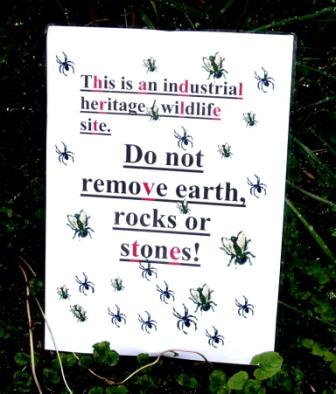
Before the destruction, we had set laminated A4 size notices in the ground asking for care and consideration to be taken as this was a site of untapped ecological wonders. These were soon disposed of, as were the laminated notices we fixed to trees asking for them not to be cut down. These notices had been wired to a number of wych elm trees and specifically stated they were home to colonies of the rare White Letter Hairstreak which was in danger of going extinct in the 1970s. The response? Cut them down of course, what else? The same fate befell trees where the Purple Hairstreak flies. The same applied to the area where the latest newby was discovered: the Brown Argus. Here a covering of imported earth was unceremoniously thrown over a carpet of rapidly expanding doves foot cranesbill killing the butterfly's food plant off. Adjacent to this was the best Small Tortoiseshell colony in Bradford. A month go we had raked choking bindweed off the young shoots of nettles in the hope it would encourage the overwintering butterflies to lay their eggs on the tender spring leaves after last year's disastrous showing due to the interminable rain. What did the council do? Why chuck a load of soil over the nettles to finish off the colony good and proper! The Small Tortoiseshell has been rapidly declining everywhere throughout the UK over the last few years so to find such an area was in itself a joyous, eventful discovery. Bravo, Bradford Council, one more notch on your belt! The same goes for the Brimstone butterfly which can usually be found on the wing here. What better than to cut its food plant down therefore. Anything for a giggle. Nearby a number of Marbled White butterflies were seen last year. Let's have an even bigger laugh; let's pull their wings off, for Bradford Council is the lord of creation and can do as it pleases. And not forgetting the Orange Tip, the site home to one of the biggest colonies of Orange Tip butterflies in the whole of the UK. Last year we photographed 5 Orange Tips on a single plant of jack-by-the-hedge. We had never witnessed anything remotely like it before.
Below: Alas we never got a photograph so the male and female below is all we have left of this remarkable colony.
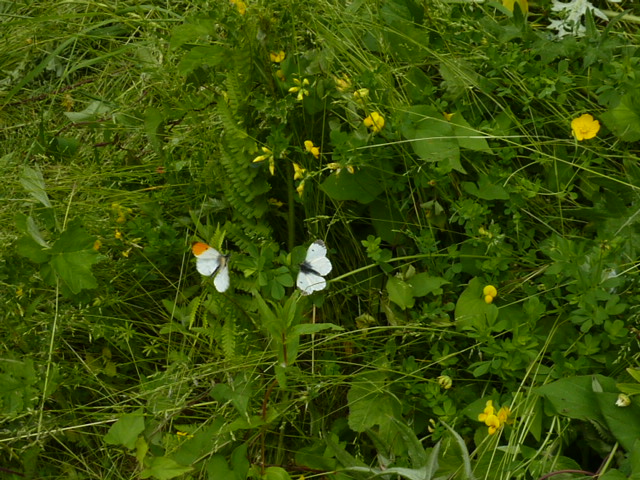
And then what about the Woodpeckers both Green and Greater Spotted and the rare flora? The buzzard that would sometime visit at dusk as the rabbits ran like hell? The kingfishers? The Herons? The Goosanders in the industrial gorge? They'd looked good in chip takeaways....."
When Shakespeare coined the term "sea change", shipbuilding was by far Britain's most advanced manufacturing sector in which the rudiments of the factory system were already clearly visible. And yet to Shakespeare, the magical transformations of timber and cloth that came off the end of the Elizabethan assembly lines and slid down the slip way, did not satisfy his imagination - only what nature did to them, and their dead and alive crews, at the bottom of the sea could do that, and which enabled us to see as for the first time, even though eyes had now become corals. And how often were our new eyes delighted by what we found on the Briggate site! Painful though it is to recall, one of our last memories of the "industrial rockery" that formed the end of the former canal basin (this splendid, metamorphosing feature has now been filled in and a deathlike normality imposed upon it) was of finding a mushroom on which a most unusual moss was growing, wrapping it in some kind of mycorrihzal shawl. The vascular tissue was so fine and lifelike; we took it to be organic, a more careful inspection through a magnifying glass, revealing these 'vascular tissues' to be strands of wool!
Below: The mushroom and a beautiful example of Aaron 's rod before destruction
[images not available]
All the more reason for Sustrans to destroy it therefore - despite our protestations. Aaron's rod is a plant of waste ground with a particular liking for railway sidings and industrially derelict sites, like this formerly outstanding one in Briggate. That such a plant with large, fleshy leaves is able to grow, often to a conspicuous size, in arid places is mostly due to the fact it is able to maximise the use of whatever water is available. The upward pointing stem-leaves funnel moisture down over which is eventually absorbed by the roots. The leaves are also covered in wax hairs that formerly would be twisted into candle wicks. Though easily ignited, the sticky hairs also act as a water storage tank, the plant a mass of twinkling rain drops after a shower and briefly resembling an upturned, bio luminescent chandelier- or shimmering spectre from the bygone age of an enchanted nature. The light, silvery grey / green hair covered leaves also reflect the rays of the sun and help prevent desiccation, the hairs having nothing like the heat retentive, body mass of the actual leaves and rapidly able to cool therefore, thus more easily permitting atmospheric moisture to condense as water droplets on the tips of the hairs.
The pandemic of herbicide use has massively reduced the spread of the plant, especially by the side of railway line, the downpour of 'round-up', the bio control equivalent of quantitative easing, which, if turned off, will result in instant catastrophe. Some of the most magnificent growths were to be found around Wakefield Westgate station but, alas, not any more, as their presence obviously posed the severest threat to high-speed trains between Leeds and London, adding intolerable nanoseconds to the journey time. I now regret that I never thought fit to take a photograph, fondly believing the plant to be a permanent resident and I had all the time in the world. However this world of crises within the crises has no time for Aarons Rod and, in the name of sustainability (what else?), will seek to destroy the plant whatever the cost, its very existence, like all defiant 'weeds' a symbol of resistance and a sign capitalism is not working .
The plant is also host to the Mullein Moth. The caterpillar is very visible if close to and, quite by chance, we found one in Briggate. Aaron's rod is poisonous, the caterpillar acquiring its toxicity from the plant. It even looks dodgy and we involuntarily refrained from touching it as if prompted by instinct, the caterpillar's bright, contrasting and forbidding colours a warning to potential predators-though unfortunately that does not include Sustrans. The question of mimicry and warning, aposematic colours arose in the latter half of the 19th century in response to Darwin's theory of natural selection, this extraordinarily fruitful line of inquiry forever associated with the names of Bates, Muller and Poulton, the latter coining the term aposematism in the 1890s. The still tricky problem of warning colours was first raised by Darwin's co-worker, Alfred Russell Wallace, when he questioned Darwin's view that conspicuous colours in species could be explained by sexual selection, Darwin immediately conceding Wallace had a point. in fact he already had his doubts, realising his theory could not explain that contrary of an 'eat me' food advert, the bilious, warning notice carried by some caterpillars that read: "beware, this caterpillar ripple is poisonous".
The insensitive, unthinking elimination of this 'worthless' plant (and moth) in Shipley by so- called ecologists is just one eco crime amongst many more, one unbelievable blow against nature rapidly followed by yet another, even more unbelievable blow. For a while we were overwhelmed by darkness and paralysed by shock. Moreover, research into this particular aspect of natural selection mentioned above would also help instigate a collateral field of inquiry-that into animal minds: if predators avoided contact with, for instance, the caterpillar of the Mullein Moth along the lines of once bitten twice shy, it implied the existence of some kind of memory, conscious discrimination and feeling, a concept Descartes, situated at the beginning of the bourgeois era, astonishingly had no time for. (Marx would point out that "Descartes with his definition of animals as mere machines saw with the eyes of the manufacturing period, while in the eyes of the Middle Ages animals were man's assistants"). Really, it is amazing how a post mortem on this lowly, sadly missed plant could prompt such a wide ranging, speculative flight. And this is the clue to its untimely demise. Because it can do this, as can so much else in a nature that is allowed to become autonomous, it was necessary to get rid of it, the essence of reification being the absence of memory, a point Sustrans and Bradford Council were hell-bent on ramming home. Around 10 plants of Aaron's rod now lie buried beneath several feet of imported spoil which now has been sown with lawn seed, courtesy of BEES (Bradford Educational and Environmental Service). In truth, though, the acronym BUST is more fitting: Bradford Urban Wildlife Swat Team. And, in truth, it would have made more sense if these feather brains had scattered bird seed, for who knows what then might have sprouted? To see nasty bits of homogenous suburban lawn in the process of taking over where once there was an unexamined richness of non conforming, urban wild life is simply heart breaking- but it does show what Bradford ecos, in their unashamed entirety, are all about.
In the gathering shadows of evening, the plants that grew in the basin of the former Bradford Canal would take on an eerie ambiguity like its taxonomic specifics were dissolving, Aaron's Rod once again belonging more to mythology than natural history. One plant in particular grew to over 7ft in 2011, its topmost florescence curving like a lifted forefinger in the twilight and which shook ever so slightly like it was at once both beckoning and admonishing me. At this moment I understood why it was called Aaron 's Rod, the original a shepherd's crook that was imbued with magical properties and, once handed on to Moses, could part the Red Sea. The shepherd's crook that was Aaron's rod also changed into a serpent before an Egyptian pharaoh , the vernacular name appropriately hinting at the plant's toxicity, even as the hairs on the plant's leaves were twisted into candle wick and its crushed leaves also used for treating coughs....... the combination of come on and rejection the plant was imparting in the gloaming also meant I was able, up to a point, to transcend the species barrier and in my new existence as bird/man, experience the lived meaning of aposematism in a way abstract theory could never do.
***********
Prior to impassable rocks being placed across the entrance to the field behind Shipley station, cars that had been stolen would be driven across it at night, and then dumped into the beck after first having been set alight. News would get around and likely lads would assemble on the bank sides to view the wrecks. And over time they would become what a majority of shipwrecks become: a wildlife haven. Silt reefs would build up around these dumped cars as aquatic plants and then land plants began to colonize these beck-change phenomena. There was one in particular from which jack by the hedge was sprouting, and it was a delight to see the Orange Tip butterflies fluttering amongst its garlic scented leaves set against a back drop of a rusting car wheel, the air sliced from time to time by a blue flash as a kingfisher darted past. Now all this has gone, and, for good measure, the largest colony of Orange Tip butterflies we have even encountered completely wiped out by arseholes that would have no problem in describing the devastation they have wreaked as an ecological enriching. Is it any wonder we were sent reeling and still in a state of disbelief?
Below: The car reef
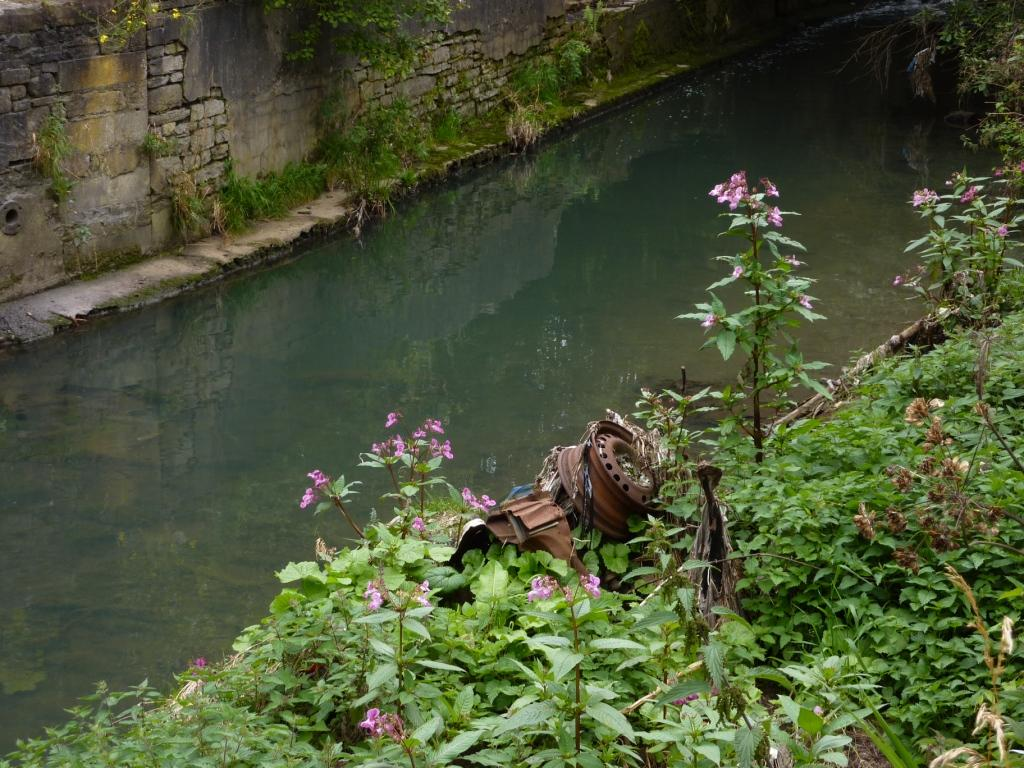
***************
Letter to Sustrans, (23rd April 2013)
Of Red Underwings, Black Poplars, Mulches, Cyber Beings, Nature Poets and Fallen Elms .......................
"The statutory laws (Rio Bio-diversity convention, planning law UK and EU, the Wildlife and Countryside Act) that have been broken on the Briggate site are legion and so extensive that there's no point here in reiterating them. However you might like to comment on the latest development of your wrecking crew: the recent and needless chain saw massacre of venerable 200 year + plus black poplars below Briggate at the side of the Sustrans cycle way that were home to the Red Underwing, a beautiful big moth at the very limits of its range and one of its few Yorkshire sites. We have seen the moth here though were yet to get decent photographs and film footage. "Bradford Nats" (Bradford Naturalists) had also seen it here years ago...and therefore all the more reason to make sure its habitat is destroyed.
"So what is our gripe this time? Well, we are were distressed to see that some venerable Black Poplars on the bankside between the former Bradford Canal and Briggate have been drastically pruned, some felled, and other giants earmarked for execution. The felling and drastic pruning has doubtless been carried out for health and safety reasons, as cyclists will shortly be using the greenway. However they have not been felled because they are diseased but on account of blame and claim culture. We will go into the aging and alleged decay of trees later, Council arboriculturalist knowing they must follow traditional orthodoxy and treat trees as if they were mammals - or face the sack.
The Black Poplars (most likely Populus Betulifolia, also known as the Manchester Poplar on account of its tolerance to pollution) are of great age, the oldest possibly dating back to when the canal was dug in the 1770s. To come across a 250 year old tree is a rare event in this country and on this account alone this magnificent bank of trees should have been respected. Some of the grandest have been daubed with paint which means they are a candidate for felling and probably would already have been laid low was it not for obstructive bastards like ourselves. When it was moved to prune these magnificent giants, the council would formerly leave the branches where they fell and so decay just as nature intended, no matter that to suburban sensibilities it might have looked unsightly. Fallen, rotten timber provides a valuable resource for a wide variety of detrivorous insects, decomposing micro organisms levels rising because of the abundance of decaying plant matter. Of particular interest are the woodborers that chew on living and dead timber and often have very long life cycles, which is unusual for insects that tend to be short-lived creatures. The practice of mulching considerably reduces ecological depth, mulching much of a muchness. And that is why, for the first time ever, the decision was taken by Bradford Council / Sustrans to mulch the fallen timber and spread the wood chippings far and wide, thus helping delouse the place of wood rotters. (The usage of words with fascistoid overtones is deliberate, by the way). But whatever prompted Bradford Council to do so? Why, because that agent of gentrification, Sustrans, and the anemic, lawned nature it esteems, was about to bring a cycle track along here.
Mulching may look like it is returning nutrients to the soil. However appearances often deceive and far from being ecologically responsible, woodchip mulch is ideal for weed suppression. Ask at any garden centre and they will tell you mulches control weeds by preventing new weed seedlings from receiving sunlight. Also bare soil is a perfect place for weed seeds to land, and so the mulch has also been spread across areas not directly under the Black Poplars where jack-by-the-hedge is growing, the Orange Tip butterfly's foodplant. (This site hosts Bradford's biggest colony of Orange Tip and all the more reason to continue with the perverse practice therefore). Mulches also retain moisture in soils and helps keep them cool in hot weather and will keep flowers and flowering bushes in bloom longer. The emphasis here is not upon natural cycles but upon the artificial, the denatured nature of the suburban garden, the floral display of municipal parks and the wearisome acres of tidy roadside verges of pollution tolerant, nature-resistant shrubs that Bradford Council is mad for.
And so, once more, to the felling of 'dangerous' trees. As they get older, trees are infected by wood rotting fungi. However that does not mean they are at the mercy of decay. Trees have no immune system and no wound repair system such as we, and other, animals possess. They do not go to war against bacteria and are able to ward off infection - and continue growing. Old rotting trees that have developed maximum windage, (as a number of the gnarled grandees on the Briggate site have), are often surprisingly resilient, their massive stem and root systems well able to resist gales. Many an old tree weakened by decay was able to withstand the storm of 1987, whilst their younger companions collapsed about them. Yet the lesson has not been learned - or rather the destruction was the lesson and all trees had to be felled, the chainsaw completing the unfinished task of the 1987 hurricane. The RSPB is certainly aware that Network Rail, hiding behind a health and safety mask, has been seized by a tree felling mania. Surveying the epic scale of the destruction on the Briggate site, we can only conclude a similar tree felling psychosis had overtaken Sustrans and the council, the psychological contagion spreading back into Network Rail who also recently went on an illegitimate felling spree behind the Ilkley platform on Shipley station that cannot possibly be justified on health and safety grounds. Since Network Rail, through the auspices of the DoT, is indirectly funding the Sustrans cycle track from Frizinghall to the exit point on Leeds Rd, then perhaps they thought they had bought themselves some 'reputation insurance' by funding the 'ecologically faultless' Sustrans. Like the buying of an indulgence, this earned Network Rail via the DoT the right to go on a wrecking binge with a clear conscience. Surveying the devastation, a cold fear grips the heart, like we are face to face with a meta-psychological turn toward death. Considering how the law has been repeatedly broken, an agent provocateur has been set to work and septuagenarians bullied and prevented from carrying out vital conservation work, then it is reasonable to assume there is something fascistic about the whole affair, reflecting the extreme right wing drift of the times. Basic ecological chemistry is even ignored in this climate of gathering reaction, to whit that trees sequester CO2. Cause and effect have, in all but name, become valueless terms, and what reigns at this watershed moment in human history is a destructive irrationality without precedent passing itself off as quintessential sanity.
It is generally agreed global warming must be stopped and yet everywhere we are expected to live with the insupportable contradiction of trying to reduce demand for fossil fuel at the same time as increasing the supply of it. Likewise the more the need to conserve nature goes up the agenda, the more it is subject to attack, until the impossible becomes fact and killing palmed off as conservation. Sounds familiar? Some speak of cognitive dissonance but that implies we are free to make up our own minds and that we won't be punished for making rational choices. In the place where it really matters, the work place, a reign of terror exists, increased job insecurity and contract work meaning people are afraid to speak up. Best not to think and do as you are told. And so a crazed destruction takes over, id not ego, sanctified by an ever more platitudinous language.
****************************
Seeing what we have to say makes not a blind bit of difference (though the word hubris comes to mind, we are aware our opposition may stimulate all concerned to carry out ever more vile acts of destruction, in the hope two wrongs will at last making a right) we may as well conclude by referencing two 'works' on Poplars by William Cowper and Gerard Manley Hopkins. This has been partially prompted by the literary evenings organized around the Save the Nightingales of Lodge Hill campaign. Rather than use the term poems we have italicized 'works' because the plaited phenomena we are describing leads beyond orthodox notions of poetry into practical engagement requiring preparedness to recognize, learn from, respond to and sing a nature that has successfully migrated, against all the odds, into the non-conforming spaces of industrial dereliction. This can be a very threatening experience and stirs up an urge to destroy what we don't understand. This nature is a counter nature, an unwanted, immigrant nature that doesn't fit in. A pogrom of these alien life forms is what is needed to set matters to rights.
Both Cowper's The Poplar Field and Hopkin's Binsey Poplars are about the felling of Poplars so are even more apposite - for instance we immediately note the trunks of the felled trees are still there in Cowper's poem and not instantly milled as on the Briggate site. Cowper's poem was written sometime around 1770, Hopkins' in 1879, over 100 years later. But during that time the integrity of poetry has been fatally undermined, the thisness of things breaking through the inherited forms of poetry. Despite wanting to look away from himself, Cowper sees in nature his double, even felled Poplars an oblique biography. (Perhaps Cowper might have seen in mulch the perfect analogue of an age which increasingly puts humans and nature through the mincing machine). Though Cowper was a Christian (one who eventually was no longer able to pray or enter a church), his religiosity was finally that of the Age of Enlightenment. Not so Hopkins, who gave himself up to a pre-enlightenment spiritual code demanding absolute obedience. And yet nature in Hopkins is allowed to speak for itself and is surprisingly free of oppressive religious symbolism. He knew - and he was the only person in Britain to then do so - that he was at the end of an exhausted tradition, the 'tame and same' of typical poetry and especially the slop of neo romantic nature poetry. He was in search of an objective, tactile language, torturing words into a plasticity, a rebirthing rather than a representation of what he was attempting to describe. The ensuing 'work' was a kind of audiovisual teaching aid and preparation for actual contact with the uniqueness of each living thing, that contact being what really mattered and which used to be so powerfully present on the Briggate site. How this man, who yearned "for the weeds and the wilderness yet", would have loved the place, a place that attracted oddballs and alternatives with a vision from the Windhill council estate, and that was the living embodiment of his ideal of beauty; "All things counter, original, spare, strange, a dazzle, dim, whose beauty is past praise".
Hopkins remonstrates, "Oh if we knew what we do / when we delve or hew - / hack and rack the growing green /even where we mean / to mend her we end her / [our italics] when we delve and hew". This suggests that the 'sanitary' lopping off of branches was already an established practice and becoming something of a health and safety issue, trees increasingly pronounced dangerous because 'weakened' by decay, This procedure, and the deceptive rationalization that accompanies it, was still in its infancy and on nothing like today's ecocidal scale, a cutting-event that is invariably sold as an ecological enhancement, in urban areas, even an "ecological installation", in more aspirational ones like in Holland Park in west London. The wholesale destruction of the Briggate site is a clear example of the incommensurable reasoning of the former. Weather wierding, and its incalculable effect on insect populations to one side, we feel the pronounced decline of the Red Underwing in Central London in the noughties is also a product of the drastic pruning of hybrid black poplars, the moth yet another victim of rapacious, litigation culture. Revealingly the most savagely pollarded trees are in the richest areas, wealth the assassin of all that lives and breathes. The practice of the contracting out of council services and the loss of overall control is something that also needs to be taken into account.
"Ten or twelve, only ten or twelve / strokes of havoc unselve". How lucky for Hopkins that he lived in a mechanically pre-lapsarian age when the time it took to do a job was tortoise-like compared with today. It was the shattering speed of the Briggate makeover that was so traumatic: one minute there the next gone, the changeful ecology of two centuries destroyed in a trice.
The Binsey Poplars could not have been all that old and most likely were Lombardy Poplars, having been planted in a row and different, therefore, to the randomly placed Black Poplars on the Briggate site, the canal owners probably hoping for a quick fix to the problem of soil creep on this steep bankside immediately overlooking the canal. What we have in Binsey Poplars is the slow time of manual tools and so poles apart from the mechanized celerity of today's chain saw, able to clear fell an area in minutes it would have formerly taken many hours to wipe clean. But we know what he means when he writes, "After comers couldn't guess the beauty been". Do you know what it's like to wake suddenly at night and have before you the heart breaking memory of "beauty been"? Can we be blamed for being in mourning? What happened on the Briggate site was a crime against nature. We are not exaggerating when we say we are beside ourselves with rage. Hush it up and denigrate us all you may, the truth will out one day.
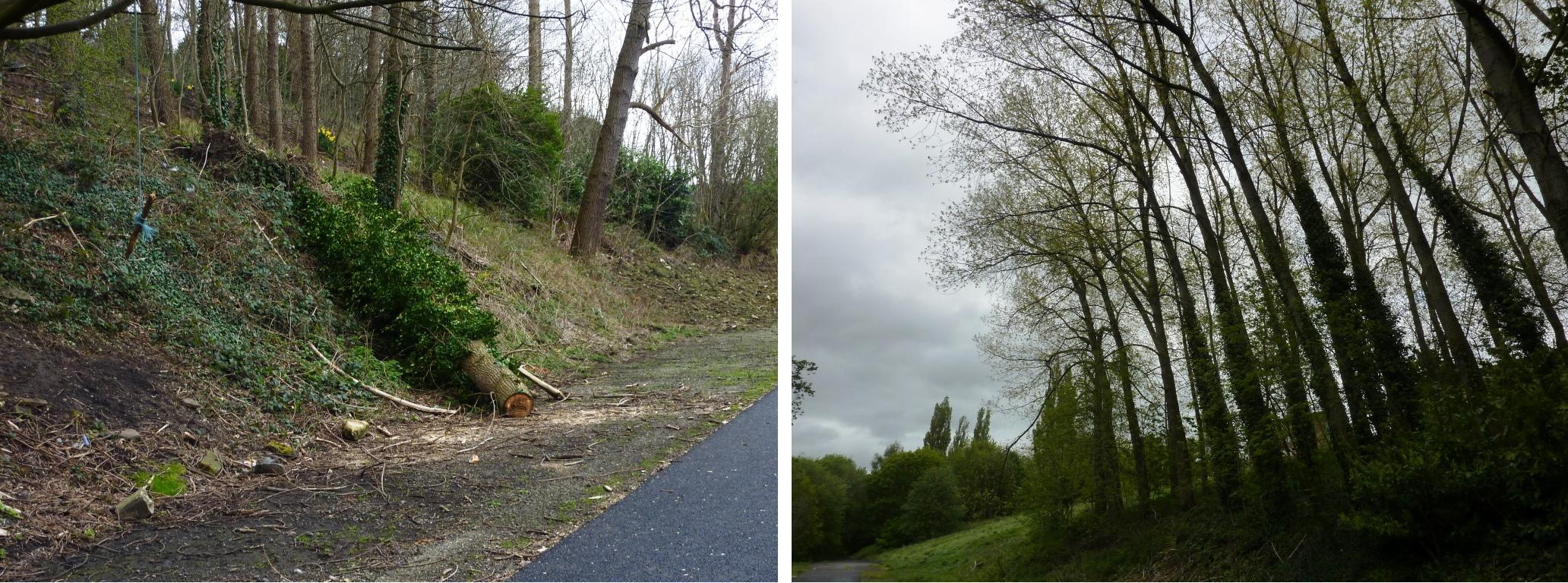
Poplars appear only incidentally in the poetry of John Clare alongside other trees such as of Sycamore, Ash, Whitethorn, Larch - AND ELM! A single elm had stood immemorial vigil over his parents' home only to be felled when the common was enclosed. Clare was permanently scarred by it, The Fallen Elm a stark attack upon enclosure with "ruin as its guide". Is it be wondered this poem, which George Monbiot strongly hints should be a trademark symbol of the environmental movement (The Guardian 9th July 2012), should resonate so strongly with us given notices pinned to Wych Elms (Elms that contained colonies of the threatened White Letter Hairstreak) were taken down and the trees cut down in the name of ecological 'improvement' this time. And that is only for starters. How will Monbiot respond? No doubt his initial reaction will be one of disbelief - and, to be fair, whose wouldn't be? Today's Fallen Elm cut down by none other than the environment movement! You must be kidding, is this your idea of a sick joke? The mind boggling incredulity of it all is your greatest asset - but one that won't last forever, given that we don't, as yet, quite live in a police state.
The bigger, wooded commons were especially singled out for all-out attack from the mid 18th century onwards. The effect of enclosure on the landscape (and people) is vividly described by Clare and could be a description of the unselective hoovering up undertaken by today's improvers on the Briggate site: "Inclosure let not a thing remain / it leveled every bush and tree and leveled every hill / and hung the moles for traitors - though the brook is running still it runs a naked brook, cold and chill". Though a walled-in, polluted, industrial stream, the Bradford Beck, in its lower reaches, had an unplanned, post-industrial sylvan feel to it, the Latin sylvanus meaning something like an untamed, natural epiphany, analogous to a wood gone wild. But not anymore, the beck bankside along part of the Briggate site ruthlessly denatured of trees. We former conservationists now become trespassers (Clare experienced much the same) numbly stand on the banks and wonder what else perished with the trees, a few of which were hollow and so like the "pulpits" described by Clare. And what were in these metaphorical pulpits - woodpeckers, owls, bats, nesting places for wild bees and not forgetting other invertebrates like specialised beetles and spiders? The place was a mine of wonder, its trees an understory full of a meaning now lost forever.
Clare inveighed against "selfish interest" but here the economic gain is at one remove (far more so than on the London Olympic site in 2012) and more a question of presentation, the domesticated nature Sustrans and Bradford Council is determined to impose, a sign Bradford is open to business. However the business model that underwrites it has spectacularly failed and with each passing year of disappointment succeeding disappointment, we are left wondering if this Canute-like attack upon nature will become ever more frenzied until finally every blade of grass is under surveillance, that blade's continued existence dependent upon whether it meets failed business criteria or not. That way madness lays, the kind of madness already glimpsed on the Briggate site.
Salaam from the friends of the new commons
Tweedeldum & Tweedeldee
PS: Still it doesn't matter. Good riddance as the damn Red Underwing would have only eaten our clothes! The sad thing is official Bradford ecos are not much above saying that sort of thing."
Plus a later self-critique of the above........
However not to be outdone by the recourse to literature by the nightingales' defenders (especially Mabey) at Lodge Hill, Kent, we too cited in our letter to Sustrans, the two most famous poems in the English language specifically dealing with Poplars: Cowper's The Poplar Field and Hopkins Binsey Poplars. We don't intend paraphrasing our 'opportunist' concession to Eng Lit criticism in the above letter to Sustrans, as it's just too embarrassing for words! Yet a practised eye would immediately see in our discussion of Hopkins, we were hinting at the death of poetry and that what touched us more than spoke to us, was Hopkin's love of the "weeds and the wilderness" and "all things counter, original, spare, strange, adazzle, dim" and that he would have gambled with the foxes in the heaps of tyres on the Briggate site and quivered at the sight of a Common Blue sunning itself on a chucked hubcap, just as we did, words no longer an adequate vehicle when it comes to communicating the intensity of that moment. Of course we knew we were wasting our time trying to awaken the dead souls of Sustrans to the strange beauties of the Briggate site. So why did we ramp up the literary schmaltz? Because no one today wants to be thought a cultural philistine, especially not Sustrans who pile on the agony when it comes to culture. Feel free to murder wildlife at will, but that we in Sustrans should ever be thought cultural philistines? We would rather murder an infant in its cradle,.......or a bat in its roost, or threatened butterflies in their hundreds ........ you name it, we'll kill it in the name of art - and sport.
*******************
"Alas, alack Poor Yorick" A requiem...
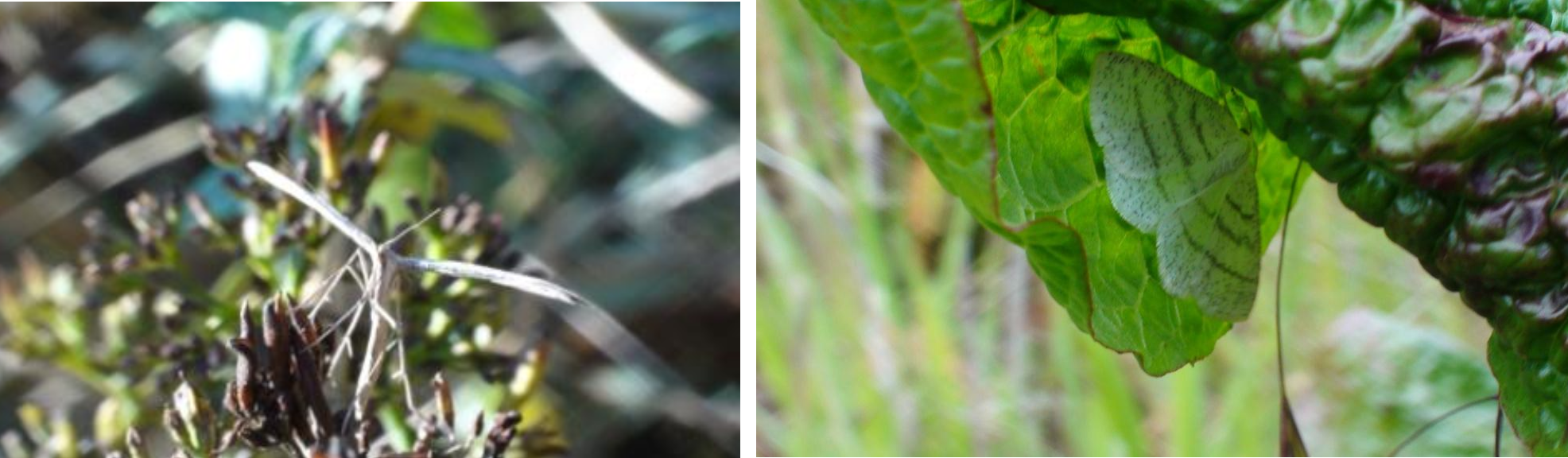
Above: A Pyralid moth and a Mullein moth which no doubt fed on the destroyed Aaron's rod. Below: Dingy Skipper (Briggate). This rare butterfly colony has now also been vanquished...
Below Left : Grey Wagtail [Libcom note - not pictured as no image was availalbe on archive.org] perched above the formerly bird rich Bradford beck in its lower, 'industrial' reaches. It had 'invaded' the territory of a White Throat Dipper, the two species able to cohabit in the friendliest of fashions and even having been known to feed each other's chicks. Grey Wagtail numbers have declined by a staggering 23% between 1995 and 2012 according to the Waterways Breeding Bird Survey and is now an amber list species. Sustrans in 2013 laid waste to beck-side bird habitat with the same enthusiasm as it did outstanding insect habitat. But while the spring shoot of migrating birds in Malta is increasingly the arena of face to face confrontation, Sustrans has got clean away with this epic of natural destruction. In 2013 a naturalist's car was set alight in Malta. In Bradford silence reigns over the unspeakable acts of criminal sabotage against nature. Below Right: A Briggate Ab mariscolare....
Gooodbye and Adieu......
Attachments
Comments

Trouble Up'T Green Eco-Mill: Bradford's Eco-Peterloo (Part 5). From Winstanley to Urban Unnatural Histories / RS Fitter, Mass Observation, Huxley &The Bauhaus / Sheffield makeovers from Oliver Gilbert to the aesthete nature of Nigel Dunnett / and a faux olde England C/o URSULA & a 'reclaimed' Bradford Beck.
Note on "Monstrous Bastards" moniker, May 2025
In reality - The Monstrous Bastards - was all part and parcel of the wider John Clare Collective experience. In fact, they (Stuart and David Wise) found out they were being named as such by council officialdom by a great gal who helped clear 'the big field' alongside the Bradford Beck and whose sister worked as skivvy cum cleaner in Bradford Council offices. Laughing with joy the moniker was immediately embraced alongside Tweedledum & Tweedledee, Batmen & Robins, etc, and spontaneously placed on flyers, letters and what-have-you and inevitably, the Revolt Against Plenty web........
David Wise
------------------------------------------
This seems a reasonable point at which to take a break and reflect on the modern scientific origins of natural history in Britain. To do this we have to go back to the English civil war and revolution of the 1640s and the twin figures of Gerard Winstanley, the digger and John Ray, the naturalist, their different, but connected radicalism, meaning they would be ignored by history for two centuries. 'Working' the land around Shipley station, we were aware Bradford had been the site of a latter day, digger inspired experiment in the early 20th century which, in some ways, was also a form of outdoor relief (though better by far than the workhouse) for the unemployed who were taught 'to dig' but by no means 'dig it, guys'. It would spark an interest in Winstanley that even extended to the press, the German social democrat, Edward Bernstein, having rescued Winstanley's name from oblivion in the 1890s. We would very much like to know the site of this cooperative agricultural experiment, though for sure it would not have been around Shipley station as the place was then occupied by railway sidings, warehousing and factories. Today the post industrial skeletal soils are doubtless very contaminated and unsuitable for growing vegetables but has not stopped nature from luxuriantly overrunning it in a devil-may-care way that inspires a surplus of dreams - until Sustrans / Bradford Council and others saw fit to turn it into a nightmare, a potential heaven on earth become a literal hell on earth.
We have referred to this discrimination as a form of nature racism in the sense the powers that be visually and arrogantly decide what superior nature is and what inferior nature is. However, on further reflection, it has more to do with class than race and therefore typically British. In Germany the environment movement has had to cope with the baneful legacy of environmental anti-Judaism, the Jew a symbol of the fall of nature, of nature in an alien state. Though this view can be traced back to the Christian middle ages, it would receive a nationalist, pro-enlightenment reworking in the hands of major thinkers like Herder, Hegel, Fichte, even Feuerbach. However, in this country, ever since the Peasants Revolt of 1381 and, more especially, through the influence of Gerard Winstanley and the Diggers in the 1640s, the fall of nature is to be redeemed through class not race war, through an act of collective appropriation abolishing private property. Like nowhere else in the developed world, nature here becomes the repository of true communism.
------------ This industrially derelict site in Bradford teeming with unexplored, nameless life was an ideal place in which to reconsider creation myths and hopes of earthly renewal. Barred from cultivating the land, it was not Winstanley the cooperative agronomist but the millenarian truth-seeker who stirred us, the Winstanley who saw nature as corrupted by the fall of man brought on by 'covetousness' (i.e. private property) and supported by the Divine Right of kings (i.e. state power). Matters did not rest here however, Winstanley's millenarianism no obstacle to him wanting to establish an elected lay polymath in every parish, the anti-university Winstanley opposed to the obscurantist theocratic dominance of Greek, Latin and Hebrew as well as being hostile to the growing technical language of modern science which threatened to supplant one overthrown theocracy with that of another, the theocracy of the specialist. And this is where John Ray makes his entrance, the great naturalist putting principle before career and refusing to swear an oath of allegiance to King Charles 11, a constitutional monarch but still a monarch. Forced to leave the sniffy precincts of Cambridge University where he rubbed shoulders with the aloof Newton, Boyle, Halley, Hooke etc, he would retreat into the countryside and obscurity, this deeply humble man revolutionizing taxonomy, his system for classifying plants according to a set of characteristics that remain unique, still holding up where all others, like that of the binomial system of Linnaeus, employed for its linguistic ease, have been found wanting. This extraordinarily wide ranging man was very approachable and locals would chat to him, bringing to this unelected local polymath who appeared to have been dropped from the sky and by default was not quite the incarnation of Winstanley's hopes, all manner of specimens to examine. Now imagine, if you can, how the tetchy, paranoid Newton would have reacted to a knock on the door, then, on opening it, find a mucky swain standing there with details of something he had seen in the night sky. .... It is said Ray's mere presence in the parish had stimulated locals to look at nature afresh...... somewhat elusive though this extraordinary connection is between a revolutionary social praxis and the growth of natural science in England, it is nonetheless real and would unfold as a powerful underground current pitted against the official nature establishment, to be ignored at one's peril. (The saga of Shipley station and its hinterland, and the loving entanglement of social protest and cutting edge science, has yet to kick off).
Of course Ray was part of a much wider democratising drift which would include, for example Nicholas Culpeper the botanical apothecary who translated Latin medical texts into English so everyone could be their own diagnostician / physician, the English translation of the Bible making everyone their own divine and priests only good for kicking up the arse. Science would then be correlated with revelation and a practical, millenarian enthusiasm would be the outcome.
A Fitter future for Britain: some background Mass Observations
The first edition of London's Natural History by Richard Fitter came out in 1945, the third book in Collins New Naturalist series. Against all the odds it would become something of a best seller, the counter intuitive effects of the London blitz upon wildlife, the book's involuntary leitmotif and id. The New Naturalist series was more of an ideal than an idea, and conceived during the darkest days of the second world war like everything else connected with post war Britain, including a comprehensive welfare state. The series on which no expense was spared, (lavish colour plates appearing in the post war years of ration books), was an anticipation of the long boom to come and heralded the growing marketisation and commmodification of nature that would eventually turn it into an unreal, media idyll, even as this new found peoples' audience for popularised scholarship in the field of natural history was neither patronised nor talked down to.
Fitter was a very considerable naturalist and the first person to in anyway comprehensively deal with what would eventually become the explosive issue of urban ecology as the issue moved from being an observational matter to one that undertook to create, with increasingly disastrous results, urban wildlife habitat. Like his mentor Max Nicholson, he was an amateur naturalist taking a degree in economics at the London School of Economics, which had been founded in the late 19th century by the Fabians, Sidney Webb, Beatrice Webb and Bernard Shaw. During Fitter's student years, the LSE was under the directorship of Beveridge, who, in 1942, would produce the Beveridge Report and that would become the lynch pin of the post war welfare state, compulsory sterilization of the congenitally idle, which Beveridge believed in, fortunately not part of it. Nicholson would study history at Oxford, both he and Fitter sharing a passion for birds - and bureaucracy - both unconditionally believing the vigour of the UK's flora and fauna stemmed from a common ancestor: enlightened state power. They were essentially the first born of a new breed of civil servant, the nature bureaucrat, creating the state institutions they would preside over. Of the two Nicholson was by far the keenest empire builder, he more than anyone else responsible for the setting up of the Nature Conservancy in 1949, the name changing to English Nature and then Natural England, each amendment signifying a further submission to market forces until conservation and the developmental agenda become increasingly indistinct, the former acting as the 'sustainable' guarantor of the damage caused by the latter.
Both Fitter and Nicholson believed a planned capitalism was possible, a fact all the obituaries of both men, who died in the first decade of the 21st century, omit to mention, nature conservation in its post war guise essentially the green wrapping on the technocratic package that defined the post war consensus. The shadowy but increasingly powerful figure of Keynes loomed over everything they did. Fitter was recruited to the Institute of Political and Economic Planning - a Keynesian sounding tag if ever there was one - by his ornithological buddy during the mid 1930s, Nicholson having written A National Plan for Great Britain at the height of the depression in 1931, Keynes's hugely influential General Theory of Employment, Interest and Money appearing five years later. Nicholson would become the deputy PM Herbert Morrison's private secretary in the land mark Labour government of 1945, "The Spirit of '45" still the delusional touchstone of so many influential 'left wing' Labour party hugging commentators like Owen Jones, capitalism having long outlasted its expiry date and therefore necessarily becoming a fictive entity of horrific organised chaos as it vainly struggles, in the era of automation, to return to core principles founded on labour value. Morrison would manage the nationalization program and also create the Metropolitan Green Belt, the crusading resistance to suburban sprawl and ribbon development gathering pace during the 1930s reaching its practical apogee in the Scott Report on land use planning of 1942, the idea of a green belt hardly requiring Nicholson's commendation in his job as private secretary to Herbert Morrison.
The Scott Report still underpins most of what happens in the countryside today and was written when Britain was under blockade and food security of paramount importance. Hence the initial emphasis was on giving priority to agriculture and protecting rural areas from the threats associated with urban development. Hard headed though it might have seemed at the time, the report hankered after the good old days, Scott calling for the preservation of rural crafts like smithying, basket weaving, thatching and the trade of wheelwright as essential to agriculture even calling for the setting up of rural guilds and a system of apprenticeships just when mechanized agriculture was about to hit Britain big time. Scott even mused these essential rural crafts could find new marketing outlets and satisfy "a growing demand for the distinctive handmade article". There was more than a hint of a Ruskin inspired over-lording of private ownership to it, the development rights of the land from now on to be more in the hands of an omniscient, far sighted state rather than that of a myopic, money grubbing landowner. Shaw once wittily branded Ruskin "a High Tory Bolshevik", a streak of quasi feudal dispossession of capitalism in the name of an equally disempowered people beholden to their public school educated, Oxbridge betters running throughout the Scott Report - and much else beside in the post war Labour government. Surprisingly, despite Scott's attempt to freeze out the mechanization of agriculture in favour of traditional, agriculturally based crafts, nature conservancy did not figure at all in the initial report, an omission recognized in the minority Dennison Report. In Scott's opinion the quality of the countryside depended upon the maintenance of a prosperous agricultural sector. Thus in order to achieve the goal of national self-sufficiency, he advocated a system of price support, a similar mechanism forming the basis of the infamous Common Market agricultural policy. In time the food surpluses it gave rise to would produce a wave of popular revulsion, 'conservation' apparently the winner in this reckoning and agriculture increasingly perceived as a major environmental threat. (In reality nothing could have been further from the truth). Moreover, Scott's hope that comprehensive planning would deliver urban containment had by now been well and truly dashed, the resident rural population now almost completely divorced from agriculture, the conservation of landscape, as a result, taking over from the exigencies of food production and aesthetics increasingly coming to blanket the land.
However the countryside the new residents were initially seeking to conserve / curate, as though they were living in an open-air museum of landscape art, was rapidly becoming a featureless green desert and not worth the bother of conserving either as an artefact or a wildlife haven. Gradually the concept of beauty shifts skywards, the pristine mountains and uplands of painterly myth now tending to become the sole repository of art and nature, when, as sheep rearing concentration camps, they had in fact become a pitiable mockery. The experience and rationalization of the sublime prefigured by the formerly lowly genre of landscape painting, and that had seized the popular imagination from the mid 18th century by inimitably managing to combine the most intense feelings possible with the workings of a higher reason (especially in Kant), was here brought crashing down, that revitalising, potentially radically democratic experience shifting to the towns and sites of industrial dereliction. The process has come full circle and we are back, broadly speaking, to where Fitter set out from.
In 1945 the same year as London's Natural History appeared, Fitter would be appointed secretary of the Wild Life Conservation Special Committee of Town and Country Planning. From this would come the National Parks and Access to the Countryside Act of 1949 (overseen by Nicholson) and which would give legal protection to official nature reserves and Sites of Special Scientific Interest (SSSI's). Wilding it was not and signified, rather, an impoverished freezing of nature's potential and also humanity's relationship with it, thus severing the link between a full-on nature and the galactic limits of human freedom, a concept fundamental to Romanticism in this country and never taken up, and made more concrete, to its great loss, by the nascent workers' movement. Against the grain of Fitter's London's Natural History, the division between town and countryside would be reinforced, real nature driven underground in urban spaces to become aberrant, criminalised, demonized and only permitted if it fulfilled the cute, reassuring, design criteria of benign 'public amenity'. Safety and control would be the main concern; these domesticated oases of a still born nature a secure place for children and for mothers to wheel their prams around in, the no-parent zones, bomb sites and industrial ruins in which nature and detritus could claim their rights. The end result of the post-war battery of nature legislation would be to strengthen the fear of nature and the wildcat in all of us and seemed to run in tandem with the great fear provoked by the post war unofficial workers' movement, both threatening to ignite the hell-fire of universal anarchy.
Investigating world war two bomb sites more than parks and the first to hone in on the rich wild life of sewage farms, Fitter's book was a smash hit attracting a huge audience which caused people elsewhere to look at bomb sites in their own back yards, often by then covered in the red / purple glories of rosebay willow herb. We certainly did though too young to know whom Fitter was! Alas, little was to follow through from this groundbreaking book. Instead the major city / town re-building and clearances of 1950s slash and burn came into being; as a supposed, largely social democratic New Jerusalem of new towns and concreted high-rise brutalism became the order of the day, succinctly opposed by, among significant others like Ian Nairn, Ralph Rumney and the first London Psychogeographical Society with special focus on Limehouse and its environs. In general this oppositional current decried the neo-housing estate, the end of pub conviviality and the birth of the dead life in favour of an ideal nuclear family surrounded with modern consumer durables sublimated in Ebenezer Howard inspired crafts, pottering about the potting shed, surviving in a cushioned urban setting having lost the vitality of the urban street and moreover, the EXACT OPPOSITE OF NATURE RICH. Amazingly, in retrospect, the latter aspect was never mentioned by the often-inspired subversives of the first London Psychogeographical Society.
***********
After a brief sojourn in government office, Fitter would become editor of The Countryman, quitting "the Great Wen" (he would use Cobbett's derogatory term for London approvingly, without going on to say anything more forthright about this incorrigible 19th century Tory radical) to live in the country. However The Countryman was far from being a stereotypical hunting / shooting / fishing journal, its founding statement of intent a conviction the countryside, now increasingly open to access by the masses, was changing for the better and no longer the preserve of penniless, forelock tugging yokels forever on their knees before the lords and ladies of the manor. He would also supplement his basic income with a steady stream of bird books - again a sign the natural history market was a rising market, ramped ever higher the more insubstantial its actual basis in living things becomes. Too big to fail - at least so far- the flora and fauna footsie index has yet to seriously crash and bankrupt its dead to the world tele-visual investors thus enabling them recover their sight and see that nature doesn't exist in two dimensions and is increasingly nowhere to be found.
The common currency of bird talk would bring Fitter into contact with another ardent ornithologist, Tom Harrisson of Mass Observation, Fitter moving to Mass Observation when the Second World War broke out, where he was charged with monitoring civilian morale by the Ministry of Information. Mass Observation, founded in 1937 by the ex Winchester schoolboy and old Harrovian, Tom Harrisson, had set up its HQ in a grimy back street in Bolton as a Ministry of Truth in waiting, its aim to counter the falsities perpetuated by the media and the politicians regarding working class everyday life. The attitude of the Mass Observation group wavered between sympathy for the working class and need to spy on them. Revolutionary agitators they were not, surveillance, in the final analysis, being the name of the game. At a stretch we can draw a comparison between this practice and that of another type of mass espionage and the common state parlance of our age via the Internet, Harrisson pioneering bird counts and censuses, beginning with the great crested grebe.
Grebes & Julian Huxley
However, in point of fact, the first bird that had been the subject of a national census had been the heron in 1928 and had been organised by Max Nicholson who even advertised in the Daily Mail for volunteers, the census been the first mass count of a single species. But Harrison would really raise the stakes with the grebe census, recruiting 1300 volunteers and even broadcasting an appeal on the BBC, the grebe a more elusive bird than the heron but now a celeb because of a remarkable little book on the courtship habits of the great crested grebe written by Julian Huxley. This book, with superb diagrammatic visual aids drawn by Huxley (in themselves a poke at the pointlessness of de-rigueur, fine art illustrations), would make, in his words "field natural history respectable again", bringing biology out of the lab where it was becoming confined, largely as a result of research into genetics. Huxley would come to question in his field research Darwin's views regarding sexual selection that it was the male who displayed to the female, male and female grebes displaying to each other, Huxley suggesting this form of courtship should be called 'mutual selection'. He would later generalize what he had observed to pass between grebes and argue proper female choice in humans would lead to evolutionary improvement if they were given the vote, regarded as equals, and allowed to think for themselves. Huxley also thought grebe couples were monogamous, an observation, when transposed to the human plain, that condemned promiscuity in the name of that founding institution of bourgeois society, the nuclear family, now given a scientific validity rather than moral one as was formerly the case. Taking the cue from grebe behaviour, couples, if we read between the lines, were being urged to continuously 'display' to each other, this avian marriage counselling keeping sexual interest alive and preventing playing away from home, the latter behaviour typical of dirty dogs, and threatening to the existing order because it was now anti scientific and against nature! (Actually, close observation has since established that bird couples are frequently naughty and play away from home). In choosing the grebe, Harrisson had to be aware the grebe was no chick but a progressive, politically correct bird, humans, particularly the male of the species, had much to learn from. Three years later Harrisson would set up Mass Observation, the subtext a deeper understanding of the everyday life of working people to be gained through close scrutiny, would lead to a more democratic, unified society where class was no longer a threatening, explosive issue, and that, at bottom, the working class was not a species apart but just like 'us'. In short, Mass Observation was a conduit enabling toffs to cross the species barrier.
Huxley's extrapolations on the subject of sexual selection amongst humans derived from his observations on grebe courtship would spark a wide-ranging debate that even the advocate of family planning, feminist, eugenicist and Nazi sympathizer, Marie Stopes, would be drawn into. It comes across as mildly quaint, of its time, a thoroughly wholesome even hearty debate conducted by well-adjusted, un-alienated human beings. What would they have ever made of a growing aversion to sex, to be given a body swerve except as virtual reality, and the ground zero of courtship and relationships, which is such a feature of our times? Reproductive fitness is being replaced by a non-moral repulsion, the failure to reproduce today a metacondition affecting nature as much as humans. This planetary stressing is a huge negative thrown in the face of the protocols of sexual selection, the end time of capitalism and its inability to meaningfully reproduce and the extreme psychological consequences thereof, a more fruitful line to pursue than any attempt to update Social Darwinism.
Huxley's fascination with birds dates from his schoolboy days at Eton College, Huxley going on to study biology in Oxford University. (Mark, again and again, just how many of our wildlife institutions, both in the pre and post war years, were the creation of a public school, Oxbridge elite). Note also the close ties between these institutions and the tendency toward overall planning in the economic social and cultural sphere, high profile naturalists sometimes bestriding both and virtually treating them as one, birds in particular the flight path between the two. To say that planning was the buzz word of the hour is to trivialize the issue, the point being to put an end to capitalist anarchy in favour of a planned one. This tendency had been growing since the late 19th century when an unlikely assortment of High Tories, liberal imperialists and Fabian socialists, determined to prevent the Paris Commune becoming the London Commune, got together to oppose laissez faire economic doctrines. The tendency would be reinforced by the experience and misnomer of "war time socialism" One must remember then – as now - 'socialism' was identified with the nationalisation of production, distribution and exchange and the Bolshevik coup de etat therefore amounting to a genuine social revolution. Yet again, nothing could have been farther from the truth. In response to all this confusion regarding the omnipotence of the state in the transcendence of capitalism, it was then easy for Keynes to become the prophet of the unfeasible, unthinkable and utterly fantastic, a managed capitalism, and numbering amongst his growing army of disciples, Nicholson and Huxley. As mentioned above Nicholson was the author in 1931 of an influential article A National Plan for Britain and from which came the PEP (Political and Economic Planning), a non-governmental think tank founded by Nicholson and financed by 'enlightened' businesses, Fitter and Huxley sitting down at the same table as the director of Marx and Spencer's. In 1946 Huxley would be elected the first director general of UNESCO (the UN's educational, scientific and cultural arm) going on to become a founding member of the WWF (the World Wildlife Fund), the PEP, after the war, sharing the same offices as the state funded Nature Conservancy steered through parliament by Nicholson and becoming law in 1949.
Huxley would serve as director of London Zoo from 1935 to 1942 turning the place into a modernist laboratory / prison for animals, commissioning Bauhaus refugees from Hitler to design a monkey house and, much more famously, a pool for penguins. Extraordinary though it sounds, Gropius was able to sucker the author of so much patient observation of animals in their actual habitat into believing the Bauhaus (i.e. what was to become the horrific International Style) approach promised to restore the lost unity between people and nature, traditional architecture having torn it asunder. Hence the multi award winning, 'educational' animal experiment designed by Lubetkin and Tecton, the concrete, helical ramps imitating the ice flows penguins liked to slide down in the wild but here gave them arthritis. Moreover the pool was too shallow not providing the penguins with the depth they needed, the penguins, come feeding time, also liking to dive to collect their food - that is if gulls hadn't first swooped down and snaffled it, keepers chucking the fish at the penguins like they were animals in a zoo. The delusional thinking was set to get worse, the pool envisioned as a didactic experiment in modern, healthy living, the unfamiliar setting a demonstration nature was infinitely adaptable and able to thrive under unnatural conditions, the same going for workers and the poor who needed to be rescued by paternalist bureaucrats, taken out of their filthy slums and given neat, deluxe boxes set in a bowling green sea of entropic apathy and starved of life-giving oxygen, the only denatured nature architects, planners, landscape architects etc are comfortable with. The entire experiment is pervaded by an excruciating lack of empathy, the real enemy the autonomy of nature and that of the working class and oppressed poor.
Huxley had an apartment in the zoo, which he used, as a showcase for modernist design. In this airless, aesthetic space, scientists, environmentalists, artists, writers like H.G. Wells regularly met to discuss how best to save humanity from environmental, economic and social catastrophe, not seeing they were part of the problem and bringing it about in ways unsuspected by them. Acting in the name of an abstraction, the working class, none were prepared to sacrifice one iota of their elitism or even see it as a problem. (Huxley would refer to Marxism as "The first radical attempt at an evolutionary philosophy" this reasonably accurate reading that seeks to link Marx to Darwin overlooks that human history is punctuated by sudden leaps – revolutions - and that "the emancipation of the working class shall be the task of the working class itself" and which implies the rejection of all political parties and hence the entire state machine. To the likes of Huxley, Wells, Gropius et al, emancipation proceeded by and through the state).
Huxley will long be remembered as a pioneer of "the new synthesis" that combined Darwinism with Mendelian genetics and other branches of biology including paleontology and population studies. In fact it was he who gave this new frontier its name, calling his book on the subject published in 1942, Evolution: The Modern Synthesis. A major aspect of population studies is field work and it is to this we must return, 'population' becoming a key word just like 'planning', terms that would, over time, lose their innocence to history as it became apparent both were about the need to keep cross species tabs on subject populations to stop them misbehaving and transgressing the boundaries of acceptable conduct - which is what wildlife did when it began to 'criminally' invade brownfield sites on a mass level from the 1980s onwards. (And it would be severely punished, cut down and butchered like it was an uprising of the people. Indeed more personification than simile, it almost was that, the virtual world coming increasingly to dominate perceptions and a type of homicidal paranoia that projected onto industrial ruins the malign phantoms of past struggles, starting to rampage through local and state power like a mental plague). Population studies that sought to establish the frequency of gene distribution within a given population would unavoidably draw on the pioneering efforts to map the distribution of native flora and fauna. As we have seen, during the 1920s individual bird species would play a preeminent role in this endeavour, the groundbreaking Oxford Census of 1927 extending a bird count to include all species.
Founded in 1921, the Oxford Ornithological Society had come from within the university (where else!) and had been the brainchild of B.W. Tucker, then studying biology under Huxley. He was supported in his mission by Max Nicholson the civil servant in waiting but still only a fledgling, Nicholson having just published a book Birds in England, its subtitle, A criticism of bird protection. In it he would use the increasingly hip term 'ecology' popularised by the botanist Tansley, arguing that a bird should be observed in relation to its habitat, this being an essential step along the road to an effective conservation praxis. The Oxford Census would involve considerable teamwork and as this type of research method progressed, would require a veritable army of volunteers. It would also exacerbate the split between amateur and professional, spotters carrying out the essential spade work for the professional scientist, the former, like all people holding a spade, regarded as an inconsequential muffin. The less demeaning term 'citizen scientist', rather than amateur, was an attempt to flatter the army of volunteers increasingly involved in conservation work that it was a citizens' army of ecos in the making, and, quite possibly, have even come about because of a revolt from within the ranks. However it has done nothing to alter the fact ecology is more on its knees to all manner of professional hierarchies than ever before, the model of unquestioning obedience undoubtedly that of the military. The submission the eco movement has generated is obviously the reason why a form of eco national service is being considered. Yet the disillusioned army of deserters this appalling development has produced is rapidly turning out to be the most numerous category of eco of all, though, like all deserters, reluctant to show their face and combine into the deadly fighting force they have the potential to become.
At the time none of this was apparent, the ideology proclaiming that without the collecting and collating of the data made possible by these innovative field organisations and administrative methods, new lines of inquiry were simply not possible and nor would conservation progress. Subsumed within the collective, the influence of the amateur naturalist, it was argued, was augmented rather than diminished, similar sentiments spreading right across the industrialised world as the individual autonomy of craft production lost out to the assembly line. Industrial scale field surveys, it could be said, were a type of countryside manufacture, a programming of nature watching, a kind of wildlife Fordism. Not only would these industrial scale censuses create a labour hierarchy, they would also lead to the establishment of a paid admin staff, university chairs in natural history, up to this point, being the only full time, paid employment within this exclusive field. Natural history was becoming monetized and bureaucratised, thus nurturing the familiar, business-like, committee mentality that is today so widespread and chokes the life out of wildlife groups. In a manner of speaking the scientist is a capitalist proxy in this chain of command, producing, we would argue, a more deadly subservience because the ends were seen as scientific rather than exploitative, the discipline required for such surveys that much more internalised and freely consented to.
**********
From London's Natural History (1945) to The Unnatural History of London (2010)
In the 1945 edition of Fitter's London's Natural History there were 40 colour plates and 43 black and white, taken mainly by Eric Hosking and John Markham, neither of whom were mentioned in the obituaries when he died in 2005. The photos bore such seemingly inconsequential titles as A London stray cat or Two mallards on planks floating in a static water tank in London, or Unusual site of a blackbird's nest, the bird having built a nest at the angle where a horizontal bar meets the vertical of a wrought iron security grill covering a window. Both the photos of mallards and the blackbird suggest some kind of low key, barely perceptible, adaptation was talking place. This was well before the term brownfield site had been coined and which came about in response to the large-scale de-industrialisation that accompanied Thatcher's rise to power. Still there are evocative titles like Waste ground at Bromley-by-Bow gasworks and a particularly fine colour photo by Hoskins titled Sand martin colony in disused sand pit near Barnet by-pass, North Mimms. In the foreground, instead of a standard motif of shattered classical columns, there are discarded, empty oil drums which, if stood one on top of the other.
Suppression of interest in the brownfield experience was to remain the case until Mabey's Unofficial Nature was published in 1973 coinciding with the experiments of Street Farmer. However, by then a slow burning fuse had been lit.....
Mabey's book would, by degrees, acquire a talismanic reputation amongst psychogeographers, an occurrence unique to this country and sufficiently different to the world wide institutionalization of psychogeography to merit further comment, for it shows just what a potent, upsetting, subversive force nature can be in this country, one that seems to possess a power, and life, all of its own. The edgelands that Mabey describes in Unofficial Countryside would come to be viewed as remarkable entities in themselves, Mabey unfortunately unable to comprehend what he had unleashed, his criticisms of this development well wide of the mark and driving him back into the countryside to lead the stereotypical life of a country gent. Sadly his unsolicited 'followers' could never go beyond surface appearances, none able to deepen their rudimentary appreciation of the natural riches to be invariably found on these 'unpromising' sites which became in their eyes something to be viewed: museums without walls. Thus none were in the least responsive to the amazing entomological discoveries at the mouth of the Thames, though they would go into meaningless poetic raptures over the area's topographical marvels, meaningless because it remains fixated on these marvels. Hence it becomes just another empty, worthless aesthetic, something to be written about and displayed but never developed in a genuinely subversive direction and made part of a world-changing praxis.
In 2010, a TV programme, The Unnatural History of London (obviously a word play on Fitter's book) was shown which was also in some ways a throwback to Fitter's world of the late 1940s although with the addition of more profound perceptions. It explores a world where nothing is quite natural and a wild sub-culture is the outcome as London has become a magical wilderness full of opportunity; a real urban jungle. The following is a précis of the programme's contents......
For fallow deer manicured lawns are irresistible. There are seals in an old coal dock outside Billingsgate and fish porters feed the seals producing an unlikely relationship with Billingsgate fish porters. For those who care to look London is full of surprises.
Some creatures have adapted brilliantly like the feral pigeon and Lisa a photographer has crawled around London suburbs for six years finding out pigeons now use roads to navigate. She now believes the character of pigeons are defined by neighborhoods they live in, thus pigeons are slightly more edgy south of the River Thames, etc.
The peregrine falcon is a phenomenon of the last 19 years. It would appear that birders know the wild places of our cities the best noting the evolution of wild sub-culture as deviant behavior is more acceptable than elsewhere e.g. with herons that nest on the ground. One birder even bought a house next to a huge landfill site to watch the 15,000 gulls feed causing him to reflect that in time people will wonder why they are called herring gulls considering herring is the last food to be found here.
We have a need for a conversation with nature, to find a solace that can bring extraordinary joy. Do the 'new' 'travelling' pigeons that commute between platforms on the London underground point to a new stage in evolution? A woman exclaims "Oh my god" on seeing a pelican eating a pigeon instead of a fish and on London's cliff faces of high rise, mallards are nesting on stratospheric balconies reaching to the skies.
London has become home to human animal and plant migrants, having 6000 parakeets and the newly acquired Norwegian brown rat grows to twice the size of its relatives back home. The European yellow tail scorpion now has three separate colonies some several 1000 strong and Crayfish hideaway in old brick work. Moreover, there are four species of crayfish all invasive. The Turkish crayfish in the Serpentine has now been replaced by signal crayfish having killed most of the white claw crayfish.
A new order is being established and life in the city can be easier than in the countryside especially for mammals. Even badgers in the city may like the fox abandon its country roots and chose city life and we like these glimpses of an untamed world as we contact a world not shaped by human hand. Moreover, our human lives can change irrevocably having entered the beginnings of a new world......
*********
Taking a cue from The Unnatural History of London why not let the imagination let rip even further? On landscapes of contempt natures deviant behavior is more acceptable than elsewhere which is also the case with human beings....... What happens to nature left to fend for itself – and innovate - in the city parallels to an astonishing degree what can happen to human beings in a similar skewed situation evolving their own cultures, or more nearly, sub-cultures, equally stigmatized under the mantra of the 'deviant' breaking away from acceptable modes of daily living, freeing themselves up in the process. Since the 1950s-60s university sociology departments have been packed to the gills with one usually high-falutin explanation after another 'investigating' mods & rockers, hippies, counter-culture in general, punks and goths, etc. So is it surprising that nature and ourselves are all in this together? True speculation like this may seem tenuous, lacking in anything like sufficient scientific clarity though a bit of intelligent surmising doesn't come amiss. What is a definite certainty and a big one at that, is the ire of an establishment disturbed by all these manifestations quickly look for ways of suppressing movements they feel threatened by suppressing their most disturbing characteristics. At all costs any attempt at autonomy must be nipped in the bud whether (it would seem) of human, mammal, or invertebrate make-up. This counter assault is more than ever becoming a total assault.
**********
Inevitably, much of the experimentation in and around landscapes of contempt or sites of industrial dereliction is about control, much of it centered in northern England because here were many more such places than in the south of the country. This experiment was more the product – and outcome – of a seemingly ever expanding neo-liberalism giving a big boost by Big Bang and the financial deregulation of the City of London as great swaths of industry were closed down or exported elsewhere in the world where wage costs were much lower. Once an insurgent working class had been defeated, a collectivized working class living in more or less, clearly defined communities was then vanquished along with strikes and more spontaneous rebellions that often enough, had turned the faces of the ruling class pale with fear. Their meaning, their example, essentially their hope, had to gotten rid of forever, no more so than on a visual level as an array of 'educated' urban designers slowly materialized putting in the place of liquidated, visually run-down, welcomely humdrum communities, endless vistas of faux landscapes, images of a chocolate box, quintessentially bucolic, olde Englande that only ever existed in fantasy but was a perfect representation of the advertisers lying sales pitch.....
Sheffield University bears the heaviest responsibility for the transmogrification of industrial dereliction and brownfield sites into anodyne, 'ecologically sustainable', parkland. The bourgeoisification of industrial waste and the enormous loss of wildlife that invariably attends it, receives its greatest impetus from the pit spoil heap makeovers of the early noughties. Not one conservationist body protests; indeed they welcome the makeovers, and in the case of Butterfly Conservation actively participate in the destruction of brownfield invertebrates whilst continuing to proudly claim to be the world's biggest invertebrate society. This is a watershed moment in Britain's conservationist movement and sets the pattern for what happens subsequently, both as regards e.g. the Olympic park, in London's Stratford and in Briggate, Shipley (and possibly countless other places we know nothing about, as yet). This act of stupendous eco vandalism is passed over in total silence and rational protest marginalised, the lone voice that cries out, all that's now left of the wilderness. As of this moment, schizophreneze is increasingly the norm and destruction becomes conservation, death, life - and debt, credit worthiness, and bust, boom. Ecology and economics were never so intertwined - and upside down, each the perfect mirror of a topsy-turvy world.
It is in Sheffield where the term "urban common" is first popularized by, of all people, Richard Mabey in his book Flora Britannica (1998) when out casting his eye over the wastelands left by deindustrialization either side of the River Don in Attercliffe. The Meadowhall Shopping Centre is still, just to say, a mote in the developer's eye. There are striking photos of Japanese Rose with the famous twin cooling towers in the background and of the fig trees by the side of the Don. Mabey even mentions talking to a miner who remembers his father purchasing Japanese knotweed and how other miners and friends were invited round to marvel at it. However that's as far as it goes though Mabey does acknowledge that his précis of the plant communities of Britain's major cities is taken from the work of Oliver Gilbert who had made a study of how vegetation varies from city to city. More than anything Gilbert was the first to recognize that modern cities are the most bio-diverse area of all and which is the axiomatic theme of these webs.
He also just happened to teach landscape ecology in Sheffield University from 1968 to 2000 gaining a PhD in botany at Newcastle University. Our paths may well have crossed during the Icteric days, we also groping our way to an urban ecology - an insurrectionary urban ecology - requiring the abolition of the wages system and the state, and that would profoundly differ from the pro business direction landscaping would take in Sheffield even as Icteric (and its infinitely more radical consequences) left its ineradicable mark on the Geography Dept in Newcastle University. Indeed, at the time botany students would ask us about our nature experiments which we tried to explain in greater detail as best we could and was Gilbert one of them? Tantalizingly, that we'll never know! Such was the underground influence of this briefest, and loosest, of avant-garde groupings.
However a weak-kneed psychogeography would bypass Sheffield University's Landscape Dept, an omission that goes some way to explaining the lack of even a token sympathy for sites of industrial dereliction and that would profoundly impact upon the Landscape Dept nauseating claims that it is able to create "ecologically-tuned urban landscapes". Retiring from teaching in 2000, the increasingly vexed question of the business university was never an issue for Oliver Gilbert. His belief in academic freedom was absolute and this remote, amiable academic naively continued to insist on respecting the genius loci of place, its soils, vegetation etc. but, in one way or another, his entire life echoed to the urban reverb, his chief subject of study, lichens, also an index of industrial pollution. His Newcastle Phd thesis, entitled Biological Indicators of Air Pollution, was published in the year of revolution (1968) and would contribute to the growing environmental debate.
Many of Gilbert's students would become practicing landscape architects and after the example of the pit spoil makeovers such nancy concepts as genius loci would go straight out of the window, even though it was thought Gilbert's 'pioneering' approach must result in an improvement on Nan Fairbrother's New Lives New Landscapes, Gilbert's dictum suggests the future of landscaping both large and small would be increasingly sensitive to the spirit of place and to the nature it contained. Nothing could have been further from the truth and only a re-commoning can do this, collective practices which will inevitable sweep away the profession of landscape architect. We had become convinced of this by the summer of 1967, the thought never entering our heads that the avant-garde revolt we had so thoroughly rejected would have such reactionary traction and that is still playing itself out on the Briggate site in Shipley, though in a barely recognizable way. However, no university dept will ever abolish itself and so we are left with a situation where a domesticating aesthetics increasingly comes to dominate an anarcho nature.
Practical considerations were continually creeping upon Gilbert, his Habitat Creation and Repair (1998) appearing around the same time as plans were being drawn up for the appalling pit spoil heap makeovers and which would totally change the face of practical ecology in this country. In the book, Gilbert mentions participating in a habitat creating, amenity park next to Sheffield Airport. Though Sheffield City Council declared it a success, Gilbert judged it a failure, mainly frustrated by the fact that there had been no body in overall control of the makeover. This candid admission marked the end of a more independent, era in which self-criticism would not be thought a sign of weakness but of strength. Henceforth the tone would become increasingly authoritarian and self-serving, eco-hype turning from a trickle into a flood. (In fact Tinsley Park and the abutting mound of Catcliffe, hosts thriving Dingy Skipper and Brown Argus colonies which cannot be said of the subsequent spoil heap makeovers that resulted in the destruction of countless thousands of Dingy Skippers, and as we said, a fact still past over in total silence by official ecos. Recalling the worst excesses of Stalinism, a lie like this has no need of a secret police to reinforce it; rather it is dependent on a refusal to personally test reality and a craven subservience to hierarchies).
***********
But first why not put down here our experiences of Ollie Gilbert's creations on the old spoil heaps of Catcliffe. Though, Gilbert was disappointed with the outcome Catcliffe is a veritable wonder in comparison to what was to follow.....
June 2006: Catcliffe, Sheffield, South Yorks
We wondered for two hours cold and forlorn on Catcliffe Hill thinking the day was a write-off and cursing the weather reporters who had predicted a fine day. Then out came the sun and I was the first to see a Dingy Skipper with Catcliffe Airport in the background. This is the most unusual colony of Dingy Skippers I have ever encountered. It seems to me it is not a settled colony and different strategies are being tried out by the Dingy Skippers.
For a start it was almost impossible to get near the Dingies before they would be off then most surprisingly of all, never to return. The one's on the path skirting the brow of Catcliffe overlooking the airport and Outo Kumpu steel works would vault the small hawthorn hedges and disappear into a field in which there was a peppering of trefoil but which also contained two highland cattle and their calves.
Despite waiting up to forty minutes these Dingy Skippers would not reappear as if they had forgotten their territorial instincts or forgone their territorial instincts assuming, of course, that they were males. Every one we encountered was like this and that was fifty or so – and some must have been females. All were the same baring one the other side of the path near the airport, which did behave territorially. Trying to get photographs of them was near on impossible, I wanted background, industrial background but none would oblige flying off after barely three or four seconds.
How long have the Dingies been here, several years? Or are they behaving like all colonisers of new territory; that is in an unsure and unpredictable fashion. We barely covered a third of Catcliffe Hill but we found them wherever we went eventually. Will this colony prove to have a character of its own? Will it finally settle down and behave in a more normal way? I feel my filming was jagged and un-noteworthy but on reflection just to present it like it is gives an idea of the uniqueness of the colony and the unevenness of the filming, the jolts and camera shake suggestive of the skippers' slightly aberrant behaviour. Camera shake and a shaky colony yet to really put down roots.Coming off Catcliffe, in addition to seeing a further Dingy we chanced upon a Brown Argus, an ab: albunnalata, which was extraordinary. This is the closest to a city centre, certainly a northern city centre; the Brown Argus has ever been photographed. Another first!
Walking back across Attercliffe Common crossing a footbridge over the canal and railway near the Hallam FM media building, David startled a Dingy Skipper. Is the Dingy about to take Sheffield penetrating its many sites of industrial dereliction or will the whole place get spruced up, hoovered of all bird's foot trefoil and industrial dereliction and become a mere image of nature with pollution tolerant plants, variegated road side verges etc?
We met a park ranger on Catcliffe. He thought the dire makeover of pit spoil heaps like at Kiveton was a result of competing interests with some losing out while some others had their way. A nice guy but I very much doubt that is the case. A faux concept of nature imposed itself and there was little contestation, probably none!
There were very few people on Catcliffe. As a country park it is underdeveloped and under used. Kiveton on the contrary appears to be much used. We met a Pakistani taxi driver who was totally bemused by the highland cattle. He was chiefly worried about their exposure to the elements - were they warm in winter for example? In fact in reality the problem is how to keep them cool – remember he had come from a warm country! Catcliffe attracts nutters. It is a place of encounters as indeed Kiveton Park once was. Now the latter is no more than an anodyne park; a place for a Sunday morning stroll where desperate mothers can wheel their babies around pretending everything is all OK.
At Catcliffe a couple in their forties passed hand in hand, she was lovely and said hello. Catcliffe is a place for genuine love. They sat on a seat overlooking industrial Sheffield then returned the way they came.
Notebook 2006: Stuart Wise
**********
Before proceeding further it would seem sensible here to give a broad outline of some of Gilbert's ideas in Habitat Creation and Repair (1997). Ollie Gilbert begins with an introduction on what he refers to as "the ethics of creation". Already we baulk: ethics, what do ethics have to do with nature? An example is given of Oxleas Wood in south London which is a large ancient oak wood that lay on the proposed route of a major road. The Dept of Transport (DoT) proposed creating a form of "exchange land". Formerly habitat creation promises carried weight against environmental objections but in case of ancient woodland, the claim that re-vegetation rehabilitation, or re-creation can restore value can be strongly contested (Gilbert would be massively anti Natural England) as there are too many unknowns. Even if very high level of habitat creation had been achieved Oxleas Wood would have lost something: it would no longer be a natural feature. Taking a notion from aesthetics the DoT was proposing that a fake was equivalent to the real thing. For Gilbert fakes lack the value of the genuine article. We value parts of our environment because they are natural to a high degree and have evolved over many decades if not centuries. Origin and evolution are important; continuity has been lost and with it, the ability of the community to explain itself.
Sites such as ancient woodland are enjoyable as more than pretty scenery; ecological knowledge transforms them into an enthralling experience just as (according to Gilbert) knowledge of art history or painting techniques sharpens aesthetic evaluation.
Oxleas Wood went to a public inquiry and finally it was ruled that a substitute would have caused a severe loss of amenity to users of the wood (and) was central to the defeat of the DoT's proposals.
The three points: naturalness, continuity and complexity.
One of Gilbert's main concerns was the role of habitat creation and he was of the opinion that habitat creation still has an enormous role to play in areas where the natural environment has already been extensively damaged by deforestation, agriculture, land drainage, mineral extraction or civil engineering projects, which included spoil heaps.
On top of this, restoration in Western Europe has tended to be geared more toward reinstating the conditions prevailing in the cultural landscape of fifty to one hundred years ago, before the intensification of agriculture, widespread aforestation, and the post war surge in habitat destruction caused by drainage, ploughing, hedgerow clearance and urban development
The potential for habitat creation is prodigious owing to the huge habitat losses experienced in recent decades (and a fact recognized by the Nature Conservancy Council in 1984). A little later and the findings of the 1990 countryside survey pointed to a failure of current conservation policies, meaning small isolated sites have no buffering capacity - and this can lead to losses from which they are unlikely to recover.
Cambridgeshire County Council was alarmed at the decline and increasing blandness of the local countryside, a mid 1990s survey showing a high level of activity demonstrating that habitat creation was becoming central to the activities of planners, landscape architects and conservationists.
Oliver Gilbert refers to this as "designer habitat" a method involving complete landscaping to a determined design. He goes on to say that habitat creation needs to be distinguished from habitat restoration and often altering the management regime is all that is required. Thus Habitat Creation and Repair is concerned primarily with habitat creation on sites that are bare or support a single community such as an arable field or a site where extensive earth moving has taken place: all such sites have a low conservation interest (Gilbert could be referring to spoil heaps here). By definition, habitat creation involves creating a dynamic community of interacting plants and animals that should increase in diversity over time. Gilbert wanted to see more pollarded willows by the side of fens as they "add character to the flat landscape", though finally this character is increasingly created through the grandstanding of art and Gilbert points the way to a more complete aestheticization to follow. Finally its worth remembering Gilbert was the first to recognize that modern cities are the most bio-diverse area of all and need we remind you yet again, the axiomatic theme of these webs.
***********
Dunnett / Lerner / Canning and a reconstructed faux Olde England
Worse, much worse was to follow with Nigel Dunnett and Ursula (Urban River Corridors of Sustainable Living Agendas). Dunnett is of course a Sheffield University man having close relations with Ursula, the nexus, along with Sustrans, which destroyed that amazing site of bio-diversity re the post-industrial gorge through which the splendidly stinking Bradford Beck runs in Shipley. They all link up.
Nigel Dunnett is Professor of Planting Design and Vegetation Technology at Sheffield University. He is also a director of the Green Roof Centre also founded by the University of Sheffield together with four surrounding local authorities, Barnsley, Doncaster, Sheffield and Rotherham. There are now 75 green roofs in Sheffield, Dunnett saying "My work revolves around innovative approaches to planting design and the integration of ecology and horticulture to achieve low input, dynamic, diverse, ecologically tuned designed landscape on small and large scale. He sees "Planting as an art form, ecologically tuned, aesthetically aware. Planting as an essential in creating healthy cities and livable places. "In my work I aim to move the consideration of planting design and landscape horticulture from a largely cosmetic decorative ad functional role, to one that is also central to the discourse of how to address the major problem of climate change ad sustainability" What else can one say but SHIT, SHIT, SHIT!
Dunnett has written several books among which are Dynamic Landscape: Ecology, Design and Management of Urban Naturalistic Vegetation (Routledge 2003) and Planting green roofs and living walls: (Timber Press 2008). His 'natural' design work is copious having through his Design and Consultancy business lain out, Chelsea Flower Shows, rain gardens and "pictorial meadows" as well as the Olympic Park in London. Yes, he is into the art / nature business big time; the bottom line being that it is all about owning your own home and climbing the property ladder followed by a planned garden display of requisite nature aesthetic. In this designer stew, nature is to have no autonomy and the inhabitants must be obediently much the same i.e. slave-like, unquestioning artistic consumers. Imperiously the garden will contain all the must have accoutrements like halogen patio heaters, lawns, lawns and lawns, balconies upon balconies, themes upon themes....decking upon decking. A modus vivendi where Manley Hopkins, "Oh for the weeds and wilderness yet" has been properly manicured into oblivion. Dunnett the man loves a bank – no (you silly fool) not a grassy bank with a few nettles – but a REAL bank like the Royal Bank of Canada arting up - in a faux primitive manner - the London Wetlands Centre. The man really loves his art especially of all people, the ridiculous, vacuous op artist Bridget Riley so attacked by the anti art subversives of the late 1960s! Dunnett is into abstract art as 'nature', a form of conservation fauvism when not a conservative fauvist. Vlaminck (a genuine enough fauvist) once said he wanted "to burn down the Louvre with my cobalt's." Can you imagine Dunnett saying anything remotely aggressively radical or direct? Instead, on his knees to the powers that be, he regularly sicks-up spiel like the following: "So you can design conceptually and it can be done very successfully, but if it isn't glued with some form of reality or theory or background knowledge, and all there is present is a concept then that's how it will stay. I think it's like being an artist...." etc, etc. And so it goes on and on and on .....
********
The quote below is from Bradford's T&A, Nov 20th 2012
"The Aire Valley Rivers Trust is devising a management plan to improve 11km beck as it works towards targets set by the European water framework directive which aims to clean up and help protect water courses with a focus on ecology. These things are not funded and because of the circumstances we live in now with public funding becoming ever smaller we have to be very creative in the way these things get to be funded. The plans for the next phase include a renaturalisation scheme which would consider bringing sections of the beck to a more natural state and a scheme of information, interpretation and sognage which could help identify where the becks are, explain their history and remove old contamination signs." (Canning)
Elsewhere the project could develop a love your river initiative, introducing litterpicks and waterway and tributary protection along with a scheme to develop nature trails along the beck".
Dunnet's colleague in Sheffield University is Prof' David Lerner, the Consortium Director of Ursula. Under the pretext of scientific investigation and clean rivers this organization, when all is said and done, is also about urban gentrification and a counterpart to Dunnett's projects. This consortium includes Defra and English Partnerships who wrecked the outstanding, developing natural beauty of the Yorkshire colliery spoilheaps. Among the so-called "Friends of Bradford Beck" Bradford University Geography Dept is also involved in the consortium though there's no academically recuperated psychogeography here merely it would seem a collection of smiling psychos if the example of [Un]Lerner's choir under the Shipley station bridges in mid 2013 is anything to go eventing a kind of 'churchy' happening that is now on U Tube after having celebrated a "wildlife improvement" becknik around July 2013 under the crag on a lawned lower beck bankside on Valley Rd having weeks previously assisted in clear felling one of the greatest wildlife sites in northern England!!!! This becknik was merely a front for a litter-pick (i.e. removing all traces of industrial detritus like palettes etc. or an old tyre among a small heap of old sawn wood and just the type of 'industrial' habitat small mammals' love. The point is these leftovers were removed because they could remind of us of all those nasty working class people that made up Bradford). As previously mentioned, Ursula is also part of a Defra that has now really taken on board GM foods Monsanto big time, which is now applying chemical round-up everywhere seeing the giant company has been absolved of all possible future law suits by a recent edict enacted by the American Congress. Elsewhere Ursula proclaims: "Even a highly modified urban river can become a vibrant element in the urban landscape, providing open-space and recreational benefits, along with some hint of wildness in the city." Prof' Lerner, along with three other achingly cornball academics, personally had the following to say in Developing Urban Riversides: "Following years of neglect, urban river corridors are now prime targets for redevelopment, offering the opportunity to create mixed use, high-density and high quality environment [providing] economic benefits to society..... a tool for sustainable design." In plain language this means Ursula loves that favourite buzz word of neo-liberalism 'regeneration' and hates derelict, brownfield sites only seeing in them arenas "awaiting new development". So is this the blueprint for the mouth of the Bradford Beck along with sticking some goddamned awful water sculpture into the weirs Prof' Lerner knows so much about assisting maybe "eel productivity" in an "integrated catchment management" resorting to the language these specialists love so much sounding like scribblers writing in the style of an updated, more aestheticised productivist manifesto?
In practice Prof Lerner (an "environmental engineer" as he describes himself) and manager project officer Mike Canning for Bradford Becks - as we've previously stated – are part of the Aire Rivers Trust. In many ways this Trust is the placeman's / woman's support for Deputy PM's, Nick Clegg's Aire Valley Regeneration Scheme which hopes to stimulate development related to retailing and housing with warehousing and industry coming a poor second from Keighley down through Bradford and Leeds to the point where the Aire meets the River Calder near to the former pit town of Castleford. As the T & A reporter added, "The trust wants the becks to be part of Bradford's regeneration plan" and Canning's partner in crime, Prof Barney Lerner added in the same article that, "other towns throughout the world have found that re-naturalising their rivers and making them visible and accessible has increased visitor numbers, reduced anti-social behaviour and raised property values" [our emphasis]. These organisations are all inter-linked even in partnership with Urbo, a property development and investment company with Sustrans as the lead partner. As for the Friends of Bradford Beck yes they desire Bradford's regeneration but one might well ask what regeneration? Well nothing other than property, retailing and the art market despite the fact that Mike Canning has even perused the Dialectical Butterflies web and was impressed!
In retrospect what can be said about the Aire Rivers Trust is that in all essentials it isn't an independent, scientific outfit but an increasingly heavily ideological body desperate finally to get the economy moving again six years after the banking crisis of 2007-8 and that is the essence of the "regeneration" envisaged. Starkly what this means in practise is "we want our bubble back" but with a few eco frills now thrown in for good measure and little more than the bland landscaping that arrived in the mass suburban extension post the second world war and initially critiqued by Henri Lefebvre. This is the bottom line of Canning's notions of a banalised 'wilding' the latter a phrase he sometimes also resorts to. To achieve this first and foremost the system must try and put the humpty dumpty of fictive capital back together again whatever the cost. Greedily they latch onto any pie-in-the-sky project; any promo that suggests this can be done. Essentially this means more neo-housing fitting in neatly with the government's sub-prime mortgage entitlements which in practise can only mean a large Ponzi scheme hiding behind the even vaster Ponzi scheme of a "narcissists buy-out" engineered by the world's stock markets thriving on the deadly illusion that a substantial capitalist boom is in the offing. It isn't but this is the essential perspective that lurks behind the entire fine sounding, bland and 'reasonable' statements that the Aire Rivers Trust comes out with. In reality it will all end in a momentous crash, part and parcel of the increasingly lethal shocks capitalism has in store for us as it enters the stage of terminal decline. Rather than reducing debt it will add to it, as for certain there is no prospect of a 'healthy' revalorisation on the horizon as all that was economically relatively sound and solid melts into even greater insubstantiality. More than ever the future is either barbarism or total social revolution....... official ecos whether they know it or not are for the former and we are more and more clearly on the side of the latter.
Basically the buffoons who staff these eco developmental organisations are prejudiced against industrial dereliction because they are prejudiced against industry per se and want to see all kinds of down and dirty manufacture swept away forever along with its former rebellious inhabitants plus its more modern counterparts; those that are now designated by the "chavs" slur, the moment when the salt of the earth has become the scum of the earth! Whatever, their perspective falls in line with the trajectory of a now updated old English longing for neo-feudalism complete with neo-serfs and churls on their knees to a neo faux Lords of the Manor class, as austerity imposed on the poor deepens. It's a syndrome based on an eternity of finance capital, endless post-modernist housing bubbles and super deluxe shopping malls all kitted out with a strange mix of plutocracy replete with whiffs of Stalinism, signified by massive cover-ups and an immense air brushing out of relevant facts and history. These official bureaucratic ecos are collectively covering up the appalling destruction of rich, autonomous nature giving way to a denuded park or house garden lawning imposed everywhere though somewhat allowed to grow a little awry having been given a light touch La Boehme; Ideal Home mag equalling Ideal Nature. For these arseholes nature has to be anaemic or not be at all, ironically at the moment real nature is beginning to take its biggest revenge in the history of the human species. It could even be said these designer nature bureaucrats are possibly against a green industrial revolution too, or rather, only want one which is firmly embedded in capitalist paradigms.
Wilding in living, communal space outside of all official initiatives seems to be (as yet) practiced sparingly in these islands and we know of few who have engaged in this practice. The wilding experiments of Nik Holliman (Principia Dialectica) on a largish Peabody estate in west London seems to beone of the few exceptions. Interestingly his experiences and tribulations almost to the last removed stone or clod match ours to a tee as parks officialdom hit on everything he put in the ground; their policed gardeners unfailing in seeing in everything different a supreme threat, nay, even a possible terrorist threat that must be liquidated immediately.
Of course the eco developmental organisations do come up with some facts that are indisputable. For instance the Briggate site is undoubtedly contaminated but how much of a risk does asbestos pose if left undisturbed and no one is cutting, milling or moving it in any way? Bradford's industrial past, particularly its dyeing industry has left a very poisoned legacy indeed and we were not opposed to the closing of allotments on Health and Safety grounds as happened in Frizinghall, immediately upriver from Briggate.
Despite what locals say, indignant at having their allotments taken from them, we, and most other people, would not like to eat vegetables grown on seriously contaminated soils for any length of time. However regarding the Briggate site, we believe Health and Safety is being used to vanquish everything that is unique about the site and, by the same token, in Bradford also, in the hope this 'god forsaken' city will eventually come to look like Ilkley - and have a cultural reputation to match, the mere mention of Ilkley conjuring up an image of natural beauty. In fact, as we keep repeating here like a jazz riff, there was more bio diversity on the area occupied by the Briggate site than on any equivalent area around Ilkley, including the whole of Ilkley Moor.
FINALLY ALL WE HAVE TO SAY TO THESE SHITTY SURBANITES WHO LIVE THE MOST PHILISTINE OF DAILY LIVES IS: get real, get imaginative, resign from jobsworths careers, and find some self respect...
************
The following was initially an almost verbatim record scribbled down by Stuart Wise in a notebook immediately after having naively attended a talk given by Michael Canning, a so-called ecologist from the Aire Rivers Trust and a member of the Friends of Bradford Becks at a Bradford Urban Wildlife Group venue in late 2012. Canning's theme was the Bradford Beck.....
(Here and there a few comments have since been added)
"Canning was obviously learned (having identified six bees along the course of the Bradford Beck, though believing there were others) but his science was I maintain, compromised by his official position and therefore not value free. He had little feeling for sites of industrial dereliction and was unable to grasp just how superlatively nature rich they could be, far outclassing more conventional nature reserves. He was firmly of the opinion dereliction was not just an eyesore but almost a moral hazard needing to be "purged" rather than just swept clean of fly tipping and detritus and then rinsed of heavy metal contamination. His voice breaking with emotion, he described a projected image of a heap of old tyres, now half overgrown with vegetation, as "disgusting". However to me they represented a possibility, the following image (which he again put through the slde projector) showing the place as it now looked with not one tyre anywhere to be seen. The audience unfortunately cooed their approval. I didn't. With a sinking heart and wondering what would it take to open people's eyes to the beauty of dereliction, to me not only was the second image less visually stimulating than the first but also a step backwards in terms of habitat creation. I have made a point of seeding the eyeless centres of the heaped tyres now morphing into lugubrious half buried rubber serpents on the Briggate site, not just because they could eventually look striking (thereby preventing their removal in the event of an all out "ecological" blitz on 'rubbish') but also because I have found the tyres provide shelter from excessive heat and downpours. Will the plants that the tyres are husbanding turn out to be particularly favoured by the butterflies, especially the Brown Argus, whose numbers I want to increase? All I know is that I will never forget watching several Dingy Skippers cavort around an enormous abandoned dumper tyre on Penistone station in South Yorkshire. Not only was this tyre the butterflies perch and rendezvous of choice, it was also a pit stop for a couple of burnet caterpillars that stayed motionless, soaking up the sun, all the while I was there. And then there were the rubber foothills of tyres that hosted flocks of seagulls and several families of foxes near Pitsea close to the mouth of the Thames. -----------and so on---------but still the majority of naturalists and ecologists cling to a deeply conservative, nature idyll of green fields, hedgerows and flowing streams, despite the mounting evidence to the contrary that where there's muck there's nature. For things to really happen, this mindset just has to change and nothing short of an earthquake seems equal to the task.
A failure to grasp the real revolution of modern art and the modern art of revolution also results in ecological failure and Mike Canning was no exception to the rule. At one point he glancingly referred to Jackson Pollock when displaying a power point image of a culvert under construction in Bradford during the early 1960s. In his opinion drip painting was a protest against the unyielding geometries of shuttered concrete which, in this instance, merely hemmed in the beck, thus increasing its destructive potential come a sudden downpour. To have cited Asger Jorn would have been far more to the point and more likely to set in motion a drift that is still burningly relevant to our own times. Pollock inevitably ends up in the museum, a place of cultural containment equivalent to the hemming in of the beck. Jorn is part of a process that ends on the barricades where streams run free. I find it astonishing that ecologists are unable to take this simplest of steps that consist in taking the art out of art history and putting in its place collective creation and the amoral fulminations of nature. This is well and truly where ecologists and us - even partially knowing ecologists - part company. And so the chasm widens when it should be narrowing - and we are obliged to take aim at that other loose end plus retardation - the anesthetization of dereliction by Gormley, Sinclair, Keiller, Meades, etc. and which is nothing more that, an ersatz prelude to its commodification.
It was easy to see that Canning was stuck in a pre critique dark ages. He was a believer not only in the 'new' arid, pristine, litter-free landscaping but also the accompanying neo-architecture as well, fulsomely praising the six stories high Victorian Plaza fronting the Aire waterfront in Shipley, housing the 'new' aspirant, greenwash clientele and no different from the kind of rubbish that hit London's docklands from the 1980s onwards. Concomitantly, he probably also hates all the 'old' York stone, back-to-back streets that characterized industrial, mill-working Bradford. For certain the notion that Bradford could be celebrated as the most creative, installation oriented capital of the UK, in the sense it has broken from art gallery display, would get no traction here! In a sense this invention sparks from Bradford's interminable litter which is also one of its unnamed, crowning glories and as previously stated, Canning HATES litter!
Canning seemed to have a thing about kids stealing cars and bikes and driving them into the beck, a pointless stupid self-destructive act. But not necessarily and there still has to be a bonfire of the jam jars with one million new cars hitting the road every month in China. As for me I would be depressed if these moral garbage collectors were to remove a rusting wreck of a car from the beck, which has taken on a life of its own, transforming almost monthly. This particular car is to be found opposite the copse that marks the side entrance to the M & S garage site on the other side of the Bradford Beck opposite Shipley Stn. To me it has the same status as a reef formed by a shipwreck but has not been romanticised to the same degree because of the promise of treasure. Slowly over the years silt has been deposited on it and plants have begun to cover it like jack by the hedge. It is a delight to see the Orange Tip flutter around this rusting heap and beck-changed car. There does not seem to be an aquatic ecologist who has deemed it worthy to explore the ecological potential of wrecks to see what life they contain and if it could be said for certain that they add to a beck's biodiversity.
I mentioned to Mike Canning how that very day I had visited the bricked in beck opposite the garden centre on Canal Road and crossing the road to marvel at the stone houses that had been constructed on cast iron joists athwart the beck and how I had noticed tansy growing from in-between the stone courses. And that I had also noticed bending down to peer at the rusting RSJ a culvert from which shit was pouring. Hidden from view I only saw it because I was crouching down. Michael Canning declined to answer directly remarking on how differently running water was regarded by Maoris' (he is from New Zealand) who refused to wash in rivers and streams believing it to be a polluting, defiling act. But I have long wondered if this open sewer which is the Bradford Beck is not its saving grace preventing destructive development along its reaches but also providing a fetid insect breeding ground which brings insectivorous birds just as sewage farms do. A sentimentalized 'rigorous' clean up restoring its lost morphology could lead to a loss of bio diversity.
Canning had been a bit of a tearaway as a kid surprising his parents by becoming a scientist. He was able to communicate with disenfranchised delinquent youth mentioning how some became fascinated with the idea of restoring the beck to its rightful place. We certainly have yet to encounter one antagonistic voice raised against our project. But we are more on their level than a member of the Bradford Beck that also has charitable status. We don't ask permission, we do - and give our all which is much respected by the tenants of the Windhill Estate.
On the other hand some of the passive neo-psychgeographers had a delinquent past and unfortunately now see in this possible crucible of future radicalism nothing but a shame leading to the confessions of a penitent. Thus Dimitrou living on his fabulously rich literary bursaries now apologises (according to Wayne Spencer) to those he 'harmed' before getting banged-up in Ashford Remand Centre. Canning seems to be of similar ilk and the tepid dismal BEES (Bradford Educational Ecological Service) recruits such 'bad lads and gals' as free labour on some of the sites it manages, as at the same time it looks down on the likes of us refusing to help in what they regard as our nefarious criminal activities. As for ourselves we still delight in our feral childhood delinquency ever romanticising our escapades like the mills we broke into whereby we turned the woollen bales into impenetrable hidden passages only we could ever navigate and then the tarred-up planks of platelayers huts we gloriously set on fire just for the hell of it, etc. etc, knowing these formative experiences were essential in acquiring not that many years later a subversive and slowly evolving relatively lucid though almost total subversive praxis.
Of course it's also accurate to say that the extreme detritus of mass throwaway consumption is a massive pollutant add-on killing us by degrees and no more so than in a huge almost semi-continental area of the Pacific Ocean known as the Pacific Subtropical Gyre, a silent sea, free of winds, jam-packed and bustling with discombobulated white goods and plastic sheetings morphing into strange shapes on the undulating waves. Whilst all this has tragic consequences for sea life and sea birds in general on terra firma these same white goods and similar detritus gets slowly colonised by an invasive nature transmogrified in the process into vibrant ecological Duchampian readymades. For certain this often ungainly process is far better that what replaces these creative messes, that blanding semi-parkland, tick box makeover 'nature'; that adjunct to the modern suburban housing estate / new town which kills all desire and life in its wake and the death-in-life Canning is so enamoured of."
Apropos of the above, Mike Canning said he would let us know about a meeting discussing these Brownfield sites along the route of the Bradford Beck. He didn't.
*************
The following is an account of a meeting a few years earlier (May 7th 2008) in Bingley with a former chief conservation officer. His candour and recognition of the positive side of industrial dereliction is positively enlightened in comparison to Canning's baneful attitudes mirroring the startling uber-reaction what has taken place since the great economic crises of 2007-8.
(Again these are notes were made by Stuart Wise in a notebook just after the encounter)
"Interestingly the former conservation officer said the biomass of the Leeds/ Liverpool Canal was greater than that of the River Aire. The water is cleaner and constantly replenished, no effluent ever finding its way into the canal. Eels are still to be found in the canals whereas they have all but disappeared from the rivers. Billheads are generally a sign of the health of running waters: they are to be found in abundance under the stones of side flashes at canal locks far more so than in the River Aire. I raised the matter of dumping in rivers - shopping trolleys and stolen cars, etc. He admitted that certain kinds of dumping create favourable habitat for wild life similar in the way sunken ships create artificial reefs and help spawn a diverse marine life. The most bio diverse stretch in all the streams around Keighley - including the River Aire - was to be found in the Worth Beck where it runs behind Morrisons supermarket. It has become a dumping ground which has generally aided wildlife. He thought tyres did not aid wild life but were useful for shoring up river banks. Nature doesn't give a fuck for aesthetics though he would never use such strong language.
When he first started in the Countryside Service in 1982 it had 119 members. They are now down to 9. At the same time the numbers employed in garbage disposal had increased. As a result of the cutbacks he finds he is doing more practical work, like mending fences, which means less time for monitoring wildlife in Bradford. He is now reliant on volunteers, particularly students. His job has undergone a degree of skills dilution and he was obliged to take a turn on the tools leading to a certain bitterness, this type of work was for others to do.
Health and Safety insurance premiums had rocketed. Though he was allowed to use a chain saw, he was unable to do so by himself and had to take along a look-out for safety reasons, I was reminded of the doubling up (the 'ghosties') of the former National Dock Labour Scheme He was particularly irked by the blame and claim culture leading to all manner of Spanish practises. He was not allowed to sell any of the 'meat' he had culled. He had culled 110 Canadian geese, and, though anyone is entitled to kill the bird when in season, they are not allowed to sell the carcasses. So he had been obliged to dispose of the carcasses when people would have willingly paid a fiver for a wild goose which would have been far tastier than a free range goose reared in captive conditions.
He also said Bradford Council owns more wildlife land – and which includes Ilkley Moor - than any other council in England. To go on a grouse shoot will cost you £120 plus an extra £20 for every pheasant shot. A rich person's sport therefore. Shoots are made up mostly of local people and it goes to show how well off the Bradford hinterlands are and why city bureaucrats are so ashamed of its polyglot poor inner city inhabitants."
***********
BRADFORD: Elysium and Thanatos / Hades and Eros
The remarks made here on Mike Canning turned out to be prescient stuff and three months later we were to meet head-on the implacable results of these blatant prejudices and it wasn't from the Windhillies but from the rigid, antediluvian bureaucratic class that rules with such ferocity over Bradford. It's obviously a retarded, backward perspective which Canning supports so truly he knows which side his bread and butter come from. Here in this city a vast chasm exists between the ordinary / extraordinary people down below and perhaps some of the most cretinous, dumb fuck, vicious morons that rule over any remotely similar urban-cum-rural conglomeration in these islands. This unbridgeable chasm has its basis in history from an insurrectionary Chartism in the 1840s that was without parallel anywhere else, through many a desperate strike, on to the formation of the Independent Labour party which in its lifetime was rather more than an opportunist social democratic party having helped form the then revolutionary POUM in the Spanish insurrection of 1936-8, finally ending its days publishing the ultra-leftist Anton Pannekoek's Workers Councils in the late 1940s. Also let's not forget the many riots that have taken place throughout Bradford in the last few decades, some quite breathtaking and others leaving much to be desired, most involving large contingents of Asian youth.
Truly this is a city with real edge combining clever recuperation (like Canning's) walking hand in hand with extremely vicious clampdowns i.e. squatting was virtually outlawed here from the early 1970s onwards and the 2011 Occupy movement was hardly allowed to get off the ground before hit with a ton of legal bricks unlike in say, Sheffield or much farther away in Bristol for example. On a more optimistic note recently don't forget George Galloway and his Respect party came to power in Bradford West because young Asians (especially the women) disobeyed the seemingly all powerful political alliance of the Baradari brotherhood which is very strong in Pakistan. This was unprecedented, even unheard of and was undoubtedly due to the effect of western feminism on young Asian women. Although we in no way support Galloway's NGO-style, parliamentary "communitarian popular front [of] Leftists and Islamists" (David Black) we recognize that his 'victory' was also multi-racial and one cannot underestimate the contribution of often young ex 'middle class' alternatives - many from the south of England – who now live in Bradford because its dirt cheap and where there's no general stigma attached to being penniless and skint.
Amazingly, despite a history of bureaucratic crack downs, alternative sub-cultures were never really eliminated in Bradford and we have great expectations of sudden re-imaginings possibly inspiring stunning initiatives. After all it was only two decades ago that the city was proudly regarded by social libertarians everywhere as the lesbian capital of the UK centered in, of all places, a then free wheeelin' Asian dominated Manningham.
We are still trying to fathom the reasons why Bradford suffers from such low self-esteem and, to compensate, out-conforms, conformity. It is as if it has never overcome the shame of T.S Elliot's wounding observation, "The low on whom assurance sits like the silk hat on a Bradford millionaire." It may help to explain the city's anti-industrialisation fervour and the pathological need to be rid of all reminders of its industrial past. Hence its continued zealous pursuit of regeneration founded on retailing and commercial and domestic property prices (and the anemic nature that accompanies it) when it is obvious that model of development crashed with the crash of 2007 and will never return because of miring the world in a chronic debt overhang which, despite media fantasies about immanent sustainable booms, is getting ever deeper.
Remember there's a yawning, mighty gap between the bureaucratic elite who rule in Bradford and those who suffer much indignity at the sharp end many of whom are extraordinarily clued-in and imaginative always ready to cut to the chase in spontaneous encounter in streets, pubs, buses, etc. Remember too, the often hilarious novel and film, Billy Liar – one of the better examples of the 1950s Angry Young Men phenomena – was based partially in Bradford and one that well surpasses the city's more well known, though dour Room at the Top. The point is Billy Liars' are very familiar characters on West Yorkshire streets, types who are magnetic, intelligent and volatile, living in a permanent imaginative state, reinterpreting almost everything experienced in daily life encounters and therefore hardly liars in any clinical dictionary definition of the term. We've known these people well from the age of eight onwards (beginning unforgettably with a railway porter name of Fred Bains on nearby Ossett station, now, alas gone) giving out joy and oomph off-setting all our essentially vacuous existences. Finally, however it is no longer sufficient that such larger than life characters remain imprisoned in the form of the novel, a genre that had died that death decades previously, this fact alone consigning into relative insignificance whatever insights the Angry Young Men possessed.
On a more city-wide, ambient level – one that a fresh and aware casual visitor to Bradford instantly grasps – is that lack of style among its populace almost as if fashion, that lynchpin of popular consumerism has done a heart by-pass over these rambling, urban seven hills that reminded Engels so much of the topography of Rome. It's as if modernity (including the latter day post modernist variation) never entered into a people no longer knowing how to look or present themselves to the imperious camera. What it does imply is the opening up of a fissure getting ever wider in and against the world of appearances, a fissure through which the remarkable can perhaps make a sudden breakthrough as obstacles crumble into dusty death and identification with the mores of capitalism become more and more tenuous. And who can ever forget that familiar, complex, sometimes exotic body smell on Bradford public transport, a mix of the 1930s plus infinities from ancient times.
However we also must recognize a very dark side running throughout Bradford's unremitting poverty, desperation and despair having produced more than its fair share of psychos and nutters; monstrosities like the Yorkshire Ripper, the Cross Bow Killer and the Hanging Heaton Panther whereby skewed recognition of class, revenge, sexuality, etc. along with the legacy of a fucked-up hell fire Puritanism gone insane has intensified another parallel low self esteem, even eternal shame, so much so, that when such local tales of extreme psychological catastrophe are seized on by the national media, 'ordinary' Bradford people clam-up, hardly able to bring themselves to face unpalatable, even traumatising facts. As for "skewed recognition of class" one has only to consider that Peter Sutcliffe, the Yorkshire Ripper, a council manual worker also took part in the mass wildcat strike of the Winter of Discontent in 1978-9, in a depot based merely yards away from the elite Muslim educational Madrassa where it is claimed the future Ayatollah Khomeini of Iran spent some time in the early 1970s; these two incredibly disparate facts pinpointing the ambient abyss that is the very essence of modern Bradford. Moreover the city gained international attention in January 1989 when a largish demonstration organized a public book burning of Salman Rushdie's Satanic Verses, evoking as the journalist Robert Winder recalled "images of medieval (not to mention Nazi) intolerance." As for ourselves at the time we sadly remarked if only this act had pointed in the direction of a real burning of the books in the sense that Mallarme and early 20th century avant-garde anti artists were inclining towards, catastrophically sensing the entropy invading an everyday life increasingly succumbing to an over plus of cultural banalities expressed in such truths as "the flesh is sad and I've read all the books." However, this act in Bradford was ridiculous; the Satanic Verses little more than a rather vapid re-run of Lautreamont's brilliant Songs of Maldoror. We remained silent. Nonetheless, an ex-gal friend did cut up untidy, bringing out a flyer saying Rushdie's book was a load of boring shit strongly critiquing the role of writer! so what was all the song and dance about?
Recently, a prime time TV programme was unbelievably called, Bradford: City of Dreams when its reality is more that of a mini Iranian statelet of outright repression whereby all tentacles of bureaucracy are marshaled into agreement behind which lies the masked presence of official thuggery. In today's Iran there is a brave Iranian woman street 'artist' who makes wall pieces, which are instantly jet sprayed out, signing herself in English, Black Hand 2014. Obviously her tag comes from ourselves who were the original Black Hand Gang in 1969 yet nearly 50 years later are still receiving similar treatment at the hands of Bradford's substitute ruling elite, a stand-up black comedy / white-skinned Ayatollah act!!!!
A word of caution. Need it be added that the term 'artist' here has to be hemmed-in with obligatory commas? Surely the reason for this is obvious. For nigh on a century what's still referred to as creative in an age when art is dead is merely the brutal response of totalitarian regimes to what is little more than an everyday banality in more highly developed, manipulative economies. Inevitably it follows that status, fame and money (a la say, the trajectory of Russia's Pussy Riot) is the outcome when pro-moed in Europe and America usually given high profile by a coterie of celebrities trying to bring back some authenticity to their jaded images. And didn't the huge Voina (War) penis on the Neva Bridge opposite the FSB headquarters in St Petersburg a few years ago also have its origins in those disgraceful, toilet inspired drawings of the Black Hand Gang?
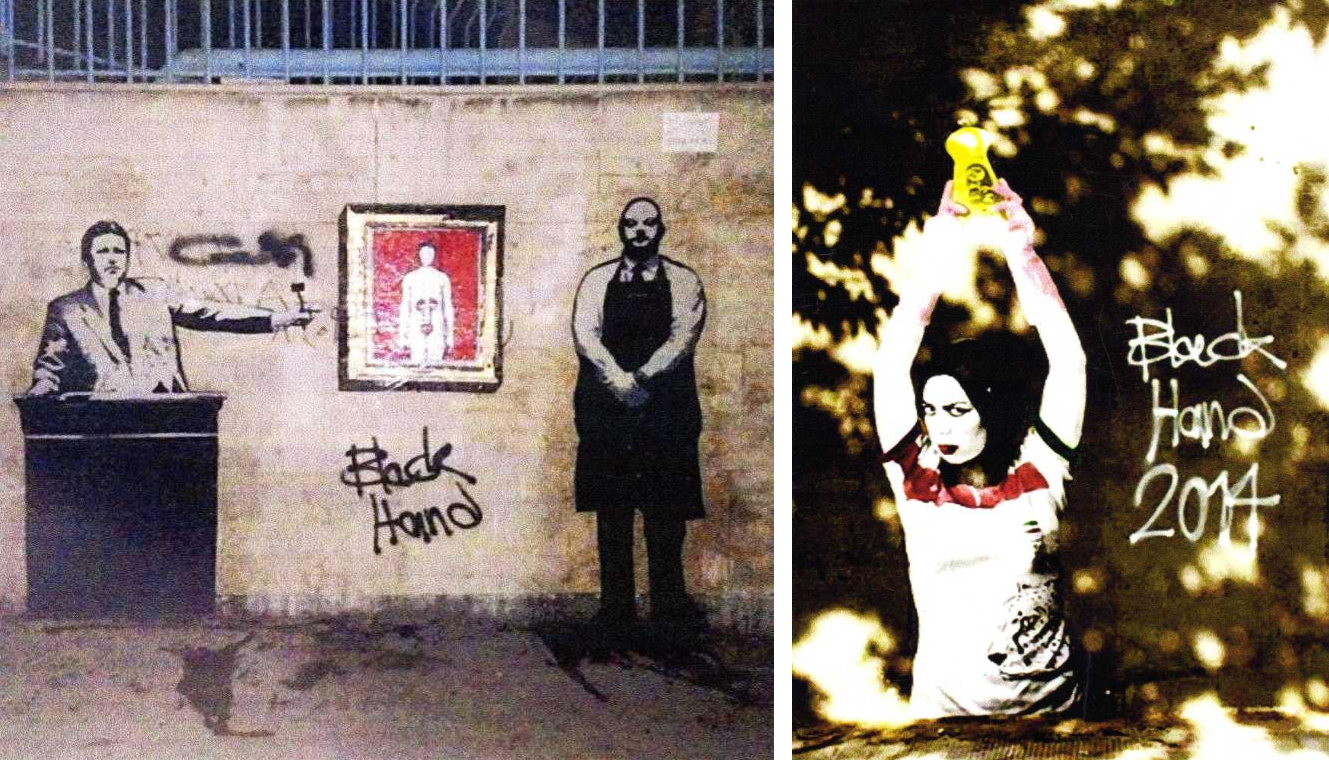
It's also as if these contradictory, even dislocated tendencies cannot be clearly demarcated, always eliding elsewhere; a warp and woof that becomes the essence of Bradford. It could be said – without overdoing dark drama – there's a barely controllable urge to kill in the city, one however that is sufficiently well masked – deep down below - by the sheer geniality and inventiveness of its multi-racial inhabitants generally just to say surviving at the sharp end. We would suggest that the previously mentioned string of vicious serial killers is mimicked in bureaucratic circles by council despots ensconced in City Hall who, knives sharpened, are ever ready to extinguish all different, enlightened initiatives springing up from below, prominent among which is the serial killing of nature – literally nipped in the bud - flourishing in and among its glorious, up and down, rocky topography, a terrain that was rightly eulogised by John Ruskin as untameable.
Throughout 2013-14 we were confronted with a good smack in the mouth from Bradford's insanely vicious ruling cabal as an almost total attack from all and sundry was launched against our potentially communal wilding operations and a praxis anybody could engage in immediately if they so desired. (IT WAS PRECISELY THE LATTER POTENTIAL THAT SO TERRIFIED THE BUREAUCRATS and they had obviously got hold of our RAP and Dialectical Butterflies webs as this was an inflection on 'wilding' that wasn't in the lexicon of the artistic neo-psychogeographers or passive, literary, academic consumers like Macfarlane or statist bureaucrats like George Monbiot. It was a counter insurgency operation with officially sponsored ecos well to the fore ever ready to cover up, excuse and even discreetly encourage fascistic individuals and manoeuvrings which amounted to clandestine involvement in black propaganda of deeds. The latter could only take place because bourgeois law was extensively overruled from the scrapping of planning procedures to the flouting of the legally binding bio-diversity agreements, which the UK has signed up to. All these disparate elements were quickly backed up by the local media in general as each specific dept sustained other's outright lies, web site redactions and generally appalling behaviour. In this thick slime of a bureaucratic stew there were to be no leaks, no whistleblowers, never mind a few half-truths discreetly whispered to fellow conspirators. A bizarre, crazed united front was quickly assembled against us. The local newspaper became full of oblique references to what was happening without of course naming names or pointing to the real crux of this explosive engagement. Though butterflies and insects were massively exterminated at Briggate, the T & A was suddenly lamenting the further loss of endangered butterflies farther afield as good old Bradford's hands remained clean in this respect.
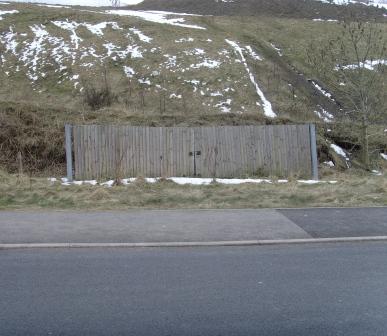
Above: the expensively padlocked gates of Bradford's Gaisby Quarry - without a fence on either side. Locals love to laugh at this unintended installation become apt visual metaphor for Bradford Council's mammoth, stupid inequities
Attachments
Comments

Bradford's Eco-Peterloo (Part 6). Opposing Operation Eco-Cide orchestrated by Bradford City Council/Sustrans and Official Ecos during 2013-2014.
Note on "Monstrous Bastards" moniker, May 2025
In reality - The Monstrous Bastards - was all part and parcel of the wider John Clare Collective experience. In fact, they (Stuart and David Wise) found out they were being named as such by council officialdom by a great gal who helped clear 'the big field' alongside the Bradford Beck and whose sister worked as skivvy cum cleaner in Bradford Council offices. Laughing with joy the moniker was immediately embraced alongside Tweedledum & Tweedledee, Batmen & Robins, etc, and spontaneously placed on flyers, letters and what-have-you and inevitably, the Revolt Against Plenty web........
David Wise
------------------------------------------
Libcom note: this article is taken from the version at archive.org which does not include some of the images.
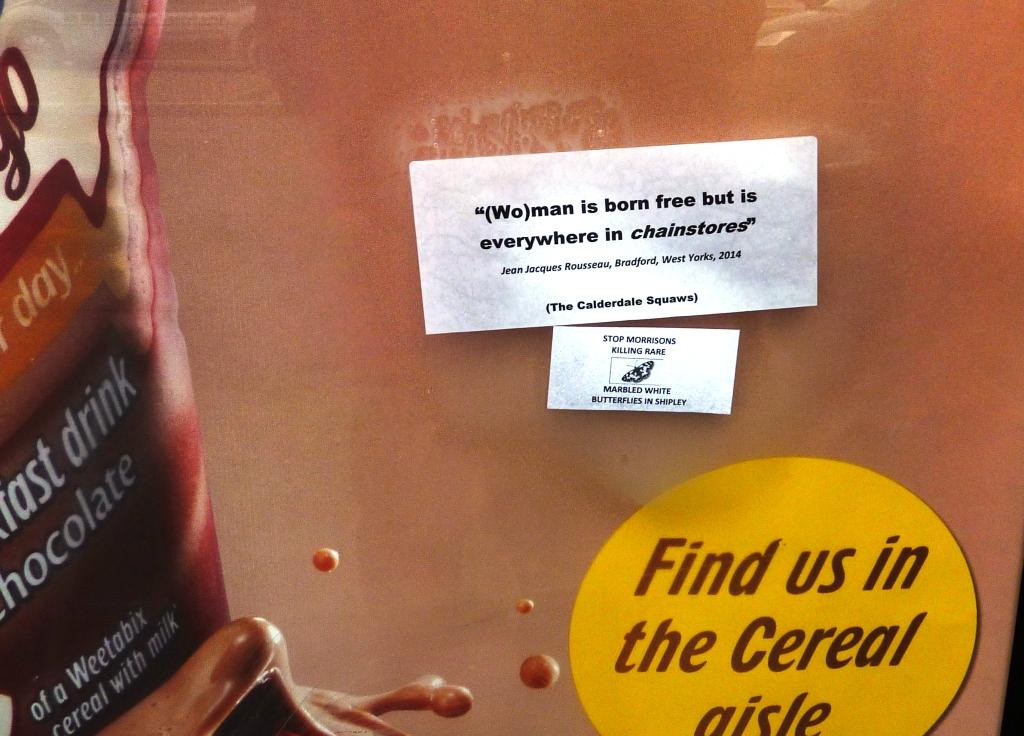
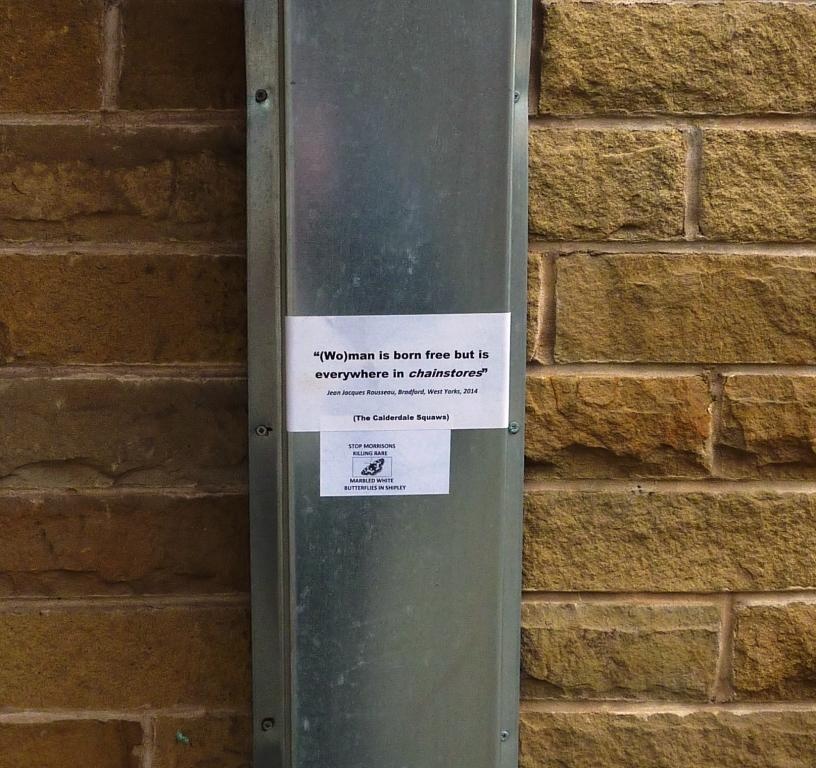
The above stickers were put up all over Shipley, especially the market place adjacent to the destroyed terrain vague arena as well as Bradford's university campus. Most (it seems) were signed by the Calderdale Injuns, the Calderdale Squaws, Chief Last Night, General Knockabout of the Ludd Tribe, etc.
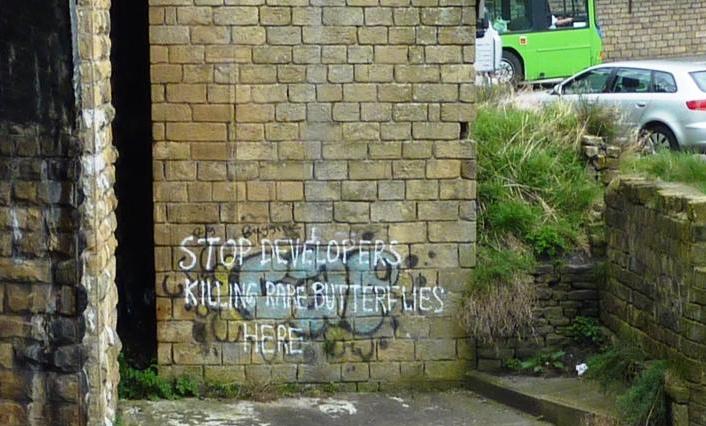
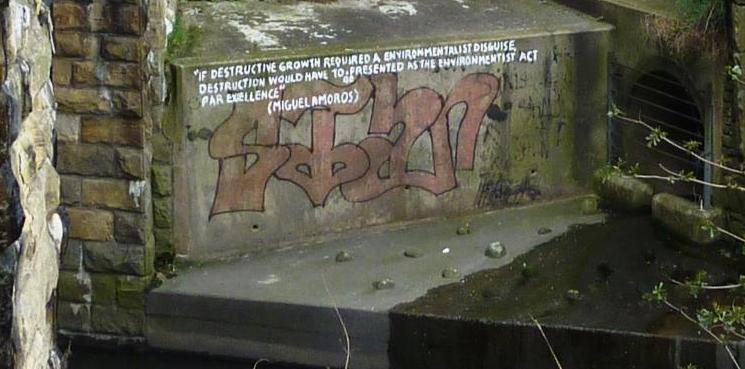
"IF DESTRUCTIVE GROWTH REQUIRED AN ENVIRONMENTAL DISGUISE, DESTRUCTION WOULD HAVE TO BE PRESENTED AS THE ENVIRONMENTALIST ACT PAR EXCELLENCE "
(MIGUEL AMOROS)
Miguel Amoros in Spain has recently set up a kind of project around various anti developmental perspectives perhaps helping make some kind of common cause with others through increasing contact and collectivity. Consequently a Barcelona periodical, Argelaga: An Anti-Developmentalist Libertarian Journal, has come into existence based on "an atmosphere of dissidence and desertion in which the historical subject, which is nothing but the anti-capitalist community, can be constituted and consolidated" (Argelaga no. 1) in a struggle that is not just rural but aimed also at "a return to the city, that is, to the self-governed and de-capitalized space where liberty and history originated" (Argelaga no. 2).
PS. Then within a couple of months along with so much else, the slogans were jet sprayed off the wall.....
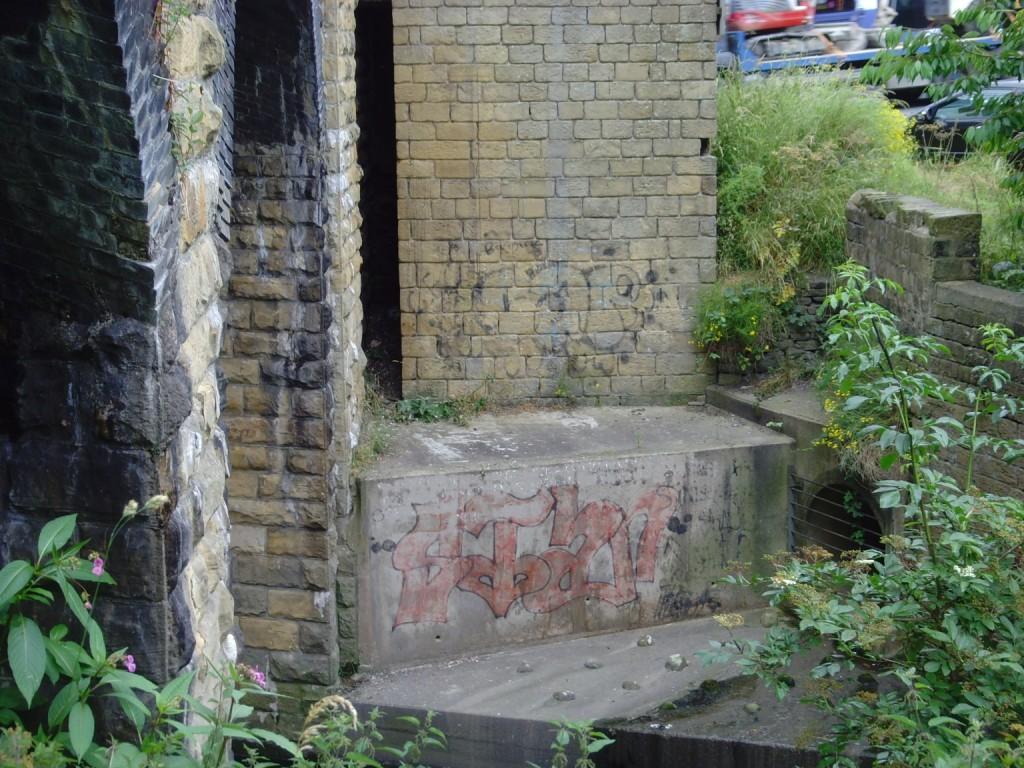
Below: And yet the more innocuous, more artistic tag was allowed to survive
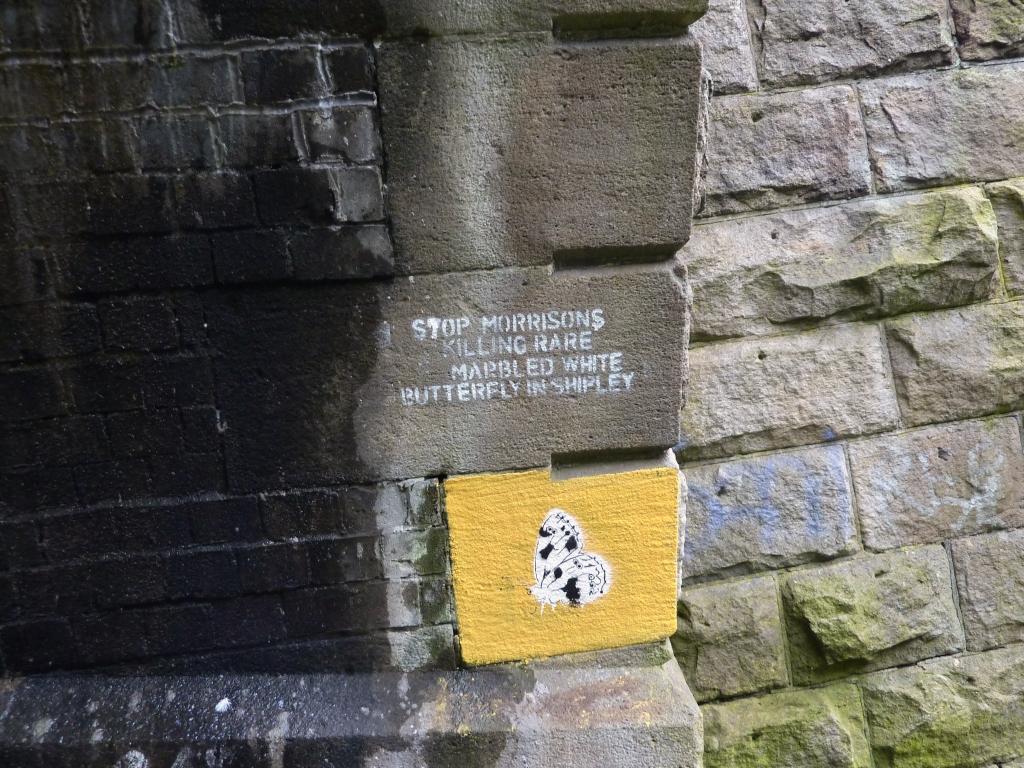
Below: The yellow square was initially rather crudely painted up alongside a Sustrans pathway on the well used Leeds/Liverpool Canal tow path. Obviously its intent was to awaken the vague green sympathies of regular walkers and cyclists.
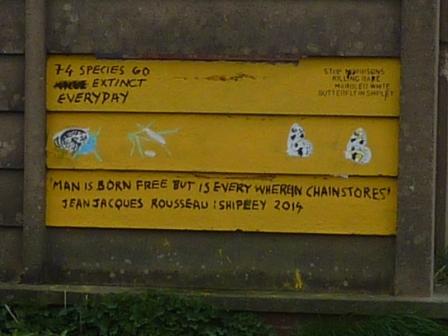 graf24a
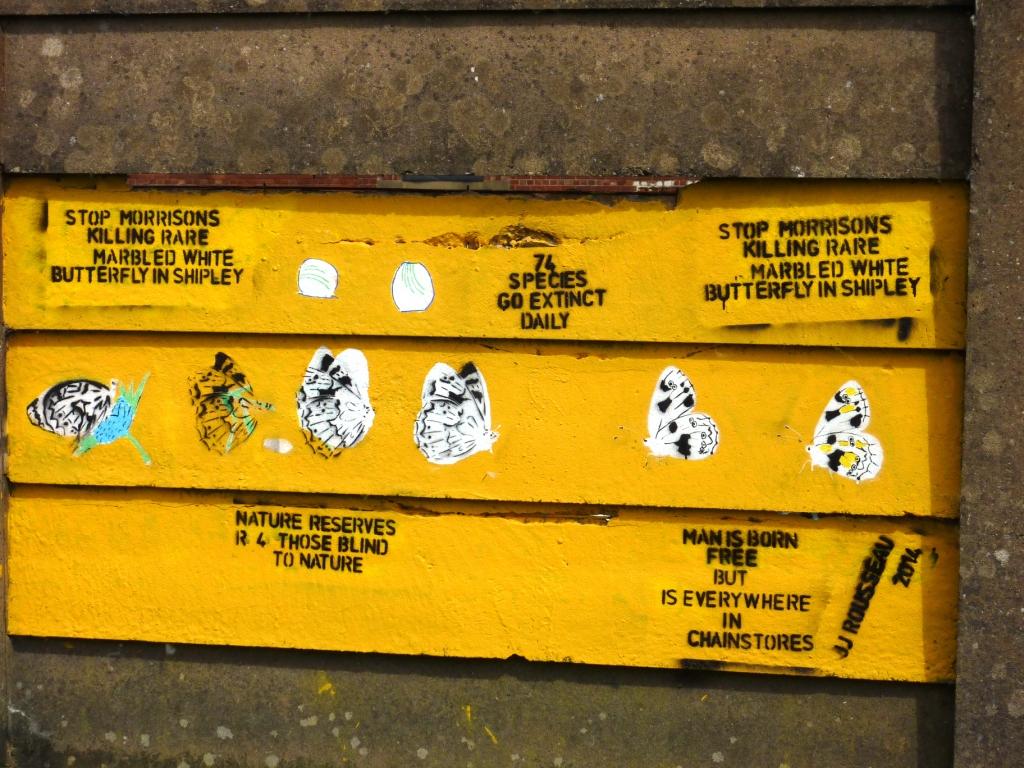
Within days the crudely executed comments were painted out (fig 2) and a lot of stickers were torn down. Obviously they had really struck home, official ecos desperate to get rid of our unseemly comments and Shakespeare's quip, "The truth must be silent, go to your considerate stone" as accurate as 400 years go. Immediately, (it seems) newer, more polished versions of the same comments were reinstated!!! Interestingly this happened more or less on the same day a priceless Banksy was 'discovered' on a Cheltenham wall whereby the council then rushed-in to save the piece from "vandalism" (would you believe) eager to preserve ART AND MONEY even though the piece was a discreet comment on the nearby GCHQ surveillance headquarters. As far as the Bradford pieces were concerned some official body rushed in to obliterate all comments while saving the visual outlines of the life history of the Marbled White butterfly! Nowadays, it would seem, all banal purely visual and empty tags and pieces are officially venerated whilst all subversive slogans, no matter how innocuous, are instantly painted out. You couldn't make it up ...........
Below: Interestingly enough Bradford Council does possess a Banksy stencilled on the metal door of a utilities cupboard on Leeds Rd and also a place where stickers referring to the local ecocide were quickly torn off. It's laughable, because more to the point, a dumb Bradford officialdom doesn't even know they've got a Banksy otherwise they would have gotten their grubby little mittens on the piece years ago!!!!!
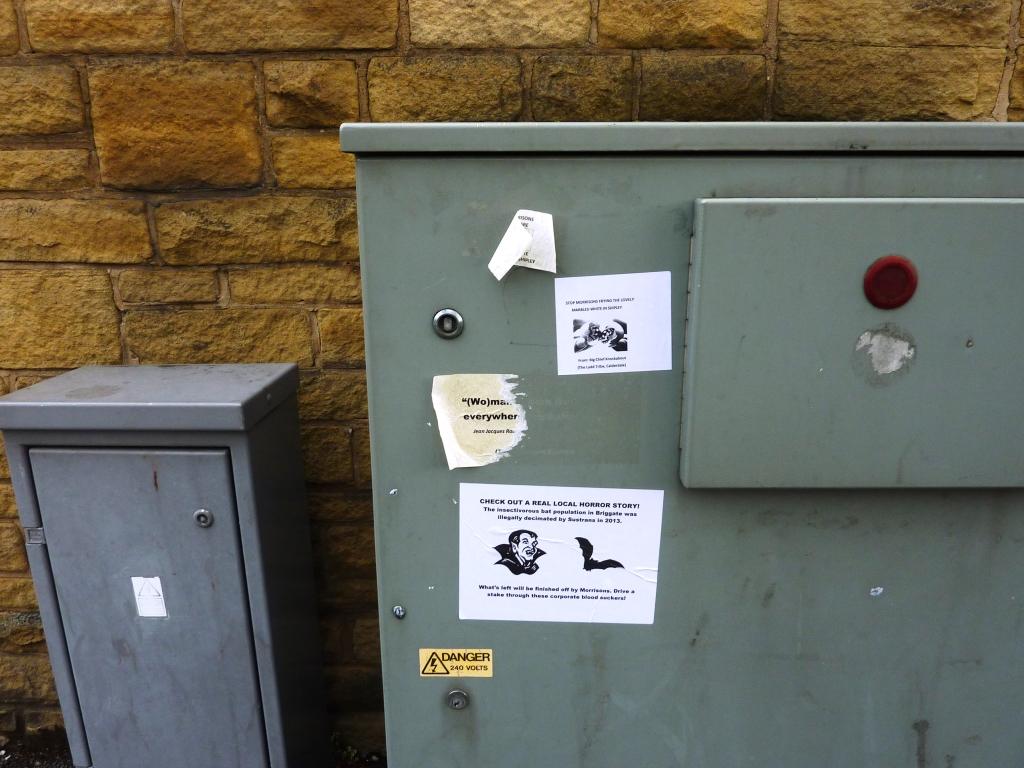
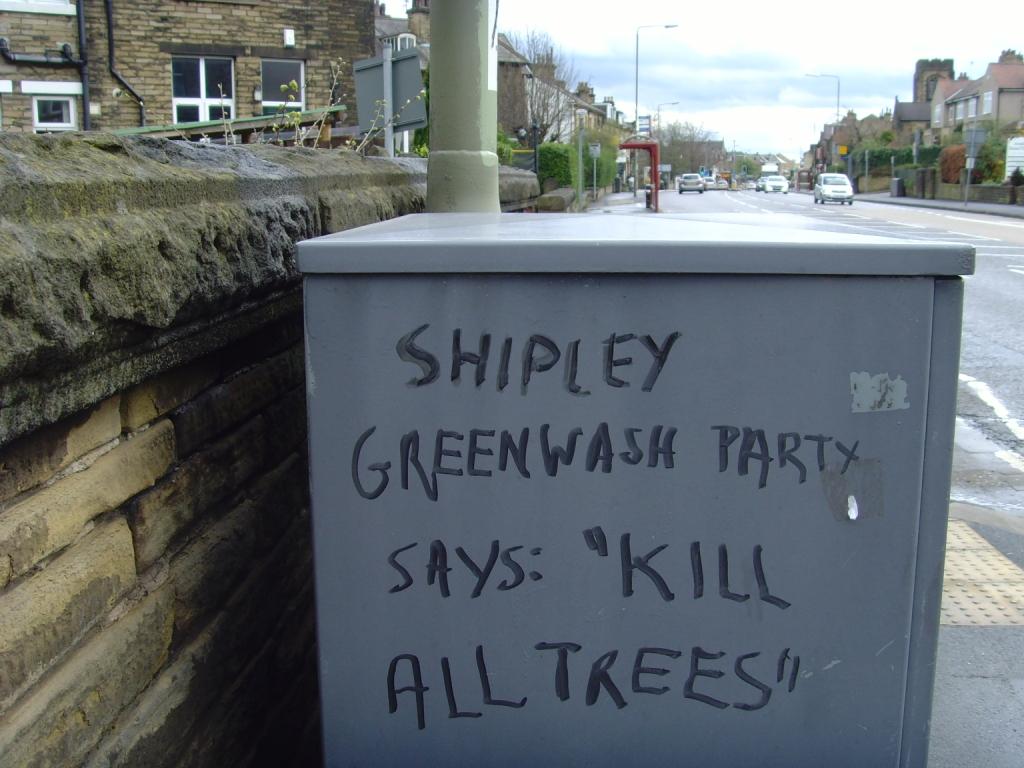
The local Green party had been contacted about the eco destruction taken part in the area but they never even bothered to reply. Worse, they then commented on local Leeds radio (April 2014) that it was kind of necessary to cut down a splendid tree lined street in Victorian Saltaire; a performance so pusillanimous that even the radio commentator was exasperated..........
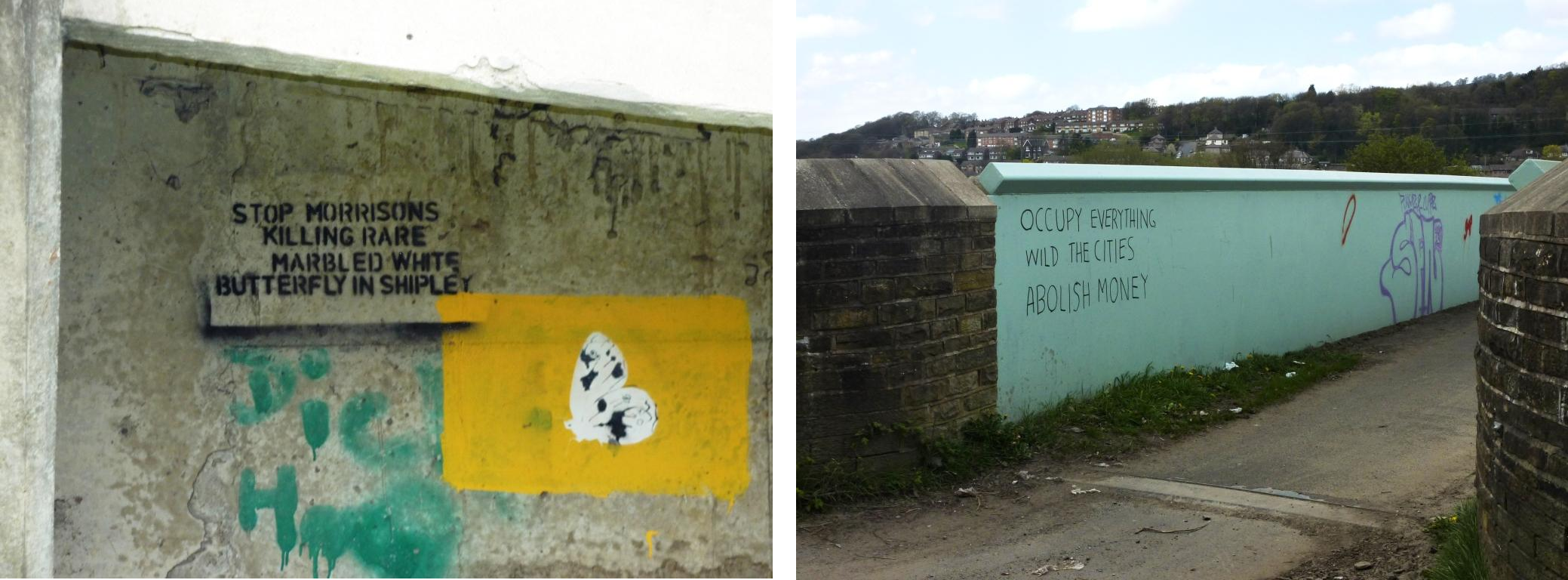
Obviously it's necessary to generalise subversive comments. The recent destruction of these rich sites of brownfield biodiversity were also terrain vagues increasingly utilised for all kinds of different activities including living in human shelters, though often cleverly disguised. They had become sites of the new occupation movement which briefly gained a profile throughout the last year of general contestation in 2011. For authority this form of stealth occupation must never happen again. Let's hope it does.......
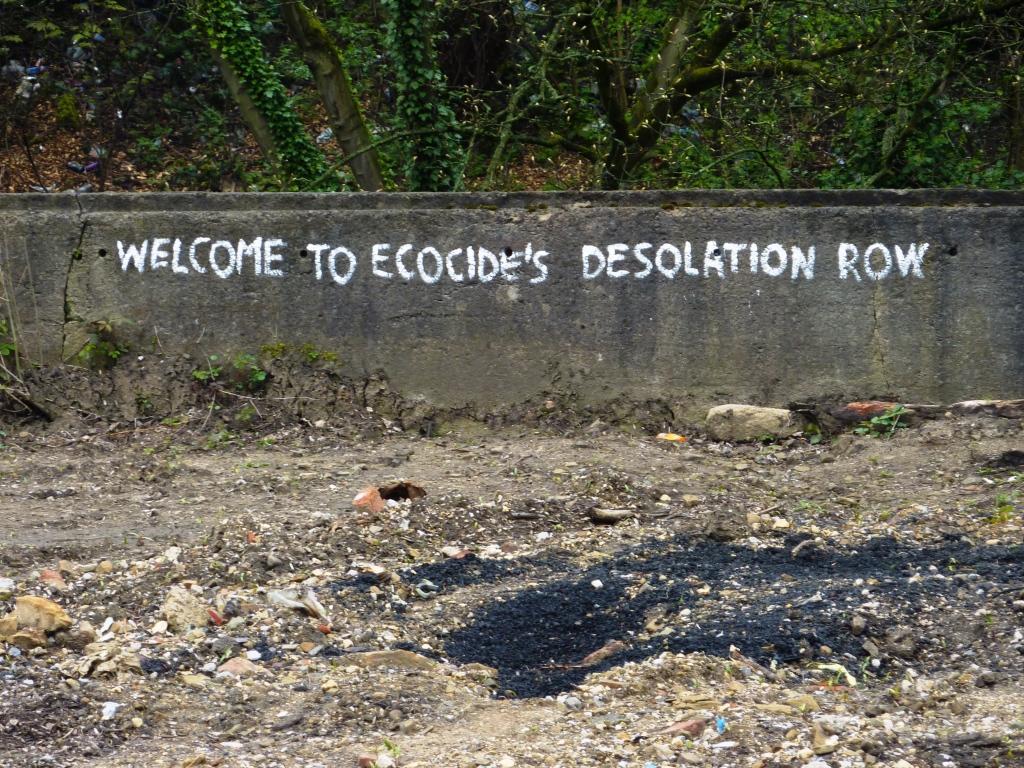
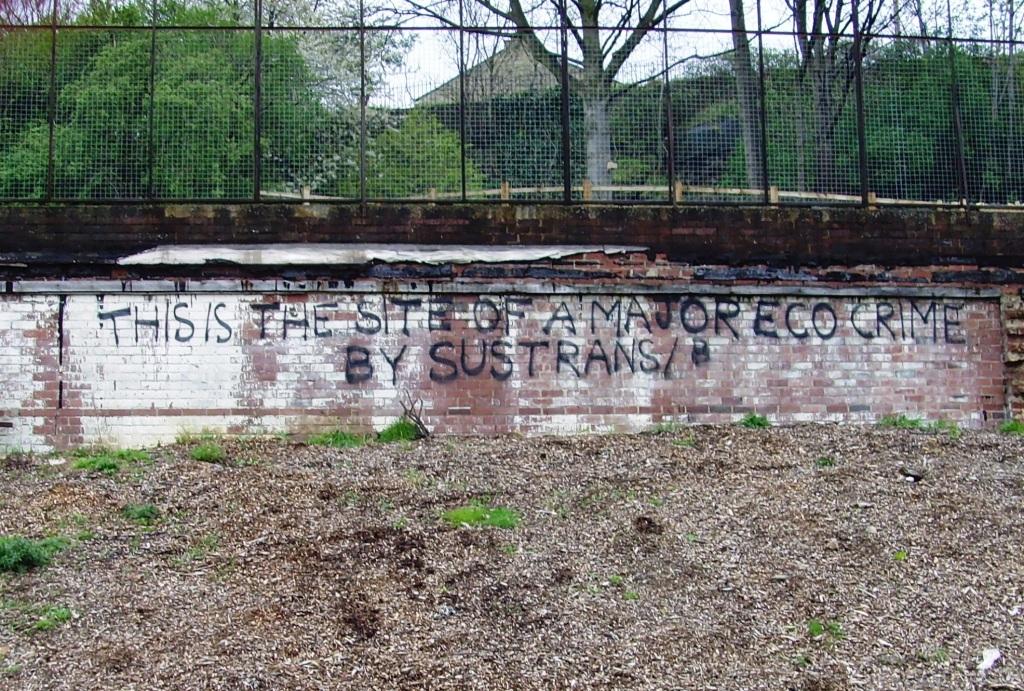
The above comments were placed over the now still centre of utter devastation in Briggate. But it wasn't long before Bradford Council / Sustrans – or rather their volunteers - painted them out? See photos below) After all, nothing ever happened.....there was no ECOCIDE!
graf28 
Although bats are protected species and flew in abundance in Briggate they also had to be destroyed. After all this was a nasty site of industrial dereliction and therefore only a nasty nature could exist here; one that must be purged for its own on-going health........ And the slogan above was almost immediately painted out. We complained as per usual but this time to the West Yorks Bat Group but again as perusual, we received no reply. Nothing to hide, of course, as this was simply the correct procedure countering wanton vandalism...... However, despite the gruesome purge, bats can still be seen here if anyone cares to take a look at dusk.
graf29a.
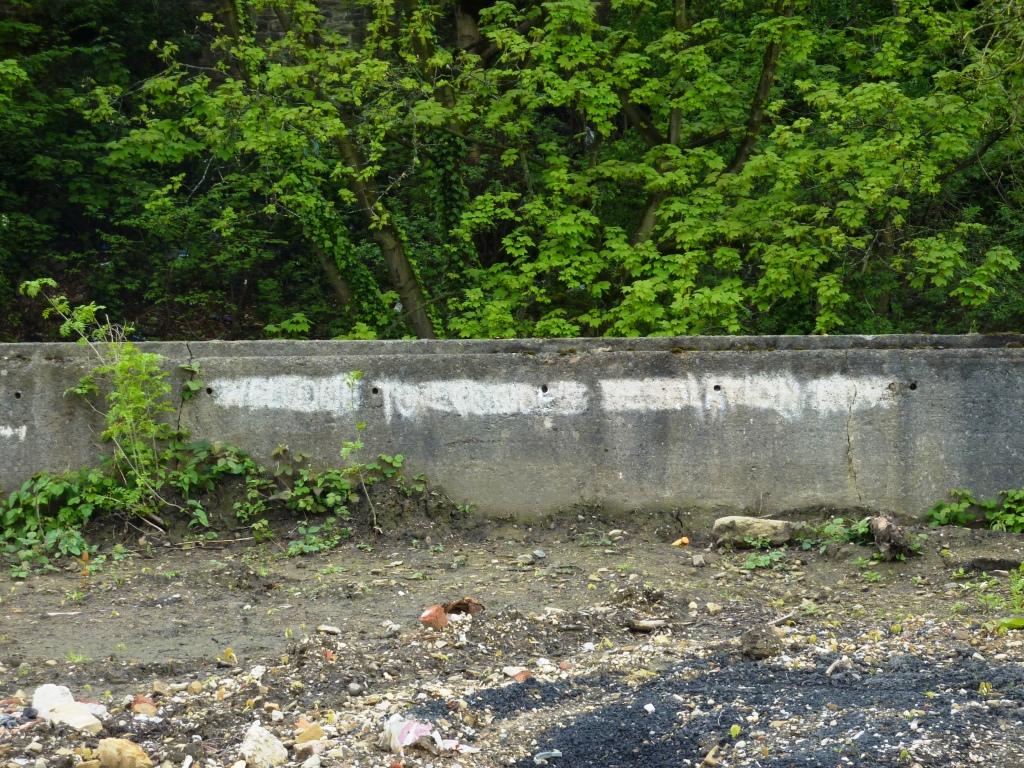
Below: The beginning of a critique of the ideology of nature reserves......
graf32
Above: A green notice board in Buck Wood
Below: Buck Wood bin
graf11
Below: All to be quickly abolished, jet sprayed out by the Friends of Buck Wood......
The professionals deciding that all cutting edge critique to be suppressed forever.........
Below: Elsewhere and a few concrete blocks came in handy...it seems........
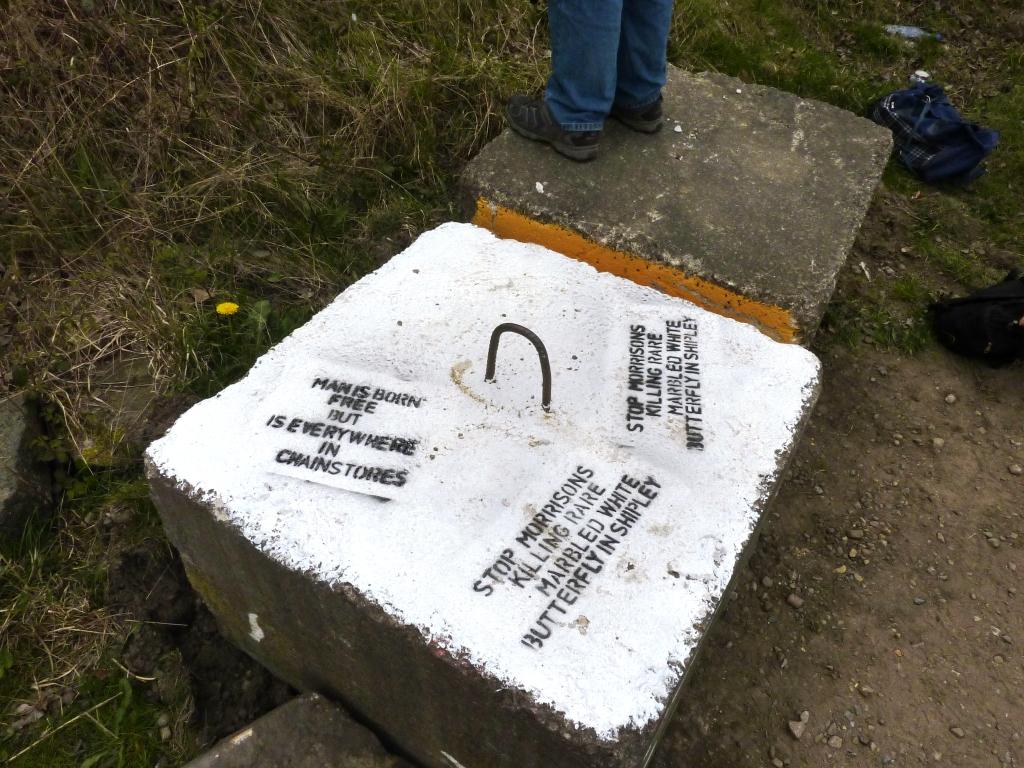
Below: Here resides another wild nature site gutted by Bradford Council. Poster by Chief Last Night (Calderdale)
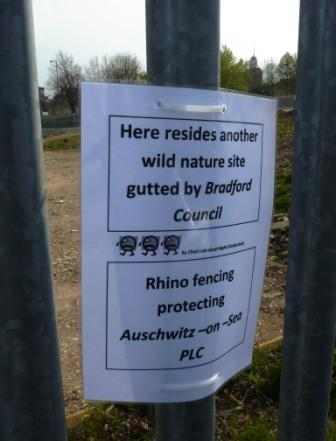
manninghamposter1
Below: Wild the Cities
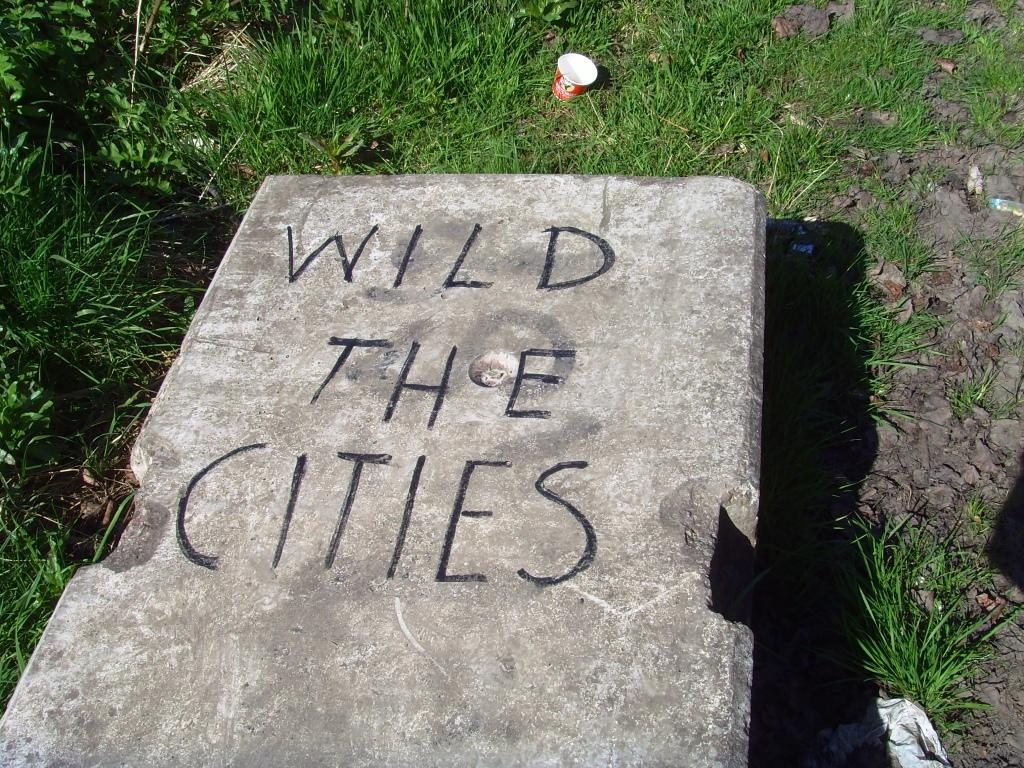
graf21a
All these slogans it seems were aimed at creating and highlighting a form of egalitarian nature intervention – a wilding - that supercedes the general passive recording proclivities of the ubiquitous so-called nature conservation groups hemmed in by officialdom, spineless to the core. Wilding is a practise anybody can participate in, aged from 8 to 80, from so-called healthy to the paraplegic, a practice also utterly democratic in character which can begin on your own doorstep...if you've still got a doorstep left.
graf36
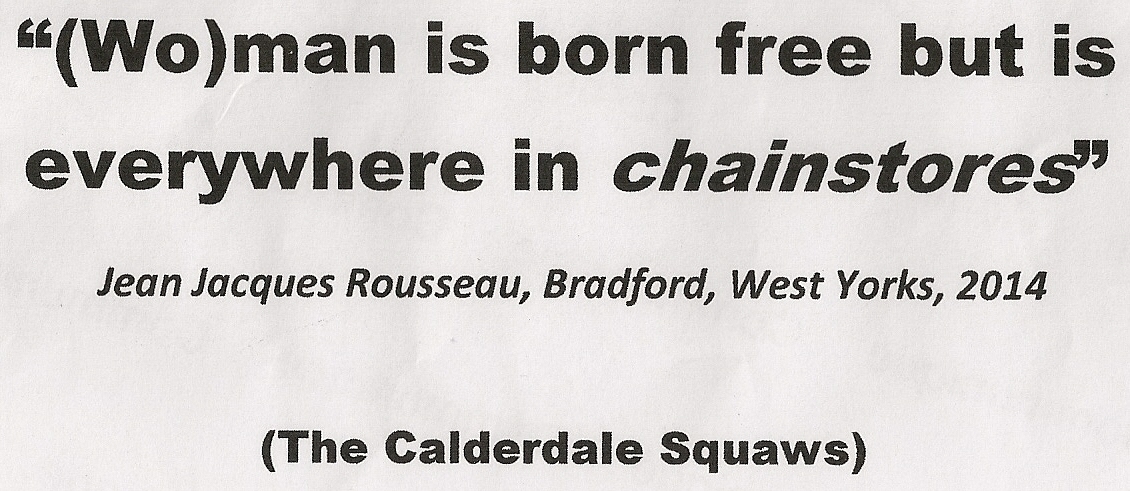
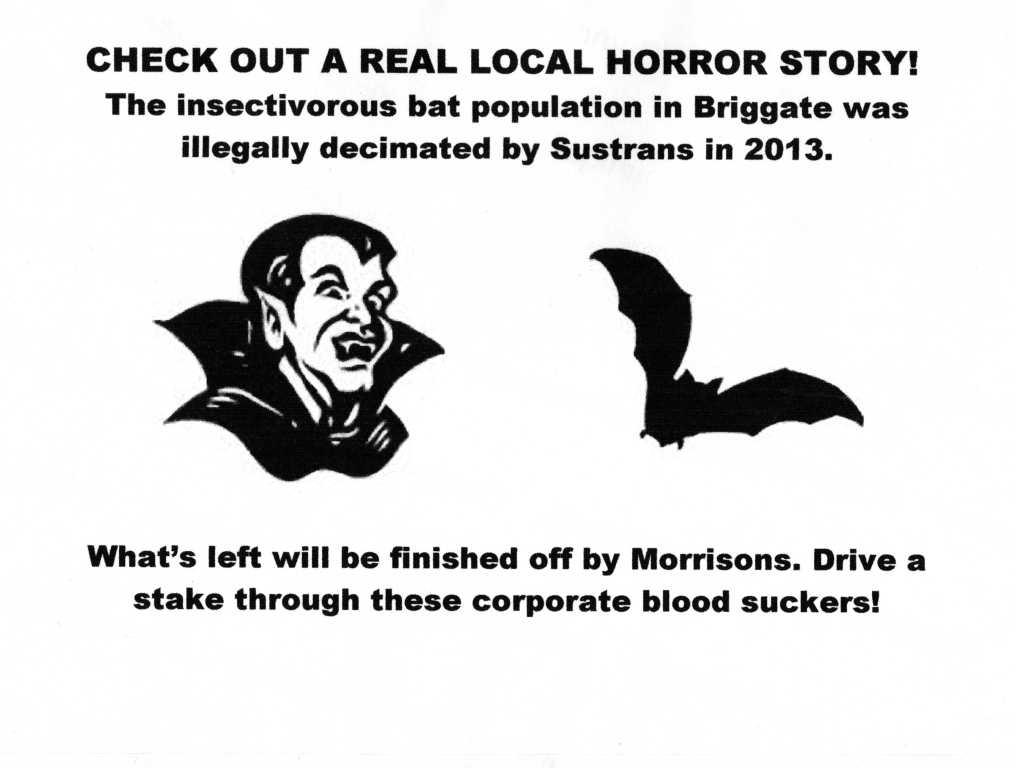
graf35
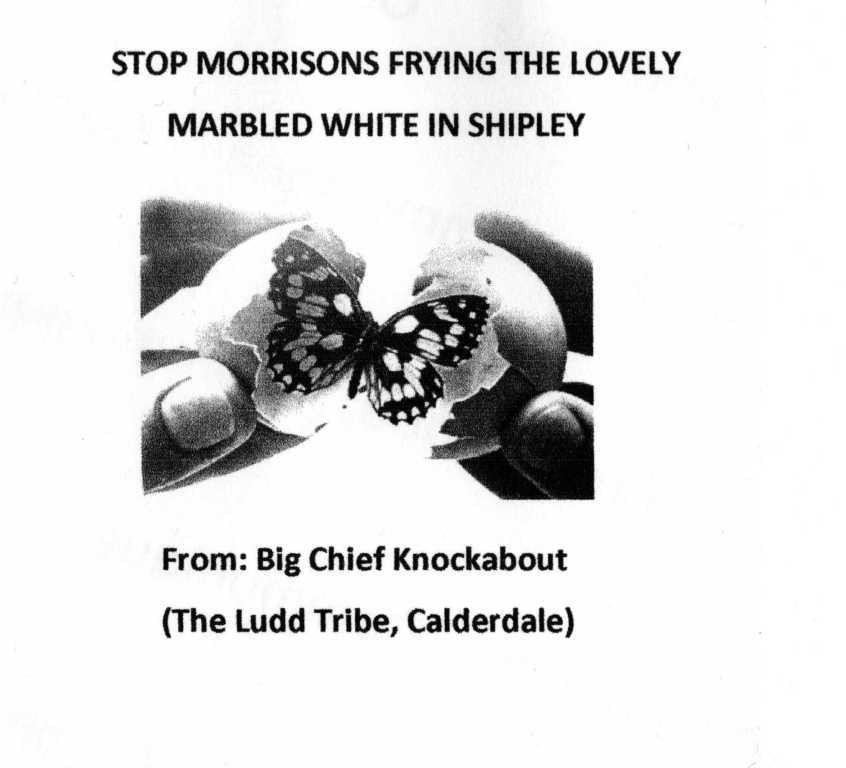
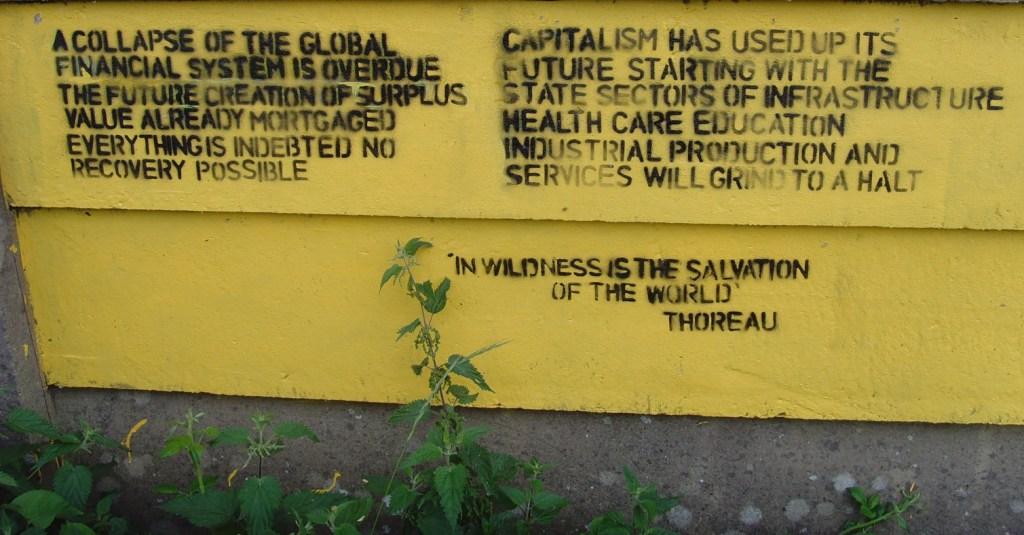
Above: Paraphrase of a statement made by Robert Kurz, the German value-ist just before he died in 2012. Nonetheless the council, or some related body in their sublime wisdom found fit to jet house out this interesting theses while retaining all the many banal tags and pieces in the immediate vicinity....
Below: Only then to be disappeared along with comment by the 1840's American writer, proto environmental anarchist and Transcendalist, Henry David Thoreau.
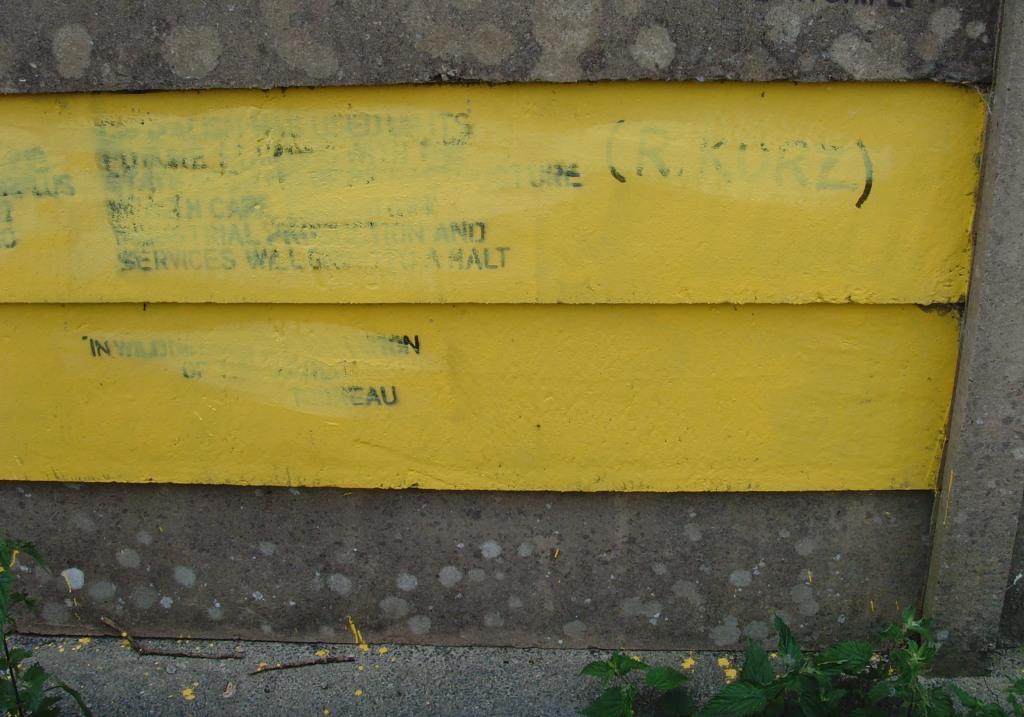
Below: Incensed that some philistine 'august' body had gotten ridden of most of the wall slogans on the Briggate site which pointed out the terrible ecocide that had taken place, a tableau – a war grave – to the disappeared and the dead was (it seems) partially erected. A mock graveyard was made, each grave to commemorate in big letters each species that had been slaughtered on this 2014 eco battlefield. Their names will liveth forever and there also was to be a grave to the unknown species. These species included The Common Blue, the Small Tortoishell, The Brown Argus, The Purple Hairstreak, the White Letter Hairstreak, the Brimstone, the Dingy Skipper, the Brimstone, the Marbled White, the Red Underwing, the Tawny Owl, The Green Woodpecker, the Greater Spotted Woodpecker, the Common Buzzard, the Kingfisher, the Goosander and so on. Interestingly, having only completed half the graveyard, undead local, young Bradford Goths immediately found the site and celebrated its existence while doing bike wheelies downing bottles of cheap lambrusco and putting their own inimical markers on some of the gravestones. Those who engaged in this wanton vandalism laughed with glee; having finally gotten through to some people!!
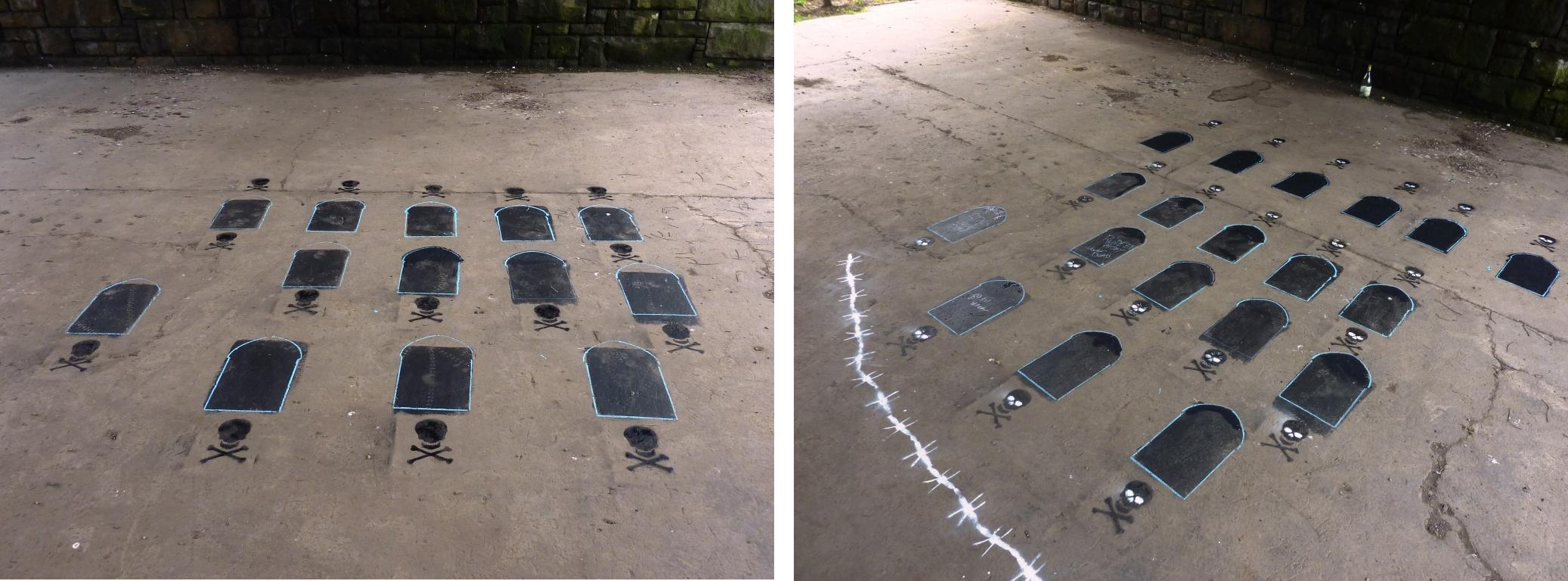
Above: Gravestones and gravestones with barbed wire
Below: Never Dead Goths intervention
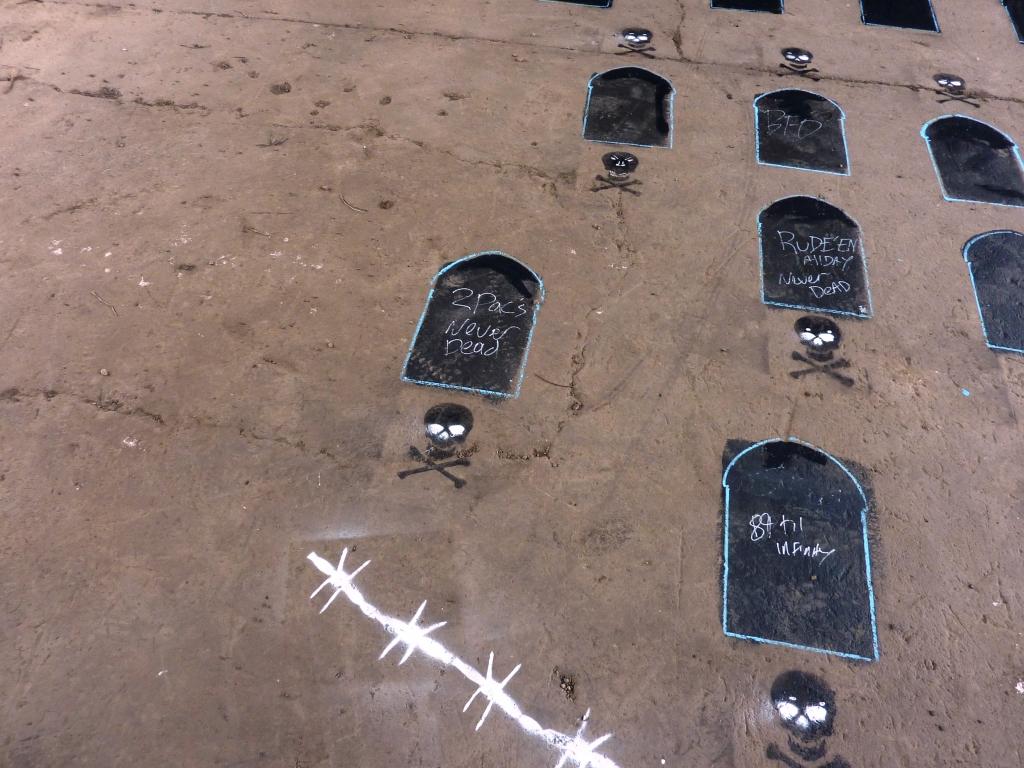
Below: The destruction of a big part of the Briggate bat roost was skilfully played with bringing in the figure of Dracula much again to the delight of the local Goths........... And the fangs were dripping with red blood and Drac's eyes were bloodshot. .......Bradford ecos, again as is their wont in relation to sites of industrial dereliction, had declared NO bats bred here as did the local Bat Protection Society, such is their prejudice against what they regard as visual eyesores...........Below a close-up of a Never Dead goth grave.
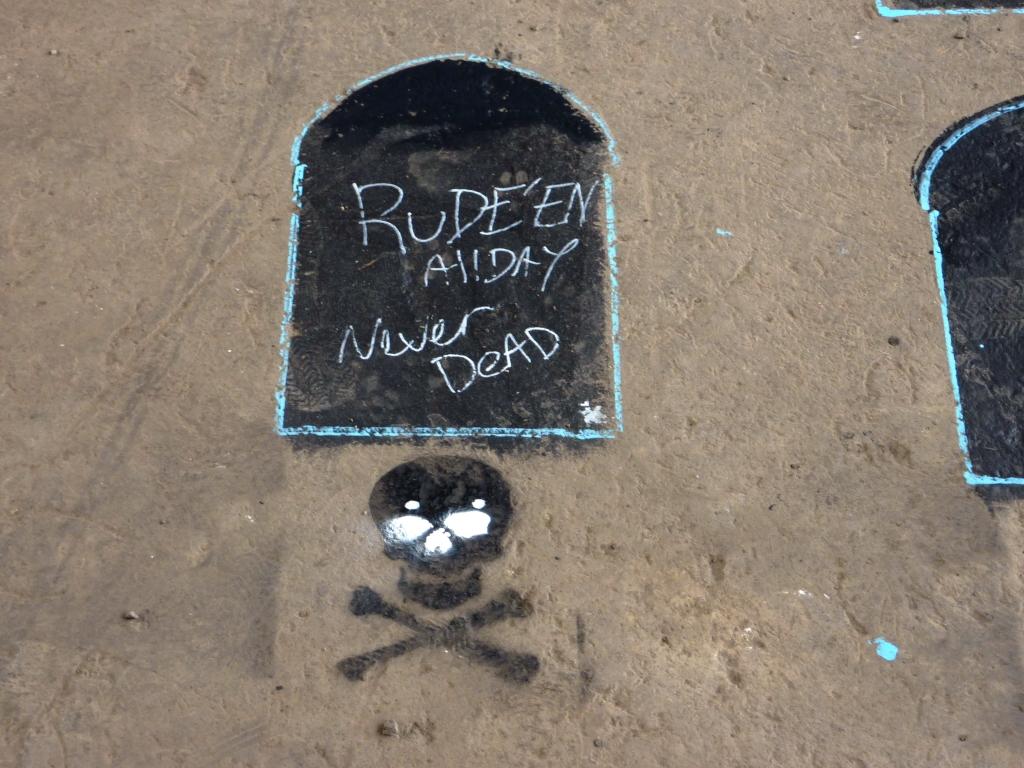
Below: Bats through steel wire
goth7
postgoth3 
After THE BATS .........six days later.......... (as above) NO BATS and below, gravestones jet sprayed out (some authoritative body had decided yet again, that enough was enough!) Yet again GUILT writ large.......
Postscript: What to make of the rise and rise of tags and pieces in general?
Since 2011 tags and pieces painted on walls, doors utility installations, etc. have massively increased everywhere in a collapsing UK plc after something of a lacunae during that year of open protest. What does this mean within the context of a country travelling socially backward at a rate of knots? On the level of surface appearances tags and pieces are simple, cartoonish, lightweight decoration with hardly a glance in the direction of subversive, enlightened comment which marked the late 1960s and early 1970s. Indeed, recently we were asked to contribute to George Stewart Lockhart's update and republishing of what has became an iconic book from that period by Roger Perry with an introduction by blues shouter, George Melly. Called The Writing on the Wall, this book is a record of graffiti largely found in and around London's Notting Hill prior to ultra gentrification. Basically we were asked just who did what and were able to supply a lot of answers as we also supplied the publishers with some of the above mentioned material. Alas, such enlightened graffiti has for decades (it seems) been largely eclipsed but for how long?
But doesn't the last sentence miss the point? Isn't today's clandestine tags and pieces phenomenon - much influenced by American shop window wildstyle graphics - riven with internal conflict often moving in many directions at once? Isn't it both artistically aspirational melded together with a strong basic undertow in the UK of proud, uncompromising social apartheid where all that matters is guts and two fingers up to authority with prison around the corner rather than entertainment for a despised art gallery coterie full of middle class wankers? Isn't 'the high', the aggressive act in itself armed with tins of spray paint (often ripped off) all that matters; a form of sabotage the bigger the better simply to more or less nihilistically fuck things up even more?
There truly does seem to be a distinction between this attitude and those aspirants flitting from wall to wall on the make ever ready to be selected for an art exhibition or, if not that, to be officially hired by the local council for some lousy frolic of a hoarding or a big shot company with an eye permanently on the money markets. And Brandalism uneasily all over the place fitting-in somewhere in-between as J.C. Decaux hoardings are cracked and new poster hoardings are inserted as Harrods becomes Horrids, etc. care of Penny Rimbaud and Steve Ignorant, et al.....which in its turn then re-influences mainstream advertising?
It seems that among the rank 'n' file base of the subterranean tag and piece community, the path of a Banksy (all the way to the bank) is despised not because the punters wouldn't like to get their hand on a mass of spondoolies but the way how it's done and the treachery against comrades in (spray can) arms which is involved; in short what boils down to a kind of un-worked out anti art aggression. Yep, a tag is to get known alright but in the sense of blackening (or reddening) the eye of authority, to really get under their skins, to provoke the law with the aim of becoming a martyr for the cause of graffiti rebellion – the act itself meaning so much more than any cornball visual statement. And isn't Banksy pure sell-out; a guy who can make something of an intelligent, amusing comment but only finally for the amusement of the super-rich of Euro / America especially the Hollywood Hills? Moreover, ever ready to viciously rubbish his tags and pieces comrades like his well known rubbishing of Fisto.
Ah yes, Fisto from South and West Yorkshire, periodically in and out of jail since his first holiday location in Her Majesty's Toilet in 1995 for knocking out big pieces usually on the side of bridge pilotis on the M1 near Sheffield and done with such sheer cheek right next to the cars endlessly whizzing by during the night. (Fisto a tag in itself alluding (perhaps) to the red – and black – fist of the miners as well as what gives you a good smack in the gob). For Fisto it was as if the miners' strike never ended, or perhaps needed to be avenged - Fisto living in Barnsley at the centre of the uprising was 9 to 11 years old during the great strike - outlining his feelings in his mid twenties with something like a radical miner's take, like say John Dennis's almost intuitive appreciation of spontaneous situationist inspired comment. Consider the following words Fisto beautifully put to paper (and masonry) many moons ago:
"This is a blind society. Every day, everywhere we go we are bombarded with these big adverts making money selling lies. And people believe them. They're brain washed even if they say they are not. But when someone is individual or real, they think it's some big crime. I don't feel part of this system or society."
And then a little later on a wall in Sheffield, Fisto was to write "In a society based on image, greed and selfishness we are the few who have broken the chains by exposing our art by any means necessary"...... (OK we forgive him for being a bit lax with the term 'art')
Then and now: Fisto in his forties but still unbending, morphing recently into Bloodaxe. Simply heavy metal but so much more, a tag remembering (again perhaps) the blood spilt by his relentless persecutors, Sheffield Council at the battle of Orgreave and even more so at Hillsborough football ground a few years later as the bodies endlessly piled up.... And the bureaucrats have still gotten away Scot-free. In response Bloodaxe pieces have become ever more gigantic, ever more intrepid, ever more in your face, the M1 giving way to the precipice-like walls on the railway gorge approaching Sheffield Midland stn, Fisto's latest trial and jail sentence becoming an instant social media hit as this "paranoid schizophrenic" – according to a doctor's report was forced again to wear Leadbelly's "ball and chain".... And in the weeks that have followed "Free Fisto" (or Fistes and Fista) pieces appearing everywhere throughout our old childhood stomping ground in South and West Yorkshire, the man an inspirational legend for refusing to ever compromise standing alongside Frem in Leeds and the Infamous Runch in London, the latter having recently extended his range all the way to Billericay in deepest Essex...and so the show goes on and on.....
************
Below: Further Stickers
“Birds and trees and flowers without a name / When lawless law’s enclosure came” (John Clare)
Love is Dead: Eros Reborn through Wilding…
Create the New Commons of Urban & Industrial Dereliction. Every Commoner Welcome
Eros through Wilding
City Wilding: Every Wild Child Welcome
Suicide Capitalism = Natures’ Apocalypse
Art is Dead: No to Wilding Aesthetics
Down with Horticulture Up with Wilding
Network Rail Roundup Tortures Wildlife
Horticulture is Natures’ Capitalism
Horticulture and Suicide Capitalism = Extinction
Unofficial Nature / Unofficial Strikes TOGETHER
Horticulture and Unofficial Nature are at War.
Horticulture and
Suicide Capitalism
= EXTINCTION
Comments