Content from this issue of the journal.
Editorial from Insurgent Notes #15, August 2017.
In case you haven’t noticed, we’ve been quiet for a while. Unexpectedly, after what we believe was a quite successful public meeting in early February, we found ourselves running aground and have not been posting very much at all. In part, our difficulties resulted from a realization that some taken-for-granted assumptions regarding the political agreements of the small New York City–based group that had been providing political guidance to our project should not have been so taken for granted at all. Specifically, we discovered that there were some quite fundamental differences in the ways in which members of the group were making sense of the extent of support among members of the working classes for Trump’s candidacy. Reduced to perhaps overly simple terms, some were inclined to emphasize the reasonableness of the grievances that led people to support Trump while others were inclined to emphasize the extent to which that support reflected deep-seated reactionary sentiments and contributed to an emboldened right-wing agenda—of both traditional and alt-right varieties.
The months since have not really clarified matters as much as we might prefer. Each new analysis of the composition of the Trump electorate shades interpretations in different directions—see, for examples, “That big wave of less-educated white voters? It never happened,” “It Was Cultural Anxiety That Drove White, Working-Class Voters to Trump,” and “It’s time to bust the myth: Most Trump voters were not working class.”
Beyond the specifics of the disagreements regarding the election results, it also became clear that political support for the Insurgent Notes project, as it had evolved within that small group was not as deep-seated as needed to allow for coherent decision-making about how we should proceed. We are in the process of forming a new editorial group that we hope will address that fundamental challenge.
For the moment, we’re going to continue publishing the journal. We are, however, going to attempt to refine what we write about, whom we are writing for and how we write. We are aware that we exist in a context of other radical/revolutionary publications (for the moment, we’d cite Jacobin, New Politics and Viewpoint) and we need to find our own place in the sun.
We have a few ideas about what that place might be:
- it is fundamentally internationalist, not only in aspiration but in actualization (we consistently have correspondents and reports from across the globe and we pay consistent attention to international developments, including those grounded in the fundamental relations of production and reproduction);
- it refuses any hard separation between the spheres of theory and practice (over the course of seven years, we have included extensive coverage and critical assessments of every major popular rebellion—Madison, the Arab Spring, Occupy, the movement of the squares, the anti-police protests in the wake of Michael Brown’s murder in Ferguson and even, Lord knows, the 2016 elections and, side by side with them, have attempted to apply and deepen theoretical understandings to major events such as the Deepwater Horizon oil spill and the Chicago teachers’ strike;
- it acknowledges the importance of in-depth analyses of historical moments (such as the Russian Revolution in 1917, the Spanish Civil War and the May 1968 revolt in France) and political tendencies (such as anarchism and Maoism) and political thinkers (such as Rosa Luxemburg and CLR James) that continue to be invoked to interpret events today;
- it introduces readers to a wide range of authors, by way of critical reviews, writing on topics that are more or less essential for understanding what might be going on in the world and what we might do.
Nonetheless, we have not consistently made clear what we believe is distinctive about our broad political perspectives on the nature of the ongoing crises of capitalist society, the emergence of a revolutionary challenge to capitalist power or the possible form and content of a socialist society. It may well be the case that a diligent and attentive reader, who has followed us since our beginning and read the better part of the contents of our issues, would have been able to sort such matters out. But that would not at all be clear to someone encountering the journal for the first time or an occasional reader.
One idea that we will be pursuing is the regular recycling of articles from past issues to a featured display on the front page of the website—thereby providing readers with easily accessible opportunities to read across the full range of topics we have addressed and to begin to piece together a view of our whole project.
Beyond that failing, we have not consistently addressed the essential topic of expanded social reproduction or, more precisely, the ways in which such reproduction is not occurring and, still further, why such reproduction is essential for the future. For now, let’s just say a couple of things. Capital develops itself according to its own deep logic of accumulation—it produces in order to realize profit so that it might have still more capital to use to realize still more profit. What it produces, of more or less worth, is of no consequence. Up to a certain point, however, it indirectly reproduces those who produce—meaning that the workers who produce, for example, become more numerous, more capable and live longer. When those trends, on a world scale, are reversed, it leads to both expanded misery and all sorts of dangerous political possibilities. We are in the midst of exactly that kind of situation.
On the matter of style—our articles need to be better written and better edited. Simply writing more and more about something is not necessarily a pre-condition for readers wanting to read and understand what’s been written. If it can be said well and convincingly in shorter articles and therefore more likely to be read, we have got to figure out how to do it. Often enough, we get some comments about our posts. Every once in a while, we get more. But we have got to get more responses more consistently and we need to pay attention to them as indicators of the sense we are providing and the uses people are making of it. In part, we hope to address this challenge by making it easier for people to find articles in the first place and to expand their further circulation by the development of a social media plan—an area where we have distinguished ourselves by our complete ineptitude. Nowhere to go but up!
We welcome comments and questions on all this.
_____________________
This issue continues with the publication of the kind of articles that we would have published in the past. Indeed, it includes one two reviews and a letter that have already been posted on our web page.
On the international front, it includes a comprehensive examination of the political operations of the National Front in France, a hard-biting report from a correspondent in London on the aftermath of the Grenfell Towers fire and notes from a recent presentation on radical ruptures emerging in workplace struggles in South East Asia.
In a different vein, we’re pleased to be publishing Ross Wolfe’s detailed and powerful critique of Decolonizing Dialectics, by George Ciccariello-Maher,
The issue also includes an essay by Amiri Barksdale on the evolving forms of whiteness—which he first presented during a panel discussion at our February meeting. Finally, we’re including a brief write-up of a presentation by Loren Goldner on us-China relations that he made at a recent conference in Seoul, South Korea.
Finally, it is easy to comment on articles (look at the end of each article) and easy to contact the editors by writing to
. It’s also quite easy to subscribe in order to receive alerts of various kinds (click “Subscribe” at the top of the page). We urge all who read this to consider doing all three.Comments
From Insurgent Notes #15, August 2017.
In 2015, during an “Ideas for freedom” debate, English, Greek, and French comrades tried to answer the question “Is the far-right winning over Europe’s workers?” In response, I explained why and how the National Front could attract workers and their votes.[1] Now I would like to describe how the National Front consolidates its power, once it succeeds in winning municipal elections.
But maybe, before doing that, I should briefly recall that the National Front was created in 1972. At the beginning it was a federation of far-right grouplets, consisting of no more than 500 people, themselves divided into several tendencies, from the most reactionary Catholics to the pagan “national-revolutionaries,” from former pro-Nazi collaborators to racist former French settlers in Algeria, etc.
Since 1972, the National Front has known four phases:
- 1972–87: the National Front appears as an anti-communist group that is against migration and abortion. Under the leadership of Jean-Marie Le Pen, it tries to get rid of its more radical militants. In 1984, it wins 10 deputies in the European elections and makes an alliance with the right wing in Dreux for a municipal election, getting one post on the municipal team. It introduces to public opinion two themes that will become more and more central on the official political scene: migration and insecurity.
- 1988–97: the National Front tries to enlarge its electoral basis and wins 1,350 municipal councillors.
- 1998–2011: the party splits between those who wanted to make an alliance with the right (led by Bruno Mégret) and those who want to explode the right (led by Jean-Marie Le Pen). The National Front loses 40 percent of its members, 500 municipal councillors out of 1,250, 3 meps out of 12, etc. Despite that, Jean-Marie Le Pen succeeds in eliminating the Socialist Party candidate in the first round and reaching the second round of the presidential elections in 2002. Marine Le Pen joins the party in 1997 and becomes a star in the media between the first and second round of the presidential elections in 2002.
- 2011–17: After the Tours Congress in 2011, Marine Le Pen becomes the president of the party and, with the help of the media,[2] succeeds in convincing more and more electors that the National Front has changed. She marginalizes her father and most of his old followers, and accentuates a “social” turn that her father had already started. She mobilizes the party around a protectionist and sovereigntist policy, critiques the European Union and the Schengen agreements; she is hostile to the freedom of circulation, denounces an American-led globalization, etc. She also tries to get rid of the anti-Semitic reputation of her party by proclaiming that the National Front is “for the future, the best shield to protect them,” even if her critique of “nomad” and “stateless” finance, her denunciation of famous Jewish intellectuals, are always borderline…
So, after this brief historical introduction, I would like to deal with the theme of my speech today: how does the National Front control its municipal territories?
Today, in 2017, the National Front manages 11 towns or districts ranging from 10,000 to 150,000 inhabitants each—one near Paris, two in northeastern France and eight in southern France.[3]
To illustrate the National Front methods, and explain how it controls a specific territory, I will mainly draw upon the examples put together by a network of “anti-fascist trade-unionists” (visa[4]) covering all France and a book written by a Green municipal councillor in Hénin-Beaumont.[5] This town is a model hailed by Marine Le Pen and which any local section of the National Front is encouraged to follow, if it wants to conquer local power.
I prefer to use the expression “national-populist” to characterize the National Front and not the term “fascist,” but I will not deal today with this problem.[6] It seems to me more important to clearly understand how the National Front operates in the bourgeois-democratic system that has enabled this party to thrive without any legal repression. If one thinks of the National Front only as a violent group using thugs, clubs, razors, daggers, and guns, one will have a hard time understanding how this party won 11 municipal elections in France and 24 seats in the European Parliament in 2014, and 8 seats in the French Parliament in 2017. It will be difficult to understand how it grew from 2 million votes in the European elections of 1984 to 6.8 million votes in the regional elections of 2015 and 10.6 million votes in the last presidential election in May 2017, even if these numbers drastically declined during the Parliamentary elections in June 2017: 2.9 million votes at the first round and 1.6 million votes at the second round.[7] Its evolution has been rather chaotic, with many ups and downs but has known an uncontested growth.
Today I will try to analyze how the National Front mayors and their municipal teams maintain and enlarge their power, once they are elected. One can identify ten main tools used by the National Front to control the territory of a municipality and its inhabitants, even if there are obviously nuances and differences according to each mayor’s personality and to each specific local socio-political situation. So obviously my description may appear oversimplified, as it tends to put together all the negative aspects of the National Front policy into one coherent model, despite the multiple contradictions and incoherencies which characterize this party.
1. First, the National Front tries to silence municipal staff members who sympathized with the left if the town had been administered by the Socialist or the Communist Party. In case the right ran the town, the task is much easier as it shares many ideas with the National Front.[8] If, before 2014, Hayange, Hénin-Beaumont, Villers-Cotterêts, Le Luc, and the 7th sector of Marseilles were managed by the left, Le Pontet, Beaucaire, Béziers, and Fréjus were administered by the right. As for Orange, Bollène, and Camaret-sur-Aigues, ran by the Ligue du Sud since 2014, a group which is almost a clone of the National Front, they were in the hands of the far-right (Orange since 1995) and of the left (Bollène, Camaret-sur-Aigues).
To fulfill its aim, the National Front mobilizes the traditional techniques used by managers and bosses in any company or administration. It targets the executives who are left-minded and tries to push them to quit their jobs on their own will; to create divisions among the municipal employees, the National Front’s militants spread all sorts of rumours (including about their love affairs); the mayor obliges the left municipal employees and executives to change their office, floor or building; the National Front puts its political opponents in isolated offices to demoralize them; it gives them tasks which are absurd or impossible to perform and then sanctions them for not having done them properly; it asks its most obedient employees to spy and report all the actions and discussions which involve left-wing municipal employees, etc.
If the unions organizing municipal workers have a militant attitude, the fn targets the most active members, by increasing the amount of defamation and even by threatening the trade unionists as well as all municipal employees with disciplinary procedures, such as in Hayange. The municipal staff is supposed to express itself “with restraint, outside their work, in their private life, on the Internet and in its e-mails.” This apparently restrictive policy does not prevent the mayor of Hayange from asking its employees to distribute leaflets attacking the local cgt union.
In its municipalities, the National Front recycles candidates who failed to be elected in other constituencies and hires a number of neo-fascist activists. The National Front also uses the services provided by communication and security companies, mutual insurance companies, consulting agencies founded by members of the far-right (gud, fane, œuvre française, etc.).
2. The National Front intensively uses the media in a very aggressive way:
- the local municipal magazine, both to promote the “good deeds” of the municipal team and to attack and slander the left municipal or regional councillors, or left-wing regional mps. As expected, in these municipal publications, the opposition has a very limited space to express its views;
- the regional bourgeois dailies, if they agree to propagate the main ideas of the National Front and publish, without any critical comments, its press releases. When the local media (La Voix du Nord in the north or Var Matin in the south, for example) dare to criticize the party or just try to practice some form of “objective” journalism, the National Front systematically asks for a “right to reply”; its militants even demonstrate in front of the local newspaper’s headquarters to protest against its political line.
- The social media, Facebook,[9] Twitter, and all sorts of official and unofficial[10] websites and blogs. The National Front has become very efficient on this ground and enjoys many far-right allies (agitators like the fascist Alain Soral but also “independent” websites like FdeSouche, Le Salon Beige, Novopress, etc.) who do its job and multiply the effect of its propaganda, videos, racist “jokes,” etc.
3. The National Front spies on the local population. The Internet and social networks are useful not only to propagate the ideas of the National Front, to slander and viciously attack its opponents (calling them “alcoholics, bums, scumbags, hysterics, donkeys” etc.), but also to watch what their inhabitants think, especially municipal employees but also all the local personalities including priests, rabbis, imams,[11] and ministers. The information collected on the social media is used to organize a systematic harassment by e-mails, sms, and messages on Facebook to pressure the National Front’s opponents or critics. Anonymous phone calls, death threats and calls to rape left-wing militants are also quite frequent in the National Front municipalities.
4. The National Front does not limit itself to intimidating its political opponents. It also tries to exert pressures on two groups of local protagonists: the shop owners and the non-political associations.
For example, the municipality boycotts any restaurant or pub owner who welcomes a left-wing or anti-racist social event. This boycott can lead to a hostile campaign in the municipal newspaper and on the social networks, blogs, and websites controlled by the National Front or its allies, but also to multiple anonymous calls, refusals to deliver certain legal authorizations, etc.
Apart from political events hosted by restaurants or pubs, all shop owners are pressured to accept, inside their commercial premises, municipal posters that convey political messages, and to explicitly support the municipality in their own advertisements, letterhead paper, etc.
As regards the associations that organize guitar classes, promote sports[12] and leisure activities, the pressures are even more efficient and direct as those associations depend on municipal funds or municipal premises that can be very easily diminished or suppressed.
Although it has tried to build a pseudo-“feminist” image, the National Front is opposed to associations like the “Planning familial” (Family Planning), which helps women and informs them about contraception, sexuality and abortion. In Le Luc, for example, the “Planning Familial” has been obliged to cease its activities because it was not financially supported by the municipality.
5. The National Front uses the bourgeois-democratic structures to destabilize left-wing municipal councillors. When there is a meeting of the municipal council:
- the National Front mayor and municipal councillors interrupt the left-wing councillors all the time;
- in Hénin-Beaumont, the members of the opposition are obliged to sit with their backs to the public, while the National Front municipal team is facing the audience;
- in Hénin-Beaumont, Hayange and Fréjus, many local National Front militants come inside the meeting room, talk loudly, or even bring food and drinks, and make noise when left municipal councillors are presenting a motion, or express their disagreements with the mayor’s policy, etc.
Faced with these vicious methods, what do the reformist left militants do?
- They often accept being treated with these anti-democratic methods because they don’t want to be considered as “trouble makers.” They don’t shout, they stay calm while being interrupted, insulted and booed in the municipal council meetings.
- They accept participation in ceremonies to commemorate the French Resistance, or against anti-Semitism, and they are unable to create their own events on the same themes. They even protest when they are not invited, which is rather strange for parties who insist on labeling the National Front as “fascist”!
- They accept being mistreated at public events organized by the mayor because they don’t want to appear as violent “leftists.” And because they share the fiction according to which the State and its municipal instrument are neutral and should serve all citizens.
- They even organize the May 1 celebration with the National Front mayor and the trade union leaders, and whine when the mayor denies them the right to use the municipal equipment!
- They protest against the “rudeness” and “authoritarianism” of the National Front mayors and their collaborators, as if it was a proof of their supposed “fascism,” forgetting that more polite and more “participatory” methods may be as efficient to impose reactionary and anti–working class ideas and measures.
- They only carry out legal actions: petitions, informative meetings, articles in the press and social networks, legal complaints, and trials.
6. Defending French popular culture, national patrimony and identity, the National Front wages violent campaigns against “sick minded, degenerated, paedophile, pornographic, elitist” artists, i.e., modern painters, musicians, sculptors, dancers, etc. And the party even requests them, as in Villers-Cotterêts, “to respect the principle of political neutrality in the framework of their artistic performance.” In Fréjus, artists and artisans have been expelled from the premises rented to them by the previous municipality for a cheap price. In Marseilles, the National Front votes against any cultural project presented by the other parties.
The National Front campaigns range from petitions and demonstrations to repainting in blue a sculpture which did not correspond to their taste, like in Hayange; or banning a film poster about a lesbian love story, like in Camaret-sur-Aigues. The cultural views of the young National Front mayors are incoherent as some of them love rap, heavy metal, and techno music, and don’t hide their musical tastes when they go to dancing clubs or musical events. But this cultural duplicity does not matter for them. Beyond their personal tastes, they find it more important to target the frustrations of their most traditional voters; to denounce, as in Cogolin, “oriental dance” classes in order to send a message to xenophobic or racist voters. Therefore they try to restore all sorts of ancient Roman, Provençal and medieval festivals, as long as they contribute to the revival of local cultural traditions[13] and give them a super “Gallic” political image.
But at the same time, on the National Front website, the party promotes the figure of Jean Vilar, a famous theater director and Communist Party fellow traveller, as a model of resistance against anti-French cultural globalization!
7. The National Front mayors wage war against the poorest inhabitants—the precarious workers, the single parents or couples who are unemployed and who ask for reduced prices for school meals or free meals so that their children can eat at the canteen. In Le Pontet and Beaucaire, this is an indirect way of applying a racist and discriminatory policy against “foreign” Franco-African or Franco-North African families who often belong to the poorest social layers. In Beaucaire, the mayor went as far as threatening to sue the parents who did not pay the canteen on time and denouncing them to the caf[14] and to the child protection services.
Anxious to save money at the expense of the working population, the National Front mayors try to make their constituents pay for services which were previously free: school buses, extracurricular artistic activities, supervised study sessions at the end of the day, etc. They reduce the subventions to social centers (which organize many activities for young people in lower-income neighbourhoods); to social action centers (which provide financial help outside the rsa[15]); and to leisure centers that organize children’s activities during school holidays.
They stop providing premises or giving subsidies to the cgt trade union, the fcpe (parents’ association) and to groups which have social activities such as the Secours Populaire; and they refuse to vote credits to rehabilitate social housing.
Obviously, all these measures may also have negative effects on poor Franco-French families. So the National Front mayors make a lot of publicity about their support to the “Restos du cœur[16] like in Hénin-Beaumont, and, from time to time, try to help Franco-French families who are in material distress.
8. The National Front tries to pit one part of the population (the foreigners, the French people of foreign origin, the “Muslims,” the “dishonest parents,” etc.) against another (the Franco-French, the people of “Judaeo-Christian” culture, the Catholics, the Christians, the “honest parents,” etc.), without always using an openly offensive language, in order to avoid being sued for stimulating racist or religious hatred. They refuse to welcome refugees in their cities with alarmist posters (in Béziers). National Front mayors and municipal councillors use many euphemisms and paraphrases (like, for example, “we have to help ourselves before the others”; “some people who arrived on our territory are more equal than others”) to develop their implicitly racist and xenophobic ideas.
They do not hesitate to attack the living conditions of children by increasing the price of the school canteens (in Beaucaire, Le Pontet, Villers-Cotterêts); by suppressing subsidies for school tutoring and by complaining about being legally obliged to finance French courses for “allophone” pupils (in Beaucaire).
They try to divide the population along religious and nationality lines: in Fréjus, they claim that a new mosque should not be built next to a “Christian” cemetery (which was, in fact, a municipal, non-religious, cemetery). They forbid Christmas shows for parents who do not have a French identity card in Marseilles. In Villers-Cotterêts and Béziers, they struggle to set Christmas nativity scenes in town halls, even if the state administration and judges prevent them from doing so.
The Roma are the social group that suffers most from racial prejudice in France. Their annual pilgrimage to the Saintes-Maries-de-la-Mer (in the south of France), which has taken place without any problem for years and which mobilizes tens of thousands of people coming from all over Europe, is regularly targeted by the mayor of Cogolin, who invites its constituents to denounce any criminal act committed by the “travellers,” while the mayor of Hénin-Beaumont, in the North of France, takes measures against the beggars.
9. The National Front uses its municipal bases to propagate and trivialize the main theses of the far right:
- It refuses any “repentance”; in other words, it refuses to expose the crimes committed by French colonialism (particularly in Algeria, which is always a sensitive issue, and which leads the National Front mayors to rehabilitate the oas, a far-right terrorist organization opposed to the independence of Algeria) and the consequences of slavery, notably in the French West Indies.
- In Mantes-la-Ville, it defends xenophobic and racist ideas: for example, it denounces “racial intermingling,” considered as a form of “eugenism which dilutes identities”[17]; in Marseilles, it forbids municipal employees to speak any language other than French with customers and among themselves; in Béziers, it supports the pseudo-theory of the “Great Replacement”[18] close to the Eurabia myth.
- It equates Nazism and communism (i.e., Stalinism) which helps to “excuse” the holocaust deniers, the nostalgics of Marshal Petain, and so on. But, more important, the National Front compares these forms of totalitarianism to the European Union and contemporary institutions (imf, World Bank).
- Instead of minimizing or excusing fascism or Nazism by the necessity of fighting a non-existent “communist” danger, the National Front militants present themselves today as the real heirs of the Resistance against the “collaborationists,” i.e., the left and right mainstream parties which support globalization, migrations, Islam, the disappearance of national identities and multiculturalism. Therefore, today, it’s the far right that accuses the left and far left of being Nazis or fascists!
- When the National Front denounces migrants, it tries to use less racist terms than before (even if this is probably very painful for its militants). For example, promoting a form of “ethno-socialism”[19] or of “welfare chauvinism,” it strongly criticizes the bosses who use migrants as a way of keeping the wages of the Franco-French workers at a low level. Marine Le Pen defends” a “patriotic protectionism” or a “social patriotism.” Therefore, she presents[20] the migrants as the first victims of the globalization and the Muslim migrants as anti-Republican (obviously also as potential terrorists).
- Islam is presented as a religion which is more dangerous and harmful than the other religions and incompatible with democracy, since now a good part of the French (but also European) far right pretends to defend the values of the Enlightenment, the republican system, direct democracy and the “Judeo-Christian” European civilization against what they call “Islamo-fascism.”[21]
- As stated by Michel Eltchaninoff,[22] the National Front has a very peculiar conception of secularism (laïcité in French): “The Lepenist view of secularism…considers that, given their historical roots, some religions have more rights than others. Secularism must protect the Christian religion, which belongs to the French identity, against a newly established religion…. [Marine Le Pen considers secularism as] an instrument of Christian France to defend itself from a religious invasion.”
- The National Front propagates conspiratorial views about national and international affairs,[23] so we should not be surprised that its electors are the most attracted to conspiracy theories.
- It defends a “patriotic” vision of ecology and animals’ rights.
- It fights against “materialism” and “consumerism.”
If the National Front cannot implement its xenophobic, racist and socially reactionary ideas with local concrete measures, it does not matter. Its aim is to accustom French citizens to hear this discourse; it wants to make the most of the scandals created by its so-called “verbal blunders” to spread the ideas of the National Front. In short, the party uses the old method of “provocations” and “sound bites” invented by Jean-Marie Le Pen, but this time delocalized and multiplied in all the territories where the fn manages a municipality. And we should remember that this party benefits not only from its dozen municipalities but also from more than 1,500 municipal, regional and departmental councillors, which cover a much larger territory than the approximately 410,000 inhabitants directly concerned by its municipal decisions and propaganda.
10. A last tool is used by the National Front: the municipal police supported by cctv cameras and local informers.
In France, the state police (143,000 agents) have the right to bear weapons and it’s also the case for 40 percent of the municipal police forces (that is: 8,000 among 21,200 agents). Everywhere it has gained local power, the National Front creates a municipal police (or enlarges its existing staff). This municipal police is sometimes sent to prevent left militants from distributing leaflets in public spaces, as in Fréjus and Hénin-Beaumont; or to prevent its opponents from speaking during a municipal council meeting, as in Cogolin[24] and Hayange (the mayor frequently provokes its opponents and, if they answer back aggressively, they are expelled from the meeting room).
The National Front mayors control their territories with surveillance cameras and incite their constituents to expose municipal employees (like those citizens of Béziers who reported the municipal street sweepers who supposedly “did not work.”.while they were on break) and to become official “district correspondents,” i.e., police informers. The mayor of Béziers went as far as calling for the creation of a militia (the “Garde biterroise”), which was supposed to regroup former police officers, gendarmes, soldiers and retired firefighters. Thankfully, this initiative was outlawed by the courts.
After such a negative catalogue of reactionary measures, maybe I should try to list a few things which the local population may consider as positive: the National Front mayors try to answer all letters, as quickly as possible; they repaint the town centers and repair the holes in the streets; they try to organise as many parties, events and celebrations as possible to revive local life in towns which suffer from a high level of unemployment; and, as they cut many social expenses (but never in their own wages!), they try not to increase the local taxes.
***
Faced with such a determined and sneaky politics, one can’t trust the reformist left because its municipal councillors (not to mention its mps and senators) will never endanger their official positions and the future opportunities they covet.
So what should we do? Old recipes won’t work, as shown by the various strategies put forward by the left and the far left during last the 40 years in France. Almost every tactic has been tried and has failed: the street confrontation of the (Trotskyist) Communist League and of the Maoists against the neofascist Ordre Nouveau in the 1970s; the passivity and abstention of the Trotskyist Lutte Ouvrière, which was supposed to build a workers party and deal later with the National Front danger; the moral denunciations of the Socialist Party and the campaigns of the “SOS Racisme” association with its famous slogan: “Touche pas à mon pote” («Don’t touch my pal»); the call to vote for Chirac and more recently for Macron. None of these tactics has prevented the National Front from becoming stronger and getting more and more votes.
I can only repeat the very general conclusion of my article written in 2014:
“We have to come back to basic old revolutionary ideas:
- elections should NOT be our main field of activity, contrary to the tradition of the French far left during the last 40 years;
- we should always put forward internationalist or, better, a-nationalist principles and slogans instead of courting nationalist prejudices as the far left often does on national or international matters;[25]
- we should wage an ideological fight against the far right and the New Right, but also against all those who, in the left or the working-class movement, propagate their ideas, consciously or not.”
The left and far left are not ready to confront racist and nationalist prejudices which contribute to the National Front’s growing influence. They know how to make moralizing “anti-fascist” speeches, but they never seriously fight for concrete measures such as:
- the right to vote for all foreigners,
- the right for foreigners to be hired in all public services,
- equal rights for all social benefits (housing, health, education, etc.),
- welcoming all refugees, etc.
These basic demands have never been central or even important in any electoral campaign of the left and far left during the last 40 years. Outside of this political framework, I don’t see any possible progress in the struggle of the far left against the National Front.
Any illusion that voting for left-wing candidates will stop “fascism” is nonsense (opposed to all the lessons of history) and a criminal illusion.
The Socialist Party, the Communist Party, the Green Party, etc., would not do anything against the National Front if they were in power, locally or nationally. And we have been able to verify this in France during the 17 years the left was in power: 1981–86, 1997–2002, 2012–17. They will calmly discuss with the National Front as they have done while this party has gained many municipal and regional councillors, and a few mayors and mps. They will complain that the National Front does not respect democracy, but they will not confront it seriously by force or even using the law.
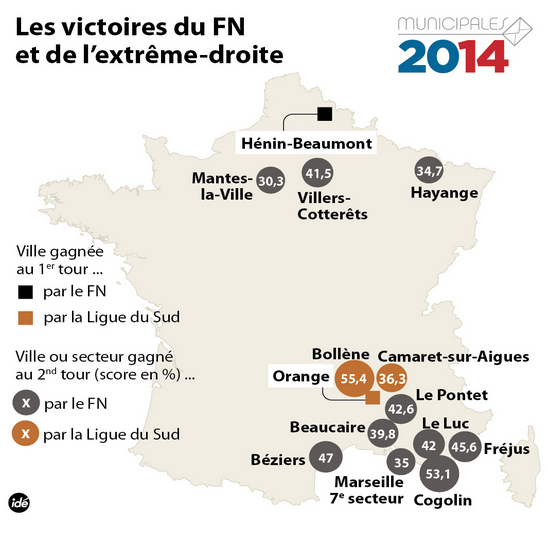
Map published by “20 minutes.”
Deindustrialization and workers’ votes
If we want to properly fight the National Front and national-populist parties in Europe, in general, there are at least two elements that we should consider:
A. In a situation where deindustrialization has fragmented workers and erased the traditional image of the local boss as a visible enemy, the national-populist parties have focused their energies on a new national enemy with two heads: the migrants (or “foreigners”[26]) and the European Union. And they have been quite successful in giving flesh and blood to this enemy and erasing the capitalist enemy from the minds of part of the working-class voters, especially those who already voted for the right and had reactionary ideas.
Deindustrialization[27] has led to the disappearance of a visible and close enemy: for example, in the case of northeastern France, the owners of the mines, big steel industries, textile industry, etc. The National Front has replaced the old social enemy (the boss) by a national enemy, a hydra with two heads: the migrants (and the “foreigners”) and the eu (and its so-called “Euro-crats”[28]).
The stable working class world of those who were employed in the same company for years, sometimes generation after generation, or even for a lifetime: this world has disappeared. It has been replaced by permanently moving social relationships:
- the name and the nationality of the boss (or of the multinational group) which owns the company, changes all the time;
- the workers change jobs regularly because their former qualifications are no longer useful on the labor market;
- they work more and more for temporary employment agencies, are often obliged to become self-employed, and depend on companies whose size is much smaller, thanks to outsourcing.
The fact that the size of most production units is smaller and that more and more blue-collar workers work in the service sector but are isolated from others means that they identify less and less with the working class and that the theme of national identity is more attractive to them. “Today, more than two out of five workers work in the tertiary sector, as drivers, stock-keepers or warehousemen, or in fast-growing commercial services (temporary work, cleaning), in situations of isolation and precariousness…. A low-skilled proletariat is developing in the service industry where the frontier between the blue-collar worker and the white-collar worker becomes blurred.”[29]
As noted by Olivier Schwartz,[30] the Franco-French workers who have a more or less stable status in the private and public sector tend to see themselves trapped between, on one side, the “top” (the rich and the powerful, those who are at the head of the state, the corrupt or incompetent politicians) and, on the other side, the “bottom” (the migrants “who don’t want to be integrated,” those who only “live on benefits and don’t bother to look for a job,” the delinquent youth). As they think they are the victims of the richest as well as the poorest individuals, such a twisted form of class consciousness helps the National Front to propagate its reactionary vision among the popular classes.
According to Valérie Igounet and Stephane Wahnich,[31] the main reason why workers vote for the National Front is not because they are unemployed (the map of unemployment does not correspond to the map of the electoral successes of the National Front); it’s no longer a vote to protest against the left as it was in the 1980s, but a vote of fear: the fear of losing the “advantages” of the welfare state, of becoming unemployed, of living in a much less protected society, with much more daily violence, the fear of coexisting tomorrow with Muslim migrants and violent youth with a foreign background.[32] According to the two historians, it’s a militant and therefore persistent vote which corresponds to the desire to “find a job in the region where they grew up, the possibility of getting the job they have been dreaming about,” all that thanks to a public policy which will enable “an equilibrium between the respect of nature and re-industrialization” and the creation of “small industries which will cause only a reduced pollution” (Marine Le Pen dixit). This dream has been selling well to part of the right-wing workers who have been more and more attracted to the National Front.
If we take the example of the economy of the Nord-Pas-de-Calais region,[33] today it is mainly organized around services and distribution companies which import goods produced in other countries, no longer in France.
In such a situation characterized by intense changes and the related disorientation, the National Front offers a cheap and illusory solution to its voters, which acts as a band-aid on a serious injury, but which is happily accepted by a growing part of right-wing workers. The National Front proposes to revive all local traditions, be they local food specialties, Catholic events or Provençal folk dances. In these small towns (remember the National Front until now has won power mostly in small towns) the party offers to pauperized Franco-French workers some distractions, a nationalist substitute and a temporary answer to their social frustrations.
These social frustrations are growing because, on the labor market, the competition is growing between the workers and the unemployed, between Franco-French and foreigners or French people with a foreign background, etc. This competition exists also in the school system: Franco-French working-class parents want their children to succeed and fear that “foreign” pupils may impede their sons and daughters to study properly. This leads to conflicts inside the school but also inside the working class districts between the youth of different national origins. These conflicts nurture the propaganda of the National Front and enable this party to deepen, in some workers’ minds, an ethno-racial cleavage which will have long-term consequences.[34]
As the power of a mayor is limited in France, especially if he (or she) rules a little town, the National Front can play two cards at the same time: on one side, it treats and solves a limited number of difficult personal situations, and on the other side, it leaves most social problems unsolved, while explaining to its electors that the municipality has limited means. Therefore it tries to persuade its electors to also vote in parliamentary and presidential elections, so when the National Front will have full power, it will be able to solve all problems thanks to seven simple recipes—it will:
- miraculously give jobs only to the French nationals;
- expel all the foreigners who are unemployed for a long time or have been condemned to prison sentences;
- revoke the French nationality of all the foreigners who have been recently naturalized and of all those who have committed crimes;
- close the French frontiers to stop “those barbarian hordes who pollute our cities”;
- set up a stronger state with tougher cops and a stricter justice, which will solve all the daily difficulties in the working class districts and eliminate the dictatorship of the communities (“communautarisme” in French) and the “tribalization” of French society; this strong state will also control the press, forbid “illegitimate demonstrations” and favor “free” (?!) trade unions;
- organize a referendum about the reintroduction of the death penalty,
- and re-establish the Franc.
B. The relationship between the workers and politics on the electoral level has been radically modified. This phenomenon contributes to the growth of national-populism, a political current that actively uses all traditional and new media as well as polls to influence public opinion.
Before the multiplication of television networks in the 1980s, followed by the appearance of the World Wide Web and its massive expansion after the middle of the 1990s, and the appearance of the social networks (Facebook was created in 2004), the votes of the workers were influenced by four main elements:
- the dense presence of local militants in the trade unions, the tenants associations, the sports associations and all sorts of cultural municipal structures,
- the militant press (daily, weekly, monthly), sold in the streets, on the markets and at the doors of the council flats,
- the mass meetings of the left,
- and the interventions of reformist leaders on radio and television which were explicitly directed at the working class.
Today, the importance of these four main factors has declined, or even disappeared, and new relationships appeared between workers, political ideas and the act of voting:
- workers read the left press less and less and, anyway, the number of left publications and their distribution have been drastically reduced;
- the number and activism of left militants has seriously declined;
- workers have more and more access to all sorts of confusionist, conspiratorial, far-right websites, videos, Facebook and Twitter messages, etc., which are supposed to provide alternative information but, in fact, propagate stupid rumours, anti-Semitic ideas, conspiracy theories and fake anti-capitalism. This pseudo–anti capitalism is based on the denunciation of some corrupt politicians or extremely rich individuals, on a vague critique of a mysterious “oligarchy,” “caste” or “globalized hyper-class,” “elite (s)” and excludes any clear vision of capitalist relations of power and exploitation.
The French Socialist Party centers all its propaganda and recruiting efforts on the cultural middle classes and does not care anymore about the working class, even in words. The Communist Party has lost its industrial base in key industries, its propaganda is softer and softer, and also directed towards the salaried petty bourgeoisie.
This context (mass influence of the television networks; political “culture” based on lousy videos, clips and short messages on Twitter and Facebook; decisive role of political polls; Socialist and Communist parties’ lack of interest in the working class) has helped to build new political figures: Berlusconi, Le Pen, Trump, Beppe Grillo, Pablo Iglesias, Mélenchon, Fortuyn, Blocher, Wilders, etc. It has introduced new elements to influence working-class voters.
A more or less subtle use of the official and alternative media (a manipulation which is even easier if you own them) helps to influence the voters outside the party (or the movement) that one is trying to build. But this use of all official and unofficial media also helps to influence and even change the balance of forces inside the national-populist parties.
For example, Marine Le Pen used the media to defeat, inside her organization, both the old traditional national-Catholic tendency, and those with a nostalgia for fascism, Nazism or the French colonial empire. So these tactics enabled Marine Le Pen to make public opinion believe that her party had totally changed under her leadership.
As regards the National Front electors, in the long term, only 3 percent of the voters remain truthful to this national-populist party, and at every election 50 percent of the voters are new electors. This huge electoral turnover shows the volatility of the National Front electorate (which could be reassuring) but also the lack of political consciousness of the voters (which is much more preoccupying).
How do the far left and anarchist movements react to these evolutions?
- The far left does not understand how the media (the main television channels, the Web as well as the social networks) have been replacing the traditional political organizations of the working class. As noted by Remy Lefebvre, the media have become “the intermediaries between the public opinion” (including the working-class public opinion) “and the ruling class.” In such a situation the media “devaluate the role of militant and party spaces as places where one can construct political alternatives.”
- The far left does not know how to use the social media and especially video techniques, in a creative and funny way. (For example, the presidential candidate for the New Anti-capitalist Party, Philippe Poutou, an automobile worker, appeared in a very silly video produced by his comrades, during the last electoral campaign.)
- The far left has not succeeded in building a significant presence on social networks and it is not rooted in working-class districts.
- The far left still views the activities of elected representatives inside the bourgeois state as the leaders of the early twentieth-century workers’ movement, who wanted to use the municipalities and the national parliaments as a tribune to “educate the masses.” It has not understood the changes that have taken place inside the bourgeois democratic institutions and just struggles to revive a decomposing corpse.
- Confined to the universities and the salaried petty bourgeoisie, the far left and anarchist movements have adopted one form or another of identity politics that leads them to adopt confused and indeed reactionary theories. Therefore, it’s not difficult to understand why they are unable (and would be unable even if they wanted) to get serious roots inside the working class.
Who are the members of the Central Committee?
Although the Executive Bureau (six members) and the Political Bureau (42) have the real power in the National Front, and although the Central Committee does not meet often, it’s nevertheless interesting to analyse who its members are, as they are directly elected by those who have paid their membership fees. Among its 100 elected members and 15 co-opted members:
- Thirteen have never worked and only occupied representative functions in the National Front apparatus and/or in the bourgeois state. Most of them are less than forty years old and have profited from the recent growth of the National Front to get an easy job as a party full-timer or an elected official. Those who have work experience are generally over forty and have been obliged to earn their living without counting on political remunerations and advantages.
- Twenty-three are mps and senators (four have been elected to the French Parliament, 17 to the European Parliament and two are senators);
- Sixty-eight are locally elected officials (and 36 of them had two or three elected jobs at the same time, at least until the elections of June 2017).
In terms of university degrees, at least twenty members have continued their studies after high school either in an engineering school, on in a university (law, political science and economics, disciplines which traditionally help for political careers).
Thus, one can better understand why the anti-“elites” rhetoric can seduce men and women who have an academic level much lower than that of the leaders of the institutional right or left.
About the social composition of the Central Committee, it includes:
Nineteen National Front full-timers (this is an approximate number as the official biographies of National Front members are often quite opaque),
- 17 executives of the private and public sector,
- 14 small company managers and entrepreneurs,
- 10 members of the repressive apparatus (police and military forces[35]),
- 9 lawyers,
- 6 primary and secondary school teachers,
- 5 engineers,
- 5 university teachers,
- 5 sales representatives, real estate agents and commercial agents,
- 4 shop or restaurant owners,
- 2 nurses,
- 2 doctors (1 general practitioner-geriatrician, 1 surgeon),
- 1 employee,
- 1 artist,
- 1 farmer, and
- 1 artisan
So, these statistics show us that, for the moment,
- The leaders of the National Front do not belong to the working class[36] or even to the “popular classes,” if by “popular” we mean those who hold a subordinate position in the division of labor.
- It includes a significant proportion (41 out of 115) of executives, company managers and bosses, cadres of the military forces who are direct agents of capitalist exploitation and domination.
- It welcomes an important proportion of the “intellectual middle classes” (20 lawyers, doctors, teachers and university graduates) who are massively present in the leadership of all bourgeois parties.
- It welcomes a significant proportion of people (13) who have no work experience and always relied on the National Front to pay their bills.
- The leadership basically relies on two legs: its full-timers (19) and its 68 locally elected militants (37 municipal councillors, 53 regional councillors, including 21 who are also municipal councillors, 4 departmental councilors and 9 mayors) and 23 mps and senators who often have also local responsibilities (12).
Until 2017, the National Front has chosen the best electoral districts for its favorite militants and thus given a lot of power in leadership organs to those who were able to win elections on several levels at the same time: municipal, regional, national and European.
Let’s now study more in detail what these elected posts are and what material advantages they provide for their beneficiaries.
A municipal councillor of a town regrouping less than 100,000 inhabitants (which is the case of most National Front municipal councillors) does not earn any wage, so he (or she) can’t count on this “job” to earn a living. This explains probably why so many National Front municipal councillors are also regional councillors. If they want to live from politics (“at the expense of the tax payers,” as the National Front usually says when it criticizes other politicians), they need to get elected at the regional level, if they live in small towns with less than 100,000 inhabitants: for a regional councillor, the wage varies between 1,520 euros and 2,661 euros according to the size of the region, so it’s a decent wage, especially if combined with other material advantages or free-lance activities or party financial help.
The National Front has 358 regional councillors… more than the Socialist Party (355)!
One thousand five-hundred eighteen National Front municipal councillors were elected in 2014. Today, in 2017, one third of them have disappeared: some moved to another town, a majority were disappointed by the National Front and decided to abandon their “job,” and some thought it was more convenient to present themselves as “independent” for their local political ambitions.
An mp earns 5,148 euros per month but can spend 4,490 additional euros per month for the expenses linked to his job, and 7,400 euros per month for his staff. The National Front had only two mps until June 2017 and has now eight mps. A senator earns 5,405 euros per month plus 4,700 euros per month for expenses linked to his job, and he receives 5,500 euros per month for his staff. The National Front has only two senators.
The wage of the eleven National Front mayors depends on the size of the town they are managing:
- Between 3,500 and 9,999 inhabitants = 2,090 euros (1 mayor)
- Between 10,000 and 19,999 inhabitants = 2,470 euros (6 mayors)
- Between 20,000 and 49,999 inhabitants = 3,421 euros (1
mayor) - Between 50,000 and 99,999 inhabitants = 4,181 euros (2 mayors)
- More than 100,000 inhabitants = 5,512 euros (1 mayor)
A European deputy (the National Front has 24 European deputies) earns 6,200 euros per month and receives 4,300 euros per month for the expenses linked to his job, plus 4,243 euros for his travel expenses.
What about the age of the leaders, and which generation has most power inside the National Front leadership?
If we study the age of the 100 members of the Central Committee and the eleven militants co-opted in 2014 (even if some have quit the leadership or have been expelled since):
Generally among those who have started being active after 1988, one can observe a quick ascension as full-timers (9 full-timers out of the 19 who are members of the Central Committee are between 24 and 34 years old), mayors (all of them, except one, are between 30 and 45 today), mps (4) or senators (2).
Most CC members have joined the National Front after 1987. Only 13 out of 115 joined before 1987, and, among these 13, only 3 participated to the foundation in 1972.
If we look at their age, now in 2017 we find
- between 20 and 30: 10
- between 30 and 40: 17
- between 40 and 50: 29
- between 50 and 60: 14
- between 60 and 70: 28
- between 70 and 80: 8
- over 80: 1
So the majority of the leaders (56 out of 115) have not known the Indochina and Algeria wars, the 1960s and 1970s, and the difficult times of the National Front before the European elections of 1984.
Most National Front leaders and cadres have joined the National Front after 1988, a turning point in the electoral history of the party, after which its influence at the ballot box and in French political life has steadily grown, to the point of determining the positions and vocabulary of the French left and right. A good proportion of the party cadres did not have any other political experience before joining the National Front. And some of the youngest joined the National Front when they were 13, 15 or 16 years old. They think that their party will enjoy a very bright future and that they will benefit from it. This can only push them to blindly stick to the party line (i.e., the one determined by its leader), to never criticize[37] the leadership, and to defend its most reactionary ideas.
Men who have no work experience (at least from the information available on the Net and on the National Front websites) are either full-timers or elected officials. (This means obviously I don’t consider full-time elected jobs as “work” but as a parasitic activity…) Women who have no work experience are most of the time women who dedicated their lives to raising their numerous children (and they are proud of it, as can be seen on some of their videos) and depend on their husband’s wage. This classic division of labor between men and women illustrates how the “feminist” image of the National Front is a lie, even if Agnès Marion, member of the Central Committee, can declare:
It is necessary to revalorize the image of the women who decide to raise their children by slowing their careers. A woman who makes this choice is not a “quiche” [i.e., stupid] and her choice must be recognized. Mothers have a sense of reality, practical intelligence, they are not disconnected from everyday life. Without my experience as a mother of a large family, I would not be able to manage my husband’s business with the same rigor and dynamism.[38]
The women of the National Front (at least those whose husband belongs to this party) religiously apply the party line[39]: most of them have between 2 and 6 children, which is probably linked to their Catholic family traditions in most cases.
- [1]My articles about the National Front are included, with other texts, in the book What’s New in France for the Left. They are also available on mondialisme.org and npnf.eu websites: “Behind the rise of the National Front” (2014); “The National Front and its influence among French workers” (2015), which is divided into 3 parts: “The National Front and French working class,” “Some clichés and preconceived ideas about the National Front,” and “French antifascism in France.”↩
- [2]Between 1983 and 1997 Jean-Marie Le Pen appeared 75 times per year on tv. But his daughter appeared 842 times per year between 2011 and 2013, while the Socialist Party’s General Secretary only appeared 200 times!↩
- [3]The name and population of these towns are respectively Le Luc, 9,500; Villers-Cotterêts, 10,090; Cogolin, 12,517; Beaucaire, 15,505; Hayange, 15,757; Le Pontet, 17,476; Mantes-la-Ville, 19,858; Hénin-Beaumont, 26,278; Fréjus, 52,953; Béziers, 75,701; and one district of Marseilles, the 7th sector, 150,971. To these cities one can add three other small towns managed by the Ligue du Sud (Southern League), a group very close to the National Front: Camaret-sur-Aigues, 4,500; Bollène, 13,574; and Orange, 29,482.↩
- [4]visa, Lumières sur mairies brunes, nos. 1–9 (a book published by Syllepse and a series of texts available on the visa website, as well as many other articles of this network of “anti-fascist” trade unionists).↩
- [5]Marine Tondelier, Nouvelles du Front. La vie sous le Front National. Une élue de l’opposition raconte, Les Liens qui libèrent (2017).↩
- [6]To briefly explain the difference between modern national-populism and fascism, I can quote what Enzo Traverso writes about Trump: “He has no program…. He does not mobilize the masses, he attracts a public of atomized individuals, of impoverished and isolated consumers,” Les nouveaux visages du fascisme, Textuel (2017). Traverso prefers to use the word “postfascism” because, like most left-wing intellectuals today, he supports Latin American populists (Chavez, Morales), and he still wants to cling to the confused concept of the “people.” This notion has always been central to conservative, far-right and fascist thought because it had an ethnico-racial-cultural foundation and the left never succeeded in transforming it into an emancipatory concept, despite all its efforts.↩
- [7]In 2017, the National Front has 11 mayors out of 36,000; 62 departmental councillors out of 4,108, and in only 14 “départements” out of 100; 1,540 municipal councillors out of 536,500; 8 mps out of 577; 2 senators out of 348 and 24 meps out of 751. The absence, in France, of a proportional voting system explains the huge gap between the number of voters and the number of elected officials. Those on the left who struggle for a more democratic system are caught in a lethal contradiction, as the introduction of a proportional vote will only give a tremendous power to a party they denounce as “fascist.”↩
- [8]According to Christèle Marchand-Lagier (Le vote fn (DeBoek), 2017), in the south of France, one of the main reasons for the defeat of the right and the victory of the National Front was that it did not leave any room for young ambitious men or women.↩
- [9]The National Front’s sympathizers and voters express their opinions very frankly on this social network, often without hiding their real names and faces. They feel less and less ashamed of their political choices.↩
- [10]An anonymous Facebook account (“La Voie d’Hénin”) is specialized in personal attacks and nasty “jokes” against the opponents of the National Front.↩
- [11]Towards Muslims (as well as on the question of celebrating gay marriages), the National Front mayors do not have a unified policy: in Hénin-Beaumont, Steeve Briois praised the local Muslims and imam and agreed to let them build a new mosque; in Mantes and Fréjus, the National Front mayors are waging a legal battle to impede the construction of new mosques or prayer rooms. And in Béziers, Robert Mesnard (who is supported by the National Front but not a member) has found twisted means to attack Muslim food shops’ owners because they were opening late during the month of Ramadan.↩
- [12]Especially soccer, probably because it appeals to youth with North African and Sub-Saharan backgrounds. This popular attraction does not fit with the National Front’s discreet ethnic cleansing policy. There are also other unofficial means to ethnically control the territory, as testified by the methods used by some mainstream right-wing mayors who want to seduce the National Front voters in the new peri-urban areas developing near important highways. These areas welcome a significant portion of Franco-French qualified workers and new petty bourgeois (executives, teachers, social workers, foremen, etc.): the mayors contact the real estate developers and the private owners who want to sell their farms or their houses and they try to push them not to sell (or rent) their properties to “non-European” buyers. For more details see: Violaine Girard, Le vote fn au village: Trajectoires de ménages populaires du périurbain, Editions du Croquant (2017).↩
- [13]Mainstream artists and (mainly Parisian) intellectuals generally don’t have a high opinion of French folklore and traditions. They are much more interested in “world culture.” Therefore, they give an opportunity to the National Front to appear as a courageous defender of “Gallic” popular culture and to defend the humble citizens of the provinces against the arrogant Parisian “elites.”↩
- [14]The caf (Caisse des Allocations Familiales) offers different services and benefits concerning nursery and daycare fees, education allowances, holidays, family allowances, pregnancy and housing benefits.↩
- [15]rsa means “Revenu de Solidarité active” (Active Solidarity Income). It offers supplementary benefits to people who are jobless: 536 euros for one person; for a parent with one child (805 euros), two children (966 euros), etc. For a couple: 689 euros; with one child (919 euros) and 2 children (1,148 euros), etc. Obviously, these benefits are “given” to people who have already worked and depend on other resources.↩
- [16]Founded in 1985 by a very popular stand-up comedian and actor, this ngo mainly provides free meals and has become an important institution given the dramatic rise of poverty in France.↩
- [17]This fantasy was already defended by the neo-fascist group Europe Action in 1966 which compared the Algerian immigration to a “slow genocide” and defended what it called “biological realism,” therefore supporting South African apartheid and racial segregation in the United States. This grouplet was created in 1963 by several former French ss, pro-Nazi collaborators and young far-right intellectuals (the most famous being Alain de Benoist who later founded the grece and dominated the French “New Right.” He has influenced all right-wing and far-right parties since then, but he claims not to be racist anymore). Most of these leading militants, including the neo-fascist theoretician Dominique Venner, joined the National Front later, where they played an important role.↩
- [18]This idea of a “foreign demographic invasion” is as old as migrations in France and has always been central to parliamentary politics. Marine Le Pen denounced “a genuine clandestine project favoring a massive settlement of migrants.” See my article: “French working class, migrants, racism and the building of French national ideology.”↩
- [19]As underlined by Dominique Reynié (“Le tournant ethnosocialiste du Front national,” Etudes no. 11, 2011), the National Front does not appeal only to the traditional petty bourgeoisie of artisans, shopkeepers, and small bosses; it tries to build an interclass alliance including all wage-earners of the public and private sectors, promoting reindustrialisation, a strong state which will control and fight globalization to defend the “French social model.” It praises the French welfare state (which it always criticized during its first thirty years of existence, when it hailed Thatcher and Reagan) against the World Bank, the imf and the eu.↩
- [20]Actually, the National Front has always mixed a xenophobic rhetoric with a social one, as testified by this speech of Le Pen in 1974: “The French people give a fraternal hand to the foreign workers who are serious and diligent, useful to our economy, who respect our laws, our morals, our civilization. But they can’t let France be colonized, exploited and terrorized” (quoted in Valérie Igounet, Les Français d’abord, slogans et viralité du discours Front National, Inculte/Dernière marge (2017), p. 76). And, if we go back earlier, to the nineteenth century, the nationalist and anti-Semitic political thinker Maurice Barrès already wanted to protect the French workers against the foreign labor force and invented in 1898 the concept of “nationalist socialism.”↩
- [21]Already in 1987, the National Front printed a poster reproducing a quotation from a Hezbollah leader, Hussein Moussawi: “Inch Allah, within twenty years France will certainly be an Islamic Republic.” Although the quotation was not exact (Moussawi actually declared: “Maybe your generation will not live under an Islamic Republic in France, but it will certainly be the case for your sons and grandsons,” the meaning was the same. Nevertheless, for twenty years this line disappeared from the National Front’s propaganda and only massively reappeared in 2009 after the referendum about minarets in Switzerland.↩
- [22]Dans la tête de Marine Le Pen, Solin/Actes Sud (2017), p. 140.↩
- [23]According to Marine Le Pen, the “European monster” is a “conglomerate under an American protectorate, the antechamber of a world global total State”; “the European Union wants to mold a new human being, with uniform tastes, cut off from his national culture,” “nomad, disposable, slave of the merchant social order”; it “weakens the family…, despises values such as effort, work, merit, courage and righteousness,” quoted in Michel Eltchaninoff, op. cit., pp. 78–79.↩
- [24]Here is the video, and the article itself is also useful because it describes how, in the département of the Bouches-du-Rhône, 38 out of 94 municipal councillors have left the National Front or moved to another town, thus also lost their elected responsibilities.↩
- [25]See my article “The sad farce of the ‘no’ victory.”↩
- [26]Migrants, foreigners or nationals with a foreign background are all mixed together in this common hatred.↩
- [27]Some historians compare the present National Front to the “Boulangist” movement. Georges Boulanger (1837–91) was a general who started his political career in 1886, supported by the monarchists, the Bonapartists, the nationalist leagues and part of the left in a context where the Republican institutions were in crisis, the politicians were considered as corrupt and the consequences of the French defeat against the German Empire in 1871 were still not accepted. This movement lasted only five years while the National Front has been active for 40 years in a context of economic crisis, mass unemployment, politico-financial scandals and parties which seem more and more incompetent and interchangeable.↩
- [28]Obviously, there are many bureaucrats in the European institutions, but most of the important decisions are not taken by a “Brussels” of fantasy, as the national-populists (and sometimes the radical left) claim, but by the prime ministers and economics and finance ministers of the 27 countries.↩
- [29]Nonna Mayer, “De Jean-Marie à Marine Le Pen: l’électorat du Front national a-t-il changé?” in Pascal Delwit (dir.), Le Front national. Mutations de l’extrême droite française (Editions de l’Université de Bruxelles), 2012, available online.↩
- [30]“Haut, bas, fragile: sociologies du populaire,” interview with Annie Collovald et Olivier Schwartz.↩
- [31]Valérie Igounet and Stéphane Wahnich, fn: une duperie politique, Cahiers du CRIF no. 39 (2015), available online.↩
- [32]This is also the opinion of Bernard Dolez and Annie Laurent (“Voix sans élus. Le vote Front national dans la région Nord-Pas-de-Calais,” in Pascal Delwit, op. cit.): “The National Front’s rhetoric focuses on the resentment and social anxieties of the categories which are threatened by downward social mobility. The feeling of being relegated to the periphery of the social space, or the threat of being soon relegated there, constitutes today one of the most powerful sources of the vote for the National Front.”↩
- [33]This region has 4 million inhabitants today and it sent five National Front deputies to the French Parliament in June 2017 (Marine Le Pen, Bruno Bilde, Sébastien Chenu, Ludovic Pajot, José Evrard). Traditionally it was an industrial region for textiles (it still has 25 percent of textile activities), metallurgy (16 percent) and transports (14 percent). The median standard of living (although not a significant indicator) is the lowest in France (17,700 euros per year, that is 2,000 euros less than the national one) and the progression of the gdp between 2000 and 2012 has been inferior (0.9 percent) to the national one (1.2 percent). Employment has diminished of 0.7 percent per year between 2008 and 2013, and all industrial sectors (especially metallurgy and chemistry, which have sacked 12,000 workers during this period) have been touched, apart from the energy sector that has been growing. This process has started a long time ago: Daniel Percheron, a “Socialist” senator, already noted in 1988 that between 1975 and 1986, 195,000 jobs had “disappeared” in the regional industry. According to a report recently written for the new region Picardie-Nord-Pas-de-Calais executive, there were 850,000 wage earners in the industrial sector in 1965 and only 280,000 in 2014. Today most interesting jobs require two years of studies after high school, the ability to speak at least two languages, and engineers’ and technicians’ diplomas. In this region, as everywhere else in France, French bosses don’t want to invest a cent in apprenticeship and internal training…but complain that they can’t find workers with “adequate” qualifications!↩
- [34]And these long-term consequences will be even more devastating because the French left uses dubious concepts like “whites” or “racialized”—even in Les classes populaires et le fn. Explication de votes (coll.), Editions du Croquant, 2017, which is an excellent book about the relationships between class divisions and the votes for the National Front.↩
- [35]One “alternative” media, Paris Luttes Info, during the 2017 presidential campaign, published an article showing that in several electoral districts having barracks where the “gendarmes mobiles” and “gardes républicains” are living, the number of votes for the National Front is much higher than in the other districts of the same town (from 30 to 100 percent more). That may not be a coincidence… And this has been also proved in a study of the vote for the National Front in Corsica, where soldiers and their families are stationed in certain districts and where the vote for Le Pen’s party is exceptionally high.↩
- [36]This myth of the National Front as the “biggest workers’ party in France” was launched by Jean-Marie Le Pen in 1995. And he even went as far as to “greet the long struggle of the workers and trade unions for more justice, more security, and more freedom in the workplaces” in 1996 (Valérie Igounet, Les Français d’abord, op. cit., p. 136).↩
- [37]Discipline is a major aspect of the National Front ideology, as evidenced by this internal document: “Our movement is an army. Exactly like in army on the battlefield, we can only be efficient if each of us accomplishes his mission, respects and executes the orders given to him so that the whole maneuver will be perfectly performed…. The militant is a political soldier; like any soldier, for the general benefit of all, he must respect a set of rules to ensure the triumph of our national ideal,” V. Igounet, Les Français d’abord, p. 43.↩
- [38]Agnes Marion, Pour le Front National, Le Progrès, February 9, 2017.↩
- [39]The National Front website greets a newly-wed leader and his wife with this very clear Biblical saying: “Be fruitful and multiply.”↩
Comments

From Insurgent Notes #15, August 2017. Originally credited to "a comrade in London".
Email from David Wise, 16 December 2025: Thanks for putting up the Comrade in London thing. In actual fact it was written by Stuart Wise but we decided better at the time to keep it anon as we were being pursued with vigour by all the reactionary forces at play on The Scrubs and the police were getting involved for our 'illegal' activities. Stu, like myself was personallly friendly with many of those around Insurgent Notes especially S Artesian and Loren Goldner. Would be grateful if you could now put his name on the article now., maybe explaining these above facts.
Still working on things in relation to Grenfell as something that belongs to a more long-term development—if you like, a culmination of so many cover-ups since the advent of brutalised Thatcherism as the neoliberal agenda unfolded during the last 40 years or so.
Most of these initial cover-ups occurred in the north of England like the Battle of Orgreave during the miners’ strike, the Bradford football stadium fire of 1985 (a book has recently appeared on this subject suggesting the fire was anything but an accident) and then Hillsborough in Sheffield in 1989. Seeing the north of England was then the epicentre of the revolt against neoliberalism, it was as if the system needed to murder enough of the people in that neck of the woods to make them submit forever. But it didn’t quite work out like that and though defeat after defeat took place nonetheless enough protagonists refused to lie down, endlessly demanding proper enquiries take place. Hillsborough especially. And only a week ago Hillsborough has finally got somewhere with manslaughter charges leveled against top cop Duckenfield and Company.
By then the Grenfell fire had happened at the very heart of Britain’s ruling elite, especially its toffocracy all—or nearly all—possessing double-barrel names; in short William Blake’s “Perfidious Albion” in its purest essence. But the drip, drip, drip over the years of endlessly re-enforcing the same lies has also stimulated an ever greater anguish, something which has finally snapped and let rip in the immediate aftermath of Grenfell Tower. Nothing but nothing has been silenced here. True, after Hillsborough, though Digger Murdoch’s filthy rag The Sun was virtually vanquished in Liverpool and surrounds, there were few moves towards semi-autonomous activity.
This is not so around Grenfell. It’s as though despite the hideous gentrification surrounding the tower, radical Notting Hill has been reinvented even if in a somewhat welcome turbulent and confused way. Rank ’n’ file tenant groupings seem to be springing up all over after the inspiring spontaneous help-outs organised by Christian, Muslim, and other faiths centered on Trad Dad places of baneful worship. However, an even more baneful ruling class on Grenfell’s doorstep during this horrific event proved to be worse than appalling. The latter are now utterly discredited and, more importantly, utterly demoralised, even terrified of the London mob again appearing on their fekking doorsteps.
Old radical Notting Hill—as we’ve long said—has dipped away towards its peripheries to the big social housing estates of Lancaster West, in the middle of which is Grenfell Tower, together with a newly repopulated Wormwood Scrubs as its playground, where great encounters among many different peoples have become the order—or rather disorder—of the day. A place where gays (many are Muslim) openly fuck in the long grass and Muslim school gals have fistfights shouting out endless fucks at the top of their voices, pleasantly kept in a kind of Queensbury Rules of white and black school chums. (For sure it’s great but do their Mums know they carry on like this? Hey Mum ease up gal!)
The Scrubs has also become one of our terrains of eco-intervention, in this instance trying to stop the place being developed as the centre of the High Speed Rail Link (hsr2) and Treeza Mayday’s pet project of making Acton City another fuckin’ enclave for the world’s super rich, maybe Chinese or Russian especially post-Brexit. And sure enough two years or so ago we got stuck into this project with ever-greater gusto, so much so that bigwigs on Hammersmith and Fulham Council have recently threatened to banish us from the Scrubs as evidently we’ve “altered the landscape.” We sincerely hope so and those bastards can take a running jump…
Moreover, radicals in and around Grenfell Tower some moons ago began to elaborate a tenants’ blog which has become the best in the United Kingdom. It’s always been a joy to keep bumping into them on the Scrubs, always endlessly uplifting. Good people and jeez isn’t that blog now getting millions of hits as they accurately predicted the fire even getting threatened with eviction for saying it was going to happen? We also endlessly cussed out the tmos (Tenants’ Management Organisations) just like the Grenfellers which in fact were the product of the inter-class community politics of Notting Hill in the 1970s (and were we the only ones who openly denounced all of this at the time???).
Over the last two weeks or so, the msm, especially the bbc and itv news, have been loathe to mention this blog but even they now have to admit it exists, if only just. And will the usual public-school Leninists of New Left Review publish it? Reluctantly at best though most likely it will be some other outfit. Moreover, that passive bourgeois negotiating body of eco-Leninists belonging to fowss (Friends of Wormwood Scrubs) hates us.
Our mates were gutted by Grenfell with Eddie Daffarn’s flat burnt out and the guy would have lost his life if not finally having been rescued by firefighters. These Grenfell guys now have come back in something like an apocalyptic state of mind, Eddie furiously riding around on his bike with one hand on the handlebars the other holding up his mob, his mouth racing with inspired language. And how the mighty are falling in front of him and all of us! And these Grenfell guys and gals are all keeping away from the msm. These people endlessly kept insisting on direct democracy and we reckon this has had a real impact precisely because they practically live in the same social space as all the other marginalised tenants, and that, alongside really relevant theory, is what really matters with little or no separation between theory and everyday life. There’s thus no real difference between any of the tenants even though many come from different countries all over the world.
Because of the tragedy of Grenfell Tower, the ruse of reason has kicked in and class thankfully is back to the fore and with it the United Kingdom’s social apartheid is also back. Full-belt. Everywhere people on street corners and at work are talking about class again. What a feckin’ relief! And rank and file responses keep increasing not only in the well-publicised invasion of Ken & Chelsea Town Hall but in many clandestine actions which don’t appear on the walls of local Dazebos. That evil hipster toff bastard, Rock Feilding-Mellon, head of the building contract that put up cut-price inflammable cladding on Grenfell Tower has had to leave his smart 3 million quid house close by—a gaff bordering Holland Park next to the Embassy Belt/Royal Palaces—because of bricks thrown through windows and gully low graffiti painted up like “Fuck Off Yer Bastard.”
Yep, good hooliganism is on the move everywhere alongside a reinvigorated Corbynista Momentum that doesn’t possess the same edge confining itself to a slightly bloody-minded left social-democratic parliamentary perspective. They are prominent at all meetings and they are altering street names—or rather adding to them—throughout Notting Hill. The Royal Borough has become the Rotten Borough, and Nasty Party/Toxic Party, etc., scrawled up everywhere on street signs. All somewhat limited and you know these people have yet to grasp real autonomy but maybe in time will do so. For feck sake get inspired on something like the old King Mob slogans—only better. And is all this going to stop with a re-vamped Labour Party devolving all power to local constituencies overthrowing the rule of the old-time parliamentary party; something like a Syriza party a few years later?
We have yet a world to win geared towards an uprising of the world proletariat or else we will be nothing, dying in total despair!
Comments
From Insurgent Notes #15, August 2015.
The following notes were the basis of a contribution to the internationalist communist summer meeting organized by TPTG, Underground Tunnel and friends, July 11–17, 2017, in Greece.
The recent past entreats us to look towards the future. We look at ourselves as a part of the seven billion who inhabit the earth, and our efforts as part of ongoing efforts by these seven billion in shaping the present and coming times. Our ancestors are ancestors of seven billion, and our descendants will be descendants of seven billion, hopefully. We try to find radical ruptures in the present, accept the gifts of our ancestors that are useful, and to let go of baggage that are best left behind. We are living in an era of unique and together human beings—these two aspects being the source of all creativity and activity among the seven billion.
In a time when ongoing social processes have opened up the possibility of complete annihilation of our (and other) species, activities among wageworkers are fostering an optimistic counter-force. This emergence of global wageworkers has been accompanied by increasing social death and murder faced by peasants, artisans, and the almost complete extinction of non-market societies. These sections have existed in great numbers in Asia, Africa and Latin America till recently, just as they once were in Europe and North America. However, with the introduction of electronics in the production processes, their desperation has spiraled up, and continues to increase. Whether this desperation has led to widespread slaughter between these sections in the guise of different identities, or whether they have taken to killing themselves in alarming numbers, the signs are blared clearly in the mass media for the world to watch. A peasant who kills himself is pitiable for civic consciousness and sets the discourse for welfare, whereas one that channels their rage outwards is considered a menace to be weeded out. Hence, questions such as which factions are at loggerheads in Syria, the dynamics of new regimes, or what welfare measures states have planned to make the social death of these sections slower are all dead ends. What is usually discussed as “national/international affairs” is bereft of any considerations of the social questions, and is more or less akin to betting on horse-races, replacing horses with nato, Russia, Rojava and so on. The terrain of these debates is statism, and hence to be avoided.
What adds to the increasing irrelevance of the statist tendencies today is that sections which found them suitable—professionals such as doctors, intellectuals, teachers, journalists, artists, lawyers, writers and others—have become workers—medical workers, education workers, research workers, art and design workers, legal workers, etc. Thus, by and large, a social strata which, a hundred years ago, claimed to have the capability to provide their intellectual leadership to the working class, and continued doing so in the period that followed, has shrunk. This division of labour between the intellectual and the physical—so essential to the functioning of wage labour–based commodity production—replicated itself even in dominant expressions of resistance to it in the past century. In the present scenario, workers often say, “We will listen to everyone, but decide upon ourselves,” and request, “Please don’t give unsolicited wisdom.” Irrespective of which strain it belongs to, statism is becoming untenable and irrelevant. The question of consciousness, so central to the left theorists of the last century, has withered away.
In its stead, coordinated, mutually inspiring exchanges between persons who are unique and together emerge as the basis of the transformations. The audacity of these exchanges is clearly seen by the amount of effort that managements put in attempting to break co-ordination among workers.
In 2011, in the [Maruti Suzuki India Ltd.] factory in Manesar, there were 950 permanent workers, 500 trainees, 200 apprentices, 1,200 workers hired through contractor companies for work in the direct production process, and around 1,500 workers hired through contractor companies for various auxiliary functions… All around discontent coalesced into a sudden stoppage of work. On 4 June 2011, when A and B shift workers were together in the factory, they took over the entry and exit points… It has been observed that important questions dealing with life, time, relations, representation, articulation and factory life were brought to the fore by the de-occupations of June and October 2011.
In the words of a worker: “Inside the Maruti Suzuki factory, 7–14 October was the best time. No tension of work! No agonizing about the hours of entry and exit! No stress over catching a ride in a bus! No fretting about what to cook! No sweating over whether dinner has to be eaten at 7 or at 9 pm today! No anguishing over what day or date it is! We talked a lot with each other about things that were personal. All of us drew closer to each other than we have ever been before, during these seven days.”
These activities by workers frequently overstep different kinds of individual and social differentiations, e.g., factory boundaries.
Shatrughan was a worker hired through a contractor at the spm Autocomp Systems factory in imt Manesar. He had been working since 3 years as a helper [considered to be the least skilled category of worker]. At 4 am on 6 April 2017, he got caught in a conveyor belt. When the workers took him out and took him to the hospital, he was declared dead upon arrival. The police were informed by the management, and they arrived to look after formalities and left. As soon as the police left, workers from Honda, Maruti Suzuki, Munjal Showa, fmi Automotive, Endurance Technologies, Bellsonica Autocomponents, etc., factories entered the spm factory. Production in the factory remained halted all day, and even for the night shift. This also affected production in the industrial area. The police were called. Management was forced to offer compensations.
A similar report from January 2012:
This is exactly what needs to be done! A Maruti Suzuki, Manesar, worker hired through a contractor company was on duty on 13th January 2012, when he received a call from a factory, Allied Nippon. Apparently, there had been a fire in the factory, in which one worker sustained burn injuries. The company had taken him to Sapna Nursing Home in Aliyar (the nearby village), and the doctor there said that he would be discharged by evening. Both legs of the worker had been burnt right up to his thighs. The Maruti Suzuki worker told the worker from Allied Nippon to ensure that the injured worker is not discharged from the hospital that evening. On the morning of the 14th of January 2012, 10–15 workers from the Maruti Suzuki factory went to the nursing home. When the doctor told them that the injured worker would be discharged, they told him to keep him there, if the company did not pay for him, they would. Nobody from the company visited the burnt worker on the 14th and 15th, though many worker-friends kept visiting him. When the production manager of Allied Nippon was contacted on Sunday evening, he bluntly lied that he did not know a worker had sustained burns. The Maruti Suzuki workers who visited the injured worker on 16th morning were asked to pay up, or else the worker would be sent to the esi Hospital (Employee’s State Insurance is a scheme meant to cover medical requirements of all factory workers). Some friends were informed, and within half an hour workers hired through contractor companies from the press shop, paint shop, assembly, weld shop at Maruti Suzuki, and along with them Suzuki Powertrain workers living in Aliyar and Dhana [villages nearby]—in all about 70–80—gathered at the nursing home. From there, they reached the Allied Nippon factory. They asked to meet the factory manager. The factory manager refused to speak a word about the injured worker. Workers even suggested that there was no need to be afraid, that he could even speak from the other side of the gate, but the manager refused to listen. Half an hour passed with the contract workers from Maruti Suzuki and Suzuki Powertrain still gathered at the Allied Nippon factory gate, when a supervisor from the contractor company which had employed the burnt worker arrived. It was decided after discussions that the expenses of the nursing home, along with payment for the time of treatment would be borne by the contractor company, and that the family of the injured worker would be called by phone. On the afternoon of the 16th, the injured worker was taken to the esi hospital in Sector-3, imt Manesar, where they asked for the esi card—he did not have one. The supervisor asked for 2 hours from the doctor, and got the esi card of the worker employed since 12th December 2010 made on 16th January 2012. The accident report was made. The father of the injured worker has arrived from his village. He’s been admitted at the esi hospital till today, the 24th Jan. Durgesh, the worker who sustained burns at the Allied Nippon factory, lives in a rented room at Baasgaon. The workers from Maruti Suzuki and Suzuki Powertrain who took the steps in this context lived in rented rooms in Aliyar and Dhana, and were not acquainted with the Allied Nippon worker earlier. Having de-occupied the factory twice in six months, new emotions and ideas arose among the Maruti Suzuki workers. To bring back workers hired through contractor companies into the factory, the permanent workers and technical trainees of Maruti Suzuki had removed the control of the company from the factory from 7th to 14th October 2011 and…at the same time, workers of 11 factories in imt Manesar had also de-occupied those factories. This has transformed the whole scenario. In a world in which even keeping acquaintance is problematic, there the practice-thought that even strangers are our own will work wonders.
There have been numerous area-wide outbreaks coordinated among workers in recent history. In February 2013, workers in noida attacked factories and vehicles, leading the district administration to impose a local shutdown, and caused a loss of Rs. 6,000,000,000 as per the local association of industries. The very next day, women and men workers in the Okhla Industrial Area in Delhi joined in chorus before noon, coming out of factories, moving from one to another factory, shutting down thousands of factories in Phase I and Phase II. In January 2014, workers from factories in the PrithlaBagola area on the outskirts of Faridabad moved from factory to factory, increasing in number, shutting production in one after another. Large-scale police deployment the next day! Workers arriving at work stepped inside factories, avoiding confrontation. Managements’ association, in their complaint to the state government, said that the police kept aloof when the workers were attacking factories. In February 2015, tens of thousands of women and men workers in Udyog Vihar (literally “Industrial Place”) in Gurgaon, close to the Delhi border, began attacking factories. Udyog Vihar police stood aside. An additional 500 policemen were rushed from different places in Gurgaon. Seeing the numbers, they too stood aside. Two thousand police personnel from Faridabad, Jhajjar, Rewari districts reached Udyog Vihar. By this time, the whole industrial area had been in turmoil, and managers-directors had run away from factories. Seeing the large police presence, workers left the industrial area. No arrests were made. Police attempts to seek evidence through cctv footage failed as, like in other places, workers had smashed the cameras and recorders in different factories.
And these expressions are also spatially connected to many other similar ones spread across. In September 2015, women tea-estates workers of kdhp company in Munnar left different trade unions and started increasing their coordination. In the beginning of October, they stopped work. The activity of these 7,000 women workers created a stir. Leaders of various hues began flocking to “support them and extend solidarity.” These women workers shooed them away. After two weeks’ stoppage of work, the company stepped back. The reverberations of these women workers resonated in the rubber and cardamom plantations in Kerala, in Tamil Nadu, and far away in tea plantations in Northeast India. On 18 April 2016, without any leaders, representatives, or unions, one hundred thousand garment workers in Bengaluru, mostly women, came out of over 1,200 factories. The Employees provident fund of forty million workers is managed by a trust which has members of the central trade unions, central and state governments, and industry bodies representatives as trustees. They announced a new rule restricting access of workers to their own money, which was resented by workers all over India. The central government, reacting to Bengaluru workers’ action, postponed the rule by three months. On the next day, the April 19, still larger number of garment workers left their factories and came on the roads. The central government, in panic, canceled the new notification. In December 2016, workers of Windy Apparels Ltd. did not turn up for work. In the peak season of garments manufacture, when overtime runs up to 150–200 hours a month, this absence of workers from factory pushed a terrified management into removing 121 of them from work. Next day, tens of thousands of workers of half a dozen factories did not turn up for work. Managements of 80 terrified companies decided to shut down on December 20. Two hundred thousand workers on the roads! A war-like situation! In this war-like situation between the workers and the managements, the Bangladesh government promulgated wartime laws against the workers. Armed forces of the state in the Ashulia Industrial Area! As per a police official, production began once again from December 27 in the factories. Earlier, the us Congress, ilo, and the Bangladeshi government in one voice called for formation of unions. The number of unions among garment workers leaped from 2 to 61 by the end of 2014, still the workers refused to be shackled. The replacement of the military regime by a democratic regime in Myanmar encouraged the formation of unions to control garment workers whose numbers increased very rapidly since 2011… And in February 2017, workers attacked the Hangzhou Hundred Tex factory. The manager was thrashed and supervisors were surrounded. The Embassy of the People’s Republic of China intervened; the police attacked the workers in the factory to free the supervisors.
Some interesting steps by workers in factories:
In the G4S group company, Indo-British Garments factory, Faridabad, 13,000 pants came back to the factory. Reason: one leg short, one leg long in each. In October 2015, in the Globe Capacitor factory, Faridabad, one hundred workers working on seven assembly lines on the third floor of the factory had stopped production for tea at 10:30 am. Tea had not arrived. The production in-charge came and shouted at them for having stopped production, and warned that if anybody leaves before 1 pm for lunch, they will be thrown out. No worker reacted to this. At 12:15 pm, in ones and twos workers went to the washrooms, returned. At 12:30 pm, the production in-charge came and stood at the gate, he didn’t find anyone going to the washroom. Then he found the workers sitting idle on the lines. First, he tried persuading them amicably. Some workers made feeble pretense at work. Then he tried shaming the senior workers, appealing to their loyalty. No response. After receiving nothing but silence from workers, he lost his cool on the foreman: “This is all your mistake! You must have started this!” When workers from the lower floor came up to the third for washing hands, the production in-charge vented his anger by shouting at them, and all the workers on the lines burst out laughing. The production in-charge did not come back to check on the workers at 6 pm, or on the next day at lunchtime. Six thousand construction workers in Saudi Arabia hailing from Trivandrum, or Gorakhpur, Bhagalpur, Delhi, Ludhiana, Lahore, Karachi, Dhaka, Chittagong, Kathmandu, Pokhra and other places, housed together in various dormitories. Different languages and food habits! No legal rights to hold meetings, or collective bargaining! A worker said: “Today we did not leave our dormitories to go to the site. Vehicles were left empty in wait. A few hours passed. Foremen arrived, requested us to board the vehicles. Engineers came and requested. No worker got into the vehicles. Managers arrived and requested, but nobody came out of the dormitories. The same happened the next day too. And the day after that! And on the fourth day too! Ten days passed like this. On the eleventh day, the Saudi police arrived and fired shots in the air to scare us. But why would we be scared? We weren’t. Nobody was.” Not leaving dormitories, not reporting on work like this is routine and happens at least seven-eight times a year. And, mass faintings on the shop floor of many factories in Cambodia led to a headline in a major daily, “Workers of the world, faint!”
“No meetings were held; nobody went around informing; no one called anyone. It wasn’t magic. Such things happen once or twice in a month,” said a worker of Globe Capacitor. These seem to be morphic resonances. It is the very being of workers that makes them speak through such unmediated, collective acts. This is visible in Globe Capacitor…Saudi Arabia…Bangladesh…Cambodia… And in the Bata factory of Faridabad in 1983: after the union-management long-term agreement, automatic lines were installed in place of semi-automatic lines. Workers did not hold meetings, nor did any group of workers campaign. And 1,500 workers began giving less production on the automatic lines than they were giving on the semi-automatic lines. The company cut wages. This went on for one and a half years. The company dismantled the automatic lines and reinstalled the semi-automatic lines. And now to millions of workers in the 1930s—let’s remember historian Tim Mason’s research on workers’ activities in the wartime Third Reich: industrial production fell by 35 percent. In the fervor of patriotism, and the rule of Nazi Party!
And what about meetings?
Six hundred workers of Maxxop (Plot nos. 10 & 27, Sec-6, imt Manesar) work in two shifts of 12 hours each. Overtime is paid at lesser than the single rate (when by law it is to be double). We had begun discussing among ourselves regarding taking overtime at double the rate. We had just begun having meetings. The hr department had planted some workers in the factory. They attended the meetings, and informed the management about the proceedings. The management found targets. We 50 were removed 15 days soon after in March 2017. “We were having discussions in groups of friends since quite long. Conversations expanded in reach. We were successful in putting pressure upon the company. Nobody became target. The management found nobody to attack. Meetings played havoc. Meetings are easily marked events for managements. Company informers even make videos for the company at meetings on their phones.” This had happened at Bellsonica as well as at Track Components factories. “Building relations of trust are easy and straightforward ways of harmonized action between large numbers of people.”
It is wageworkers who are the active subject, and companies and governments that react. The very being of the workers makes them act so. A significant part of workers today are women, very often in their late teens and early 20s. While civil society—academics, media, radical activists—has often been found demanding increased security for women, more police, more security cameras—emphasizing their vulnerability—what women workers have been doing in collectives has been a different story. Young women and men workers of ASTI electronics in imt Manesar sat outside the factory together, day and night, for 40 days. This is emphasized by events over the years at Napino Auto. In 2010, when 800 workers stopped work and sat in the factory for four days, 100 women workers returned home by evening. In 2014, they stopped work again in the same factory, this time the women workers staying in the factory with the male workers day and night for ten days. These radical ruptures in gender-relations are unpalatable to channels of representation—liberal or conservative.
In 1992, discussions took place among Japanese managements on the question of permanent and temporary workers. The managements were aware that they could not afford to keep permanent workers, even though they had some loyalty towards the company. On the other hand, temporary workers were cheaper, but had no loyalty whatsoever towards the company. Companies could see this danger clearly over these twenty-five years, temporary workers have increased very rapidly all over the world, and the number of permanent workers has shrunk. In industrial areas today, 80–90 percent of factory workers are temporary workers. With the fig leaf of conditions and wages out for these workers, and the assertions of these workers ever present, the question that plagues the governments and companies is: what do the workers want?
Employment is a problem, and nobody wants to work. For ages, automation has been considered the bane of work, and many among different shades of thinking have dreamed that one day, technology would minimize work. And yet, those on the left and right do not tire preaching about the necessity of increasing employment. The socially necessary labour-time today has shrunk exponentially, and yet workers do between 100–200 hours overtime in a month. Abolition of work is on the agenda. Further, we live in the times where phrases such as “seizing the means of production” could only mean perpetuating the present. We must, instead, think on lines of what could be an alternative for a happier, more fulfilling, meaningful life. The amount of production has increased the antagonism between humans and nature, part and whole at large, putting life on earth at stake. A paradigm shift is needed. We wish you incessant festivities!
Comments
From Insurgent Notes #15.
The decade or so since the financial crisis of 2008 has seen a resurgence of interest in what nineteenth-century thinkers would have called “the social question,” backpedaling somewhat from the “cultural turn” of previous decades. Yet despite a series of recent skirmishes against the post-communist geopolitical order—from the Greek uprising in December 2008 to the London riots, Arab Spring, and Spanish indignados of 2011, up to the Polish women’s strikes in October 2016—old habits die hard. Few self-styled radicals who came of age during the nineties and aughts, especially those who attended universities, want to see the discourses of “difference” on which they were weaned suddenly abandoned wholesale. Alongside nascent and budding movements, then, one witnesses the recrudescence of concepts and strategies which ought to have been superseded by events themselves. Nowhere is this more evident than in the almost endless balkanization of identity formations. Each lays claim to a particular set of un-relatable “lived experiences,” as if hell-bent on proving the old psychoanalytic trope of Narzissmus der kleinen Differenzen (narcissism of small differences).
“Decolonial” criticism is an example of just this sort of vogue academic approach, which can be grafted onto preexisting disciplines and practices with relative ease. Still further, in so doing, it offers the semblance of radicalism, because it appears to challenge the tacit erasures and hidden presuppositions of prior revolutionary perspectives. In reality, however, it simply transposes dependency theory in the realm of economics onto that of epistemology. Third-worldism, based on the model proposed by the French demographer Alfred Sauvy in 1952, has been supplanted by talk of the Global South, based on the line proposed by the former West German chancellor Willy Brandt in 1983. But the substance remains the same. Mainly it consists in diagnosing the allegedly Eurocentric prejudices of various bodies of knowledge, down to their very methodologies, and then enjoining individuals to decolonize their minds. “Kill the cop in your head!” is seemingly replaced by “kill the Pilgrim in your head!” Recently, this procedure has even sought to “colonize” dialectical thought, although in the name of its decolonization. Here it becomes worthwhile to review one of the more elaborate efforts to subsume dialectics under difference.
Irreconcilable differences
“Ours is a newly dialectical age,” announces George Ciccariello-Maher at the outset of his book Decolonizing Dialectics (2017). By this he means “the much-touted teleological ‘end of history’ has collapsed like the myth it always was into fragmentation, disunities, and dynamic oppositions.” He immediately calls attention to the contentious character of the term, since many who heralded this historical denouement a quarter century ago did so on the basis of arguments invoking the dialectic.[1] “For too long,” Ciccariello-Maher continues, “dialectics has not served to denote the moments of combative division that give its name but instead the opposite: a harmonious closure.”[2] Against this conservative conception, he hopes to restore its critical, revolutionary valence.
The book’s title might give rise to some confusion. Decolonizing Dialectics does not aim to deploy dialectical methodology in ongoing projects of decolonization. Indeed, colonialism in the narrow sense of direct territorial occupation and administration scarcely exists today, having been replaced by more indirect “colonialism by remote control.”[3] Rather, Ciccariello-Maher aims to “decolonize” the methodology itself: i.e., remove the accidental features that mark its geographic origins and add any essentials it may be lacking. Whereas the two classic forms of dialectic, idealist and materialist alike, proceed by means of internal contradictions and move toward determinate ends, “decolonizing dialectics underscores how the Hegelian and Marxian conceptions of history emerge from a particular location (Europe) and assume dialectical resolutions specific to it (Sittlichkeit through civil society for Hegel, the abolition of class by proletarian revolution for Marx).”[4]
Ciccariello-Maher’s latest release thus contributes to a growing body of literature within the academy, the gist of which is to challenge established disciplines and schools of thought by questioning their provenance and scope of applicability. Pioneered by figures like Walter Mignolo, Nelson Maldonado-Torres, and Ramón Grosfoguel, the approach cultivated in this literature has been dubbed “decolonial”—an admittedly torturous locution. Over the past year or so, a number of works have appeared in a similar vein. Amy Allen, author of The End of Progress (2016), asserts that “critical theory stands in need of decolonization insofar as the strategy for grounding normativity relies on the notion of historical progress.”[5] She implores critical theorists to adopt a stance of “epistemic humility” as well as a “genuine openness to subaltern others.”[6] Gennaro Ascione argues in Unthinking Modernity (2016) that Marxists see modern society as too self-enclosed, too sealed off from outside forces: “[Marx’s] notion of incorporation [into global capitalism] conceals the colonial gaze and neutralizes the colonial difference by obscuring non-Western, non-capitalist agency.” Everything becomes reducible to “[capital’s] own inner contradictions.”[7]
Like Allen and Ascione, Ciccariello-Maher believes that existing modes of radical politics are still too reliant on narratives of linear progress and not yet open enough to marginalized perspectives. In contrast to a traditional dialectic that “moves inexorably and deterministically in keeping with its own internal oppositions,” he explains, “a decolonized dialectic recognizes both the historic source of that motion outside Europe in the colonies as well as the brutal reality that for colonial subjects, history often seems to move backward rather than forward, if it moves at all.”[8] Unlike Allen and Ascione, however, Ciccariello-Maher is more interested in “dialectics understood…as a practice”[9] than in theoretical matters such as normativity or the empirical validity of social science. Furthermore, he regards recent high-profile efforts to relate dialectical thought to non-European revolutionary movements as flawed: Susan Buck-Morss’s Hegel, Haiti, and Universal History (2009) and Timothy Brennan’s Borrowed Light: Vico, Hegel, and the Colonies (2014) each “remain conspicuously Eurocentric.”[10] Ciccariello-Maher insists that “a decolonized (and decolonizing) dialectics—construed as radical practice and orientation toward struggle—predates, exceeds, and exists independently of even Hegel’s formulations, in the self-assertion of colonized and enslaved peoples.”[11]
Yet in attempting to alter the dialectical method, Decolonizing Dialectics abandons several of its crucial premises. Namely, the categories of totality, reciprocal mediation, and immanent critique, the absence of which ought to cast doubt on Ciccariello-Maher’s entire enterprise. His argument is pieced together from readings of texts by Georges Sorel, Frantz Fanon, and Enrique Dussel, two of whom disavow the concept of dialectics as such and none of whose views square neatly with their counterparts.’ This difficulty is acknowledged more than once by Ciccariello-Maher, which suggests he is at least aware of the implausibility (if not outright impossibility) of his thesis. Because built-in social antagonisms cannot function for him as the source of “a self-starting and automatic movement,”[12] the impetus must come from without. Progress hinges here on “an appeal to exteriority and a ‘colonial difference’ that exceeds an internally dialectical relation,”[13] which allows “the antagonistic projection of militant identities to jumpstart historical motion.”[14] Revolutionary subjectivity can only be revived by “drawing together multiple dialectics whose central identities—class, race, nation, and people—are neither distinguished categorically from nor reduced to one another.”[15]
Just how far this has drifted from the materialist dialectic will be shown by the following. While Ciccariello-Maher nowhere claims to be a Marxist, it is nevertheless instructive to set his retrofitted radicalism side-by-side with the universality of Marx. “Today, the notion there is any meaningful commonality based on human beings as a species is under a cloud, even if its opponents rarely state their case in so many words,” Loren Goldner explains.
For them, such ideas—for instance, the idea that Western Europe from the Renaissance onward was a revolutionary social formation unique in history, or that there is any meaning to the idea of progress, or that there exist criteria by which one can judge the humanity or inhumanity of different “cultures”—are “white,” “male,” “Eurocentric” constructs designed to deny women, peoples of color, and gays the “difference” of their “identity.”[16]
Needless to say, the project of Decolonizing Dialectics is fundamentally at odds with that of revolutionary Marxism. Ciccariello-Maher is cognizant of this fact, however, and admits as much several times throughout the book. Ultimately this has to do with the aforementioned “colonial difference,” which Maldonado-Torres classifies as a “subontological difference”[17] (in an article cited by Ciccariello-Maher).[18] Here there are obvious echoes of Martin Heidegger, whose exploration of so-called “ontological difference” in Being and Time (1927) paved the way for both the “trans-ontological difference” of Emmanuel Levinas’s ethics as well as Jacques Derrida’s deconstructive “différance.” The former was extremely influential for Dussel,[19] and hence, by extension, for Ciccariello-Maher (insofar as he takes his cues from the Argentine). Decolonizing Dialectics also shares clear methodological affinities with the latter. “I trail slightly closer to deconstruction than the dialectic,” he writes, “in the degree to which contingency, indeterminacy, and an open hostility to totality imbue the multiple and local dialectics of the thinkers dealt with in this book.”[20] But Heideggerian Differenz, colonial or otherwise, cannot coexist with the Hegelian Dialektik, Marxist or otherwise. Some scholars consider the pivotal shift in philosophy over the last century to have been the displacement of one by the other.[21] Again, Goldner summarizes this shift rather well:
Like Foucault after him, Heidegger aimed his arrows directly at dialectical thought, at Reason that tends to absorb the Other into itself, that understands all “otherness” as alienation (Or as in Marx’s motto, “nothing human is alien to me”). Against this kind of rationality, Heidegger tried to erect a wall of Differenz, difference that was not dialectically mediated or superseded by any historical process, but just…different: the same irreducible, anti-dialectical difference Derrida would later call différance.[22]
It is no accident that “incommensurability” appears as often as it does in Ciccariello-Maher’s brief study.[23] Nor is it purely adventitious that he would so applaud Sorel for “pressing class difference to the very breaking point”[24]—i.e., “to the point where an internal class relation threatens to become an external nonrelation.”[25] For Sorel, Ciccariello-Maher maintains, “the relation between the classes is one of incommensurability and irreconcilability bordering on nonrelation.”[26] The literary critic Fredric Jameson, whose work provides occasional guidance for Ciccariello-Maher,[27] calmly observes that “the concept of the incommensurable is at the very heart of contemporary philosophies of difference, and so one needs to know whether the dialectic is not powerful enough to transform this affirmation of ‘radical difference’ into a new form of relationship.”[28] One might note in passing that the real (historical) basis for the commensurability of incommensurable items, and thus for dialectic itself, is precisely abstract labor as the measure of value under capital.[29]
Goldner is right to suspect, at any rate, that “behind their all-too-facile attacks on ‘master narratives’ and bureaucracy, theoreticians of difference were after the real game: the unitary working-class ‘subject.’ ” This is certainly the case with Ciccariello-Maher, who contends that “in order to overcome capitalism, we must call into question the immanent perfection of the (European) proletariat as revolutionary subject.”[30] Moreover, those who continue to defend the classical Marxist doctrine that the proletariat is “the only decisively revolutionary class in society”[31] are either convicted of class-centrism, Eurocentrism, or both.[32] “Any insistence on the centrality of class as the universal political identity motivating human progress elevates a particular feature of European development to the status of world-historic universal,” writes Ciccariello-Maher, “thus imprisoning the racialized and colonized of the world within a linear developmentalism which obliges them to catch up with Europe.”[33] Sorel is summoned as an expert witness in Ciccariello-Maher’s case against the central role assigned to the proletariat by Marxism. “Instead of a progressive clarification of class oppositions through the unbridled logic of capital and an unfolding dialectic leading to inevitable proletarian victory… Sorel saw only blockage and stasis, a frozen dialectic.”[34] Pivoting to a discussion of Fanon’s Wretched of the Earth (1961), Ciccariello-Maher contends: “Even dialectics lacks traction in this peculiarly barren space [in Europe], as Sorel has shown. While the proletariat could have smashed the narcissistic dialogue of European thought, it refused to step forward, and instead demanded inclusion in a totalized Hegelianism of the spirit. Yet European equilibrium was only possible at the expense of a substantial outside beyond its borders.”[35] Fanon is repeatedly quoted in order to say that workers are “pampered.”[36]
Of course, the search for a revolutionary subject to replace the old industrial proletariat is nothing new. Who will fill this role left empty by the proletariat? Ciccariello-Maher seems to doubt the very logic of a universal social subject, much less one founded on class, and so he turns to the third author dealt with in his study: the Argentine philosopher Dussel, whose “decolonial appeal to excluded exteriorities”[37] represents one of Decolonizing Dialectics’ main points of departure. Dussel’s category of exteriority functions as a sort of catchall or generic grab-bag of oppressed identities, covering “all those groups that are systematically excluded (economically, politically, according to gender, etc.) from the various systems comprising that totality to the global ‘cultural exteriority’ of colonized and formerly colonized spaces, where collective practices either predate or coexist with those which make up the world-system.”[38] Looking to the fringes of global capitalism, to the periphery away from the core, Ciccariello-Maher discovers “multifaceted subjects, individuals to varying degrees outside the system”[39]: “Exteriority is expressed by a multiplicity of subject-positions.”[40] All this talk of world-system and the alternation of core and periphery immediately calls to mind economists like André Gunder Frank, and indeed Ciccariello-Maher seeks to buttress his argument in “dependency theory” à la Monthly Review.[41] (Frank, credited by Dussel with the solution to this question,[42] would later abandon the Mao-inflected Marxism of his youth in favor of a more decentered model that regarded even Marx as “Eurocentric.”)[43]
To claim there is still space outside capitalist society considered as a totality implies that its expansionary logic is incomplete. Perhaps no one would have been surprised if this were so a hundred years ago, when capitalism had yet to make inroads into every territory across the Earth. But in today’s fully globalized world, the notion that anywhere remains untouched by its growth seems unlikely. Nevertheless, Ciccariello-Maher feels that Decolonizing Dialectics requires “a fundamental break with the paradigm of totality.”[44] He is concerned to get away from “the prevailing, totality-bound Hegelian-Marxist tradition.”[45] Or as he puts it elsewhere: “We cannot decolonize dialectics solely by prying open the cracks of immanent critique,” as this requires “stepping beyond the geographical and methodological boundaries of traditional dialectics.”[46] Ciccariello-Maher even scolds Bruce Baum, an author sympathetic to decolonial critique, for attempting to “decolonize” critical theory only “from within” (rather than “from without”). In his view, this resulted in “a very limited and almost wholly immanent critique of the Frankfurt School,” an approach which he deems insufficient.[47] “Epistemic decolonization,” he remarks, introducing another infelicitous phrase, involves finding “the outside from which to decolonize European thought.”[48] Rather than “the dialectics of Eurocentric communism,” which search for “faint refractions of borrowed anticolonial light,” Ciccariello-Maher counsels his readers to “go straight to the incandescent luster of the source”[49]—by which he means “struggles emerging from the global periphery.”[50] As opposed to the path taken by Brennan in Borrowed Light, for example.
Likewise, Ciccariello-Maher finds contemporary efforts to resuscitate universal history to be misguided. That a European philosopher like Hegel drew inspiration from events outside of Europe like the Haitian Revolution is apparently of little consequence. Buck-Morss’s Hegel, Haiti, and Universal History is furthermore taken to task for its “privileging the Enlightenment ideal of liberty,” which for some unknown reason “betrays a troubling Eurocentrism.”[51] Her celebration of Toussaint Louverture’s abstract universalism for its lofty cosmopolitan rhetoric is also evidence of her incorrigibly Eurocentric habits of thought. Ciccariello-Maher prefers a less remembered figure, Jean-Jacques Dessalines, who in his mind represented “the dialectics of black and national identity.”[52] One begins to get a sense of just what kind of “outside” he envisions as a decolonial springboard, as “the identitarian moment becomes an essential step toward the universal.”[53] Subjectivity and identity are treated as more or less synonymous by Ciccariello-Maher (a significant slip, given the heavy historico-philosophical overtones of the former). Moreover, he grants “equivalence and coevalness” to every form of political identity, in a nod to “equiprimordiality” (Heidegger’s Gleichursprünglichkeit), just as he rejects “the all-too-frequent contempt for identity politics.”[54]
Ultimately, Ciccariello-Maher follows Dussel through to his postulate of the “people” or pueblo as a decolonial alternative to the old-fashioned Marxian proletariat: “By breaking with a purely internal relation of oppression, Dussel’s pueblo breaks with a narrowly Marxist focus on economic exploitation and the working class as a revolutionary subject, providing a new conceptual framework to accommodate colonial economic conditions.”[55] However, pueblo is more of a meta-subject than a subject in the traditional sense. “The people functions as an identity of identities, drawing together various subidentities—each with their own particular subdialectics—into a broader horizon and antagonistic frontier,” writes Ciccariello-Maher.[56] Popular identity in Latin America thus becomes a “category of rupture,”[57] one which “tears down the walls of totality and opens a space through which exteriority bursts into history.”[58] While Ciccariello-Maher takes this category over from Dussel, whose treatise on the subject he translated, it synchs well with his own longstanding support for the Bolivarian Revolution in Venezuela.[59] In a paean to the 1989 Caracazo rebellion, for example, he lyrically recounts that “this expanding and combative people came into existence the second they shook the frontiers of Being, shattering the mythical façade of Venezuelan harmony by rushing forward relentlessly, with little attention paid to the sometimes-dangerous shards that remained.”[60] Venezuelan Chavismo, Ciccariello-Maher contends, preserves these multifarious elements as “a subdialectic or dialectic-within-a-dialectic.”[61]
A corollary of the philosophical shift from Dialektik to Differenz is a shift from negation to affirmation. Goldner aptly comments that “what was ending [with the rise of theories based on ‘difference’] was the world-historical career of ‘negation,’ theorized for modern times by Hegel.”[62] In agreement with Dussel, then, Ciccariello-Maher argues that “negative dialectic is no longer enough.”[63] Revolution today requires the “affirmation of exteriority,” or rather “an appeal which is more than a merely internal and negative critique of the totality, more than a simply dialectical rupture.” Once again this is due to “both the colonial tendency of ontology and its violent hostility to alterity.”[64] Fittingly, Ciccariello-Maher ends his book on a “positive” note, with a section entitled “Labor of the Positive” (a détournement of Hegel).[65] “The self-activity of decolonial subjects evades a purely negative dialectics,” he declares, “with tradition providing a positive wellspring for dialectical motion.”[66] Hence Ciccariello-Maher’s call for “a recrafted dialectics of tradition, exteriority, and distance.”[67] Nationalism can even at times be put to positive use as a traditional source of decolonizing sentiments,[68] and anyone who says otherwise is guilty of Eurocentrism: “Black and decolonial nationalisms are thereby collapsed into the same [old nationalisms]: thus spoke Europe.” Populism, traditionalism, nationalism are each “weapons whose meaning appears to change depending on who wields them.”[69]
Still, there is another difficulty lurking behind this positivist twist. After all, Dussel’s whole “turn toward the Other, the outside, and the beyond”[70] in his Philosophy of Liberation is part of what he calls “analectics.” Or as he explains it, “analectic refers to the real human fact, by which every person or people or group is situated ‘beyond’ (ano-) the horizon of totality.”[71] Ciccariello-Maher tries to soften Dussel’s antipathy to dialectics, arguing that his “analectics” are not so diametrically opposed.[72] From the start, Decolonizing Dialectics maintains: “Dussel’s break with dialectics is far from complete, and his incorporation of the category of exteriority into national and popular identity proves an essential ingredient for decolonized dialectics.”[73] What results is instead “a reformulated and decolonized dialectics…in which the analectical appeal [interpelación] to the Other figures not as a ‘method’ per se—i.e., a replacement for dialectics—but as a ‘moment’ in a broader dialectical progression.”[74] This “anadialectical” or “affirmationist” reformulation of the dialectic might not be unwarranted in light of the latest writings Dussel has published.
Positivity is understood as the origin of negativity, defined as “analectics” (a dialectics that is initially positive). Ironically, the first Frankfurt School discovered Hegel’s critical negativity (negative dialectic), but not positivity (analectics), and for that reason in the end either succumbed to tragic messianism (Horkheimer or Adorno) or to a creative imagination without radical alterity (Marcuse).[75]
Ciccariello-Maher is admirably forthright in his renunciation of major tenets of dialectical thought: totality, immanence, many-sidedness, reciprocity. One wonders if anything is left of dialectics apart from the name, since, as Marx once said of Proudhon, Decolonizing Dialectics “has nothing of Hegel’s dialectics but the language”[76]—and often not even that. Dialectical methodology, where it remains intact, has been thoroughly “sophisticated” with warrantless additions.[77] The tempered steel of German logic, as Trotsky called it,[78] has been alloyed with metals of vastly inferior quality (usually of French origin). Now that the primary arguments of Decolonizing Dialectics have been dealt with, though, certain comparisons can be made. And even beyond this, Ciccariello-Maher’s readings of works by various authors—especially the writings of the Peruvian socialist José Carlos Mariátegui, The Black Jacobins by the Trinidadian Marxist C.L.R. James, and Fanon’s masterpiece Black Skin, White Masks—may be evaluated to see whether their spirit is faithfully communicated. Finally, the “motley band of theoretical heretics” (as he refers to Sorel, Fanon, and Dussel)[79] might be interrogated further. Some of the works Ciccariello-Maher invokes are far more promising than the highly selective use to which he puts them.
Before delving into Ciccariello-Maher’s mistakes, however, it is fair to pose a question he raises at the outset of Decolonizing Dialectics but never adequately answers: Why dialectics? How does Ciccariello-Maher determine this method is necessary, as opposed to any other? Indeed, given his commitment to sustain a “space for contingency,”[80] it is uncertain whether he would ever try to derive the necessity of his method. All three reasons he gives for taking a dialectical approach are arbitrary: 1) he does not want to cede dialectics to conservatives; 2) he does not want to succumb to theories of diffuse “multiplicity”; and 3) he is influenced by various “decolonial organic intellectuals” who adopted this framework.[81] Later Ciccariello-Maher explains in a note that, while he takes Cristina Beltrán’s The Trouble with Unity (2010) seriously, his own approach “will tread closer to a radicalized dialectics than the rhizomatics associated with Gilles Deleuze.”[82] Yet this seems more a matter of preference than a matter of substance. Either option would be just as valid, in other words, but dialectics are more to his taste. Ciccariello-Maher subscribes to what might be called the “buffet” model of picking and choosing theories, a smattering of this and a smattering of that, instead of adopting one approach and applying it rigorously (much less letting the object dictate). Method should not be thought separate from the content of what is under review. If the dialectic is to be more than a subjective addition, an arbitrary “way of thinking” about the world, its logic has to be discovered in the object itself, in this case society: “Dialectical understanding is nothing other than the conceptual form of a real dialectical fact.”[83]
For a dialectical account of society to be warranted, then, a dynamic tension thus has to operate throughout the social whole and govern its totality. The Frankfurt School sociologist Theodor Adorno went so far as to contend in a lecture series of 1968 that “the concept of ‘society’ is, and must be, inherently dialectical.” Society, he continued to explain, signifies “[a] mediated and mediating relationship between individuals, and not as a mere agglomerate of individuals. It is thus dialectical in the strict sense, because the mediation between these two opposed categories—individuals on the one side, and society on the other—is implicit in both.”[84] Even further, as the great Hegelian Marxist Antonio Labriola had pointed out seven decades prior:
The real criticism of society is society itself, which by the antithetic conditions upon which it rests engenders from itself—within itself—the contradiction over which it finally triumphs by passing into a new form. But the solution of existing antitheses is the proletariat, whether proletarians themselves know this or not. Even as their misery has become the condition of present society, so in their misery resides the justification of the new proletarian revolution. It is in this passage from the criticism of subjective thought, which examines things from the outside and imagines it can correct them all at once, to an understanding of the self-criticism exercised by society over itself, in the immanence of its own processus, that the dialectic of history consists, which Marx and Engels, insofar as they remained materialists, drew from the idealism of Hegel.[85]
Labriola thereby introduced a conditio sine qua non of dialectical thought, “the immanence of its own process.” Hegel once defined dialectics as “the immanent process of transcendence [dies immanente Hinausgehen]” of finite judgments issued by the intellect,[86] a definition later borrowed by Lukács.[87] According to Hegel, thinking is nothing other than “the resolution of contradictions from its own resources [aus sich].”[88] Placed back on its feet, of course, dialectic must seek appropriate means to resolve its contradictions. “The weapon of criticism cannot replace criticism by weapons,” wrote Marx in 1843. “Material force must be overthrown by material force, but theory becomes a material force as soon as it has gripped the masses…” Sociohistoric immanence is embodied by the proletariat, however, and so “philosophy finds its material weapons in the proletariat.”[89]
Obviously, anyone who finds the immanent critique of capitalism too limited will not be persuaded by the idea that the proletariat alone can overcome its contradictions. Ciccariello-Maher, for example, argues that “Sorel can even be understood as a forerunner of those for whom the twentieth century…would mark the ‘real subsumption’ (in Marx’s terms) of the working class under the capitalist state, via mediating organs such as political parties or trade unions.”[90] Proletarians had been more or less successfully integrated into capitalism, in other words, their revolutionary potential nullified. This is a fairly standard conflation on the part of Ciccariello-Maher, however. Sorel’s theories do not in any meaningful sense prefigure those of Hardt and Negri or the Endnotes collective, who are listed as latter-day adherents to this belief. Real subsumption corresponds to the dominance of what Marx called the production of relative surplus-value, whereas formal subsumption corresponds to the dominance of the production of absolute surplus-value.[91] However, Sorel was not just skeptical of the concept of surplus-value, but rejected the theory of value as such, so there is no basis for comparing Sorel with a group like Théorie Communiste.[92] Both reach the verdict that the working class can no longer be counted on as an agent of historic change. Whereas the latter does so on the strength of an argument about the real subsumption of labor under capital, however, the former does not. Nor should this be thought immaterial in a treatise on dialectics, either, for as Hegel pointed out long ago, what matters for science is not just the result, “but rather the result along with the process by which it came about.”[93] For the truth of a conclusion ought not be thought incidental to the method used to arrive at it; nothing is learned from what is only fortuitously correct.
Labriola, whose writings Sorel briefly championed in France during the 1890s, mercilessly mocked the Frenchman’s “premature lucubrations on the theory of value.”[94] Dussel, another of Ciccariello-Maher’s decolonial avatars, also runs into roadblocks when it comes to Marx’s value theory. This despite having dedicated an entire book to the exegesis of the 1861–1863 economic manuscripts. His problems begin once he tries to translate the Marxian critique of political economy into a Levinasian idiom, which is ill-equipped to handle its dialectical flux of categories (let alone convert these into language about “otherness” or “exteriority”). Oddly, Dussel locates the primordial node of exteriority to capitalism well within its borders, in the living labor employed by production. Ciccariello-Maher tucks away mention of this fact in an endnote, as it does not really fit with the overall thrust of Decolonizing Dialectics’ argument.[95] Unusually, Dussel’s close reading of the 1861–1863 drafts for Capital leads him to claim that “Marx’s category par excellence is not ‘totality’ but ‘exteriority.’ ”[96] Formulated differently, the Other of capital is labor, so Dussel can maintain that “the ‘exteriority’ of living labor vis-à-vis the ‘totality’ of capital is the precondition of Marx’s discourse.”[97] Patrick Murray, an excellent interpreter of Marx, shows that Dussel’s mistake is to focus on trans-historical forms like living labor instead of the more historically specific form of wage labor, which becomes generalized only with capitalism.[98] As a consequence, he falls prey to moralizing platitudes reminiscent of Proudhon. Surplus-value acquired through production is the Ur-form of “unequal exchange,” as workers are robbed of overtime.[99]
Moreover, while Ciccariello-Maher is at great pains to distinguish Dussel’s concept of the pueblo from Ernesto Laclau’s “populist reason,”[100] a decidedly less “popular” category among contemporary theory types, these efforts are undercut by the very man he seeks to defend. Dussel told an interviewer in 2001 that he “agreed with Laclau since day one,” insofar as he understood the latter to be “deconstructing class-based dogmas.” “What I proposed already in the seventies,” Dussel continued, “was the category of ‘the people’ [pueblo], which is not opposed to the concept of ‘class,’ but contains the former category. Class cannot completely take into account people, which is what Laclau and I are saying.”[101] Venezuela is Ciccariello-Maher’s preferred proving ground for this notion of the pueblo. And while he waxes poetic about “the combative dialectics and multiple sub-dialectics swirling around, and coalescing in, Venezuela’s ‘Bolivarian Revolution,’ ”[102] petrol populism is a poor stand-in for the proletariat of old. Sergio López of Kosmoprolet already noted in 2009, at the pinnacle of Chavismo, the popularity of slogans like “Chávez is the people!” and “President Chávez is a tool of God!”[103] López saw then that this “charitable kleptocracy” was rapidly steering the country toward its next social crisis, as indeed it has since the price of its oil mono-commodity bottomed out in 2013.[104] “Postmodern Bonapartism,” as Marco Torres dubs “twenty-first century socialism,” is “a bricolage of thirties vintage pop-frontism together with nineties antiglobalization, molded upon sixties developmentalist Third Worldism.”[105]
Even more fraught than the question of societal immanence is the question of “totality,” in the emphatic sense. Though he anchors Decolonizing Dialectics conceptually in Martin Jay’s 1983 Marxism and Totality,[106] a fairly comprehensive overview of the relationship, Ciccariello-Maher owes more to Dussel’s Levinasian transcendence of totality along with John Stanley’s elaboration of the Sorelian diremption of totality.[107] Leaving aside the issue of whether such a totality does today or should someday exist, however, the difference between descriptive and normative totality in Jay’s sense, one can perhaps conceive totality as a critical category. Jameson stresses that “totality is not something one ends with, but rather one begins with,” and goes on to explain: “It is capitalism as a now global system that is the totality or unifying force, such that one can even say the dialectic itself does not become historically visible until capitalism’s emergence.”[108] Brennan is more adamant still: “Modernity, if it is singular, is so not because of any unilateral declaration, or because theorists of a certain persuasion find totality attractive or find comfort in simple-minded formulae about the universal. Rather, it is singular because the overdeveloped and interlocking global systems of capital always act as the prime motives of colonialism and imperialism.”[109] While Ciccariello-Maher is obliged to address this nuance in his dissertation, he is reluctant to say whether he accepts the existence of totality as a tentative fact. Each of the thinkers discussed in Decolonizing Dialectics, he admits, “breaks with descriptive notions of totality as a point of departure.”[110] Perhaps the definitive critique of such deconstructive gestures, which seek to affirm agency by denying structure, has been articulated by Moishe Postone:
[Some are] critical of both homogeneity and totalization. However, rather than denying their real existence, [the Marxian] critique grounds processes of homogenization and totalization in historically specific forms of social relations and shows how structural tensions internal to those relations open up the historical possibility of abolishing those processes. The problem with many recent approaches that affirm heterogeneity is that they seek to inscribe it quasi-metaphysically, by denying the existence of what can only be historically abolished… In this way, positions intended to empower people often prove to be profoundly disempowering, insofar as they bracket and render invisible central dimensions of domination in the modern world of capitalism.[111]
Marx’s ruthless criticism of modern society proceeds from the historical possibilities opened up by that society. The standpoint of the proletariat invoked by Lukács, following Marx and Engels,[112] is not some sort of Archimedean point outside the capitalist mode of production, but rather a point inside this process from which the social totality can be glimpsed.[113] “Only from the standpoint of the proletariat can social contradictions be grasped as dialectical and made conscious,” declared Lukács in 1925, “the one class that is in a position to understand the total development of capitalist society as a process.”[114] As Marx proclaimed in the 1871 post-face to Capital, “in its rational form, the dialectic includes in its positive understanding of what exists a simultaneous recognition of its negation, of its inevitable destruction; because it regards every historically developed form as in a fluid state, in motion, it therefore grasps its transient aspect; and because it does not let itself be impressed by anything, being in its very essence critical and revolutionary.”[115] Vladimir Lenin similarly emphasized fifty years later that capitalism would only ever be overcome by “a long and persistent struggle… on the basis of capitalism itself.”[116] Communism will be inside out or not at all.
Postscript
It ought to be mentioned that many thinkers posthumously enlisted to the decolonial cause would hardly recognize themselves in it. Fanon might, though he would likely be horrified by anti-humanist readings of his work, as Peter Hudis notes.[117] James and Mariátegui, by contrast, almost certainly would not. While someone like Grosfoguel takes pride in the fact he draws upon indigenous resources, and hence does not rely on master thinkers from the Occident, it is unlikely anyone not steeped in that tradition would be able to follow decolonial theory. Mignolo brings up the necessity of acts he refers to as “epistemic disobedience”: “Decolonial thought presupposes ‘delinking’ (both epistemically and politically) from the web of imperial knowledge.”[118] As Goldner explains, “delinking is a fancy name for an idea first developed by Stalin, called ‘socialism in one country,’ ”[119] first used in Samir Amin’s 1988 book Eurocentrism. Grosfoguel even calls for the “decolonization of postcolonial studies,” a field he thinks is still too reliant on the authority of Western thinkers, in an article on “The Epistemic Decolonial Turn.”[120] Mignolo delineates decolonial from postcolonial theory in a similar fashion, claiming that “the ‘decolonial’ shift is a project of ‘delinking’ whereas postcolonial theory is a project of scholarly transformation within the academy.”[121]
Yet the palpable irony here is that—even if Grosfoguel gets rid of the names Foucault, Derrida, and Gramsci while retaining only Guha, or if Mignolo jettisons Foucault, Lacan, and Derrida but holds on to Bhabha—they would still be working within the tradition they just disavowed, because Guha is unthinkable without Gramsci and Bhabha is unthinkable without Derrida. Nevertheless, this has nothing to do with the intrinsic “greatness” or unique “genius” of European civilization, or other such chauvinist nonsense. Rather, it has everything do with an historic form of universality that happened to develop in Europe and expanded outward from there. Decolonial theorists tend to be dissatisfied with this version of events, however. Toward the end of Decolonizing Dialectics, Ciccariello-Maher insists the method he sets forth is an ens causa sui. “Lest the underlying chronological architectonics of this book be seen as reinscribing the very same linear, deterministic, and progressive teleology that the thinkers in it contest,” Ciccariello-Maher writes, “the decolonized dialectics of Frantz Fanon and Enrique Dussel exist independently of Georges Sorel’s radicalized dialectics of class struggle… He is not their origin, source, or mandatory point of departure… While capitalism and coloniality emerged so jointly as to be nearly synonymous, decolonization itself is not an outgrowth of, nor does it find its ‘parentage’ in, the class struggle.”[122]
Still, the secondary figures Ciccariello-Maher deals with in Decolonizing Dialectics did not suffer the same anxiety of influence he imputes to them. Mariátegui, for example, noted the universalizing quality of capitalism as it arose in Europe. “Internationalism is not a brand new current,” he recorded in 1924. “For roughly a century or so now in European civilization one sees the tendency to develop an international organization of humanity.”[123] Anti-imperialism was not a particularly promising orientation for Mariátegui, seeing as it “does not constitute, and cannot constitute by itself, a political program, a mass movement capable of conquering power.”[124] Revolt in the periphery was meaningful only in conjunction with revolution in the core of capitalism, he felt, so he affirmed: “We are anti-imperialists because we are Marxists, because we are revolutionaries who oppose socialism to capitalism as an adversarial system called upon to succeed it.” By struggling against foreign imperialism they were merely fulfilling their “duties of solidarity with the revolutionary masses of Europe.”[125] Here he was more in line with Lenin and the early Comintern than the national liberation fronts of the second half of the twentieth century, since the former had written that “the dialectics of history are such that small nations, powerless as an independent factor in the struggle against imperialism, play a part as one of the ferments, one of the bacilli, which help the real anti-imperialist force, the socialist proletariat, to make its appearance on the world scene.”[126] Little wonder, then, that the great Peruvian Leninist would declare:
the fate of all the workers of the world is in play in the European crisis, which ought to be of equal interest to workers of Peru and of the Far East… This crisis has Europe as its principal theater, but the crisis of European institutions is at the same time the crisis of institutions of Western civilization. And Peru, like other countries of the Americas, revolves inside the orbit of this civilization—not only because politically independent countries are being dealt with, but also because they are still economically colonized through their links to British, American, and French capitalism, because both our culture and types of institution are European. Right now, these democratic institutions—this culture we copied from Europe—come from a place which is in total crisis… Capitalist civilization has historically internationalized the life of humanity; it has created the material connections among peoples that establish an inevitable solidarity among them. Internationalism is not an idea, but a reality. Progress makes interests, ideas, customs, and regimes unify and merge. So Peru, like other countries in the Americas, is not, then, outside the crisis, but inside it. Global crisis has already had repercussions on these countries, and will of course continue to do so. A period of conservative reaction in Europe will likewise be a period of reaction in the Americas, just as a period of revolution in Europe will likewise be a period of revolution in the Americas… More than a century ago, when the life of humanity was not as linked as it is today, when today’s communication media did not exist, when the nations did not have the immediate, constant contact they have today, when there was no press, back when we were still distant spectators of European events—even then French Revolution provided the origin of our War of Independence and creation of all these republics. Just remembering this is enough for us to realize the rapidity with which the transformation of society is reflected in Latin America. Those who say Peru, or the Americas in general, is far from the European revolution, have no idea of contemporary life… Nor do they have even an approximate understanding of history.[127]
Mariátegui was evidently unconcerned with the provenance of ideas, whether they could be traced to native sources or were imported from Europe. “Socialism is certainly not an Indo-American doctrine,” he admitted in September 1928. “No such doctrine, no contemporary system is or could be. Although socialism, like capitalism, may have been born in Europe, it is not specifically or particularly European. It is a worldwide movement… Western civilization drives towards universality with forces and means that no previous civilization has possessed. One hundred years ago we owed our independence as nations completely to the rhythm of Western history, whose compass has inexorably moved us since colonization. ‘Democracy,’ ‘liberty,’ ‘sovereignty of the people’: all the great words men of that time pronounced, came from the European repertoire. History does not measure the greatness of such men for the originality of their ideas, however, but for the efficacy and the genius with which they served them.”[128] The Brazilian Marxist Michael Löwy has demonstrated, moreover, that the Sorel in Mariátegui’s writings was “invented” to suit his needs.[129]
James likewise remained a Marxist throughout his life, though in his elder years he came to soften his stance on black nationalism,[130] national liberation struggles,[131] and Maoism.[132] In 1937 particular, he reaffirmed that the emancipation of labor is neither a local nor a national but a social problem, depending for its solution on the practical and theoretical concurrence of the most advanced countries.[133] Universality was clearly at the forefront of James’s mind in his Notes on Dialectics, as he dedicated five consecutive pages to the proposition, “Socialism is a universal.”[134] Lecturing on W.E.B. Du Bois’s Black Reconstruction (1935) and his own book on The Black Jacobins (1938) in 1971, James took exception to the pigeonholing of Du Bois as a mere “black historian”: “People today take Du Bois and say that, in Black Reconstruction and The Souls of Black Folk, he was a man concerned primarily with blackness; they limit him to what they are concerned with. They are quite wrong.”[135] Du Bois certainly at times was a nationalist, but in his best moments he produced lines of unparalleled universalism—writing that “there should be no distinction of race or nationality, but only separation into two great classes: laborers and those who live by others’ labor.”[136] But the most dramatic contrast that can be offered between the perspective of a Marxist such as James and the perspective of a “decolonial” theorist like Ciccariello-Maher has to do with their respective interpretations of the massacre of white subsistence farmers in Haiti 1804. “When the whites were massacred during the Haitian Revolution,” Ciccariello-Maher expressed recently, “that was a good thing indeed.”[137] Here is what James had to say about it:
The massacre of the whites was a tragedy; not for the whites. For the old slave owners, the ones who burnt a little powder in the arse of a negro, or buried him alive for insects to eat, those who were well-treated by Toussaint, and who, as soon as they got the chance, began their old cruelties again; for them, there is no need to waste a tear or single drop of ink. The tragedy was for the blacks and the mulattoes. It was not policy but revenge, and revenge has no place in politics. The remaining whites were no longer to be feared, and such purposeless massacres degrade and brutalize a population, especially one which was just starting out as a nation and had so bitter a past. People did not want it. All they wanted was their freedom, and independence seemed to promise just that. Christophe and rest of the generals strongly disapproved. Had the British or the Americans thrown their weight on the side of humanity, Dessalines might have been curbed… But as it was, Haiti suffered terribly from the resulting isolation. Whites were banished from Haiti for generations, and the unfortunate country was ruined economically, its population lacking in social culture. Haiti’s inevitable difficulties were doubled by this massacre. That the new nation survived at all is forever to its credit, for if the Haitians thought imperialism was finished with them, they were mistaken.[138]
Ciccariello-Maher is no doubt aware of this passage. He even quotes a snippet from it in his review of Buck-Morss’s Hegel, Haiti, and Universal History, but is careful to leave out the parts that might contradict his celebratory narrative. Even Fanon—the one who wrote Wretched of the Earth—was far more ambivalent about the effects and effectiveness of violence than is Ciccariello-Maher. Postone has diagnosed such empty militant posturing as a symptom of historical helplessness, which has been the more deeply felt since the decline of the workers’ movement after the sixties. “Violence became seen as a nonreified, cleansing force erupting from the outside, identified now as the colonized, which took aim at the very foundations of the social order,” indicates Postone. “Retrospectively, we can see that the sort of existential violence promulgated [by Sorel, Pareto, or Fanon] may have effected a break with bourgeois society—but not, however, with capitalism.”[139]
As mentioned above, Ciccariello-Maher instead decides to lavish praise upon Dessalines, the general who sold Toussaint out to Leclerc[140] before doing the same to his rivals, Charles and Sanité Bélair.[141] Dessalines crowned himself emperor in 1804 and ruled with an iron fist over the ex-colonial island until his assassination two years later. If James likened Toussaint to Robespierre, Dessalines could be likened to Napoleon (this would still be in keeping with James’s political analogy, since Napoleon had once been a Jacobin). Marx had no patience for self-styled New World Napoleons like Simon Bolivar,[142] so it is not hard to imagine what he might have thought of Dessaline: “To see the most dastardly, most miserable, and meanest of scoundrels [Lump] described as Napoleon was altogether too much. Bolivar is a veritable Soulouque.”[143] What little success Dessalines enjoyed during his short-lived reign was thanks to “the economic exploitation of the black labor force,” as Marc-Rolph Trouillot pointed out in Haiti, State against Nation.[144] Of course, it is unsurprising that a supporter of Bolivarianism like Ciccariello-Maher would go in for populist strongmen like Bolivar or Dessalines. Chávez was not wrong to claim the former as an antecedent.
Finishing here with Fanon: Regrettably, as Sunit Singh points out, Wretched of the Earth is far better remembered than its predecessor, Black Skin, White Masks, largely because of the former’s historic importance to the New Left.[145] Ciccariello-Maher sees Fanon’s career as of a piece, and so the two works are viewed as compatible: “Those who would divide Fanon’s oeuvre—distinguishing Black Skin, White Masks from Wretched of the Earth—often do so by neglecting his decolonized dialectical vision.”[146] Later, however, he concedes that: “Fanon’s relation to the universal had changed between 1952 and 1961.”[147] Wretched of the Earth has some great moments, to be sure, setting aside its flawed class analysis and nationalist poetics, but Black Skin, White Masks is great from cover to cover. Near the end of it, Fanon brushed aside the need for so-called “epistemic decolonization” (more than fifty years avant la lettre, let it be said):
As a man, I must rework the world’s past from the very beginning. I am not just responsible for the slave revolt in Saint Domingue… Every time a man has brought victory to the dignity of the spirit, every time a man has said no to attempt to enslave his fellow man, I have felt a sense of solidarity with his act. In no way does my vocation have to be drawn from the past of peoples of color.
Must I ask today’s white men to answer for the slave traders of the seventeenth century? Should I try by every means available to cause guilt to burgeon in their souls? Have I nothing better to do than avenge the blacks of that age? I have no right as a man of color to wish for a guilt complex to crystallize in white men regarding the past of my race; I have no right to become mired in the determinations of the past.
There is no black mission; there is no white burden.
I am not a slave to the slavery that dehumanized my ancestors.
For many black intellectuals, European civilization possesses a characteristic of exteriority. Furthermore, in human relationships, the western world can feel foreign to a black man. Not wanting to be thought a poor relation, an adopted son, or a bastard child, must he feverishly try to discover a black civilization?
Let there be no misunderstanding. We are convinced it would be of enormous interest to discover a black literature or architecture from the third century before Christ, and would be overjoyed to learn of the existence of correspondence between some black philosopher and Plato. But we can absolutely not see how this fact would change the lives of eight-year-olds working in the cane fields of Martinique or Guadeloupe.
There should be no attempt to fixate man, since it is his destiny which is to be unleashed; the density of history determines none of my acts. I am my own foundation, for it is by going beyond the historical given that I initiate my cycle of freedom.
The misfortune of men of color is to have been enslaved. The misfortune and inhumanity of white men are having killed man elsewhere. Still today they organize this dehumanization rationally. But insofar as I can exist absolutely, I have no right to confine myself to a world of retroactive reparations.[148]
Elsewhere, in his 1956 address on “Racism and Culture,” Fanon again confirmed: “Racism…is not a constant of the human spirit, but a disposition that fits into a well-defined system.”[149] The task confronting revolutionaries today is to overthrow that system. If on the one hand it is necessary to recognize that “the ‘colorblind’ Marxism of many left communist currents—a proletarian is a proletarian is a proletarian—is simply…a blind Marxism,” as Goldner rightly contends,[150] then neither should it be admissible to endlessly prevaricate about some bizarre “racial allocation of guilt.”[151] As if Fanon did not raise this as a postulate to be refuted within the pages of the same book.
Decolonial theory does not advance the cause of emancipation. Much less does it shine the path forward for some renovated dialectic (unless, of course, this path is visualized as a dead end, or perhaps an ideological cul-de-sac). Quite the opposite: it attests to a regression that has taken place across the political spectrum, but which is particularly acute on the left. Nowhere is this more evident than in the simultaneous academicization of theory alongside the activistification of practice.
Still, neither this postscript nor the text it succeeds should be seen as an immanent critique of decolonial discourse, since strictly speaking this technique is reserved for objects worthy of redemption. Hence Marx’s approach to French revolutionary socialism, British political economy, and German classical philosophy—each had something in it that pointed beyond itself toward the transcendence of capitalism, something worthy of being redeemed. This is not the case with decolonial theory. If there is any immanence here, it is because the thinkers conscripted by this theory (Mariátegui, pre-1956 James, and Fanon between 1952 and 1956) deserve better, and should at least be spared the embarrassment of being associated with it.
Glossary
Theodor Adorno: Frankfurt School sociologist and critical theorist trained in philosophy as well as musicology. While in America, on the run from Nazism, he collaborated on Dialectic of Enlightenment with his fellow émigré Max Horkheimer. Later he developed the notion of a “negative dialectic,” which clung to the enduring antagonisms and impasses left unresolved by history. The Anglophone reception of Adorno tends to downplay or ignore the Marxian dimensions of his thought.
Jean-Jacques Dessalines: Manumitted Haitian slave who became an accomplished general during the revolt against the French. Dessalines was Toussaint Louverture’s right-hand man, and was also a military genius. Yet he later betrayed Louverture and the Bélairs to Leclerc’s men in 1802–1803. Crowned himself emperor of Haiti in 1804, before he had the remaining white inhabitants of the island massacred. Unpopular, seen as a tyrant by his own people, his rivals assassinated him just two years later.
Enrique Dussel: Argentinian philosopher living in Mexican exile, influenced by the concept of “radical otherness” [altérité radicale] from Emmanuel Levinas. He believes that a sense of “exteriority” is missing from classical dialectics, an element that escapes their immanent logic yet sets them into motion. Dussel even asserts that this was Marx’s original conception with regard to living labor, but replaces the proletariat with “the people” [pueblo] as revolutionary social subject all the same.
Frantz Fanon: Martiniquan psychiatrist and philosopher later involved in the Algerian revolt against French colonial rule. Chiefly influenced by Freud, Hegel, and Marx, his brilliant analysis of racism in Black Skin, White Masks (1952) is today sadly overshadowed by his later call for Third World liberation in Wretched of the Earth (1961). Fanon’s commitment to humanism, as well as his warnings about the persistent dangers of nationalism, are often overlooked by his contemporary admirers.
G.W.F. Hegel: Idealist philosopher originally hailing from Bavaria, great systematizer of past thought. Writing as Napoleon’s men swept across Europe, Hegel saw the French Revolution as a turning point in human history—understood as freedom’s self-realization in time. Once one had been free, then some were free, and now all were free. Hegel’s name in philosophy will forever be linked with Aufhebung and Dialektik, a dynamic movement whereby opposites progressively unfold and are resolved.
C.L.R. James: Trinidadian Marxist, autodidact historian, and cricket enthusiast. A member of Trotsky’s Fourth International from the early thirties up until the end of the forties, when he joined with Raya Dunayevskaya and Grace Lee Boggs to form the Johnson-Forest tendency. James authored an excellent early account of the Comintern in 1936 and a groundbreaking study of The Black Jacobins, on the Haitian Revolution. He also dedicated several long essays and notebooks to dialectics.
Fredric Jameson: Literary theorist of an Hegelian-Marxist persuasion; also an accomplished movie critic and architectural commentator. Today he is probably most remembered for his investigation of Postmodernism, or the Cultural Logic of Late Capitalism (1991). Jameson has in recent years authored a book on Hegel’s Phenomenology of Spirit, as well as an encyclopedic overview of dialectical thought entitled Valences of the Dialectic (2010)—a quite challenging but often rewarding read.
Antonio Labriola: Early Italian socialist, considered to be “a strict Marxist” by Engels. Lenin and Trotsky both held him in high esteem. “Unlike most Latin writers,” expressed the latter, “Labriola had mastered materialist dialectics.” Amadeo Bordiga, another fierce critic of Sorel and Sorelianism, called Labriola “one of the good guys” [uno dei buoni]. Steeped in the ideas of Kant, Hegel, and Marx, he helped pave the way for a more nuanced understanding of the materialist conception of history.
Georg Lukács: Hungarian philosopher and literary critic, best known for his essay collection History and Class Consciousness (1923), which sought to recover the Hegelian underpinnings of Marx’s method from both logical positivist and neo-Kantian adulterations. Most famously, he identified the proletariat as the revolutionary “subject-object” of history—i.e., the social agent responsible for its own emancipation. Also theorized the phenomenon of “reification” under capitalism. Cultural minister in the 1919 Hungarian Soviet Republic.
José Carlos Mariátegui: Peruvian Marxist principally inspired by the works of Hegel, Marx, Nietzsche, and Lenin. He joined the Left Opposition within the Comintern after Trotsky was expelled from the ussr in 1926, maintaining internationalist principles against Stalin’s slogan of “socialism in one country.” Mariátegui wrote a spirited Defense of Marxism in 1929 against the Belgian ex-Marxist (and later fascist collaborator) Hendrik de Man. Two years earlier he published Seven Interpretive Essays on Peruvian Reality.
Moishe Postone: American Marxist and critical theorist writing within the Frankfurt School paradigm. Widely read throughout the world, but especially in German-speaking countries. His 1993 magnum opus, Time, Labor, and Social Domination, a systematic rereading of Marx’s mature writings, has been called by Loren Goldner “provocative and important, above all to critique.” Significantly, he recasts capital in the role of revolutionary subject-object of history, exaggerates somewhat the shortcomings of “traditional Marxism.”
- [1]Francis Fukuyama, The End of History and the Last Man (The Free Press. New York, NY: 1992), pp. 60–67.↩
- [2]George Ciccariello-Maher, Decolonizing Dialectics (Duke University Press. Durham, NC: 2017), p. 1.↩
- [3]International Communist Party, “The Colonial Question: An Initial Balance Sheet,” Il Programma Comunista no. 14 (1957).↩
- [4]Ciccariello-Maher, Decolonizing Dialectics, p. 11.↩
- [5]Amy Allen, The End of Progress: Decolonizing the Normative Foundations of Critical Theory (Columbia University Press. New York, NY: 2016), p. 36.↩
- [6]Ibid., pp. 76–77.↩
- [7]Gennaro Ascione, Science and the Decolonization of Social Theory: Unthinking Modernity (Palgrave Macmillan. New York, NY: 2016), p. 183.↩
- [8]Ciccariello-Maher, Decolonizing Dialectics, p. 11.↩
- [9]Ibid., p. 14.↩
- [10]Ibid., pp. 175–176.↩
- [11]Ibid., p. 153.↩
- [12]Ibid., p. 158.↩
- [13]Ibid., p. 118.↩
- [14]Ibid., p. 107.↩
- [15]Ibid., p. 21.↩
- [16]Loren Goldner, “The Universality of Marx,” New Politics (volume 29, no. 2: 1989), p. 86.↩
- [17]Nelson Maldonado-Torres, “On the Coloniality of Being: Contributions to the Development of a Concept,” Globalization and the Decolonial Option (Routledge. New York, NY: 2010), p. 108.↩
- [18]Ciccariello-Maher, Decolonizing Dialectics, p. 118.↩
- [19]Ibid., pp. 108–113.↩
- [20]Ibid., p. 14. Mignolo insists even deconstruction must be decolonized: “Internal variability or différance cannot transcend colonial difference, as deconstruction has to be subsumed and transformed by decolonization, from a perspective of subalternity.” Walter Mignolo, Local Histories, Global Designs: Coloniality, Subaltern Knowledges, and Border Thinking (Princeton University Press. Princeton, NJ: 2000), p. 45.↩
- [21]“One constellation does not dispel another, but installs itself in the gaps of the former, and occupies its old neighborhoods, and proposes new signs: a new economy of the same places… Where there was the severely articulated matter of the dialectic, its astonishing passages from the celestial to the terrestrial state, there is now henceforth the cloudy matter of difference, its dusts, its errant multiplicities, its black and white holes—born apparently from dissemination of the dialectic.” François Laruelle, Philosophies of Difference: A Critical Introduction to Non-Philosophy, translated by Rocco Gangle (Continuum Books. New York, NY: 2010), p. 1.↩
- [22]Loren Goldner, “Ontological Difference and the War on the Social: Deconstruction and Deindustrialization,” (Unpublished pamphlet, August 2001).↩
- [23]Nearly twenty times.↩
- [24]Ciccariello-Maher, Decolonizing Dialectics, p. 117.↩
- [25]Ibid., p. 35.↩
- [26]Ibid., p. 34.↩
- [27]Ibid., pp. 10, 13–14, 81.↩
- [28]“When two phenomena are juxtaposed, at what point do they cease to be two separate items and become united in that very unity called juxtaposition? At what point does difference begin to relate? And in the name of what does one deny the right to call the juxtaposition of incommensurables an opposition?” Fredric Jameson, Valences of the Dialectic (Verso Books. New York, NY: 2009), p. 36.↩
- [29]Karl Marx, Capital: A Critique of Political Economy, Volume 1, translated by Ben Fowkes (Penguin Books. New York, NY: 1971), p. 188.↩
- [30]Ciccariello-Maher, Decolonizing Dialectics, p. 115.↩
- [31]Karl Marx and Friedrich Engels, “Address to the Central Committee to the Communist League,” translator unlisted. Collected Works, Volume 10: 1849–1851 (International Publishers. New York, NY: 1978), p. 277.↩
- [32]Ciccariello-Maher, Decolonizing Dialectics. pp. 7, 9, 48, 103, 216.↩
- [33]Ibid., p. 69.↩
- [34]Ibid., p. 28.↩
- [35]Ibid., p. 100.↩
- [36]Ibid., pp. 91, 96, 106.↩
- [37]Ibid., p. 8.↩
- [38]Ibid., pp. 111–112.↩
- [39]Ibid., p. 119.↩
- [40]Ibid., p. 111.↩
- [41]“Dependency theorists like Frank came to understand capitalism as a global structure, challenging both existing linear (as in modernization theory) or purportedly dialectical (as in Stalinist orthodoxy) stances.” Ibid., p. 107.↩
- [42]Enrique Dussel, Towards an Unknown Marx: A Commentary on the Manuscripts of 1861–1863, translated by Yolanda Angulo (Routledge. New York, NY: 2001), p. 210.↩
- [43]Marx was contrasted with Weber in Dependent Accumulation and Underdevelopment (Macmillan Press Ltd. New York, NY: 1978), pp. 25–91. By the time of his last major work, both Marx and Weber were “narrowly Eurocentric.” ReOrient: Global Economy in the Asian Age (UC Press. Los Angeles, CA: 1998), pp. 12–24.↩
- [44]The phrase “paradigm of totality” occurs no fewer than thirty-five times in Ciccariello-Maher’s dissertation, from which the text of Decolonizing Dialectics is scavenged. Mercifully, this is cut down to only two occurrences in the edited version. Ciccariello-Maher, Decolonizing Dialectics, pp. 18, 109.↩
- [45]Ibid., p. 41.↩
- [46]Ibid., pp. 14–15.↩
- [47]Ibid., p. 176.↩
- [48]George Ciccariello-Maher, “Decolonizing Theory from Within or Without? A Reply to Baum,” Constellations (volume 23, no. 1: Spring 2016), p. 136.↩
- [49]George Ciccariello-Maher. “#NotAllEuropeans? Brennan’s Borrowed Light,” Theory & Event (volume 18, no. 4: 2015).↩
- [50]Ciccariello-Maher, Decolonizing Dialectics, p. 2.↩
- [51]George Ciccariello-Maher, “So Much the Worse for the Whites: Dialectics of the Haitian Revolution,” Journal of French and Francophone Philosophy (volume XXII, no. 1: 2014), p. 23.↩
- [52]Ibid., pp. 25–26.↩
- [53]Ibid., p. 32.↩
- [54]Ciccariello-Maher, Decolonizing Dialectics, pp. 18–19.↩
- [55]Ibid., p. 130.↩
- [56]Ibid., p. 147.↩
- [57]Ibid., p. 129.↩
- [58]Enrique Dussel, Twenty Theses on Politics, translated by George Ciccariello-Maher (Duke University Press. Durham, NC: 2008), pp. 78–79.↩
- [59]See his two previous releases. First: George Ciccariello-Maher, We Created Chávez: A People’s History of the Venezuelan Revolution (Duke University Press. Durham, NC: 2013). Second: George Ciccariello-Maher, Building the Commune: Radical Democracy in Venezuela (Verso Books. New York, NY: 2016).↩
- [60]Ciccariello-Maher, Decolonizing Dialectics, p. 141.↩
- [61]“[The] dynamic and overlapping movement of these multiple identities in Venezuela today preserves the heterogeneity of the popular bloc, the part that aspires ultimately to re-create the whole.” Ibid., p. 146.↩
- [62]Goldner, “Ontological Difference and the War on the Social.”↩
- [63]Dussel, Philosophy of Liberation, p. 158.↩
- [64]Ciccariello-Maher, Decolonizing Dialectics, p. 114.↩
- [65]Ibid., p. 160.↩
- [66]Ibid., p. 162.↩
- [67]Ibid., p. 165.↩
- [68]“Some decolonial nationalisms display a ruthless antipathy toward ingrained hierarchy.” Ibid., p. 170.↩
- [69]Ibid., p. 126.↩
- [70]Ibid., p. 104.↩
- [71]Dussel, Philosophy of Liberation, p. 158.↩
- [72]“Dussel’s severe critique of dialectics and embrace of analectics… arguably shuns internal conflict to face the Other.” Ciccariello-Maher, Decolonizing Dialectics, p. 117.↩
- [73]Ibid., p. 8.↩
- [74]Ibid., p. 113.↩
- [75]Enrique Dussel. Ethics of Liberation in an Age of Globalization and Exclusion, translated by Eduardo Mendieta (Duke University Press. Durham, NC: 1998), p. 559.↩
- [76]Karl Marx, The Poverty of Philosophy, translator unlisted. Collected Works, Volume 6: 1845–1848 (International Publishers. New York, NY: 1976), p. 168.↩
- [77]“During my stay in Paris in 1844, I came into personal contact with Proudhon… To a certain extent I am to blame for his ‘sophistication,’ as the English call the adulteration of commercial goods. I infected him, greatly to his detriment, with Hegelianism, which he could not study properly.” Karl Marx, “On Proudhon,” translator unlisted. Collected Works, Volume 20: 1864–1868 (International Publishers. New York, NY: 1985), p. 27.↩
- [78]“Dialectical thought is like a spring—and springs are made of tempered steel.” Leon Trotsky, “Problems of Civil War,” translated by A.L. Preston. Challenge of the Left Opposition: Selected Writings and Speeches, 1923–1925 (Pathfinder Press. New York, NY: 1975), p. 198.↩
- [79]Ciccariello-Maher, Decolonizing Dialectics, p. 9.↩
- [80]Ibid., p. 19, 43.↩
- [81]Ibid., pp. 10–12.↩
- [82]Ibid., p. 173.↩
- [83]Georg Lukács, Lenin: A Study on the Unity of His Thought, translated by Nicholas Jacobs (Verso Books. New York, NY: 2009), p. 21, translation amended.↩
- [84]Theodor W. Adorno, Introduction to Sociology, translated by Edmund Jephcott (Stanford University Press. Stanford, CA: 2000), p. 38.↩
- [85]Antonio Labriola, Essays on the Materialist Conception of History, translated by Charles H. Kerr (Charles H. Kerr & Company. Chicago, IL: 1908), pp. 169–170.↩
- [86]G.W.F. Hegel, Encyclopedia of the Philosophical Sciences in Basic Outline, Part 1: The Science of Logic, translated by Klaus Brinkmann and Daniel Dahlstrom (Cambridge University Press. New York, NY: 2010), p. 129.↩
- [87]Georg Lukács, “Reification and the Consciousness of the Proletariat,” History and Class Consciousness: Studies in Marxist Dialectics, translated by Rodney Livingstone (MIT Press. Cambridge, MA: 1973), p. 177.↩
- [88]Hegel, Encyclopedia, Part 1, p. 39, translation modified.↩
- [89]Karl Marx, “Contribution to the Critique of Hegel’s Philosophy of Right: Introduction,” translated by Clemens Dutt, Collected Works, Volume 3: 1843–1844 (International Publishers. New York, NY: 1975), pp. 182, 187.↩
- [90]Ciccariello-Maher, Decolonizing Dialectics, p. 183.↩
- [91]“If production of absolute surplus-value was the expression of the formal subsumption of labor under capital, then production of relative surplus-value can be viewed as its real subsumption.” Marx, Capital, Volume 1, pp. 1024–25.↩
- [92]Théorie Communiste, “Much Ado About Nothing,” Endnotes (no. 1: 2008), pp. 154–207.↩
- [93]G.W.F. Hegel, The Phenomenology of Spirit, translated by A.V. Miller (Oxford University Press. New York, NY: 1977), p. 2.↩
- [94]Antonio Labriola, Socialism and Philosophy, translated by Ernest Untermann (Charles H. Kerr. & Company. Chicago, IL: 1912), p. 164.↩
- [95]“This multifaceted concept of exteriority grants a degree of exteriority to the worker, confirmed in Dussel’s systematic rereading of the role of living labor in Marx.” Ciccariello-Maher, Decolonizing Dialectics, p. 214.↩
- [96]Dussel, Towards an Unknown Marx, p. 240.↩
- [97]Ibid., p. 8.↩
- [98]“The role Dussel assigns to living labor betrays the Ricardian cast of his thinking, as living labor is a generally applicable category and not an historically determinate one like wage labor.” Patrick Murray, The Mismeasure of Wealth: Essays on Marx and Social Form (Brill Academic Publishers. Boston, MA: 2016), p. 513.↩
- [99]“If the capitalist would pay living labor the totality of the value produced, wages would be equal to the value of the product and there could not be any profit.” Dussel, Towards an Unknown Marx, p. 10.↩
- [100]“There is significant overlap between Dussel’s concept of the people and Ernesto Laclau’s efforts to reclaim the concept of populism. However, the two differ above all in the concreteness and contextual content that Dussel ascribes to his concept of the people. While Dussel’s people seeks to stretch the limitations of Marxist categories—in particular, the working class as revolutionary subject—he is in no sense post-Marxist. Laclau’s populist logic, by contrast, pays a heavy price for its post-Marxism, gaining its universal traction at the expense of all particular content, through an explicit privileging of ‘political logics rather than social contents.’ We might therefore be tempted to re-pose the Fanonian critique of Hegelian universalism between Dussel and Laclau.” Ciccariello-Maher, Decolonizing Dialectics, pp. 131–132.↩
- [101]Enrique Dussel, “Ethics is the Original Philosophy, or the Barbarian Words Coming From the Third World,” translated by Fernando Gomez, boundary 2 (volume 28, no. 1: Spring 2001), pp. 35–36.↩
- [102]Ciccariello-Maher, Decolonizing Dialectics, p. 8.↩
- [103]Sergio López, “Venezuela and the ‘Bolivarian Revolution,’ Part 1,” Internationalist Perspective (no. 51–52: Fall 2009).↩
- [104]Sergio López, “Venezuela and the ‘Bolivarian Revolution,’ Part 2,” Internationalist Perspective (no. 53: Spring 2010).↩
- [105]Marco Torres, “The Dead Left: Chávez and the Bolivarian Revolution,” Platypus Review (no. 25: July 2010), p. 2.↩
- [106]Ibid., p. 9.↩
- [107]John Stanley, The Sociology of Virtue: The Political and Social Theories of Georges Sorel (University of California Press. Los Angeles, CA: 1981), pp. 310–342.↩
- [108]Fredric Jameson, Valences of the Dialectic (Verso Books. New York, NY: 2009), p. 15.↩
- [109]Timothy Brennan, Borrowed Light, Volume 1: Vico, Hegel, and the Colonies (Stanford University Press. Stanford, CA: 2014), p. 13.↩
- [110]George Ciccariello-Maher, Identity Against Totality: The Counterdiscourse of Separation Beyond the Decolonial Turn (UC Berkeley PhD Thesis: Spring 2010), p. 192.↩
- [111]Moishe Postone, “Deconstruction as Social Critique: Derrida on Marx and the New World Order,” History and Theory: Studies in the Philosophy of History (vol. 37, no. 3: October 1998), p. 383.↩
- [112]Individuals are revolutionary insofar as they “abandon their own standpoint in order to adopt that of the proletariat [so verlassen sie ihren eigenen Standpunkt, um sich auf den des Proletariats zu stellen].” Karl Marx and Friedrich Engels, Manifesto of the Communist Party, translated by Samuel Moore and Friedrich Engels, Collected Works, Volume 6: 1848 (International Publishers. New York, NY: 1976), p. 494.↩
- [113]“This image of a frozen reality nevertheless caught up in an unremitting ghostly movement at once becomes meaningful seen from the standpoint of the proletariat.” Lukács, “The Standpoint of the Proletariat,” in History and Class Consciousness, p. 181.↩
- [114]Georg Lukács, Tailism and the Dialectic, translated by Esther Leslie (Verso Books. New York, NY: 2000), p. 88.↩
- [115]Marx, Capital, Volume 1, p. 103.↩
- [116]Vladimir Lenin, “Left-Wing” Communism: An Infantile Disorder, translated by Julius Katzer, Collected Works, Volume 31 (Progress Publishers. Moscow, ussr: 1966), p. 56.↩
- [117]Peter Hudis, Frantz Fanon: Philosopher of the Barricades (Pluto Press. London, England: 2014), p. 64.↩
- [118]Walter Mignolo, The Darker Side of Western Modernity: Global Futures, Decolonial Options (Duke University Press. Durham, NC: 2011), p. 143.↩
- [119]Goldner, “The Universality of Marx.”↩
- [120]“As a Puerto Rican in the United States… I was dissatisfied with the work produced by the Latin American Subaltern Studies Group. They underestimated in their research ethnic and racial perspectives coming from the region while at the same time privileging predominantly Western thinkers, like the so-called ‘four horsemen of the apocalypse’: Foucault, Derrida, Gramsci, and Guha. Of these four, three are Eurocentric. Only one, Ranajit Guha, is from the Global South. By privileging Westerners as their central theoretical apparatus, they betrayed their goal to produce subaltern studies.” Ramón Grosfoguel, “The Epistemic Decolonial Turn: Beyond Political-Economic Paradigms,” Cultural Studies (volume 21, nos. 2–3 March/May 2007), p. 211.↩
- [121]“…insofar as Foucault, Lacan, and Derrida have been acknowledged as grounding the postcolonial canon.” Walter Mignolo, “Delinking: The Rhetoric of Modernity, the Logic of Coloniality, and Grammar of Decoloniality,” Globalization and the Decolonial Option, p. 306.↩
- [122]Ciccariello-Maher, Decolonizing Dialectics, p. 153.↩
- [123]José Carlos Mariátegui, “Nationalism and Internationalism.” Translated by Harry E. Vanden and Marc Becker. Anthology (Monthly Review Press. New York, NY: 2011), p. 261.↩
- [124]José Carlos Mariátegui, “Anti-Imperialist Point of View.” Anthology, p. 268.↩
- [125]Ibid., p. 272.↩
- [126]Vladimir Lenin, “The Discussion on Self-Determination Summed Up.” Collected Works, Volume 22: December 1915-July 1916, translated by Yuri Sdobnikov (Progress Publishers. Moscow, ussr: 1964), p. 357.↩
- [127]José Carlos Mariátegui, “The World Crisis and the Peruvian Proletariat,” Anthology, p. 297.↩
- [128]José Carlos Mariátegui, “Anniversary and Balance Sheet of Amauta,” Anthology, p. 129.↩
- [129]“Mariátegui ‘invented’ the Sorel he needed, creating a historical personage that was sometimes quite distant from the real historical referent. This is the case when he makes Sorel a ‘determining influence’ in the spiritual development of Lenin—a purely imaginary link that certainly has no basis in Lenin’s rare references to Sorel.” Michael Löwy, “Marxism and Romanticism in the Writings of José Carlos Mariátegui,” translated by Penelope Duggan, Latin American Perspectives (volume 25, no. 4: July 1998), p. 81.↩
- [130]See his changing opinion of Marcus Garvey. Ciccariello-Maher, Decolonizing Dialectics, p. 187.↩
- [131]Frank Rosengarten, Urbane Revolutionary: C.L.R. James and the Struggle for a New Society (University Press of Mississippi. Jackson, MI: 2008), p. 121.↩
- [132]Matthew Quest, “C.L.R. James’ Conflicted Intellectual Legacies on Mao Tse-Tung’s China,” Insurgent Notes (March 11, 2013).↩
- [133]“As in the beginning, so it is today. The Russian Revolution depends on the revolution in Western Europe.” C.L.R. James. World Revolution, 1917–1936: The Rise and Fall of the Communist International (Martin Secker and Warburg. London, England: 1937), p. 420.↩
- [134]C.L.R. James. Notes on Dialectics: Hegel, Marx, Lenin (Lawrence Hill. Westport, CT: 2005), pp. 121–126.↩
- [135]C.L.R. James. “Lectures on The Black Jacobins.” Small Axe (no. 8. September 2000), p. 86.↩
- [136]W.E.B. Du Bois. Black Reconstruction in America, 1860–1880 (The World Publishing Company. Cleveland, OH: 1962), p. 354.↩
- [137]George Ciccariello-Maher. Tweet published 25 Dec 2016, 8:53 AM.↩
- [138]C.L.R. James. The Black Jacobins: Toussaint L’Ouverture and the San Domingo Revolution (Vintage Books. New York, NY: 1963), pp. 373–374.↩
- [139]Moishe Postone, “History and Helplessness: Mass Mobilization and Contemporary Forms of Anticapitalism,” Public Culture (volume 18, no. 1: 2006), pp. 106–107.↩
- [140]James, The Black Jacobins, p. 333.↩
- [141]Ibid., p. 346.↩
- [142]Karl Marx, “Bolivar y Ponte,” Collected Works, Volume 18: 1857–1862 (International Publishers. New York, NY: 1987), pp. 234–236.↩
- [143]Karl Marx, “Letter to Friedrich Engels, 14 February 1858,” translated by Peter and Betty Ross, Collected Works, Volume 40: 1856–1859 (International Publishers. New York, NY: 1983), p. 266, translation emended.↩
- [144]Marc-Rolph Trouillot, Haiti, State Against the Nation: The Origins and Legacy of Duvalierism (Monthly Review Press. New York, NY: 1990), p. 49.↩
- [145]“The historic importance of Wretched of the Earth to the New Left sadly overshadows the brilliant analysis of racism in Black Skin, White Masks.” Sunit Singh, “Review: Black Skin, White Masks by Frantz Fanon,” Platypus Review (no. 21: March 2010), p. 1.↩
- [146]Ciccariello-Maher, Decolonizing Dialectics, p. 71.↩
- [147]Ibid., p. 76.↩
- [148]Frantz Fanon, Black Skin, White Masks, translated by Richard Philcox (Grove Press. New York, NY: 2007), pp. 203–205.↩
- [149]Frantz Fanon, “Racism and Culture,” translated by Haakon Chevalier, Toward the African Revolution: Political Essays (Grove Press. New York, NY: 1967), p. 41.↩
- [150]Loren Goldner, “Theses for Discussion,” Insurgent Notes (August 2, 2011).↩
- [151]George Ciccariello-Maher, “Yes, Philando Castile was Killed for the Color of His Skin,” Jacobin Magazine (July 19, 2016).↩
Comments
From Insurgent Notes #15, August 2017.
To first define what it is, I am going to go over a brief history of whiteness in the United States and then bring it up to the past election.
Whiteness is a protection racket that used to provide material bonuses. It is a minimally advantageous deal that the ruling class continuously renegotiates with a part of the working class, and the first such deal happened before the founding of the United States. I am thinking of the Virginia Codes of 1705, in response to Bacon’s Rebellion, during which black and white colonists united against a governing aristocrat. The carrot was material advantage, and the stick was basically death by official hanging or lynching through the 1960s. The vast majority of white people are not personally malignantly prejudiced, but they are still more or less aligned with white supremacy, and enjoy their privileges, such as they are.
Whiteness has gone through several large renegotiations, like the integration of the Irish and the civil war, the resolution of which required the sacrifice of the democratic hopes of the radical abolitionist vision for the country and therefore those of the freed slaves in the compromise of 1877. Those Romantic Southern gentlemen would be ideologically redeemed over the next couple of decades. That settled, some new immigrants, who would be part of the newly recomposed “white working class” went on the offensive in the railroad wildcat strikes of that very same year. Like the Tammany Hall had served for the Irish, the Knights of Labor served as the organizational expression of this part of the working class, and there was a struggle over the race question—they were willing to allow some blacks to join, but they were reluctant and ambivalent, and they were totally anti-Chinese.
Then there was Sam Gompers’s unambiguously racist American Federation of Labor. You could say that the afl took the skilled workers from the Knights, and the unskilled were unrepresented until the appearance of the Wobblies, during the transition from craft to industrial unionism. The Wobblies were openly anti-racist, and they were the only labor organization not to fall victim to white supremacy in the manner of the Knights and the others that followed. Their anti-racism was not an ideology, though they were passionate about it, but a necessity of their open and aggressive anti-capitalist, pro-revolutionary, pro–class struggle stance. Revolution requires the organization and mobilization of the whole working class, period. Appropriately, one of the founders of the iww was a black woman, Lucy Parsons. In any case, the final acceptance of workers’ combinations and the repeal of Prohibition were the last major expansions of whiteness, and we know that these took place during the Great Depression and World War II. We can clearly see that whiteness is the product of class struggle that hasn’t challenged white supremacy. It is not bound to ethnicity or culture, though it does carry an identity of a sort, a blankness and an obliviousness that is “normal” in the context of a thoroughly commercial, fully capitalized American culture. White ethnicities of origin become mostly decorative.
The potted history above is the story of “White Man’s Democracy.” Small-government “Populist” and Indian-killer Andrew Jackson epitomizes this vision of American life—free white men competing in the free market on a continent under a manifest destiny and a divine dispensation, in which political parties reward their loyal allies when in power. This sounds familiar, because it’s mother’s milk in the United States.
Like I mentioned above, the New Deal was the last major component of “White Man’s Democracy.” It worked for a while, particularly to cultivate a layer of business-friendly union officials and to exclude radicals from the labor unions. That was the bright midday of us imperialism, and whiteness was a kind of state-subsidized illusion of Jeffersonian/Jacksonian independence, individualism and stolid self-reliance. But “White Man’s Democracy” came under attack in the transition from the postwar boom to the new era we live in today. I mean the civil rights and black power movements and later the women’s movement, and the most intense period of class struggle since the end of World War II. We can call this era postwar too, if you mean Vietnam, or we can call it “neoliberalism.” The defining characteristics of this new era are the assault on the public sphere, including all the gains of “White Man’s Democracy,” and thereby the contraction of social reproduction. Developed-world capitalism goes cannibalistic.
This attack of the ruling class on the working class in motion—the whole working class, and sometimes under black leadership in auto—from the wildcat strikes in auto factories in Detroit, across the country in trucking and civil services like the post office, and agriculture, like the grape and lettuce fields, was necessitated by the economic crisis resulting from three things: (1) international competition with us capital, (2) wartime deficit spending and (3) higher wages, which were the fruit of working-class militancy. The crisis took the form of consumer goods inflation and weak economic growth, and then layoffs, unemployment, and industrial reorganization, including factory relocation to the South and other countries. Life in the ghettos was that much more precarious, because black workers, migrants from the South in the 1920s and during WWII, were already the last hired and first fired.
Nixon’s “Southern Strategy,” inspired by George Wallace’s 1968 populist campaign, provided the ideological script for what came next: a reassertion of whiteness, by which he meant patriotism, war and reaction, as a neglected public value, and white folks as neglected citizens, “the silent majority.” There were no longer material benefits to expect, just wrongs to right and property to defend.
The economic crisis did the rest. Social disintegration from this economic transition manifested in crime, drug use, and public disorder, and so white flight from city centers to suburbs, formerly incentivized by New Deal mortgage policy, continued throughout the 1970s. Racial discrimination, segregation, and oppression is ok as long as money is the mechanism, and this has become a major theme of American life. It didn’t take long for, say, the openly racist Boston anti-busing movement to become the slick conservationist and economistically framed BusStop movement of the San Fernando valley in Southern California, which was run by the same core group of people behind the so-called “tax-revolt” Proposition 13. They defeated busing in 1979. The Sunbelt, and the “New South,” saw its boom here, as factories relocated to anti-union states. Some workers followed.
A sort of siege mentality foreshadowed by Nixon’s script took hold. Capitalists were having a hard time making a profit, and therefore it was harder to get a job, let alone a good paying job. Those that had them wanted to hold on to them. Ecology and the “new movements” took hold on what passed for a left, and elsewhere various formations such as “citizens,” “consumers,” “concerned parents,” “Christians” and “red-blooded Americans” dug in. These defensive identities sought to preserve the advantages, such as they were, of whiteness. I mean house prices, school budgets, tax dollars, family wages, business opportunities, pensions, union seniority, etc. No new material benefits, just defense against them.
The end of stagflation didn’t restore the good old days. Volker’s interest rate hikes and super-strong dollar put more manufacturers out of business and more workers out on their ear. The “unskilled” part of the working class has never recovered.
This defensive hunkering down remains the basic posture of whiteness and its associated identities. The ideological script Nixon introduced and Reagan reiterated remains in effect. But the declining economic prospects for white workers have required innovations in victim-blaming and self-loathing. These have formed justifications for the nastiness and brutality of public policy since the late 1970s, like the end of desegregation policies, the war on drugs, a wave of “reverse racism” lawsuits, mandatory minimums, the defunding and destruction of public housing, welfare reform, the attacks on public employees and all the rest.
Without getting too psychological, I want to emphasize what I think is the most important aspect of whiteness today, given the fact that the positive material benefits have been declining. I guess it has to be called a privilege, but it is hard to make the case ultimately. The plight of white workers is just the same as that of the working class in general: dire. Consider that the decline in material benefits is not only evident in job prospects and economic security for “unskilled” workers, but also the wealth lost by white families in the two bubbles and the generally out of control indebtedness of workers. That’s the New Deal heritage out the window, and that’s the last positive piece of “White Man’s Democracy,” given that capital is reaching deeper into workers’ lives and pockets than ever before. Now that I have said that, here’s this last so-called privilege, a deadly poison: it is the sine qua non of whiteness, and it is the annihilation of solidarity: this is the privilege not to know and therefore not to care.
This know-nothing ignorance is defended vigorously and often, and it seems like most current ideology has this as its aim. I have had a couple of conversations recently in which people wanted to impotently bash Trump in some sort of virtue-signaling circle-jerk. In one of these I started instead with how terrible Obama had been. I mentioned his despicable use of the civil rights legacy to legitimize himself, and I said something to the effect of “Like Martin Luther King and Obama are somehow on the same continuum.” My interlocutor said he didn’t know enough about mlk to make a judgment, and therefore foreclosed critical discussion. This is a guy who has no problem having political opinions about all kinds of things, but somehow he doesn’t know that mlk would have been against drone bombings. This is a 50-plus year old man, by the way.
This willful ignorance and callousness was the object originally purchased by the material benefits, but now it seems to function as an asset in itself. To make this concrete beyond the anecdotal, this is not only about consciousness and psychology. I am thinking about geography and spatial racial and economic segregation. Most of the country is not laid out anything like New York City. Most of the country is like here in Los Angeles, where one can drive from one’s subdivision to the freeway, to a major thoroughfare and to the office, and never see anything else. The “white bubble” was made physical a long time ago, before the crisis, and people still live in that material space. And of course suburbs are often racially segregated via class mechanisms. This ignorance is the general anesthetic that allows one to cut off one’s own nose to spite one’s face, and not notice. Later, bleeding to death, one has forgotten what happened, and seeks to blame others. This breeds the currents of nastiness and vulgarity we hate among our class brothers and sisters, and it has to be addressed, in some way. It might not be possible to address it directly. I don’t know. But to maintain a large number of workers in this state of callousness and brutality is the whole point of whiteness, after all.
So Trump has been running the same script as Wallace, Nixon, and Reagan, but after almost 4 decades of economic decline, it seems to me not to pack the same punch. Reagan won in a landslide, remember. I am not convinced that Trump voters are more reactionary than Clinton voters. As Black Agenda Report has been saying, the Democrats are the more effective evil. I am not convinced that there was even a substantially racist swing in the vote in those areas that were decisive to the election, if by “racist” we mean personal prejudice. There’s evidence that many of Trump’s general voters would have voted for Sanders. I think what most likely happened is that a decisive portion of Midwestern voters decided to throw a stick of dynamite into Washington.
I am not even convinced that Trump’s racism and misogyny was even an added bonus to this “fuck you,” except insofar as it made him even more offensive and unacceptable to limousine liberal types. That is not the same thing as agreeing with him or cheering him on in those particular bits of backwardness. My point is that Trump’s victory may look like the silent majority rising, it may look like voters choosing “morning in America,” but I don’t think it actually is. There was no positive referendum on anything here—just a condemnation of the Democrats among a certain section of Midwestern voters. I think trade and xenophobia were more important to those voters, while, however, the basic posture of white identity and white supremacy have not changed, and the us working class divisions are still in place. This is a reason to criticize Trump voters for their foolishness. “America first” protectionism, immigrant bashing, visa-revoking and all the rest is not going to protect them from the market anyway, and anyone should be able to think that through. In the United States, whiteness is the reason they can’t.
Comments
From Insurgent Notes #15, August 2017.
The following purports to be, not so much an article, but more an outline of major themes or theses presented at the June 24–25, 2017 International Worker Activists conference in Seoul.
1. us policymakers often discuss, as an analogy to the current situation of us– China relations, the “Thucydides trap,” where a newly-ascending power, ancient Athens, challenged the then-current hegemon, Sparta, leading to their long mutually destructive war. Other examples are the rise of Germany in the late nineteenth century at the expense of Britain, then the dominant world power, leading to 1914. I do not feel that there is much danger of a direct war between the United States and China, in the short or medium term. I do think we may see “proxy wars,” as was the case between the ussr and America during the Cold War (Korea, Vietnam, Afghanistan). China and the United States both serve each other’s purposes for whipping up nationalist sentiment when necessary. Despite China’s year-in, year-out increase in military spending, it is still overshadowed by the United States military. (I leave out of this discussion the deep structural crisis of international capitalism which frames all these considerations, too complex to be included in a short article.)
2. There is no question that us capitalism and its policymakers fear the rise of China, whatever the soothing statements of the more “dovish” policy people, and their “win-win” rhetoric, such as former Secretary of the Treasury Henry Paulson. On the other hand there are more explicit quasi warmongers such as Graham Allison. The “realist” Henry Kissinger stands somewhere in the middle of this debate, at least in his public statements and his recent superficial book on China. Needless to say, the rise of Donald Trump throws a wild card into this situation, even though once in power he has backed off (for now) from aggressive China-bashing and claims to have had a successful meeting with Xi Jinpeng on the latter’s recent visit to the United States. (Most commentators believe that China got the better deal from those talks.) 3. The fact remains that China’s foreign policy and foreign economic policy have overshadowed the declining United States in Africa and Southeast Asia, where once us hegemony was mainly unquestioned, except by now-diminished or extinct nationalist and revolutionary movements. Latin America as well had a raw materials export boom with China until 2009 (materials which China then shipped as finished products to the United States), after which that boom receded, but still making it clear that there is a new power in the world with which developing countries (as well as developed countries) can counterbalance the United States, as they often did with Soviet help during the Cold War. Most recently, Panama (a country of a certain geopolitical importance) broke relations with Taiwan, and will soon recognize China; China proposed to build a new canal in neighboring Nicaragua (which has since run into problems). More importantly, China’s proposed New Silk Road (which also has had its problems) aims to create a speedy railroad link with Europe, and a further railroad link with Southeast Asia and South Asia (it is building a port on the Indian Ocean in Pakistan).
The Silk Road will open up trade with and investment in the Central Asian countries and their rich natural resources. Trump’s withdrawal from the tpp (Trans-Pacific Pact) has left an opening for China to step in, under the mantle of “free trade” (a bit strange, given China’s strong control over foreign investment in its own economy). China also hopes to renew its historical trading relationship with East Africa (Kenya, Uganda) as well. Its first military base in the Middle East is under construction in Djibouti, in the sensitive geopolitical zone of the Red Sea. (It should also be kept in mind that such Asian economic powers as South Korea, Japan and Taiwan now conduct more trade with China than with the United States, though they remain dependent on us military support against China.)
4. Then there is the direct relationship between the United States and China. There are the well-known foreign policy flashpoints, starting with North Korea. Some of the foreign participants in the older “six-power talks” (the United States, China, Japan and Russia, in addition to the two Koreas) have their reasons for tacitly opposing a reunified Korea. China opposes a reunified Korea under us hegemony, and is enraged by the deployment of the latest us radar tracking and missile system in the south. Japan opposes a reunified Korea as an ever-greater competitor in East Asia. The United States and China, on the other hand, both fear the implosion of North Korea, which would create a huge refugee problem in both China and South Korea. Then there is the South China Sea. The United States contests the South China Sea, and the new artificial islands built by the Chinese there, in the name of protecting “freedom of the seas” but in reality as another arena where it is challenged by rising Chinese power, especially given the nearby chokepoint of the Straits of Malacca. (One wonders—not too much—what the United States attitude would be if Chinese ships appeared in the Caribbean.) The Chinese development in the South China Sea is of course making many of the nearby powers nervous, Vietnam and the Philippines first of all. Since the Vietnamese recently allowed the United States Navy to use the same bases the United States built during the Vietnam War, they are under special pressure, especially given their millennial hostility to China. Cambodia and Myanmar are for now safely within the Chinese orbit. 5. Most important, however, are the direct economic ties between China and the United States. China currently holds $3 trillion foreign currency reserves in the People’s Bank of China (pboc), down from the $4 trillion built up prior to the 2008–09 financial collapse in the United States which may have been a major turning point in this rivalry. This sum is in fact a two-edged sword; if China for some reason dumped it onto international financial markets, it could easily provoke a collapse of the dollar but also a sharp revaluation upward of the renminbi, which would be a blow for China (as well as the United States). Much of those $3 trillion are invested in low-interest us Treasury Bills, enabling the United States to continue its budget deficits. China of course has for years been making noises about finding alternatives to the United States capital markets, and did score a victory several months ago when most European countries, including perennial us ally the United Kingdom, rushed to affiliate with the new Chinese international development bank, openly conceived as an alternative to the declining World Bank. It must above all be kept in mind that much foreign investment in China does not benefit Chinese capital much, but rather leaves China in an intermediary position.us, Japanese, and Taiwanese high tech firms (such as Apple or the Hon Hai Precision Industry Co. that owns FoxConn) do the research and development, the assembly work is done in China, and the marketing is done in the west. The Chinese firms generally receive only a small percentage of the total sale. The recent us-China talks between Trump and Xi, as indicated, were generally interpreted as a “win” for China, since China mainly agreed to terms that it had already accepted months if not years before. Not a week goes by without a Chinese acquisition of some us trophy investment, such as (in 2014) the New York Waldorf-Astoria Hotel, now being converted to luxury apartments. This is of course reminiscent of similar Japanese acquisitions prior to its financial collapse in 1990 and thereafter, and some commentators have pointed to parallels between Japan’s powerful emergence and then relative decline, and what might happen with China, something too complex to call at the moment. When China opened in the 1980s and 1990s, us banks and corporations saw it as a bonanza, and broadly speaking have been disappointed. For every success story, such as us fast food companies, there have been multiple disappointments. These include failed joint ventures between us and Chinese firms; intellectual property and technology theft, and the tight control of the Chinese banking system (in which us banks today have only 2 percent of total assets). China, rather than loosening controls over flows of capital, has been tightening them, especially in light of capital outflows after the stock market downturn of 35 percent in 2015. True, the new link between the Hong Kong, Shenzhen and Shanghai stock markets have made it possible for the first time for foreign capital to directly invest in Chinese stocks (so far to little effect) but the western financial press never stops its drumbeat of calls for ending the controls of the renminbi (above all its non-convertibility on capital account) and to downscale the “lumbering” state-owned enterprises (soes). None of these demands will go anywhere as long as the Chinese Communist Party (ccp) and its “national team” retain control of the “commanding heights” of the economy, which is of course exactly what us strategy and demands aim to undo. Both in China and in the United States, nothing is more highly politicized than investments by one in the other, going back to dramatic failures such as the attempt by the state-owned oil company cnooc to acquire a us small oil refinery (blocked by Congress for reasons of national security) in contrast to the Chinese acquisition of Smithfield Farms, a major pork producer (which was finally decided not to be a threat to national security). China has been repeatedly threatened with violations of the rules of the World Trade Organization (wto), which it joined in 1999. A small Virginia wood furniture factory took its case against Chinese unfair trade practices all the way to the United States Congress, where it finally won an agreement from China to stop dumping wood furniture at below cost in the United States market. (It should be pointed out that China has done little or nothing, in terms of dumping, technology and intellectual property theft that the United States itself did not do to Britain during its rise in the nineteenth century. But such details rarely are mentioned in the China-bashing articles in the United States press and in Congress.) 6. As with its new leadership position in the advocacy of “free trade,” on the question of climate change, China again has the potential to move into a vacuum left by the Trump administration’s withdrawal from world commitments, in this case the Paris climate agreement. While Trump talks of reviving the use of coal in the United States, China has in fact been making innovations in green technology, and now controls the world market for solar paneling. While important, this shift remains relative. On the other hand, 75 percent of energy consumption in China is still powered by coal. China and the United States together are the world’s two biggest polluters. China faces major problems in terms of water pollution, desertification and sterilized land, and respiratory diseases caused by air pollution.
7. We come at last to the most important question of all, the working class. It is well known that the number of “incidents” in China increase every year (not merely strikes but riots and confrontations of all kinds, usually involving land grabs by local authorities; there were 150,000 in 2015). The big strikes at FoxConn and at Japanese firms in 2010 put the world on notice of the potential of the Chinese working class. The us government and the cia have their own hopes for the Chinese working class, i.e., to make use of an upsurge as a wedge against the regime as they did in Poland in 1980–81. The current debate about the Chinese working class pits “pessimists” such as the sociologist C.K. Lee (author of the influential book Against the Law) who do not see any significant class consciousness developing out of these uprisings, and the “optimists,” as in the book China On Strike (2016 revised edition) who do. The recent crackdown on labor-oriented ngos and labor lawyers indicates that the regime, at least, sees the working-class unrest as potentially explosive. For the moment, where the possibility of international solidarity between Chinese and American workers is concerned, the situation of the United States working class is quite different, given the four decades of attacks on its material conditions, the decline of strikes, the organized atomization of workers by capital (as for example at companies such as Amazon) and at least a significant minority of white workers who supported and still support Trump. The seiu (Service Employees International Union) claimed a major victory in organizing workers in Wal-Mart stores in China, but the actual contract the union signed committed the Wal-Mart workers to work together with management to improve productivity and the like.
Addendum, June 2017
Not a week seems to go by without some further step in China’s integration into the world market. Recent weeks have seen China’s admission to the msci, an “All-Country World Index” of stocks of “emerging markets,” which had previously denied it admission for several years running. This will complement the now-open link between the Hong Kong, Shenzhen and Shanghai stock markets, allowing foreign investors to directly buy Chinese shares. The Chinese Banking Regulatory Commission just recently cracked down on Chinese overseas investment fueled by high debt ratios, affecting such increasingly well-known Chinese firms as Dalian, Fosun, HNA and Anbang (the latter having acquired New York’s Waldorf-Astoria Hotel in 2014). For his part, Donald Trump recently announced that the United States will ramp up sales of liquid natural gas (lng) to China, as a step toward reducing America’s chronic balance-of-payments deficit with that country. Finally, perennial rivals India and Pakistan just announced that they will join the China-oriented Shanghai Cooperation Organization.
Comments

Loren Goldner reviews "A Great Place to Have a War: America in Laos and the Birth of a Military CIA " by Joshua Kurlantzick. From Insurgent Notes #15, August 2017.
Few people in America today know where the small (population 7 million) Asian country Laos is. Far fewer still knew in the 1960s and early 1970s, when the United States government, its B-52s and the Central Intelligence Agency were carrying on a top-secret war right next to the far better known war in Vietnam, a secret war rivaling Vietnam in mayhem. The United States dropped more bombs on Laos than on Japan in World War II; in 1971 alone, there were more than 500,000 bomber sorties over a country with a smaller population than Boston, and one where the anti-US (communist) forces possessed few anti-aircraft weapons.
What made Laos different, however, was not merely the top-secret veil cast over American involvement there from 1960 onward, a veil only partly pulled aside starting in 1969. The difference was the far lower commitment of US personnel, and those being primarily CIA agents and civilian employees, as opposed to military. Because of top-level US government paranoia about any media coverage or Congressional oversight, even the relatively few deaths of Americans killed there, official or civilian (about 780 total), were rarely reported publicly, and their families sworn or intimidated into silence.
Further, what makes the story told in this book more than “ancient history” about an obscure country, is that Laos, more than the debacle of Vietnam, became a template for further American foreign intervention right up to the present, offering an alternative strategy to massive troop presence, based on smaller expense, less commitment of US personnel, and the enlistment of local populations to do the real fighting. Even more importantly, it became a paradigm for the transformation of the CIA from intelligence gathering and oversight of operations into an organization of professional killers targeting and eliminating key people “on the ground.” The Laos “paradigm” was the inspiration for the United States harassment strategy in Afghanistan during the Soviet presence there, later in Central America, and it continues to be an ultimate source of counter-insurgency in different arenas in the Middle East and, undoubtedly, elsewhere.
Finally, Insurgent Notes reviews this book, like that of Nick Turse on Vietnam, to offer further documentation of the barbarism fomented worldwide by the United States, far from the view and daily lives of most ordinary Americans.
Why, in 1960, was such a small, dirt-poor country as Laos so important? One must first recall the dominant US foreign policy paradigm at the height of the Cold War, the “domino theory,” according to which a communist victory anywhere, especially in compact, densely populated Southeast Asia, would quickly topple other nearby regimes. In fact, when John F. Kennedy became US president in January 1961, the top crisis priority in foreign policy on his desk was not the US–Soviet standoff in Berlin before the wall, or U-2 flights over the Soviet Union, but…Laos. A mere glance at a map drives home the importance of Laos in Cold War terms, bordering as it does on potential “dominoes” Burma/Myanmar, Vietnam, Cambodia and Thailand, as well as on China, then in the business of supporting insurgencies wherever it fit Chinese foreign policy to do so. Laos was also a convenient route for clandestine shipments of North Vietnamese weaponry and supplies to the insurgent forces in South Vietnam. The action in Laos, finally, served to divert important numbers of North Vietnamese troops from the ongoing war in South Vietnam, and this diversion was also a top policy priority. The author of the book under review, Joshua Kurlantzick, is no comrade or muckraker. He is a senior fellow of the Council on Foreign Relations, and has published journalism in the Economist, Time, the New Republic, Mother Jones and Rolling Stone. That said, the extent of the barbarism he reveals is eloquent enough. Somewhat like Graham Greene’s great novel about CIA operations in Indochina, The Quiet American (1955), Kurlantzick’s narrative is carried along by several memorable (real life) characters, above all the Hmong chief and outstanding military strategist Vang Pao, the true “quiet American” Bill Lair, the paradigmatic Heart of Darkness/Apocalypse Now figure Tony Poe, and the smooth Ivy League diplomat Bill Sullivan, whose skillful military micro-management of the secret war (especially unusual for a State Department official) won the attention and respect of Richard Nixon and Henry Kissinger, and who wound up a major negotiator of the 1973 settlement of the United States withdrawal from Indochina. The Hmong people, among the various indigenous peoples of Laos, played the major role in military action against both North Vietnam and the Laotian communists, the Pathet Lao. The Hmong, who numbered in the hundreds of thousands, were tough mountain people with long-term antipathy to the Vietnamese and to “communism,”1 in total contrast to the combat-shy officers of the Royal Laotian Army, who spent most of the war and a good part of US aid building their villas in the capital, Vientiane. The Hmong were also animated, in the event of defeat, by vague American promises of refuge in nearby Thailand or even more so in the United States, few of which materialized after the war (though there are now Hmong communities in Wisconsin, Minnesota and California).
The Texan Bill Lair was (for a CIA agent) an unusual, almost sympathetic figure with more than a decade in Southeast Asia, who spoke fluent Vietnamese and Lao, and whose unsurpassed (among American personnel on the scene) knowledge of the region’s complex multiethnic culture allowed him to be initiated into the Hmong, and who seemed almost to resist the attempts of American higher ups to instrumentalize the Hmong struggles and those of other Laotian ethnicities for American purposes.2 His replacement by the diplomat Bill Sullivan in 1964 was a “paradigm shift” in which professionals, whether CIA or State Department or other, with no particular roots in, or feel for, the region, took over strategy in strict subordination of the aims of the different local Laotian groups to US aims. These later professionals tended to suspect Lair of having “gone native.”
The real-life “Kurtz” in this book, Tony Poe (he had Americanized his name from Anthony Poshepny) had been involved in US military operations since 1942, when he joined the Marines. His life’s work, so to speak, was, from that point on, fighting and guns, having been wounded in battle six times before he arrived in Laos. Despite his “bravado and sometimes recklessness…even his harshest critics admitted that he possessed enormous talent for fighting and for teaching men to fight.” Poe evokes the men described by Hannah Arendt in The Origins of Totalitarianism, those Western figures drifting back from various colonial wars who, starting in the 1880s, unfit for civilian life of any kind, introduced a proto-fascist character type into late nineteenth-century bourgeois society.
Bill Sullivan was US ambassador to Laos, a country generally regarded as a backwater for ambitious State Department officials. In contrast to Bill Lair, the war in Laos was, for Sullivan, just another war, of interest only as a front in the Cold War. In spite of the remoteness of Laos, Sullivan was anything but the typical cocktail party ambassador. A graduate of Brown with a patrician manner, he quickly became “the most powerful US ambassador in the world—in charge of a war.”
Last and hardly least of Kurlantzick’s cast of characters was the above-mentioned Hmong chief, Vang Pao. Bill Lair first heard of him from departing French officers3 as “the only Hmong who could deliver a significant force of men.” Laos was, militarily, in some sense the opposite of Vietnam, where communists conducted guerrilla warfare against an established regime; by contrast, in Laos, North Vietnamese and Pathet Lao forces controlled a significant (northern) part of the country, so the anti-communist forces could be the guerrillas, carrying out pin-prick operations and capturing weapons. Lair was impressed by Vang Pao’s blunt style, quite a contrast to the “verbal misdirection and obscurity he had seen from most Laotian and Thai leaders.” Vang Pao’s sharp mind, however, was “too often undermined by the man’s rage, sadness or manic energy,” a passion that “sometimes overtook his abilities and knowledge.” Lair planned to make the Hmong “into a kind of Southeast Asian maquis,” more cheaply than US troops or other available forces; the Hmong could be paid $3 per month.
The overall US operation in Laos was known as “Operation Momentum.” The Hmong suited the program perfectly, as Lair wrote: “They would be better than the average American soldier…In the mountains, the Hmong could walk faster than anybody because they’d never taken a step that wasn’t up or down…they were very bright and easy to train…And they were fighting for Laos, not for the United States” Vang Pao’s hill tribe army numbered 20,000 by 1963. The force was partly funded by the opium trade, carried on by the Hmong on flights of Air America, one of the CIA’s barely concealed business fronts in Southeast Asia. Vang Pao’s reputation soared after brilliant actions, with outnumbered and poorly armed troops, against North Vietnamese and Pathet Lao forces. Due to such successes, “in 1963 Laos already received more American aid, per capita, than South Vietnam or any other countries in Southeast Asia.”
Operation Momentum was, unlike later secret interventions such as the Iran-Contra affair, funded directly with CIA money. With the Hmong doing the fighting, messy dealings with Congressional oversight were avoided. In public hearings, the CIA denied any involvement in Laos; in closed secret hearings, they revealed some details. Most foreign journalists in Laos had to piece together evidence from hearsay, and were asked by the CIA to be “discreet.” Other vetted figures were employees of the CIA’s own “charter” airline, Air America. The few visiting Congresspeople were treated to a quick interview with Vang Pao.
Bill Sullivan quickly established himself as an unusually intrusive ambassador, requiring all agency heads to attend daily meetings in Vientiane to report on and get approval for their operations. Sullivan worked with the CIA but excluded the United States military, whose advisors were required to live in Thailand. All this was possible because Sullivan had unique ties to high levels of the Lyndon Johnson administration. Bill Lair continued his independent ways, as he had before Sullivan’s arrival, but the military successes of Vang Pao began to attract CIA agents who had previously avoided Laos as a backwater for the careers of the ambitious. These new arrivals cared nothing for the basis on which Lair had built his ties to the Hmong. More and more Tony Poes arrived. Ignorant of the terrain and unaware of the dangers, the new arrivals actually posed more danger of American deaths that could blow the secret cover of the operation. They were “sheep-dipped” to expunge their prior records and experience and given only sidearms to defend themselves. The higher ups brushed off Lair’s warnings about the dangers.
Vang Pao meanwhile was increasingly demanding US air cover for his outgunned forces in their battles with the North Vietnamese. He was “much more powerful than any Hmong leader had every been.” Lair, however, worried that an expanded war would lead to a losing war. But Lyndon Johnson’s top aides overruled Lair and Air America pilots started bombing and strafing. Shackley, the new CIA station chief in Vientiane after 1966, was the opposite of Lair. He was the kind of operative “who could move from country to country, never becoming too personally involved in any one place.” He would never “go native.” He saw the air war as a way of draining North Vietnamese forces from the war next door in Vietnam. Under Shackley’s leadership, the Hmong would “take the war to the North Vietnamese army.” Hmong elders, however, worried that “many young Hmong men were being sucked into battle.” But Vang Pao expanded training of young Hmong for his ambitious plans to expand the scale of fighting. North Vietnam was being forced to send more troops against him. A Laotian “Dien Bien Phu” shaped up in the northern town of Nam Bac, surrounded by mountains. Lair warned it was a trap, and was ignored. One of North Vietnam’s toughest divisions attacked the town and its 7,000 defenders. The latter were shelled mercilessly from the surrounding mountains. Between the thousands fleeing and thousands more killed, Nam Bac became a rout. Lair was increasingly isolated and shunted aside by the Shackleys. The CIA’s war in Laos was now the agency’s biggest, costing $300 million a year. Lair did not have the stuff of a whistleblower and simply decided to leave Laos. Even then, his departure was marked by the same ceremony, led by Vang Pao, whereby he had been initiated into the Hmong years before.
After a similar debacle at the mountain-top tracking station of Phou Pah Thi, Vang Pao decided he needed a big victory to reverse the tide. This ambition meshed with the desire of the new Nixon administration to expand the bombing, regardless of its dubious efficacy. To this end, Tony Poe pulled together various hill tribes into a force of 6,000 men by 1969, a force by his own estimate of doubtful utility, while Vang Pao’s own forces were hemorrhaging demoralized troops. He launched a go-for-broke attack on the North Vietnamese on the Plain of Jars, backed by a massive US air campaign, with 3,000 sorties a day. Helped by an unusually wet rainy season that slowed the North Vietnamese retreat, “it was Vang Pao’s biggest win.” For civilians, it was a dubious win, as only 9,000 of the 150,000 people living there remained at the end, the others being either killed, wounded or having fled. And only a few months later, in early 1970, North Vietnamese army divisions retook the Plain of Jars. The Nixon administration, true to form, retaliated with a further escalation of the bombing. Many of the total 580,000 bombs dropped on Laos by 1973 were antipersonnel bombs which burrow into the ground and continue to kill and maim to this day. By the fall of 1969, it was becoming more and more difficult to deny the extent of American involvement in Laos. Bill Sullivan was the skillful point man in denying or downplaying this involvement before Congress. Hmong forces were thinning under the impact of the bombing, as was the popular support for the United States in the Laotian population generally. Vang Pao’s forces melted away along with that broader support. Some were defecting to the communist side.
Driving home the crux and contemporary significance of this book (and hence the purpose of this review) Tony Poe’s makeshift tribal alliance fared no better, and Poe himself went crazy in remote isolation. Lair, learning of this from his new post in Bangkok, said that characters such as Poe should be “locked in boxes” when not needed in operations. But as Kurlantzick comments, “the CIA would not lock up men like Poe; instead, it would find many more Tony Poes.” This was the final step in the “birth of a military CIA” alluded to in his title.
Fred Branfman, “aid worker turned antiwar activist” with real experience in Laos, managed to testify in an open Congressional hearing in April 1971 about the dimensions of US involvement there. Nixon had already extended the war to Cambodia in April 1970, leading to massive protests and also to the Kent State shootings that killed four demonstrators. The United States was running into a “credibility problem” in Southeast Asia, as one high official gingerly put it. But all this had relatively little impact. On the contrary, the CIA institutionalized “changes that vastly increased the level of secrecy around its operations.” And these changes remained permanent. CIA officers stopped cabling and communicated only by written notes that were burned upon use. As one example, in 2005, the head of the CIA’s clandestine operations ordered the shredding of ninety videotapes of interrogations of Al Queda members to protect “clandestine operatives.”
The shift that began in Laos continued in Afghanistan, Yemen, Somalia, Pakistan and wherever “the secret antiterrorism battle took place,” so that ordinary Americans were even more anaesthetized to such practices than they had been in the Indochina wars.
Vang Pao, however, was not done. The “largest and most critical fight of the entire war in Laos” took place in 1971–72 at northern Skyline Ridge, protecting the open road to Vientiane. It was in fact one of the largest battles of the entire Indochina war. Thai troops, the Hmong fighters and US bombing defended against a superior North Vietnamese force, led by some of the North’s most seasoned generals. Heavy fighting over weeks with thousands of casualties on both sides did blunt the North Vietnamese advance, but as the author comments, “it hardly mattered that Hanoi’s men had briefly retreated.” North Vietnam was in any case starting a massive offensive in the south. Vang Pao was at the end of the road, and his forces were reduced to abducting preteen boys.
Bill Sullivan continued his role as public flack-catcher in the Paris peace talks then underway. Part of the deal with North Vietnam was the tacit admission that Laos would fall to the communist side, though the Laotian government was not informed of this. After begging Kissinger in vain not to abandon them, top Laotian officials in February 1973 formed a coalition government with the Pathet Lao. US strategy was already “moving on” to a rapprochement with China against the Soviet Union. Vang Pao’s forces held on, unsupported, into 1975. In May of that year, Vang Pao and his closest circle were evacuated to Thailand. “Mass hysteria” among remaining Hmong ensued. Ultimately, only a few hundred further Hmong were evacuated. Some CIA and civilian operatives managed to evacuate a few thousand more, despite orders from above. By August 1975, 41,000 Laotians had fled on foot to Thailand. Vang Pao and a small circle of close aides and friends were ultimately given asylum in the United States. The Hmong remaining in Laos bore the brunt of communist repression for their support to the United States side. Four hundred thousand were left at the end of 1976. They were regarded by the United States government as the “stepchildren” of the Indochina war, and there was little public pressure to help them. As Kurlantzick puts it, “almost no one at the State Department cared about Laos now.”
CIA retrospectives on Laos were, rather incredibly, about “the war we [not, however, the local peoples on the United States side —LG] won.” The paramilitary operations in Laos were, in this estimate, “the most successful ever mounted.” The many CIA Laos “alumni” “graduated” to prestigious postings elsewhere, despite the growing anti-CIA “mood” in the United States typified by the (Senator Frank) Church hearings in Congress, as CIA domestic spying also moved, for a time, into the spotlight. With the coming to power of Ronald Reagan, covert actions of the kind pioneered in Laos were back in demand, first of all in Afghanistan, which had been occupied by the Soviets in 1979, and then in Nicaragua against the Sandinistas. Still other Laos veterans emerged in the Iran-Contra affair in 1986. In the 1990s they moved on to Somalia and Kosovo. The 9/11 attack completed the turn, and as the author comments, today “intelligence gathering, though still important, is secondary to the agency’s mission to kill enemies of the United States.” This shift was further documented in the revelations of Edward Snowden in 2014. Most recently, the much-evolved strategy first worked out in Laos was employed against the Islamic State in Syria (ISIS).
What, then, to make of Kurlantzick’s book, from a Marxist perspective? It does do a service in making public a largely forgotten episode of barbarism unleashed by US foreign policy after World War II, as well as linking it meaningfully to present barbarisms. Kurlantzick never seems to doubt that the United States “should have” been in Southeast Asia, resisting “communist” expansion there, nor does he, in his survey of post-Indochina consequences, ever question the rightness of later interventions from Afghanistan to ISIS. He doesn’t ever step back to survey the wastelands left by these interventions during the United States “post-Vietnam” regroupment and counter-offensive in the name of the now-defunct “Washington consensus.” To truly draw the “balance sheet” of devastated Afghanistan, or gang-ridden Honduras, or ruined Iraq, would perhaps be another book, but certainly worth a mention. The book does do the service of reminding us of the now-forgotten dualistic world of the post-1945 Cold War, when, at least until the mid-1960s, the United States could gamely claim it was fighting for “democracy” without unleashing gales of laughter. Quite a contrast to today, when no one bothers to invoke such pretenses while discussing the United States involvement in the Syrian civil war, or Yemen, or Afghanistan, or Iraq, or the growing escalation in the South China Sea. Nor is there much discussion of the United States responsibility for the “failed states” of Africa, or growing American military activity there, or for the current military regime in Egypt, or the barely contained chaos that is (for now) the Middle East as a whole. Today, the masks are off, and the naked power politics, that were always the true agenda, are there for all to see. America’s global involvement today can dispense with the low-key sophistication of the Bill Lairs and make do with, and push to the fore, the Tony Poes. It makes graveyards and calls it peace, and has nothing else to offer, in this epochal dead end of the capitalist mode of production.
- 1For descriptive purposes only, this term will be used to refer to the forces of the various state-bureaucratic regimes and movements in play, none of which have anything to do with communism in Marx’s sense.
- 2Lair is reminiscent of the French Maréchal Hubert Lyautey, a top French counter-insurgent in North Africa from 1897 to 1925, who learned fluent Arabic and tried to develop sophisticated methods of pacification, alternatives to brutal repression, but who was always, first and foremost, a counter-insurgent.
- 3Following the final French defeat at Dien Bien Phu in 1954.
Comments