Abeng, a short-lived newspaper, offers a window into Jamaica's revolutionary currents in the late 60s. Acting as a theoretical nexus between communism and black power, it also served as a means of practical communication between different currents of class struggle on the island. By Saul Molcho for Heatwave #2 (2025).

The ecstatic days of the long 1968 placed social revolution squarely on the agenda for militants around the world. The decades-long entrenchment of parties hamstrung by their ties to the Soviet Union, the bureaucratization of previously militant trade unions, the monological focus on the factory and its downtrodden inhabitants as the sole social base for revolutionary transformation of society—all these calcified forms of class struggle and organization were challenged openly in the various globe-trotting skirmishes that characterized the heady, staccato timeline of the late ’60s.
The specter of ‘68 took on additional valences in the Caribbean against the backdrop of national independence and racial capitalism. The few short years of independence,1 which saw the evacuation of the former colonizing powers, failed to bring about the benefits of national uplift and basic dignity for the majority of Caribbeans that had been promised by the tepid anticolonialism of the national bourgeoisies. Instead, the beneficiaries of the postcolonial state cowered to the reinvigorated demands of imperialism, now devised to recruit the consent of the national elite who, in turn, aimed to manufacture the consent of their respective populaces.
Jamaica’s neocolonial condition was expressed primarily by the island’s continued exploitation by foreign companies for raw materials, particularly in the bauxite, sugar, and banana industries. The bauxite and aluminum mining sectors grew especially quickly in the 1960s, with land devoted to mining overtaking sugar plantations and Jamaica’s bauxite industry becoming the largest in the world.2 The growth of the mining industry contributed to land monopolization, environmental degradation, and poor living conditions, all while the bulk of profits went to the US and the UK where the aluminum was finished. Urban development for tourism caused evictions and segregation as police shielded resort-goers from black Jamaican life. In one politically formative moment in April 1963, known as “the Coral Gardens incident,” a group of Rastafari protesting police violence and segregation burned down a gas station, leading to the death of two police officers.3 Then-Prime Minister Alexander Bustamante ordered those with locks and beards to be “brought in dead or alive,” and in the subsequent repression of the Rastafari movement, Jamaican police killed eight Rastas and sent many more to jail. Jamaica’s political elite in the 1960s, in bed with foreign capital, was at war with its own population, declaring emergency powers for weeks at a time and banning Black Power literature and figures from the island. A Creole middle class—“white-hearted” lackeys of imperialism, in the words of Walter Rodney—came to define the terrain of national politics, capturing and quelling the widespread anticolonial fervor that had contributed to the end of formal colonialism.
In this context, the revolutionary movement in Jamaica had to confront the power of foreign multinational companies and the neocolonial state that facilitated exploitation and inequality. Largely based among the educated middle class, this movement also needed to solve the problem of its isolation from Jamaican workers, peasants, and “the lumpen” while articulating new organizational forms that could replace the political parties and their affiliated unions. This meant bringing together a diverse group of people against the current state of affairs, an unstable mixture of communists, Rastas, black nationalists, unemployed or semi-employed proletarians of the “rude boy” subculture, independent union members, intellectuals, and rural workers.
During his brief eight months lecturing at the University of the West Indies, the Guyanese historian Walter Rodney took up this organizational challenge by holding “groundings” throughout Kingston and its surroundings, talking with Jamaicans at dance halls, football pitches, and slums. Rodney maintained that he had much to learn from these interactions about Jamaica and how to fight for liberation, primarily engaging in conversation about their lives and only occasionally delivering lectures on African and West Indian history. Rodney was successful in catalyzing Black Power consciousness in Jamaica because he eschewed middle-class social conventions while articulating a sharp critique of capitalism and neocolonialism, thus positing a resounding example of how others in a shared position might contribute to the revolutionary movement. Rodney’s own intellectual production articulated the commonalities of emergent Black Power politics with an anticolonial Marxism: “there is nothing,” Rodney asserted, “with which poverty coincides so absolutely as the color black.”4 The result provided an analytical framework that could accommodate multiple forms of revolutionary political articulation that did not otherwise organically find association with one another.
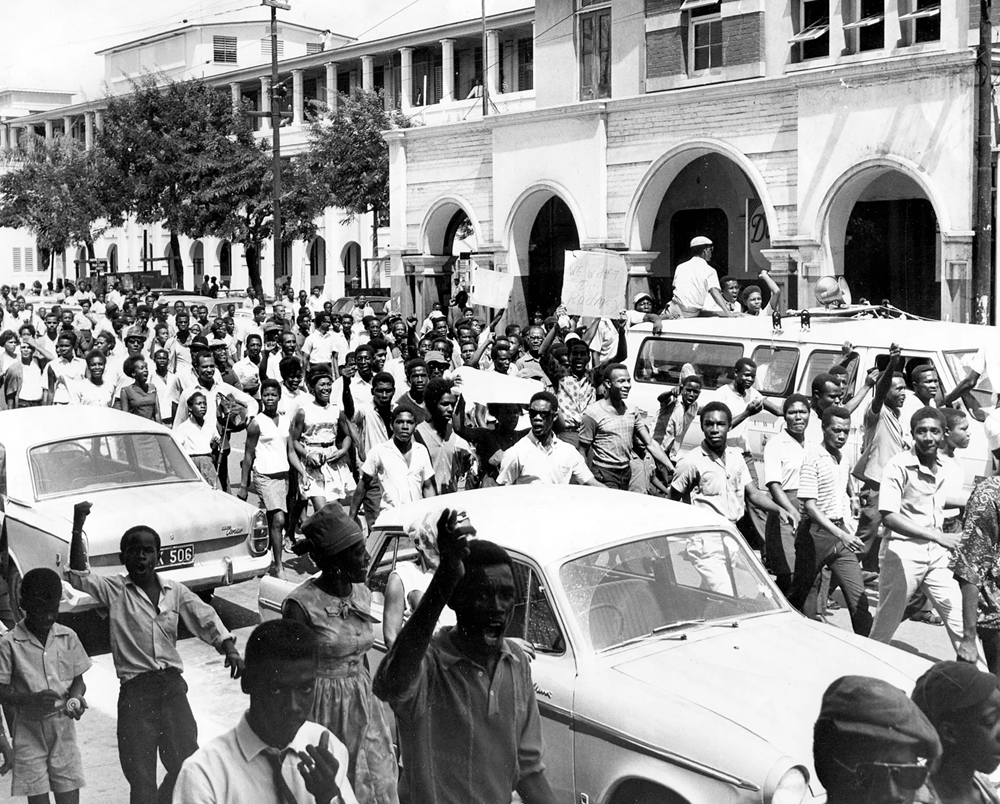
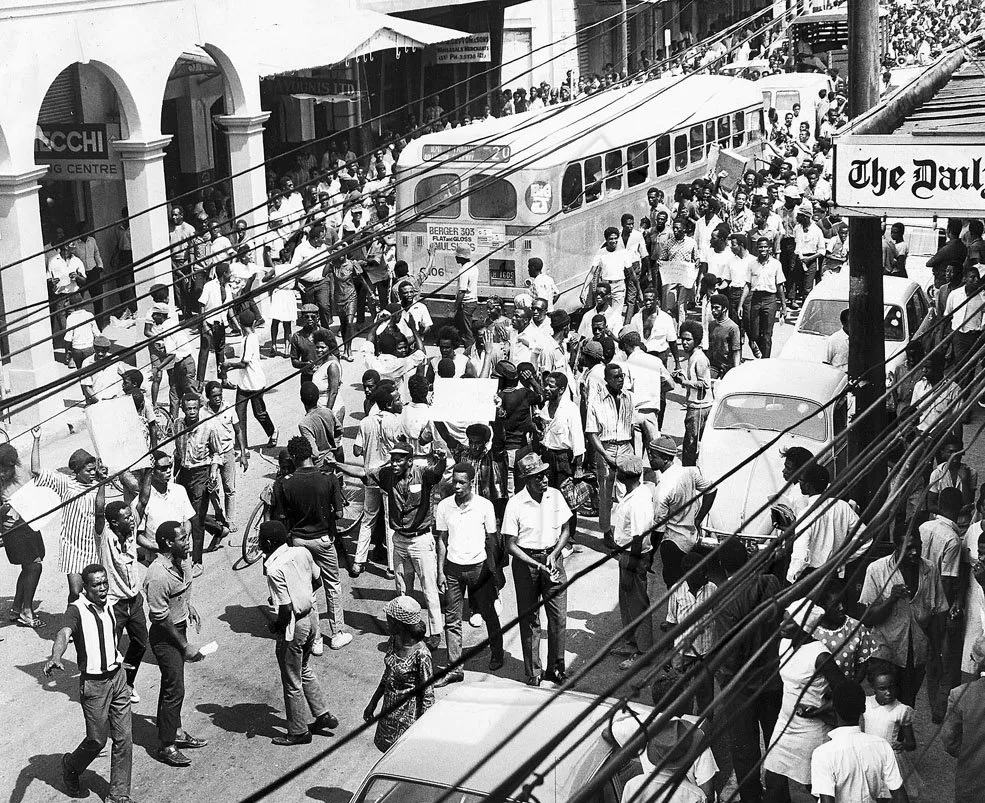
Rodney’s exemplary status in Jamaica did not last long. After he was banned from Jamaica for posing a presumed threat to national security, proletarians and university affiliates alike took to the streets of Kingston to display their frustration at this open act of state repression, and to express a deeper and more pervasive disdain for the dispensations of the neocolonial order. University affiliates, just hours after the news of Rodney’s expulsion was announced, staged a march from the secluded University of the West Indies campus into downtown Kingston, where they were met with attacks from both police and official trade union stalwarts, the latter being just as committed to the neocolonial state as the former. On the heels of the university affiliates’ actions, proletarians—whose domain in Kingston had been confined to the densely concentrated “dungles” (slums)—burst into open revolt, resulting in an estimated $1 million of damage in Kingston alone. The spirit of 1968 had come to manifest in Jamaica.
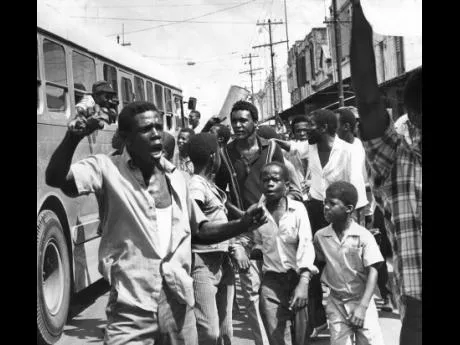
“A riot is not a revolution,” Rodney opined following his expulsion.5 The flashpoint of the “Rodney Riots,” while delivering a significant blow to private property in the heart of Jamaica’s capital, did little in themselves to put in place or build upon organizational capacities that could sustain a revolutionary challenge to capital’s dominion in the Caribbean. However, the riots were seen to be the clearest expression of a popular desire for the reordering of things, expressed through a program of total disorder. For Rodney, “a riot can contribute to revolutionary consciousness,” lending itself to the development of a force capable of confronting the ruling order directly. The Rodney Riots exposed in broad daylight the fault lines of neocolonial society in Jamaica, with the imperial order and their local representations on one side, and the aggregate population of Jamaican proletarians—the chronically unemployed, small farmers, sugar estate workers and bauxite miners, the manifold dangerous classes—on the other. Militants in Jamaica faced the challenge of deepening, clarifying, and codifying the rupture brought to the surface of Jamaican society in the wake of the Rodney Riots while avoiding capture by existing compromised institutions, whether bureaucratic trade unions, national political parties, or Comintern-affiliated organizations.
It is within this context that the Abeng group and its weekly, eponymous newspaper first appeared in January 1969, offering an innovative and popular response to the deepened crisis in Jamaica. Several of Abeng’s key contributors were radicalized by Rodney’s exile, and the group was inspired to cultivate an organic connection to Jamaica’s disaffected classes by Rodney’s grassroots work and the clarifying experience of the riots. Abeng’s short existence until October of the same year was characterized and unified primarily by an opposition to the neocolonial situation in Jamaica and the Third World more broadly, and the belief that a creative response to this situation could be devised only through connection and collaboration with the proletariat in its various formal and informal guises. From our contemporary vantage point, the primary lessons of the Abeng group are to be found in their innovative approach to the relationship between party and class, and to the new forms of organization this approach called for.
Abeng and the Spread of Assemblies
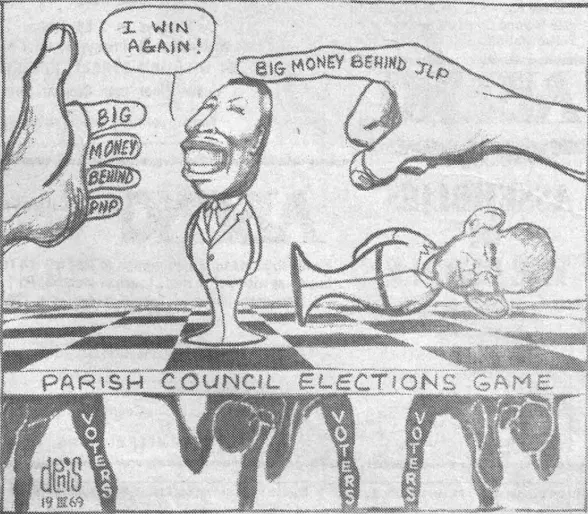
In the wake of Rodney’s banning, disenchanted intellectuals and dispossessed “sufferers” became politically entangled in previously unforeseen ways, presenting a new conjuncture through which to agitate for revolutionary change. To sustain this coalition and to expand its influence, a small group of revolutionaries resolved to establish a national newspaper that could provide a mouthpiece to all disaffected elements of Jamaican society and begin the articulation of a generalized antagonism against the neocolonial state. Contributors to the paper came from diverse ideological backgrounds, including acolytes of C. L. R. James like Robert Hill, proponents of a mixture of vernacular black nationalism with Situationist-inspired council communism such as Fundi (Joseph Edwards), and more orthodox Marxist-Leninists like Trevor Munroe. The Abeng group sought to shatter the dominance of the Jamaica Labour Party (JLP) and the People’s National Party (PNP), and to create new forms of organization which they thought could only come about through collaboration with the working class. They named the newspaper after the maroon word for a sheep’s horn, used during the colonial period to communicate across vast distances and stage attacks on slave society.
If Rodney codified the conjunctural impetus for Abeng’s coherence, Trinidadian historian C. L. R. James in many ways set the foundations for the paper’s manifest philosophy of revolution. For James, the moment of insurrection frequently took the form of a mass, democratic insurgency: rather than the storming of the Winter Palace, James saw the creation of soviets in every workplace as the basis upon which socialism was to take shape. The latter was the political form that would expand the “natural and acquired capacities” of human beings, conjoining the moment of capitalism’s delegitimation with that of the proletariat’s newfound self-legitimation. Revolutionary activity carried for James both a destructive capacity and, perhaps more importantly for him, a pedagogical mandate. The storming of the Winter Palace could teach nothing of the technicalities or intimacies of self-management within the arteries of a democratized mode of production, much less ensure the expanded political power of the proletariat itself to act in a newly self-capacitated manner. It was from the shopfloor that the most intimate knowledge of socialism derived and, in order to thrive, such knowledge needed the broadest dissemination. James, ever the man of letters, regularly emphasized the importance of literary production and, in particular, the creation of newspapers as the basis upon which struggles could be conjoined, knowledge of the productive apparatus could be distributed, and lessons from experiences of proletarian self-organization could be adequately aggregated and publicized. The practices organized around the production and distribution of Abeng saw James’ philosophy play out: the paper aimed to become a mechanism for catalyzing mass, democratic insurgency.
The Abeng newspaper also provided an opportunity to institute a dynamic reciprocity between, on the one hand, the militant core of the paper’s partisans who propelled its production and distribution and, on the other, the nebulous aggrieved and disaffected sufferers who were quick to see the paper as addressing their most prominent concerns and who, in turn, spoke through the newspaper to one another. This reciprocity by and large designated Abeng’s self-conscious approach to revolutionary organization:
The strategy of Abeng is—from the people to the paper, from the paper to the people and back again. At each stage the paper must raise itself and the people to a more solid union. A paper written, edited, financed, produced and distributed by committees of the people must subvert the politics of exploitation, give the people experience in collective action and help form the forces for a national community based on freedom and justice for all.6
The paper was therefore not only to put revolutionary intellectuals in contact with Jamaica’s lower classes, but to do so in the context of “collective action.”7
This reciprocity was largely achieved through “Abeng Assemblies” which would regularly form along the distribution routes of the paper. After printing every Friday, Abeng group members would disperse throughout Jamaica early the next morning, “devoting much time and petrol to the effort” of distributing the paper to rural and urban readers alike.8 Along the way, they would assemble with locals in various urban and rural enclaves across Jamaica’s parishes to discuss the contents of the paper, reflect on their daily lives, and, on occasion, announce the political forms that their struggles against dispossession and impoverishment were already taking. These assemblies varied in scope and scale but commonly provided the foundation for an ever-tightening entanglement between those most regularly producing the newspaper and those who identified most readily with its aims.
While travelling the country to distribute Abeng and conduct assemblies, members dealt with stiff state repression. Multiple issues of the paper recount police harassment of distributors such as Bongo Neville, a young man from Kingston who was arrested on several occasions and even had eviction orders served against his mother in retaliation. Police attention was unsurprising given the banning of Black Power literature in the 1960s, including many of the authors reprinted by Abeng like Stokely Carmichael and Malcolm X.
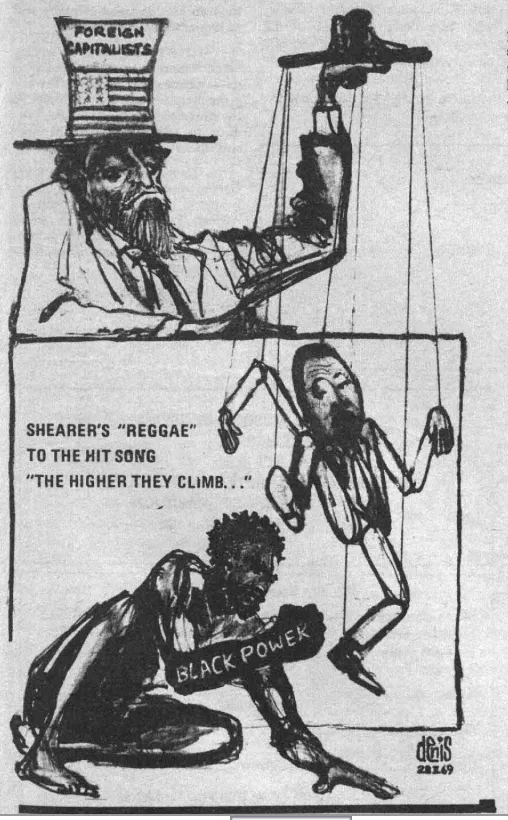
Although they brought increased state scrutiny upon Abeng members, the assemblies allowed them to identify various forms of existing and emergent struggle among proletarians. Most prominently, reports of efforts to form workers’ councils on sugar plantations in Westmoreland clearly demonstrated the independent capacities of Jamaica’s proletariat to innovate forms of collective self-management and resist domination implemented at the point of production. Other areas formed “Citizens Councils,” which would write to Abeng explaining local conditions and their attempts to intervene. The Greenwich Town Citizen’s Council, for example, recounted the pollution of a local river and destruction of subsistence fishing by industry, stating succinctly that the present task was to “link the struggles for the pre-existing immediate needs of the oppressed Black populace with the revolutionary goal of Black liberation and social change.”9 This task was at the center of Abeng’s operation.
In addition to placing Abeng members in direct contact with sufferers throughout the island, the Abeng Assemblies provided the basis upon which an ever-growing readership also became implicated in the production of Abeng: where concerns were raised in the course of an assembly, those concerns would become the basis of reportage or testimony in the following issue. Readers were encouraged to contribute reflections on their daily lives and attendant struggles to the newspaper, or to orally recount them to an Abeng member who would give them written form. These contributions were most commonly implemented under the recurring section “Blow the Horn, Tell the People,” an eclectic combination of brief letters-to-the-editor, commentary on previous Abeng issues, and a myriad of grievances. As the second issue of Abeng insisted, “the reporting of news [and] experiences and distribution of the paper depends on everybody.”10
Such efforts at dispersed production and distribution lent themselves to the softening of positional differences between an educated middle class and a vastly discontented but often illiterate working class, while nevertheless preserving these distinctions in the technical division of labor. The Abeng group, largely drawn from the most militant of the former camp, aimed to displace their own class hierarchies by placing their technical expertise—writing, researching, printing—at the service of an emergent class-for-itself, rather than claiming leadership over the class: “Those of us producing the paper can only go to these assemblies to help discussion, not to lecture and tell people what to do.”11
Of course, Abeng assemblies couldn’t entirely displace class society, and critiques were commonly printed in the paper. Readers often remarked that the group’s connection to the grassroots was incomplete and that the paper expressed itself in a language too elite to be meaningful to most Jamaicans. Another critique held that Abeng needed to develop a strategy and more directly advise workers on what to do rather than simply record and amplify struggles as possible examples. This suggests that belief in the revelatory nature of “groundings” and assemblies wasn’t shared across the movement, and that at the least the strategy being pursued by Abeng had to be more clearly explained within its own pages. Clearer strategizing may have been precluded by the multi-tendency composition of the group.
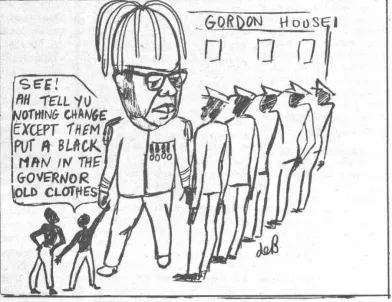
In this context, “readers” is only an approximate and ultimately unsatisfactory term, given the active nature in which proletarians engaged with Abeng. “Reader” suggests a unidirectional relationship where content is provisioned and disseminated by “producers” before being passively consumed by the former. The act of “consuming” Abeng was not so standardized and, in addition to being read by individuals, the paper was often spoken aloud to groups of sufferers gathered together, a practice that then served as an impetus to discuss the contents of the paper. We might consider “correspondent” a more apt term for those who engaged with Abeng from various angles, where readers served as active participants in the creation and circulation of the paper, insofar as they provided critical and instructive feedback within the Abeng Assemblies. As such, we can begin to place Abeng alongside the long history of communist correspondence projects like Marx’s own Communist Correspondence Committee, the International Council Correspondence journal edited by Paul Mattick, Sr., and the Correspondence Publishing Committee around C. L. R. James in Detroit—all of which were committed to a practice of inquiry. This lineage of communist correspondence projects sought to institute an open and inquiry-based form of communication that regularly militated against a staid and all-too-anachronistic party line emanating from Moscow and conveyed by its agents, seeking instead the proletarian reinvention of class struggle. Abeng’s contribution to this tradition of correspondence is its most profound legacy for contemporary politics, demonstrating a comprehensive reworking of the relationship between party—a coherent grouping of individuals dedicated to the task of identifying and extending revolutionary practice—and class—that living force which demonstrates the movement from which communism is rendered possible.
Conclusions
At its peak, Abeng amassed a print run of 20,000 copies which circulated throughout Jamaica and, to a lesser extent, the Caribbean diaspora. Despite this popularity, after just nine short months, Abeng ceased to exist, beset by the ills of interpersonal fallout, the destruction of their printery in a mysterious fire, and the twinned counterstrategies of state repression and recuperation. Legal fees accumulated from staving off repression drained the paper’s finances, and then the more permissive and recuperative environment of the 1970s under Michael Manley’s Prime Ministership further fractured the composition of the group, as some dedicated their activities to electoral politics while others continued to rail against Westminster governance altogether. Abeng saw the continuation and spread of the revolutionary movement in Jamaica to the immediate next stage following a popular uprising, raising for thousands the prospect of sustained antagonism to the neocolonial state—but it left the historical stage having amplified and conjoined grievances without illuminating what might emerge in its wake.
From a contemporary vantage, the lessons of Abeng, considering its shortcomings in practice and in theory, appear more as the promise of Abeng, an orienting idea that nevertheless fell short of its own aspirations. Rather than resolve upon and thus codify an answer to what shape organization for social transformation should take in Jamaica, Abeng refrained from programmatic declarations, hoping to advance a popular discussion around the needs, desires, and afflictions of Jamaica’s sufferers to better clarify a popular social basis for radical transformation. In so doing, Abeng was able to give expression to a number of otherwise competing ideologies within a single textual space, not as so many preferential options to be considered and ranked, but as a practice of articulating across their differences for purposes of popular mobilization. While this composition did not sustain itself for long, Abeng nevertheless posited a complex discursive formation that evaded left factional distinctions, instead reconfiguring the register of the popular within its historical moment and redefining the terms of democratic participation in revolutionary struggle. If we are to distill a particular form from the Abeng experience, it is one that is necessarily flexible and expansive, capable of accounting for the “multiplicity of interests” in a manner not dissimilar from how Marx characterizes the Paris Commune. Abeng did not seek to design and implement any “ready-made utopias,” but rather to “set free the elements of the new society with which old collapsing bourgeois society itself is pregnant.”12
While there is much about Abeng that feels relatively anachronistic 50 years on—a physical newspaper passed hand-to-hand has now largely been displaced by digital communication and impersonal delivery—much of its animating spirit should continue to inform contemporary revolutionary struggles. Abeng demonstrates a central object around which a non-sectarian coterie of partisans could cohere and agitate nation-wide against the independent state. The paper provided a material project that reflected the ideologically diverse social basis that brought it into being and served to highlight discrete tasks. These tasks brought revolutionaries into regular contact with Jamaicans across the country and actively involved them in the project of producing the paper.
The production of Abeng can perhaps most accurately be compared to the operaisti practice of co-research rather than traditional workers’ inquiry, particularly in its relation to struggle and to the types of knowledge it sought to produce. Each assembly held, each paper published, was an attempt to create a greater unity between party and class, and to one day do away with the distinction altogether. Abeng did not separate the paper’s production from the waging of class struggle, seeing research and writing as a way to spread and connect democratic grassroots groups capable of expanding confrontation in the workplace and village. The group sought to uncover not primarily objective technical aspects of production and consumption, but rather subjective experiences of suffering and domination that would spur opposition to neocolonialism and clarify alliances between partisans across sociological and ideological differences. The group’s flexibility and close attention to Jamaica’s specific historical conjuncture allowed it to identify the most salient contradictions in Jamaican society and push to deepen them. If not for its premature end, Abeng might have provided the context for long-term collaboration between revolutionaries and sufferers of disparate social groupings, a prerequisite for expanding struggles towards a rupture with the current order.
As in so many places across the world, the Caribbean left in the 1970s moved towards more bureaucratic and authoritarian forms of communist practice as well as more specialized modes of armed struggle, with few exceptions. In Jamaica, a reinvigorated social democracy fractured the revolutionary movement and, although workers continued to engage in wildcat strikes, independent trade unions never reached the scale or coherence necessary to challenge the state. For a brief moment in 1969, Abeng helped sketch a different future, one without managers and politicians, where reciprocity and equality come to characterize relationships. Their experiment was an essential piece of the communist movement that will bring about a classless world.
Saul Molcho is a communist writer & researcher based in the U.S. Midwest.
- 1Jamaica and Trinidad & Tobago both gained national independence from the United Kingdom in 1962.
- 2Monica Silberberg, “The Jamaican Bauxite Industry and Decolonization,” Caribbean Quilt 2 (2012): 92-106.
- 3Horace G. Campbell, “Coral Gardens 1963: The Rastafari and Jamaican Independence,” Social and Economic Studies 63, no. 1 (2014): 197-214.
- 4Rodney, The Groundings with My Brothers (Verso, 2019), 13.
- 5Walter Rodney, “Africans Abroad in Jamaica,” unpublished manuscript, 36.
- 6Abeng 1, no. 11 (1969): 4.
- 7In this way, Abeng may be seen as a vehicle for what Sartre called the “group-in-fusion,” a social body constituted through a unified orientation toward practice. Jean-Paul Sartre, Critique of Dialectical Reason, vol. 1 (Verso, 2004).
- 8Ken Post, “UWI Mona and the Government of Jamaica, 1967-69,” in Rupert Lewis and the Black Intellectual Tradition, eds. Clinton A. Hutton, Maziki Thame, and Jermaine McCalpin (Ian Randle Publishers, 2018), 26.
- 9Abeng 1, no. 29 (1969): 2.
- 10Abeng 1, no. 2 (1969): 2.
- 11Abeng 1, no. 6 (1969): 2.
- 12Marx, The Civil War in France (1871), marxists.org/archive/marx/works/1871/civil-war-france/ch05.htm.
Comments