
Ayşenur Ezgi Eygi was a Palestine liberation activist from Seattle, Washington in the USA who was murdered by the Israeli Occupation Forces at a Palestinian demonstration in the West Bank in late 2024. This is a transcript from an interview with a comrade who travelled to the occupied West Bank with Ayşenur Ezgi Eygi and the International Solidarity Movement. Originally published in Heatwave #2 (2025).

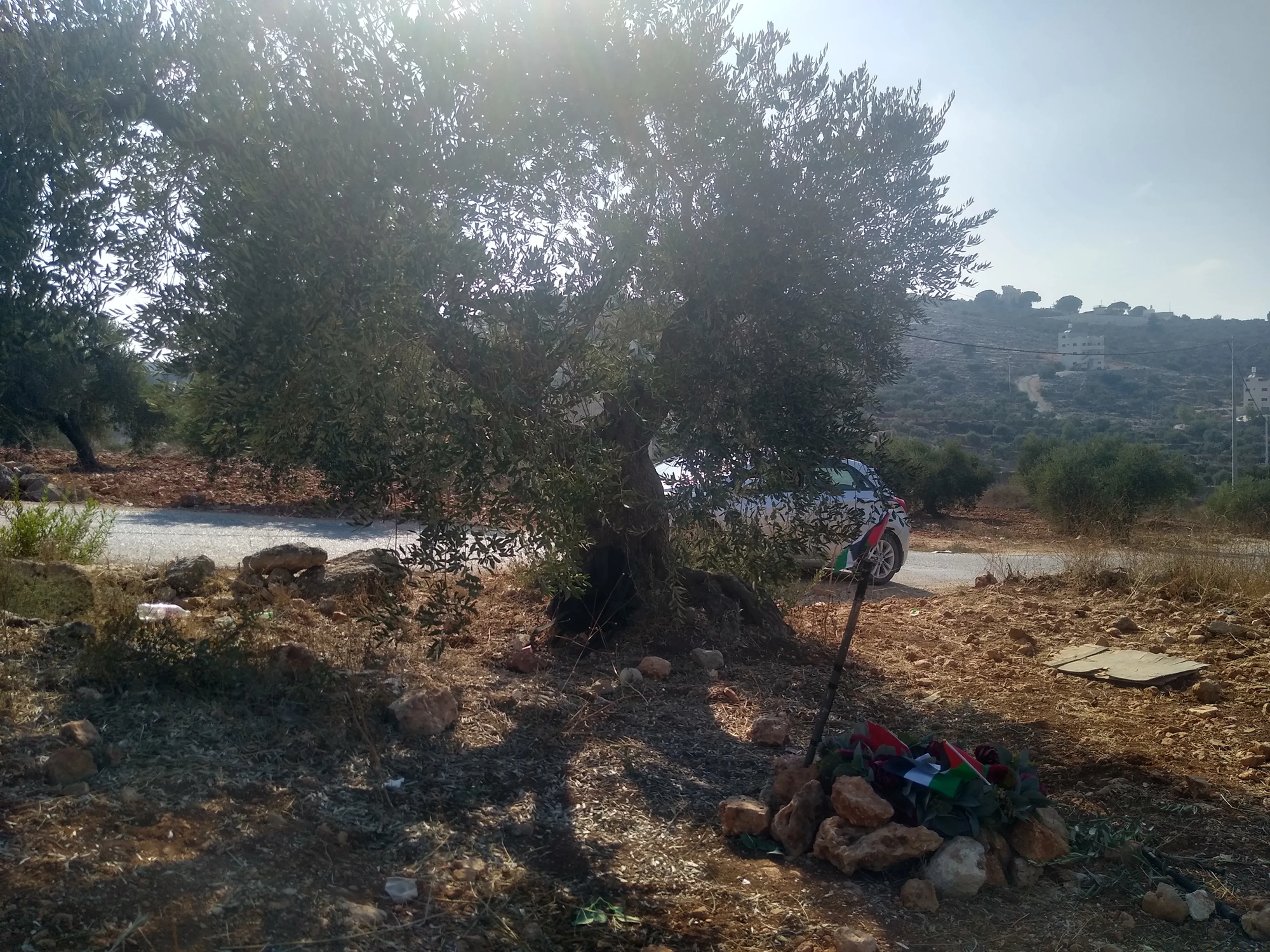
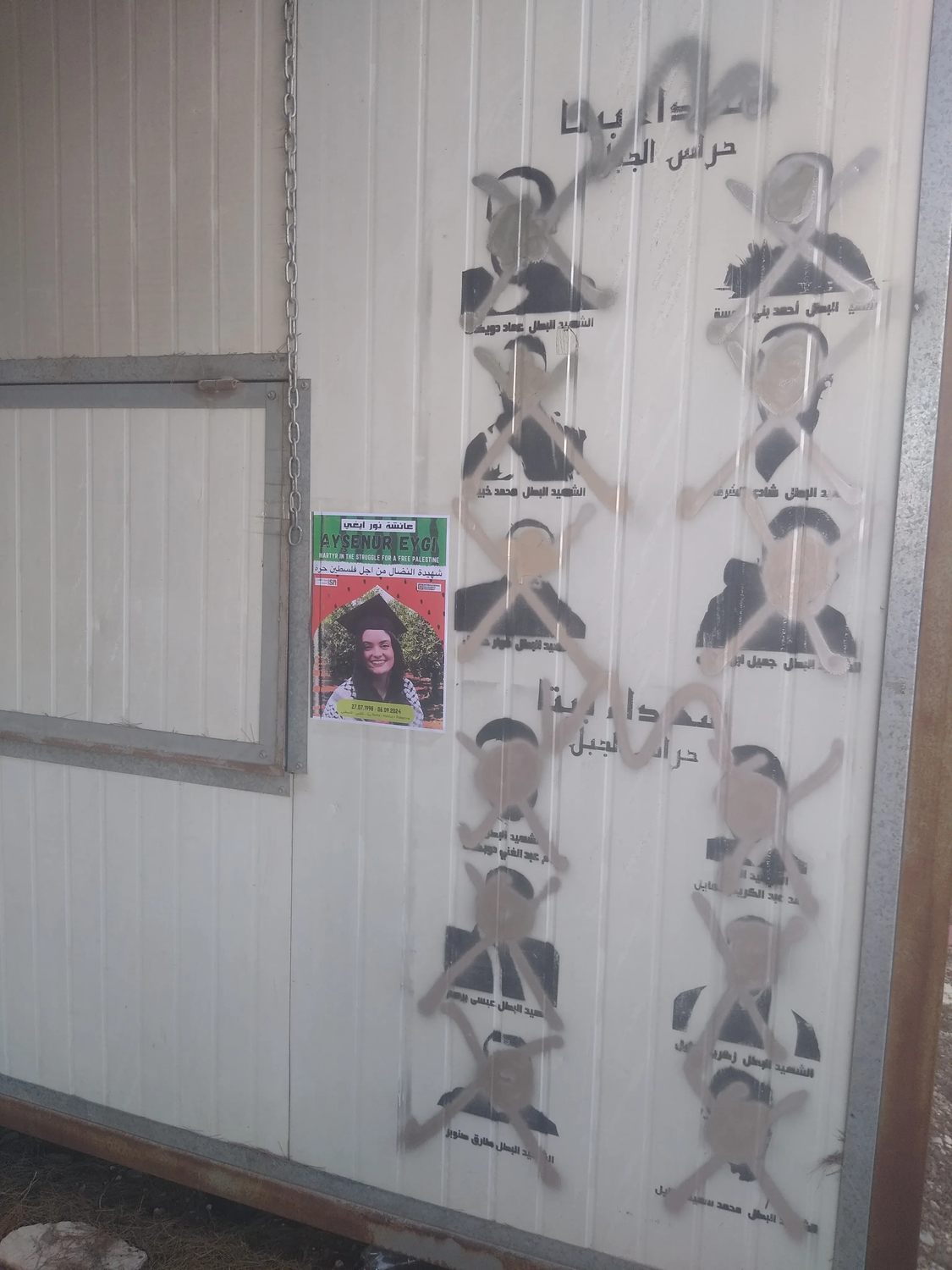
Above: A memorial near where Ayşenur Ezgi Eygi was murdered in Beita, Palestine.
The following is the edited transcript of an interview with a comrade who travelled to the occupied West Bank with Ayşenur Ezgi Eygi and the International Solidarity Movement. Ayşenur Ezgi Eygi was a Palestineliberation activist from Seattle, Washington in the USA who was murderedby Israeli Occupation Forces at a Palestinian demonstration in the West Bank in late 2024. This interview was originally recorded and broadcast on The Beautiful Idea, a podcast from a collective of several anarchist and autonomous media producers scattered around the world. A link to the full episode can be found in the footnotes.1
Could you explain what exactly ISM is and what it does?
It stands for International Solidarity Movement. It was founded in 2001 by some Palestinian activists, a small group of anti-Zionist Israeli activists, and some international activists. They operate along four principles: they’re Palestinian-led; they’re committed to non-violence as a strategy, not necessarily as ideology; they make decisions using consensus; and they use an anti-oppression lens, which includes being explicitly anti-Zionist. Their origin is connected to the Palestinian popular committees that arose during the First and Second Intifadas. ISM’s goal is to participate in and support the popular resistance. They do this through a variety of activities. A big part of what they do is what they call protective presence: international volunteers accompany Palestinians in their daily lives in the hopes that an international presence will lessen or decrease the amount of violence that Palestinians face from both Israeli settlers and the military. Concretely, this includes simple things such as accompanying sheepherders in the field, farmers harvesting their crops, accompanying school children on their way to school, or being present at homes that are threatened with demolition.
What does it mean to be involved in the popular resistance in Palestine? Could you talk a little bit more about ISM’s relationship to different government entities and to armed groups?
First, I should clarify that I volunteered with ISM and travelled to the West Bank, but I actually didn’t do the work with the ISM that I intended to do, because my friend was murdered soon after I arrived. So, I can’t speak in depth about what it looks like in practice. My understanding is that ISM doesn’t have a direct relationship with any specific political entity. The organization doesn’t take a position for or against any of the political parties or groups. I imagine that there are a range of political opinions amongst volunteers, but as an organization, there’s no formal relationship with, for example, the Palestinian Authority, Hamas, or any other party-like formation. The relationship with the Israeli government is very contentious, obviously, because ISM is an explicitly anti-Zionist organization.
Could you share why you decided to work with ISM? I’m also wondering if we could talk a little bit more about this question of the difference between nonviolence as a strategy versus an ideology, and how this ties into your decision to work with ISM.
In my case, I didn’t decide to go to the West Bank because I thought that I personally was going to make any difference in the broader, brutal, colonial dynamic. I wasn’t convinced that being an international doing protective presence was going to change much about the situation either. For me, it was specifically an opportunity to expose myself to dangerous conditions in the hope that the experience would be useful for coming struggles and would give me more courage to act in the future.
What do you think about “protective presence”?
I have complicated views on it. I’m not exactly sure what I think. The phrase itself is a little uncomfortable to me because it reveals that there’s an acceptance of inherent difference between internationals and Palestinians. And, I don’t know that, in the long run, emphasizing or accepting that difference is a sound strategy for liberation. It calls into question what solidarity means in my mind. The underlying assumption of that strategy is that by mobilizing the racial or national privileges of international volunteers, the ruling class and the government of the United States alongside other world powers will suddenly be convinced that they need to stop funding ethnic cleansing and genocide in Palestine. This could be the case, but it seems unlikely. It hasn’t worked yet.
Not purposely, but incidentally, this also accepts the premise that the lives of Americans or other internationals are fundamentally more valuable than, and completely separate from, Palestinian lives. This is probably true in the eyes of the Israeli government and military. But it undermines the concept of solidarity. If we’re truly in solidarity with people, Palestinian or otherwise, don’t we have to see ourselves as no different than them? It doesn’t seem like there can be a tiered struggle in which Palestinians risk their lives as insurgents and internationals only risk their social reputations. And the extent of solidarity is simply supporting or observing the insurgents from a distance rather than participating as an equal. Until large numbers of internationals are willing to see themselves as 100% invested in the struggle, the Palestinian rebels will still effectively be on their own.
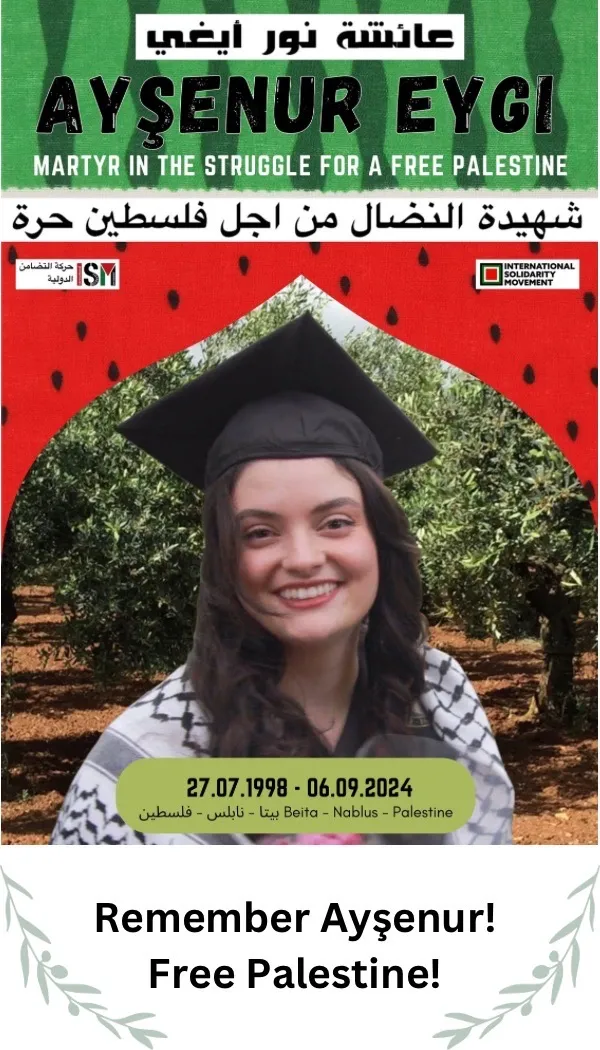
You went to Palestine with Ayşenur. Can you speak on what motivated her?
Since Ayşenur’s murder, there’s been a number of tributes published about her, written by people who knew her, maybe even more so than I did, or in different ways, or at different points in her life. All of those are worth reading. In my case, we became acquainted 4 years ago through her partner, who is my friend. I’ve since learned that she had quite an active political life before I met her. After October 7, we both got re-engaged in Palestine solidarity work—this helped us build a new dynamic in our friendship based around shared political activity.
She was involved in some notable things the year prior to us traveling to the West Bank. For example, she organized a grassroots fundraiser for people in Gaza. She did it seemingly all on her own in a very short period of time and was able to raise something like $40,000 or $50,000 in just a matter of hours. It was 10 or 20 times the amount that she expected to raise. She was a very tenacious organizer—when she set her mind to something, it was pretty admirable.2 Last year, Ayşenur was also heavily involved in organizing the student encampment at the University of Washington, where she was a student.3
She worked tirelessly. The experience of the encampments deepened our political relationship. I’m not positive about this, but it’s my viewthat the disappointment at how the encampment at the University of Washington ended led her to search for a different sort of activity around Palestine. That’s when she approached me about traveling to Palestine. We had previously talked about going to volunteer with ISM, but neither of us had really committed to it. But it was in theaftermath of the deterioration of the UW encampment that seemed to make her more certain about going. Her certainty and resolve motivated me to take that step.
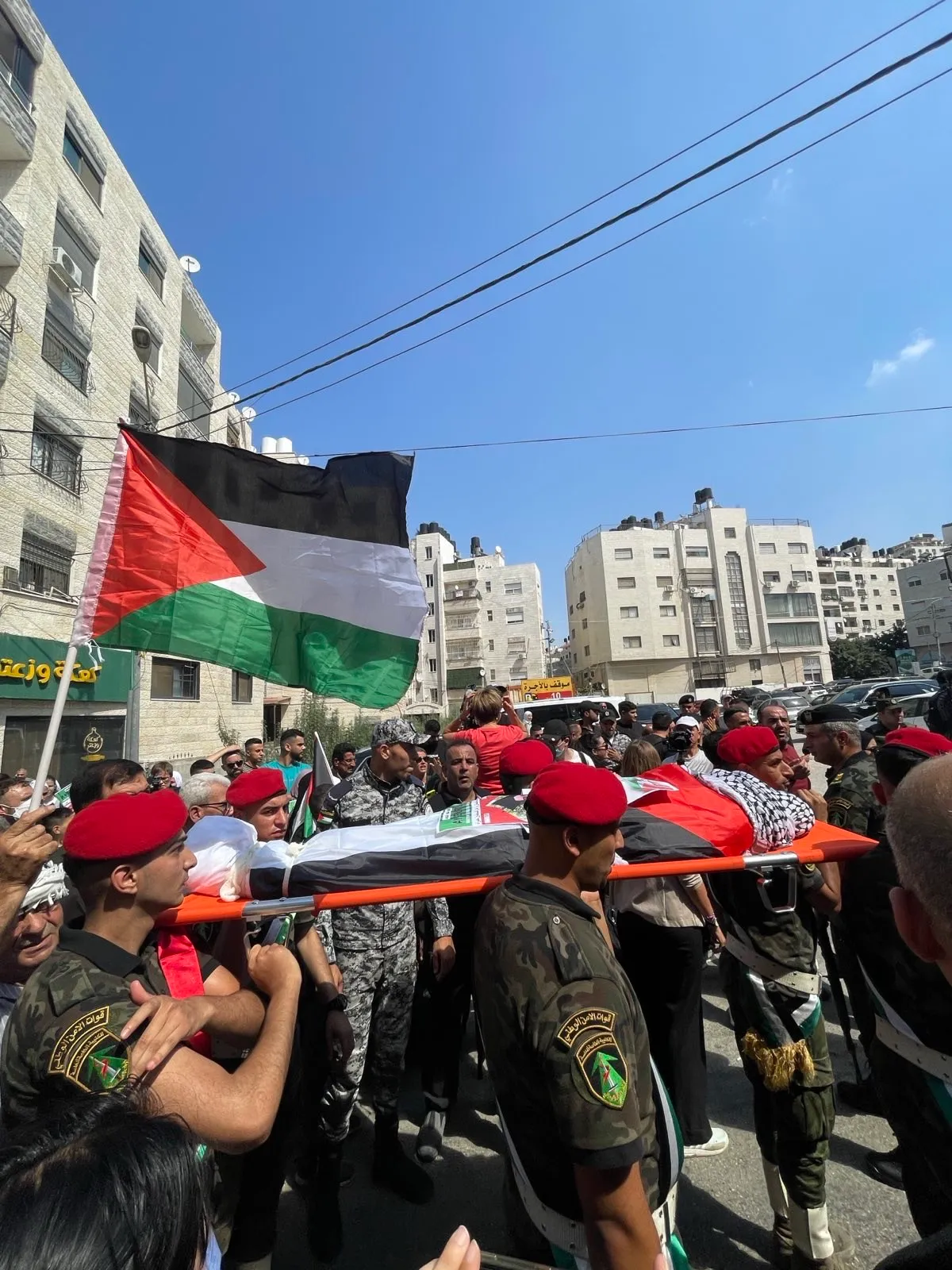
How long did it take to plan that trip? What steps did you take? And what was the situation on the ground when you arrived?
ISM does a vetting process. This was followed by a couple of online informational and training sessions before actually traveling there. The planning took 3-4 months.
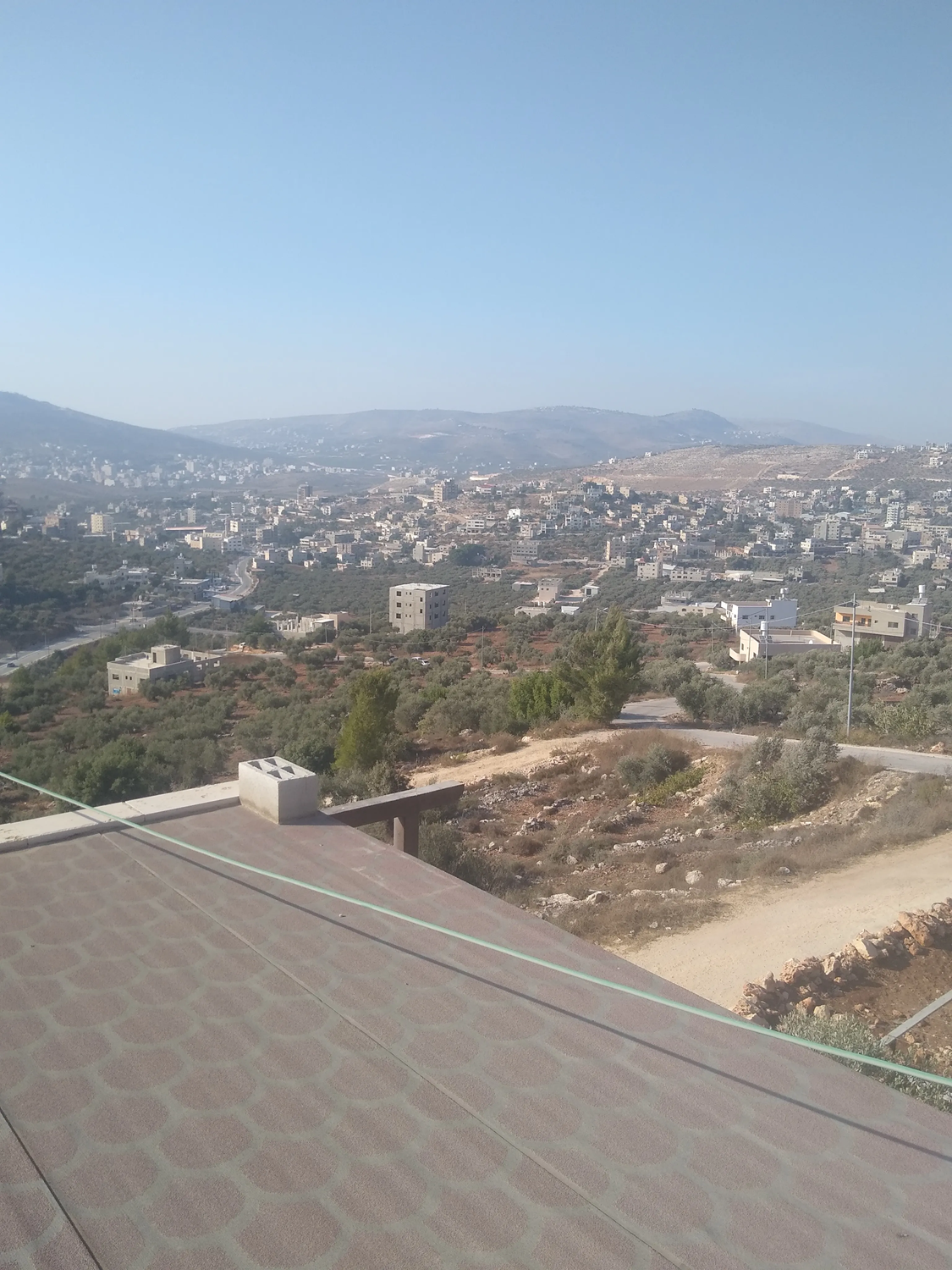
I think that in large part the West Bank is off the international radar because of the ongoing genocide in Gaza. But the reality in the West Bank was also very brutal and had been getting more and more deadly over the course of that year. It’s always been bad. And it had grown significantly worse over the past year. In the West Bank, there’s this very complicated system of governance, and what it all essentially boils down to is Israeli occupation and control, but they call it different things in different areas. There are three areas: A, B and C. It’s quite complicated. The three different areas are the result of the Oslo Accords from 1993-95. Area A is supposed to be controlled by the Palestinian Authority. Area B shares control between Palestinian Authority and the Israeli military. And Area C is exclusively controlled by the Israeli military. In effect, the Israeli military can do whatever it wants in any of those areas, but their presence is less frequent in area A and to an extent, Area B. Area C is often where territory is actively being settled and annexed by Israelis with the help of the Israeli government.4 Some of the larger cities in the West Bank are primarily in Area A. For example, Ramallah, which is where ISM issomewhat based, and Nablus, another major city. But, outside of Nablus is a town called Beita, whose land is defined as a mix of Area B and Area C with an active settler outpost being constructed on it for the last four to five years.
It would be really helpful to hear your reflections on your experience with Ayşenur’s murder.
After two days of training, it was Friday, and we were planning to attend the weekly Friday demonstration in Beita. But then I becameunexpectedly ill. Ayşenur decided to go to the demonstration without me.
I’ll just say that the story has been reported extensively in the media. A lot of people already know the details.5 I wasn’t there but was able to piece together what happened from eyewitness accounts of other ISM volunteers.
She attended the demonstration. As soon as it started, the Israeli soldiers shot tear gas and live ammunition at the demonstrators. This area is on a very steep hill. When the Israeli soldiers begin firing at the crowd, the protesters usually quickly retreat down the hill into olive groves near the village. After this period of retreat, a period of calm followed where it seemed like the demonstration might wrap up. People later said this lasted between 20 to 30 minutes. But what some of the Israeli soldiers regularly do, and they did on this day, is they take over nearby Palestinian homes to use as surveillance points. At the top of the hill, a group of Israeli soldiers took over a rooftop of a Palestinian home, where they had a clear view all the way down the hill. The demonstrators that had retreated were over 200 yards away from where the soldiers were standing on the rooftop. And then suddenly, in the midst of what seemed like the end of the demonstration, two shots of live ammunition rang out. One of them struck something metal, either a pole or a dumpster, ricocheted, and hit a Palestinian youth in his leg. The other one was a direct shot at Ayşenur’s head. She was standing next to an olive tree in one of the olive groves. People tried to stop the bleeding while she was loaded in an ambulance and rushed to the hospital, but she died very shortly after reaching the hospital in Nablus.
Do you want to share how you how you found out and then maybe also some pieces from your journal from that time?
My journal while I was in the West Bank was in the form of somewhat regular reports to a group of friends on a messaging app. I asked friends if they wanted to receive updates from me on this list and I would send reports when I could. I found out that Ayşenur had been shot via text message from other ISM people who were present at the scene in Beita. I was in shock for quite a while. Soon after it was reported that she had died. I can share some of what I wrote that day. It captures where I was at emotionally at the time.
September 6, 2024: I don’t know how to say this. There’s no easy way. I wish I could write something eloquent, but I can’t through my sobbing tears, Ayşenur, my friend, comrade and travel partner to Palestine was just shot in the head and murdered by the Israeli occupation forces. May she rest in power. She is now one of many martyrs in the struggle.
I’m just sitting here all day, tears welling intermittently. I don’t know what to do. So many regrets. I wish it would have been me and not her. I am much older than her and she had so many things she wanted to do with her life. I was the one who came more prepared to die here. I knew the risks. I wrote a will before I came. I don’t think she really considered that much of a possibility. I should have discouraged her from going to the demo. I was asked not to go to it today because I have Covid. So I stayed in Ramallah. I should have asked her to waitanother week for when we could go together. Instead, when she asked me if I was in her shoes, would I go alone, I said I would. This morning, I gave her some supplies to deal with tear gas, advised her to stay alert, to stay away from the front of the demo, out of the line of fire, and to stay close to the more experienced activists. Finally, I told her I thought she would be alright. In fact, I think that may have been the last thing I said to her: “I think you’ll be alright.” Shows that I know absolutely nothing.
At 2:41 p.m. today, I called Hamid, her partner, and delivered the devastating news. We both sobbed and cried. What do you say to your friend whose wife was just murdered on a trip she took with you? What do you say when she traveled from Istanbul to Palestine with you, and yet you didn’t go with her to the demonstration? What do you say when you have known for months that bringing a camera phone to face the US-Israel genocidal machine is completely insufficient, and yet you traveled here with her anyway? To be honest, I thought injury, arrest or death was likely for me. For some reason I didn’t think death would come for Ayşenur. I was not prepared for this moment. It came so suddenly.
Thank you. Do you want to continue sharing from other parts of your journal?
I can read from a few parts of the journal from the following two weeks. Ayşenur was born in Turkey but moved to the US, I think, before she was even one year old. So she grew up in the US, but her family made the decision to have her formal funeral in Turkey and have her buried inTurkey. I decided to travel there for the funeral. This journal entry is from the funeral.
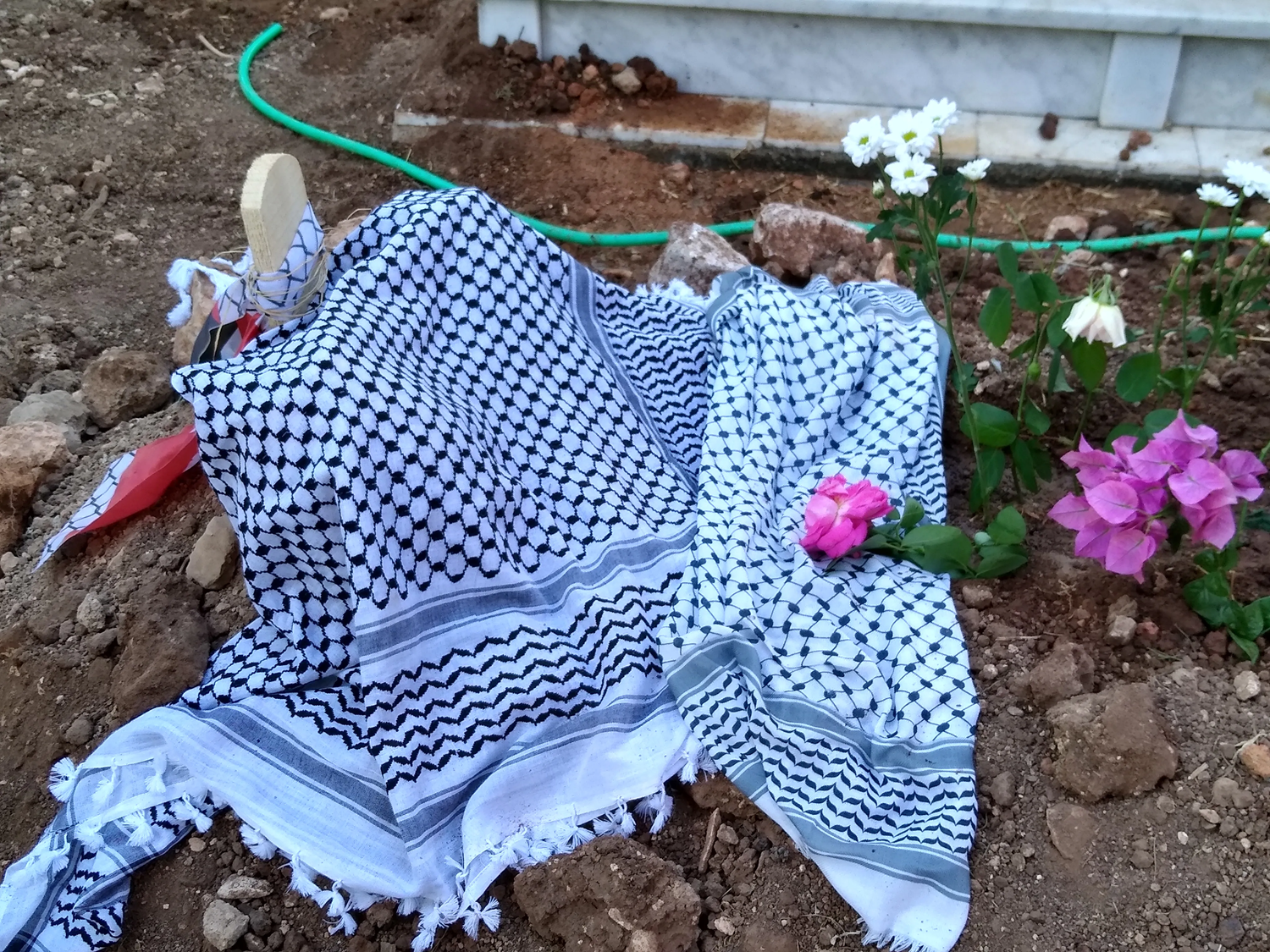
September 14, 2024: A few friends have caught glimpses of me standing off on my own. They acknowledge me with a subtle nod or a slight wave of the hand. A friend comes over and gives me a hug and whispers, “I’m sorry” in my ear. I don’t think Hamid has seen me. After he and others fill her grave with dirt, he sits solemnly next to her for a very long time, just staring at the new mound of dirt dotted with flowers and draped in a kufiyeh and two small flags: one Turkish and one Palestinian. I don’t notice any tears on his face. He appears dry-eyed. I am the same. The tears won’t come in this moment. They feel stuck behind something. Perhaps if I was dead and had no more concerns swirling inside my brain, then this body would know how to cry. Instead, I retreat to a different part of the cemetery, too consumed with worry. Some time passes and everyone else has now left. I sit alone, waiting for the unknown time when this body will be at peace.
Later, I approached Ayşenur’s grave, grateful to have an opportunity to finally get close and not have any cameras or dignitaries present. I touch the soil covering her body, and all I could think to say was, “I’m sorry”, over and over again. As I did this, the tears finally started to flow. This was the moment I needed with her.
A couple weeks after returning home, I wrote this reflection:
Each morning, I spend a few minutes looking at Ayşenur’s face amidst the memorial-in-process that I have been building, contemplating what has happened. On occasion, a few tears drip from my eyelids, down mycheek, sometimes a groan of agony, sometimes a shake of the head. I do not feel weak when my tears bubble to the surface. I only feel weak that my tears don’t translate to effective and decisive action. These are the twists and turns that my grief takes. Undoubtedly, I have not reached the end of this winding road. For now, all I can say is that life is composed of dying and mourning. Yet still we must honor our martyrs. We must destroy what destroys us; what destroys the people of Palestine. We must globalize the intifada.
Since I’ve returned, it’s been really unclear to me what to do, how to honor her, how to remember her, and how to give a report back. The only things I have come up with to share are these journal entries because they just seem like the most honest words.
I wanted to return to the ISM. How did your experience impact your understanding of the role of accompaniment, if at all? And what is your analysis of the work that ISM does?
I will say that the people I’ve met in ISM are some of the bravest andmost dedicated people I’ve ever met. So, I have a tremendous amount of respect for them as individuals and as an organization, and the work that they do. Also, I actually didn’t do the on-the-ground work with ISM. I only had the training, and then the next day, Ayşenur was murdered. The rest of my few days there were spent attending memorials.
There are many ISM volunteers who have anecdotes that their direct presence made a tangible difference in saving lives. I can’t discount those experiences. If we look at the Palestinian context more broadly, however, it does seem that this sort of model of accompaniment or protective presence tends to devolve into a service-oriented framework.
What do you mean by service oriented?
It’s sort of this crisis response model rather than a long-term strategy of resistance. That’s not to say that it’s not important to do that stuff. But I think if we step back and assess whether it’s effective overall at countering Zionist terror, I don’t know that it is. The degree of violence and repression from the Israeli state makes a commitment to non-violence at times seem illogical.
There’s this common idiom, you don’t bring a knife to a gunfight. But with this model, you’re only bringing a smart phone equipped with a camera to a violent conflict with highly armed security forces. It doesn’t seem sufficient.
What resistance strategy do you think would be effective? And what international solidarity do you think is useful in Palestine,specifically?
In the context of Palestine, it seems clear that Israel is not going to stop their settler colonial project and all the brutality that comes along with that unless the US no longer backs them militarily, economically, diplomatically, etc. So I guess that points to the broader strategy for Americans that instead of traveling to Palestine to act as a protective presence, you stay in the US and try to, frankly, destroy the US empire from within.
There was an essay released shortly after October 7, 2023 and its conclusion on what solidarity with Palestine looks like in the US was pretty simple: solidarity with Palestine means destroying the United States.6 The Israeli settler state is a project of empire. But how to do that obviously becomes a much more difficult question.
Yeah. That was my next question to you.
I think it’s pretty unclear. In general, as a movement, there’s not a clear direction. From what I can tell, the most inspiring moments have been direct action campaigns of sabotage and property destruction. Those seem like the most tangible acts of solidarity that I’ve seen. A more specific example might be the Palestine Action campaign of targeting Elbit Systems, one of Israel’s largest weapons manufacturers.7 A lot of their activity has been in the UK, although there have been activities on the east coast of the US as well. Some of their activities have had success in shutting down factories and offices of the arms manufacturer. There have been other small direct actions that are designed to limit the material support for the State of Israel by targeting groups that directly finance its activities.
I also want to hear your thoughts on supporting the Axis of Resistance. For example, there are organized armed groups fighting the Israeli military, who are statist or capitalist in orientation, and do not share left wing or anarchist values. It’s a really challenging nuance that doesn’t necessarily have a clear answer.
For most of my life, the visible Palestine solidarity movement in the US has taken an almost pacifist and liberal approach, publicly. And publicly, none of these groups would talk about supporting Hamas or even acknowledge that armed struggle existed. In this portrayal, Palestinians were only victims. I think that has changed in the past year or so. There is now a sizable chunk of the solidarity movement, the decolonial Left, which actively and publicly supports Hamas and other armed factions in the Palestinian resistance, along with the broader Axis of Resistance in the region. This new solidarity movement views the Axis of Resistance as a kind of vanguard of anti-colonial struggle. In this instance, solidarity with Palestine equates to supporting these movements and political parties without question. I find that a little problematic. But there isn’t space for this discourse because it’s automatically assumed you have some ideological aversion to violence as a form of struggle.
But that’s not where I’m coming from. Personally, I think the only thing that really makes sense in the context of a place like Palestine is armed struggle. I’m not a scholar of Hamas. I only know what they’ve said publicly that’s readily available. My objection to Hamas is that their political vision has nothing to do with abolishing capitalism or a centralized state authority. It’s hard to align my political values with that sort of vision. The objection is not that they have taken up armed struggle.
There’s a lot of pro-Zionist propaganda out there, and its entire purpose is to discredit Palestinian resistance. I think all of this should be acknowledged. And also there should be an honest debate amongst revolutionaries about what the political vision of these organizations that are considered the leaders of anti-colonial struggles is exactly. We should also look at it from a historical perspective—within past anti-colonial struggle, there’s a variety of political orientations and visions involved. Almost always, the authoritarian factions in these struggles succeed in taking over. Once independence is gained, these factions ascend to power and become the ruling party. This usually results in generating the same inequalities and class organization of society for the majority of people that existed under the previous colonial regime. Given the historical examples, we have to approach anti-colonial struggle with a critical lens and a vision for something different, an anti-capitalist and anti-statist vision.
- 1The Beautiful Idea, “The Murder of Ayşenur Ezgi Eygi and theFuture of International Solidarity,” April 5, 2025,https://thebeautifulidea.show/the-murder-of-aysenur-ezgi-eygi-and-the-future-of-international-solidarity-2/
- 2https://www.instagram.com/blaqelephantpartyorg/p/CzM3_34PUkA
- 3Horizend, “The LZ and Death by Negotiation,” The Horizend,https://horizend.substack.com/p/the-lz-and-death-by-negotiation;Julia Park, Susan Fried, and Maeve Smith, “Voices From Inside andOutside the Liberated Zone at the University of Washington,” SouthSeattle Emerald, June 4, 2024,https://southseattleemerald.org/feature/2024/06/05/voices-from-inside-and-outside-the-liberated-zone-at-the-university-of-washington
- 4“What are areas A, B, and C of the occupied West Bank?” AlJazeera, September 11, 2019,https://www.aljazeera.com/news/2019/9/11/what-are-areas-a-b-and-c-of-the-occupied-west-bank
- 5Miriam Berger, Loveday Morris, Meg Kelly, Jarrett Ley and SufianTaha, “New video, witnesses challenge Israel’s account of U.S.activist’s killing,” The Washington Post, September 11, 2024,https://www.washingtonpost.com/world/2024/09/11/american-activist-aysenur-eygi-killed-idf-west-bank
- 6Anonymous, “10 Anarchist Theses on Palestine Solidarity in theUnited States,” Haters Café,https://haters.noblogs.org/files/2024/01/Theses-on-Palestine-Solidarity.pdf
- 7See: palestineaction.org


Comments