
A heartfelt tribute to Joshua Clover (1962-2025).
When Joshua passed away in late April, social media was filled with a cornucopia of similar stories from those lucky enough to see him in his element: at the riot, the occupation, the barricade.

A heartfelt tribute to Joshua Clover (1962-2025).
When Joshua passed away in late April, social media was filled with a cornucopia of similar stories from those lucky enough to see him in his element: at the riot, the occupation, the barricade.
for Joshua (1962-2025)
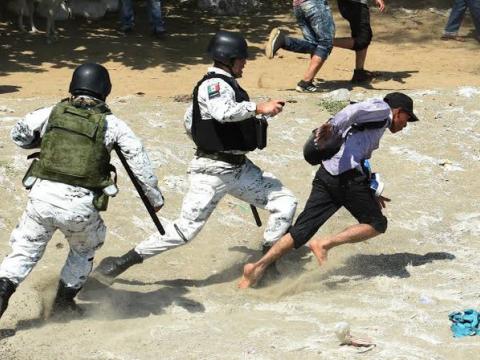
The scene has played out many times in the last few decades. A horrific event takes place—police murder yet another Black man, the state disappears migrants or political opponents, a financial crisis leaves millions without homes or jobs or both—and this time people take to the streets in protest of these immediate events and, perhaps, out of some deeper longing that the world ought not be the way that it is. Property is damaged. Police are called in. The crowd does not disperse but pushes back. Then tear gas. It stings the surface of your eyes and burns at the edges, dripping like acid down the nose and into the throat to pool in the lungs. Maybe this is your first time, maybe you were at the front of the line, maybe you just got unlucky. Regardless, you are overcome, gasping out desperate, burning breaths as your vision blurs. Suddenly, you feel arms around you and you are lifted from the heat of battle, dragged to the sidelines. Then those same arms depart, making quick motions that you can’t quite make out through the blur, rustling through something, and returning with that same gentle touch: pulling open each eye with care, dousing each with water that seems glacier cold. The moment seems almost ritualistic: an intimate baptism of the sight. Suddenly you are pulled back into the profane world. The person makes an awkward joke to ease the tension. Eventually, your vision clears enough for you to reenter the crowd, to blend into the sea of black and then into the night, free to return again tomorrow. Years later you will tell the story of that night: “The first time I met Joshua Clover he washed tear gas out of my eyes.”1
When Joshua passed away in late April, social media was filled with a cornucopia of similar stories from those lucky enough to see him in his element: at the riot, the occupation, the barricade. The flurry of places and dates invoked in these stories—Berkeley, Paris, Seattle, Davis, Mexico City, Ferguson, and Oakland, always Oakland—paint the picture of a man committed to being in the struggle wherever it arose, someone you could count on equally in the street and the quieter moments before and after. It was in the course of class conflict that his work as a teacher and poet achieved its practical truth, alive in the throes of history. Indeed, Joshua took knowledge seriously. Whether we were reading his work, arguing with him on some online forum, studying Capital together, or organizing alongside him, thinking with Joshua felt like nothing so much as being made to see clearly, the rapt vision of eyes blinking through tear gas just rinsed away. For so many young communists, this process of learning to see was our real introduction to Joshua and to the communist movement. The tools of siege are nothing if not instruments of sensory hijack. Amidst the smoke and chaos and pain of the present, he was there, not to show us the way, but to share the arts of clarity and to demonstrate how they could be wielded against the blinding powers of a social order that thrives in obscurity.
Most of the young communists emerging in the U.S. after the turn of the century found themselves unmoored from the history of the communist movement. Previous generations had learned to articulate politics through active mentorship within left-wing institutions built up through decades of struggle. Though such institutions could be stifling, they nonetheless endowed subsequent generations with the practical and theoretical proficiencies that would then allow them to distinguish their own politics from that of their predecessors, even framed as a revolt against this institutional inheritance itself and articulated as a new “revolutionary” position in contrast to the “reformist” remnants of an “old” left—even if that “old” left had, in its heyday, been new and revolutionary in contrast to its own predecessors.
After many decades of defeat, however, this generation was left with nothing but ruin. The institutions of both the old and new lefts were crushed, made historically obsolete by the shifting sands of capitalist production or ripped apart by their own sectarian decay. The brave were killed, the cowards returned to the fold as the romantics fled to the hills, and the swindlers built up their cults in the ashes. In the end, only a spare few remained, scattered and alone. Our communism was therefore not learned but salvaged. Wandering the wilderness of work, wage, and forever wars, we were left to rediscover the fragments of our own history, unearthing the rusted weapons of battles lost. And, lacking a meaningful institutional inheritance (whether “reformist” or “revolutionary”), we were forced to reinvent the basic axioms of the partisan project in our own fight against the status quo.
In these long decades of repression, at least some memory of the collective intelligence of revolutionary history was sequestered in subcultural insignia, in rank-and-file reform caucuses within the shrinking unions, and of course in the academy. Anti-communist purges across the unions, universities, and culture industries had ensured that communist thought could proliferate only at the seemingly harmless margins: in the punk subculture, the breakroom of a dying industry, or the underfunded English department, where it could be left to molder under the gnawing influence of “postmodernity.” And yet these repositories proved invaluable, preserving and even elaborating key aspects of the partisan project as much as possible in the exultant years of liberal victory once thought to be the “End of History” and which proved, in the end, to be merely an intermission.
The process was long and grueling, but new generations of partisans emerged at first slowly and then more quickly in the wake of the world-shaking crisis of 2008 which spawned, on the one hand, a minor renaissance of interest in Marx and, on the other, the sputtering struggles of the 2010s, where new waves of militants would come to see the practical limits of lofty theories tested on the ground. A rising generation of communist thinkers came to reengage with their own sequestered lineage and reappraised old texts in the light of fresh-lit fires burning across the world. In this context, figures like Joshua proved invaluable in first linking young militants to their own history (and encouraging an active, questioning engagement with it), and then linking them to one another, gathering what would otherwise have been scattered sparks.
It is difficult to exaggerate how crucial this work was in the moment. While there were other communists in art scenes, universities, and community centers, many carried with them the baggage of sectarian battles and a salient fear of repression. As a result, when sought out by young radicals, they were reticent, quietist, and sometimes outright hostile. Joshua was, in every respect, the opposite. Even in the vigor of debate, he showed a spirit of open engagement that tended to uplift all involved. At the same time, he was always willing to argue any topic down to the finest points, bluntly pointing out misunderstandings of Marx, rigorously shattering the false or oversimplified historic narratives that served as the ideological bedrock of “the left” for so many years, and always insisting that we return to the original texts, to the real complexities of revolutionary history, and to the world as it actually exists. He never used disagreement as a pretext to tear others down, nor did he accept partisan name calling as a substitute for articulating the real substance of disagreements.
Perhaps most importantly (and in distinction to many so-called Marxist academics), Joshua retained fidelity to both the popular and incendiary dimensions of the communist project. He was not only immensely skilled at interpreting popular sentiment but also demonstrated mastery in the forgotten art of translating high theory into accessible language without oversimplification. Meanwhile, whether in the classroom or a magazine column, he never quavered over the fact that the communist project is a revolutionary one and that revolutions are inherently violent affairs. In an era when many “radical” theorists were seeking out the peaceable expression of politics in “everyday utopias,” Joshua stressed that politics was always, at root, a fiery confrontation with the powers that be. To these ends, he not only helped bring together a new generation of young communists but also pushed them to engage directly with the rising tide of class conflict, understanding full well that the street and the shopfloor are the true classrooms of the partisan.
Heatwave is, in a sense, an attempt to embody this spirit at a larger scale. Like Joshua, we hope to serve as an engine of engagement, linking our readers to their own history and to one another. Like Joshua, we adopt a principle of ecumenicism, refusing the false dividing lines inherited from the long dissolution of the last global communist movement. At the same time, like Joshua, we also insist on a theoretically rigorous approach that invokes the real complexity of revolutionary theory and history, actively seeks evidence for its claims, and engages in good faith with opposing positions. And, like Joshua, we maintain that the partisan project is inherently incendiary, requiring confrontation with the rulers of the world, rather than gradualist compromise or secessionist retreat. Finally, communism requires an unambiguous commitment to internationalism. Although our project is currently anglophone, we recognize that elaborating a partisan politics requires learning from the self-activity of the dispossessed at the global scale.
For all these reasons, we work to ensure that every issue contains material from multiple countries and continents, that this work upholds a vision of revolutionary social transformation, and that it expresses an ecumenical spirit, putting diverse views into conversation with one another rather than elaborating our own editorial “line” by passing content through a sectarian sieve. We apply the same standards of rigor and accessibility that Joshua encouraged. Regardless of the argument, we ask: does this intervention make logical sense on its own? Can its analysis make sense of the real world? And, if so, could it also be explained to most people? In so doing, we hope to develop a collaborative, common language through which to express the partisan project: a vernacular for contemporary communist thought. This is perhaps the simplest summary of our editorial mission.
In this second issue, we bring together perspectives from Serbia, Jamaica, India, France, Iran, Chile, the United States, Palestine, Japan, and the Thailand / Myanmar border. The articles range widely in scope and subject matter, from longer explorations of the conditions surrounding contemporary struggles to reflections on historical movements and their legacies to accounts of the daily work of survival, organizing, and community defense. Many are works in translation, a practice we consider integral to our internationalist ethos, as it allows us to make global perspectives available to an anglophone audience and break through the siloed analysis that often prevails in the U.S., which is so habituated to seeing itself as the center and entirety of the world.
While many of the pieces in this issue think through the conditions in a particular place, others rove over issues of greater breadth. J. Caurine’s theoretical exploration of communism as a form of ecological partisanship will satisfy those looking for more sweeping analysis, while readers interested in larger movement dynamics will find an evaluation of the pressure campaign’s revitalization as a popular strategy. On the cultural front, this issue features poetry as well as multiple essays exploring popular culture, including meditations on country music, pop albums, and the porous boundaries between genres.
The pieces herein are not intended to be read in isolation, but rather shared and discussed. Taking inspiration from the case of the workers’ newspaper Abeng, explored in the contribution from Saul Molcho, we hope that you will take this issue to your comrades, that you will debate and argue and get caught up in the minutiae, as Joshua would have. We hope that you will test the validity of any conclusions in practice, in daily life and in the streets. And we hope that you will bring back your findings to us, so that we can all refine our understanding together.
“I cannot imagine what it must be like to be making one’s way through the current chaos with the knowledge that you will have to navigate its causes and its effects for a sustained time and figure out how to survive and how to act in the world. But it must be some amount of terrifying alongside the infuriating and obscene. I am very much hoping you can find a way to make it and not go mad, and will try to help as best I can.” This message from Joshua, sent to a younger comrade in despair, demonstrates a comradely tenderness, but pulls no punches. Desperation holds primacy. As the world grows ever darker, as the rubble of today’s catastrophes pile atop the last, we do not feign hope or deny the terrors and obscenities that face us. Navigating this chaos often feels impossible, and every departed comrade only adds to the burden. Lost in a dark forest, it often appears that our only guide is the very process of analysis itself, of trying to understand the terrain, and finding our bearings in the long night. In this task we have Joshua’s example, and the example of so many communists who came before us. And we have each other, the connections that Joshua and others helped to forge, those we continue to make for ourselves through correspondence, and those that only exist in brief moments of recognition at a distance, glances through clouds of tear gas. Maybe Joshua put it best: in the end, “it comes down / to comrades known and elsewhere.”




Comments