Joe Jacobs reflects on his life in early 1936, including the intersection of local struggles and global events in a tense pre-war climate. The chapter includes Jacobs' comrades setting off to fight in the Spanish Civil war as well as his own growing scepticism about the USSR.

So far as I was concerned in the beginning of 1936, despite the war going on in Abysinnia, the growing severity of Hitler’s persecution of the Jews and what was left of the political opposition from the CP and others and the still large unemployment here at home, things seemed a bit quiet. Maurice Dobb lectured at the Circle House, on the Economy of Communism (1). Reports from the Soviet Union spoke of cheaper food, tumbling prices—the road to prosperity. John Strachey wrote in the Daily Worker about the prospects for the revolutionary movement being better (2). Torgler, co-defendant of Dimitrov in the Reichstag Fire trial was expelled from the German CP for his conduct at that trial. Tanev and Popov were criticised for theirs and accepted the criticism. Dimitrov was praised to the high heavens and had become the secretary of the CI (3). There was still some lingering references to the ILD in connection with the Scottsboro case in the USA. This ceased altogether soon after.
After a big protest, Mosley was refused permission to hire the Birmingham Town Hall (4). Our people were making steady progress in penetrating the NUTGWU local branch. John Mahon of the London District Committee, CP, was giving a lecture at the Union’s premises at 48, New Road (5). Our recently formed branch of the Shop Assistants Union was engaged in strike action with two local wholesale stores: Goldman of Houndsditch and Rintzlers of Whitechapel High Street (6). The Young Communists were engaged in a lot of social activity alongside their vigorous anti-Fascist work on the streets.
John Strachey thought it important to raise the question of the Stakhanov movement in Russia, as a topic for further discussion. He reported some doubts on the matter and invited correspondence to his column in the Daily Worker (7). Several important people died within days of each other.
Our old comrade Saklatvala, Kipling and George V (8). The press reflected on the tense feelings and political uncertainty. Shop stewards from fifty clothing factories subscribed to a protest resolution regarding the continuing imprisonment of Thaelmann in Germany. They sent a deputation to the German Embassy (9). Lenin had been dead for twelve years and W. Gallacher, MP, wrote about him in the Daily Worker (10). In Spain, the right wing army leaders were openly inciting to mutiny against the growth of liberal and leftwing tendencies in the government. The ‘People’s Front’ was getting very strong (11). We had a new king, Edward VIII. The French government crisis led to the resignation of the Laval cabinet. Critical moves were being planned on the eve of a new General Election (12). Mosley’s thugs raided the Daily Worker offices, overturning cars and causing extensive damage (13). A picture of the Moscow leaders of the Party appeared in the Daily Worker which included Kruschev, its secretary (14). Ihad never heard of him.
Strachey was still going on about Stakhanov (15). George V’s funeral was attended by General Franco from Spain (16), among the representatives of foreign governments and others. I hadn’t heard of him either. Three years of Hitler’s rule in Germany had transformed the political situation in Germany and was having a growing impact on events in Europe and the world in general. All these events were keeping us very busy and were linked to local issues like the shop assistants’ strike, which we supported by demonstrations supported by the Stepney Trades Council (17). All good ‘United Front’ action.
At the district level it was thought necessary to organise a meeting to explain still more how Stakhanovism works. The Essex Hall was well attended to hear Andrew Rothstein explain ‘how it works’. I was still not happy about this movement and resented any tendency to intensify labour in this way. I could not reconcile this with my idea of Socialist production methods, as I understood them. But I was persuaded that this was necessary to overcome the backwardness of Russia and for rapid industrialisation to meet the growing menace from Germany and other hostile forces. Strachey told us about the degree of recovery of the economy since 1929. Certainly things had improved slightly and it was easier to find work. Although there were still over two million unemployed (18).
The workers at Smithfield meat market were on strike. They had just been joined by other meat market workers from Islington and Aldgate. All these were supported by dockers and transport workers. We organised demonstrations to the docks, calling for more support for the Smithfield strikers (19). Our shop assistant strikers, after five weeks, agreed to a compromise settlement at Goldmans, involving a piecemeal return to work. The strike at Rintzlers continued (20).
This was all being discussed locally in the CP and the arguments kept revealing old differences concerning Trade Union activity and how it should be conducted. Attacks on those who spent most of their time on ‘street work’ continued. A party aggregate meeting was held at Circle House on Thursday, February 6th (21). This meant cancelling all cell and other meetings. These inner Party meetings were occasions for dealing with immediate organisational tasks and reviewing the application of policies covering many areas of activity.
They were more and more becoining the battle-ground for opposing points of view. None of this came out into the open. I speak about Stepney at this time. I had no idea whether this sort of thing was going on elsewhere. Our conferences and district meetings did not reflect this. Occasionally, people were criticised in the party organs, or some tendency was referred to as being dangerous or good. On the whole, I only found out if anything had been going on when, as in the case of J.T.Murphy, someone had been found ‘guilty’, before we even knew there had been a serious ‘difference of opinion’.
I was frequently being attacked at internal meetings by Sarah Wesker, ‘Chick’ and Morrie Segal, Ruby Silkoff and more recently by Phil Piratin, Alf Finklestein and others. Always it was about my alleged neglect of Trade Union activity and against my emphasis on so-called street work. Language was getting stronger and I was often called a ‘Leftist’. Lenin’s ‘Left Wing Communism’, was referred to for authority. This was particularly important because I also criticised my Trade Union comrades, for what they regarded as Trade Union work. I regarded this as nothing more than trying to capture the Trade Union organisation by using the rule book etc. in an endeavour to outmanoeuvre the right wing Labourites in control. This was particularly true in their attitude to compromise settlement of disputes, strikes and other issues, in which they were unable to distinguish themselves as members of branch or district committees, from the right wing Social Democrats serving on these same committees.
Always, and as the years passed, more and more the positions these people captured in the Unions were held to be more important and sacred than the outcome of this or that particular struggle. In the clothing industry in London, these people became identified with many defeats. No amount of explaining that they were Communists who had to work in the reformist organisations and could not risk losing their positions, would satisfy the workers. I, and I know many others, had to spend a great deal of time trying to defend these fellow Party members against the criticism of workers who felt they had been betrayed and could not differentiate between Trade Union officials who called themselves Communists and those who were Labour. My position as secretary of the Stepney CP was secure at this time because Mosley was becoming increasingly active and anti-semitic. Whether we liked it or not, other people were taking to the streets in opposition. We could not do anything but try to head this opposition in the direction we thought it should go. That’s the job of a vanguard.
So, I had a majority for continuing our maximum effort in fighting Mosley on the streets, which is where the battle was taking place in East London. My own complaints against my critics were not confined to their kind of Trade Union work or their failure to oppose Mosley as I saw fit. They | seemed to be satisfied with getting left resolutions passed through this or that internal TU or Labour organisation. Often I felt that these were good, but simply pious statements if they did not lead to concrete action in the factories and on the ‘streets. The ‘TU faction’ found great satisfaction in getting such resolutions passed, only to find that the right wing usually prevented these resolution§ from leading to anything. This left the position open for the ‘Communists’ to expose these ‘traitors’ and excuse themselves in the process. This also made it possible to argue that they were not as effective as they might be if all the Party members did this kind of work too.
My conclusion was that they saw the tasks of the CP in building the ‘united front’, as simply being a case of capturing the Trade Unions. This, they thought, would lead to CP leadership of the Unions, which in turn, would lead to electoral and similar success and eventually, to the overthrow of the capitalist system. What was happening in Germany, to say nothing of the whole history of the working class movement, didn’t seem to register with these people. As Piratin had said, ‘Branch meetings were verbal battlefields’(22).
The Jubilee Street cell headed by Nat Cohen, Sam Masters and all my old comrades and friends continued to be a good unit and conducted a steady stream of agit-prop and social activity. They organised a very successful film and variety show at the ‘Circle House’, making use of sympathetic people from among the most unlikely sources. I have in mind people like Harry Rabin and Al Lipman, popular local wrestlers who attended this function (23). A mass meeting of the Smithfield strikers was held at the Pavilion Theatre, Whitechapel, where a vote for the return to work was taken (24). I can’t remember the details, but it was not a complete victory. Trade Union organisation did improve in London’s wholesale markets. They were a source of strength to the movement, because of their shop-floor organisation based on local shop stewards’ committees. In the same way the dockers with even greater success, were showing one aspect of Trade Union work, which I regarded as much more important than simply getting elected to committees in the internal structure of the Union organisation itself. Many years later, I was not the first to attempt this sort of thing in the tailoring industry, with quite different results.
In France the government were ratifying their non-aggression pact, with the Soviet Union. Czechoslovakia already had such a pact with the Soviet Union (25). R.F.Andrews, in the Daily Worker, was praising the opening of a ‘Stakhanov Year’, in the Soviet Union. ‘It’s the figures that tell!’ he wrote (26). The general elections in Spain were due to take place in a few days’ time. We in Stepney embarked on our most ambitious plan for a ‘Week of Peace and Democracy’. Starting Monday 17th February, at the St George’s library. We had arranged for the Cambridge Exhibition for Peace and Democracy to be displayed. This was opened by Her Worship, the Mayor of
Stepney, Councilor Helena Roberts, JP. There were to be public meetings and conferences as well as social activities of all kinds. This was supported by our local MP for Whitechapel and St George’s, J.H.Hall. Clement Attlee, MP for Limehouse, promised to attend, parliamentary duties permitting (27).
At the main meeting in the St George’s town hall on the 20th, we had the support of the Rev Percy Ineson, the Rev John Groser, in addition to our local political leaders of the Labour and left wing organisations, including many Trade Unions (28).
We held a grand variety show with much local talent, including the ‘Four Chassidem’. Throughout the week, we held nightly sessions of our local congress. We had established the ‘Stepney Peace Group’, with headquarters at 66, High Street, Shadwell, E1 (29). When Councilor Helena Roberts opened the exhibition, she said, ‘I did not consider who had sent the invitation, at least here are some people prepared to do something. I’m tired of speeches only’ (30). This was a clear reference to the fact that she, along with other Labour people, were in fact working with Communists and being prepared to do so in the face of the threat to peace and democracy. For us this was the ‘United Front’ in action. Good old Mary Hughes, wearing a bright red cloak, stood outside shouting, ‘Peace exhibition upstairs—don’t miss it’. This was Mary’s thirty-sixth year of hard work in Stepney. She was now in her seventies. Mary didn’t like any publicity which sought to praise her work. She had to be persuaded, after long argument, before she would agree to be photographed by the press. As she said, ‘Oh well, if it’s publicity for the cause of peace I will allow it’ (31). At one of the main meetings, we had speakers from the Cambridge Anti-war Committee, the Mayor of Stepney, Isobel
Brown and John Strachey. Strachey dealt with the Soviet peace policy. There were lectures too. One was given by Professor J.D.Bernal, on Science and War. School children visited the exhibition. Even many local ‘Blackshirts’ and some supporters came. They behaved themselves and many were genuinely interested, but would not comment. We received messages of support from The Bishop of Stepney, Mr Attlee and George Lansbury (32). At the final meeting supported by so many organisations, there were speeches and messages from all over the area. A resolution was agreed and our views were expressed in a document which we addressed to the Italian, Japanese and German embassies (33). This was a great week and I can’t tell you all that went into getting the work done. The CP and Young Communist League members didn’t get much rest during its preparation and while it lasted. I felt we had done a good job in making direct contact in a concrete way, with so many people who had always regarded us Communists with great suspicion if not hostility. This was the real ‘United Front’.
Over 2,500 people visited the exhibition. We agreed to have a re-call conference in a month’s time. A representative ‘Peace Council’ was formed to continue the work on a day-to-day basis (34). All our expenses had been met out of delegates’ fees. All the meetings and lectures as well as social functions were well attended. We had met all our financial commitments. This was one of those rare occasions when we did not finish a campaign, wondering where to get the money to pay for printing, hiring halls, etc. This time I did not have to appeal to Party members to dig deep into their pockets to get us out of a tight corner.
At this time Ernest Thurtle, MP for Shoreditch, raised the question of Fascist violence, particularly attacks on local Jewish shop-keepers. The Home Secretary promised to have the matter investigated (35). In the Spanish general elections, there were armed Fascist terror tactics at work. In France, Leon Blum had been physically assaulted by Fascists. This provoked a mass demonstration which brought 300,000 people onto the streets. Athousand signatures were collected in Shoreditch among tradesmen, calling for some protection against Fascist violence. Ernest Thurtle presented this to the Home Secretary (36). ‘Kill the Jews’ was a slogan directed at all Jews, including trades people, and was seen chalked on walls etc. in many places in East London. Thurtle was threatened he would be dealt with ‘by fair means or foul’. We had to fight the London County Council policy of allowing Mosley to hire their schools and premises for meetings.
I remember a meeting at the ‘Circle House’ to elect a clothing worker delegate to some event to be held in the Soviet Union. This had the support of Bernard Sullivan of the NUTGW. Dr E. Summerskill was a speaker and the meeting was also supported with messages from George Lansbury and Lady Marley (37). Dr E. Summerskill was one among many who entered the leftward trend in the Labour Party via support for activities which were generally referred to by the right-wing as ‘fellow travelling’ So many came to the East End at various times, I felt that some of them used our area to sharpen their teeth for future efforts to improve their political career prospects. Small wage gains and slightly better unempioyment benefits were being eroded by increases in food prices (38). In the clothing industry, this was partly met by slightly longer busy periods with their accompanying opportunity for more overtime.
Mosley was meeting more opposition in places like Oxford where organised opposition succeeded in getting permission to use the Town Hall withdrawn (39).We had begun to make progress in local organisations like the Blakesley Athletic Group, part of an evening institute, held on school premises. A ‘Daily Worker Supporters’ League had been formed, and this group became a unit of the league (40). From Paris to Madrid we recorded a “people’s” victory! The “People’s Front” had registered big victories. The fight against Fascism and war preparations was growing (41).
Nine thousand clothing workers at Burton’s of Leeds had gone on strike against new piece work systems, resulting in reduced earnings. This was unofficial and was opposed by the Executive Board of the National union. The strikers’ demands included fitters’ rates to be increased by sixpence per garment, recognition of the central factory committee and no victimisation.
They appealed for help (42). We immediately called a meeting of all Party members in clothing in London. We used every means to get support in the unions for the Burton strike. We collected money in the factories and workshops to help the strikers. We invited a large delegation of strikers to come to London to head a campaign for recognition by the Union and for general supporting activity. This meant we would have to see that these people would be looked after and accommodated (43). Poor old Sam Berks still recalls how Nat Cohen kept him out all night walking to keep warm, so that two of the Burton strikers could sleep in their beds. That’s how things were done.
Nat in particular, was a great one for getting people to make sacrifices in which he was always the one to set an example. You could not resist doing whatever he asked, when the issue was calling for an obvious need to sacrifice or even to stick your neck out. If he wanted you to go forward when most people were going in the opposite direction, say in a police charge, it was because he would be in front. His presence was a signal for me to stop worrying about whether I was doing the right thing. I could consult him and feel sure he would know exactly what to do. This applied to my intervention in discussions at internal Party meetings, as much as to actions on the streets.
He wasn’t always present and I had been through nearly a whole year when he was away in the Soviet Union. I was soon to lose his company once again.
We held poster parades in support of the Burton strikers, and while their representatives were with us, we engaged in factory gate meetings, distribution of printed matter and fundraising (44). All this is hard, detailed effort which had to be done before and after a normal day’s work in the workshop.
Harold Cohen made one of his big efforts on this occasion and spoke at factory gate meetings all over the place. Sam told me that after a particular meeting outside Glanfields in Brick Lane, the Burton strikers embraced Harold in a way that Sam had not seen from workers anywhere in this country. They put their arms round him and hugged him, without any attempt to conceal their emotions.
My mother did not see much of me during those days and for many months to come. I was so busy I didn’t know what was happening to my family. Pearl, of course, was as heavily engaged in all this as I myself. We nearly always managed to end the day in each other’s company. I did not get to bed before two a.m. most nights. Pearl had told me about a period when she was a child, spent at a place in the country. It appears she had been a victim of a mild form of rheumatic fever called corea. I did not realise at the time that this was likely to leave her with a heart condition. She did in fact have such a condition which I came to know by the name of mitral stenosis.
She did not say a great deal about this, except to assure me she had made a hundred per cent recovery. Judging from the energy and effort of the first five or six years before we were married, I had no reason to think otherwise.
This did not prove to be the case and I know now that this period of her life must have contributed to her later suffering from this weakness of her heart, which was to prove so disastrous. She never complained and was outwardly as able as the next one to endure this period of intense activity.
I knew many people who were sick or disabled in some way or other, who did not spare themselves when helping the struggle against Fascism and war. In any case, general conditions, including long periods of unemployment, did not do sick people any good. They were forced to do work beyond their capacity in order to feed their families. It was very much a case of the survival of the fittest. Some used to say that hard work was good for you. Some still do. Looking at people who had managed to reach middle age, I thought it obvious that most of them bore the marks of excessive work. Especially the women, who somehow managed to outlive their menfolk.
In addition to Ernest Thurtle, Herbert Morrison was also moved to raise the question of Jew-baiting in Shoreditch and Hackney with the Home Secretary (45). Stafford Cripps was very active in the movement and was speaking at meetings alongside CP and other people including J.T. Murphy who was still active after his expulsion from the CP (46).
We began to organise opposition to Mosley, who was due to speak yet again, this time at the Albert Hall on 22nd March. September 9th, 1934, was recalled as an example to follow (47). Opposition to Mosley’s Albert Hall meeting had the support of Virginia and Leonard Woolf, Rebecca West, Will Thorne MP and Ted Hill, among others (48). Hitler’s forces had crossed the Rhine. War clouds were gathering. There were still over two million unemployed.
Eight large clothing factories in Leeds came out on strike in sympathy with Burtons. Official TU support was still witheld. After three weeks the Burton workers agreed to an ‘organised return to work’ (49). This sort of return usually meant that the workers had not managed to get what they wanted. I can remember on many occasions when Trade Union leaders were advocating a retreat and advising workers to give up the fight, that they would resort to this kind of official statement. They still do. On such occasions, what follows depends on whether or not the rank and file leaders in the factories are able to maintain their influence. If not, they are for the ‘chopping block’. Many workers who have been active in disputes have been victimised by the employers who could not get away with it, without the help of official Trade Union leaders. Very often it is these leaders who are more active in demanding the heads of such militants than the employers themselves.
An important announcement heralded the formation of “The Left Book Club’. This turned out to be a big thing for us (50). The Daily Worker was still explaining Stakhanovism. One headline read, ‘Speed up? Wage robbery? No! (51)’. I could not make myself believe all that was said about this. I felt unable to oppose what was said effectively. I didn’t think it so important. I might be able to understand better as it worked out in practice. I trusted Stalin and the leaders in the Soviet Union. Richard Goodman wrote an article in the Daily Worker, under the headline, ‘The Yellow Spot’ (52). This was an indictment of Hitler’s policies regarding the Jews, which accurately foresaw the extermination policy which followed. I don’t think many people thought such a policy could or would be carried out. Certainly not at that time. Although anyone listening to Streicher or reading Die Sturmer, might have wondered if such ravings could result in governmental action on the scale of the extermination camps.
The East End was covered with white-washed slogans calling for a huge turn-out against Mosley on the twenty-second, at the Albert Hall. More people were becoming involved in this activity. The Daily Worker did all in its power to link the events in Germany with Mosley’s efforts. The treatment of the Jews in Germany.and the BUF’S growing violence in the East End left the Jews with no alternative but to resist. Still there were those who called for no action. Stay at home. Leave it to the authorities. Trust in the Lord. The 22nd March came and the Albert Hall was surrounded by a strong force of police.
No individual could get anywhere near the hall without a ticket. It was becoming more obvious that Mosley could not have held meetings at all without strong police protection. The nearest convenient place for us to rally was in Hyde Park. From the beginning, the police were anxious to break up any large concentration of anti-Fascists. This led to running clashes whenever crowds gathered. The crowds left the park and blocked the roads leading to the Albert Hall. Traffic was stopped. Streets were cut off. There was a baton charge outside South Kensington underground station, some distance from the hall. The hall was only three-quarters full when Mosley began his speech, some fifteen minutes late. Despite all the efforts of the police and Mosley’s own forces, many opponents managed to get into the meeting and from the beginning, interruptors were being ejected with the usual violence from the stewards.
A counter demonstration assembled in Alfred Place, despite all the police efforts to keep the crowds on the move. This meeting was addressed by John Strachey, Maurice Orbach and Bob McLenan. Eventually the police drew their batons and charged the demonstration with more than usual violence. Maurice Orbach was among those arrested (53). There were many arrests followed by the usual court proceedings the next day. Some were remanded, others fined on the spot. These proceedings enabled us to continue spotlighting police participation in Mosley activity, which was obviously planned and carried out with full co-operation and growing enthusiasm (54).
The BUF would have been unable to exist at all without police protection which the government and others supported, in the name of ‘free speech’. That Hitler, with Mosley’s open support was making ‘free speech’ impossible, made no difference to these supporters of ‘democratic rights’. We had every right to draw the conclusion that these people who took this line, were in favour of ending free speech and democratic rights, because the growth of working class opposition to unemployment and low wages was threatening profits and eventually, the whole capitalist system.
Questions to the Home Secretary revealed that no less than 2,500 police plus 400 in reserve, were used to protect Mosley on 22nd March (55). A letter to the Daily Worker signed by R. Goodhall, headed, “Are the Jews doing their bit’, protested that the Jewish people did not attend in sufficient numbers to oppose the BUF (56).
Reports from Spain told of workers taking control of factories and other enterprises, like tramways, etc (57). The peasants in Badajoz had taken over the large estates in the whole province. The Red Flag was flying everywhere. There was joint action of workers and peasants regardless of political affiliations.
It was said that the elections had brought the opportunity for proletarian revolution nearer. ‘Ve were very much encouraged by the reports from Spain (58). Our aggregate meeting of the Stepney branch reflected all this in our reports, as we sought to help and link these events with the events and issues facing us at home. One of the issues at this time concerned a government White Paper relating to the forthcoming budget.
To understand something about the state of the economy at this time, I need only tell you that the railwaymen were seeking an increase in pay to restore cuts, described as ‘temporary’, five years before. These cuts ranged from two shillings and fivepence, to five shillings and sevenpence per week.
The employers were now offering threepence in the pound on these miserable rates of pay—forty-seven thousands earning two pounds per week, seventythree thousands between two pounds and two pounds, ten shillings. The increases proposed would be of the princely sum of one shilling and three halfpence.
In short, 114% on these pay scales. The profits recorded by the companies were six million pounds higher in 1935 than in 1932 (59).
While Hitler was seeking allies on the basis of his avowed opposition to Bolshevism, the French Popular Front demonstrated in Paris. Eighty thousand people marched for Peace and against Fascism. May Day was not far off and we began to prepare for what looked like a very important May Day, in the light of all that was happening. Cases arising from the Albert Hall meeting were still before the courts. Maurice Orbach had been bound over to keep the peace against the sum of five pounds. Sir John Simon, the Home Secretary, rejected a demand for an enquiry into the police violence on that occasion (60). Mussolini was still fighting to subdue the Abyssinians. The League of Nations was not being very effective in its efforts at restraining him. Some little time earlier I remember attending the opening of the ‘Unity Theatre’ in a disused factory off Grays Inn Road. Dr E. Summerskill was there and I heard her praising Aneurin Bevan’s work in the Labour movement.
I waded in with my usual, rather aggressive attitude. I regarded all social democrats as harmful, and even more, the so-called left-wingers. I don’t think Dr Summerskill thought much of my intervention. She would be likely to consider me a very rude person. I was very arrogant and dogmatic when arguing with some of my opponents. I must have made a few enemies because of my manner. On reflection, I think I was not alone among Communists, with this kind of attitude. The ‘Unity Theatre’ became firmly established and arose directly from the Workers’ Theatre Movement (61), which included many of my old friends. The ‘Unity Theatre’ still exists after all this time, when so many other theatre groups have come and gone. Among those who played there, was Paul Robeson who did so much to further our work whenever he visited London.
Tom Mann was eighty years oid (62). This event was celebrated and used to further our cause as are the birthdays of kings and presidents to further theirs. Tom’s record was an example for all to follow and we never stopped drawing attention to his steadfastness. One of a few who had not been ‘bought’ by our enemies. One other such character was J.H. Thomas, who was shortly to be involved in a big scandal concerning the alleged leakage of budget secrets.
In Stepney, we were holding more open branch meetings in order to bring in people from the Trade Unions and Labour Party and others, for more discussion of our full programme, including our objective, Social Revolution (63). The French Communist Party was growing fast. The ‘left’ was moving more to the left. There was alarm at the growing Bolshevisation of Spain. We felt ourselves to be part of this process, but well behind our French and Spanish comrades. Despite some success in bringing in a few Labour people to join in meetings etc. on this or that issue, we were a long way from a Popular Front movement as in France and Spain. The Daily Worker praised Stepney for its results in selling the paper and topping the ‘Daily Worker League’ (64).
As May Day approached and the agreed route was made public, we continued to hold meetings with local Labour and CP speakers appearing on the same platforms.
The budget emphasised the government’s war preparations with no relief for the unemployed or other workers (65). Sportsmen of every kind were beginning to focus attention on the proposed Olympic Games, to be held in Berlin. There was a great deal of opposition to this event being held in Berlin.
The French general election was due in a few days’ time. Everyone was forecasting a big defeat for the right wing forces. Hitler was moving troops up to the Austrian frontiers. The situation was becoming more serious with every passing day.
May Day arrived. Our main slogan was, ‘Unity and Peace’. Mosley had decided to hold a rally on May 1st at Victoria Park Square, Bethnal Green. We decided to call on everyone to oppose him by counter demonstrating after our return from Hyde Park (66). Millions marched all over the world on May Day. The Spanish workers declared a general strike in Madrid (67). About three thousand turned out to oppose Mosley at Victoria Park Square when he appeared on top of a loud speaker van, surrounded by four to five hundred Fascists in uniform (68). There was a constant barrage of cat-calls and slogan shouting, interruptions of all kinds. Fights were breaking out all round the meeting wherever Fascists and anti-Fascists made physical contact, despite police efforts to keep us apart. They spent most of their time trying to pick off anyone who was making a noise or moving towards the ring of Blackshirts round the van. We were becoming used to this sort of thing and learning how to keep the opposition going while not allowing too many of our people to get arrested or beaten up. I still felt that this side of our work was not given sufficient attention. Although it was obvious that the real answer, so far as confrontation on the streets was concerned, lay in getting really large numbers of people to turn out whenever Blackshirts decided to hold meetings. There was still the problem of Fascist assaults on individuals and small groups engaged in political activities as well as violence directed towards Jews in general.
The Emperor of Abyssinia decided to leave Addis Ababa. Mussolini was gaining ground. The Fasc:st forces in Spain were preparing to turn the tide.
Arms stores were found hidden in churches among other places. We were not alone in East London, when it came to meeting the threat of Fascism. By way of contrast, two people I knew, A. Holland and I. Rennap, wrote an article in the Daily Worker, which declared ‘USSR solves the Jewish “problem” ’ (69). This was a reference to Birobidjan, the ‘autonomous’ Jewish ‘Socialist Region’. They and others really believed this.
The Left Book Club was well under way and Harry Pollitt called on the Party to give it every support. He also concluded a series of articles headed ‘A crusade for peace’ (70). Leon Blum was to become head of the new French government. The French CP with seventy-two members in the parliament, decided not to join in the government by accepting ministerial posts (71). In Spain there was a cabinet crisis in the new proposed Republican Popular Front government. The new government was not yet formed (72). We had been reading about alleged leakage of budget secrets, in which J.H. Thomas and his son, along with some well-known gentlemen in the city, were said to have made quite a lot of money. The government set up an enquiry tribunal which promised to be very interesting. We had no illusions about our so-called betters. So we looked forward to the reports coming from this tribunal, which would prove what we had always said about them (73).
I was now twenty-three. I was having to find some time to visit my sister Annie who was very ill in hospital. My mother was very distressed at this time and for a short time I had to pay a little attention to her. This period didn’t last very long as Annie did not live much longer. Mum had to accept the position and learn to live with what had happened. Debbie took charge of Annie’s young daughter and we did not see Annie’s husband, who disappeared soon after her death. My brother Hymie was still not around very often, but it was not long before I was to hear from him.
Annie’s husband, who disappeared soon after her death. My brother Hymie was still not around very often, but it was not long before I was to hear from him.
Pearl and I were beginning to think about the summer holiday and the possibility of getting a break from work and all our other troubles. Many of our friends were also hoping for a short relief from the hard grind of our daily lives. We could not plan too far ahead and there was still a couple of months to go. Much could happen to alter such plans. The Amateur Athletic Association met to discuss their attitude to the forthcoming Berlin Olympics. The British Workers’ Sports Association, whose president was Sir Stafford Cripps, passed a motion not to participate (74).
The national press had been reporting the proceedings of the budget leakage tribunal, which turned the spotlight on the way of life of J.H. Thomas and his friends. The enquiry ended and its findings were anticipated, but as yet not reported. Our local new branch of the Shop Assistants’ Union won a cup and shield in the same year, for the best recruitment to the Union.
They celebrated with a meeting at the Shoreditch Town Hall (75). The chairman of this branch was Ruby Silkoff, a member of the CP, one of those in disagreement with me over the application of policy. Ex-Communist MP Phil Piratin, tells us in his book that Ruby was still the chairman in 1948, but I notice his name was now Ruben Silk (76). Two other people were becoming better known in the clothing fraction of the Party, Mick Mindel and Hymie Kanter. These two, with Sarah Wesker and some important allies, inside and outside the CP, were to lead the ladies’ clothing workers union in London for many years to come. I was to meet them head on many times. My worst fears were to be substantiated.
A man called Sheffner, leader of the Polish Bund, came to the ‘Circle House’ to lecture on the situation in Poland. Since a large proportion of Jewish immigrants were Polish, many with a knowledge of the Polish workers’ movement, there was some interest in this visit. I can’t remember anything specific about the lecture on the Polish situation, but I would think that the immigrants who played such a big part in East London’s politics through the ‘Workers’ Circle’ in particular, were influenced through their earlier connections with the Bund.
J.H. Thomas resigned from the Cabinet. Mr Baldwin refered to ‘My dear Jim’ in the official correspondence (77). He was determined to protect him and his other friends by delaying the publication of the Enquiry Report.
Arthur Horner, a well known Communist, was elected President of the South Wales Miners Federation (78). The CP made much of this success. My opponents in Stepney also used this to show what could be done by persistent work in the trade unions. I got the impression that they rather felt that if only we had a few more Arthur Horners, then the revolution would be just round the corner. While welcoming any improved influence in the unions, I became even more convinced that this aspect of our work would be exaggerated to the point where it would take over from what I then considered was the real practice of the CP as the Vanguard of the Proletarian revolution.
Our Stepney party aggregate meetings were becoming more distinctly of two kinds: tho open ones, where our sympathisers could be invited, and closed ones, where we argued and made plans.
A Daily Worker report, 26.5.’36, had this headline: ‘Real facts of rumoured Soviet approach to Mussolini’. Among other attempts to explain matters, I quote the following paragraphs which indicate possible trends in future Soviet foreign policies.
‘...The fact that the British government has been able to sabotage any effective action against Mussolini is the result of the weakness of the working-class and peace forces. At the same time the Soviet Union, not losing its sense of proportion and never failing to realise that the greatest danger of all today is the menace of Nazi Germany, has warned the world’s peace forces against failing to see the greatest danger to peace by an unbalanced preoccupation with a smaller one. (Emphasis in original).
And now what about these latest canards which seek to bring the Soviet policy into question? With Italy, as with Germany and almost every other capitalist State, the Soviet Union has the ordinary diplomatic and trading relations.
But the present talk of a rapprochement with Italy is as mendacious and fantastic as all previous journalistic efforts to ‘foreshadow’ alliances with Hitler.
The anti-Soviet campaign in Italy (assisted by the Pope, of course) is almost as fierce, even if not quite as monotonously sustained, as the anti-Soviet reg ulm of the Nazis.’ (79).
Big ‘stay-in’ strikes were leading to the occupation of factories in France.
The workers’ demands were being met as a direct result of these actions (80). Both France and Spain decided to boycott the Olympic games in Berlin. Their sportsmen and women decided to support the Barcelona Olympiad due to be held in July. The Soviet Union also decided to send a team (81). After a long delay, the Budget Tribunal findings were made public. J.H. Thomas was guilty. . information had been used for private gain’. As if this was anything new. The Opposition called for the resignation of the Baldwin government.
Also, the prosecution of those declared guilty by the tribunal (82). The Emperor of Abyssinia was due to arrive in England. Mussolini had made still more progress. Fascist aggression was being encouraged wherever it existed (83).
East London Anti-Fascists decided to organise a demonstration in Victoria Park on June 7th at 5p.m. (84). The timing is rather important, in view of what was to happen at a later date. The reason for this timing was that this day happened to coincide with the National Youth Day rally to Trafalgar Square, due to be held earlier that day. Mosley was to hold his own rally, and we had to decide how to keep the plan for Trafalgar Square and deal with the situation in East London. So we were expected to support the Youth Day Rally, and then come back to Bethnal Green, where we planned to march through the area to Victoria Park.
I was not too happy about this plan, but the Mosley effort on this occasion was a relatively local affair and I could not argue successfully for a cancellation of the Youth Rally in favour of an all-out concentration in Bethnal Green. So the compromise plan was to keep me busy for many hours that day.
* * * * *
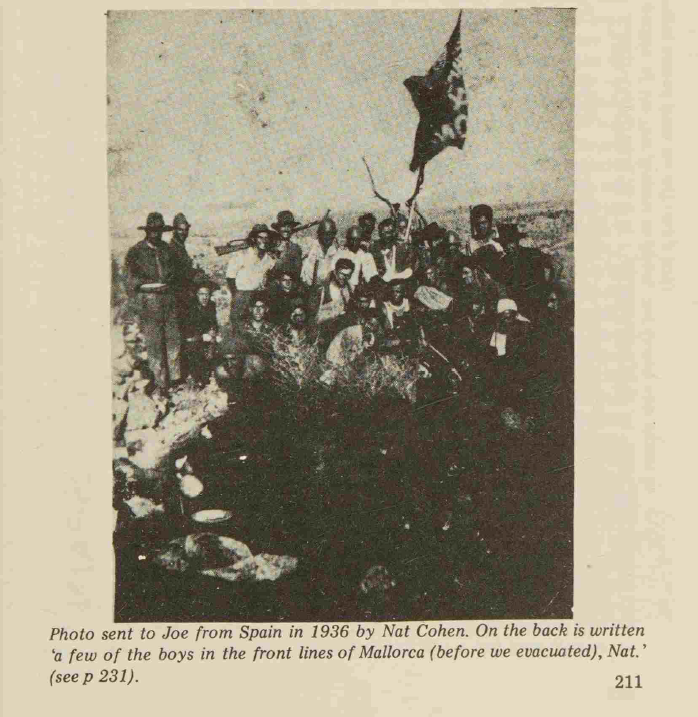
July 22-25, the date set for the Barcelona Olympiad, was to play a part in changing the history of the world, in which, unknown to us at the time, we shared in an important role in the sequence of events. Nat Cohen, Sam Masters and Alec Sheller were discussing the idea of spending their summer holiday on a cycling tour through France. Pearl and I were thinking of going to Antwerp for a few days to enjoy the company of old friends who had given us such a good time the previous year. I suggested to Nat that they could time things so that on their return journey through France, they could join us in Antwerp. The date of the Olympiad gave us a good time-table for planning our holiday. Pearl and I would not be free before the first week in August. Nat, Sam and Alec could cycle through France, attend the Olympiad and cycle back in time to meet us. We were thinking that they could leave Barcelona on the 25th or 26th July and meet us during the first week in August. This was not to work out this way. Pearl and I nevet went to Antwerp and Nat, Sam and Alec never cycled back from their visit to Spain.
We had been holding a series of meetings throughout the area, to whip up support for our Victoria Park demonstration. The BUF, not to be outdone, decided to break into territory which they knew would bring trouble. They arrived with a van, something like a big, closed troop carrier with loudspeaker equipment, at the corner of Dellow Street and Cable Street (85). The spot selected formed one of the points where the gentiles of dockland lived side by side with many Jewish people in Stepney. Despite the surprise tactic employed, the local people soon began to show their opposition and it was not long before we got to know the meeting was being held. When I arrived, among many others, from other parts of Stepney, I saw a big fellow climbing up the side of the van, being hit by the Fascists on top. He was giving as much as he was getting. His courage was great and his ability was even greater. A second look, and I could see it was Ernie Leek, a local docker and some time boxer who could more than take care of himself. Ernie was arrested, but not before he and the rest of the crowd had forced the Fascists to abandon the meeting and the van drove off with a police escort. The Rev Jack Boggis then addressed a big meeting to celebrate our victory over the BUF. This kind of quick reaction was possible all over Stepney whenever Mosley’s forces tried to hold meetings which had not been advertised, but were deliberately attempted in order to provoke trouble and gain publicity.
It could be argued, and it was, that by reacting as we did, it only served to help Mosley and we were playing into his hands. But what do you do when the local people, on whose doorsteps these Fascist meetings were being held, turned out in opposition? Were we to say, ignore them, you only play into their hands? What about the anti-semitic abuse? What about the violence?
What about the fact that, as each attempt met with some partial success, this only meant a further penetration into areas which had previously been closed to the Fascists? Inside the CP and elsewhere, these questions were debated. I think the majority view, certainly among the youth, was that Mosley should be met everywhere with the maximum force available. True, there were places like Green Street, Bethnal Green, Duckett Street, Mile End, parts of Shoreditch and Limehouse, where the BUF could hold meetings with some local support. It was clear to me that they could not be content to continue without breaking out of these few areas. Therefore I argued that we must resist all their attempts to hold meetings in East London, especially at places where they had never been before. I said more. We should build up the antiFascist forces so as to be able to drive Mosley out of East London.
I believed, no matter what the CP said, that there were anti-Fascists who would have a lot to say about these matters without the benefit of our advice. For one thing, the Ex-Servicemen’s Anti-Fascist Movement and other organisations in the area, had their own ideas about all this. In fact, as time went on, these forces were as important as the CP itself in deciding what should be done. Even Harold Cohen who was a Party member and a recognised leader of the ex-servicemen’s organisation, could not have held the members back, even if he had wanted to follow such a course. We were getting a big response from local Labour Party members for our demonstration on June 7th. As arranged, we went to Trafalgar Square for the Youth rally and left there for our demonstration to Victoria Park. The opposition to Mosley was great. There were twenty arrests resulting from our march and meeting with the Blackshirts, throughout the demonstration (86).
Then the Executive Board of the NUTGW called a meeting of all shopstewards in London to discuss a demand for an increase of twopence an hour for all workers. The employers offered one penny for men and a half penny for women (87). At least the fight was on for an increase in wages all round, showing that the position had improved a little since the dark days following 1929. As usual, we Communists met as a fraction to organise our activities in the industry and in particular, to discuss tactics in the Union. I don’t remember what Sarah Wesker was doing at this time. She had been a fulltime official of the old UCWU. When the CP members went into the reformist unions, it was only possible to join either one of two branches of the National Union or the LTU, which was independent of any other union. Sarah had been a gents’ tailoring worker and I’m not sure how she managed to finish up as an official of the Mantle and Costume, London branch of the National Union a few years later. In my view, she was always the leading spirit in clothing as far as the CP was concerned. Her long membership of the Party had given her some influence, even though I can’t recall her doing any actual factory work since her days with Schneider’s. Another thing which worried me was that I knew she had access to the Party leaders, particularly Harry Pollitt. When she could not get her way there seemed to be an early intervention of someone from the District Committee if not from the Centre, to back her point of view. She was a member of the Party branch committee but spent most of her time on clothing trade matters, while still taking part in the discussions on all other subjects, including the question of Mosley in East London.
* * * * *
At this time we heard that the government had decided not to prosecute J.H. Thomas & Co of the Budget scandal. He and Sir Alfred Butt resigned their seats in parliament (88). The revelations of the enquiry tribunal into their affairs were used by the Daily Worker to further expose the character of our class enemies. The government in its turn simply made excuses. There were ‘black sheep’, they explained, among all groups, but the rulers never did anything about their black sheep. The possibility of using positions for personal gain continues. After all, we live in a ‘free enterprise’ system of society where private gain is the big incentive which, according to its supporters, makes ‘progress’ possible. The crime which J.H. Thomas and his friends had committed was to have been found out doing their shady deals without due care and attention to keeping their activities secret. Not only that: in making money in this way, they trod on the toes of other fellow profit-seekers.
Lloyds were no small fish to be eaten by bigger fish. J.H. Thomas had often embarrassed the Labour leaders in the past, and, true to colour, he ended his public career an embarrassment to his Conservative friends. Then, One week after the previous attempt, the BUF again tried to hold a meeting at Dellow Street. This time we had some advance information and were ready for them. They arrived with a strong police escort, including some mounted police. The Blackshirts never managed to open the meeting and had to leave. We took over and this time Father Grosser spoke to the workers on his own home ground. It should not be forgotten that in East London, some of the local churchmen played a big part in the fight against Mosley. Father Grosser and the Rev Jack Boggis were outstanding examples (89).
There was a penny pamphlet being sold at this time, with the title, A new France has been born—the stay-in strikers. I was very impressed. This sounded like the kind of trade union activity which I thought was very important (90). Also, the campaign for affiliation to the Labour Party, which the CPGB had been carrying on for a long time, was showing widespread support. It was quite clear, however, that there was no chance that the Labour leadership would ever agree to affiliation under any circumstances.
We could not lose. Who was for the split in the working-class movement? Not us—we wanted unity. Of course, there was the point that we could have liquidated our organisation and all joined the Labour Party. That would have been one way of ending the split. Not our way. We were for the revolution and the Labour Party was for reforming the capitalist system. The campaign for affiliation was needed as part of the general campaign for the United Front and Popular Front for the immediate task of opposing the drive to Fascism and war. The Communist International 7th World Congress resolutions made this quite clear. Spain and France were showing the way.
The Soviet Union chose this time to publish the draft of a new Constitution. All the rights of every citizen clearly stated as never before by any constitution (91). What a contrast to what was happening in Germany, Italy and Japan. To say nothing of the conditions imposed on millions of colonial peoples under imperialist tyrranies. That’s how it looked to me and, I’m sure, to most members of the CP. Sam Berks tells me he never fell for all that. He claims he could see through all this. I don’t remember his having done anything about this at the time. His attitude was that only the CP was doing anything worthwhile in opposing Fascism, and he had to overlook any shortcomings.
‘The best of a bad bunch’, as he said. I didn’t know at the time, he had said to Phil Piratin that he was not surprised he found it difficult to sell copies of the Draft Constitution of the USSR. To me it still looked good in print.
If I had any doubts about our leaders here in Britain, it did not follow that I had any doubts about Stalin and the leaders of the CI. The resolutions of the 7th World Congress were a chapter in my bible, I believed, so why should I not take the written constitution as read? Where else was there any hope for mankind? Certainly not for Jewish workers of London’s East End.
Hitler in Germany and Mosley on our doorstep, supported by Rothermere and company, didn’t seem to be looking after my rights as a citizen. My MP, Mr J.H. Hall, received a reply from the Under Secretary, Home Office, that steps would be taken to deal with Fascist violence and attempts to insult and molest Jews (92). Sir Percy Harris pointed out that the same conditions existed in Bethnal Green. So did George Lansbury for Poplar. All I saw was massive police support for Mosley.
At this time, we called a meeting of the Near-East sub-district of the Party to discuss ‘trouble in Palestine’ (93). Jews were in conflict with Arabs. The British were playing one off against the other to serve the needs of imperialism. Everything was quite clear. All over the world, outside the Soviet Union, there was one great conspiracy against the workers. Why should I doubt that only in the Soviet Union were the workers’ interests being served?
Was it not true that Hitler was bringing together all the forces of anti-communism to smash the Soviet Union? Was Hitler my friend? How could I avoid taking sides?
More British athletes were going to Barcelona in July for the anti-Fascist Olympiad. Nat, Sam and Alec were preparing for their cycle ride through France to Barcelona. Then, despite anything we could do, and again with massive police protection, Mosley was able to hold a big meeting in Finsbury Park (94). The Bethnal Green Borough Council, led by Councillor King LCC and Councillor Turpin, moved to withold £24,150 due to the Police Commissioner (95). They protested on behalf of the ratepayers at having to support police protection for Mosley. They said there should be no aid for this kind of police activity. The matter was referred back to the Finance Committee.
Meanwhile, fighting between Arabs and Jews continued in Palestine. The Arabs refused to call off the general strike which was one way of showing their attitude to British policy (96). The Jews in East London were not yet in favour of Zionism. That is not to say that many Jews were not Zionists. The majority still did not see this as a solution to their problems. They saw themselves as British Jews, as the American Jews regarded themselves as Americans. Indeed, until the arrival of Hitler, the German Jews could not have been more German. We often accused them of being eager to forget that they were Jews. Unfortunately for them and us, Hitler would not allow them to forget. Even many of the Jews who were Zionists in London, combined their Zionism with Socialism. Many Jews rejected Zionism entirely, including Communists who saw the Jewish question as one part of the general problem of the persecution of minorities. For us, the matter was simply a class question in which the Jewish workers had to identify themselves with workers everywhere to organise for the overthrow of the capitalist system. This, we said, was the only way that anti-semitism and racialism could be ended. We pointed to Birobidjan!
As for Palestine, it followed that the unity of Arab and Jew as workers, was the way to defeat imperialism, which exploited all workers. In short, just as we said, here in Stepney, that the fight against the National Government and Mosley, was to unite Jew and gentile, so also in Palestine or anywhere else, only workers’ united action could solve the problems. Zionism was not yet as strong as it was to become among Jews. Our opposition to Zionism was made much easier by the fact that so much of the working-class movement, as far as the Jews in East London was concerned, had a long tradition based on the original immigrants, who were supporters of the Bund in Poland and East Europe.
The CP in Stepney called an open branch meeting to discuss our point of view on Palestine (97). We always tried to hold open branch meetings on important issues of the day. In this way we tried to win more people to our overall political positions.
More questions were asked in parliament about the increasing Jew-baiting in East London. Members of parliament for Stepney, Hackney and Bethnal Green, in addition to Will Gallagher, cur Communist MP, drew attention to the partiality of the police on the side of the Blackshirts (98). The London District Congress of the CP was held on the week-end of June 26th-28th. It followed the usual pattern. D.F. Springhall, district organiser, presented a report, in which he drew attention to our weaknesses, particularly in our efforts to win more influence in the Trade Unions (99).
The Labour Party called a demonstration in Hyde Park on June 28th to oppose the government’s policies on unemployment. 30,000 attended (100).
Huge Peoples’ Front rallies were being held in Spain and France. East London CP members working in the clothing industry met to mobilise for more activity. The Near-East Sub-district summoned all local committee members and group leaders to meet. ‘No other meeting to stand in the way’. So said the advert for July 3rd (101). The International Federation of Trade Unions was meeting. The Trade Unions called for a demonstration on July 5th in Hyde Park. Speakers from France and Germany as well as leading British Trade Unionists, Jack Tanner, Brigginshaw, Adams and others. This was to celebrate the great victories of the French Popular Front (102). Twenty thousand athletes, many British, were preparing for their journey to Barcelona (103). Persecution of Jews in Germany was increasing every day.
The League of Nations was suffering serious defeats as a result of its unwillingness to act effectively against Mussolini’s victories in Abyssinia (104).
In Stepney, we were engaged in activities related to all these matters. Starting July 8th, we arranged a series of outdoor meetings at Clive Street, Duckett Street and Dellow Street, accompanied by a van to tour the area, starting from Prince’s Square. July 10th there was to be a meeting at Jubilee Street; van to tour the area, starting from Manningtree Street. July 11th we were to hold a Poster Parade starting from Stepney Green at 3.30p.m., ending with a meeting at St Mary’s Street, Whitechapel. All groups were to whitewash the area, advertising these activities, leading to a mass rally on Sunday 12th July at 4p.m. to join the East London demonstration in Victoria Parx against Fascism (105). This rally, organised by the local Labour Parties and Trade Unions, was to be addressed by J.H. Hall, MP for Whitechapel and St George’s, Dan Frankel, MP for Mile End, Fred Watkins MP and Herbert Morrison MP from Hackney, and Ernest Thurtle from Bethnal Green. On the day it rained heavily, but there was a very good turnWe were so busy it seems unlikely that any of us could have been thinking of the forthcoming summer holidays. But we certainly were going ahead with our plans. If Nat, Sam and Alec were to get to Spain by the nineteenth of July for the Barcelona Olympiad, they would have to leave right away. This they decided to do. They mounted their cycles loaded with camping equipment etc for the journey to the coast and then through France to Spain. We saw them off, Pearl and I, fully expecting to see Nat and Sam again in Antwerp in a couple of weeks’ time. A day or two after they left, a report appeared of a right-wing Spanish army officers’ coup which had been crushed.
The workers were alerted to the danger of a Fascist attempt to overthrow the Popular Front Government in Spain. I can’t say we felt the urgency of this danger at that moment. This report appeared on the sixteenth of July while my friends must have been just a few hundred miles from the Franco-Spanish border. On July 17th, the British delegation for the Barcelona Olympiad left Victoria Station (107).
This was the time the Left Book Club was getting off the ground. They had recruited sixteen thousand members after only a few w2eks since opening, with a proposal to produce a book a month for only half-a-crown (108).
There was tremendous interest in left-wing politics in general and anti-Fascism in particular. The growth of the popular Front in Spain and France on one hand and the growth of Fascism in Germany and Italy on the other, was forcing. more people, including intellectuals and artists of all kinds along with workers, to take up firm positions on one side or the other. Our local Party branch had recently discussed the District Congress proceedings, including plans to oppose the government’s new draft regulations for the unemployed.
These were directed against young people under twenty-five years old, who were out of work. The Means Test was to stay, despite big opposition to it over the past few years (109).
On July 20th, the news from Spain took on a very serious character, but we didn’t realise at first, how serious. The Daily Worker for that date, had its headline on the front page devoted to the unemployed. Other headlines refered to Spain: ‘Fascists land troops on Spanish coast’. . .“Masses defend the Republic’. . .“Government resigns as officers attack’. . . “General strike begins’ (110).
The same issue carried reports of an outrageous Jew-baiting episode in Petticoat Lane the previous day. A van full of uniformed Blackshirts drove into the market area. Leaving the van, they proceeded to smash stalls and assault the stallholders. The van drove up and down belting out anti-semitic obscenities from the Blackshirts still on board. A meeting of the Anti-Fascist Ex-Servicemen’s Organisation, which was just starting a few streets away, was alerted. The meeting closed and everyone headed for “The Lane’. Fighting broke out and it was not long before the Fascists had to get away in a hurry (111). Reports I got from those who were caught up in this incident, indicated that there would have been very serious consequences for those thugs if they had been trapped in the market and unable to drive their van out quickly. This might well have been the case, if it happened just a little further on, when Petticoat Lane begins to get so crowded as to make motor transport impossible while the market is open.
The Daily Worker on the following day, July 21st, still did not make the events in Spain its major headline. Instead the front page read, ‘Labour into action on Means Test’ (112). They seemed to be treating the Spanish reports as a simple revolt of army officers. This despite the fact that there had been three changes of government in the previous twenty-four hours. The rest of the press was in no doubt about the full-scale, right-wing revolution which had begun. The main Daily Worker headline on the 22nd was, ‘Miners take stand for unity with Communists’, which refered to a decision of some miners in Britain. The column on Spain was headed, ‘Republicans march on’. The full report was on page five (113).
Notes
1. DW, 1.1.1936.
2. DW, 2.1.1936.
3. DW, 3.1.1936.
4. DW, 4.1.1936.
5. DW, 5.1.1936.
6. DW, 10.14.1936.
7. DW, 16.1.1936.
8. DW, 18-21.1.1936.
9. DW, 18.1.1936.
10. DW, 21.1.1936.
11. Ibid.
12. DW, 22.1.1936.
13. DW, 23.1.1936.
14. DW, 24.1.1936.
15. DW, 23.1.1936.
16. DW, 27.1.1936.
17. DW, 16.2.1936.
18. DW, 1 and 4.2.1936.
19. DW, 6 and 8.2.1936.
20. DW. 8.2.1936.
21. Announced DW, 5.2.1936.
22. Phil Piratin, op cit, p 18.
23. DW, $.2.1936.
24. DW, 10.2.1936.
25. DW, 11.2.1936.
26. Ibid.
27. DW, 14.2.1936.
28. Ibid.
29. DW, 15.2.1936.
30. DW, 19.2.1936.
31. DW, 21.2.1936.
32, DW, 19.2.1936.
33. DW 22.2.1936.
34. DW, 26.2.1936.
35. DW, 17.2.1936.
36. Ibid.
37. DW, 18.2.1936.
38. DW, 19.2.1936.
39. Dw, 21.2.1936.
40. DW, 20.2.1936.
41. Ibid.
42. DW, 24.2.1936.
43. DW, 26 and 27.2.1936.
44. DW, 3.3.1936.
45. DW, 6.3.1936.
46. Ibid.
47. DW, 7.3.1936. The reference is to anti-fascist opposition to Mosley’s Olympia rally in 1934
48. DW, 123.1936.
49. DW, 14.3.1936.
50. Ibid.
51. DW, 20.3.1936.
52. DW, 16.3.1936.
53. DW, 23.3.1936.
54, DW, 24.3.1936.
55. DW, 26.3.1936.
56. DW, 28.3.1936.
57. DW, 31.3.1936.
58. DW, 3.4.1936.
59. DW, 4.4.1936.
60. DW, 7.4.1936.
61. Programmes announced DW, 114.1936.
62. DW, 15.4.1936.
63. DW, 16.4.1936.
64. DW, 21.4.1936.
65. DW, 22.4.1936.
66. DW, 1.5.1936.
67. DW, 2.5.1936.
68. DW, 45.1936.
69. DW, 7.5.1936.
70. DW, 9 and 13.5.1936.
71. DW, 12.5.1936.
72. DW, 13.5.1936.
73. DW, 12.5.1936.
74. DW, 15.5.1936.
75. DW, 16.5.1936.
76. Phil Piratin, op cit, p60ff.
77. DW, 235.1936.
78. DW, 25.5.1936. ,
79. DW, 26.5.1936.
80. DW, 29,5.1936. .
81. DW,16.1936.
82. DW, 3.6.1936,
83. Ibid.
84. Ibid.
85. DW, 6.6.1936.
86. DW, 9.6.1936.
87. DW, 8.6.1936.
88. DW, 12.6.1936.
89. DW, 13.6.1936.
90. Advertised DW, 13.6.1936.
91. DW, 16.6.1936.
92. DW, 17.6.1936.
93. Ibid.
94. DW, 22.6.1936.
95. Ibid.
96. DW, 23.6.1936.
97. DW, 25.6.1936.
98. DW, 26.6.1936.
99. DW, 27.6.1936.
100. DW, 29.6.1936.
101. DW, 1.7.1936.
102. Ibid.
103. DW, 2.7.1936.
104. DW, 4.7.1936.
105. Announced DW, 8.7.1936.
106. DW, 13.7.1936.
107. DW, 16.7.1936.
108. DW, 18.7.1936.
109. Ibid.
110. DW, 20.7.1936.
111. Ibid
112. DW, 21.7.1936.
113. DW, 22.7.1936.
Comments