
Joe Jacobs on mid‑1930s East London as a committed Communist activist balancing demanding political work with his job in tailoring, personal relationships, and growing anti‑fascist struggles. This chapter highlights the rising threat of Mosley’s British Union of Fascists, the rapid growth and internal tensions within the Communist Party, and the importance of grassroots organisers, often overlooked compared to more prominent speakers.

It was now mid 1935. Here I was in a leading position in an already divided Stepney Communist Party. Fascists were menacing.
My life in the workshops was at times very difficult because I could not and did not want to work overtime during the busy periods. I did sometimes do an hour or two but my work in the Party always came first. I had been in this one job for a long time. I was the shop steward and in any case my boss was not the kind of man who would be ruthless enough to try to get rid of me. That is probably why he never got beyond being a very hard working small master tailor all his life. He produced a very good garment for a well established manufacturer, so he had an edge over lots of other master tailors who had always to be relying on bigger output to remain in business. He also liked me and I was often a visitor to his workshop long after I left. The only way I could meet the demand for more output during the season was to employ an extra under presser which meant sharing some of the money I could have earned for myself. That was alright by me and if others had done the same thing there might have been a little less hardship for those workers who suffered such long periods of unemployment between seasons. Overtime was a curse in as much as it only shortened the season anyway. For most people it was a case of getting as much money as possible while it was available and many reasoned that if you didn’t do it, others would and you would be the loser. Even so, because my job was an exception I was able to earn a relatively good wage and on the whole I was among the better off party members. This didn’t really amount to all that much as I had my periods of unemployment along with the rest. Pearl was a good worker and although she had to work hard for low wages, she managed to be in work most of the time.
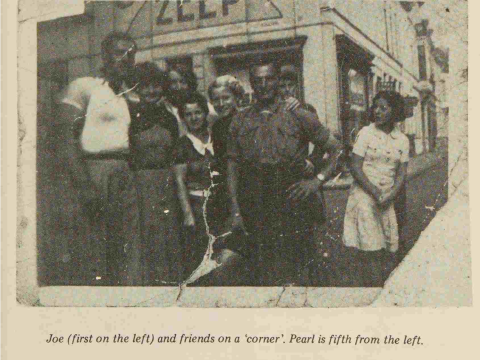
Between us we could afford to get out and enjoy ourselves whenever time permitted. We were never bored. On the contrary, there were never enough hours in the day or days in the week. Most days we would not even meet until around 10.30 p.m. in a cafe, whichever one was currently in use.
After the usual chat over a cup of tea, which also included some attention to details of organisation with the many people who we met there, we would get to her place around 11.30 p.m. Then it might be any time before I left her to go home. I had the greatest difficulty in getting up the following morning for work. I was often late but being a piece worker I could catch up with my work without losing any money. We began to think about our visit to Antwerp to see Peter and his friends. This would be our first trip abroad and we were looking forward to the break.
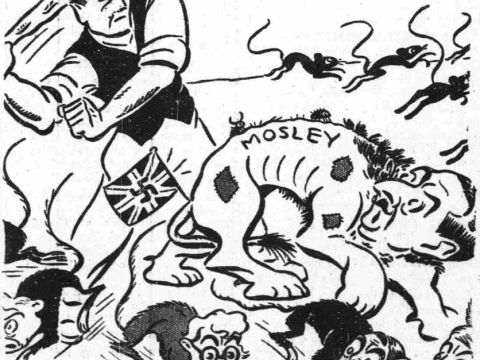
The Stepney branch of the CP was growing very fast now, because it was impossible not to be interested in what Mosley was doing in the East End.
The news from Germany was disturbing the Jews and still forcing them to take up a position, which often included ours. Lots of young people were becoming active, and there were always large crowds going to those areas where Mosley’s meetings were being held. The main spot was Victoria Park Square in Green Street, Bethnal Green. Harold Cohen was now spending most of his time with the ex-servicemen and they had formed their own organisation which included a youth section which could not have been of exservicemen.
This made it possible to develop a bigger body of anti-fascists who would not become members of the CP simply because they did not follow all the way with what we said.
AJthough Harold was a communist as were others in this organisation, he was not the kind of person to worry too much about what other party members thought. He was involved in some of the arguments with the “TU supporters”, in the local Party, Sarah Wesker, The Segals Phil Piratin, Alf Finkelstein, Silkoff, Greenblatt and others. He would not get involved in the deeper political controversy because for one thing he had not read very much and he didn’t want to study. He had a natural intelligence and was a good speaker and organiser. He was also very rough and ready and did not mince words. He used to say things to Sarah Wesker in private conversation which would have met with a different response were it from someone else.
He near enough told leading party members to mind their own business and get on with the fight against fascism and not meddle in the affairs of the ex-servicemen’s organisation. There wasn’t much they could do with him. He had a big organisation behind him which could not be coerced from outside.
Harold knew this and took advantage of his position to use very strong language towards his party critics. He regarded them as gas bags who were only hindering those who were getting on with the job. To avoid having to argue with them, he was usually too busy to attend some of the inner party meetings.
He was very much the leader of the ex-servicemen, mostly men much older than himself. They liked him for his openness, honesty and great sense of humour. He worked very hard and suffered the loss of his voice at times because of countless meetings he had to address. He was a real ‘rabble rouser’ and was enjoyed by most ordinary workers who did not take too well to the kind of pseudo intellectual efforts of some platform performers.
Sam Masters had become a very active member by now and I know of no one who was more involved and reliable in carrying Gut any task he had undertaken. On many occasions, when he was responsible for the local distribution of the Daily Worker to newsagents and regular readers, he would be left with piles of papers which someone had failed to collect and distribute.
After doing his own bit, he would be up half the night covering those deliveries which had been left by others. Nat Cohen was paying a lot of attention to him in much the same way as he had done to me in the past. As always he would have a couple of special people who he regarded as his proteges. I’ve no doubt that he could make you feel like a criminal if you failed to do something which you had undertaken. I know that he would try to select people who were not good at making excuses. Just as he would have special categories in which to characterise others according to their ability to get away with excusing their lapses. In short, he payed far more attention to behaviour and results than to anyone’s ability to make good speeches.
In general it was the good talkers who seemed to get into positions in our organisation. Take Hymie Goldstein for instance. He never missed a day during which he would not be out somewhere selling the Daily Worker (DW).
He was still hard at it, up to the time of his death just a few years ago. He never got married and needed very little to satisfy his personal needs. When he died he left a couple of hundred pounds which he willed to the D.W. His brother was annoyed about that, as he felt that Hymie should have considered that charity began at home. He didn’t understand that his brother regarded the CP and the DW as his close relations. Through all the years of tireless activity, Hymie never managed to get any position which carried any recognition or ‘prestige’. There were many like him.
On the other hand some crackpot who never did a real day’s work for the movement could be selected as candidate at elections and serve on committees just because he could make himself heard. My experience of people I have known in the Labour Party and T.U.s is pretty much the same. The steady plodders in these organisations are what keeps them going, in order that others can use the organisation to further their own ‘careers’. Hymie Goldstein had a friend called Foley, who was inclined to argue from amore informed level than most. In my opinion he did not match this with real concrete work. He argued with me quite a lot over the years, whenever we met. I was often amused to see how his point of view shifted from one extreme to the other. At least he changed his view when it could no longer be defended. Unlike others who manage to accept whatever was not going to offend the leaders.
Archie Fiddleman, ‘Ubby’ Cohen and Jack Cohen were all recruits from my street, who became active Party members. ‘Ubby’ had been an old school friend of my younger brother. Archie and Jack were around my age, but had been left behind by me. I was glad when they caught up and joined me and all the others in the CP. Another recruit from my street was Hymie Rosen-— wieg, from the older crowd. The effect of Mosiey activity and the news from Germany, was having much the same result all over the Jewish area in East London, just as in my street. This resulted in more recruits to the CP and more anti-fascist activity from a variety of other organisations. I don’t want to give the impression that everyone in the Jewish community was sympathetic to the CP, however much they were obliged to be anti-fascist. The majority of the older folk were very much concerned to see the Jewish way of life continue as in the old days. The struggle for existence made some of that effort hard to sustain. Lots of people were becoming small traders and venturing further afield in search of markets and shops. This would mean more people having to do their business on Saturdays. It also meant a greater contact with non-Jewish communities in areas beyond the East End.
The nature of the tailoring trade also gave some an opportunity, between seasons, to try their hand at some other ways of getting aliving. In later years, parents did all in their power to discourage their children from going into tailoring. Taxi driving was one way out, as soon as age and circumstances permitted. Others would start on their own with nothing more than a hired barrow and a sack of cucumbers or some bananas, fruit and veg of all kinds, which were hawked around the streets. Even fresh fish and other foods were sold from barrows, in not very clean conditions, as a means of earning a few shillings. While there were many who tried and failed, there were others who made good. Then there was a supreme effort on the part of parents to further their childrens’ education, where a child showed any potential. Winning a scholarship was just about the greatest thing a child could do, in the East End.
Parents would grow inches taller when a child of theirs had done that. I know, when Saul Rose was due to go to university, the whole street was involved and thrilled. Music was encouraged more where it might lead to the mastery of an instrument. The Jews were very ambitious despite the limited opportunities in the thirties. When the opportunities did come, with the war and after, they really came into their own and hundreds of businesses large and small still exist which began in those days.
The majority were not able to do anything but work long hours of intense effort, when work was available. The idea that Jews are ‘work shy’, which Mosley and other anti-semites have peddled around for so long, is just about the biggest falsehood imaginable. Others have certainly worked as hard, but none harder. Jews are also thrifty, but this does not mean they are mean.
Others may be as charitable, but none more. Where family ties are close, the weak stand a good chance of being helped by the strong. If one member of a family managed to make progress it usually meant all or most of his relations would benefit. Not always, but often. This goes right back to the emigration from Eastern Europe, when people would send for relations as soon as they themselves had somewhere to live. Some exploited the people they helped, but even that was accepted as legitimate, because as soon as the ‘greener’ learned the ropes, he had escaped from the even harsher conditions of the old country.
Despite the undoubted petit-bourgeois character of Jewish people, they managed to produce more than their share of revolutionaries. In almost every walk of life they have produced a great number of distinguished examples. Some like to think that all this is due to centuries of persecution which has in some way made them determined to survive and do better than their persecutors.
I’m not sure if this can be sustantiated. It is possible to say that if a minority community is not allowed to take part in all the economic and social activities where they live, that they will find an alternative. That has happened. It does not explain why other people who have suffered long periods of persecution, have not so far matched the Jews’ ability to survive and prosper, despite devastating calamities which have befallen them. The class structure of the Jewish community is much the same as among other people: Jews are not isolated from the rest of capitalist society.
I have no figures, but I would guess that the number of upper and middle class Jews, in proportion to workers, is greater than in society generally. They have managed to remain a community which in some ways can overlook class barriers in their family and social life. The very rich do get away from their poor brethren as much as possible. This might be explained by the fact that anti-semitism seems to transcend class barriers when it is used for the economic and political advantage of the overwhelming number of the ruling class. This throws even rich Jews into some peculiar alliances with workers they exploit who happen to be Jews.
I pose some of these questions which others might be interested to investigate, because some of these forces were at work in the Hast End and even spilled over into the CP in that area. I found Jewish communists more pushing and generally capable of exercising some of the drive of Jews who were not political. Somehow, Jewish party members were ambitious and wanted to be good communists. I have heard it said that Jews suffer from a sort of collective inferiority complex, which makes them behave as though they are superior. A common phrase used to describe a shrewd Gentile is, ‘He’s got a yiddisher kopf’. (A Jewish head). Jews have added to some of the anti-semitic myths, by their own irrational beliefs about themselves. I have come across communists who were not free of anti-semitic feelings and beliefs, just as there were Jewish CP members who were not free of anti-Gentile sentiments. The struggle of black people is similarly bedevilled by this kind of thing, when black revolutionary forces find it difficult to join with white revolutionaries.
It follows from all this that we in Stepney had some special problems in combatting Mosley, by means of ordinary appeals for unity on a siniple class basis. It does not follow that we should not have tried to do that, but where antisemitism played such a big part in political affairs, just as in Germany, it was not so straight forward as some Marxists imagine.
There was resistance to landlords whether they were individual Jews, Gentiles or the local authorities. The unemployed did unite to fight for better conditions. In Stepney, the NUWM had a good organiser, Gordon Roper, who was a communist full-time functionary. He was an intelligent man and I found him very critical of some of the leaders. Like so many others he just faded away. I don’t know what happened to Morrie Silver, but Morrie Goldstein did become a shirt manufacturer after the war. These two along with Alf Chernoff, a personal friend of mine, were the leaders of the Stepney NUWM.
A very spectacular addition to the membership of the Party was ‘old Man’ Mason. He was the father of Harry Mason a famous boxer. ‘Old man’ Mason was one of the East End’s characters. Like ‘Schlomki Cokeman’ and ‘Chiam Shalom’, he had a reputation for being a heavy drinker and as strong as an ox.
He certainly livened up the proceedings at meetings. Two of ‘Chiam Shalom’s’ daughters, Bessie and Shanie were in the YCL. The fight against Mosley was bringing in members from all quarters.
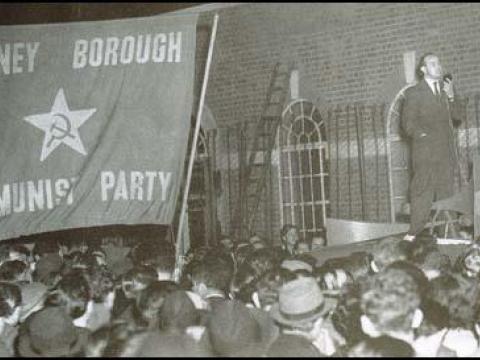
‘The Relief Committee for the Victims of Fascism’, sponsored a demonstration to Trafalgar Square, in which a protest was registered against the proposed Anglo-German Naval Agreement, to permit Germany to build a Navy including submarines (1). A National Congress was convened to fight the growing war preparations (2). Baldwin had become Prime Minister. We decided to make a counter offensive to Mosley by calling a rally at Mosley’s main meeting place, Victoria Park Square, with the slogan, ‘Drive Fascism out of East London’. We sent a deputation to the Borough Council, asking for a ban on Fascist meetings because of their anti-semitic propaganda and violence towards Jews and political opponents. Our rally was violently assaulted by the police. Many people were beaten and some were arrested(3). A couple of days later we called on all anti-fascists to oppose aBUF meeting at the same place. The usual gang of BUF members in black shirts were packed round the platform with a heavy cordon of police round them. Then came the large crowd of anti-fascists who were kept a few yards away from the Blackshirts, by the police. Anyone bold enough to press forward to ask a question or heckle, was immediately set upon by the police. One or two who succeeded in getting through the cordon were beaten by the Blackshirts. During the skirmishing, the police cordon would be broken for a time.
I was with Nat Cohen and I could see his face getting redder as he saw the brutality of the police. He said to me, ‘Come on, I’m going round the back’. He started to push his way round the side and suddenly there was a surge in the other direction which left a gap in the police cordon where they had gone to intervene in a battle between some of our people and the blackshirts.
Nat hurled himself at the platform in a kind of rugby tackle. He did this without regard for his personal safety. The platform went flying and all hell seemed to be let loose. There were police batons and Blackshirt’s leather belts, with heavy buckles, going in all directions. Nat was arrested and taken to Bethnal Green police station. I went along to try to get him out on bail, but it was decided to keep him in custody. Barney Becow was also in custody for a week arising from another fascist meeting. We called an emergency meeting at Carters book shop, to set up a Defence Committee for all those arrested and needing legal and financial aid (4).
On the 17th, Nat Cohen came before the court at Old Street. His efforts to defend his actions by declaring that the fascists were responsible for the violence, were brought to an end when the magistrate ordered his removal from the court. He was dragged out shouting, ‘This is like Fascism’. He was brought back and remanded for a week in custody. Others in North London who opposed Mosley were also sent to prison. Nat was fined when he eventually came up again, because his remands in custody were taken into account (5).
We organised another meeting at Victoria Park Square, but this time we got the support of two prominent Labour councillors, Turpin and Edwards These two, Scott of the Socialist League, Gordon Roper NUMW, Nat Cohen and J.F. King LCC spoke. This meeting was a great success with only a few arrests where some of our people got involved with some Mosleyites. Mosley was able to get the Stratford Town Hall for a meeting and his penetration of East London, though resisted, was getting a measure of success. The Communist sponsored alternative Clothing Workers Union (The UCWU), moved to 63 Whitechapel Road (6). I think some of the moves had a lot to do with the difficulty of maintaining a small Trade Union with a shifting membership, which resulted in a low income. Most of our organisations were in debt to members who were called upon to give generously or loan money to meet crises, which were always arising.
Fascist terror metholds were getting more ruthless in Germany. The Jews were being persecuted and discriminated against in every conceivable way.
Communists and Social. Democrats along with their organisations were being liquidated. Mussolini attacked Abysinnia. The 7th World Congress of the Communist International opened in Moscow. This was our reply to the fascist war threat (7).
No matter what happens, it seems that people think of a holiday, when the first week in August arrives. Not that many people in the East End could afford a holiday. The tailoring trade would be slack anyway and lots of places would close for that week. There was no such think as holiday pay. So, if you wanted a holiday, it would have to come out of savings or loans from clubs or friendly societies, which catered for such things. Pearl and I had decided to make our visit to see Peter and his friends during this first week in August. Nat had decided that he too would like to meet Peter. He didn’t have much money, so he proposed to Sam Masters that they should acquire a couple of bicycles, on the cheap and cycle through France via Belgium, where they could meet us and Peter. Sam had a married sister who lived in Antwerp. She was expecting a baby around that time, so Sam wanted to kill two birds with one stone. We were discussing the arrangements, when the fact suddenly emerged that Nat could not ride a bike. Sam who was a good all round athlete and physicial training instructor, laughed his head off. So did we. But Nat insisted he could learn to ride in one day, if only he had a machine. You could get a secondhand bicycle for very little, if you were not too fussy about its appearance. Nat got one and Sam did too. Sure enough Nat was able to get along, after a fashion, in no time at all. But Sam kept on about how it would be impossible for Nat to undertake anything like a tour ° of France. Nat was about 35 years old and had no experience on the road. On one of their practice runs, Nat fell into the trap of following a big lorry by getting into its slipstream. When it breaked suddenly, he finished up with a buckled front wheel along with some bruises and cuts. That wouldn’t stop him. He had the bike repaired and Sam with some misgivings agreed to the trip.
Pearl and I were going to travel in style, by train from London to Dover, then a boat to Ostend and train to Antwerp. We had arranged to meet Nat and Sam two days later in Antwerp. Sam wasn’t so sure they wouid get there.
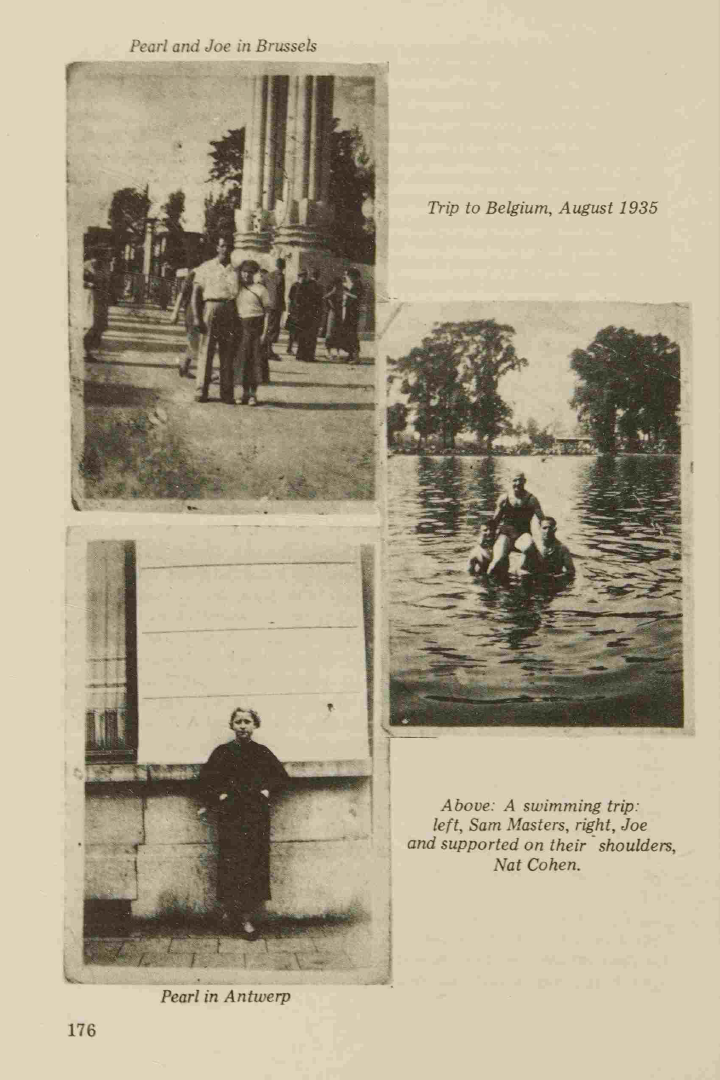
They were going to carry all their kit including a small tent, on their backs and machines. Nat assured us he would be there as arranged. Pearl and I were dressed and equipped with new cases, looking like a couple of prosperous tourists. We set off with best wishes from our families who envied us, because holidays abroad were still a rare thing for workers to enjoy. We enjoyed the journey, even though Pearl was a bit sick during the sea trip.
On arrival in Antwerp we had no difficulty in finding the cafe where we were to meet Peter. In one respect, the movement there was like ours. They met in cafes. This one was much bigger than most of ours and they had wine and other alcoholic drinks, which we did not. As usual, with so many people in the CP, arrangements have to be broken to meet pressing demands of the day-to-day struggle. Peter wasn’t there when we arrived. He would not be back from an important engagement out of town. He had left a message to this effect, but no address where we should go. His friends rallied round to assure us that we would not be without a bed for the night. We were directed to a restaurant just opposite, where we had a grand meal and were fixed up for the night. The following morning, after a slap-up breakfast, which the continentals did not normally have, we offered to pay our bill. The man refused to take any money. As he explained, we were his comrades who had come to see Peter, who turned out to be quite a celebrity among the diamond workers of Antwerp as well as a respected anti-fascist.
This was rather important at this time, because of Belgium’s proximity to Germany, from which refugees were arriving all the time. Antwerp was a major port which was also a major factor for those fleeing from German fascism. We waited back at the cafe after Pearl had insisted on getting some chocolates and cigars for those grand people who had looked after us. Peter arrived and after explaining his inability to see us earlier, he reverted to his usual laughing, bustling self. He was Jewish and had some of the characteristics I knew so well. We went off to meet his family, sister and cousins, who lived in the Jewish Quarter which also contained some of the diamond workshops.
Hospitality could not have been better. We were wined and dined and given the best accommodation in the house.
Late afternoon there was a knock at the door and there was Nat and Sam already sunburned, in cycling shorts and shirt. Their cycles were in the kerb weighted down with their gear, which did not include any clothing except underwear, shirt and swimming costume. They had found us via the same cafe, the only address we were able to give them. They were welcomed and assured they could stay, if they didn’t mind sleeping on a couch. Then we didn’t stop laughing as Nat described their journey. They had left London for Dover with Sam peddling away and urging Nat to keep up, as they would never get there if he didn’t. In the end the position was reversed, with Nat having to urge Sam on for the same reason. Nat as usual, had shown his quite amazing physical stamina to be far superior to young men little more than half his age. Sam agreed he was a wiser man as a result of this experience.
Sam wanted to visit the hospital where his sister had just had her baby. The problem was, that she was in a place where it would not be right to go in cycling shorts. I was big and much fatter than Sam, who was built like a perfact physical specimen. Again we laughed, as he set off down the road in a suit belonging to me, which looked very baggy indeed. When he returned we all set off for a tour of the town, during the late evening. This was mainly a visit to one cafe after another, until very late into the night.
The following day the four of us decided to hitch-hike to Brussels, where the 1935 Intenational Exhibition was being held. Pearl and I, in more informal dress, joined Nat and Sam, towards a road from which we started thumbing a lift. We got a car which took us all the way to Brussels. After an enjoyable visit to the exhibition, we were back on the road. This time a lorry pulled up and the driver explained that he could take us all the way to Antwerp, providing we didn’t mind having to wait in a village on the way, where he had to make a delivery. We agreed. He dropped us off at a cafe in the village and before I knew what was happening, Nat said he and Sam would be staying at this village over night and that they would meet us the following morning in Antwerp. It appears he had made contact with a couple of young women and that meant he and Sam would be giving these two ladies the benefit of their company. Nat was like that. He and Sam were almost unattached so I suppose it was alright. The lorry driver returned but he was minus two passengers.
They did return the following day and after a short chat with Peter and one or two of his friends, they said good-bye. They said they would see us back in Stepney at the end of the week. They set off on the cycle-tour through France, or as much of it as could be managed. I was sorry for Sam despite his undoubted physcial fitness, because I knew Nat would take a great delight in driving Sam to the limit of his endurance.
They didn’t go far because they were back in Antwerp on the Thursday.
On Friday we had a day out, which included a trip to an artists’ retreat near the border with Holland. We did some swimming which again only served to demonstrate Nat’s superiority in that field too.
The following day Nat and Sam ieft for home on their bikes. We followed the next day to arrive back in London early Sunday evening. We met a good number of Peter’s friends during the course of the week. I learned very little about the movement there, which I did not already know from my experience in East London. Peter was not going to discuss anything in depth even though his English was good enough to make that possible. He gave me the impression that his jovial behaviour concealed a good brain and a serious mind if he would be called up to use them. Our holiday was to lead to quite a different result the following year which might never have been the case if we had not had this one. Some important historical events have such beginnings.
* * * * *
Back in East London, Councillor Turpin from Bethnal Green was fined five pounds after his arrest while opposing a fascist meeting (8). ABUF meeting in Shoreditch Town Hall was broken up (9). Mosley was able to get such halls with Council approval using the argument that he was entitled to enjoy free speech, even if he, like Hitler, would not be like-minded towards his opponents. East London Ex-servicemen were meeting at Circle House before they eventually acquired their own premises (10). Many people in Shoreditch among our supporters were being attacked and beaten up by Blackshirts. Many of our members were complaining that we were unable to defend ourselves, or oppose even a small force of fascists, in some places.
Mussolini’s invasion of Abysinia began in earnest. Our response was to call a demonstration in Hyde Park on October 13th (11). I had by now forgotten about the ILD and the leadership’s role in its demise. All seemed to be well as I read with approval, the mass of words coming out of the 7th World Congress of the Communist International. We discussed this at meetings specially convened for that purpose. There were classes organised to study the material methodically. Among friends, there were endless discussions, each drawing attention to those aspects of the Congress’ deliberations and conclusions, which suited their particular point of view.
The resolutions, seemed to me to cover everything needed to meet the situation, based on their analysis. If words alone could be relied on to get the desired results, then surely we could not fail. I have learned that words can be manipulated to mean whatever skilled use of them may require. Statements taken out of context and reservations, which often make some otherwise clear intentions meaningless, are only two of the ways in which written and spoken words are manipulated as I later discovered. I have learned to be sceptical about all so-called analysis, which finishes with a blue-print for the future.
More new members arrived including Alf Fitterman, Jack Ross and Jack’s sister Rachel, who married Alf. Alf’s brother along with a friend later founded one of the better-known dress firms, which is still in business to this day. Alf himself became a dress manufacturer on a small scale after the war. Alf, Jack and their wives are still good friends of mine. There were others who had come up through the ranks of the Pioneers or YCL into the Party. Sam Apter was one who had visited the Soviet Union when he was still a schoolboy. His father was one of the old Socialists from way back in the old country. Sam’s wife was a Party candidate in a local election after the war, by which time Sam had become a ladies clothing manufacturer and had re-visited the Soviet Union in connection with trading deals. There were more people coming forward to increase the volume of activity and there was no shortage of issues needing attention. We made special appeals to dockers and seamen to refuse to handle any war materials going to Italy. Meetings and demonstrations were organised all over London condemning Italy’s aggression to Abyssinia (12).
Mosley’s forces were being driven off the streets in Manchester, Carlisle, Ashton-Under-Lyme, Southall and Wembley (13). The fascists attempted to break up a Labour Party meeting which was addressed by Earnest Thurtle, Landsbury’s son-in-law, in Shoreditch (14). Jews were being attacked on the streets in Hackney (15). A move was made to get the BUF headquarters in the borough, closed down. The appeal was addressed to the Borough Council because of the increasing racial propaganda which led to more violent attacks on Jews (16). The anti-war demonstration on the 13th, October, marched to the Italian embassy (17).
A book, written by Simon Blumenfeld called, ‘Jew Boy’, attempting to portray life in my East End, was published. My old pal Sam Berks did a review for the Daily Worker (18). Sam was becoming more involved in party work, despite the fact that he had many misgivings concerning what the leadership had to offer. He has often said that he felt a need to do something and the CP was the best of a bad bunch, who were attempting to oppose fascism.
We had begun our preparations for the general elections due to take place on November 14th. Our line was for the return of a Labour government and the gaining of a few selected places which might be filled by communusts, where possible. In Stepney we did not have a CP candidate, so we offered ourselves for all kinds of activity in support of the local Labour Party candidates.
It was while Sam Berks was out canvassing in Mile End, in a little narrow street opposite the People’s Palace, now Queen Mary College, that he met a young man named Bronowski. The now famous professor, Bronowski came to the door in response to Sam’s knock. After the usual appeal on behalf of the Labour candidate, Sam made it clear that he was aCommunist and after a short talk sold him a ticket for a film show which was to take place at the ‘Circle House’. Bronowski attended and Sam told me about him afterwards because he was quite impressed with him and thought he had made a good ‘contact’. However, nothing came of it because this was the time when Bronowski was studying and had no time for any detailed political activity.
Sam likes to think he is a sceptic. But I found him very gullible and a mass of contradictions. A few stories about him might help to show that not all CP members were dull or dry political types. As Sam still says, ‘I want Communism without Communists’. Sam is tall, broad shouldered and has only become rather thick around the middle in recent years. He is now seventy years old. He never cared about his appearance when it came to selecting clothes, but was always clean and looked healthy. In all the years I have known him, I cannot remember ever seeing him really laid low, despite the fact that he suffered from malaria which he picked up in Burma, while in the army during the war. To this day, despite failing sight (he is almost blind), walking long distances is part of his life. He has seen a lot of the world and lived and worked as a trousers cutter in many places. His considerable physical appearance would not encourage anyone to seek a fight with him and I never saw him ever raise his hand or threaten to do so. He can become very angry, but not physically aggressive. His sense of humour is without bounds. He laughs most of the time and is a delightful companion.
Sam was one time ‘Lit Sec’ (Literature Secretary), in a cell group. He was approached by Phil Piratin who asked him things were going. Sam replied, ‘Not so good’. Piratin said ‘why is that?’ I can imagine just how Sam’s answer must have sounded. ‘Well what do you expect, I can’t read this shit, how do you expect anyone else to?’ When the Stalin Constitution was first published, it was printed on very thin paper and written in very small print. It almost looked like a long legal document, in sections and sub-sections. Paragraphs were arranged so that they could be identified for reference purposes. In CP jargon. This was being sold to East End workers who just about managed to read the racing results. Sam took one look at the pamphlet and said, ‘The only way this is going to be any good is, if it is printed on a roll of paper suitably perforated at intervals.’ Sam is a person of violent likes and dislikes.
He can smell lack of sincerity a mile off. He suspects all businessmen and particularly Jewish businessmen. The law will not permit me to say what he says about some well known ones. On the other hand, he will often praise their qualities and condemn the actions of Jewish workers and all workers in general. One could write a book about this man. Indeed, ‘Jew Boy’, by Simon Blumenfeld, is very largely based on him. He has a wide circle of friends who, no matter where they have gone in the world and up the social ladder, are still in close contact. Sam is the centre which keeps so many of us together up to this very day. He is not very good at reading any of the so-called philosophical and political theorists. He suspects them all. History, biography, travel stories, novels, form the bulk of his reading material which he has constantly indulged in since he was a boy. He still reads a couple of books each week. Sam feels very deeply when confronted with any form of what he regards as injustice.
He is not squeamish and can react quite violently, and does so frequently, in words, when he wants to condemn anything. A firm friend who thinks nothing of giving away his last penny. As Nat Cohen said, ‘Sam does not wait to be asked. He asks first.’
When he met his wife Bessie, in the movement, we had some good times. A group of us would go along to Bessie’s home for an evening in and Sam would arrive with a bunch of flowers. A conservative in many things is Sam.
Since he is the most untidy person imaginable, it would take a better descriptive writer than me to give you a real picture of him carrying a bunch of flowers. A story which makes me laugh as I contemplate telling it, is of an occasion when Sam with others, had been out whitewashing slogans in support of Spanish democracy’s fight against Franco. As happens on these jobs, someone is left with the whitewash bucket and brushes. Sam was the one that night. A good job done, those who had girl or boy friends, husbands or wives, would be able to behave in a normal manner and got to meet their loved ones. Sam was on his «way to Bessie’s house where he intended leaving the bucket and brushes and see Bess. As he got to Nelson Street, he realised that there was some whitewash left. As he explained at the time, ‘It’s a pity to waste good whitewash, so I wrote all down the street, ‘SAM LOVES BESSIE’, until I got to her door’. Sure enough it was there for everyone to see.
Throughout their long life together the stories of his many misdeeds could also fill a book. When he was off to America for a holiday recently, Bessie carefully supervised his dress. As she said at the time, ‘He looked like a prince’. I went to the B.O.A.C. terminal in Victoria and waited for them to arrive. A van drew up driven by Alf Sheldon. Sam and Bessie stepped out complete with luggage. We all entered the terminal building reception area.
Sam really did look neat and tidy. He even wore a trilby hat which I only ever saw him wear at Jewish funerals. We proceeded down one side of the reception area, starting with a weighing machine, followed by several desks, each dealing with different aspects of the proposed flight. Sam and Alf carrying the luggage, went to the weighing machine and at the same time Bessie made a fatal mistake. Being a fanatical bargain hunter, she immediately noticed a large kiosk, over which in bright lights, were the words, ‘Duty free wines and spirits’. She could not resist heading towards it, saying at the same time, ‘I’ll catch you up when you get to “Seat Reservations” ’, which was the last desk.
She had no sooner left Sam’s side, than he had pushed his hat onto the back of his head. He had begun to sweat and at the next desk he loosened his tie and opened the collar of his shirt. By this time his greatest ‘crime’ was being committed—His trousers were hanging two or three inches over the top of this shoes. The mac he was supposed to be carrying over his arm, was trailing along the floor. When Bessie finished getting her duty free liquor, she turned and let out a howl, which caused nearly everyone there to almost jump off the ground. She spent the next few minutes trying to restore Sam to his former glory. Calling him all the names she could think of including ‘shloch’, which means, ‘untidy, dirty, careless tramp’. We were by no means finished.
By this time Alf and I were reduced to tears with laughter. Sam, we decided, should go with his luggage, on the Terminal bus to the airport and we would follow the van. We said our good-byes and left for London Airport. When we arrived, we proceeded to where the bus was due to arrive.
The bus turned up in due course and the passengers began to alight. Almost the last to get off was Sam. What Bessie saw caused her to say afterwards that she wished the ground would have opened up and swallowed her. Alf and I nearly convulsed with laughter. You never saw such a sight. Sam looked as though someone had thrown his clothes at him. Bessie was defeated utterly.
You see, there was a glass partition separating us from the passengers and she could not do anything. We waved until the place was out of sight. That’s my Sam. He didn’t really, but he said, he worried all through his holdiay, about what Bessie would have to say on his return.
Sam is always having parties at his place. Bessie never knew how many people to expect, in addition to the figure agreed between them. Sam would always find more people he wished to invite. Rather than argue, he would tell them to come along and Bessie could not do anything. She eventually got used to the idea and I can never remember a time when she would run out of food even when there were more than forty people present. Sam has acquired a set of moral principles which he has made all his own. They are very high as regards personal conduct and in my view, cannot be applied. He is shot through with prejudices, some of which are so primitive as to be almost unbelievable in someone so well read. He will not recognise changed circumstances. These are my personal views and I think they make him incapable of serious political understanding. I know his heart is in the right place and I love him, warts and all.
* * * * *
Meanwhile back to November 1935. All our groups throughout the borough were fully occupied in the General Election campaign. We were received with thanks by J.H. Hall in Whitechapel and St. Georges, but with less enthusiasm by Dan Frankel in Mile End. Since these two seats were held by a Liberal and Tory respectively, the Labour candidates welcomed some help to regain them. In fact James Hall offered to speak at one of our outdoor meetings at Blooms Corner. We ali joined in an eve of poll rally (19). Although we told people to vote Labour we did not fail to put across our own policies which were very critical of the Labour Party. The result of the election confirmed the fact that despite mass unemployment, the growing danger of war and the rise of Fascism, the British electorate still favoured the Tories.
The new parliament consisted of, 379 Tories, 31 Liberal Nat., 8 Labour Nats., 2 Nats., 153 Labour, 16 Liberal, 4 Independant Liberal, 4 Independant Labour Party and 1 Communist Party (20). For us, that one CP was heralded almost as the beginning of the revolution.
Willie Gallacher, M.P. for West Fife was going to transform the House of Commons. Or so it seemed from the way we saw this victory. Harry Pollitt only just missed being elected in South Wales. This was a great disappointment.
I thought the whole election result very strange. The CP never seemed to be able to register much success when it came to elections, in more than a few places. No matter how many times we were rejected at the polls, we never stopped believing that we were destined to lead the workers to their emancipation from capitalism. What is more, Communist parties in many places have paid more attention to the possibility of winning elections, even to the point of saying that the change to Socialism can be achieved by this means.
A new movement had emerged in the Soviet Union under the name of a man who had set the pace for increased production; towards achieving the Five Year Plan in four years, Stakhanov! Stalin’s article on the importance of the Stakhanovites, appeared in the Daily Worker (21). Thousands of words were written glorifying the prodigious feats in increased production, including , many innovations which had their origins on the shop floor. Leading Soviet personalities, Molotov, Malinovski, Ojhonikidse and others visited the factories to hear all about this and to present awards for outstanding achievement.
Many of these reports sounded very improbable to me and Nat. We often discussed the nature of this movement with its emphasis on the intensification of labour. It didn’t seem to fit in with my idea of Socialism with its prospect of shorter hours and less physical effort.
Having considered the concrete circumstances of the backwardness of Russia and the effect of war and revolution, as well as the need for rapid industrialisation, I still could not see how the vast mass of workers and peasants could be persuaded to work harder, for the common good some time in the future. This kind of appeal had a familiar ring here, where we lived under capitalism.
We often refered to it as, ‘pie in the sky’. After all this was eighteen years after the revolution and we had been fed on stories of massive production achievements which had led to shorter hours and improved living standards which were fast catching up with the advanced capitalist rates.
There are always people prepared to work for the common good without much thought for their own personal gain. I doubted that this was something which could be acceptable to the vast mass of poor people. They would need more concrete incentive to work harder and had a right to expect immediate results of Socialist economic practice. I could have accepted the argument that a huge programme of intensive effort was neccesary, to get the kind of capital accumulation which would lead to rapid industrialisation.
This wasn’t what was said. It took a long time before I learned of the real nature of Stalin’s efforts to get Russian workers and peasants to ‘conform’ to his idea of ‘Socialist’ production processes.
John Strachey was a regular contributor to the Daily Worker. He had a column headed ‘Looking at the news’, (22), at this time. I remember his presence at a meeting in ‘Harry the Barbers’ shop, when Nat and I approached him and George Allison afterwards for a private discussion on the Stakhanovite movement. George was all for it. He said I did not understand the nature of the forces which were released when people no longer worked for private profiteers. I thought Strachey was not so sure. He didn’t say we were right, neither did he say we were wrong.
An interesting news item reported that Louis Carlos Prestes, had been elected to the Executive Committee of the Communist International (23).
Nat had fought in the ‘Prestes Column’ in South America. Also at this time the CPGB applied for affiliation to the Labour Party, in pursuit of its United Front objectives (24). It was ten years since disaffiliation. It didn’t seem likely to succeed, but then it would be possible to point to the Labour leaders as the ones continuing the split in the working class movement. We could hardly lose anything from such an obviously good tactical move.
In Stepney, we took exception to a visit of a football team from Nazi Germany. We held a protest meeting in the Mile End Baths, which was addressed by our newly elected Labour M.P., J.H. Hall, alongside CP and YCL speakers (25). Our united front tactics were having some partial success locally.
Our tactical position shifted in regard to the situation in the clothing industry. All our CP members and supporters were urged to join either the LTU or the NUTGW. The UCWU was no more. It went along with many other unions which had been formed out of the Minority Movement, which had been affiliated to the Red International of Labour Unions. There was one exception, in East London, which did not liquidate itself. The Stevedores and Dockers union, the ‘Blue Union’ as it was called, because of the colour of its membership card. It still exists.
We set about working in the ‘reformist’ Unions with a will. Our young members lost no time in forming a sports and social club in the local branch of the National Union of Tailors and Garment Workers, which had its premises at 48 New Road (26). We were in! 48 New Road became a new centre for our activities. Breaking into the LTU was not so easy. We could join as individual members and bring our organised shops to join. The leadership of the LTU were not going to let us capture their Union without a fight. The party fraction for clothing met to deal with policy and direct operations towards changing the Unions to a more militant approach, as a means of building the organisation. This was the beginning of a long process leading to the amalgamation of the LTU with the NUTGW and the formation of the London Mantle and Costume branch of the national union. This was not achieved before 1939. Some who were in at the beginning of this fight, became Union officials and oné who was never a Communist, but worked very cleverly with them, became a Labour MP.
As usual, the rest of our local activities continued. Tenants struggles were directed mainly by small organised groups on particular estates. These were very simple types of organisations dealing with local grievances. They often combined this with social activities and the provision of services not provided by the authorities. Communists were pretty good at getting control of these groups, with varying results. The big struggle in East London between tenants and landlords was yet to come. The man whose name was to become most prominent in those struggles had recently become a member of the CP.
‘Tubby’ Rosen joined the CP after he had given some of his time, with his camera, towards assisting our activities. He came from the Bromhead Street area, only a few streets away from where I lived. He also became prominent in the Union and was eventually hounded out of the CP by some of the people who opposed me, throughout the years (27). He was a good, sensitive person, despite his bluff appearance. He had considerable courage. He was a good platform performer and made many sacrifices, in spite of the ciriticism and sometimes open opposition from his wife. They had a growing family and she thought he should pay more attention to them. They all grew up and as far as I could see, had not suffered because of their father’s activities. On the contrary, “Tubby’s’ kids did as well as so many of the children of my old friends and comrades. As did my own two daughters.
Another person who came on the scene around 1936, was one, Michael Shapiro. I think Michael and Tubby had a joint interest in tenants’ questions.
As a matter of fact, Shapiro was brought into Stepney by the District Party Committee, as an expert on housing and other tenants interests. Indeed, he became a‘spokesman for the District Party Committee (DPC) when he opposed me and also acted as an unofficial liaison man, between Stepney and the DPC.
He did a lot to influence what happened later. Shapiro and Dave Springhall, London District Organiser at the time, went to China after the war. Springhall had served a prison sentence for Breaches of the Official Secrets Acts, after falling into a trap because of his own stupid actions. So he-wasn’t around very long. Springhall died in China after serving a very long sentence, along with Shapiro, for alleged anti-China activities. Shapiro was released from detention and opted to stay in China, where he is to this day.
At the time these new people joined us, Mosley was deciding to make a big effort in Manchester, where he had connections stretching back into the past. New offices were opened and a lot of money was spent on launching his campaign. The reaction was instant. He had little favourable response to his efforts (28). It did look as though his backers were going to make a big effort to build a mass fascist party, based on the one Hitler had built in Germany. I felt we were in for a big fight in the coming months. If we lost ground and the BUF made any significant progress, then our whole future would be in danger of meeting the fate of the German CP. Since we did not see ourselves as anything but an important integral part of the working class, the fate of all workers would be involved. As Jews, living in a Jewish area, the dangers confronting us were bound to be felt more immediately. For us it was a matter of survival, even in the short term. It is no wonder that I may have exaggerated the importance of my role in all this, as secretary of the Stepney CP. Along with some who shared my views, we were constantly on the lookout for any tendency to underestimate the danger from Mosley and his friends, at home and abroad.
Despite the large Conservative majority in the House of Commons, based on support at the polls, it looked as though there would be greater difficulty in managing the economy, other than at the expense of the workers. Therefore a time could come when the so-called democratic process would not be capable of ensuring the power of the established authority. Then, a resort to open fascist methods would take its place, as in Germany and Italy. Since the German CP with its great strength, and in some measure, because of it, had failed to meet the Hitler challenge, I wondered how we could meet a similar challenge with more success than they appeared to be having. Clearly, ‘prevention was better than cure’. Hence my emphasis on doing everything to prevent Mosley’s growth.
All sorts of arguments were advanced within the context of the 7th World Congress of the Communist International resolutions. The United Front, Popular Front tactics could not be opposed in any way. When it came to the interpretation of these tactics, in the concrete circumstances of any area of political or industrial organsation, then there seemed to be a great deal of difference of opinion. The central body of opinion in the CP which spoke so strongly in favour of penetrating the Labour and Trade Union organisations, seemed to me to be based on an idea, not fully expressed, that somehow these organisations could be captured from the reformist Social Democrats and turned into revolutionary organisations. I understood how Trade Unions could be used to further our revolutionary aims, as indeed could other organisations. It could even be possible to have a corps of people functioning in Fascist organisations for disruptive purposes. Even that could be said to be an aid to the revolutionary process. As I saw it, none of these things could be a substitute for workers participation in direct action to secure the demands of the unemployed and to fight for shorter hours and higher wages. Nor could they be a substitute for direct opposition to landlords, direct defence of civil liberties and democratic rights, and the direct independent pursuance of a whole range of social demands. The workers could support and fight for all these things with their own organisation, on a local and national level. I felt that any work inside the mass reformist organisations would have to be expressed in such a way as to lead to actions in the factories and on the streets. My views were often labelled ‘Leftist? and I reacted by regarding my opponents as ‘right wing deviationists’.
1935 was coming to its end. The Jewish organisation ICOS, based on our members in the Workers Circle, held a meeting at the Mile End Baths. Willie Gallacher, M.P. spoke. It drew attention to the existence in the Soviet Union of an Autonomous Jewish State called Birobidjan. Here was the answer to Zionism! (29). The Dachau concentration camp already existed. We read about the awful treatment of Jews in Germany every day. Birobidjan was given a lot of publicity in all our publications. ‘Russia Today’ showed pictures of Jews working in this so-called autonomous state for the building of the workers’ fatherland, in which the Jewish people would at last be free from their wanderings and persecutors. We fought Zionism as a nationalist reactionary creed, based on religious aspirations, which could only act as a means of dividing the workers and eventually doing harm to the best interests of Jews and non-Jews alike. The debate among Jews in East London, was between Zionists and those who were opposed to Zionism. It was always going on. There were several Zionist organisations ranging from the left to far right.
I can remember helping to organise the opposition to a Zionist meeting to be addressed by Jabotinsky, at the Pavilion theatre in Whitechapel Road. He represented the extreme right wing of the Zionist movement, which favoured the building of para-military forces on much the same organised basis as the Fascists. In other words, he saw the need for force and the use of violence in the process and achievement of his objectives. The stewards at this meeting were ready to deal with any opposition from us. We had made our intentions quite clear. It was like preparing to attend a Fascist meeting without having to deal with opposition from the police. It turned out to be more difficult to heckle Jabotinski than Mosley. His stewards were well organised for dealing with opposition without police aid. The Social Democratic Zionists were much more effective and enjoyed wide support among working class Jews. We Communists thought we had come up with the answer to the Jewish Question with Birobidjan. We had a lot to learn.
Just before Chirstmas, Anthony Eden became Foreign Secretary under P.M. Baldwin. Things were happening in the world of diplomacy and the general field of international relations. Much of this was behind the scenes as always, and | felt that Stalin would be more than a match for our fascist and other opponents. Above all those interested in furthering the interests of the capitalist system, would have to deal with the mighty Communist International and the workers ability to fight and organise against the war plans, and opposition to the social revolution.
* * * * *
The year ended for us in Stepney, as always, with a break at Christmas for the usual round of family get-to-gethers and parties. A Jewish festival ‘Chunukah’, comes just before Chirstmas and somehow as time went on, the Jews seemed to me, to be extending their celebrations into the Christmas period. Since it was a holiday from work it could be an opportunity for social gatherings. We in the CP were almost fully integrated. Jews and Gentiles whatever their conditioning may have produced, in the way of lingering prejudices, were united on the surface. Non-Jew George Searle and his wife invited me and Pearl, along with many others like Harold Cohen and Sam Waldman, to a party at their place in Limehouse. This went on for a couple of days during which we made ourselves sick with food and drink. There always seemed to be lots of food and drink at Christmas time in the East End, despite the poverty which existed most of the time. People saved in loan clubs etc., the whole year round, even a couple of shillings aweek, which was often hard to find. Come Christmas their children should not feel deprived or hurt because their mum and dad could not buy, at least, some kind of toys and new clothes. Parents made big sacrifices in order to do their best to brighten the lives of the children. My own childhood was about as bad as anything could have been in this respect. My mum could not afford toys or new clothes, for us. I often wondered how much this aspect of my family’s childhood, contributed to the early revolt of my brother and sisters and their taking of what they thought was the easy way out of poverty and hard work in the factory. I also think that the accident which led to my being away from home for four years, between the ages of seven and eleven, saved me from a similar fate. When I was at Swanley, we had wonderful parties and the receiving of presents at Christmas. I was particular fortunate in this respect because, as I told you, our C of E minister was always referring to me as one of ‘Gods chosen people.’ He made a special point of telling the children that Christ was a Jew. As an adult I always had a good time at Chirstmas. 1935 was no exception.
* * * * *
1936 looked like being a very important year for me. I was so fully occupied in the movement I can hardly remember any details of my personal life.
Pearl was getting a bit restless. Our future prospects of marriage looked as far off as ever. I know now that I was making excuses for delaying the event, for reasons which I found easy to elaborate, but which concealed my fear of leaving my mother alone. In addition I did not want to complicate my personal life, as it might interfere with my work for the Party. It was not a very good time for talking about settling down and having children. The immediate danger of fascism and war made it easy to arg.te, that a settled married life was a pipe dream. Could we be responsible for bringing children into such a world? Would it not inhibit us from doing uf in our power to bring about a revolution? People were getting married and having children. That was different. They weren’t dedicated revolutionaries. Pearl would agree.
But I knew she was not very happy. She found it difficult to argue with me and did not. She played things by ear, on a day to day basis and made life as pleasant as possible for me. I took her for granted as I also became used to accepting my mother’s sacrifices on my behalf. I was lucky in having two women to see that I was looked after and loved. I must have seemed very selfish in their eyes, as I was always finding high minded excuses for not giving some of the attention they deserved.
Certainly my ego had become enlarged. I was still not twenty-four years old and felt very important. Nat Cohen was like that too. But he had a long record of service to the working class, involving considerable personal sacrifice.
He had a right to feel important and there was an important role for him in the future. I was being a bit big-headed to think I had much to offer. Nat was constantly urging me on. Pearl often felt hurt when her mother said, “He’ll never marry you, he’s married to Nat Cohen.”’ When she told me about that kind of thing, she would laugh, but I knew she felt bad and this was her way of getting through to me, what she really felt. Most of the time we never mentioned our future from a purely personal angle. It was always related to the needs of the Party. If this sounds pretentious, you don’t know what it is like to be caught up in a process called, ‘conscious revolutionary activity’ and to believe in it with all your heart.
My sisters’ visits home were becoming more frequent and I could see that Annie was a very sick person. My brother Hymie did not arrive so often and that was because he was not free to visit anyone, some of the time. I did not pay much attention to them, but my mother did look forward to seeing them and seldom discussed them with me. She was obviously worried about Annie, as well she might be. Annie only had a few months of life left. As I told you, she died after a useless, hopeless, horrible, short twenty-six years of ‘life’. This only served to give more meaning to my way of life. My mother’s long years of miserable suffering, along with Annie’s life and what I knew of the lives of Debbie and Hymie, was only a small part of the whole story.
What Hitler was doing in Germany, what people suffered at the hands of colonialists, could only be ended by a socialist revolution. How that could be achieved, was a task worthy of my attention. I’m still trying to learn how this can be done. I did not know that my brother was to play a part in this process and that his life was not to be regretted. On the other hand, Debbie never did grow into a mature person, capable of living within the ‘normal’ circumstances of life. She was to suffer a terrible end as a result.
I continued te push my thoughts about my family out of my mind. I called this process, being objective. I know that I have been profoundly affected by all that my family suffered. How could it be otherwise? What is more, others, not least among them, Pearl, also suffered. Repeat this experience many thousands of times and you will know a little about what makes a revolutionary tick. I repeat, it would be wrong to think that all was grim and horrible in the East End. People would rise to great heights of personal as well as collective achievement. Mutual aid, charity, self-help, social and religious, combined with political action, occupied many people. In addition there was a never ending stream of good humour coupled with an attempt to bring a little ‘culture’ into our lives. The Jewish way of life based as it is on the family, had some merit. A feeling of belonging often helps to overcome suffering. Even at work, in the many small units in the clothing industry, there existed a whole store of jokes and experience which was not just part of being exploited by the boss. It helped to make the hard work more bearable.
There was a group of young men called the ‘Chasidim’ (remember the ‘ch’s), who used to do an act on the stage which was based on real life experience in tailoring workshops. You would need to understand some yiddish and something about tailoring to appreciate their act. Unfortunately this humour cannot be translated, so their fame never got beyond the East End. Those who could understand were in for a real feast of humour when attending one of their performances.
As time went on, however, lots of Jews began to leave to live in Hackney, Stamford Hill and points north and north-west. The hold which the original immigrants had exercised, was beginning to fracture. Young Jews were not practising their religion as much as before. In fact, they were more and more questioning religion altogether. They would still be Jews and would have to defend themselves from anti-semitism. But that was not the same as believing in God and going to synagogue. At high holidays, like New Year and the Day of Atonement (the Black Fast), even the atheists would all become practising Jews. This was largely because children did not wish to upset their parents too much, and these occasions were when family ties were cemented. Even the ‘shpielers’ (30) in the East End closed at these times. The most immoral and outrageous villains, criminals of all kinds became religious observers and adhered to the family structure of Jewish life. Even now when most of the original immigrants have gone, when regular attendance at synagogue is not observed, these holidays are observed almost as before. But not quite.
Notes
1. DW, 15.6.1935.
2. DW, 29.6.1935.
3. DW, 15.7.1935.
4. DW, 18.7.1935.
5. DW, 19.7.1935.
6. Ibid.
7. DW, 27.7.1935.
8. DW, 108.1935.
9. DW, 218.1935.
10. DW, 24.8.1935.
11. DW, 4.10.1935.
12. DW, 6.10.1935.
13. DW, 9.10.1935.
14. DW, 11.40.1935.
15. DW, 12.10.1935.
16. Ibid.
17. DW, 14.10.1935.
18. DW, 16.10.1935.
19. DW, 22.10.1935: 4.11.1935; 9.11.1935.
20. DW, 16.11.1935. Liberal Nats, Labour Nats and Nats. Refer to National Liberals, National Labour and National Candidates, i.e. those still supporting the National Coalition Government. The Labour Party were by now firmly in opposition.
21. DW, 26.11.1935.
22. Ibid.
23. DW, 29.11.1935.
24. DW, 3.11.1935.
25. DW, 3.12.1935.
26. DW, 6.12.1935.
27. DW, 9.12.1935. Tubby Rosen is mentioned by Phil Piratin in his book Our Flag Stays Red, pp 33-49.
28. DW, 13.12.1935.
29. DW, 17.12.1935. Birobijan (or Birobidzhan), formerly Tikhonkoye, 78 miles from Khabarovsk on the trans-Siberian Railway, was founded as a national territory for the Jewish population of the Soviet Union in £928. The present population is 43,000, but the population has never been Jewish in its majority, but mostly Russian and Ukranian.
30. Gambling Clubs.
Comments