
Joe Jacobs on his increasing dissatisfaction with the Communist Party of Great Britain.

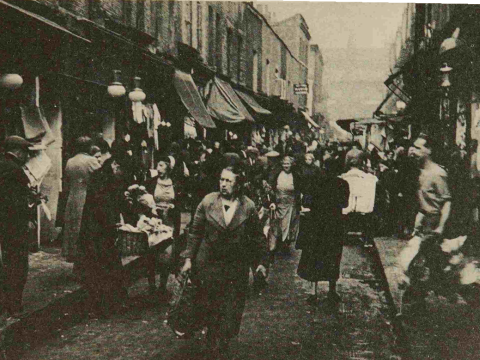
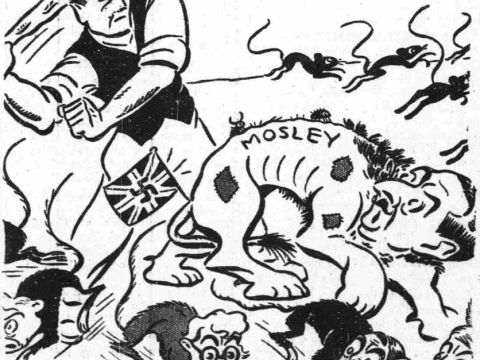
I was becoming increasingly aware that all was not well inside the Party itself. It seemed to me that for all the positive activity which was going on, very often initiated at the local level, there were forces at the top who were critical of some of the tactics being employed. The old argument regarding so called ‘street? work versus ‘Trade Union work’ was still raging. People were beginning to doubt the correctness of opposing all Mosley’s efforts to hold meetings and he was beginning to make headway in places like Green Street, Bethnal Green and Ducket Street, Mile End as well as in Limehouse. All these places being on the periphery of the Jewish areas.
It seemed to me that the time was coming when we would have to consider how to deal with the organised violence of the fascists supported by the police. The time was coming when it would be difficult for us to hold meetings without being attacked by gangs of Fascist thugs. If you tried to ask questions at Fascist meetings you were really asking for a beating up. People were saying, we must not seem to be behaving like the Fascists themselves by trying to break up their meetings.
In fact Piratin in his book says, there were people who were saying— ‘Bash the Fascists wherever you see them’(1). That is not what we were saying at all, but interpreting what we said in this way made it possible to make us look irresponsible and we could be called leftists’.
The questions really being asked at that time were, how do we meet the growing attacks on individual Jews who were being violently assaulted by Fascists and how do we meet the growing assaults on our organised activity? What to do when our people were whitewashing or selling papers, etc. and were attacked by thugs? How to prevent Mosley from making further penetration into areas where he had previously not been able to hold meetings?
As I saw it, this was not a question of how we attacked Mosley’s force and the police, but how we defended ourselves from them. More important still, how did we stop them from getting further support from workers who were vulnerable to anti-semitic propaganda. This whole question was a source of internal argument and discussion extending over a long period, as you will learn.
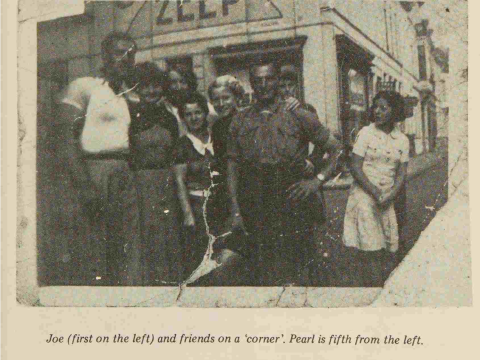
I don’t remember what was happening to me in my personal relationships, other than that Pearl and I continued to enjoy each others company and were now ina wide circle of friends in the movement which kept us busy and reasonably happy. There were lots of occasions for social activity of all kinds and occasionally we were able to tear ourselves away for outings and visits to the cinema or the variety theatres, on our own.
I had become a part of her family as she was now part of mine. Harold was becoming more and more involved with the anti-Fascist ex-servicemen which he eventually led into the formation of a very good organised body with big premises in Whitechapel Road and a fine lot of active people, who performed yeoman service in the fight against Mosley.
Several different aspects of the work which the ILD had been doing were being taken over by other bodies which seemed to come and go as occasion demanded. Usually Defence Committees set up around a particular case. Barney Becow was one example.
The pressure from the Party for different members to take on other activities was taking some of the active members from the ILD. The Coleman strike now in its ninth week also needed a great deal of attention. A proposal to collect five hundred pounds to send children from the East End to a holiday camp, had the support of the Mayor of Stepney, Councillor I M Vogler JP (2). The secretary of the Children’s Fund organisation was Mrs Finkle, formerly Finklestein, of the ILD. Her husband Alf was now engaged in Trade Union activity and had not been active in the ILD for some time. He had become critical of Nat Cohen and myself. He now joined the others on the Party branch committee who didn’t see eye to eye with us.
Then it happened. So far as I can find out it must have been late February or early March 1935. Certainly it was before Nat Cohen returned from the Soviet Union and I know when that happened. The last reference to the ILD in Stepney I can find is in February (3). This coupled with a reference to Mosley’s appearance in Cambridge has given me the approximate time (4). George Allison called a meeting of the members of the Party Faction of the National Committee of the ILD. I don’t know who had discussed our organisation or how a decision was arrived at without any prior consultation with us, but George simply said that the Party required us to liquidate the ILD.
I know that Alan Thomas was present but I can’t remember any others of the small group. Not more than six. I pointed out that we were a national organisation with many branches and a great number of non-party people working with us. George said that that was no problem as some of the work was being done by the Council for Civil Liberties and that this was a much broader based body and would do much better than we could. As for the rest, it was clear that without the active party members, the organisation would fold up anyway.
This was true, but I saw a great deal of value in the mass campaigning which we had done and saw no great reason why it should not continue. The answer to this one was that the Party needed all the active members to concentrate on building the party itself, because we needed a strong party in order to pursue the United Front tactic.
I could not see how the existence of the ILD did anything but help in that direction. I pointed out that it was precisely our kind of approach which made united action easier, and in the process we were able to recruit people into the party. Alan Thomas looked very glum, and I thought he rather agreed with me, but was keeping very quiet. I realised that he knew alot more than I did about what must have been going on behind the scenes.
It didn’t occur to me right away that ours was not the only organisation to be closed down. What had happened to the Workers’ International Relief? I said to George, ‘What about the fact that we are part of an International organisation?’ He said something like, ‘Don’t worry about that. It has all been discussed and decisions have been made’.
We had been visited some time earlier by a person called Peter, from Belgium. When he was here I had accepted an invitation to visit him in Antwerp, with Pearl, later on during the summer holidays. He was a very lively person, and a leading Party member in Belgium. I’m not saying that I know why he was here or what his mission was, or that he had anything to do with the discussion. It is possible that there was some connection. I don’t know. I never found out. He and his brother were both killed fighting in the International Brigade.
After a lot of discussion I found myself in a minority of one. The general attitude was that the Party had decided and we as disciplined members must accept the decision of a higher body. I had no difficulty in understanding that but I remained unconvinced of the political or any other reasons for the decisions. I must have been behaving in a rather hysterical fashion because George said that I was a young comrade and I would learn. He would do his best to let the Party Secretariat know my point of view. In the meantime I was not to discuss the matter with anyone outside the National faction.
It couldn’t have been more than a day or two after this meeting that George told me that I must attend a meeting of the Party secretariat to be held at 16 King Street, the head office. I was convinced that this was a bad decision and I was prepared to do battle when I came before the secretariat. I know now how inexperienced I was and how much I was taking on. I believed I could really have an effect on the leadership. Certainly I had a lot of experience in fighting for my points of view inside the Party at the local and district level. This was a different kettie of fish.
Present at the meeting were Harry Pollitt, Palme Dutt, J. R. Campbell, Bob Stewart and George Allison, who was not a member of the secretariat. I think, Peter Kerrigan came in later during the meeting. Pollitt opened up by telling me that this was an extraordinary prodecure which had been agreed, because I was considered a good comrade and very young. He said the secretariat were anxious to instruct me in such a way as to convince me that this was a correct decision. He felt I should not be lost to the Party for failing to accept the decision. I replied that I was not worried at this point about what happened to me, but whether or not he could convince me that the decision was correct. I added that I understood that at the end of the day, I could not think of opposing a Party decision and remain a member.
That out of the way, I was requested to say why I thought the ILD should not be liquidated in face of the growing need for concentrating all our forces to building the Party and working for united action with existing Trade Union and Labour Party organisations. I told them that I didn’t see how the work of the ILD, NUWM, League Against Imperialism or the Friends of the Soviet Union, in any way conflicted with the general aims of the United Front. In fact I saw the work of these and other organisations created to attract people around issues which might appeal to them specifically, as an excellent way of making contacts who could not yet accept the whole policy of the Communist Party. As a result of participating in these different kinds of activity they would learn to accept the revolutionary solution to all the problems which capitalism presented. I added that in the past, these socalled non-party bodies were used as levers and conveyor belts for policies which we sought to further. That is how I had always regarded them and I could see no need to change that view. If an unemployed man joined the NUWM to get help and to see as a result that he was being asked to help himself by taking part in the work of the organisation then he could eventually be taught that the solution to the problem of unemployment required an end to the system which produced such a thing.
Similarly if you were attracted to the movement because you had been arrested for attending a meeting or demonstration, or knew of someone who had been treated unjustly by the authorities, you could then be brought into the whole field of injustice generated by the capitalist system. Once again it was possible to win members for the Party from such beginnings. In the same way, if someone was sympathetic to the Soviet Union, then this interest could be expanded by joining the Friends of the Soviet Union and we would hope eventually becoming a member of the Party.
I repeated all the arguments I had put to George Allison about our National and International organisational ties. | wanted to know whether this applied to the ILD only and was this a decision taken at some International decision-making body, or was it just a matter for the CPGB?
The reply generally stated was that this was a tactical matter which I was not in a position to appreciate fully because I did not know the facts which had prompted the decision. If the leadership after due consideration had come up with a decision it was because they believed that they knew best how to deploy the forces available, which was something which could not be discussed publicly. Such matters as membership figures and precisely where they were employed on a national basis could not be gone into by the membership in general. They added that since it was a tactical matter in which no great political principles were involved, I should have no difficulty in accepting the decision and they were sure things would work out all right. I would see that the Party leadership were as keen as I was to further the aims of the Party and the working class, for a revolutionary solution to our problems.
I continued to argue and ask questions but after a long time, it was decided that I must accept the decision and undertake not to raise the matter anywhere, as this meeting represented the highest authority in between 1meetings of the Executive Committee. Somehow I had been persuaded that this was only a tactical question so I would carry on and do my best to abide by the decision. I was not happy and I said so. Then someone came up with another idea. It appears that Pollitt was due to address a meeting at the Guildhall in Cambridge the following day. He would need a couple of bodyguards.
So if I would go along with him, he could use some of the time of the journey to give me more instructions.
The secretariat were in possession of some threatening letters which said that Pollitt would be attacked and prevented from speaking in Cambridge and he had better not come. Mosley had addressed a meeting in Cambridge recently. Some of his supporters as well as other right wing bodies had decided that Cambridge should not hear Pollitt. It was agreed that I should find another suitable comrade and meet Pollitt the following morning.
I suggested Lew Mitchell and this was readily accepted. I found Lew and he was more than willing to join us. We left London as arranged. Henry Parsons was driving with Lew by his side and Pollitt and I in the back seats.
We decided that going by train was out as this would present anyone intent on attacking Pollitt, with an easy point from which to intercept him. So we went by car, intending to get within a few miles of Cambridge before turning off and skirting the town so that we would approach it from any other direction than London. Somehow Pollitt didn’t get round to discussing anything with me as was suggested.
He was in a jovial mood and was more interested in teasing Lew Mitchell who was making alot of noise about what we would do if we were attacked. Pollitt did not take the threats very seriously. He had faced that sort of thing many times before. He told us how he had been kidnapped while speaking from the tailboard of a lorry, in Liverpool. Someone had simply gone into the cab and driven away as he was addressing the meeting. He was dumped down in a quiet street and the lorry drove away and was abandoned. We all laughed.
The weather was very bad that day and as we got within about ten miles of Cambridge, Pollitt nudged me and whispered, ‘support me’. He then said to Henry Parsons, ‘I think it would be a good idea if we stop here and walk the rest of the way’. Well, if you would have seen Lew’s face, you would think he was about to burst open. He started to shout and wave his arms and what he wouldn’t do to those Fascist bastards if they came within a mile of us. He wasn’t afraid and he saw no reason to walk miles in the rain just to miss meeting up with them. I ‘supported’ Pollitt and Henry, who had seen what Pollitt was up to, was pretending to look for a suitable place to park the car. I thought Lew was going to have a fit. We allowed him to rave on fora few minutes and then Pollitt said he would only agree to drive on into Cambridge if we all agreed not to let the secretariat know that we had decided to take this ‘grave risk’. Lew calmed down and was happy. We arrived in the centre of the town without encountering any interference.
The meeting was not due to start before the evening and we had about five hours to spare. We did not want to contact the organisers of the meeting until as late as possible, as that might have presented them with a security problem. After having a meal, Pollitt and Henry wanted to spend a few hours at a cinema, reasoning that that was a good place to avoid an open attack.
Lew and I wanted to see the town. After seeing Harry and Henry into the cinema, we two ‘bodyguards’ left them and went for a stroll. After having a good look around, during which Lew took a great delight in whistling after the undergraduates in their gowns and mortar-boards we went back to meet Pollitt and Parsons outside the cinema. Then for some tea, by which time we decided to head for the Guildhall. We got into the car and decided to have a look round before actually approaching the hall.
People were going into the hall and there was quite a crowd outside as weil as a iarge force of police. We decided to approach the front of the hall and we were greeted by people who knew Pollitt. Apparently those who might have been waiting to give him a hostile reception didn’t even know what he looked like. We were approached by a senior police officer who ushered us into the entrance to the Guildhall and said to Pollitt, that in his opinion we would be well advised to abandon any attempt to hold the meeting. Pollitt replied that he had come to address a perfectly legal gathering, and that it was the job of the police to maintain order outside and our stewards would handle the situation inside.
Lew, Henry and I had strict instructions. We should take up positions in the front row and if any attempt was made to mount the stage we were to try to prevent anyone from getting there and not concern ourselves with anything that might be going on in the hall. If Pollitt should not be able to continue speaking, we should get to him by the shortest route and get him out of the hall and into the car.
That there was going to be some trouble there could be little doubt. Before the meeting opened noises were coming from the gallery which did not sound very friendly. Lew and I were to one side of the front row not far from some steps leading up to the stage. Henry had decided he should actually be on the stage, in the wings, so that he could get to Pollitt first, if necessary. The meeting was very well stewarded and the majority of the crowd were our sympathisers. The thing to worry about was if those who were intent on breaking up the meeting decided to throw missiles. This is always a big worry.
The meeting got under way in very good order. When Pollitt rose to speak he was received with loud cheers and hand clapping mixed with some loud boos and cat-calls. The interruption started almost right away. Mostly individuals heckling. Pollitt was more than a match for that sort of thing and after about ten minutes he had the meeting in the palm of his hand. Pollitt was a great orator. Not long before this meeting took place Princess Marina had married the Duke of Kent. When Pollitt mentioned Princess Marina the meeting suddenly erupted.
A soldier in uniform stood up at the back of the hall and started to shout. Pollitt was accusing him of having been sent into the meeting to provoke trouble as he had no right under military law to be there. That’s when all the tough guys in the gallery let fly. Our stewards were having a hard time restraining people and trying to restore order. No attempt had been made to approach the stage and Pollitt was determined to continue. The soldier was hustled out of the hall and things became relatively quiet. Pollitt finished his speech and the meeting closed. Lew and I were on the platform before you could blink an eyelid. We had Pollitt in the car and were moving away from the back of the Guildhall where the car had been left. We pulled up outside a big house which we all entered. This was where Maurice Dobb, the well known Cambridge professor lived. There were lots of people there and after Pollitt was seated in the centre and some drinks were poured we settled down to a happy review of the meeting, followed by a general discussion of the current political scene.
Lew and I had some difficulty in finding the toilet. Every door opened in this big house seemed to be full of young people lounging about. We decided to leave as late as possible to shake off anyone who might decide to try to get Pollitt on the way out of Cambridge. Nothing happened and we got back to London about 3.00a.m.
There had been no discussion about the ILD or anything else which related to my disagreement with the leadership. The following day I felt very much alone. I could not discuss things with anyone. I went to our head office in Doughty Street and I learned that Alan Thomas was winding up things in this office and that it would not be long before there would be no more ILD.
George was right about one thing. It would not be difficult to convince our people that we should not continue in business. The Council for Civil Liberties would be able to function more effectively!
As time went on I got more worried. The NUWM was continuing to function as was the Friends of the Soviet Union. The Minority Movement was still functioning and this was related to the Red International of Labour Unions. I didn’t realise that this was to go when it was decided that all our people were to join the reformist unions. But that did come. It began to dawn on me that only those organisations based on international ties were the ones to be liquidated. This would leave only the Communist International which was shortly to hold its 7th Congress, with Dimitrov as its secretary.
It didn’t seem possible then that even this would no longer exist. Had I thought that the Cl would cease to function, things might have been different for me. I’m quite sure I could not have altered the course of history. There were lots of people saying that something had happened at the top in the CI.
There was the NAC of the ILP. There was Trotsky. I knew little about all this as I did not and would not read Trotsky. James Maxon and Fenner Brockway did not appeal to me very much. Besides, I was sold on the idea of the Communist Party being the workers’ vanguard and without it there could be no successful revolution. In any case, the 7th Congress of the CI could not have been more outspoken in its determination to fight Fascism and war.
Now that I know what happened I am surprised that I refused to think things through to a logical conclusion. My whole development in the CP had made that impossible at that time.
Like so many who were to be perplexed by the Moscow Trials, Spain and the eventual disappearance of the CI I had only one of two alternatives. To remain a Party member and accept decisions or to vote with my feet. At all times when I found myself in disagreement with the leaders I felt as did Nat Cohen, that you could only be effective in fighting for your point of view so long as you remained a Party member. To risk expulsion or to desert was the end of the line. I had alot to learn. Learning was not going to be easy and it was going to take a long time.
As I write this, it is over fifty years since the Russian revolution occurred and so far as I can see the Communist Party has not succeeded in getting rid of capitalism in the world. Neither has it established Socialism in those territories it controls. The idea that Socialism could be built in one country was not new and I along with the rest of the membership had accepted this. What I did not see, was that Stalin had decided to make the defence of the Soviet territory the key to his relationships with the hostile forces surrounding that territory.
I felt that it was legitimate to try to divide these forces based on the differences between the capitalist states and these empires. Since there was an inter-imperialist rivalry which had caused capitalist countries to seek an advantage at the expense of their competitors in the world market, it was right to take advantage of such rivalries. If you could prevent all the opponents of the Soviet Union from combining to attack her it would be correct to try to do so. But surely the best defence of the Soviet Union would be the extension of the revolution to other countries, especially Germany, France, Spain and Great Britain.
Firstly, however, you would need to be convinced that such revolution were possible and then that you could do all in your power to make it succeed. If however such faith in the revolution was not held, then it would be correct to retreat from the policy of helping to make the revolution in other countries outside the Soviet Union. What then was the need for a Communist International? Hitler, Mussolini and the rulers in Japan were on the brink of concluding an anti-Comintern pact. If later on Britain and France and America could join in, this would be a possible way of smashing the Soviet Union, which all concerned would have liked. They along with many other states were after all, anti-Communist. It would be necessary to convince some of their governments that you would not try to foment revolution in their countries if they in turn would refrain from joining any attack on the Soviet Union. You could see a number of variations on this theme.
I did not yet begin to see these matters in this way. The Communist International still existed. The United Front tactic was succeeding in France and Spain. Even if the German CP had not been able to prevent Hitler’s victory over the German working class, it was still possible to oppose Hitler from all the other countries and help to make possible a successful overthrow of his regime in Germany. The 7th World Congress Communist International would have alot to say about how we could defeat Fascism and war.
I went back to Stepney and arranged a meeting of the Party members in the ILD which was addressed by George Allison who gave us ‘the line’ and the decisions of the Party leadership. I was under discipline not to oppose this line, so I had to vote for its acceptance without taking part in the discussion.
Strange to relate, no one seemed to think that anything was wrong. It was not the first time the Party members had to face abrupt turns in policy or tactics.
It certainly was not the last. I believe Alun Thomas went back to South Wales from whence he came. I don’t know what happened to other branches and I made no attempt to find out. The International Labour Defence was dead.
I was free to engage in whatever Party work was being carried on, and there was much to do. I was more able to take on activity initiated by the Jubilee Street cell and in the Stepney Branch generally. I was still amember of the Branch Committee and the Near East Sub District Committee. I should think that most of our active members in the ILD had become Party members because it was clear in Stepney at least, that Mosley should be fought and there were other dangerous threats hanging over the heads of the workers.
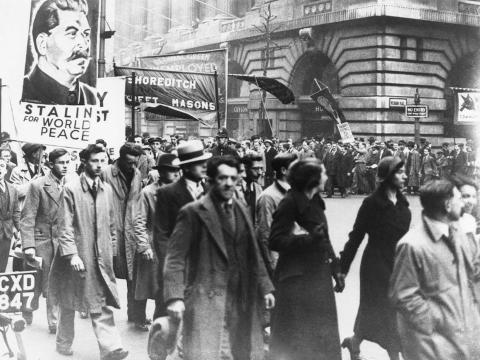
Around this time Sam Waldman, my very close friend, was the organiser of the Near East Sub District and I had lots of friends in Stepney. The Party members in the NUWM, Friends of the Soviet Union, Workers’ Theatre Movement and sports organisations, along with other broad-based anti-Fascist organisations like the Ex-Servicemen and Jewish bodies were largely engaged in agitational and propaganda work on the streets.
There were still the others who seemed to do little more than take part in the Trade Union movement, which included attempts to get the unions to join in anti-Fascist activity. I would have been content to see a sensible division of labour in deciding how our forces should be deployed. But the Trade Union people backed by some other leading members who were not themselves engaged in Trade Union work did not seem at all satisfied. They wanted more people to give up ‘street work’ for “Trade Union work’.
Almost all Mosley’s activity was on the street and I could not see how we could allow his efforts to go unchallenged. It was argued that if we had greater influence in the Trade Unions and Labour Party it would be possible to generate more united front action which in the long run would be more effective in the fight against Fascism. I could see this point of view but I was not convinced that the Trade Unions and Labour Party leaders would allow the CP to manipulate their organisations for furthering the aims of the CP.
There had been the ‘Black Circular’ against the CP, produced by the Labour Party. as well as a long history of how in the words of the CP—the Social Democratic role in society was to betray the workers. Look at what had happened in Germany. There had been a very strong CP, with massive electoral support, yet the Fascists had been successful. It was said then that this was all the fault of the wicked capitalist agents, the Social Democrats. Didn’t we call them ‘Social Fascists’ at one time? Hadn’t we said often enough that there was nothing to choose between the leaders of Social Democracy and Hitler?
Yes, but don’t you understand I was told. We are talking about building the United Front from below. We know that the leaders will betray the workers. Look at France and Spain. That’s what the United Front could achieve if we work correctly.
I argued that the position in France and Spain was quite different. A large part of the Trade Union organisation was not in the hands of right wing leaders. Much of the development in both those countries had been achieved by bringing the workers out on to the streets in big demonstrations against the Fascists and the near Fascist policies of their governments. In any case we could not afford to neglect the mass of unorganised workers like the unemployed and others. I was not arguing against the need for more and better
Trade Union activity. I was resisting attempts to curtail what was called ‘street work’. My personal responsibilities were not very great, and I was still feeling pretty bad about what had happened to the ILD.
Without telling anyone I decided to get away from it all for a while, so that I could try to see where I stood. I told my mother that I was going away for a few days. She should say that she didn’t know where I had gone if anyone should inquire. J never even told Pearl.
This was a bit mad really, but I was feeling so confused and I didn’t want anyone to find me. I wasn’t so sure that I even wanted to come back. I knew that my sister Debbie was now the owner of a restaurant in the West End. I thought I would go to her and tell her that the police were after me and that she should allow me to stay with her until the heat was off. I got to the restaurant which was situated in a narrow courtway called St Anne’s Court, which connects Wardour Street with Dean Street in the middle of the Soho district.
Debbie agreed to my request. In fact she was rather glad to see me and not a bit surprised. My sister Annie was living in Dean Street just opposite St Anne’s Court. So I saw her too. My younger brother Hymie was not around at the time and I don’t remember if he was in gaol or just out of town. I stayed there for three days and walked around the back streets of Soho during the day, thinking about all that was happening and where I stood.
What I saw of the life in that area made me feel sick. Debbie was being quite successful in running her restaurant and she fed me very well and provided me with a good bed. The people who frequented her place were all in or very near London’s underworld. Some of them were quite colourful characters but without any principles whatsoever, except for a kind of close attachment to each other which resulted in a willingness to help anyone in trouble, particularly with the law.
Most of their time seemed to be spent in clubs and cafes of all kinds. The back street pubs were also used extensively by these people. No one seemed to be working as far as I could see. People who worked for a living were referred to as ‘mugs’. The main activity which one could see going on was prostitution. Many of the men were pimps with only one girl working for them.
There were other ‘organised’ groups of prostitutes who were ‘protected’ by organised groups of white slave racketeers. Not all the men were pimps. Nearly all were engaged in various kinds of crime but their precise activities were not talked about in front of a stranger like me.
Annie was looking rather sick when I saw her despite her efforts to use make-up to cover her obvious deterioration. I met her ‘husband’, a young man from Manchester who later began to visit my mother with Annie and was accepted as a son-in-law. Annie was now the mother of a young daughter who was being looked after by a foster mother living near by.
After three days I could stand the atmosphere no more. I decided I had seen enough and my thoughts were clearer. I knew that I must continue to be an active Communist despite all the hard work and worry. What was more, what I had seen at first hand only confirmed what I already knew, and made me feel the need for increased effort to bring this horrible economic system to an end. I returned home and told my mother that I had enjoyed my stay with Debbie and I was alright now. I went round to Pearl’s place and everyone was asking what had happened to me.
I concocted a story about how I was feeling bad and that I had wandered off to the west end where I had met some people who took me in and looked after me for a few days.
Everyone had been looking for me and my mother had told them that I had said I would be away for a few days. She didn’t know where. She did know where I was but like I said, she had agreed not to say. No one really believed me and I was often chaffed about my sudden disappearance. I told Pearl the real reasons for what I had done and apologised for not confiding in her completely. I explained that since she was also a Party member I did not want to plant any suspicions in her mind about all the misgivings I had about the leadership.
So far as I could see the so-called wrong leadership was the sole responsibility of the British party leaders. I did not believe that the CI or our leaders in Moscow could be aware of what was happening here. I held that view fora’ long time. This opinion was shared by Nat Cohen when he returned.
As always we concluded that no good could come from excluding oneself from membership of the Party. Whether you like it or not, to be excluded meant that you were now opposing the revolution which only the CP could lead to a successful conclusion.
Pearl forgave me for my heartless behaviour towards her and I told her I would never again try to hide what I was thinking from her. We were very much in love and I tried to be frank and open with her although we were both to be tested very near to breaking point.
The war clouds were gathering. Hitler had introduced conscription. The Versailles Treaty was directly challenged by Hitler, as he had always said it would be if he came to power. An estimated half million were to be taken into the German army. Macdonald returned from Chequers for urgent cabinet meetings. Sir John Simon and Anthony Eden were to visit Hitler (5).
Many Party members were still puzzled by the outcome of the Kirov assassination. The Party produced a pamphlet written by Bill Shepherd, Moscow correspondent of the Daily Worker, called, The truth about the Kirov murder (6). Every effort was made to explain the work of counter revolutionary forces whose work extended right into the highest organs of the CI and Soviet Party. Somehow it seemed to make sense. To me it also meant that such forces would not neglect the leadership of the CPGB or any other Communist Party.
This could partly explain why I could not always agree with our leaders. I was suspicious but I could find no concrete evidence. It certainly must be possible for capitalist agents to enter our ranks. We certainly sent people into our enemy’s organisations. Why then should our enemies not infiltrate ours?
That made good sense. One needed to be on guard all the time. Once again it was imperative to remain in the Party at all costs to keep it from being subverted by counter revolutionary, imperialist agents. The problem was how to conduct a battle for the right Party line when you felt it was being led off the straight and narrow.
Opposing what was said by leading members would sooner or later lead to some disciplinary measures being taken to stop what could be called ‘disruptive activity’. It would not be easy. But to remain silent would be even more of a betrayal of one’s principles. I would have to learn how to deal with these matters as they arose. I knew that I had not been very good in dealing with the ‘wrong lead’ regarding the ILD but I was alive to tell the tale and to continue the good fight.
The Stepney Party was growing in numbers and extending its activities right throughout the borough. We now had a bookshop called ‘Carter’s’ which had become the full-time job of Phil Carter who had started as our literature secretary.
The bookshop operated for a long time in Stepney from premises in Church Lane. This was just round the corner from Manningtree Street where we now used a cafe owned by a sympathetic club owner called Wolfie Levene.
His son later became a leading Party member in Stepney, where he was also a schoolmaster. Phil Carter in partnership with his brother remained in the bookshop business and when I met him after the second world war, they were the owners of a very good business.
The local NUWM conducted a good campaign around the local employment register. This was a system whereby the local borough council could employ casual labour directly. It was proposed to transfer its administration to the Labour Exchange, over which there was no democratic control, unlike that of the Borough Council administration. Our campaign roused some interest and had the support of ex-Labour MP, J. H. Hall as well as Barnett Janner, our Liberal MP. This was allied to the fight against the means test and some good united activity resulted in highlighting the continuing plight of the unemployed (7). Individual cases were being represented by NUWM people who had become experts in fighting personal claims.
Once again the BUF had booked the Albert Hall for a meeting on 24th March (8). The Albert Hall was not available for anti-Fascist organisations. We decided to organise a march to Hyde Park on the 24th to oppose Mosley. This march was stopped by the police when it headed in the direction of the Albert Hall. Questions were asked in Parliament by Dingle Foot and Jane Maslow. There had been the usual scuffles with the police and a few arrests. Mosley had succeeded in holding his meeting (9).
The Coleman strike was now in its twelfth week. Pickets had been arrested and the firm was able to get some of its work done by outdoor tailors (10). This was always a problem for strikers in the tailoring industry.
There were reports of tenants fighting landlords, including local housing authorities, from Oxford and Swansea among other places. Evictions had resulted in families being split (11).
Anthony Eden had been to Moscow for talks with Stalin after his visit to Hitler. There was talk of anti-war pacts and it began to look as though not all the British politicians were behind Hitler’s intention to rearm Germany. Our contribution consisted of calling for an anti-war demonstration in Trafalgar Square on 31st March. Pollitt declared that the National Government was setting the pace for war (12). Eden went to Warsaw. There was a world wide interest in the Moscow Talks. The Daily Worker said, ‘Soviet Peace Battle hits warmongers’. A sub-heading said, ‘Organising Peace’ (13).
There was a further report on the Scotsboro Boys’ appeal against the death sentence which was being handled by the American ILD (14). This surprised me as I had been told that the International Labour Defence was to shut down as in Britain. It appeared not to be so. They had not been able to organise this as quickly as we did. It did eventually go out of existence confirming the fact that the original decision was made somewhere in the Communist International. This began to worry me even more now because I began to think that my acceptance of this as simply being of a tactical nature was not in keeping with the wide ranging character of the decision. I had to live with it. Harry Pollitt wrote a leading article in the Daily Worker headed, ‘Soviet Peace Fight Strengthens Workers’ Movement’ (15).
An eviction attempt on three families was successfully resisted at Edmonton. Unemployment was beginning to fall by a small amount. I must have been coming back into full strength in my Party activities because I found myself billed as Chairman of a meeting at the St Georges Town Hali to be addressed by Willie Gallacher, George Roper (NUWM), J. Hammond (ILP) and Nat Cohen, just returned from the Soviet Union. This was an anti-war meeting organised by the Near East Sub District Communist Party (16).
Nat was back. As he had been a member of the National Committee of the ILD I was able to ‘avoid’ breaking my undertaking not to discuss my disagreement with the leadership. This discussion was confined strictly between us. He shared my views, which was a big relief to me, because I had not had the ‘benefit’ of his guidance for almost a year and I thought it probable that I could be mistaken.
As in the past he continued to be my mentor and he was anxious to continue pursuing the Party line as he thought fit. He had no scruples in using me or anyone else in pursuit of that aim. I’m not saying that he did not stick his neck out, but he did push me into being the chief spokesman for his ideas. I was a willing tool. I was aware of some hostility to Nat from the leadership both at the local as well as at District and National levels. We had talked about this on occasions going right back to his arrival in this country from the Argentine. He was regarded as a ‘hot head’ and his methods were often criticised as being applicable to South America but not always so here in Britain.
We regarded such criticism as the thin end of the wedge against militant action on the streets. We felt this argument was beginning to manifest itself in the debate on ‘street work’ versus “Trade Union work’. One thing we always agreed on, was that there could be no alternative to the CP as the instrument for leading a successful revolution and therefore your membership was crucial if you were to be a revolutionary.
The usual internal Party meetings which were by ‘Party card only’ continued. The Party had just published a series of portraits and pamphlets by Karl Radek, leading Soviet journalist (17). The Finsbury tenants were still fighting for their 25% reduction in rents (18).
Two interesting adverts appeared in the Daily Worker personal column on the same day: ‘To Comrades Lily and Andy Davidson, Andy’s cafe, a daughter. To Elsie and ‘Shimmy’ Silver a boy, Frank, both doing well’. (19). Andy and Shimmy had been close friends for years. We made various cracks about this very good timing in their domestic affairs.
The Coleman strike ended after three and a half months. It was a complete victory. The strikers obtained full Trade Union recognition, reinstatement of the shop steward, the sacking of all blacklegs, work to start on the 20th, no victimisation, a six months’ agreement with the Trade Union.
The shop steward to be reengaged first and all workers to be reemployed. A bit different from previous efforts in the clothing trade (20). The necessity of a mass Communist Party was the keynote of Harry Pollitt’s speeches at this time. A report in the Daily Worker of the ILP conference supported a delegate, who had defended the Soviet Foreign policy by declaring that it had not changed, but only developed (21). King George V Jubilee celebrations were on the way. So was May Day.
Somewhere along the line, I can’t pinpoint it exactly, I had become Secretary of the Stepney branch of the CP. I’m not sure if it was before or after Nat’s return from the Soviet Union. | rather think it was soon after.
He had become instructor to the Jubilee Street cell which had grown to more than double its size. I can’t remember if I had been appointed by the District Party Committee (DPC) and endorsed by the Branch or whether I had been elected by the Branch and endorsed by the DPC. But there it was, I was the secretary and this began the most hectic period of my life, to say nothing of the internal battles which eventually resulted in a radical change which was to alter my whole future.
May Day emphasised our anti-war slogans in addition to its normal international solidarity objectives. The Red Flag challenged the Union Jack on the streets which were beflagged in preparation for the George V Jubilee celebrations.
About 5,000 took part in a May Day demonstration in Hyde Park (22). We organised a series of Eve of Jubilee Rallies in various districts on 6th May.
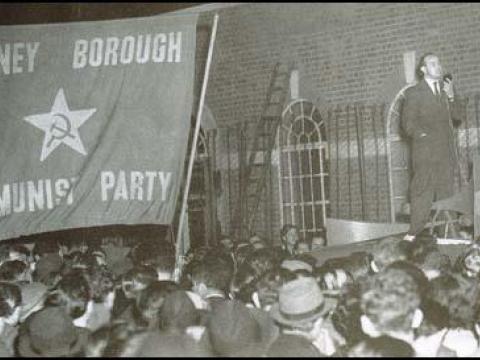
At Stepney Green, the speakers were George Allison, Willie Cohen and Joe Jacobs (23). The Labour Party May Day rally took place as usual on the first Sunday in May. We attended this as we had always done to inject our slogans into the proceedings.
Came the big day. The opening of the Jubilee ceiebrations. A massive programme of processions and street parties as well as gala performances of all kinds and big dinners in all the posh hotels and restaurants. Lots of speeches to be made, pledging loyalty to the crown and royal family. The unemployed were expected to join in this Thanksgiving for 25 years of George V’s presence on the throne. All this had to be challenged as best it could.
The main procession on the opening day was from Buckingham Palace to St Paul’s Cathedral for a service of thanksgiving. The route from the west end was by way of the Strand, Fleet Street, Ludgate Hill to St Paul’s. This would be the main processional way. How could we make a demonstration?
A very ingenious stunt was devised. The Daily Worker reported what happened as follows:
‘Jolt for Jubilee Parade! Drama of Red banner across the Royal Route! A huge banner stretching right across Fleet Street suddenly revealed itself with the slogan on one side—‘‘Workers of all lands unite!”’— and on the other—“‘25 years of hunger and War!”’ (24).
Remember that this was only one of the many big banners expressing joy and devotion to the crown as well as hundreds of flags and streamers of bunting and decorations of all kinds which had been put in place by the Ministry of Works in addition to the private efforts of loyal supporters who occupied the big offices and shops on the route. Quite a bit of money was made by letting window space etc. to people who wanted a good view of the procession. This is how that banner got its position and proceeded to present our message. On the eve of the Jubilee, after having made the banner and found an office in the middle of Fleet Street which was to let, we made our first direct move. I must explain why we needed empty premises. The banner was constructed in a special way. It consisted of the main wide canvas sheet bearing our slogans with strings coming from all four corners to be attached to the buildings on either side of the road. Each side was then covered by two sheets of equal size to the main one. These two sheets bore slogans of a loyal nature. I think there was ‘God save the King’ or something like that. By lacing the three sheets together top and bottom along the edges it was possible to conceal the main sheet until such time as someone would pull the laces at the right moment. In those days there were always places to let and it was a simple matter to approach the agents and get the keys to empty premises in order to view them as an interested party. My brother told me later on that this method was used to gain access to adjacent premises which had been selected for the purpose of robbery.
Fortunately the small office was directly opposite one of the high newspaper buildings in Fleet Street. On the eve of the day, when lots of people had already started to celebrate and Fleet Street had some of its share of revellers, a phone call to the newspaper office was made. Our people said we were the Ministry of Works and that after surveying the decorations had decided to place another banner across the road. Would it be all right to use one of their windows from which to suspend one side of this banner? Not only would it be all right, they would be delighted to assist in any way.
Our people arrived with the banner and after securing one side to the newspaper office the banner was dropped to the pavement. It was then necessary to carry it across the road to be hauled up to the windows of the empty office opposite. Some lively revellers who had been drinking had some great fun helping to carry the banner across the road where our man was at the window having dropped a line which when attached would enable him to draw the banner up and secure it in position. The police helped by holding up the traffic while this was done. Everyone had alot of fun including of course our blokes from the ‘Ministry of Works’.
The banner was now in position awaiting the following day when someone would be in that empty office ready to pull the laces. It worked perfectly. The banner was unfurled just as the Royal coach was due to arrive. Our man left the building before anyone could get to it in order to deal with the offending banner. Not before the news people had filmed the incident. This was cut out of the films which were shown but the press did report the appearance of our slogans.
The Jubilee week did provide an excuse for lots of celebrating which was enjoyed by the children as well as the grown ups. These street parties were great and all this was a relief from the hard fact of existing poverty and suffering which was normally endured. The enormous sums of money spent on the Jubilee were reckoned to be worthwhile by a government which was always seeking to excuse their inability to relieve the suffering of the unemployed. Royalty does have a hold on many workers and most people joined in the celebrations. Once again circuses did help to make people forget about bread for a short while.
With all that over, the East End still had to contend with Mosley’s attempt to divide the King’s loyal subjects. Not only in the East End. There were reports of fierce battles in Birmingham and elsewhere. The London District Communist Party held its annual conference where we had our usual reviews of the international situation (25). More speeches from leading Party members calling for greater efforts towards united action against the National Government, Fascism and War. I cannot remember ever hearing any differences of a substantial character discussed at our conferences.
Somehow these matters were always dealt with by commissions or committees which then presented a resolution based on the conclusions of these bodies. I can’t remember actually hearing a member address a conference to defend a point of view which differed from the leadership on any major topic. There were differences of emphasis and on relatively small tactical matters. People who had been expelled or had offended the Party were usually condemned in reports from these commissions with the concerned never being permitted to make a statement to the conference itself. Certainly it would be unthinkable for anyone to put anything in print to be distributed to the delegates, and hope to remain a Party member. I was to learn all about these matters in due course.
A feature of all our internal meetings was the frequency with which people would get on their feet to express their complete agreement with the leadership without adding one bit to the substance of what had already been said. Some of these people were loudly applauded for their loyal adherence to the line presented by leaders who were often referred to in very flowery language. One was used to hearing references to our “great leaders’ like Stalin or Pollitt.
I found it embarrassing to listen to such tributes to Springhall, Bramley, Mahon and others who I knew as quite ordinary people who could make good speeches, but were in my view, capable of mistakes of a kind which could easily be avoided. Sam Berks, my old friend, at one of our social get-togethers at his place later once did a skit of one such crawling comrade who never failed to address each meeting he attended in almost identical words except for the details for which that particular meeting had been called. Sam started by explaining that no matter which meeting it happened to be, whether in a hall or a room, Sam would take up a position near an easy exit in case this character should arrive. As he said, even if he was not present at the beginning there was always the chance that he would arrive late and explain that some ‘urgent revolutionary activity’ had held him up. ‘So’, said Sam, ‘I had to be ready.’ With suitable gestures Sam gave his version of this person’s inevitable intervention.
"Comrade chairman and comrades, I wish to be associated with the report given here tonight. This was a masterly outline of the world situation and I wish to. congratulate our comrade on his analysis which shows his mastery of Marxism, Leninism, Stalinism.
‘There is however one point upon which I wish to disagree profoundly. It shows an underestimation of the degree of proletarian revolutionary consciousness which is developing in our area.’
‘When he suggests that we should try to sell only four quires of Daily Workers at the weekend, he is guilty of this understimation. I declare that we can sell at least four and a half quires!’
Sam finished by saying, ‘I would not be present to hear the thunderous applause’. We had our quota of wild men and silly ones. Extroverts and introverts. People for whom no sacrifice was too great. Opportunists who knew how to climb ladders to whatever was thought desirable.
In the days when street corner meetings were going on all over the place it was possible to feel very important when mounting a platform to address the workers. There was really no shortage of people who would enjoy this kind of effort once they had been pushed into breaking the ice. I listened to some awful rubbish from some people who felt the urge to talk long and loud. Mosley also had his quota of good speakers as well as those who could do no more than spit out anti-semitic abuse. Come to think of it, I don’t know where public speakers of the kind we produced could possibly get any practice today. Maybe at the few places like Speakers’ Corner in Hyde Park.
I’m talking about the time when all that was needed was a box and a street corner and you would have a crowd ready to listen to almost anything.
Nationally known politicians now find it difficult to attract more than a handful of people to well advertised meetings, even at elections. It is still possible for strike leaders to address large numbers of workers in the old style, but that is another matter. Jack Dash the London docker was very good at that sort of thing. He had been through the old school in Stepney.
I recall his being around during part of my time but he was not yet the man of influence he was to become. He might remember me. I Know he has remained a loyal Party member through all these years. I don’t know quite how he managed to do that. Maybe like some other people I know, including Nat Cohen and Bert Teller, they simply cannot see any real alternative to the CP. They cannot bring themselves to believe that the reports from the Soviet Union including Kruschev’s admissions about Stalin are really true. They must know that all is not well, but they still think that somehow it must be better than capitalism. Like any religious fanatic, they will not oppose their gods no matter how cruel their behaviour may appear to be. They have this blinkered faith that even the most horrible results of the God’s actions is after all, somehow, leading them towards heaven.
Notes
1. Phil Piratin, op cit, p 17.
2. DW, 9.3.1935.
3. International Labour Defence meeting announced DW, 3.2.1935.
4. DW, 16.3.1935.
5. DW, 19.3.1935.
6. DW, 18.3.1935.
7. DW, 19.3.1935.
8. DW, 22.3.1935.
9. DW, 25.3.1935.
10. Ibid.
11. DW, 30.3.1935.
12. Ibid.
13. DW, 2.4.1935.
14. Ibid.
15. DW, 6.4.1935.
16. DW, 11.4.1935.
17. DW, 12.4.1935.
18. DW, 13.4.1935.
19. DW, 17.4.1935.
20. DW, 18.4.1935.
21. DW, 23.4.1935.
22. DW, 1 and 2.5.1935.
23. DW, 4.5.1935.
24. DW, 7.5.1935.
25. DW, 14 and 16.5.1935.
Comments