The advice contained in this section won't change the world, but it can help you improve your life by helping you not get messed around by debt collectors, the police or other public nuisances.
Personal guides

These ideas could also be used to organise around in community or workplace campaigns. Why not print them out, put them in a local newsletter or email them to friends?
Files
Personal guides.pdf
(1.08 MB)
Office worker's survival guide

The modern office is fraught with dangers. From the risk of getting fired, to stress, repetitive strain injury (RSI), mindnumbing boredom and more. This helpful guide from libcom.org will help you navigate these hazards to a happy work life, and perhaps a slightly better world...
Of course not all of the tips will be appropriate in every setting so pick and choose the right ones for you, depending on how safe your job is how much you care about it.
Appearance
A vitally important aspect of office life is how you come across to management and colleagues. If you want the kudos of being a hard worker, without all the bothersome hard work, then you need to look the part:
- Always look busy.

- Keep your desk covered in piles of paperwork.
- Don't say yes to meeting invitations right away, always check your diary first (even if you know you don't have anything in it) and frequently say you can't make certain times, and suggest others instead.
- Wherever you go, take files with you. If you walk briskly with files, you can go chat to colleagues, go for a walk, etc but it will look like you are going to do something important.
- Instead of actually working late, just leave your monitor on and leave a cardigan on the back of your office chair to make it look like you are still at the office when actually you're already at home with your feet up watching Gossip Girl. You could even leave a half empty cup of tea/coffee on occasion, and maybe even a half eaten bourbon biscuit (or other crappy biscuit, you wouldn't want to waste a good one).
- Use the e-mail scheduling function in Outlook (or whatever your e-mailing software is) to send e-mails late at night and early in the morning to make it look as if you have still been working.
- Eat lunch at your desk - but after actually taking your full lunch break off. Thus maximising your free time and looking like a dedicated employee.

- Have loads of programme windows open on your computer. This helps mask your web browser windows!
- Often have your voicemail box be full. Fill it with messages yourself if necessary.
- Help out workmates with little jobs. It makes you look helpful, and can make you popular, while not causing too much stress, and it makes life easier for them. And it makes others more likely to help you out when you're overloaded or don't know how to do something. And of course it's always nice do something which actually helps people, unlike much of your job.
Take it easy
Stress kills. Not only that, but working too fast is antisocial behaviour. If that sounds odd, let me explain: slow work means that more workers are needed. More workers means lower unemployment. Low unemployment means greater demand for labour, which puts an upward pressure on wages. So working fast means higher unemployment and lower wages. It also singles out those unable to work quickly enough, such as some disabled or elderly staff, putting them at risk of dismissal. Don't do it!
- Take the breaks you are entitled to. Look at your legal rights in your country, and your employer's procedures and practices. Encourage colleagues to do the same so individuals can't be singled out.
- Take additional breaks wherever you can. Many office-based workplaces will have health and safety policies recommending 5 to 10 min breaks every hour to help prevent RSI/eyestrain etc. Take them! You can also sneak breaks by smoking, or better for your health go out and chat with smoker colleagues on their breaks: after all, it wouldn't be fair if non-smokers weren't allowed similar breaks.
- Have naps. Regular naps reduce stress and can make a work day much more enjoyable. Try to find a private spot where you can grab 40 winks without being spotted. A lockable room like a private bathroom or one where your face can't be seen, so you can quickly wake up and pretend you weren't sleeping if anyone comes in.

- If you figure out a way to make your work quicker, or make the process more efficient, don't tell your boss! They may just give you extra work or worse reduce your hours or make staff redundant. Keep your innovation to yourself and use your additional time to do things you want to do, like write your novel, send personal e-mails or just mess about. You could always offer to take on a little bit more work, to make yourself look efficient without giving away how much free time you really have.

- Informally with workmates try to establish a rate of work which you are all happy with and which isn't too fast, and don't let management know what you're doing! If a new member of staff starts make sure you induct them into how you do things.
- If in your job you get the chance to work from home, try to get the work done in advance but don't give it to the boss. Then when you're at home sit around in your dressing gown eating Doritos and masturbating, and every couple of hours just send in a bit of work you had already completed.

- Take sickies when you need them. If you can find out what the average sickness absences at your workplace, make sure you get at least the average. Aside from giving you a break, it can help prevent discrimination against any disabled workers who have to take time off. If colleagues get annoyed about people being off sick, encourage them to take time off as well to level the playing field.
- Volunteer to do jobs which take you out of the office, especially with close colleagues. Not only does this make you look helpful, but it can give you the opportunity to go to a cafe, go around the shops, sit in a park, grab some beers etc.

- If you suffer from mental health problems or another disability and you are overworked, your employer may be required to make adjustments for you, which could include reducing your workload. Get advice on this from a trade union, or advocacy organisation in your area.
- If you and your colleagues are all overloaded, meet together and try to collectively agree a way to challenge it. You can have a look at our workplace organising section for suggestions on how to do this.
- Don't be a pushover: people who agree to do too much for bosses just get asked to do more. So try to be clear with your boundaries.
- Finally, nothing eases the stress of work like a little sabotage. Okay so you can't get those 45-odd working years of your life back, but finding your own ways of getting a little revenge feels bloody good.

Making the most of your pay
As wage slaves, the money is why we turn up each day. Obviously, the more of it for the least work the better for workers, although of course the opposite is true for our employers (here lies the central contradiction of capitalism). So they are always coming up with ways to try to get us to do more work for less. Here are some ways of turning the tables…
- Eat breakfast at work. Why get up earlier and eat at home, when you could be getting paid to have breakfast?! (Depending on your workplace there may also be free coffee and milk)
- Steal as much as humanly possible. Work steals our whole lives, so never feel bad about this, as we could never steal back everything which is taken from us. From time (doing what we want to do, rather than what the boss wants us to do) to stationery, to tea and coffee to computer equipment and beyond - get everything you can making sure you don't get caught.
- If management don't always see when you get in or when you leave, arrange with your workmates to take it in turns to get in late and leave early. If you use time cards, punch each other in.
- Try not to work any unpaid overtime, and encourage colleagues to do the same so "troublemakers" can't be victimised.
- Go to the toilet in work time when possible. Don't go in your lunch break, as you probably won't be getting paid for it. And you'll save money on toilet paper.
- Make the most of your work printers and photocopiers. Print out your personal photos, long texts you've downloaded and would like to read, photocopy revolutionary pamphlets, leaflets, posters and anything else you can think of.
- Take a look at our sabotage section which is full of accounts of workers slacking off on the job and getting the most out of their employers.
Not getting fired
Some jobs are more secure than others. Your risk of getting fired also varies greatly depending on the country you live in and your employment status (agency, permanent, etc). So here are some general tips to make it less likely as whatever your situation:
- Try to make yourself indispensable. Try to either get or hold onto some important responsibilities. If you are the only one who knows how to do something, guard this knowledge closely. Keep shortcuts you know for doing things quickly to yourself.
- Know your rights. Read up on your employment rights in your area and for your type of contract, and your employer's procedures. The more you know the better position you will be in to protect yourself from dismissal.
- Join a union. If there is a recognised union at your workplace, you should join it as an insurance policy. Look into their track record first to see if it is worthwhile. If there isn't a recognised union depending on where you are you could join a general union which might be able to represent you if you got in trouble.
- Get to know your employer's code of conduct and acceptable behaviour, so you know what lines not cross.
- Hide the fact you're a slacker!
- The best defence against redundancy or disciplinary firing is the solidarity of your workmates. If you can get your co-workers to stick together and take action to defend each other this is the most effective way of stopping dismissals. See our workplace organising guide for suggestions on how to do this, or our workplace activity section to read the organising experiences of others.

The internet
The internet can be a bit of a minefield at work. On the one hand it offers more opportunities for rewarding shirking than ever before (I have often wondered what office workers did in the days before the net, just stare at their typewriters?). On the other hand, it is easy for employers to monitor and can get you fired. In general you could take your cues from other colleagues, especially more long serving staff. If you know that lots of people surf the web all the time, and no one has ever been disciplined then maybe you can relax. But you should be aware that employers can easily track all internet and e-mail use, and can discipline or dismiss workers easily for personal use of them.
These tips are based on it being better safe than sorry:
- If you are someone who management doesn't like, or if your employer is going to be making redundancies, it can be advisable to be on best behaviour with respect to internet use, because some employers can use workers' web use to sack people they don't like, or to make redundancies on the cheap. Pointing out others being worse than you won't help you.
- Steer clear of any indecent/profane material. This can definitely get you sacked, and many employers use software which automatically looks for swear words on your screen or in e-mails, so stay away from it. Especially don't use work e-mail to slag off bosses or other colleagues.
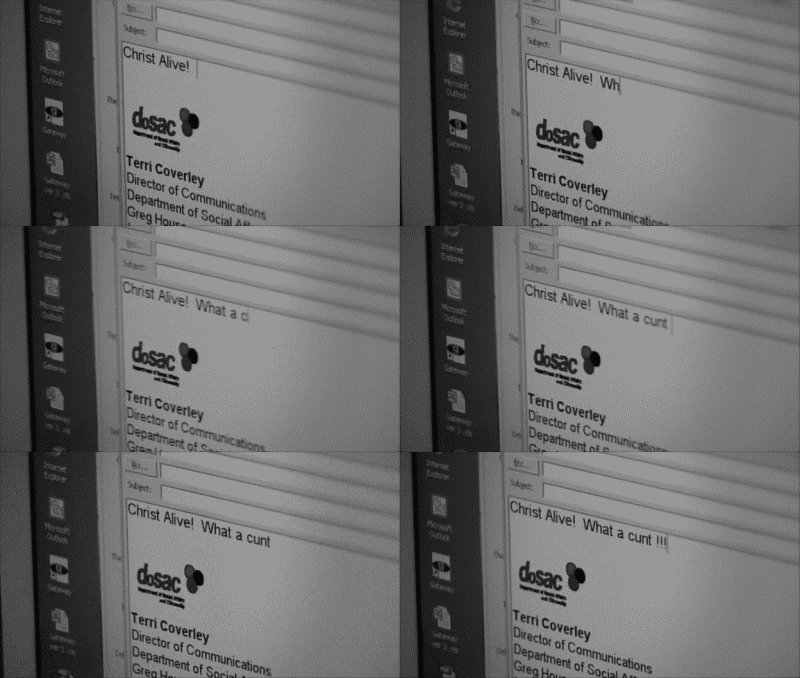
- If you have a smart phone or tablet computer with mobile internet you can either legitimately or sneakily use, that would be a safer way of browsing without your boss being able to track it.
- If you are going to browse the net at work, be aware of who can see your screen. You can even put a mirror on your desk (or leave mirrored sunglasses) to watch for your boss coming with your fingers ready on the alt and tab keys!
- To be safest of all, you could just copy and paste websites you want to read into Word documents, then either bring them to work on a USB stick to read them, or upload them to your personal e-mail account's drafts folder and download them from there, but don't save them to your work computer. You can also do other personal projects like this, such as work on your own blog or help format articles for our library. Better still, write your own account of your working life or your one woman/man workplace rebellion and post it up on libcom!
Now you have read this handy guide, you are ready to shirk, like a boss.
Post your top tips below.
Files
Libcom.org- Office Workers Survival Guide.pdf
(352.18 KB)
Comments
Steven.
Make the most of your work printers and photocopiers. Print out your personal photos, long texts you've downloaded and would like to read, photocopy revolutionary pamphlets, leaflets, posters and anything else you can think of.
Just a tip on this: check the print queue first (usually start menu > network > printers on windows systems). There's nothing worse than printing off something obviously anarchist/communist, then getting to the printer only to find a manager is stood there waiting for a 100 page report to print, and checking to see which pages aren't theirs. So either check the print queue's clear before you print, or you'll have to think on your feet ('i'll bring that over for you when it's finished printing' saved my skin once).
You can also set the job as a 'locked print' so it will only print once you get to the machine and type in your password. I've had a few close calls before just sending stuff to the printer!
Joseph Kay
Steven.
Make the most of your work printers and photocopiers. Print out your personal photos, long texts you've downloaded and would like to read, photocopy revolutionary pamphlets, leaflets, posters and anything else you can think of.
Just a tip on this: check the print queue first
Rename the file as well... having "How to shirk work, crush your boss and achieve FULL COMMUNISM.pdf" in the printer queue is not ideal.
Steven.
and maybe even a half eaten bourbon biscuit (or other crappy biscuit
I take great offence at this one. The bourbon's are actually one of the best biscuits in my office, they go really well with coffee!
Ugh. 10min late for work... gotta go
Could always have some fun too, I just found this today http://www.officeleaks.com
Lots of companies already on it, seems legit.
Good point about the printer, I have nearly got caught before. At a previous temp job I had, probably about eight years ago now, some days I would start work until about 8 PM printing thousands of pamphlets, leaflets and stickers. I got my money's worth from that place…
Cooked
Steven.
and maybe even a half eaten bourbon biscuit (or other crappy biscuit
I take great offence at this one. The bourbon's are actually one of the best biscuits in my office, they go really well with coffee!
cooked, I feel sorry for you. I can't imagine what biscuits you must be used to. Maybe digestives, or nice.
One day, we will tell stories like that to our grandchildren, of how harsh life was under capitalism.
good post, nodded my head to a lot of those points!
couple of small tips regarding internet use: most browsers allow you to disable images - this sometimes helps make browsing look more like reading a document. use encrypted IMs like skype rather than unencrypted ones like MSN if you want to talk to work colleagues or friends, they can't be monitored (as far as i understand).
Good article. I really need to work out how to shirk properly at my job.
PRinting is more dangerous than photocopying. No one is going to check stuff coming out the copier tray, but they will often look at stuff from the printer.
Renaming files etc is a good idea. Personally now I have a real job *sigh* I don't use the internet for anything that I could remotely get in to trouble for, the computers record everything which I try to use to my advantage. Always email everything! that way there's a record of it on the system. Unless you don't want a record, then you just go and tell the person :)
You guys are all utopian armchair anarchist dreamers who know nothing about labor discipline.
http://libcom.org/forums/theory/labor-discipline-under-socialismcommunism-16022012
snipfool, that's some crazy high-tech stuff!
One thing to be wary of is that some employers have software which looks for things on a screen and take screenshots apparently. One libcom poster got sacked for sending a private message to another poster with "c*nt" in it…
Yeah, disabling images is a good one, I forgot about that since I no longer browser work, but might edit it into the article. Means porn isn't as good though*
*This is of course a joke, you should never do that at work, unless you work in Japan, where it seems like it's okay: http://www.dailymail.co.uk/news/article-563571/Civil-servant-Japan-logged-780-000-hits-porn-sites-months.html
Great article - done most of these, but defo a few I should start doing too ;)
Many an Organise! and SolFed leaflet paid for by THE MAN!
I'm gonna agree with Ethos. Take pride in your labor. If you are unwilling to work then what good are you?
jonk88
I'm gonna agree with Ethos. Take pride in your labor. If you are unwilling to work then what good are you?
I think at this point it might be worth pointing out that Ethos' post was sarcastic ;-)
It's a couple of years since I worked in an office, this brings back memories and also makes me feel out of date.
While logging has gone up a lot in that time, I used to use http://ghostfox.mozdev.org/ at one job - let's you have firefox open with no images, all grey small fonts inside another application, and just moving the mouse off the window will hide it. I used to have it in a large-ish outlook preview window so it looked like an e-mail, and moving mouse off would just show the e-mail.
Won't get past screenshot monitoring but you'd have to be really up close to see any difference in person. You can load it off a usb stick so you don't have anything installed.
Was going to suggest people look into proxies and tor (I never got to the point of needing those at work and it'd be even riskier if you got found out), but tethering to a 3g phone from the desktop is a much better idea since you only need to change the wi-fi settings.
Not sure how you could set it up (a bit harder to disconnect and reconnect a monitor than an alt-tab), but these will be available soon. It'll be possible to have a full credit card sized PC driving a desktop monitor that'd fit in a tin of mints for about £20.
http://www.raspberrypi.org/
Maybe someone could write a guide to "masking" software and other techniques. I could have really used this info a few years ago. Management were frequently monitoring my internet usage and emails due to my union activites and online political voyages.
sabot
I just avoid looking at libcom from work.
In the mind numbing boredom of the office some of us are to weak to do that. Libcom and other far-left forums killed a lot of hours.
My former boss caught me printing off communist tactics and world revolution. He said nothing until an office party when he told me he was once a member of the SWP a lifetime ago and was quite well read on Marxist lit (I then lent him the copy I printed off). Turns out his girlfriend (also a former SWPer) ,now wife, got pregnant so he had to go for the foremans job (so the workingclass can kiss his ass).
Awesome Dude
sabot
I just avoid looking at libcom from work.
In the mind numbing boredom of the office some of us are to weak to do that. Libcom and other far-left forums killed a lot of hours.
My former boss caught me printing off communist tactics and world revolution. He said nothing until an office party when he told me he was once a member of the SWP a lifetime ago and was quite well read on Marxist lit (I then lent him the copy I printed off). Turns out his girlfriend (also a former SWPer) ,now wife, got pregnant so he had to go for the foremans job (so the workingclass can kiss his ass).
My boss used the term "a fair day's pay for a fair day's work" on me before. :cry:
Also a lot my co-workers are frequent visitors on infowars so I keep the commie thing on the DL as best as I can. On tuesday I had someone try to convince me that there were microphones in the computer monitors.
I had an old Tro boss who was ex-WRP. He was kicked out of the party in the 70s because they thought he was a blind police infiltrator. True story.
This has been mentioned, but you all seem technically clued up enough, have you thought about using a USB version of TOR (the proxy router) to make this more secure/flexible?
If you've got enough control to route your IP anyway it seems, so this will add a useful mask and let you use a non IE web browser. Also it's a handy tool to have in general, what with the 'snooper's charter'.
Also, make sure you use the office phone for those long, boring phone calls to the tax people, your electricity company, your bank etc. It'll probably save you money on high phone charges and it looks like a legit activity being sat at your desk on the phone.
I've been doing so little work and getting away with it that they're hiring someone else to do my job as well, so I am a 'job creator'. I just hope they don't let slip how little work there is to do and get me fired.
Beating the bailiffs guide

Bailiffs can only win when they get us on our own - if we stick up for each other, we can stop them
Getting overloaded with debt and don't know what to do? This articles contains useful advice, tips and contacts for dealing with debt and bailiffs.
Overloaded with debt? Bailiffs threatening you?
Some useful advice from WAG...
Firstly, get advice from your local Citizen’s Advice Bureau. They are busy, but very helpful.
Bailiffs firms and the police break the law if they think that they can get away with it. Knowing your rights, and making sure that the Council and Bailiffs have followed legal procedures, should buy you some more time.
Several key things to take note of:
If you’re still stuck and would like some help with taking on the bailiffs by whatever means are necessary, you could do better than get in touch with your local libertarian group (see our listings or ask in our forums for details) or ask your friends and neighbours to help you out. Walthamstow Anarchist Group also have more information about your rights against the bailiffs - see their website below.
If you are struggling with debt, both the Consumer Credit Counselling Service (0800 138 1111) and National Debtline (0808 808 4000) offer free information and advice.
Written by the Walthamstow Anarchist Group
Edited by libcom, last reviewed 2006
Comments
Dealing with accusations of benefit fraud guide

Never let them scare you into signing or admitting to anything
Some tips and advice for any claimants who are facing accusations of benefit fraud.
The Government spends hundreds of thousands of pounds talking about this but actually has little success prosecuting alleged fraudsters. It is important to remember that receiving benefits you are not entitled to does not automatically make you guilty.
Overpayments of benefits can be caused through official error and claimant error and may not actually be classifiable as fraudulent.
If you are accused of fraud by benefit agency staff don’t pay any attention to their attitude, much of which may be bluff, as in the case of bailiffs.
Remember, you are allowed to agree or disagree with statements they ask you to sign and there should be no coercion on their part what-so-ever.
If you are found guilty you should always appeal.
Bear in mind that benefit underclaiming is much more widespread than fraud so never, ever, let them make you feel guilty and admit to anything.
Written by the Walthamstow Anarchist Group
Comments
Further info can be found on Edinburgh Coalition Against Poverty's 'Links' page : http://edinburghagainstpoverty.org.uk/node/42
Dealing with credit card debt guide

Cut-Card.jpg
A short guide to help you deal with credit card debt, as consumer debt in the UK continues to spiral.
Cut it up!
You don’t need to work for the Financial Times to realise that credit card debt is getting well out of hand. Ten years ago hardly anyone had one. Now there are 91 million credit and debit cards in the UK. Two fifths of our shopping is now put on the plastic. The net result is a large portion of the population with massive credit card debt. Given the extortionate interest rates charged this is seriously bad news for us and the source of gleeful hand rubbing for the high street bankers (what’s that rhyming slang for I wonder?) who are pocketing it.
We see it like this. Credit cards have been introduced not to make our lives easier, but to extract money from us. Credit card debt acts like a mini mortgage – got to keep our noses to the grindstone so as not to miss any payments. We lived without them for years, and can start doing so again. To help you on your way to liberating yourself from plastic purgatory we have our “Cut it up” campaign. The first step in taking part is as easy as you make it. Get your credit card and take a pair of scissors to it. This may seem hard at first, but believe me, the feeling of relief when its done is immense. Worried about the debt you’ve accrued? The most important thing is not to panic. There’s plenty of free advice you can get out there, and things really might not be as bad as you think. For starters, did you know the following?
We don’t claim to be legal experts. We certainly don’t claim to offer “impartial” advice either – we despise bailiffs, bankers and other creditors as much as anyone and support fair means or foul to get the better of them! Some decent, free, practical advice is available from The National debtline on 0808 808 4000. Their website is www.nationaldebtline.co.uk
Alternatively, you could visit a local Citizens Advice Bureau.
Written by the Walthamstow Anarchist Group
Comments
Dealing with street harassment guide

A guide for women with advice on how to effectively deal with sexual harrassment in public.
Harassment is: Any number of acts or comments which make you feel physically or sexually unsafe or uncomfortable. They can be made by people you have known for years or by perfect strangers.
Basic Advice
If you are the victim of harassment, take the following steps:
Be safe
Safety is a priority. If you are in a situation in which you feel unsafe at all, remove yourself from it as quickly as possible. Do not put yourself in unnecessary danger for the sake of making a principled stand.
However, if you do feel safe enough to respond to your harasser, do the following:
1. Name the behaviour
For example, "Don't slap my arse. That's harassment" or "Don't make suggestive remarks to me. That's harassment" or "Don't talk about my body. That's harassment" or "Don't stare at me. That's harassment". You can also simply say in a strong voice, "Don't sexually harass women" or "Stop! That's sexual harassment."
2. Name the perpetrator
"You, the man in the blue pinstriped suit, get your hand off my breast" or "You, the driver of the blue Polo, don't stare at my breasts"
3. Use strong body language
Look the harasser in the eye and speak in a strong, clear voice. Be confident in what you say and do.
4. Do not apologise or ask a question
For instance, don't say "Excuse me...", "Would you...", "Do you realise...", "I'm sorry, but...", "Please..." etc
5. Do not get into a dialogue with the harasser
Do not answer any of the harassers questions. Simply repeat your statement or leave.
So, for example,
What you should not do:
You say, "Don't shout 'Nice tits' at me or any other woman. That's harassment".
He says, "Jeez, can't you take a compliment?"
Don't say, "Yes, I can take a compliment, but that's not a compliment. That's harassment."
He will then counter with something like, "Well, you're crazy if you take it that way. I meant it as a compliment."
This allows him to justify his behaviour to you, himself and anyone else standing around.
What you should do:
When he says, "Jeez, can't you take a compliment?" either leave the situation, having made your point, or repeat your statement. If he continues to try to engage you in a dialogue, either leave or keep repeating your statement.
6. Do not swear or lose your temper
For many harassers, the goal is to get a rise out of you, which is why they participate in this kind of behaviour. For them to see you getting angry or upset just encourages them to continue to harass both you and other people.
In addition, if a passer-by hears you shout out, "You f***ing arsehole!" when they have seen or heard nothing the harasser has done, they will tend to think you are the harasser. This, again, benefits the harasser, who can put on a "Can you believe this woman?" look. If you remain calm, it will be clear that you are the person being harassed and the perpetrator is in the wrong. It will also take away the reward (upsetting you) for their action.
Taken from Anti-Street Harassment UK, edited by libcom
Comments
Gardening and food-growing guide

Personal advice and tips on growing your own fruit and vegetables to stay healthy and save money.
We all know the advantages of organically produced food, but why should we have to spend a fortune on organic fruit and veg? It is often from miles away, over packed, expensive, a bit manky by the time we get it and in some areas only available from supermarkets.
Another option for some people can be to grow it yourself. Producing your own food is a top buzz! It saves money (especially if you are growing more expensive or rarer varieties), keeps you fit, reduces food miles to food inches, tastes better, teaches you lots, and is a whole lot easier than people think.
Professional gardeners and gardening books have done a lot to portray food growing as something which only an experienced producer with a hundred acres, and tons of machinery and biocides, should even consider taking on. Small time growers are often poo-pooed and people with no access to land often give up before they've started.
But there is so much that can be produced with minimum space: mushrooms in the airing cupboard or on an old compost heap, endless summer salads from just six or seven square feet, pots of jam from just one mature currant bush, sprouted seeds from anywhere you can fit a jam jar and huge tomatoes in the cab of a parked up truck.
Try not to get disheartened by lack of space. It is quite incredible the yields that can be obtained from the tiniest plot, or even urban balcony.
There are many opportunities to get access to land. If you live in a town, you should be able to get an allotment. These are wonderful places to meet other gardeners, swap plants and pick up tips. These green oases are under constant threat from developers, so having an allotment is one of the best ways of protecting their survival.
Another option is to use other people's land. Ask to use a neighbours abandoned garden, advertise for one, or even squat!
WWOOF (Willing Workers On Organic Farms) is an excellent scheme that places people who want to garden or farm organically, both nationally and internationally, on fix-it-yourself placements. Placements can last from two days to years, usually for bed and board. A brilliant way to travel and grow.
There are several books. 'The Permaculture Plot - a guide to Permaculture in Britain', and 'The Organic Directory - your guide to buying natural foods" which lists organic farms and small holdings that take working visitors. Similarly ‘Diggers and Dreamers - a guide to Communal Living’ lists intentional communities of varying type, who may take visitors. Although these options are nowhere near as the same as having your own garden they can offer experience. contacts and a chance to get started
So even if you haven't got a garden. Go on get growing! Grow some of your own healthy chemical-free food, even collect your own seed. Try it, it’s not hard!
WWOOF tel: 01273 476 286
National Society of Allotment Growers tel. 0153666576
Permaculture Association tel: 01654 712 188
Henry Doubleday Research Association tel 01203 303 517
Soil Association tel: 0117 929 0661
The Permaculture Plot - a guide to Permaculture in Britain ISBN 1 85623 0104
Diggers and Dreamers - a guide to Communal Living ISBN 0 951494546
Organic Directory - your guide to natural foods ISBN 1 900322 03
Taken and edited by libcom from Schnews
Comments
Haven't ye seen this? http://www.wwoof.ie/
If it's personal exp. you want to hear of I don't have any, as I've only done wwoof in Spain
Infosec 101 - Preventing Doxxing

Steps for Protecting Yourself from Doxxing
Intro
What is doxxing?
Doxxing is a technique of tracing someone or gathering information about an individual using sources on the internet. Its name is derived from “Documents” or “Docx”.
Why doxx?
Doxxing is a method of intimidation often intended to threaten or silence someone.
People can use leaked information to harrass, not just the targetted individual, but their friends and family as well. Sometimes employers are contacted in hopes that those doxxed will be fired for their beliefs.
With so much information publically available on the internet--posted by either companies or ourselves--both fascists and anti-fascists use this tactic against their opponents.
Strategy
Relative privacy via maintaining distinct spheres
This part of the guide assumes you have one or many online presences. This could be social networks, message boards, job sites--anything you need to log into.
Often in doxxes, information is not collected in one single place but triangulated from many sources. Do you spend your time on r/politics or your loose Facebook aquaintence's wall debating? Do you frequently like or repost statuses from radical Instagram or Twitter accounts? Do you have images or personal information on job boards?
Each on their own may not be a problem, but together they can be dangerous. Ask yourself:
How separate are each of these accounts/identites?
What is public? What is private?
What does public and private mean in the context of each site?
Take a moment to think about the way in which all of these spheres overlap IRL.
Does your job allow you to be your political self?
Do you filter some or all of your social media content from relatives?
And futher still....
Are there any references to illegal activies?
Do you filter some or all of your social media content from relatives?
What follows are a few examples of someone's online presence across sites. While the examples use six different categories, there could always be more.
Relatives - How open is the relationship between you and your blood/legal relatives? What could a stranger, having information on just one person in this network, discover about the others?
Politics - Do you discuss or post about your political beliefs online? If so, on which platforms?
Friends and Community - If you have social media, who are your friends? your followers? In what ways do your online communities reflect your IRL communities?
Hobbies - What hobbies do you have? Do you have friends and community through them? Are you a part of any internet communities dedicated to those hobbies?
Legal - Who are you on paper? What names, phone numbers, and addresses are you tied to? Do any of your accounts have this information? Any other sites (probably without your permission)?
Career - Does your job require an online presence, a website, or a social media account? Would there be a problem if your politics overlapped with your career or is your career in some way tied to your political identity?
These are just a few examples. Maybe they overlap in ways making some redundant, or maybe there are some these categories don't take into account. However, given that many people are present online with different goals, it can be useful to think about how you're represented in each.
Let's examine a few examples:
Dangerous online presence
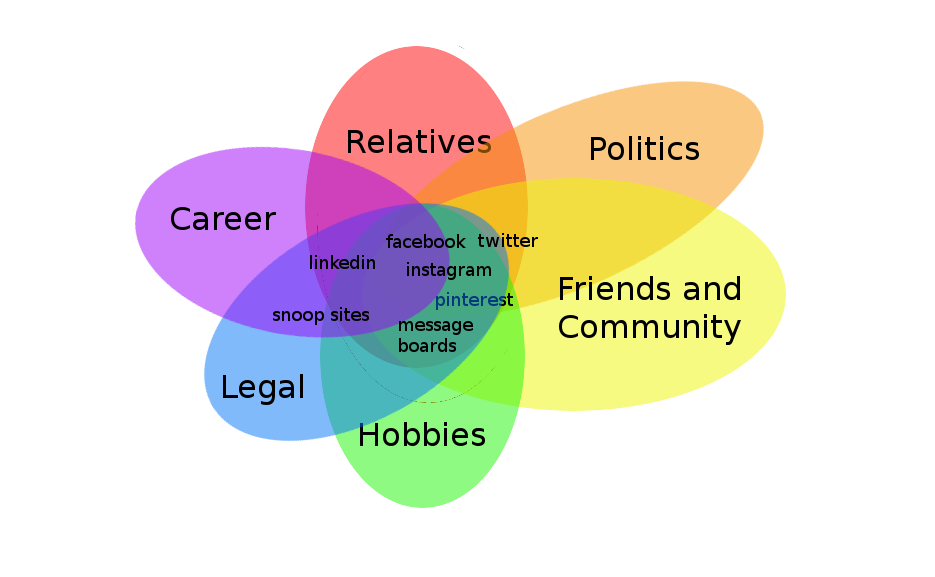
This person's online presence isn't very safe because there is far too much overlap. Even if their Facebook and Instagram are private, from a Twitter or message board post, one can get their username from other sites.
Or perhaps their legal name is known. With enough digging on various snoop sites, it'll be possible to find relatives and perhaps even their contact. Snoop sites will often link to social media accounts as well. While the younger generation tends to be better at keeping their accounts on lock, their older relatives generally aren't. One simply has to search the relatives' public accounts for pictures, friends, or other details and all your security would be rendered useless.
Somewhat safer online presence
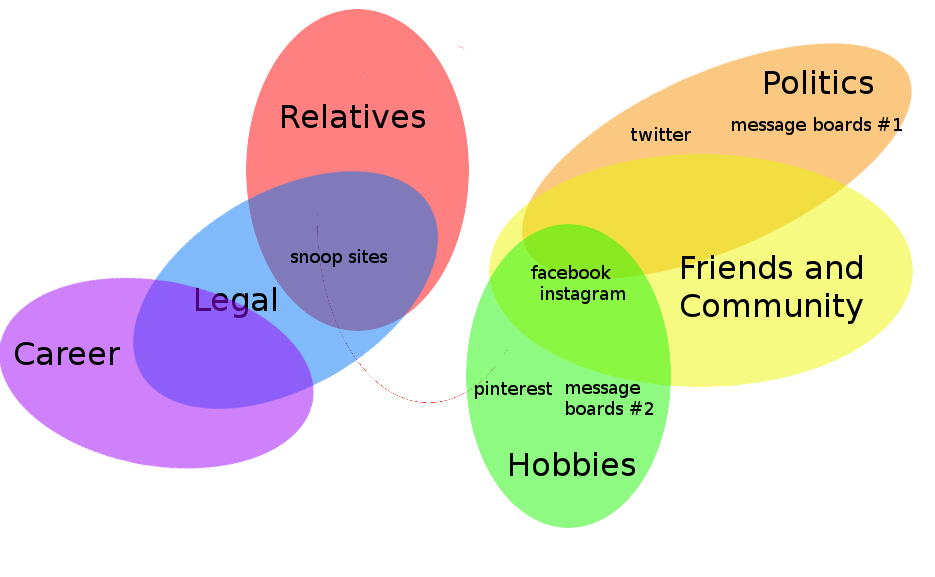
What makes this one safer? The most significant difference is now one essentially has two selves: one legal and professional, the other radical.
This is okay, but still poses many risks. First, it requires that one be extremely careful about not letting the two identies overlap. No shared emails. No adding relatives on Facebook. No way of tying the legal you to your hobbies or politics.
A minor but significant difference is separating one's politics from one's hobbies (I'm assuming here one has hobbies outside of politics). This doesn't mean you have to IRL, but there isn't a good reason for the same account to debate politics on Reddit one moment and asking for motorcycle help the next.
Another somewhat safer online presence
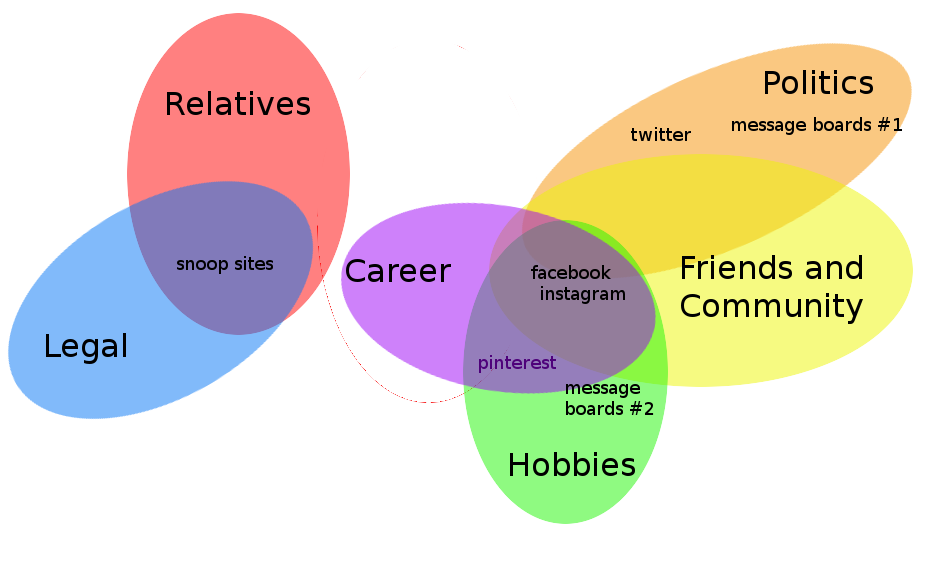
The key difference here is that one's source of income is no longer tied to one's legal self. This approach may be better for artists and craftmakers, but it does rely on a clean split, never having used one's legal name tied to one's work.
One's work likely relates to one's hobbies, and if one creates things that are political in nature, it becomes hard to separate--especially from one's friends and communities. Here, separate social media with clear distinctions is an absolute must, and while a private personal account could promote one's work, accounts relating to one's work must completely avoid anything personal.
It's important to note that these are only suggestions for how to craft one's digital presences and not a set of rules. Strictly adhering to them may not protect your identity, and one may luck out and fly under the radar without thinking through their presence to such an extent.
And yes having absolutely no online presence is perhaps the safest, but people have grown accustomed to having a digital presence and should not need to give it up if they find it fullfilling.
Tactics
Managing your online presence on a site-by-site basis
Now that you have a fuller picture of where different parts of you exist online, you can start to unravel the pieces you want to keep separate. Start by creating new accounts and usernames. Go back and delete content that doesn't fit with with what you want each persona to be.
Put everything on lock. If it's personal, opt for the strictest privacy settings. If it's political and public, make it untraceable to you. Perhaps create new identities entirely.
Delete everyone you cannot personally verify and unfollow any radical account you're not entirely certain of. On and outside of social media be wary of honeypots.
(Honeypots are fake profiles or pages fascists and anti-fascists create to collect and network profiles of the other.)
Social Media
Social media is often a starting point for being doxxed. What information is public? What accounts are linked? What information can be gained about someone's network?
Facebook - Facebook is pretty awful when it comes to privacy defaults, but fortunately, there is an up-to-date guide to setting privacy settings.
Instagram - Is your Instagram private? If not, is there any political content? Are there photos of you or your loved ones? Could you vouch for every one of your followers?
Twitter - Twitter is a bit of an outlier because people often use it as a platform to be public, which is fine if it is separated entirely from all other accounds. If it's linked in any way, however, you'll want to set it as private.
Online Networking
To quote one private investigator, LinkedIn is the worst thing to happen for privacy and yet the best thing to happen for people who make a career of finding others.
Are you actively looking for a job and would benefit from having a public LinkedIn? In that case, it may be an unfortunate necessity, and your best option is to separate your legal online presence from all others. Even still, ask yourself what information is necessary. Do you want your address and phone number accessible to anyone who downloads your résumé? How close could someone get to your other identities by weeding through your high school's or university's graduating class with the years you have listed?
People tracking sites
Numerous sites exists for tracking people and publish personal details without their consent. Sometimes, a little work will get you removed. Other times, what they have is there for anyone who puts the time and effort into finding it out.
Finding all of these sites and navigating their policies can be the biggest headache of this process, but the more you remove, the deeper someone will have to dig. Hopefully too, if your legal identity is separate enough from others, people won't have a starting point. Instead of going through each of these sites, here is a list of links that will hopefully remain up-to-date:
Motherboard's list of sites to opt out of with links
A guide to for opting out of the most popular search sites.
Privacy Broker's list of 3rd party data collection sites.
Another massive list of sites to remove yourself from with rating about how easy each are.
Hacks, etc.
Despite maintaining a crafted and innocuous online presence, you could still fall victim to being doxxed. Up until now, this guide has focused on the legal means anyone with time and energy can use to find information about you, but there are other ways of obtaining data. Your account could be hacked. Though it's not likely someone will crack you gmail password, data breaches are fairly common. Even if someone isn't a hacker, they can by hacked data.
This is why, when separating online personas, different usernames and circles may not be enough. Think back to the graph and ven diagrams. Each self should rely on a different email account with a different password. A password vault will keep you from having to remember dozens of passwords. Two-factor authentication may be annoying, but it could prevent someone from logging into your account.
haveibeenpwned.com tracks data breaches. Enter your email and test it out. If any accounts have been breached, change everything that shares and email or password.
Remember when Equifax got hacked with all that personal data? Here you can see if you were affected.
questions || concerns || innacuracies || more info -- reach out to [email protected]
Comments