
Brief historical notes on the organisation the Anarchist Youth Network (AYN). The AYN was a loosely-organised grouping of young anarchists, supposed to be based in Britain and Ireland. Lasting only from 2002 to 2004, it suffered many of the weaknesses common in the contemporary anarchist movement of the English speaking world.

"Bring the war to the streets" AYN art project
These notes are the personal views and recollections of one early London AYN member, which has been checked for accuracy with several other former members from London and Essex. This article was written rapidly in one evening, is heavily London-centric in its view and is not intended as a complete history, nor as a flawless analysis but more a summary of the lessons that I took from my experiences in the group.
Beginning
Against the background of a lively "anti-capitalist movement" based largely around mass demonstrations at international financial and governmental summits, the AYN was founded in 2002 by two members of the anarchist-communist Anarchist Federation.
They set up a meeting in a café in London's Leicester Square with about 10 other young people who had expressed interest in the idea of an anarchist youth organisation. The people in attendance were mostly male, and from 14 to 20 years of age. Most were school students, with a couple of university students and one or two young wage workers. Three of those present had been involved in the small-scale action-oriented anarchist group the Wombles, one of whom was also in the AF. Apart from the other AF member none to my knowledge had any previous involvement with anarchist organisations. One or two of these had been loosely involved in state socialist groups, as had one or two of the others, including Revolution (youth group of Trotskyist grouplet Workers' Power), the Young Communist League and the Socialist Workers Party.
Much of the initial discussion was deciding on a name, and with all new suggestions, such as The Edelweiss Pirates1 , being rejected the provisional name of "Anarchist Youth Network" was adopted. An email list was set up and a further meeting organised to bring together a larger group of people to officially start the organisation.
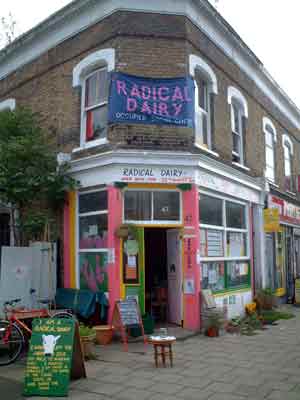
The meeting took place at the Radical Dairy squatted social centre in Stoke Newington, East London (pictured, above) and the AYN was official. It was decided that it should be a network of autonomous groups which would keep in touch via email lists, internet discussion forums and regular network "Gatherings". All local groups and affiliated individuals (though there was no official membership) would be entitled to use the AYN name. No political points of unity were established, other than the group was "anarchist", and no strategy was developed other than attempting to grow the network and undertake small group direct actions.
It quickly became the UK's fastest-growing anarchist organisation, as young people who had been radicalised by the anti-capitalist movement and weren't interested in bureaucratic, hierarchical Trotskyist parties sought to put their new ideas into practise.
Zenith
At its height in mid to late 2003 there were around 70 to 95 people who were involved in some AYN-affiliated group. There were some other dispersed individuals who had contact with the network via the internet, including one in Northern Ireland, who was the reason for the AYN being called Anarchist Youth Network: Britain and Ireland, even though contact was lost with him by late 2003.
The majority of people who became involved with the organisation had no previous involvement with other socialist or anarchist groups, though many had involvement with single-issue politics such as anti-war, anti-GM or animal rights campaigns. There were people involved between the ages of 13 and 26, with the majority being 15-20 years old.
Nominally affiliated groups were located in the following places, with the following estimates of peak numbers involved, the names of the local groups if they had them, and additional information about the groups:
Bristol
3-6 - Bristol Anarchist Action (BAA) - short-lived group founded by a former Swindon group member.
Essex:
3-4 - Essex Youth Resistance (EYR) - Two or three people were heavily involved in the network, the group had a class struggle bent.
Glasgow
3 - A group if I recall correctly called Glasgow Anarchist Students seemed to consider themselves linked to the AYN only very briefly in its early stages. When the students were all expelled from university for political activity there we heard nothing more from them.
Herefordshire
3-4 - Herefordshire Anarchist Group (HAG) , who later requested to be listed as an all ages group but whose young members were still linked to AYN. Had members in the Anarchist Federation.
London
30-40 - London Anarchist Youth (LAY) - At its peak the London group was having fortnightly meetings of around 40 people. Two main nuclei – one class struggle, one individualist (albeit both highly activist) with a large periphery who were not very active in organisational work or decision-making.
Manchester
6-12 - Manchester Anarchist Youth (MAY) - This group was the second largest in the AYN, and had a generally affinity with green, Earth First style "direct action" politics.
North East
2-3 - North East Anarchist Youth - Two individuals from in and around Newcastle who came to one network gathering attempting to form a group which never got off the ground.
Stroud Valleys
2-3 - Stroud Valleys Anarchists (SVA) - Pre-existing group which joined AYN and had one member (who was also in Class War but later left) heavily involved in the network. Had a somewhat crude class struggle politics.
Surrey
8-9 - Surrey Anarchist Group (SAG) had a young contingent who were among the founders of the AYN, and were originally a Woking Wombles-linked group, with one member in the Anarchist Federation, and one ex-YCL.
Swindon
2-4 - Swindon Organised Subversives (SOS) - Two people were heavily involved in AYN throughout, and were ultra-lifestylist primitivists. For an example of the discussions we had with them, see their article, The distraction of class.
West Midlands
4-6 - West Midlands Anarchists (WMA) - all ages group with its young members loosely associated with the AYN.
Worthing
2-3 - Worthing Anarchist Youth (WAY) - linked to AYN for a time. Small group action-oriented politics.
The AYN had bi-annual Gatherings to co-ordinate and to help people keep in touch and maintain the identity of a unified organisation. Two large gatherings of 20-45 people were held in London by LAY, with two smaller ones of 10-15 in Manchester by MAY and Birmingham, by WMA.
Activities
The AYN and groups within it undertook various activities during its lifetime. These were almost entirely ill-thought out with no look at long-term goals or objectives. In London at least they were centred around involvement in demonstrations and small direct actions, and producing some propaganda.
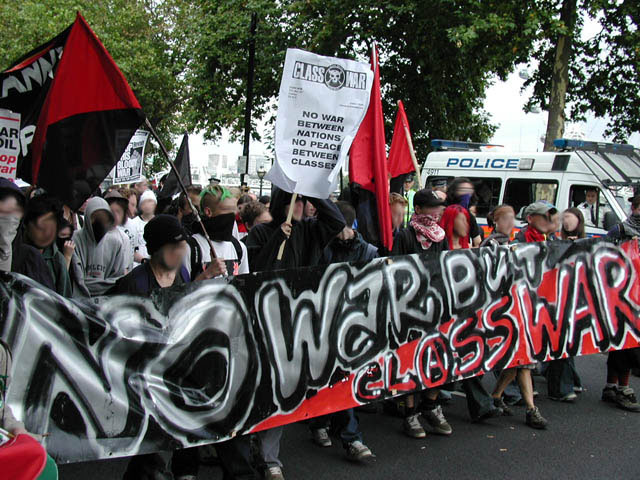
The AYN's first attempt at a reasonable large-scale initiative was an anti-capitalist bloc on the September 28th demonstration against the looming war on Iraq (pictured, above). Initiated by the London group and taken up as well by various people around the Wombles, the aim was to lead a break-off from the main march to try and invade the nearby London Soldier army recruitment event and cause as much disruption (or damage) as possible. On the day a block of about 150 people came together with a reinforced banned in front, which was quickly surrounded and escorted by police. The army event was closed with large barriers around it, ITV news stating it was shut down due to fears anarchists would disrupt it.
Following this perceived success, the AYN organised other, less successful anti-capitalist or "libertarian blocs" (as they were later named) on demonstrations, in an attempt to unite the anarchist movement and show the anarchist movement as a sizeable, serious force.
The London AYN group also produced a small amount of AYN propaganda, written almost entirely by two or three people, and printed almost entirely by one person. Leaflets were made explaining what anarchism was, and an anti-war leaflet linking opposition to war with opposition to capitalism was made. Only a few hundred to a couple of thousand were distributed. LAY also printed a couple of hundred older theoretical and historical pamphlets written by other people, which were distributed on a few AYN stalls at anti-war or big socialist events.
AYN attempted to start anti-war group Direct Action Against the War Now (DAAWN), which never got off the ground, before the Wombles started the similar Disobedience, which also floundered albeit slightly less disastrously. A big emphasis by some of us was put on attempting to escalate confrontations on peaceful anti-war demonstrations. This was attempting to import an atmosphere some of us had experienced in the big European summit demonstration, which apart from not being particularly politically useful, simply did not translate into a UK setting where political violence has not been as prevalent as on the continent.
Some AYN members were individually involved in organising and participating in the mass walk-outs of school students against the war. This inspiring movement could have been one arena in which an organised intervention of the network could have had an impact. However the network just did not have the coherence for any concerted activity. Similarly, during the national firefighters strike individuals in London and Essex supported the strike by producing and distributing leaflets, and raising money for the strike fund but again there was no coordination, and the majority of the network failed to see the importance of the strike.
One or two small-scale direct actions were undertaken, such as an attempt with some non-aligned anarchists (embarrassingly including myself - I was young and foolish) to storm the Israeli embassy in opposition to the killings of Palestinian civilians, immediately after the failure of which the activists foolishly thought it would be a good idea to then try to storm the Israeli airline El-Al's offices instead. This action led to several house-raids and arrests of AYN members and other anarchists involved. They were originally threatened with charges of Violent Disorder, which carries a 5-year prison term. This together with having their houses raided was disturbing for some of the members involved. One DAAWN/AYN-peripheral individual who was arrested after apparently being mistaken for me threatened to grass me up. This individual - "Squealer Andy" as he came to be known - was one of the several absolute nutters and arseholes who hung around AYN and were tolerated, when they should have been rapidly shown the door. See also this snapshot of AYN local groups' activities.
Decline
Over time contradictions within the AYN began to worsen. As the wider anti-capitalist movement ran out of steam the network stopped bringing in new members, activities continued to have diminishing returns and this accelerated the progression of these contradictions
The main problems with the actual political organisation were, in my opinion:
Commitment
Most people involved in the AYN were not active in any sense or than in a subcultural social respect. People would turn up to meetings and hang out, chat on email lists, chat rooms and internet forums but would not carry out organisation work like write and produce outreach materials, organise, facilitate and minute meetings, hand out leaflets, raise money etc. Almost all organisational work in London was carried out by about 4-5 people (including myself), and almost all national AYN network work - such as organising gatherings, moderating forums and lists, updating the website, checking email, etc. - carried out by those same people. In retrospect it is clear that this was partly due to the aimlessness of the group, but mostly was due to lack of commitment of most people involved.
Politics
The AYN had two main political problems - one was internal political differences, the other was political immaturity. There were two main broad tendencies within the network: class struggle, social anarchists and more individualist, anti-organisational anarchists. Some of the class struggle anarchists in London undertook most of the AYN's organisational work.
There was a general anti-intellectualism within the group that saw politics all being boring, irrelevant "dead men with beards stuff." This hampered any political discussion. When discussion was held it was on the useless terrain of "green" versus "red" anarchism - neo-primitivism versus anarcho-syndicalism or -communism.
The political immaturity of the entire membership cause one of the founding AF members to leave the AYN almost immediately. Even the class struggle anarchists within AYN were confined entirely within an activistoid framework, with no conception of how radical politics can relate to people's everyday lives. We were viewing class struggle in terms of the "actions" of anti-capitalists, which would "attack capitalism", and get bigger and bigger, effectively attempting to "kick the system till it broke."
We did not stop to think about how capitalism was reproduced every day due to the everyday actions of billions of people, and how real social change can come about only due to the slow processes of transforming all of our lives and activities, slowly attempting to build on currents of working class solidarity and mutual aid.
We had no idea of what would be useful political activities which could increase our and our fellow workers' class confidence and help ourselves collectively take back control over our own lives and surroundings. As such we devoted our time to organising "actions", and attempting via propaganda to make more people into anti-capitalists and anarchists. We did not look at the problems in our everyday lives and attempt to apply anarchist solutions of direct action and solidarity to them alongside other workers similarly affected, to try to slowly help build an independent, militant working class movement to advance its class interests.
I believe most of the membership were not actually anarchists, as they had no understanding of what capitalism -which they were meant to oppose - actually was. This reflected the nature of most of the so-called "anti-capitalist movement" which Aufheben magazine effectively demolishes in this editorial. This state of affairs could have been changed had there been effective means of educating ourselves and our membership.
Collapse
People began to drift away as it was clear the network was not achieving anything. People got older and left, and local groups disintegrated as key people left the area to go to university. There was an attempt to revive the organisation by starting university-based groups. Contacts were made at the following unis:
University of Bristol, University of Birmingham, Cambridge University (Anti-Capitalist Action), Cardiff University (Alt&Shift), University of East Anglia (Norwich Anarchist Students), Keele University, Oxford University (Oxford Students Activist Network), Goldsmiths College (Goldsmiths Anarchist Society), London School of Economics, Royal Holloway, School of African and Oriental Studies, London University College London (M12 Collective), and possibly more.
This attempt to find direction, however, failed since the problems of the network were far more fundamental.
The informal grouping of class struggle anarchists in London who had done the bulk of the organising work called a meeting of LAY in which we said we would no longer do any organisational work, and that if other people wanted to take it up they were welcome, and could continue the network. No one in London did.
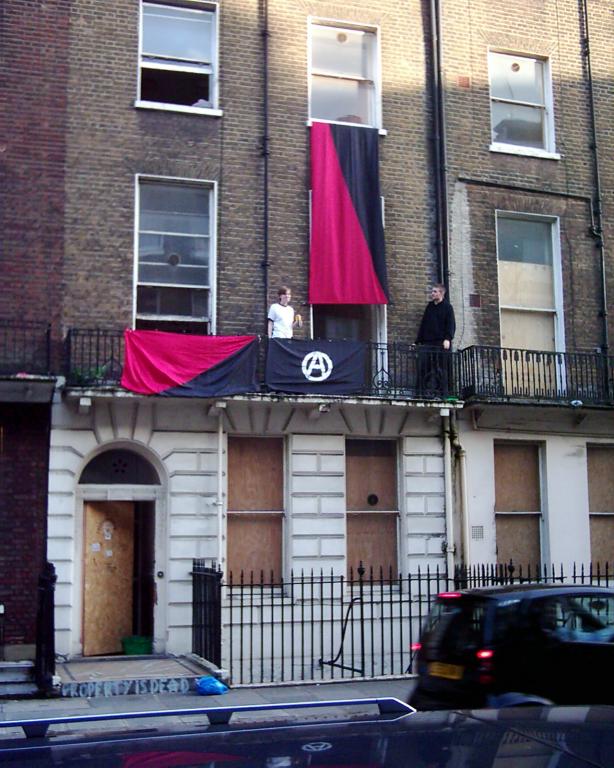 The Bristol group attempted this briefly but was unable to, and a brief attempt was made to resurrect the London group as an explicitly class struggle, membership organisation but by now it had totally run out of steam.
Some local anarchist groups like WMA remained, just no longer linked to the AYN, and the London group split into two principle factions - the class struggle anarchists, and the more action-oriented, individualist and "post-leftist" anarchists.
The latter became the Black Star Collective and became involved in squatting social centres (see the Marble Arch squat which hosted the Summer 2003 AYN Gathering, left) before rapidly shrinking, some people dissolving into other similar groups.
The former became the enrager.net web collective, later the libcom group, running the libcom.org website. Some of these people initially assisted with Black Star projects in a naïve attempt at "unity."
The majority of the London AYN group simply drifted away, as did most of the rest of the network. This confirmed my thoughts that the bulk of the membership were not actually anarchists but subcultural alternative kids enjoying the social and cultural element, and feeling "rebellious."
Personal lessons
I believe that I learned a lot due to my involvement in AYN. Mostly a lot about how not to run a political organisation, and here's a quick summary of the key lessons I think can be gleaned from the AYN. (I apologise in advance for any rambling in this section - writing is not my strong point.)
Organisation
That loose networks without defined memberships are not effective organisations. AYN was powerless to intervene effectively in any struggles due to disorganisation. Local groups were too disconnected from each other, and the joint "network identity" was only ever really used by the London group, so nationwide or large-scale publicity was impossible.
Theoretical unity
That to be politically useful organisations need clearly defined principles and points of political agreement, which are narrower than just being, as AYN was, "anarchist, young and in a network." Without basic levels of agreement on key issues we were unable to produce proper outreach materials, get involved in struggles collectively, or even decide which struggles were worth supporting.
Collective responsibility
That political groups are not social circles for subcultural types to feel at home in. If people aren't committed to the political ideas or the activities of an organisation then they should not be tolerated in it. With no membership fees organising fundraising was also the task of the small number of people who did most of the rest of the organisational work.
Class
Without an understanding of the class nature of capitalism, (that it is based on the working class selling our ability to work as a commodity to those who own the means of life and survival) and an orientation towards attempting to increase our collective confidence, autonomy and power as a class then a "revolutionary" organisation is useless.
"The movement"
This is not even to mention the completely flawed conception of the role of political organisations that we held, or the utterly pointless substitutionist and juvenile activities to which we devoted most of our time. Though I feel that we were not entirely to blame for that, as we were strongly influenced by certain elements of the anarchist movement (the activistoid2 end most active in the anti-capitalist movement) who we looked up to and felt we should imitate.
We were only young, and so we emulated the activities of older anarchists, and I think we were keen on winning their approval, like they were older siblings or something. As such we were quickly sucked into the bizarre activistoid anarchist ghetto which is so far removed from mainstream society, in which valued qualities are very different to most people. It is a peer group where getting approval means adopting a weird lifestyle, fitting into a largely punk aesthetic, appearing "hardcore," glorifying violence and militant imagery, looking down on many lifestyle choices of most people like eating meat, having a job, etc. There is the social pressure to attempt to engage in more and more militant and extreme action, which while it didn't have any real negative consequences for us, it can (and has done to some extent in the US, or UK animal rights movements) when some young people get involved in pointless, elitist urban guerrilla activity, glorified within the activistoid scene, such as that practised by the ELF, Weathermen, Baader-Meinhof, etc.
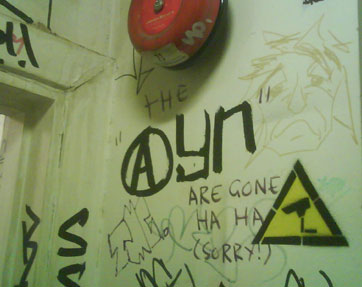
AYN tag in the gents toilets of The Foundry, later modified by one of our Revo Trotskyist rivals, who ironically later became an anarchist himself, and was involved in Liberty & Solidarity, an even worse group.
Generally this is just part of the pressure to remove yourself more and more from mainstream society and become part of a self-referential subculture which revolved around informal hierarchies, petty rivalries, elitist buzzwords, misanthropy, disdain for ordinary "brainwashed" people, anti-intellectualism, and propaganda and action which has no relevance to the everyday lives of most of the population. But those too entrenched in this subculture do not realise this since they surround themselves entirely by others in the subculture, never putting their ideas to test in the real world at their jobs or amongst non-politicos.
I think that the activistoid scene in which the AYN grew was the cause of most of its problems, especially when combined with the naivety of its members. Our idea of what political activity was was shaped by this scene, and our experiences showed quite clearly that it was utterly bankrupt. I'm glad we had the good sense to call it a day.
I write this in the hopes that other people can learn from our mistakes, and do not repeat them. I have heard of the existence of an Anarchist Youth Federation from the 1980s which made many of the same errors as us, if this knowledge had been passed on maybe we could have done a better job...
Steven Johns, libcom group


Comments
This is a really good and
This is a really good and useful assessment, especially the concluding 'personal lessons' section. Me and some friends are setting up a libertarian socialist society at our uni, and we will do our utmost to learn from the experiences of the AYN.
Passing down experiences from generation to generation, critiquing them, and continually evolving the way we operate is so important, so thanks again for this article.
Glad you found it useful!
Glad you found it useful!
Do you know if any of the
Do you know if any of the former AYNers are still in AF?
I was involved in the second
I was involved in the second incarnation of the group in Manchester and can confer most of whats been written, no defining structure or accountability, anti-theoritical, irrelevant sub-cultures and some awful politics.
Quote: Do you know if any of
I think so, but since I've been away from the AF for 5 years I can't say for sure.
Quote: Do you know if any of
Not as far as I know. In London, most disappeared into the activist scene or out of politics entirely (of course, minus the few who started libcom and some of these are now also in Solfed). Not sure about elsewhere though..
I think that one of the two
I think that one of the two founders, the one who left after about 10 minutes, is still in the AF. Or at least he was last I heard of him a few years ago, was national secretary for a bit I believe, name begins with C
Quote: Do you know if any of
You should maybe ask on the internal forum
Yeah, other people who
Yeah, other people who weren't in the small founding group are still in the AF as far as I'm aware as well. Like where's my shoes, for example.
I thought farce was just asking about the original two.
this is a very very
this is a very very interesting article. I just find the chance to read the article.
I found lots of parallels with the turkish anarchism. In 2002 similar anti-war demos and similar rise in anarchism. I was in high-school then, very confused. I was not even clear about the differences between anarcho-syndicalism and anarcho-communism but still, I wanted to be involved in some "direct action". I was very influenced with the red army fraction and stuff like that. At that time there was a newly found anarchist youth federation (AGF still exist in a vegetable form in istanbul). Actually the movement was then divided between pro-organisational (not-class struggle) anarchist youth and more older generation with no organisational aims.
Some people who were disullisoned with both came together towards 2002 summer (I guess) and formed an explicitly class struggle group (liberter - there were around 4-5 people in it). We were very confused. Some of us (including me) were very close to platformism others were not, still all of us were calling ourselves class struggle anarchist with one exception who was a bookchinist and left early on. We also had a sympathy for situationism and councilism etc. The group rapidly grew, started to publish a theoretical journal that covered certain topics in each issues. However we could not have any clear position on any of these. In the "class struggle issue" there were both pro-union and anti-union ideas and even a lefty union bureaucrat's article was present..
In 2003 I moved from istanbul to ankara. There we had developed connections with another platformist group. They were around 5-10 people. Talks of a federation started. At that time the istanbul group calling itself Anarchist Communist Initiative was able to gather around 50 people in demos. However the core group never increased. That was the problem eventually led the group to death. Nobody knew how to implement organisational principles thus nobody knew how to make people join. So there were small circles of friendship and affinity but there was no real organisational formal ties. The new comers, if they could not join the affinity circles never felt themselves really in...
Moreover we did not really knew how to intervene in class. Some were for community activism in working class slums. I was for a more workplace orientation then. Still we had nothing to offer in practical terms as a strategy. (The ankara group is still working in a slum area and they are not even producing a journal and they do not even have an internet site)
Around 2004 I left and with a friend started to translate dauve, No War But the Class War, Antagonism and ICG stuff. My conclusion then was makhno's platform was not a real solution since a superficial acceptance of organisation and class struggle could only hide the underlying theoretical-practical-methodological weaknesses....
In turkey the problem of class struggle anarchists was their criticism towards other anarchists. We were calling them as "liberal" since this old generation and their young followers were still singing the same old song of "working class is dead". In order to oppose it we argued that this was an expression of neo-liberal ideology. In fact this was the same arguement that stalinist left also used to explain the relative rise in anarchist movement.
We on the other hand thought that we were "honest" revolutionaries and that differentiated us from the left... Afterwall we had the "state capitalism" theory then... Of course by the time I started to move left communism I started to think that maybe we were cliffites with black flags. Becuase apart from state capitalism the majority of us were pro-national lib. and pro-union...
there is one strong
there is one strong interesting difference though;
in Turkey -maybe turkey might be representative case here for the third world?- the decline in the movement after 2003, especially the anarchist movement destroyed class struggle tendecy. However as far as I can follow in england the anarchists were more succesful in resisting that. For instance AF or some other anarcho-syndicalists both increased in numbers and deepened their theoretical understanding. I do not know whether this is a similar pattern generally valid for western europe and north america.
But this third world v.s. first world dichotomy was probably caused by the harsh political conditions over here that did not allow the maturation of relatively new political tendencies. Here the conventional leftism never had a natural death but always suppressed by the state. Porbably that made its supporters to either leave politics or develop an emotional attachment to their politics caused by the traumas of civil war and bloody coups.
what do you think?
hi, that's interesting stuff,
hi, that's interesting stuff, and yes looks like there are very important similarities - particularly regarding your comments on the platform, and on us "anarchists" actually being more like trotskyist/social democrats with a black flag. If you want to write that up in a more article-like form we could host that here as well...
thanks for your interest.
thanks for your interest. I'll try do my best. Maybe I should ask some old anarchist friends for a more objective perspective. It would be good for me too since I'm thinking a lot on the past days nowadays.
This was an excellent piece,
This was an excellent piece, I remember the AYN but I did not figured out that it had a link to enrager.
I find the moralising tone sort of amusing. I mean, what did you wanted, when you set up YOUTH network? Purpose of any youth organising (political or otherwise) is to IGNORE any experience of grown ups, which is a good approach, as best way to learn is to repeat yourself mistakes some other people did before you. And as for the subcultures, pick a handful of random teenagers and sent them to a common space, and they will have their own subculture and cypher in one day. That is part of growing up. Obviously, AYN accomplished pretty well in this respect.
thanx for this.. having been
thanx for this.. having been a member of the AYF in the united states in the late 80s early 90s (which may not be the AYF you refer to at the end of your article) i find the parallels of the AYN and the AYF (in the US) strangely similar.
though the AYF, in the US, was almost completely tied to the punk sub-culture and the Love and Rage Network.
I appreciate that your lessons you have taken from your experiences in the AYN were written down, and i wish that many of us that were apart of the AYF in the US would have done the same. I don't personally like re-inventing the wheel, and had we passed down our lessons maybe there would have been less repetition of some critical mistakes.
Cheers.
Really enjoyed reading this
Really enjoyed reading this article and the comments were useful too. Thanks.
jondwhite wrote: Really
jondwhite
cheers!
I was part of the Manchester
I was part of the Manchester group from the beginning, you can see me with a green mohican in the photo of that 2003 London anti-war protest.
It brings back memories to read about all this, so thanks Steven.
I mostly agree with your analysis of the group. For the most part it was fairly lacking in intellectual political discussion, but as S2W says, that was sort of the point. I remember being very angry about 'adults' treating me as if i was naive and idealistic. Specifically I remember being at stop the war coalition meetings leading up to that huge 2003 protest and being ignored because I was part of the AYN. I also remember arguing with the SWP alot, or maybe just taking the piss out of them.
Also I remember the gathering in London being very divided between 'lifestylist' anarchists (as we got labelled) and 'class war' anarchists. All this seems very silly now. All in all though it was a very exciting time, and as a political awakening it was fascinating. I'm very glad I didn't go the SWP route, however silly the AYN was at points I am still close friends with pretty much everyone I met during that period in Manchester, and surprisingly most of us are still on the anarchist/libertarian 'left', so it can't have been that off putting. The squats were great fun, and a lot of binding happened. That said, I reckon my 17 year old self would be angry that I was happy about Corbyn now, as at 17 I vowed never to ever vote in my life.
Now I still hold similar political beliefs, and have similar ideals, but perhaps I think the way to them should be less confrontational. I'd like to think I am still fairly idealistic though.
Thanks beanis, although very
Thanks beanis, although very disappointed to hear about Corbyn…
Stumbled across this thread from 2005 which has some discussion about people's experiences in AYN and what happened with it. There are a couple of silly in jokes in it but overall I think it's quite interesting: https://libcom.org/forums/libcommunity/ayn-enrager-libcom
I seem to recall there was another thread where people swapped anecdotes about it which was pretty good but can't find it. beanis you got any good anecdotes or particular recollections from a Northern perspective?
Lets not get onto
Lets not get onto Corbyn...
In relation to anecdotes, well plenty yes, but I won't bore you with them here. In summery the Manchester group was pretty small and we danced between groups like the Anarchist Federation and Earth First, hence getting called green/lifestylist at that second AYN gathering in Marble Arch, which by the way, was pretty crap in terms of action. I think from our perspective, we'd actually been 'active', and we felt the London group was more about watching riot porn and eating take away noodles. But all those unspoken divides were really not very interesting, and I'm sure both groups were active in their own way. I later became cynical of certain direct action groups, when I spent a day towing a car to a dairy factory apparently producing GM milk, where people locked onto it, only to find the factory had another entrance. Noone could communicate because our phones had been taken by one of the activists so they couldn't be 'tapped', and we all know now that some of the activists were probably police anyway, ha!
The point I was trying to make really is that it was great to meet people with similar ideals at a young age. It was very important, meaning I wasn't stuck listening to Crass in my bedroom. It was a time when the internet had just opened up the possibility of connecting politically. It was a lifeline to someone like me who grew up in a small town in the Pennines.
I reckon it was more of a social group for us, though at the time I did think it could be more than that. When the school's walked out over the Iraq war, it was one of the best protests I'd seen in Manchester. People my age protesting without the SWP or STWC telling them where to go. I think a defining moment on that spontanious protest was seeing an SWP member shouting through a megaphone at a load of 14 year olds "STOP RUNNING!", and the 14 year olds running straight past him and breaking a police line. There was no purpose to this apart from pure energy release, and that's why it was great at that age. I remember thinking 'if all these people joined the AYN...', but in reality it was a stupid thought. It was enough that they had become political through their action.
I wish the AYN still existed, even if it was still people talking shit in a squat. It was good, whatever you think about 'effectiveness'.
mutual aid The Anarchist…
The Anarchist Youth Network (AYN), personal recollections, 2002-2004 - Steven Johns
Is "mutual aid" the same as human relations? Yes. Is mutual benefit inhuman? Yes.
Looking at the slogan—PROPERTY IS DEAD—written on the step of the West (?) London squat, the shortcomings of these endeavors may have been less political naivity and more a misunderstanding of the economic basis of capitalist production, "capital is dead labour".