
The emergence of fascism in Japan in the inter-war era is often seen as an anti-modern, authoritarian and traditionalist backlash against the political concepts of the West. Yet, historical evidence shows that the theory behind Japanese radical ultranationalism and fascism was developed on the basis of European socialist, Marxist and anarcho-syndicalist doctrines. Instead of forming opposite ends of an ideological spectrum, radical leftist theory and state-oriented ultranationalism merged in the Taishō (1912-1926) and early Shōwa eras under the impact of a similar perception of crisis.

Disillusionment with the concept of “Taishō democracy,” dramatic changes caused by capitalist industrialization and vulnerability on the international arena compelled a wide array of Japanese theorists to seek radical, state-oriented solutions[1]. Using the example of Takabatake Motoyuki, Uesugi Shinkichi, Kanokogi Kazunobu, as well as the later tenkō (ideological conversion) movement among members of the Japanese Communist Party, we can see that socialist doctrine gave impetus to totalitarian militarism in Japan. The development of national socialist and proto-fascist ideologies in Japan occurred in conjunction with the crises of the Japanese capitalist system. The period following the Meiji Restoration was characterized by rapid state-guided industrialization and the formation of what is known as “dual economy”.
Takabatake Motoyuki and Marxian State Socialism
The link between Marxism and Japanese fascism on a theoretical level has been pioneered by Takabatake Motoyuki (1886-1928). A former political activist in the Meiji socialist movement, Takabatake shifted towards serious study of Marxist theory in the “winter period” that followed the state repression associated with the High Treason Case of 1910-1911. Takabatake published the first full Japanese translation of Karl Marx's Capital in 1919. In the same year, however, inspired by the Bolshevik Revolution of 1917, Takabatake parted company with socialist leaders such as Yamakawa Hitoshi and Sakai Toshihiko to elaborate his doctrine of Marxian national or state socialism (kokka shakai-shugi) [2].
The genius of Takabatake Motoyuki was in accepting Marxist economics while thoroughly rewriting Marx's theory of the state. Takabatake believed that Marx had a split personality: as an economist Marx was a great scientist, yet as a theorist he was wrong and unscientific because he was too much an emotion-driven utopian when he predicted the disappearance of the state through “withering away” after proletarian revolution. Based on his Hobbesian conception of human nature, Takabatake claimed that humans were egoistic and antisocial, thus making public tōsei – domination, authority and control – a supra-class and supra-historical necessity for all stages of human civilization[3].
Domination preceded economic exploitation, according to Takabatake. The state was not only an executive body of the ruling class, but a constant institution needed for cohesion of society. Thus, a “proletarian state” that was supposed to disappear was a logical paradox confirmed in practice by the authoritarian centralization of power in Soviet Russia controlled by the Bolsheviks.
Instead of a stateless utopia, Takabatake supported “functional statism”. Takabatake proposed to utilize Marxian economic planning through elimination of private capitalism, state control of finance and industry, and centralization of production in the context of strong militarized national state. Importantly, Takabatake insisted that this type of state socialism had to be suited for the national character of Japan. He substituted Marxist class struggle with minzokuteki unity of the nation, which he considered more authentic than class consciousness based on historical, cultural and racial sentiment. Moreover, Takabatake added the imperial institution to his formula of state socialism. Takabatake maintained that the monarchy was the most natural and fitting form of state authority for the Japanese kokumin (nation). In international politics, Takabatake demanded universal military conscription and national defense as protection of Japan against encirclement by the West and “workers' imperialism” of the Soviets. This formula of Takabatake's Marxian national socialism created a very influential model, spawning a number of radical rightwing political parties such as Taikakai, Ishikawa Junjūrō's National-Socialist Party of Great Japan, Tsukui Tatsuo's Patriotic Labor Party, and the fascist wing of the Social Mass Party (Shakai Taishū Tō) led by Asō Hisashi and Akamatsu Katsumaro.
Kita Ikki: Japanese Fascism as Pure Socialism
Kita Ikki (1883-1937) was one of the most important and controversial theoreticians of Japanese radical nationalism, whose intellectual evolution clearly reflects the synthesis of the critique of the early socialists and national renovation centered around the state.
Kita Ikki embarked upon his intellectual career within the framework of the early Japanese socialist movement. In 1906, he wrote his first major theoretical work entitled Kokutairon Oyobi Junsei Shakaishugi (“The Question of the Kokutai and Pure Socialism”). In the text, Kita Ikki attempted to synthesize the critique of the society advanced by Marxist theory and the Japanese national polity (or kokutai)[4]. Contemporaries like Katayama Sen reviewed this work in context of the general discussion within the Japanese socialist movement about the legitimacy of the Meiji imperial constitution.
As a reaction to the widespread disappointment in the political inadequacies of the liberal “Taisho democracy”, Kita developed an even more radical program. In 1919, he wrote his classic text titled “An Outline Plan for the Reorganization of Japan (Kokka Kaizōan Genri Taikō)”.
In this work, Kita formulated a program of national socialism aimed at restructuring of the domestic economic system and overturning of the existing international order:
- Domestic restructuring: Kita demanded the state control of private capital, extensive social reforms, restriction of “zaibatsu” wealth as a means of alleviating class struggle;
- International “Have-Not” theory: Kita proposed the division of the world into two types of states - “have nations” (representative Western capitalist powers of Anglo-America) and “have-not” or proletarian nations (like Japan). According to Kita, as the domestic working class had a right to organize strikes against the capitalists, the proletarian nation had the right to go to war and expand into Asia to fight against Western imperialists.
Kita Ikki was among the key members of radical post-WWI renovationist circles, establishing together with Ōkawa Shūmei, Kanokogi Kazunobu and Mitsukawa Kametarō the Rōsōkai (Old and Young Society) and the Yūzonsha (Society of Those Who Yet Remain). The Ministry of Justice considered the latter organization as one of the two principal sources of radical national revolutionary movements in inter-war Japan. However, personal, and ideological conflicts between Kita and Ōkawa Shūmei resulted in the eventual disintegration and dissolution of the Yūzonsha in 1923.
While statists strived to maintain existing conservative institutions, Kita Ikki propagated revolutionary theories. His readiness to accept radical democratic principles (which were criticized by the rightist opponents, such as Kanokogi, as “direct democracy à la Jean-Jacques Rousseau”) was especially despised by the fundamentalist ultranationalists who viewed these theories as subversive and dangerously close to the organ-theory constitutionalism.
Through his supporter Nishida Mitsugi, Kita's ideas greatly influenced the young officers' movement (Kōdōha or Imperial Way Faction) within the Imperial Japanese Army. Kita's “Outline Plan” became an ideological base for the young officers who aimed at the overthrow of the civilian cabinet through direct action. As a result of the military coup of February 26, 1936 (2.26 Incident), Kita Ikki and Nishida Mitsugi were arrested by the state officials and executed in 1937.
The Keirin Gakumei and Early Proto-Fascist Mobilization
In January 1923, Takabatake Motoyuki teamed up with Uesugi Shinkichi – a conservative professor of law at the Tokyo Imperial University who had gained recognition with his advocacy of absolute imperial sovereignty against Minobe Tatsukichi’s theory of emperor as an organ – in order to found the Keirin Gakumei (Statecraft Study Association), which is seen by historians as one of the key progenitors of Japanese ultranationalist and fascist organizations of the interwar period. What made the contemporaneous political observers astounded is the fact that the Keirin Gakumei is the first formally recognized formal union between an outstanding Marxist ideologist and a well-known ultra-conservative scholar.
The manifesto of the Keirin Gakumei and its six-point program included a prototype of the fascist ideology[5]:
- Complete Ideological Mobilization: Implementation of the idea of “the whole nation beating as one heart” to get rid of the liberal and communist subversives;
- National Militarization: Introduction of universal conscription based on the principle that each citizen is a soldier;
- State-Controlled Economy: Creation of the national economy based on state control over private capital and labour;
- Anti-Capitalism and Anti-imperialism: Resistance to the big capitalist monopolies while actively counteracting the influence of the USSR and domestic communism;
- Ethnic Self-Sufficiency and Imperial Devotion: Devotion to the Emperor (tennō) and promotion of the glory of the Japanese ethnic nation (Nihon minzoku) worldwide.
In March 1923, the leftist journal Kaizō published a special edition which criticized the association, with the commentators mentioning that it resembles Italian Fascism and Takabatake dreaming of becoming the “Japanese Mussolini”. Moreover, according to the secret 1923 report of the Criminal Investigation Bureau of the Ministry of Justice, the Keirin Gakumei is the “Japanese Mussolini's Blackshirts” and the main source of the national revolutionary politics along with the pan-Asianist Yūzonsha.
The unity within the Keirin Gakumei was achieved through the conviction in state predominance. Even though Uesugi was the traditionalist, he confessed that he was greatly inspired by the anarchist criticism of Western capitalism of Peter Kropotkin. Yet, both Uesugi and Takabatake did not support anarchist anti-statism and stated that no society can exist without a central authority and the statism is the basic element which is necessary to reach the socialist economic equality. In particular, in accordance with Uesugi, Japan is unique for creation of such total state since its ethnic community (sōkan renzoku) is homogeneous and morally guided by the continuous authority of the Emperor.
Although the Keirin Gakumei soon ceased to exist, its intellectual synthesis was quite significant. First of all, it shows that Japanese fascism was created not only due to the conservative reaction but as the result of adaptation of the European socialist criticism of capitalism and Bolshevik approaches to mass manipulation, centralized state control, and dictatorship. The association predicated the “Total War System” (sōryokusen taisei) of the 1940s through formulation of state-controlled social and economic homogeneity 20 years prior to its implementation during the war period.
Kanokogi Kazunobu: Anti-Imperialist Theory of Japanese Fascism
Alongside Takabatake, Kanokogi Kazunobu (1884–1949) fashioned a native form of proto-fascist ideology that prefigured European totalitarianism by several years. A former naval officer who fought in the Russo-Japanese War, Kanokogi underwent a dramatic intellectual conversion from Christian pacifism to Nietzschean statism and social Darwinism while pursuing a philosophical education in America and Germany. As early as August 1917, two years prior to the establishment of Mussolini's Fasci di Combattimento, Kanokogi invented and defined the term “totalitarianism” (zentaishugi) in his public lectures as the basis for his vision of the total reorganization of the Japanese state.
There were three pillars of Kanokogi's ideology, which complemented one another[6]:
- Totalitarianism (Zentaishugi): The complete obliteration of Western individualism, liberalism, parliamentarian democracy, and laissez-faire capitalism. Kanokogi called for the complete submission of the individual to the state, state control of private enterprise, economic autarchy, and total militarization of all human and material resources.
- Pan-Asianism (Sumera Ajia): The geopolitical concept of the Japanese divinely ordained mission of leading a “racial world revolution” against Anglo-American imperialism and liberating Asia and organizing it into an “Imperial Asia” under the spiritual tutelage of the Japanese Emperor.
- Fundamentalism (Kokutai): The mythical notion of the divinity of the Emperor and uniqueness of the Japanese national polity.
Japan was, in fact, viewed by Kanokogi as a real-life embodiment of Plato's ideal state (Republic). In this Platonic ideal society, an aristocratic group of “philosopher-kings” (disinterested bureaucrats and intellectuals) will govern the society and the Emperor will be the center of devotion for the whole nation, embodying the principle of “leadership”.
Interestingly enough, Kanokogi admired Bolsheviks for their iconoclastic, ruthless character, unyielding commitment to world revolution and total state control during his early radical period. They were seen as Kanokogi's natural partners in the fight against Anglo-American capitalist hegemony. However, in the 1930s he recanted his early sympathy for Bolshevism and began to admire National Socialism of Hitler as a natural political system. Still, Kanokogi's early admiration for Bolshevik dictatorship reflects a common tendency in Japanese radical rightists.
Throughout his life, Kanokogi played a major role in radicalizing various political organizations of the interwar period. He influenced leaders of right-wing movements such as Rōsōkai and Yūzonsha (Ōkawa Shūmei and Kita Ikki, for example), founded radical student organization Kōkoku Dōshikai and advised officers who participated in coup attempts of the interwar period.
The Tenkō Movement and the Conversion of the Left
The ideological convergence between socialism and fascism culminated in the 1930s in the form of tenkō or mass ideological conversion. On June 8, 1933, imprisoned heads of the underground Japanese Communist Party (JCP), Sano Manabu and Nabeyama Sadachika, made a shocking announcement from the Tokyo District Court denouncing the Comintern, rejecting the doctrine of orthodox Marxism-Leninism, and swearing loyalty to the Japanese imperial nation. This declaration led to an unprecedented mass defection of communists: in a month's time 548 imprisoned JCP members made official statements renouncing their membership, and by 1935, the communist movement in Japan was totally liquidated[7].
Far from being a mere instance of cowardly capitulation to police pressure, tenkō meant an intellectual and psychological solution of the “national question” (minzoku mondai). Japanese Marxists imported European socialism in order to help Japan become modern and resist Western domination. Yet, in doing so, Comintern dictates compelled them to accept proletarian internationalism, attack their own state, and demand the total abolition of the Emperor system—a system closely bound to the culture and personality of Japanese people. Cut off from Comintern in jail, facing the growing military confrontation with China, the bonds of tradition and personality became paramount for the members of kokutai.
To overcome the conflict, Sano and Nabeyama combined Marxism with imperial nationalism in the concept of “one-country socialism” (ikkoku shakai-shugi). They believed that:
- The Comintern Was Irrelevant and Imperialist: The Comintern was an agency of the interests of Russia as a national entity which imposed doctrinaire views without taking into account the realities of Japan.
- The Monarchy Was Compatible with Socialism: Japanese Emperor system was not a feudal anachronism, but a living symbol of ethnic unity protecting the people historically; true Japanese socialism could only be built around the Imperial Household.
- Class Struggle Should Be Subordinated to the National Unity: Class struggle divided the minzoku (ethnic nation) and weakened Japan in front of Western encirclement; hence, the struggle of classes ought to be substituted by the unity of the nation.
- Asian Expansion Was Progressive: Military expansion of Japan into Manchuria and China was interpreted not as capitalist expansion, but as progressive, anti-imperialist mission aimed at liberation of Asian peoples from the oppression of Western colonization.
This ideological transformation was echoed throughout the leftist camp in Japan. Many Japanese leftist intellectuals and politicians—Akamatsu Katsumaro, who worked out the theory of “scientific Japanism,” Takahashi Kamekichi, who developed Marxian justification of Japanese continental expansion called “petty imperialism,” and Asano Akira of the “dissolutionist faction” (kaitō-ha)—shifted from Marxist internationalism to imperial national socialism. And in 1940–1942 the ideological tenkō was translated into organizational tenkō as ex-leftist political parties and trade unions merged voluntarily into totalitarian mobilization organization of the state, the Imperial Rule Assistance Association (Taisei Yokusankai).
As Germaine Hoston and others have argued, national socialism in Japan was invariably constructed on the basis of the Left as opposed to that of the Right. Here, Japan paralleled the development of Italian Fascism led by Benito Mussolini, himself a former radical Marxist whose class struggle ideology was reformed into a doctrine of national-socialist expansion, and German National Bolshevism. In the context of such late developing countries as Japan, Germany, and Italy, the rapid process of state-controlled industrialization and the pressure exercised by the established Anglo-American capitalist world order made national existence especially vulnerable.
For late-developers, Marxism was an efficient ideological apparatus for criticizing the West. However, since stateless internationalism undermined the existence of the nation-state in a dangerous world situation, radical ideologists in such societies were constantly revising the Marxist doctrine with the inclusion of national elements.
Conclusion
The history of interwar Japan has shown that Japanese fascism was not a stupid and reactionary deviation from the path of civilization, but a well-thought-out modernization ideology with a pronounced socialist and Marxist pedigree. Japanese radicals managed to combine the Marxian criticism of capitalism, syndicalist techniques of direct action, and Bolshevik practices of totalitariansim with the indigenous kokutai political mythology.
From the early work of Takabatake Motoyuki on Marxian state socialism and proto-fascist agenda of the Keirin Gakumei up to the Platonic totalitarianism of Kanokogi Kazunobu and tenkō movement of the 1930s, the socialism has played the primary role in intellectual justification of Japan's refusal from Western liberal ideology. In the end, this combination of Left-radicalism and imperial statism led to the disappearance of dividing line between anti-capitalist social revolution and military totalitariansim, creating ideological basis for the Total War System and Japanese aggression in Asia.
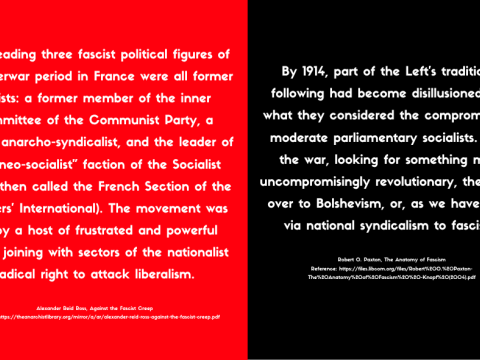
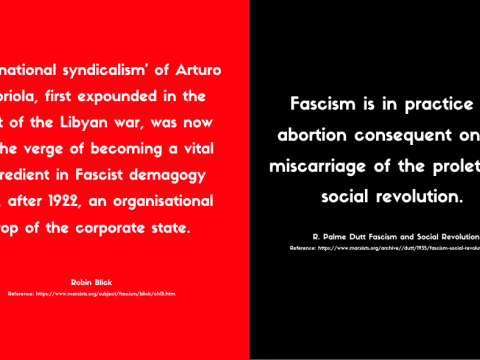
This synthesis in Japan is consistent with the proto-fascist and revisionist Marxist doctrine of “national syndicalism” prevalent in France by Georges Sorel along with Cercle Proudhon[8], classical fascism prevalent in Italy under Mussolini, and the National Bolshevism, prevalent in Ernst Niekisch and Karl Otto Paetel of Germany. From national syndicalism in France, classical fascism in Italy, National Bolshevism in Germany, to “pure socialism” in Japan, behind each fascist doctrine there lies a former Marxist or a group of former Marxists who invented or co-invented fascism through the replacement of the internationalism of Marxism with that of proletarian nation concept of anti-imperialism. This, therefore, replaces class conflict with class collaboration and stateless society with socialism in one country. This is all that the socialists need to turn Marxism into fascism.
Bibliography
- Crump, John Derek.A Critical History of Socialist Thought in Japan to 1918. Vol. 2. PhD diss., Centre of Japanese Studies, University of Sheffield, 1980.
- Hoston, Germaine A. “Between Theory and Practice: Marxist Thought and the Politics of the Japanese Socialist Party.” Studies in Comparative Communism 20, no. 2 (Summer 1987): 175–207.
- Hoston, Germaine A. “Marxism and National Socialism in Taishō Japan: The Thought of Takabatake Motoyuki.” The Journal of Asian Studies 44, no. 1 (November 1984): 43–64.
- Kyaw, H. H. The Marxist Roots of Classical Fascism: Genuine Anti-Fascism Begins with Understanding Fascism. Zenodo, 2025. https://doi.org/10.5281/zenodo.22202541.
- Hoston, Germaine A. “Tenko: Marxism & the National Question in Prewar Japan.” Polity 16, no. 1 (Fall 1983): 96–118, https://www.jstor.org/stable/3234524.
- Szpilman, Christopher W. A. “Kanokogi Kazunobu: Pioneer of Platonic Fascism in Japan.” Monumenta Nipponica 68, no. 2 (2013): 233–280.
- Szpilman, Christopher W. A. '“Japanese-style” Fascism in the Early 1920s'.
- Linkhoeva, Tatiana. "Debates on 'Japanese-style Fascism' in the 1920s." Paper presented at the Axis Empires: Toward a Global History of Fascist Imperialism Workshop, Ludwig Maximilian University of Munich, November 23–24, 2015.
Footnotes
[1] Germaine A. Hoston, “Marxism and National Socialism in Taishō Japan: The Thought of Takabatake Motoyuki,” The Journal of Asian Studies 44, no. 1 (November 1984): 43–64.
[2] Tatiana Linkhoeva, “Debates on 'Japanese-style Fascism' in the 1920s” (paper presented at the Axis Empires: Toward a Global History of Fascist Imperialism Workshop, Ludwig Maximilian University of Munich, November 23–24, 2015).
[3] Germaine A. Hoston, “Marxism and National Socialism in Taishō Japan: The Thought of Takabatake Motoyuki,” The Journal of Asian Studies 44, no. 1 (November 1984): 43–64.
[4] John Derek Crump, “A Critical History of Socialist Thought in Japan to 1918” (PhD diss., Centre of Japanese Studies, University of Sheffield, 1980), vol. 2.
[5] Tatiana Linkhoeva, “Debates on 'Japanese-style Fascism' in the 1920s” (paper presented at the Axis Empires: Toward a Global History of Fascist Imperialism Workshop, Ludwig Maximilian University of Munich, November 23–24, 2015).
[6] Christopher W. A. Szpilman, “Kanokogi Kazunobu: Pioneer of Platonic Fascism in Japan,” Monumenta Nipponica 68, no. 2 (2013): 233–280.
[7] Germaine A. Hoston, “Tenko: Marxism & the National Question in Prewar Japan,” Polity 16, no. 1 (Fall 1983): 96–118.
[8] H. H. Kyaw, "The Marxist Roots of Classical Fascism: Genuine Anti-Fascism Begins with Understanding Fascism," Zenodo, 2025, https://doi.org/10.5281/zenodo.22202541.



Comments
What...what is this?
What...what is this?
Bullshit
Nonsense mostly. Like is the author completely oblivious to how right-wingers go around arguing Nazis were socialists? Japanese authoritarinism had nothing to do with the ideas of Marx and Engels. Just because some right-wingers might have been influenced by some small part of what Marx or Kropotkin wrote doesn't mean you can go around saying that wartime Japan had "Marxist and anarchist roots." Like seriously lol
The above criticisms would…
The above criticisms would appear to have missed the fact that Kyaw is differentiating what made Japanese fascism unique among other fascisms. To claim that Fascism has nothing in common with Marxism or anarchism is to make the definitionally incorrect claim that all three of these ideologies aren't Radical. Furthermore, to understand the way that fascist movements, including Liberal Fascist movements, coopt expressions of emancipatory radical movement, is an essential insight. Please don't insult the brilliance of this article by calling it "nonsense."
Yeah ok "A. Scott Buch,"…
Yeah ok "A. Scott Buch," member for 21 minutes. The author writes for the fucking Mises Institute lol. Get this right-wing anti-socialist crap off of here
https://mises.org/profile/hein-htet-kyaw
That's pretty funny this…
That's pretty funny this person writes anti-socialist nonsense for Mises and then on libcom tries to connect Marxism to fascism.
There's interesting things to consider in the relation of early syndicalists and socialists to early fascism. But I don't think there is really anything new to say about it.
The author, to me, is indistinguishable from a lot of the stock right-wing "libertarian" anti-Marxist stuff. I think its notable that a lot of these kinds of people went on to the alt-right or Trump movement. This ideology was and is at the end of the day a reaction against social democracy, the New Deal and Marxist-Leninism and for the complete domination of capital over labor and the state. So they are ultimately quite flexible when it comes to the authoritarian right or neofascism. See: the US Libertarian Party degenerating into edgelords who joke about Pinochet and helicopter rides for progressive Democrats and the Left.
It is unfortunate, but as anarchism as a burgeoning movement has seemingly collapsed, this occasional flirtation with right-wing "libertarianism" is something that seems more common. I've seen some CNT-AIT accounts repost Ayn Rand!
The author’s pet theme of…
The author’s pet theme of massively exaggerating marxism & anarchism’s cross-fertilisation with fascism fits in easily with his bedfellows:
"The Mises Institute is ... Non-political, non-partisan, and non-PC, we advocate a radical shift in the intellectual climate, away from statism and toward a private property order." – Mises website
“The Mises Institute was founded in 1982 by Lew Rockwell, who was chief of staff to Texas Republican Congressman Ron Paul; previously Rockwell had been editor for the conservative Arlington House Publishers and had worked for the far-right John Birch Society and the traditionalist Hillsdale College.”
“It is a center for the anarcho-capitalist movements in the United States, particularly for right-wing libertarian thought …” https://en.wikipedia.org/wiki/Mises_Institute
The admins have been flagged repeatedly about the crap content from this author. Their justification to me was that, though they don’t like these articles, the author has also posted stuff about some Asian political movements - on which libcom library was lacking - so they’ll tolerate the red-brown stuff like the above article. An opportunist and moronic attitude. In other articles the author C&P’s from openly fascist sites and links to them. When I queried it admin Steven said they were discussing it and would get back to me but never did and then he just blanked me. So you can apparently post any far right stuff here now (presumably as long as it’s not openly racist) if it’s dressed up in some slightly ‘intellectual’ garb. Conclusion: the admins are happily complicit in the spread of far right propaganda and want to avoid discussing this.
In the current political climate and with the present tolerance of far-right propagandism here, you have to ask: what is now the real function of this site and what are the mentality, goals and politics of the admins? But don’t bet on getting an answer.
@Red Marriott This shouldn't…
@Red Marriott
This shouldn't needed to be stated for a normal person with proper or good IQ: this piece is not an endorsement of red-brownism; it documents its presence within Marxist and anarchist movements.
Calling out figures and groups like Dugin or the ACP for their fascism doesn't make the critique red-brown—it exposes what they actually are.
Also, almost all of the cited references are peer-reviewed academic sources, and every argument is strictly factual.
At no point does this work equate Marxism or anarchism with fascism. Instead, it analyzes how specific elements within these traditions historically developed proto-fascist traits that facilitated fascist movements.
Understanding these underlying characteristics is critical for prevention. Furthermore, attempts to censor or deplatform this analysis only serve to demonstrate the authoritarian tendencies currently operating within our own circles.
Since you clearly lack the intellectual capacity to grasp this distinction, this is the final comment I'll waste on your two cents.
HKK tries to criticise those…
HKK tries to criticise those who disagree with him by suggesting they have low IQ. For all your uncritical devotion to academia you might wise up and investigate the extensive academic critiques of IQ as western-centric and as a narrow definition and measure of intelligence.
It’s unsurprising that bourgeois academia – which, alongside the far right and fascist sites, are the author’s near-exclusive sources for his articles – are keen to exaggerate marxism & anarchism as a foundation of fascism. That they are often keen to ignore the more credible and consistent relation and transmission belt between parliamentary democracy, statism and fascism is also unsurprising: though this relation is far more relevant to the current political situation. (Elections were held in Japan throughout the 1930s period that some categorise as fascist.) The real common thread is the acceptance by left and right ideologues alike of national-statist models as solution to social problems – and that this illusion leads to similar unfavourable outcomes. That statists could migrate between ideologies shows little more than that statism has an overriding commonality. This banality is then used as an attempt to suppress what is distinct and/or irreconcilable between left and right and to make sweeping generalisations. Nolte defines fascism as “anti-Marxism which seeks to destroy the enemy by the evolvement of a radically opposed and yet related ideology and by the use of almost identical and yet typically modified methods, always, however, within the underlying framework of national self-assertion and autonomy.” (Ernst Nolte – Three Faces of Fascism: Action Francaise, Italian Fascism, National Socialism)
Note also that HKK’s ‘proof’ is always based on the shifting ideological positions of a few, mainly obscure, political intellectuals rather than the content or practice of actual marxist or anarchist social movements: who were always the foremost active opponents of fascism. An inconvenient truth for HKK’s claims.
As usual HKK fixates on the ex-marxist intellectual elements within fascist circles while ignoring all the other influences and components. There were far more diverse and internal influences than a minority of Japanese marxist intellectuals: Historian Masao Maruyama characterized a "fascism from above," created by military, state bureacracy and imperial institutions. These are hardly “marxist roots”. By the early 1930s Italian fascism was being widely and enthusiastically discussed in the mainstream press and within the Japanese state, independent of any ‘marxist influence’. In the aftermath of the Manchuria Incident (the Japanese army’s imperial land grab in China) there was a “huge growth of interest in fascism in 1932 and 1933”, particularly among state and army officials who were impressed by Mussolini. (see: https://www.sciencedirect.com/org/science/article/pii/S2211624913000089 )
But this was not due to any ‘marxist influence’.
Marxism (and anarchism) had a much greater international presence and membership in the early to mid-20th C political arena so it’s no surprise to find a few moving across political boundaries. (Though in the UK it was a few ex-Labour social democrats who transitioned to Moseley’s blackshirts – along with a few ex-Tories. But it would be idiotic to then claim that UK Labourism was ‘the roots of UK fascism’.) The roots of Japanese fascism are in European fascism and its influence on pre-existing traditional structures. A few Japanese ex-marxists were not a dominant voice and fascism’s emergence in Japan was not dependent on their presence - there were plenty of non-marxist political actors attracted to European fascism.
As JC points out above, it’s ironic (or likely just devious) that someone writing for anarcho-capitalist right wing websites (and posting links on here to nazi articles and sites) is – in the name of some supposed vague leftism - claiming to warn about the dangers of left-right collaboration.
For related discussions and criticism of the author's claims, see also comments below articles here; https://libcom.org/article/ussr-was-fascist-under-stalinism-red-fascism-not-slur
https://libcom.org/article/untold-experiment-national-syndicalism-when-fascism-was-decay-socialism