
The political regime of General Francisco Franco, which came about following the conclusion of the Spanish Civil War, is often described as being conservative, clerical, and authoritarian. The distinctive features of the fascist rule under General Francisco Franco are revealed in a curious episode from history – on his death, the very first flowers laid at his coffin came from China, signed by Communist leader Zhou Enlai. It just happened to be about the same period of time when communist Cuba led by Fidel Castro observed three days of national mourning. It’s beyond irony for communist regimes to express such friendliness to a fascist dictator. However, rather than indicating some form of ideological sympathy, this unusual episode reveals another side of Cold War diplomacy, a possible precursor of nowadays campism.

However, looking closer, the earlier movement of the Franco regime before it suffered an internal coup had the rhetoric, symbols, and even some aspects of the organizational structure characteristic of National Syndicalism as the pre-cursor to their Spanish fascism. The earlier Spanish National Syndicalism did not emerge from the typical right-wing Spanish conservatism. Rather, the radical ideology was formed in the early 1930s and the main authors of this movement were Ramiro Ledesma Ramos and Onésimo Redondo Ortega. Being inspired by the revolutionary ideologies that dominated the European left of that period, such as Sorelian Marxism (revolutionary syndicalism), anarchism, and Marxist socialism, National Syndicalism rejected any attempts to preserve the existing capitalist or agrarian order in favor of a total revolution of the working class.
Between 1936 and 1937, however, due to the physical elimination of the leadership of the movement and the purely tactical actions of Franco, who managed to seize military and political power, National Syndicalist movement in Spain was thoroughly co-opted by Franco. Having deprived the ideology of its social-revolutionary nature and keeping the symbols and slogans of the movement, Franco transformed the movement of total state transformation into a means of labor control.
National Syndicalist movements within Spain
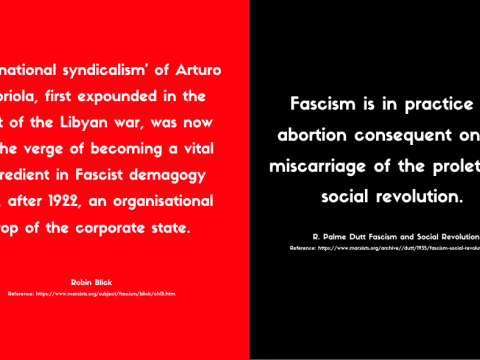
In order to see how Franco managed to pervert National Syndicalism, it is necessary to take a look at the ideological origin of the movement. The main ideologist of National Syndicalism, Ramiro Ledesma Ramos, created his political newspaper "La Conquista del Estado" (The Conquest of the State) in March 1931, stating from the very beginning that his purpose was to channel the revolutionary spirit of the Spanish proletariat for the sake of the national project. His paper (The Conquest of the State) even became a subject of debate in a CNT assembly, yet, it did not have the intended impact. Ledesma was well-versed in continental philosophy and embodied what is called the greatest assimilation of Georges Sorel's revolutionary syndicalism in Spain. The syndicalism of Sorel proclaimed direct actions of workers' syndicates to crush bourgeois liberal regime.
The key reference point of Ledesma on the left side of Spain was the Confederación Nacional del Trabajo (CNT), a strong anarcho-syndicalist labor union. It was obvious that Ledesma admired the fighting spirit, anti-bourgeois combativeness, and revolutionary passion of the masses of the CNT. In his opinion, anarcho-syndicalists were the best combat forces in Spain, and it was his main aim to "nationalize" the CNT, that means to redirect revolutionary power of CNT from internationalist anti-statism to the national state.
It is important to note that this influence was not only theoretical. The early National Syndicalist cells included many former members of anarchist and communist organizations. One of the leaders of CNT, Alvaro de Sotomayor, became the head of National Syndicalist union of taxi drivers in Madrid. Similarly, Dr. Santiago Montero Díaz from Communist Party of Spain also joined them. Both National Syndicalists and anarchists shared the following superficial values: their common hatred of bourgeois democratic system, opposition to gradual reforms, and support of direct action through workers' unions.
Similarly, the relations between National Syndicalism and Marxism were also very similar. The movement was defined by structural mimicry and fierce ideological rivalry. First of all, Ledesma admitted Karl Marx as a great philosopher and agreed with the basic ideas of his criticism of bourgeois liberal capitalist system. Even though the ideology of National Syndicalism was also anti-capitalist, condemning the liberalism of the capitalistic economy for making workers economic slaves and making labor a commodity, Ledesma and Redondo sharply denied two fundamental ideas of the Marxism:
- Historical materialism, because according to their opinion it was destroying the spirituality, culture, and nationalism of humanity, reducing the history to purely economic interactions;
- Class struggle, considering it a destructive civil war that divided the nation and made it vulnerable for foreign domination.
Thus, in order to answer the challenge of Marxism, the JONS (Councils of National-Syndicalist Offensive), formed as a result of the merger of Ledesma and Redondo organizations in October 1931, presented their sixteen-points manifesto including radically leftist economic policies in the frame of nationalist ideology. The document demanded:
- The compulsory syndicalization of all production processes and placing of the private enterprises under the control of the state in order to prevent the exploitation of workers;
- The nationalization of credit, banks, and transport;
- Expropriation of vast semi-feudal estates owned by absentees and their transfer to peasants' syndicates and peasant family farms;
- Severe criminal prosecution of the financial speculators and capitalists exploiting the misery of the working class.
With such demands, the JONS claimed to provide the Spanish proletariat with "bread, justice, and dignity".
The Falangist Synthesis and Internal Fractures
On February 28th, 1934, because of financial difficulties and lack of electoral success along with the beginning of the attacks from the left, the JONS joined forces with Jose Antonio Primo de Rivera’s Falange Española into FE/JONS. Although the charisma and aristocratic connections of Jose Antonio, the son of the former dictator of Spain General Miguel Primo de Rivera, provided the new organization with the funds and the speaker, his party was lacking a coherent programmatic doctrine.
It is Ledesma who formulated the Twenty-Seven Points of the platform of the new alliance based on his Sixteen Points. Nevertheless, ideological conflicts started appearing very soon after the unification of the organizations.
The Leadership Vacuum and Franco's Usurpation
The outbreak of the Spanish Civil War in July 1936 marked the final absorption of the movement into the mainstream. Four months after the beginning of the war, all of the leaders of the National Syndicalist political faction had been liquidated:
- Onésimo Redondo was murdered in a roadside clash at Labajos on July 24, 1936.
- Ramiro Ledesma Ramos was executed by republican militiamen in Madrid on October 29, 1936.
- José Antonio Primo de Rivera was executed in a prison of Alicante on November 20, 1936.
Once the leaders were gone, the burgeoning ranks of Falangist militants, who were primarily composed of newly-recruited young men who were ideologically inexperienced, lacked a leader strong enough to prevent military domination.
Realizing the value of the Falange for propaganda purposes, General Francisco Franco decided to take control of the movement. In 1937, on April 19, he issued the Decree of Unification, forcing the merger of the Falangist party (FE/JONS) with the ultra-conservative, religious Carlist monarchists in order to form a unified state party called “Falange Española Tradicionalista y de las Juntas de Ofensiva Nacional Sindicalista (FET/JONS)”. Franco proclaimed himself the undisputed leader (Caudillo) of this fabricated alliance.
From Proto-fascism to Dictatorship
The substantive objectives of National Syndicalism were deliberately perverted under Franco. While the idea was for the economy to be controlled by the workers through the use of vertical syndicates that were supposed to end the exploitation of workers, under the “Spanish Syndical Organization” system, vertical syndicates were formed but with the opposite meaning.
Rather than giving the workers power, these syndicates served to ensure labor discipline, prohibit strikes, and keep the wages constant so as to increase the profits of the capitalists and landowners. The syndicates membership was compulsory for both the employers and employees.
Inversion of the Structural Elements of Syndicalism:
- Original Vision of the National Syndicalists: Workers and technicians formed vertical syndicates from the ground up to capture state power and tame the interests of capital for the benefit of the nation.
- Francoist Reality: State bureaucrats and capitalists controlled top-down official syndicates to discipline workers, prevent strikes, and ensure their profits.
The true early supporters of the movement—the "old shirts" who had joined before 1936 and who maintained social radicalism—are ignored, jailed, or silenced if they complain. Besides, they had been outvoted by millions of new opportunists and post-war members of the party who saw the party as just a means for bureaucratic advancement.
Through his glorification of the dead founders, especially José Antonio, as sacred martyrs, Franco mythologizes them and puts their portraits on streets everywhere and even inscribes their names on the walls of churches throughout Spain. Through this substitution of ritualistic hagiography for radical and activist doctrine, he ensures that their original teachings of “national syndicalism” never become a challenge to the social order.
Conclusion
The hijack against the Spanish National Syndicalism movement by Francisco Franco is one of the great examples of political cooptation in the twentieth century. Beginning as a radical syncretism of revolutionary syndicalism, and Bolshevik influenced state-controlled economy of the kind appropriated by Sorel, National Syndicalism was a militant querfront response to both capitalist liberal democracy and internationalist socialism. By making use of the deaths of Ledesma, Redondo, and José Antonio, Franco took control of the movement's revolutionary symbols, flags, and organizational system. He incorporated it with reactionary monarchism and Roman Catholicism, thus neutralizing the movement's threat to the Spanish landowners and industrialists. He succeeded in transforming the revolutionary anti-bourgeois workers' movement into the ideological facade of an aristocratic and conservative dictatorship.
Here, it’s important to state the key differences between the anarcho-syndicalism and National Syndicalism with regards to their ultimate goals concerning the state. Anarcho-Syndicalism required the destruction of the state through general strikes with the creation of the stateless and collectivist global society of free communes of workers. On the other hand, National Syndicalism proclaimed the complete statism. As stated by Ledesma, the workers' syndicates should not destroy the state, but become the state, inspiring the experiences of Bolshevik revolution and their attempt to establish socialism in one country according to National Syndicalism. They believed that it was possible to get it accomplished through "vertical syndicates" which will organize the whole sector of industry from the top to the bottom, and thus parliament will be substituted by functional economic representation of four national classes, ensuring the national unity.
As Alexander Reid Ross stated in the book “Against the Fascist Creep”:
- The leading three fascist political figures of the interwar period in France were all former leftists: a former member of the inner committee of the Communist Party, a former anarcho-syndicalist, and the leader of the “neo-socialist” faction of the Socialist Party (then called the French Section of the Workers’ International). The movement was led by a host of frustrated and powerful leftists joining with sectors of the nationalist radical right to attack liberalism.
And as Robert O. Paxton stated in the book “The Anatomy of Fascism”:
- By 1914, part of the Left’s traditional following had become disillusioned with what they considered the compromises of moderate parliamentary socialists. After the war, looking for something more uncompromisingly revolutionary, they went over to Bolshevism, or, as we have seen, via national syndicalism to fascism.
It’s apparent that anarchism and Marxism to fascism pipeline was via proto-fascist movements like national syndicalism. Thus, to remain genuinely anti-fascist, anarchists and Marxists must ensure that the core principles of internationalism and class struggle are never sidelined or replaced without straying into dogmatism. History shows that when nationalism and anti-imperialism—such as the concept of the "proletarian nation"—superseded these core values, it triggered a pipeline from anarchism and Marxism straight into fascism. This dynamic unfolded across multiple countries through proto-fascist movements like national syndicalism, demonstrating that the trend was structural rather than an isolated anomaly.
References:
Gomez, Pablo. "The JONS: National Syndicalist Ideology in Spanish History and Politics." Master's thesis, Florida International University, 1995
Pertierra, Andrés. "From Fidel to Franco: Why Communist Cuba Mourned the Death of the Fascist Caudillo." Writing European History / Europäische Geschichte schreiben (blog). Leibniz Institute of European History, December 19, 2025. https://ieg.hypotheses.org/3786.
Deng, Xiaoping. "Deng Xiaoping Interviewed by Oriana Fallaci." Interview by Oriana Fallaci, August 21–23, 1980. Red Sails, published March 11, 2021. https://redsails.org/deng-and-fallaci/.
Arrese, José Luis de. "The Social Revolution of National Syndicalism." Translated by María Soledad Barbón. In Spanish Fascist Writing, edited by Justin Crumbaugh and Nil Santiáñez, 118–21. Toronto: University of Toronto Press, 2021. https://doi.org/10.3138/9781487520700.016.
Ross, Alexander Reid. Against the Fascist Creep. Oakland, CA: AK Press, 2017.
Paxton, Robert O. The Anatomy of Fascism. New York: Alfred A. Knopf, 2004.


Comments