Joe Jacobs on young adult working class life in the East End of London in the 1930s. Including his involvement with the Communist Party of Great Britain.

1930 was a hard year. Wall Street had crashed in 1929 and we didn’t have to be told that there was a depression. Masses of unemployed could be seen everywhere. We had a Labour Government and as far as I could see they were not much better than their predecessors. The East End had voted solidly Labour and had a right to expect some action to alleviate their suffering. I had a fairly good job, one of the best in our trade, so I was seldom out of work for more than 7-8 weeks at any one time. Many of my friends were out of work for months and those in other trades and especially the unskilled workers suffered very long periods of unemployment. The Labour Exchanges were very crowded and where previously you had to sign daily (especially tailors and dockers, because of the nature of these trades) after a time even we tailors were only required to visit the Exchange twice weekly. They could not cope. Stories were current among my own close friends and acquaintances of extreme hardship.
My activities were haphazard and not really organised as I was still only a ‘contact’. I can remember attending countless open air meetings and demonstrations, some of which I had helped to prepare, by distributing leaflets, whitewashing and chalking, etc.
The Daily Worker had been launched 1st January 1930 and I well remember going to Shoreditch Town Hall for the public meeting celebrating this event. Where previously there had only been a weekly The Sunday Worker, we now had to help selling a daily paper, which meant a great deal more detailed planning of activity which, as I say, I had nothing to do with.
Not only the Party and Young Communist League (YCL) members but all sorts of people took part in this work. If you remember that this paper was not being handled by the wholesalers in the business, it will not be hard to imagine the effort and devotion of hundreds of workers which was needed to distribute a national daily. ‘Selling’ the Daily Worker was a big job taking up a great deal of time. Then there was a never ending stream of pamphlets, books, tickets for meetings and social functions, fundraising items, raffle tickets and collecting cards, all of which required human hands to find other human hands to take all this. Platforms for street corner meetings don’t get to their positions by themselves, and meetings need stewards and literature sellers. There were not only the unemployed questions to be dealt with, but a hundred and one industrial, social and political issues, international, national and local, to be handled at any one time. I knew many peopie who worked a damn sight harder when they were unemployed than when they had a boss who paid wages.
Incidentally Mosley was a minister in the Government at this time. The noises coming out of Germany were very disturbing to the Jews and it is no wonder that so many of us were attracted to politics. I personally was not too dismayed because I felt that there was a very powerful Communist Party and our comrade Thalmann would be able to handle Adolf Hitler and that the best way to defeat Fascism was to build a powerful Communist Party and weren’t we doing just that?
It has always interested me to think that the Fascists should couple the Jews with Communism, in the way they have, when they themselves have used the Jewish question to divide the workers. Where did they expect us to go? It’s not a bad thing to ponder this matter again when other minorities are being attacked in a community.
My politics at this time were by no means clear to me. I was ‘against’ the capitalist system and for Communism. I was reading a great deal and being pushed by others to get a knowledge of ‘Marxism-Leninism’. I soaked up as much as I could and I’m afraid that my ‘teachers’ knew very little of the vast store of knowledge outside this particular view of the world and as a result I became like them. Don’t blame me. Have pity.
This went on and I’m afraid I cannot be more specific about my activities during the period leading to the formation of the National Government in the autumn of 1931.
I was now over 18 years old and it is around this time I met that lovely girl I told you about. I was getting to know more and more people from outside my little bit of Stepney.
We had many sympathisers in the Labour Party as well as in the Trade Unions and other workers’ organisations. Many of them took part in the activities I have mentioned. Often it was possible to get quite good campaigns going on special issues, and our contacts in the Labour Party were under fire from their leadership for their ‘fellow travelling’.
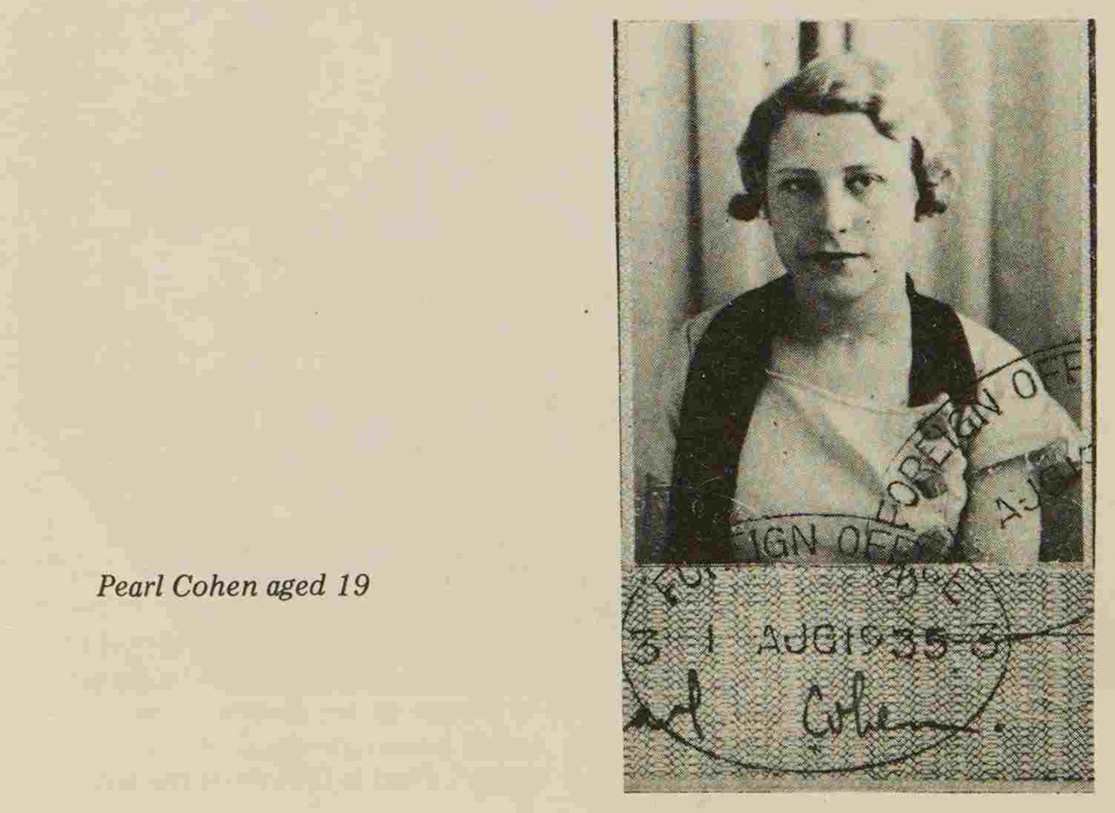
During the whole period late 1931 until about the end of 1932 I saw a lot of Pearl, that was ‘my girl’s’ name, but only as an acquaintance. She was a lively girl and had lots of boy friends. At one time she was ‘going steady’ with a chap called Willie Goldman who later wrote ‘East End My Cradle’. He had a friend, whose name escapes me, who fancied himself to be a poet. They seemed quite nice people and they all formed part of a wide circle of Young Communists who seemed to use the ‘Circle House’ as a base for their activities.
Somewhere along the line she became separated from Willie Goldman and I saw her again in the company of Joe Sternlight and Harry Davis, among the actors in the Workers’ Theatre Group, which was an important part of what later became the ‘Unity Theatre’. I heard lots about outings, rambles, camps, dances and other social activities common among the young people in the movement. Somehow I was not a part of all this.
You will remember that I always associated with people much older than myself. It’s not just that I was more serious or advanced politically, because this was not quite so. I was shy. I was fat. I had one eye. I couldn’t dance. I couldn’t play games. I had missed many of the normal pastimes of youth in general, yet I was still only a youth. I had played with girls as a small boy but up to this time I had not dated a single girl. I knew lots of them and in my activities I found them quite pleasant company and I could relax, but when it came to personal relationships I shut up like a clam. Pearl also seemed to be active around the United Clothing Workers’ premises in Philpot Street so I saw quite a lot of her around.
Then there was Andy’s where we all seemed to be, after about 10.30pm until near midnight. Now and then she would smile and I would try saying something funny or nice, but mostly I spoke to her companions rather than to her. She had a girlfriend who was one of Shimmy Silveyr’s sisters so really the net which was bringing us together was there, without me being aware of it. She was gay. She was very popular with the boys and she seemed to revel in the attention she received.
I began to feel a sickly sensation in the pit of my stomach every time I saw her in the company of these laughing young people. This feeling got worse and I would feel quite miserable when I got home late at night, but my books helped me to take my mind off her. I was becoming very jealous of her friends although I had no claims on her whatsoever. So far as I know whe never encouraged me in any way. So why should I feel like that?
I didn’t know much about inferiority complexes in these days, but I did know what it was to feel inferior. I thought, there must be something I can do to break out of this position and maybe let her see that I was interested in girls. Because of course I was. After all, I knew what was happening to my body if no one else did. Andy had a young girl who worked for him as a waitress. I think she came from South Wales. There were lots of girls from South Wales in the East End doing domestic work for Jewish families who could afford to keep them as members of the family plus a little pocket money. These were girls in their very early teens who could not find employment in their home towns and villages and had to leave their families to fend for themselves in London. Her name was Rhoda. She was not political and I wonder what she thought of us. ‘Very strange’, I think. Now here was a young girl I had to talk to without any connection with politics. I had to order tea or a meal and it was possible to crack jokes and be quite relaxe with her. :
She was quite a good looking girl, about 17, I imagine, and full of life.
Otherwise I suppose she wouldn’t have been a waitress. I hit on a plan. If I could take her out on her night off and bring her back to the cafe later, then everyone including Pearl would see me, and maybe the girls would see that I was ‘normal’. It took me weeks to build up enough courage to make the break. I sot to Andy’s one night, in a crowd, and I was feeling quite happy.
Rhoda said said ‘What are you having’, I said ‘You’. It just blurted out. She laughed very sweetly and didn’t seem to mind. I had my usual egg and chips, one slice and a cup of tea, sevenpence, the lot.
When I went to the counter to pay, after about an hour of conversation and debate, I remembered her response to my approach, earlier.
I paid up and as she took the money I grabbed her hand and said, “I meant that, you know’. She smiled again, and I could hardly believe that it was me saying ‘How about coming out with me on your night off.’
She said, ‘OK’ and there and then we arranged to meet. I forget exactly which night it was in the week, but I was floating on air. On the night in question, I made more than my usual effort to look good. I was always a fairly well dressed person. Quite fussy really. I waited on the corner of Great Garden Street for Rhoda to appear, coming out of Andy’s where she ‘lived in’. Sure enough there she was dressed up and looking, I thought, very nice.
We boarded a bus and headed for the Finsbury Park ‘Astoria’ which had opened recently and was reputed to be a fabulous place. We saw the film, held hands, and when we came out I said ‘Shall we have a bite out, or do you want to go home and have a meal at Andy’s’. It was rather late and there was still the journey back to the East End to consider. We decided to go back to Andy’s.
Sitting on the bus, a strange feeling was creeping over me. I would have to make an entrance with Rhoda, both of us dressed up, at Andy’s. I was terrified. There was no way out. I tried to conceal my feelings and conversation in the bus going east almost came to a dead stop. I wonder what Rhoda must have thought.
We got to the cafe and I was trembling all over. My face must have been as red as a beetroot. We walked in and you never heard such a cheer in all your life. Or, so it seemed to me. Everybody was laughing and I was very embarrassed. They were all very friendly and I soon relaxed and Rhoda and I had a meal, accompanied all the time with the well intentioned ‘chaff’ of the ‘crowd’. I felt a lot better after that and I arranged to take Rhoda out again.
On my way home I realised that Pearl was not at Andy’s that night but hoped that she would hear all about my reception. Rhoda really wasn’t my type at all and after a couple of meetings I told her that I was much too busy to go steady with anyone and we remained friends but not in any special way. I did learn from Pearl that she knew all about it at the time but she had no hint that she was in any way involved. Well, what do you expect, I was only a youth. I had broken the ice and from that time on did try to pay more attention to girls but I was still very inhibited so I hadn’t much success.
Strangely enough I did seem to get on with older women. They never seemed to cause me so much embarrassment as did the girls of my own age group. Now that I reflect, I must have missed quite a lot one way and another.
During the middle of 1930 until about the end of 1931 my mother and I were living together and had not had any contact with my sisters Debbie and Annie or my young brother Hymie, as far as I can remember. I know that my mother cried a great deal and I tried not to think about them. I can’t remember anyone asking me where they were or how they were getting on and I was 68
thankful. Mother was working as usual but it was not a calamity if she only managed to get one job a week. There were times during the year when no Jewish weddings are allowed so she had to try to save a little to meet our needs during these periods. I was working and beginning to earn a bit more but I’m afraid I was too selfish and did not give her as much as I should have done. We were not short of food because my mother would bring home a great deal of very good food which was left over from the functions which were always quite lavish affairs. She was a very good cook and a good mother who, I felt, always somehow blamed herself for my sisters’ and brother’s absence from our home. She had tried so hard to run a good Jewish home without the aid of a husband, but this had not succeeded through conditions beyond her control,
We managed to live like this and as time went on we got used to things as they were and she didn’t cry quite so much. Although I didn’t spend too much time at home, mother was not lonely because, as I said, this was not likely in my East End. She doted on me and did anything she could to make life good. I was not at all considerate and often complained if my shirt was not just so, of if I didn’t happen to fancy the particular meal she had prepared.
Some time later my young nieces, Sophie’s children, used to come to see their ‘Booba’ (grandma) every Saturday around 11.00 in the morning, to stay until about 1.00 p.m. They told me how, while trying to get me out of bed, my mother was constantly fussing over the table which she had prepared and would not let them go near, in case they made any finger marks on the table cloth. That was my mum.
I was spending quite a lot of time at the ‘corner’ listening to Sam Berks’ stories about America and how he had to sleep in Central Park during the period before he decided to come home. I was arguing with him, Leon Grill, Dave Easterman and anyone who happened to be there. The Labour Government, unemployment, Hitler, the tailoring trade, the Russian Revolution, Marx, Lenin, Stalin, everything was discussed and I usually managed to satisfy myself that I could deal with all these matters and much more. I frequently solved all the world’s problems almost every day, only to find that they still existed, to be dealt with all over again, the next day, That was me.
During our sessions at the card tables in Joe Kessel’s home I got to know his five sisters very well. Dollie and Millie were a bit younger than me. Annie was about my age. Leah and Ada were older. Millie was about the same age as Pearl and not known to me then, they had both been to Myrdle Central which was a secondary school where girls and boys stayed until they were 16 years old. It was not a grammar school but inbetween. Pearl had left when she was 14 and later regretted having done so. She had been quite a good runner and knew Millie who was very good at sports. I secretly thought a great deal about Millie. I don’t think she ever knew. I remember her coming home from school one day when she was about 15% years old looking like the most desirable thing I had ever seen. She wore a skirt revealing a beautiful pair of legs and thighs, white tennis blouse and carrying of all things a tennis racket, to which was attached a pair of white plimsoles which she was swinging about as she walked. My heart skipped a beat. I felt she was beyond me and I dare not do anything but admire her in silence. When she left school she became friendly with a lovely looking girl, blond, like herself, but taller and if anything, even more good looking. One day while standing on the corner, this girl was about to leave Millie at the door of the building and we were admiring her and making the usual cracks that young men do, when a sudden impulse made me walk towards her and I began to walk alongside, away from the corner. She didn’t seem to mind and I chatted to her all the way to Redman’s Road, about 14%miles away, where she lived. I did this quite a few times subsequently and came in for a lot of chaff from the boys. She was a nice girl but there was nothing but friendship between us. I was clearly not her type. I remember this so well because it was so rare for me to have personal relationships with girls.
Joe’s sisters grew up. Ada the eldest married a chap from the West End, where I found out there was a big Jewish community. Leah joined the Communist Party and remained a spinster. Annie was a milliner and a good business ‘nut’. She married and became very prosperous. Millie married a taxi driver. In my view, at the time, quite below her potential. Dollie married a shop keeper from Chelsea.
Mr. Harris was the owner of the shop on our corner. He had married one of the daughters of the Satins, who lived in a flat above the shop. They had just had their first child. Mrs Harris’ brother, older than her, was the envy of all the Jewish families nearby. He would arrive at our corner about once a week in a chauffeur driven Minerva Limousine. A big brown car in a sort of wood grain paintwork. This was the man who had really made good. He was married to a dressmaker who was one of the two sisters responsible for a very successful dress manufacturing firm in the West End, which still exists. They were reputed to be very wealthy people. I am talking about the time of the ‘depression’, remember, so you can imagine how envious people in our little area were.
Lew Lee (Lew the Lip) who was a traveller for a firm of cloth and silk piece goods’ merchants, knew this woman. He tried to tell us what she was like by saying — if you happened to see her with some samples and she happened to be in the lavatory at the time, she would say, ‘Push them under the door’. An exaggeration, no doubt, but you knew what he meant. That’s the stuff which goes to make a successful businessman or woman.
Lots of the men in their early twenties were beginning to pair off, often with local girls. Sam’s brother Solly was going with one of the Stein girls who lived over the Stain’s. Another of the Stein girls was going with Danny Berg from Nelson Street, another successful clothing manufacturer in the end.
One of Willie Cohen’s sisters married a stranger to us. His other two sisters did not marry as far as I know.
On Yaro’s comer, things were moving rather faster. ‘Ginger’ Waldman was married to Nancy Berg. A boy and girl romance this. Henry Lasky was married to Yaro’s younger daugher. Her old sister Sadie (I knew her as Sarah) married a barber from some distance away. Nearly all the men in this age group were moving away at the time when my activities were making my stay on the corner shorter and less frequent.
* * * * *
Most people who I know, who know the East End from reading about it seem to think that the population was almost entirely Jewish. Reading so far you may still think that this was so. Nothing could be further from the truth.
If you want to understand what happened in the East End, particularly with regard to Mosley and the militant dock workers, you would be well advised to consider what I tell you now. The population of Stepney at the time was about 225,000. About one third, 70,000 were the people who lived in St Georges, i.e. in Wapping and Shadwell, to say nothing of the people of Limehouse. But it is Wapping and Shadwell in particular that I am talking about.(1) These people were descended from an earlier immigration from Ireland. There were other Gentiles in the area but the majority were Catholics. When I first got to know them they had reached something like the fourth or fifth generation, if not more. There is a church in Commercial Road among several in St Georges, which was so crowded on Sundays you would not think you were in London, but in Ireland, Spain or Italy. Those who don’t know a thickly populated Roman Catholic area cannot know what this means. The church completely dominated almost every aspect of life.
They had their own schools and influenced the state schools in every possible way. Every kind of social activity was centred in the church. The only activity not centred around the church was the heavy drinking in pubs, which in some way was not entirely divorced from the way of life. More important than all this is the absolute domination of Catholics in the local Labour Party and the Trade Unions.
Here are some names of local councillors: John Sullivan, LCC; Jeremiah Long (Jerry), the ‘big man’ among the Catholics in the Labour Party; McCartney, McKie, the three O’Briens, Edward James, Julia O’Connor, O’Leary, Leary, Hurley, Jarvis, the two Leweys, Mullan, Carthy, Shaw and Shea. It may have been just a coincidence but even the Town Clerk was a man called W.L. McCarthy. Have I made my point?
Just over one third of the council were of Jewish origin, and there was a constant battle between them and the Catholics for leadership. For a long time, Jerry Long was in power, but he was defeated for a time by Morrie Davies, who was also the ‘big man’ in the Jewish Federation of Synagogues and Burial Societies. He later was involved in a big scandal and lost his positions in this organisation as well as in the Labour Party.
* * * * *
To get back to me. So far as I was concerned, there was a great deal to interest me in the movement and I was not short of opportunities to be an active Communist. At the beginning of 1931 there was the United Clothing Workers’ Union (UCWU) then situated at no. 9 Manningtree Street, E.1 as well as some branches of the following organisations which were mostly initiated by the CP:—
Friends of the Soviet Union — Secretary T. Bell; The British Section of the Red Sport International, founded in 1920 to which the British affiliated in 1929; The League against Imperialism, Honorary Secretary R. Bridgman; International Labour Defence, which had been known as the International Class War Prisoners’ Aid (ICWPA) (this was founded in December 1924 and was a section of International Red Aid, founded by a group of old Bolsheviks, headed by Helena Stassova, in 1920); The Workers’ International Relief; The Workers’ Theatre Movement; the National Unemployed Workers’ Committee Movement, founded 1921, which later dropped ‘Committee’ from its title; The Seaman’s Minority Movement. There were other Minority Movement organisations throughout the country, the best known being the miners’ one.
This movement was part of the Red International of Labour Unions (RILU) founded in 1921. The British Minority Movement (MM) was founded in 1924 (2). In addition there were two other Trade Union and Labour Party organisations as well as the Independent Labour Party (ILP) and many small left-wing groups.
The Daily Worker managed to keep one informed of most of the activities as well as reporting on the many meetings, demonstrations, social activities etc. In addition there was a regular feature column, reporting the Inner Party Life. This gave reports of discussions in the Central Committee of the CP as well as items from the 3rd International. There were open discussions in which people were often attacked and allowed to defend themselves in public, or admit mistakes, as the case might be. One important case was when Arthur Horner was being called over the coals for something he had done regarding the miners which was not to the liking of the Central Committee (3).
In the March London County Council (LCC) Elections, we had two CP candidates. Pountney and Elias, standing in Stepney. Pountney was a Party Functionary who was the secretary of the United Clothing Workers’ TU, drafted for the job, and I thought a most unsuitable type, who looked nothing like a clothing worker. Elias was a leader of the unemployed. The voting gave Pountney 374 and Elias 380. The Labour Party won with about 3,500 votes for each candidate. (4)
The Labour Government were proposing cuts in every part of the economy not least in unemployment benefits. The New Party led by Mosley had formally left the Labour Party early in March 1931. The political situation regarding the state of the parties, particularly the Labour Party, was to say the least confusing. The unemployed were being treated in a most heartless fashion by all the politicians. They fought back with all their might and suffered a great deal.
The Daily Worker, the International Labour Defence (ILD), the League against Imperialism and the Workers’ International Relief, were running campaigns in support of movements around cases like the Meerut trial in India were 31 people had been arrested in March 1929 for militant TU activity and were still being tried. There were three English defendants — Bradley, Spratt and Hutchinson. Bradley frequently wrote articles for the Daily Worker on their case.(5)
There were the Scottsborough boys on trial on a framed up charge of rape, in the South USA. Tom Mooney, California, on a bomb incident frame up, because of his militant activities. (6). Also there was a Moscow trial of ‘Social Democrats’, but somehow this did not bother me at the time. I must have been wearing blinkers.
A meeting to explain this trial was organised by the Friends of the Soviet Union, (FSU) at which Tom Mann, Willie Gallacher and Tom Bell spoke. After the meeting there was an ‘inquest’ because it was so poorly attended. In addition to the above named speakers there was of course Harry Pollitt, J.R. Campbell and a few names not so well remembered now, who seemed to tum up at all our meetings and demonstrations. They were
J.T. Murphy, T.A. Jackson, Saklatvala and Wal Hannington. (7) Locally, there was the 2nd Annual Conference of the UCWU at the ‘Three Nuns Hotel’, Aldgate, in April. (8) About a month after this conference the Ladies’ Tailors’ Union (LTU) called a strike which was supported by the UCWU.
Here is a list of the demands:
1. Against the absence of the 48 hour week.
2. Limitation of overtime during the busy period.
3. Abolition of overtime during the slack period.
4. Payment of not less than two shillings and sixpence per hour for tailors, pressers, machiners.
5. Payment of not less than one shilling per hour for felling hands, finishers and skirt hands (9).
Could anything be more primitive than this. We had to fight for such elementary things. At a public meeting organised by the LTU the speakers were Colton and Freedlander. The UCWU wanted to join in but were not allowed to have speakers on the platform. Groups of strikers would go round the workshops, still working after 6.00p.m. and ask the workers to stop work and often there were heated arguments and clashes with a lot of bitterness.
Some employers locked out their workers for refusing to work till 7.00p.m.(10)
There were a few successes in the form of more organised shops being established where the employers agreed to the 48 hour week. What usually happened after these skirmishes with the employers was that when the next season came around there would be a change round of workers and they would go back to the bad old days. As time went on there was a gradual adoption of the 48 hour, 5-day week. Pay only improved when the general economic situation created a bigger demand for clothing. I remember a report in the Daily Worker on clothing work in the Soviet Union by ‘an English girl’.
I’m not sure who it was, but I do know that Sarah Wesker had been to the Soviet Union for quite some time (11).
It was around this time that the news from Germany was beginning to get very grim. Hitler was getting stronger. Raids on the CP headquarters and the ‘Rote Fahne’. The Communist Party was being suppressed. At home the Labour Government was proposing massive cuts. Wage and dole cuts, including in the armed forces, totalling £120,000,000. In August the Labour Government resigned and a National Government under MacDonald was formed (12)
* * * * *
The second half of 1931 and the first half of 1932 proved to be the most important periods in my life. By a series of gross coincidences, events taking place in different parts of the world, which I only knew about from press reports, led to my getting to know nearly all the main people to be concerned in my future development. This in a very short time after these events occurred. It is almost unbelievable and I don’t know how to account for it unless I start to believe in ‘Astrology’ or ‘Fate’.
At the end of May, John Gollan was arrested in Edinburgh for distributing leaflets to soldiers. (13) He was waiting to be tried. He was eventually sentenced to six months imprisonment in July. He was released on bail pending an appeal. He must have lost the appeal because I remember his welcome home late in December 1931. I met him soon after his release but did not get too involved with him even though he was a close, active worker with my pal _ Willie Cohen. In August John Strachley left the New Party and I met him later a few times. (14)
Then I read a report around the middle of September of ‘unrest’ in the navy over the proposed cuts in pay along the following lines:
Leading Seaman 5/3d per day, cut 11d
Able Seaman 4/- per day, cut 9d
Ordinary Seaman 2/9 per day, cut 9d
The report said that the sailors had refused to carry out orders on 15th September. (15) This was the Invergordon Mutiny. The ordinary sailors did a great deal and I learned all about it from the undoubted leader of this mutiny — Len Wincott himself, who I got to know intimately. He became an important influence in my life.
In late 1931, there was talk in the press about a ‘General Election’. I recently read in the Oxford History of England, English History 1914-1945 by A.J.P. Taylor that ‘11th September 1931 marked the watershed of English history between the wars’ (page 298). On page 323, he writes:
‘On 5th October someone — perhaps Neville Chamberlain, perhaps Snowden, perhaps no one in particular — came up with a solution: a general election with each party putting forward it’s own programme under a blanket of words produced by Macdonald’
Between these two quotations there is a lot of ‘history’ written, but not one word about Invergordon! If that’s the way history is written I can do without such writers!
No one in the CP could have known about what was going on at Invergordon.
The Daily Worker did not carry its report about the ‘unrest’ until the mutiny was well and truly underway and almost over for the time being at least. It lasted two days. I can assure you that had anyone known about it the Daily Worker would have had to carry a report. The news from the ‘Atlantic Fleet’ was a very well kept secret, for as long as the authorities could hold it. The Australian fleet also mutinied but a report on this appeared on 11.11.1931 in the Daily Worker. On 1st September, two weeks before Invergordon, there was a mutiny in the Chilian Navy against a proposed 30% cut in pay. The first report I read was in the Daily Worker on 9.12.1931. So it would appear that this kind of action is not to be given publicity if it can be avoided.
Meanwhile, in Canada, two leading Communists Tim Buck and John Boychuck had been arrested during the middle of August. (16) This was to test the legality of the Canadian CP. There was a slump in Canada too! Tim Buck was eventually sentenced to five years in November (17). In Britain the Gold Standard had collapsed — the general election was on its way. Mosley’s New Party was trying hard to break into the political scene. It would seem that Mosley felt the need of protection from the very beginning. One of his bodyguards was Ted Kid Lewis and another, a former Rugby International.
This did not prevent thousands of Glasgow workers from chasing him out of town, around this time. The Daily Worker was raided and the printers arrested. The Bow Street magistrate ordered, no mention of ‘armed forces’ while the trial was pending. The Daily Worker appeared with blank spaces marked ‘censored by the printer’ (18) Wal Hannington the unemployed leader was arrested and refused to be bound over. So he went to gaol. (19) I got to know him too!
Then things really began to hot up. George Allison, an ex-Scottish miner, was the national organiser of the Minority Movement. He was arrested at Portsmouth on 2nd October. W.G. Shepard, a leading woodworker and CP member on the staff-of the Daily Worker at the time, was arrested in London and taken to Portsmouth. George and Bill were charged with Incitement to Mutiny! I got to know George Allison very well indeed!
During September-October there were 109 leading Communists and active sympathisers arrested for a variety of ‘offences’ (20). The Opposition to the ‘cuts’ was growing. Mass demonstrations on the streets of all large cities throughout Great Britain were a daily occurance. Women fought mounted police in the general fighting which was a feature of most of the demonstrations. 80,000 in Manchester, 150,000 in Glasgow, 100,000 in Hyde Park. (21) We began to prepare for the general election. Harry Pollitt was adopted as the CP candidate for Whitechapel and St Georges on 7th October.
Our committee rooms were situated at 59 Cannon Street Road, right in the middle of the constituency. There were other CP candidates, like Joe Vaughan, Bethnal Green —and W. Gallacher in Scotland. I got to know all three.
The International Labour Defence was appealing for funds to help the many causes of arrested militants and their dependants. So another name appeared in the Daily Worker, Alun Thomas from South Wales. A leading CP full-time functionary, National Secretary of the ILD. (22) He was to be another important man in my early days as an active Communist.
With ten days to go before the election, this is how the Daily Worker reported the adoption of candidates for Whitechapel. ‘H. Pollitt, CP, J. Hall, Lab, B. Janner, Nat Lib, Kid Lewis, Fascist’ (23).
In the East End this really was something. Ted Kid Lewis was a legend in his very early life-time. He had fought his way from the gutter, to international fame, as a boxer. He had made the East End of London better known than almost anyone else. Yet here he was, back in the gutter, so far as we Communists were concerned. I will never know why Mosley ever did this. Other
than the fact that he was out for cheap publicity. He must have known that there was no chance of his Party getting anywhere in Whitechapel. That Kid Lewis did this, is testimony to his lack of brain power, which I suppose in a way was why he was such a good man with his fists. No offence meant to other great fighters, who certainly had brain as well as brawn. I have heard so called ‘historians’ pay tribute to Mosley’s political ability, how do they explain this one?
Mosley was driven from Birmingham and Kid Lewis was ‘trounced’. The election campaign was furious in our area. What with Mosley and Kid Lewis there was a new factor in the form of Barnett Janner. He somehow managed to get some support of quite a number of Jewish boys, from the ‘shpielers’.
Meetings were hectic and exciting, as well as violent on many occasions.
The Jewish people saw in Janner a possible champion against the Fascist threat coming from Hitler and his supporters here. Up to the General Election in October 1931 Stepney had been solidly Labour for a long time. Our MP’s being Clem Attlee for Limehouse, John Scurr for Mile End and J.H. Hall, Whitechapel and St Georges. So confused was the state of local thinking that the election produced the following result. MP’s for Limehouse, Attlee, Labour, Mile End, O’Donovan, Conservative and Whitechapel and St Georges, Barnett Janner, Liberal. Limehouse had a small number of Jews, but the other two constituences were mixed. I think the Jewish people were responsible for this result. O'Donovan the conservative had a good local reputation because of his work at the London Hospital, where he was a well known consultant, in addition to his other social activities. Barnett Janner, now Lord, was a Jew, a lawyer, a Liberal and very prominent in the Jewish community. He later became Labour MP for Leicester and ‘Sir Barnett’ as well as being president of the Jewish Board of Deputies. Kid Lewis got 154 votes. I need say no more about him. Pollitt got 2,658.
I was very disappointed, as were a lot more people on our side. If the campaign on the streets was anything to go by, Pollitt should have won the election easily. Apparently, those who make the most noise are not always the strongest. The result needs a little closer scrutiny. The full figures were as follows.
B. Janner 11,013, J. Hall 9,864, Pollitt 2,658, Kid Lewis 154. (24) You will see that Pollitt’s intervention actually split the solid working class vote. In a Daily Worker report following a review of the campaign in Whitechapel, they actually drew attention to the fact, but no one condemned the CP for standing. (25) This was true for the review meeting of CP members also. One could not say that this was the view of the Labour Party. In Limehouse, Attlee only managed to hold his seat by about 500 votes. Hodge for Mosley got 307 votes. (26)
The 1929 Labour Government and the split in the Labour Party left the Jewish community in a confused state. Those who think that all Jews are ‘left’ or ‘red’ should remember what happened at this 1931 General Election in Stepney. Just as they should remember that the existence of a large Catholic population concentrated in Wapping and Shadwell did much to decide the outcome of Mosley’s attempt to win a mass base in East London. His failure may even have been a decisive factor in what followed, on an international level, leading to the second world war. I shudder to think what might have happened if Mosley had succeeded in getting a really big following.
* * * * *
1932 opened with the National Government in power, and no shortage of issues for us Communists to be active: in all forms of protest and the general conduct of the ‘class war’. This was the year in which the British Union of Fascists (BUF) was constituted giving us Jews a big interest in politics because here we were being threatened, directly on our own doorsteps. This together with unemployment was what we could deal with on an easily understood basis because it affected all of us. We must not forget the news from Germany, which was also of immediate concern to the Jews. So, what with hunger marches ane the purely local issues, life was full of hard work.
One positive result of the election for ‘us’ was that we made about 100 recruits to the party. The full result of the election was a massive vote for the National Government. Con. 471, Nat. Lib. 39, Simonities 27, Lab, 51, Nat. Lab. 13, LG Lib. 13, Independent 5, no CP, no Mosley. (27) Macdonald became Prime Minister and George Lansbury took over in the Labour Party with Atlee as his deputy. In my view, Invergordon continued to play a major role in the events which followed despite the overwhelming vote for the National Government.
Only a few days after the election we learned that the original proposals for the cuts in service pay were to be halved. Despite a definite undertaking, by Sir Austin Chamberlain, First Sea. Lord, that there would be no victimisation resulting from the mutiny at Invergordon, 24 ratings were dismissed.
This undertaking was skated round, by the use of a revealing phrase.
The ratings were dismissed without a trial of any kind, for ‘continued conduct subversive of discipline’, on 4th November 1931. (28)
Exactly one week after this, a report in the press which I must have read at the time but to which I did not give much attention, spoke of someone who was to be the most influential human political contact I ever had. Here is the Daily Worker report/excerpts.
‘British Communist Jailed in Argentine — Comrade Nat Cohen, Clothing Workers’ Secretary, Imprisoned without Trial — Fight to Release Him!
... Amongst those 250 workers recently thrown into prison without trial (they have just been on a five-day hunger strike demanding tea, warm meals, beds, etc.) is an English comrade, Nat Cohen, amember of the Communist Party and secretary of the Tailors and Garment Workers’ Union of Buenos Aires. . . .
. .. This comrade , who had been in South America about ten years, was formerly a member of the Communist Party of Great Britain... .
. . . Whilst in Chile he was in prison a number of times, underwent brutal tortures, and was eventually deported... .
. He came to Buenos Aires, where he was again imprisoned a number of times....
. .. And this time they mean to hold him in prison and probably send him to the Island Usuhia, “The Land of Lost Hope’’, because they put him down as an “international Bolshevik agent”, sent from Moscow to carry on propaganda amongst the workers of Argentine... .
. . . They refuse to deport. him despite the fact that he is a British subject. ...
. .. All trade union branches, etc., should send resolutions of protest to the British Home Secretary and to the Argentine Consul here, also to the British Counsul in Buenos Aires.
Fellow-workers, don’t delay one moment in sending in your protests, for it means sure death to this comrade and to the other comrades in prison with him.’ (29)
I had no idea that Nat Cohen’s family actually lived in my street. I probably knew most of the 2,000 odd inhabitants by sight, but I certainly did not know all of them, by name. This family actually lived less than 100 yards from our ‘corner’. Cohen is such a common name among Jews, it could have referred to anyone anywhere. I knew still less of the background to this report. This is what I learned almost immediately.
You remember Bert Teller? Well, he along with Sid Kersh were seamen as I have said. Bert had been going to sea for a few years and was on a regular run to Buenos Aires in the Argentine. The ‘turn round’ for this trip was about two months, when we would see Bert. He had been a ‘Party courrier’ for some time. I am not giving away any secrets, as it is a well known fact that revolutionary forces have always used sympathetic seamen in this way. The courriers carry messages and material which cannot be ‘risked’ by sending through the post. They are not spies. They do not collect information, or carry out ‘instructions’ of any kind.
This does not mean that on occasions one or two may not have overstepped the mark. Anyone who knows anything about illegal revolutionary
activity, would know that there is a vast difference between a ‘messenger’ and a ‘spy’. Just as during the war, we could distinguish between a ‘resistence worker’ and a spy.
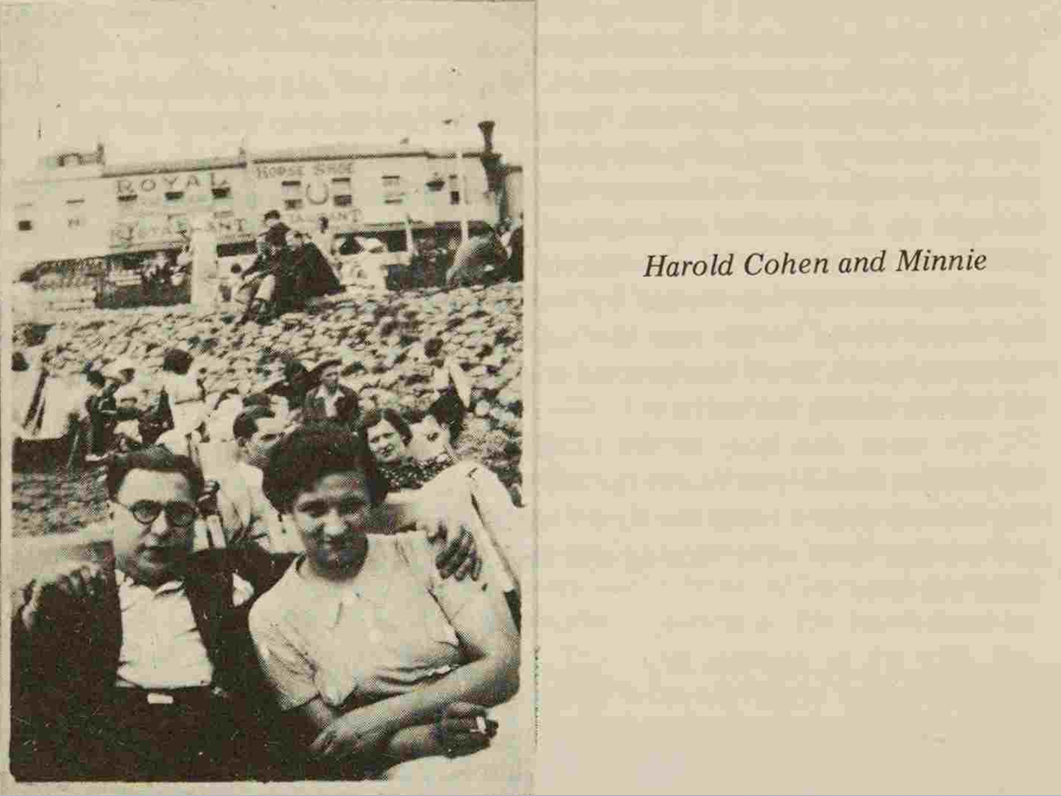
Well, Bert was a friend of ‘Shimmy’ Silver and at one time very friendly with his sister Annie. By this time she had become very attached to a Party member called Hymie Cohen. It was Hymie who asked Bert to see if he could find his brother, Nat, who had been in South America, for over ten years. Sure enough, Bert found him, and has remained a close friend for the last forty years. Bert met Nat before he was arrested. he took part in demonstrations in Buenos Aires for his release, as well as the others. So we got first hand reports of what was happening to Nat. I was immediately fascinated by the sheer romance and adventure, associated with this character.
Nat Cohen’s family consisted of his parents, who were getting on, three (?) brothers and two sisters. I knew Hymie was a Party member but till now I didn’t know he had a brother called Nat. I’m not sure when Hymie married Annie Silver but around this time they had a daughter who was handicapped and rather difficult. Pearl, who I was still very interested in, was a friend of Annie Silver’s young sister, Miriam. Most of the Silvers were either YCL or CP members. There were a lot of them. Their father had a sweet and tobacconist shop at the corner of Old Montague Street and Queen Street, off the north side of Whitechapel Road. Pearl’s grandmother had lived in Queen Street and if my memory is not at fault Pearl met Miriam as a result of visits to her grandmother. That’s how Pearl made contact with the YCL. She loved children and even as a young girl of almost 17 she would spend a lot of time taking care of Annie’s little girl, Once again unknown to me the net was getting tighter and it became more certain that I would become more than just an acquaintance. I never knew that Pearl lived in Varden Street which started off in New Road and ended in my street. It was ali fitting together as though it had to be.
* * * * *
I was approaching my 19th birthday and had made rapid progress in learning to be a good presser. Because my top presser was well over 70 and getting a bit past it, his son, the boss, insisted that he should retire. -I was considered good enough to take over, despite my comparative youth. But since I was always accepted by people much older, it may not have been so unusual. This meant a big jump in my income and I could be quite ‘extravagant’ from now on and enjoy good clothes, which I liked. There is a very relevant point here concerning the appearance of Communists. Many of the young Communists were fond of dressing in an outlandish way. Khaki or Red shirts were common. Also, they liked to wear sandals. Even some boys who could afford it, didn’t go in for tailor made suits. The girls were even more likely to look different from the usual appearance of the non-political Jewish girls who really tried hard to be very smart and in the fashion.
Being in the clothing industry made this possible because clothing workers got some of their clothes made on the cheap. There were frequent arguments in the YCL and CP because some of us felt that these outlandish dressers were behaving in a ‘secretarian’ manner. I have since learned that nearly all progressive youth express their dissatisfaction with things as they are by trying to look different. I don’t think it a bad thing any more.
Things were hotting up on the political front. Tenants were organising against high rents and slum conditions. (30) The hunger marchers were on the way. Paterson of the Daily Worker was made a scapegoat for alleged incitement of the armed forces and got two years hard labour. Allison and Shepard were sentenced to three years and 20 months respectively, for ‘incitement to mutiny’. This was a blatant ‘frame up’. They had nothing to do with the Invergordon mutiny (31). When I met George Allison after he had completed his sentence I asked him how he fell for the simple trick which the ‘agents’ of the powers that be, had thought up. He was inclined to agree that he had been rather foolish. Fancy taking part in an arrangement to meet someone you never heard of by means of showing a yellow handkerchief in the breast pocket. This in connection with an offer from unknown people to help to extend the mutiny at Invergordon to the Home Fleet at Portsmouth. To meet in a public house bar of all places, and later in a lavatory at the station. Real fictional stuff this. Like you read in the cheapest sort of spy stories. He paid dearly for this, although he rightly earned a big reputation for getting more concessions from the authorities, than any other prisoner.
Invergordon was not allowed to go by without the authorities hitting back at the Communists, their main enemy at that time. I thought that the crude methods used by the ‘Special Branch’—the political arm of the law— were capable of being defeated. But I suppose someone would have to be found to take the blame for what the ordinary people in the Navy had done, because they did not enjoy suffering.
The young unemployed were being sent to institutions for ‘training’ when they had exhausted their statutory benefits. One notorious place was called Belmont, situated on the outskirts of London. Forty-one of these unfortunate victims were discharged for organising the inmates of this establishment, against the bad food and conditions. It seems there was no stopping these ‘Commies’ (32).
A new name began to appear in our adverts for meetings and demonstrations. Len Wincott—dismissed Sailor. (33). This was just before the end of 1931.
I first saw Len at a meeting in Limehouse Town Hall, and I was already impressed from what I had read and heard about him.
I was even more pleased when I finally saw him and even more so when I met him and got to know him. The story of Len Wincott’s early life has been told in detail in his own book Invergordon Mutineer (34). He was one of a family of eight with a drunken father and a long-suffering mother and was brought up in the dire circumstances of working class life in Leicester. He joined the Navy when he was sixteen. As he put it, no one will suppose that a 16 year old boy was moved by heroism to read a pamphlet on how to join the Royal Navy. In his case the urge was certainly the ominous spectre of unemployment. Len’s background was an adequate recipe for what went into his actions during the mutiny.
We were also busy in the UCWU, which moved to bigger premises at 4-6 Philpot Street, just round the corner from where I lived. (35) John Gollan was around quite a lot in the East End. We were also interested in the dockers and seaman who were stirring and their strikes against wage cuts (36). And 1931 was over.
1. 1931 Census—Total population 224,238: Limehouse 67,651, Mile End and Whitechapel 75,683, St Georges 81,904.
2. See J. Klugmann, History of the Communist Party of Great Britain, 2nd edition 1968,
vol I, pp 109, 121, 229, 296 and vol Il, pp 313 and 314.
3. The Daily Worker (DW), 18.3.1931 and 20.3.1931.
4. DW, 23.2.1931.
5. DW, 1.1.1931.
6. DW, 8.4.1931 and article by Theodore Dreser, DW, 17.6.1931 plus ILD pamphlet
printed in 1931, address: 29 Theobalds Road, London WC2.
7. DW, 30.3.1931.
8. DW, 15.4.1931.
9. DW,6.5.1931 and 7.5.1931.
10. DW, 8.5.1931 and 19.5.1931.
11. DW, 11.5.1931.
12. Detailed articles in DW, 11, 17 and 26.8.1931.
13. DW, 25.5.1931.
14. DW, 31.8.1931.
15. DW 17.9.1931.
16. DW, 14.8.1931. ;
18. DW, 26.9.1931 and 28.9.1931.
17. DW,17.11.1931.
19. DW, 5.10.1931.
20. DW, 6.10.1931.
21. DW,7 and 8.10.1931.
22. DW, 15.10.1931.
23. DW, 17.10.1931.
24. DW, 29.10.1931.
25. DW, 2.11.1931.
26. Ibid
27. DW, 2.11.1931. The election was to form a Coalition Government made up of defectors from the split Liberal and Labour Parties lead by Ramsay-Macdonald and Snowdon and the Conservatives in 1931. The abreviations stand for the following:
1. Con.—Conservative; Nat. Lib.—National Liberals; Nat. Lab. —National Labour; Simonites -- followers of Sir John Simon, Liberal.
2. Lab:—Labour; Ind. —Independent; Mosley -New Party; CP—Communist Party; L.G.Lib. —Lloyd George Liberals. Opposition to the National Government.
28. DW, 5 & 6.11.1931.
29. DW, 12.11.1931.
30. DW, 21.11.1931.
31. DW, 24 & 26.11.1931.
32. DW, 26.11.1931.
33. DW, 16.12.1931.
34. Invergordon Mutineer, by Len Wincott. Widenfeld & Nicholson, 1970. Libcom note: and see also this review by Joe Jacobs.
35. DW, 22.12.1931.
36. DW, 30.12.1931 and 4.1.1932.
Comments