
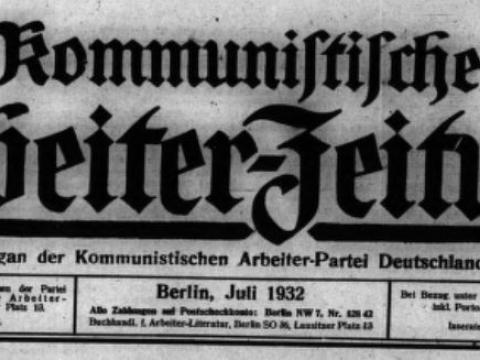
An article from the Kommunistische Arbeiter-Zeitung of the Berlin tendency, dated: 13-1932-011

Many workers, who know little about anarchism, regard it as a movement related to communism or standing closest to it, standing to its left, and so on; it is therefore necessary to clarify these fatal errors.
The classical works of anarchism emerged a hundred years ago; in them is expressed the hatred of the rising bourgeoisie—struggling for freedom of trade and commerce—against the rigid feudal state, which suppressed every liberty and rested on authority, violence, and religion. While liberalism, the great intellectual creation of the flourishing bourgeoisie, merely sought to tear out the feudal fetters of idols and reduce the state to the role of a “night watchman,” whose only task was to protect the moneybags; while liberalism wanted to humanize authority and morality, to rationalize religion, to reduce it to its “reasonable” (i.e. useful to the bourgeoisie) moral content—anarchism adds a crisis-ridden element: business is already prospering less, one refuses to think and bangs the fist on the table: the state must go entirely, no society should exist at all, no authority and no domination, no binding of the individual—I am I, and the others can go hang! This is the standpoint developed by Max Stirner in his work The Ego and Its Own—crass bourgeois egoism, liberalism made vulgar. Dripping with blood and sweat from every pore, the bourgeoisie steps onto the stage of history; its cry for “freedom” means nothing other than: down with all restraints of tradition, morality, custom, and law, we want to act and exploit freely to the point of unconsciousness; down with noble oppression—long live the bourgeois! The theory of the violent demolition of all feudal barriers of authority, the theory of the bourgeois revolution—that is anarchism.
The old anarchists, who cleared crowned heads out of the way with bombs and daggers, at least still had marrow in their bones—though in truth they only freed the thrones for the broad behinds of the bourgeoisie. By contrast, how far their descendants of today have fallen, those who reject violence and busy themselves only with enlightenment, instruction, raw food, vasectomy, and the like—gnawing at the breadline of the intellect—is recently proven by a pamphlet Thoughts on Anarchy by St. Ch. Waldecke. Strictly speaking, anarchism has no such thing as a program, since its principle is that every person should be a fool on their own account. But the author does bring out very well the basic ideas and principles of “rulelessness,” and for that reason we shall carefully examine the pamphlet.
Anarchy is absolute nonviolence; it cannot be introduced by force or imposed on anyone. Only when everyone is an anarchist does the thing truly begin. “Perhaps I can prevent someone from ruling over me, but as long as I must force him not to, it is still not anarchy.” From there it is but one step to the Christian teaching: resist not evil, and turn the other cheek. But one can already begin here on earth. Rebellion or revolution is not necessary; wherever there are anarchists, they can begin with anarchy at once. “Here, then, and now is the time to begin.”
And what about production and the economy? Nothing may be dominant—so not even communism. Some have not yet realized that the most authoritarian parties, no matter whether they are supposedly on the right or the left, are precisely those the anarchist must most fiercely fight—for example, the National Socialists and the Marxist communists. The state party, however, is probably still the most sympathetic to the anarchist. To fight communism—that, of course, already means arrogating authority to oneself! “Whoever capitulates before the idea of the councils is no anarchist at all.” And the anarchist leader says it bluntly: “Anarchism does not even have a class-struggle character in the Marxist sense.” The author is so historically and politically unscrupulous, and at the same time so well-versed in anarchism, that with his mistaken points he inadvertently makes clear the bourgeois character of this fossilized “movement” itself, showing that it has nothing whatsoever to do with the proletarian movement of our own time. He himself says: “The older liberalism of a Jefferson, Paine, Diderot, etc.—who saw the state as an evil, unfortunately a necessary one, but still as an evil that had to be pushed back as far as possible—stands closer to the idea of anarchism than do democrats, social democrats, and class fighters for dictatorship.” The proletarian dictatorship, to him, is perhaps even more repugnant than the bourgeois class state. So then what anarchism actually is, is hard to say: since no one may be forced to hold a particular opinion, the best thing would be not to open one’s mouth at all. If someone says: anarchism is a cowshed, the true anarchist must not contradict him—for that would already be authority and terror against freedom of opinion. Of course, any solution to social questions—even if it were objectively the correct one—would, without the consent of every single member of society, be a wholly un-anarchistic act. So in the meantime capitalism must continue, unless and until every single capitalist declares for the communist society! And such a thing dares to stand “to the left of communism”!! In democracy 51% rules; in anarchy you need 100%. So it is by 49% more idiotic. A world economy, of course, does not enter Herr Waldecke’s mind—that would be too large an organization. Everything must be broken down into tiny fragments: a little individualism, a dash of communism, then wait for experiences and make use of them. “Personally, I am more strongly impressed by the individualist ideas of Stirner, perhaps also of St. P. Andrews and G. Landauer, yet I fully believe in the possibility of a communism that does not impair freedom, within narrower circles, on the basis of close human relations, and I have myself already lived it.” At last we learn how little Morita imagines communism! A few families in neighboring allotment gardens live communism, a few others live capitalism, and the whole business is anarchy! So let us smash the world into nothing but Robinson islands, and then everyone can sit on the shore, with Max Stirner in his left hand and a fishing rod in his right, to catch himself a fish—and Marxism is finally killed off!
Anarchism is a stagnant “movement”; it has been dead since the bourgeois revolution and is therefore historically blind. It does not see the turning of the ages, the collapse of individualism. It keeps droning on with its hundred-year-old refrain of individual freedom—while what we need is not “freedom,” but organization; not looseness and individualism, but the deepest fusion, subordination, and concentration of all forces into socialist planned economy. In place of the “Unique” comes society; in place of the I, the We. It is not “freedom” we want—that already exists in the capitalist state, where everyone can do and leave off as they please, go wherever they wish, and just as well perish however and wherever they will. No—our slogan is not individual “freedom,” but social cohesion!


Comments
Thanks for uploading this…
Thanks for uploading this article, even though I don't agree with all aspects of it. If you have any other identifying info for the article (e.g. volume and issue numbers, the source from which you're transcribing it etc.), then that would also be great to note somewhere.
Not just anarchists employed violence—the People's Will in Russia also notably employed violent means against Tsar Alexander II, killing him in a bombing. They were not anarchists because they called for the creation of a democratic and decentralized workers' government/All-Russian Federation (including peasants) in the event of a revolution in Russia. Marx and Engels were also sympathetic toward the People's Will and thought that their more militant tactics were justified in Russia given tsarist oppression.
I think this article also focuses too much on individualist anarchism and doesn't directly engage with the social anarchist thinkers enough.
It is disappointing to see…
It is disappointing to see that even Council Communists had no shame in exposing their utter ignorance of anarchism publicly. I do wish Marxists would actually read some anarchist theory before they spout forth upon it.
A few do (Harry Cleaver's excellent article on Kropotkin being one) but most do not -- and it shows. As can be seen from this nonsense... equating Stirner with anarchism, not even wrong...
This article is so terrible…
This article is so terrible that it is baffling that anyone thinks this belongs in the library. This is the opposite of a scholarly attempt to critique anarchism. It is not enough to just say it is too focused on individualist anarchism. The author does recognize that other workers regard anarchism as close to communism, to its left. The author then states that is a fatal error and uses the article to explain why. But the piece is so detached from reality, that it provides no sufficient explanation. This article by a council communist reminds me of something a SPGBer would write.
adri Not just anarchists…
adri
The Bolsheviks also carried out several robberies, planned by Lenin & Stalin, e.g. ; https://en.wikipedia.org/wiki/1907_Tiflis_bank_robbery
Yes, I should note that I'm…
Yes, I should note that I'm also somewhat sympathetic toward the People's Will myself. They were the precursor to the Socialist Revolutionary Party and the rivals of the less militant Black Repartition group headed by Plekhanov, which was itself a precursor to the Russian Social Democratic Labor Party. Marx and Engels both criticized Black Repartition for doing nothing,[1] among other reasons, though Plekhanov would later cozy up to Engels and get on closer terms with him. Engels similarly became more pessimistic about Russia's chances of avoiding capitalist development on the basis of the Russian peasantry/mir, seeing as how the efforts of the People's Will and preceding decades ("Going to the People Movement" etc.) had failed to bring about a revolution among the peasantry and workers.
1. See Marx's letter to Sorge in 1880:
In any case, what I was…
In any case, what I was getting at is that it was a bit strange for the author(s) of this article to single out anarchists for using violent methods and to make them appear as "adventurist" when non-anarchist groups like the People's Will, and also the Bolsheviks as you mention, engaged in violent acts against the ruling order as well. Not only did the People's Will employ violence, but as the above quote by Marx shows (along with other sources), both Marx and Engels even thought that their tactics were justified within a Russian context and sympathized with them.
But yeah, overall this article is not a very good critique of anarchism.