By Bayan Saleh
Throughout history, women have played crucial roles on both global and local levels. They have fought for rights, participated in
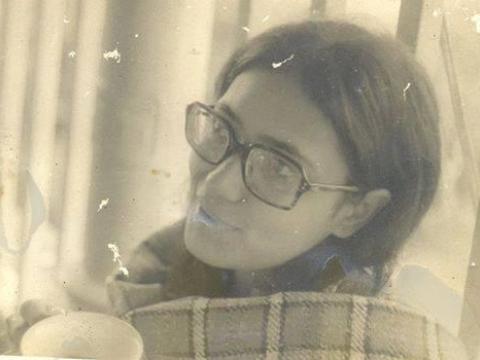
Anuradha Ghandy
1954 – 2008
“We cannot liberate working women if we wage the struggle with a patriarchal mindset.”
When a woman leads an underground struggle, engages in both intellectual and field work among the masses, and reshapes feminist theory from within the heart of class struggle, you are witnessing an extraordinary life story.
Anuradha Ghandy was not merely a thinker but a true revolutionary militant, about whom little has been written in Arabic despite her significant role at the time.
Anuradha Ghandy—also known as Anuradha Shanbag—was among the most prominent communist activists in contemporary India and one of Asia’s leading revolutionary feminist figures. She played a pivotal role in developing Marxist feminist discourse by integrating theory and practice, confronting patriarchy not only in society but also within leftist organizations and parties themselves, proposing a class-based feminist vision rooted in Indian reality.
In a complex social and economic context like India—where class, caste, and gender structures intersect—Anuradha emerged as a rare example of a revolutionary militant committed simultaneously to class struggle and feminist liberation, never separating the two. She consistently emphasized that women’s emancipation could only be achieved through dismantling the intertwined roots of capitalism and patriarchy.
From a Communist Childhood to a Communist Leader
Anuradha Shanbag was born in Mumbai in 1954 into an educated communist family. Her father was a lawyer and an active member of the Communist Party of India, while her mother was a social activist. This political and cultural environment shaped her awareness from an early age. She became involved in public debates and social causes as a teenager and developed an interest in the arts, such as theater and classical dance, which endowed her with a deep humanistic vision and early critical consciousness of her society’s issues.
During her university years at Elphinstone College, Anuradha entered political life through youth movements and quickly became involved in urgent social issues such as the famines in Maharashtra and the Bangladeshi refugee crisis. These experiences deepened her connection to popular struggles and gave her direct field experience. They ultimately led her to join the Maoist movement, where she helped establish the Maharashtra branch of the Communist Party of India (Maoist) and later rose to its Central Committee.
Her class consciousness was inseparable from her understanding of India’s complex social structure. In her work “The Caste Question in India”, Ghandy explored the dialectical relationship between class and caste, criticizing the prevailing Marxist simplification that reduced caste to a mere reflection of class. She argued that India’s caste–class system constituted an intricate and interwoven structure that required deep analytical and field-based deconstruction within a liberatory framework attuned to India’s social specificity.
Marxist Feminism: Beyond Inherited Conventional Thought
One of Anuradha Ghandy’s most significant intellectual contributions lies in her profound critique of both Western liberal feminism and patriarchal practices within leftist parties. In her book “Philosophical Trends in the Feminist Movement” (2006), she offered an in-depth critical reading of feminist schools, showing that most of them stemmed from bourgeois perspectives detached from the realities of working and poor women in the Global South. She called for a proletarian feminism organically tied to class struggle and freed from individualism.
Her critique was not limited to feminism—it extended to the left itself. She sharply criticized leftist leaderships for ignoring women’s oppression and exposed the contradiction between their revolutionary rhetoric of equality and the persistence of patriarchal practices within leftist organizations. She insisted that women’s liberation could only be achieved as part of a radical socialist project that restructures all forms of power, including patriarchal authority.
But she did not remain a theoretician—she translated her ideas into action. Working in rural areas such as Dandakaranya and Bastar, Anuradha put her revolutionary principles into practice: organizing women into agricultural cooperatives and struggle groups and integrating them into the grassroots process of social change. She documented this experience in her 2001 article “The People’s War Has Removed Women’s Hesitation in Dandakaranya”, asserting that revolutionary work cannot succeed without restructuring gender relations within the movement itself.
Anuradha Ghandy: A Human Presence as Revolutionary as Her Thought
Despite her deep involvement in political struggle and clandestine work, Anuradha Ghandy never lost her warmth and humanity. She was known among her comrades for her emotional sensitivity and deep personal commitment to those she worked with—especially poor rural women. She did not observe from a distance; she listened to women’s stories and experiences, believing that a conversation with a poor woman was no less important than any party meeting.
In her personal relationships, Anuradha combined tenderness with principled rigor. Her marriage to the activist Kobad Ghandy was not merely personal but a true revolutionary partnership that lasted decades. The couple lived under aliases, facing persecution and imprisonment, sharing both the political and existential responsibilities of a life wholly devoted to a collective cause.
One of her close comrades described her after her death:
“Anuradha fought with a steadfastness that did not resemble shouting—it resembled the silence that makes revolutions. She never compromised, but she always listened.”
Despite the hardship, she never lost the capacity for reflection. In her secret journal, she once wrote:
“Sometimes I feel I carry the weight of the world on my shoulders—but then I remember: if not me, who else?”
This human dimension completes her Marxist and feminist thought, giving it rare sincerity and depth.
Personal Life and an Early End
In 1983, Anuradha entered a life and struggle partnership with the Maoist activist Kobad Ghandy, united by a shared belief in the socialist revolutionary cause. Their marriage was unconventional, lived clandestinely and in constant movement due to their deep political commitment. They traveled between cities and rural areas under false identities and faced repeated arrests and persecution.
Anuradha continued her revolutionary work under harsh conditions even as her health deteriorated. In 2008, while in Junagadh on an organizational mission, she contracted a rare form of cerebral malaria. Because she was living under a false identity for underground work, her diagnosis was delayed, aggravating her condition. She was also suffering from systemic sclerosis, a chronic illness, which led to a rapid decline in her health.
Anuradha Ghandy passed away on April 12, 2008, at the age of 54, leaving behind an indelible intellectual and human legacy. She remained, until her last breath, faithful to her cause and at the heart of the struggle.
Her Legacy and Continuing Influence
Anuradha Ghandy is regarded as one of the most important revolutionary thinkers in modern Indian political history. She left behind a rich intellectual heritage that extends beyond theoretical analysis to practical engagement with the daily struggles of the poor, women, and marginalized classes.
Her writings are today studied as essential references in many Indian universities within feminist and leftist political studies, and she stands as a model of revolutionary thought emerging from the Global South. Her work remains living testimony to the ability of revolutionary theory outside the Western center to produce critical analytical tools that go beyond even Western leftist frameworks.
Her legacy forms a cornerstone for all who seek to build a class-based revolutionary feminism rooted in the Global South—one that transcends the red lines drawn by both patriarchy and capitalism.
Selected Works by Anuradha Ghandy
Philosophical Trends in the Feminist Movement
One of her most influential works, this book provides a critical analysis of different feminist currents—liberal, radical, Marxist, and existentialist. It explores how these trends interact with women’s issues, particularly in the Indian context, and critiques Western tendencies that ignore class and local realities. It calls for adopting a proletarian feminism linked to class struggle and women’s liberation from economic, social, and cultural exploitation.
Publisher: Foreign Languages Press
Scripting the Change: Selected Writings of Anuradha Ghandy
A collection of her essays and lectures covering topics such as fascism, fundamentalism, patriarchy, and issues of class and gender. The book reflects her deep commitment to social justice, socialist transformation, and the struggles for the rights of women and marginalized groups.
The Caste Question in India
This work critiques the traditional Marxist interpretation that equates caste with class, arguing that such simplification ignores the complexities of India’s caste system. It calls for a deeper understanding of the relationship between class and caste and insists that caste issues must be addressed independently within class struggle, grounded in India’s particular social structure.
References:
• Ghandy, Anuradha. Philosophical Trends in the Feminist Movement, Foreign Languages Press, 2006.
• Anuradha Ghandy
https://en.wikipedia.org/wiki/Anuradha_Ghandy
• PHILOSOPHICAL TRENDS IN THE FEMINIST MOVEMENT ANURADHA GHANDY
https://www.marxists.org/archive/gandhy/2006/philosophical-trends-in-feminist-movement-2nd—print–ing.pdf
• Book Review: Philosophical Trends in the Feminist Movement by Anuradha Ghandy
https://ins-ph.medium.com/book-review-philosophical-trends-in-the-feminist-movement-by-anuradha-ghandy-a92541f781b0





Comments