
From the hardhat riot in 1970 to Minneapolis and ICE murdering protesters in 2026, the Right has created narratives that dehumanize the Left to justify extreme violence against them. It is done to establish the far Right as the lone defender of the country and "American values."

Aww there’s such evil goin’ down it’s ridiculous
And our leaders tell us
Swear to the flags
It’s your duty
As we all burn
—Suicide, Swearin’ to the Flag
Intro
As I wrote this review, US Immigration and Customs Enforcement (ICE) agents terrorized cities, fomenting violence, engaging in racist mass detentions, and murdering people who were observing them. The victim-blaming narratives fired up within minutes of each killing. Across the MAGA media eco-system, social media handles and bots, television channels and celebrities, You Tubers, and Trump officials, created and repeated mantras about crazy left wing terrorists attacking ICE agents. Everyone knew it was a lie. Whether you chose to spread the lie or call Bullshit is a very simple test of which side you are on.
The hardhat riot was certainly an instance of Right-wing violence against the Left. The incident and broader history of social class in the US are often misremembered as the conservative working class versus the elitist liberal Left. The story highlights working class resentment toward liberal elites and their government that left workers behind. It’s a bait and switch that identifies the capitalist systems’ inhumane treatment of workers, only to shift that blame onto Left political parties and social movements. At that point, the Republican Party and movements of the far Right can arrive on the scene like white knights. Part of this Right wing “rescue” of “the working class” will include violence against all enemies. Once a scapegoat is identified, hippies, immigrants, antifa, feminists, Somalis, whoever it may be, any violence against them can be justified as “self-defense” carried out by those “protecting the country and its values.”
Bearing that in mind should help the reader understand why I thought this documentary was important enough to write about. In it, the rioting hardhats become the underdog heroes. Their violence is justified, including their choice of a target, the antiwar movement and the Left. In challenging the framing of the documentary, I cite a bunch of books articles, and videos, but most of all Hardhats, Hippies, and Hawks by Penny Lewis. So this is largely a Kuhn vs. Lewis blog post and I recommend you read her book!
Basic Background to the Hardhat Riot
On April 30th, 1970, President Richard Nixon announced the expansion of the Vietnam War with the invasion of Cambodia. He had been elected on the promise of ending the war. Somewhere around two million Vietnamese had already been killed by that point. Student and other anti-war protests once again exploded across the US.
On Saturday, May 2, 1970, students protesting at Kent State University in Ohio set fire to the ROTC building with flares. The National Guard was mobilized and on May 4th, shot and killed four students. This further fueled campus protests, many of which became shutdowns. 1.5 million students closed 20% of campuses nationwide.
On May 8th, 1970, a small group of anti-war protesters marched on Wall Street. A couple of hundred construction workers marched in response. They arrived waving giant American flags and proceeded to unleash brutal beatings against protesters, students at nearby Pace College, and onlookers. Seventy people were injured. This riot was followed by large marches of construction workers and Wall Street workers, as well as other patriotic supporters, culminating in the “Honor America, Honor the Flag” rally on May 20.
This episode became known as the “Hardhat Riot.” Nixon seized upon the symbolism of it and was able to parley the image of the construction workers’ anger against Left elites into support for his 1972 reelection campaign, based on a new alliance of white workers with the Republican Party.
Whose History?
When I saw that the PBS series “American Experience” released a documentary on the May 8th, 1970 Hard Hat Riot in New York City, I had high hopes. I used to teach history at a local community college and found American Experience episodes very useful, accurate, and historically critical in a good way. For example, their series “Reconstruction: The Second Civil War” does a great job of dismantling the Dunning School, and Lost Cause type portrayals while also focussing down into specific stories about Freedmen and the horrors of Redeemer government. Eric Foner’s scholarship shapes much of the narrative of the series to good results.
“Hard Hat Riot” provides a decent overview of the events of May 8th, as well as some of the context of the 1960s political scene, particularly in New York City, that were the backdrop to this explosive incident between construction workers and protesters. This documentary also bases its narrative heavily on one scholar. Unfortunately, that scholar is David Paul Kuhn, author of the 2020 book The Hardhat Riot: Nixon, New York City, and the Dawn of the White Working-Class Revolution.
I had not yet heard of his book when I watched this, but I noticed him popping up repeatedly in the interviews. As I grew more uneasy with the framing of the thing, he kept reappearing, more excited with each snippet, offering qualified support for the hardhats.
At first, I tried to hold off on dismissing the presentation as “Right-wing,” because the tone was mostly neutral with a heavy focus on class issues. But as Kuhn’s thesis became apparent, it clearly had problems. In his view, the real, white, American working class, (blue-collar, traditional, tight knit, community-based, and patriotic), had been disrespected, ignored, and baited by the alliance of middle and upper middle class, draft avoiding, effete, college students, elite professors, mainstream media, and out of touch government officials. Because of that, the brutal wilding against protesters, while wrong-headed, was ultimately justified. The anti-war protesters deserved it, and the hardhats represented the white working class finally standing up for itself.
Instead of just documenting and analyzing the ways in which Nixon and his advisors seized upon the “politics of resentment,” Kuhn’s narrative justifies them. He portrays Nixon’s opportunistic creation of a ruling class/blue-collar alliance as a victory over the Leftist forces that had not only abandoned workers, but judged and hated them.
It’s true that the Democratic Party had lost control of its “New Deal Coalition” and abandoned the postwar “liberal consensus.” That consensus sought to ensure that (mostly white, industrial) workers got good union jobs and good wages in exchange for “labor peace.” The ruling class kept control over the forms, pace, and security of work. Many labor scholars have noted the way this left Labor vulnerable. Having been coopted into what amounted to an alliance with big business and the capitalist class, they were no longer positioned to fight back once the era of the post-war boom (roughly 1945 to 1973) ended and concessions to labor were no longer a given.
Nixon’s trick was to spot blue-collar, ethnically white, workers’ resentment of losing ground to capitalists as the post-war boom waned. As the boom fizzled, the liberal consensus gave way to what would become known as neoliberalism, with less protection for workers and freer markets, including labor markets, for capitalists. Nixon directed worker anger at non-whites, the antiwar movement, and the liberal universities. The latter were reductively portrayed as sites of out-of-control brats burning buildings and American flags in between orgies, while others had to work and fight in wars. The antiwar movement could serve as a villain for the white working class.
Kuhn wants to show that this resentment toward the Left made sense, and that the beatings were both cathartic and a reclamation of working-class dignity. So he has to create a story in which students, professors, and the anti-war movement generally can’t be working class. They have to represent elitism. Workers must be blue-collar. All blue-collar workers must hate the anti-war movement. Kuhn claims that the New Left gave up on the working class to organize people and protests rooted in “identities” based on goals such as Black liberation, Chicano rights, feminism, LGBTQ, Civil Rights, etc. Because of that, he seems to imply, they don’t count as workers. Class reductionism creeps into a lot of what he wants to pass off as class analysis. Class reductionism tends to work well for anti-woke, contrarian, Right-wing arguments.
Kuhn discusses the winding down of NYC as a hub of unionized industrial workers’ power and the shift to the city becoming more of a financial hub. The construction of the World Trade Center Towers serve as a powerful symbol of this shift. He forgoes any attempt to analyze how the shifting composition of the working class in the face of the dying liberal consensus left workers vulnerable and instead inserts a kaleidoscope of resentments about leftists burning flags and cheering on Ho Chi Minh, blaming these behaviors for the blue-collar turn to the Right. That leaves the far Right and Republican Party as default saviors, or at least the lesser evil. The “regular Joe” workers interviewed in the documentary serve as mouthpieces for this narrative.
Ignoring the Changing Capitalist Terrain
Kuhn surmises that just as the Democratic Party had abandoned workers, so too had the New Left, leaving behind the class struggle politics of the Old Left. There is some truth to the notion that the working class itself was not as class-conscious and militant as it had been in the 1930s. But it might be more accurate to say that anti-capitalist, anti-systemic, anti-authoritarian movements had to adapt their strategies and broaden their ideological tools and tactical actions to the changes occurring within capitalism. It’s hard to miss that new attention to “identity” was also correcting the incredible racism and sexism that was and still is as much an issue in labor and revolutionary circles as anywhere else.
At any rate, as the global capitalist system was rearranged after World War II, it became apparent that the Keynesian policies of the New Deal would not be sustainable if capitalists wanted to maintain “economic growth.” Simultaneously, the production capacities of nations reduced to rubble during the war were rebuilt to modern standards and became competitors for the US in many cases. The history is complex and included many opportunities for US policy to take advantage of various regions of the planet through investment strategies that put the US at the “core” and mostly non-Western countries at the “periphery.” Suffice to say that the golden age for that section of the US industrial working class that had grown accustomed to job security and single bread winner families was disappearing by 1970.
The documentary reduces the complex context to come up with some partial truths and those are in turn said to imply that the Left now hated workers.
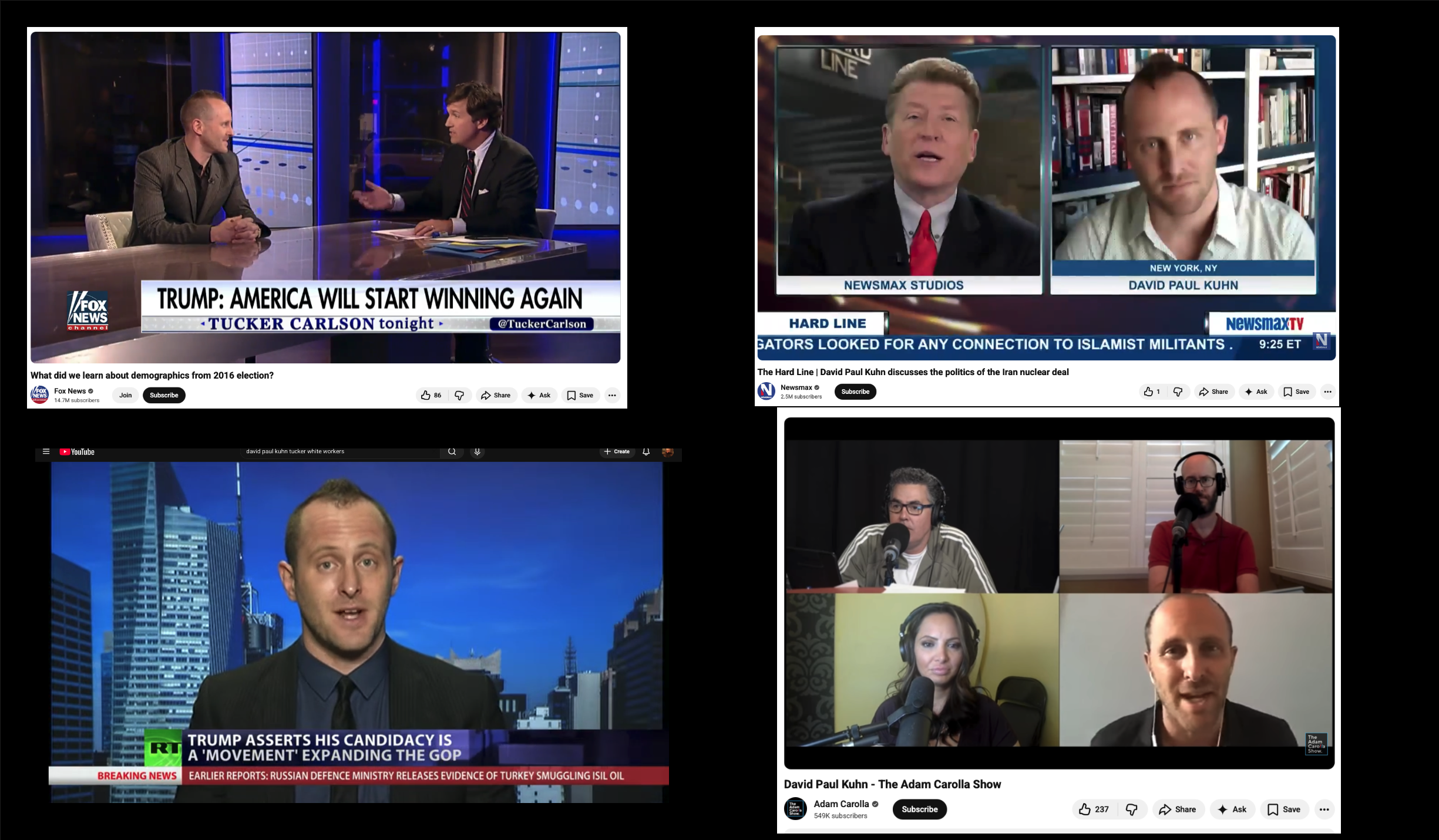
David Paul Kuhn shows up for interviews on a lot of weird Right wing shows
Hijacking Class Struggle
Ultimately, Kuhn’s book, which came out in 2020, and this documentary from 2025, are about justifying Trump’s Right-wing populism as a genuine attempt to revitalize working class power. A friend on social media also disliked this documentary saying that it felt like a “Whiggish protohistory of MAGA.” He means it identifies the failures and alleged insolence of the Left, which are portrayed as inevitably leading to the glorious present of a Labor-MAGA alliance. “Look at what you made us do!” It’s all too neat and precooked.
Gabriel Winant points out in his review that “[Kuhn’s] book as a whole, in fact, renders judgments on events of all kinds almost purely on the basis of how they registered in public opinion polls. Under the syllogism that protesters were elites and workers were patriots, antiwar protest must therefore have been anti-worker.”
Cliff Sloan, a student who was interviewed by the NYT a month after the hardhat riot, provided a clarifying observation that Kuhn seems not to have picked up on: “If this is what the class struggle is all about, there’s something wrong somewhere.” [The Sloan quote is from a 2020 Jefferson Cowie article in the NYT here
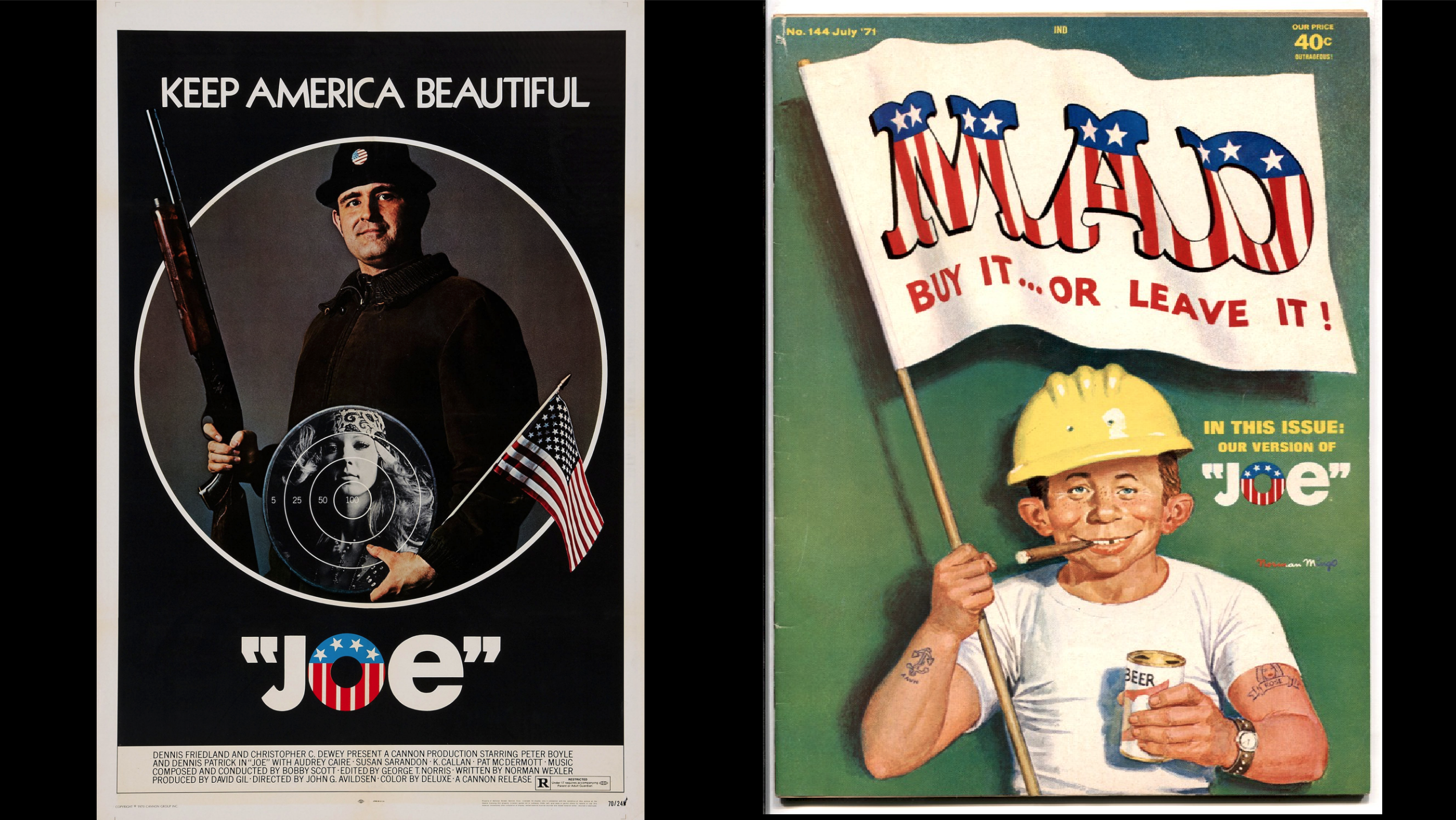
The film "Joe" is an example of the over the top portrayals of blue-collar anger toward hippies and Mad Magazine immediately picked up on that. Note Alfred E. Neuman's hardhat.
Just as the antiwar movement was not anti-worker, Nixon’s strategy was obviously not about unleashing working-class power, nor is Trump’s. They are about neutralizing it, and using the identitiesof workers, as patriots, families of soldiers, religious, traditional, and white, to tie them to the Republican Party in a culture war. While Kuhn says that the New Left had pivoted from class politics to identity activism, he misses the class aspects of those New Left politics, to justify the culture war aspects of Nixon’s appeal to the “Silent Majority,” whom he claimed were now an “emerging Republican majority.”
Building the “White Working Class” Narrative
Here’s a brief collection of quotes from the documentary meant to define the authentic working-class identity of the Hardhats. This would not be a problem if the film were able to lift this basic fact out of the stereotypes and misremembered histories of this era that repeat the distorted “patriotic workers vs. elite leftists” narrative. But the interviews and framing are extremely manipulative toward maintaining that story.
DENNIS MILTON, IRONWORKER: To us, as the working stiff, let's put it– or blue-collar, you would just have people go to college to beat the draft. And they had money, and they let the working class people fight the wars.
DAN ROSSI, SHEET METAL WORKER: And you take that flag and throw it on the floor and step on it? You’ve just made it personal.
DENNIS MILTON, IRONWORKER: When they would come home, there was never a welcoming for troops. The people here. A working-class guy took offense to that.
RAY MELVILLE, LATHER: We were told don’t wear your uniform when you go on leave, just try to avoid any confrontation with anybody.
DENNIS MILTON, IRONWORKER: And all of a sudden, boom, everybody's swinging. I could fight, believe me. If you get hit by a construction worker, you're going to know it compared to being a college student, put it that way. I felt they had a beating coming.
DAN ROSSI, SHEET METAL WORKER: You knew these kids were going to get hurt. So I wasn't sure if I wanted to help the kids get hurt or if I was on the side of the construction workers. Until I saw them disparaging the flag, that drew the line with me. I’m a marine and you take that flag and throw it on the floor and step on it, you just made it personal. They’re stepping on the bodies of the men that fought, that died in Vietnam next to me.
DENNIS MILTON, IRONWORKER: Whether the government is right or wrong, with a war, you should support the troops.
[See transcript for the documentary here
Kuhn sets himself up as the guy who is finally setting the record straight on how the working class stood up for itself. I also have to note how stripped down the views of the working class are here. A search of the transcript shows the word “flag” comes up 29 times, which seems a lot for an 81 minute documentary, but it also highlights how much of the riot itself centered around shallow symbolism, missing the entire point of working-class, and any other kind of opposition to the war.
Class, Race, Identity
Penny Lewis, in her book Hardhats, Hippies, and Hawks, does a deep dive on both the timeline of class composition in the antiwar movement and the class aspects of its varied sections in the 1960s and 70s. She finds that stereotypes about elite, wealthy liberal antiwar protesters stem from the early period in which college-educated and middle-class activists dominated. But this started to change by 1965 as college participation spread from Ivy League to public colleges and working-class communities. (The first “teach-in” against the war was at the University of Michigan, a public, non-Ivy League college, in March of 1965 (Lewis, 58).)
As far as the varied sources of opposition to the war, it was not only coming from “upper class and upper-middle class” white liberal elites. In fact, Black people, GIs, veterans, Civil Rights Movement activists, Chicanos, women, gay people, working-class college students, and many other “identity” groups and communities opposed the war from the start. The “hardhats vs. elites” narrative was often used intentionally by the ruling class and the Right to demoralize the movement in an attempt preclude widespread solidarity.
This is still a key strategy for the MAGA cabinet today: “And let’s just also address another thing. All these demonstrators you’ve seen out here in recent days, all these elderly white hippies, they’re not part of the city and never have been. And by the way, most of the citizens who live in Washington, D.C., are Black.” That’s United States Homeland Security Advisor Stephen Miller describing people protesting against the bogus “federal crack-down on crime” in Washington D.C. in 2025.
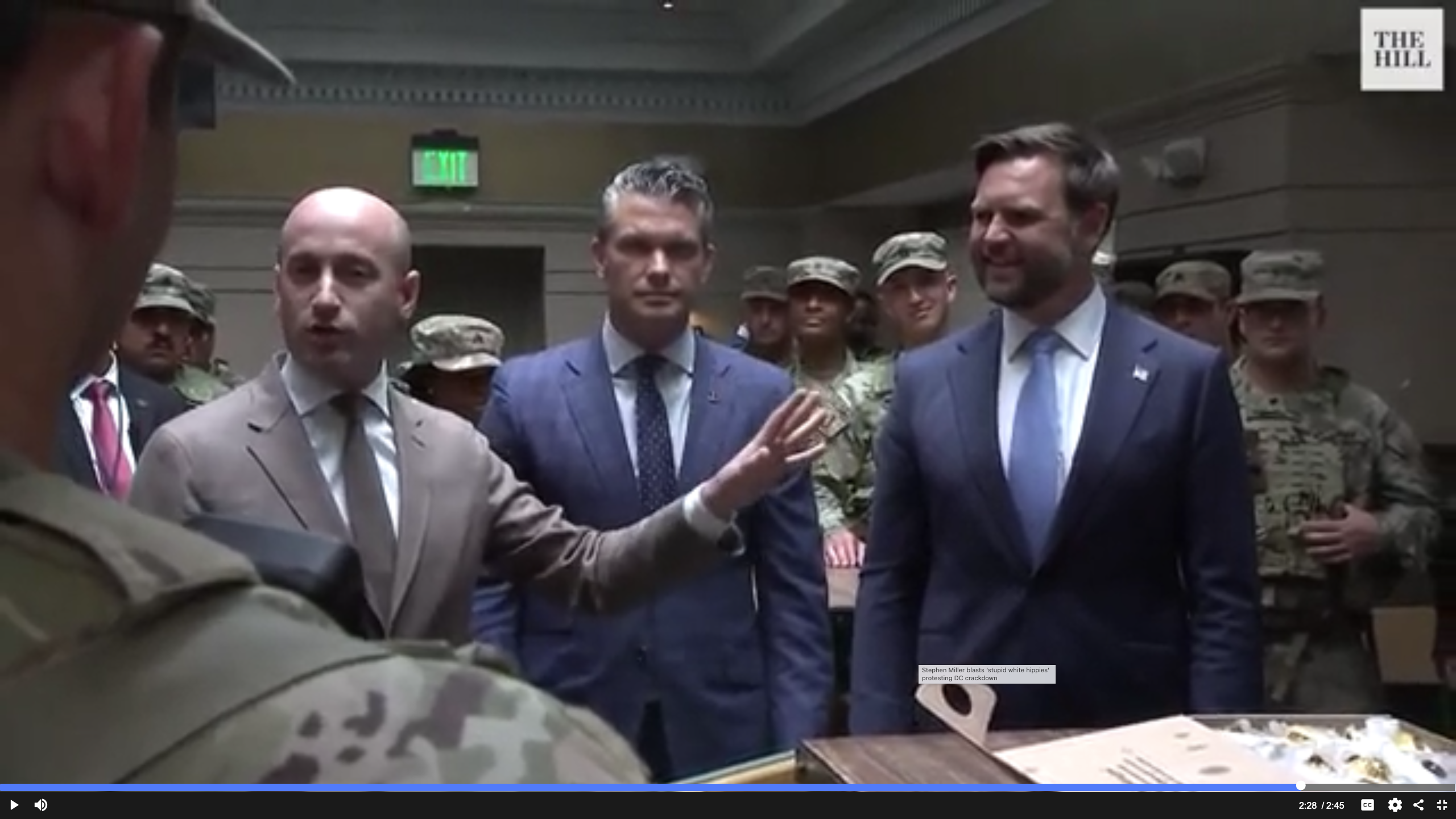
Stephen Miller, Pete Hegseth, and JD Vance having a good ol' time with troop occupations of US cities
It’s true that the Vietnam draft and resultant inductions (1964-1973) overrepresented poor and working-class citizens. The documentary doesn’t go into the way in which African Americans were overrepresented in combat and dying, which undermines the centrality of the aggrieved white worker narrative:
African Americans filled 31% of the ground combat battalions in Vietnam, while the percentage of African Americans as a minority in the general population was 12%. In 1965, African Americans suffered 24% of the U.S. Army's fatal casualties. African Americans saw combat at a higher percentage and suffered casualties at a higher rate. Dr. Martin Luther King, Jr. referred to the Vietnam War as a white man’s war, a black man’s fight.
[source: Racial, Ethnic, and Religious Minorities in the Vietnam War: A Resource Guide.
Hispanic Americans were similarly overrepresented. Penny Lewis notes that “The Chicano Moratorium was reacting to [the] death rate of Chicano GIs (double that of whites) and connecting this to the poor living conditions facing Chicano youth, wherein “poor schools...scarcity of jobs, police harassment, poverty—all conspire to push Chicano youth into the military” (Lewis, 97).
She also criticizes the way some scholars portray students who opposed the war and got deferments from the draft by attending college, or who burned their draft cards. They were said to see themselves as elites who deserved to avoid fighting, unlike the workers who would go fight in their place. Again, the idea is that if you were antiwar you didn’t care about the workers. Lewis responds that this “ignores the fact that the movement specifically argued against the class discrimination of the student deferments and everyone who burned their card or otherwise resisted the draft was directly confronting that system” (Lewis, 28).
Kuhn’s documentary does present some of the racism of the time. One example given is when the unions were integrated by law, it threatened their whites-only nepotism. This was a source of resentment for many unionized industrial workers who came from ethnically white communities and expected generational job security in exchange for doing hard and dangerous work. One of the interviewees admits to having been foolish in his youth for resisting the integration, only to realize he had become friends with Black workers as they joined the crews. It’s a moving moment, but it’s disrupted by the punchline: Now the Black workers also expected nepotism, and the white guy joshes them about that. It seems like the fact that the white workers had a 300 year head start with that perk could be very relevant.
Nancy Seifer, the head of the Mayor’s Office of Ethnic Affairs at the time, offers what comes closest to sensitive class analysis here, commenting on the differences between Mayor Lindsay’s staff and the ethnic white working-class communities of some of their constituents. She describes the working- class jobs as the ones “that kept the city alive,” but says that the people doing them lived in ways her middle-class colleagues didn’t know much about. Mayor John Lindsay came out early against the war, but he was also seen as an elite and had almost no connections to the city unions. Seifer says he felt “compassion and empathy for people in Black and Puerto Rican communities. But that same empathy wasn’t aroused by the plight of white working-class people because of the thought that if you were white you should be able to make it in America, so if you weren’t upwardly mobile it was your own fault.”
An astute viewer might notice that it’s possible to both address racial exclusion of Black workers while also addressing economic injustice against white and all other workers. It’s not Siefer’s job to explain that, but in Kuhn’s narrative, it feels like we’re asked to see implementing “identity based” policies as inherently harmful to white workers.
Martin Scorsese and the Cinetracts Collective: Raging Bull[shit]
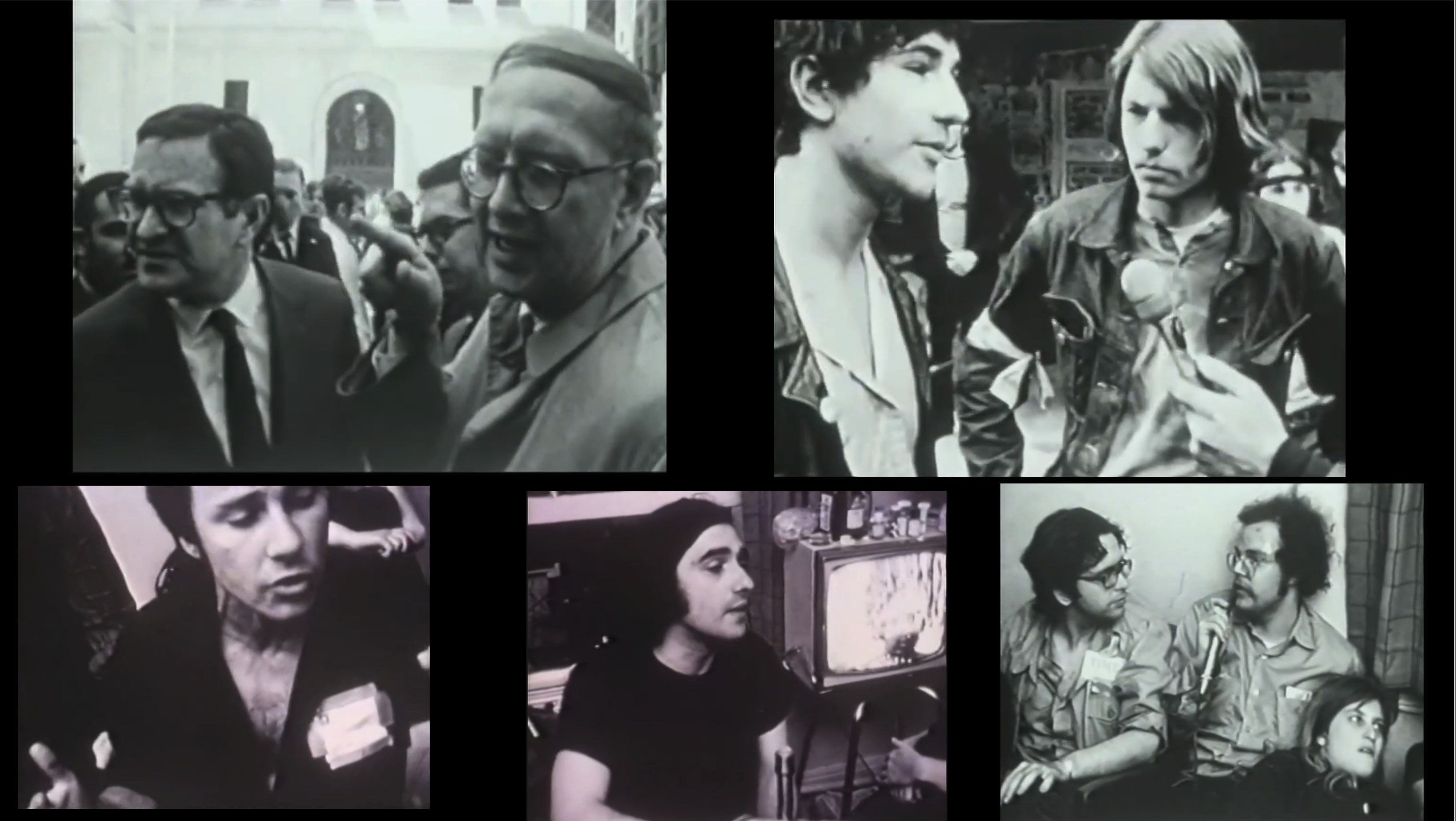
"Street Scenes" Clockwise from top left: 1."Working Man" talks about his counter-revolution.2. Two protesters interviewed as they gather wooden beams from a construction site after hearing the hardhats are on their way. 3. Harvey Keitel in the debrief after the film crew got beat up at the riot. 4. Martin Scorsese at the debrief. 5. Three film crew members at the debrief.
The hardhat’s rage, and the support from their boosters, the Wall Street bankers, stockbrokers, and clerks at the rallies, are best presented in the clips from the documentary “Street Scenes.” The film was created by the then College instructor Martin Scorsese’s Cinetracts Collective. One real standout interviewee is a white, and white collar, fascist, identified in the transcript as “working man.” He unleashes a bombastic verbal assault on the hippie filmmakers as they question him about support for the war:
Go back to the middle class...It's a completely middle class, upper class movement. It's nothing to do with working people. You can't even make contact. You can't even make a contact with the working class in this country, and you know damn well I'm right. The revolution is confined to the campus, and that's where it's going to be confined. I approve of what you're doing, because it's going to cause a revolution, but not your kind, my kind.
If you watch his full segment in the “Street Scenes” film, he’s obviously talking about a “counter-revolution” against any kind of Leftist movement, specifically a fascist counter-revolution. He plays coy and doesn’t use the f-word.
“Really Neat”
Perhaps in a sign of respect toward the critical thinking skills of the viewers, the documentary does not follow up on the sinister implications of “working man’s” worldview, nor that of the hardhat rioters,. The latter are given the floor to make the simpler case that they were just regular guys pushed to the brink by the insolence of the Left.
What we do get is Nixon’s advisers talking about how rebellious and forward-thinking their embrace of the working-class participants of the hardhat riot was:
STEPHEN BULL, AIDE TO PRESIDENT NIXON: The other people in the White House might have opposed this, have been shocked by this. But I know that people like Chuck Colson and myself thought this was really neat. And maybe that was the beginning of a change in the Republican Party. Source
Beat on the Brats
The film draws a line from the 1968 student occupations at Columbia University, to the Kent State shootings in 1970, and the Hardhat Riot four days later to show a justified white working-class rage against out-of-control elitist student protesters. However, by 1970, public sentiment had turned against the war.
In 1968, the Tet Offensive launched a massive surprise attack against South Vietnamese, American, and other allied troops. Though it was not a victory for the Vietcong and the North, the mass destruction and casualties led most Americans to question whether the war could really ever be won. So by 1968, the majority of the US population wanted an end to the war. The question was how. But the year 1968 also saw the assassination of Martin Luther King Jr. followed by mass uprisings in Black cities. The assassination of Robert F. Kennedy that same year contributed to hopelessness and anger on the Left, and more unrest. This included campus occupations.
“Liberal elite,” New York City Mayor Lindsay had been pressured to bring in the cops to end the student occupations at Columbia University, but he insisted that the Columbia leadership ask for it themselves. Political scientist William Sales (who is Black) notes, “The kind of energy the police committed to hurting these kids had much more to do than what was going on at Columbia. It had to do with the whole history of how poor white ethnic groups have felt disrespected and mistreated in American society.” I don’t want to lump in Sales with Kuhn’s overarching intent but the nuances of any racial issues here are recuperated and flattened to serve the white working-class grievance narrative.
Kuhn comments that, “to those cops, it’s shocking for the time to see kids of privilege demean them. They call them pigs, insult their mothers.” The protesters are shamed here with no context about the number of Vietnamese killed, any of the atrocities of war, brutality against Black people at home, how protesters had already been brutalized, or an honest portrayal regarding the scope and breadth of the resistance to the war, including from working-class people.
Some of the people who wanted an end to the war wanted it to end “with honor,” as Nixon put it, including some who believed that it should be fought harder to bring it to a close sooner. Deeper context is again important. Penny Lewis notes that after 1968, the antiwar movement “formed deeper roots among people of color, religious communities, labor unions, the armed forces, veterans, and students attending second-, third-, and fourth-tier college campuses.” While it is true that the antiwar movement usually polled badly, “after 1968, for all of the unpopularity of the movement, the majority of people polled echoed many of its arguments when asked about the war” (Lewis, 45).
Misremembering History
While there is some truth to “Working Man’s” accusations in “Street Scenes,” it turns out his characterization of the antiwar movement, and antiwar sentiment being completely cut off from the working class is mostly wrong. While it might have been more accurate in the early years of the antiwar movement to say it was mostly intellectuals, professionals, middle and upper middle class activists, this would not be the case for long, and certainly not by 1970 when he was saying these things in a very convincing tone.
Lewis states that, “[w]orking class opposition to the war was significantly more widespread than is remembered, and parts of the movement found roots in working-class communities and politics.” Furthermore, the opposition to the war, it has to be remembered, was opposing elites. These were elites in the roles of policy makers, media commentators, major labor leaders like George Meany of the AFL-CIO, even university administrators who tied their colleges economically to war production and the corporations making weapons. Lewis cites author Betsy Leondar-Wright who writes that, “[i]n fact the greatest support for the war came from the privileged elites, despite the visible dissension of a ‘minority of its leaders and youth’” (Lewis, 5, and footnote 2 to introduction).
Despite Kuhn’s role as a booster from the sidelines 55 years later, the hardhats didn’t speak for all blue-collar workers, or even most of them. Not when they beat up students, nor decades later when they told their stories to the American Experience interviewers. Writing generally about common media commentary, from opinion pieces and articles, to television drama portrayals of the hardhat riot over the years and at the time, Lewis says that “[t]he violent aggressor became the righteously aggrieved victims.” The reality was that “[b]lue-collar America in fact, disapproved of the hardhat attacks, and other authors argue it was precisely the over-the-top actions of the construction workers that catalyzed the greater antiwar involvement from the official labor movement” (Lewis, 22-23).
She writes that the conservative leadership of the larger trade unions, especially industrial unions, were generally far to the Right of large portions of the rank and file. President Johnson was known to strongly retaliate against labor leaders and anyone else who went against him on policy, including over the war.
While some labor leaders may have been anti-war, they felt constrained from expressing it. Walter Reuther of the UAW was in many ways an internationalist liberal, but he did not speak out publicly against the war until after Johnson stepped down. The ILWU’s Harry Bridges was anti-war and saw his membership as also opposing it, but would not commit his rank and file to participate in anti-war actions. This was due to the prevailing Cold War anti-communist ideology among US union leadership. As the war continued, it became harder to openly support it, and even the hawk George Meany dropped his support, but not until 1974 (Lewis, 100-102).
While Kuhn loves to point to polls to show how divided the working class was from the antiwar movement they don’t all strengthen his thesis: “In 1967, the [UAW] leadership conducted a poll that indicated the rates of dovishness were higher in the UAW than in the public at large” (Lewis,108).
A late 1967 poll by Gallup, weeks before the Tet Offensive, found that 43% of unionized workers thought the war was a mistake, just a bit lower than the 45% of the general public that thought this. After the Tet Offensive, Gallup found that “union members’ disapproval of the war outpaced the national average” (Lewis, 109).
Sign Sign, Everywhere a Sign
There are a lot of signs that David Paul Kuhn was the wrong guy for the job of lead historian for this documentary. They shoulda got Penny Lewis!
In a review of Kuhn’s book, David Austin Walsh points out a reactionary tone is easily detected: “...Kuhn seems more interested in validating the grievances of working-class whites against New Left radicals and their liberal political allies than in analysis.” And this: “...An entire chapter is dedicated to the violence at the Democratic National Convention in Chicago in August 1968; while Kuhn points out quite rightly that most Americans sided with the police over the protestors, he also implies that the police violence in Chicago was—if not exactly justified—brought on by the radical demonstrators themselves.”
Even in the portrayal of the patriotic working class, the documentary is distorting the record with its narrow focus. It’s acknowledged that the soldiers were, in Kuhn’s words, “overwhelmingly blue-collar and impoverished whites or struggling Blacks.” Missing is any indication that the GI resistance was key to bringing the war to an end.
David Cortwright wrote, in the intro to his 1975 book Soldiers in Revolt that
This book makes clear what anyone with even a small understanding of American society might expect—that black soldiers and sailors would be more prone to rebellion than others and that GIs who came from the working class would also be less enthusiastic about the war than those from more privileged backgrounds. In short, racial resentment and class anger fueled much of the disaffection from the war in Vietnam. [p, viii]
Cortwright’s book shows that GI resistance reached a level at which the war could no longer be fought effectively. “Such figures suggest that as many as one fourth of all Army enlisted men engaged in some form of rebellion against military authority” (25).
Other documentaries, such as “Sir, No Sir!” and “Berkeley in the Sixties,” provide excellent examinations of the antiwar movement, including the importance of the resistance from soldiers themselves. They resisted in Vietnam and back in the states in groups like Vietnam Veterans Against the War. These veterans and active duty soldiers were both participating from within their own organizations and within the broader antiwar movement, and helped dispel narratives that only elites and draft dodgers protested the war.
Conclusion
“American Experience: The Hardhat Riot” is worth watching as an introduction to the basic issues surrounding this event, but only if the viewer is on guard against the inversion of class analysis. It does very little to examine the class composition of the antiwar movement or the ways in which pro or antiwar views were contingent and often nuanced. For example, among antiwar groups, within groups and between different groups, there existed liberal, Black Nationalist, Chicano, veteran, communist, feminist and other radical approaches that overlapped with each other but were not entirely the same.
My main concern is that it “recuperates” the history and bends it toward a far Right narrative which sees the Republican Party as somehow “the party of the working class.” Kuhn really does strongly imply this: “Richard Nixon will seize the breach and shift the Republican party from blue bloods to blue collars.” After seeing this film I had to take a shower and then immediately took Penny Lewis’s book off my shelf, where it had been waiting for years, and dove in. As the historian at the center of this documentary, Kuhn makes the case that the reactionary Right can take the helm of the ship of labor and it will still serve the working class. This is class reductionism and the logic of “labor peace” taken to its most ridiculous end.
“I believe in the workers’ revolution
and I believe in The Final Solution”
—The Buzzcocks, I Believe
Comrade Motopu, January 24, 2026


Comments
Great article. Thanks.
Great article. Thanks.
I just saw this on facebook…
I just saw this on facebook. George Daly is the labor leader seen handing the hard hat to President Nixon. His daughter posted about the documentary on facebook. "I truly hope the message of this documentary reaches and resonates with all Americans. Anyone who desecrates the flag should be punished."
Look forward to reading. I…
Look forward to reading. I remember this event well. My young years as a radical. I knew many friends fathers and neighbors who were blue collar reactionaries. My Dad, proud WW2 patriot, was more liberal, I think because of his lower east side upbringing, anti-semitism and so forth, but he would, from time to time, pull this "love it or leave it" schtick on me.