
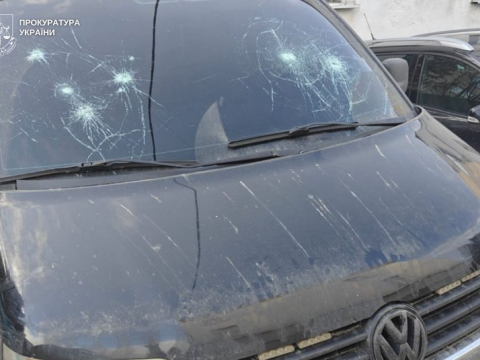
A bullet-riddled enlistment bus in the suburbs of Lviv. Photo from local social media

The development and continuation of our media depends solely on its audience. Please support our work on this fundraising page to continue enjoying materials like this one. Many thanks to everyone involved!
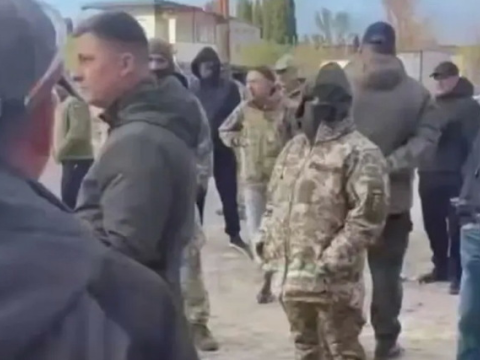
Large protests against the immigration Gestapo sweeping across the United States are clearly different from the fight against territorial recruitment centers (TRCs) in Ukraine in their massive and nationwide-coordinated nature. At the same time, the strength of the small and chaotic revolts in Ukraine is the frequent use of armed violence and the complete lack of connections to any fraction of the political establishment. Just like in the footage that appeared in late January from the Kherson region, where mobilizers came to kidnap a mechanic from a service station. The team stood up for their colleague, and the uninvited visitors, having been repelled with rebar or something similar, were forced to flee...
According to the AFU Ground Forces Command, 272 cases of attacks on TRCs have been registered in Ukraine in almost 4 years of full-scale war. Even though most of these "attacks" were actually individual self-defense, this is a significant number for a country with a population of only 20-25 million people, compared to over 340 million in the United States. This process will continue, given that Ukraine will keep the exit ban on men aged 23-60 locked down for as long as possible.
Moreover, as we can see from the same press release, the tendency is that all cases of TRC employees killed by grateful civilians occurred in 2025. Along with the already familiar cases of Vadym Kuzub and Hryhoriy Kedruk, the hit-and-run by a heavy-duty truck driver on their sergeant, Vadym Klochko, and soldier, Vladyslav Kvachuk, near a road checkpoint in the Ovidiopol district of the Odessa region, on the morning of October 17, was also qualified as homicide. The 63-year-old driver reportedly ignored speed-reduction and stopping signs. At the same time, police reported that the man simply did not notice the military. No convictions have yet been handed down in all these cases.

In mid-January, a woman toppled an installation honoring fallen soldiers in the city center of Rivne. She was detained and stated that the portraits of military "irritated" her because they "reminded her of the war." According to cops, the woman apologized to the families of the fallen
On December 30, a 73-year-old man brought a box labeled "A mine" to the Rainbow shopping center in the Russian-annexed Lugansk. He also left a message for the mall's owner: "The prices will ruin you!" Though this was all a ploy to intimidate, his action led to an evacuation and the arrival of police and bomb squads. The court sentenced the pensioner to three years' probation. He also has to reimburse the emergency services for their expenses.
In mid-December, on Pedagogical Street of Odessa, two guys smashed one TRC vehicle and shot the driver of another their minivan in the face with a gas pistol. On December 28, in the Peresyp district of Odessa, the TRC and cops identified a suspect in the stabbing of a TRC employee in early November. He was taken to the police station despite "active physical resistance." On the morning of January 2, a 46-year-old resident of the Gaisyn district in the Vinnytsia region, stabbed a TRC patrolman into a leg with an awl during a military registration document check. After escaping, he was apprehended by police at his residence. On January 11, in Lviv, when enlistment agents stopped a 46-year-old local resident and asked to show his documents, he stabbed one of them and fled in his car, but was soon detained by police. On January 23, in the village of Solonka in the same Lviv region, a 46-year-old local man, after seeing a TRC group, quickly got into a car and locked himself inside. When military and policemen began to speak with him, he threw an airsoft grenade and drove away. No one was injured, and the suspect is still wanted.
Two new sentences for self-defense in our Kharkov region. On December 29, a Kharkov local court sentenced a citizen who three months earlier collided with a TRC patrol in a white Fiat Doblo. They exited the car and approached the man to check his military registration documents, but he began to run away and then fired a pepper spray at them, according to the verdict. When the defendant tripped and fell to the ground, he pulled out a camping knife and stabbed the serviceman, who had fallen on top of him, under the knee. This was classified as grievous bodily harm, and the court sentenced him to five years in prison with a two-year probationary period. On January 2, a court in the town of Pervomaysky also convicted a local resident who treats disabled parents. On October 18, he was stopped by police for a document check while drunk and then handed over to the TRC. He was about to be transported for medical examination to Kharkov when he pulled out a knife and stabbed his captor in the stomach with a butterfly knife before attempting to escape. The employee sustained a mild stab wound to the anterior abdominal wall. The court gave three years in prison with a one-year probationary period.
On the morning of January 14, in the village of Rudno near Lviv, the driver of a Volkswagen Passat fired several shots from a traumatic weapon at a minibus of the district TRC servicemen who were carrying out "notification measures." No one was injured, the driver who fired the shot fled the scene, police said. There is no information about his detention. See the title image.
Also on the morning of January 14, during a street raid in Cherkasy, a violator of military registration rules attempted to evade patrol servicemen. A crowd gathered around him, and one of the passersby pulled out a metal object and began smashing the windows of enlistment vehicles. The detainee was then taken to the TRC, but the attacker fled. On January 27, in the same region, during an attempt to detain a suspect in the attempted murder of Vitaliy Storozhuk, a member of the Korsun-Shevchenkivskyi Town Council, on the basis of some personal conflict, he shot dead four police officers from the capture group: three majors and a senior lieutenant, another senior lieutenant was wounded. The shooter was killed by return fire. This was a 59-year-old discharged military man who allegedly saw the police in advance as they approached his house, set up an ambush and opened fire. His name is Serhii Rusinov. From the words of his former army colleague Yaroslav Nyshchyk, he was the first to open fire in the February 2014 attack near Korsun on Crimean Anti-Maidan activists. Criminal cases have been reportedly opened against him in Russia. He left the army due to health reasons. The assassination attempt on the councilman was carried out by blowing up his car as it was moving. Storozhuk managed to jump out, and the car burned. He reportedly tried to seize land of the Serhii's small farm.


When this resident of the Cherkasy region saw the cops, he took a bulletproof vest, an automatic rifle, and ran from his home into the forest. All shots were aimed at the neck area, between helmets and body armor. Can the one say that he deserved forgiveness for his participation in the fascist paramilitary coup?
Today in Uman of the same region, as the regional TRC reports, some man approached a group of their employees and stabbed one of them in the neck. The knife missed the carotid artery, and the mobilizer was hospitalized. The attacker was immediately detained.
The grassroots response to terror by federal forces in the United States is not limited to street demonstrations: a coalition of local unions and community organizations in Minneapolis has called for a citywide one-day strike on January 23, which, however, has not been supported by the leadership of leading trade union centers. Although workers in Kharkov and other regions of Ukraine also regularly block enterprises by staying home due to TRC raids, there is no talk of an organized strike movement. At the same time, residents of Kiev, Odessa, Krivoy Rog, and many other cities from time to time block the streets to protest the prolonged lack of electricity and heating in their homes.
In particular, on the evening of January 21, protesters came to the building of the regional military administration of Khmelnytsky to get an explanation for the prolonged blackouts. One of the rally participants threatened to open fire and detonate a grenade that police found on him. He was taken to the police station. Two days later, in Kamianets-Podilskyi of the same region, during a rally "for turning on the lights" people blocked an important bridge. On January 22, in Mohyliv-Podilskyi of the Vinnytsia region, participants in a gathering over "unfair power outages" beat up the chief of the district power supply company. Police have opened a criminal case regarding the minor bodily harm on a 49-year-old man.

Almost 200 people joined the protest in Khmelnytsky, public transport was delayed for more than an hour
With this month’s news from Kiev about the appointment of General Kirill Budanov as head of the Office of the President, another step has been taken towards strengthening the kleptocratic dictatorship at the expense of the head of the intelligence structure, who had under him his an own "army" in the form of super-equipped special units. Budanov has never been shy about using these units in business conflicts between security forces. For example, for the sake of rear skirmishes over expensive land for development, units were even withdrawn from the front. Now this force will serve directly the top authorities, essentially guaranteeing them armed protection in the case of any unrest. So far, the ghost of the Syrian scenario from last December has not materialized, however with the EU plans to allocate 90 billion euros instead of 180, it has become much closer. Also, 2026 marks exactly 100 years since the assassination of Symon Petliura by the anarchist avenger Sholem Schwarzbard. Perhaps this is a sign for the one who declares succession to his state? All of this requires strengthening unity between revolutionary and internationalist activists in Ukraine and abroad, overcoming squabbles over personal ambitions and historical sympathies.
The main street battles are still, in all likelihood, ahead. Even in the US, it's too early to say the battle is over and Trump is ready to soften his immigration policy. Everything that's happening so far looks like a tactical retreat and a regrouping of forces. Let the first partial victory of the working class and youth in Minneapolis serve as an inspiration to all of us on this path.

Comments