
KAPD Berlin, The Program of the KAPD. KAPD, 1924. Translated 2023 by Fredo Corvo, available in PDF form at https://leftdis.wordpress.com/.

Foreword
In a period of rapidly swelling crisis, the accumulation of social catastrophes, warlike imperialist entanglements, and growing chaos in the economic, political, and social spheres, the Communist Workers' Party of Germany presents the proletariat with a new program in which it should and - we hope - will find two things: A condensed reflection of the present phase of capitalist development and a presentation of the tasks which it must fulfill on pain of its downfall as a class.
Between the publication of this second program and the first lies a period of almost four years filled with the struggles and defeats of the German working class. The publication of this program, adopted by the Sixth Party Congress of the KAPD (9-11 Sept. 1923), is also intended and aimed at recording the experiences and insights gained from this period and making the working class aware of them.
A program is not a recipe for all cases. If it is to be more than paper wisdom, it must be followedby action. However, clarity about the paths, conditions, and goals of the proletarian liberation struggle is an indispensable prerequisite for accomplishing the deed.
The knowledge of the dialectical interaction in history, which again and again raises organizations and ideologies to counter-revolutionary obstacles and obliges them to freeze and finally overcome them again and again, is still little anchored in the proletariat. But the old is sinking and breaking down. To the extent that it still exists, it acts as a scourge, a weapon in the hands of the counterrevolution. It mocks all attempts at reformation and "conquest." One day, however, the veils must be torn asunder.
The present program will confront the real situation and its consequences. It will present the means of overcoming a dying world, including the partly utopian, partly treacherous policies of social democracy and the trade unions of all tendencies. The experiences of proletarian class struggle crystallize here anew. Their proclamation will illuminate the path to new shores for those seeking them and thus be an act in itself, a prerequisite for practical political action until decisive events.
May the entire world proletariat draw from this the general clarification and strengthening of class consciousness and international class solidarity, which are absolutely necessary for creating an international struggle as an expression of the revolutionary will from below, to accelerate or internationalize the following program!
Berlin, January 1924.
Communist Workers' Party of Germany, Executive Main Committee.
First Part
The rise and fall of the capitalist economy in the age of imperialism, the consequences of the world war and the peace treaties for bourgeois society and the proletariat.
I. Imperialism and World War
Imperialism, as the strongest development of forces in capitalist society, is destroying the foundations on which it is built. The productive forces it has developed have blown up their social framework; capitalism has turned from a constructive element into a destructive one by devouring itself. This downfall occurs with terrible convulsions and constant rebellion against the iron necessity of history.
Throughout its development, capitalism has been shaken by various crises. So far, these crises have been the rungs for its renewed rise and the necessary preconditions for its final overcoming by communism. Each crisis has a specific historical setting that sharply defines its character.
The general characteristic of the earlier crisis was a stagnation of production due to overproduction. The anarchy of the economy, which was expressed in the crisis in question, was overcome by converting production, raising the level of technology, changing the form of organization, and, at the same time, opening new sales markets. These measures made it possible for capital to increase the purchasing power of the masses despite falling monetary wages and not only to compensate for its loss but even to increase profits by raising the production level in the economy. These crises were necessary bloodletting to help the fever- shaken body regain a new life opportunity. However, the contradiction inherent in capitalism as an economic system was not overcome; instead, its tendency towards its destruction was reinforced. The improved technology in the organization or economy and the associated concentration forced capital to cross national borders because there were no longer any opportunities for expansion within this framework. By the various stages of development in the structure of capitalism, a shift occurred between and within the classes. The all-overshadowing opposition between capital and labor obscured the various gradations within the classes. Too little attention was paid by the proletariat to the significance of the conflicts between the individual classes in the conduct of the class struggle. Nor were the resulting tactical possibilities fully exploited.
This regrouping is an essential basis for the economy's structure during the reign of capital. In the bourgeois revolution, capital, which was essentially agricultural, prevailed in a fierce struggle against the feudal system and created elbow room for itself. With growing industrialization, the dominance of agrarian capital was overcome in an intense struggle. It was replaced by the combined financial and commercial capital, which raised industrial capital.
The struggles between the capitalist groups for supremacy also brought about a reshuffling within the oppressed classes. The peculiarity of the agricultural capital production method, which allowed only a narrowly defined section of the ruling class to benefit, created a surplus of forces that flowed into industry and the simultaneously expanding state administration. The middle class and the proletariat thus had a broader base. The flourishing of capitalism relied in particular on the strengthened petty bourgeoisie and the qualified part of the working classes, which capital separated from the majority of the exploited by granting them more significant advantages to play them off against and among each other. Since even the mass of wage slaves did not go away empty-handed with the general increase in prosperity, there was no stronger emergence of self confident class expressions of the proletariat in this epoch. This was reflected in the growth of reformist illusions within the labor movement.
The law of national economic competition forced capital to increase production enormously by improving production methods and intensively exploiting labor. Such led to a complete exhaustion of national sales and profit opportunities. Even the attempt to find a way out of this impasse through a generous colonial policy could not eliminate the contradictions and the anarchistic tendency of the capitalist order in the long run. Particularly those states which, with the later but even more unrestrained onset of industrialization, had no means of creating territories for themselves using forced colonial sales, were bound to exacerbate the contradictions, which pushed them towards violent conflict. The impossibility of economic evasion led capital to the conviction that war was the only means of overcoming the contradictions created by development. As a result, a period of insane arms races began. Capitalism reached its zenith here and, simultaneously, the starting point of its collapse.
Imperialism, with its corrosive effect, is a historical necessity born of capitalist development; only petty-bourgeois pacifists can see in it a correctable movement dependent on the goodwill of the capitalists. Its brutal methods of violence are unavoidable. They generate tremendous external pressure against the competitors and, at the same time, internal pressure against the dominated proletariat. The result is a chain of continuous social catastrophes that lead to political entanglements. The world war was a violent attempt to cut this Gordian knot in one fell swoop. This attempt failed, and the antagonisms came to a head in the final confrontation. The thunder of the guns on the battlefields heralded the twilight of capitalism.
When it entered the war, capital was aware that the impending crisis could only be overcome by a short-term military conflict. It was considered a longer, almost exclusive adjustment of the productive forces to the needs of the war to be economically impossible since such an adjustment would necessarily be equivalent to the destruction of the economy. Accordingly, the military measures were also tailored to conquer the enemy in the first onslaught. This hope was dashed with the beginning of the trench warfare. As a result, the fighting powers had no choice but to enable the war to continue by creating a broader base and organizing the economic and military forces down to the smallest detail. For the same reason, they also drew all the nations not directly involved in the war into this cauldron. Since both sides carried out the mobilization with the utmost energy, the struggle could only end with a tremendous exhaustion of forces.
The entire economic apparatus was converted to the production of direct war needs. Organized murder became the sole purpose of the economy. It offered world capital a brilliant field of exploitation. - For five years, the necessities of life of the working masses were cut back further and further. The measures that had previously restricted exploitation were abolished: older men, women, and children were driven into the factories to produce the tools of murder in place of the men ordered into the trenches as cannon fodder. All political life was violently suppressed. Public opinion became stultified under the corrupting thumb of the ruling class and its satellites, who subordinated everything to the purpose of the war. All previous social ties and connections broke apart because the economic conditions, the ground on which they were based, suffered away.
The war economy, which was geared solely towards the destruction of property and blood, removed the basis for reproduction. The production of means of production was almost completely stopped. In this respect, people lived entirely off the substance; moreover, millions of people who had previously been involved in the production process were used in an unproductive way. These years of systematic over exploitation completely undermined the reproduction of production relations. This was particularly noticeable in agriculture. Instead of the previous intensive economy, the lack of human and animal labor and fertilizers led to a widespread switch to extensive cultivation. As a result, soil yields fell by around 40 percent. The standard of living of the working classes in the industrialized countries was also enormously depressed because the import of foodstuffs, which was already necessary in normal times, was partly prevented by the blockade and partly by the almost exclusive use of cargo space for warfare. The entire production apparatus thus deteriorated more and more. The lack of accumulation prevented further technical development. This was particularly true of the so- called vital industries, while the particular war industry was driven to unprecedented heights. As a result of the enormous consumption of materials, the costs of waging war consumed the entire economic forces of the national capitalisms involved in the war. Not only were the means in their own economies worn out by all means, but foreign credit was also strained to the utmost after all the credit balances created by the export of capital had been exchanged for material supplies. American capital was thus primarily involved in the absorption of European capital. In this way, the center of gravity of the capitalist economy shifted from Central and Western Europe to America. At the same time, domestic debt grew and diluted the national wealth. The possibility of bringing the national budget into balance disappeared more and more.
II. German Social Democracy from revisionism to 'Burgfrieden'
The proletariat generally behaved passively towards these signs of decay in the capitalist economy. The lack of activity was essentially because the proletariat's standard of living had risen during the previous heyday of capitalism, thus fostering the illusion that an even more significant increase in the standard of living was possible through cooperation with capital. This led to a weakening of the class struggle, which found its theoretical expression in revisionism. Even though the official movement continued to reject revisionism in the strongest formulations and denied it the right to exist, it practically dominated the politics of the socialist parties united in the Second International. The ever-greater influence of the purely economically oriented trade unions, due to the strong leaning of the parties towards them, further promoted this tendency. In addition, the enormous growth of the movement meant that the bureaucracy, which dominated the proletarian organizations, became increasingly detached from the masses and, because of the centralist structure, acquired an independent position. It saw the maintenance and further expansion of the organizations as its primary task, even more so because it ran parallel to its conditions of existence. The apparatus was transformed from a means to an end into an end. It, therefore, increasingly evaded confrontation with the ruling class and limited itself to hollow demonstrations. The revolutionary principle of overcoming capitalism through class struggle was gradually transformed into a struggle for goals that lay in the line of developing capitalism and eliminating its excesses rather than destroying it. The sharp focus on achieving these program points, which naturally had to be within democracy, meant that the movement was everything, and the final goal was eliminated in practice. Out of this tactic, the social democratic movement (II International) came to rapprochements and compromises with the petty-bourgeois liberal parties. The social-democratic community was replaced by the idea of the national state, which, ignoring class antagonisms, substituted the generality of the people for the global community of all proletarians. From there, it was only a short leap to the ideal and material commitment to this democratic state, to social patriotism under the banner of democracy. The battle cry of the Communist Manifesto: "Proletarians of all countries unite," was transformed into the slogan: "Workers of all countries fight for your fatherland." The national determination of the proletariat blew up the II. International and inflicted severe wounds on international solidarity
The proclamation of "Burgfrieden" [class peace in the fatherland] increasingly pushed back the idea of class struggle and paved the way for an "Arbeitsgemeinschaft" [working community of Capital and Labor]. The harsh reality of war gradually drove larger masses into opposition to this socially patriotic attitude. Some fell prey to bourgeois pacifism, which appeared in socialist guise during the war and formed the core of a centrist movement. During development, the two-and-ahalf International crystallized from this movement. A small, united, and energetic section of the working class remained faithful to the idea of class struggle and attempted to use it to overcome the war in a revolutionary struggle by eliminating capitalism. The rallying point for this in Germany was formed by the Spartacus League and the International Socialists (left-wing radicals), who brought the idea of internationalism back into the world.
The first success of revolutionary activity was the uprising of 1917 in Russia. It led to the overthrow of tsarism and initially to the establishment of a bourgeois republic, which, after a short existence, was replaced by the workers and peasants under the leadership of the Bolsheviks by a soviet republic. In the first period, Soviet Russia regarded it as its foremost task to further the revolution on an international scale. It was guided by the realization that the present crisis of world capital because it was precisely its death crisis, could only be overcome by a world revolution.
The war's further course brought the military collapse of the Central Powers, which also broke the authority of their ruling classes. They lost all authority, abdicated, and gave way to the proletariat. Political power fell into the lap of the working class like an overripe fruit.
The proletariat did not know what to do with this power. It did not understand what tasks it had to solve in a social revolution. Now, after seizing political power, it was essential to take up the struggle for the means of production based on the councils to establish the communist economy.
While the proletariat exhausted itself in empty discussions about the manner of implementation, the bourgeoisie acted. With great energy and prudence, it gathered its scattered forces. At first, it did not act openly and let Social Democracy do its dirty work, which - fearing the consequences of an entire revolution with all its uncertainties - saw the only solution in a slow, calm reconstruction of the economy on a capitalist-democratic basis. Social democracy and the trade unions gladly took the hand of the bourgeoisie offered to them. In this goal, they falsified the idea 8 of social revolution by presenting the capitalist reconstruction policy as a prerequisite for socialism. The necessary consequence of this policy was that they became the butchers of the revolutionary proletariat and rendered the most shameful services to the bourgeoisie; in their zeal for the capitalist order of exploitation, they surpassed even Galliffet, the butcher of the Commune.
The war not only brought about significant changes in the structure of the economy of the Central Powers but also shook the very foundations of the economies of the victorious and neutral states. While the Central Powers also showed the typical outward signs of disintegration, the victorious countries appeared less affected. However, the content of the peace provisions alone showed how badly their economy had collapsed. Through the peace provisions, the victors wanted to extort the means for their reconstruction from the defeated countries, regardless of the interdependence created by the economic connectedness of modern capitalism. This rescue attempt proved impracticable; the national antagonisms, which still existed and could not be overlooked, stood in its way. Economic disintegration, therefore, continued unchecked, forcing capital to look for ways to rebuild on an international basis. It had become clear that the purely national approach pursued up to then contradicted the laws and needs of the developed capitalist economy.
However, even international attempts to reach an agreement have always ended in increased chaos and general disorganization.
True to their attitude, the Social Democrats and trade unions slavishly followed the individual stages of capitalist reconstruction policy. In the Entente states, they supported the purely nationalist-based peace provisions. At the same time, the Central Powers lent their support to the capitalist groups that sought to save the national economy through the policy of fulfillment. They thus lost the last remnants of their proletarian character and became appendages of their capitalist overlords. They were still clinging to this tactic when, through sabotage and as a result of the further disintegration of the capitalist economy, the policy of fulfillment was abolished by the bourgeoisie. Naturally, they took up the idea of inter-capitalist economic understanding again. They tried to re-form the fragmented parts of the old International on this basis.
With the collapse of international attempts at understanding and the subsequent nationalist relapse of French capital in particular, German Social Democracy joined the defensive front of German capital without any ties. It developed from a policy of compliance to a policy of sabotaging compliance. The KPD took the opposite path.
III. The KPD from an opponent of the Versailles peace treaty to the defense of Russian state interests, finally to nationalism
In the beginning, the KPD took a thoroughly revolutionary stance towards the Versailles Peace Treaty. It emphasized that the proletariat should not allow its policies to be dictated by the agreements of the bourgeoisie and that only its interests as a class should be decisive. The Peace of Versailles was the apparent proof that the violent attempt made by the war to overcome the contradictions of the capitalist order had failed. In their view, its content was an attempt to resolve the general crisis exacerbated by the war at the expense of the defeated party. The peace agreements were the continuation of the war by other means, mainly of an economic nature. It was not the task of the proletariat to be the obedient lackey of the bourgeoisie in upholding and implementing the peace agreements. Instead, the proletariat must immediately represent its class interests vis-à-vis this capitalist machination through a revolutionary policy aimed directly at the final overcoming of capitalism and must not see its class interests in supporting the special interests of its bourgeoisie. Similarly, the KPD rejected the pacifist attitude of a section of the proletariat (USPD) towards the Versailles peace, which demanded that the working class support an "honest" policy of fulfillment. This pacifist group claimed that the task of the proletariat was to force capital to refrain from any warlike confrontation. In contrast, the KPD stated at the time that the slogan "Never again war" summarized all petty-bourgeois elements who, in cowardly evasion of the tasks of a revolutionary policy, were committed to capitalist reconstruction. Instead, the proletariat had a duty to sabotage the policy of fulfillment because this was only possible based on an even greater exploitation of the proletariat, leading to complete impoverishment. However, this sabotage should by no means result in a merger with the nationalist elements that seem to be going in the same direction.
Because of this position, the KPD denied parliamentary activity and rejected the old trade union organizations because these two were the carriers of the fulfillment policy. The KPD believed practical implementation of proletarian politics was only possible if the German and Russian proletariats joined forces. This union would prove to the French proletariat that the revolutionary movement emanating from Russia would continue in Germany and that the first steps of a revolutionary movement on a world scale were thus in place. The inevitable overthrow of German capital would force the proletarians of the other capitalist countries to take a stand and put an end to the rule of their capital. This was also the only guarantee and basis for a "proletarian policy of fulfillment," which was based on proletarian solidarity as a matter of course. The Soviet government supported this tactic of the KPD to maintain its position in Russia, as it could not build a communist economy without the help of the European proletariat. Despite all the pressure, however, the pace of the Western European revolution slowed. Added to this were the ongoing military attacks, the economic blockade of international capital, and the civil war at home, causing the Russian economy to collapse completely. This also changed the tactics of the Soviet government. It began to regard the development of the Russian economy as the basis of international policy and thus subordinated international interests to national interests. It saw the only way forward as being to lean on world capital, which it called upon to help build up Russia. As a result, it became increasingly dependent on world capital. It was forced to call upon the revolutionary masses of workers united in the Third International to adopt a position towards their national bourgeoisie that corresponded to the needs of the Russian state. This also included renouncing revolutionary tactics. The III. International had to move closer to social-democratic ideology and seek a connection with parliamentarism and the trade unions. It was thus forced to adopt Russia's foreign policy. But to meet the pressure of the masses under its banner, it disguised this reactionary policy with radical phrases and dragged all social-democratic slogans to the extreme; it adopted capitalist construction and finally ended up with the wildest nationalism.
IV. KAPD
Of all the workers' parties, only the KAP has maintained the purely revolutionary line. Organizationally and politically, the two groups' direct successor united to form the Communist Party (Spartacus League) at the Unification Party Conference of December 1918. It has rescued the healthy revolutionary elements, mainly from the former "IKD" (International Communists of Germany), from the declining development process of the KPD.
The KAPD's first program was essentially based on the Spartacus program. Like it, it was based on anti-parliamentary and anti-union principles and shared an anti-legal attitude. The council system is an expression of the proletarian will and the means to build the communist economy. Both programs agree that they have recognized the present crisis of capital as its death crisis and conclude that the proletariat now has the task of establishing its dictatorship with the help of the councils. On this basis, the KAP built its foreign and internal political standpoint. Each of its measures was guided by the viewpoint of creating subjective preconditions for the seizure of political power by the working class in addition to spreading the realization of the objective collapse. The KAPD put up the most determined resistance to the attempts of the international bourgeoisie to harness the workers to its reconstruction policy. It rejected the policy of fulfillment initiated by German capital in all its phases and the last attempt to sabotage this policy openly. It was the most implacable opponent of every capitalist policy. It adhered to the realization that the Peace of Versailles and the other peace treaties had no connection whatsoever with proletarian politics and, above all, should not be allowed to become a guiding principle. Even when the revolutionary wave temporarily subsided, it did not allow itself to be swayed in its clear stance as the KPD did. It preferred a separation from the opportunist elements to abandoning its revolutionary tactics. It refused to make any concessions to parliamentary democracy to feed an artificial mass movement, even at the risk of being labeled a sect. The KAP was aware that giving in to the illusions associated with parliamentarism would result in a considerable weakening of the idea of class struggle and would end in bourgeois democracy. It recognized the demagogic slogans of anti-parliamentarism as a hoax that was only intended to cover up the retreat into the opportunist camp. The KPD's swing to the right soon followed, as did the entire III. International, which gradually became an instrument of Russian state policy. For this reason, the KAP, which initially sympathized with this movement, was forced to draw a sharp line. The KAP, independent of all external influences and dependent on itself, took the straight path of revolutionary knowledge.
The broad masses still stand by the socialist parties and the KPD, they still believe in the future of capitalism and salvation through capitalism, but the dialectic of real life will crush these illusions with an iron kick and prepare the ground for the insights of the KAP and thus for communism.
Second Part
The role and significance of the Communist Workers' Party in the liberation struggle of the working class, its relationship to the trade unions and parliamentary parties, and its position on the General Workers' Union, the youth question, and the Communist Workers' International. Guidelines on the agrarian question.
I. The Development of Parliamentarianism and Trade Unions
The decline of capitalism, with its efforts to gain a breathing space, means for the proletariat a growing increase in its misery and progressive insecurity of its existence; in the final analysis,these phenomena can lead to the complete disintegration of the proletarian class. On the other hand, the development of the forces of production has reached a point where the transformation of the mode of production from a proletarian point of view is the most urgent vital interest of society and offers the prospect of increased opportunities for life and a new social order on a higher basis.In the present epoch, the proletariat, therefore, has the historic task of straining all its forces to overcome the contradictions of the capitalist order through the dictatorship and to build the communist economy of needs.
Social laws determine the means and nature of the struggle. However, the majority of the proletariat still believes that it can continue to improve its standard of living within the capitalist economy with the old forms of organization. The realization of the inevitability of capitalist collapse, of the consequent necessity of directing the class struggle towards the goal of a communist economy of needs, is still insufficiently present among the proletariat. It fails to recognize that every form of organization corresponds to a particular epoch and can only be an element of historical progress within it.
During the period of early capitalism, the proletarians recognized that they could only counter the impoverishing tendencies of capitalism through organizational unity. They founded professional organizations for the sole purpose of fighting for better wages and working conditions. With the general upswing of capitalism, the political workers' movement also developed to a greater extent,coming into ever more powerful opposition to the trade union movement, which was striving for independence. In the view of the politically organized section of the working class, the only way to improve the economic situation of the proletariat was through election campaigns and parliamentary action. By conquering the mandates in bourgeois hands, the influence on the state apparatus was to grow. The gradual conquest of the state on a parliamentary-democratic basis was to pave the way to socialism. The idea was to create a unified political organization that would make an independent trade union movement appear superfluous. It was also feared that establishing professional organizations would obscure the workers' awareness of the necessity of political struggle and political organization in the face of a solid commitment to professional interests. The development of the constantly growing trade associations followed the line of independence and centralization of the local organizations, which led to the merger of all local organizations into local trade union cartels. This was followed by the consolidation of all trade union organizations into a single head, the General Commission. This created an organ in the Correspondence Bulletin for the unified intellectual leadership of all affiliated organizations. The idea of centralist-reformist trade unions thus prevailed.
With the growth of industry, the proletariat grew steadily. The progressive development of technology made it increasingly difficult for independent master craftsmen and small entrepreneurs to survive. Large-scale production took the production process to a higher level and destroyed the ability of small businesses to survive. The proletariat received a powerful influx from the proletarianized peasant masses. The development of the trade unions was closely linked to this. The ups and downs of the capitalist economy strongly influenced the struggle for the livelihood of wage laborers. During a boom period, the trade unions sought to achieve improvements in wages and working conditions. This tactic was successful because the employer was keen to exploit the business cycle. This was only possible if wage disputes caused no disruptions. As a result of the increase in profits, employers were able and willing to make concessions. These concessions, which were undoubtedly in the interests of the smooth development of the capitalist economy, were booked by the trade unions as their successes and exaggerated enormously. In times of crisis, capital began to snatch their accomplishments from the workers. The trade unions sought to counter this endeavor through collective bargaining policy. They aimed to hold employers to the concessions forced on them during the economic cycle, even during stagnation. For many years, the fight for collective bargaining and the expansion of collective bargaining policy was the most crucial task of the trade unions. They were encouraged in this tendency by the ever closer and more powerful alliances of employers in cartels and trusts. Initially, the unions' collective bargaining policy was intended as a means of leading the class struggle. In its effects, it led to a rapprochement with capital and the elimination of the class struggle. It was also evaluated and used by employers in this sense. The trade unions became the prisoners of this policy. This tactic inevitably led to the development of the labor union.
II. From "Arbeitsgemeinschaft" [working community of Capital and Labor] to counterrevolution. The cell tactics of the KPD
The idea of the working community, first propagated by the trade unions for the purpose of making better use of collective bargaining policy, was initially opposed by the business community, but was then taken up under the pressure of the impending collapse at the end of the war. The trade union wanted to achieve an improvement in the proletariat's standard of living through the working communities without jeopardizing the increase in capitalist profit. However, both together are only possible through the higher development of technology and the avoidance of stagnating sales. In this way, the trade unions linked themselves to their national economy for better or worse. They wanted to secure their position and higher development by aligning themselves with the capitalist economic order and were thereby dragged into its downfall. The appearance of the international character of the labor movement was maintained by trying to secure the nationally won "achievements" through international agreements. This is the basic idea behind the tactics of the so-called Amsterdam International. The national idea embodied in the working community also forced them into the imperialist policies of their national capitalists. For them, the war was not an attempt by capital to eliminate the insoluble contradictions of the capitalist economy by force at the expense of the working class but a defense of the common interests of the people against the "evil enemy."
While practically every revolutionary attitude had previously been abandoned as allegedly contrary to purpose and therefore fought against, now there was an open declaration of common interests and a proclamation of truce between the bourgeoisie and the working class, i.e., between capital and labor. In reality, this meant a declaration of war on international thought and the international interests of the working class and an abandonment of the class struggle. The trade union bureaucracy went so far as to place its organizations at the disposal of the bourgeoisie for war purposes to the greatest possible extent, both materially and in terms of ideas. Even the establishment of the Russian soviet republic and the collapse of German imperialism did not prevent them from rescuing the bourgeoisie, which had become headless, to devote their full strength to the reconstruction of capitalist exploitation.
This attitude of the trade unions resulted from a clear realization of the conditions of their existence, which were tied to the continued existence of the capitalist economic order. As a result, they were forced to go over to open struggle against the revolutionary sections of the working class and, in conjunction with the bourgeoisie, to organize the defeat of the revolutionary workers. In this way, it diverted the proletariat's attention from its historical tasks.
The trade unions have proved their counter-revolutionary tendency throughout the entire period of the German revolution up to the present day. The trade union bureaucracy and the Social Democracy fought most vigorously against the idea of councils when it began to take root in the German working class. Wherever political tendencies emerged logically from mass economic action and the goal of seizing power became apparent, the trade unions and the SPD were able to successfully fend off this development. Numerous employers in Germany declared that they would only hire workers who belonged to a trade union organization. This revealed to the whole world that the trade union bureaucracy was the most reliable pillar of the capitalist system.
In all countries with highly capitalist development, the illusion of democracy and the belief in the unshakeable stability of the capitalist economy is expressed and embodied in the old workers' organizations. In the era ushered in by the world war, they no longer have a right to exist. This epoch demands the building of organizations that lead the proletariat as a class into struggle and, at the same time, are the foundation for the structure of the communist economy. Building such organizations can only be equivalent to a struggle to smash the trade unions. Both are being held back by the illusion, spread among the masses by the KPD, that it is possible to revolutionize the trade unions from within by forming communist cells and thus turn them back into organs of class struggle. To this end, it was necessary to remain in the trade unions to conquer them.
The cell tactic is based on the fallacy that the failure of the trade unions to date is a consequence of the failure of the leaders. This means abandoning the insight gained from the materialist view of history that people are products of their circumstances. A change of leaders cannot bring about a change in the character of an organization. Where the cell tacticians prevailed, they were soon forced back into the old channels of trade union politics by the power of circumstances.
In highly developed countries, cell tactics can theoretically have a certain success against the trade unions in two different directions. It can lead to the desired goal of conquest or destruction and division. In the case of conquest, the communists conquer a weapon useless for the revolution. In the second case, the communists destroy a weapon of the counter-revolution and put a new one in its place. However, the workers did not create a valuable instrument for the social revolution and its struggles in both cases.
The disputes in the German trade unions show that the trade union bureaucracy is very quick to exclude cell activists who become dangerous to them from the trade unions and to nip the movement in the bud. In doing so, it invokes the organization-destroying effect. If the communists want to counter this argument, they are forced to keep as far as possible within the framework of traditional trade union policy. In doing so, they hinder the revolutionary clarification of the masses and fall prey to opportunism. The occupation of the trade union apparatus by members of a communist party is not a conquest of the trade unions for communism but merely a party-political measure to cheapen their party apparatus. By breaking away from the masses, every trade union official must change from a proletarian attitude to a petty-bourgeois one. The prospect of such posts will always, in due course, attract experienced elements who will turn the labor movement into a lucrative business for themselves.
III. End of the class struggle character of the trade unions. AAU and KAP
With the collapse of capitalism and the collapse of national states, the state apparatus in its old national form is dissolving. Private capital is increasingly seeking to penetrate the state and free itself from its authority. The trade unions, on the other hand, are still trying to preserve the authoritarian character of the state. In the period of capitalist development and prosperity, the state not only had the function of maintaining the exploiting class in possession of its privileges but also of protecting the undisturbed continuation of this exploitation by preventing the all too open outbreak of class antagonisms and, thus, in the interests of the capitalist class as a whole,intervening under certain circumstances against dangerous abuses by individual members of the capitalist class. Social policy as a whole is an example of this activity of the state in a period of capitalist prosperity, which restricts class antagonisms. This also gave rise to the ideology of a state supposedly standing above the classes and representing a so-called national community,which was intended to deceive the exploited. The trade unions had already surrendered to this deception during the war. As the state-destroying effect of collapsing private capital became increasingly visible after the war, the trade unions, in their fear of the open clash between the hostile classes, had no choice but to organically integrate themselves into the state and oppose the state-destroying development of capitalism. Their material and ideal condition makes it appear necessary for them to utilize the remaining part of the crumbling state for their own purposes. The character and function of the trade unions as an organization of class struggle is thus finally finished. For this reason, they are ruled out as organs for the construction of the communist economy. Suppose the proletariat wants to carry out its historical task. In that case, it must smash the old organizations and create new organs of the class struggle that do justice to the necessities of the social revolution in terms of form and content. The first steps in this direction are the Communist Workers' Party and the General Workers' Union.
The General Workers' Union is the unification of the proletariat as a class in the factories. It is structured as a factory organization according to the council system. Its task is to transform the ever-increasing pressure on the masses caused by the downfall of capitalism, which manifests itself in spontaneous rebellion, into a class consciousness based on knowledge and the will to act. It shows the proletariat the way to the decisive struggles and leads the way with action. After the conquest of political power, it is called and enabled to build the communist economy based on its internal organization as a council organization.
The most advanced sections of the General Workers' Union have united to form a political party out of the realization that every liberation struggle of the working class, regardless of the motives from which it arose, must simultaneously be a political struggle. This is the Communist Workers' Party of Germany. It emerged from the need for a genuinely proletarian party. Its ideological starting point was the realization that the organizational foundations of all the old parties - from the SPD to the KPD - were motivated by purely capitalist principles and experiences and that, therefore, these moribund and boggy entities could no longer be transformed into weapons of the proletarian liberation struggle from within. The KAPD is the party without dictatorship from above and without faithful waiting from below. Always: community, mutual complementation, supportive understanding, and above all, the integration of all questions into the desired goal, action, striding towards clarity, the transformation of inertia into creative power, bold daring at the correct hour, and restless deepening of the proletarian world outlook. For its rapid and formative implementation, this will require an organizational carrier who, in selfless, self-sacrificing work, masters and carries out all the things that belong to the promotional and preparatory tasks of the revolution. The best form of purpose for the preparation of the liberation struggle of the oppressed classes within the capitalist economic form is precisely this proletarian party. It is the rallying point for like- minded and sympathetic people who are carried by the same thoughts urging towards the proletarian revolution. It is the crystallization point where the transformation of historical knowledge into fighting will occur. The party is the organizational apparatus, but the association of comrades within it is the driving, living force without which the party sinks into a dead mechanism. Solidarity is community. Anyone who has actively experienced the nerve- wracking illegal activity and the blazing days of open turmoil knows that these struggles are only possible in complete mutual trust, brotherly love and helpfulness, and total dedication to one's personality. Mutual help during preparation and struggle is not the ethical demand of some new apostle. Still, it is one of the fundamental prerequisites for successful party work and even more so for the victorious realization of the struggle to conquer political power. This community of revolutionaries, the proletarian party, is based on the council system, whereby the right of determination of the entire membership is the supreme principle - and the principle of building "from the bottom up" is fully realized. The executive organs are chosen solely based on their purpose. Every political and public action they take must be subordinate to the party's position as a whole. The responsibility of each comrade requires that he take a lively interest in the manifold tasks of the Party and that he observes and expands the sphere of action of the various activities. Supportive, healthy criticism is an element of life. Still, it must always be influenced by the will to serve the revolutionary movement.
During the period of preparation - and perhaps also later - the most critical task of the party is to work outwardly for the promotion of the class and self-consciousness of the working class. As always, the development of economic and trade union conditions has run ahead, and the development of consciousness, especially of the oppressed class, is only laboriously running behind the advancing external reality. The liberation struggle of the working class, however, can only be victorious when the proletariat itself has become sufficiently aware of its class position and its historical task.
The mental revolution that leads to this goal is already in the making thanks to the intensification of class antagonisms. It manifests itself wherever the proletariat seriously endeavors to eradicate purely bourgeois ideology from its brain and instead consciously views all impressions and perceptions from the standpoint of the exploited worker living in class stratification. At that moment, both the forms of daily life and all theoretical knowledge take on an essentially different image. After a complete conversion of the mind in the proletarian sense, all things are involuntarily examined for their usefulness for the great goal of the working class, the revolution, critically reviewed and influenced as far as the possibility exists. This intellectual process of revolution is by no means carried out in the closed study but most vividly in the political actions of the masses and because of the inevitable defeats. To promote it with all its strength is the first task of the KAPD. This task encompasses the complete unity of thought and action, which includes the most careful analysis of the world crisis and the organization and leadership of the armed uprising.
The present final crisis of capital with all its terrible consequences and suffering can only be shortened and ended by serious and heroic class struggle. This is a fundamental revolutionary law. We cannot simply shrug our shoulders and ignore it. "When the time comes, we will know what we have to do." - That is the politics of missed opportunities. On the contrary, looking at these things from the eye is essential. The wide-ranging and forward-looking policy of the Communist Workers' Party and all the actions that this entails must be consciously geared to this coming struggle so that when the time comes, there will also be centers of revolutionary will. This is achieved through the organizationally tight grouping of the conscious section of the proletariat within the Communist Workers' Party. However, only in the action itself can it become clear what is healthy and strong-willed, and, on the other hand, what is rotten and decaying. Only when drums resound in the night, when the riots blaze in the streets and revolutionary life wells up in the will to revolt, only then, the revolutionary who has worked tirelessly and self-confidently in the service of the party and within the framework of the community from the bottom up at every time and hour, will be considered a revolutionary.
Guiding principles of the youth organization
The capitalist profit economy knows no age differences in its exploitation. That is why the proletarian youth is not a special section but belongs to the proletariat as a whole. Their struggle is the struggle of the entire proletarian class.
Promoting self-awareness and self-confidence among the youth is one of the most essential tasks of the KAPD because the future generation of revolutionaries will grow out of the youth. The youth's special way of thinking requires organizational adaptation. This can best be achieved by forming the youth into their own organization. The youth must pave their own way. The existence of an independent Communist Workers' Youth is, therefore, an absolute necessity.
The mode of struggle and the goal of the party and the youth are the same; only their sphere of activity is different. If the KAP unites the most active part of the proletariat, the KAJ is the union of the class-conscious young proletariat. Youth and party are not two different weapons, but only two ends of one weapon: the political organization.
Through the political struggle, young people themselves are forced to develop their full strength, which gives us the certainty that they are fulfilling their great tasks with clarity and determination.
It is the duty of the KAPD to provide the youth with every possible support in their struggle.
Guiding Principles of the Communist Workers' International
The profit order is an international phenomenon. It has spun the world with its threads, dragging the whole world into the abyss when it dies. No matter how often the proletariat's attempts to overcome it have begun on a national scale, they can only guarantee victory on an international scale. The class struggle is international; if it wants to win, proletarian revolution cannot occur within closed national borders. It is a world revolution. Already during the first struggles, the proletariat became aware of the importance of internationality. The attempt to set up an international front of struggle runs like a red thread through the entire workers' movement.
The "League of Communists" was already an international organization with national sections in individual countries. Its narrow, sectarian framework, with its conspiratorial character, was shattered by the emergence of the modern proletariat after the revolution of 1848.
On the eve of the bourgeois revolution in Germany, Marx and Engels published the "Communist Manifesto." This milestone in the history of socialism was the theoretical anticipation of the international character of the workers' movement. The Manifesto, with its concluding words: "Proletarians of all countries unite," helped to rebuild the workers' movement, which had been crushed after the bourgeois revolution.
The international development of capitalism increasingly impressed the need for an international upon the proletariat as a means of arming itself. In September 1864, the First International was founded in London, and its leading figures were Marx and Engels. And if the "Communist Manifesto" was a theoretical anticipation of the internationality of the workers' movement, the First International was its organizational anticipation. The bond that surrounded the International was very elastic. It united the most diverse elements that diverged on tactics and principles. The historical task it solved was the theoretical education of the developing working class.
The 1870s military campaign brought the nature of nation-states in Europe to an end for the time being. Strong workers' parties were formed in the individual countries. The completion of the formation of states and the growth of solid national socialist parties had to loosen the form of the First International. The fall of the Paris Commune and the subsequent international onslaught of reaction, on the other hand, proved the necessity of a tightly centralized unification of all forces. This contradiction, which found its ideological expression in the struggles between Marx and Bakunin, sealed the demise of the International. Its historical mission as a nursery of socialist parties with a firm theoretical foundation had been fulfilled.
After the Franco-Prussian War, an intensified period of capitalist development began. The international idea in the proletariat, still overgrown with national-bourgeois ideas, drew new nourishment from the capitalist class's aspirations for world power. In 1889, after four years of preparatory work, over 500 delegates of workers from all countries met in Paris and launched the Second International. This new defense of the socialist proletariat was not a fixed organization. All the parties affiliated with it were only linked to each other through an information bureau. Within the International, each party enjoyed complete independence, not only in tactical questions but also in questions of principle. Decisions taken at international conferences were carried out as they saw fit. Such a policy might be justified if a country's political and economic conditions forced it. The permanent tactical attitude towards everyday practice made the principle, namely eliminating capitalist exploitation, increasingly recede into the background. Plain calculation without historical foresight became the guiding idea of practical activity. The tendency to compromise with the prevailing economic system was not without consequences for the spirit of the International. At the outbreak of war, the 2nd. International collapsed. Its germs of death, nationalism, opportunism, and reformism were born with it at its birth, and when the struggle of the European armies for world distribution began, it fell apart.
The demise of the Second International was not a glorious event in its history. In the hour when the question 'Capitalism or Communism?' became flesh and blood, it shamefully abandoned the proletarian banner and switched to the camp of the belligerent bourgeoisie. It broke up at the moment when an international instrument of the international class struggle was more necessary than ever.
Still, the 2nd. International succeeded in one task, namely the gathering and training of the proletariat. It was an arsenal of ideas and showed the workers of all countries new paths. In addition to the old weapons of critique, it left behind the critique of weapons as a legacy.
Today, the 2nd. International with its Amsterdam Trade Union International, which has recently been strengthened by the Two and a Half International of the Crispies, Frederick Adler, etc., is the best bulwark of international capitalism against the world revolution, just as the individual national parties were the best helpers of the particular national bourgeoisies during the war. It sees its task in reconstructing collapsing capitalism on the back of the proletariat.
The attempts during the war in Zimmerwald and Kienthal to revive the International showed that the purity of the class struggle could only be restored through a fundamentally new International.
Amid the storms of the world war, the Third International was created. This decisive step started in Russia. Russia was where the World War first turned into the world revolution, where the victory of the proletarians crowned the final struggle between capital and labor. Russia raised anew the banner of revolution, which had been trampled into the dirt, and carried it before the enslaved proletariat of the world. In its early days, the new International, an International of Action, was a tight-knit community of struggle of the most energetic elements of the international proletariat to promote the world revolution. To fulfill its task, it had to break above all with all opportunism and reformism in theory and practice.
In March 1919, the official founding congress of the Third International met in Moscow. Under this new banner, the revolutionary workers' parties of the world came together.
Although a whole series of foreign fraternal parties had joined the Third. International, it relied primarily on the Bolsheviks. Nor did it completely deny the social characteristics of the motherland.
Agriculture dominates in Russia. Its land, which initially belonged to the villagers as a common property, had been seized by a few large landowners and the crown. In some parts of the country, industry had developed with foreign help, creating a modern proletariat. The technically backward land cultivation did not require skilled labor like the highly developed mechanized production methods in Western Europe. Large masses of farmers were still at a low cultural level.
When considering these facts, the question then arises as to whether, under such circumstances, the Russian workers could permanently help their banner to victory. Friedrich Engels already answered in the "Communist Manifesto" (preface): "If the Russian revolution becomes the signal for a workers' revolution in the West, so that both complement each other, then today's Russian common property can serve as the starting point for a communist development." However, the old communal land ownership was almost non-existent when the revolution broke out in Russia. Nevertheless, the Russian revolution became the world revolution's first flame. The Third International's most crucial task was to throw fire into the capitalist buildings of Europe.
Western European capitalism recognized the vital role of Russia and the Third International in the struggle between the proletariat and the bourgeoisie and immediately tried to break this base by all means. With true heroism, the Russian brothers resisted all the attacks of the counterrevolutionary armies. Despite civil war, blockade, and lack of industrial products and means of transportation, they proceeded to rebuild the economy in the communist spirit.
The onslaught of the united counter-revolution put Russia in a difficult situation from which it could only be rescued by the progress of the revolution in Western Europe. After the initial 'Sturm und Drang' of the November days, the revolution in Central Europe fell at a snail's pace. Active help for Russia failed to materialize. In the West, the ground for the revolution had to be laboriously prepared piece by piece. The revolution's pace was not only slow: it also took place according to rules different from those in Eastern Europe. The Central and Western European countries are, first and foremost, highly developed industrial states where capital exercises dictatorship with social democratic assistance. They are ruled by a capitalist class that can look back on years of experience in fighting the workers. Here, a bourgeoisie equipped with all the means of power faces an unarmed proletariat. This places higher demands on the individual fighter regarding courage and self-confidence. The "outstanding leader" recedes more into the background and merges with the whole. The self-confidence of the united masses grows and gains in importance. Promoting this process of education and reorganization is essential, a subjective prerequisite for victory.
The situation in Russia was different. The bourgeoisie and the middle classes, who in Western Europe constantly struggled against the working class, fought alongside the proletariat against tsarist absolutism in Russia until before the war. Yesterday's allies became today's enemies when the proletariat seized power, but they no longer had any vital means of power to oppose the proletariat. The social structure of the population and the social conditions in Russia before the revolution, the lack of more significant workers' organizations meant that, on the one hand, "ruleless" anarchism found a good breeding ground in Russia and, on the other, the Marxist-oriented organizations fell into the error of the strictest principle of authority. When mass organizations came into being, they were only assembled heaps of troops with a central authority hovering above the clouds, unconnected with the masses of the organization, as was the party of the Narodniki. The revolutionaries with a clear goal were united in groups of a sectarian character. The proletarian movement was very similar to the form of the movement in Western Europe at the time of the Communist Manifesto.
The great loose heap of armies, the party of the Narodniki, disintegrated in the fire of the proletarian revolution, and the leadership of the struggles passed into the hands of the most left wing of the workers' movement, the Bolsheviks. This party of "professional revolutionaries" naturally could not deny its sectarian character and its caste spirit and stamped this character on the Third International. For them, the "masses" are only an object, never a subject. They want to rule as a caste. And if they court the "masses," it is to use them as a steppingstone, as a pedestal for their party dictatorship, for their caste rule. To maintain or establish their party dictatorship, they are prepared to make any concessions, they ally themselves with God and the devil, and they use all means, even the most evil ones.
This fundamental attitude of the Bolsheviks also characterized the Russian revolution's further development. The ruling will of the Bolshevik caste had to be the enemy of every development of self-consciousness and every independent movement of the proletariat. In the long run, it could only assert itself through the strictest centralism and the most brutal terror against the proletariat. This centralism and bureaucratism had to suffocate every independent initiative of the proletariat. A dictatorship that fails in mobilizing the forces of the proletariat can never lead to the construction of communism; on the contrary, it must destroy all the beginnings of a new construction. As long as the Russian proletarians still had to defend themselves against their external and internal enemies from the camp of the bourgeoisie, and this struggle naturally required the centralization of all revolutionary forces, they were not yet aware of these facts. But when these struggles subsided, this strict principle of authority, this caste system of the Bolsheviks as a dictatorship of the bureau over the party and party dictatorship over the proletariat, became particularly evident.
When the Bolsheviks seized power, they had to try to rely on the majority of Russia's population. As a result, they made concessions to the ideology of the peasants, who made up 85% of Russia's population, right from the start by dividing up the land among the peasants. The resulting tremendous strengthening of the peasants' ideology of private property was naturally bound to have repercussions on the further course of the Russian revolution. The Bolsheviks had to take the food they needed from the peasants by force. The peasants often greeted these requisitioning columns with machine-gun fire. A huge rift developed between the town and the country. The farmers now only grew as much as they needed for their own consumption. At the same time, the anti-Soviet gangs of the Makhnos, etc., found a warm welcome among them. The food situation became catastrophic. The workers, no longer willing to indulge in a bureaucratic party dictatorship with hunger in their guts, rebelled (Kronstadt). To maintain their caste rule at all costs, the Bolsheviks introduced a fundamental change in their economic policy. The requisitions were replaced by the tax in kind. Free trade was reintroduced, thus legalizing racketeering and usury. The period of the "New Economic Policy" began. The "Muchnik," the small peasant, did not benefit from this "Nep." He was just as miserable as before. A period of prosperity dawned only for the big farmers, racketeers, and usurers, the capitalists of all grades. Private capitalism, private banks, etc., were reintroduced. The period of original accumulation with all its cruelties, the period of the formation of usury capital, began. Large-scale concessions were offered to foreign big businesses to force the growth of private capitalism through the import of capital.
This development in Russia naturally also had to influence the politics of the Third International. The Third International, which at its first congress had set itself the goal of uniting the revolutionary vanguard of the world proletariat in its ranks, soon changed tactics. The Second Congress already adopted the Bolsheviks' tactic of obtaining the masses at any cost as a base for the party dictatorship, or rather for the dictatorship of the party authorities, together with the apparatus of party employees dependent on them. The Third International issued slogans for entry into parliament and cell tactics within the trade unions. Confidence in the world revolution had been lost. With this change, the undoubtedly leading party of the Bolsheviks attracted parties in various countries. They did not have to give up their social-democratic character; they only had to learn new phrases to become comfortable with the intellectual and material clients of the Bolsheviks. In this way, the Third International became increasingly an instrument of the Russian government's foreign policy.
In this endeavor to maintain the caste rule of the Bolsheviks in Russia under all circumstances and to create a firm basis of foreign policy bases for themselves by establishing similar caste rules in other countries, the Bolsheviks and, in interaction with this, the entire Third International abandoned all remnants of a revolutionary-proletarian transformation. The Bolsheviks formed alliances with other capitalist states and supported the nationalist movements of the East financially and militarily despite their distinctly anti-communist character. To promote the capitalist reconstruction policy, they attended the salvation conferences of the capitalist powers in Genoa, Lausanne, etc.
They see the most vital support for the Russian economy's capitalist development and for maintaining their party rule in the closest possible alliance with capitalist Germany. This alliance is only of value to them if it remains possible for German capital to fully supply the Russian economy with industrial products. That is why the Third International had to defend itself during the occupation of the Ruhr against the separation of critical economic areas from Germany. Therefore, It was forced to seek as allies those elements that offered the most substantial active resistance to French imperialism. The KPD, thus, sought to join forces with the nationalist elements.
This tendency also corresponds to the "workers' and peasants' government" slogan put forward by the Third International in July 1923. With this slogan, the proletariat is eliminated as the sole bearer of the social revolution. The party and trade union bureaucracy, together with the organs of the reactionary peasantry, substitute the proletariat as the bearers of this sham revolution.
The Third International is a tool of capitalist reconstruction, an obstacle to the proletarian movement. It is all the more dangerous because, misusing its revolutionary traditions, it cloaks its capitalist politics in a mantle of revolutionary phrases. At the same time, however, its slogans and deeds suggest to the proletarians the illusion that improving their living conditions within capitalism is possible and that the bloody conflict between capital and labor can be avoided. It is thus incomparably more dangerous in its effect than all other treacherous organizations.
The Second and Third International, together with the bourgeoisie, form the united front of reconstruction, the united front of truce ("Burgfrieden") against the revolutionary proletariat. This united front of workers' betrayal must be opposed by the united phalanx of the revolutionary proletariat, nationally and internationally. Unifying the revolutionary world proletariat into the Communist Workers' International is absolutely necessary.
The Communist Workers' International will emerge out of class struggles and class necessities. Its precondition is the existence of communist workers' parties in the countries most important for the world revolution. All existing communist workers' parties must create this precondition.
The Communist Workers' International (German: KAI) must be a preliminary stage of a true International of Councils. It must seek to realize the idea of councils, the principle "from the bottom up," and must avoid and fight everything that stands in the way of this principle.
The objective preconditions for a KAI have long been in place. But, like the revolution itself, it cannot be artificially created. It can not be raised to historical life by an arbitrary decision. Just as the KAPD, in its constant struggle against lukewarmness and workers' betrayal, helps to create the subjective foundations of the revolution, it also seeks to create the preconditions from which an International can emerge. The International of revolutionary action is not at the beginning but at the end of development. Within this development and to promote it, international contact, international propaganda work, and international active solidarity are necessary.
The Communist Workers' International should lead in revolutionary struggles and point the way. It will and must be supported by great inner self-discipline, which gives it the ability to intervene decisively in national and international struggles.
A Communist Workers' International must cooperate closely with an International of unions (meaning the 'Arbeiter Unionen,' different from the state Trade Unions; translators note). The International of Unions, like the Communist Workers' International, can only emerge out of class struggles and class necessities. The nature of the two Internationals also determines their relationship to each other. The necessary unified leadership of the revolutionary struggles on an international scale cannot be achieved by mechanical domination of one of the two Internationals, laid down in statutes and the like. Only through revolutionary achievements will the communists gain confidence and actual leadership.
As the world revolution progresses, the International of Unions will increasingly transform into an International of Councils. If, before the conquest of power by the proletarian masses, the Communist Workers' International had the more important task to fulfill, its significance will disappear over time compared with the nascent International of Councils. Just as the tasks of the political parties are limited and they die out when they have carried out their tasks, the field of activity of the Communist Workers' International is limited. The International of Councils, however, leads to a classless society.
Guidelines on Agricultural Issues
The agrarian question is difficult because agriculture has not kept pace with general industrial development in Germany. As a result, the proletariat as a mass is little developed in the countryside. The peasantry, with its anti-communist ideology, is predominant in many districts. The KAPD is convinced that overcoming this difficulty is only possible along the same fundamental lines outlined here for industry.
Agricultural production lagged behind the industrialization of Europe and the growth of the population. To meet the demands of national nutrition, i.e., the reproduction of the labor power of the wage slaves, it became necessary to import food from surplus countries. In the period before the outbreak of the World War, German capital was able to cover its import needs with the surpluses from its industrial financial exports. With the decline of the German economy, it became increasingly impossible for German capital to maintain imports at the necessary level of one-third of total demand. Nor did it take any countermeasures through the industrial expansion of agriculture; on the contrary, the yield of agricultural production fell compared to the pre-war period. It must be expected that the proletariat will find the takeover of power will lead to a further decomposition of agricultural production conditions. The immediate sabotage of the landowners will aggravate this situation. Moreover, a German council republic will be hit by the blockade of the international bourgeoisie, just as every revolution in history has been blocked by the old powers.
The industrial proletariat leading the revolution will only find an ally for the takeover of agricultural production in the rural proletariat. The November Revolution freed the agricultural workers from the greatest pressure and triggered a significant movement among them. Their revolutionary will and feelings have strengthened. They often show an astonishing maturity of class consciousness. The previous antagonism between the urban and rural working classes has been overcome by the awareness of the common proletarian goal, thus providing the basis for cooperation.
The rural proletariat has also realized that only the industrialization of agriculture on a communist basis — and not life "on one's own clod" — will save the future. The rural proletarians are willing to expand agriculture together with the industrial proletariat on the indicated basis. On the other hand, the urban industrial labor force has the task of converting industrial production to the needs of agriculture.
The rural proletariat is not strong enough in numbers to solve the task set for it alone. Therefore, a far-reaching regrouping of the urban proletariat is necessary for economic and political reasons. The most practical way to do this is to draw out the forces from the countryside and retain a connection with agricultural production techniques.
The decisive principle for a revolutionary solution to the agrarian question can only be that the complete takeover (expropriation) from the owners of agricultural and forestry land guarantees the existence of a proletarian dictatorship. Any half-measure, any recognition of the right of ownership of land, e.g., for small and middle peasants, would mean that the firmest bases of the counter-revolution would be left in place, from which it could repeatedly break out against the revolutionary proletariat.
Since expropriation only means a dissolution of the existing economic form, it must find its positive complement in establishing agrarian communes. The rural commune (Räteland) as a farm is built up on the estate, the village, or a combination of both, utilizing the given conditions through the agricultural workers' councils. The amalgamation of the fragmented peasant holdings into large estates in a rational form, mechanized cultivation, the incorporation of production into large storehouses, and the most modern design of the transport network - all these will be the technical factors through the implementation of the proletarian dictatorship will guarantee the food base while destroying the economic basis for attempts at an agrarian-feudal counterrevolution.
Third Part
The tasks of the working class after the takeover of political power.
For objective and subjective reasons, implementing the workers' revolution needs to clarify the first tasks of the victorious working class as far as possible beforehand. The need for such clarity has so far been overlooked within the Marxist section of the working class. On the other hand, the revolutionary syndicalists of the Romanic countries and the IWW (Industrial Workers of the World) in the Anglo-Saxon area, who are close to them, have drawn up very far-reaching descriptions, especially of economic measures but without sufficient insight into the relationship between political power and economic facts, and generally without clear ideas about the development of the social revolution, i.e., on a utopian basis.
The historically necessary goal of the workers' revolution is ultimately a reorganization of production. But the working class's tasks in the revolution are, first and foremost, political tasks. Only the secure possession of political power enables the working class to reorganize production and lead society toward communism.
Political power can only be conquered against the desperate resistance of the exploiters in a struggle in which all means are used. If this struggle is decided in favor of the workers, the productive apparatus will inevitably come into the hands of the victorious revolution in a highly disrupted state. Whoever wants to carry out the revolution only if this is avoided; in other words, whoever wants to make the revolution but does not want to bear its costs, is sabotaging the liberation of the working class.
The productive forces with which the proletariat enters the historical epoch of its rule will be enormously developed. But the technical apparatus will be so shattered by the crisis-ridden self--destruction of capital and by the class struggle in its last highest stage, the civil war, that the working class will require a transitional period to transform the possibilities offered by modern production methods into productive realities. Only after such a transitional period will society have at its disposal the wealth of products that will enable it to transform itself into an economy working in solidarity for its needs.
The unavoidable sufferings and privations of this transitional period, as well as the resistance and attempts at revolt of the oppressed exploiting class, create life-threatening difficulties for the victorious proletariat. In the less conscious sections of the working class itself and all the ideologically backward petty-bourgeois strata, the suffering and privations of the transitional period create opponents of the revolution who place themselves at the disposal of the overthrown bourgeoisie as white guards and bandits.
Therefore, the urgent task of the victorious working class will be maintaining the newly won power. The supreme duty of the proletarian dictatorship is to preserve its existence. The self-preservation of the proletarian dictatorship can only be based on the organization of the revolutionary workers in the revolutionary councils. The KAPD will have to use all its intellectual and organizational forces in the struggle for the establishment of the councils and for their purely revolutionary character.
The means of political power mustered for the self-preservation of a proletarian dictatorship result from the sum of the experiences made so far. However, political organizations of the bourgeoisie, as well as those of the lackeys of the bourgeoisie within the working class, parliaments and their parties, trade unions, bourgeois press, courts, and administrative apparatus, are to be destroyed insofar as they have not already been worn down during the struggle. The councils must create a new administrative apparatus out of themselves. In place of the existing bourgeois class law, a proletarian class law must be applied, which must be exercised by revolutionary tribunals. The control of all inhabitants must be continued using all the technical experience of the bourgeois police but with the elimination of the old staff of officials. The complete disarmament of the bourgeoisie and the arming of the revolutionary workers are self-evident. The armed workers must be organized primarily according to enterprises. The leading large revolutionary enterprises as armed units must and will remain the core of the Red Army,
Political power, however, is nothing if it cannot be based on the mastery of the most critical economic foundations. The essential economic elements, the mastery of which is indispensable for maintaining the political power of the working class, are food stores, coal, and ore mines, potash mines, the arms industry of all kinds, including large chemical plants, power stations, means of transportation, especially railroads, the electrical communications network, and the large printing works.
With all these economic elements, during the struggle and for the first period after victory, their control is more critical than their utilization by putting them into operation. As long as, for example, the organs of the dictatorship (the councils) are not in a position to monitor railroad traffic in their territory most closely, wagon by wagon, it is suitable for the beginning to restrict traffic to a level that can be monitored, than to allow the class enemy positioned in the countryside to concentrate its resources through full operation of the railroads.
Given the inevitably international character of the workers' revolution, the territorial boundaries in which the proletarian dictatorship is exercised can only be defined from a particular moment. To choose this moment correctly will be one of the most difficult political problems for the council power. Likely, these borders will not coincide with the present political borders or with the linguistic border. On the contrary, they will probably be partly narrower and partly broader for some time under the compulsion of economic and class relations. During its international development, the proletarian revolution may temporarily create entirely new national territories and continually destroy them until the great goal is achieved and the borders of the countries are eradicated.
On the way there, with every rising wave of revolution, old territorial and national borders will be blown up; when the tide flows back, on the other hand, it will be necessary to recognize and seal off fixed territorial borders for a certain period. The absolute control of such borders once they have become necessary, the free disposal and complete control over which people and which goods can pass in both directions, is a political and economic condition of life for the dictatorship. However, it is equally vital to disorganize and sabotage the political and economic border protection of capitalist-ruled areas, by all means, to carry propaganda and organization from the conquered regions into the still enslaved ones. The proletarian class struggle is international and can only remain victorious in an international form.
II. The struggle for control of the means of production
The revolution of the working class is not a purely economic act, and it is not ended by a political act in the main. Instead, in its overall course, it is a unified political-economic process in which the political element can never be wholly separated from the economic element. To set aside one of the two always means deviating from the straight path of the revolution for a time.
Generally, political action will ultimately be a means in the service of the economic goal, a means that is destined to make itself superfluous. In detail, however, political means, i.e., means of power, must inevitably often affect the economic field in a sense that initially contradicts economic needs. The "Communist Manifesto" already says:
The Communist Manifesto
"The proletariat will use its political rule to gradually wrest all capital from the bourgeoisie, centralize the instruments of production in the hands of the state, i.e., the proletariat organized as the ruling class, and increase the mass of the forces of production as rapidly as possible.”
“Of course, this can only be done at first by means of despotic interventions in the right of property and in the bourgeois relations of production, that is, by measures that appear economically inadequate and untenable, but which outstrip themselves in the course of the movement and are unavoidable as a means of overturning the whole mode of production."
The Russian Revolution and the course of the German Revolution in the years 1918-23 have shown that the "proletariat organized as a ruling class" has nothing to do with the bourgeois state but rather that the organization of the proletariat as a ruling class can only take place in the course of a struggle in which the bourgeois state is smashed. A completely different state (council state) is formed in its place. The proletariat cannot organize itself as a ruling class within the forms and apparatus that the bourgeois class uses to exercise its rule. Thus, the centralization of the instruments of production in the hands of the proletarian council state can have nothing in common with a centralization of industries in the hands of a bourgeois organized state, no matter what the formal conditions of such centralization, such nationalization, such "socialization" may be, and no matter which and how many alleged "representatives of the proletariat" may sit in the government of such a state with a so-called "workers' government."
Generally, the takeover of the means of production does not begin with centralization but with the proletariat using its political power to "gradually wrest all capital from the bourgeoisie." This phrase is not a mere figure of speech in the "Communist Manifesto" mentioned before centralization but has good sense and a proper meaning. It is a brief-expression that only one part of the struggle is over with the conquest of political power. A second, more critical part will follow, namely the struggle for the total domination of the means of production. It is true that, in historical reality, the struggle for political power cannot be completely separated from the struggle for the means of production. We have already stated which groups of means of production are most important in this struggle because of their political significance. But it is to be expected with certainty that political victory can be won more quickly than the full disposal of the entire means of production.
For the proletariat as a class to dispose of production, it is not enough to write decrees and not enough to set up all conceivable controls on the observance of such decrees. The working class as such (not only in its political leaders and forerunners) must seize control of production. Only to the extent that it succeeds in doing so can it subject what it has gained to centralized regulation without being subjected to a new bureaucratic dictatorship and exploitation.
Therefore, the conquest of the means of production is a process that must be carried out in every factory, from factory to factory, by the workers themselves. Only when the working class becomes aware of this during the struggle, will it grasp the special meaning and necessities of the proletarian revolution; only then will it be able to wage its struggle in a revolutionary way.
The problem, the solution of which is bound up with the successful realization of the workers' revolution in industrial Europe, is the formation of the proletariat's self-consciousness and class consciousness. The sentence that "the liberation of the working class can only be the work of the working class itself" also means, among other things, that the working class must become aware of its historical tasks as the bearer of production. Therefore, the working class can only carry out the economic part of the revolution - on which the existence of every political victory depends - if it, in its broad masses, at least during the struggle, understands the necessary economic measures in their effects down to the individual enterprise and carries them out itself. Conversely, only those measures can have a revolutionary impact and be sustained, understood by the broad masses of workers, shaped by them out of their production experiences, and implemented in reality.
No one can say for sure how large that section of the proletariat in Germany must be and thus will be, which, as a vanguard, will win the first victories of the revolution today. What is certain, however, is that this leading vanguard must take the most urgent steps to ensure that the broadest masses of workers proceed consciously and actively in the production field. Industrial production is the mother soil of the modern working class; it is the womb of the revolution. In it - beyond all political divisions - the revolutionary instinct of every worker is pre-formed and alive, and here, the broadest masses will know best what they have to do after the first impulse. Many mistakes made in the German revolution could only arise because the workers felt they were not serious about destroying the bourgeois class. The socialization debate of recent years - insofar as workers have taken part in it - arose only from the embarrassment of wanting to do something despite the felt counter-revolutionary attitude of the political leadership. The more energetically and ruthlessly the political leadership of a revolution knows how to drag events forward, the more clearly the conscious vanguard of the class fighters will make it clear through its actions that there is no turning back, the more surely all workers will know what has to happen in their workplaces.
Organizational statutes
Structure and Statutes of the Communist Workers' Party of Germany
1. Anyone who recognizes and acts in accordance with the program and statutes may become a member of the Communist Workers' Party of Germany. Every KAPD member employed for pay must be a General Workers' Union of Germany member.
2. The KAPD is a centrally structured organization. The party is based on economic districts, which are determined by the party congress. For the purpose of organizational development, each economic district shall be divided into sub-districts and local groups. Each district shall independently determine the number and type of these sub-districts and regional groups. The economic districts shall adopt their organizational statutes, which must remain within the party's framework.
Practical organizational work in the Reich and the districts is required:
• closest connection between the main committee and the suburb where it is based;
• as frequent as possible personal discussions, exchange of speakers from district to district, from place to place;
• a fast, abundant information service from the localities via the districts to the headquarters and vice versa on political, economic, and military facts;
• All members are generally called upon to carry out specific, occasionally changing tasks in working groups, courses, and the like (companies, military and police, propaganda, youth, women, unemployed, opposing rallies, etc.).
No member without a function! Furthermore:
• Careful preparation and organization of tasks at the time of an action;
• permanent recall ability of all functionaries;
• tight centralization in all matters of pure management with the greatest possible use of modern tools.
4. The tasks of the economic district are:
• Propaganda, implementation of actions decided by the party, collection of contributions and management of the district's administrative business.
5. The monthly compulsory contribution to finance the Main Committee shall be based on the respective membership fee of the suburb in which the Main Committee is based. The individual local groups determine the amount of the local contributions.
6. Anyone who acts against the party's principles and resolutions shall be expelled from the party. In the event of an appeal by the delegates' assembly of the economic district and, in the last instance, by the party congress, the local members' assembly shall make decisions on expulsion.
If the person concerned does not lodge an appeal against his exclusion within four weeks, the exclusion must be published. During the investigation, the functions of the comrades concerned must be suspended.
7. An ordinary Party Congress shall be held annually, which shall be convened by the Main Committee. At the request of at least one-third of the existing economic districts, which comprise one-third of the total membership, the Main Committee shall be obliged to convene an extraordinary Party Congress.
8. The convening of the Party Congress may take place at the earliest six weeks after the Central Committee meeting and must be known to the economic districts at least four weeks before the date on which it is to be held, stating the planned agenda.
The economic districts must confirm receipt of the invitation to the party conference. Motions for all party conferences must be submitted to the economic districts at least four weeks before the party conference.
9. The Party Congress is the supreme representative body of the party. The following are entitled to participate in it:
a) The elected representatives from the individual economic districts, whose number is determined by the number of organized comrades. However, each economic district has the right to send at least one representative
b) The editors and the central leadership of the party.
c) The representatives of the General Workers' Union and the Communist Workers' Youth.
However, only delegates from the party's economic districts, for which tied mandates are required, are entitled to vote at the party conference.
Employees of the party have no voting rights and should not be elected as delegates if possible.
The vote is based on the contributions settled in the last three months. Unemployed members are to be included accordingly.
The party conference checks the legitimacy of its participants, elects its leadership, and determines its own rules of procedure.
The resolutions of the party conference are binding for all party members.
10. The tasks of the party conference include:
a) Receipt of the reports on the business activities of the Main Committee.
b) The location of the head office is to be determined. This location shall constitute the managing main committee.
c) The passing of resolutions on the party organization and all questions affecting party life.
d) Election of an economic district, which elects a control committee from among its members to monitor the organization and cash management of the Executive Committee and the leaderships of the economic districts.
The Control Commission should not be located at the seat of the Executive Main Committee. It is responsible to the Party Congress.
11. The number of members of the Executive Main Committee shall be determined by the subcommittee set by the Party Congress. The comrades elected to the Main Committee shall be responsible for current party business from one Party Congress to the next.
12. The Main Committee shall meet at least every three months or immediately if a dispute arises.
The Main Committee consists of a delegate elected by the economic districts and the members of the Executive Committee. The voting procedure at the central committee meeting is the same as at the party congresses.
The Main Committee shall have the right, subject to the subsequent approval of the Party Congress, to dismiss the members of the Executive Main Committee and replace them with others.
The location is also entitled to the above right. A main committee meeting shall be convened immediately after dismissal.
13. The main executive committee and the main committee may only sign in the name of the party when it concerns a statement that is in the general line of the program and the established tactics. In matters where these bodies consider it necessary to change the existing tactics and where, for technical reasons, it is impossible to obtain an immediate opinion from the membership, they may only sign with the name of the body concerned, not on behalf of the party.
All members of this body should be consulted as far as possible on any such decision. Resolutions may only be passed if at least two-thirds of the members are present or represented.
14. The party press's content and style shall be kept within the framework of and based on the program and resolutions of the KAP party congress
The Central Committee decides on the publication of brochures by the KAPD.
The KAPD publishing house is responsible for publishing literature. Its business is in the hands of the working committee of the Berlin-Brandenburg economic district. The Berlin organization's bookshop distributes all publications issued by this publishing house.
15. The costs of the national meetings shall be levied on the party's total membership. The Executive Committee shall determine the necessary amount of the levy on a case-by-case basis.
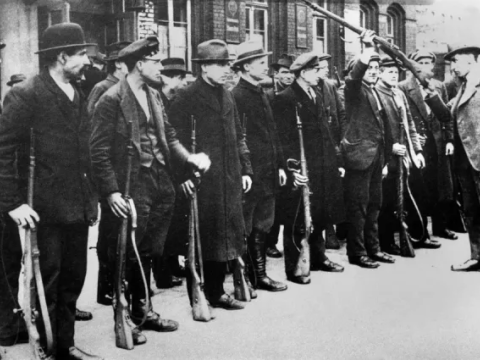
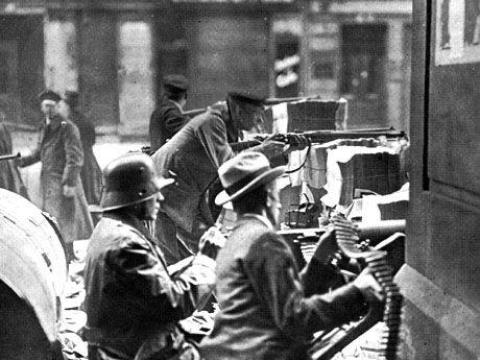


Comments