1: The causes of the parties formation and the period of revolutionary action
The Communist Workers' Party of Germany (KAPD) was formed during a period of intense revolutionary struggle. Its history is therefore part of the history of the German Revolution. Its development was influenced by the fact that, when the German proletariat first entered into a state of active revolutionary mass movement, the dictatorship of the bourgeoisie used unprecedented means of martial law, which had already been in force for years due to the war, and the most severe restrictions on speech, the press, and assembly, to make clarifying debate impossible. To make matters worse, and decisively so, the workers' organizations, which, on the basis of their Marxist theory of class struggle, their history, and their fate in the prewar period, were called upon to grasp the revolutionary situation and shape it from within the proletariat, had concluded a truce with the powers of the old state for the sake of the national idea. The inevitable consequence of this was to maintain their own opposition to Ludendorff's war aims in such a way that his conduct of the war was not disrupted, forcing them to adopt an anti-revolutionary stance in all cases and to reject the revolutionary moment as a factor in shaping society and realizing socialism. The resulting legality of their actions, unhindered journalism, and financial management ensured that the party and union leadership had sole control over the magnificent organizational apparatus. This naturally meant that the gradually rebelling masses had to fight not only against the state and its war, but also against the leading authorities of their organizations. The confusion this caused led, and inevitably had to lead, to the failure of the most important task of the awakened proletariat: to clarify the chaotic elements that are and must be present in every revolution and to shape them into conscious action by the class.
These considerations are placed at the beginning of this treatise not in order to polemicize or to make revolutionary moral judgments, but because these connections, just as they were the starting point of the revolution, also characterized its further course and became decisive for the nature of class formation within the proletariat and thus for the particular structure of the individual parties, whose emergence and development cannot be understood without recognition of this initial situation. It was inevitable that the negative element within the opposition would remain dominant for a long time and that its transformation into a positive factor of will would be delayed and postponed – beyond the élan – beyond the beginning, the period of solidarity and sacrifice on the part of the proletariat, the period of complete confusion, despondency, and inability to resist on the part of the bourgeoisie.
Out of this chaotic situation, at the end of December 1918, the Spartacus League broke away from the U(nabhängige) S(ozialdemokratische) P(artei) D(eutschlands) (Independent Social Democratic Party of Germany) and merged with the Gruppe I(nternationale) K(ommunisten) D(eutschlands) (Group of International Communists of Germany) to form the K(ommunistische) P(artei) D(eutschlands) (Communist Party of Germany) (Spartacus League). The leaders KARL LIEBKNECHT and ROSA LUXEMBURG, and soon after LEO JOGISCHES, were killed by the White Guards. Under the circumstances at the time, it was not possible to hold new elections for the central leadership. The central leadership was therefore supplemented by co-optation and was now headed by PAUL LEVI, who, under the influence of KARL RADEK and the Russian emissary BRONSKI, led the party from activity into passivity. At least, this was the view of a gradually growing opposition, which found expression in the party press, especially in the important districts of Berlin, Hamburg, and Saxony. The Central Committee was accused of being a source of distraction and indecision rather than a driving force urging the broad masses to action and thus bringing clarity and focus to these active revolutionary tendencies, and was therefore partly to blame for the fact that the resulting struggles were isolated and fragmented. True to its once-adopted tactic of turning away from revolutionary offensive politics, according to the opposition press and complaints to Moscow, the party leadership wanted to limit itself to those areas in which bourgeois society allowed the working class to operate: in the political arena in the parliaments and in the economic arena in the trade unions. For its part, the opposition considered parliamentary and trade union activity incompatible with revolutionary action.
This gave rise to three points of contention: the restructuring of the party organization; its parliamentary participation; and, alternatively, activity within the trade unions or the creation of new economic struggle organizations. These points of contention then led to the split in the party and the founding of the KAPD. The following report by the KAPD delegation to the Executive Committee of the Third International in June 1921 describes how these contradictions developed:
The founding party conference of the KPD (Spartacus League) had decided by an overwhelming majority not to participate in the elections to the National Assembly, unlike all other parties. After the struggles of spring and summer 1919, a strong movement toward parliamentarianism became apparent in the party leadership (Reich headquarters). The mood among the membership was the opposite. In August 1919, a meeting of functionaries in Greater Berlin passed a resolution to issue an ultimatum to Comrade Klara Zetkin, who was still sitting in the Württemberg state parliament as an "independent," to resign her seat or leave the party. Comrade ZETKIN did not respond, and the party headquarters, to which Comrade ZETKIN herself belonged, reinforced her opposition. In the following period, the central committee then openly declared its support for parliamentarianism without waiting for a change in the party's decision. Indeed, it went further, fighting the local groups and districts that adhered to the party conference decision, sabotaging their agitation by withdrawing financial support, etc.
The development of the opposition to the trade union question took roughly the following course: from the struggles of 1919, the proletarians had learned that trade unions were not only completely useless for leading major struggles and mass actions, but even constituted a serious obstacle to the revolution. Everywhere, they spontaneously proceeded to establish their own proletarian fighting organizations, which were based not on professions but on workplaces, which did not divide the workforce and provoke class antagonisms within it, but united the class of the revolutionary proletariat where it is naturally one, in the workplace. Such B(etriebs)-O(rganisationen) arose spontaneously in the Ruhr region, in the Upper Silesian industrial area, in central Germany, in Berlin, on the waterfront, in short, in all the industrial centers of Germany. When the party leadership of the K.P.D. saw the emergence and growth of this mass movement in the summer of 1919, it initially tried to promote these organizations by all means. Leaders at the time, such as LEVI, LUDWIG, KÖRTING, and FRÖHLICH, issued a general call to establish such B.O.s and to leave the trade unions. With the Reich Central Committee's change of heart on the question of parliamentarianism in late summer 1919, the faction within the party leadership led by PAUL LANGES, which vehemently opposed the B.O. and demanded that communists join and work within the trade unions, gained the upper hand. Now even those members of the central committee who had helped to establish the B.O. themselves became its most vehement opponents. The majority of party members, however, remained loyal to the B.O.s, which were grouped together in the A(llgemeinen-)A(rbeiter-)U(nion) (General Workers' Union). The rift between the party leadership and the large masses of members, mainly in the industrial centers, widened day by day. As a result, a party conference was convened in Heidelberg from October 20 to 24, 1919. There, the Reich headquarters surprised the delegates with the well-known "Heidelberg Principles," which had not been presented to the membership for discussion beforehand and were completely new to the delegates. The 18 delegates who voted against them were excluded from the conference after various maneuvers had secured a majority of votes for the Reich headquarters. The opposition districts did not initially consider forming their own party, but wanted to force a new party conference where all these issues could be voted on again after the membership had taken a position on them. In order not to lose contact with each other, they decided to transfer the function of an opposition information center to the North-West district (Bremen). The following months were filled with internal disputes, with the Reich headquarters taking the harshest measures. For example, it called public meetings in Berlin, Bremen, Hamburg, and other cities against the local party organizations. In February 1920, the Central Committee meeting expelled the districts of Greater Berlin, North, Northwest, and East Saxony from the party and called on the supporters of the headquarters to establish new organizations there. The Greater Berlin district is an example of how few supporters the central committee had in these districts. Around 500 members left this district, which at the time had 8,000 members, and founded a new party organization in line with the Reich central committee.
The expelled districts did not yet want to form a new independent party. Two things prevented them from doing so: the hope that, due to the numerical strength of the opposition, they would still be able to save the unity of the party and the victory of their views. Furthermore, they wanted to wait and see the position of the Third International, from which they ultimately expected to agree to the opposition's theories. This was also because the representatives of the Amsterdam office of the Communist International, comrades HERMAN GORTER and ANTON PANNEKOEK, who were held in high esteem by the Russians, advocated this theory of anti-parliamentarianism and the formation of a union based on workplaces. However, this expectation proved to be deceptive. KARL RADEK, who, from his prison cell ,in addition to conferences with industrialists such as RATHENAU and DEUTSCH and with politicians of all stripes, had also taken the lead in the German revolution and was at least the inspirer of the Reich Central Committee, took the harshest stance against the opposition and also insisted that the Amsterdam office be declared dissolved by telegram.
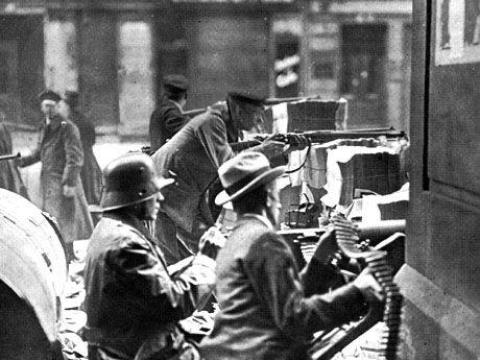
The decisive impetus for the constitution of the opposition as a new party was then provided by the attitude of the Central Committee during the KAPP Putsch, i.e., at the moment of highest readiness for action and sharpest slogans of the opposition, which was thrown into confusion by the Central Committee's leaflet, written by BRONSKI and defended by him in any case: Against the general strike – to arms! However, the next few days revealed the complete isolation of the men at headquarters, so that they disavowed their own leaflet. The Comintern also distanced itself from them energetically.
Events then took their familiar course. The KPD sent two representatives to negotiate the so-called Bielefeld Agreement, which it sanctioned. The opposition sought by all means to generate the most active resistance to this agreement among the masses, arguing that neither the military nor the rescued old government would keep the concessions made to the workers in the agreement and that the other side merely wanted to disarm the workers, and that the other side merely wanted to achieve the disarmament of the workers.
We will now follow the above-quoted report in our account of the founding of the KAPD and the events that followed.
The Kapp Putsch had shown that the behavior of the official party leadership was tantamount to abandoning the revolutionary struggle and sliding into opportunism. It had shown that two different parties had in fact formed, whose reunification was as impossible as the union of fire and water. The Berlin organization therefore convened a party conference of the opposition on April 3, 1920, at which it was decided to constitute itself as the “Communist Workers' Party of Germany.” Approximately 80,000 members of the former KPD were represented, although some districts did not join us until after the party conference. The tasks and activities of the new party were clearly defined. Rejecting parliamentary legal activity, it had to exploit every domestic and foreign policy situation to rekindle the active struggle against the bourgeois state, and above all to prevent this state from regaining strength, so that in the extremely confused, politically and economically unstable, undermined situation, the proletariat remained prepared to take power.
An example of the KAPD's activities in this direction is its behavior during the Russian-Polish War in the summer of 1920. The KAPD called on the workers to refuse to work in the munitions factories and to sabotage the munitions deliveries that were rolling into Poland. The KPD dismissed this as revolutionary romanticism until, following an appeal by the Moscow Executive Committee, it took up the same slogans. The KAPD called on the proletariat to take the most active measures, to elect revolutionary action committees and political workers' councils, to unite with their Russian brothers as the Red Army approached East Prussia, and to form a united front between Soviet Russia and Soviet Germany. We wanted to bring about an uprising, while the K.P.D. issued the nonsensical slogan "Neutrality in favor of Russia." From this slogan of absolute passivity, it moved on to one form of activity — not against the bourgeoisie and its state, but against the KAPD, which was in a state of high combat readiness and was propagating and preparing for the uprising. Then, on August 19 and 20, alarmist appeals against the KAPD slogans appeared in the Rote Fahne, the Freiheit, and the provincial newspapers. The workers, many of whom were ready to fight, were confused, and the beginnings of the movement, which could no longer be prevented, were nipped in the bud. This was a typical example of how a movement, not in its structure, but in its result, in its effect, has the effect of a coup, because the attitude of the K.P.D. confuses the workforce. The same thing happened during the March action, which we'll talk about later, which was started by the KPD itself. We then continued to try to expand the economic struggles into political struggles for power. The biggest struggle of this kind was the electricians' strike in Berlin in November 1920, which ultimately failed due to the behavior of the KPD leadership at the very moment when it could have been expanded into a general strike.
The two communist parties then collaborated during the struggles in central Germany around Easter 1921, in the so-called "March Action."
This movement was triggered by the entry of troops into the industrial area of central Germany to occupy the factories, in particular the Leuna plant. The fighting was led throughout by joint district commissions of the VKPD (it was shortly after the left wing of the U.S.P.D. had joined the K.P.D. at the party conference in Halle) and the KAPD, on whose behalf MAX HÖLZ, a member of the KAPD, took part in the leadership of the fighting.
The outcome of these struggles is well known. In its press and through its representative on the Executive Committee of the Third International, the KAPD pointed out that a major factor in the failure was the fact that the VKPD had not prepared its supporters at all in terms of publicity and organization fora complete reversal of its policy, that a major factor in the failure was the fact that the VKPD, without any publicity or organizational preparation of its supporters, had initiated a complete reversal of its previous tactics, thereby causing confusion among its unprepared members. If one pursues exclusively parliamentary-trade union tactics for months and then switches to revolutionary activity overnight, a central body may be able to make such a rapid change, but not the entire body of functionaries and the broad masses of the membership.
Large masses of workers do not react to an unexpected change of command like a company of soldiers in the old Wilhelmine army. The attitude of the KPD headquarters turned the action of the proletariat ,which broke out as a natural consequence of the dialectical interplay of forces in the revolution, into a coup. The policy proclaimed by the Third International, above all to bring larger masses into the affiliated parties, which would then be revolutionized by the party, had always been opposed by the KAPD as a non-Marxist misunderstanding of the laws of mass psychology, according to which the structure of the class and the development of proletarian ideology into class consciousness are shaped.
At the time, the leadership of the KPD excused this failure on the grounds that there had been too little time to revolutionize the masses who had come over from the USP. Subsequent events have shown that the process is proceeding in exactly the opposite direction to that imagined by the advocates of this mass theory: the bulk of the broad masses, who out of sympathy with Soviet Russia, but without a clear and hard-nosed understanding of the necessities of revolutionary class struggle politics, constituted the main component of the VKPD and prevailed in the party's overall stance. It was not the masses who were revolutionized, but the masses who de-revolutionized the party. This result was repeated in the struggle within the trade unions.
The March action had been the last attempt to trigger the latent elements of class struggle on a broad basis in the struggle for power. These attempts failed for two reasons: the fundamental resistance of the Social Democrats and the trade unions to an active revolutionary approach to class struggle; and then on the behavior of the KPD, which, revolutionary in its program, wanted to replace the dictatorship of the class with a dictatorship of leaders, whereby this leadership constantly changed its mind on the most diverse and contradictory conceptions of revolutionary politics, and through this behavior, which confused the workers, prevented the development of class consciousness among the broad masses.
2: Internal power struggles: Theses on the role of the Party and Proletarian Revolution
It has already been pointed out at the outset how this party arose from the opposition of members of the KPD to the central leadership. As a result, all groups opposed to the ruling central leadership initially flocked to the new party, without this opposition already being a homogeneous mass with uniform views and goals in a positive sense. The struggle against the old party was accompanied by an internal clarification process, which was conducted primarily against two directions: against the National Bolshevik program of the Hamburg opposition (Fritz WOLFFHEIM and Heinrich LAUFENBERG) and against the supporters of the so-called unitary organization and party deniers (Otto RÜHLE-Dresden).
WOLFFHEIM and LAUFENBERG advocated a program of revolutionary truce between the bourgeoisie and the proletariat, a general popular uprising against Entente imperialism, and condemned the Spartacus League's call for desertion during the last months of the war as treason.
Shortly after the party was founded, the Northern District Conference addressed the party membership in a leaflet dated May 1, 1920, with an open appeal in line with this theory, signed by W. and L. The party immediately took a stand. The party conference in Berlin-Weißensee in August 1920 spoke out sharply against the National Bolshevik group; the district was expelled and rebuilt over time. WOLFFHEIM and LAUFENBERG soon lost all contact with the proletariat and, together with officers and landowners, founded a “Society for the Study of German Communism.” The resulting Denksportring e.V. Sitz Hamburg (Mind Sports Club, Headquarters Hamburg) continued to exist until the summer of 1927.
While the National Bolsheviks were a small group that actually consisted only of the close followers of the aforementioned propagandists and had no significance beyond the local level, the conflict with the "Unitarists" led by RÜHLE encountered a tendency that was widespread throughout the proletariat, namely a distinctly anarchist-syndicalist tendency which, interspersed with petty-bourgeois individualist ideology, rejected the party as an organ of the proletariat altogether and propagated only the unionization of economic organizations, the unions, on a federalist basis of complete autonomy for the individual districts. The struggle was essentially fought within the A(llgemeine) A(rbeiter-)U(nion) (General Workers'Union), from which a special group split off as the A.A.U.E. (Unity Group). These supporters of the "unity movement," who felt an affinity for the ideas of the American I.W.W. and its principle of "One big Union," left the party. The KAPD had recognized that there were many good and reliable revolutionaries in these ranks, who had often fallen into the extreme of rejecting the party altogether, simply because they were disappointed by the failure of the large parties based on the Führer principle. In doing so, however, they were anticipating a state of affairs during the preparatory period of the revolution that could only be realized with the classless society. The KAPD's position on the question of the party was summarized in the “These on the Role of the Party in the Proletarian Revolution” in July 1921. Because of the fundamental importance of this question, the main points are reproduced in excerpts as follows:
1. It is the historical task of the proletarian revolution to bring the disposal of the wealth of the earth into the hands of the working masses, to put an end to the private ownership of the means of production, thus rendering impossible the existence of a separate, exploiting, ruling class. This task involves freeing the economy of society from all fetters of political power and is, of course, posed on a world scale.
2. The ending of the capitalist mode of production, the taking over of this production, and putting it in the hands of the working class, the ending of all class divisions and withering of political institutions, and building of a communist society is a historical process whose individual moments cannot be exactly predicted. But, as regards this question, the role which political violence will play in this process is nevertheless settled on some points.
3. The proletarian revolution is at the same time a political and economic process. Neither as a political, nor as an economic process can it be solved on a national scale; the building of the world commune is absolutely necessary for its survival. Therefore it follows that until the final destruction of the power of capital on a world scale, the victorious part of the revolutionary proletariat still needs political violence to defend, and if possible attack, the political violence of the counter-revolution.
4. In addition to these reasons which make political violence necessary for the victorious part of the proletariat, there are additional reasons relating to the internal development of the revolution. The revolution - looked on as a political process — has indeed a decisive moment, the taking of political power. The revolution, viewed as an economic process, has no such decisive moment, long work will be necessary to take over the direction of the economy on the part of the proletariat, to eradicate the profit motive, and to replace it by an economy of needs. It is self-evident that during this period the bourgeoisie will not remain idle, but will try to regain power for the purpose of defending their profits. It follows that in the countries with a developed democratic ideology - that is, in the advanced industrial countries - they will seek to mislead the proletariat with democratic slogans. It is thus essential that the workers wield a strong, unwavering political violence till they have taken over, in concrete terms, the control of the economy and broken the grip of the bourgeoisie. This period is the dictatorship of the proletariat.
5. The necessity for the proletariat to hold political power after the political victory of the revolution confirms, as a consequence, the necessity for a political organisation of the proletariat just as much after as before the seizure of power.
6. The political workers’ councils (Soviets) are the historically determined, all-embracing form of proletarian power and administration: at all times they pass the individual points of the class struggle and pose the question of complete power.
7. The historically determined form of organisation which groups together the most conscious and prepared proletarian fighters is the Party. Since the historical task of the proletarian revolution is communism, this party, in its programme and in its ideology, can only be a communist party. The communist party must have a thoroughly worked out programmatic basis and must be organised and disciplined in its entirety from below, as a unified will. It must be the head and weapon of the revolution.
8. The main task of the communist party, just as much before as after the seizure of power, is, in the confusion and fluctuations of the proletarian revolution, to be the one clear and unflinching compass towards communism. The communist party must show the masses the way in all situations, not only in words but also in deeds. In all the issues of the political struggle before the seizure of power, it must bring out in the clearest way the difference between reforms and revolution, must brand every deviation to reformism as a betrayal of the revolution, and of the working class, and as giving new lease of life to the old system of profit. Just as there can be no community of interest between exploiter and exploited, so can there be no unity between reform and revolution. Social democratic reformism — whatever mask it might choose to wear — is today the greatest obstacle to the revolution, and the last hope of the ruling class.
9. The communist party must, therefore, unflinchingly oppose every manifestation of reformism and opportunism with equal determination in its programme, its press, its tactics and activities. Especially it should never allow its membership to expand faster than is made possible by the power of absorption of the solid communist nucleus.
10. Not only in its entirety, but in its individual moments, the revolution is a dialectical process; in the course of the revolution the masses make inevitable vacillations. The communist party, as the organisation of the most conscious elements, must itself strive not to succumb to these vacillations, but to put them right. Through the clarity and the principled nature of their slogans, their unity of words and deeds, their position at the head of the struggle, the correctness of their predictions, they must help the proletariat to quickly and completely overcome each vacillation. Through its entire activity the communist party must develop the class consciousness of the proletariat, even at the cost of being momentarily apparently in opposition to the masses. Only thus will the party, in the course of the revolutionary struggle, win the trust of the masses, and accomplish a revolutionary education of the widest numbers.
11. The communist party naturally must not lose contact with the masses. This means, aside from the obvious duty of indefatigable propaganda, that it must also intervene in the movement of the workers caused by economic needs and attempt to spiritually clarify such movements and develop them, by encouraging appeals for active solidarity so that the struggles are extended and take on revolutionary and, where possible, political forms. But the communist party cannot strengthen the spirit of opportunism by raising partial reformist demands in the name of the party.
12. The most important practical performance of the communists in the economic struggle of the workers lies in the organisation of those means of struggle which, in the revolutionary epoch in all the highly developed countries, are the only weapons suitable for such struggle. This means that the communists must therefore seek to unite the revolutionary workers (not only the members of the communist party) to come together in the factories, and to build up the factory organisations (Betriebsorganizationen) which will unite into Unions and which will prepare for the taking over of production by the working class.
13. The revolutionary factory organisations (Unions) are the soil from which action committees will emerge in the struggle, the framework for partial economic demands and for the workers fighting for themselves. They are forerunners and foundation of the revolutionary workers’ councils.
14. In creating these wide class organisations of the revolutionary proletariat, the communists prove the strength of a programmatically rounded and unified body. And in the Unions they give an example of communist theory in practice, seeking the victory of the proletarian revolution and subsequently the achievement of a communist society.
15. The role of the party after the political victory of the revolution is dependent on the international situation and on the development of the class consciousness of the proletariat. As long as the dictatorship of the proletariat (the political violence of the victorious working class) is necessary, the communist party must do all it can to push events in a communist direction. To this end, in all the industrialised countries it is absolutely necessary that the widest possible amount of revolutionary workers, under the influence of the spirit of the party, are actively involved in the taking over and transformation of the economy. Being organised in factories and Unions, schooled in individual conflicts, forming committees of action, are the necessary preparations which will be undertaken by the advanced guard of the working class itself and prepare them for the development of the revolutionary struggle.
16. In as much as the Unions, as the class organisation of the proletariat, strengthen themselves after the victory of the revolution and become capable of consolidating the economic foundations of the dictatorship in the form of the system of councils, they will increase in importance in relation to the party. Later on, in as much as the dictatorship of the proletariat is assured thanks to being rooted in the consciousness of the broad masses, the party loses its importance against the workers’ councils. Finally, to the extent that the safeguarding of the revolution by political violence becomes unnecessary, in as much as the masses finally change their dictatorship into a communist society, the party ceases to exist.
All these ideological battles, which were fought with great intensity in keeping with the spirit of the times, had been settled by the end of 1920 and had led to a coherent political line. Only the battle of opinions on the question of the position towards Soviet Russia and the Third International flared up again with great intensity.
3: The KAPD and the Third International. Parliamentarism and the trade union question.
On the day it was founded, the party had decided to join the Comintern, fully aware of the differences that separated it from the opinion of the Comintern representatives sent to Germany and the executive informed by them on the essential questions of the revolutionary class struggle. But there was still faith in the possibility of influence. The proletariat saw Soviet Russia as the vanguard of the world revolution, which it was necessary to support in solidarity, and from which the impetus for the breakthrough of the revolution among the masses of the Western European industrial proletariat was expected. For the KAPD, the struggle for the Third International began, which was only replaced by the struggle against the Third International after its complete failure and after Russia's rapid development from revolution to an understanding with the international bourgeoisie, which was inevitable for reasons of state policy.
Shortly after its first party conference, the party sent JUNG and APPEL to Moscow, accepting the invitation of the Executive Committee, which had proposed a discussion in Moscow. However, the outcome was entirely negative, as the expert on German affairs was KARL RADEK. This naturally made it impossible to arrive at a truly clarifying debate. The leitmotif of Soviet Russia — above all, to connect with the large masses of workers, which was very obvious in the interests of Russia's desperate struggle for self-preservation – was found by the KAPD at that time to be understandable for Russia, but for the struggle of the Western European proletariat, it seemed to them that the first demand that a communist party must make was the principle of unambiguous clarity, unconditional rejection of any growth in membership aimed at broad expansion, whose members still lacked an understanding of the special conditions of the revolution because they were caught up in the pre-revolutionary forms of parliamentarianism and trade union organization. On the other hand, Russia attached importance to establishing contact as quickly as possible with the large working class, with the large organizations that already existed and their members, who, even if they did not agree with the program, were nevertheless emotionally strong enough to influence their own government in a pro-Russian direction as a political factor, or at least to paralyze tendencies directed against Soviet Russia.
The KAPD understood this attitude from the standpoint of the will to maintain power. In contrast, she took the view that this had nothing to do with the nature of the proletarian revolution in Western Europe, that the Bolsheviks sought to eliminate the revolutionary "experiment" against the practice of their own past. They themselves fought a battle in 1917 and a tactic that could certainly be called one of the greatest experiments in history. However, the conquest of power means a phased struggle between victories and defeats in the sense of dialectical events. Only then can the proletariat emerge from these struggles to develop self-confidence if it is led by a party that rejects any compromise and in the struggle - even if it leads to defeat - represents the advanced part of the proletariat.
After a few weeks the delegation returned with a series of exhortations to revise the party's views on parliamentarism and the trade union question, now with the K.P.D. to organize a provisional communication office and to send delegates to the upcoming Second Congress in July 1920.
Despite a widely circulated open letter to the members of the KAPD, Moscow's negative attitude had no influence on membership other than sticking to what has been recognized - even against the majority of the sections of the Comintern. RÜHLE (who was still in the party at the time) and MERGES, who were delegated to Moscow for the Second Congress, left in the first few days without even attempting to represent the KAPD's position before the general public of the assembled foreign comrades. The Second Congress culminated in the well-known 21 theses, in which the KAPD only saw a strengthening of a reformist development. She was asked to declare by the next assembly whether she would accept these conditions of admission.
At the subsequent party conference in Gotha, the KAPD their accession as a "sympathizing" party – against a minority, led by PFEMFERT and BROH, who were already calling for negotiations with the Executive Committee to be broken off. However, the party wanted to make another attempt to assert its views in Moscow and among the other parties of the 3rd International and sent a new delegation, consisting of GORTER, RASCH and SCHRÖDER, to Moscow to communicate this decision. The extensive debates in this context in Moscow and Leningrad were reflected in GORTER's book: “Open Letter to Comrade Lenin”, a response to LENIN's brochure: “Left wing communism: an infantile disorder”; in ANTON PANNEKOEK's brochure: “World Revolution and Communist Tactics” and in numerous essays in the party press, resolutions of the district organizations, all of which unanimously supported the KAPD program: Get rid of parliamentarism! Destruction of the unions! Building the workplace organizations!
On the question of participation in parliaments:
The power that the bourgeoisie still possesses in the current period is the intellectual dependence and lack of independence of the proletariat. The development of the revolution is the process of the proletariat's self-liberation from this dependence, from the tradition of past times – which is only possible through its own experience of struggle… Parliamentarianism is the typical form of struggle by means of leaders, with the masses themselves playing a subordinate role. Its practice consists in deputies, individual persons, waging the essential struggle; this must therefore create the illusion among the masses that others can wage the struggle for them... Parliamentarianism has the inevitable tendency to inhibit the masses' own activity, which is necessary for revolution... The revolution requires that the big questions of social reconstruction be tackled, that difficult decisions be made,that the entire proletariat be set in creative motion... As long as the working class believes it can take an easier path by letting others act on its behalf, agitate from a high platform, make decisions, give signals for action, and make laws, it will hesitate and remain passive due to old habits of thinking and old weaknesses.
On the trade union question:
Trade unions emerged at the time of rising capitalism and fulfilled their original purpose as organs for fighting for better wages and working conditions within the capitalist system. Their ultimate propaganda goal was probably the transformation of capitalism into socialism, but their actual activity consisted entirely of reformist efforts to combat the damage and excesses of the capitalist system. In line with this activity, the unions increasingly took on a purely capitalist character in their organizational form. A leading bureaucracy emerged that had all the means of power at its disposal without itself having any roots in the production process. Tied for better or worse to the existence of the organization, they were necessarily doomed to become victims of the system, forced to avoid serious upheavals, to oppose the intensifying class struggle with their own selfish, privately-oriented desires, and to serve compromise and concealment.
Trade union membership is structured according to occupational groups. This only made sense,i.e., a class struggle meaning, only at a time when capitalism was mostly limited to small and medium-sized businesses with a specific occupational activity. However, occupational classification lost its justification to the extent that modern big capitalism, in giant corporations, in vertical and horizontal trusts across entire countries, drew workers of all categories, ages, and genders into its technical apparatus and exploited them as accessories within a production framework.
The A.A.U and workplace organization:
A.A.U. is the first cornerstone for the formation of the council organization. It must therefore be based on the companies as the cells of production. In the factories the proletariat stands as a class, one next to the other as class mates. Here the masses are the driving force behind the transformation and reformation of society. Here the spiritual struggle, the revolutionization of consciousness, can go in an inexhaustible stream from man to man, directed solely at class interests, not at capitalist club preoccupation; the professional interest is narrowed down to the extent that suits him.
The operational organization is the basic cell of the Union; the union is the organic unity of these cells... The individual company organizations, to which the unemployed belong as a special type of company, initially unite according to geographical economic districts; these economic districts correspond, if possible, to certain economically coherent complexes.
As a result of the above-mentioned negotiations in the fall of 1920, the KAPD was granted a permanent seat on the Executive Committee of the Comintern. The party also sent its delegates. But no practical success was achieved. ZINONIEV, BUCHARIN, Radek, and others agreed with many of thevKAPD's points and criticisms of the KPD leaders' stance. However, precisely because these criticisms were justified, they repeatedly demanded that KAPD members join the KPD and, above all, became active in parliaments and trade unions. They maintained that only the participation of true revolutionaries was necessary to achieve revolutionary effects even in these counterrevolutionary organizations. The opposite position, that a principled counterrevolutionary, historically obsolete form of organization in the current state of class struggle development cannot be revolutionized, but rather, in the best case scenario, inevitably absorbs revolutionary forces uselessly, and in most cases, however, de-revolutionizes them as a result of the gravity of its own sociologically effective laws, this view, which the KAPD believed it could prove from daily practice, was disputed.
The benefit of this closer contact with the Moscow circles, which lasted about six months in total, was merely the opportunity to gain deeper insights into the structure of Russian reconstruction work, the mentality of the leading class, and the connections to the most diverse proletarian classes. This was because the delegates were granted unrestricted freedom of movement.
The passionate interest shown by Russian proletarians in the events in Germany at the large workers'meetings made a deep impression, all the more so because the heated debates clearly revealed the contradictions between the well-known leaders of the KPD on the question of the March action. The conflict, which had also led to fundamental differences of opinion between the moderate wing led by Klara ZETKIN and the radical wing led by REUTER-FRIESLAND as a result of PAUL LEVI's pamphlet against the parties, had confused the Russian proletarians. In a personal conversation with LENIN, it emerged that although he strongly condemned LEVI's approach, he agreed with his objective assessment of the March policy.
Contact with the non-Russian members of the Executive Committee often revealed that many sections of the Comintern had joined the Third International out of sincere proletarian enthusiasm, without this enthusiasm being based on a clearly thought-out Marxist understanding. This was particularly noticeable among the delegates from the British party.
In the summer of 1921, the Third Congress took place, at which the representatives of the KAP, Bergmann, Hempel, Sach, and Seemann, were once again able to present their party's position in the discussions, as far as this was possible given the limited speaking time and the rejection of their request to be assigned a presentation or co-presentation.
Apart from these discussions on its own behalf, the KAP delegation was the only foreign delegation to support the workers' opposition within the R.K.P. in the debate on the question of Russian policy (speaker LENIN).
At the end of the KAPD congress. imposed obligation to align with the K.P.D., the KAPD rejected the idea of merging and submitting to the 21 theses. Since the delegation was not allowed to make a final statement in a public meeting, the following statement was read out and recorded in the final meeting of the Executive Committee:
The KAPD delegation has submitted the results of the Congress to a new examination, both as regards the decision which it must announce in response to the motion of the Congress which demands, in the form of an ultimatum, the dissolution of the KAPD into the VKPD, as well as in respect to our relations with the Third International. Fully acknowledging the gravity of the responsibilities it assumes, the delegation unanimously draws the following conclusions:
The tactical struggle against the KAPD throughout the Congress was from the beginning carried out like a fight against an adversary whose arguments must not be taken into consideration, insofar as its basis, and its very existence as a political factor, must be annihilated on the pretext of discipline.
This is confirmed by the following facts:
1. For several weeks, the Congress participants have been given a completely false image of the KAPD, through articles which misrepresent our party in the Russian press, in The Communist International and in the Congress newspaper. Meanwhile, our in-depth reports and our rectifications have not been printed.
2. The way the Congress was structured constantly obliged us to fragment the expression of our positions. That this tactic had been pre-arranged becomes especially clear due to the fact that we were not even granted the opportunity to prepare a report or even a supplementary report on an issue which directly concerns us, the issue of the KAPD. We were thus obliged to refuse to speak at all so as to not become accomplices in a farce.
3. The basis for the ultimatum directed against us was an alleged EC resolution brought to the attention of the Congress participants despite the fact that the EC never addressed the matter in any of its sessions, and despite the fact that none of its sessions ever heard, and therefore had all the less opportunity to have arrived at, any decision on this problem.
4. This question, which had for a whole week remained one of the last points on the Congress’s agenda, as an issue which was to be treated separately, was never even separately discussed with us in preparation for the EC report. (Point Number Two of the day’s agenda). It was arranged by “decree.” In this manner, the result which was expected in advance was achieved: the Congress’s judgment was settled in advance, before it could have dared to become aware of our positions during the course of a debate on questions of principle.
This formal procedure is strictly connected to the political orientation along which the Third International has been evolving, under the determinant influence of the Russian comrades. The outcome of the Congress has proven this: the political line of Paul Levi has been victorious in the Congress; the formal recognition of the March Action has been revealed as the freedom of revolution.
The Czechoslovakian party was admitted as a section with full rights, without any real guarantees at all and on the basis of empty promises. Out of fear, its opportunist leader Šmeral was treated with great tact. As for the Italian Socialist Party, which has just signed a pact with the fascists, it was treated with the utmost indulgence amidst a welter of concern for details. The principle of participating in bourgeois parliaments was preserved, despite the sorrowful experiences of Germany, Austria, France, etc., and even though the caricatures of the supposed revolutionary parliamentarism were seen in action. Reaffirming the disastrous policy of working in the old trade unions has led those who have followed it, despite all their phraseology, towards Amsterdam; the capitalist ploy of economic parliamentarism was also preserved. The Congress has even supported, without a single word of demurral, the ridiculous idea of revolutionizing the consumer cooperatives.
All of this is testimony to continued adherence to the path laid out by the Second Congress, and to the same detour: from revolution to reformism; from the sphere of struggle to the tactics of diplomacy, to intrigues and the illusory whitewashing of contradictions. All of these examples justify the protest (against the adoption of the theses on tactics) which we have published in the summary reports.
These are the facts which must be taken into account (in considering the resolution demanding our dissolution into the VKPD) in order to conclude that the ultimatum is totally unacceptable to the KAPD. Such a reunification would mean our subordination to the discipline of a party in decomposition, in which reformism has snuck in the back door under the influence of the Congress. We would be muzzled by an organizational apparatus (press-finances-cliques-leaders) which is set up against us. Any faint hope of having a salutary influence within such a party lacks the least basis in reality. The delegation has dispensed with all such hopes on its own accord, even without a special order from the party:
The delegation unanimously rejects the ultimatum to join the VKPD.
We do not declare the KAPD’s break with the Third International, although we do have the power to act in the name of our party. Our comrades will address this matter. They will provide their response to the attempt to force them to join with others on the road of reformism and opportunism. The international proletariat will await their response.
Our decision was made in the full awareness of its very serious nature. We are fully aware of our responsibility to the German workers, to soviet Russia, and to the world revolution. The revolution will not allow itself to be shackled by a Congress resolution. The revolution lives. It will continue on its path. We go with it; at its service, we follow our road.
Signed,
The KAPD Delegation
The response of the membership came immediately after the publications on the course of the congress: the party declared its withdrawal from the Third International on the basis of almost unanimous decisions by the individual economic districts.
Together with opposition groups from the Dutch and Bulgarian parties, which also broke away from their Comintern sections, the Communist Workers' International was founded in April 1922. It essentially consists of an organizational office tasked with bringing about the international union of like-minded parties.
The present work is limited to the period of the proletariat's struggle for power, which has already become history. Therefore, the further development of the party will only be briefly outlined.
Due to the decline of the revolutionary wave and the large gaps that the rule of bourgeois class justice has torn in the ranks of the membership, their numbers have declined considerably. The party now considers it its task to continue to expand its knowledge of the character and organizational necessities of the revolutionary class struggle even in times of decline and to propagate it among the proletariat, in accordance with its view that even in a new wave of revolution and strengthened class consciousness, the proletariat can only triumph by resolutely turning away from the pre-revolutionary forms of proletarian representation of interests.






Comments