
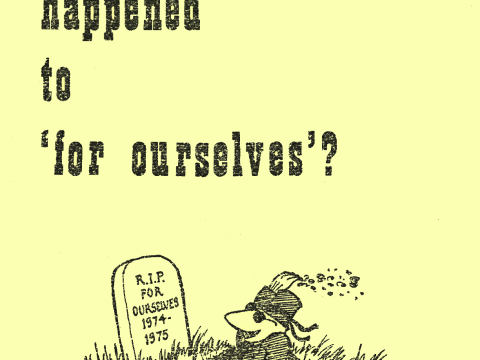
A comic strip about the occupation of a workplace published in August 1973 by people associated with the post-Situationist group For Ourselves in California.

The PDF and the introduction below are taken from the Lust For Life site. (This site includes a huge amount of material, much of it worthwhile. However it is worth noting that the site's list of contents commences with several documents about the Rothschilds and includes nonsense such as "COVID-1984 as the Great [Rothschildian] Reset", alongside a typically wearying roll call of enduring conspiracy theory topics.)
Introduction
Already in the early 1970s, when the intervention involving the subject comic book took place, the ruling class war on the working/middle class — with lots of ideological cover, religious, "conservative"-political, etc. — was well underway, often without that middle/working class realizing thet they were being targeted for dis-empowerment and impoverishment.
One manifestation of this war was the "runaway shop" phenomenon.
All over the rust belt, and throughout the U.S., corporations were shutting down industrial plants, laying off the the workers formally employed in those plants, destroying the workers' unions thereby, with the corporations often also reneging on their pension obligations to those workers, and, thereby, impoverishing or ghost-towning entire cities, while the corporations moved their industrial plant assets to "Third World" countires, where ruling class/CIA created/supported dictatorships prohibited unions, and held down wages, burgeoning the profits of the "runaway shop" corporations.
One of the non-member associates of FOR OURSELVES was employed by a "runaway shop" in the San Francisco Bay Area of Northern California, and enlisted two members of FOR OURSELVES to collaborate, with him, in producing an intervention among the workers of that runaway shop, whose closure was imminent. One of those FOR OURSELVES members had developed consumate skills in realistic illustration, and produced all of the images for the resulting "comic book". This "comic book" also featured new efforts by FOR OURSELVES members to express the fundamental theory of the Marxian critique of capitalism, including of state-capitalism, fascist and Stalinist alike, in language closer to typical English, such as this expression of the Marxian surplus-value theory of the capitalist ruling class's exploitation of the working class:
"What do you mean, they don't owe us anything? Do you think the owners built this plant and all these machines by themselves? Hell No! It was us, and other workers like us! The difference between what they pay us in wages and what they can get for what we produce they keep! And they use it to buy more workers like us and more machines, to keep more of that difference, and so it goes, man! Communist, Sheeeit! They do it to you the same way all over the world — Russia and China too!".
This comic book advocated, to the worker's of this particular runaway shop — somewhat recklessly, considering the sanctions that the ruling class controlled police forces might have visited upon their heads as a consequence — that they occupy the plant, and hold its assets hostage so as to extract severance package and pension benefits from its owners. The non-member associate of FOR OURSELVES who had originally catalyzed this intervention distributed the "comic book" among his co-workers, and those co-workers chose not to implement the occupation that the "comic book" advocated.
They did so, probably, in many cases, out of fear, and out of habitual subservience, but also, in many cases, out of a sober assessment of the relationship of their potential forces to those of the repressive state that such an action would have brought down upon them, and out of a realistic, likely cost-versus-benefits analysis for such an action.
A clear formulation of the constitution, institutions, and socio-political processes of societal self-reproduction of a higher successor social system to that of the present, [state-]capital/wage-labor social relation of social reproduction, is prerequisite to any successful movement for trans-capitalist social revolution today, and such a formulation was missing from this intervention. Advocating that workers sacrifice themselves in "romantic", "beautiful loser" forays into illegal actions easily repressed by the capitalist state is as ethically untenable as it is practically untenable: it is, as it should be, a non-starter for a movement for trans-capitalist revolutionary social change.
Attachments
TakeCareOfBusiness_RunawayShopComics.pdf
(2.71 MB)




Comments