
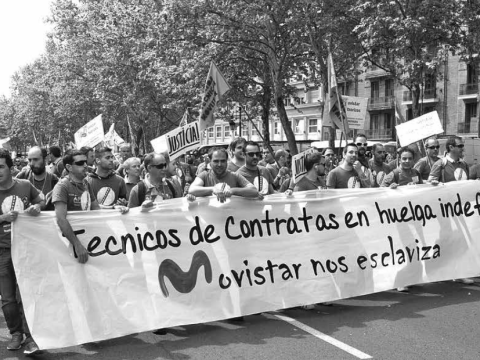
An article from CGT Catalunya of a strike at Spanish telecomunications giant Telefónica Movistar. Appeared in the Industrial Worker (July/August 2015).

(Editor's note: This article discusses the strike of subcontracted and freelance technicians working for telecommunications giant Telefónica’s Movistar, which began in Madrid on March 28. For background on this strike, see “#ResistenciaMovistar: A Strike Of This Century In Spain” on page 1 of the June Industrial Worker).
“We must favor understanding and collaboration. Not only workers are involved in this conflict. Also, there are collectives interested in creating tension and making it difficult to reach a solution.” – Felip Puig, Counselor for Enterprise and Employment of the Generalitat de Catalunya
The Movistar strike is interesting in many ways. We could look at the joint action of thousands of freelancers and subcontracted workers, the surprising organization in the beginning (based, literally, on thousands of isolated individuals acting together through smartphone messaging systems in order to make information flow instantly) or the fact that the major institutional unions were overwhelmed by the workers.
We could also talk about the company’s many complaints about sabotage or about the thousands of breakdowns that accumulated over time, causing many problems to clients and businesses.
However, we prefer to focus on the concept of “total strike” as opposed to other strikes that are only labor strikes and are closed in on themselves; strikes that don’t go out of the limits of the company, like the eight-month strike at Panrico; strikes with determination but with the handbrake on.
Everyone has witnessed how this is an active strike with a growing presence of workers in the street. Social support has been extending progressively, adding pressure along with the strike itself, which culminated in the last 10 days of May. Paradoxically, when the strike’s following was at its lowest, the company was under the most pressure.
Other territories have looked at what was happening in Catalonia with healthy jealousy at first, then as a spearhead for their own aspirations.
Why has the strike been stronger in Catalonia?
We’ll overlook the cohesion and internal organization of the strike. One thing we could point out is the intelligent use of existing resources in order to deal with the predictable attrition. Sparse objectives were set aside in favor of specific targets where we could hit harder.
However, what made this strike different in Catalonia was the socialization of the conflict. If we look back to strikes that we can remember, they’ll probably have one thing in common: the participation of the common people.
Complying with our own agreements in the Confederación General del Trabajo (CGT), on the first day of the strike we initiated contact with social movements along with strikers. A few days after, a large number of organizations were present at the union’s premises and agreed on the relevance of this strike and the need to join efforts.
Solidarity fundraising events multiplied, up to tens in a week. Money was never enough, but it allowed workers to keep the struggle up without resources. A credit line of €120,000 (or approximately $135,187 [USD]) was set up by Coop57, a credit co-op, in order to advance what would be collected afterwards.
Conferences about the conflict fulfilled the goal of making the strike better known by the general population, promoting awareness and thus preparing the people for participation. Movistar has tried to make the strike invisible through a powerful campaign, which involved the “free press” in the hands of capitalists. This front has been attacked by local events and coordinated work in the social media.
The first demonstration took place on April 20 in Barcelona. After that, almost every action that took place in the streets had some reference to the Movistar conflict. There have been many coordinated occupations and demonstrations in Movistar shops in many locations. These actions have grown in frequency. In the last two weeks, the company knew an action of this kind could take place in any city at any moment. Attacks came from all possible flanks.
Occupations at the Mobile World Centre
Social movements participated in the labor conflict and taught strikers their methods. The first occupation of the Movistar store at Plaza Cataluña (Barcelona) in the Mobile World Centre (MWC), a worldwide mobile technology congress, took place thanks to coordination by strikers and people in solidarity with them. A milestone was achieved since, for the first time, the company showed signs of weakness. An agreement was reached that the occupiers would leave the store and the company committed itself to negotiating with the strikers. Unfortunately it was a trick, since once the strikers left the store, the company returned to its previous inflexible position. This deceit angered protesters and encouraged solidarity.
The fact that some political parties have shown support for this strike since the middle of May is a symptom of the social relevance it has achieved.
Following the motto “one eviction, another occupation,” strikers and those in solidarity with them did what seemed impossible: despite the security measures, which had been reinforced due to the MWC, they occupied the store again in order to hit the company where it hurts. This took place on May 23, the day before the local elections.
The following week witnessed the outbreak of solidarity in the city and the rest of Catalonia. It seemed like a labor 15M (a protest movement similar to the Occupy movement in the United States) had begun: there were actions every day; there was a constant movement of people acting in solidarity; there were many organizations supporting the strike; there were occupations; and there were demonstrations taking place in Movistar stores all over the territory. It became impossible for mass media to hide these facts. Economic losses reached €75,000 ($84,510 [USD]) each day in the MWC store, added to the invaluable damage done to the image of Movistar.
We must take note of many aspects of this strike: is it possible to unite precarious and atomized collectives in order to fight against powerful machineries specialized in destroying workers’ rights? Do the big institutional unions always have the key to the conflicts in places where they have a majority of representatives?
These questions were answered clearly at a state-wide level. Now we want to stress what made the struggle more powerful in Catalonia than it was in other territories: making solidarity from society work actively in a labor conflict.
Transcribed by Juan Conatz


Comments